Tag Archives: Maulana Syed Sulaiman Nadvi

Bihar Collective to Release Booklet “Remembering Muslim Makers of Modern Bihar” in Patna on Feb 23

Patna, BIHAR :

Patna :

In an era of unprecedented majoritarian ascendance and anti-Muslim hatred, Bihar Collective, a platform of intellectuals and activists, has brought out a booklet highlighting the contribution of eminent Muslims in making the modern Bihar in the last 200 years.

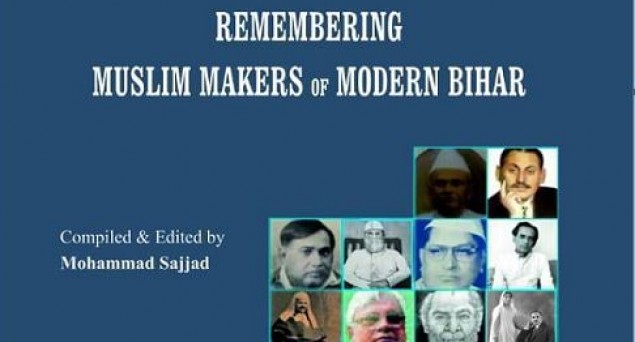
The booklet titled Remembering Muslim Makers of Modern Bihar has been compiled and edited by renowned academician and writer Prof. Mohammad Sajjad on the initiative of Bihar Collective.

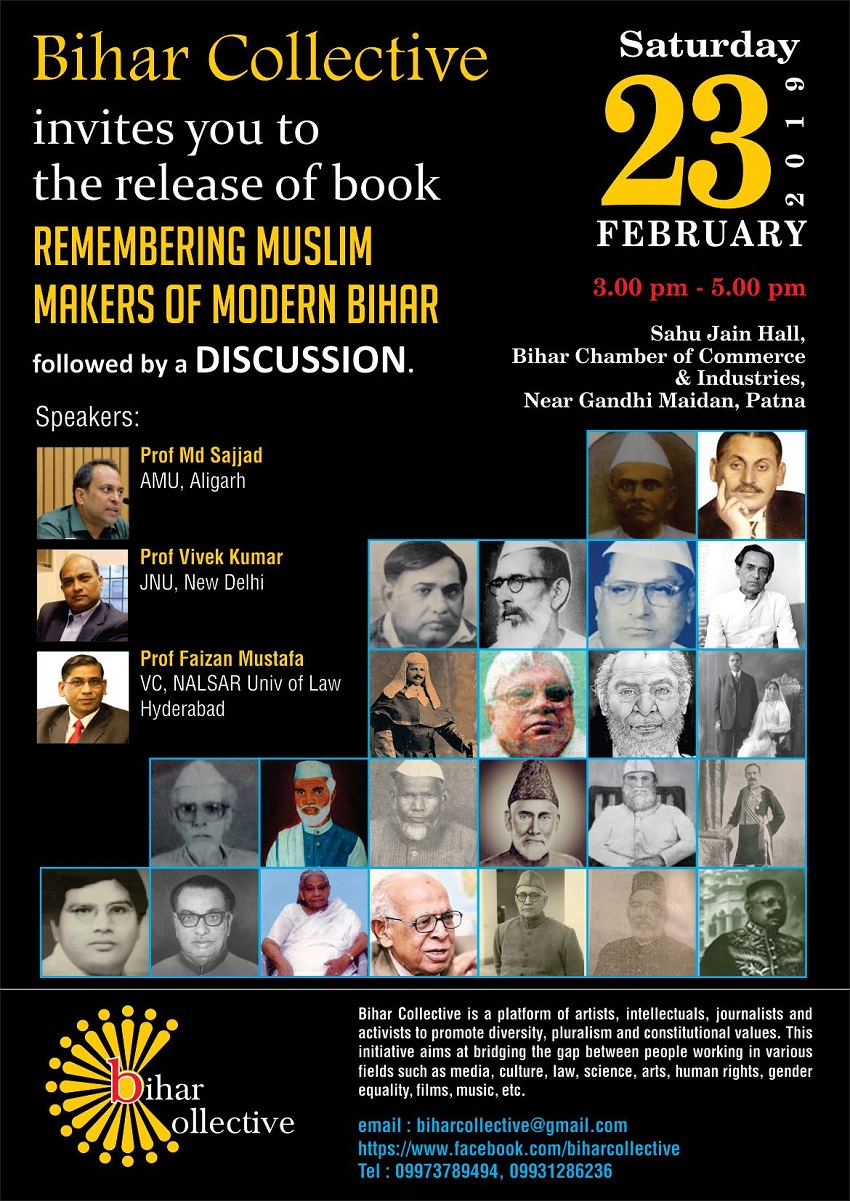
The booklet will be released at an event in Patna on Saturday (February 23).

On the occasion, a discussion will also be held with Prof Faizan Mustafa, Vice Chancellor, NALSAR University of Law, Hyderabad; Prof Vivek Kumar, JNU, New Delhi; and Prof Mohammad Sajjad, AMU, Aligarh as panelists.

A Brief about Booklet:


Pre-empting a reasonable question about the title of the booklet, Prof Sajjad, who has compiled and edited it, writes in its preface: “A simple and obvious question that may readily arise is: why only Muslim makers of modern Bihar? Why not others too? This is indeed a valid and pertinent question.”

Responding to the question, he further says: “Candidly put, this is because of an unprecedentedly menacing rise of majoritarianism, bigotry, and anti-Muslim hatred, with open support of the state.

The Muslim identities are ominously threatened. There are also unabated attempts to dilute (or even take away) whatever little accomplishments have been made by the forces of social justice and secularism.

Only the Muslim segment however is threatened by the jingoist, exclusionary, violent nationalists, to be thrown out to another country. As if the other country is a dustbin, owned by these bigots, into which they can throw away everything they dislike! As if only the religious majority constitutes the nation! Notably, these jingoists had aligned with the British and had stayed away from the national movement.”

“Muslim contributions in the nation-making (and in the freedom movement) remain under-acknowledged, forgotten or even omitted. Erasure of their histories and memories seem to have become even more pronounced and vociferous, now, than ever before…The Bihar Collective therefore decided to compile a short profile of these inspiring role models, history-makers…This is small and humble step towards retrieving and restoring the nationalist provincial pantheons bearing Muslim identities,” says Prof Sajjad.

He, however, admits that the list of Muslim heroes of Bihar given in the booklet is not exhaustive as “…many have been left out essentially because of lack of documentations and researches. Not many have left their own accounts/memoirs; the available memoirs/accounts have not written much about all the personalities. In many cases, even otherwise “resourceful” descendants and/or associates of the history-makers have not been able to provide us with adequate (and credible/verifiable) details.”

Prof Sajjad hopes this small exercise may lead to some big academic work on these history-makers. “In short, this kind of venture may be said to be an ongoing exercise. This effort may hope to open up (and obtain) more details about such history-makers and would also get to know about many more of such peoples and processes, we failed to include here in this hastily prepared tiny volume, amidst constraints of resources and time.”

Names of Muslim Makers of Modern Bihar Mentioned in Booklet:
1. Syed Imdad Ali (d.1886]
2. Khuda Bakhsh (1842-1908)
3. Syed Amir Husain (1843-1910)
4. Imdad Imam Asar (1849-1934)
5. Shah Badruddin(1852-??)
6. Syed Ali Bilgrami (1853-1911)
7. Rasheed-un-Nesa (1855-1926)
8. Syed Noorul Huda (1855-1939)
9. Justice Syed Sharfuddin (1856-1921)
10. Shaikh Gulab (1857-1920)
11. Sarfaraz Husain Khan (1860-1931)
12. Maulana Mazharul Haque (1866-1930)
13. Batakh Miyan Ansari (1867-1957)
14. Sir Fakhruddin (1868-1933)
15. Syed Ali Imam (1869-1932)
16. Syed Hasan Imam (1871-1933)
17. Salahuddin Khuda Bakhsh (1875-1931)
18. Shafi Daudi(1875-1949)
19. Khwaja Md. Noor(1875-??)
20. Abdul Wadood (d.1955)
21. Syed Abul Hasan (1878-1960)
22. Sir Sultan Ahmad (1880-1963)
23. Maulana Sajjad (1880-1940)
24. Pir Mohammad Munis (1882-1949)
25. Abdul Bari (1882-1947)
26. Syed Sulaiman Nadvi (1884-1953)
27. Mohammad Yunus (1884-1952)
28. Shah Md. Zubair (1884-1930)
29. Syed Abdul Aziz (1885-1948)
30. Zubaida Begum Daudi (1886-1972)
31. Syed Tafazzul Karim (1886-1964)
32. Mr. Mohammad Shafi (1888-1955)
33. Qazi Ahmad Husain (1889-1961)
34. Dr. Syed Mahmud (1889-1971)
35. Ali Husain Aasim Bihari (1890-1953)
36. Shah Mohammad Umair (1894-1978)
37. Abdul Ahad Mohammad Noor (1894-1975)
38. Hakeem Md. Kabiruddin (1894-1976)
39. Maulana Usman Ghani (1896-1977)
40. Manzoor Ahsan Aijazi (1897-1969)
41. Shah Md Ozair Muni’mi (1899-1961)
42. Maghfur Aijazi (1900-1966)
43. Syed Jafar Imam (1900-1965)
44. Syed Badruddin Ahmad (1901-1983)
45. Mohammad Tahir (1903-???)
46. Syed Jafar Imam (1903-1979)
47. Syed Fida Husain (1904-80)
48. Abdul Qaiyum Ansari (1905-1974)
49. Wajihuddin Minhaji (1907-1984)
50. Syed Md. Aiyub (1910-1964)
51. Abdul Sami Nadvi (1913-????)
52. Abul Hayat Chand (1914-1958)
53. Ahad Fatmi(1915-1980)
54. Zawwar Husain (1916-80)
55. Shafiqullah Ansari (1917-1980)
56. Shah Mushtaq Ahmad (1917-2002)
57. Abdul Ghafoor (1918-2004)
58. Col. Mahboob Ahmad (1920-1992)
59. Taqi Raheem (1920-1999)
60. Zahra Daudi(1923-2003)
61. Shakoor Ahmad (1924-1981)
62. Syed Hasan (1924-2016)
63. Yunus Lohia (1925-2019)
64. Ghulam Sarwar (1926-2004)
65. Syed Shahabuddin (1935-2017)

A Brief about Author:


Prof Mohammad Sajjad teaches late-colonial and post-independent Indian history at the Centre for Advanced Study in History, Aligarh Muslim University. He has written several books including Muslim Politics in Bihar: Changing Contours; and Contesting Colonialism and Separatism: Muslims of Muzaffarpur since 1857.

His articles are published in reputed academic journals from Routledge, Sage, EPW etc. and also in anthologies from the Oxford University Press and Cambridge University Press.
Bihar Collective:
It is a platform of artists, intellectuals, journalists and activists to promote diversity, pluralism and constitutional values. It aims at bridging the gap between people working in various fields such as media, culture, law, science, arts, human rights, gender equality, films, music, etc.
Email: biharcollective@gmail.com
Facebook: https://www.facebook.com/biharcollective

source: http://www.indiatomorrow.net / India Tomorrow / Home> Society / by India Tomorrow / February 21st, 2019
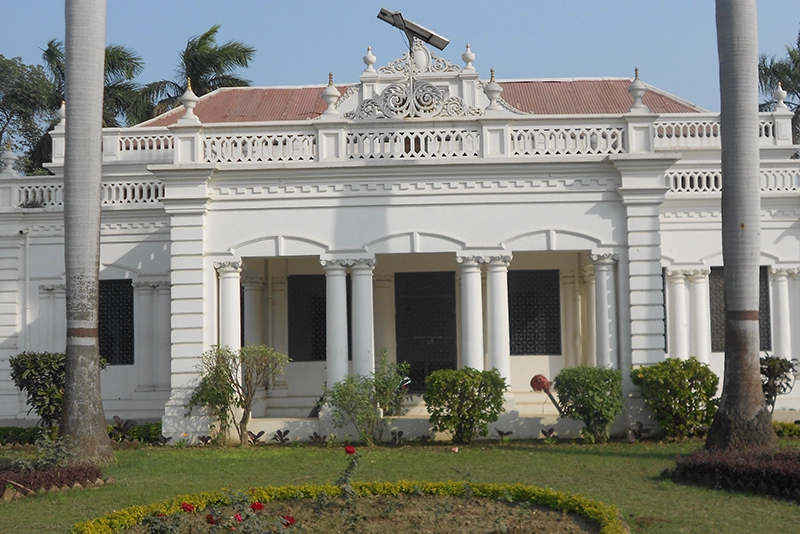
Darul Musannefin – Azamgarh’s Pride

Azamgarh, UTTAR PRADESH :

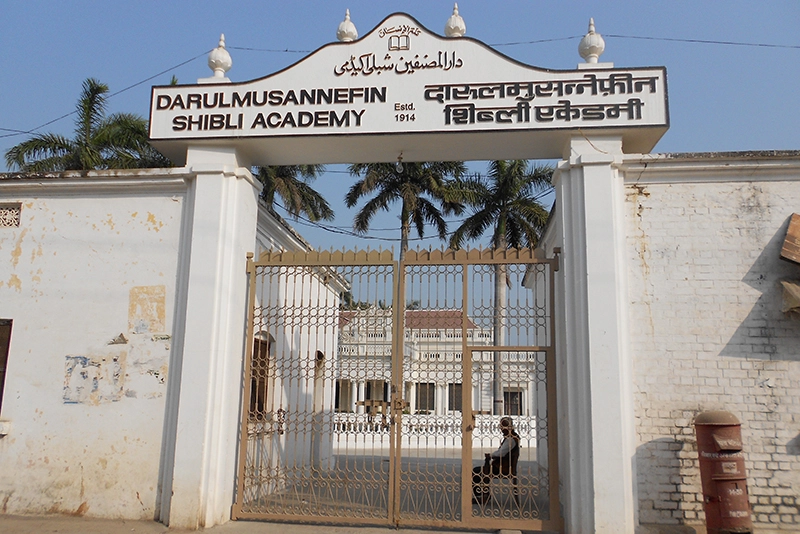
Darul Musannefin, an institute established to propagate the rich cultural heritage of Urdu, Arabic and Persian texts through the institute’s publications and magazine, was established in 1914 by Maulana Shibli Nomani

Darul Musannefin, an institute established to propagate the rich cultural heritage of Urdu, Arabic and Persian texts through the institute’s publications and magazine, was established in 1914 by Maulana Shibli Nomani.

However, over the years like many other institutes associated with the Muslim community in India, this institute has fallen on bad days courtesy the apathy of the governments and the community’s disinterest with anything associated with its cultural and academic heritage.

When we talk about the rich heritage of Urdu books, then every Urdu lover bemoans that the government is not doing enough for saving and promoting the Urdu language – a language which binds at least 70% of Indians, socially and literally.

Yet, few of us ponders that what the Urdu lovers themselves are doing for saving and promoting the language. Their concern becomes abundantly clear by the everyday decreasing sales of Urdu books and newspapers. Further, what they are doing to save institutions which have been the flagbearers in propagating and saving the language by publishing books on different topics in Urdu. The answer is pretty obvious: nothing concrete except bemoaning and using hollow words.

One such institution is Darul Musannefin or Shibli Academy, just like the Rampur raza library of Rampur or the Khuda Baksh Library of Patna, in addition to a vast repertoire of books in private collections of individuals and organisations throughout India.

Darul Musannefin or Shibli Academy is a research academy based in Azamgarh, Uttar Pradesh. Its aim was to add authentic historical literature in Urdu so that people could have easy access to history. It was started as Darul Musannefin but later it was named after its founder Shibli Nomani.

Maulana Shibli Nomani, a Sunni Muslim scholar established it in Azamgarh in February 1914; after failing to establish the Academy in Lucknow, it was established in Azamgarh at Nomani’s mango orchard. It started working on 21 November 1914, 3 days after Maulana Nomani’s death under the guidance of Maulana Hamiduddin Farahi. Other founders included Maulana Syed Sulaiman Nadvi, Maulana Abdus Salam Nadvi and Maulana Masood Ali Nadvi.

Established just three days after Shibli’s death in 1914, the Academy is a leading institution of Oriental, Islamic and Mediaeval Indian Studies, and Azamgarh’s pride. It occupies nine acres donated by Shibli and his relatives. The centrepiece is a beautiful whitewashed building housing a massive library of over 1.5 lakh books and around 700 manuscripts, some of them rare, and an office.

Staff residences, the mosque and a conference hall stand apart.

Shibli Academy: A Treasure Trove

The Academy’s library is a treasure trove. Its spacious central hall is furnished with sofas and chairs, which have been graced by personalities ranging from Mahatma Gandhi, to Jawahar Lal Nehru, Indira Gandi or in other words virtually every Indian Prime Minister and President, except the present dispensation, and scores of other Indian and foreign dignitaries. “Here have sat dozens of famous dignitaries,” Academy’s senior fellow Mohammed Umair Siddique Nadvi, told me on my recent visit to the acclaimed institute.

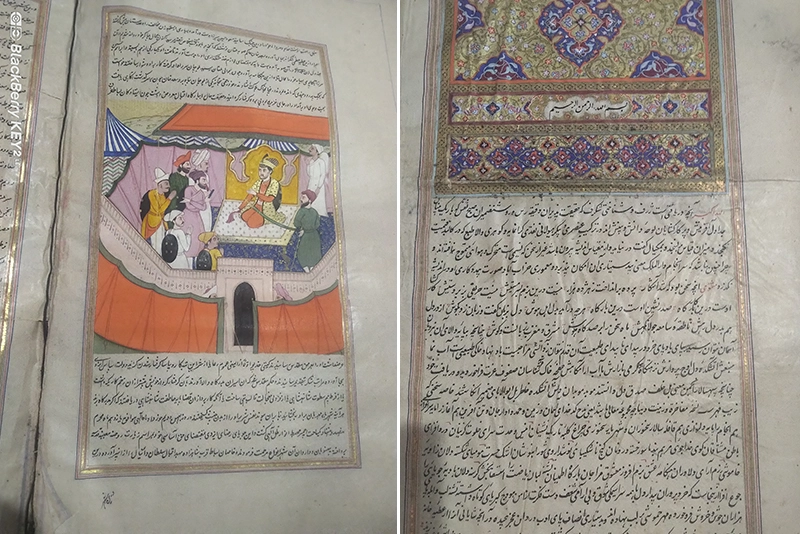
Mohammed Umair showed me rare books and manuscripts, including Persian translations of Ramayan and Mahabharata, and Sirr-e-Akbar, Persian translation of the Upanishads by Mughal prince Dara Shikoh, a great scholar. The excellent condition in which most of these rare books have been preserved over the years shows the dedication of the institution’s staff despite meagre resources. The gold embossed titles and pages decorated with gold border still retain their sheen.

[Akbar Nama (L) and Monsiual Arwah]

Another gem is Monisul Arwah, a book on Sufi saint Khwaja Moinuddin Chishti by Dara’s sister Jahanara. “This is our most prized possession which Maulana Shibli found at an old bookshop in Lucknow and bought for Rs 100 in 1906. It was very dear to him and travelled to an international exhibition of rare manuscripts in Paris,” says Nadvi.

There’s a section where testimonies of some famous visitors, including Mahatma Gandhi, Madan Mohan Malaviya and Maulana Azad, are kept. Motilal Nehru and Jawaharlal Nehru, stayed at the Academy several times during their visits to Azamgarh. When Gandhi first visited it in the 1920s, the Academy’s founding secretary, Maulana Syed Sulaiman Nadvi, showed him the library by lantern light since electricity supply was erratic.

Another famous visitor was Bi Amma, mother of Muhammad Ali Jauhar and Shaukat Ali, freedom fighters and Khilafat Movement leaders better known as the Ali brothers. But while the Academy is Azamgarh’s pride, it faces a severe financial crunch. It has only one librarian, 48-year-old Saleem Javed, son of the Academy’s former director Maulana Ziauddin Islahi, to look after the vast collection.

“I do whatever I can, but it is not possible for one person to look after so many books. I opened my eyes on this campus and have been working here for around 25 years, and will continue to do so.” says Javed, apparently resigned to his and the institute’s fate.

The funding crunch prevents the management from hiring more staff and expediting translation and digitisation of titles from Arabic, Persian and Urdu into other Indian languages and English.

Future of Darul Musannefin

The Academy’s primary purpose is to protect and propagate the scientific, authentic history and rational interpretations of Islam. It also upholds Hindu-Muslim harmony, or the much talked about Ganga-Jamuni Tehzeeb, and sheds light on the life and times of Maulana Shibli, yet so far no one has come forward to help the institute and its committed staff to restore the institute to its former glory. Before Independence, it received grants from Nizam of Hyderabad, Nawab of Bhopal, and others. But now that those streams have dried up, many say the cash-starved institution should look beyond its four walls.

Maulana Shibli had donated his own land with a mango orchard and persuaded close relatives to donate parcels of their land for Darul Musannefin, the library, printing press and publication of Maarif, the monthly journal founded in July 1916.

Since Urdu is shrinking, the library’s patrons have dwindled over the years.Today, it would help if more people started subscribing to Maarif for Rs 10,000 as a life member or even if subscribing to the same for Rs 400 or Rs 1800 towards annual or five years subscription, as a corpus of Rs 10 crore can bail out the institution and help implement its future development plans. In this regard any of the big business houses can also help, as part of their CSR responsibility.

(The writer, Asad Mirza, is a New Delhi-based senior commentator on national, international, defence and strategic affairs, environmental issues, an interfaith practitioner, and a media consultant.)

source: http://www.ummid.com / Ummid.com / Home> Special Report / by Asad Mirza / February 25th, 2025