Tag Archives: Muslim Leaders of India

Obituary: Maulana Muhammad Salim Qasmi, an ocean of knowledge

Deoband, UTTAR PRADESH :

With scarcity of good ulama, the passing away of Maulana Muhammad Salim Qasmi, rector of Al-Jamia Al-Islamia Darul Uloom Waqf, Deoband, has sent a sense of gloom across India.

People have written obituaries describing his death as the loss of the last chain in the golden series of Khanwada-e-Qasmiyat, a metaphor used to describe the great legacy whose history got prominence with establishment of Darul Uloom in Deoband in 1867 against the backdrop of persistent British onslaught on Indians on the one hand and its ugly design to kill ulama in large numbers on the other hand, to mitigate the impact of resistance against the Colonial power.

Maulana Salim Qasmi was a witness to the British cruelty on Indians and the Indian ulama during the eventful years if Independence. He had lived those times as a young student of India’s most prominent madrasa that had been a great centre of anti-British movements like the Silk Letter Movement.

Being the great-grandson of Maulana Muhammad Qasim Nanautwi, Salim Qasmi knew well the role he had to play to live up to the reputation and expectations both of his family and its followers and admirers spread over countries and continents. He rightly did so. His demise thus has rightly been described as the end of that golden chain. However, as there are others from the same family trying to carry forward both the academic and social and historical legacy, will they be able to do justice with that, only time will tell.

Muhammad Salim was born on 8 January, 1926 at Deoband and received primary education from many teachers. He completed his studies in 1948 from Darul Uloom Deoband where his teachers included great luminaries like Maulana Hussain Ahmad Madani, Maulana Aizaz Ali, Allama Ibrahim Balyawi, Maulana Syed Fakhrul Hasan Moradabadi.

He is said to be the last surviving disciple of Maulana Ashraf Ali Thanwi from whom he studied Mizan, an important book of Arabic grammar. Soon after passing out, he was appointed a teacher there. However, later, due to a serious conflict and crisis then in Darul Uloom, he along with some other colleagues, decided to stay away from it and established Darul Uloom Waqf which he nurtured till his last breath. Besides looking after its administrative affairs as a rector, he also taught Bukhari Sharif, the well-known book of hadith. Earlier, he had taught Muslim Sharif, another important book of hadith.

Some of the key positions he held at the time of his death are as follows:

Chief Rector, Al-Jamia Al-Islamia Darul Uloom Waqf, Deoband,

Vice-President, All India Muslim Personal Law Board,

Member, Aligarh Muslim University Court,

Member of Advisory Board and Managing Committee, Darul Uloom Nadwatul Ulama,

Member of Advisory Board, Mazahir Uloom Waqf, Saharanpur,

Permanent Member of the Fiqh Council, Al-Azhar,Cairo,

President, All India Muslim Majlis-e-Mushawarat (before two fractions of it finally united),

Patron, Kul Hind Rabta-e-Masajid,

Patron, Islamic Fiqh Academy, India.

About his written contribution to the domain of knowledge, the website of Darul Uloom Waqf Deoband mentions that besides being:

… one of the top speakers of ulama, his articles and writings are also much admired. Some of the books are worthy to be mentioned here like (1) Mabaadi al-Tarbiyat al-Islami (Arabic), (2) Jaiza Tarjama Quran Karim, (3) Taajdar-e-Arz-e-Haram ka Paigham, (4) Mardaan-e-Ghaazi, (5) Ek Azeem Tarikhi Khidmat, (6) Safar Nama-e-Burma.

(7) The book Khutbat-e-Khatibul Islam (a collection of his speeches) has been published in 5 volumes. Moreover, there are many articles and scripts awaiting publication.

Formally, Maulana received bai’at (a reformative and self-actualization method historically in vogue for quite long as an Islamic tradition in certain schools of thought) at the hand of Maulana Shah Abdul Qadir Raipuri. However, he received much of the training from his glorious father, Qari Muhammad Tayyib (d. 17 July, 1983)

A remarkable trait of his personality was to maintain the dignity of a true aalim (religious scholar) by not partaking in sectarian lines as is the wont of some Ulama. He was therefore respected among all sections of Muslims and his views were very well received. Maulana Salim did not create the binary division of education between religious and modern. He believed that ‘the source of all streams of knowledge is one’.

In recognition of his services to the domain of knowledge and ideas Maulana Salim was honoured with many awards, some of which are as follows:

Nishan-e-Imtiyaz (Mark of Distinction) from the Government of Egypt for being a distinguished aalim of the Indian Sub-Continent,

Imam Muhammad Qasim Nanotwi Award,

Shah Waliullah Award.

Prominent leaders and ulama from different countries have expressed grief over the demise of Maulana Salim Qasmi. In her telephonic message, External Affairs Minister Sushma Swaraj said that Maulana Salim’s love for education was amazing. Outside the country he worked as an exemplary ambassador of education. Congress President Rahul Gandhi said Maulana Salim Qasmi illuminated the world through education and he would touch people through simplicity. Samajwadi Party chief, Mulayam Singh Yadav said that Maulana never asked anything for himself. He was a crown prince of education whose absence would be felt long.

Former Justice of Pakistan’s Shariah Court, Mufti Taqi Usmani described Maulana Salim Qasmi as an ocean of knowledge. His death is a huge loss to the Islamic world. The simplicity with which he lived is rare, he said adding, “His service in the field of education is a golden chapter”.

Member of Parliament and AIUDF President Maulana Badruddin Ajmal Qasmi termed the demise of Maulana Salim Qasmi as ‘end of an era’ whose enumerable services are worth to be written in golden words. Senior leaders Ahmad Patel, Ghulam Nabi Azad, Syed Shahnawaz Hussain and others also sent their condolence messages.

Maulana Syed Rabey Hasani Nadwi, President of All India Muslim Personal Law Board, who had closely worked with Maulana Salim Qasmi and had also been his classmate at Darul Uloom Deoaband, wrote an article in which he stated that Maulana Salim Sahab had acquired many of the qualities of his father Qari Tayyib Sahab and his great grandfather Maulana Qasim Nanautwi. He worked in a similar way from whom different sections of ummah benefitted. His death therefore has caused concerns about the void in the ummah and in religious circles.

Maulana Arshad Madani described Maulana Salim Qasmi’s death as a loss which does not seem to be filled in near future. “Whenever there is a crisis he would be remembered’ he said. The responsibility to protect the institution that he established falls on all of us.

Prof Humayun Murad said that Maulana knew well how to avoid confrontation and find peaceful and constructive ways. Darul Uloom Waqf Deoband is its living example.

Maulana Muhammad Sayeedi, nazim, Mazahir Uloom Waqf said, “In the passing away of Maulana Salim Qasmi, Mazahir Uloom has been deprived of one of its true guide and patron”. He was its member since 1988. Mufti Muzaffar Husain would trust him a lot and his suggestions were highly helpful.

As against the commonly held opinion of ulama who do not tire of speaking about the division of knowledge between religious and modern or worldly, Maulana Salim Qasmi, in June 2013, had in a public programme, very categorically said that all the available forms of knowledge are from Allah. There is nothing as religious and worldly knowledge.

Maulana Qasmi said that the division of knowledge (between religious and worldly) is a political creation because all streams of knowledge flow from God. He then asked heads of madrasas to invite people of other faiths to their madrasas and exchange views and, share their problems with them also.

As I write this obituary, his soft-spoken words remind me of the sincerity with which he would draw the attention of the people to real issues and to the approaches that need to be adopted to find their solution.

Maulana Salim Qasmi was among the important personalities who had set up the Darul Uloom Waqf. His colleagues Maulana Muhammad Nayeem Deobandi died a little over a decade ago on 23 August, 2007, Shaikhul Hadith Maulana Syed Anzar Shah Kashmiri died 10 years ago on 26 April, 2008, Mufti Khursheed Alam died on 7 February, 2012, while Maulana Salim’s younger brother Maulana Muhammad Aslam Qasmi, an outstanding orator, died about five months ago on 13 November, 2017. Finally, this great son of the great Khanwada-e-Qasmiyat passed away on 14 April, 2018. He is survived by four sons and two daughters.

May the Almighty grant him an exalted place in Jannah!

The author is a PhD Fellow at the Academy of International Studies, Jamia Millia Islamia and is also doing an online program “Contending Modernities” of the University of Notre Dame, USA.

source: http://www.twocircles.net / TwoCircles.net / Home> Articles> Indian Muslim> Lead Story / by Manzar Imam for TwoCircles.net / April 28th, 2018

All India Muslim Development Council (AIMDC) Unveils List of 40 Future Leaders 

INDIA :

The All India Muslim Development Council (AIMDC) has officially unveiled the final list of “40 Under 40 Leaders” — a landmark initiative aimed at identifying, nurturing, and empowering the next generation of Muslim leaders in India. The announcement follows one of the most exhaustive and merit-based selection processes in the nation’s recent history, spanning a year-long journey and involving multiple stages of evaluation.

From 950 Applications to 40 Leaders 

The initiative drew an overwhelming response, with approximately 95 applications from across the country. Candidates came from diverse fields — education, politics, corporate leadership, engineering, medicine, activism, journalism, law, research, academia, entrepreneurship, economics, Shariah scholarship, counselling, motivational speaking, Ulemas, students and governance.

The journey began with a meticulous application process, requiring detailed documentation of qualifications, achievements, contributions to society, and personal background. Based on rigorous assessment criteria, 215 applicants were shortlisted for personal interviews.

An expert panel then conducted comprehensive interviews, narrowing the field to 112. Following further scrutiny, 105 exceptional candidates earned a place in the in-person finale for 4 days.

Four Days of Intense Evaluation in Bengaluru 

In India’s startup capital, Bengaluru, hosted the four-day in-person selection event.

Candidates participated in group discussions, parliamentary-style debates, and collaborative tasks designed to assess both individual brilliance and teamwork capabilities.

Organizers also closely evaluated their commitment to nation-building, sincerity towards the Community, Human Relations and personal discipline

From this stage, 70 leaders were selected, each awarded a Certificate of Leadership in addition to a Certificate of Participation.

Silent Assessment for the Final 40 

On July 1, 2025, the same day as the 70 Leaders’ announcement, AIMDC formed an Adhoc (Consultation) Committee of 40 Under 40 Leader blending self-nominated leaders and organizer nominations.

They were asked to pick two projects of their interest from a curated list of initiatives aligned with Community and nation-building. The objective: evaluate their decision-making capabilities, foster team bonding, spark brainstorming, and plant the foundational seeds of advanced leadership skills.

Unbeknownst to many participants, this period doubled as an “invisible” final evaluation. Organizers monitored sincerity, akhlaaq (good character), ikhlaas (pure intentions), punctuality, and the ability to follow through on commitments. Participation in educational events, organizational skills, and collaborative spirit were also critical factors in determining who would advance.

The Final 40 — India’s Muslim Leaders of Tomorrow 

After months of observation, assessment, and engagement, AIMDC has now announced the final 40 Under 40 Leaders — individuals under the age of 40 whose vision, expertise, and dedication position them as catalysts for positive change.

We were truly overwhelmed by the remarkable talent, dedication, and vision demonstrated by all 70 leaders who participated in the process. After a rigorous evaluation, the final 40 leaders selected under the 40 Under 40 Initiative will form the National Executive, serving as the strategic and driving force of the initiative.

Recognizing the immense value and potential of the remaining 30 outstanding leaders, we have proudly welcomed them as members of the National 40u40 Team. They will play a pivotal role in executing projects and events at all levels, ensuring our mission reaches communities across the country and contributes meaningfully to nation-building.

“This initiative is more than a recognition program — it is the foundation of a Change,” said an AIMDC Gen Secretary. – Mohammed Imthiyaz “These leaders represent the intellectual, moral, and strategic strength needed to guide our community and contribute meaningfully to the nation.”

“I came here thinking I would meet other young leaders. I leave knowing I am part of a network, a brotherhood and sisterhood of purpose,” said one of the selected leaders from Maharashtra.

“The process was humbling. It wasn’t just about our CVs — it was about our character, our sincerity, and our ability to work for something bigger than ourselves,” added another finalist from Kerala.

Sidebar: Fields of Expertise Represented in the Final 40

•                   Education Specialists

•                   Politicians & Policy Advocates

•                   Corporate Leaders & Entrepreneurs

•                   Engineers & Doctors

•                   Activists & Journalists

•                   Legal Experts & Researchers

•                   Shariah Scholars & Counsellors

•                   Motivational Speakers & Coaches

•                   Economic Policy Experts

•                   Ulemas

•                   Students

Names of the Selected  Candidates: 

Afza Khan

Imaan Hawwa Hafiz

Amreen Farooq

Juveriya Sarkar

Amrin Ayaz Shaikh

K. HAJIRA SULTHANA

Areefa ali

Ramsa Jaan

B Seeni Rahfu Nisha

Raniya Zulaikha

Fathima Saba

Rikza Pervez

Gulzar Karishma Malik

Shabnam Mohammed Akbar Khan

Hina Fatima Sarfraz Ali Sayed

Zulekha S Rajani

Mufti Yahya Moin Samar

Mohd Imad Ali

Abdul Gani Nadeem Punjabi

Mohd Ovais

Adil kampoo

Mohd Zeeshan

Afsar Rayeen

Mossab Mustafa Khan

Asadullah Waliullah Khan

Muhammed Rafi KE

Asiruddin Shaikh

Mujtaba Muneeb

Dr Bilal Sheth

Nawaz S

Dr Mirza Alamdar Ali Baig

Nouman Alam

Fahad Abdul Basit Hani

Ramiz Abdul Wadood

Khan Abdur Rehman

Reyaz Haider

Md Faizan

Sarfaraz Khan

Md Faizan Ahmad

Sarfraj Nawaj

Md Faizul Bari

Seemab Qayyum

Md Fateen Raza

Shaaz ahmed faruqui

Md Hifzur Rahman

Shaik Shabeer

Md Osama

Sharukh Syed

Md Sadaf Kamran

Sheikh Khurshid Alam

Md Saleh Umar

Suhaim ul islam

Md Yazdani Feroze

Syed Ansar Ali

Meer Faisal

Syed Hamid Ali Moin

Mohamed Maaz

Syed Shoaib Qasim

Mohammad Aamir Ansari

Syed Umar Ahmed

Mohammad Abdul Ahad

Tariq Abdullah Akhon

Mohammed Aftab Ahamed

Umar Farooq Masoodi

Mohammed Feroz

Wafi Shihad

Mohammed Gulam Ahmed Khan

Yusuf Mohamedy

Mohammed Ismail

Zubair Ahmed

About AIMDC’s Vision

The All India Muslim Development Council (AIMDC) is committed to fostering leadership that serves both the Community and the nation with excellence, integrity, and unity. The 40 Under 40 Leaders Initiative is envisioned as an incubator for change-makers, equipping them with networks, mentorship, and the moral compass required to navigate the complex challenges of modern society with Collective Efforts

source: http://www.muslimmirror.com / Muslim Mirror / Home> Indian Muslims> Positive Story / by Muslim Mirror Network / August 16th, 2025

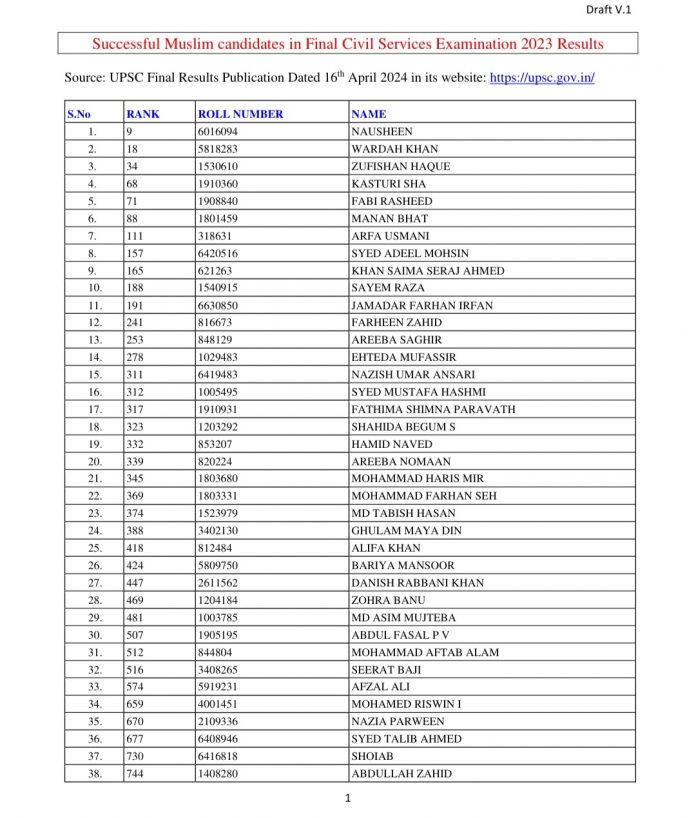
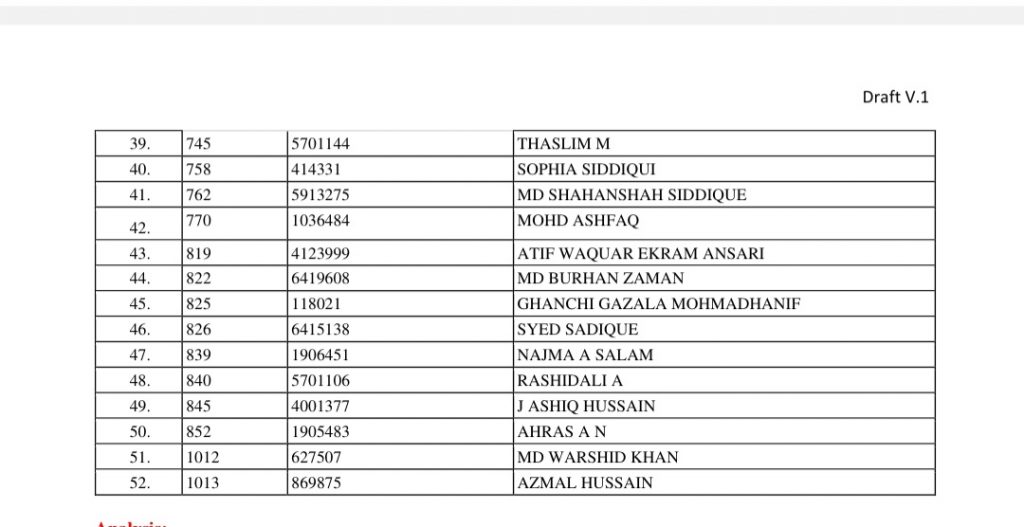
UPSC Results 2023: 52 Muslim candidates crack UPSC examination

INDIA:

More than 50 Muslims figured in the UPSC Civil Services Merit List 2023.

More than 50 Muslims figured in the UPSC Civil Services Merit List 2023 released today, with five of them securing different ranks and positions in the list of top 100.

Of the total 51 Muslims who figured in the Civil Services Merit List 2023 released today, five – Ruhani, Nausheen, Wardah Khan, Zufishan Haque and Fabi Rasheed are in the Top 100 list.

A total of 1,016 candidates cleared the examination and have been recommended for different central government services, the UPSC said.

The Civil Services Exam is conducted annually in three stages — preliminary, main and interview — by the UPSC to select officers of Indian Administrative Service (IAS), Indian Foreign Service (IFS) and Indian Police Service (IPS), among others.

List of sucessful Muslims candidates who cracked UPSC 2023

source: http://www.muslimmirror.com / Muslim Mirror / Home> Indian Muslim> Positive Story / by Muslim Mirror Staff / April 16th, 2024

Book Review: Amar Sohal’s ‘The Muslim Secular’

UNITED KINGDOM:

Amar Sohal’s ‘The Muslim Secular’ is a compelling exploration of ideas, identities, and legacies that takes you on a scholarly journey that traverses the intricate terrain of India’s struggle for Independence and its subsequent partition through the lens of three influential Muslim leaders: Maulana Abul Kalam Azad, Khan Abdul Ghaffar Khan, and Sheikh Abdullah.

Photo: Getty Images
Photo: Getty Images 

Amidst the dynamic sociopolitical landscape of the subcontinent, the Muslim community grapples with multifaceted challenges, navigating issues of identity, representation and political agency. It is against this backdrop that Amar Sohal’s book ‘The Muslim Secular: The Parity and Politics of India’s Partition’ emerges as a pertinent exploration. 

Sohal embarks on a scholarly journey that traverses the intricate terrain of India’s struggle for Independence and its subsequent partition through the lens of three influential Muslim leaders: Maulana Abul Kalam Azad, Khan Abdul Ghaffar Khan, and Sheikh Abdullah. This meticulously crafted work not only delves into the historical narratives surrounding these figures but also navigates the complex intersectionality of religion, politics, and regional identity, offering readers a profound and nuanced understanding of a pivotal period in South Asian history.

Sohal’s narrative unfolds with the exploration of Azad’s vision, which significantly departs from conventional perspectives. Azad, rather than emphasising a stark dichotomy between Hindus and Muslims, envisions a shared Indian nationality rooted in historical evolution. His integrationist stance grapples with the challenges of sectarian antagonism, weaving a narrative that transcends the simplistic notions of religious division. Sohal adeptly captures Azad’s dynamic response to historical exigencies, portraying him not merely as a religious leader, but as a visionary navigating the multifaceted socio-cultural landscape of India.

The focus then shifts to Ghaffar Khan, a transformative figure whose reinterpretation of the Muslim Pashtun warrior archetype challenges prevailing stereotypes. By divorcing bravery from violence, he introduced an ethical dimension to the pursuit of freedom. Sohal meticulously unravels the intricacies of Ghaffar Khan’s advocacy for a symbiotic relationship between Muslim Pashtuns and Hindu Hindustanis. The book doesn’t shy away from the complexities of Ghaffar Khan’s engagement with the post-Partition referendum in Kashmir, illuminating the enduring impact of his ideas on regional political dynamics.

Amar Sohal's book 'The Muslim Secular: Parity and the Politics of India's Partition'
Amar Sohal’s book ‘The Muslim Secular: Parity and the Politics of India’s Partition’

Abdullah emerges as another pivotal figure and Sohal meticulously traces the evolution of his perspectives on Kashmiri identity. Abdullah’s delicate balance between preserving the region’s distinctiveness and fostering unity with the broader Indian context adds layers of complexity to his political trajectory. Sohal deftly navigates Abdullah’s integrationist phase in later years, providing readers with a nuanced understanding of the man and his enduring influence on the Kashmiri political landscape.

What distinguishes ‘The Muslim Secular’ is its seamless transition between historical narratives and contemporary implications. Sohal draws intriguing parallels with the present, shedding light on how the legacies of Azad, Ghaffar Khan, and Abdullah continue to shape the political landscape. The comparison with the Pashtun Tahafuz Movement in Pakistan adds depth to the exploration of non-violence and symbiotic centre-region relationships, offering readers insights into the ongoing dynamics in the region.

Expanding the scope of the book, Sohal delves into the role of large Muslim-minority communities in Kerala, West Bengal, and Assam. These communities, constituting a significant portion of the population, actively resist the homogenising efforts of the Bharatiya Janata Party (BJP) through sub-national political formations. Inspired by the integrationist visions of Abdullah and Ghaffar Khan, they navigate the intricate socio-political terrain, contributing to the overarching theme of the book. This expansion not only enriches the narrative but also provides a holistic understanding of how these visions transcend regional boundaries.

‘The Muslim Secular’ stands out as a seminal work that transcends traditional historiography. Sohal’s narrative is not only informative but also reflective, inviting readers to engage deeply with the complexities of India’s political trajectory. The book encourages a nuanced understanding of the legacies of Azad, Ghaffar Khan, and Abdullah, urging readers to contemplate their enduring impact on the current socio-political milieu.

In conclusion, ‘The Muslim Secular’ is a compelling exploration of ideas, identities and legacies. Sohal’s nuanced and insightful approach ensures that readers not only gain a profound understanding of the historical context but also appreciate the lasting relevance of these visionary leaders in shaping India’s political landscape. The book serves as an indispensable resource for scholars, historians, and anyone seeking a comprehensive understanding of the intricate interplay between religion, politics, and regional identity during a pivotal period in South Asian history.

However, it is imperative to recognise that the book might present challenges for the general reader, particularly in the initial sections. The narrative, laden with academic jargon and intricate historical details, necessitates a certain familiarity with the subject matter. While this scholarly depth undoubtedly elevates the work, it could potentially form a barrier for readers less acquainted with the nuances of Indian history and politics. Yet, for those willing to navigate this initial complexity, the reward is a profound and enlightening exploration that unveils the complex tapestry of India’s political evolution, offering insights that extend far beyond the pages of this thought-provoking work. 

Sohal’s ‘The Muslim Secular’ not only adds scholarly richness to the discourse but also invites readers to confront and engage with the multifaceted dimensions of a crucial period in South Asian history.

(Saleem Rashid Shah is a literary critic and an independent writer based in New Delhi. He tweets at @SaleemRashid176. Views expressed are personal.)

source: http://www.outlookindia.com / Outlook / Home> Weekend Reads / by Saleem Rashid Shah / October 28th, 2023

A Shia Mirza Ismail constructed a Sunni mosque

Bengaluru / Mysuru, KARNATAKA :

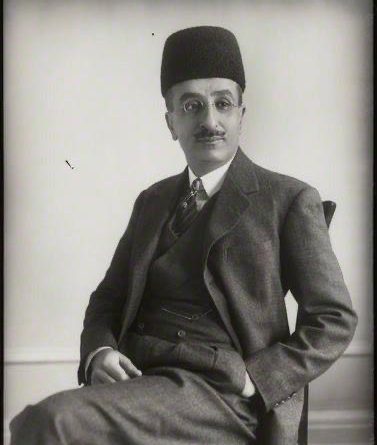
“I believe deep down in my heart that the great reality of spiritual revelation given to humanity by the Prophet (blessed be His name) is an infinitely greater thing than any sectarian difference (Shia & Sunni) imposed upon it by subsequent human feeling and by lesser vision than his of the inner realities from which the external life of humanity has developed.” Mirza Ismail, a Shia Muslim by faith, who was the Prime Minister of Mysore had spoken these words at the inauguration of Jamia Mosque, a Sunni mosque, in Bengaluru on 30 May 1941.

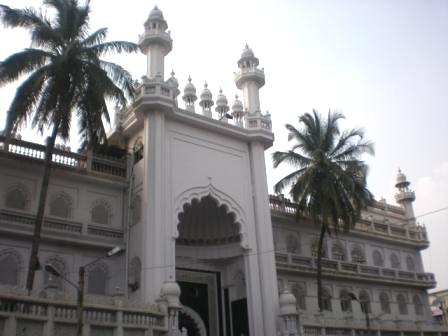
Jamia Masjid, Bengaluru

Mirza Ismail remained one of the most important politicians in India as he held the position of Prime Minister (PM) of the second wealthiest state, Mysore, from 1926 to 1941 after which he became PM of Jaipur and Hyderabad.

A Shia by his faith whose foreparents had migrated from Iran and stayed in India, Ismail remained committed to the unity of humans. He believed that Shia and Sunni, Hindu and Muslim, or any caste difference among humans could not stop them from living together harmoniously. 

Ismail inaugurated the mosque at Bangalore, which was one of the most important cities in Mysore state, as his last public ceremony in the capacity of the PM of Mysore after resigning from the post. On the occasion he noted, “I am particularly happy that this function, which is the last of my period of service as Dewan of Mysore, gave me the opportunity of expressing an ideal of my life which has been foremost in the past and will remain foremost in the future.” 

What was the ideal Ismail talking about? Making a mosque or something else?

The ideal he was talking about was the unity of Shia and Sunni as one Muslim community. He told the people gathered there that the non-Muslims observing this ceremony would not think much about it. In their view a Muslim had come to lay the foundation stone of a mosque of his fellow Muslims. “But to you”, Ismail argued, “fellow-Musalmans, it is not so simple. You know that in the historical development of Islam I belong to a section of the organised expression of the Faith that for centuries has been in sharp opposition to the section to which you, who are going to build this mosque, belong.” He expressed satisfaction that Sunnis had invited him for this event. He told the people that since its very inception he had taken “the greatest possible interest” in this mosque where Sunni Muslims would pray in the manner they wanted. 

Ismail went on to tell the people;

“At the centre of Islam is the teaching and practice of brotherhood. You would have been false to the truth of life if, because I am a Shia by birth, you had not invited me to this function, and I would have been equally false to the brotherhood of Islam if, because you are Sunnis, I had not accepted your invitation. Our differences are transient, even trivial, in comparison with the spiritual reality which these differences tend to obscure and weaken.”

Ismail went on to state that love and peace are the essence of Islam and Muslims should stop fighting among themselves as well as with their coreligionists in the country. The mosque is one of the most important mosques in Bengaluru today.

(Author is a neurobiologist with a keen interest in history, society and culture of India)

source: http://www.heritagetimes.in / Heritate Times / Home> Featured Posts> Heritage> Leaders / by Mahino Fatima / March 08th, 2022

IP academic Prof Shamnad Basheer among six Infosys Prize winners

KERALA :


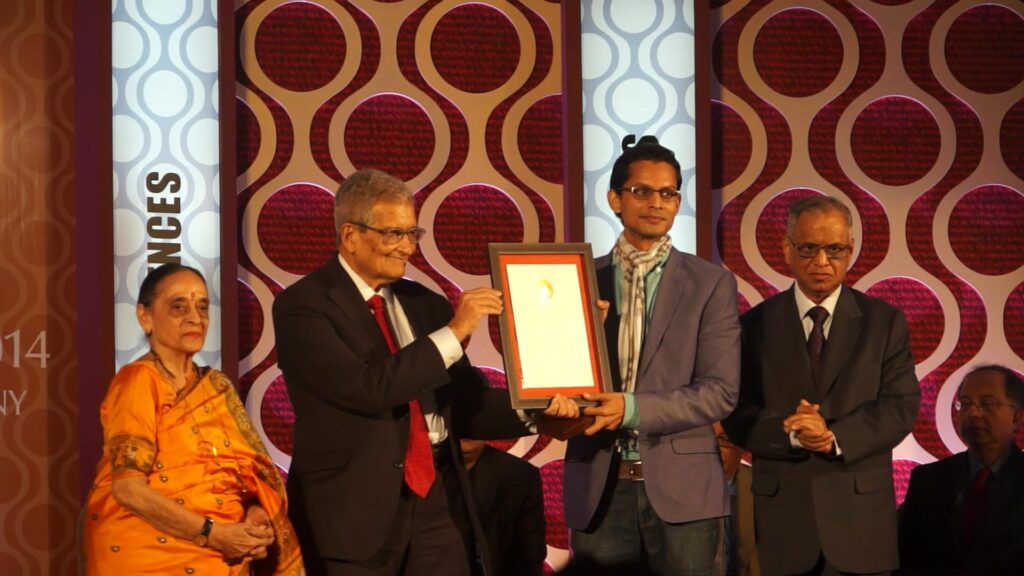
Photo of Shamnad receiving the Infosys Prize (Humanities) in 2014 from Mr. Amartya Sen / pix: shamnad.com

Bengaluru : 

Indian Institute of Science (IISc) professor Jayant Haritsa and Intellectual Property (IP) academic and consultant professor Shamnad Basheer, both from Bengaluru, are among six winners of the Infosys Prize for this year.

Each prize, comprising a purse of Rs.55 lakh, a 22-carat gold medallion and a citation, is awarded by Infosys Science Foundation, a not-for-profit trust, set up by the global software major and funded by a corpus of Rs.100 crore ($16 million), contributed by the IT firm, its trustees and co-founders in 2009.

“Haritsa, computer science and automation department professor at IISc, has been awarded the prize under the Engineering and Computer Science category for his contribution to the design and optimisation of database engines,” the Foundation said in a statement here Thursday.

Haritsa also heads the supercomputer education and research centre at the institute.

Basheer, founder of SpicyIP, India, bagged the prize for his contribution to the analysis of a range of legal issues, including pharmaceutical patent injunctions and enforcement in the Humanities category.

As India’s premier blog on IP and innovation law and policy, SpicyIP does accurate reporting of IP developments across the country.

Basheer is also founder and managing trustee of Increasing Diversity by Increasing Access (IDIA) in Bengaluru.

Shubha Tole, associate professor at Mumbai-based Tata Institute of Fundamental Research (TIFR), got the prize under the Life Sciences category for her contribution to studying the hippocampus and amygdale centres of learning and memory in the brain.

“Tole’s work can lead to a better understanding of human behaviour, cognition and emotions,” the statement noted.

Tole is also a principal investigator at the TIFR’s biological sciences department.

Massachusetts Institute of Technology (MIT) adjunct professor Madhu Sudhan has been awarded the prize under the Mathematical Sciences category for his seminal contribution to probabilistically checkable proofs and error-correcting codes.

As a principal researcher at Microsoft Research in New England in the US, Sudan also heads the electrical engineering and computer sciences (EECS) department and computer science and artificial intelligence laboratory (CSASIL) at MIT in Boston.

Council of Scientific and Industrial Research (CSIR) senior scientist Srivari Chandrasekhar at the Hyderabad-based Indian Institute of Chemical Technology (IICT) has bagged the prize under the Physical Sciences category for his contribution to the synthetic organic chemistry with special focus on the synthesis of complex molecules from natural sources.

Abdul Latif Jameel Professor of Poverty Alleviation and Development Economics at MIT, Esther Duflo, got the prize under the Social Sciences category for her pioneering contribution to development economics, including the work related to India and Africa.

Duflo is also founder-director of Abdul Latif Jameel Poverty Action Lab in the US.

“The Foundation has been able to recognise some of the best researchers of our time through the prize. Their contributions are an inspiration to students and professionals and have the potential for real-time impact on individuals and society,” Infosys co-founder and Foundation president N.R. Narayana Murthy said on the occasion.

A panel of jurors, comprising renowned scientists and professors from the world over, evaluated the noted winners.

The Infosys Prize jury chairs are Pradeep Khosla, Nobel Laureate Amartya Sen, Inder Verma, Srinivasa S.R. Varadhan, Shrinivas Kulkarni and Kaushik Basu.

President Pranab Mukherjee will award the winners and felicitate them Jan 5 in Kolkata.–-IANS

www.shamnad.com

source: http://www.muslimmirror.com / Muslim Mirror / Home> Exclusive Reports> Indian Muslims> Youth / November 15th, 2014

Global Excellence & Leadership Award to Karnataka’s Abdul Subhan Sait by Global Business Federation

Abdul Subhan Saith, co-founder of Bengaluru based Upmyranks Pvt. Ltd. will be coferred Global Excellence and Leadership Award by the Global Business Federation in Dubai. Subhan will be awarded under the category of “Edtec Educational Excellence.

The award will be conferred during Business Conclave and Global Excellence and Leadership Awards ceremony on October 22 at The Oberai Hotel in Dubai.

He will also take part as a panelist at a panel discussion that will be held at the Indian Pavillion at Dubai Expo 2020 on October 23 as a part of the business conclave.

Abdul Subhan Sait is the son of senior Congress leader Abdul Mannan Sait.

source: http://www.english.varthabharati.in / Vartha Bharati / Home> Gulf / by Vartha Bharati / October 16th, 2021