Tag Archives: Muslim Women Poets of India

Feroza Begum chronicles hardships of life in her poems and stories

Jubuni Village (Rampurhat subdivision of Birbhum District), WEST BENGAL :
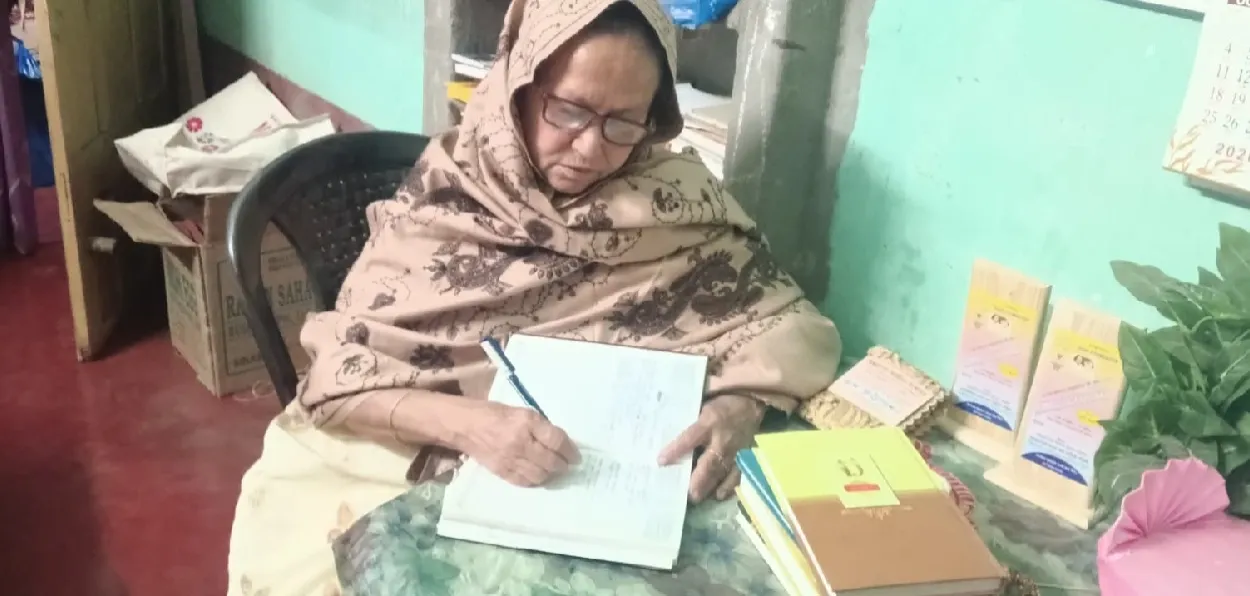
Feroza Begum

Firoza Begum’s language of protest against the harsh realities of rural India, gender inequality, and family adversity is a strong statement. The poet and writer in her, though, has emerged from a phase of struggle.

She was born into a respectable family in Jubuni village of Rampurhat subdivision of Birbhum district, West Bengal. Her parents, Abdul Hakim Mallick and Arestun Bibi, faced poverty, disease, and social uncertainty, due to which her childhood was difficult.

The struggle for survival of her family and relatives during the terrible smallpox epidemic influenced and triggered a humanitarian spirit in her.

In her childhood, when women’s education was neglected in rural society, she completed her schooling. She broke many social barriers. The discrimination and neglect she faced while in school ignited the spirit of rebellion in her, which, in due course, made the language of her writing sharp, protestant and sensitive.

Feroza Begum with an award

In 1974, she married Nurul Haque Mallick, a science-minded teacher. With her husband’s liberal attitude and inspiration, she managed to balance both her family life and pursuit of literature. She made sure her four daughters got educated and financially independent, self-reliant. Although her husband’s death in 2016 left a deep void in her life, she did not stop pursuing literature.

Since 1992, Firoza Begum has been regularly writing poems, songs and essays. Her writings have been published in various literary magazines of Murshidabad, Rampurhat and Kolkata, Pragati, Trinayani, Kalam, Bhabbana, Sangbad Darpan, Roddur, Arpan, etc.

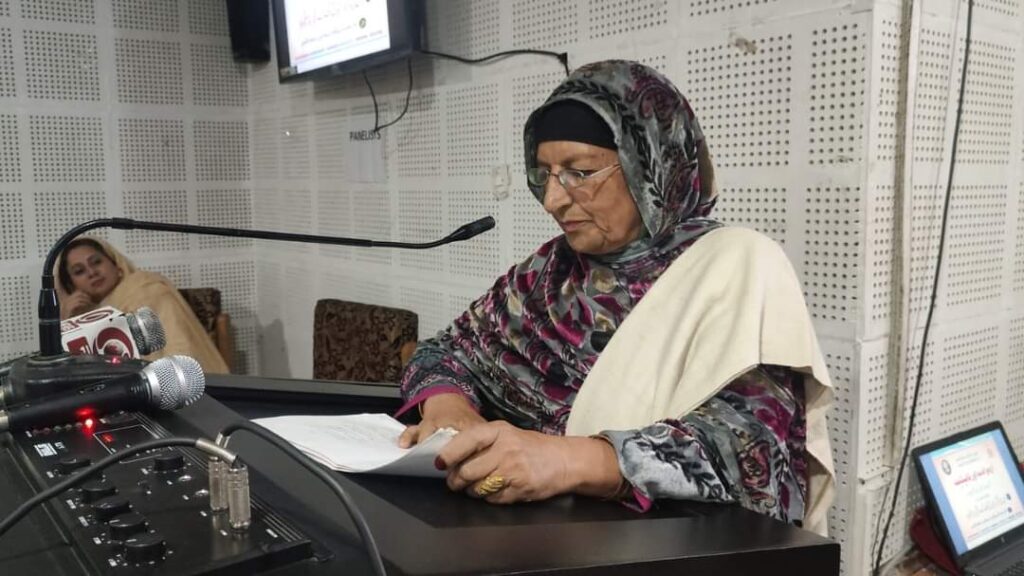
Besides, she is also a regular participant in the radio and television programs and has received recognition beyond her hometown and community.

The poetry collection “Nayantara” published in 2010) and “Aparajita” published in 2014) clearly reflect the struggle of women, the adversities of life, and the human spirit.

She proofread and published the book, despite illness and limitations, and it reflected her perseverance.

 Firoza Begum has received several honours and awards in recognition of her contribution to literary endeavours.

The reception by the Bhabna O Anubhavber Dana newspaper of Rampurhat, the Rokeya Award from the Roddur newspaper, certificates from various radio stations in Kolkata and Baharampur, the Ambedkar Shilpi Ratna Award from New Barrackpore, and the recent “Best Bengali” award from the Asha Foundation are important recognitions of her literary and humanitarian activities.

The life of poet Firoza Begum is not just the autobiography of a writer, it is a courageous document of a struggling woman. Her pen still bears witness to the fact that even in the deep darkness of adversity, education, humanity and literature are capable of illuminating the path of humanity.

source: http://www.awazthevoice.in / Awaz, The Voice / Home> Stories / by Dev Kishore Chakraborty / February 03rd, 2026
Rukhsana Jabeen: a doyen of Urdu poetry from Kashmir

JAMMU & KASHMIR:

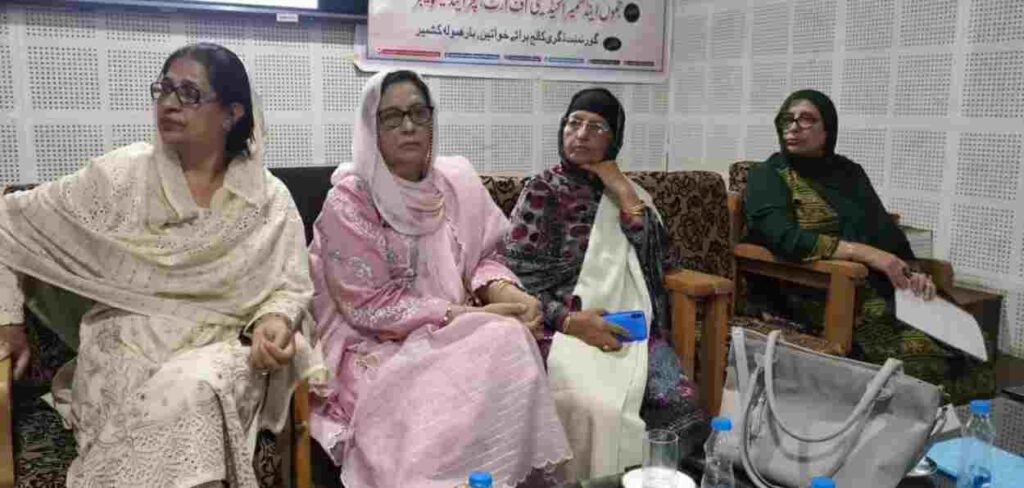
Rukhsana Jabeen (Second from right) at a poetic symposium

Rukhsana Jabeen is one of the very few female litterateurs in Jammu and Kashmir who carved a niche in the Subcontinent’s vast domain of Urdu poetry at the intersection of the 20th and the 21st century. An overarching and unceasing armed insurgency, that muted all expressions in art and literature in the Valley failed to silence her for 33 years.

After serving All India Radio for over 30 years, Jabeen retired as a Director at Radio Kashmir Srinagar in 2015. The participation of a Kashmiri woman in the annual All India Mushaira on the eve of Republic Day or Independence Day was fatally proscribed by terrorists. Jabeen did so without break.

“Whatever came to my mind, I wrote and expressed without thinking a bit about its consequences”, Jabeen revealed to Awaz- the Voice at her winter residence in Jammu.

Born in a family of the decedents of the revered saint and Kashmiri-Persian poet Syed Meerak Shah Kashani in the Khwaja Bazar neighbourhood of downtown Srinagar in 1955, Jabeen did Master’s in Urdu followed by MA and M Phil in the Persian language and literature at the University of Kashmir. In 1983, she joined AIR Srinagar as a program executive.

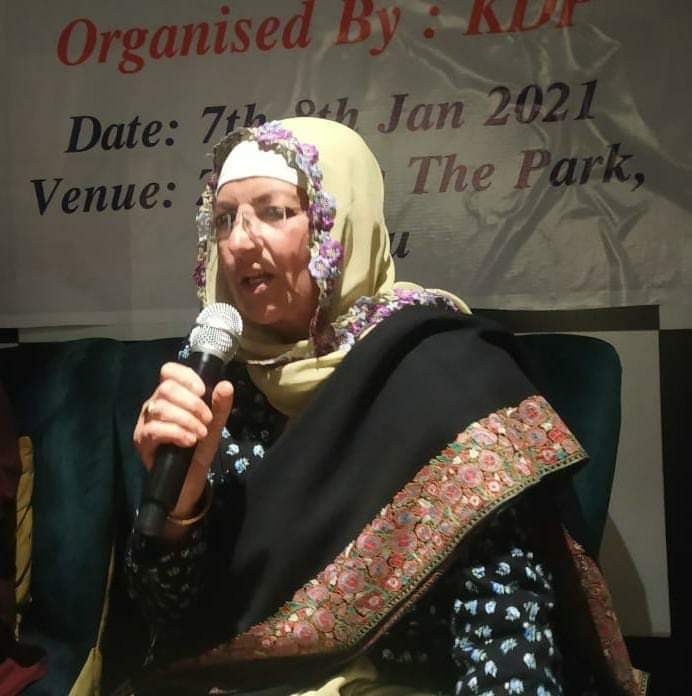
Rukhsana Jabeen at a poetic symposium

“I was not the first woman to enter the station for an all-India job”, Jabeen said “but in our family setting it was like breaking the glass ceiling. Getting selected for the job in a tough patriarchal competition was like a big success for me. Knowing well that I wouldn’t be permitted to apply for it, I kept it all discreetly concealed from my family”.

“I was also selected as a teacher in the State Education Department. As my father learned about my getting a job at the AIR, he insisted I should join as a teacher. I agreed with him that the AIR officers could be transferred to any Indian State, but I lied that female officers were not posted outside their home States. Thereupon my family relented, and I joined as a program executive”, Jabeen said.

In 1994, Jabeen established AIR’s Poonch station close to the Line of Control in Jammu where she served for three years. In 1999, she was promoted to Assistant Station Director (ASD).

Unlike many of her tribe, Jabeen’s tryst with creative literature began late during her university days. A prominent Urdu poet and literary critic and the head of the Urdu Department, Prof. Hamidi Kashmiri, encouraged Jabeen to write prose and poetry in Urdu. “I was thrilled when Hamidi Sahab refined my first Ghazal and got it published in the annual edition of his department’s magazine ‘Baazyaft’. Under his tutelage, I learned about modern sensibility and the post-modernist literary trends”, Jabeen recalled.

Rukhsana Jabeen recording a radio programme

She narrated how affectionately some celebrated litterateurs like Hamidi at the University of Kashmir and Zubair Rizvi at Radio Kashmir Srinagar gave her select books and literary magazines to hone her talent and faculties as a creative writer.

“One day, incredulously I found five of my poems published together, alongside my profile, in Kumar Pashi’s journal ‘Satoor’. Later, Zubair Sahab disclosed that he had got the same published in the prestigious Urdu magazine. It was an incredible encouragement and my recognition as a poet. Thereafter, a number of my poems were published in the top representative journals like ‘Alfaaz’, ‘Shayir’, ‘Mafaheem’ and ‘Asri Agahi’. Hamidi Sahab and Zubair Sahab steered me to the extensive studies of Shaharyar, Rajinder Manchanda Bani, Nasir Kazmi, and Mohammad Alvi. I am still deeply under the influence of Mohammad Alvi and a few others”, Jabeen added.

Kishwar Naheed, Parveen Shakir, and Fahmida Riaz inspired Jabeen into some new experiments. She was initially also influenced by female Urdu litterateurs like Rafia Shabnam Abidi, Aziz Bano Darab Wafa, and Sajida Zaidi and later shared the stage with them at AIR and all-India poetry symposiums. For over three decades, Jabeen was a regular guest poet at Delhi’s Red Fort and other literary rendezvous, integrating a Sub-continental network of the intelligentsia and defying a hostile ambiance at home.

For several years, Jabeen translated poetry from 22 Indian languages into Kashmiri as a project of the Sahitya Akademi. She participated in many such all-India poetry symposiums at Varanasi and other Indian cities. She remained closely linked to top-notch Urdu poets like Shaharyar, Bashir Badr, Nida Fazli, Makhmoor Saeedi, Ali Sardar Jafri, Kaifi Azmi, Qateel Shifai, Ahmad Faraz besides literary critics like Shamsur Rahman Faruqi, Naiyer Masud and Malikzada Manzoor Ahmad.

“Many of them organized Mushairas in my honour at their homes. It was a unique recognition and hospitality as never before has anyone from Kashmir been entertained to such honours”, Jabeen said. “I invited many of these doyens of Urdu literature to our programmes at Radio Kashmir”.

Ghazal in Urdu and Kashmiri is Jabeen’s forte even as she also tried her pen at the popular genre of ‘Nazam’. “But I no love lost for blank verse and free verse. I believe those who can’t write in Urdu’s traditional meters have little right to write in free verse. Besides, I have seen how many of the aspirants, particularly females, get free verse written by others and read the same as their poetry. They perform such poor poetry at stage. Contrarily, nobody gives out a Ghazal. A Ghazal and Nazam writer is often an authentic poet”, Jabeen said.

In addition to volumes of the translation of short stories from different languages into Kashmiri and a translation of the collection of Hafiz Shirazi, which she accomplished with Dr. Syed Raza of Budgam, Jabeen has three of her collections—two in Urdu and one in Kashmiri—ready to publish.

“But I’m unbelievably indolent. I never get after awards and accolades. I can’t fulfill those formalities. Every year, I decided to publish these three volumes of my poetry but my laziness spoils my endeavour.”

source: http://www.awazthevoice.in / Awaz, The Voice / Home> Story / by Ahmed Ali Fayyaz, Jammu / January 14th, 2024