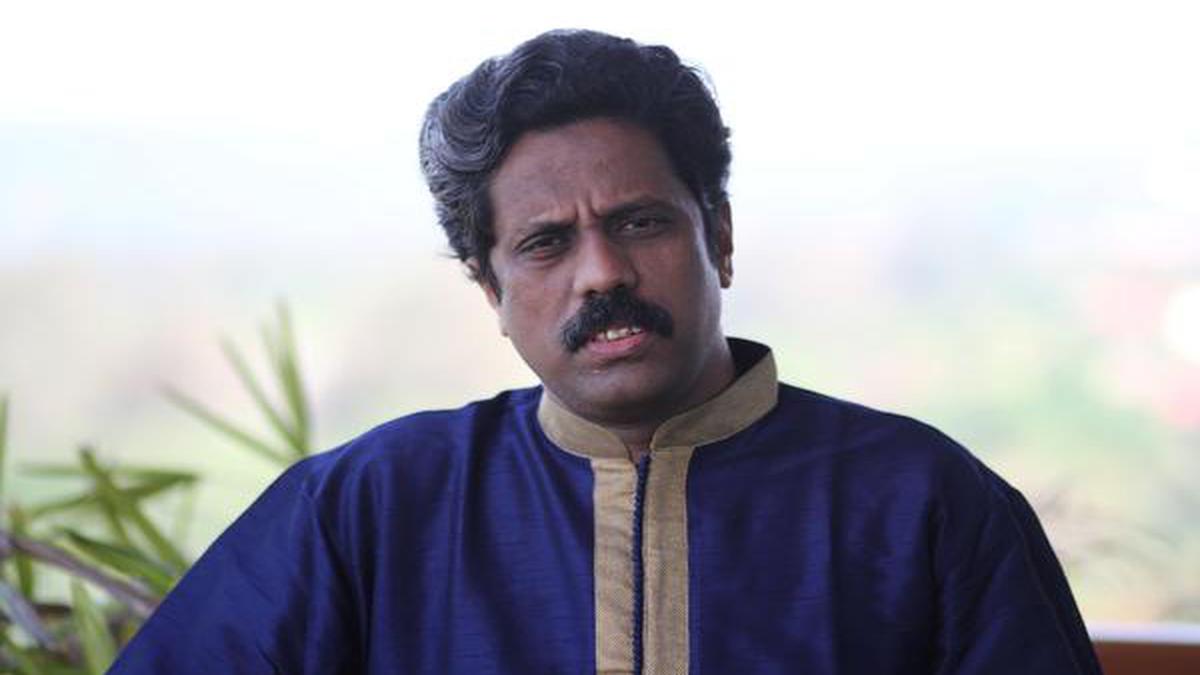
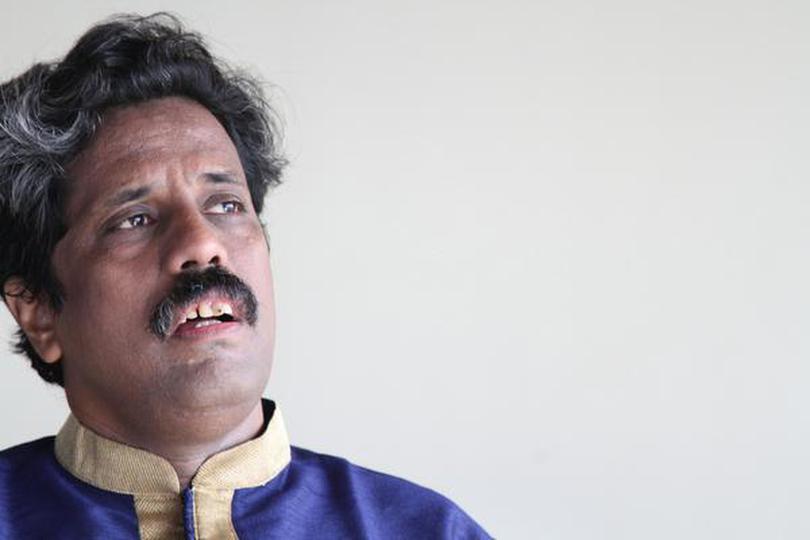
Tragically, Munawar Ali Khan Sahib died at the peak of his career, at the age of 59 in Kolkata in 1989.
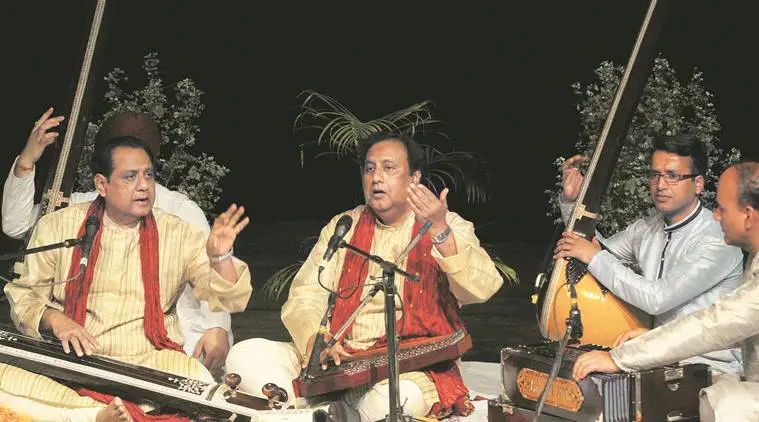
Artistes perform at Tagore Theatre in Sector 18, Chandigarh, on Saturday. Express
Triveni Sangeet Sabha paid a homage to late Ustad Munawar Ali Khan of Kasur Patiala Gharana on Sunday evening at Tagore Theatre. An audio-visual presentation on Ustad Munawar Ali by Niharika Popli was projected. This was followed by vocal recitals by Ustad sahib’s son Raza Ali Khan and his two nephews Ustad Mazar AlI and Awaad Ali Khan. Chandigarh-based Primila Puri, his disciple, also sang.
Ustad Munawar Ali Khan was born in 1930 in Lahore. He was the son of the legendry maestro Padmabhushan Ustad Bade Ghulam Ali Khan and trained under his father and his uncle Ustad Barkat Ali Khan. Munawar Ali Khan had a full-throated, powerful voice with open aakar, which adapted itself to different styles of bandishes like khayal, thumri, dadra and after his father’s death in 1968, he became a worthy representative and the ‘Khalifa’ of the Kasur Patiala Gharana. He created many khyals, thumris, geets and ghazals and sang brilliantly difficult ragas of his gharana and also created a new raga named Malini Basant.
Tragically, Munawar Ali Khan Sahib died at the peak of his career, at the age of 59 in Kolkata in 1989. The Kasur Patiala legacy is now carried on by his son Raza Ali Khan and his nephews Jawaad Ali Khan, Mazhar Ali Khan and Naqi Ali Khan.
source: http://www.indianexpress.com / The Indian Express / Home> News> Cities> Chandigarh / by Express News Service / March 18th, 2018
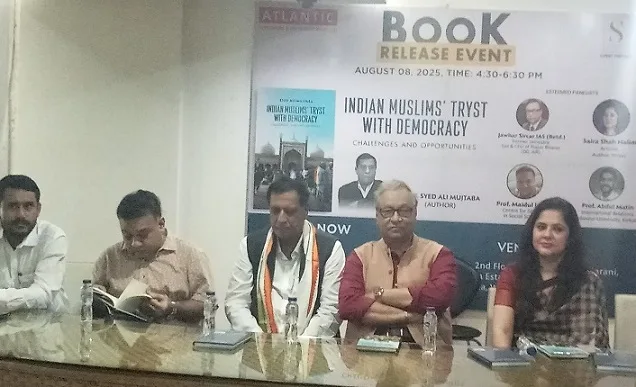
At the launch of the book Indian Muslims’ Tryst with Democracy: Challenges and Opportunities at ICCR Library, Kolkata, academics and public figures underlined that meaningful improvements in government schools and hospitals could significantly uplift India’s Muslim community, especially its poorest segments.
Professor Abdul Matin of Jadavpur University stressed that socio-economic realities leave many Muslims dependent on failing public services. “We keep saying Muslims lag in education — but how do we fix it? When families earn only ₹8,000–₹10,000 a month, they cannot afford private schools. They rely on government schools, which have deteriorated so much that students rarely move up in life,” he said.
Matin pointed out that this crisis is not limited to rural Bengal but also affects Muslim-majority urban areas such as Metiabruz, Khidirpur, Topsia, Park Circus, and Raja Bazar. Once-active Kolkata Municipal Corporation schools, he noted, have shut down, worsening access. The state’s public education system, weakened by years of political interference, has hit all low-income communities hard — with Muslims among the worst affected.
He also painted a bleak picture of healthcare: “In rural Bengal, people travel overnight and queue from midnight for a doctor’s appointment. We must revive mohalla-level schools and clinics.”
Jawhar Sircar, former Rajya Sabha MP and bureaucrat, urged the community to prioritise education over religious symbolism and to resist being reduced to a political vote bank. He encouraged Muslims to join democratic, secular movements fighting to restore India’s plural ethos. On the castecensus, Sircar advised patience, saying its 2026 release could be a “game changer” for the community.
Political activist and CPM leader Saira Shah Halim spoke bluntly about systemic discrimination, citing examples from both Delhi and Kolkata. On housing bias, she noted: “People say Muslims are ghettoised — but do they have a choice?” She also criticised the absence of certain MPs, including secular leaders, during critical parliamentary debates on Muslim concerns such as the CAA and the abrogation of Article 370.
From a historical and political perspective, Prof Maidul Islam of the Centre for Studies in Social Sciences, Calcutta, traced a steady decline in Muslim political representation — in the Lok Sabha since 1980 and in the Bengal Assembly since 2011. He alleged that parties deliberately withhold tickets from Muslim candidates, echoing warnings made decades ago by B.R. Ambedkar. The lack of progressive leadership, he argued, further limits the community’s advancement.
The book itself — Indian Muslims’ Tryst with Democracy — offers a detailed examination of these socio-political dynamics, combining historical insight with policy recommendations. Described by speakers as “a guide for collective action,” it lays out both the challenges and the concrete opportunities available for India’s Muslims to achieve equitable development.
You can order a copy from Atlantic Publishers & Distributors Pvt. Ltd 7/22, Ansari Road, Darya Ganj, New Delhi – 110002. Email- aparna@atlanticbooks.com – Phone: 011-40775252 Website: www.atlanticbooks.com
source: http://www.theindianawaaz.com / The Indian Awaaz / Home> Quami Awaaz / August 13th, 2025
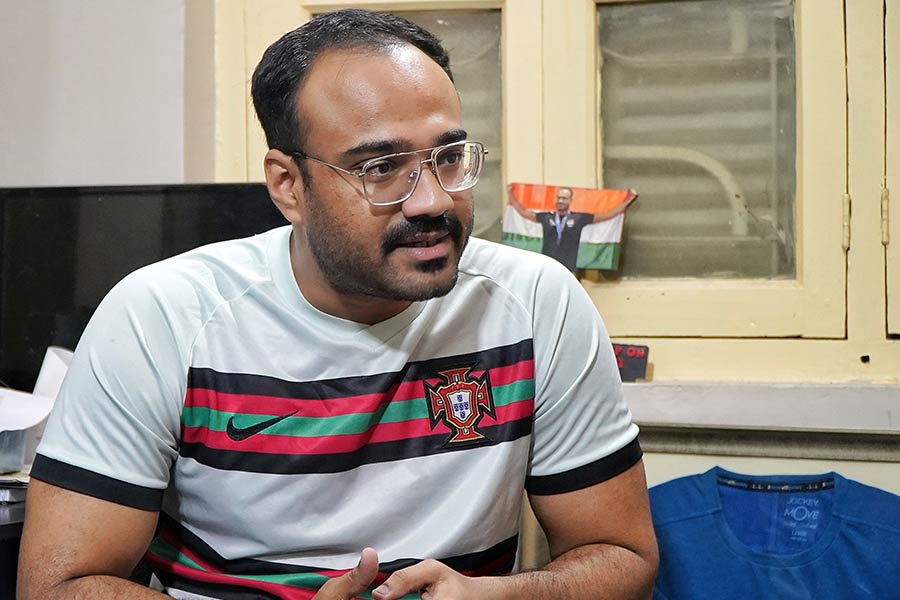
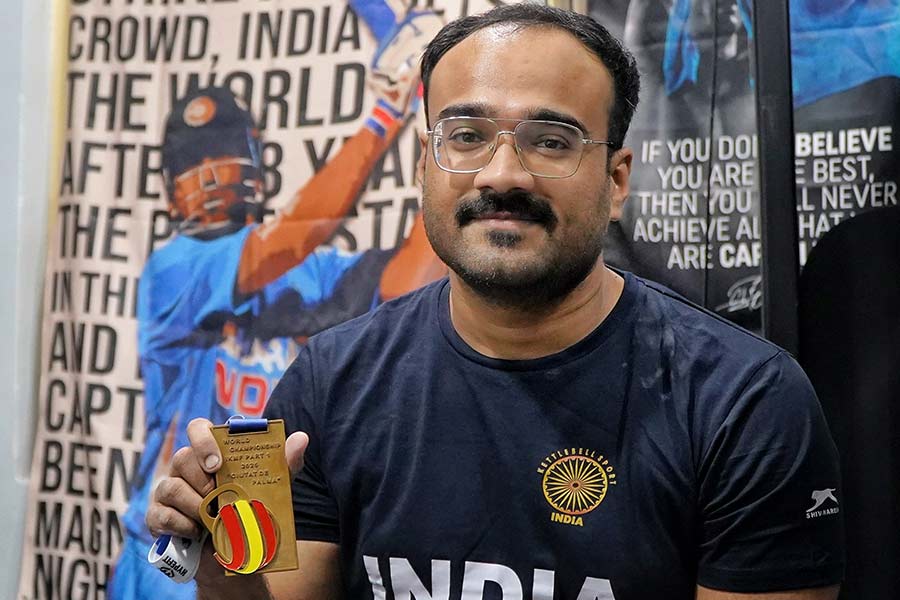
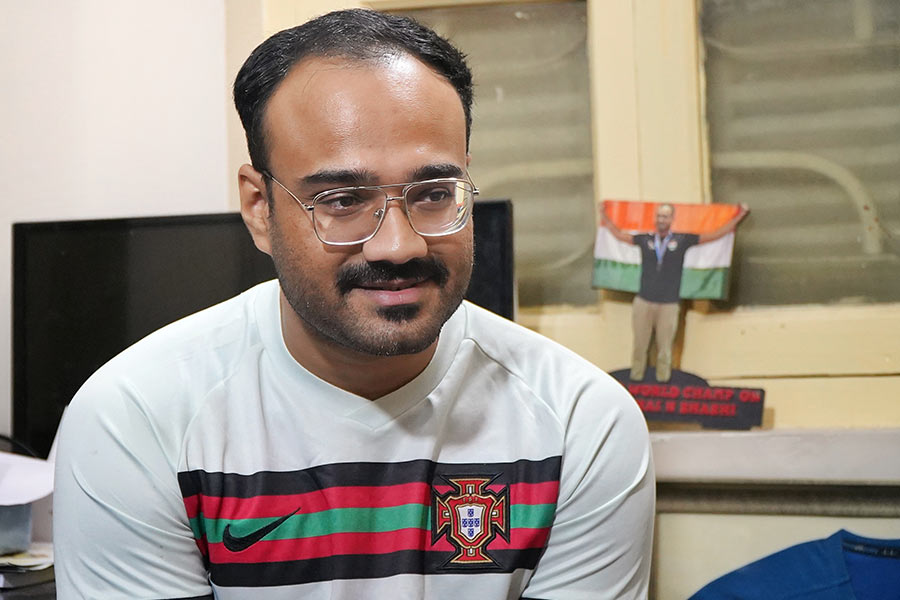
From a modest Kolkata gym to the world podium, kettlebell champion Danish Naushad lifts dreams without the weight of support — just sheer will.
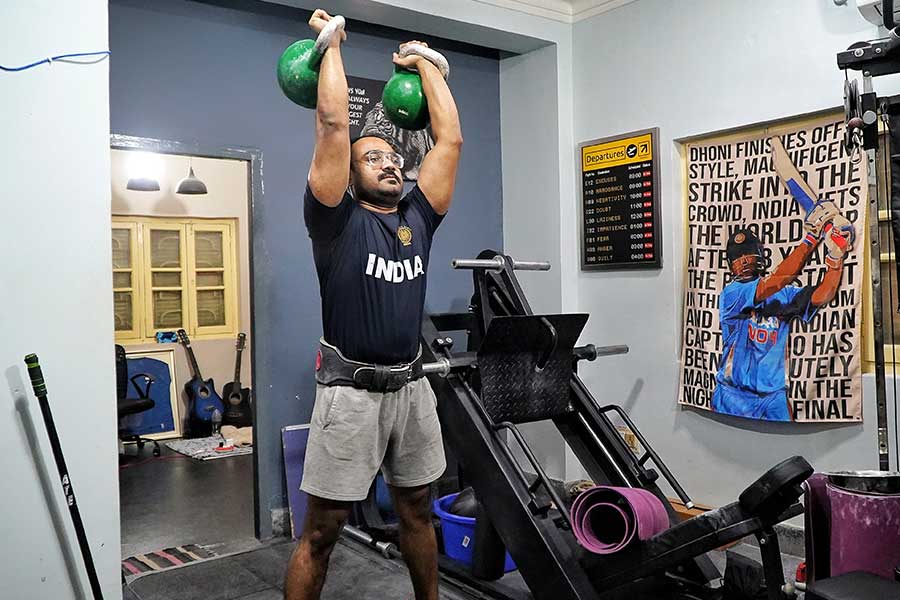
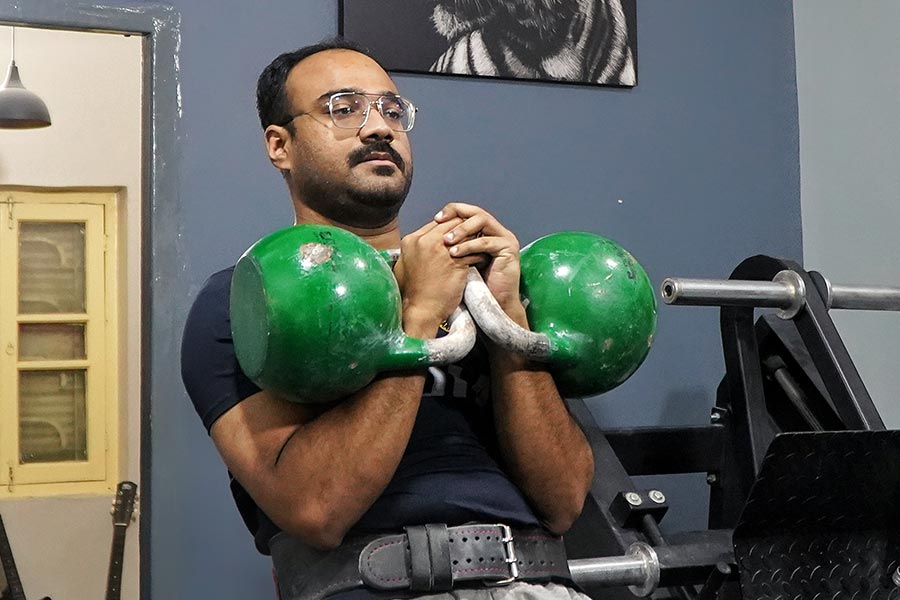
Danish Naushad is raising the tricolour at an international level, one lift at a time / All pictures by Soumyajit Dey
In 2017, Danish Naushad was training for the National Defence Academy (NDA) and following standard hypertrophy routines at a modest Kolkata gym. It was there that a chance encounter with a little-known piece of equipment — a kettlebell — set him on a path he had never imagined.
“A trainer named Saikat introduced me to it. It was kept in a dusty corner. We started with swings, and I found it refreshing, different,” said 28-year-old Danish.
Kettlebell: The unseen sport
Kettlebell lifting — or Girevoy Sport as it’s known in Russia — is an endurance-based strength sport. Unlike Olympic weightlifting that focuses on one-rep max lifts, kettlebell events run for 10 minutes or more, demanding relentless reps without setting the weight down.
Danish Naushad practicing at his home gym
“You need technique, lungs, and legs — not just muscle. That’s what people don’t understand,” Danish explained.
From NDA dream to a new calling
Danish was on track to join the NDA but couldn’t pursue it due to personal reasons. He fell into depression and briefly left home. But his family pulled him back — and his gym community, too. “My gym owner said, why not go ahead with fitness? That changed my life.”
He became a certified trainer under NASM (National Academy of Sports Medicine) and began coaching clients worldwide. Danish is also a certified strength training specialist under ISSA (International Sport Sciences Association). He reinvested his earnings into his athletic journey — even selling his dream Kawasaki Z900 to build a home gym.
Early Failures and the Ego Check
Danish’s raw strength took him through his first competitions, but failure at a 2018 state meet — where he only received a participation certificate — deeply affected him. “That shook me. I was overconfident, relying only on my shoulders.”
Danish built his home gym by selling off his dream bike, a Kawasaki Z900
That humbling led him to coach Arnab Sarkar, a pioneer of the kettlebell sport in India. “From 2019, real training began. I learnt that patience and technique matter more than brute strength.”
National records and online competitions
Danish’s breakthrough came in 2020 with a national record of 155 jerks using double 16 kg bells. When Covid hit, he embraced the new normal — online competitions.
“We hosted the world’s first online kettlebell championship from India. Judged live over video calls. Over 100 athletes joined. It kept the sport alive.”
Setbacks and redemption
In 2022, a missed visa meant he couldn’t compete at the IGSF (International Gira Sport Foundation) World Championship in Greece. But luck turned when the IUKL(International Union of Kettlebell Lifting) hosted a world event in Delhi later that year. Danish won bronze — his first world medal.
From missing a tournament due to visa issues to securing gold at the next, Danish’s story is an inspiring one
He followed that up with an emotional win at the 2024 IKMF (International Kettlebell Marathon Federation) World Championship in Denmark, clinching gold in the double pentathlon — an event he hadn’t prioritised. “I was shocked. I was going to the washroom and heard my name being called.”
Spain 2025: Against the odds
Preparing for Spain’s 2025 IKMF Championship, Danish dropped nearly 8kg in weight and doubled down on training. He lifted 52 reps in the 40 kg event — a personal best, finishing fourth against heavier European lifters.
Danish posing with his most recent gold won at Spain’s IKMF Championship 2025
But once again, it was the pentathlon — the side event — where he struck gold. “The event I didn’t bet on gave me the biggest reward. It’s always like that.”
Kettlebell in India: No support, all heart
Despite multiple international medals, Danish receives no government support. “There’s no funding, no recognition. We pay for our own visas, travel, gear.”
He dreams of a future where kettlebell lifters are backed by the government like in Russia — where athletes are promoted in the army or railways for their achievements. “Here, we don’t even get a pat on the back. But we keep going.”
Training the next generation
Danish now coaches aspiring athletes, including those who can’t afford international travel. “I’ve taken athletes to nationals on my own dime. One under-60 kg lifter I train could be among India’s best.”
He sustains himself as a full-time online coach, training clients across the US, Mexico, and Canada via Zoom. “I do assessments, build personalised programs — some people just have a rope or dumbbell at home. I make it work.”
Faith, focus and Bernabeu dreams
Danish credits his spiritual journey — one that deepened post-Ramzan in 2024 — for helping him stay grounded. “I pray before every event. Not to win, but to not come back sad. That matters more.”
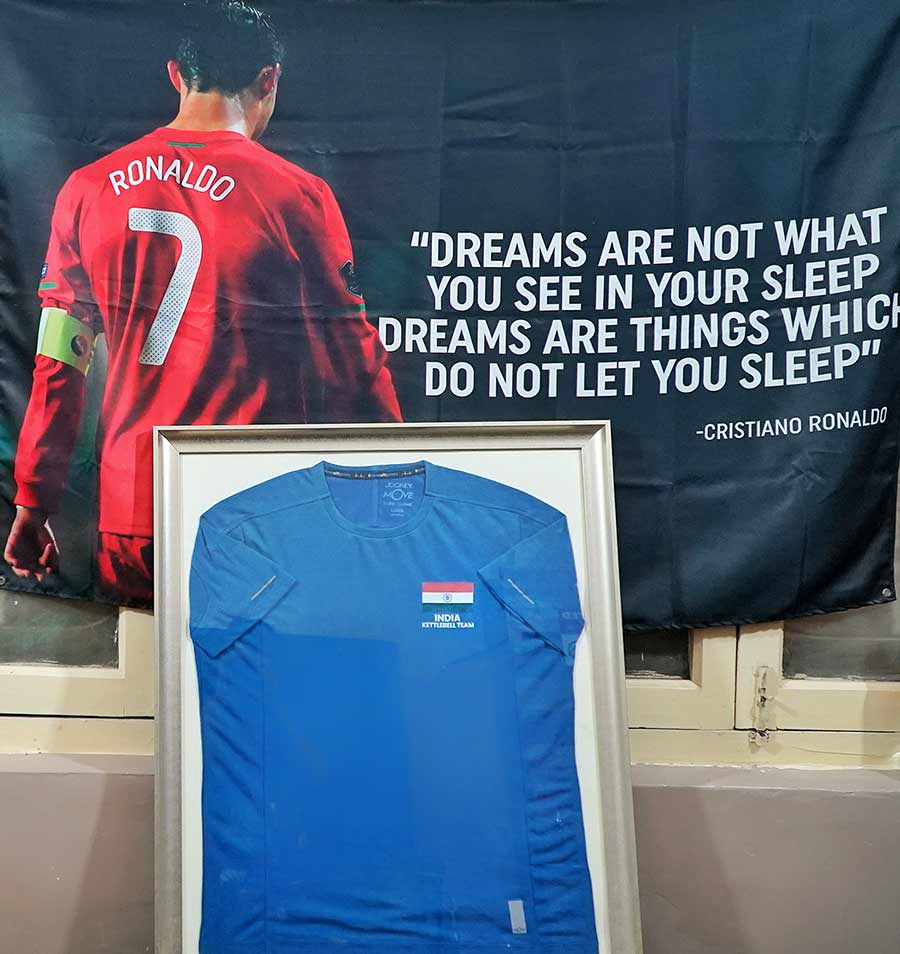
Danish has his gold winning jersey from Denmark framed. His idol is Cristiano Ronaldo and being able to see Real Madrid’s stadium was a dream come true for him
In Spain, he fulfilled a childhood dream — visiting Real Madrid’s Santiago Bernabeu stadium. “The quote I remember is, ‘The jersey can be stained with blood, sweat, and mud — but never with shame.’ That’s how I see my Indian jersey too.”
The road ahead: Hungary and beyond
Next stop: Hungary, for the IKMF World Championship in November 2025. For now, he’s training without a coach — building his own programs and aiming to hit CMS (Candidate for Master of Sport) and then MSWC, the highest global kettlebell rank.
“We dream of beating a Russian in Russia one day,” he says with a smile. “That’s the moment we’ll know we’ve done something.”
A final word
Danish has made his aspirations clear and he hopes backing will come at some point in his career
Eight years into his journey, Danish Naushad still doesn’t consider himself accomplished. “When I win a world medal under the Indian flag — with government recognition — only then will I say I’ve made it.”
Until then, the man from Kolkata will keep lifting. Not just weights — but the hopes of a sport still struggling for a place under India’s sporting sun.
source: http://www.telegraphindia.com / The Telegraph Online / Home> My Kolkata> People / by Debrup Chaudhuri / June 25th, 2025
Ohida Khandekar’s Dream Your Museum, an installation and film about her uncle’s collection won the V&A’s Jameel Prize for contemporary art and design inspired by Islamic traditions.
Selim Khandakar with his grand-niece and the trunks housing his collection. | Photo Credit: Anand Kumar Ekboty
Selim Khandakar, 71, has always dreamt of making a museum in his village for the 12,000-plus objects he has collected over 50 years. A small portion of that collection has now reached one of the best museums in the world — the Victoria & Albert Museum (V&A) in London — thanks to his artist niece, Ohida Khandakar.
Ohida, 31, has turned her uncle’s lifelong obsession into an installation and film — Dream Your Museum — which won the V&A’s prestigious Jameel Prize for contemporary art and design inspired by Islamic traditions. The work is not just a tribute to what seems to be her uncle’s calling; it also challenges colonial museum structures and asks whether ordinary, personal objects deserve a place in museums. Can museums be flexible and inclusive spaces, showcasing the narratives of minority communities and customs? Are private collections the exclusive privilege of the rich?
The installation and film, ‘Dream Your Museum’, at the Victoria & Albert Museum (V&A) in London.
Selim worked as a doctor’s compounder in Kolkata and started collecting random objects from the year 1970. A stamp exhibition piqued his interest first, prompting him to start collecting them. He also came across an exhibition of vintage objects from Mallik Bari, one of Kolkata’s heritage homes. “It was a record of what objects were used in the ancient times and how lives were led,” Selim tells me over a Zoom call from his home in Kelepara, a village near Hooghly, West Bengal. “It inspired me to start collecting whatever felt like a record of the common person’s life and times. From bus tickets to stamps to refills of pens, I wouldn’t throw anything away.”
An assortment of rare and mundane items makes up Selim’s collection. Old clocks, inscribed ceramics, vintage records and music players, letters dating back to Partition, perfume bottles, crystal rocks, hand fans, stamps, handbills, ink pots, cameras, train tickets, receipts, even matriculation answer sheets from the 70s!
Selim Khandakar surrounded by the objects he has collected over the years. | Photo Credit: Anand Kumar Ekboty
Gramophones to baby clothes
Much of Selim’s collection is housed in tin trunks and scattered across his home in Kelepara. It sometimes becomes a ‘travelling museum’ for people in the village to explore and interact with the objects as Selim takes them around. There is curiosity, awe, some ridicule, some laughter, and from those who understand history and record keeping, even encouragement.
Ohida’s film captures Selim walking through village fields with his trunk, stopping by the river to rinse some crystal stones, and holding them up to the sun. “Where did you find these, nanu?” asks Maria, his grand-niece, who appears in the film. “In the graveyard,” Selim replies.
Selim Khandakar walking through village fields with his trunk. | Photo Credit: Anand Kumar Ekboty
Ohida, who studied art at the Government College of Art & Craft, Kolkata, and Jamia Millia Islamia, New Delhi, says it is sometimes hard to understand what keeps her uncle going. Is it hoarding, as his exasperated family has often believed? She and Selim don’t think so. Instead, he thinks his collection, much like Dream Your Museum, is about storytelling. “Collecting is my way of showing people from my village a glimpse of things from around the world,” Selim notes. “Like rare coins dating back to the Mughal period or vintage perfume bottles from around the world. Often people here do not get a chance to go to cities to see such things. That’s what has always kept me going.”
Selim Khandakar’s house that was destroyed after a cyclone.. | Photo Credit: Anand Kumar Ekboty
Once displayed in his modest mud house, now destroyed after a cyclone, Selim’s possessions came close to being discarded by his family until Ohida decided to document it digitally. She reacquainted herself with both her uncle and his collection when stuck at home during the pandemic. To her artist’s eye, it is a compelling one, given its range — from gramophones to baby clothes from the 80s. “It even has a bunch of fingernails [Selim’s own] in a box. It reminds me of Marcel Duchamp’s Dadaist Fountain exhibit [1917], where he displayed an upside-down urinal. Such objects challenge conventional notions of what belongs in a museum. These items, including a broken plate passed down through generations, show the power of storytelling through objects.”
Selim laughs when asked about the fingernails. “I had once visited an exhibition where I saw art made with fingernails and thought I would do the same with mine. It made me curious, so I kept them.”
What makes a museum?
Curiosity has been the driving force behind Selim’s obsession and this is what Ohida celebrates in her work. Maria accompanies Selim throughout the film, asking him curious questions about the objects in his collection, an attempt to peek into his mind. Ohida started filming Dream Your Museum as an entry for the 2022 Berlin Biennale, where it was received well, eventually landing her the V&A award.
Filmmaker Ohida Khandakar
Growing up in Kelepara, Ohida hadn’t stepped inside a museum until she came to study art in Kolkata. “I had achieved my dream of studying art and moving beyond a village where many women still had no voice and were married off early. It made me wonder — was there a limit to our dreams? Was there a limit to the dreams of my uncle, a rural, aged Muslim man?”
With the funds from the award, Ohida is now hoping to create a museum for her uncle’s collection and a cultural space in the village. “We need accessible museums that work as alternative spaces for the narratives of rural minority communities; as safe spaces for women without opportunities; to engage those who might not typically visit traditional museums due to a lack of knowledge, distance or financial constraints.”
In Dream Your Museum, her camera gently films Selim among his collections in his crumbling ancestral home. He expresses frustration at having no permanent place even after 50 years to showcase his prized collection. “I’ll now make a museum on the moon,” he declares.
The writer is a freelance journalist and the co-author of ‘Rethink Ageing’ (2022).
source: http://www.thehindu.com / The Hindu / Home> Entertainment> Art / by Reshmi Chakraborty / April 20th, 2025
Marui Village (Nawada District), BIHAR / Kolkata, WEST BENGAL :
A young Jamal who met Gandhi in 1947 later shaped Kolkata’s hospitality scene and contributed to renowned chains like Arsalan and Mezban.
A scholar of Sanskrit, he is a well-known figure in the city’s literary circles. However, despite his generous donation of 15 katthas of land for a government hospital, the Bihar government has yet to honor the donors, leaving his legacy unacknowledged.
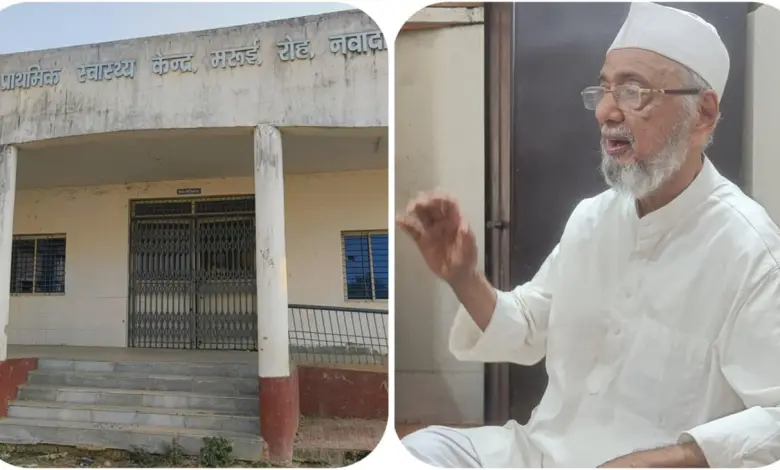
Primary Health Centre in Marui, Nawada and Jamal Ahmed ‘Jamal’
Kolkata:
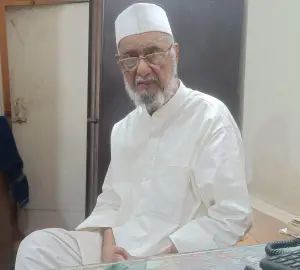
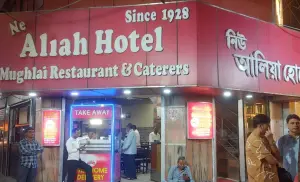
In the heart of Kolkata’s vibrant Prafulla Sarkar Street, Jamal Ahmed, the 98-year-old hotelier and poet, sits in the backroom of Aliah Hotel, his voice resonating with the same intensity as the lively street outside.
Jamal Ahmed, a nonagenarian, is known in the city as a poet and a concerned citizen. But the 98-year-old is also a philanthropist. He has donated 15 Katthas of land in his native village in Bihar for a government hospital, which last year became operational.
A Philanthropic Legacy: Land Donation for a Government Hospital in Bihar
“The land (in Marui village, Nawada district) was the costliest in the adjoining areas. But my father, who decided to donate it to the government to build a hospital there, did not hesitate,” informed Firdaus Jamal, son of Jamal Ahmed.
The market rate for land in Marui village is at least Rs 20 lakhs per kattha. In Bihar’s Nawada district, one kattha of land is equivalent to 3 decimals.
“I had told my mother that one day there will be a hospital in your name. So I had to do it,” Jamal Ahmed told eNewsroom. The family proposed the name of the hospital as QZJ Government Hospital, incorporating the names of Jamal and his parents. There is a board at the hospital where Jamal Ahmed Jamal’s name as the donor is mentioned. However, the Bihar government has yet to adopt the name suggested by the donors’ family.
The 20-bed primary hospital is now operational.
Poet Jamal Ahmed ‘Jamal’ | eNewsroom
When donating, I did not make any demands, such as asking for government jobs for my family members or insisting that a doctor from my family should practice here,” he said.
“I demand that either the Bihar Chief Minister (Nitish Kumar) or the Health Minister inaugurate the hospital,” the donor added.
Jamal Ahmed, a multifaceted personality, knows five languages and completed his Master’s in Sanskrit from Banaras Hindu University (BHU) and his Bachelor’s in Science (BSc) from Patna University. He frequently uses Sanskrit shlokas in his poetry. Much of his poetry focuses on communal harmony in the country.
A major event in his life was meeting the Father of the Nation, Mahatma Gandhi, on August 13, 1947 in Kolkata.
A Life of Literature and Peace: Jamal Ahmed’s Encounter with Mahatma Gandhi
“I was just 18 years old, but Gandhiji was desperately seeking peace for the country. When I heard that Gandhiji was in Kolkata and my uncle, Kareem Sahab, was going to meet him, I joined my uncle and reached Beleghata,” recalled the nonagenarian, quickly adding that he has no picture with Gandhiji.
“In my brief interaction, I requested Gandhiji for peace in the country and to stop the riots. Gandhiji replied that he came to Kolkata for this very purpose and would be traveling to other parts of the country for the same reason.”
The well-known hotelier has great command over recipes and dishes. “I have helped several hotel outlets in Kolkata and abroad set up their centers. Some of them are now big names, like Arsalan and Mezban.”
Jamal Ahmed’s sons run several hotels in Kolkata, including the famous Arafat Hotel on Rafi Ahmed Kidwai Road, which is managed by Firdaus Jamal.
Aliah Hotel on Prafulla Sarkar Street—where Jamal Ahmed feels he gains the wings to fly.
Preserving Harmony Through Poetry: The ‘Tatkal’ Poet’s Message for Unity
But in Kolkata’s literary circles, ‘Jamal’ is known for his ‘Tatkal’ poetry. A ‘Tatkal’ poet is one who can deliver a poem instantly, depending on the situation.
“I was very young when I met Gandhiji, and still, I recited a poem for him:
Andhi Tawaf Karti Hai, Gandhi Ki, Aye Jamal. Ye To Bhanwar Se Laye Hain Kashti Nikal Ke
(The storm circles around Gandhi, O Jamal. He is the one who has brought the boat out of the whirlpool.)”
The poet ‘Jamal’, an Acharya in Sanskrit often uses the couplet to promote communal harmony.
Yem niza pro weti ganna laguchetshaam udarnaam chatrinantu, washudhew kutumbakam.
A rough translation of this Sanskrit couplet is:
“This is ours, that is yours—those who think this way have small hearts. But for the great ones, the entire world is one.”
He also mentioned that the shloka is written at the entrance of the old Parliament building’s gate. Eleven members of Parliament, including Maulana Azad, had agreed to imprint it there.
source: http://www.enewsroom.in / eNews Room India / Home> Art & Culture> Bengal / by Shahnawaz Akhtar / February 19th, 2025
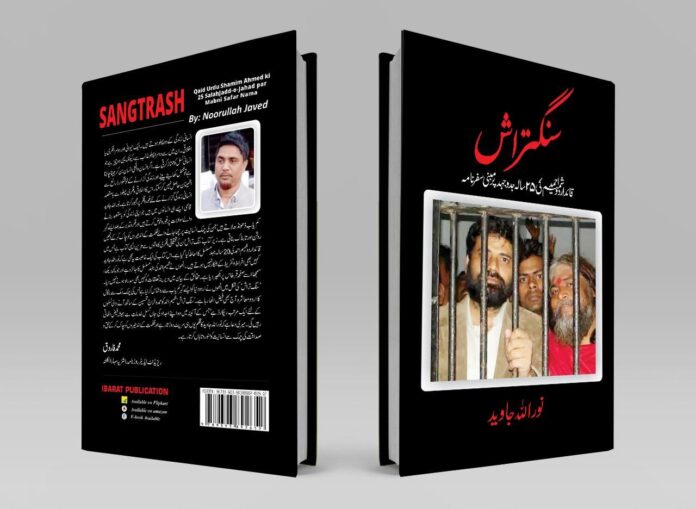
“The Book SangTrash: Shamim Ahmed’s account of the fight for human rights and Urduh” penned by Nurullah Jawaid is an immersive and powerful exploration of the life and activism of Shamim Ahmed, one of India’s most distinguished human rights advocates. As a pioneer of the Urdu movement, Shamim Ahmed’s story is one of unwavering dedication to social justice, human rights, and the preservation of cultural identity in the face of systemic injustice and political turbulence. This book, rich in historical and cultural context, offers an in-depth look at the life of a man who was not only a visionary leader but also a symbol of courage and resilience in the fight for equality and dignity.
The book delves into Shamim Ahmed’s lifelong struggle to address some of the most pressing socio-political issues of his time. Set against the backdrop of India’s dynamic and ever-evolving socio-political landscape, “SangTrash” chronicles Shamim Ahmed’s tireless efforts to combat the deeply ingrained inequalities that plagued the country, particularly the discrimination faced by marginalized communities. These efforts were not limited to his work as a human rights advocate but extended to his role as a cultural leader, educator, and innovator. Through the lens of his activism, the book paints a vivid picture of the complexities of Indian society during times of immense political and social upheaval.
Shamim Ahmed was not merely a passive observer of the struggles faced by the oppressed and underprivileged. He was a relentless force working to bring about tangible change. From his early days as a young idealist, Shamim Ahmed was deeply moved by the plight of the marginalized—those whose voices were suppressed by both society and the political elite. His passion for human rights led him to establish the Human Rights Protection Association (HRPA), an organization dedicated to addressing human rights violations across India. Through this platform, Shamim Ahmed sought to mobilize citizens to stand up for justice, regardless of their background, religion, or ethnicity.
In addition to his advocacy for human rights, Shamim Ahmed is best known for his work with the Urdu Movement. At a time when the Urdu language was facing marginalization and disintegration due to political pressures, Shamim Ahmed took it upon himself to revitalize and protect the language as an integral part of India’s cultural and literary heritage. His campaigns to promote Urdu literacy and its inclusion in educational institutions were not just about language preservation; they were about the empowerment of communities who saw Urdu as an essential part of their identity. Through this movement, Shamim Ahmed demonstrated that language is not merely a means of communication but also a symbol of cultural resistance and resilience.
As the narrative unfolds, “SangTrash” brings into focus the challenges Shamim Ahmed faced along the way. His activism was not without its detractors. Political opposition, societal resistance, and personal sacrifices were all part of the price Shamim Ahmed paid for his unwavering commitment to justice. The book sheds light on the obstacles he encountered, from the government’s attempts to suppress his initiatives to the skepticism and hostility from those who feared change. Yet, despite these challenges, Shamim Ahmed’s resolve remained unshaken. His determination to bring about social change and protect the rights of the disenfranchised never faltered, even when his own safety was threatened.
Shamim Ahmed’s legacy is further immortalized through his initiatives such as the “Food for All” campaign, which aimed to address hunger and poverty in India’s rural and urban areas. The campaign sought to ensure that food was available to every citizen, regardless of their social status, and to promote sustainable agricultural practices that would reduce reliance on outside aid. Through his leadership, the campaign brought together communities, activists, and policymakers, resulting in significant strides towards alleviating food insecurity in many regions.
Nurullah Jawaid’s writing not only brings Shamim Ahmed’s efforts to life but also contextualizes them within the broader historical and cultural milieu of India. By delving into the political, social, and economic landscape of Shamim Ahmed’s era, the book offers readers a nuanced understanding of the obstacles that activists and marginalized groups faced during this turbulent period.
“SangTrash” is a deeply informative and educational work that highlights the interconnectedness of human rights, cultural preservation, and social justice. It challenges readers to reflect on the ways in which systemic inequalities continue to shape society and the moral responsibility that each individual bears in addressing them.
The book also pays tribute to the human rights defenders who, like Shamim Ahmed, dedicate their lives to advocating for justice in an often hostile environment.
In telling Shamim Ahmed’s story, Nurullah Jawaid brings to the forefront the importance of collective action. The struggles faced by Shamim Ahmed were not his alone; they were shared by countless others who, inspired by his work, joined in the fight for a more equitable and just society. This collective action is central to the book’s message—individual activism can spark movements, but only through solidarity and collective efforts can lasting change be achieved.
“SangTrash” is not merely a biography of a prominent figure in Indian history. It is a call to action. By recounting Shamim Ahmed’s life and the impact of his work, the book challenges readers to engage with the pressing social issues of today, particularly those related to human rights, inequality, and cultural identity. The lessons of Shamim Ahmed’s life are timeless, and the values he fought for—equality, dignity, and mutual respect—remain as relevant as ever.
This book is also a reminder that activism is not always glamorous or celebrated in its time. Often, it is the courage of individuals like Shamim Ahmed, whose actions go against the grain of societal norms that change the world for the better. “SangTrash” is, therefore, more than just the story of one man; it is an inspiration for anyone who believes in the power of activism to bring about positive, meaningful change. It challenges readers to question the status quo and to take responsibility for shaping the future in a way that is more inclusive and just for all.
In conclusion, “SangTrash” is a tribute to Shamim Ahmed’s life and legacy. It is a book that encourages readers to consider the ways in which activism, grounded in human rights and social justice, can transform society. By examining the key moments in Shamim Ahmed’s life and the challenges he overcame, the book underscores the enduring importance of standing up for what is right, even in the face of adversity. Through this compelling narrative, “SangTrash” becomes not just a biography but a powerful call for activism in today’s world.
source: http://www.muslimmirror.com / Muslim Mirror / Home> Books> Positive Story / Reviewed by Kulsum Farooque / February 14th, 2025
Ustad Waseem Ahmed Khan on maintaining his gharana’s parampara and his views on music.
Ustad Waseem Ahmed Khan
The illustrious Agra gharana of Hindustani classical music has had distinguished exponents and teachers who have imparted this school of music to countless disciples over the centuries. Ustad Waseem Ahmed Khan is a prominent vocalist of this gharana.
Born in 1974, Waseem Khan is the grandson of Ustad Basheer Khan from his father’s side and of Ustad Ata Hussain Khan from his mother’s side. He has thus inherited the rich repertoire of both the khandans . He took his initial taleem (education) from Ata Hussain Khan at the age of six. Thereafter, he learnt from his father, Ustad Naseem Ahmed Khan.
Waseem’s debut performance was at the age of 10. In July 1999, he became a scholar of ITC Sangeet Research Academy ( ITC – SRA) under erstwhile guru Ustad Shafi Ahmed Khan. He left the academy in April 2003 as an A-grade scholar. Since then he has performed at various venues all over the world, sharing the stage with maestros. He taught for five years as a senior faculty member of Shakhri Begum Memorial Trust, an academy run by Ustad Rashid Khan and is currently assisting with ITC-SRA projects. He is also a regular performer for All India Radio.
Waseem, based in Kolkata, will give his first ever concert in Kerala at the Kerala Sangeeta Nataka Akademi Hall, Thrissur, on September 21 at 5 pm. Prior to the concert, Waseem spoke to Friday Review on his gharana, Indian classical music and more. Excerpts from an e-mail interview.
What are the defining features of the Agra gharana?
The voice production is distinctive; the voice throw is open-throated. The other distinctive features are nom-tom alaap (the rhythmic section where the raga develops with a steady pulse employing syllables such as non-tom but without the binding of tala). The method of presenting a bandish (fixed, melodic composition) is also distinctive of this gharana. We break the bandish into many parts. For example, if there is an interesting line in the antara, we use this line for bol tan (rhythmic pattern of notes which uses the words of the bandish), bol bandh, bol vistar and so on. We are not supposed to create an artificial voice but rather polish the one gifted by God.
Is there an amalgamation of features of various gharanas in the Hindustani music we hear today?
Yes. It is healthy as long as one is able to express one’s identity clearly. Every gharana has its own beautiful features. Artistes of the past also adapted the features of other gharanas and enriched their music. They, however, retained a stamp of their gharana, which could be identified by the opening ‘sa’.
Being part of an ancient and reputed gharana, what are your responsibilities? Do you have another generation to take on the mantle?
It is a huge responsibility. But I feel proud too. I consider it is my duty to carry on this tradition and, if possible, enrich it. The most important aspect is to pass on this legacy to the next generation. My young daughter has started learning it and I’m also teaching students at the ITC-SRA Kolkata apart from my own students. The Agra gharana, today, has a lot of good artistes making their mark in the world of music.
Ustad Waseem Ahmed Khan
What is your opinion about lighter forms of classical music such as thumri, dadra…?
It is beautiful to sing the light forms also. Old masters of our gharana like Ustad Faiyaz Khan Sahib, for instance, used to sing the thumri and the dadra. I sing these in almost all my concerts. It is nice to switch to a relaxed mood after a heavy khayal.
Is there a link between spirituality and Indian classical music?
Definitely! Music without spirituality is meaningless. Our bandishes address gods irrespective of religion, requesting their mercy for the well-being of this world.
How do you decide which raga to sing at a concert?
The time of the concert plays an important role. Each raga is associated with a specific time. We follow that strictly. But this can be modified depending on the weather and the mood of the concert. For example, Malhar is a night raga. But we may choose it intuitively during a concert held in the day if it is raining outside. We do it because we feel that it will suit the mood and the effect is usually amazing. During festivals like Durga Puja or Basant Panchami, we render ragas like Gouri, Durga or Basant accordingly. And if it is a concert series, we render it according to the raga rendered earlier.
How much does an audience affect your performance?
Like any musician, I love to sing before a huge audience. But there should at least be a handful of good listeners whose presence should motivate me to sing wholeheartedly. In the past, music was confined to a few, now it is accessible to millions across the globe. The gharanas are flourishing, Dhrupad and khayal are intact, there are gurus and shishyas, and there is innovation.
Do you think that the classical music scene is strong and prosperous?
I don’t think there is any threat to good music. Earlier, maharajas were the promoters of classical music. Now we have corporates and organisations in that place. I can say that ITC is a classic example. Then there are organisations like SPICMACAY and NCPA that have also done their bit to carry forward this great tradition.
How relevant is Indian classical music in the modern world?
It is relevant in the modern world. When I see young boys in half-pants touching my feet and learning classical music seriously, I feel it is because they feel it is pertinent. And in the West, the young generation has taken it up enthusiastically.
If you were asked to pick a memorable concert, which would you choose and why?
That’s a tough one. There are so many, like the one in New York recently where the listeners asked me to sing only khayals with elaborate nom tom alaap and not even thumri or dadra. I was surprised. I’m looking forward to the concert series here where I’m sure I will be in the company of avid listeners.
Is the guru-shishya parampara still existent? And what is the best way of doing riyaaz (practice)?
I teach my students the same way I learned from my gurus. But it was tough then, as the gurus were task masters. In the case of riyaaz, my advice would be to do ‘Kharaj Riyaaz’(practice of holding notes on the lower octave, where every single sur is used with full breath) in the morning. It is extremely important for improving one’s voice culture.
If not a professional musician, what career would you have chosen?
I would have been a cricket player, perhaps. I was passionate about the game and played it during my college days. I admire Sourav Ganguly, I’m a great fan of his.
source: http://www.thehindu.com / The Hindu / Home> Entertainment> Music / by K Pradeep / September 19th, 2019
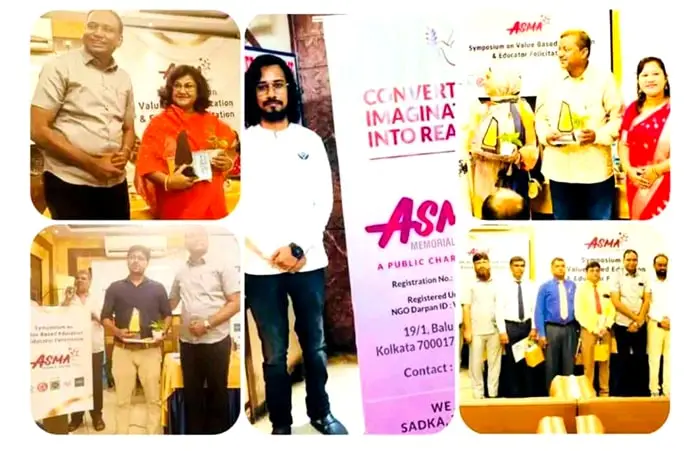
Asma Memorial Trust felicitates 80 educators including retired ones and specially-abled who served without recognition.
(Clockwise) Noor alam with Afaf Jameel, Junaid Kamal, Sangita Gurang (red sari) and the felicitated ones
Kolkata:
When the name of Junaid Kamal was announced, a 32-year-old man, with the help of two crutches, tried to stand up from his seat and began moving towards the stage to be felicitated at Asma Memorial Trust’s function. Soon, the fine art teacher was assisted in walking to receive a memento, a plant, and a set of notebooks and pens.
It was the first time in his 13-year teaching career that the art teacher, who is associated with four different organizations in Kolkata and serves the community, was recognized as a specially-abled person (left leg and right paralysed).
“I am thankful for the felicitation. For someone like me, it is not only difficult to study, but getting a respectable job is another challenge. Even when you succeed, it is rare that people appreciate it in this fast-paced life,” the Academy of Fine Arts graduate told eNewsroom.
Junaid was not alone; at least 15 retired educators, from both government and private schools, were also felicitated at the event.
Dr Umar Khyyam (70) of Maulana Azad College, Mobark Ali Mobarak (65) from Bankura district Urdu School, Nurul Hoda (62) of Kankinara Himayatul Ghurba High School (underprivileged), and Ashraf Ahmad Jafri (65) of Karaya School, Kolkata, were among them.
There were also current teachers, such as Afaf Jameel of Frank Anthony Public School, Sangita Gurung of Assembly of God Church School, Michael A Panja of GD Goenka Public School, Dr Khalid Hossain of Monu Memorial Institution (Kolkata), Debashish from Well and Gold, Md. Shahnawaz of Noble Mission School, Mubashshreen Shakil of KS Consultancy & Academy, Shaguta Adnan, who teaches French, and Manwar Sultana of Sir Syed English Medium School, among the total 80 teachers who were felicitated.
The felicitated and the felicitetors together after Asma Memorial Trust’s event
Teachers from South Point, East West, Goenka, Albani Hall, Islamia, Mohammed Jan, Flair International, and Izma International schools were also honored.
Noor Alam, the founder of NEET Basket, who also established the Asma Trust in memory of his wife to promote value-based education and encourage those involved in it, told eNewsroom, “We used to celebrate Education Day on the birthday of India’s first education minister, Maulana Abul Kalam Azad. But this year, we started the celebration earlier and began by felicitating educators who have served society but have not received any recognition for it.”
Alam, the Rashtriya Shiksha Ratan Award winner also pointed out that during the felicitation, a plant was given to each honoree to symbolize how educators nurture children. Just as trees benefit society in many ways, a well-nurtured child can positively impact the community.
The chief guest, Indian Revenue Service (IRS) officer Shamsher Ahmad, who took voluntary retirement and started Crescent School in one of Kolkata’s ghettos—Topsia—shared his journey as an educator. “When I started the school in Topsia (in 2002), I decorated the building very well. People asked me why I was doing so. I told them that to build confidence in the Topsia students, they must study in a place that is not inferior to other major schools in the city.”
“In later years, to boost their confidence to appear for the Union Public Service Examinations, I used my contacts and made my school a center for the UPSC exam, which produces IAS and IPS officers. As a result, today our school produces doctors and students who pursue higher education after graduating from Crescent,” Ahmad said to the gathering.
Sangita Gurung of Assembly of God said a one liner for the teachers, “Teach what your preach and preach what you teach, is the motto remained in my career and it should be with every teacher.”
Dr Sarfaraz Adil, founder of Izma International School , reminded attendees of the importance of education in Islam and how it has been emphasized. “Getting an education is one of the fundamentals of Islam. It not only includes religious education but also opens doors to physics, astronomy, and chemistry. Before Islam, there was no scientific temperament in religion. Only the rich could study, but Islam made education accessible to everyone. Prophet Muhammad announced that any slave who learned and became educated would be freed. Later, a slave named Hazrat Barira became educated and declared that she should be freed, according to the Prophet’s word. And she was freed. Although it was difficult because she was married to an uneducated slave, she wanted her freedom and to be separated from her husband, so she was granted it.”
Dr Adil also had a message for today’s teachers: “Information is easily shared among students. So, what is important for teachers is to teach students skills and show them
source: http://www.enewsroom.in / E Newsroom India / Home> Bengal> Education / by Shahnawaz Akhtar / September 16th, 2024
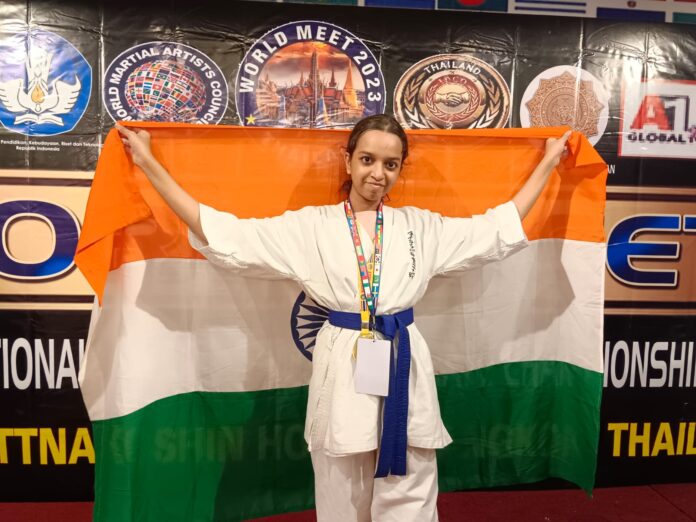
Humairah Shami, a young Karate champion from Kolkata, has recently earned the honour of representing India at the 7th World Meet, scheduled to take place on May 8, 2025, in Bangkok, Thailand, at the Royal Rattanakosin Hotel. This prestigious event is organised by the World Martial Arts Council. Although she is thrilled about this incredible opportunity, Humairah faces a challenge – the limited financial resources that may prevent her from attending.
Her father, Shami Ahmed, repairs footwear for a living. But due to poor health, he cannot work regularly. Her mother, too, has been battling a serious illness for the past three years. Despite these challenges, Humairah, along with her siblings, who are in grades 7 and 10, continues to pursue her education with the support of relatives.
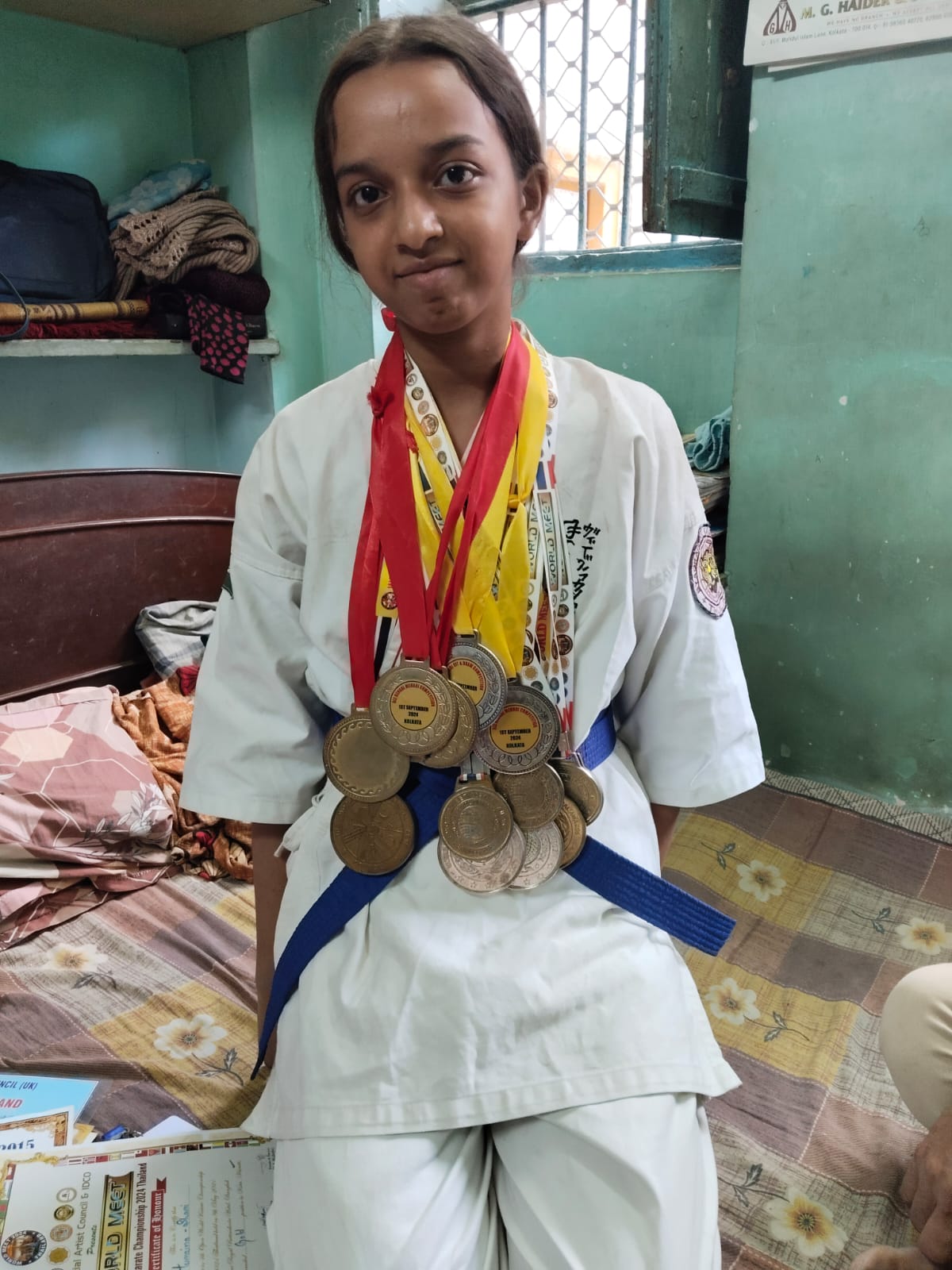
However, these obstacles have not dampened her spirit. Humairah’s determination to follow her dreams led her to enrol in a self-defence course at the Indian Karate Association. Encouraged by the academy’s founder, M.A. Ali, who seems to have recognised her potential and took her under his wing, she was trained free of charges. Humairah’s agility and passion for the sport enabled her to quickly master the karate techniques. It led her to qualify in the 45 kg weight category. She triumphed in every competition she entered.
In 2023-24, Humairah earned a gold medal in Thailand. Her journey to Thailand was made possible thanks to the support of her schoolteachers and well-wishers who contributed to her travel expenses. She was also honoured with the International Sports Award by King Sany Wijaya Nata Kusuma of the Padjadran Kingdom of Indonesia.
His Majesty the King Sany Wijaya Natakusuma of Padjadaran Kingdom Indonesia honouring Humairah with International sports award 2024 in Bangkok Thailand
Humairah has once again proven herself by qualifying to participate in the 2025 World Meet. Though she is still a blue belt and has a long way to go before earning the coveted black belt, her commitment remains unwavering. “I took up Karate for self-defence, and I will continue to persevere until I achieve my black belt,” she says.
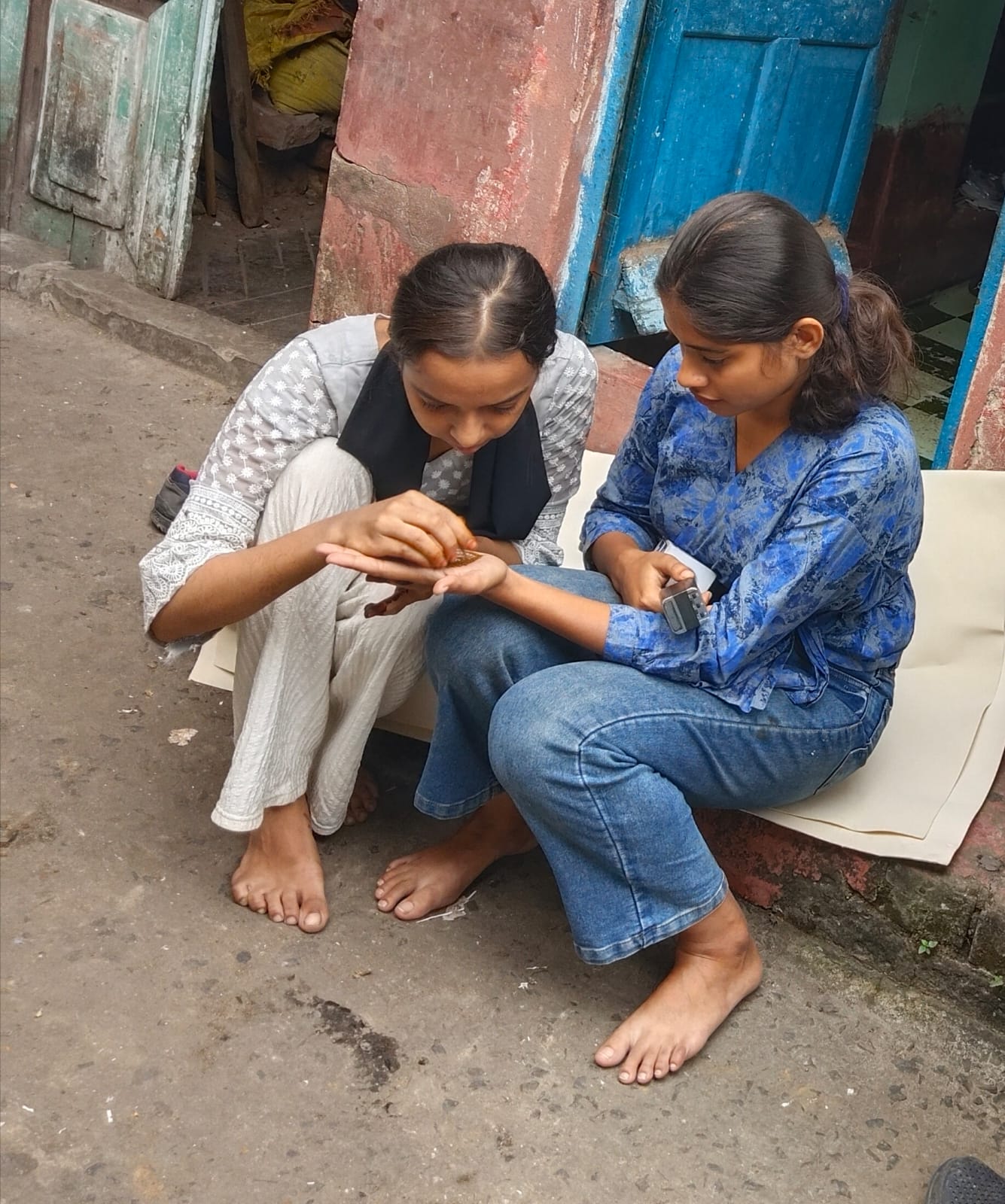
Humairah’s talents extend beyond Karate. During her holidays, she completed a crash course in Mehendi (henna) designing, and now, in her spare time after school and studies, she applies Mehdi to fulfil orders and earn some money.
A grade 11 student at Anjuman Girls High School, Humairah lives in the vibrant, bustling lanes of Mufidul Islam Lane in Kolkata. Her siblings look up to her, and her teachers hold high expectations for her future.
Deeply religious, Humairah dreams of becoming a doctor. She believes that her faith in God will help her overcome any challenge that comes her way. “Being able to go to Thailand last year was an impossible dream that came true. So, I am confident that the hurdles ahead will also be overcome, as I have utmost faith in Allah,” she says with a hopeful smile.
At present, Humairah is striving to raise the funds necessary to attend the 7th World Meet. In a remarkable show of resilience, she is using her mehdi art to raise money for her dream. Each intricate design is a testament to her determination to break through financial barriers and make her country proud.
“Despite coming from a financially disadvantaged family, Humairah has excelled in every field she has touched. Her dedication and perseverance have earned her a place in the prestigious 7th World Meet, where she will represent India on the global stage. This is a golden opportunity for her,” says her coach and mentor, M.A. Ali.
He further appeals to all philanthropists, sponsors, and kind-hearted individuals to help Humairah overcome her financial challenges: “Humairah’s story is a call to action for those who wish to invest in a bright young talent. Sponsoring Humairah isn’t just an act of charity—it’s an investment in a future filled with hope, ambition, and success. Let us unite as a community to ensure that financial constraints do not dim the light of this rising star.”
Those who wish to help Humairah in her journey can contribute to the following bank account:
Account Holder Name: Humairah Shami Bank Name: Punjab National Bank (PNB) Branch Name: Entally Account Number: 0088010367851 IFSC Code: PUNB0008820 Mobile Number: 7439884641
With the help of the community, Humairah can realise her dreams and take another step towards making India proud on the world stage.
source: http://www.twocircles.net / TwoCircles.net / Home> India News / by Nikhat Fatima, TwoCirlces.net / December 31st, 2024
City author Salil Gewali received Dr. APJ Abdul Kamal award recently during the release of Urdu edition of his book — ‘Great Minds on INDIA’.
The book was released by the Governor of Assam Gulab Chand Kataria at Raj Bhavan, Guwahati.
The function was attended by scholars and guests from Assam, Kolkata, Meghalaya and Manipur.
During the programme, Gewali was awarded “Dr. APJ Abdul Kalam Rashtra Gaurav Samman” by a Muslim organisation, Dr. APJ Abdul Kalam Foundation of Howrah, West Bengal for Gewali’s contribution to the nation.
The governor formally presented the award to the author and lauded him for his contribution to the country through his research-based book highlighting the profound impact of ancient Indian literature on Western luminaries.
Great Minds on India” was translated into Urdu by Dr. Syed Hussain of Hyderabad and edited by Abdul Khalique of Kolkata.
The book published by Dr. APJ Abdul Kalam Foundation, Howrah, has so far been translated into thirteen languages, including German.
The secretary of the organisation Abdul Khalique has also promised to distribute the Urdu edition to a minimum of sixty countries worldwide, ensuring its global reach and impact.
Gewali extended his appreciation to each member of the organisation for their support in translating and publishing his book in Urdu. He acknowledged the organisation’s dedication and commitment to its cause.
Gewali was honoured with multiple Ananda Sammelan Puraskars and Bhanu awards. In 2011, his contribution was further acknowledged with the prestigious Thomas Jones Award from the United Christian Writers’ Association.
Also having been prescribed as a study textbook in several academic institutes in India and Virginia in the USA, ‘Great Minds on INDIA’ stands as a testament to the rich cultural heritage and intellectual contributions of India to the world. It is an inspiring read that bridges the ancient wisdom of India with modern scientific and philosophical discourse, Gewali said.
“Know Your India” is Gewali’s another patriotic book, released by the Chief Minister of Sikkim in 2022. This title has recently been approved for higher classes in one of the prestigious schools in Kolkata. Gewali is also credited with a series of school textbooks prescribed by the Meghalaya Board of School Education (MBOSE).
source: http://www.meghalayamonitor.com / Meghalaya / Home> State / by Reporter (headline spell corrected) / June 25th, 2023