Mewat, RAJASTHAN :
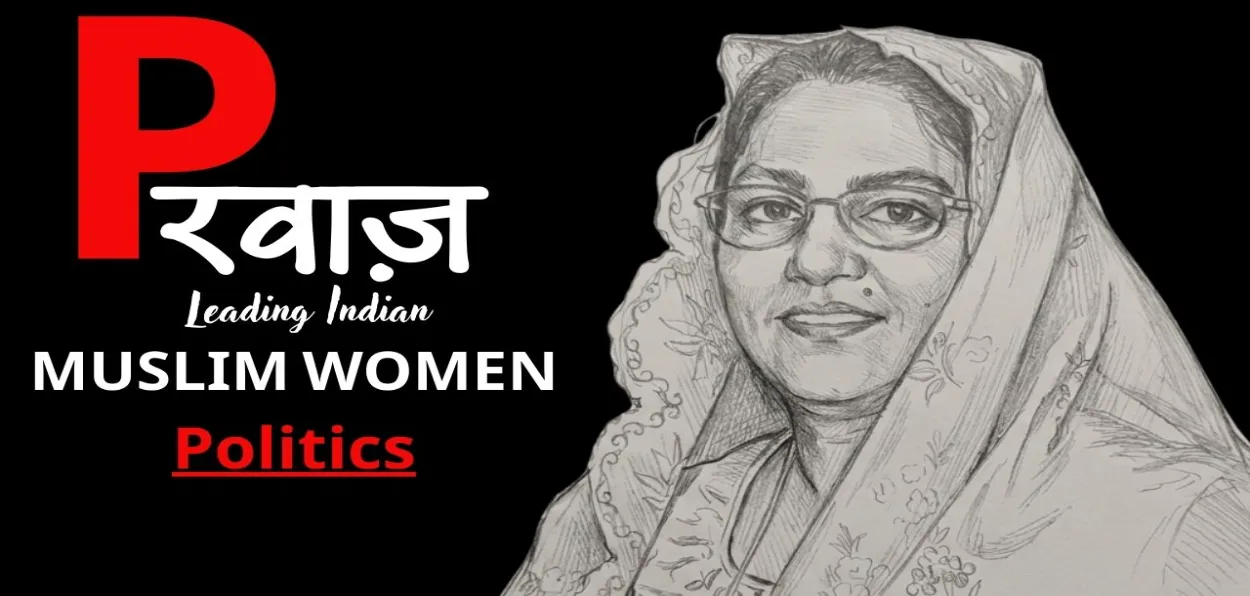
Zahida Khan
From Alwar in Rajasthan to the Mewat belt stretching across Nuh–Palwal, Faridabad in Haryana and the Mathura–Kosi region of Uttar Pradesh, Zahida Khan’s name is a source of inspiration for Mewat.
The first woman MLA from Mewat, Zahida, left her legal practice to enter politics. Today, she is not only a political leader but also a prominent face of Muslim politics in Rajasthan. Her political journey spans from courtrooms to the legislative assembly and the cabinet, and her influence is now clearly felt in the corridors of power.
Zahida Khan carried forward a rich social and political legacy. Her family has a long and distinguished history in Mewat’s politics. From her family, a few names —Chaudhary Mohammad Yasin Khan, Chaudhary Tayyab Hussain – are well known for their contribution to the region’s social and political life. Zahida Khan is the youngest of her four siblings, yet her work has set a new benchmark across the region.
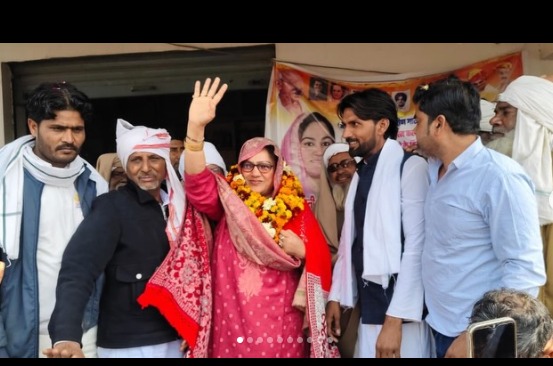
Zahida Khan at a public rally
Zahida Khan, 58, has inherited public life from her family. Her grandfather, Chaudhary Mohammad Yasin Khan—revered in Mewat as Baba-e-Qaum—launched a campaign for education in 1921. He founded the Brain Mew High School, which later became Yasin Mew Degree College.
He dreamed of bringing the Mew community into the national mainstream through education. Yasin Khan was a member of the United Punjab Legislative Council and later a member of the Punjab Legislative Assembly. He also holds the record of being elected unopposed as an MLA in 1957.
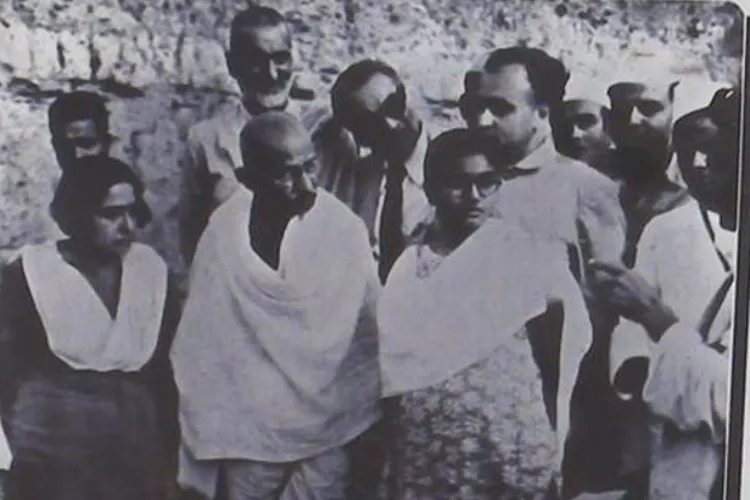
During Partition, he opposed the migration of the Mew community to Pakistan and invited Mahatma Gandhi to boost their morale. This is why the Mew community today stands confidently in India.
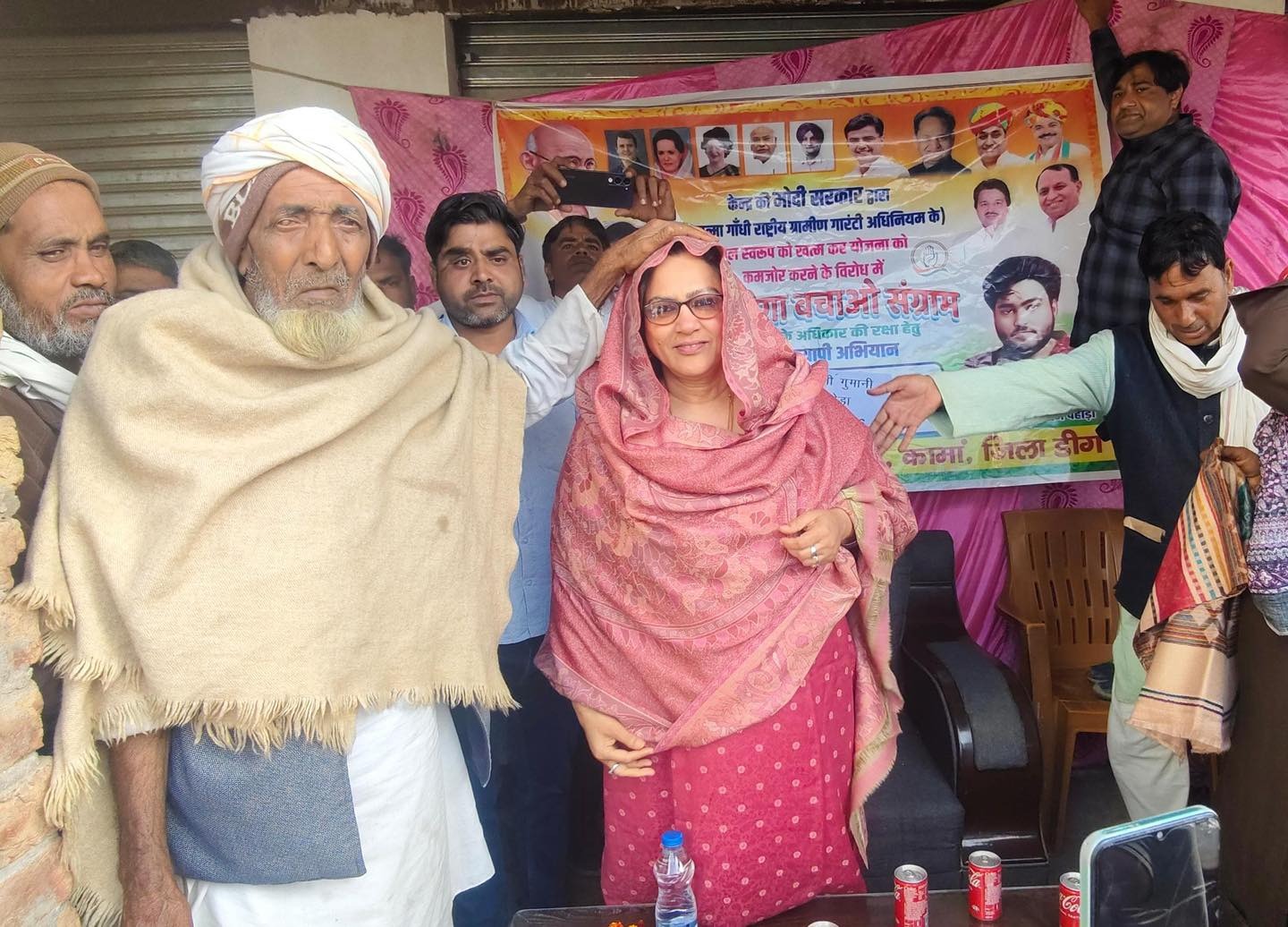
Zahida Khan being blessed by an elderly person
Zahida’s father, Chaudhary Tayyab Hussain, was among the rare Indian politicians who served as a minister in three states—Punjab, Haryana, and Rajasthan. He was an MLA from the Nuh and Taoru regions, served as Chairman of the Waqf Board, and was a strong advocate of education, minority rights, and social justice. His vision and leadership played a key role in organising and developing Mewat.
Zahida’s brother, Zakir Hussain, is the Administrator of the Haryana Waqf Board and has earlier served three terms as MLA from Nuh and Taoru.
Her younger brother, Fazal Hussain, has contested assembly elections from the Tijara region in Rajasthan. Her elder sister is a gynaecologist, and her brother-in-law is an ENT specialist.
Zahida received her early education at JMC School in Delhi and completed her graduation from MDU Rohtak. She earned her LLB degree from Delhi University and practised law at the Delhi High Court before entering Rajasthan politics.
In 2000, when her father, Chaudhary Tayyab Hussain, was a minister in the Gehlot government, panchayat elections were held. The Kama Panchayat Samiti seat was reserved for women. With unanimous support from the local community, Zahida was chosen as the most suitable candidate. She was elected unopposed as Chairperson of the Kama Panchayat Samiti—an achievement that remains a record to this day.
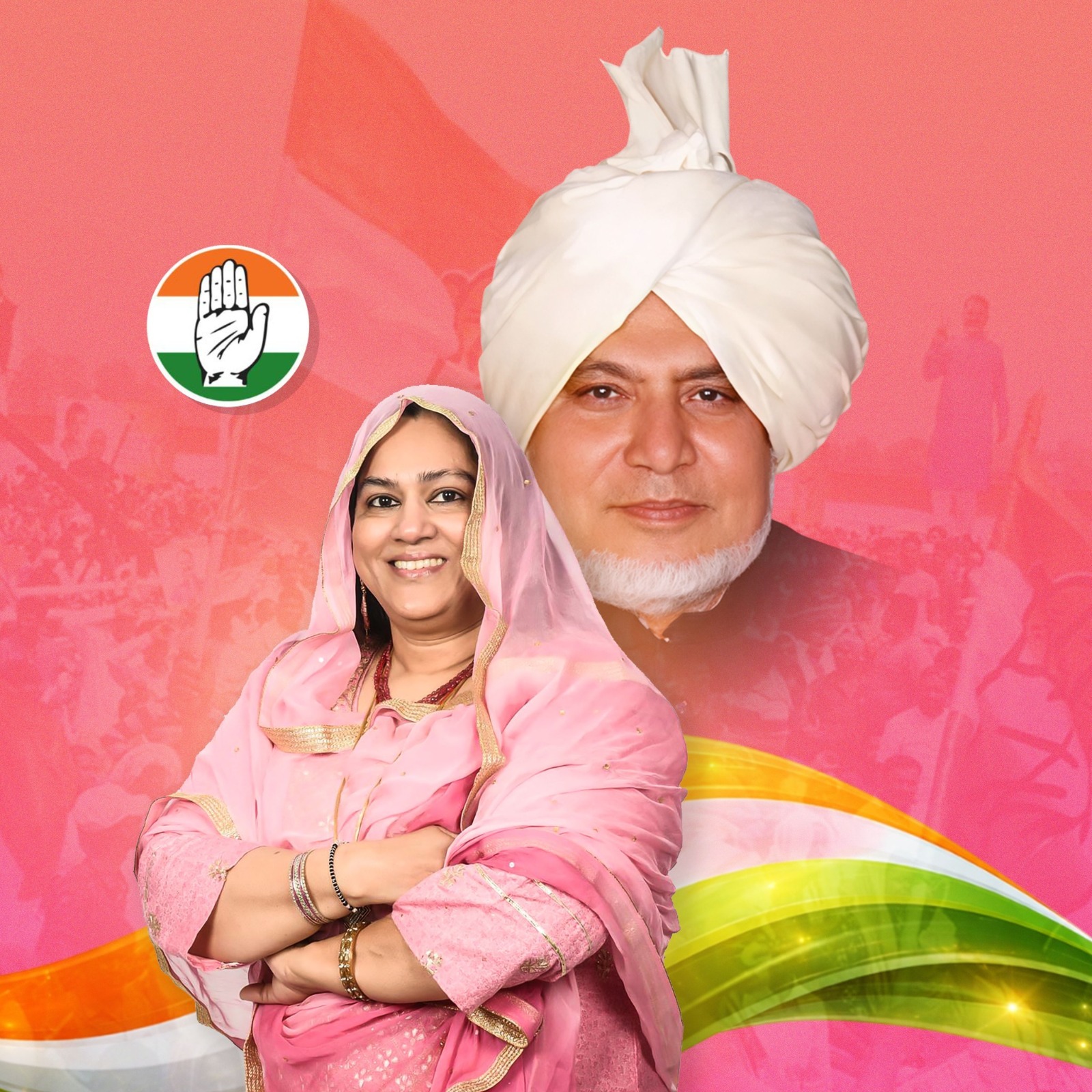
Zahida Khan standing in front of her father’s image
From the outset of her political career, Zahida prioritised social development and education, with a special focus on girls’ education. After her father died in 2008, she contested the state assembly elections on a Congress ticket and won, and became Mewat’s first woman MLA. She was again elected in the 2018 assembly elections. During this period, she served as Rajasthan’s Education Minister and handled portfolios including Education, Science and Technology, Art and Culture, and Printing and Stationery.
Zahida Khan has prioritised education and social justice. She has served as an AICC member, a Rajasthan PCC office-bearer, and General Secretary of the All India Women’s Congress. Her brother Zakir Hussain has furthered the family’s political tradition by serving three terms as MLA in Haryana and Mewat.
Zahida Khan’s husband, Jalees Khan, an electrical engineer by training, chose entrepreneurship over a job. He supports her political work and also manages family responsibilities. He says, “After Chaudhary Tayyab Hussain’s demise, there was consensus in both families—ours and the entire Chaudhary family—that Zahida Khan should enter politics from Kama.”
Zahida’s daughter is a doctor, and her son Sajid Khan is a law graduate. Sajid was elected unopposed as Pradhan of the Pahari Panchayat Samiti. He also manages the family business while fulfilling political responsibilities.
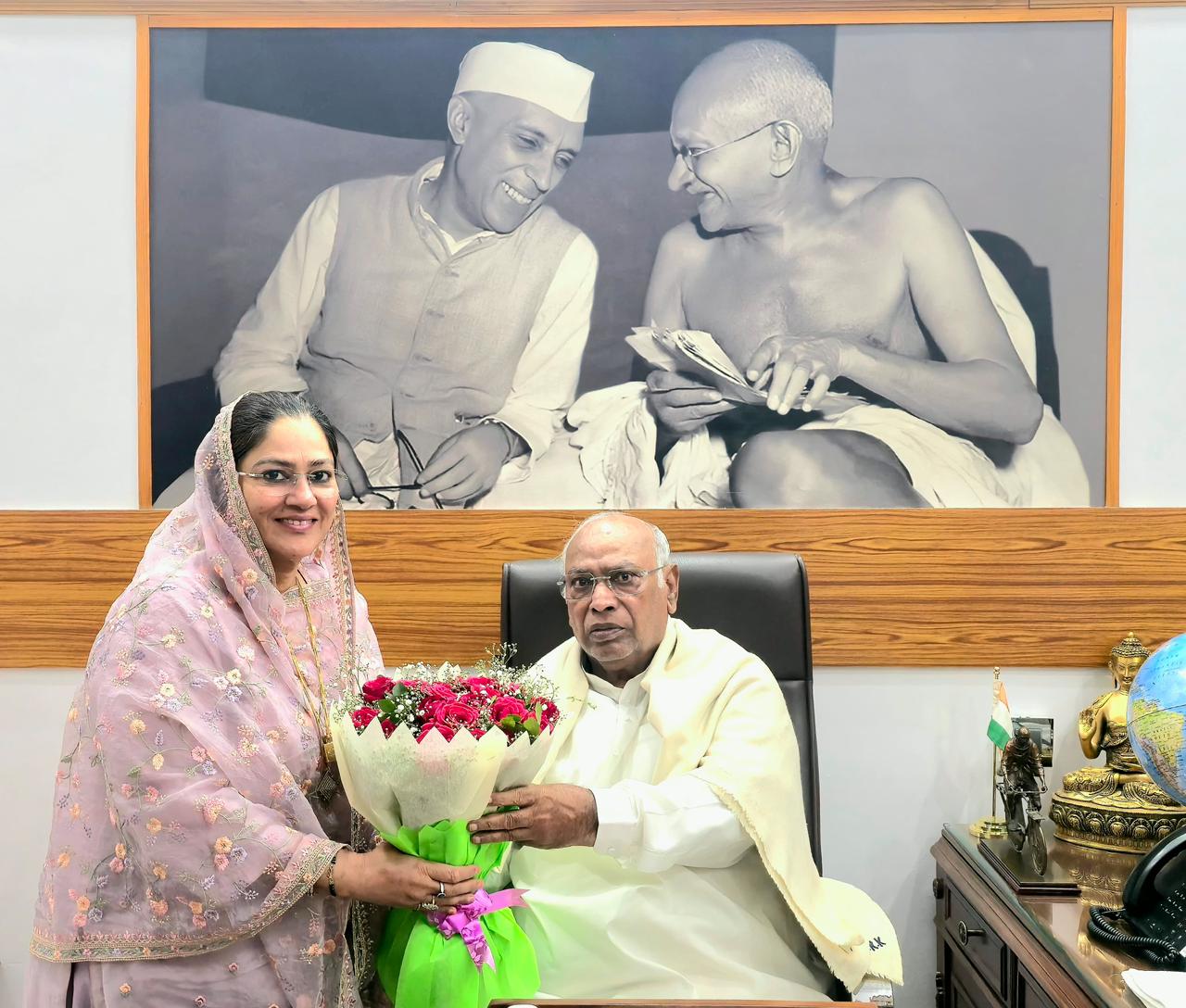
Zahida Khan with Congress President Malikarjun Kharge
The family has given Zahida a complete “free hand,” enabling her to carve out a distinct identity in politics. Because of her work style, assertiveness, clarity, and integrity, people often see a reflection of her father in her.
Former minister Zahida Khan says, “In today’s times, it has become extremely difficult to work in politics with clarity and fairness. Over the past 15–20 years, the political environment has changed significantly, and good people are hesitant to enter politics. Politics is no longer just a medium of service; it has also become linked to business. People now view it from a commercial perspective, which is deeply distressing and worrying for democracy.”
In the history of Mewat’s social and political consciousness, the contribution of a few families has been immensely significant. Without them, the region’s history would be incomplete. Yasin Khan’s emphasis on education, Tayyab Hussain’s political leadership, and Zahida Khan’s women-led politics—this three-generation legacy has become Mewat’s identity.
Zahida Khan’s political journey conveys the message that dedication to service and society is the essence of true politics. Under her leadership, the people of Mewat are moving forward on the path of education and development. This family exemplifies placing service above power, principles above position, and society above politics.
Mewat’s identity—education, politics, and women’s leadership—is the result of three generations of effort and struggle. This is not just the story of one family, but the story of an entire region’s social and political awakening that has fought for education, rights, and self-respect for decades. By carrying forward this legacy, Zahida Khan has opened new paths for women and society in modern politics.
While a lack of clarity and fairness is often felt in today’s politics, leaders like Zahida Khan prove that principles and service to society must remain politics’ core purpose. Her contribution and leadership for Mewat are truly inspiring. Yasin Khan’s educational vision, Tayyab Hussain’s foresight, and Zahida Khan’s women-led leadership together tell the story of making Mewat socially and politically empowered.
source: http://www.awazthevoice.in / Awaz, The Voice / Home> Stories> Leading Muslim Women / by Younus Alvi, Alwar, Rajasthan / March 11th, 2026