Tag Archives: Muslims of West Bengal in Education

NEET (UG) 2025: 472 Students of Al-Ameen Mission Qualify for Free Medical Seats in Government Medical Colleges Across West Bengal

Khalatpur Village (Howrah), WEST BENGAL :
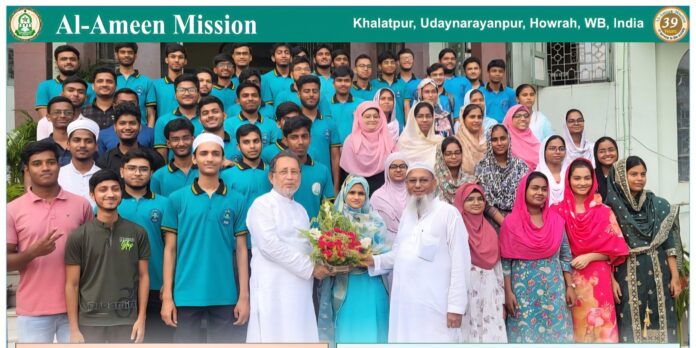
M. Nurul Islam with some of the future doctors at Al Ameen Mission Khalatpur campus

M. Nurul Islam is a proud man as 472 students of Al Ameen Mission have qualified for free medical seats in government medical colleges across West Bengal through NEET (UG) 2025.

Muslims remain one of the most disadvantaged communities in India. In West Bengal—among the more underdeveloped states—their educational and socio-economic struggles are even more pronounced. Districts like Murshidabad and Malda, with significant Muslim populations, rank among the most backward in the country.

When the NEET results were announced, 154 students from Murshidabad and 77 from Malda scored above 500 marks, making them eligible for free medical education in the state’s government colleges.

What stands out is the socio-economic background of these students. Of the 472 successful candidates, 278 (59%) come from modest backgrounds: 194 (41%) belong to middle and upper-middle-income families, 152 (32%) to lower-middle-income groups, and 126 (27%) are from poor and Below Poverty Line (BPL) families.

The success of these students reflects not only academic excellence but also the transformative impact of Al Ameen Mission in empowering underprivileged communities through education.

“This year’s exam was comparatively tougher than in previous years, but by the grace of Allah, our students performed even better,” said M. Nurul Islam, founder general secretary of Al Ameen Mission, while speaking to Muslim Mirror.

Nurul Islam, the visionary general secretary of Al-Ameen Mission—often referred to as the Sir Syed of West Bengal—is widely recognized among the 100 most influential Indian Muslims. He pioneered an educational movement aimed at uplifting underprivileged Muslim students in West Bengal, significantly increasing their representation in medical colleges, even exceeding their population proportion in the state.

Born in 1959 in the small village of Khalatpur in Howrah district, Nurul Islam came from a humble background. His passion for education and community service became the foundation of a lifelong mission. In 1986, while he was a student, he started a hostel with just seven students inside the madrasa building. This initiative was sustained by a grassroots campaign—collecting a fistful of rice from every household in the village. In January 1987, this effort took shape as Al-Ameen Mission.

Today, the Mission has 77 branches across 23 districts of West Bengal, housing nearly 23,000 residential students. Over 49,000 students have passed from Al Ameen Mission, which follows the WBBSE, WBHSE, and CBSE curricula. In 2015, the West Bengal government honored M Nurul Islam with the Banga Bhushan Award for its contributions to education.

The Mission also engages in charitable work, offering financial aid and scholarships to unemployed Muslims. Under Nurul Islam’s leadership, it has become a beacon of holistic education, blending academic excellence with Islamic ethical values. The institution has produced hundreds of successful NEET and JEE candidates, changing the lives of many.

Nurul Islam’s resolute commitment to education and empowerment continues to inspire generations, reshaping the future of Muslim youth in Bengal and beyond.

source: http://www.muslimmirror.com / Muslim Mirro / Home> Education> Indian Muslim> Positive Story / by Jasmine Nehar / June 25th, 2025
Recognizing the Roots: Teachers Who Nurtured Kolkata’s Future Felicitated

Kolkata, WEST BENGAL :

Asma Memorial Trust felicitates 80 educators including retired ones and specially-abled who served without recognition.

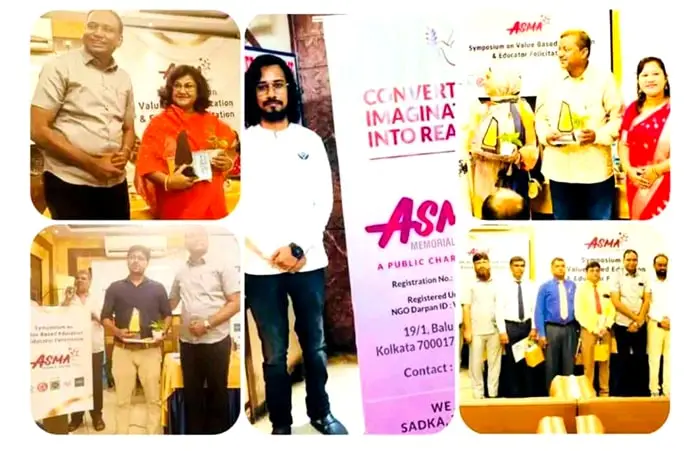
(Clockwise) Noor alam with Afaf Jameel, Junaid Kamal, Sangita Gurang (red sari) and the felicitated ones

Kolkata:

When the name of Junaid Kamal was announced, a 32-year-old man, with the help of two crutches, tried to stand up from his seat and began moving towards the stage to be felicitated at Asma Memorial Trust’s function. Soon, the fine art teacher was assisted in walking to receive a memento, a plant, and a set of notebooks and pens.

It was the first time in his 13-year teaching career that the art teacher, who is associated with four different organizations in Kolkata and serves the community, was recognized as a specially-abled person (left leg and right paralysed).

“I am thankful for the felicitation. For someone like me, it is not only difficult to study, but getting a respectable job is another challenge. Even when you succeed, it is rare that people appreciate it in this fast-paced life,” the Academy of Fine Arts graduate told eNewsroom.

Junaid was not alone; at least 15 retired educators, from both government and private schools, were also felicitated at the event.

Dr Umar Khyyam (70) of Maulana Azad College, Mobark Ali Mobarak (65) from Bankura district Urdu School, Nurul Hoda (62) of Kankinara Himayatul Ghurba High School (underprivileged), and Ashraf Ahmad Jafri (65) of Karaya School, Kolkata, were among them.

There were also current teachers, such as Afaf Jameel of Frank Anthony Public School, Sangita Gurung of Assembly of God Church School, Michael A Panja of GD Goenka Public School, Dr Khalid Hossain of Monu Memorial Institution (Kolkata), Debashish from Well and Gold, Md. Shahnawaz of Noble Mission School, Mubashshreen Shakil of KS Consultancy & Academy, Shaguta Adnan, who teaches French, and Manwar Sultana of Sir Syed English Medium School, among the total 80 teachers who were felicitated.

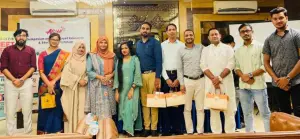
The felicitated and the felicitetors together after Asma Memorial Trust’s event

Teachers from South Point, East West, Goenka, Albani Hall, Islamia, Mohammed Jan, Flair International, and Izma International schools were also honored.

Noor Alam, the founder of NEET Basket, who also established the Asma Trust in memory of his wife to promote value-based education and encourage those involved in it, told eNewsroom, “We used to celebrate Education Day on the birthday of India’s first education minister, Maulana Abul Kalam Azad. But this year, we started the celebration earlier and began by felicitating educators who have served society but have not received any recognition for it.”

Alam, the Rashtriya Shiksha Ratan Award winner also pointed out that during the felicitation, a plant was given to each honoree to symbolize how educators nurture children. Just as trees benefit society in many ways, a well-nurtured child can positively impact the community.

The chief guest, Indian Revenue Service (IRS) officer Shamsher Ahmad, who took voluntary retirement and started Crescent School in one of Kolkata’s ghettos—Topsia—shared his journey as an educator. “When I started the school in Topsia (in 2002), I decorated the building very well. People asked me why I was doing so. I told them that to build confidence in the Topsia students, they must study in a place that is not inferior to other major schools in the city.”

“In later years, to boost their confidence to appear for the Union Public Service Examinations, I used my contacts and made my school a center for the UPSC exam, which produces IAS and IPS officers. As a result, today our school produces doctors and students who pursue higher education after graduating from Crescent,” Ahmad said to the gathering.

Sangita Gurung of Assembly of God said a one liner for the teachers, “Teach what your preach and preach what you teach, is the motto remained in my career and it should be with every teacher.”

Dr Sarfaraz Adil, founder of Izma International School , reminded attendees of the importance of education in Islam and how it has been emphasized. “Getting an education is one of the fundamentals of Islam. It not only includes religious education but also opens doors to physics, astronomy, and chemistry. Before Islam, there was no scientific temperament in religion. Only the rich could study, but Islam made education accessible to everyone. Prophet Muhammad announced that any slave who learned and became educated would be freed. Later, a slave named Hazrat Barira became educated and declared that she should be freed, according to the Prophet’s word. And she was freed. Although it was difficult because she was married to an uneducated slave, she wanted her freedom and to be separated from her husband, so she was granted it.”

Dr Adil also had a message for today’s teachers: “Information is easily shared among students. So, what is important for teachers is to teach students skills and show them

source: http://www.enewsroom.in / E Newsroom India / Home> Bengal> Education / by Shahnawaz Akhtar / September 16th, 2024

From Brick Kiln to Medical College: The Inspirational Journey of Sarfaraz

Purba Medinipur District, WEST BENGAL :

A labourer’s son in West Bengal defies all odds to achieve his dream of becoming a doctor

New Delhi :

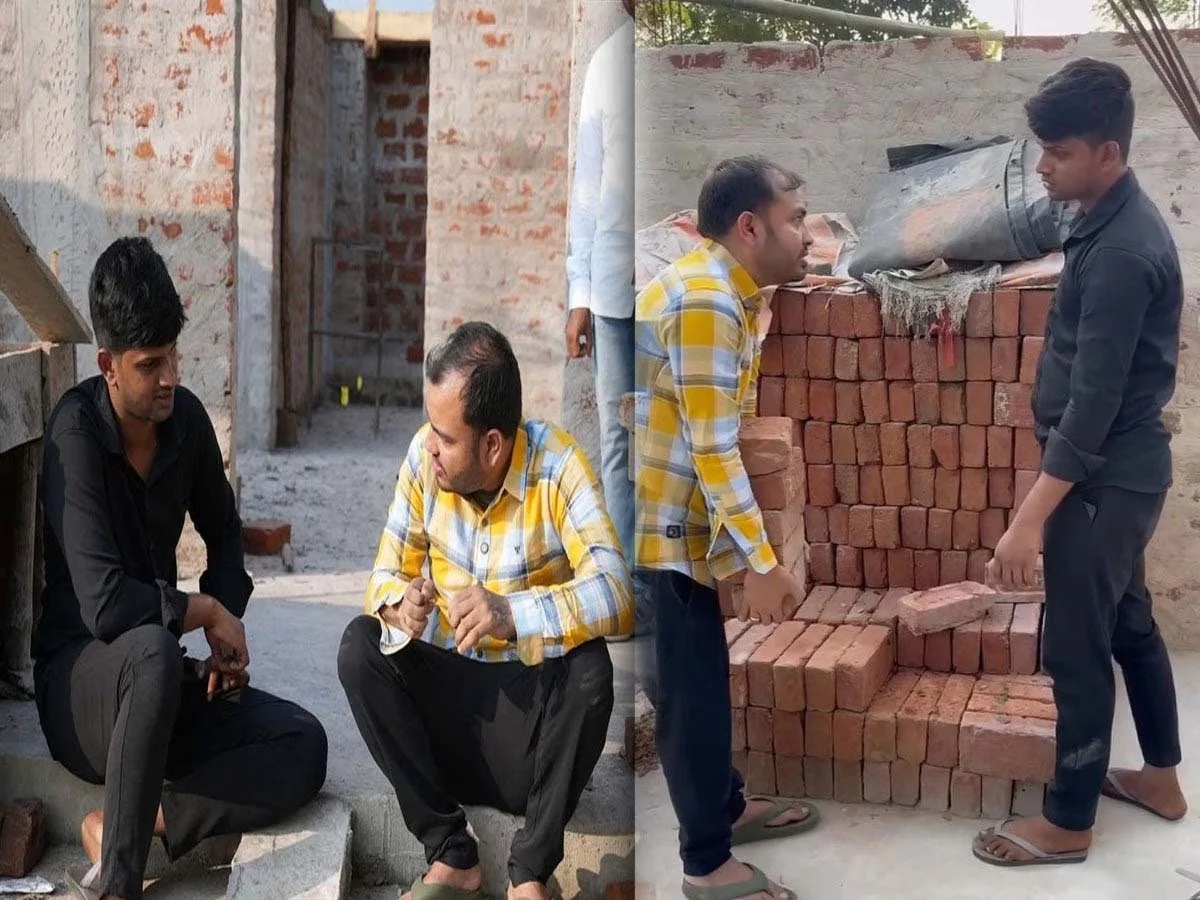
In an era where mobile phones are often criticised for their harmful impact on society, the story of 21-year-old Sarfaraz from East Medinipur, West Bengal, shines as a beacon of hope. Once a labourer carrying bricks under the scorching sun, Sarfaraz’s remarkable journey to gaining admission into the prestigious Nil Ratan Sarkar Medical College for an MBBS degree showcases grit, determination, and the transformative power of education.

Born into a family with limited financial resources, Sarfaraz’s childhood was marked by hardships. His father, also a labourer, earned a meagre daily wage, barely enough to feed the family of six. Despite these challenges, Sarfaraz excelled in his studies, harbouring the dream of joining the National Defence Academy (NDA).

An unfortunate accident dashed his NDA aspirations, but Sarfaraz did not let despair consume him. “Life was never easy, but giving up was never an option,” he said.

The COVID-19 pandemic brought a glimmer of hope in Sarfaraz’s life. With financial assistance from the government, his family bought a smartphone. This device became Sarfaraz’s lifeline, as he used free YouTube tutorials and online ed-tech platforms to prepare for the NEET, India’s highly competitive medical entrance exam.

“I studied through free YouTube videos initially and then enrolled in an online course with a concession in fees. It changed everything for me,” Sarfaraz said.

For three years, Sarfaraz juggled gruelling physical labour and relentless academic preparation. His daily routine involved carrying 400 bricks under the blazing sun for a wage of Rs 300, followed by seven hours of uninterrupted study.

“My father and I would work from morning until afternoon. After that, I would come home and dive into my books. It was difficult, but I never lost sight of my dream,” Sarfaraz explained.

In 2023, Sarfaraz’s NEET score qualified him for a dental college, but the prohibitive costs forced him to forgo the opportunity. Undeterred, he decided to make a final attempt at NEET in 2024.

“I thought, I’ve worked so hard — let’s try one more time. This was my last chance. If I hadn’t succeeded, I would have given up,” he said.

Sarfaraz scored an impressive 677 out of 720 in NEET 2024, securing his place in Nil Ratan Sarkar Medical College.

Behind Sarfaraz’s unwavering determination was his mother’s dream of seeing her son become a doctor. Her sacrifices inspired him to push through every obstacle.

“My mother always wanted me to be a doctor. I promised myself that I would make her dream come true,” Sarfaraz said, his voice filled with emotion.

Now donning a white coat and stethoscope, Sarfaraz is a source of pride not only for his family but also for his entire village.

Sarfaraz’s success has brought hope to his village, where many children often abandon their studies due to financial difficulties. Determined to give back, he has started mentoring young students.

“When I become a doctor, I want to work among the poor. My village folks have supported me throughout this journey, and now it’s my turn to support them,” he said.

Sarfaraz’s story has inspired countless people. His former teacher, who guided him in his early years, remarked, “Sarfaraz always had a spark. Despite his circumstances, he was determined to learn and grow. His success is a testament to his perseverance.”

A fellow villager, moved by his journey, said, “He has proven that no obstacle is insurmountable. He is the pride of our village.”

Sarfaraz’s journey from a labourer at a brick kiln to a medical student serves as a reminder of the potential within every individual, regardless of the circumstances. His story resonates deeply, offering hope to those who dream big despite the odds stacked against them.

“Dreams do come true if you work hard enough,” Sarfaraz said with a smile.

As Sarfaraz begins his medical education, his journey is not just a personal victory but a source of inspiration for countless others. It proves that with determination, resilience, and the right opportunities, even the toughest challenges can be overcome.

source: http://www.clarionindia.com / Clarion India / Home> Editors Pick> Indian Muslim / by Mohammad Alamullah, Clarion India / November 26th, 2024