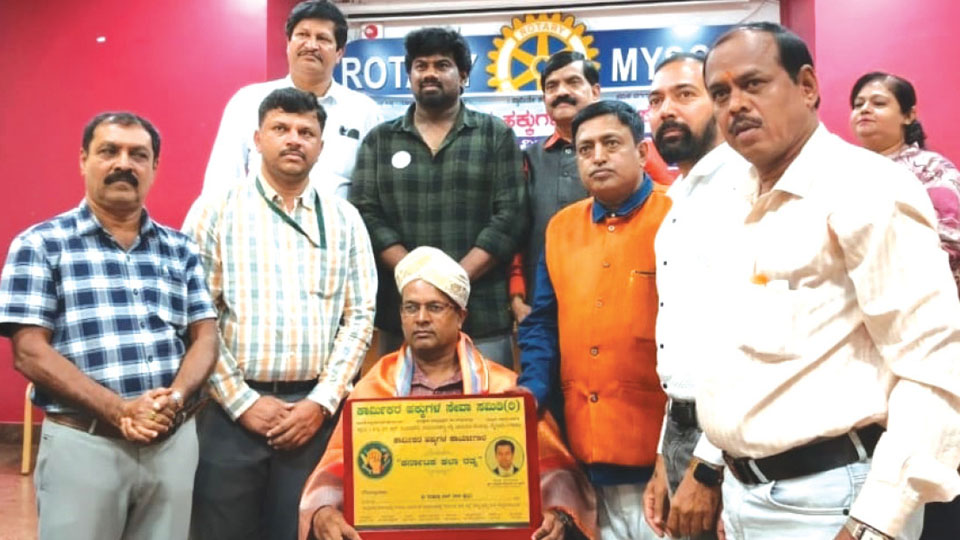
Radiulla Khan, Organising Secretary of Mysuru District Kannada Sahitya Parishat, being presented with ‘Karnataka Kala Ratna’ State Award during the workshop on ‘Labour Rights’ organised by Karmikara Hakkugala Seva Samiti at Rotary Hall on JLB Road in city recently.
The award was presented to Radiulla Khan in recognition for his works in multilingual films especially in Kannada language as a junior artiste.
M.S. Naveen, Chief Legal Aid Guardian, District Legal Services Authority (DLSA), V. Vinay Kumar from Employees State Insurance Corporation, industrialists and social workers M. Lalita Rao, Shubh Krupesh, V. Ramamurthy and Prashanth P. Aask, Actor-director Mahesh K.H. Belur, journalist Kasthurichandru and others were present.
source: http://www.starofmysore.com / Star of Mysore / Home> Photo News (headline edited) / July 26th, 2025
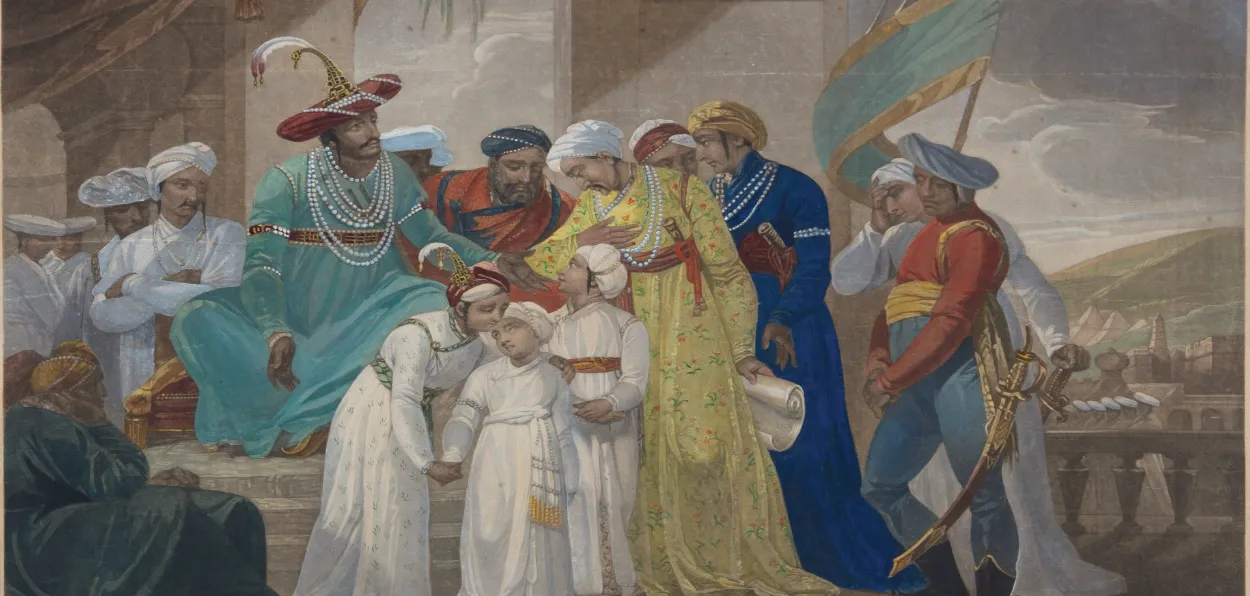
Tippoo Sultaun delivering to Gullum Alli Beg the Vakeel his sons who are taking leave of their brother previous to their departure from Seringapatam (1793) Painting by Henry Singleton
“The Christian drummers were seized, taken to the palace where Tippu’s sons were confined, and made to beat the “general” ; lights flashed in the palace, refreshments were brought out; a mob of sepoys called on the princes to place themselves at their head; Tippu’s own flag, green stripes on a red field, was nailed to the flagstaff. Prince Muizuddin (son of Tipu Sultan) ordered his horse to be saddled, and told off a party of sepoys to go and seize the principal hill fort; when that was captured and the dead body of Colonel Marriott, paymaster of stipends, brought before him, he promised he would mount his horse and ride through the native town proclaiming the restoration of the Mahommedan power.”
A Slice of History
This is the account by Colonel Alfred Keene of the night of 10 July 1806 at Vellore. The rising, popularly known as the Vellore mutiny, was a dress rehearsal of a sort of what would happen in May 1857 at Meerut.
Keene pointed out, “In the mutinies of Vellore and the greater one of 1857, two points of similarity stand out prominently. In each is the unreasoning fear of an attack on the institutions of religion and of caste; for the greased cartridges in the latter mutiny had as much to do with the outbreak as had the new head-dress in 1806, and the presence of the remnants of the Moghul Dynasty at Delhi acted in 1857 precisely as had the presence of Tippu’s family at Vellore in 1806.”
After the fall of Tipu Sultan in 1799, the English East India Company shifted his children to Vellore. In early 1806, the Commander-in-Chief ordered a new headgear and, the removal of beards, tilaks, earrings, or any mark of caste identity.
The Indian sepoys of the 2nd Battalion 4th regiment showed dissatisfaction in May 1806 and disobeyed the orders. These sepoys were tried in army court and 21 of them were found ‘guilty’. Of them, one Hindu leader and other Muslims were discharged from the duty and sentenced to receive 900 lashes each. The other 19 were not discharged but ordered 500 lashes each. The order was passed on 29 June and published to the army on 2 July 1806.
The wife of a serving English officer at Vellore, F. W. Blunt, wrote in a letter to her family in England, “Nine of the ringleaders, as they were called, were brought down to Madras and here passed publicly through the streets in irons, destined to receive the most dreadful military punishment…… The nine men in irons awaiting a most severe punishment was made use of by the sons of Tippoo, who have been kept prisoners in the Palace at Vellore since the taking of Seringapatam and served to ripen a design that had been long formed. A conspiracy was formed by the Sepoys to murder all the Europeans and take possession of that Fort.”
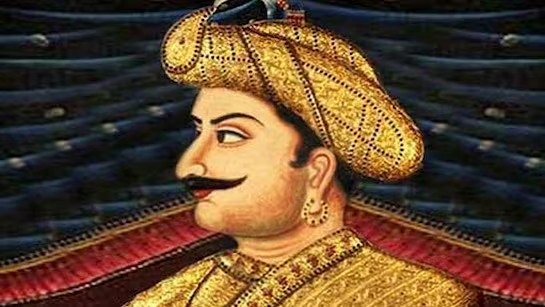
Tipu Sultan
On the night of 10 July 1806, Shaikh Kasim, a sepoy, led the English East India Company sepoys in starting a general massacre of the English troops.
Lt. Col. W. J. Wilson in ‘History of the Madras Army’ wrote, “The sepoys went away shortly afterward, and were heard to call out “Come out, Nawab, come out, Nawab, there is no fear.” This was supposed to be addressed to Futteh Hyder, the eldest of the four Mysore Princes.”
Of the 372 Englishmen present at Vellore, 128 were killed that night by the Indian sepoys. The English flag was replaced with the flag of Tipu Sultan, which was handed over by Moizuddin, the eldest son of Tipu. He was proclaimed the leader of the revolutionaries.
Though the immediate cause was the headgear and other orders, the revolt had been planned for a long time. Charles Macfarlane wrote, “The splendour which the sons of Tippoo were enabled, by the liberality of the Company, to keep up, attracted a continual influx of visitors, including all that came to Vellore from the countries which had once belonged to their father. Among these men were very many who had lost by the change which had taken place in Mysore, who hated the tranquillity which we had introduced into their country, and who longed for the old days of rapine and violence. It is believed that these desperadoes contributed to a regular conspiracy and facilitated the execution of the daring design.
It is said that the confederates intended that all who were brought to join in the insurrection should act upon a preconcerted plan, which had been digested and privately circulated by some of the turbulent Marawa chiefs; and that in connection with these desperadoes were some few Frenchmen, disguised as fakeers or dervishes, who went about the country inveighing everywhere against the English as robbers and tyrants. It is also stated that placards were fixed up within the mosques and Hindu temples, where Europeans never entered, to excite a general spirit of revolt among the whole native population of Madras.”
The English Government set up an enquiry commission headed by Major General Pater which submitted its report on 9 August 1806. The report said, “There are two principal causes which appear to us to have led to the mutiny. The late innovations in the dress and appearance of the sepoys, and the residence of the family of the late Tippoo Sultan at Vellore.”
Sir J. F. Cradock, the Commander-in-Chief, disagreed with these findings and argued in his submission that change in dress was a pretext and the real objective was to restore the rule of Tipu Sultan’s family.
The Court of Directors after the investigation declared that the “immediate cause of the discontent among the sepoys was the introduction of certain innovations in their dress, which were offensive, and, as they held, degrading to them; and that the captive sons of the late Tippoo Sultan, with their adherents and abettors, took occasion, from the dissatisfaction of the sepoys, to instigate them to insurrection and revolt, with the view of effecting their liberation, and the restoration of the Mahomedan power.”
The mutiny was suppressed by noon on 10 July. Colonel Gillispie stationed at Arcot came to rescue the Englishmen at Vellore before 7 am. His forces, which also included Indian sepoys, killed more than 500 Indians in the fort within a few hours.
At least 15 English officers including, Colonel Fancourt, H.M.’s 34th regiment, commanding the garrison, Lieutenant-Colonel McKerras, Captain Willison and Lieutenants Winchip and Jolly of the 23rd, Captain Miller, Lieutenants O’Reilly, Smart, and Tichbourne of the 1st, and Lieutenants Eley and Popham of the 69th, Mr. Mann Deputy Commissary of Stores, Mr. Gill Conductor of Ordnance, Mr. Smith the Military Paymaster and Major Armstrong of the 16th N.I. were killed.
Among the captured sepoys, six were blown away with cannon guns, five were shot by firing squads, eight were hanged, and several others were transported for life. Out of the retainers of Mysore Princes, one was sentenced to death, two to transportation for life, one to imprisonment for life, and one to imprisonment for ten years. The sons of Tipu Sultan were sent to Kolkata with stricter vigilance.
Lord William Bentinck, Governor, and Sir J. F. Cradock, C-in-C, were removed from their respective offices by the Court of Directors.
source: http://www.awazthevoice.in / Awaz, The Voice / Home> Stories / by Saquib Salim / July 10th, 2025
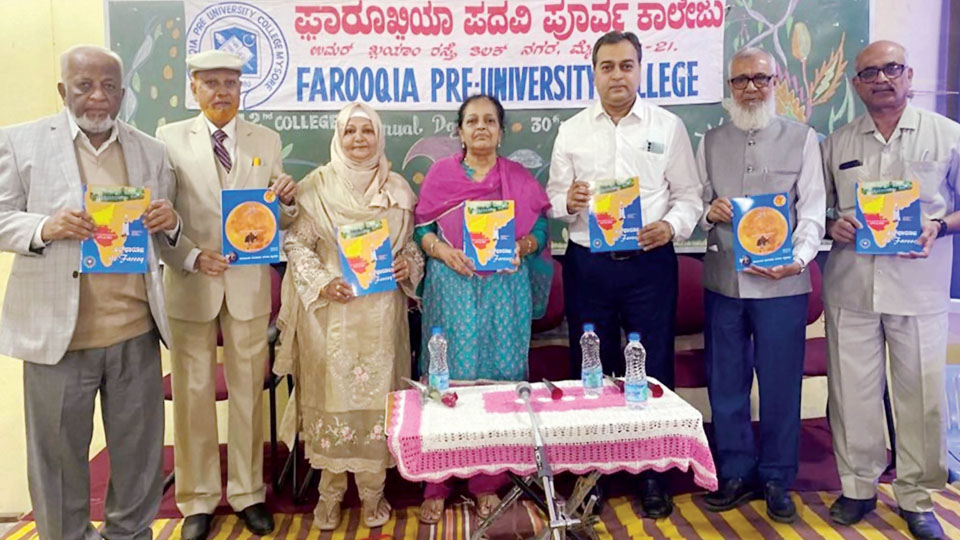
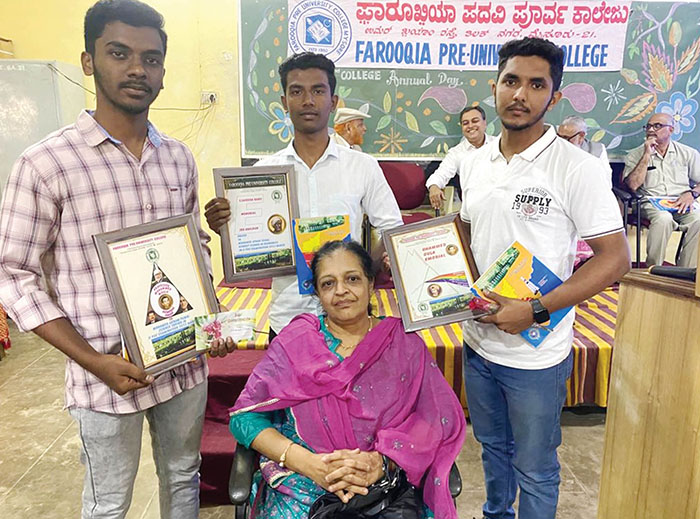
Farooqia PU College marked the success of Chandrayaan-3 at a celebration during its 42nd Annual Day. The event featured Kamran Ahmed, a scientist and engineer from the Indian Space Research Organisation (ISRO), Bengaluru and a resident of Mysuru.
Kamran Ahmed played a key role in the Chandrayaan-3 mission. He presented glimpses of the mission and on space exploration, encouraging students to aspire to become accomplished scientists, drawing inspiration from role models like Dr. A.P.J. Abdul Kalam.
Prof. M. Sayeed Ahmed and Dr. Syed Abdul Khuddus presented a memento to Kamran Ahmed and Prof. Riyaz Ahmed unveiled the 35th volume of the college magazine, “Al-Farooq,” featuring the Chandrayaan-3 rocket launch and Vikram’s historic soft landing.
The issue also dedicated a section to late Mujeeb-Ur-Rehman Khan, a key figure in the establishment of Farooqia College in 1980, and paid tributes to freedom fighter Khazi Abdul Ghafoor Khan, known as “Coorg Gandhi.”
Dr. Anisa Ather, Retired Associate Professor of Microbiology, presented cash prizes in memory of her parents late Prof. Mohammed Moula and late Y. Sayeeda Banu to outstanding students — Mohammed Ikram (highest scorer in Science), Mohammed Afnan (Economics) and Zaid (Physics) — in II PU March 2023 exam.
Additionally, the magazine honoured the first method actor of world cinema, Dilip Kumar, with articles and rare photographs, and featured articles on Prof. B Shaikh Ali and Kannada Professor Kareemuddin of MDTDB College.
Special invitees were Dr. Thouqeer Ahmed and Dr. Shaista Ahmedi, an alumna of the college and successful doctors. Dr. Ahmedi announced cash prizes for the highest scorers.
Prof. M Sayeed Ahmed, Hon. Secretary of the College, emphasised the importance of serving parents and society, highlighting the obligation of Huqooq-ul-Ibaad for every Muslim.
Dr. Syed Abdul Khuddus presided over the function, which included Qirath by Mohammed Taufeeq and Naath by M.K. Zakir.
The event, compered by Zahara Jabeen Tabassum, featured a brief report on the college’s 2023 activities by R.H. Basha, Principal. BiBi Ameena proposed a vote of thanks, following cultural programmes, literary competitions and sports events.
source: http://www.starofmysore.com / Star of Mysore / Home> News / January 04th, 2024
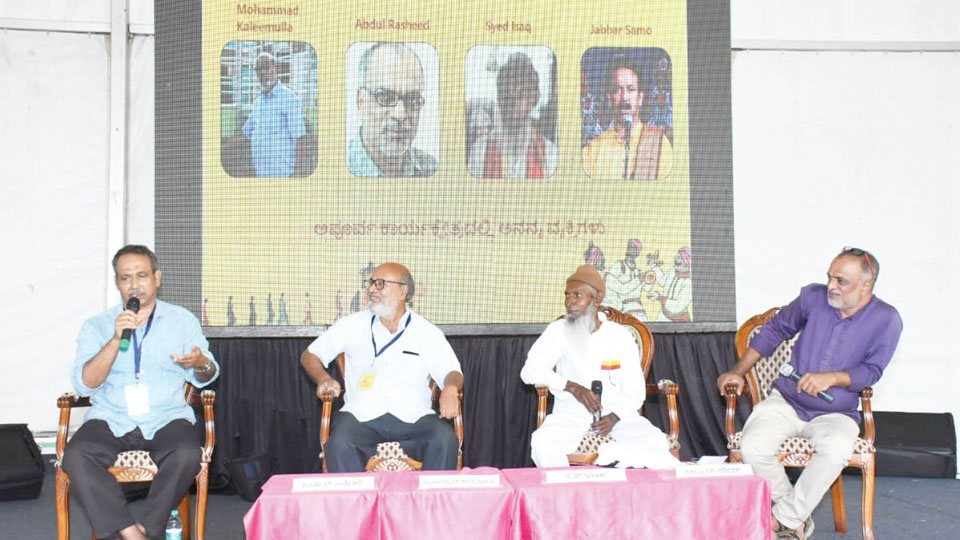
In a unique session, extraordinary individuals from different domains came together for a rare confluence at the Mysuru Literature Festival last evening. They introduced the audience to new perspectives and showcased their talent beautifully.
Abdul Rasheed, Programme Executive, Akashvani, Mysuru, delivered an engaging speech and introduced the audience to the world of new ideas. He explained his journey through various phases of life and how he embraced several individuals from different social strata as his mentors. He expressed his excitement about presenting his distinctive insights, which will provide a more representative portrayal of himself.
Jabbar Samo, a talented Yakshagana artiste from Uttara Kannada district, shared his experiences and motivations. He shed light on the significance of his performances in different aspects of life, both at the societal and personal levels. He also acknowledged the numerous individuals he considers his gurus and how they have influenced him.
He expressed how art flourishes without a specific reason and shared the dedication of Yakshagana artistes, who work without any external motivation. Despite facing difficulties as a member of the Muslim community, Jabbar Samo fearlessly pursued his passion. “Due to the prevailing circumstances, pursuing formal education was not possible, but I found solace in Kannada poems sung at the school, which fuelled my interest in the language,” he recalled.
Mohammed Kaleemulla, a retired teacher from Nagamangala taluk, dedicated his life to the preservation of historical temples, monoliths and hero stones in Mandya district. He explained the architectural aspects of these stones, their current conditions and the ongoing efforts to safeguard them with the support of Shri Kshetra Dharmasthala. “Many hero stones are being used for mundane purposes like drying clothes. I took it upon myself to inform the villagers and engage in the preservation work,” he said.
Syed Isaq narrated how he had built the library with zinc sheet roof at the corner of a playground in Rajivnagar and has been running it for the benefit of the public for 12 years. He also told the audience how the library was burnt down and his efforts to rebuild it.
“I have never been to school but my love for books gave wings to my dream of setting up a library. I built the library with 85 percent of books in Kannada and newspapers of various languages. My Kannada library is located in an area where there is a majority of the Urdu-speaking population and Kannada language must be propagated in areas like these,” he added.
source: http://www.starofmysore.com / Star of Mysore / Home> News / July 03rd, 2024
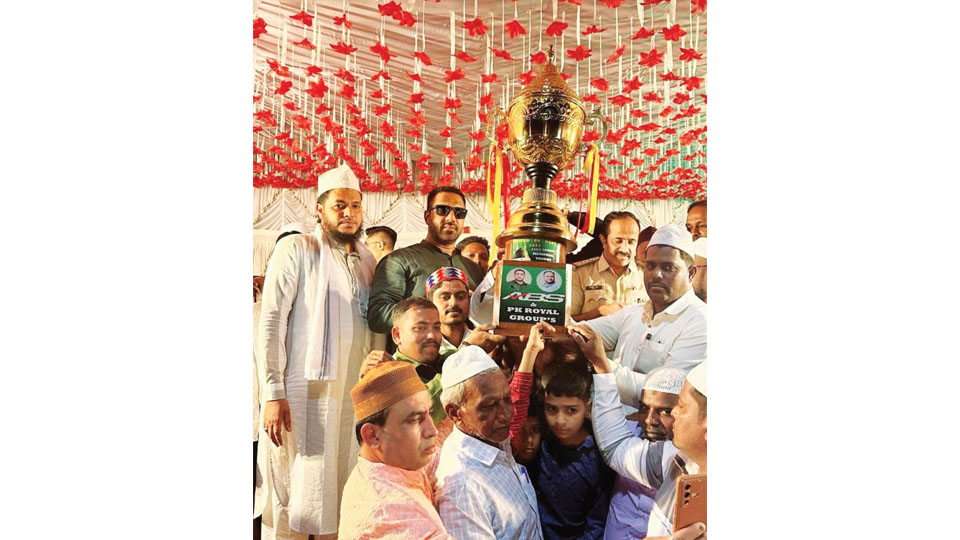
The tableau designed by Masjid-e-Aqsa Meelad Committee, which was taken in a procession along with other tableaux during Eid Meelad celebration in city on Sept. 28, has bagged the first prize.
ABS Abbas, Syed Umar, Zubair Ahmed, Corporator Basheer Ahmed, Zakir, V.V. Puram Inspector Arun Kumar, Moulana Abdul Salam, Khateeb of Masjid-e-Aqsa and others were present at the prize distribution ceremony.
source: http://www.starofmysore.com / Star of Mysore / Home> Photo News / October 05th, 2023