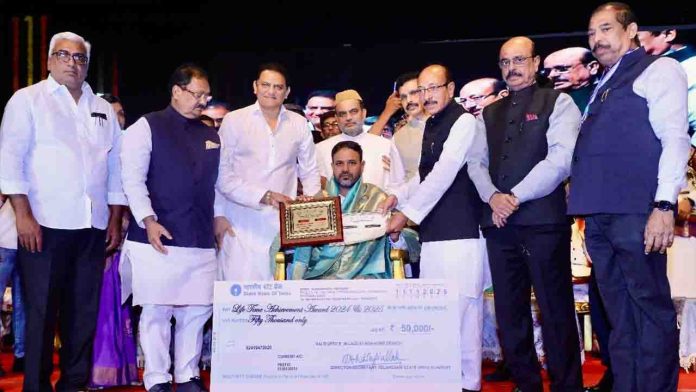
The Telangana Urdu Academy celebrated Minority Welfare Day at Ravindra Bharathi by presenting the first-ever Lifetime Achievement Award in the Digital Media category to veteran journalist Mohammed Akram Ali, popularly known as Azad Reporter Abu Aimal.
The award, instituted under the Revanth Reddy-led Congress government, marks the growing recognition of digital journalism’s role in promoting awareness and preserving Urdu culture. The award includes a memento, a citation, and a cash prize of Rs. 50,000, presented by Minister for Minorities Welfare Mohammed Azharuddin.
Mohammed Akram Ali was honoured for his decades-long contribution to digital journalism and his consistent efforts to advance Urdu language and literature through online media platforms. His work has been widely regarded as instrumental in connecting Urdu-speaking audiences with contemporary issues through accessible and credible digital channels.
The event was attended by several senior officials and community leaders, including Advisor for Minorities Welfare Md Ali Shabbir, Secretary of Minorities Welfare Department B. Shafiullah, Urdu Academy President Taher Bin Hamdan, Haj Committee Chairman Khurso Pasha, and CMFC Chairman Deepak John.
Syed Ghouse Mohiuddin, General Secretary of the Digital Media Publishers and Broadcasters Federation, congratulated Abu Aimal and praised the government for acknowledging digital media professionals.
The Telangana Urdu Academy announced plans to continue recognising contributors in emerging digital sectors to motivate younger generations and strengthen Urdu’s presence in modern media spaces.
source: http://www.radiancenews.com / Radiance News / Home> Latest News> Report / by Radiance News Bureau / November 12th, 2025
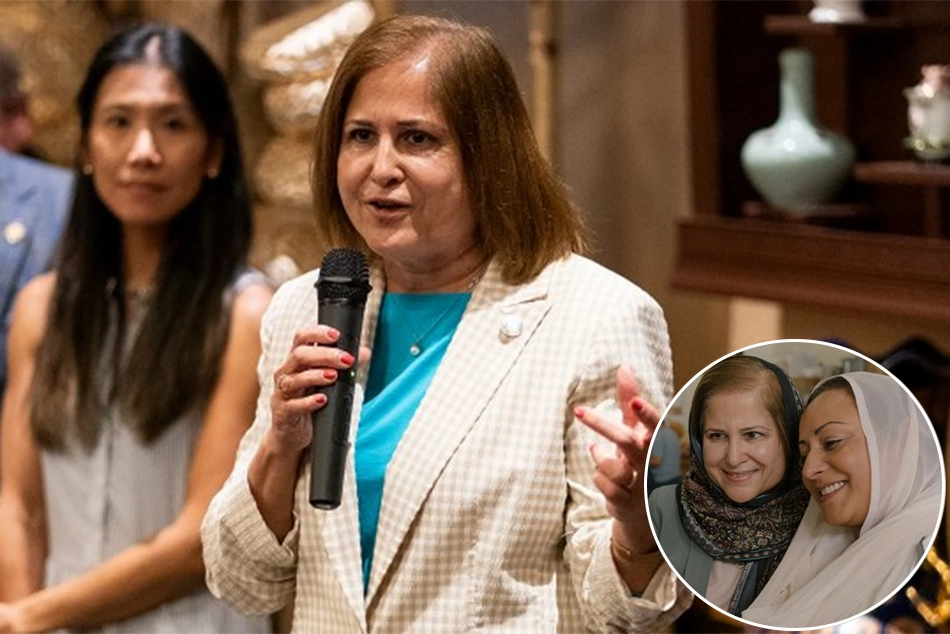
Indian-American Ghazala Hashmi, who is closely linked with the prestigious Aligarh Muslim University (AMU), has won the Virginia Lieutenant Governor 2025 Election result of which was declared on Monday.
Virginia:
Indian-American Ghazala Hashmi, who is closely linked with the prestigious Aligarh Muslim University (AMU), has won the Virginia Lieutenant Governor 2025 Election result of which was declared on Monday.
A Democrat Party candidate, Ghazala Hashmi, defeated Republican candidate and the state’s first gay statewide nominee, John Reid, to become first Muslim and first South Asian American elected as Lieutenant Governor of Virginia, a Republican stronghold.
Ghazala Hashmi polled over 55% votes as against her nearest rival John Reid who got the support of around 44.7% voters. Hashmi had earlier defeated five primary challengers in June, narrowly winning the nomination with 28% of the vote, as per the final result of the Virginia Lieutenant Governor Election 2025.
Ghazala Hashmi was the first Muslim woman to be elected to the Virginia State Senate following her stunning victory over sitting Republican Senator Republican Glen Sturtevant in the 2019 U.S. elections.
Ghazala Hashmi was born in India and emigrated to the US as a child with her family. She is also a former director of the Center for Excellence in Teaching & Learning at Reynolds Community College.
Ghazala Hashmi’s AMU Link
Ghazala Hashmi was born to Zia Hashmi and Tanveer Hashmi in Hyderabad in 1964. She spent her childhood days at her maternal grandparents’ house in Malakpet, Telangana.
She migrated to the United States with her mother and older brother as a 4-year-old child to join her father in Georgia.
Ghazala Hashmi’s mother, Tanveer Hashmi, is an alumna of Osmania University’s Women’s College in Kothi from where she did BA and B.Ed before migrating to the United States.
Ghazala’s father Professor Zia Hashmi is the alumnus of Aligarh Muslim University (AMU) from where he did MA and LLB. He completed his PhD in International Relations from University of South Carolina and soon after began his university teaching career. He retired as the Director of Centre for International Studies which he founded.
Ghazala Hashmi is married to Azhar Rafiq. The couple have two adult daughters – Yasmin and Noor – who both graduated from Chesterfield County Public Schools and the University of Virginia.
According to information available on her official website, Ghazala Hashmi is an experienced educator and an advocate of inclusive values and social justice. Her legislative priorities focus on public education, voting rights and the preservation of democracy, reproductive freedom, gun violence prevention, environmental protection, housing, and affordable healthcare access.
Hashmi spent nearly 30 years as a professor, first teaching at the University of Richmond and then at Reynolds Community College. At Reynolds Community College, Hashmi also served as the Founding Director of the Center for Excellence in Teaching and Learning (CETL).
Former Minister, MLA and BRS leader KT Ramarao has congratulated Ghazala Hashmi on her victory.
“This is massive! From Malakpet to Virginia… Congratulations to Ghazala Hashmi on becoming the first Indian-American Lieutenant Governor of Virginia. There is nothing more beautiful when democracies celebrate diversity of the world”. KTR wrote on X.
source: http://www.ummid.com / Ummid.com / Home> United States / by ummid.com news network / November 05th, 2025
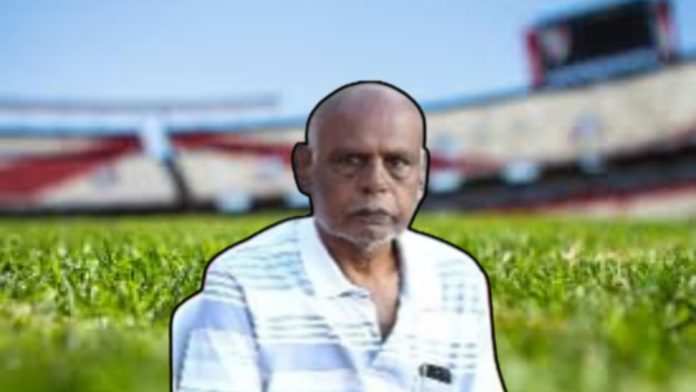
Former national footballer Syed Ahmed Khan passed away at the age of 64. He is survived by two daughters and a son.
Ahmed was a prominent player who represented the Police team for nearly three decades. His long career and consistent performance earned him respect in the football community. Teammates and officials remember him as a disciplined player who dedicated his life to the sport.
The Telangana Football Association expressed condolences to his family and acknowledged his contribution to the game. Football lovers in the region recalled his role in strengthening the Police team and inspiring younger players during his career.
His death is a significant loss for the local sporting fraternity. Community members paid tribute to his achievements and extended support to his family.
source: http://www.radiancenews.com / Radiance News / Home> Latest News> Report / by Radiance News Bureau / September 01st, 2025
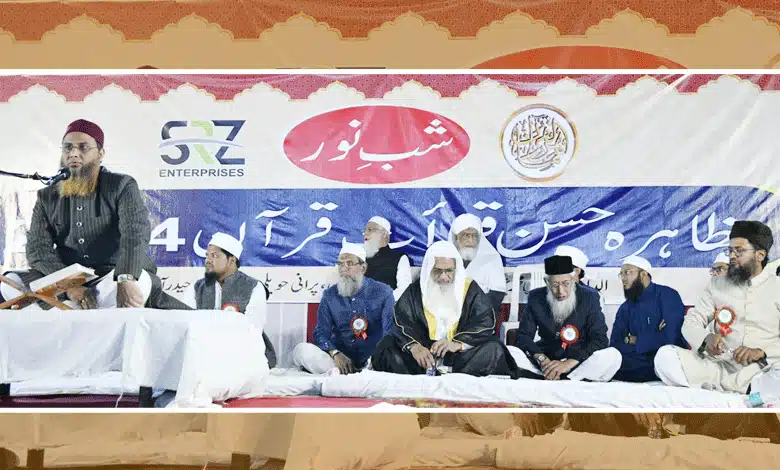
Hazrat Maulana Ghiyas Ahmad Rashadi Sahib, President of Safah Bait-ul-Mal and Manbar-Mihrab Foundation, was felicitated for his completion of the Tafsir al-Quran by Qari Muhammad Abdul Rahman Shahid Sahib and his brothers.
On the evening of December 31, 2024, a grand “Shab-e-Noor” Quranic Recitation event was held at the vast Dar-ul-Shifa Football Ground in the city. The event was presided over by Ustaad-ul-Qura’ Hazrat Maulana Qari Muhammad Ali Khan Sahib (may his blessings last) with the patronage of Mufti Hafiz Sadiq Mohiuddin Sahib (may his blessings last). The event featured renowned internationally acclaimed Qaris from the city, who presented their recitations.
Hazrat Maulana Jafar Pasha Sahib, Hazrat Maulana Hassan Farooq Sahib, respected Mir Zulfiqar Sahib (Charminar MLA), and respected Riyaz-ul-Hassan Afandi Sahib (MLC) participated as distinguished guests.
The Qaris presented their remarkable recitations until 2 AM, with a large crowd of both common people and elites in attendance.
Hazrat Maulana Ghiyas Ahmad Rashadi Sahib, President of Safah Bait-ul-Mal and Manbar-Mihrab Foundation, was felicitated for his completion of the Tafsir al-Quran by Qari Muhammad Abdul Rahman Shahid Sahib and his brothers.
The program concluded with a special prayer from Ustaad-ul-Qura’ Hazrat Maulana Qari Muhammad Ali Khan Sahib.
source: http://www.munsifdaily.com / Munsif News 24×7 / Home> Hyderabad / by Syed Mubashir / January 01st, 2025
Another area where his enthusiasm manifested itself was in exploring the religious history of meteors.
Mohammad Abdur Rahman Khan
The night sky has been one of the oldest sources of wonder. Through the ages men and women have looked up to the stars and been filled with curiosity and awe. This peculiar awe inspired by the diamond-studded vault has also inspired a number of distinct disciplines and practices. From hobbies like stargazing to highly systematised knowledges like astronomy and astrology and several cosmological myths in every major world religion have all been inspired by the awe one feels for the “heavens”. When we write the history of our all-too-human interest in the night skies, however, we usually parse these various practices and knowledges into neat silos.
Stargazing is seen to be an activity proper to children and hobbyists. Religious cosmologies are mostly left to theologians or historians of religion. Astronomy becomes the province of the savant. Even if some traffic between these distinct groups and their practices may be allowed in earlier eras, the distinctions seem to have become watertight by the 20th century. And that might be why no one today remembers Mohammad Abdur Rahman Khan.
A passion for meteors
In the last decade of British rule in India, Khan published a whopping ten papers and reports in Nature, the preeminent scientific journal of the time. Khan only had a bachelor’s degree to his name and had taught all his life at the Osmania College, away both from the then-new research institutions like the IISc and the old universities like those at Calcutta, Bombay, or Madras.
By the end of the 1940s, however, Khan had become well-known to the international scientific community. Besides his regular contributions to Nature and other scientific publications, he had also been elected a Fellow of the Royal Astronomical Society and appointed a Research Associate at the Institute of Meteoritics at the University of New Mexico. In 1936 and again in 1948 Khan was invited to present papers at the annual meetings of the Society for Research on Meteorites in the United States.
Khan’s passion was meteors. He had first become interested in them as a schoolboy at the Madrasa-i-aliya in Hyderabad in the late 1880s.
Later, the arrival of Halley’s Comet in 1910 reinvigorated his interest in astral phenomena and he set about translating Sir John Herschel’s Outlines of Astronomy into Urdu. It was also the time when he began to systematically observe the night skies. In 1940, by then nearly 60 years old, he reported to Nature that he had spent a total of 103.25 hours over 152 nights observing the skies that year. As a result, in just that single year, he had observed and mapped the paths of 1390 meteors!
Apart from personal observations, Khan managed to put together a network of other amateur observers who regularly sent him their observances as well. One 1945 publication, for example, contained observations from MM Ali Beg, a school headmaster, MA Latif Khan, a lawyer, and MT Ali, an official in the Finance Department of Hyderabad. What Khan had thus managed to do was link up a number of hobbyists and turn them into data collectors. Here was an early example of what would later sometimes be called “citizen science”, i.e., incorporating lay citizens into the task of scientific knowledge production.
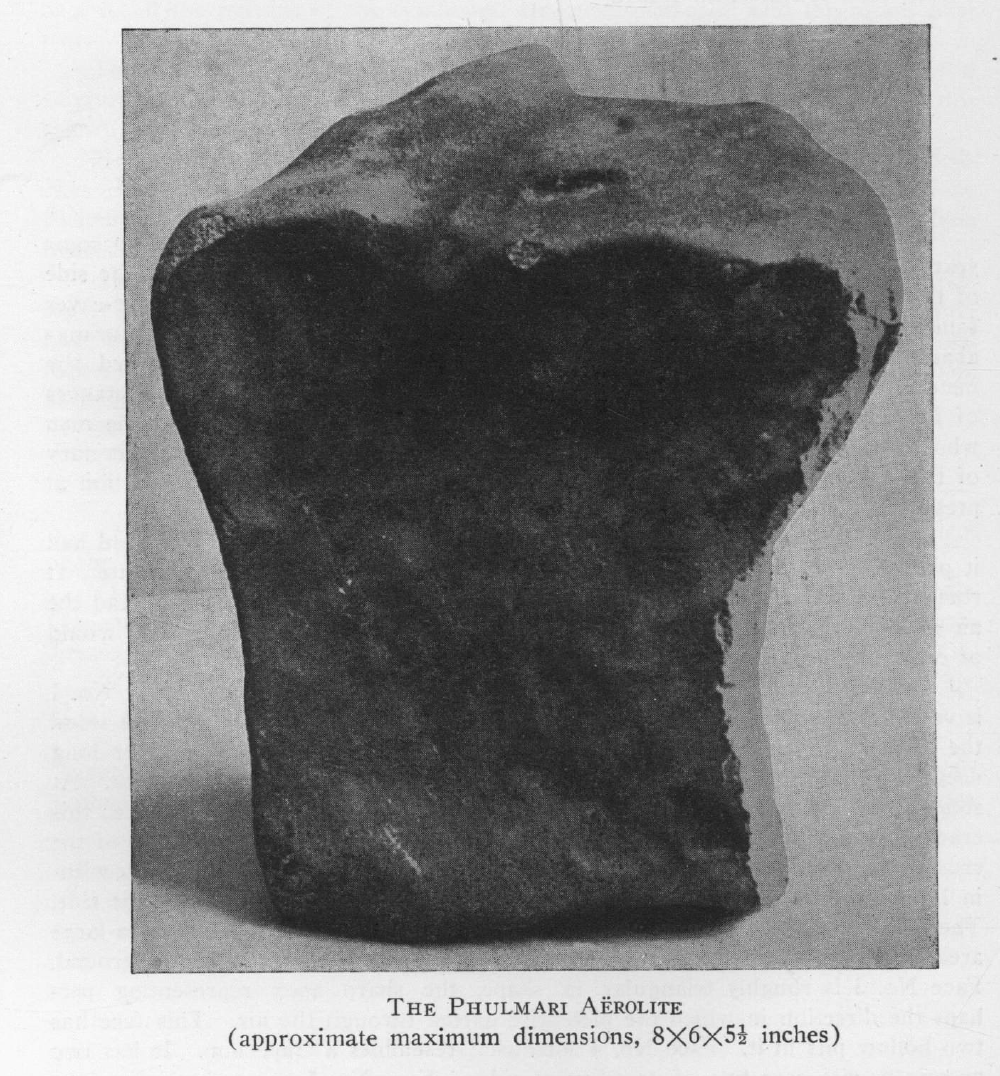
The study of meteors at the time depended not only upon the mapping of aerial pathways and frequencies but also on the study of the actual meteorites. Here again, Khan utilised his social networks to great advantage. In August 1936, for instance, he received from Maulvi Abdul Hag Saheb an aerolite that had fallen a couple of years ago onto a farm near the village of Phulmari in Aurangabad district. At other times, he heard of an old meteor shower in an area and personally went to search for meteorites. Since, unfortunately for Khan, the ground had been flattened in the intervening years, he offered a financial reward to the local villagers to induce them to part with any pieces of the old “shooting star” that anyone might have kept back.
The Phulmari aërolite.
Not satisfied with simply collecting local meteorites, Khan also started buying rarer meteorites from international dealers. He bought several pieces, for instance, from Wards’ Natural Science Establishment – a dealership trading in rare scientific specimens based at Rochester. On another occasion, possibly in the 1920s, he paid the then-princely sum of $24 to a dealer in Denver for some rare meteorites. His collection, in time, became a significant scientific resource. The eminent physicist Satyendra Nath Bose, remembered today as the discovery of the “boson”, once borrowed some meteorites from Khan’s personal collection for x-ray analysis at Bose’s laboratory at Dhaka University. What is also noteworthy is that Khan financed his collection entirely out of his salary as a college teacher. The prices charged by foreign dealers, the financial rewards given to locals etc. all came out of his personal finances.
Yet, Khan had not been a rich man. He came from a scholarly family with roots originally in Ghazni. His ancestors had then served the Nawabs of Arcot before switching to British employment upon the fall of Arcot. The family had been comfortably off as a result of employment in the British military and civil establishments. But Khan’s father had died suddenly when he was still in college, putting the entire family in straightened circumstances. A small scholarship given to him by the government allowed him to tide over the lean period. Always a very good student, he was able to find employment soon after graduation and thus eventually mend his financial circumstances. That neither this experience of precarity nor the relatively modest salary of a college teacher discouraged him from spending lavishly on the collection of meteorites is a testament to the depth of his passion.
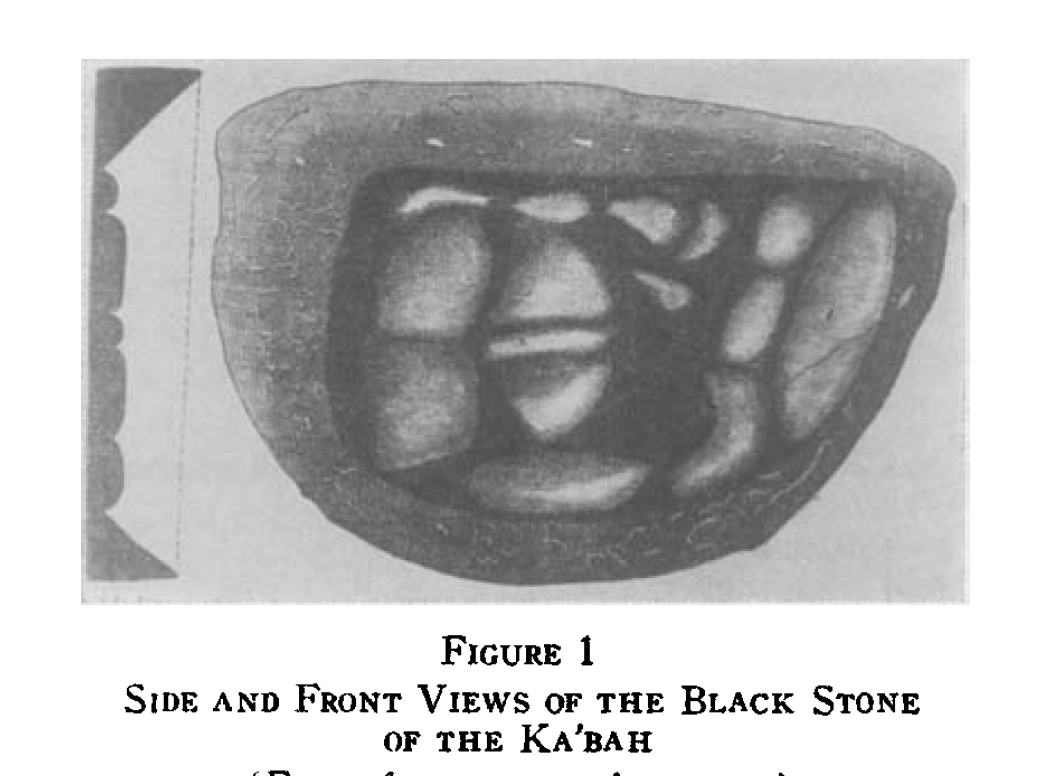
Spending hours staring at the night sky or shelling out generous sums for buying meteorites did not exhaust Khan’s passion for the topic. A third area where his enthusiasm manifested itself was in exploring the religious history of meteors. Hailing from a scholarly family and being educated in classical Persian and Arabic, Khan sought to document and analyze the reports of meteorites in religious texts. One of his most interesting studies in this regard comprised attempts to establish the meteoric origins of the holy black stone of Ka’aba in Mecca. Though he was far from being the first one to propose the theory, it was to his credit to bring both scientific knowledge about meteors and classical textual references together to try to establish the case.
Side and front view of the black stone of the Ka’bah.
A node at which several disparate worlds came together
Khan’s career as a man of mid-20th-century science is a curious blend. At one level he is a hobbyist who managed to keep alive an interest in stargazing that arose as a child. On another level, he is a man brought up in an old Islamic scholarly culture with an abiding antiquarian interest in classical works in Arabic and Persian. At a third level, he is a figure in a global scientific network organised in the form of scientific societies, research institutes, and scholarly journals. Above all, however, he was a node. A node at which several disparate worlds came together. The worlds of hobbyists and scientists, the worlds of antiquarians and astronomers, the worlds of old Hyderabad and modern America, to name only a few.
As a node connecting these heterogeneous worlds, he is reminiscent of an early modern practitioner of natural history. A kind of meta-discipline that predated the birth of modern science, natural history combined the collection of specimens, particularly of exotic and rare objects, with textual studies of classical texts. It was largely displaced by the middle of the 19th century when modern, organised, and increasingly professionalised science took its place. Disciplines gradually became more specialised, collections became institutionalised, and scholarly enquiry became less interested in classical precedents to their topics. The relish with which Khan is said to have displayed his personal collections of meteors to visitors, like SN Bose, after lavish Hyderabadi dinners, or the way he would recite both Sa’adi’s poetry and talk about meteorites at the same event, clearly recalls a world of early modern natural history than modern, scientific astral sciences.
The success of Khan’s career demonstrates the incompleteness of the transitions from natural history to modern science. The former, it would seem, could continue to coexist with modern scientific practices. Moreover, it could even inspire new modes of participatory citizen science, thereby turning dilettantism into a valuable resource for cutting-edge scientific work.
Astronomy was once called the Queen of the Sciences. But the Queen always had more lowly siblings, like stargazing, that remained outside the hallowed halls of science. Remembering Khan and his likes reminds us that on occasion the Queen did in fact meet and learn from her humbler siblings.
Projit Bihari Mukharji is the Head of the Department and a Professor of History at Ashoka University.
source: http://www.scroll.in / Scroll.in / Home> Reading Science / by Projit Bihari Mukherji / August 05th, 2025
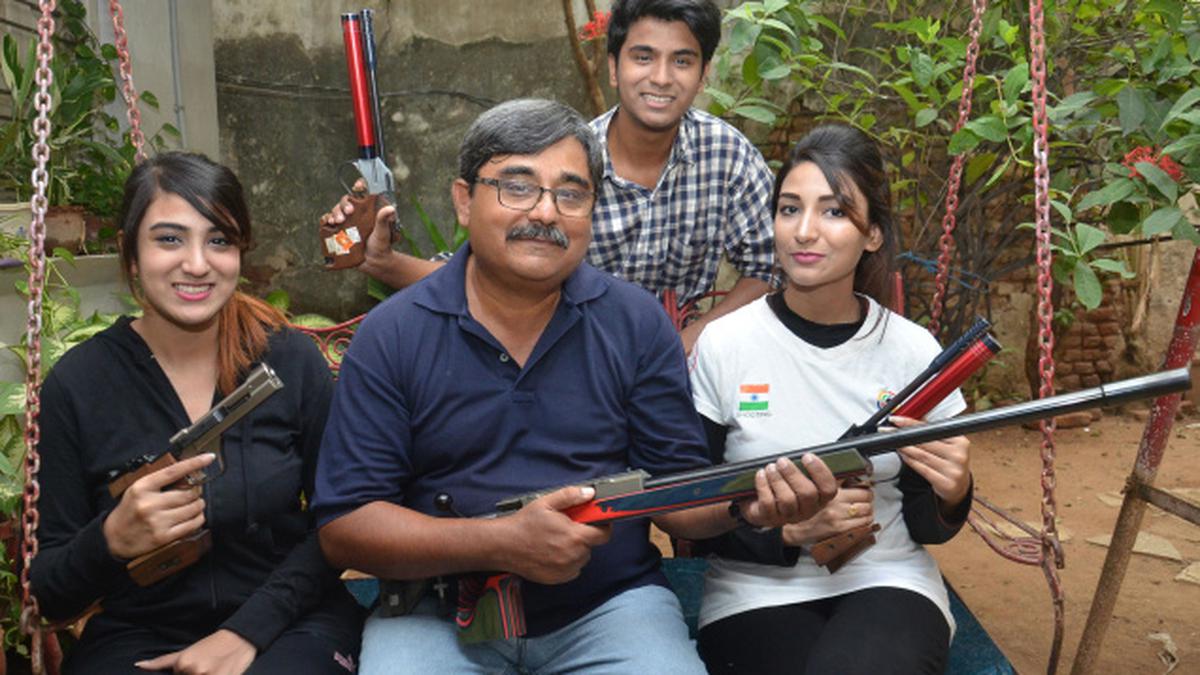
Siblings Nargis Fatima, Saba Fatima and Mohammed Zainulabedein on charting their own path in shooting
Narjis Fatima, A.M. Zainulabedin, and Saba Fatima with their father and coach Abbas / Photo: Nagara Gopal
On the first floor of Aga Mohammed Hussain’s house, Saba Fatima aims at the target as her sister Nargis Fatima and brother Mohammed Zainulabedein watch on. “I am very strict during practice and keep giving instructions,” laughs Saba. The trio do not indulge in the usual brother-sister spats and instead regularly practice on the home trainer range installed at home. These siblings make Hyderabad proud with their shooting achievements.
Interestingly, they are fulfilling their father Hussain’s dreams. Hussain has been shooting for the past 16 years and is a renowned shot. “Since I was into shooting, the children saw me and got guidance. The biggest advantage was that the weapons were at home,” recalls Hussain on how his children took to shooting. He also adds that his fatherly instincts do not come in the way of coaching. “When I am coaching I tend to forget I am their father. I am disciplined and strict and the results show. The only reason they have come up in the field at such a young age is because of their perseverance, discipline and dedication,” he says.
While Nargis Fatima won her first national medal at the age of 11, her aim is to make it to the Olympics. “By God’s grace both Saba and Zain are in the Indian national squad,” states Hussain. Saba, whose ranking is no. 4 is practicing to take part in shooting championship later this year. “Only the top three are sent by the sports ministry and she will be going at her own cost,” says Hussain.
Recently Saba, a D. Pharm student couldn’t go to Germany because of her final year exams. “D. Pharmacy is worse than medicine; it is a five-year course and I told her not to take it because she has to study a lot,” adds the father. However, he is more than glad with Zain’s performance and feels he will bring in laurels to the country. “Zain, whose ranking is number 5 is going for selection trials; Next year, he will be representing the country but getting into the Indian squad itself is a big achievement,” he points out.
Hussain speaks of his recent visit to Uttar Pradesh. “Youngsters are working very hard and one can see them practicing for even six hours,” he adds.
What do the girls do when not shooting? “I study or attend family parties,” laughs Saba. She feels Indian women shooters are charting their own path. “There is Heena Siddhu, who is making us proud,” she beams.
On the importance of having calm nerves during shooting, Hussain says, “For shooting, one needs a temperament that is extraordinarily soft and a synchronisation of multiple things; about 20 things happen in a fraction of a second and one needs to hone the technique and register it in the sub-conscious mind. Conscious mind is very powerful and the moment you shoot with it, you tend to lose everything. One needs to blindly follow what one has put in the training. Ninety percent shooters fail because they get excited and go in for score and don’t get the technique,” he explains.
source: http://www.thehindu.com / The Hindu / Home> Features> Metroplus / by Neerja Murthy / October 18th, 2016
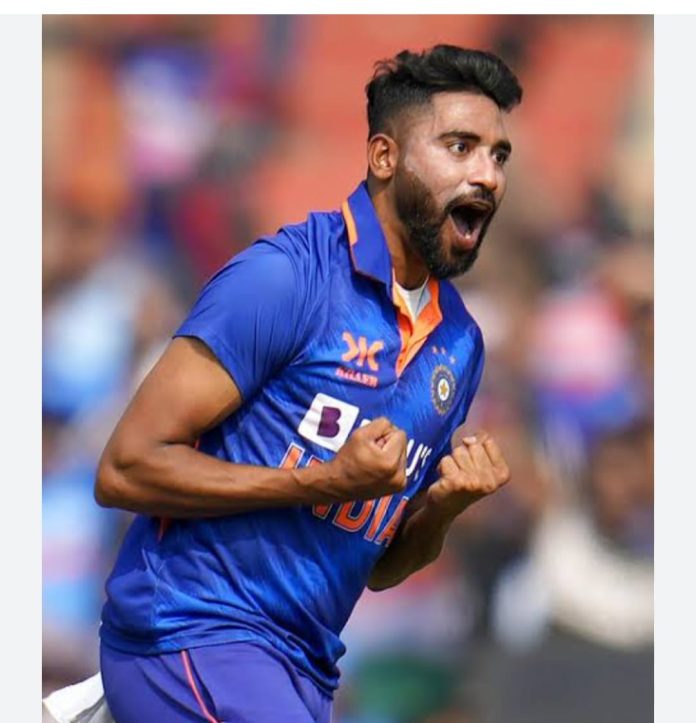
Mohammed Siraj scripted history with a stunning display of fast bowling at Edgbaston, claiming 6/70 to bowl out England for 408 in the second Test of the 2025 Anderson-Tendulkar Trophy. His fiery spell handed India a strong 180-run first-innings lead.
With Jasprit Bumrah absent, doubts hovered over India’s bowling attack. But Siraj, supported by Akash Deep’s four wickets, kept India firmly in control. This came despite a massive 303-run partnership between Harry Brook and Jamie Smith.
Siraj dismissed key English batters, including Zak Crawley, Joe Root, and Ben Stokes. He then ran through the tail, removing Brydon Carse, Josh Tongue, and Shoaib Bashir.
This six-wicket haul is the first by a visiting pacer at Edgbaston since 1993. It is also the third-best performance by an overseas fast bowler at the venue.
At 31, Siraj joins an elite group of Indian pacers with five-wicket hauls in England. The others are Amar Singh, Chetan Sharma, Bhuvneshwar Kumar, and Ishant Sharma. This is his fourth five-for in Tests and his best performance in England.
Despite the long stand from Brook and Smith, India’s pace attack—led by Siraj—remained disciplined and aggressive. They kept the pressure on England and are now in a strong position to level the series.
India will aim to carry this momentum forward as the match enters a crucial phase.
Siraj’s brilliance echoes his historic Asia Cup 2023 performance—where he delivered one of the finest spells in a tournament final. His rise now mirrors the legacy of legends like Chaminda Vaas and Anil Kumble.
Siraj has firmly established himself as India’s new pace spearhead.
source: http://www.radiancenews.com / Radiance News / Home> Latest News> > by Mohd. Naushad Khan / July 05th, 2025
In his passing away, Hyderabad has lost not just a good educationist, an able administrator but a great champion of Urdu cause. No wonder the death of Dr. Abdul Raheem Khan, former Principal, Urdu Arts College, has plunged Urdu lovers into grief and left Urdu circles shell-shocked. Khan leaves behind two sons, a daughter and a legion of Urdu aficionados teary-eyed.
Over the years the soft spoken Khan became synonymous with Urdu and the Urdu Hall, Himayatnagar where he worked till the very end. He spent his entire life in this campus, joining the Urdu Arts College as a commerce lecturer in 1973 and retiring as its principal in 2006. But he contributed a lot for the propagation and preservation of Urdu as the general secretary of Anjuman-e -Tarqqi Urdu Telangana and Andhra Pradesh.
Khan touched many lives and moulded students looking for quality education. Quiet, firm and unrelenting in pursuit of causes dear to him, his death the other day following a brief illness, brought the curtains down on a multifaceted career. The crowded Urdu Hall on Sunday indicated his popularity. A large number of professors, teachers, students and Urdu lovers turned up to pay their respects at the condolence meeting organised here. ‘Ustad-e-mohtaram’ was how many chose to address him. He encouraged many of his students to take up teaching professions and gave breaks to the struggling ones. Dr. Nikhat Ara Shaheen recalled how Khan engaged her services for teaching of Urdu even though there was no vacancy. “I will miss him every day of my life”, she remarked.
Usually teachers do not make good administrators. But Khan begged to differ. His administrative skills came to the fore when he took up the affairs of the Anjuman-e-Taraqqi Urdu and management of the Urdu Hall. Though a commerce teacher basically, he strove to promote the Urdu language. He took the initiative of organising free Urdu classes during the summer vacations. Khan also organised budget discussions in Urdu to explain in simple terms a dry subject like budget. Under the title ‘Apne mulk aur budget ko janiye’, every year a lecture was organised at the Urdu Hall. Prof. Masood Ahmed, a management expert, explains the nitty-gritty of the Union budget within a week of its presentation.
As Prof. Majeed Bedar says, Khan remembered the past, worked for betterment of the present and meticulously planned for the future. No wonder he left his mark of excellence in whatever he did. It speaks about his honesty and integrity that he never misused his office position. He spent from his pocket to treat visitors who came to meet him. His colleague of several years, Zahoor, says he still has about Rs. 3000 given by Khan to arrange tea and snacks for people who come to meet him.
Though the vacuum created by his departure is difficult to be filled, the successor of Abdul Raheem Khan should be one who should carry forward the mission of Urdu so dear to him, said many including senior advocate, Ghulam Yezdani, who is also the president, Anjuman-e-Taraqqi Urdu.
source: http://www.telanganatoday.com / Telangana Today / Home> Hyderabad / by J S Ifthekhar / May 09th, 2022
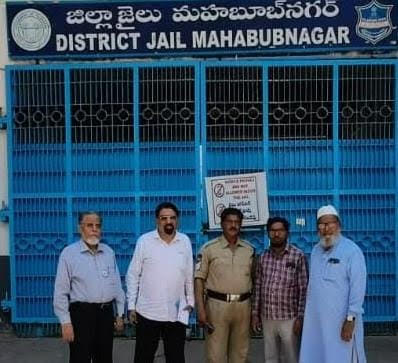
The Movement for Peace & Justice (MPJ) Telangana has reaffirmed its commitment to supporting justice and rehabilitation by providing monetary and legal assistance to first-time Muslim offenders seeking bail across various jails in Telangana. In the year 2024–2025 alone, MPJ facilitated the release of 57 such prisoners.
The organisation, which has consistently worked to aid the underprivileged segments of society, specifically limits its legal and financial support to individuals charged for the first time with non-heinous crimes. Those involved in grave offenses such as rape, murder, or digital financial frauds are excluded from MPJ’s assistance programs, irrespective of their first-time offender status.
In addition to helping individuals secure bail, MPJ Telangana previously extended support to prisoners who had completed their sentences but remained behind bars due to an inability to pay court-imposed penalties.
Beyond legal aid, MPJ Telangana has also taken several humanitarian steps. The organisation distributed general knowledge books, Islamic literature in Urdu and Telugu, stationery, and sports items to inmates. Notably, educational materials were also provided for children living with their incarcerated mothers at the Chanchalguda Special Prison for Women.
Expanding its outreach, MPJ Telangana provided general aid to 121 underprivileged families, educational support to children of 41 daily wage laborers, and medical aid to 59 impoverished families in the state.
MPJ Telangana continues to serve as a vital support system for the marginalized, promoting both justice and rehabilitation with dignity and compassion.
source: http://www.radiancenews.com / Radiance News / Home> Latest News / by Reliance News Bureau / June 11th, 2025
In a celebration of academic excellence and community empowerment, The Siasat Daily hosted a grand felicitation ceremony to honour 373 Intermediate BiPC students who scored above 90% in their board examinations. The event, held at the Siasat Auditorium on Tuesday, is part of a larger educational upliftment initiative spearheaded by Congress MLC Amer Ali Khan.
Addressing the packed hall, Amer Ali Khan declared, “This is not just a function—it is a movement. A campaign to build an atmosphere of academic pride and ambition among Muslim youth.” His powerful words echoed the core message of the ceremony: education is the most effective tool to uplift India’s Muslim community and ensure a dignified future.
Over 1,500 students had responded to an open call, out of which 373 were selected for recognition. Notably, 43 top performers scoring between 99% and 99.6% were awarded cash prizes, certificates, medals, and boAt smartwatches under the tagline “Smart Watches for Smart Students.” An additional 204 students scoring above 95% also received smartwatches as a token of encouragement.
The students were honoured in the following score brackets:
43 students with 99% and above
97 students with 98% and above
49 students with 97% and above
36 students with 96% and above
33 students with 95% and above
27 students with 94% and above
29 students with 93% and above
19 students with 92% and above
98 students with 91% and above
19 students with 90%
Speaking with heartfelt emotion, Amer Ali Khan reminded students of their heritage: “Knowledge is noor (light), and hard work is ibaadat (worship). With Allah’s help, even the impossible becomes possible.” He urged them to emulate Islamic historical figures such as Muhammad bin Qasim, Salahuddin Ayyubi, and Imam Bukhari, who once were students and later transformed the world through their knowledge and leadership.
The event emphasized the importance of both male and female education. Faiz-e-Aam Trust Secretary Iftekhar Hussain passionately appealed to parents to support their daughters’ education. “Girls often outperform boys. We must break the practice of marrying them off immediately after exams,” he said.
The ceremony began with the recitation of the Quran and concluded with the distribution of awards. Despite his busy schedule, Amer Ali Khan remained present throughout, personally honouring each student and motivating their families.
Other dignitaries present included Asghar Ali Khan, M.A. Hameed (Career Counselor), Zahed Farooqui (Director, Siasat Hub), N. Snehith, and Sai Sree (Managers). The event proceedings were conducted by senior journalist Mohammed Riyaz Ahmed.
With applause reverberating through the auditorium, the atmosphere brimmed with pride, inspiration, and a strong sense of community direction. The initiative reinforced the idea that education is not just a means to employment, but a path to dignity, empowerment, and leadership.
source: http://www.radiancenews.com / Radiance News / Home> Education> Latest News>Markers of Excellence / by Radiance News Bureau / June 06th, 2025