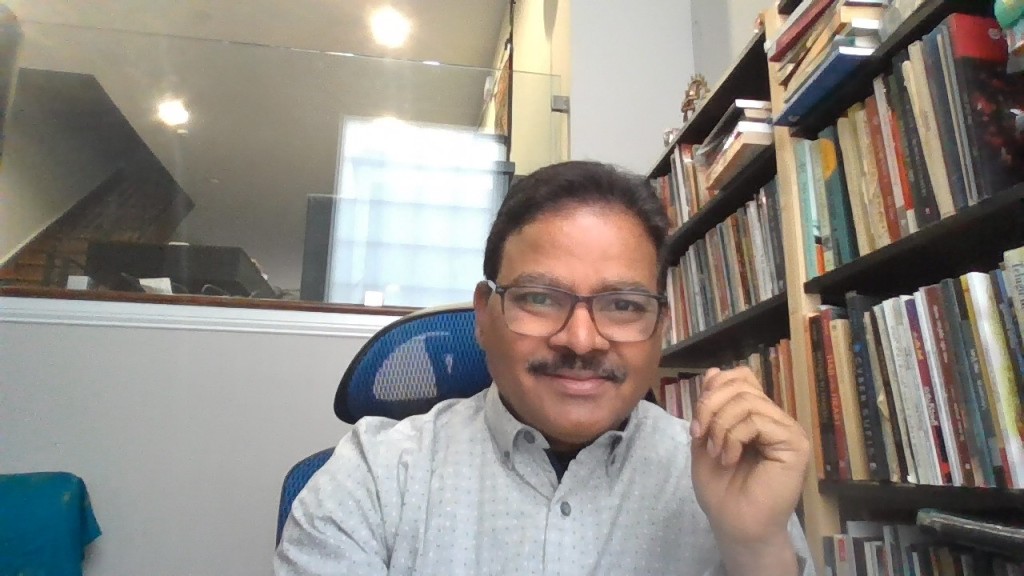
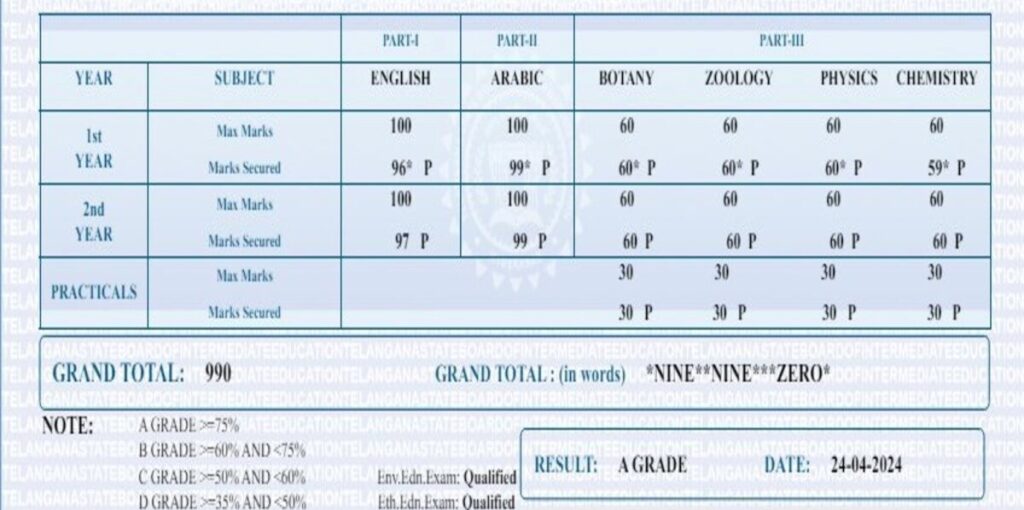
A Hyderabad girl, Ayesha Sultana, has emerged as one of the Telangana inter toppers. She scored 99 percent.
Out of 1000 marks in all subjects in the first and second years of intermediate, she scored 990.
How did the Hyderabad girl become one of Telangana inter toppers?
A student of St. Joseph’s Junior College in Hyderabad, Ayesha Sultana became one of the Telangana inter topper after scoring 100 percent marks in botany, zoology, and physics.
In chemistry, she scored 59 out of 60 marks in the first year, whereas in the second year, she scored 100 percent in the subject.
It was in the languages, English and Arabic, where she lost nine marks.
Telangana intermediate results
Today, the Telangana State Board of Intermediate Education (TSBIE) announced the much-awaited results for the first and second years of intermediate.
The pass percentage for the first year is reported at 60.01 percent, while for the second year, it stands at 64.19 percent. Notably, female students have outperformed their male counterparts in both the first and second year exams.
The incredible achievements of the Hyderabad girl Ayesha Sultana, one of the Telangana inter toppers, inspire all students.
According to officials, the Inter Advanced Supplementary Examinations will start from May 24 to June 1. The TSBIE has released the schedule to this extent. First year exams will be held from 9 AM to 12 PM, and the second year exams will be held from 2 PM to 5 PM.
The examination fee for the supplementary examinations will be collected from April 25 to May 2 in the respective colleges. Fees for recounting and reverification also have to be paid online at the same time.
source: http://www.siasat.com / The Siasat Daily / Home> Top Stories / by Sameer Khan / April 25th, 2022
Gotla Palli Mauza (Padamul Mandal) Tandur Town (Vikarabad District / Hafeezpet, Hyderabad, TELANGANA :
Mohammad Ashfaq
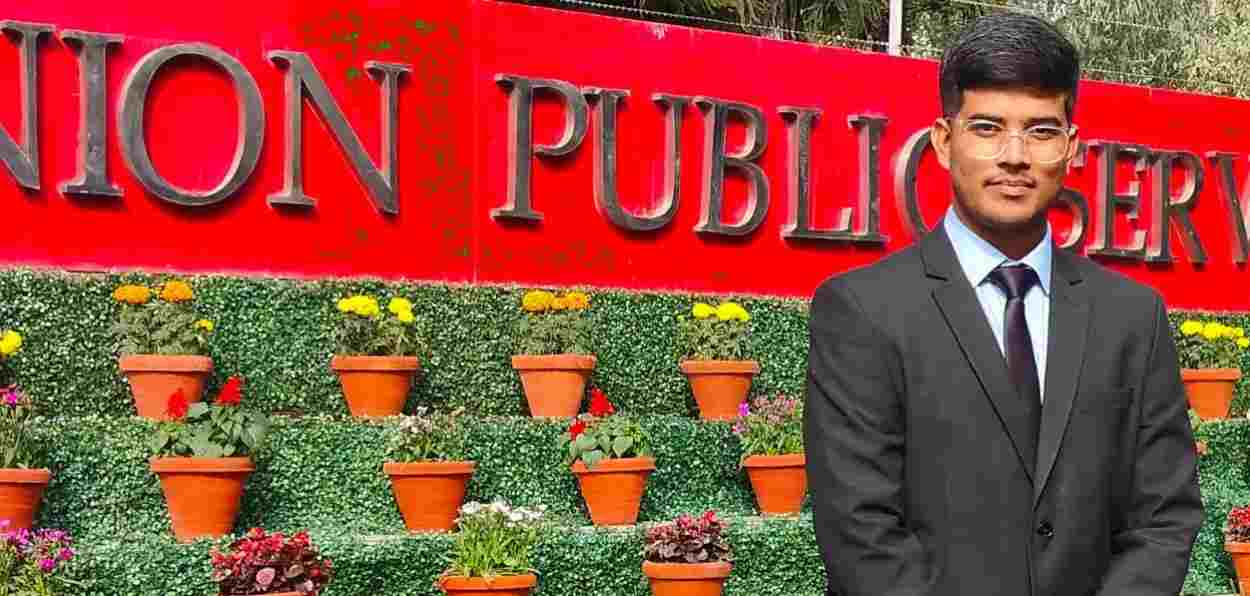
Mohammad Ashfaq of Tandoor, a small town in Telangana, who cleared the Civil Services examination 2023 on his fourth attempt gives credit to his family, especially his mother, for his achievement.
Muhammad Ashfaq said that his mother realized the importance of education and despite he being the only child sent him to Delhi to do his graduation and post-graduation studies. “For my bright future, my mother looked alone after the family and never bothered me with problems at home.”
A sensitive soul, Muhammad Ashfaq gives full credit for his success to his parents.
Speaking with Awaz-The Voice, Mohammad Ashfaq attributed his success to his parents and elder sister. He said that his father dreamed that his son would become a civil servant. “At every stage of my life, my father not only encouraged me but also instilled determination to reach the goal in me. His words motivated and made me determined to clear the examination.”
Mohammad Ashfaq said at the time he thought of picking a corporate job but his father reminded me of my dream and goal. “I can never forget the role my parents and elder sister played in my educational journey,” he said.
Muhammad Ashfaq was a bright child from the beginning. He passed his SSC from Janapriya High School and completed his graduation in Economics from Shri Ram College of Commerce, New Delhi in 2020. Two years later he completed his master’s in Economics from Delhi School of Economics.
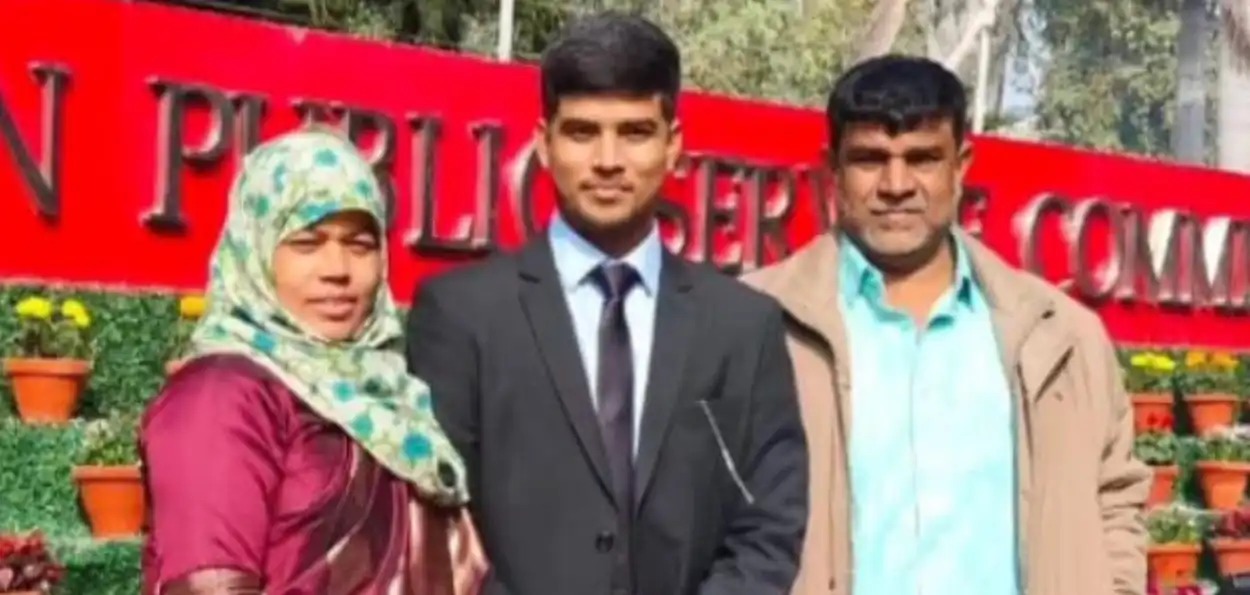
Mohammad Ashfaq with his parents posing in front of the UPSC office in New Delhi
He joined coaching for the civil services from his intermediate class. He wrote his first civil services exam in the year 2020, soon after completing his graduation.
He did not succeed. It was the same in his next two examinations. Failures did not deter him; he continued to pursue his dream with renewed determination and courage.
Muhammad Ashfaq is a native of Gotla Palli Mauza of Padamul mandal of Tandoor. Currently, he resides in Hafeezpet, Hyderabad. His father Mohammad Jafar has an engineering works company at BHEL Ashoknagar. Mother Rizwana Begum is a homemaker.
Mohammad Ashfaq’s elder sister Uzma Sultana is a dentist. His father Mohammad Jafar dreamt of his children having good careers and he is the happiest man today.
Mohammad Jafar moved to Hyderabad in 1992 from Tandoor and started working as a scooter mechanic for a small salary. Later he established his engineering works company.
Ahmed Ashfaq’s grandfather Abdul Razzaq and Grandmother Syedan B live in their ancestral village. They were overjoyed at Nabirah’s success in the civil services examination and celebrated it by distributing sweets among the villagers.
Muhammad Ashfaq is thus the epitome of a never-give-up spirit. His story tells the youth never to be a victim of despair hopelessness or failure.
He said that instead of being discouraged by failures, one should get motivated and try to move forward by addressing one’s shortcomings. He said that hard work never goes in vain.
Muhammad Ashfaq said that as a civil servant, he will focus on the development of the country, service to the people as well as the elimination of corruption. He said that corruption has become a problem in the administration today. They know that they cannot eradicate corruption alone, but they will try their best to eradicate corruption with the cooperation of all honest officials. He said that he would try his best to bring the administration to the doorstep of the people.
Muhammad Ashfaq said that although he has achieved success in civil services, he may get a job in IPS or IRS depending on his rank, but his aim is IAS and he will write the exam again for it.
source: http://www.awazthevoice.in / Awaz, The Voice / Home> Stories / by Sheikh Muhammad Yunus, Hyderabad / April 23rd, 2024
Our Prime Minister Narendra Modi fondly refers to girls as Bharat ki Beti. One such Bharat ki Beti Uzma Fatima, 26, an assistant engineer at the Srisailam Power Plant in the Telangana State left a blazing trail of bravery as she saved 4 of her colleagues from the fire reportedly caused due to short circuit a few days ago.
Modi also says: Beti Bachao, Beti Padhao (Save girl child, educate girl child). Young Hyderabadi Uzma’s bravery can make us say: Beti Padhao, Beti Bachaati (Educate girl child, she will save you)!
Thousands of girls have been raped and burnt to death. Many others have been burnt to death for dowry. But when girls get a chance, they save the families and the nation. Uzma Fatima was a notch higher in the sense that she saved those 4 colleagues, who were not even her own family. She put humanity first!
Uzma Fatima’s father Mohammed Zubair runs a footwear business at Chappal Bazar in Hyderabad. He has three daughters and a son. The elder daughter is married. Uzma Fatima was his second daughter and was unmarried. His youngest daughter is in the eighth standard.
Mohammed Zubair’s son Mohammed Minhaj who is a degree college student told that his family is in a state of shock due to the sudden tragedy. According to him, Uzma Fatima was working in Srisailam Power Station as an Assistant Engineer for the past four years. The CCTV footage of the fire accident shows that Uzma had come out of the fire engulfed place. According to the survivors, she saved 4 (four) of her colleagues. She went back to bring out the other assistant engineers trapped there. She could not come of the tunnel along with eight other colleagues. The brave engineers perished in the fire.
It may be recalled that women were finally given combat roles in the Indian Army after a long struggle. Uzma’s sacrifice proves that women are second to none in bravery. Women are our best bet to save our country within and on our borders. Rani Laxmi Bai of Jhansi proved her bravery in the battlefield against the British. Every girl in our country is a potential Rani Laxmi Bai. They prove it when they get chances. Our Prime Minister Narendra Modi may certainly be feeling proud about the sacrifice of Bharat ki Beti Uzma Fatima.
A fitting tribute to Uzma’s memory would be institute a gallantry award her name and also rechristen Srisailam Power Plant as Uzma Fatima Power Plant. It will not only generate electricity but it will also generate bravery for our future generations of girls to emulate.
The Telangana Chief Minister K. Chandrasekhar Rao (KCR) should pay tribute to Telangana’s daughter Uzma Fatima by naming a major road in Hyderabad after her. The Malakpet Railway Station near her residence can be named as Uzma Fatima Railway Station. Are Modi ji and KCR Garu listening?
source: http://www.beyondheadlines.in / Beyond Headlines / Home> Real Heroes / by Dr. Ahmed Moinuddin Siddiqui / August 25th, 2020
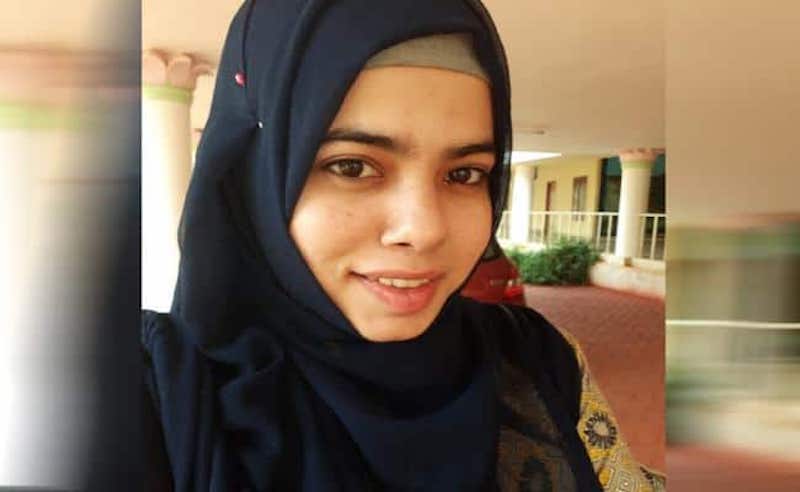
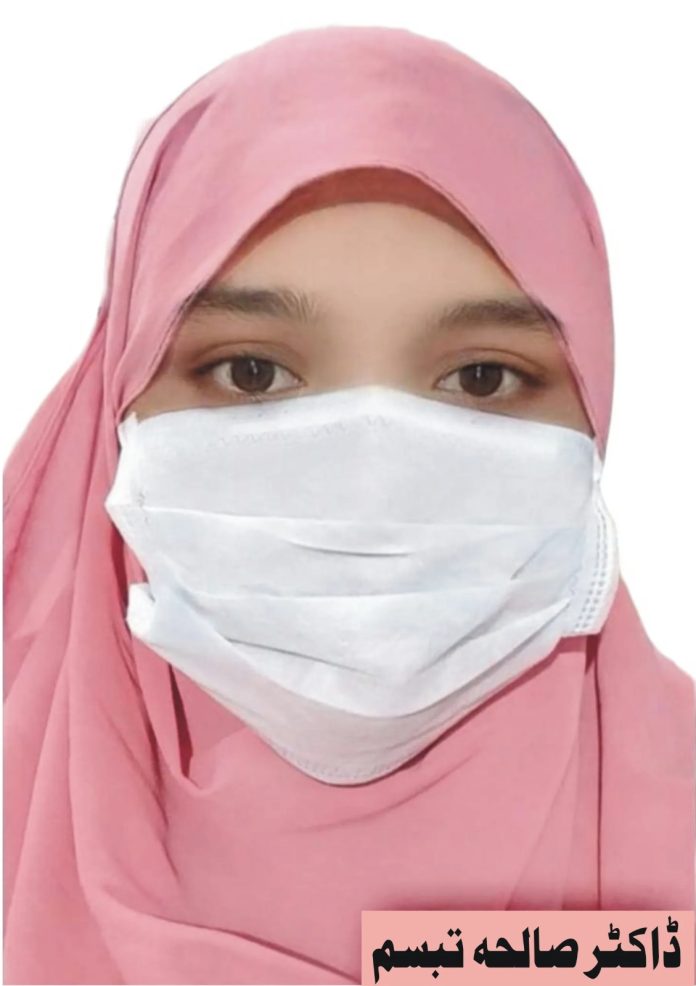
Salihah Tabassum, daughter of Muhammad Waheed Ahmed and wife of Muhammad Atiqur Rahman, has achieved a remarkable milestone. She has obtained a Ph.D. degree in Zoology from Glocal University, Saharanpur.
Her doctoral dissertation, titled “Implications of Seasonal Variations on Global Health: An Examination through the Lens of the United Nations,” explores crucial aspects of global health in relation to seasonal changes.
Salihah’s research was conducted under the supervision of Dr. Banshidhar Singh. She successfully completed her research and underwent a viva voce examination on February 23, 2024. The examination, which was attended by Dr. Vinod Kumar, Associate Professor, and Dr. Banshidhar Singh, Assistant Professor, as well as other Zoology experts, affirmed the quality and significance of her work.
Salihah, Correspondent of Naunehal Urdu High School, Adilabad, is grateful to the Almighty for her success and acknowledges the unwavering support and guidance of her father Muhammad Waheed Ahmed and her husband Muhammad Atiqur Rahman, who are her pillars of strength.
source: http://www.radiancenews.com / Radiance News / Home> Education / by Radiance News Bureau / April 02nd, 2024
Irshad, with 11 years experience at Govt Model School, Pegadapally, was chosen as one of two TG educators for 2024 FTEA
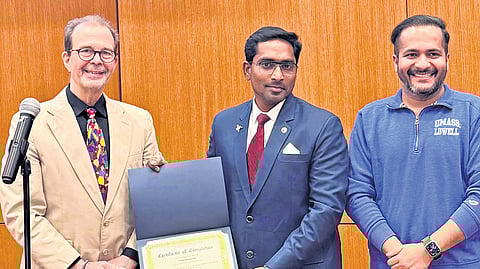
Irshad receives a certificate
Hyderabad :
After seven years of perseverance, it’s a moment of celebration for 40-year old Syed Irshad Ali, a post graduate teacher from Model School and Government Junior College in Pegadapally village of Jagtial district, to have attended the Fulbright Teaching Excellence and Achievement (FTEA) programme at the University of Massachusetts, Lowell, US.
Headed by the Bureau of Educational and Cultural Affairs, US Department of State, the six-week FTEA programme opens doors for secondary school educators to partake in developmental initiatives at prestigious US universities.
Irshad was one of only two teachers chosen from Telangana and one of the seven teachers handpicked from across the country for the 2024 programme. Irshad was selected after attending national-level interviews and attempting the TOEFL (Test of English as a Foreign Language), scoring 61.
Irshad was aspiring and attempting to be a part of the programme for the past seven years and his efforts finally paid off when he was selected to attend the programme, where teachers from 19 other countries were also a part of the cohort.
Speaking to TNIE, Irshad said, “The six-week programme has been a one-of-its-kind experience which gave me an exposure to different cultures and people from various parts of the world. Besides exchanging teaching techniques and knowledge-sharing, the programme expanded my approach and gave me exposure to challenges faced by teachers in different countries, some of which were similar to what we face here in India, while others were extremes, which helped me understand the progress made by India in infrastructure, as well as the areas where we need to improve”.
Syed Irshad Ali speaks at Massachusetts University during the Fulbright Teaching Excellence & Achievement programme
Irshad further said that discussions on gender rights, English pedagogy and visit to the Harvard University, which were a part of the programme were a significant value addition to his learning experience.
Irshad has 14 years of experience in teaching and has been working in the Model School for the past 11 years, where he teaches English language to students from classes 9 to 12.
He has also been a state resource person and has contributed in designing various training programmes for English teachers in the state and was also awarded the district-level best teacher award for 2022, for excellence in English teaching during the Covid-19 period.
Irshad, who is a father to a son and a daughter, stressed on the significance of empowering and fostering girl students, especially in the rural areas, where girls face several challenges, hampering their education and said that this achievement came as an added responsibility for him in creating awareness amongst teachers for improving the quality of education in the government schools.
source: http://www.newindianexpress.com / The New Indian Express / Home> Telangana> GoodNews / by Aarti Kashyap / April 07th, 2024
Since 2014, MS Education Academy has been dedicated to assisting visually impaired students.
Hyderabad:
In a remarkable initiative aimed at empowering visually impaired Muslim students, MS Education Academy has launched a pioneering project to provide comprehensive Islamic education in Braille format.
Since 2014, MS Education Academy has been dedicated to assisting visually impaired students, initially by distributing Braille versions of the Quran.
Recognizing the growing need for Islamic literature in Braille, the academy embarked on a mission to develop a tailored curriculum accessible to visually impaired students.
Over the years, MS Education Academy has meticulously developed Islamic literature in Braille, tailored to the spoken Urdu language prevalent among Muslims in Telangana.
Comprehensive Deeniyat course
A team of experts was assembled to compile a comprehensive Deeniyat course specifically designed for the visually impaired. This initiative has resulted in the creation of a series of Braille books titled “Asaan Deeniyat”
The first instalment of this groundbreaking endeavour, “Asaan Deeniyat Part 1,” has been successfully implemented with the organization of offline classes in Old city of Hyderabad in 2019.
To further extend their reach and cater to students beyond Hyderabad, MS Education Academy launched an online course titled ‘Deeniyat Visually Impaired Maktab.’ This online platform provides flexibility for students residing outside of Hyderabad or those preferring to learn from the comfort of their homes.
Impact of online initiative
The impact of this initiative has been profound, with 250 visually impaired students having already enrolled in the course and demonstrated remarkable progress in grasping the material. Remarkably, students have been able to complete Part 1 of the course in just six months, underscoring the efficacy of the Braille curriculum developed by MS Education Academy.
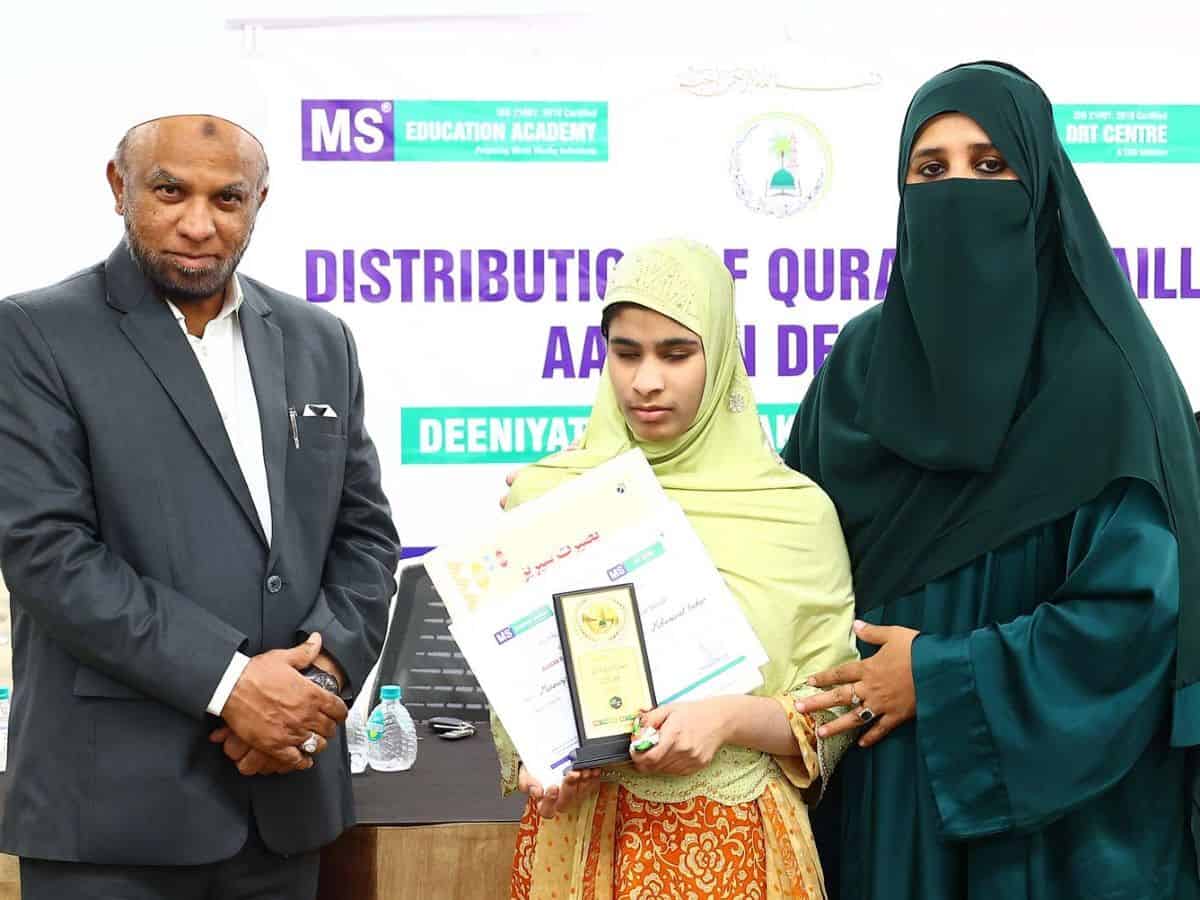
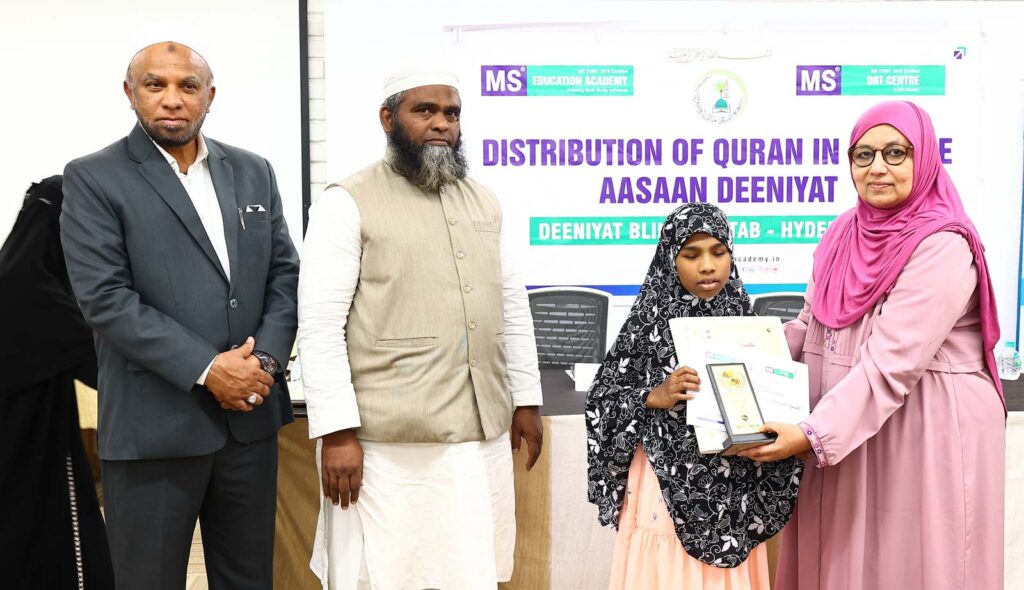
In recognition of their achievements, MS Education Academy organized a special event at its corporate Office to celebrate the completion of Part 1 of the course.
Certificates of completion were awarded to students, marking a significant milestone in their educational journey. Additionally, students were provided with copies of “Asaan Deeniyat Part 2” alongside Braille copies of the Quran, further enriching their educational resources.
MS Education Academy’s commitment to inclusive education and empowerment continues to inspire, serving as a beacon of hope for visually impaired Muslim students seeking access to quality Islamic education. Through their innovative approach, MS Education Academy is not only breaking barriers but also fostering a more inclusive and equitable society for all.
source: http://www.siasat.com / The Siasat Daily / Home / by Sameer Khan / February 23rd, 2024
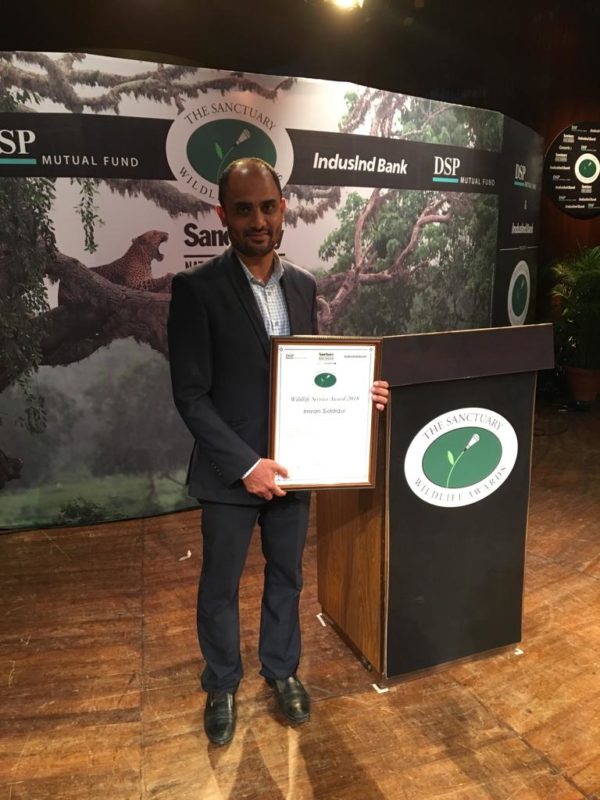
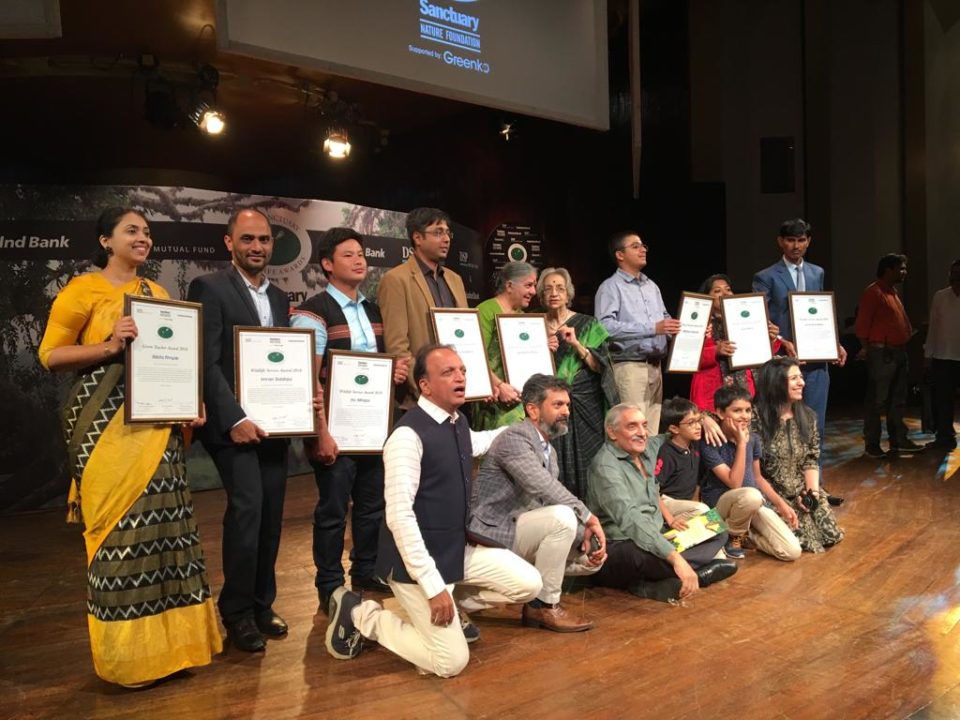
Imran Siddiqui of the Wildlife Conservation Society – India has been honoured with the prestigious Sanctuary Wildlife Service Award 2018.
Imran Siddiqui has come a long way from raising and selling poultry to fund his wildlife obsession.
He is now on the Telangana State Board for Wildlife and works as an external expert for tiger monitoring in Andhra Pradesh and Telangana. He is also the Assistant Director for Conservation Science at WCS-India, and the co-founder of the Hyderabad Tiger Conservation Society (HyTiCoS).
As his life and work reveal, Imran has no respect for man-made boundaries, much like the wildlife he’s so obsessed with. Traversing the rugged landscapes of Kawal, Amrabad and Nagarjunsagar-Srisailam Tiger Reserves and the Gundlabramheswaram Sanctuary, he works in tandem with state forest departments and local communities. His work covers 10,000 sq km of wilderness in Telangana and Andhra Pradesh, with his crew comprising over 35 field staff, 300 volunteers and hundreds of supporters.
Taking a cue from the success of WCS-India in Karnataka and extending it to the neighbouring states of Andhra Pradesh and Telangana, he leads scientific surveys on prey analysis and occupancy surveys on mammals.
He also helps in management planning, engages in snare removal drives, initiates voluntary relocation programmes for forest dwellers, facilitates capacity building workshops for the forest department and influences policy through public interest litigations, high-level committees, community engagement, strong advocacy and creating political will on wildlife.
His efforts have resulted in the speedy disbursal of compensation, besides the initiation of relocation of landless tribals who live within the two tiger reserves of Kawal and Amrabad.
Imran is also largely credited for the declaration of the Kawal Tiger Reserve (where he conducted the fieldwork for his Masters dissertation). For this he had to lobby relentlessly at the political level as well as work tirelessly on the ground to counter misinformation spread by vested interests, and finally win the support of local communities.
A tenacious man on the field and a convincing man in the boardroom, Imran Siddiqui is in no small way responsible for the revival of tigers in this vast but obscure landscape.
The Sanctuary Wildlife Service Award 2018 is a testimony of his untiring efforts to save wildlife and wild places.
source: http://www.india.wcs.org / WCS – Wildlife Conservation Society / Home>News> Current Articles>Archive / by WCS India / December 07th, 2018
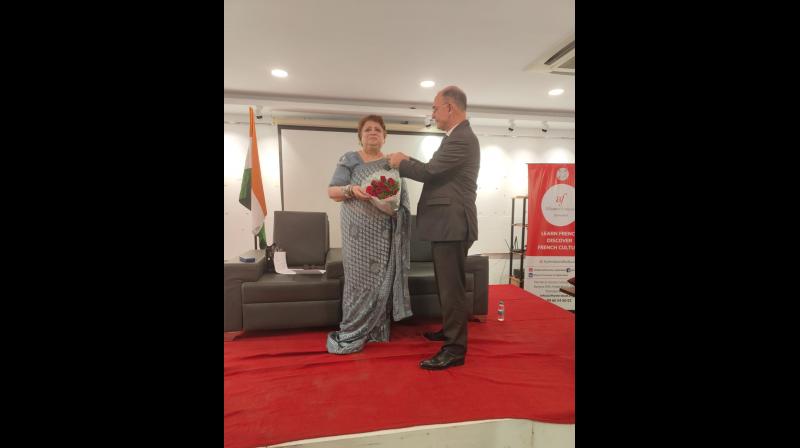
Dr Begum Fatima Shahnaz being conferred the Chevalier dans l’Ordre des Arts et des Lettres (Knight of the Order of Arts and Letters), the second highest French civilian honour by the French ministry of culture for her significant contribution to arts and literature, on Thursday. ( Photo: DC)
Hyderabad:
The multifaceted Dr Begum Fatima Shahnaz was conferred with Chevalier dans l’Ordre des Arts et des Lettres (Knight of the Order of Arts and Letters), the second highest French civilian honour by the French ministry of culture for her significant contribution to arts and literature, on Thursday.
The Jawaharlal Nehru gold medal winner for writing in her teens, Dr. Shahnaz was felicitated at a special investiture ceremony at Alliance Française by Consul General of France, Bangalore, Thierry Berthelot.
The teary-eyed Shahnaz broke into French as she thanked the distinguished guests and shifted to English after a minute or two.
“I didn’t realise I was speaking in French, it comes so naturally to me and I sometimes think in French too,” said the actor, writer, humanitarian, journalist, theatre & art director, professor and journalist.
Talking about the significance of the honour, she said, “France has supported me, and through me, it has supported the Indian people. A Hyderabadi being honoured is an honour to all my people. This places huge responsibility on me, as a citizen of India.”
She also spoke about France and its relationship with Hyderabad and recalled her college years there.
Hailing from royal Indian dynasties, Shahnaz is an actor from the Institut d’Arts Dramatiques Rene Simon in Paris, and is associated with Broadway in New York. She completed her education with a stint at the legendary French school of cuisine, the Cordon Bleu and hopes to bring a new dimension to ‘nouvelle cuisine’ through innovations in Indo-French culinary arts.
Her works include Golconda, Khaki-poems on Pulwama, Saraswati, Shards, Prince of Tears, The New York Poems, Kaleidoscope Eyes, Tiger in the twilight, among several others.
source: http://www.deccanchronicle.com / Deccan Chronicle / Home> Nation / by DC Correspondent / May 19th, 2023
Shah Rukh Khan’s mother Lateef Fatima Khan’s picture with former Prime Minister Indira Gandhi went viral. A rank holder magistrate from Oxford University, England, she was a close associate of the former prime minister.
Lateef Fatima Khan was born and brought up in Tolichowki, Hyderabad on July 1, 1941. Khan was a social worker and passed away in 1990 due to complications with diabetes.
Lateef Fatima Khan was born and brought up in Tolichowki, Hyderabad on July 1, 1941. Khan was a social worker and passed away in 1990 due to complications with diabetes. She passed away before her son Shah Rukh Khan made his Bollywood debut Deewana.
Khan studied at Oxford University and was a first-class magistrate. The Bollywood actor spoke about her accomplishments and said, “She was among the first few Muslim women to have achieved so much.” He added that she was an executive magistrate for the longest tenure recorded. She was a close associate of the former Prime Minister Indira Gandhi and an image of her with the late prime minister is going viral.
In 1992, Shah Rukh Khan was awarded a newcomer award and dedicated it to his late mother. He said, “I am getting a major award in the film industry, she’s still not here. This one’s for you Ma.”
He also spoke about how he rarely prayed but began praying when his mother was battling for her life in the Intensive Care Unit (ICU).
Lateef Fatima Khan was the daughter of a senior government engineer and married Meer Taj Mohammed, an Indian independence activist from Peshawar.
Shah Rukh Khan recently completed 30 years in the film industry on June 25, 2022. His upcoming films include Jawaan, Pathaan, and Dunki. He is a co-producer for the Alia Bhatt starrer Darlings. He was last seen on screen in the 2018 film Zero along with actors Anushka Sharma and Katrina Kaif.
The actor and film producer was awarded the Padma Shri and has won 14 Filmfare Awards for his work in Bollywood. His career began with television appearances and made his Bollywood debut in 1992 in the film Deewana. In his thirty years of acting in Bollywood films, he has appeared in more than 80 films.
While initially resistant to acting in films, he decided to act in films in 1991 and cited it as a way to escape the grief of losing his mother, Lateef Fatima Khan.
source: http://www.shethepeople.tv / She The People / Home> Art> Culture / by Ritika Joshi / July 07th, 2022
In your final rest
on a rope-cot,
were you still dreaming
of a piece of bread?
Beloved one,
we the people
of this country,
of that country,
can make anything
but a piece of bread
for you.
--Evening with a Sufi: Selected Poemsby Afsar Mohammad, translated from the Telugu by Afsar Mohammad & Shamala Gallagher, Red River Books, 2022.
These lines send shivers down the spine and recreate an empathetic longing for immigrant souls in search of succour. They also swiftly draw an image laced with poignancy — a loss, a regret, the economics that deny innovative young men their keep and force immigration in search of sustenance. Would the poet have been one of them?
Travelling from a small village in the South Indian state of Telangana, Afsar Mohammad has journeyed across continents and now teaches South Asian Studies at the University of Pennsylvania. Known as a trendsetting poet and literary critic for post-1980s Telugu literature, Afsar has brought out five volumes of poetry, one collection of short stories and two volumes of literary theory essays. He is also a distinguished scholar of Indian studies and has published extensively with various international presses, including Oxford and Cambridge. He is currently working on a translation of Sufi poetry from Telugu to English. In this interview, we trace his growth as a writer and editor of the webzine, Saranga, which now seems to be transcending linguistic barriers to give voice to multiple cultures…
Tell us about your journey as a writer. When and how did it start?
It’s a long story, but to cut it short — the beginnings were somewhat puzzling… Inspired by Shakespearean sonnets, I first wrote some sonnets in English, and then switched to free verse. Since most of my friends in my high school started pushing me to write something in Telugu, I had to migrate to Telugu. Quite surprisingly, I was first published in English, and then it took me a while to get something published in Telugu. I had hard time getting published in Telugu due to its newness in expressions and most editors felt that there was nothing “Telugu” in that kind of writing. So, my early writings quite naturally found their home in some English journals!
Your poetry rings with the pain of distance, the pain and struggle from others’ suffering transcending your own self. What is the source of your inspiration — is it your past or your present?What affects you more — your being an immigrant or a Sufi?
We’re distanced by many things — not just physically! We live in many shattered and scattered worlds, and sometimes we fail to reflect on those worlds. I feel like I’m a constant immigrant — despite my formal citizenship and legal boundaries. Sufism is merely a segment of this expansive realm. Both past and present define our destiny, right?! Of course, I try to live in the present rather than in the past, but never deny the baggage of the past.
Why do you subscribe to the Sufi school of poetry? What is Sufism all about?
I come from an extremely local rural setting where such Sufi mystical practices openly defined my everyday life. It’s not about the technicalities and theories or institutionalised Sufi schools of their philosophies, this is more about what I learned from my childhood, and its physical surroundings dotted by several hybrid shrines. I’ve described this cultural setting in my 2013 Oxford University Press publication, The Festival of Pirs: Popular Islam and Shared Devotion in South India. This version of Sufism has more to do with everyday life rather than a spiritual domain.
You have lived away from your country for long, and yet the past seems to still haunt you. What is the identity you seek as a poet? Is it necessary to have a unique identity or can one be like a drop that flows and moulds as per the needs of the vessel?
In a way — physically– I’m away from my birth place, but in many ways, I’m also closer to my homeland than in my past. When I moved away from the actual picture, I see many dimensions from a new lens. Each dimension contributed to my rethinking and reconsidering the idea of India. As I wander around and meet totally different places and people, I learn more about my birthplace and moved a little closer to it. I totally understand this as a process to reconcile with the past and connect it to a new present intensified by many factors, not just personal. We’re living in a virtual world, which also looks like “real” in its sounds, colours and words. Every moment it makes me realise that I’m actually not that far. On the other hand, I also see the people in my homeland who are far more removed by their immediate reality and everyday experiences. We need to read this conditionality more in terms of perspective rather than physical distance.
You are fluent in Telugu, Urdu and English. You started writing in English and then moved to Telugu. And all your poetry collections have been in Telugu. Why? Would the outreach of English not have been wider? What made you pick Telugu over English?
Great question! My literary graph is neither linear nor simplistic. When I look back and reflect on it, it’s a quite messy roadmap — actually, there’s nothing like a map to get its contours. Yes, I started writing in English and then suddenly stopped sending out the poems to magazines. In fact, I write more in my personal journals rather than in print journals. Theoretically, I saw poetry as a personal diary for my experiences for many years. Due to financial concerns within my family, I had to start working very early on and left most of my journals at home. Then, my friends found them by chance and put them together that became my first collection of poems in Telugu. The collection was an instant success for its innovative style and then that opened up my career in Telugu rather than English which was my first language of literary expression.
You are now bringing out a bi-lingual online magazine, Saranga? What made you think of a magazine in two languages?
Before entering into teaching career, I worked as an editor of the literary supplement and Sunday magazine for a largest circulated Telugu newspaper. When we moved to the USA, I thought it would be better to have some outlet to engage with my home language and literature. In the early phase, Saranga was primarily a Telugu webmagazine. When I started teaching South Asian literature, then I realised the importance of making Indian literary texts available to contemporary generation in the USA. That was just one reason, but there’re were many factors as our team saw a rise in the Indian diaspora writings in the new millennium. Luckily, we got wonderful support from writers and poets in various Indian languages. The humble beginnings have actually ended up as a rewarding experience.
What is it you look for in contributors from two languages? Is it the same guidelines or different?
We’re still learning how this works! As it appears now, these two sections require two different approaches and guidelines. Since the English section has been now attracting writers from various languages, it’s moving more towards a multi-lingual base. We’re trying to accommodate more translations into English from different Indian languages. We still need to do lots of work there.
Is the journal only aimed at South Asian diaspora or would you be extending your services to all cultures and all geographies?
Saranga, as we see it right now, is more about South Asia and its diaspora. As you know, we need more such spaces for South Asia and its diaspora. Not sure about its future directions at this point, however, if the situation demands, we will extend its services further.
You have number of essays and academic books in English. But all your creative writing is in Telugu. Why? Would you be thinking of writing in English too because proficiency in the language is obviously not an issue?
Most of my academic writing came out of my teaching experience. As I started teaching new courses, I then realised that we need more material from South Asia. I started focusing on producing such materials primarily for my courses and then gradually, they became useful for many academicians elsewhere too. I still believe creating writing as a more personal space — that enables me to articulate more about myself. However, the publication of Evening with a Sufi, brought a new change — as I’ve been getting more requests for more writing in English for the last two years. As you know pretty well, I’m an extremely slow writer.
How do you perceive language as a tool for a poet?
I see language working many ways since I dwell in multiple languages. I started my elementary education in Urdu, and my middle school was in Telugu, and the subsequent studies were in English. Through the last day of her life, my mother was extremely particular about me learning Arabic and Farsi. So, I believe that helped me so much to understand how language works in a poem. When I published my first poem in Telugu, the immediate critique was it was a not a “Telugu” poem. Telugu literary critics labelled me as a poet who thinks either in Urdu or English, then writes in Telugu. Of course, most of them were also fascinated by the new syntax of my Telugu poems and the new images and metaphors—that totally deviate from a normative or mainstream Telugu poem of those days. The uses of language in a poem varies for each poet. If you’re reading, writing and thinking in just “one” language, that might be a safe condition. A contemporary or modern poet, however, belongs to many languages and cultures. We also migrate from one language to another in our everyday life.
Do borders of nationalism, mother tongue and geographies divide or connect in your opinion? Do these impact your writing?
The response to this question might be an extension to the above conditionality of a person. Anyway, I’m not a big fan of those ideas of nationalism, mother tongue and singular geographies. They don’t exist in my world. Most of my writings both creative and academic contest such boundaries and borders. To describe this in a single term- borderless. In fact, I believe we’re all borderless, but unfortunately, many boundaries and borders are now being imposed on our personalities.
(The online interview has been conducted by emails by Mitali Chakravarty)


/shethepeople/media/post_banners/ZPgiNgUOcTPzyNDD9MxE.png)