Tamkeen Fatima, a past student of Aligarh Muslim University (AMU), has been selected as Scientist ‘B’ by the Defence Research and Development Organisation (DRDO), Ministry of Defence, Government of India
Aligarh Muslim University:
Tamkeen Fatima, a past student of Aligarh Muslim University (AMU), has been selected as Scientist ‘B’ by the Defence Research and Development Organisation (DRDO), Ministry of Defence, Government of India.
Tamkeen Fatima is a recent M.Tech. graduate from the Department of Computer Engineering. Her selection came through a highly competitive process comprising academic performance, GATE score and interview.
Tamkeen completed her M.Tech. (Computer Science & Engineering) in 2025 with an outstanding CPI of 9.944, securing the top rank in her class.
She also completed her B.Tech. from AMU in 2023 and qualified UG-NET (JRF) 2024 in Computer Science with an All-India Rank 2 (99.9933 percentile) in her very first attempt.
“A Consistent Performer”
Tamkeen is a Second Year student pursuing M. Tech. in Computer Science and Engineering at the Department of Computer Engineering, Z.H. College of Engineering and Technology, Aligarh Muslim University.
She completed her B Tech from AMU in 2023 with 9.703 CPI. She has been a consistent recipient of Merit Scholarships from class X onwards, including UP STSE, University Merit Financial Award (AMU), and GATE scholarship.
During her B Tech, Fatima participated in research internship programmes at ISRO, McMaster University, Toronto, Canada (Mitacs GRI), and The Fields Institute, Toronto, Canada (Fields Undergraduate Summer Research Programme). She has also published a research paper in ACM Conference Proceedings.
Recognising her academic excellence and research potential, she was selected as Assistant Professor (Contractual) through the Local Selection Committee and joined the Department of Computer Engineering, AMU in August 2025.
source: http://www.ummid.com / Ummid.com / Home> Career / by Ummid.com news network / November 01st, 2025
Professor Ghulam Muhammad, widely known by his pen name Marghoob Banihali, was an illustrious scholar, poet, and cultural historian whose literary and academic contributions have left an indelible mark on the landscape of Kashmiri literature and thought.
Born on 5th March 1937 at Bankoot, Banihal, in the erstwhile princely state of Jammu and Kashmir, he emerged as a multidimensional personality whose erudition encompassed not only Kashmiri language and literature but also Persian, Urdu, and English.
Marghoob Banihali’s journey, marked by personal loss, intellectual rigor, and literary innovation, reflects the resilience of a scholar deeply rooted in his cultural milieu yet transcending regional boundaries in his vision.
He passed away on 27th April 2021 at his residence in Srinagar, leaving behind a rich legacy of scholarship, poetry, and cultural reflection. The formative years of Marghoob Banihali were fraught with challenges. He lost his mother at the tender age of eight and his father when he was merely fourteen. The successive losses not only plunged his family into economic hardship but also exposed the young boy to the harsh realities of life at an early age. The family’s business suffered a severe blow, forcing Marghoob to traverse arduous paths—both literal and metaphorical—toward education and personal growth. In March 1954, he undertook a challenging journey to Islamabad to appear for his matriculation examination, traveling around seventy kilometers through snow-clad mountainous terrain. These early experiences of adversity instilled in him resilience, humility, and a deep understanding of human struggles, qualities that would later find expression in his literary and scholarly endeavors.
Marghoob Banihali received his early education under several prominent Kashmiri educators who shaped his intellectual and literary sensibilities. Among these were Haji Ghulam Ahmad Shah, who later became his father-in-law, Hakim Muhammad Hafiz Allah of Rawalpora, Srinagar, and Molvi Ghulam Muhiuddin Kirmani of Pattan Baramulla, who advised him to adopt the pen name “Marghoob.”
Another significant influence in his formative years was Master Ghulam Nabi Geeri, a member of his own family, who provided guidance and support during his early scholarly pursuits. Despite financial constraints, Marghoob pursued his education in a private mode, simultaneously embarking on a teaching career that would span decades. He eventually completed his Masters in Persian and went on to earn a PhD in the same field, laying the foundation for a distinguished academic career.
Professionally, Marghoob Banihali held diverse roles that reflect his commitment to education and literature. He served as headmaster and vice-principal at higher secondary schools and as a Tehsil Education Officer (TEO) before joining the University of Kashmir in 1969 as a lecturer in the Persian Department. His tenure at the university spanned over three decades, during which he contributed to the Department of Kashmiri, the Central Asian Studies Department, and the Iqbal Institute. He retired in 1997 as the Head of the Department of Kashmiri, leaving behind a legacy of mentorship, scholarship, and administrative excellence.
Marghoob Banihali’s literary oeuvre is vast and varied, reflecting his erudition, spiritual depth, and commitment to human values. His writings primarily focus on Islamic subjects, communal harmony, and ethical and cultural reflections. He authored over fifty books in Kashmiri, Urdu, Persian, and English, covering poetry, literary criticism, cultural history, and translations. His first poetic collection, Partavistan, earned him the Sahitya Akademi Award for Kashmiri literature in 1979 and the state Sahitya Akademi Award in 1977, establishing him as a prominent voice in contemporary Kashmiri poetry. His works transcend mere literary expression; they engage deeply with the cultural, spiritual, and philosophical dimensions of Kashmiri society.
Among his notable works is Marghoob Theory, published in English in 1982, which offers a systematic proposal for the improvement and modernization of the Kashmiri script. This work has been lauded by scholars such as Prof. Syed Maqbool, former Director of the Centre for Central Asian Studies, who described it as a scientifically viable and practical method that preserves the connection of Kashmiri with its source languages while making it more accessible to the Kashmiri-speaking populace.
Similarly, Prof. Nazir Ahmad Malik, a distinguished linguist, recognized the significance of this contribution for the development and preservation of Kashmiri language and literature.
Another seminal work, Kashir Bale Apare (1989), provides a detailed account of Kashmiri culture, language, and literature as prevalent in the Pir Panchal region. Through meticulous research, Marghoob Banihali chronicled the evolution of Kashmiri literature, highlighting its linguistic and cultural heritage.
His translations further enriched Kashmiri literary resources; in 1975, he translated Kalilah wa Dimnah into Kashmiri, introducing the classic collection of fables to a broader audience.
He also translated the monograph on the “Nightingale of India” (Bulbul Hind), Sarojini Naidu, thereby familiarizing Kashmiri readers with the Bengali poet Qazi Nazrul Islam. Marghoob Banihali’s engagement with historical and cultural scholarship is exemplified in Qadeem Kashur: Some Glittering Milestones of Ancient Kashmiri (with Special Reference to Shaikhul Alam), published by the Central Institute of Indian Languages, Mysore, in 2001.
This work provides the cultural and linguistic background of Shaikhul Alam’s poetry, situating it within the broader historical and intellectual traditions of Kashmir.
Similarly, his scholarly inquiry into Iqbal’s thought culminated in Kalam Iqbal kay Ruhani, Fikri wa Fani Sarchasmay (2006), a critical exploration of Iqbal’s philosophical, spiritual, and literary dimensions.
He also authored Ikhliqiat Marghoob (2005) and Khas Ihsan, poetic collections that address Islamic themes such as Tawhid, Risalah, and Akhirat, blending devotional fervor with literary sophistication.
His translation of the rare manuscript Noor Namah of Baba Naseebuddin Ghazi into Urdu (published in 2013) further attests to his dedication to preserving and disseminating Kashmir’s spiritual and literary heritage.
“Professor Marghoob Banihali was a cultural beacon of Kashmir, revered in literary and social circles for bridging the region’s historical, linguistic, spiritual, and literary traditions with contemporary scholarship. His work, including his writings, teachings, and translations, deeply engaged with Islamic thought, human values, and communal harmony. Banihali significantly contributed to the Kashmiri language through the Marghoob Theory and rejuvenated Sufi poetic traditions. As a poet, scholar, teacher, and humanist, his legacy is a testament to the power of knowledge and devotion to culture, faith, and humanity, making him a jewel in the crown of Kashmiri literature.”
Marghoob Banihali’s scholarship was not confined to the written word; he was a dedicated teacher and mentor, particularly in the study of Persian poetry of Iqbal.
Associated closely with Aali Ahmad Saroor, whose monumental works on Iqbal he studied and taught, Marghoob enabled research scholars at the Iqbal Institute of Philosophy and Culture to engage with Iqbal’s Persian poetry critically and independently.
By teaching the fundamentals of Persian language and literary analysis, he empowered a generation of scholars to navigate complex texts and philosophical concepts with confidence. In the foreword to Adam Gharay Iqbal (Iqbal’s Humanistic Philosophy), Professor Abdul Haq aptly observed: “Prof Marghoob is a knowledgeable person and a thinker as well. He is truthful, sincere, and honest in thinking, and practical in dealings. His multidimensional personality, combined with his erudition in Urdu, Persian, and Kashmiri literature, provides students and teachers ample guidance.”
A prominent dimension of Marghoob Banihali’s personality was his humility, nobility, and spiritual inclination. Mir Ghulam Rasool Nazki affectionately called him “mahboobi” (my beloved), while Akhtar Mohiuddin described him as an Islamic poet and writer endowed with pure nature (salim al-tabah).
Yusuf Taing, a renowned literary critic, noted that Marghoob Banihali’s poetry, whether in ghazal, naat, nazm, rubai, or manqabat, consistently reflects a profound love for the Prophet Muhammad (SAW), serving as a versified biography of the Prophet and reviving the spiritual essence of Kashmir’s Sufi poetic tradition.
Through works such as Tohfai Tawhid (2017), he rejuvenated the age-old legacy of Kashmiri Sufi poetry, imbuing it with tawhidic thought and devotional depth.
Professor Marghoob was a vital link between Kashmir and Jammu, belonging to the distinguished line of Pir Panchal poets and literary figures, including Kamghar Kashtwari, Rasa Javeedani, Nishat Kashtwari, Janbaz Kashtwari, Bashir Badrwahi, Shahbaz Rajourwi, and Manshur Banhali.
He was described by Bahar Ahmad Bahar as “a movement, a history, and a trendsetter,” and Prof. Ghulam Mohiuddin Hajni famously likened him to “a jewel coming from the sky-rocketing mountains of Pir Panchal.” Mohan Lal Aash extolled him as “a diamond carved out from the high rocks of Pir Panchal,” recognizing his deep understanding of global literary trends, mastery over expression, and devotion to the Rishi philosophy of Hazrat-e-Alamdari in Kashmir. Prof. Waheed-u-Din Malik, former Vice Chancellor of the University of Kashmir, hailed him as “a brilliant scholar of oriental languages, a sincere Kashmiri who undertook the arduous task of bringing out the best of Kashmiri culture and language through creative writings.”
One of Professor Marghoob Banihali’s seminal contributions to Kashmiri linguistics is the Marghoob Theory, a concise yet powerful work in English that chronicles the birth and evolution of the Kashmiri language and proposes a practical framework for its script reform. This work, consisting of around 100 pages, received praise from scholars and linguists alike for its scientific approach, practical applicability, and preservation of linguistic heritage. It has been recognized as a landmark achievement in Kashmiri language studies, providing a bridge between tradition and modernity in the realm of script and literacy.
Throughout his life, Marghoob Banihali exemplified the qualities of a consummate scholar, poet, and humanist. His multidimensional personality combined erudition, humility, devotion, and a profound sense of social and cultural responsibility. He engaged deeply with the literary and spiritual heritage of Kashmir while extending his intellectual reach to encompass Persian, Urdu, and English literature. His literary output, comprising over fifty books, reflects a commitment to ethical values, spiritual insight, and cultural preservation. His translations, critical studies, and original works enriched the literary corpus of Kashmir and created pathways for future scholars to explore the region’s rich literary and philosophical traditions.
Marghoob Banihali’s contributions were recognized with numerous accolades, including the prestigious Sahitya Akademi Award in 1979 for Partavistan, the state Sahitya Akademi Award in 1977, and the Ghalib Award from the President of India in 2008.
Beyond awards, his enduring legacy lies in the generations of students, scholars, and readers he inspired, the rejuvenation of Kashmiri Sufi poetic traditions, and the preservation and propagation of the Kashmiri language and culture.
Professor Marghoob Banihali’s life exemplifies resilience in the face of adversity, intellectual curiosity, and unwavering dedication to cultural and spiritual values. His scholarly rigor, poetic genius, and commitment to education rendered him a guiding light in Kashmir’s literary and academic spheres. The impact of his work continues through his sons, particularly Prof. Mushtaq Marghoob, who carry forward his philanthropic and intellectual legacy, ensuring that the torch of knowledge and cultural enrichment remains alight.
In conclusion, Professor Marghoob Banihali was not merely a literary figure or an academic; he was a cultural beacon whose life and work bridged the historical, linguistic, spiritual, and literary traditions of Kashmir with contemporary scholarship. His writings, teachings, and translations reflect a deep engagement with Islamic thought, human values, and communal harmony, while his humility, sincerity, and spiritual devotion rendered him a revered personality in both literary and social circles. He rejuvenated the rich Sufi poetic traditions of Kashmir, contributed to the evolution of the Kashmiri language through the Marghoob Theory, and inspired generations of scholars and poets. As a poet, scholar, teacher, and humanist, Marghoob Banihali remains a jewel in the crown of Kashmiri literature, a legacy that will endure for generations to come. His life is a testament to the power of knowledge, perseverance, and devotion to culture, faith, and humanity. May his soul rest in peace.
(The author a veteran academician is a former Professor and Head Department of Islamic Studies, Kashmir University. The views, opinions and conclusions expressed in this article are those of the author and aren’t necessarily in accord with the views of “Kashmir Horizon”) hamidnaseem@gmail.com
source: http://www.thekashmirhorizon.com / The Kashmir Horizon / Home> Opinion / by Prof. Hamid Naseem Rafiabadi / October 28th, 2025
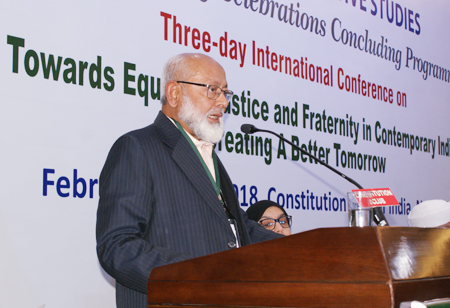
Dr. Mohammad Manzoor Alam, the founder of the Institute of Objective Studies (IOS), stands as one of the most prominent leaders of the Indian Muslim community. Recently, his biography “Dr. Manzoor Alam: Empowering the Marginalized” written by senior multilingual journalist A. U. Asif, was released at the Constitution Club of India in New Delhi. The event was attended by several distinguished personalities from politics, academia, the judiciary, and the media.
The biography reveals many unknown aspects of Dr. Manzoor Alam’s life, his contributions, and his wide national and international connections — from Dr. Manmohan Singh to Ahmed Patel, from cabinet ministers to chief ministers and governors. His close friendships extended to Malaysian Prime Minister Anwar Ibrahim and several prominent personalities across the Gulf Cooperation Council (GCC), including ministers and academicians. Among his international associates were Prof. Omar Hasan Kasule, Secretary General of the International Institute of Islamic Thought (IIIT), USA; Dr. Ahmad Muhammad Ali, the first President of the Islamic Development Bank (IDB); Dr. Ahmed Tutunji, General Secretary of the International Islamic Federation of Student Organizations (IIFSO); and Professor Ismail Raji al-Faruqi, co-founder of IIIT, Dr. Abdullah Al-Maatouq, Chairman of the International Islamic Charity Organization (IICO) Kuwait etc.
The Institute of Objective Studies: A Pioneering Muslim Think Tank
Undoubtedly, the IOS — the first Muslim-run think tank in India — has played an unparalleled role in academic and intellectual engagement. Over the past four decades, it has organized more than 1,230 conferences, seminars, symposia, and workshops on diverse issues affecting Muslims and Indian society at large. It has completed over 410 research projects and produced around 405 publications focusing on socio-economic, educational, and cultural challenges.
Through its data-based research, collection, and presentation, IOS provided valuable insights into the conditions of marginalized communities. The institution succeeded in building a network of more than 500 research scholars, social scientists, academicians, judges, lawyers, and politicians. Its studies and deliberations form a crucial body of work on the socio-economic conditions of Indian Muslims.
However, despite its achievements, the IOS has failed to evolve a sustainable mechanism for implementing the findings of its research. After nearly four decades of existence, the impact of its ideas on the ground remains negligible. The think tank, while rich in intellect and intent, fell short of translating its research into practical policies for the empowerment of marginalized communities. When one examines the ground realities, the absence of tangible transformation makes this collective effort appear more like an academic exercise than a movement for social change.
The Promise and the Reality
The Institute of Objective Studies was established in 1986 with the vision of empowering the 200 million-strong Indian Muslim community — a group that, even today, lags behind many other marginalized sections, including Dalits, on multiple socio-economic parameters. While IOS produced a wealth of research and data, it failed to create models of empowerment or tangible change on the ground.
It would be unfair to assume that Dr. Manzoor Alam’s vision was limited to research and conferences alone. He unsuccessfully attempted to extend his work into education, media, and healthcare. Unfortunately, many of those initiatives remained unrealized.
Dr. Alam had conceived numerous projects, including a dream university and television channels Al-Hind and Falak TV — both designed to serve as platforms for education and social awareness. He presented these projects at several events in India and abroad, yet they never materialized beyond the planning stage. Why these ideas remained confined to files is a question that only Dr. Alam himself can answer.
Dr. Manzoor Alam’s Tryst with Education and Development
In the 1990s, Dr. Alam invited Mohammad Yunus Saleem, then Governor of Bihar, to lay the foundation stone of an educational institution in his native village, Ranipur, in Madhubani district. Decades later, that very school continues to function from a thatched hut.
Similarly, he invited another Governor, Akhlaqur Rahman Kidwai, to lay the foundation of a hospital in the same village. However, there is no trace of that foundation today, and the land has reverted to agriculture. It is said that even a few delegations of Arab dignitaries visited the site to explore funding possibilities for these projects. Yet, despite such visits and promises, Ranipur remains a mirror reflecting the unfulfilled dreams of Dr. Alam’s vision for grassroots empowerment.
Akhlaq Ur Rehman Kidwai, then Governor of Bihar, during his visit to Ranipur — the native village of Dr. Manzoor Alam — for the foundation stone-laying ceremony of a school.
The Unfulfilled Dream of an Islamic University in India
Following the model of the International Islamic University Malaysia (IIUM), the International Islamic University Islamabad, and the International Islamic University Dhaka, it is said that funds were once earmarked for a similar university in India. The responsibility for establishing it reportedly rested with Dr. Manzoor Alam. A 25 acres of land were even purchased in Palwal district, Haryana, under the Taawun Trust which was formed in 1980s for the same purpose. However, the project never moved forward, and its current status remains unknown.
Under the same trust, a clinic in Zakir Nagar, New Delhi, was inaugurated by the then Chief Minister, Sheila Dikshit. But today, little remains of that initiative — its fate is known only to its former manager, Mohammad Alam, son of Dr Manzoor Alam. Likewise, a valuable piece of land (D-16 worth over 10 crores) in Abul Fazal Enclave, earmarked for the Taawun Trust office, was later developed into a five-storey building. The ownership and purpose of this property are known only to Dr. Alam and other trustees.
Other Institutions and Initiatives
Along with the late Qazi Mujahidul Islam Qasmi, Dr. Manzoor Alam co-founded several organizations, including the All India Milli Council, Islamic Fiqh Academy (IFA), Qazi Publications, Universal Peace Foundation (UPF), Featured and News Analysis (FANA), United Mass Media Association (UMMA), Indo-Arab Economic Cooperation Forum, and the Taawun Trust. Except for IOS and IFA, most of these institutions are now nearly defunct.
In earlier years, FANA and UMMA operated from 166 Zakir Bagh but were later shifted to the IFA premises at Zakir Nagar. The present status of the Zakir Bagh flat remains unclear. Similarly, behind the IOS office once stood the premises of the Universal Peace Foundation (UPF), which was closed many years ago.
A Malaysian organization once sponsored Bharat Offset Press, located at 2035 Mumtaz Building, Gali Kasim Jan, Ballimaran, Delhi. The press was set up under Dr. Manzoor Alam’s patronage to provide financial support to widows and orphans. One can only hope it continues to serve that noble purpose today.
Interestingly, most of the important publications of the Institute of Objective Studies are now being published and marketed by Genuine Publications and Media Pvt. Ltd., where Dr. Alam’s younger son, Ibrahim Alam, serves as the Executive Director.
Now, his elder son Mohammad Alam has taken over as the General Secretary of the IOS. It is hoped that the unfulfilled dreams of Dr. Manzoor Alam will be realized and a university will be established on the proposed land in Palwal
The Unasked Questions
A serious question arises: Why has no one from among Dr. Manzoor Alam’s large circle of associates — including intellectuals, professors, writers, and bureaucrats — ever raised concerns or sought accountability? Why has there been such silence around the unrealized projects and abandoned initiatives?
Dr. Alam is a man of extraordinary connections and resources, with access to national and international leaders, institutions, and philanthropists. Yet, despite such privilege and goodwill, he could not establish even a modest school or clinic in his own native village — a village that once saw two governors visit to inaugurate his projects.
Dr. Manzoor Alam’s journey represents a paradox: a leader of vision and intellect who created one of India’s most influential Muslim think tanks, yet whose dreams for practical empowerment of the marginalized remain largely unrealized. His ideas, no doubt, inspired a generation of scholars and activists. But without concrete implementation, the towering edifice of research and conferences risks standing as a monument to missed opportunities.
source: http://www.muslimmirror.com / Muslim Mirror / Home> Exclusive Reports / by Syed Zubair Ahmad / October 30th, 2025
For the first time, the Bodoland Territorial Council (BTC), led by Bodoland People’s Front (BPF) chief Hagrama Mohilary, has a Muslim woman as an elected executive member. As Muslims in BTAD (Bodoland Territorial Autonomous Districts) had been feeling marginalised for a long time, a Muslim woman’s election to a council is significant and historic.
BTC is the governing autonomous council of BTAD, aka BTR (Bodoland Territorial Region), comprising Kokrajhar, Chirang, Baksa, Udalguri and Tamulpur of Assam as districts. It was formed following the peace treaty with the Bodoland Liberation Front in February 2003. BTAD covers an area of over 9000 square kilometres and is predominantly inhabited by the Bodo people and other tribal communities of Assam.
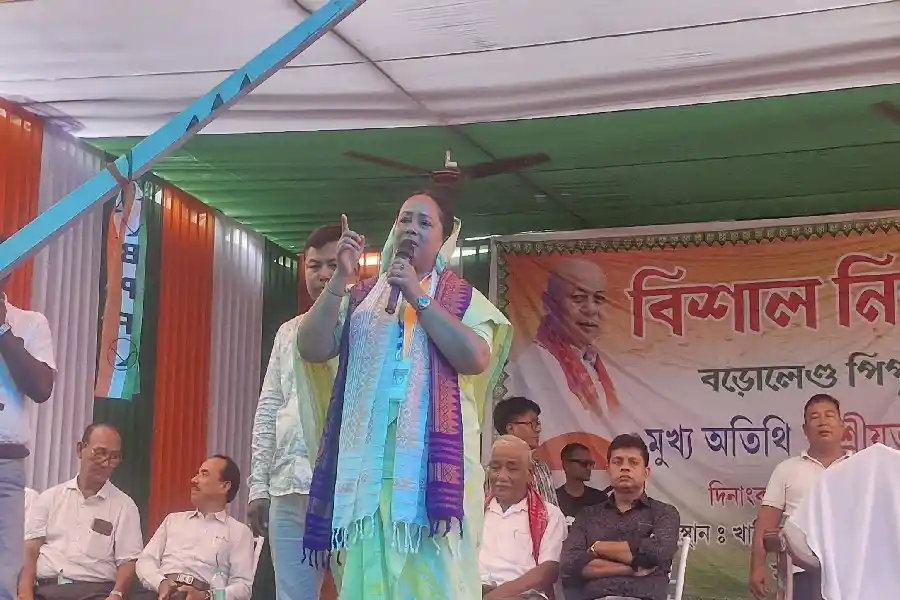
Begum Akhtara Ahmed has been elected from Mathanguri constituency of the BTC and inducted into Mohilary’s cabinet. She has been bestowed with the responsibility of the Public Health Engineering (PHE) Department. Regional political party BPF won the single largest party majority in the BTC elections held in September 2025 with 28 seats.
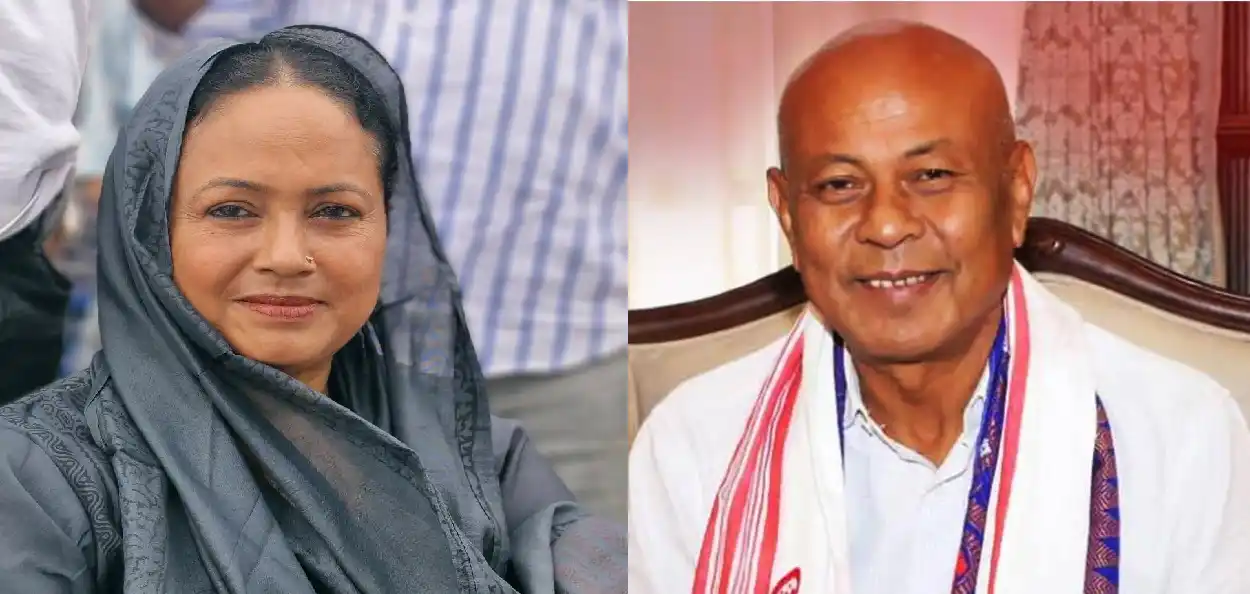
Begum Akhtara Ahmed and Hagrama Mohilary
Incumbent UPPL won seven seats and the BJP won five seats in the 40-seat council. The BTC was formed in 2003, and Hagrama Mohilary has been in power for the past five years.
Begum Akhtara Ahmed of the BTC had no aim or desire to be in politics as she wanted to be a litterateur. But destiny has another script for her life.
Begum Akhtara was born in the Kalgachia area of Barpeta district. She got her primary education in Kalgachia. She was married while studying in Class VII.
Her husband, Ibrahim Ali Molla, recently retired as a higher secondary school teacher. Begum Akhtara could pursue her education. Her first child was born while she was in Class X. She passed her matriculation examination under such circumstances.
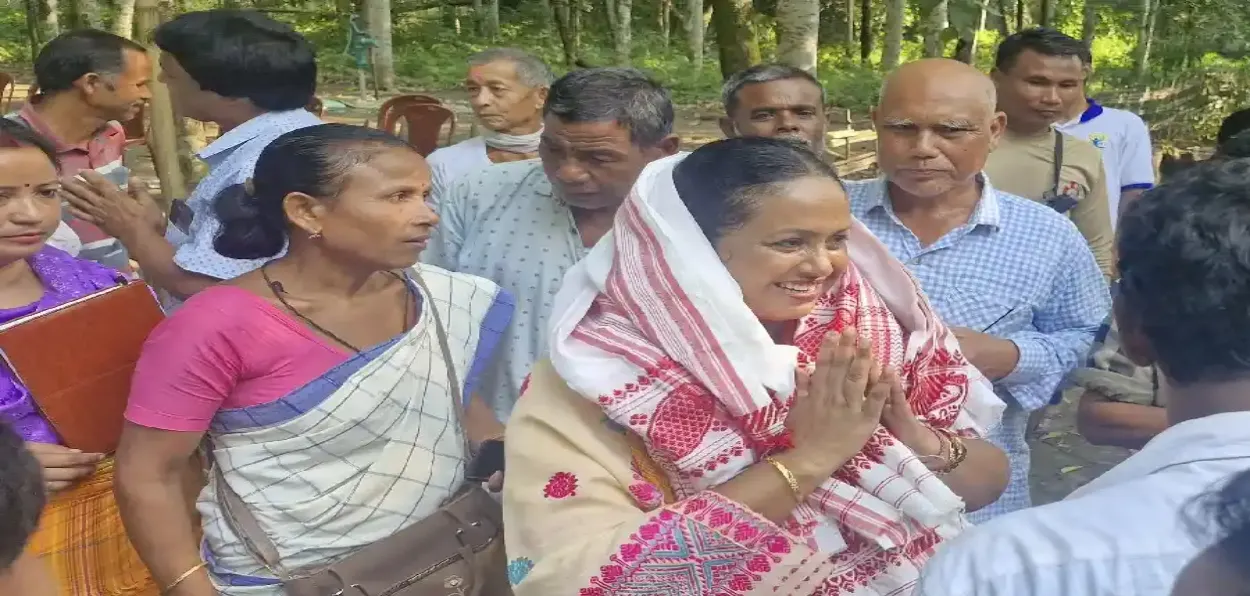
Begum Akhtara Ahmed addressing a political rally
Her second child was born while she was in Class XII. Begum Akhtara continued her education and completed her postgraduate degree from Gauhati University in 2003.
She joined Langla College in the Bangaigaon district as a part-time lecturer, but quit soon. She got involved in politics. She joined the Congress and was appointed as the organising secretary of the Barpeta District Women’s Congress.
Since her matrimonial home is in Lawahur village of Mathanguri constituency in Baksa district, she changed her address and became the president of the Baksa District Women’s Congress. She joined the BPF in 2004.
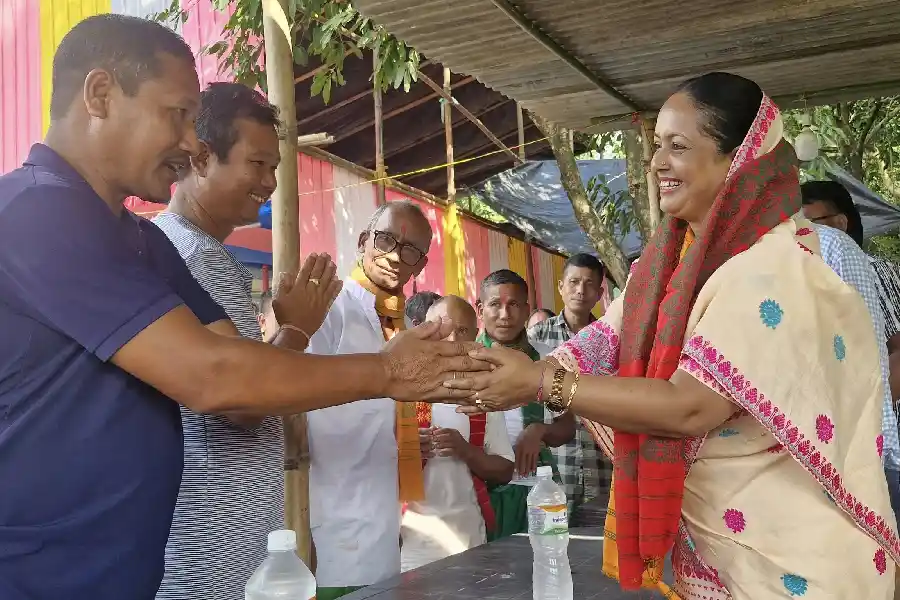
Begum Akhtara Ahmed with Chief Minister Himanta Biswa Sarma
This is where her new political journey and new life of conflicts begin. Party chief Mohilary formed the women’s wing of the BPF, and she was appointed its president.
After three years as the women’s BPF president, she was appointed as the party’s organising secretary by party president Hagrama Mohilary.
She contested the 2020 BTC elections for the first time and was defeated by the BJP’s Gautam Das in the Mathanguri constituency. This time, however, Begum Akhtara contested from the same constituency for the second time and defeated the same opponent.
Begum Akhtara Ahmed was attacked and her house was torched in the once-violent BTC. She was even threatened and asked to stay away from politics in the BTC. Once, while she was busy with a political meeting, her car was set on fire at the venue, and she barely survived.
Begum Akhtara Ahmed with activists of her party at a rally
Begum Akhtara Ahmed said three of her cars were set on fire in 2012. It may be mentioned that several incidents of attacks on minorities took place in the BTC in 2012. Most of the attacks took place in the Baksa district, from where many minorities were forced to flee their homes. Several people were even brutally murdered.
However, all this could not distract her from her goals and objectives.
Praising her leader, Hagrama Mohilary, Begum Akhtar said he wants the Bodo people to move forward along with all ethnic groups. So she is happy to work under the leadership of Mohilary.
According to Begum Akhtara, BTC is a small place. Therefore, it is necessary to rely on the governments at the Centre and in the state to work for its development. Otherwise, developmental work may be interrupted. “We don’t have to look at which party’s government is at the Centre or in the State, we have to work with that government in coordination,” she said.
source: http://www.awazthevoice.in / Awaz, The Voice / Home> Story / by Priya Sarma, Guwahati / October 27th, 2025
Raizada Village (Ajnala Tehsil, Amritsar District), PUNJAB :
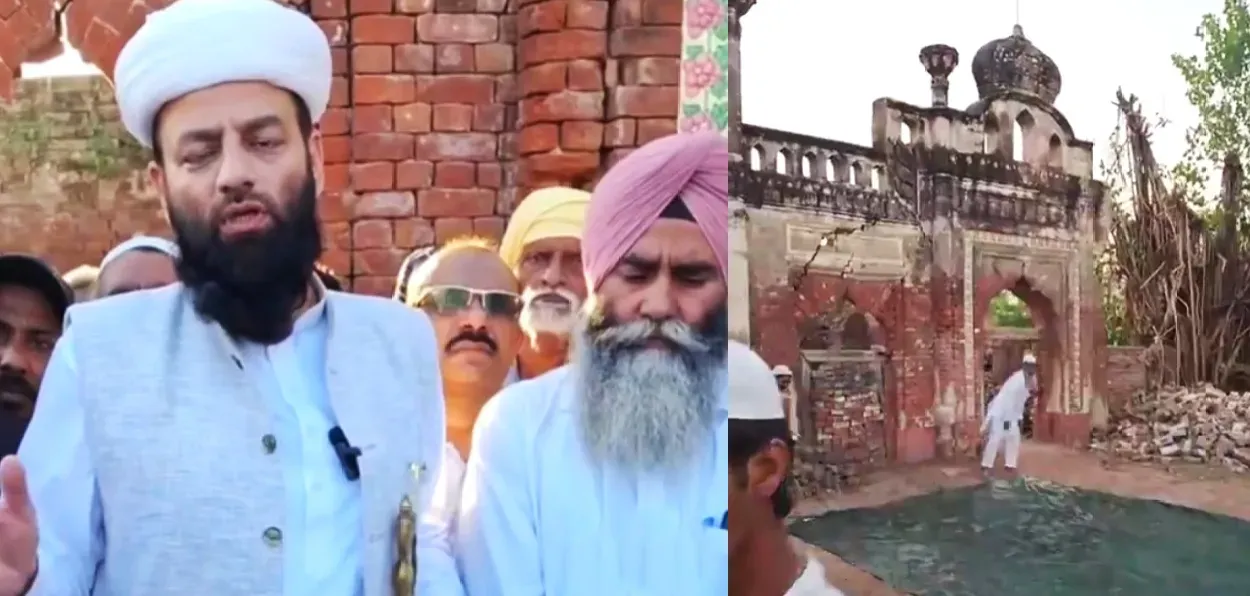
Shahi Imam of Punjab Maulana Usman Rehmani Ludhianvi taking charge of the mosque in village Raizada of Amritsar, Punjab
The Sikhs and Hindus of a village in the Amritsar district of Punjab have handed over a mosque which lay in a run-down state since no Muslims lived there after the partition of India in 1947, to the Muslims for restoration.
In a ceremony attended by Shahi Imam of Punjab, Maulana Muhammad Usman Ludhianvi, in the small village of Raizada in Ajnala tehsil of Amritsar, locals formally handed over the mosque to the Muslim community.
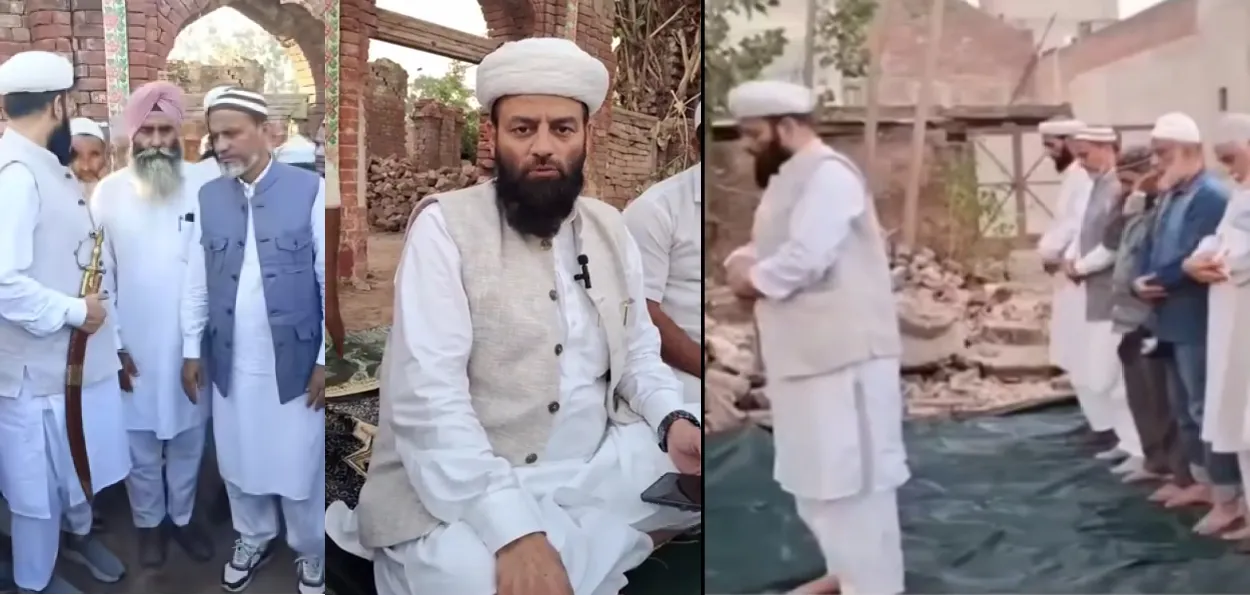
The initiative was led by the village sarpanch, Sardar Omkar Singh. Closed since the partition of 1947, the mosque, for the first time on Friday, echoed with the sounds of the Azaan, the call for prayers.
Sikhs, Hindus, Muslims, Christians and Dalits all stood together inside the mosque located on the banks of the River Ravi.
The mosque is in a dilapidated condition, wild grass and vegetation covered it; its walls collapsed. A school running inside it was closed 11 years ago.
Yet the non-Muslims of the village believed the mosque was not just a Muslim heritage, but that of the village. One of them remarked, “In Punjab, we are connected not by religion, but by heart.”
Shahi Imam of Punjab Maulana Muhammad Usman Rahmani Ludhianvi with villagers of Raizada
In his address, Maulana Muhammad Usman Rahmani Ludhianvi narrated the history of harmony in Punjab. He said Guru Nanak Dev, whom Muslims remember as “Baba Nanak”, was carried to a safe place by Muslim brothers Nabi Khan and Ghani Khan in his palanquin during the war.
He also mentioned Diwan Todarmal, a minister in Akbar’s Court, who dedicated his land for the burial of the Guru’s sons.
The Shahi Imam said that this is the real strength of Punjab, Sikhs, Hindus and Muslims have stood together for centuries. The greatest beauty of India is its “unity in individuation”.
He announced that the restoration of the village mosque was being done as a tribute to two Muslim volunteers who sacrificed their lives during relief work in the recent floods.
These youths were Shamshad Bhagwanpuri (Uttarakhand) and Zakaria Mewati (Rajasthan). Both of them distributed ration and medicines in the affected areas for a week, but met with an accident on their return journey. Shahi Imam said that they did not just deliver goods, but also conveyed a message of love and brotherhood. Punjab will never forget their sacrifice.
The mosque will be named ‘Masjid-e-Shamshad Bhagwan Puri’ to honour the sacrifice of the flood relief volunteers in the name of humanity.
پنجاب میں تقسیم ملک کے بعد ویران پڑی ایک اور مسجد سکھوں نے مسلمانوں کو سونپ دی، پنجاب کے شاہی امام مولانا محمد عثمان لدھیانوی نے سب کا شکریہ ادا کیا ،اس کو ملک کی گنگا جمنی تہذیب کا نمونہ قرار دیا ہے In Punjab,a abandoned Mosque handed over to Muslims by the Sikhs#Mosquepic.twitter.com/Lq4Ii8tR7t
He said while the foundation of the mosque will be laid this month, the story of Shamshad’s life and service will be engraved on the wall of the mosque.
The second mosque, “Masjid-e-Zakaria” will be built in Fagan Majra village of Mewati-Patiala district, the land for which was acquired this week. The parents of these two martyrs have been invited to lay the foundation. The Shahi Imam prayed that for love to spread throughout the country.
The incident comes amid a wider humanitarian effort that has been seen during the recent floods. Volunteers from Mewat in Haryana, traditionally allies of Punjab farmers, sent more than 300 truckloads of relief supplies to the states of Punjab, Himachal Pradesh and Jammu and Kashmir. It reflects agricultural ties that predate the separation of Haryana and Punjab in 1966. Organisations like Khalsa Aid have been on the ground since August, rescuing families and providing water and medical aid in affected areas like Gurdaspur and Ferozepur.
The event took place in a backdrop of peaceful harmony. As the sounds of Gurbani recitation echoed from the gurdwara during evening prayers, the call to prayer for Maghrib was soon heard from the mosque, symbolizing the harmonious heartbeat of Punjab. The villagers distributed sweets to celebrate. As the sun was setting over the Ravi River, the Shahi Imam concluded the ceremony with a prayer. He said, “May this love spread throughout the country and every corner be illuminated like a lamp of brotherhood.”
According to media reports, more than 30 such mosques have been restored so far through interfaith cooperation, with most of them led by Sikhs in providing financial support, labour, and land.
According to Shahbaz Ahmed Zahoor, leader of the Idara Mosques, there have been about 200 such incidents across the state in which Sikh families have donated land for mosques and graveyards.
In 2018, in village Moom, Baranala district, while Hindus provided the land, the Sikhs raised funds for the construction of a mosque that shares a wall with their gurdwara.
This created a rare combination of Hindu, Muslim and Sikh places of worship in one place. In 2022, in the Bakhatgarh district, Barnala, farmer Amandeep Singh donated 250 square yards of land for the Noorani Masjid. Other Sikhs and Hindus shouldered a major part of the construction cost of Rs 12 lakh so that 15 Muslim families would not have to travel 5 km to offer prayers.
In January of the same year, former Sarpanch Sukhjinder Singh Noni and his brother Avininder Singh donated 5.5 biswas (worth Rs 7-8 lakh) of valuable roadside land for a new mosque in Umarpura village of Malirkotla district. They were joined by donors like Tejwant Singh (Rs 2 lakh) and Ravinder Singh Grewal (Rs 1 lakh).
In Malla village of Ludhiana district, in 2016, Sikhs and Hindus renovated the old mosque for the only Muslim family in the village and provided financial assistance while locals worked as labour for its construction.
In Nathuwal village of Sangrur district, in 2015, non-Muslims bore more than 65% of the Rs 25 lakh cost for the renovation of the Jama Masjid and the addition of a second floor.
source: http://www.awazthevoice.in / Awaz, The Voice / Home> Story / by Mansooruddin Faridi, New Delhi / October 27th, 2025
Diners at Sheraton Hyderabad were recently introduced to the rarely seen Bhatkali cuisine, thanks to home chef Fatima Riyaz. Through an exclusive pop-up, Fatima presented dishes rooted in the coastal town of Bhatkal in Karnataka, highlighting its Nawayathi heritage and centuries of cultural exchange.
Bhatkali food is known for its unique blend of spices, coconut, and rice. “Five out of six dishes have rice in some form,” Fatima explained, noting how coconut adds sweetness and depth to most preparations. Spice levels are high, but carefully balanced with caramelised onions. Signature to the cuisine is Loli, a red chilli-based spice paste slow-cooked in coconut oil and used across dishes.
The Sheraton menu included Mudkale, rice balls with prawns cooked in coconut oil, and seasonal desserts like Chibbad, a local melon served with coconut milk and lime. While seafood dominates the cuisine, Fatima also created vegetarian versions to suit diverse diners.
Her food is deeply personal, drawn from family traditions and her community’s layered history. “Our cuisine reflects Islamic influences, Jain touches, and coastal Indian roots,” she said. The language of her community, Nawayathi, similarly borrows from Marathi and Konkani, echoing cultural ties along the western coast.
Fatima began cooking professionally after the pandemic, inspired by people reviving traditional recipes. Since then, she has taken Bhatkali cuisine to cities through curated pop-ups. “I only cook this cuisine,” she noted. “It is Indian, but with a sweetness that is ours.”
Story by Deccan Chronicle
source: http://www.radiancenews.com / Radiance News / Home> Features> Latest News> Report / by Radiance News Bureau / September 20th, 2025
Dr. Waliur Rahman, an alumnus of the Department of Geology, Aligarh Muslim University (AMU), has been named for the prestigious Rashtriya Vigyan Yuva-Shanti Swarup Bhatnagar 2025, announced by the Government of India on October 26, 2025.
Currently serving as Scientist-E at the National Centre for Antarctic and Ocean Research (NCAOR), Ministry of Earth Sciences, Government of India, Vasco-da-Gama, Goa, Dr. Rahman has been recognised for his outstanding contributions in the field of isotope geochemistry and Antarctic climate research.
A distinguished earth scientist, Dr. Rahman’s research spans a wide range of topics, including Antarctic climate variability through ice core records, trace element and isotope studies in oceans, paleo-oceanography using radiogenic and stable isotopes, and Himalayan weathering and erosion processes. His pioneering work in developing non-traditional isotope measurements has contributed significantly to understanding global climatic and oceanic processes.
Dr. Rahman earned his B.Sc. (Geology Hons.) and M.Sc. (Applied Geology) degrees from Aligarh Muslim University in 2002 and 2004 respectively, and later obtained his Ph.D. in Geochemistry from the Physical Research Laboratory, Ahmedabad.
His illustrious career includes research fellowships and international recognition such as the Alexander von Humboldt Fellowships (Germany), the Certificate of Merit in Polar Science and Technology (2019), the Young Researcher Award (2021) from the Ministry of Earth Sciences, and the National Geoscience Award (2023) from the Ministry of Mines, Government of India.
Dr. Rahman has authored over 50 peer-reviewed research papers in leading international journals including Nature Communications, Geophysical Research Letters, Marine Chemistry, and Science of the Total Environment. His contributions have enhanced India’s global standing in the fields of Antarctic and oceanic research.
Congratulating Dr. Rahman on his achievement, AMU Vice-Chancellor Prof. Naima Khatoon said that the university takes pride in its alumni who continue to bring laurels to their alma mater through excellence in research and national service, and Dr Rahman’s achievement will work as an impetus for young students who wish to make a career in the field of earth sciences.
source: http://www.amu.ac.in / Aligarh Muslim University / Home> AMU News / by Public Relations Office / October 07th, 2025
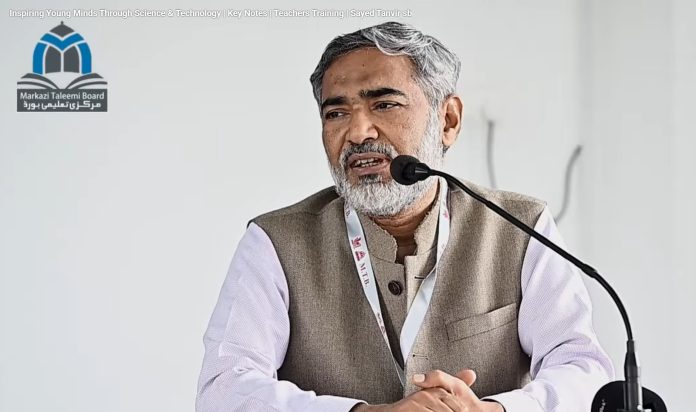
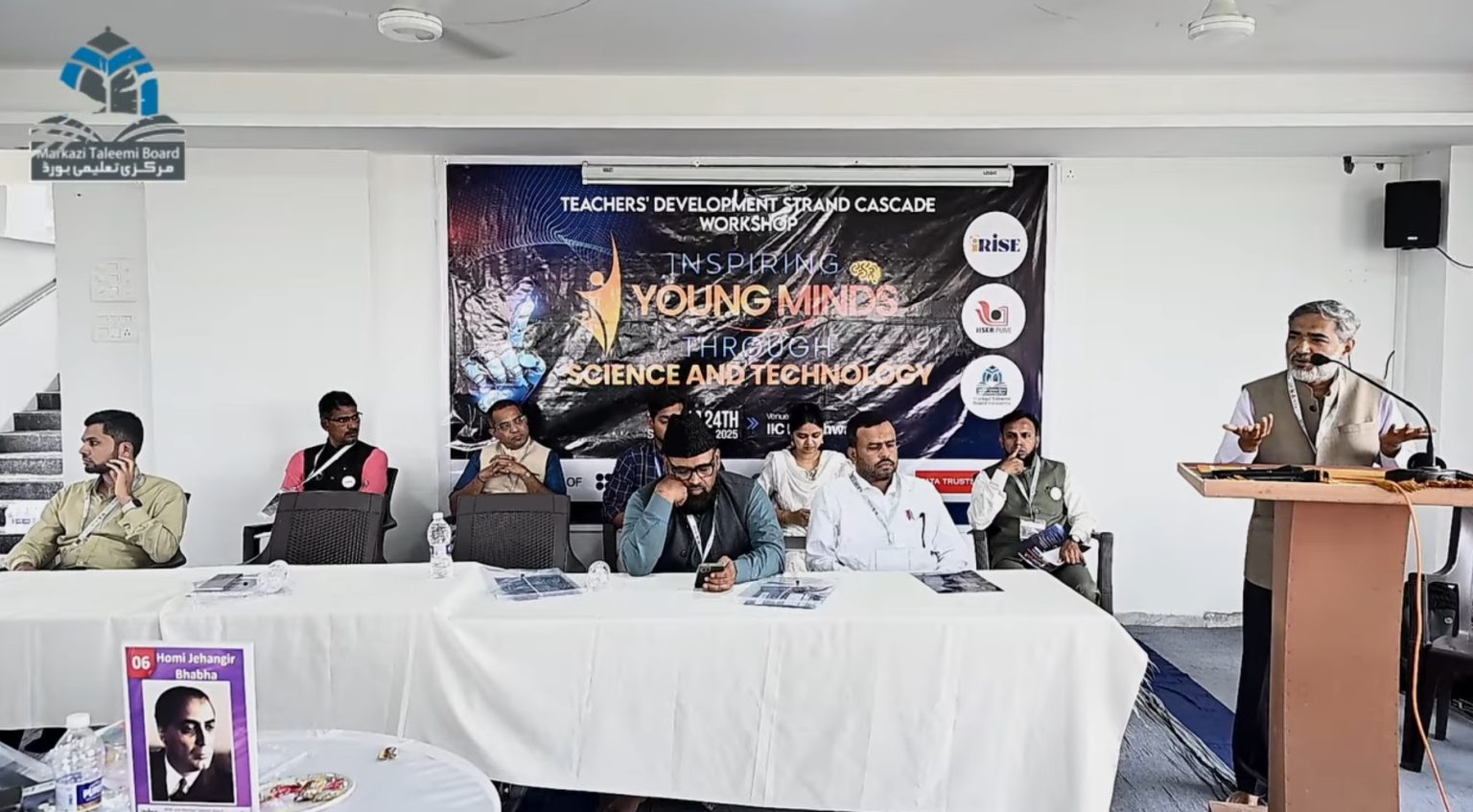
Syed Tanveer, Secretary of the Markazi Taleemi Board (MTB), urged teachers to transform science and mathematics education during his keynote address at the Teachers Development Strand Cascade Workshop. The event was organised by Markazi Taleemi Board Maharashtra in partnership with IISER Pune. The session focused on methods to align classroom practice with the National Education Policy 2020.
Syed Tanveer began by welcoming the IISER Pune team and thanking the organisers for arranging training across Maharashtra and other states. He told participants that the workshop aims to shift teaching from rote memorisation to active, hands-on learning. He said teachers must make classrooms places where students observe, experiment, and think.
He pointed out a common issue: society often dislikes maths teachers, and science teachers face similar bias. Many students avoid science because it is considered difficult. Tanveer argued that this perception arises from how teachers teach. “We have treated maths and science as fact-transfer subjects,” he said, adding that this has made learning mechanical instead of meaningful.
Syed Tanveer explained Bloom’s taxonomy as a guide to moving students from lower-order to higher-order thinking. He described six cognitive levels. “Most of our classrooms are stuck at the first stage—knowing or memorising,” he said. The next stage is understanding, achieved when students learn by hearing, seeing, and doing. The workshop, he added, would train teachers to conduct hands-on experiments that encourage conceptual understanding.
The third level is applying. Tanveer urged teachers to help students connect formulas and scientific principles to real-life applications. The next levels—analysis and evaluation—involve breaking concepts into smaller parts and examining their relationships. The final stage is creation, where learning leads to innovation. “Education is not about memorising facts. It is about creating something new,” he said.
Giving examples, Syed Tanveer said a short experiment could teach photosynthesis better than hours of memorisation. A paper plane can explain mechanics, and observing local water pollution can connect science with social responsibility. He praised simple, observation-based teaching models such as those promoted by educator Arvind Gupta and scientists like C.V. Raman.
Syed Tanveer also highlighted the moral role of science. “Scientific temperament must not remain limited to exams,” he said. “It should guide ethics and social responsibility.” He explained that true education transforms human beings into moral, thoughtful individuals, not mere human resources for the market.
He concluded with five key tasks for educators: raise awareness of civic responsibility, reject divisive politics, support independent educational institutions, revive critical thinking in academia, and promote debate and dialogue among youth and women.
“Do not make students pen drives filled with memorised data,” Tanveer said. “Make them thinkers, creators, and problem-solvers.” He prayed for the success of the workshop and called on teachers to inspire young minds through curiosity and experimentation.
source: http://www.radiancenews.com / Radiance News / Home> Education> Latest News> Report / by Radiance News Bureau / October 16th, 2025
One of the oldest places in Uttar Pradesh is Sambhal in District Moradabad, has a long list of people in its history who confronted with British and posed great resistance with their historic acts of gallantry. Abdul Qaiyyum, Lala Prem Pal, Qari Abdul Haq, Maqsood Turki, Chaudhary Riyasat Ali, Lala Chandulal, Lala Roop Kishor, Maulvi Noorul Hasan, Sheikh Abdul Raheem, Chetan Swaroop, Radhey Lal Poddar, Munshi Moinuddin, Ml. Sultan Ahmad,Maulvi Abdul Waheed are prominent among such people.
The exact date of birth of Maulana Ismail Sambhli is not known however, he might have taken birth in 1899 at Mohallah Deepa Sarai. He belonged to the Sarwar Waley family of Turk community. His father, Munshi Kifayatullah was considered among the educated people of the area and was famous with the nickname ‘Munshiji’. His grandfather’s name was Sarwar Husain who was a native to village Mundha in J. P. Nagar. Later he shifted to Sambhal. His family surname, Sarwar Waley was due to his grandfather’s name.
He received primary education at Madrasatul Mohammadia, Deepa Sarai and was admitted to class VI to continue further education in English against his mother’s wish. She wanted him to get Arabic education and finally her will prevailed. Meanwhile, his father passed away and he was sent to his elder brother at Bahawalpur where he had the honour to receive education from Maulana Farooq Ahmad, Sheikhul Hadees and Head, Jamia Usmania.
Maulana Farooq Ahmad was the disciple of Shaikhul Hind Maulana Mahmoodul Hasan and relative of Maulana Mansoor Ansari who was put on exile on the pretext of abetting and participating in the freedom movement. He was extremely unhappy with British and a staunch supporter of freedom struggle. It was his company that helped instill a sense of nationalism in the heart of Maulana Ismail Sambhli and inspired him to participate in the freedom struggle.
After completing education at Bahawalpur, Maulana Ismail Sambhli returned back to his native place, Sambhal and continued with his education at Madrasa Sirajul Uloom. In the meantime the barbaric incident of Jalianwala Bagh took place that put the whole of India on fire. A protest strike was observed in Sambhal as well and a mass gathering of all communities was organized at the gardens of Gul Chhatar. Maulana Ismail Sambhli delivered a very inspiring lecture at the mass convention. Maulana was the youngest among all orators yet his oration impressed the public most and thus his national and political life began. Maulana gained popularity as Raees-ul Muqarrareen (master orator).
When the British defeated Turkey, the resulting loss and the sense of defeat made the Muslims furious. On November 22, 1919 the Khilafat Committee was founded and the Jamiatul Ulema-e-Hind took birth in Delhi. The Khilafat Movement was pronounced through out the country. Just months after the sad demise of Sheikhul Hind Maulana Mahmoodul Hasan, Maulana Ismail Sambhli took admission in Darul Uloom Deoband where his nationalist ideas and concepts received firmness. He started partaking in the nationalist activities with much vigour and zeal and despite him being a student he was arrested on February 22, 1921 for his radical ideas and inflammatory speeches. After two – three days his case was heard at Moradabad Jail and he was sentenced to two years’ rigorous imprisonment. Then the political detainees were generally subject to extreme brutalities. Maulana and his companions borne all types of atrocities. They were put under penal servitude, were imprisoned in small cages and were compelled to sleep handcuffed. Precisely, they were put to all types of brutalities but did not tender apology. Finally, he was released after the term of his punishment was over. Back to home he concentrated on completing his education. After completing courses at Darul Uloom Deoband he joined Jamia Qasmia Madrasa Shahi, Moradabad as a teacher in later 1924. The country’s condition had changed by the time, Khilafat had come to an end, there were communal disturbances through out the country and Congress had suspended its Civil Disobedience Movement. Mahatma Gandhi was imprisoned for six years. People were feeling let down but Maulana Sambhali kept moving ahead with full confidence.
In 1930 when Congress proclaimed for complete freedom. On March 13 Mahatma Gandhi commenced his famous Dandi march in violation of the laws of salt. A Civil Disobedience Movement was also commenced.
The Britishers put the nationalist people to extreme brutalities. They were mercilessly beaten, shot by guns and imprisoned. The Jamiatul Ulema sense the need of the hour and vowed to support Congress in its Civil Disobedience Movement. It established a Daira-e-Harabia (Circle of War). Mufti Kifayatullah, Maulana Ahmad Saeed, Maulana Husain Ahmad and Maulana Mubarak Husain Sambhli were arrested one by one. Maulana Mohammad Ismail Sambhli was the seventh in this order to be arrested and was sentenced to six months’ rigorous imprisonment.
When the time came for Provincial Assembly elections, the Muslim League Parliamentary Board came to existence. On behalf of Maulana Ahmad Saeed, Nazim of Jamiatul Ulema Mohammad Ali Jinnah was given the right to nominate members to the parliamentary board. Mr. Jinnah nominated 22 members from 56 out of which 20 were of Jamiatul Ulema and two of Ahrar. The Provincial Boards were under the control of Central Board. Maulana Ismail Sambhli was admitted to UP Board. He was also declared candidate from Sambhal of Moradabad and Tehsil Bilari constituencies. Those days the land lords, nawabs, kings and English title holders enjoyed great immunity and British supported people were considered prominent in the society. The nationalists participated in the election to defeat the pro-British candidates.
In 1939, the war in Europe started and the Indian government without taking the members in confidence sent the Indian army to war. The Congress opposed the move and boycotted the Assembly. It convened its session at Ramgarh on March 20-21, 1940 under the president ship of Maulana Abul Kalam Azad. The Civil Disobedience Movement was pronounced in the session and finally in the last of 1940 the non-violent civil disobedience movement commenced. A programme was chalked out for individual speeches. Maulana Ismail Sambhli was arrested in Moradabad during the movement and was sentenced for nine months’ imprisonment. In August 1942, Congress gave the famous ‘Leave India’ slogan. Mahatma Gandhi was arrested and sent to Sabarmati Jail. There were arrests every where in the country. Maulana Ismail Sambhli was again arrested in Sambhal and was put under house arrest at Moradabad Jail for indefinite period. Later he was released after one year.
In 1946, when elections were declared, the tussle between Congress and Muslim League was at its peak. Maulana Sambhli was elected, remained MLA till 1952.
Maulana Ismail Sambhli did not participate in the 1952 elections and stationed at Delhi as the Nazim-e-Ala of Jamiatul Ulema. He served Jamiat for four years and remained busy in social and political affairs. In 1957 he resigned from Jamiat and returned to Sambhal.
In 1962, he was appointed as Sheikhul Hadees at Madrasa Imdadia, Moradabad and served there for about three years.. In 1974, he shunned the idea of service and returned back to Sambhal and engaged himself in the literary work only to complete the half hatched books. “Maqalat-e-Tasawwuf”, “Akhbarul Tanzeel” (the Quranic prophesies) and “Taquleed-e-Aimma” are some important books authored by him.
Meanwhile he went to Mawana, Meerut and taught Quran’s translation for eight months. In his last age, he spent a few Ramadhan months in Bombay delivering lectures on the translation and analysis of Quran every night after Taraweeh. He fell sick in the last Ramadhan of his life yet, and after returning to Sambhal he breathed his last on 23rd November 1975 after one and half months’ prolonged illness. (deoband.net)
source: http://www.milligazette.com / The Milli Gazette / Home> News> Family & Kids / by Mohammad Najeeb Qasmi / May 22nd, 2016
The residents of these slums are prone to infection. Lack of water could cause dehydration in residents. Hence, we took up this initiative.”
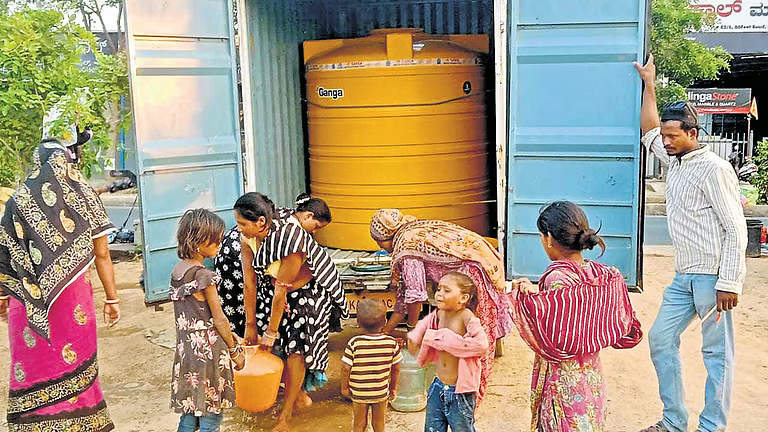
‘Active Bengaluru’ supplies water to a slum in North Bengaluru. It has come as a saviour to the residents of several slums in the city Photo | Express
Bengaluru :
‘Active Bengaluru’, a non-profit organisation, has come as a saviour to the residents of several slums in the city this summer. The organisation is supplying water to these residents to tide over this harsh summer.
‘Active Bengaluru’ is supplying 50,000 litres of water at the doorsteps of the residents of slums in North Bengaluru, including in areas like Thanisandra, Hegde Nagar, and Saraipalya, every alternate day.
Like other parts of the city, close to 6,000 public borewells in these areas have gone dry this year. Members of ‘Active Bengaluru’ supply water in four water tanks (2,500-litre capacity each) mounted on mini-tempos.
Speaking to The New Indian Express, Tauseef Ahmed, a volunteer with ‘Active Bengaluru’, said, “Under ‘Project Zam Zam’, the slum population in North Bengaluru is being supplied water free of charge. The project began in March, and till date, over 12 lakh litres of borewell water has been supplied. The residents of these slums are prone to infection. Lack of water could cause dehydration in residents. Hence, we took up this initiative.”
“The water is collected from good Samaritans from their borewells, and the same is then supplied to the slums. The residents have been told to call the emergency number of the NGO to place a request. Based on the number of calls received from an area, a vehicle is sent. In each tank, about four taps are fixed, and residents are asked to come in a queue and collect water,” said another member of ‘Active Bengaluru’.
“The NGO mostly deals with policy issues, women’s empowerment, health, and education. Shortage of water directly impacts the health and education of children. We decided to do our bit to address the same and joined hands to supply water to the needy,” said another member of the organisation.
source: http://www.newindianexpress.com / The New Indian Express / Home> Karnataka / by Mohammed Yacoob / April 23rd, 2024