Berar (During British in Hyderabad), now in MAHARASHTRA :
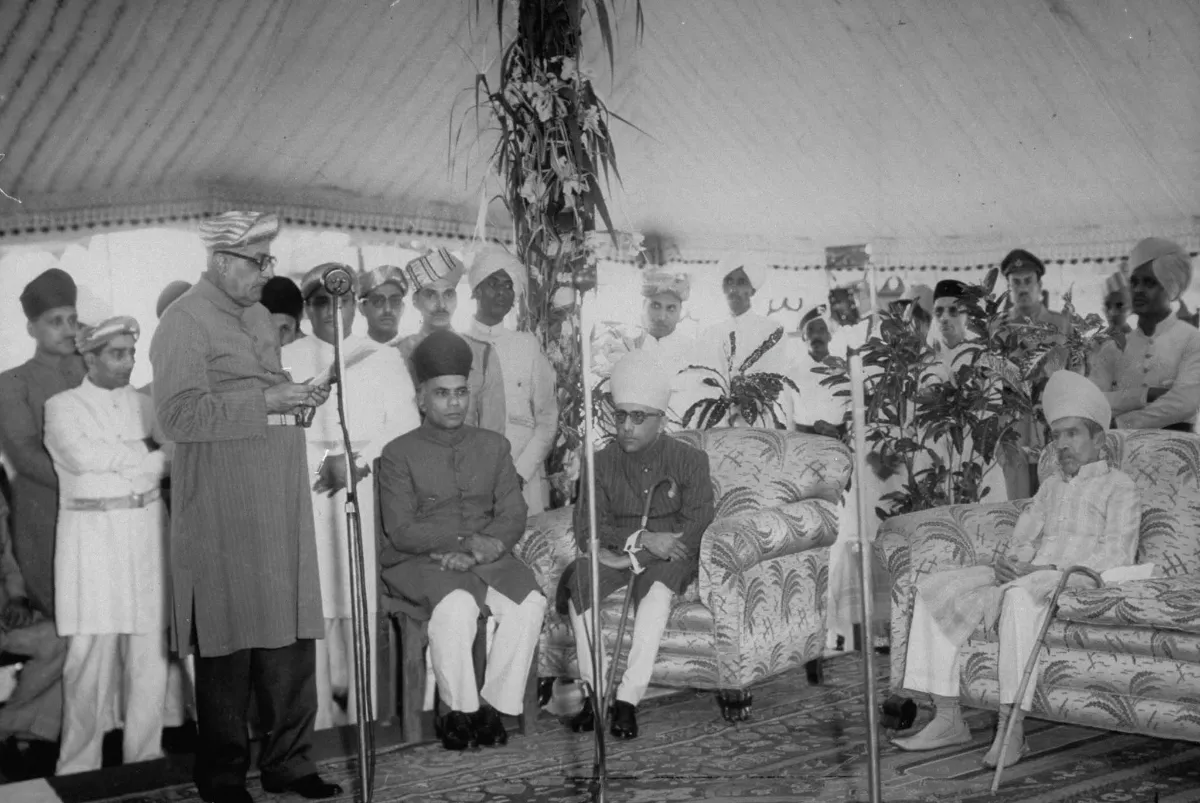
Nizam Osman Ali Khan of Hyderabad and Berar, Himayat Ali Khan the Prince of Berar listening to a presentation
The universal ideals of Islam found a distinctive expression in the historic region of Berar, where the faith spread not only through political authority but also through the influence of scholars, Sufis, jurists, poets, educators and public servants. Over the centuries, Berar became a centre of Islamic learning, Urdu and Persian literature, social reform and public service, producing generations whose lives reflected the Qur’anic ideals of knowledge, justice, compassion and service to humanity.
Situated in the heart of the Deccan, Berar emerged as a meeting ground of diverse cultures and traditions. Mosques, madrasas, khanqahs, libraries and charitable institutions shaped both the religious and intellectual life of society. Islamic scholarship developed in dialogue with local cultural currents, creating a rich and distinctive regional heritage.
The Muslims of Berar were notable not merely for their attachment to religious tradition but for their active engagement with the wider world. They served as judges, administrators, teachers, physicians, lawyers, bankers, writers, journalists, freedom fighters and philanthropists, contributing significantly to the social and cultural development of the region. Their achievements demonstrate that Islam, when lived in its authentic spirit, inspires excellence in every sphere of human endeavour.
Unlike historical accounts that focus mainly on rulers and political events, this work highlights individuals whose enduring influence arose from scholarship, moral leadership and public service. Some belonged to the medieval period, when Islam was taking firm root in the Deccan through scholars and Sufi saints; others flourished under the Bahmani, Imad Shahi, Mughal and Hyderabad administrations; many emerged during the colonial era and in independent India, responding creatively to changing social and educational challenges.
Their fields of achievement varied greatly, yet they were united by common values: knowledge as a sacred trust, integrity as the foundation of leadership, and service to humanity as an expression of faith. Whether they taught in madrasas, administered public institutions, wrote poetry, healed the sick, established schools or worked quietly for community welfare, each contributed in some measure to the intellectual and moral life of Berar.
The spread of Islam in Berar was gradual and deeply connected to institutions of learning and public welfare. From the fourteenth century onward, the growth of towns, educational centres and religious institutions transformed the region into an active participant in the intellectual currents of the medieval Deccan. Persian scholarship flourished for centuries, later enriched by the development of Urdu literature, poetry and historical writing.
Equally important were the contributions of ordinary men and women whose names seldom appear in conventional histories. Teachers in village maktabs, imams guiding local congregations, merchants supporting charitable works and families nurturing learning within the home collectively sustained the spiritual and cultural life of the community. Their quiet efforts formed the unseen foundation upon which more celebrated achievements were built.
The personalities presented in the following pages represent only a small cross-section of this rich inheritance. Some attained national prominence, while others exercised influence within local communities. Together they illustrate how Islamic values were translated into scholarship, public service, literature, education, jurisprudence, spirituality and community leadership across successive generations.
This section is therefore more than a collection of biographies. It is a tribute to a civilisational tradition that flourished in Berar and formed an integral part of India’s composite cultural heritage. In remembering these distinguished men and women, we preserve not merely their personal achievements but also the ideals they embodied—faith enlightened by reason, learning tempered by humility, and devotion expressed through selfless service to society. Their legacy continues to inspire future generations and deserves an honoured place in the history of both Berar and Indian Islam.
The Modern Legacy
Berar’s rich intellectual traditions continued into the modern era through its judicial lineages, literary circles, educational institutions, and public service. Madrasas, mosques, khanqahs, libraries, and scholarly households remained the custodians of an intellectual culture that regarded knowledge as an amanah—a sacred trust to be exercised with integrity, wisdom, and responsibility for the common good.
Across the Bahmani, Imad Shahi, Mughal, and Asaf Jahi periods, the Qazis of Berar successfully adapted to changing political systems without compromising the ethical foundations of their office. Their authority rested not upon political power but upon scholarship, moral integrity, and the confidence of the communities they served. This remarkable continuity enabled the House of Qazis to maintain its influence even as successive dynasties transformed the Deccan’s administrative landscape.
With the advent of modern India, this legacy assumed new forms. Descendants of Berar’s scholarly traditions emerged as judges, advocates, parliamentarians, educationists, scientists, physicians, administrators, industrialists, writers, entrepreneurs, and spiritual leaders. While their professional pursuits diversified, they remained united by a shared commitment to justice, learning, ethical leadership, and public service. In doing so, they demonstrated how a centuries-old culture of scholarship could flourish within the institutions of a democratic nation.
Foremost among these distinguished personalities stands Justice Mohammad Hidayatullah (1905–1992), one of the greatest jurists produced by the erstwhile Central Provinces and Berar. Educated at Morris College, Nagpur, before proceeding to Trinity College, Cambridge, and Lincoln’s Inn, he returned to practise at the High Court of the Central Provinces and Berar. His brilliant legal career included serving as Advocate General, Judge, and Chief Justice of the Nagpur High Court before his elevation to the Supreme Court of India in 1958. In 1968, he became India’s first Muslim Chief Justice. He subsequently served the nation with distinction as Acting President of India and later as Vice President of India, embodying the highest ideals of constitutionalism, judicial independence, and public service.
The biographical sketches that follow present some of the most eminent representatives of Berar’s modern legacy. Though drawn from diverse professions and walks of life, each reflects the enduring values that have characterised the region’s intellectual and spiritual heritage: scholarship, integrity, compassion, and an unwavering commitment to serving humanity.
Kazi Syed Karimuddin belonged to the distinguished Qazi family of Berar, a lineage renowned for its contributions to Islamic jurisprudence, education, and public service. A respected lawyer, parliamentarian, and statesman, he combined professional distinction with an unwavering commitment to constitutional values. As an active member of the Constituent Assembly of India, he made thoughtful and principled interventions in the framing of the Constitution, particularly in defence of civil liberties, minority rights, and the guarantees of equality, freedom, and the rule of law that now form the bedrock of the Republic. Through his legal practice, public service, and constitutional vision, he strengthened the Qazi family’s enduring reputation for scholarship, integrity, and enlightened leadership while promoting education, communal harmony, and ethical public life.
Kazi Syed Ghiyasuddin belonged to the eminent hereditary Qazi family of Berar, renowned for its legacy of judicial scholarship and public leadership. A distinguished statesman of Maharashtra, he served as a Cabinet Minister for over a decade during the tenure of Chief Minister Y. B. Chavan. He later held several key portfolios in the State Government, exemplifying the family’s enduring tradition of service, integrity, and administrative excellence.
Justice Mohd. Mujibuddin Qazi served with distinction as a Judge of the Bombay High Court, being appointed an Additional Judge in September 1981 and confirmed as a permanent Judge in December 1982. Widely admired for his judicial scholarship, integrity, fairness, and balanced judgments, he retired in February 1992 after a distinguished career devoted to the administration of justice. Following his retirement, he served as Chairman of the Maharashtra Administrative Tribunal and later as Chairman of the Anjuman Hami-E-Islam Trust, continuing his distinguished contribution to public life and educational administration.
Justice Mohd. Arifur Rahman Khan was a distinguished member of the higher judiciary whose career was marked by scholarship, integrity, and judicial independence. Through his service on the Bench, he upheld constitutional values and the rule of law while contributing significantly to the administration of justice. His achievements reflect Berar’s enduring legacy of legal excellence.
Justice Zaka Azizul HaqHaq is a distinguished former Judge of the Bombay High Court, serving principally at the Nagpur Bench. Elevated to the Additional Judge rank in 2013 and later confirmed as a permanent Judge, he became widely respected for his judicial scholarship and integrity. Following his retirement, he was designated a Senior Advocate by the Supreme Court of India. He was appointed sole Administrator of the Anjuman Hami-E-Islam Trust, one of Nagpur’s foremost educational institutions, where he has continued to render distinguished service in educational administration and public life.
Dr Syed Mahmood Hussain (S. M. H.) Khatib was an eminent zoologist, pioneering entomologist, and former Head of the Department of Zoology at the Institute of Science, Nagpur. His outstanding research advanced entomological studies in Central India and inspired generations of scientists. Rashtrasant Tukadoji Maharaj Nagpur University perpetuates his memory through the Dr S. M. H. Khatib Memorial Gold Medal and the S. M. H. Khatib Memorial Entomology Research Forum.
Dr Fauzia Khan traces her lineage to the Naqshbandi spiritual tradition through her father, Dr Zafar Naqshbandi, a distinguished physician of Aurangabad. She is a prominent politician from Maharashtra and an advocate of women’s empowerment, education, and public welfare. She made history as the first Muslim woman to serve as a Minister in the Maharashtra Government, holding the portfolios of Education, Health, and Women & Child Development. A former Member of the Rajya Sabha, she has devoted her public life to advancing inclusive governance, social justice, and the welfare of women and marginalised communities.
Qazi Syed Sirajuddin belonged to the distinguished hereditary lineage of the Qazis of Berar. He was a scion of the historic Qazi family of Kalamb, whose judicial and religious authority extended over several generations. Associated with the honorary office traditionally held by the family, he upheld its long-established reputation for integrity, scholarship, and public service. Through his standing within the community, he helped preserve the prestige of an institution that had long served Berar as a guardian of justice, Islamic learning, and moral leadership, while sustaining the family’s enduring legacy of civic responsibility.
Manzoor Hussain Shor (1916–1991) was a distinguished Urdu poet born in Amravati, Berar, where he first established his literary reputation. Following the Partition of India, he migrated to Pakistan and became a respected poet, critic, academic and teacher, later serving at the University of Karachi. His landmark poetry collection, Nabz-e-Dauran (1959), established him as a leading voice of modern Urdu nazm, while subsequent works further enhanced his literary stature. His poetry combined classical elegance with modern sensibilities, preserving the rich literary heritage of Berar while making a lasting contribution to Urdu literature across the subcontinent.
Dr Syed Naimuddin was an eminent scholar of Urdu and Persian who served with distinction as Professor, Head of the Department, and later Principal of the Government Vidarbha Institute of Science and Humanities, Amravati. His pioneering research in Persian and Indo-Turkish literary studies earned international recognition, and one of his scholarly works was published by the Government of Turkey—a rare honour reflecting the global appreciation of his academic contributions. Through his teaching, research, and literary scholarship, he made a lasting contribution to the advancement of Urdu and Persian studies in India.
Dr Syed Rafiuddin Qadri was a distinguished scholar of Arabic and Islamic Studies, renowned for his profound erudition and lifelong dedication to higher learning. A recipient of the President’s Award for Arabic, he earned national recognition for his outstanding contribution to Arabic language and Islamic scholarship. He was also the son-in-law of the revered Sufi saint, Peer Nahe Miyan of Bhopal, reflecting his close association with a distinguished spiritual lineage alongside his own remarkable academic achievements.
Wajida Tabassum was an acclaimed Urdu novelist and short-story writer born in Amravati, Berar. Later associated with Hyderabad, she emerged as one of the most distinctive voices in modern Urdu fiction. Renowned for her bold narrative style and unflinching portrayal of Hyderabadi aristocratic society, gender relations and social change, her works challenged conventional norms and secured her a prominent place in twentieth-century Urdu literature.
Manzar Bhopali (Syed Ali Raza) was born in Amravati, Berar, and is one of the most celebrated contemporary Urdu poets of India. Widely admired for his powerful recitation and lyrical expression, he has represented Urdu poetry at prestigious national and international mushairas. His poetry, rooted in classical tradition yet responsive to contemporary concerns, has earned him recognition across the Urdu-speaking world.
Qaisar Amravatwi was a distinguished Urdu poet and writer born in Amravati, Berar. A respected representative of the classical literary tradition, he contributed significantly to the development of Urdu poetry through his refined diction, literary scholarship and elegant style. His writings enriched the cultural life of Berar and secured him a lasting place among the region’s notable literary figures.
Dr Bano Sartaj was born in Pandharkawada, Yavatmal district of erstwhile Berar. Dr Bano Sartaj is a distinguished fiction writer, humorist, translator and educator. Former Principal of Lal Bahadur Shastri College of Education, Bilaspur, she has made significant contributions to Hindi and Urdu children’s literature. Through her creative writings and academic engagement, she has enriched literary culture while promoting education and imagination among younger generations.
Dr Syed Firozuddin Qadri was a distinguished scholar of Islamic thought and Urdu literature. His doctoral research on Shah Waliullah Dehlawi made a significant contribution to the understanding of one of the greatest reformers, theologians, and intellectual figures of eighteenth-century India. Through his teaching, research, and scholarly writings, he enriched the fields of Islamic studies and Urdu scholarship while upholding Berar’s enduring tradition of learning and intellectual inquiry.
Syed Saulat Hussain Kazi served with distinction as a District Judge and earned widespread respect for his impartiality, legal scholarship, and administrative ability. Though descended from the Khateeb family, Saulat Husain retained the title of Kazi because his branch held the hereditary Qaziat of Anjangaon. Besides his public standing, he was an accomplished writer and reciter of devotional na’ats, earning admiration for his literary and religious contributions. He was an accomplished mystic poet whose writings reflected spiritual insight and literary refinement. His wife, Mrs Surayya Saulat, was a poet whose literary talent found expression in a published collection of poetry.
Shaukat Husain Khateeb e belonged to the distinguished Khateeb family of Ellichpur (Achalpur), a lineage closely associated through matrimonial ties with several eminent Kazi families of Berar. He served as Assistant Director of Education in the erstwhile Hyderabad State under the Nizam.
Dr G. S. Khwaja, a native of Patur, Akola district, is an eminent historian, epigraphist, scholar of Arabic and Persian inscriptions, medieval numismatics, Islamic calligraphy, and architecture.After completing his postgraduate studies in Arabic and Persian literature and journalism, he obtained his Ph.D. from Nagpur University. Retired s Director, Epigraphy, in 2016.A recognised khattat (calligrapher) and scholar of Indian Islamic heritage, he authored important works including Mashaheer-i-Berar Biographies (2005), which preserves the memory of distinguished personalities associated with Berar’s historical and cultural tradition.
Syed Qasim Rasool Ilyas, son of Late Syed Akhtar Husain, represents the contemporary intellectual and public leadership tradition of Berar.He obtained his Ph.D. in Chemistry from Nagpur University in 1983, after completing his M.Sc. and B.Sc. from Nagpur institutions.Alongside his academic background, he has contributed to journalism, public affairs, and social issues. He was associated with the founding of the Welfare Party of India in 2011 and serves as its National President.He has also been associated with the All India Muslim Personal Law Board as a senior member and spokesperson, contributing to public discourse through writing, lectures, and organisational work.
Khan Mohammad Azhar Hussain was a distinguished public figure from Akola who served as a Minister in the Government of Maharashtra and represented the Akola Assembly constituency in the Maharashtra Legislative Assembly. Known for his integrity and commitment to public welfare, he worked for educational advancement, minority welfare and regional development. His enduring association with educational institutions and community service earned him wide respect in Berar’s public life.
Dr Mirza Rafi Ahmad Baig, affectionately known as “Mirza Express,” spent much of his later life in Amravati, from where he captivated audiences across Maharashtra through more than 6,000 performances. His residence, aptly named Mirza Express, became a landmark for admirers of his wit, Varhadi humour, poetry and literary brilliance. Through his unique blend of satire, storytelling and cultural insight, he emerged as one of the finest ambassadors of Varhadi literature and Berar’s rich literary heritage.
Dr Humayun Athar Khatib is a distinguished ophthalmic surgeon from Berar who has earned international recognition for excellence in eye care. After advanced specialist training in Edinburgh, Scotland, he served with distinction in the Kingdom of Saudi Arabia, where his clinical expertise and compassionate service won wide professional respect. His outstanding contributions to ophthalmology have enhanced the reputation of Berar’s medical fraternity both in the Middle East and internationally.
Hamid Husain Khateeb was a distinguished Islamic scholar, accomplished orator, and prolific writer who served as the All-India Secretary of Jamaat-e-Islami Hind. Widely admired for his eloquence, intellectual depth, and leadership, he made significant contributions to Islamic thought and public discourse. Through his scholarship and organisational work, he promoted religious education, moral reform, and social awareness.
Sulaiman Khateeb was the foremost exponent of Dakhani Urdu poetry and was celebrated as the Badshah-e-Mizahiya Shayari. Through humour, satire, and vivid portrayals of everyday Deccan life, he elevated Dakhani into a respected literary medium while preserving its distinctive language, culture, and enduring literary heritage.
Ahmad Husain (Talegaon)was remembered as a prominent literary and political figure. His family’s enduring commitment to scholarship is reflected in later generations, including his grandson SQRIlyas, a noted authority on Muslim Personal Law and a prominent member of the All India Muslim Personal Law Board.
Nawab Anees Ahmad Khan graduated in Commerce from Jamia Millia Islamia, New Delhi. A distinguished philanthropist, educationist, and community leader, he devoted his life to the advancement of education and public welfare in Berar. He rendered valuable service as a member of the Maharashtra State Urdu Academy, the Berar Muslim Education Society, and the Vidarbha Youth Welfare Society.
Shafaqat Husain Kazi He was a distinguished public servant who served as the Honorary Magistrate of Anjangaon during the late nineteenth and early twentieth centuries. Renowned for his exceptional command of English, sound administrative acumen, and unimpeachable integrity, he enjoyed widespread respect among both the public and the civil administration. His career reflected the ideals of justice, enlightened leadership, and civic responsibility, leaving behind a legacy of public service that continued to inspire subsequent generations of the Kazi family.
Khan Bahadur Azmat Husain Khateeb was a distinguished religious scholar and public figure whose learning, integrity, and service earned him the prestigious title of Khan Bahadur. As Khatib of the historic Jama Masjid of Ellichpur, he played a pivotal role in preserving the region’s rich Islamic scholarly tradition while promoting education, religious instruction, and community welfare. Revered for his eloquence, moral leadership, and commitment to public service, he remains one of the most respected figures in the intellectual and religious history of Berar.
Syed Zulfiquar Hussain Khatib was the son of Syed Azmat Hussain Khatib and Mohammadi Begum. After obtaining his LL.B. from Aligarh Muslim University, he devoted himself to legal practice, public service, and the preservation of the distinguished religious and educational traditions associated with the historic Jama Masjid of Achalpur.
Zehra Begum Khatib received her education at home, when formal schooling for girls was uncommon. A gifted Urdu and Persian poet, her literary works were deeply rooted in classical Islamic learning, ethical values and traditional literary culture. Her poems became for her the primary medium of communication. Alongside her devotion to family life, she actively encouraged education, particularly for girls. She is remembered for her literary refinement, cultural influence, and enlightened vision, which harmonised religious learning with intellectual cultivation. She rendered her poems in a mellifluous tone.
Bughdadi Begum was a distinguished Urdu poetess from Berar whose literary talent earned her admiration in the region’s vibrant cultural circles. Her poetry, frequently recited at mushairas, was celebrated for its elegance, sensitivity and expressive beauty. Unlike poets whose writings centred on classical religious themes, her work explored the experiences, emotions and everyday concerns of ordinary life with remarkable grace and insight. She occupies a respected place in Berar’s rich Urdu literary tradition.
Syed Akram Husain Khatib studied under the Calcutta Board before pursuing higher education at Aligarh Muslim University. He served as Rationing Officer at Nagpur from 1945 to 1955 before assuming the hereditary office of Khatib of Ellichpur. Remembered for his generosity and compassion, he devoted his life to assisting students, patients, and families facing social and legal difficulties. His humility, scholarship, and spirit of public service earned him enduring respect throughout Berar.
Syed Abdur Rauf Shah was one of the foremost political leaders produced by Berar during the closing years of British rule. A Member of the Legislative Assembly in the Central Provinces and Provincial President of the All-India Muslim League, he worked closely with Quaid-e-Azam Muhammad Ali Jinnah in strengthening the League’s organisation. At the historic Lahore Session of March 1940, he emerged as one of the principal spokespeople of the Muslims of the Central Provinces in support of the Lahore Resolution. He also served as Salar-i-Ala (Supreme Commander) of the Muslim League National Guards in the region.
Sami Khatib was an eminent industrialist and philanthropist, and the founder of one of India’s leading pharmaceutical enterprises. Widely recognised as a pioneer of the Indian pharmaceutical industry, he received the prestigious Vijay Ratna Award in 1991. He subsequently served on the Government of India’s Drugs Advisory Committee (1996–1999). Through the Sinkhai Foundation and his long association with Anjuman-i-Islam, Maharashtra College, and Kamala Nehru College of Pharmacy, he rendered distinguished service to healthcare, higher education, and philanthropy.
Mohammad Mohibbul Haq was a distinguished parliamentarian of the Indian National Congress who represented the Akola Parliamentary Constituency in the Third Lok Sabha after his 1962 election. A respected public representative from Vidarbha, he actively participated in parliamentary affairs and consistently worked for the region’s political, educational, and economic development.
K. M. Asghar Husain represented Akola in the Fourth and Fifth Lok Sabhas as a distinguished parliamentarian of the Indian National Congress. Throughout his public life, he devoted himself to advancing Vidarbha, earning widespread respect for his integrity, accessibility, and steadfast commitment to democratic values.
Qazi Syed Shahabuddin obtained postgraduate qualifications in the humanities and law. He is remembered among the eminent personalities associated with Berar’s intellectual heritage for his contributions to education, scholarship, and community life. His career reflected the family’s enduring commitment to learning and public service.
Mohd Izhar Qazi is a distinguished human resource professional based in Mumbai. He has served as a trustee of one of India’s leading minority educational institutions and has actively contributed to educational administration, institutional development, and community service. His professional accomplishments demonstrate the Qazi family’s continued engagement with modern educational and social institutions.
Razia Sultana Ahmed was a distinguished educationist and social worker based in Mumbai. She was the first woman from Berar to obtain a postgraduate degree from Osmania University, Hyderabad. Throughout her career, she occupied leadership positions in several Muslim educational and social organisations, becoming a pioneer in promoting women’s education and social empowerment.
Khalida Sultana Qazi obtained her postgraduate degree in Philosophy from Osmania University. Widely respected as an authority on the philosophy and thought of Sir Muhammad Iqbal, she made significant contributions to the study of Islamic philosophy, comparative thought, and modern Muslim intellectual history through her scholarship and public lectures.
Dr Rana Noor Siddiqui is the founder of the Begum Noor Jehan Salam Ahmed Trust, based in Yavatmal district, an educational trust dedicated to the advancement of learning and women’s empowerment. Under her visionary leadership, the Trust has established and nurtured several educational institutions, beginning with the Sunrise English Medium Convent, Wani, followed by the Noor Jahan Begum Salam Ahmed Arts and Commerce College, Wani, and the Noor Jahan Begum Salam Ahmed Women’s College of Law, an exclusive institution devoted to women’s legal education.
Qazi Syed Moinuddin was a prominent advocate practising at Yavatmal. Widely respected for his integrity, legal scholarship, and public spirit, he enjoyed an excellent reputation within the legal fraternity. His distinguished professional career strengthened the longstanding association of the Qazi family with the administration of justice.
Prof. Mohd. Ahtemad Qazi devoted his academic career to the teaching of Zoology. An inspiring teacher and respected scholar, he earned the admiration of generations of students through his scholarship, dedication, and commitment to scientific education. His work exemplified the growing contribution of the Qazi family to higher education.
Prof. Syed Salahuddin Qazi was an accomplished teacher of Zoology at a leading college. Remembered for his commitment to scientific education and academic excellence, he inspired generations of students through his disciplined scholarship and devotion to teaching.
Prof. Syed Minhajuddin Qazi was a distinguished educationist and social figure of Nagpur. A respected Professor of Chemistry, he devoted his career to higher education while actively participating in educational, literary, and community initiatives. His influence extended far beyond the classroom through his mentorship of students and involvement in public life.
Qazi Syed Saifuddin graduated in Science from Aligarh Muslim University after securing a merit scholarship. Deeply committed to humanitarian service, he made his residence in Nagpur a welcoming home for students from Yavatmal and neighbouring districts pursuing higher education. His generosity and hospitality benefited countless young scholars.
Prof. Abrar Hussain Khatib earned a doctorate in Physics and taught at a leading college. Alongside his distinguished academic career, he served as the Khatib of Ellichpur, exemplifying the harmonious integration of religious scholarship with modern scientific education. He remains an outstanding example of intellectual versatility.
Syed Hishamuddin Khatib was a prominent political leader of Balapur. Serving for many years as President of the Municipal Council, he earned widespread respect for his civic leadership, administrative ability, and dedication to public welfare. His long public career contributed significantly to local self-government.
Syed Natiquddin Khatib represented Balapur in the Maharashtra Legislative Assembly and also served as Chairman of the Municipal Council. His distinguished public career reflected his commitment to democratic governance, efficient administration, and community development, making him one of the region’s respected political leaders.
Syed Mukarram Husain Khateeb, currently serving his third consecutive unopposed term as President of the iconic, over-a-century-old Sadar Muslim Library, Nagpur, established in 1922, has also been deeply involved in strengthening school education and uplifting students from poor and working-class families, often extending financial assistance to deserving pupils. With a collection of more than 30,000 books in classical and modern languages, the Library has long been a distinguished centre for promoting Berar’s rich literary and cultural heritage.
Abdul Qadar Khatib was a distinguished educationist and scholar of Urdu, Arabic, and Persian. He taught these classical languages at a leading college in Vidarbha and inspired generations of students through his scholarship, simplicity, and devotion to learning. His intellectual legacy continued through his son, Dr Humayun Khatib, an internationally respected ophthalmic surgeon based in Edinburgh.
Dr Naim Durdana Kazi was an eminent scholar of Urdu, Persian, and Arabic, holding Triple M.A. degrees, a PhD, and the traditional qualifications of Maulvi, Munshi, and Fazil. She served as Principal of Bapuji Aney Mahila Mahavidyalaya, Yavatmal, and was a member of the Boards of Studies of both Nagpur and Amravati Universities. Her research on Allama Rashidul Khairi and her contribution to Urdu scholarship earned her widespread academic respect.
Mardan Ali Khan was a distinguished jurist, Urdu poet, and public figure. A recipient of the Nagpur University Gold Medal in Urdu, presented by Prime Minister Jawaharlal Nehru, he began legal practice at Akola before serving as a Civil Judge and First Class Magistrate. Returning to the Bar in 1973, he authored the acclaimed ghazal collection Sarood-e-Rafta, leaving an enduring legacy in law, literature, and public service.
Dr. Mansha-ur-Rahman Khan was a distinguished Professor of Urdu, celebrated poet, literary critic, and scholar. Through his teaching, research, and creative writings, he made enduring contributions to the Urdu language and literature. Widely respected as a mentor and public intellectual, he enriched the literary and cultural heritage of Berar through his refined scholarship and poetic expression.
Syed Ejauddin Tariq Qazi is a distinguished civil engineer who graduated from the Maulana Azad National Institute of Technology (MANIT), Bhopal. He also obtained professional qualifications in accountancy in the United Kingdom and is presently settled in London. His successful international career reflects the continuing professional excellence and global outlook of the Qazi family.
THE ENDURING LEGACY OF BERAR
The history of Berar’s scholarly families is ultimately the history of ideas carried through generations. Kingdoms disappeared, political frontiers shifted, and administrative systems were repeatedly transformed, yet the ideals that sustained these families remained remarkably constant. Justice, learning, ethical leadership, and service to society continued to define their identity across nearly seven centuries.
The preservation of this legacy now assumes particular importance. Many manuscripts remain unpublished; family archives await systematic documentation; oral traditions risk disappearing as older generations pass away; and numerous scholars who contributed significantly to regional intellectual life remain absent from mainstream historical narratives. Recovering these forgotten histories is therefore not merely an academic exercise but an act of cultural preservation.
Future research must extend beyond biography to encompass the broader institutional history of Berar’s mosques, madrasas, khanqahs, libraries, schools, and courts. Such studies will reveal that the region’s intellectual life was sustained through networks of scholars whose influence extended across the Deccan, Central India, and beyond. Berar deserves recognition not merely as a geographical region but as one of India’s important centres of learning.
In remembering the Houses of Qazi, Khatib, and Qadri, we recover more than the history of distinguished lineages. We recover a vision of civilisation in which knowledge is inseparable from character, public office is inseparable from moral responsibility, and learning achieves its highest fulfilment in the service of humanity. That vision constitutes Berar’s enduring gift to India and secures its rightful place in the nation’s intellectual history.
source: http://www.muslimmirror.com / Muslim Mirror / Home> Indian Muslims / by Moin Qazi / August 04th, 2026