DELHI :
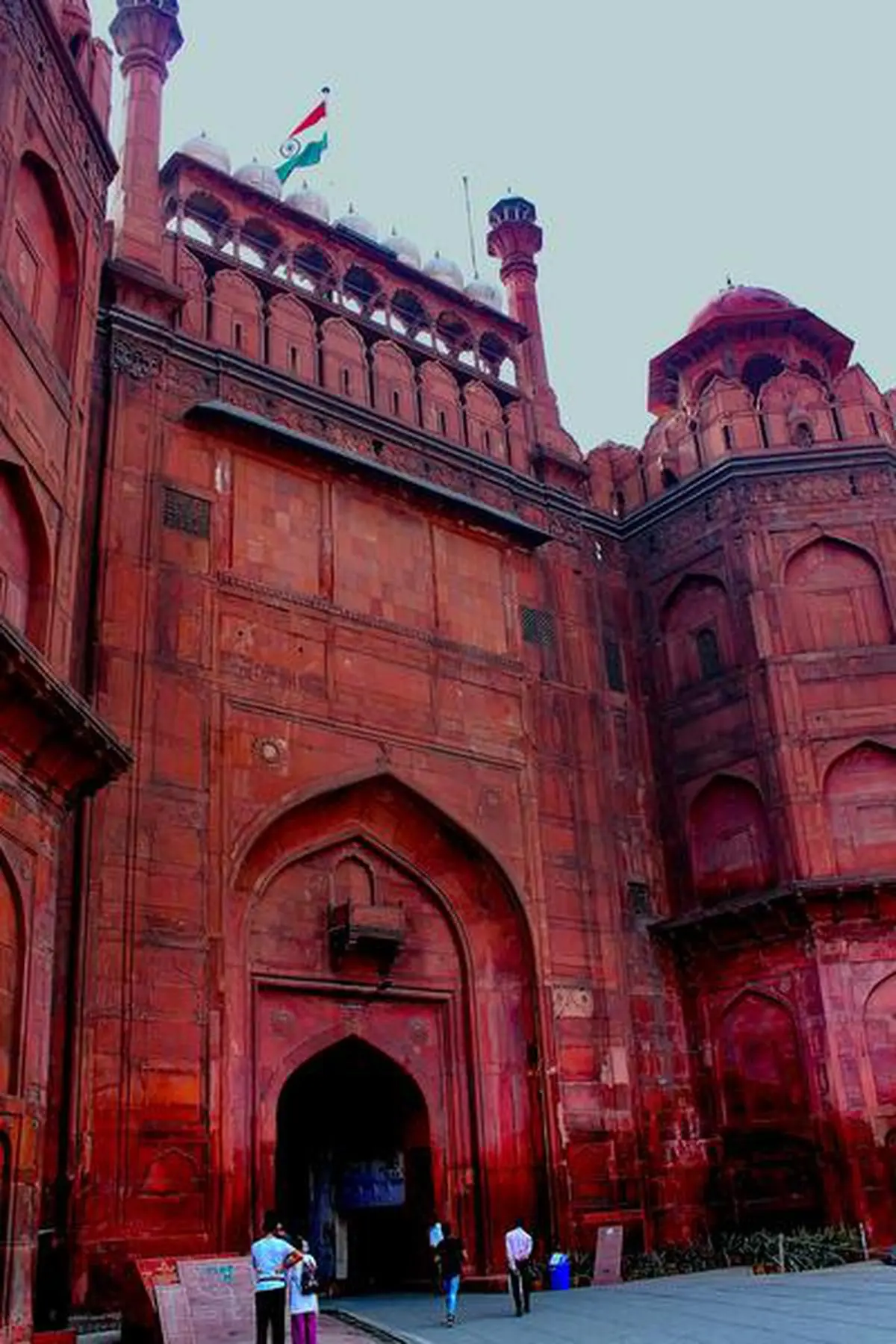
The Lahori Gate of the Red Fort that the Mughal emperor Shah Jahan built in Shahjahanabad, the new capital city he moved to from Agra in 1638, which is now know as Old Delhi.
ON the eastern edge of Delhi along the banks of the Yamuna river, which has shifted its course considerably today, and adjacent to the older Salimgarh Fort is situated the Lal Qila, or the Red Fort, one of the most iconic representations of India’s Independence Day celebrations. Declared a World Heritage Site in 2007, it was built by the fifth Mughal emperor Shah Jahan (regnal years 1628-1658) as the citadel of his new capital city, Shahjahanabad (literally the abode of Shah Jahan). Known by different names at different points of time such as Qila-i-Mubarak (the Fortunate Citadel), Qila-i-Shahjahanabad or Qila-i-Mualla (the Exalted Fort), the Red Fort represents the pinnacle of Mughal palace-fort building activity.
Shah Jahan constructed Shahjahanabad after he changed his capital from Agra to Delhi in 1638. The French traveller Francois Bernier said the scorching heat of Agra forced the emperor to look for a new capital. But there were clearly other deeper reasons. Delhi’s geographical location was more strategic for the control of the empire. Further, as the author of the 19th century biographical work Maasir al-Umara said: “Exalted sultans always had it in mind to cause the world to remember [them] by a permanent monument.” Agra had by then become a little too small for Shah Jahan’s grand and ambitious building plans. Overbuilding and encroachments had led to huge congestion in a city getting progressively eroded by the Yamuna. There had also been incidents of people getting killed/injured during processions/festivals. In 1639, Shah Jahan instructed his architects, engineers and astrologers to select a new site in a mild climate somewhere between Agra and Lahore.
The choice of Delhi was facilitated by many factors. It had been the capital and a centre of Muslim rule since the times of Qutbuddin Aibak until around 1506 when the Afghan ruler Sikandar Lodi (regnal years 1489-1517) shifted his capital to Agra. Later, Shah Jahan’s grandfather, the Mughal emperor Humayun, laid the foundations for a new capital called Dinpanah in the modern Purana Qila /Old Fort area. Delhi had also been an important religious-spiritual and pilgrimage centre housing tombs and graves of several holy men, including Nizamuddin Auliya, Qutbuddin Bakhtiyar Kaki and Nasiruddin Chirag Dehlavi. Hakim Maharat Khan Isfahani, writing in the early 18th century, says: “It was always the dar al mulk [seat of empire] of the great sultans and the centre of the circle of Islam [ markaz-i dairah Islam ].” The historian Swapna Liddle argues that the specific spot—the right bank of the Yamuna and south of the Salimgarh Fort, which Islam Shah Suri built in 1546—is regarded as auspicious in Hindu mythology. It was believed to have been blessed by Vishnu as a place where knowledge of the Vedas could be had by just taking a dip in the waters. It was called Nigambodhak , meaning that which makes known the knowledge of the Vedas. Nigambodh Ghat continues to be regarded as a holy site by Hindus.
Scholars have suggested various models to comprehend the city. The historian Stephen Blake argues that like many other capital cities, such as Istanbul, Isfahan (Persia), Tokyo and Peking, Shahjahanabad was also the “exemplar” of the sovereign city model—the “capital of the patrimonial-bureaucratic empire”, a type of state that characterised Asian empires from about 1400 to 1750. Others, such as E. Ehlers and Thomas Krafft, have characterised Shahjahanabad as an “imperial Islamic city”. An important factor to bear in mind is the way the Mughals, or for that matter even Hindus, viewed capital cities. The capital was an axis mundi —or the centre of the earth where the celestial and the mundane intersected. In the words of Muhammad Salih, an official historian of Shah Jahan’s reign: “Its four walls… enclosed the centre of the earth [ markaz-i khak ].” While the nature of the city continues to be debated, there is no doubt that it was one of the finest imperial capitals of the time. It had all the features of a great Mughal city: a palace-fort, enclosure walls, streets with squares, bazaars, mosques, gardens, imperial buildings, commercial neighbourhoods and industrial establishments, some within the palace-fort complex and some outside it.
On April 29, 1639, at a time determined by imperial astrologers, the subahdar (governor) of Delhi ordered the architects Ustad Ahmad and Ustad Hamid to begin the excavations for the new capital. After nine years, on April 19, 1648, Shah Jahan entered the Daulatkhana-i-Khas / Diwan-i-Khas (Hall of Special Audience) through the gate fronting the river.
The palace-fort was built at a cost of around one crore rupees, half of which was spent on the construction of the palaces within. It occupied the north-eastern edge of the new imperial city. Later, Shah Jahan also constructed a wall around the city, which Bernier found to be inadequate. The wall was punctuated by towers, bastions, gates and entryways. Of its 14 major gates, the important ones are the Mori, Lahori, Ajmeri, Turkomani, Kashmiri and Akbarabadi (later known as the Delhi Gate) Gates.
Fort wall and entrances The palace-fort complex together with the Salimgarh Fort occupies an area of 121 acres (one acre is 0.4 hectare). It is an irregular octagon with its two longer sides in the east and west. According to the art historian Percy Brown, most of it was laid out in squares and there was hardly an oblique line or curve in the entire scheme. The riverfront section contained important royal buildings. A water channel, called Nahar-i-behisht (Stream of Paradise), ran through these buildings. The fort complex was surrounded on three sides by a moat and by the Yamuna on the eastern side. The wall on the north-eastern side borders the Salimgarh Fort, which served as a prison during Mughal times. The wall of the palace-fort covers a perimeter of 2.41 kilometres. Along the river, it is 18 metres high and on the other sides it is 33.5 m high. The wall was built of red sandstone (hence the name Red Fort) brought upstream on the Yamuna from Fatehpur Sikri.
The archaeologist Y.D. Sharma pointed out that there were five grand entrance gates to the fort, only two of which are still in use: the imposing three-storey Lahori (facing the direction of Lahore) Gate and the Delhi Gate (facing Delhi). The latter, which Shah Jahan used to go to Jama Masjid, is similar in layout and appearance to the Lahori but is notable for the two life-sized stone elephants on either side of it. Aurangzeb, Shah Jahan’s son and successor, demolished the elephants, but the British Viceroy Lord Curzon had them restored in 1903. Lying under the Musamman Burj , the riverfronting octagonal tower, was a third gate that the emperor used as a private entrance.
The bazaars The fort was characterised by rectangular buildings laid out in a symmetrical arrangement with intersecting thoroughfares. There were two principal streets/thoroughfares, which also served as bazaars. They emanated from within the fort-palace but went beyond to the city. They intersected at right angles in the courtyard outside the Naqqar Khana (Drum House). The principal imperial street, running from east to west, began at the Rang Mahal (Palace of Colour) and ran through the Lahori Gate of the fort to Fatehpuri Masjid. This street was divided into three bazaars separated by two squares. The first, lying between the Lahori Gate and the chowk (square) of the Kotwali Chabutra (City Magistrate’s Platform), was called Urdu Bazar (Bazaar of the Royal Camp). The second part, commissioned by Shah Jahan’s daughter Jahanara Begum, extended from Kotwali Chabutra to the octagonal Chandni Chowk (Silver Square) and was called Ashrafi Bazar (Moneychangers’ Market) or Jauhari Bazar (Jewellers’ Bazaar). It had a hammam (bathhouse), a sarai (inn) and a garden (Bagh Sahibabad) near it. The final section, from Chandni Chowk to Fatehpuri Masjid, was called Fatehpuri Bazar . The Nahar-i-behisht , bordered by trees, ran down the middle of the bazaars.
The second street, in the north-south direction, stretched from the Akbarabadi Gate of the fort to the Akbarabadi Gate of the city and had a market that later came to be known as the Faiz Bazar (Bazaar of Plenty). As in the case of the first street, a stream from the Nahar-i-behisht ran down the middle of this bazaar. There was also a bazaar, a small one, that connected Jama Masjid and the palace-fort and it was inhabited by dancing girls, medicine men, jugglers, storytellers and astrologers.
The Lahori Gate remains the main public entrance to the palace-fort. The pointed arched entrance has kangura s (ornamental merlons) on the parapet and a row of dwarf chhatri s (canopy), each with a small marble dome. It is flanked by octagonal towers with sandstone domes and marble finials. Since 1947, Prime Ministers have made Independence Day speeches from the ramparts adjacent to this gate. Aurangzeb added barbicans to the Delhi and Lahori Gates and made the former the headquarters of the qiladar (fort commander). When Shah Jahan was imprisoned by Aurangzeb, he apparently wrote to his son from Agra saying: “You have made the fort a bride, and set a veil before her face.” The historian Percival Spear points out that Aurangzeb built the great wall in front of the Lahori Gate to save nobles the trouble of having to bow constantly as they walked the length of Chandni Chowk , which court etiquette required them to do when they were in the view of the emperor. Blake, however, says the wall was built to strengthen the outworks of the structure.
After entering the Lahori Gate, one comes to a vaulted arcade, or a covered bazaar ( Bazaar-i-Mussaqaf ). Blake says that establishing roofed bazaars was a common practice in Iran and West Asia but was unusual in India. This was a double-storey structure with arcaded shops at both levels, and there were shops on sides of the street too. Here, merchants of Delhi sold their goods to the nobles. In the middle of the bazaar is an octagonal court known as Chhatta Chowk with an open roof to allow in air and light. Going past the covered bazaar, one reaches the three-storey sandstone pavilion Naubat Khana (Music Gallery), or Naqqar Khana , where once ceremonial music was played five times a day and from where the arrival of the emperor and other dignitaries was announced. The Indian War Memorial Museum now occupies its upper storey. Between Naqqar Khana and Chhatta Chowk is an open square forecourt ( Jilau Khana ) on the sides of which were small rooms for officials connected with the daily guard. It is in the Jilau Khana that the people attending daily audience, ministers, bureaucrats, amirs and others waited. Only the princes could go beyond this point on their horses; all others had to dismount here.
The Naqqar Khana led to the rectangular Diwan-i-Aam (Hall of Public Audience) open on three sides with a courtyard in front. It is an arcaded structure consisting of nine engrailed arches supported by double columns made of sandstone. It has 27 bays, and the ceiling and the columns were originally decorated with gilded stucco work and hung with heavy curtains. Set against the centre of the eastern wall is a marble canopy known as the Nashiman-i-Zill-i-Ilahi (Seat of the Shadow of God). This canopy with fluted/baluster columns, inlays of precious stones and a Bengal-styled roof once stood over the emperor’s throne. Here he sat and listened to complaints and suggestions from the general populace and deliberated upon routine military, administrative and financial matters. A railing separated him and the common people. Below the throne was a marble dais decorated with semi-precious stones to be used by the wazir (prime minister). The wall behind the throne was ornamented with beautiful panels of pietra dura work, said to have been executed by the Florentine artist Austin de Bordeaux. The panel has beautiful flowers along with birds and animals. It also has a representation of the Greek god Orpheus playing the flute to animals, including a hare, a leopard and a lion. The art historian Ebba Koch says this symbolised the ideal rule of Shah Jahan “whose justice would make the lion lie down with the lamb and, in the human world, free the oppressed from their oppressors”.
The Diwan-i-Aam was sometimes used for state functions, and the courtyard behind it leads to the imperial apartments. In order from north to south, they are Mumtaz Mahal , Rang Mahal , Khas Mahal , Diwan-i-Khas , the hammam and Hira Mahal . Built along the Yamuna, these palaces now overlook the traffic-heavy Mahatma Gandhi Road. The eastern ramparts are flanked by two towers, Asad Burj (Lion Tower) and Shah Burj (Emperor’s Tower) respectively, on the south and north ends. Raised on a common marble platform, these were mostly open marble pavilions with perforated screens, inlaid with precious stones and decorated with moulded plaster and paintings. They had walled courtyards on the western side to give them privacy from the rest of the palace. The Nahar-i-behisht brought water from the river by way of a marble ramp that led into a lotus-shaped pool in the north-eastern building. From here, it filled the royal baths, ran through the Diwan-i-Khas and the emperor’s private chambers and beneath the marble trellis screen that carried the carving of the Mizan-i-Insaf (Scales of Justice), through the section reserved for the royal women.
Behind the Diwan-i-Aam and separated by a court is the Rang Mahal , a huge hall whose name is derived from its painted interior. It had a facade of five engrailed arches set on piers. The ceiling was originally built of silver and, in the words of Muhammad Salih, was “gilded and ornamented with golden flowers”. The central hall was divided into 15 bays formed by intersecting arches. The structure had two vaulted chambers on either end that were adorned with wedges of mirrors embedded in the ceiling. These apartments are popularly called Shish Mahal (House of Mirrors) because of the effect they produced.
Beyond this is the Mumtaz Mahal (Distinguished Palace), a building that now houses the Fort Archaeological Museum. It had a brightly coloured ceiling inlaid with gold and at four corners were reed houses ( khas khanas ). There was a large garden with a pool and a marble basin between this palace and the Diwan-i-Aam . Between the Mumtaz Mahal and the Asad Burj were living quarters for women of the imperial household. Small gardens laid around central pools dotted the courtyard.
Emperor’s living quarters Immediately north of the RangMahal were the emperor’s living quarters called the Khas Mahal (Special Palace). This composite palace consisted of three segments: a beautifully carved marble building inlaid with precious stones called the Aramgah or Khwabgah (Place of Sleep) flanked by the Tasbih Khana (Chamber for counting beads for private prayers) and the Tosha Khana (Robe Chamber). The Tasbih Khana was a set of three rooms facing the Diwan-i-Khas . This was separated from the central Khwabgah by a marble screen containing a representation of the Mizan-i-Insaf suspended over a crescent amidst stars and clouds. The Tosha Khana , also known as the Baithak (Meeting Hall), faced the Rang Mahal and had painted walls and ceiling and a perforated screen. The Musamman Burj , with its beautifully painted interior, protruded from the eastern wall of the Aramgah . It served as a place for the Jharoka Darshan (Balcony of Audience)—a practice borrowed from Hindus whereby the emperor appeared before his subjects every morning. In 1808, Akbar Shah II added a small balcony to this burj . It was from this balcony that King George V and Queen Mary appeared before the people of Delhi during the Durbar of 1911.
To the east of the Diwan-i-Aam and along the riverfront is the Diwan-i-Khas . The location of this hall, deep within the living quarters of the imperial family, indicated its special, private character. This rectangular chamber was a place for exclusive and private audience. Built of pure white marble, it was one of the most elegant buildings in the palace-fort. Its roof has pillared umbrellas at the corners. The chamber has engrailed or scalloped arches resting on a set of 32 piers with square shafts. The lower walls were studded with agate, pearl and other precious stones while the upper portion had fruits and flowers painted in colourful and intricate designs. Takht-i-Taus , the famous peacock throne with the Koh-i-Noor diamond embedded in its canopy once stood in the centre of the room on a wide marble platform. The Nahar-i-behisht flowed right through the middle of the hall, adding to the beauty of the place. The Diwan-i-Khas inspired the poet Amir Khusrau (1235-1325) so much that he left a quote in the building wall: “If there be a paradise on the earth, it is this, it is this, it is this.”
North of the Diwan-i-Khas lay the hammam , which was a three-storey structure built of marble. While one storey was used as a dressing room, the other two were for hot and cold water baths respectively. It was decorated with mosaic and pieces of glass and nicely painted. At the north-eastern corner of the palace-fort and along the riverfront, lay the Shah Burj .
North of the Diwan-i-Khas was the marble Moti Masjid (Pearl Mosque) built around 1659 for exclusive private use. This is the only building that Aurangzeb erected within the palace-fort and is now closed to the public. The northern sector of the imperial quarters was occupied by the gardens, primarily the Hayat Baksh Bagh (Life Bestowing Garden) and Mahtab Bagh (Moonlight Garden). The Hayat Baksh Bagh was a paradise garden with tanks, fountains, tunnels, pavilions and all the other structures typical of such gardens in the West Asian countries. It had a rectangular pool in the centre beside which stood an open summerhouse ( barahdari ). At the north and south ends of this garden stood two identical pavilions named after the monsoon months of the Hindu calendar: Sawan (fourth month) and Bhadaun (fifth month).
After Shah Jahan The fortunes of the fort started disintegrating after the death of Aurangzeb, a period that witnessed battles for succession, dissensions within the royalty, the rise of ambitious nobles, invasions from abroad and natural calamities. The palace-fort was a centre for artistic and cultural performances during some periods. Muhammad Shah, one of the later Mughals, patronised Urdu, Qawwali and music, particularly khyal . Paintings of Holi celebrations during his period are well known.
In 1739, Nadir Shah, the Turk ruler of Iran, crossed over Afghanistan and Punjab and defeated the Mughals at Karnal. In the subsequent display of power, his name was proclaimed as the sovereign in the khutba read in the mosques in Shahjahanabad. He also got Muhammad Shah to receive him at the fort where he symbolically returned the throne to the defeated emperor. On March 22, 1739, infuriated by attacks on his army, Nadir Shah ordered a massacre of citizens of Delhi and witnessed the barbarity sitting on the roof of Sunehri Masjid near Chandni Chowk . He also plundered the fort and the city and carried away a booty with an estimated value of 700 million rupees, including the Peacock Throne and the Koh-i-Noor .
The destroyed city and plundered empire was further weakened by the raids of the Marathas, the Sikhs, the Jats, the Gurjars, the Rohillas and the Afghans around the mid to later 19th century.
The historians Percival Spear and Amar Farooqui argue that the Mughal Empire as an imperial raj or a political entity ceased to exist in the 1750s. But the “imperial” aspect of the emperor and his distinctive social status as the foremost resident of Delhi ensured that his position remained central to the identity of the city even after British occupation. In 1803, Lord Lake defeated the Marathas near Patparganj and gained control of the Ganga-Yamuna plains and the Delhi-Agra region. The city became a part of the North-Western Provinces and was governed from Agra. A British Resident was stationed in Delhi. He started functioning from an office at Dara Shukoh’s Library on the right bank of the Yamuna close to the imperial palace.
Rebellion of 1857 The early decades of the 20th century, sometimes described as the “English Peace”, were also the period of the “Delhi Renaissance”, which was characterised by literary greats such as Ghalib, Momim, and Zauq; the intellectual endeavours of the faculty at the Delhi College and its English institute; and the coming of printing presses and newspapers. This was disrupted by one of the most serious challenges to the British colonial rule, the Rebellion of 1857.
The year 1857 witnessed armed revolts in parts of central and northern India, leading to a loss of British control over these regions. It began with a mutiny of sepoys but acquired a civil and popular character in parts of Upper India. The historian Eric Stokes says that the rebel sepoys showed a “centripetal impulse to congregate at Delhi”. The Red Fort thus emerged as a focus centre for the rebellion. Under pressure from the rebels and princes, the reluctant 82-year-old Mughal emperor, Bahadur Shah Zafar, became the titular leader of the rebellion, while Prince Mirza Mughal (commander-in-chief) and Jiwan Bakht ( wazir ), along with other princes and nobles, exercised the real power.
The palace-fort soon became the seat of new power and Bahadur Shah a symbol of the rebellion. There were attacks on Europeans, Christians and those connected with the British government. The British army waited for reinforcements from Ambala. Once the army started gaining control of the city, it went on an offensive against both Hindus and Muslims. The population of the city was driven out and took shelter around the Qutb and the Nizamuddin and could only re-enter the city the following year. Mosques were taken over. After September, the British forces unleashed a reign of terror that saw indiscriminate shootings, courts martial and summary hangings.
Bahadur Shah had escaped via the Yamuna and taken refuge in Humayun’s tomb. He was arrested along with three princes who were killed on the way back near the Delhi Gate by Major William Hodson. Bahadur Shah returned to the Red Fort as a prisoner of the British, was tried in the Diwan-i-Khas in 1858 and exiled to Rangoon, Burma (now Yangon, Myanmar), on October 7.
The fort complex also incurred the wrath of British officials. More than two-thirds of the inner structures were destroyed. Henceforth, the palace was to be used as quarters for the British garrison and the famed Diwan-i-Aam as a hospital. The buildings south of the Diwan-i-Khas were found to be “of little architectural interest” and were declared suitable for troops. Most of the jewels, precious stones and artworks of the Red Fort had been looted and stolen during Nadir Shah’s invasion and after the “Great Indian Rebellion” was suppressed. Several existing Mughal structures were demolished, including the harem courts and gardens to the west of Rang Mahal and the royal storerooms and kitchen to the north of Diwan-i-Aam and the Mahtab Bagh . British buildings such as army barracks, hospitals, bungalows, administrative buildings, sheds and godowns became a part of the palace-fort complex.
The rebellion ended the rule of the East India Company, and an Act passed in the British Parliament in August 1858 made Queen Victoria the sovereign head of British India. The office of Secretary of State was created to rule India. The new power dynamics were sought be cemented through imperial durbars held in 1877, 1903 and 1911. The author Pran Nevile says this was in keeping with the Indian tradition of the durbar, which celebrated the coronation of a new ruler to mark his/her sovereignty over his/her subjects. The third durbar also saw a surprise announcement from King George V of the transfer of the capital from Calcutta (now Kolkata) to Delhi. The next few decades were spent on building the last imperial city, New Delhi, also known as Lutyen’s Delhi.
The Red Fort became visible again in the years preceding Independence. The chambers within the baoli , or stepwell, believed to predate the Red Fort, were converted into a prison. It housed Colonel Shah Nawaz Khan, Colonel Prem Kumar Sahgal, and Colonel Gurbaksh Singh Dhillon during the Indian National Army (INA), or Azad Hind Fauj, trials in 1945-46. The massive nationwide campaign for their release reinforced the public perception of the former Mughal palace as the symbol of anti-colonial resistance. On August 16, 1947, Jawaharlal Nehru, the first Prime Minister of India, raised the Indian national flag above the Lahori Gate. Farooqui says that the act of replacing the British flag with India’s national flag—a day after the swearing-in of the first Cabinet—amounted to reclaiming this contested site for the nation.
After Independence, the Red Fort witnessed a few changes but continued to be used as a military cantonment. A large part of the palace-fort remained under the control of the Indian Army until 2004 when it was handed over to the Archaeological Survey of India for restoration.
Shashank Shekhar Sinha has taught history in undergraduate colleges at the University of Delhi. He does independent research on tribes, gender, violence, culture and heritage .
source: http://www.frontline.thehindu.com / Frontline / Home> Arts & Culture> Heritage> Agra Fort / by Shashank Shekhar Sinha / January 30th, 2019