Tag Archives: Salman Khurshid

Muslim Mirror Releases List of 100 Most Influential Indian Muslims 2025; Young Faces Gain Prominence

INDIA :

Muslim Mirror’s 100 Most Influential Muslims of 2025

New Delhi: 

Muslim Mirror has released its much-anticipated annual list of the “100 Most Influential Indian Muslims of 2025,” spotlighting individuals who have made significant contributions to India’s public life across a wide spectrum of fields including politics, culture, education, business, media, religion, sports, and social service. Now in its second edition, the list aims to document influence not merely as power or popularity, but as sustained impact, leadership, and the ability to shape public discourse.

A defining feature of the 2025 edition is the growing prominence of younger achievers, signalling a visible generational shift within Indian Muslim leadership. Alongside established national figures, the list includes emerging voices who have built influence through grassroots activism, professional excellence, digital platforms, legal advocacy, education, and community engagement. Editors associated with the project said this was a deliberate attempt to recognise new centres of influence beyond traditional hierarchies.

The list reflects the diversity and plural character of Indian Muslim society, cutting across geography, ideology, profession, and language. From seasoned politicians and religious scholars to artists, entrepreneurs, academics, and social reformers, the compilation offers a broad snapshot of leadership trends at a time when issues of representation, constitutional values, and social justice remain central to national debate.

Representation Across Sectors

The 2025 list features several eminent academicians and intellectuals who have shaped higher education, policy discourse, and social research. Among them are Abul Qasim Nomani, Ameerullah Khan, Furqan Qamar, Shahid Jamil, and Ubaid-ur-Rahman, recognised for their contributions to education, public policy, and academic leadership.

In the business and entrepreneurship category, the list includes influential names such as Azad Moopan, Azim Hashim Premji, Farah Malik, Irfan Razack, M. P. Ahammed, Mecca Rafiq Ahmed, Meraj Manal, Syed Mohamed Beary, P. Mohammed Ali, Shahnaz Hussain, Tausif Ahmad Mirza, Yusuff Ali, and Ziaullah Sharif. Their inclusion underlines the growing economic footprint of Indian Muslim entrepreneurs, both domestically and globally, spanning sectors from retail and healthcare to infrastructure and consumer goods.

Community leadership remains a strong pillar of the list, with figures such as Arshad Madani, Mahmood Madani, Malik Motasim Khan, Mehmood Pracha, Syedna Mufaddal Saifuddin, Navaid Hamid, Pirzada Md Abbas Siddiqui, Qasim Rasool Ilyas, Sadatullah Husaini, Umer Ahmed Ilyasi, and Yusuf Mohamed Abrahani recognised for their roles in religious guidance, legal advocacy, social mobilisation, and institutional leadership.

Culture, Media, and Public Discourse

In arts and entertainment, globally recognised names such as A. R. Rahman, Aamir Khan, Mammootty, Munawar Faruqui, and Shah Rukh Khan continue to command immense cultural influence, shaping narratives that extend well beyond cinema and music into social consciousness.

The list also acknowledges the growing importance of media and journalism in shaping opinion and challenging dominant narratives. Journalists and commentators such as Arfa Khanam, Irfan Meraj, and Seema Mustafa are recognised for their consistent engagement with issues of democracy, minority rights, and constitutional values.

Religious and Intellectual Scholarship

A significant section of the list is devoted to Islamic scholars and religious thinkers, reflecting their continued influence on moral leadership and intellectual discourse. Names such as A. P. Aboobacker Musliyar, Qasim Nomani, Prof. Akhtarul Wase, Asghar Ali Imam Mahdi Salafi, Asjad Raza Khan, Ibraheem Khaleel Al-Bukhari, Javed Jamil, Khalid Saifullah Rahmani, Khaleelur Rahman Sajjad Nomani, Qamaruzzaman Azmi, Rashid Shaz, Shakir Ali Noori, Shamail Nadvi, and Yasoob Abbas find place for their scholarly work, writings, and public engagement.

Politics and Governance

The political category features leaders cutting across party lines and regions, including Asaduddin Owaisi, Ghulam Nabi Azad, Hamid Ansari, Mehbooba Mufti, Omar Abdullah, Salman Khurshid, Najeeb Jung, Syed Naseer Hussain, Engineer Rashid, Akhtarul Iman, Iqra Hasan, Zameer Ahmed Khan, Rakibul Hasan, K. Rahman Khan, Kadir Mohideen, Mohibullah Nadvi, Md Shafi, Agha Mahadi, Asim Waqar, and Sadiq Ali Shihab Thangal. Their inclusion reflects influence exercised through electoral politics, governance, diplomacy, and legislative advocacy.

Changemakers and Social Reformers

One of the most dynamic sections of the 2025 list is that of changemakers and social reformers, featuring individuals such as Safeena Husain, Shahabuddin Yaqoob Quraishi, Syeda Hameed, Zameer Uddin Shah, Mahbubul Hoque, Sabahat S. Azim, Mehmood Pracha, Faiz Syed, and Zahir Ishaq Kazi, among others. Many of these figures have earned recognition through long-term grassroots work rather than formal authority.

International Booker Prize 2025 winner Banu Mushtaq for Heart Lamp, along with renowned poet Wasim Barelvi, has been placed in the category of Literary Figures.

In sports, iconic names Sania Mirza and Irfan Pathan continue to inspire younger generations through excellence and public engagement beyond the playing field.

Beyond Rankings

The editors emphasised that the list does not claim to be exhaustive, nor does it measure influence solely through fame, wealth, or official position. Instead, it seeks to capture real-world impact, moral authority, intellectual contribution, and the ability to shape conversations within and outside the community.

The annual list has increasingly become a reference point for understanding evolving leadership patterns among Indian Muslims. By foregrounding both established figures and rising talents, the 2025 edition reflects continuity as well as change, underscoring how Indian Muslims continue to contribute meaningfully to India’s democratic, cultural, and social field.

source: http://www.muslimmirror.com / Muslim Mirror / Home> Indian Muslim / by Muslim Mirror / January 15th, 2026

Begum Qudsia Rasul must get her place in history: Speakers at book launch

UTTAR PRADESH :

Tehmina Punvani (second from left) with Salman Khurshid and Manish Tewari releasing the Book

Tehmina Punvani offered a rare glimpse into her grandmother’s life. Her grandmother, Begum Qudsia Rasul, was no ordinary woman; she was the only Muslim woman in the Constituent Assembly that drafted India’s Constitution in 1949.

The occasion was the launch of Begum Qudsia Rasul’s book, 24 years after her death.

Tehmina Punvani, a lawyer, is the daughter of Begum Qudsia’s daughter.

Speaking at the book launch in Delhi, Tehmina said, “For the world, she was a fearless political figure, but for me, she was my Ammijan, gentle, grounded and unwavering in her integrity.”

Punvani recalled the period when a fatwa was issued against Rasool for entering public life. While the family felt fear, Rasul was composed.

“If my conscience is clear, no decree can frighten me,’ she would say,” Punvani recounted, drawing applause from the audience.

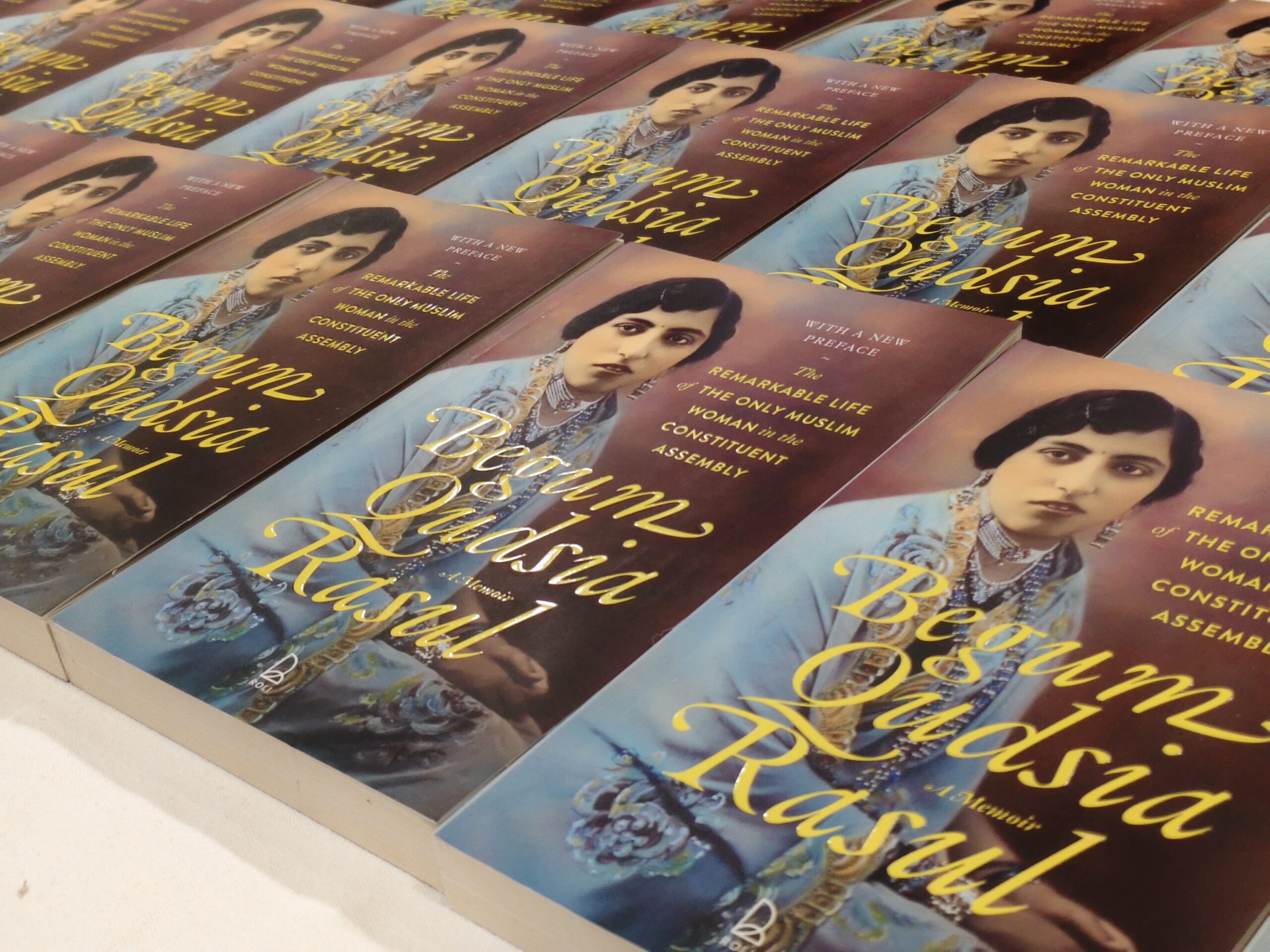
The book, Begum Qudsia Rasul – The Remarkable Life Of The Only Muslim Woman In the Constituent Assembly, is a relaunch of her autobiography “From Purdah to Parliament: The Memoirs of a Muslim Woman in Indian Politics” on the life and political legacy of this remarkable Muslim woman leader of India.

The Book Begum Qudsia Rasul – The Remarkable Life Of The Only Muslim Woman In the Constituent Assembly

The event brought together journalists, lawyers, and political leaders to revisit the contributions of a woman forgotten in mainstream historical narratives.

Moderated by journalist Nidhi Razdan, the panel featured Salman Khurshid, Indira Jaising, Manish Tewari, and senior lawyer Tehmina Punvani.

Begum Qudsia Rasul, born in 1909, was the only Muslim woman in India’s Constituent Assembly. A trailblazing politician, she opposed religious reservations, championed minority rights, and promoted women’s hockey.

Elected to the Rajya Sabha and Uttar Pradesh Assembly, she received the Padma Bhushan in 2000.

Besides being the only Muslim woman in the 1946 Constituent Assembly, she fought for minority equality and opposed religious reservations.

Qudsia Begum was also elected to the UP Assembly, Rajya Sabha and served as a minister.

She is credited with promoting women’s hockey, and a Hockey Cup is named after her. She was a trailblazing woman for giving up purdah. Besides her autobiography, she has authored a travelogue, Our Bapu, a book on Mahatama Gandhi and Hayat-e-Qudsi, about Bhopal’s Begums. 

Tehmina said that despite her political stature, Rasul stayed close to the grassroots. “She met women daily, listened to their concerns, and worked for them without fanfare. Activism, for her, was a duty, not an identity.”

Other speakers highlighted Rasul’s exceptional resilience in an era when Muslim women faced social barriers.

Former Union Minister Salman Khurshid explained that Qudsia had won from a general seat to the United Province Assembly despite many technical hurdles. “It was an extraordinary act of courage,” he said.

Congress MP Manish Tewari underlined the democratic significance of her public life: “Her presence in the Constituent Assembly reflected India’s openness at a time of enormous political and social turbulence.”

Noted lawyer Indira Jaising praised Rasul’s moral clarity and empathetic leadership, calling her “a rare combination of conviction and humility.”

Speakers were unanimous in calling for acknowledging Begum Qudsia Rasul’s contributions and a prominent place for her in India’s political history.

Rolli Books has published this book.

source: http://www.awazthevoice.in / Awaz, The Voice / Home / by Aasha Khosa, ATV / December 11th, 2025

9th Anniversary of Millat Times: Prominent figures appreciate its efforts, extend good wishes

NEW DELHI :

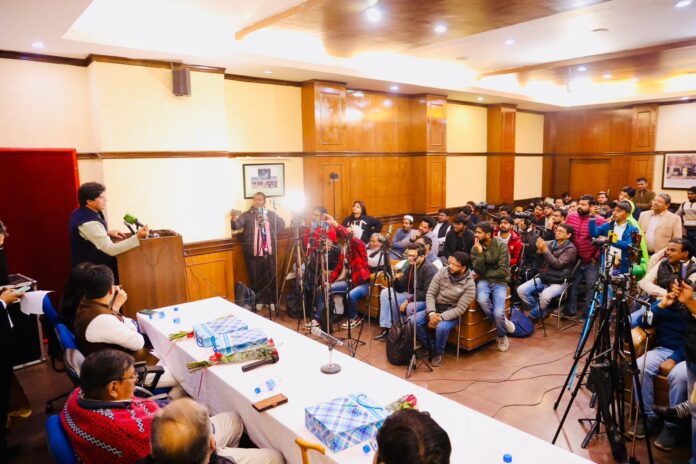
Renowned media house Millat Times celebrated its 9th anniversary on January 18 at the Press Club of India. The event witnessed participation from prominent intellectuals, politicians, and journalists who shared their thoughts on the theme, “The Role of Media in Democracy.” Attendees lauded the platform’s fearless journalism, its remarkable achievements, and its commitment to amplifying marginalized voices.

Former Foreign Minister and President of the India Islamic Cultural Centre, Salman Khurshid, highlighted the media’s role as a mirror of society and emphasized the need for independent responsibility. Praising Millat Times for its unique position in alternative media, he remarked, “Millat Times has countered the mainstream media’s negative propaganda by shaping truthful narratives. Shams Tabrez Qasmi and his entire team deserve congratulations and my best wishes.”

Imran Pratapgarhi, Rajya Sabha MP and Chairman of the Congress Minority Department, expressed delight at the presence of numerous young journalists. Applauding the platform’s achievements, he said, “In challenging times when the voice of the pen is silenced, Millat Times fearlessly speaks truth to power.” He urged the community to financially support independent media platforms to ensure their sustainability.

Former Rajya Sabha MP and Chairman of Indian Muslims for Civil Rights, Mohammed Adeeb, lamented the commercialization of media. “Newspapers are sold even before they reach the readers’ hands, becoming tools of mockery. Amid this, Millat Times lights the path of truth,” he said, commending Shams Tabrez Qasmi for giving a voice to the unheard.

Syed Sadatullah Husaini, Ameer of Jamaat-e-Islami Hind, underscored the importance of free media in sustaining democracy. Expressing concern over India’s low ranking on the Press Freedom Index, he congratulated Millat Times for its responsible journalism. Husaini encouraged expanding the platform’s multilingual content into regional languages like Gujarati and Malayalam.

Veteran journalist Bhasha Singh criticized the communalization and government alignment of mainstream media while lauding Millat Times for upholding journalistic integrity. “Congratulations to Shams Tabrez Qasmi and his team for their steadfast commitment to true journalism,” she said.

Dr. Khalid Anwar, Chief Editor of Hamara Samaj and JDU MLC from Bihar, acknowledged the unparalleled power of media to shape narratives. “In a deteriorating environment, platforms like Millat Times are vital for representing our voices,” he noted.

Gautam Lahiri, President of the Press Club of India, stressed the critical need for independent, people-oriented media. Highlighting the Press Club’s opposition to government-imposed restrictions, he recognized Millat Times as a standout platform and commended Shams Tabrez Qasmi’s contributions.

Iqra Hasan Chaudhary, MP from the Samajwadi Party, sent a written message appreciating Millat Times as a vital need of the hour.

In his inaugural address, Shams Tabrez Qasmi, the Founder and Editor-in-Chief, reflected on the journey of Millat Times. He shared how the platform was established to address the need for amplifying Muslim and marginalized voices. “In nine years, we’ve trained over 100 journalists and covered issues such as riots, mob lynching, crimes, and elections from the ground. Despite hurdles, including FIRs and government actions like shutting down our Facebook page with over a million followers, we remain committed to our work,” he said. He proudly announced that Millat Times now reaches over 70 million people monthly, with nearly five million subscribers and followers across platforms.

The event’s anchoring was managed by Shruti Sharma and Mohammad Sufiyan Saif, while Ruba Ansari delivered the vote of thanks.

Notable attendees included Mirza Qamar Hasan Baig (Chairman, Jamia Cooperative Bank), Mufti Athar Shamsi (Director, Al-Quran Academy), Mufti Ansar-ul-Haq Qasmi (President, Jamia Al-Qasim, Supaul), senior journalists Iqbal Ahmed (BBC) and Armanlesh (NewsClick), activist Safoora Zargar, Aditya Menon (Political Editor, The Quint), and others.

The event’s success was attributed to the dedicated efforts of the Millat Times team, including Mohammad Sufiyan Saif, Ruba Ansari, Mohammad Afsar, Mohammad Tamanna, Mazhar Khan, Sarem Ahmed, Rehan Razi, Talha Shameem, Mohammad Shameem, Sarah Khan, Advocate Abu Nasr, Nazim Hasan, Amir Zafar Qasmi, and Maulana Zafar Siddiqui Qasmi.

With its fearless journalism and unwavering commitment to truth, Millat Times continues to inspire hope for a more inclusive and democratic India

source: http://www.muslimmirror.com / Muslim Mirror / Home> Indian Muslim> Media / by Special Correspondent / January 19th, 2025

IICC Election: I would try to spread the message of peace through this Centre, says presidential candidate Dr. Majid Talikoti

NEW DELHI :

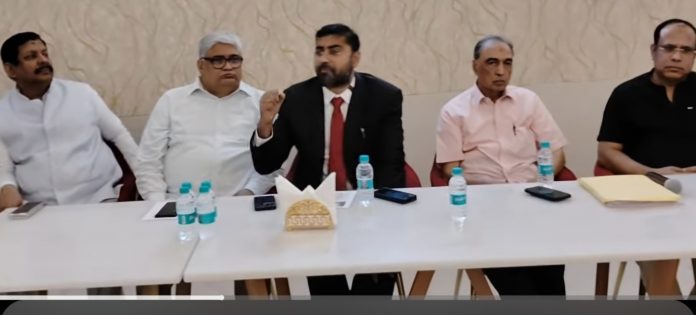
Dr. Majid Ahmed Talikoti, a renowned oncosurgeon, announced his candidacy for the presidency of the India Islamic Cultural Centre (IICC) during a press conference at Hotel Riverview in Jamia Nagar, New Delhi.

Dr. Talikoti highlighted his diverse interactions with people from various walks of life as a key factor in his decision to engage with IICC. “As a surgeon, I interacted with people from different walks of life, and I know how to deal and serve people. That’s why I decided to engage myself with IICC,” he stated.

Dr. Talikoti, who is well-regarded in the medical community, aims to showcase IICC as a beacon of Islamic heritage and culture. He emphasized the peaceful nature of Islam and the importance of promoting this message through IICC. “Given a chance, I will try to showcase IICC as a prominent center of Islamic heritage and culture. Islam is a religion of peace, and I would try my best to send the message of peace through this Centre. We are supposed to welcome our non-Muslim brothers on Eid and join them on Diwali,” Dr. Talikoti said.

Dr. Talikoti outlined his vision for IICC, focusing on maintaining a non-political, brotherly atmosphere during the election and beyond. He stressed the importance of adhering to IICC’s aims and objectives, which include fostering youth empowerment and initiating interfaith dialogues to bridge community gaps. “We will not fight this election as a political battle, but in a brotherly manner in a very congenial atmosphere and try to keep the center away from politics, following the aims and objectives of IICC. We will develop IICC as a center of empowerment for youths and start interfaith dialogues to bridge the gap between communities,” he asserted.

With the support of former IICC president Sirajuddin Quraishi, Dr. Talikoti’s campaign has garnered significant attention. He is also the convener of the Muslim Rashtriya Manch (MRM), an RSS-affiliated organization formed in 2002 to facilitate dialogue with the Muslim community.

Established in 1981, IICC is a premier institution in New Delhi dedicated to promoting and preserving Islamic culture and heritage. It aims to foster cultural exchange, interfaith dialogue, and communal harmony through various educational, social, and cultural programs.

The election campaign for the governing body of IICC has officially commenced, with candidates contesting for posts of president, vice president, and members of the Board of Trustees (BoT) and Executive Committee (EC) promising significant shifts in the center’s functioning. The election is scheduled for August 13th.

Among the other presidential candidates are ex-cabinet minister Salman Khurshid, retired IRS officer Abrar Ahmad, former bureaucrat Afzal Amanullah, businessman and philanthropist Waseem Ghazi, businessman M. Asif Habib, and BJP activist Suhail Hindustani. Each candidate brings unique perspectives and visions, making this election a pivotal moment for IICC’s future.

Interestingly, Dr. Majid Talikoti’s panel includes Kaleemul Hafeez, who is contesting for the post of vice president. Until recently Hafeez has been a sharp critic of Serajuddin Quraishi, the former IICC president, who is also running for membership on the Board of Trustees (BoT)

Md Irshad Ahmad Advocate, Supreme Court of India & Former President, AMUOBA-DELHI is also contesting for BoT from this panel.

source: http://www.muslimmirror.com / Muslim Mirror / Home> Indian Muslim / by Special Correspondent / June 25th, 2024

Delhi HC Refuses to Entertain Plea to Ban Salman Khurshid’s Book

UTTAR PRADESH / NEW DELHI :

The petitioner alleged that Khurshid has misused his fundamental right to freedom of expression in a very complex manner as it is not absolute.

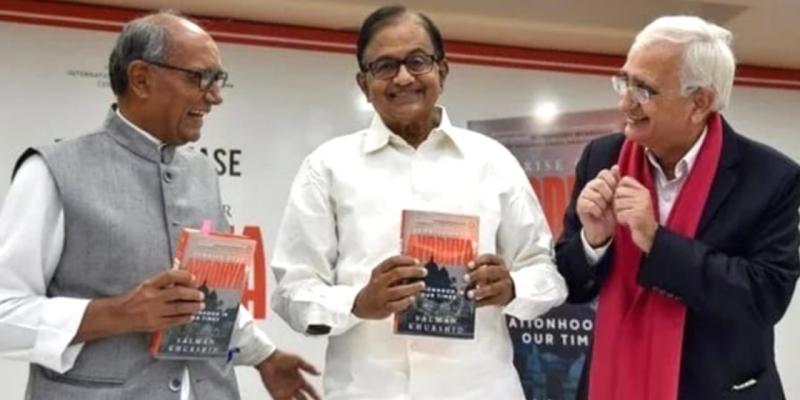
Congress leaders Digvijay Singh, P. Chidambaram and Salman Khurshid at the launch of ‘Sunrise over Ayodhya’ book on November 10. Photo: Facebook.

New Delhi: 

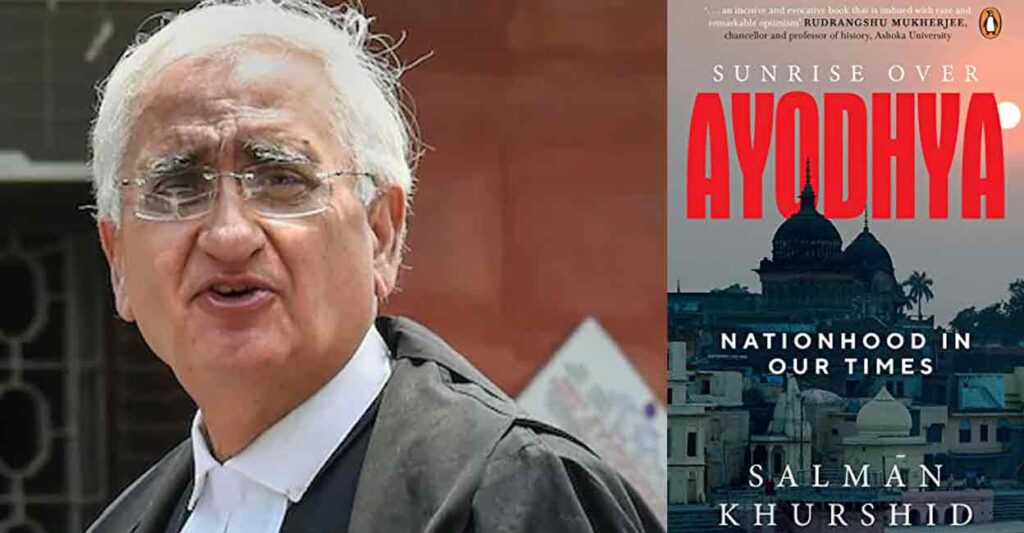
The Delhi high court Tuesday refused to entertain a plea seeking direction to the Centre and Delhi government to ban the sale and publication of Congress leader Salman Khurshid’s book Sunrise Over Ayodhya: Nationhood In Our Times.

A bench of chief justice D.N. Patel and Justice Jyoti Singh pulled up the petitioner for not impleading the author of the book or publication house as a party to the plea, saying he was a chance taking petitioner who has filed the plea for publicity.

“You want a complete ban on the book but you have not made the author a party. You may ask any heaven or sky. We may dismiss it with costs. You are not joining the author as a party. Stop doing this activity in court. Why are you feeling so shy and not joining the author as a party. We will not give you any chance, this is a deliberate move. These are all chance-taking petitioners. It is for publicity,” the bench said.

After some time, the petitioner’s counsel sought permission to withdraw the petition and file a fresh one with proper averments, annexures and joining proper persons as parties.

The court allowed him to withdraw the petition and disposed it of as withdrawn.

“He has no courage to join Salman Kurshid as a party, what type of PIL (Public Interest Litigation) he will argue. If you are so much worried about the name of the author or the senior advocate, you should not have filed the PIL. These are blackmailing or publicity petitions. This is a waste of time PIL,” the bench said.

Petitioner Rakesh, in his plea through advocates A.K. Dubey and Pawan Kumar, alleged that Khurshid has misused his fundamental right to freedom of expression in a very complex manner as it is not absolute and carries with it special duties and responsibilities towards public interest.

It said there are 90 crore Hindus in the country and if anyone takes offence of such statements made in the book, it could become a law and order problem in society.

“Salman Khurshid has written in the chapter that Sanatan Dharma and classical Hinduism known to sages and saints was being pushed aside by a robust version of Hindutva, by all standards a political version similar to the jihadist Islam of groups like ISIS (Islamic State of Iraq and Syria) and Boko Haram of recent years,” it said.

Khurshid’s new book on the Ayodhya dispute was released recently.

On November 17, an additional civil judge here had refused to grant an ex-parte injunction on a lawsuit by Hindu Sena president Vishnu Gupta to stop the publication, circulation, and sale of the book for allegedly hurting sentiments of a large section of society.

While declining interim relief, the trial court had said the author and publisher had the right to write and publish the book.

(PTI)

source: http://www.thewire.in / The Wire / Home> English> Books> Government> Law / by PTI / November 30th, 2021

Most Muslim thinkers say there’s no such thing as triple talaq: Salman Khurshid

UTTAR PRADESH / NEW DELHI :

Salman Khurshid | Photo Credit: Shanker Chakravarty


The senior Congress leader talks Pakistan, triple talaq, Indian Muslims, and his party’s need for a new vocabulary

Congress leader, former Foreign Minister and lawyer Salman Khurshid is a man of many parts. From tomorrow, he will be appearing in the Supreme Court as amicus curiae in the controversial triple talaq case. In a wide-ranging conversation, he talks about the triple talaq issue, what it means to be a Muslim in Narendra Modi’s India, the need in the Congress party for a new narrative, and the problem with the government’s Pakistan policy. Excerpts from the interview:

Why have you offered your services to the Supreme Court on triple talaq?

Why not? It may have a political context, but it’s not necessary to look at it in a political context. It can be seen in pure humanistic terms, and towards (developing) a pure understanding of the sociology of Islam. Instead of a partisan approach, we can have an objective discussion that will be helpful for both parties, the court and society. I have done some research, I offered it to the court and am very encouraged that the court accepted it.

But for the BJP (Bharatiya Janata Party), it is a political issue.

In politics, [you can] pose something for the benefit of a segment of society; or you can propose something [because] it gives you political advantage. If the BJP is genuinely concerned about the welfare of Muslim women, then it is understandable. If they are doing it to excite aversion to Muslims, it’s very sad. My view is that they may be taking a simplistic political stand. Therefore I hope an objective understanding of triple talaq will be an appropriate response.

The Muslim ulema see it as an interference in personal laws.

That’s their point of view. There are many other points of view. If ulema from elsewhere in the world and ulema from India have different positions then there needs to be a dialogue between the two sets of ulema rather than for Indian Muslims to say we will only listen to the Indian ulema.

Do you think the BJP is gradually moving towards enacting a Uniform Civil Code?

Maybe, but anyone in the BJP who thinks framing a Uniform Civil Code is about removing elements of Islam from the law in this country is barking up the wrong tree because there are many more complicated issues that arise. Let me give you an example: what is the position of the BJP on same-sex marriages? If you have a Uniform Civil Code, you can’t stop at traditional attitudes towards human relations.

Isn’t there a court ruling already on triple talaq?

There are High Court rulings and one specifically from Delhi of Justice Badar Ahmed which is very explicit: the ruling doesn’t say we will overrule triple talaq, it says there is no such thing as triple talaq. The world over, the majority view of Muslim thinkers is that there is no such thing as triple talaq. Even if you say talaq three times, it amounts to talaq being said only once. So we have to look at the texts more closely and then come to a conclusion.

Is triple talaq really a big issue for Muslim women?

It is not an issue at all, but anyone who feels the threat of adversity would like to stand up against it. But for the BJP to assume that Muslim women think only it can save them from this adversity is completely wrong. There are systems within Islam, and an understanding within the Muslim community that does not favour triple talaq. In fact, triple talaq is largely a propagation and promotion of Hindi movies.

You have written at least two books in which you have dwelt at length on what it means to be a Muslim in India. What does it mean to be a Muslim in Narendra Modi’s India?

Those books are already dated. What it means today is to understand what it means to be irrelevant. And you cannot blame Mr. Modi or [Uttar Pradesh Chief Minister] Yogi Adityanath for making Muslims irrelevant. The BJP is a political party and it has to win elections, and they have won elections by making Muslims irrelevant. But Muslims have played a major role in making themselves irrelevant.

Muslims have been wrongly described as a political group that is captive of the Congress and other liberal parties. They were participants in the Congress movement because it was the only movement that vigorously fought against Partition, refuted the idea of a divided India. So Muslims of India are those who rejected the idea of Pakistan. Where would they go? There have been disappointments with the Congress. Periodically, they return to the Congress. That’s how 10 years of UPA rule was possible. But Muslims have been constantly attacked for being Congress lackeys and the Congress has been attacked for appeasement of Muslims.

However, the fact remains that Muslims are not the only ones who have made themselves irrelevant. The liberals have made themselves completely irrelevant. The liberal voices are in complete isolation. It is liberal India that stood up for the minorities and women.

On the subject of appeasement of Muslims by the Congress, the A.K. Antony Report after the 2014 elections hinted that that might have been part of the problem.

I have not seen the report but I don’t accept the report has this because I have spoken to Mr. Antony. He said he was saying this is in the context of political structures in Kerala, it was not a general proposition.

That is not how it is read in your party.

My party has all kinds of characters but I don’t think they have a right to claim they speak for the party. I can say with enormous confidence that either in private conversations or in public we haven’t heard such a direction from our top leadership.

You mean Sonia and Rahul Gandhi.

Yes, yes. But there is ideology, principle and perception. If a perception is being created against the Congress, then we have to learn the idiom and the manner of presentation so that we don’t become susceptible to perception. And that’s where some of our colleagues are lacking.

We are not an NGO, we are a political party. And therefore, what needs to be said has to be said in a manner that will unite, not divide people. We were under a lot of pressure from the NGOs to use a language that is unfortunately divisive. The Congress has a very inclusive and nationalistic idiom that it has used in the protection of minorities and of vulnerable sections of our society. If we lose that idiom, we will be hurt, and that’s what the BJP has done. It doesn’t mean that we have second thoughts on our ideology.

Doesn’t the party need a new narrative?

Of course, we need a new narrative, a redrafting of strategies, a change in vocabulary. I would say fight for liberal India, you don’t have to fight for secular India. If people are unwilling to understand what secularism means, we should take the larger picture and talk of liberalism.

Define it as freedom, the right to express yourself, do things that you want to do in a way that does not impinge on the other person, community. That’s how all liberal societies define themselves and that’s how India should define itself till such time as we can get the balance back to speak more freely and more openly about the rights of minorities.

It’s been three years since 2014 but there is no talk of a new narrative in the Congress.

In our party we tend to concentrate more on organisation. There’s always a lot of good people available all the time but the larger winning strategy — of course the changes you make in the organisation are absolutely indispensable, the fresh flavour, the fresh passion, fresh vigour to work, reorganise yourself — will come from new thought processes. Perhaps we have not done enough of that. We did this when we had conclaves in the past in the years before we came to office in 2004, we built up a narrative that brought us to power for 10 years. I think a similar exercise is called for.

What will you say about the BJP’s Pakistan policy?

Disastrous. They have not understood Pakistan. Mr. Modi thought it was all about hugs and kisses, and the amazing charm that won him elections in India would win him Pakistan. He has realised that is not the case. Pakistan is a hard nut, very complicated case. Not only are they convinced that their existence is hugely dependent on the continuing disharmony with India but also that their internal structures are very finely balanced on hostility towards India.

In all my references to Pakistan, I have said we must stand by the government. It is our duty and obligation that the nation remains united and speaks in one voice. But frankly, how long can we keep our eyes shut and not cry out in pain about what is going on — the repeated casualties and no explanations? What happened to all those promises of we will fix them, show them what India is… There are no easy answers, but you can’t show you are weak as far as your military preparedness is concerned.

What about dialogue?

Let them say that dialogue will never be resumed. You start it, one day you stop it. Nowhere in the world does conflict end without dialogue. To hold out a promise that there won’t be a dialogue is silly.

There will be dialogue at an appropriate time and under appropriate conditions after we have no reason to feel a sense of weakness. Casualties must stop, that is the first priority and it won’t stop by begging Pakistan to stop it. We must have the strength to stop it.

source: http://www.thehindu.com / The Hindu / Home> Opinion> The Wednesday Interview – Interview / by Smita Gupta / May 10th, 2017

World needs new awakening to tackle rich-poor divide: Salman Khurshid

salmankhurshidMPos06feb2014

Observing that disparities between the rich and the poor are growing, External Affairs Minister Salman Khurshid today pitched for a new global awakening and a means to meet the needs of the poorest “effectively and adequately”.

“We are living in a complex world where disparities between the rich and the poor, as just being told, are wide and continue to grow. The world population continues to grow and increase globally,” he said during the inaugaral address of the Delhi Sustainable Development Summit.

“Consequently, the needs also grow exponentially. We, therefore, need a new global awakening to be able to deal with disparities and means by which the needs of the poorest can be met effectively and adequately,” Khurshid said.

He said this was not just a political imperative, as has been reminded due to important and dramatic changes taking place in several countries of the world, but also a moral obligation. He asked the global community to take urgent steps to anticipate future challenges and start dealing with them right away in the wake of growing problems of energy, water and food.

“Problems of energy, water and food are likely to become more acute over time unless we take urgent steps globally to anticipate future challenges in this regard and start dealing with them right away,” Khurshid said. He said while large number of people in this world do not have access to electricity, there are others who are living under the shadow of water shortages, hunger and malnutrition.

“Continuation of these conditions will lead to global tensions and threats to lasting peace. The global community and international organisations in particular have to be at the forefront of efforts — to change directions if need be — and take such initiatives as are required to solve these problems,” Khurshid said. He said India has placed great emphasis on food, water and energy and no global efforts to live in peace together will be possible unless we ensure sustainable development.

source: http://www.dnaindia.com / DNA / Home> India / Thursday –  February 06th, 2014