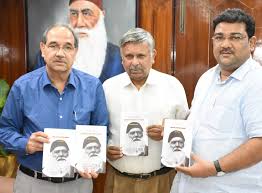
Aligarh Muslim University (AMU) Vice Chancellor, Professor Tariq Mansoor today released the Hindi translation of Sir Syed Ahmad Khan’s ‘Asbab-e-Baghawat-e-Hind’ along with a special reprint of the book in Urdu. The translation has been done by Dr Jasim Mohammad.
The book was released in the presence of Professor Shafey Kidwai (Member-in-Charge, Public Relations Office, AMU).
On the occasion, the Vice Chancellor said that Sir Syed Ahmad Khan took upon himself the challenge of educating the masses by pushing ahead common people towards over all development with the most modern and scientific education. He added that it is imperative that the teachings Sir Syed should reach all corners of world through translations in various languages.
Dr Jasim said that the idea behind the translation of ‘Asbab-e-Baghawat-e-Hind’ is to educate people on how Sir Syed with his nationalistic approach towards problems and controversies prevailing at that time took the unimaginable step of speaking against the British rule.
Dr Jasim has authored 26 books including ‘Sir Syed Ahmad Khan aur Aligarh Movement’, Aligarh Muslim University Minority Character: A Comprehensive Study’ and ‘Urdu Mass Media aur Rabta-e-Aama’. He regularly writes articles and opinion pieces in Hindi, Urdu and English languages for national dailies. Dr Jasim is also a recipient of Bharat Gaurav Samman, Acharya Hasthi Karuna Institutional Award and Rais Uddin Rais Award.
source: http://www.indiaeducationdiary.com / India Education Diary / Home> Academics> Competition> Edu Events> National News / by India Education Diary Bureau / pic: edited – facebook.com/proamuofficial / September 09th, 2017
The evocative recapitulation of eminent personalities provides a quick, candid, exquisite and scrupulous portrayal of those who retain their abiding presence without being physically present in the world.
The unprecedented acceptance of monolingualism has put a big question mark on the existence of numerous languages through which people stitch up a warm social rapport and seek to fulfill their cultural aspirations. India, an awe-inspiring repository of innumerable dialects, languages and different linguistic traditions, finds it nerve-racking to carry through the challenges thrown open by the technology-savvy language-English. The domination of English has taken a heavy toll on regional languages, and Urdu, once considered a significant link language, is no exception. Though Urdu is widely used as a spoken language, and its sensitively rendered poetry gets across the country, its script has been fading away with bewildering speed.
It aches much to realize that the popularity draws its sustenance from its oral rendering, and familiarity with its distinct script has been melting away steadily. Barring some notable exceptions, only faculty members and research scholars associated with various departments of Urdu of the universities and colleges use Urdu as the medium of trifling academic discourse. At a time when Urdu faces the threat of obsolescence, the gleam of hope emerges from the citadel of learning, Aligarh, where academicians not belonging to humanities draw on Urdu to initiate a perceptive discourse on a plethora of issues without bringing rhetorical flourish into play.
Professor Saeeduz Zafar Chagatai (Physics), Professor Faseeh Ahmad Siddiqui (Chemistry), Professor Athar Siddiqui (Zoology), Professor Shaan Mohammad (Political Science), Professor Iftikhar Alam Khan (Museology), Professor Zilur Rehman (Unani Medicine), Professor Mohammad Sajjad( History ), Professor Zafar Mahfooz Nomani (Law) Dr Asad Faisal Farooqui (Mass Communication) and the like seek to strengthen non-fiction prose in Urdu.
Autobiography, memories, diary, letters, sketches and anecdotal scrolls are much-adored genres of non-fiction prose, but in Urdu, they usually betray a strong sense of gushiness and sickening self-adulation. The preponderating narrative of reminisces does not go well with the celebrated author, Professor Athar Siddiqui, whose evocative recapitulation of eminent personalities appeared.
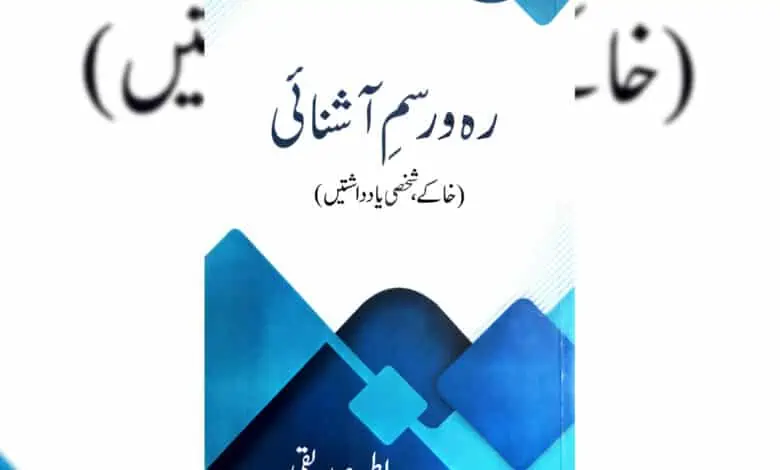
The book Rahe wa Rasm-e-Aashnai (sketches and personal memoirs) provides a quick, candid, exquisite and scrupulous portrayal of those who retain their abiding presence without being physically present in the world.
Professor Athar Siddiqui, a widely recognized scientist, has produced a captivating narrative of his eventful life, Main Keya Meri Hayat kaya, with disarming humility and jotted down travelogues vividly calling attention to down reaching human experiences that frequent foreign travels produce. Interactive media frequently carry intriguing stories featuring commonplace occurrences. The stories with a strong sense of moral tutoring dished out by the digital world need to be shared with non technology conversant Urdu knowing people.
He left Professor Athar Siddiqui to supplement what had been missing and started translating these pulsating stories into Urdu. It was left to Professor Athar Siddiqui to supplement what had been missing, and he translated these pulsating stories into Urdu.
Tahzibul Aklaqh, a prestigious periodical launched by Sir Syed in 1870, started serializing it with a suggestive title Hairat Sarai Ki Kahaniyan (The stories of wonderland), and two volumes of these laconic and absorbing stories have appeared so far.
He meticulously edited two autobiographies of two illustrious alums of Aligarh Muslim University–Dr. Sheikh Mohammad Abdullah (founder of women’s college, AMU) and Nawab Ahmad Saeed Khan Chattari ( former Governor of Uttar Pradesh). He had astutely done over translating books on Shaheryar and Musa Raza.
Athar Siddiqui’s recently published book, Rah-o-Rasam-e – Aashnai,” creatively maps out the accessible and unchartered terrains of thirty-five personalities in candour-driven idiom, and he hardly holds with the popular notion that put a lock on showing the slightest discourtesy to the deceased. The author asserts, “It is widely mentioned that the sketch writer must not use any indecent or improper word for those resting in the peace. If this sort of exhortation is adhered to, then the sketch, personal article and memories will be read as appreciation and admiration-filled text. If history writing sticks to this principle, then the authentic history of any period could not be produced. I do not buy this argument.”
The subtle wised-up mélange focuses on nine creative writers such as Shahryar, Iqbal Matin, Sajida Zaidi, Qazi Abdus Sattar, Professor Mukhtar Uddin Arzoo, Syed Hamid, Lateefuz Zaman and a couple of close relatives, teachers, friends and former vice-chancellors.
Iqbal Matin, whose awe-inspiring artistic sensibility could not get him the recognition across the country he fully deserved, has come in for a refined exploration. Athar Siddiqui’s reminiscence is peppered with unusual but fascinating details about the author. The author living in Aligarh tried desperately to contact Iqbal Matin (Hyderabad) when the letter was the preferred communication medium. He realized that his letters were not delivered to the addressee, who was prone to change houses. Iqbal changed thirty-five houses and bore testimony to his nomadic lifestyle.
Much has been written on Jnanpith awardee and prominent poet Shahryar but a comprehensive and insightful article highlighting his distinctive personal traits and oeuvre is still looked-for. The piece titled “Shahryar as a man and poet” fills the bill with remarkable ease. Athar saheb cites many instances to prove Shahryar’s unflinching loyalty to his friends but never spitting upon the rivals. The voice of modernism with strong traces of neoclassicism, Shahryar never nurtured animosity and did whatever he could for those who looked up to him in their hours of peril. People, even authors and pushover critics tend to read creative texts in the backdrop of personal details; hence when Shahryar suffering from a terminal illness- cancer–composed a couplet; Aasman ab kuch nahi tere karney ke liye/Ham ne sab taiyaariyan karli hain marne ke liye (O sky, now you have nothing to do/I have completed all the preparations for dying) it was considered as the affirmation of impending death. Employing critical acuity, Athar saheb mentioned that the couplet has nothing to do with a nagging sense of personal extinction; the poet laments how we perfected the art of self-destruction reflected in the depletion of Ozone layer manufacturing of weapons of mass destruction.
Athar Siddiqui wrote an immensely readable sketch of Qazi Abdus Sattar, a much overrated and pretentious writer who always took pride in using ornate and florid language in his fiction. His novel Tamam Sultan has been described as magnum opus, but it is hardly more than an oft-repeated titillating story of unrequited love. Athar Saheb and Qazi have had close ties for over fifty years, but Qazi was so intemperate that he pulled ties into pieces as Athar could not attend his facilitation function. It was an act of civility to describe this narcissism as uniqueness of personality.
Prof Zilur Rehman, a widely- respected academician of Unani medicine, is a well-known scholar of Urdu, Persian and Arabic and has more than fifty books to his credit. His books, especially on Ibne Sina, Hakim Ajmal Khan, Sir Ross Masood, Hakim Ehshanullah Khan, and Hakim Abdul Moid, got widespread admiration. In addition to discussing his well-documented and invigorating writings, Athar Siddiqui effortlessly unravels his amenable nature and inimitable passion for books and artefacts. He has a collection of over 70,000 and set up a museum and library, Ibne Sina Academy, which has its website.
Seldom does one attempt to spell out what essentially embodies his wife, going beyond the adulation and berating with a sense of objectivity. This nagging edginess seems to have no bearing on Athar saheb, who painted a stirring wordy portrayal of his wife Zakia Siddiqui, a renowned academician and former principal of Women’s College, Aligarh Muslim University.
One tends to agree with the author when he asserts that during the first ten years wife is treated as the beloved; with the birth of children, she takes over the role of the mother. If harmonious marital life continues, she becomes an inseparable friend who hardly gets perturbed, no matter how annoying one becomes. It is all momentary, and the bond of affinity never weakens.
Athar saheb also evocatively narrated his mother’s life story, and he recollects his memories and anecdotes to document her extraordinary considerate nature. Suhail (son) and Taab (daughter) get pat on the head by the caring and unerring father for their abiding sympathy for others.
The book turns attention to a dozen vice-chancellors and pro-vice-chancellors of AMU, such as Dr Zakir Hussain, Bashir Hussain Zaidi, Badruddin Tyabji, Abdul Aleem, Ali Mohammad Khusro, Syed Hamid, Syed Hashim Ali, Wasiur Rehman, Naseem Farooqui, Mahmoodur Rehman, Hamid Ansari and Abul Hasan Siddiqui.
The author’s appraisal of them looks convincing, but occasionally subjectivity surfaces. The assortment of sketches offers a discerning peep into the life of all who impressed the author. The nuanced and readable prose is used impeccably, and Athar Siddiqui deserves accolades for producing such picturesque vignettes.
Shafey Kidwai is an Indian academic, communication scientist, translator, columnist, and author. He is the chairman of the Department of Mass Communications at Aligarh Muslim University.
source: http://www.siasat.com / The Siasat Daily / Home> Featured News / by Shafey Kidwai / September 26th, 2025
Despite the unprecedented popularity of J.K. Rowling’s fantasy novel series, “Harry Potter’ and Jeffry Kinney’s Wimpy Kid series, it is widely believed that the book faces an existential crisis as the dazzling visual culture will soon make it archaic.
The readership of books on different themes in various genres has stagnated. However, contrary to this, young adult literature seems to be a thing of feathers as it judiciously juxtaposes the elemental art of storytelling with poetic sensibilities. If it is short stories or novels, one can find easy-to-understand text structures, different focalizations and multiple narrators with strong moral bearings. In the era of book decline culture, the popularity of children’s literature in verse and prose goes beyond geographical boundaries and language barriers.
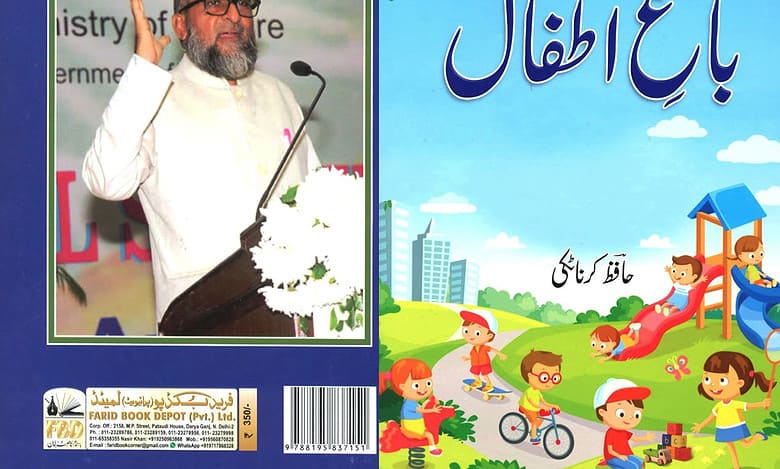
It is heartening to note that the celebrated Urdu poet Hafiz Karnataki has provided the “sweet spot” to Urdu publishing. It did not happen in the famous centres of Urdu literature and culture –Delhi, Lucknow, Hyderabad, Patna and the like; this remarkable feat was achieved by a poet who lives in Karnataka. Recently his hundredth book, Baagh e-Atfal (The Garden of Children), was launched in the presence of eminent Urdu authors and poets, including Khaleel Mamoon, Professor Irtiza Kareem, Professor Ejaz Ali Arshad, Dr Shaista Yusuf, Dr Dabeer Ahmad, Dr Abdullah Imtiyaz, and many others during a three-day national conference on children literature held in Shikaripur, Karnataka.
Hafiz Karnatki, a recipient of the prestigious Sahitya academy award for children’s literature(Urdu ), is an accomplished poet who uses various verse genres such as Ghazal, Rubaiyee, Masnavi, Nazam and others with equal ease. His evocative and multi-sensory verses covering a plethora of themes indicate the ever-increasing range of creative dexterity. He meticulously rendered the life history of the Prophet in verse for children. He made it a point to explain the moral and ethical contribution of the Prophet to humanity. Perhaps he is the first Urdu poet who blazed a new trail in Urdu’s age-long tradition of hagiography by composing it in verse fully alive to children’s cognitive level and expectations. His two books, Hamare Nabi and Zikre Nabi, impeccably summarise the life and teachings of the Prophet.
Hafiz Karnataki is fully committed to fulfilling children’s cultural and literary aspirations and produced nursery rhymes, limericks, short poems and long poems on single topics in a fresh idiom. He gives credit to children for his creative sharpness and cerebral outpourings.” I always strive to stitch up a warm and ceaseless dialogue with young minds, keeping me fresh and mentally alert. Their appreciation and feedback unfailingly hone my writing. As long as this conversation is continued, my literary pursuits bear more fruits,” Hafiz unassumingly asserts.
At the insistence of his young admirers and living up to their expectations, a teacher turned poet Hafiz Karnatki, who has written forty-six books in prose and sixty in verse, started composing much – admired genre of Urdu poetry, Ghazal for children. He compiled six collections of ghazals titled Massod Ghazlen, Nanhi Munni Ghazlen, Bachoon ki Ghazleyen, Ghazal Saaz, Shaane ghazal, and Jan e Ghazal. The poet went further ahead and started meticulously setting ghazals to the tunes and Raags cherished by the children by using Urdu prosody. His verses drawing sustenance from religion, traditions, convictions, cultural, literary and linguistic sensibilities got tremendous applause, and his poems are popular on social media. His latest collection of exclusive poems praising God, Allaho Ahad, has just hit the stand. His hundredth book, Baagh-e-Atfal, carries more than one hundred succinct and didactic poems, zeroes on the topics that directly impact day-to-day life. A distinct tilt towards universal human values and moral framework binds through poems that poignantly harp on different themes. It looks incredible that a person fully trained in traditional knowledge and a scholar of oriental learning has a penchant for new technology. New information technology is an empowering tool that opens its door to all and ushers in a new era of equality. The Internet has subverted the concept of entitled and privileged living, and now everyone is equal as far as the use of technology is concerned. The collection is replete with poems on the tools that shape our lives. Google, Facebook, Twitter, Instagram and others surface repeatedly. Spelling out how Instagram lends a helping hand to its users, Hafiz saheb says, “Tehzeeb bhi yahan hain tammadun ke saath saath/ har shai yahan milegi Tawaazun ke saath saath (One can find culture and civilization simultaneously here/Everything is available here proportionately). Why Twitter has become the handiest medium, Hafiz poetically reasons out, “Jo baat Dil mein na rakh sakho bol do yahan /aik aik kar ke greyhen khol do yahan (pour out whatever you can not keep it to yourself/ Untie the knots one by one here).
The latest collection of the remarkably prolific poet Hafiz Karnatki is braced for making an invaluable contribution to children’s literature, and his efforts deserve accolades from all quarters
Shafey Kidwai, a prominent bilingual critic, is a professor of Mass Communication at AMU, Aligarh
source: http://www.siasat.com / The Siasat Daily / Home> Featured News / by Shafey Kidwai / March 23rd, 2023
Aligarh Muslim University has given the town itself a facelift. Many luminaries have graced the halls of AMU, and it remains an oasis of learning amid uncertainties and controversies that surround the old town
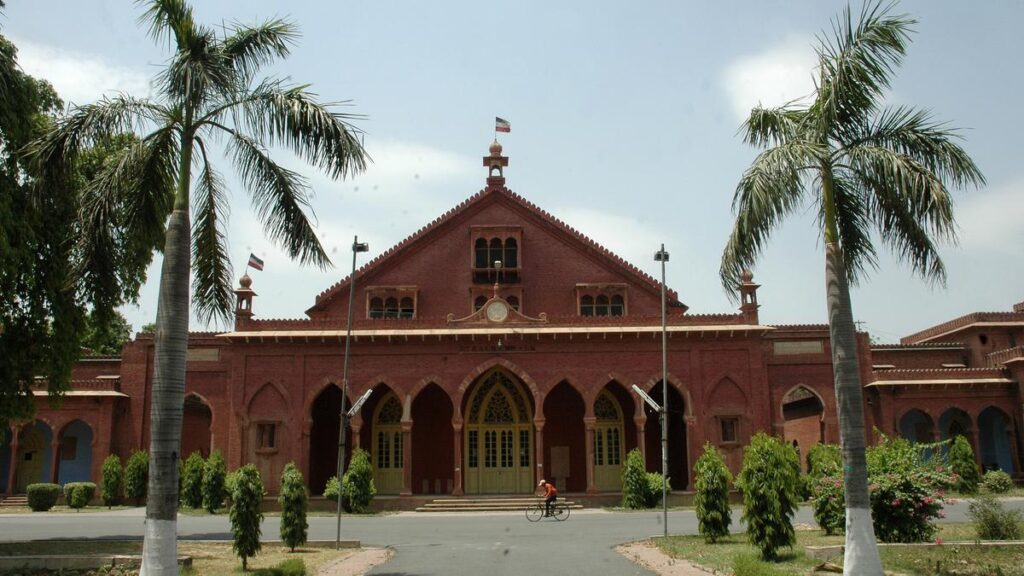
A view of the Aligarh Muslim University Campus | Photo Credit: Sandeep Saxena
There is something about Aligarh that tells us that the past never dies. It merely reinvents itself to suit contemporary demands. Back in 1937, Mohammed Ali Jinnah, soon to transform into Quaid-e-Azam, took the route with a rare flourish. Recalling the Muslim League session in Lucknow in 1937, author-journalist Mohammed Wajihuddin writes in his persuasively argued, lucidly expressed book, Aligarh Muslim University, “The October 1937 Lucknow session was so important to Jinnah that he discarded his well-cut suits and donned flowing trousers and a long coat. From Mr. Jinnah, he transformed into Janab Jinnah and Quaid-e-Azam. While he had kept himself aloof from ordinary Muslims, now he began mingling with them….He travelled extensively, and Aligarh became a regular place to visit during these travels.” Around the same time, he raised the rhetorical slogan of ‘Islam in danger’ too.
Passing storm(s)
The following year when Jinnah visited AMU, which had begun as the Mohammedan Anglo-Oriental College in 1875, he was given a rousing welcome. The students’ union made him an honorary life member. “It was a tradition the union had followed since 1920, when Mahatma Gandhi was given this membership. In those days they would also put up a portrait of the guests they honoured on the Union Club’s wall. It was such a portrait of Jinnah’s at the AMU Students’ Union Club that created a storm on the campus on May 2, 2018,” writes Wajihuddin.
The storm, essentially a passing one, was caused by local MP Satish Gautam writing to the Vice Chancellor Tariq Mansoor demanding the removal of Jinnah’s portrait from the campus. The demand was not conceded but it made sure the university was in the spotlight, and as a consequence, Aligarh remained in the headlines for days on end. Like it did when the anti-Citizenship (Amendment) Act protests hit the campus in December 2019. Controversies and Aligarh seem to go together. Yet, AMU, despite frequent protests, occasional violence and various stirs, seems to be an island by itself wherein students seek knowledge, chart out great careers and soak in its culture just as the university’s founder Sir Syed Ahmed Khan, would have advised them. As academic-literary critic Shafey Kidwai, author of Sir Syed Ahmad Khan: Reason, Religion and Nation, said, “The question of his (Jinnah’s) glorification does not arise, but the university’s job is to protect the truth of history. His photo was there as the hall carried the names and photographs of all who visited it. The list incudes Mahatma Gandhi, Dr. B.R. Ambedkar, Maulana Azad and Sarojini Naidu.” Unsurprisingly, Prime Minister Narendra Modi called it ‘mini-India’ in an online address.
The story of a name
AMU has the unique distinction of taking along with it the name of the township where it is based, and giving the town itself a facelift. Otherwise, known for its brassware and lock industries, Aligarh has a chequered past, one that has seen many a nawab, maharaja or local leader make an attempt to leave an indelible impression on the town; the most recent one being an attempt by zila panchayat members to rename the place Harigarh. Vijay Singh, zila panchayat chairman, stated, “It was a long-pending demand to rename Aligarh as Harigarh.” He was probably referring to a similar call given in the late 1970s by members of the Jan Sangh, the precursor of the Bharatiya Janata Party (BJP). At that time, a new temple was also called Harigarh Mandir. Nevertheless, the demand to rename the place died down soon enough.
There is an interesting tale behind the name of Aligarh. It was initially called Kol or Koil. Though obscurity surrounds the origin of Kol, according to Edwin Atkinson, who compiled the first gazetteer of the district, the name Kol was given by Balram who slew the great Asura called Kol over here. Noted medieval India historian, Syed Ali Nadeem Rezavi, explained the genealogy of the place, at the height of the Harigarh controversy, stating, “Sometime before the Muslim invasion, Kol is said to have been held by the Dor Rajputs. Sultanate period sources, both Persian and non-Persian, mention Kol as a centre for the production of distilled wine. The sources of the period of Alauddin Khalji mention this town as Iqta Kol; Iqta was an administrative unit.” It continued to be called Kol during the Mughal age too with Emperor Jahangir calling it Kol in his memoirs.
However, things changed in the 18th century. The Jats captured the fort briefly and called it Ramgarh, quite removed from the earlier nomenclature of Sabitgarh and Muhammadgarh. Then came the Marathas who dubbed the fort as Aligarh after their governor Najaf Ali Khan. By the 19th century, the town itself came to be called Aligarh. Some locals dispute this fact-based assertion, claiming Aligarh is named after Hazrat Ali, the last caliph and son-in-law of Prophet Muhammad.
City of joy
In reality, Aligarh, not Kolkata, was the original City of Joy; it was only in 1985 that Dominique Lapierre called Kolkata the City of Joy. Some 50 years before that, popular Urdu poet Asrar-ul-Haq Majaz had called Aligarh as ‘Shahr-e-Tarab’ or the City of Joy! Moreover, Aligarh, and AMU, whose tarana (anthem) was penned by Majaz, transmits joy.
Here studied Begum Para, the heroine of the first talkie Alam Ara. In her painstakingly researched and elegantly produced book, The Allure of Aligarh, Huma Khalil writes, “The musical leanings of Padma Bhushan winner Talat Mahmood…can be traced back to when he used to sing the works of Ghalib and Mir, at the age of 16 in the school functions of Minto Circle. Award-winning film and theatre actor Naseeruddin Shah is still remembered as the finest badminton player of the university.” Not to forget Anubhav Sinha, Surekha Sikri and Zarina Hashmi. Incidentally, Hashmi brought Aligarh to her canvas. A mathematics graduate from AMU, Hashmi had seen villages burning around Aligarh in 1947 and could never forget her home and relatives who were dispersed in the violence.
If violence was here, could prayers have been far behind? Not quite. Hence, besides its historic mosque where countless students stand in neat rows for prayers, Aligarh has the age-old Khereshwar temple which, Khalil tells us, “is the oldest Shiva temple”. Tansen’s guru, Swami Haridas, lived here and Mughal emperors are said to have come down to the temple “to witness the magic of raga Malhaar”.
The persistence of knowledge
Of course, Aligarh has been a happy host to the annual numaish (exhibition) and for years its students frequented Tasveer Mahal, one of a dozen cinema halls in the city. Tasveer Mahal was more than a cinema. It was like a gateway to the University, a rendezvous point for students in the evening. It’s all gone now. What remains untouched is the determination of the students to learn. As Khalil recounts in her book, “Ilm (knowledge) is the second most used word in the Quran after Allah; Aligarh’s motto captures this ethos, ‘(Allah) taught man what he knew not’.” As youngsters seek to know more and more, Aligarh is like the body and AMU its soul.
source: http://www.thehindu.com / The Hindu / Home> Books / by Zia Us Salam / February 09th, 2023
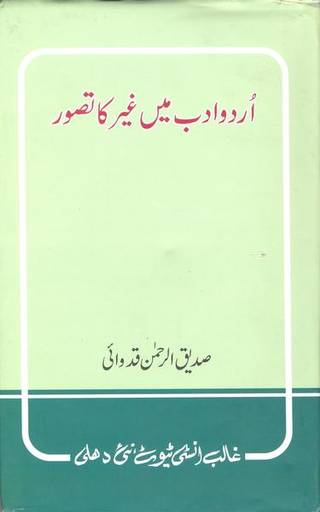
“Urdu Adab Mein Ghair Ka Tasawwur” explores the concept of the other in Urdu literature
The biggest ‘other’ is not the one whose religious beliefs, cultural practices and social convictions and the mode of expression – language – stand poles apart but it is the one who is deeply revered and worshipped and people seek his blessing all the time. It refers to the almighty who remains inaccessible to all those who adore Him. Man cannot reach to Him though he feels His presence everywhere. The multiple and contradictory referents of the term “other” constitute literary texts which set people free from the humdrum of life. These poignant and pithy observations are offered by a widely- acclaimed fiction writer of Urdu, Khalid Javed in his article “Lafz-e-Ghair – Falsafiyana Tanazur Mein” (the Other in Philosophical Perspective) which is carried by an astutely produced anthology, “Urdu Adab Mein Ghair Ka Tasawwur” (The concept of the other in Urdu Literature) published by the Ghalib Institute, New Delhi recently.
The book, carrying 18 articles, presented in an international seminar on the concept of the other and aptly edited by Professor Siddiqur Rehman Kidwai, explains how the much-debated and hatred filled notion of the other is perceived and presented in various genres of Urdu literature. The articles also discuss how this concept is creatively depicted by prominent Urdu authors and poets such as Meer, Ghalib, Daagh, Momin, Manto, Premchand, Qurratulain Hyder, NM Rashid, Meeraji, Akhtarul Iman and Shahryar, etc.
Delineating invisible power
Khalid Javed, whose two novels – “Maut Ki Kitab” and “Naimat Khana” created waves in Urdu literature, asserts that every invisible power is essentially the other, no matter it is God or Devil. Invisible but all-pervasive power conjures up ecstasy and fear simultaneously and it gives birth to “Myth” and “Faith”. According to the ancient Indian philosophy, ‘ego’ is the other as Atma is the essence of existence and Khalid Javed rightly asserts that people completely unaware of their inner self or Atma, take the body, sensory organs and intellect for their existence. When one attains enlightenment, he realises that a marked sense of distance exists between the inner self and its ill-conceived outer manifestations.
Describing the term as the most commonly used tool of political subjugation, Siddiqur Rehman Kidwai points out that the process of othering is conveniently adopted by the people who consider themselves rescuers who assert that they are committed to empowering all those who are at the receiving end.
In his brilliantly structured address, “Formation of the Other – Strategy and Kinds”, noted Urdu critic Qazi Afzal Hussain says that the concept of other portrayed in literature hardly endorses what is being projected by the social scientists.
The collective other created by the power that – be is not acceptable as it unfailingly produces hate literature. In literature, the other is a foil for creativity that refuses to divide men into caste, colour, linguistic and religious categories and in the creative world, political affiliations and ideologies hardly have any significance. Qazi Afzal brilliantly concludes by saying that if a literature does not respect the sensibilities of others , it loses value and it fails to ensure the transcendence of life.
A well- author known fiction writer Zakia Mashadi points out that uneasy co-existence, no matter how old it is, sets in motion the process of subjugation which in the final reckoning perpetuates an intense feeling of impotent rage among people who are being marginalised – unconditional emulations is the most lethal form of othering as it wipes out every trace of self -identity
Dalit novel in Urdu
Can a religious text that espouses the cause of equality can be used as a formidable tool for not granting the right to worship to the subalterns? Yes it is being used for administering severe punishment to those belonging to the downtrodden class and who have been denied and this sums up the poignant narrative produced by a prominent Urdu Novelist Ghazanfar in his novel “Divya Vani” which is perhaps first full-length Dalit novel in Urdu
Lucid writings
Many prominent authors such as Anis Ashfaq, Qazi Jamal, Ziauddin Shakaib, Ali Ahmad Fatimi, Abul Kalam Qasmi, Khalid Qadri, Deepak Budiki, Sarwarul Huda, Mushraff Alam Zauqi, Abubakar Abbad and Javed Danish took pains in delineating various manifestation of the other in easy to understand the idiom.
The articles covering across a huge sweep of the time attempt to understand various shades of vexation of the pain of those whose sufferings remains unheard. It is the book that acquaints the readers with varying and enticing perspectives on the dominant discourse of our times.
source: http://www.thehindu.com / The Hindu / Home> Books> Authors / by Shafey Kidwai / August 17th, 2018
Urdu writer Rahman Abbas on the challenges of being defiant
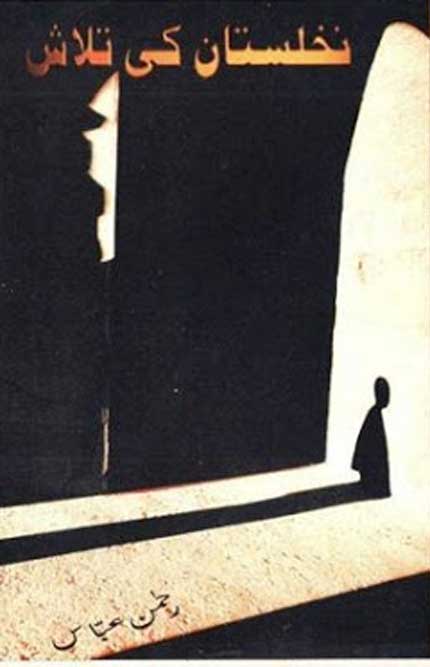
A few paragraphs were all it took for the trouble to start. Thirteen years ago, Urdu writer Rahman Abbas was booked for obscenity for his debut novel Nakhlistan ki Talash, a love story set in Bombay following the 1992-93 riots. The offending two or three paragraphs dealt with love and sex.
It’s been more than 10 years since that particular combination of words got him arrested and two since the case of obscenity was closed. But aside from polishing the rawness of a first novel, he probably wouldn’t change the words.
“I may [take] care about a few words; I will use those words but will try to use them more creatively,” he says, when asked what he would have done in hindsight. “But I don’t think there is any word we should hide. I, for one, cannot.” He continues, “As Manto said, you say ‘breast’ for ‘breast’, you can’t use another word. Or for a ‘chair’ you have to say ‘chair’, you cannot say ‘donkey’.”
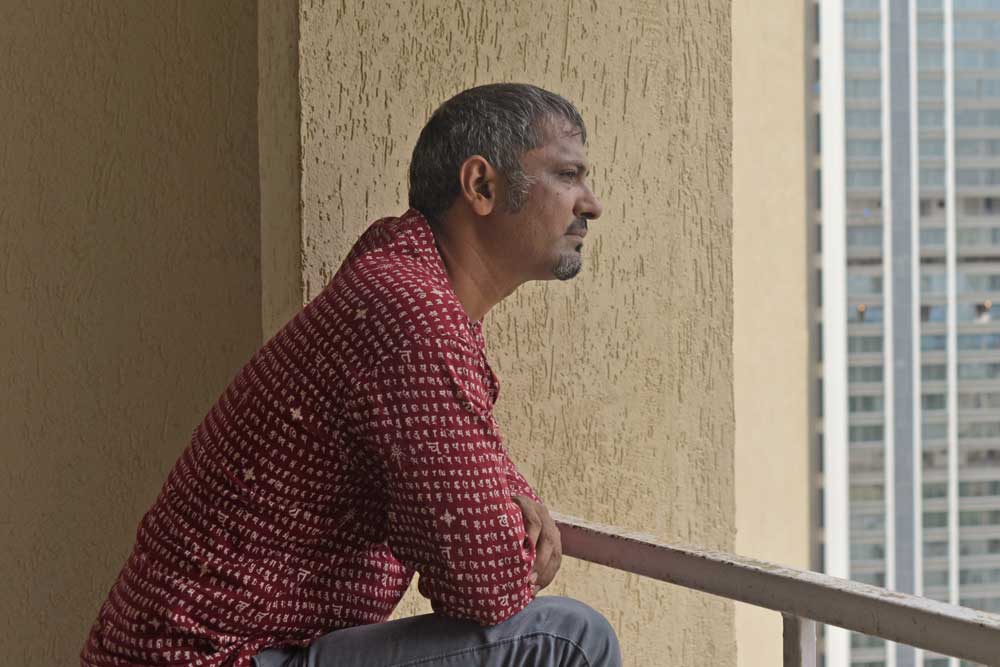
A medium-height man with a soul patch and a disarming frankness, Abbas, 46, is currently translating Nakhlistan into English, and expects it to be published next year. He has just come back from a tour of Germany with the German translation of his fourth and latest novel Rohzin—the first time any of his novels has been translated. Next month, Rohzin’s English translation, by Sabika Abbas Naqvi, is slated for release. Set in Mumbai, the love story opens with the flood of July 2005 and won a state Sahitya Akademi award in 2017.
But to a general audience Abbas, a former teacher, is still perhaps best known as the writer who found himself in the crosshairs of an outdated legal provision: Section 292 of the Indian Penal Code that punishes obscenity in writing and art.
“I don’t regret what happened,” he says. “These are the challenges you have to face as a writer or creative person. If your society is orthodox, it is your duty to challenge the orthodoxy.”
And that is precisely what he plans to do. Since the police case that changed his life, Abbas has left the teaching profession, won and returned a Sahitya Akademi award, won and retained a Sahitya Akademi award, and is in the incipient stages of launching a broader campaign against Section 292. That section, among others, has for years been a part of the restrictive free speech architecture that bedevils Indian writers and artists.
“There is freedom for people to protest against a book, to dislike a book. I respect that freedom. If I have the freedom to write, people have the freedom to criticise,” says Abbas, who won his first state Sahitya Akademi award for his third novel, Ek Mamnua Mohabbat ki Kahani . “But a [legal] provision that gives people an opportunity to send a writer to jail, that should be stopped.” He adds, “For a democracy, this is crucial.”
The first step, Abbas believes, is to galvanise public opinion through writing and advocacy against Section 292 in particular. A public interest litigation (PIL) opposing the use of this provision against writers and artists is already in the works.
Abbas is also busy working on a fresh piece of Urdu fiction, his first literary effort since the case against him was closed in 2016, liberating him in several ways. “For my next novel, I will try to explore the things I couldn’t explore in my previous three novels,” he says. “Since the case has ended, I feel I am free to write.”
Abbas denies the impact that fame— or infamy—can have on the reception of a work. “I think if you aren’t a good writer, it will not help,” he says. “Nothing can help.” He names Sadat Hasan Manto and Ismat Chughtai as illustrious Urdu predecessors who were prosecuted (though ultimately unsuccessfully) under the same law he was. Then he chuckles: “There is no single example of bad writers having any problem.”
Good or bad, Indian filmmakers and artists have consistently faced oppressive free speech laws, whether through criminal prosecution, government bans or threats from conservative factions.
In 2016, various groups protested against Tamil writer Perumal Murugan’s One Part Woman and sought a ban on it. In 2015, Jharkhand-based writer Hansda Sowvendra Shekhar’s The Adivasi Will Not Dance was banned by the state government on allegations of having violated Section 292, among others. Earlier this month, the Supreme Court dismissed a plea seeking a ban on the Malayalam novel Meesha. To Abbas, this is part of a wider pattern. “English writers enjoy more freedom than us. I don’t know why. Alice Walker’s novel was in our syllabus and used those same words that I did and went to jail for,” he says. “On the one hand, the Government makes you read a book; on the other hand, if you use the same word in your text, you are a criminal.”
Though he was let off without a trial—the complainant told the court she had misunderstood the offending passages and the case was closed—Abbas spent one night under arrest in Arthur Road jail until his lawyer was able to complete the bail formalities. “It was quite a humiliating process,” he says, its memory still fresh more than a decade later. “When you go to jail, you feel your whole freedom is gone, that you will never get out of there.”
The experience was both debilitating and transformative. “I remembered Manto and wrote about how I felt the pain of Manto,” says Abbas, a touch dramatically. “If you are a writer or journalist and you experience jail, you understand the importance of freedom. I had it when I was writing; when it is stopped, you realise the importance of maintaining it. It’s not only your struggle, but a struggle of humanity.”
Though he lost his job, was pilloried at the time by the Urdu media, and still faces the censure of conservative Muslims, he now has more enthusiastic readers, he believes. “Now my writing has been accepted in a big way. Urdu readers are not that narrow minded,” he says. “They are openly reading and I am happy when young people appreciate the work which the previous generation had condemned.”
Abbas taught at a Muslim institution for several years and was also the principal of one. He later decided to leave academia and joined a think-tank fulltime in 2012. “If you are liberal Hindu, you won’t work in an RSS shakha,” he says of leaving that minority institution. “It is very conservative. Through education, they want to promote their religious ideas. I believe education should be 100 per cent secular; there shouldn’t be any discussion on religion. But now both communities are insisting on preaching religion and morality, and that is antieducation, anti-scientific temper.”
In 2015, Abbas joined the awards return protests initiated by authors disturbed by the silence of institutions and the apathy of the Government to violence against free thinkers. Like many writers and intellectuals, he too is concerned about what he perceives as the shrinking space for dissent in the country and the rise of divisive politics. “The right-wing is gaining. And only because it is doing the same ugly, dirty propaganda and dividing people in the name of religion,” he says. “There is a feeling that Dalits, Muslims, Christians, Adivasis can be targeted. Yes, there is a fear. And people should speak up.”
source: http://www.openthemagazine.com / Open / Home> Salon > Web Exclusive: Books / by Bhavya Dore / September 21st, 2018