NEW DELHI :
It is a great privilege for me to accept this honour from the Shah Waliullah Institute. Honestly, I was reluctant at first and had declined this recognition multiple times.
New Delhi :
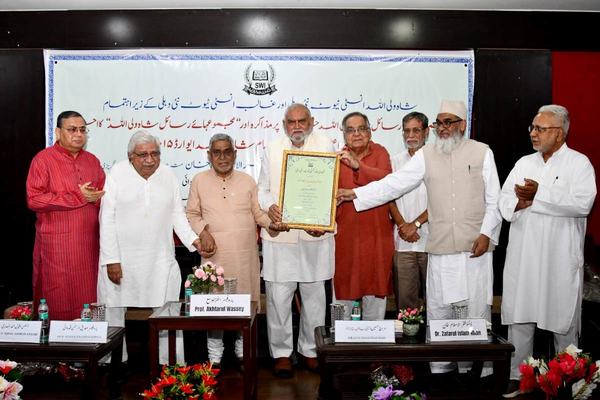
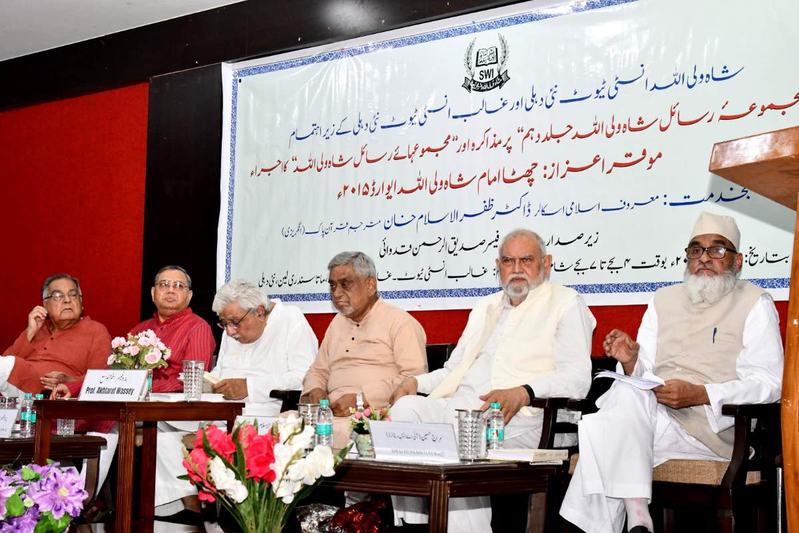
In a momentous event, renowned Islamic scholar, author, senior journalist, and former Chairman of the Delhi Minorities Commission, Dr. Zafarul-Islam Khan, was awarded the prestigious Sixth Imam Shah Waliullah Award here on Monday. The ceremony took place amidst a distinguished seminar on the theme of ‘Epistles of Shah Waliullah’ at the Ghalib Institute here.
Jointly organized by the Shah Waliullah Institute and the Ghalib Institute, the seminar sought to celebrate and highlight the scholarly and intellectual legacy of Imam Shah Waliullah. A special highlight of the event was the launch of the tenth volume of his acclaimed series of epistles, offering attendees an intimate glimpse into his teachings and enduring contributions to Islamic sciences.
A diverse assembly of eminent scholars, intellectuals, and thinkers from across the country participated in the event, engaging in profound discussions about the contemporary relevance of Shah Waliullah’s message, writings and teachings.
Senior journalist Suhail Anjum introduced the Shah Waliullah Institute and provided an overview of the newly launched the tenth volume of Shah Waliullah’s epistles, sharing insights into the publication process, ongoing scholarly discussions and past and future programmes of the Shah Waliullah Institute.
Anjum also felicitated Mufti Ataur Rahman Qasmi highlighting his unwavering dedication to research and publish the scholarly legacy of Shah Waliullah. He highlighted Mufti Saheb’s long-standing scholarly pursuits, first as a teacher for fourteen years at the Dargah Shah Waliullah madrasah near Shah Waliullah’s shrine in Delhi’s Mehdiyan area.
During this period, Mufti Saheb developed a deep spiritual and intellectual bond with the great scholar, gaining profound insights into his contributions to Quranic sciences and other fields. Inspired by this connection, Mufti Saheb established the institute to make Shah Waliullah’s invaluable legacy accessible to all. Some of these writings were published long ago or still lie as manuscripts in libraries. Under this initiative, Mufti saheb has already published ten volumes of Shah Waliullah’s writings. The tenth volume of this series was released during the event.
Expressing humility and honour, Dr Zafarul-Islam Khan said, “It is a great privilege for me to accept this honour from the Shah Waliullah Institute. Honestly, I was reluctant at first and had declined this recognition multiple times. However, I succumbed in the face of Mufti saheb’s insistence for a number of reasons. Paramount among these is my nearly forty-year-long association with Mufti Saheb, dating back to 1984 when I returned from abroad.
At that time I visited Mehdiyan and made a spiritual bond with Shah Waliullah and with Mufti saheb who at the time taught at the madrasah there. He said that another reason is that this award is associated with Shah Waliullah, the greatest Islamic scholar produced by India. In fact, he may be regarded as the greatest non-Arab Islamic scholar of all ages. He said that long ago he wrote a modest book in Arabic on Shah Waliullah trying to attract people’s attention to the ocean of knowledge which he was and remains till this day. He said that Shah Waliullah’s monumental work Hujjatullah al-Balighah stands out as an unparalleled masterpiece in the Islamic literature. It is printed, reprinted and studied in the Arab World till this day. Dr. Khan underscored the importance of Hujjatullah al-Balighah as a treasure trove that provides a deep, balanced and comprehensive understanding of Islamic sciences.
Dr Khan commended Mufti Saheb’s tireless efforts in unearthing and publishing many of Shah Waliullah’s manuscripts and texts that were hidden and forgotten. The current tenth volume stands as a testament to this scholarly dedication. He stated that his personal and scholarly bonds with Mufti Saheb and Shah Waliullah motivated him to accept this award. He added that there is a third reason for accepting the award and that is the fact that the award is given in recognition of the Glorious Quran, his translation of the Islamic holy text which tries to offer an authentic version of the Quran based on most authentic Arabic sources.
Dr Khan said there is a great responsibility on our shoulders: to try to understand and disseminate Shah Waliullah’s teachings and present them in modern language and style. Reflecting on Shah Waliullah’s revolutionary impact, Dr. Khan highlighted his translation of the Quran into Persian—a daring act at the time, which many scholars at the time considered a blasphemy. Even today, some argue that the Quran cannot be translated into any language. But if that was true, how would the 85% of Muslims outside the Arab world understand the divine message? Therefore, it is imperative that the Quran be translated into all languages—be it Assamese, Burmese, Chinese, or any other so that the common Muslim and non-Muslim could read and understand Allah’s last message to humanity. He pointed out that Western scholars, despite their scholarly rigour, often distorted the meanings of the Quran in their translations. Therefore, it is the duty of Islamic scholars to offer correct and accurate rendering of the divine text. Dr. Khan said he dedicated eleven years to accomplish his translation of the holy Islamic text. He said he fully devoted the three years during the COVID19 pandemic to complete this work. He regarded the award as a motivation to himself and all scholars to continue scholarly pursuits.
Mufti Ataur Rahman, chairman of the Shah Waliullah Institute, addressed the gathering sharing insights into how the idea of an institute dedicated to Shah Waliullah was conceived and narrated the journey since founding the institute. He took a moment to acknowledge the previous recipients of the Shah Waliullah Award: the first was given to Maulana Abdul Karim Parekh from Nagpur in 2007; the second and third to Maulana Akhlaq Hussain Qasmi and Maulana Faqihud-Din in 2010; the fourth to Maulana Muhammad Salim Qasmi in 2013; and the fifth to Maulana Qamaruz-Zaman Ilahabadi in 2014.
The event was enriched by the presence of distinguished speakers including Muhammad Adeeb, former Member of Parliament, Mr. Siraj Hussain, former vice chancellor of Jamia Hamdard, Justice Iqbal Ahmad Ansari, former Chief Justice of Patna High Court, Prof. Khalid Mahmood and Khwaja Muhammad Shahid among others.
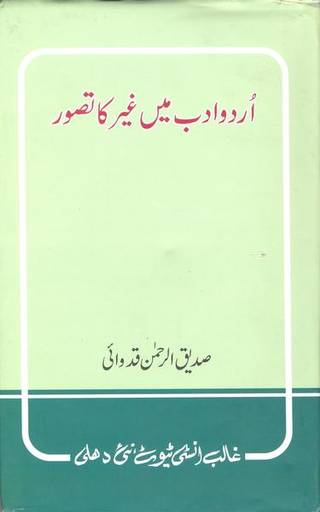
The proceedings were presided over by the chairman of the Ghalib Institute Prof. Siddiqur Rahman Kidwai who lauded Mufti Ataur-Rahman’s exemplary work and extended warm felicitations to Dr. Zafarul-Islam Khan for his well-earned recognition.
source: http://www.milligazette.com / The Milli Gazette / Home> News> Community News / by Zillur-Rahman Haider / June 30th, 2026