Tag Archives: Taj Mahal

How Taj Mahal and Aligarh’s Jama Masjid – Built 250 Years Apart – Share a Calligrapher

Agra / Aligarh, UTTAR PRADESH :

The imposing walls of both the Taj Mahal and Aligarh Muslim University’s Jama Masjid have Quranic verses crafted onto white marbles in black paint.
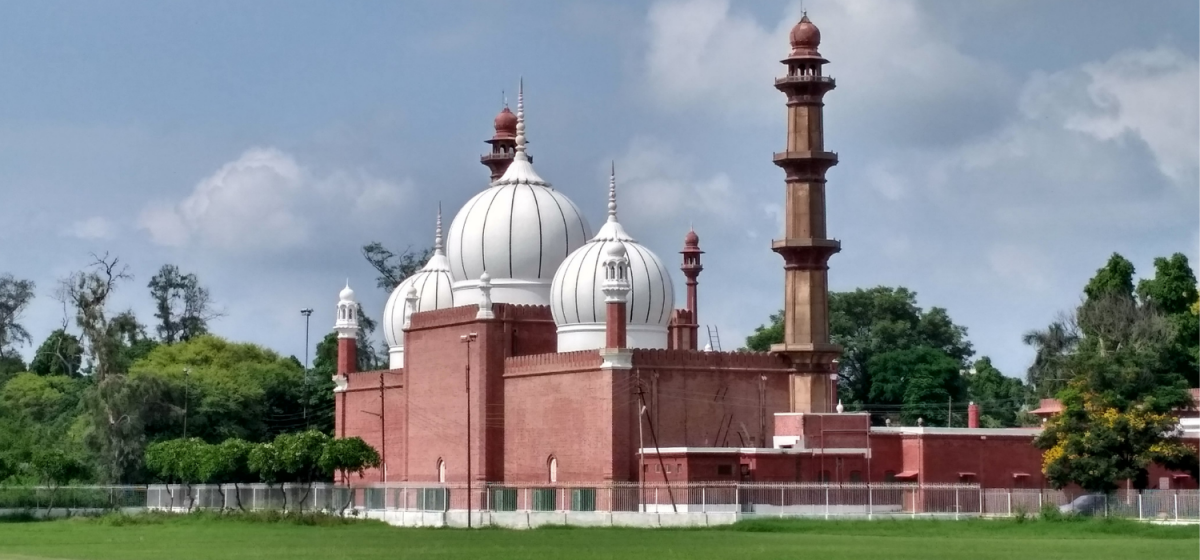
Jama Masjid on Aligarh Muslim University campus. Photo: Author provided.

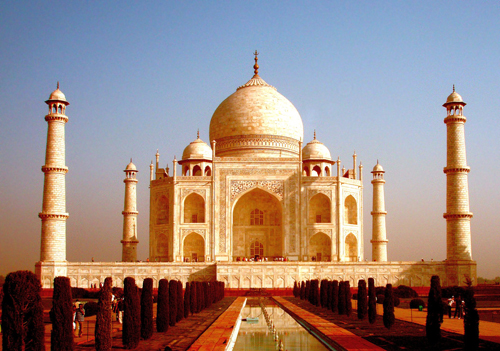
Constructed nearly 250 years apart, the Taj Mahal in Agra and Jama Masjid at the Aligarh Muslim University (AMU) have an interesting connection.

The construction of the Taj Mahal began in 1632 and was completed in 1653, while the construction of Jama Masjid at AMU began in 1879 and was completed in 1915.

While the Taj Mahal, which is the tomb of Mughal emperor Shahjahan and his wife Mumtaz Mahal, attracts millions of visitors every year, AMU’s Jama Masjid is the main mosque of the university. AMU’s Jama Masjid is, perhaps, the last enduring symbol of the Mughals, constructed when the Mughals lost their kingdom during British rule.

A surprising connection

As one enters the Taj Mahal, beautiful calligraphy adorns all four corners. Several verses from the Holy Quran crafted in black calligraphy on white marble can be seen. This is a unique form of calligraphy, and expert artisans from Persia were involved in creating it. Similar calligraphy can be seem inscribed at the tomb of Mughal King Akbar at Sikandra, Agra, and also at the AMU Jama Masjid.
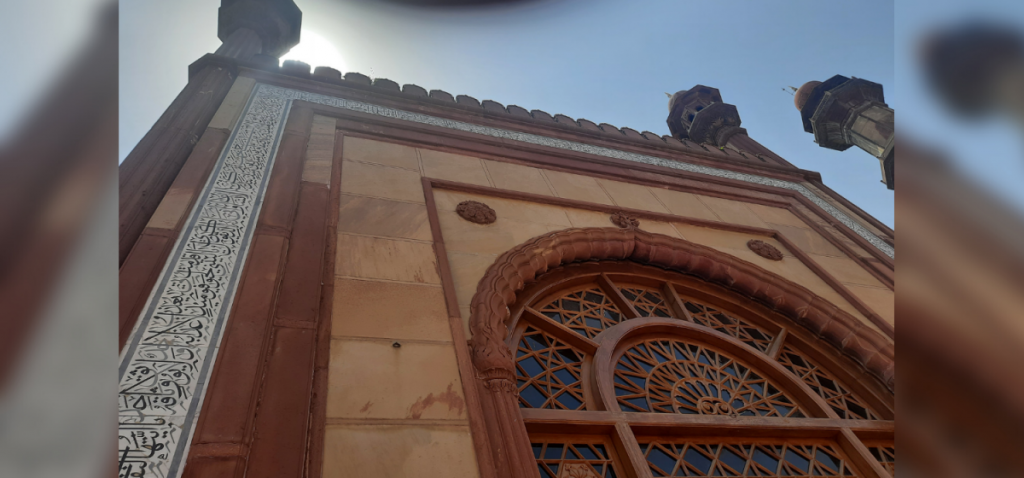
A closer look at the white marble with Quranic verses in black colour adorning the walls of Jama Masjid in Aligarh Muslim University. Photo: Special arrangement.

In fact, it is believed that the artisan responsible for the calligraphy at the Taj Mahal also brought his expertise to AMU’s Jama Masjid.

Since there is a difference of nearly 250 years between the construction of both architectural wonders, it is interesting to study how this was possible.

During Shah Jahan’s regime, several buildings were constructed, including the Taj Mahal and Delhi’s historic Jama Masjid. The calligraphist used was the same.

Professor Nadeem Ali Rezavi of the Centre of Advanced Studies, Department of History, Aligarh Muslim University, says that the master calligraphist in most of the buildings constructed during Shah Jahan’s regime is the same person.

“His name was Abdul Haq, and later due to his craftsmanship, his rank was elevated. He was given the title of Amanat Khan. In fact, he even signed the bands on this calligraphy with dates,” says Rezavi.

Still, there is a gap of over two centuries between these two buildings, Taj Mahal and AMU’s Jama Masjid.

The connection between the two monuments becomes clear with the involvement of Akbarabadi, one of Shah Jahan’s queens. Her original name was Aiza-un-Nisa. She, in 1650, commissioned the construction of a mosque situated in Daryaganj, Delhi, during the same period. In that mosque, Quranic calligraphy was done by the same artisan in black paint on white marble. This was around the same time as when the Taj Mahal was built.

After nearly two centuries, the Daryaganj mosque was demolished by the Britishers following the 1857 revolt. This was when Britishers gained control over the Red Fort, and the last Mughal emperor Bahadur Shah Zafar was sent in exile to Rangoon. They destroyed many buildings which were supposed to have harboured the rebels. At the site of the destroyed Akbarabadi Mosque, a park was developed and came to be known as Edward Park in 1911, which is now called Subhash Park.

During the same period, Sir Syed Ahmed Khan, the founder of the Mohammadan Anglo Oriental College (which later became AMU) felt the oppression against Muslims after the revolt. He nurtured the idea of setting up an educational institution to try and uplift the community.

A visionary man, Sir Syed had the taste for collecting things, particularly artefacts which had archaeological and historical importance. He was aware of the demolition of the Akbarabadi Mosque in Delhi.

As per the AMU Gazette, the scraps generated at the demolished Akbarabadi mosque were sold to a dealer and later purchased by Sahabzada Suleman Jah Bahadur. These remains were thus sold after over 200 years. These were presented to Sir Syed Ahmed Khan, who planned to use them in the Jama Masjid of the educational institution.
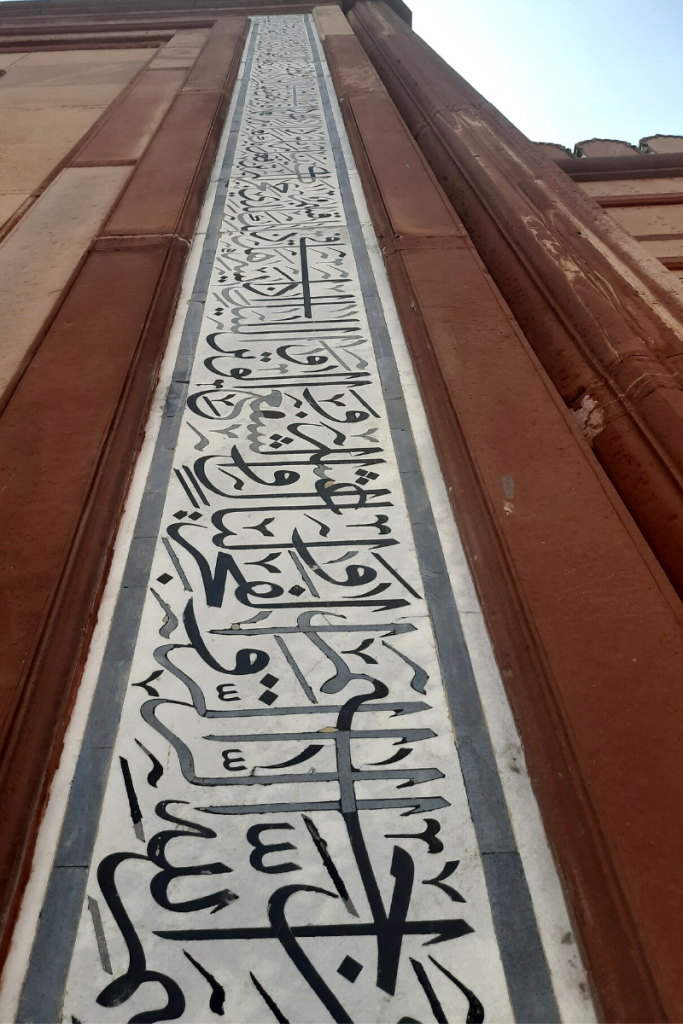
A closer look at the white marble with Quranic verses in black colour adorning the walls of Jama Masjid in Aligarh Muslim University. Photo: Special arrangement.

The white marbles with black calligraphy now present in the Jama Masjid of AMU depict Surah Fajr from the Holy Quran. Thus centuries apart, the two buildings carry the work of the same artisan.

“Even if you compare, it is the same thing and the only difference is in the scale. The artisans are the same who have shown their skills in the construction of the Taj Mahal,” says Prof. Rezavi.

Thus AMU’s Jama Masjid is, perhaps, the last enduring symbol of the Mughals, constructed when the Mughals lost their kingdom during the British rule. On the other hand, the domes of AMU’s Jama Masjid employed techniques of the Mughal era: they are “true domes” as they were built using lime mortar and vousseurs (wedge cornered stones/bricks).

“It is a brick structure, guava-shaped, carrying white marble with black stripes. This is the last true dome. After this, the particular technology faded out, and the buildings constructed after them have concrete domes,” said Rezavi.

Later, in 2016, AMU authorities began the conservation of the Jama Masjid. Now revived at the cost of Rs 90 lakh, the Jama Masjid has a Hauz in the courtyard, three domes, seven arches and two lofty minarets cornered by a Cricket Pavilion at its rear end. Sir Syed, the founder of the institution, was also buried in the same compound.

Faisal Fareed is a senior Lucknow-based journalist. 

This article went live on June fifth, two thousand twenty one, at zero minutes past seven in the morning.

source: http://www.thewire.in / The Wire / Home> History / by Faisal Fareed / June 05th, 2021
The actual Taj story: how a monument’s history has been warped

Agra, UTTAR PRADESH :

Tushar Goel’s film, ‘The Taj Story’, has reignited controversy over the Taj Mahal’s origins, claiming it is a Hindu temple rather than a mausoleum built by Mughal emperor Shah Jahan. The film’s debut highlights debates about the interplay of history and ideology in contemporary India.

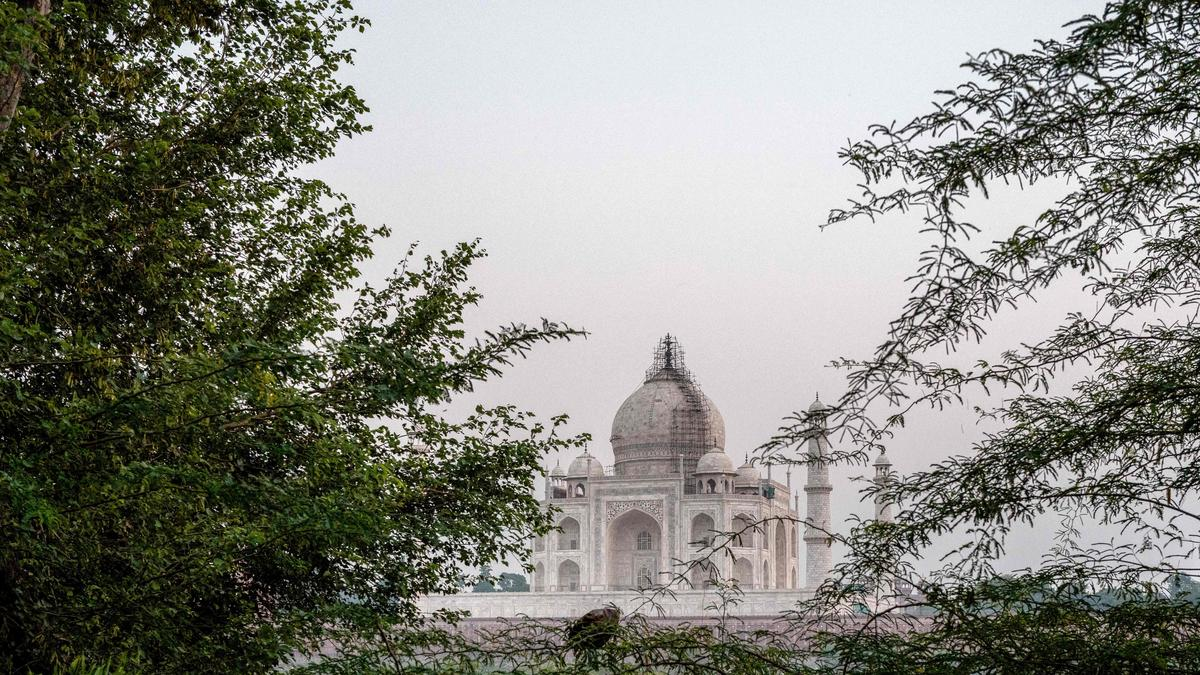
Scaffoldings are pictured as restoration work goes on at the dome of the Taj Mahal in Agra on October 17. | Photo Credit: AFP

A little over 60 years ago, Purushottam Nagesh Oak slept and dreamt. He woke up and claimed that the Taj Mahal in Agra was actually a Hindu palace going back all the way to 4th century. Friends of Mr. Oak, an English teacher-turned-lawyer-turned-journalist but never a historian, told him that the Taj Mahal couldn’t have been a fourth century structure as the technology employed in building the Taj in the 17th century didn’t exist back then. The fantasist turned a pragmatist, and Oak brought his argument forward by a few centuries. The Taj was now claimed to be a Hindu temple. This was in 1989. He wrote articles and a book too, but found no support from historians. Even the Supreme Court dismissed his claims as “a bee in his bonnet” in 2000.

But post-2014, history is like a revolving door, you enter and exit at your ease and pleasure. You pick and choose, you circumvent and invent. Dress it up as a movie and claim you are looking at history anew. That is how we get a movie like Tushar Amrish Goel’s The Taj Story, starring former BJP MP Paresh Rawal; just like we had The Kashmir Files and The Bengal Files, starring Anupam Kher and Mithun Chakraborty, all ideological partners of the Bharatiya Janata Party (BJP).

With The Taj Story, Goel goes where no historian has gone. Proof, evidence and knowledge amount for nothing as the director makes a case for the Mughal monument being actually a Hindu temple, much like the BJP leader Sangeet Som who called it alternately a Shiva temple and a monument built by a man who incarcerated his father. Mr. Som obviously couldn’t make out a Shah Jahan from an Aurangzeb and hence got mixed up. Much like Oak, oops, Goel, who sees no difference between history and mythology, facts and fantasy.

Recorded history

Talking of facts, the Taj Mahal was built by the Mughal emperor Shah Jahan after his favourite wife Arjumand Bano Begum breathed her last after bearing the last of their 14 children. Its chief architect was Ustad Ahmed Lahori. The land for her last resting place was procured from Mirza Raja Jai Singh of Amber who had inherited it from Raja Man Singh, a celebrated general of Akbar, who was Shah Jahan’s grandfather. Shah Jahan compensated Jai Singh with four havelis from the royal property for the massive haveli in which rests Mumtaz Mahal. His firman to Jai Singh, the latter’s agreement and the Mughal emperor’s subsequent letter of granting him four havelis in lieu of one, are all part of history; unlike the claim of The Taj Story which talks in terms of a massacre and genocide of the locals for fulfilling the wishes of an emperor and his consort!

The work on the tomb started in 1632 with the finest craftsmen from across the country and West Asia. The chief mason was Mohammed Hanif from Baghdad who earned ₹1000 a month for his efforts. The pinnacle was built by Qayam Khan of Lahore and its Quranic inscriptions were done by Amanat Khan Shirazi. The mosaic work was done by local Hindu workers. Above all, some 20,000 workmen toiled for 22 years to build the monument to love. Its white marble came from Jaipur, lapis lazuli from Sri Lanka, crystal from China and coral from Arabia. The monument uses the double dome technique, previously seen only in the Humayun’s tomb in Delhi, and never seen in the country before the arrivals of the Turks.

Not the first time

Over the years, many have tried to appropriate credit for its beauty and majesty. In the 17th century, it was claimed by many in the West that the architect of the Taj was Venetian Geronimo Veroneo, a jeweller by profession. Then came the claim by Mughal Beg in Tarikh-e-Taj Mahal that it was designed by Muhammad Effendi, an architect supposedly sent by the Sultan of Turkey. Effendi though was as much an architect as Oak was a historian. In the mid 19th century it was claimed that the monument was the result of the genius of Frenchman Austin de Bordeaux, a jeweller. However, Austin died in 1632, the year the work on the Taj began. With his death all claims of Austin being the Taj’s architect were buried. And facts began to be raised.

As for fantasy, well there is Goel’s film, never mind its claim of presenting the “untold history of the Taj Mahal”. The film, replete with stereotypes of kohl-lined, skullcap-donning Muslims aims at building a nation’s memory on unreasoned mythology, far removed from the well argued debates of history. Much like Oak’s view that Christianity was nothing but Krishan-Niti. Not game for any ridiculous claims in an insipid film which opened with a mere 14% attendance in the first show? Watch M. Sadiq’s 1963-saga Taj Mahal. Sure, you would remember its song, ‘Jo wada kiya woh nibhana padega’, penned by Sahir Ludhianvi and sung with much love by Mohammad Rafi and Lata Mangeshkar. Sadiq’s film with Pradip Kumar and Bina Rai in the lead cast, made no effort at replacing history with mythology.

source: http://www.thehindu.com / The Hindu / Home> Entertainment> Movies> In the limelight / by Zia Us Salam / November 07th, 2025

Muslims’ historic contributions highlighted at National History Conference in Delhi

NEW DELHI :

New Delhi :

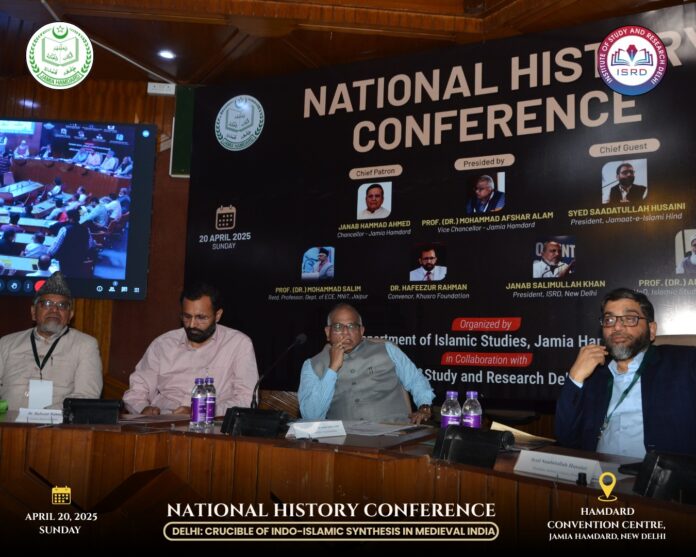
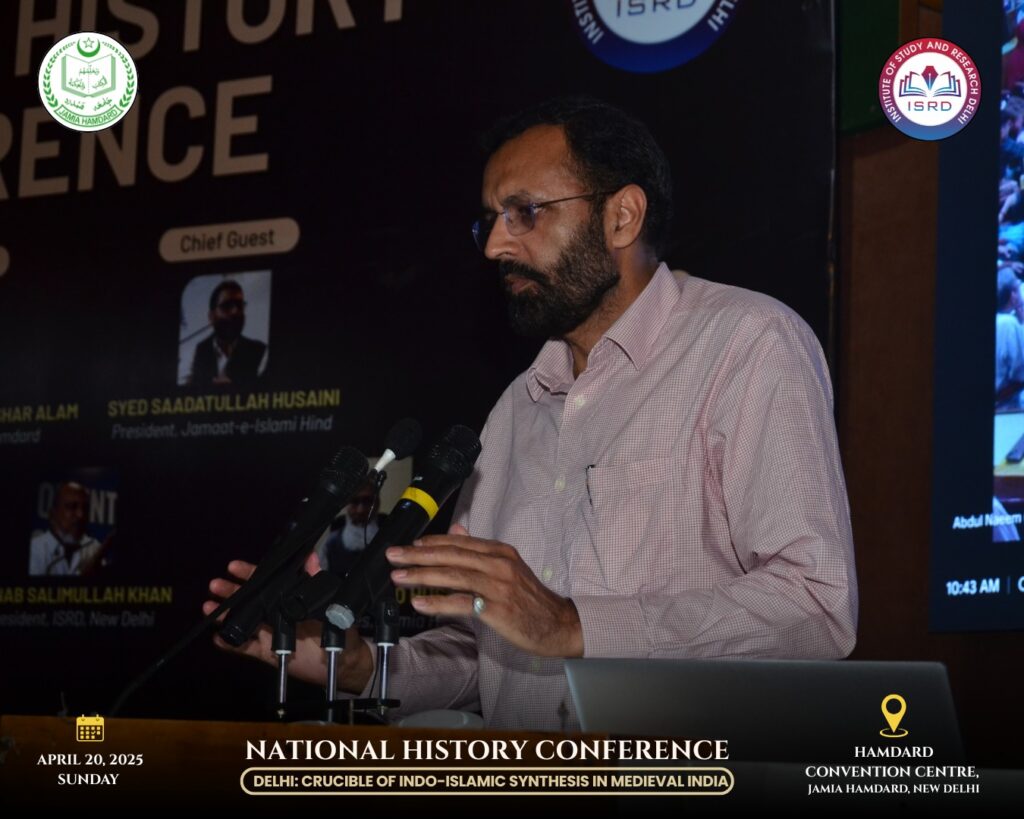
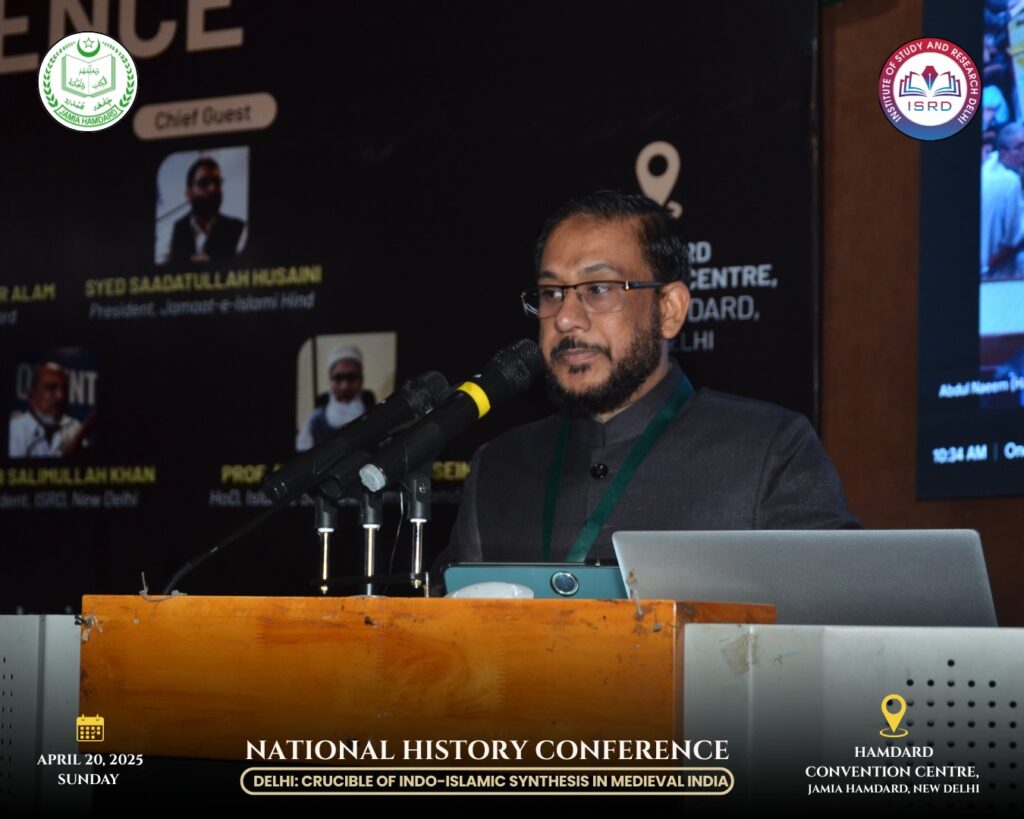
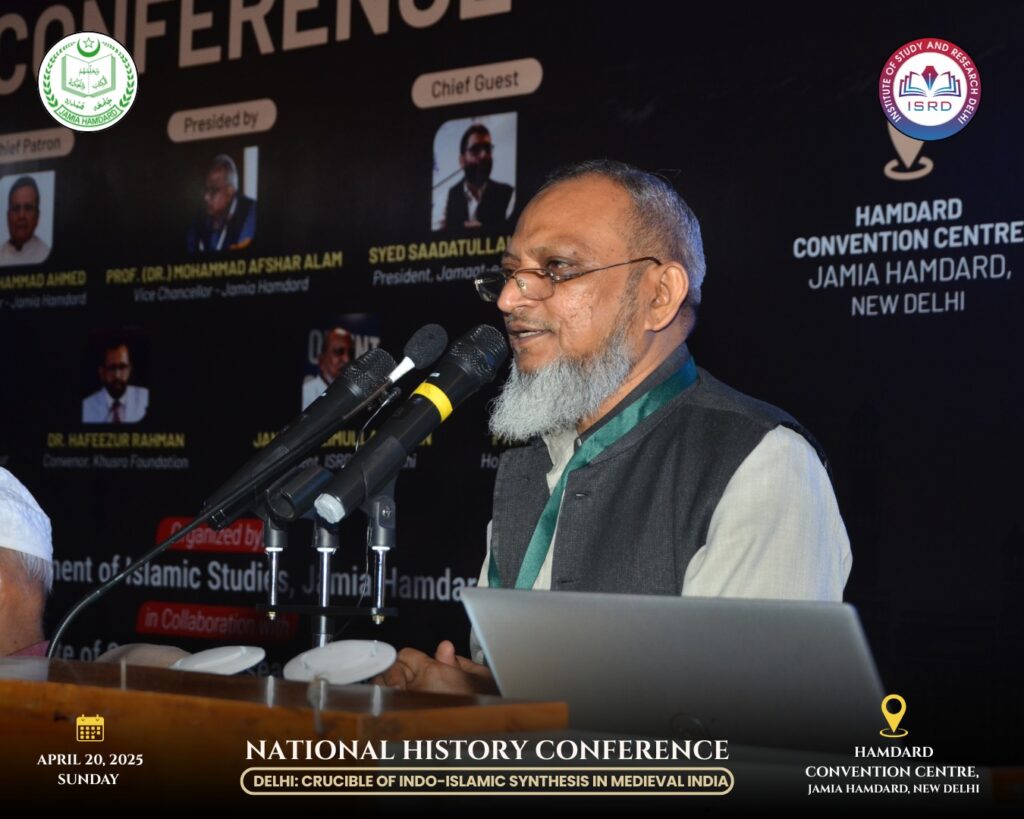
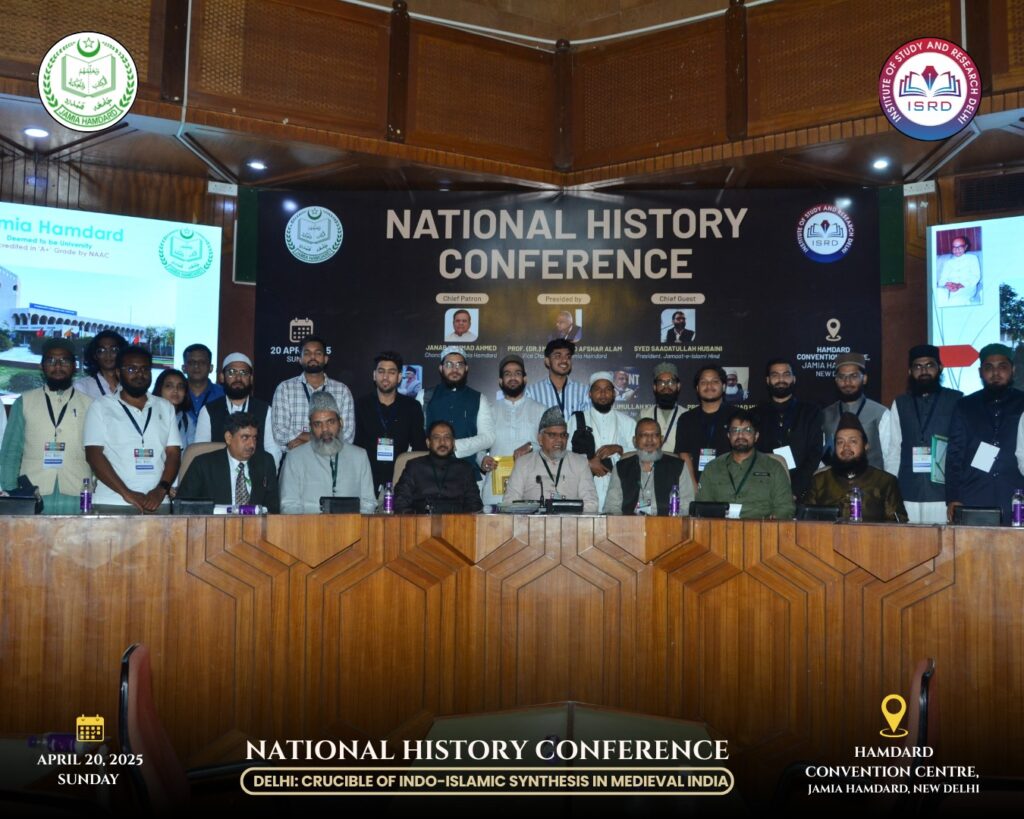
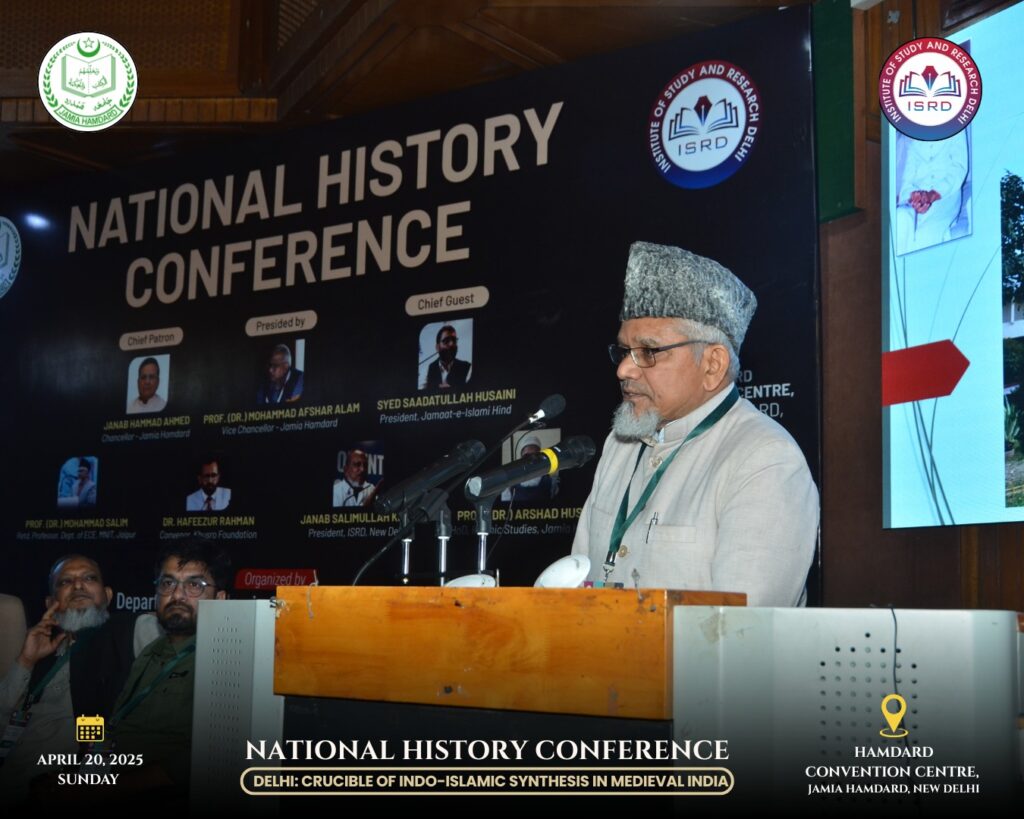
At a landmark one-day national history conference, prominent scholars, professors, and historians Sunday gathered to commemorate the unparalleled contributions of Muslims to India’s cultural and civilizational fabric. Titled “Delhi: Crucible of Indo-Islamic Synthesis in Medieval India,” the conference was hosted by the Department of Islamic Studies, Jamia Hamdard University, in collaboration with the Institute of Study and Research Delhi (ISRD), New Delhi.

Held at the Hamdard Convention Centre, Jamia Hamdard, the conference aimed to explore the profound impact of Islamic heritage on shaping medieval Indian culture, society, and governance, with a special emphasis on Delhi as the epicenter of this cultural convergence.

A wide array of research papers was presented under several sub-themes aligned with the central topic, including the Advent of Islam in North India , Educational Institutions and Knowledge Production, Indo-Islamic  Architecture, Sufi Traditions and Sacred Spaces, Language and Literature, Music and Performing Arts Role in the Freedom Struggle, Calligraphy and Decorative Arts, Culinary Heritage and the Culture of Cuisine, Women’s Contributions, Science and Technology, Mughal Gardens and Economic and Administrative Innovations.

As a chief guest, Jamaat-e-Islami Hind Syed Sadatullah Husaini emphasised that the Quran repeatedly encourages the study of history and historical events to extract lessons and guidance. “If lessons are taken from history, it becomes an asset,” he asserted, adding that history serves as a mirror of society.

Refuting the prevailing negative narratives surrounding Muslims in India, Husaini remarked, “Muslims are not outsiders or foreign invaders. They are developers, not destroyers; builders, not colonizers; inheritors, not intruders.” He highlighted how the Delhi Sultanate acted as a conduit, connecting India with the thriving global centers of knowledge in the Muslim world.

He cited the example of Sanskrit scholars and experts in numerics being recognized and honored in the court of the Abbasid Caliphate. The Arabs, he noted, never appropriated the intellectual achievements of Indian scholars but instead gave them due credit. “Muslim Sultanates helped disseminate India’s hidden treasures of knowledge across the globe,” he stated.

Husaini also praised the architectural marvels of the Delhi Sultanate, such as the Qutub Minar, calling them a testament to the era’s artistic grandeur. He emphasized that the most valuable contribution of Muslim rulers was the promotion of unity and human equality, bringing together people across religions, castes, and classes under a shared identity of humankind—a concept Allama Iqbal referred to as “Wahdat-e-Khaas Quwwat” (special power of unity).

Referencing Maulana Abul Kalam Azad, he recalled Azad’s fervent appeals to Muslims at the time of Partition to remain in India, invoking their emotional and civilizational connection to iconic Islamic monuments such as the Taj Mahal, Red Fort, and Qutub Minar.

Dr. Afshar Alam, Vice Chancellor of Jamia Hamdard University, presided over the inaugural session. He provided a historical overview of Islamic rule in India, tracing it from Mohammad Ghori’s arrival in the 12th century to the British colonial era, covering the Slave, Khilji, Tughlaq, Sayyid, Lodhi, and Mughal dynasties.

He emphasized how Delhi became the nucleus of Indo-Islamic cultural fusion, with Central Asian and Persian architectural styles merging with indigenous Indian designs. This, he said, resulted in a unique Indo-Islamic architectural identity, visible in the city’s rich heritage.

Alam also elaborated on the contributions of the Islamic period in education, science, music, literature, governance, and social reform, asserting that this synthesis laid the foundation of what is now referred to as South Asian culture. “This fusion didn’t just shape Indian civilization—it gave it depth, diversity, and resilience,” he concluded.

Dr. Hafeezur Rahman, convenor of the Khusro Foundation and an expert in Urdu and Persian, delivered speech as a special guest. He reflected on historiography, distinguishing between pro-establishment and anti-establishment narratives, and praised Islam’s contribution to historical objectivity through the tradition of “Asma al-Rijal” (biographical evaluation of narrators).

He noted, “It is often said that the Mughals gifted India three unparalleled treasures: the Taj Mahal, Mirza Ghalib, and the Urdu language.” Rahman particularly celebrated the role of Sufi saints, especially Hazrat Nizamuddin Auliya and his disciple Ameer Khusrau, a 13th-century polymath and the founding father of the Urdu language. Khusrau, he said, was also a distinguished scholar in astrology, astronomy, and music.

Quoting Khusrau’s oft-repeated teaching from his spiritual mentor—”Agar duniya aap ke raste mein kaante bichhaye, to tum phool bichhao” (If the world throws thorns in your path, you lay down flowers)—he emphasized the Sufi message of love and resilience.

Dr. Hafeezur Rahman further illustrated how cultural synthesis led to creations like biryani and sherwani, both products of Indo-Islamic fusion. He expressed hope that the academic papers presented at the conference would become historical documents in their own right.

Dr. Fazlur Rahman, Assistant Professor in the Department of Islamic Studies, anchored the conference and gave a brief introduction to its aims.

ISRD Secretary and Organizer Asif Iqbal outlined five core objectives and sub-themes of the event. Asif Iqbal emphasized that civilizational interactions—such as those between Islam and Indian culture—often result in positive transformations. He stated that Muslims, while introducing new cultural and civilizational values to the subcontinent, also embraced indigenous practices. “This mutual exchange reshaped the cultural and intellectual landscape of the region,” he said.

ISRD President Saleemullah Khan offered reflections on the ethical teachings of Prophet Muhammad, citing his instruction to Hazrat Ali to return belongings even to those who plotted to kill him during the Hijrah (migration to Madinah). He also quoted Urdu writer Rashidul Khairi, who praised the skills, cooperation, and intelligence of Delhi’s women during the medieval era.

Professor Arshad Hussain, Head of the Department of Islamic Studies at Jamia Hamdard, delivered the welcome address and warmly greeted all dignitaries and guests.

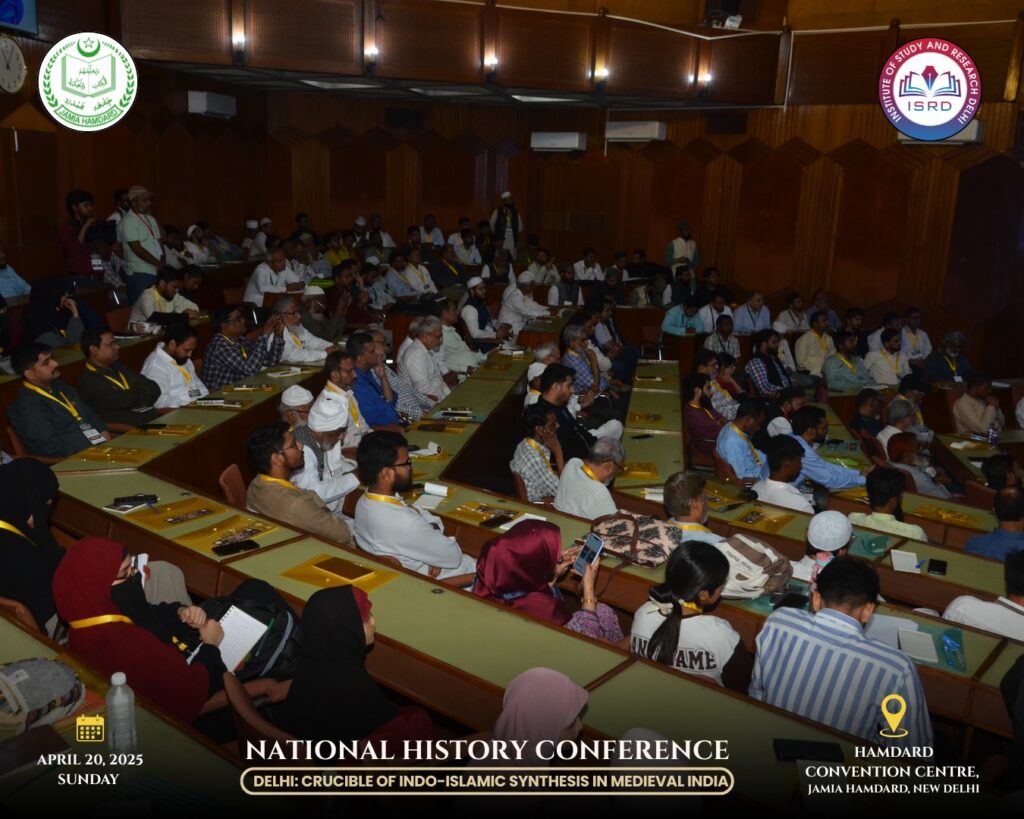
The day featured parallel academic sessions, with 50 research papers presented by scholars and students from institutions including Jamia Millia Islamia (JMI), Aligarh Muslim University (AMU), Jawaharlal Nehru University (JNU), Maulana Azad National Urdu University (MANUU), National Institute of Technology (NIT), Delhi University, and Jamia Hamdard.

Sessions were chaired by eminent professors such as Prof. Obaidullah Fahad (AMU), Dr. Faizan Ahmed (National Archives of India), Dr. Mohiuddin Ghazi (former Dean, Al Jamia Al Islamia, Kerala), Prof. Azizuddin Husain, and Prof. Parvez Nazir. Guest speakers received mementoes, and research scholars were presented with certificates.

In the valedictory session, Prof. Mohammad Salim Engineer, retired professor from MNIT Jaipur, addressed emerging researchers, emphasizing key research ethics—many of which, he noted, align with Islamic principles. These include academic honesty, objectivity, peer review, and depth over volume. “There’s no shortcut to excellence,” he advised. “Hard work can even surpass intelligence.”

In light of the current communal atmosphere, he urged the Muslim community to take charge of creating history, not just recalling it.

Abdul Kalam, co-convenor of the event, delivered closing thanks, while Dr. Shadab Musa, Assistant Secretary of Jamaat-e-Islami Hind, offered a speech reflecting on the present socio-political environment.

source: http://www.indiatomorrow.net / India Tomorrow / Home> Breaking News> Education> National Interest / by Anwarulhaq Baig / April 21st, 2025

Shahjahan’s urs from April 2

Agra, UTTAR PRADESH :

The urs of Mughal emperor Shahjahan will be observed at the historic Taj Mahal for three days from April 2 next. Entry into Taj Mahal will be free for visitors after noon on April 2 and 3 while it will be free for the entire day on April 4.

Lakhs of  devotees will throng the 17th century monument during the three-day event and will pay homage at the graves of Shahjahan and his wife Mumtaz, in whose memory the Taj Mahal was built.

On the last day, a ‘saptrangi chadar’ (multi-coloured bedsheet ) will be offered at the graves as part of a ritual. Sandalwood powder will be sprinkled on the grave too.

The urs of the Mughal king Shahjahan is celebrated on the 25, 26 and 27th day of Rajab, which falls of April 2, 3 and 4.

The Shahjahan urs committee will meet here on March 8 to decide on the arrangement and preparation to be made for the urs.

Officials said that a notification was issued by the ASI on the urs of Shahjahan. The administration will prepare a fool proof strategy to ensure full security to devotees attending the urs.

source: http://www.dailypioneer.com / The Pioneer / Home> State Editions> Lucknow / by PNS, Lucknow / March 06th, 2019

”Taj – A Monument Of Blood”: New Series On Mughal Empire In The Pipeline

Agra, UTTAR PRADESH :

The series will capture the dark side of the story of the Mughal empire and had emperors like Akbar, Jehangir, Shah Jahan and Aurangzeb.

Mumbai :

“Taj – A Monument of Blood”, a period drama series on the rise and fall of the the Mughal empire, is set to be produced by Applause Entertainment in partnership with Contiloe Pictures, who are confident of presenting a story with a mix of blood, betrayal, power, beauty, deceit and heartbreak.

The series will capture the dark side of the story of the Mughal empire, which ruled India for just over 3 centuries and had emperors like Akbar, Jehangir, Shah Jahan and Aurangzeb. Writing is currently underway.

The tale will be told over 5 seasons of twelve episodes each, using the birth and death of Shah Jahan as bookends. It will delve deep into the Mongol origins, bloodlines mixing with Persian and Rajput royalty, the court and palace intrigues, the repeated purging of aspirants to the throne, and the arrival of the British and Portuguese.

Sameer Nair of Applause Entertainment calls himself a big fan of revisionist narratives of history.

“Our history books have been written by victors and often paint very two-dimensional pictures about past empires. When Abhimanyu Singh (Contiloe Pictures) and I first discussed this idea, we immediately moved away from a typical historical to a darker and edgier version of the Mughal empire, a version in which symbolically the Taj is more a monument of blood, than a monument of love,” Mr Nair said in a statement.

Mr Singh, who has produced a slew of historicals for the small screen, says the new series will show viewers the historic journey through a fresh lens.

“It will take viewers on a historic journey showing them an unseen perspective of this illustrious dynasty which lead to their rise as the greatest empire in medieval times and the quest for power, within it, that finally lead to its downfall.”

source: http://www.ndtv.com / NDTV / Home> All India / by  Indo-Asian News Service / July 12th, 2018

Taj Mahal gets notice board in Braille

Taj-MahalMPos10mar2014

Agra:

Blind tourists can now read the history of the Taj Mahal in the complex.

The Archaeological Survey of India (ASI) has provided a notice board in Braille script for their convenience.

Agra District Magistrate Manisha Trighatia unveiled the notice board, which some visually handicapped students and their teachers read — and expressed satisfaction.

N.K. Pathak, the superintending archaeologist of ASI’s Agra circle, said the facility will be a great relief to the sightless who had earlier to be told the history orally.

The board has been developed by Arushi, an NGO from Bhopal. It is both in Hindi and English.(IANS)

Photo Courtesy: www.wallpaperswala.com

source: http://www.tntmagazine.in/ TNT , the north east magazine / Home> Related News / March 07th,  2014