The band is set to make its World Premiere debut at the Tanweer Festival on 21 November in Sharjah, United Arab Emirates.
Rahman earlier dropped the teaser of the band on his Instagram account, which shows the band members dressed in purple, with headscarves covering their hair | By special arrangement
New Delhi:
Academy and National Award-winning composer A R Rahman announced the launch of Rooh-e-Noor, a six-member all-women band, formed under the leadership of his daughter, Khatija Rahman. The band has been launched under Rahman’s KM Musiq audio label, with Kannika Urs heading the project.
Rooh-e-Noor is set to make its World Premiere debut at the Tanweer Festival on 21 November in Sharjah, United Arab Emirates.
Apart from Khatija, the ensemble comprises musicians Pooja Tiwari, Sana Aziz, Shaoni Mojumdar, Amina Rafiq, and Shifa Ruby. Tiwari and Mojumdar are the vocal trainers, Rafiq and Ruby will lead music supervision, and production will be carried out by Sana Aziz, Sarthak Kalyani and Nakul Abhyankar. Rooh-e-Noor means “Soul of Light”, and it has been created to focus on the idea that women’s voices are transformative and can heal, inspire, and uplift.
“Rooh-e-Noor isn’t just a band, it’s a light that connects hearts. Each of these women carries the confidence of modern artistry. Their collective voice is pure, powerful, rooted, and futuristic,” said AR Rahman.
Rahman earlier dropped the teaser of the band on his Instagram account, which shows the band members dressed in purple, with headscarves covering their hair. Khatija is the only member who has also opted to wear a hijab in the video.
A rare sight in the music industry
All-girl bands in India are still few in the music industry. Music producer Mikey McCleary created the band W.I.S.H in 2021, which released their first single Lazeez last year. The last time a girl band took over the Indian music scene was in 2002 when Viva was created.
But soon after its launch, band member Seema Ramchandani left, and the remaining members continued without her for another year.
Rahman’s band—a new step in the world of Indian girl bands, for its distinctive aesthetic—seeks to bring reimagined classics, film compositions, and spiritual renditions.
The teaser shows the girls performing the whirling dervish, a Sufi form of devotional dance. Earlier, Rahman spoke of his own spiritual journey as well as embracing Sufism and its influence on his life and music.
(Edited by Saptak Datta)
source: http://www.theprint.in / The Print / Home> Features> Around Town / by Shubhangi Misra / February 19th, 2025
Mecca, (Ottoman-SAUDI ARABIA / Kolkata, WEST BENGAL / DELHI :
Abul Kalam Ghulam Muhiyuddin (November 11, 1888-February 22, 1958), better known as Maulana Azad, was a writer-activist-statesman.
Historian S Irfan Habib speaks on Maulana Azad on his birth anniversary at an event organised by the Maulana Azad College alumni association in Calcutta on Tuesday / The Telegraph
Historian S. Irfan Habib, while delivering his Maulana Abul Kalam Azad memorial lecture titled “Revisiting Maulana Azad in Contemporary India” on Tuesday, rued how in today’s India, anytime he posts anything on social media on the freedom fighter, 80 per cent of the comments comprise hateful abuse.
“Full of abuse… 80 per cent of the comments. And from people who have no idea of who he was, what he stood for, and what he did for India,” said Habib, whose lecture on the Maulana on the icon’s 137th birth anniversary was organised by the Maulana Azad College alumni association to mark the college’s centennial.
Abul Kalam Ghulam Muhiyuddin (November 11, 1888-February 22, 1958), better known as Maulana Azad, was a writer-activist-statesman.
One of Mahatma Gandhi’s most trusted lieutenants and the youngest president of the Indian National Congress, he made crucial contributions to the freedom movement. He was also Independent India’s first education minister.
“I will speak about those issues relevant for today’s India. What he did for education, how he defined nationalism — today all those who have no idea of what nationalism is are nationalists — and how he defined Islam…. Islam too is in danger when we see what we believers have done to our own faith,” said Habib, former Maulana Azad Chair at the National University of Educational Planning and Administration, New Delhi.
Maulana Azad’s family moved from Mecca to Calcutta when he was two. He spent several decades of his life in this city, his residence on 5 Ashraf Mistry Lane of Ballygunge now a museum.
November 11 is celebrated as National Education Day to recognise his contribution in establishing the education foundations of India — from the Indian Institutes of Technology, the University Grants Commission, the All India Council for Technical Education, the Council of Scientific and Industrial Research, the Indian Institute of Science, and the Sahitya Akademi, the Sangeet Natak Akademi and the Lalit Kala Akademi, besides the Indian Council for Cultural Relations.
“Patriotism, nationalism and humanism, the difference between them Maulana tried to look at. In this (the belief in the culmination in humanism) he was very close to Gurudev Rabindranath Tagore, and he actually writes about it, that he believes in the idea of nationalism which was pitched by the idea of Tagore’s humanism and universalism,” said Habib.
“True relationship is only one, where the entire earth is one’s native land. This is necessary is today’s India, where we indulge in othering among own citizens, in the name of religion, caste, language, all sorts of issues, all sorts of divisive tools we use to divide Indians, while Maulana says mankind is one family and all humans are brothers, this is the idea of humanity of nationalism which Maulana left behind,” he added.
Habib underscored how the Maulana began as a pan-Islamist, speaking against the subjugation of Muslim nations by imperialist powers — a sentiment expressed strongly in his papers Al-Hilal and Al-Balagh, and it was because of his role as a fiercely upright journalist that the British Raj viewed him as one of the most dangerous persons in India.
Habib stated that after the Maulana was released from exile in Ranchi in 1920, he was torn between reading and writing in seclusion, or public life and the freedom struggle. It was soon after coming out of exile that the Maulana met Gandhi on January 18, 1920, for the first time.
“The meeting seemed to have had a profound impact on both… and they remained inseparable for the rest of his (Gandhi’s) life,” he said.
According to Habib, the Maulana fought on multiple fronts, not only against the British, but also Hindu and Muslim communalists.
“Maulana stressed on indivisible or composite nationalism, where he went back to early Islamic history, when the Prophet (Muhammad) created the first Muslim nation in Medina by aligning with the Yehudis (Jews). He saw no reason why Muslims could not join hands with Hindus and others in nation-forming…. He was appalled with communalists busy with sectarian campaigns when the need was to fight the British as a composite nationalist group,” Habib said.
“Maulana stood for a united India and remained steadfast in this resolve till the end. We are amid polarising politics where religion has become a distinct marker of identity…. The majoritarian nationalism being flaunted today runs contrary to the idea of composite nationalism espoused by Maulana all his life,” he added. “Maulana found the demand for Pakistan absurd as he was conscious of the fact that religion cannot be a binding factor for a nation.”
source: http://www.telegraphindia.com / The Telegraph Online / Home> West Bengal / by Meghdeep Bhattacharyya / November 12h, 2025
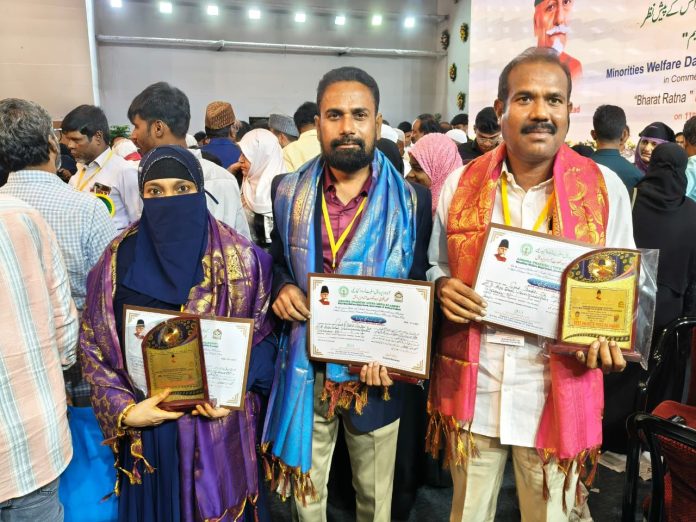
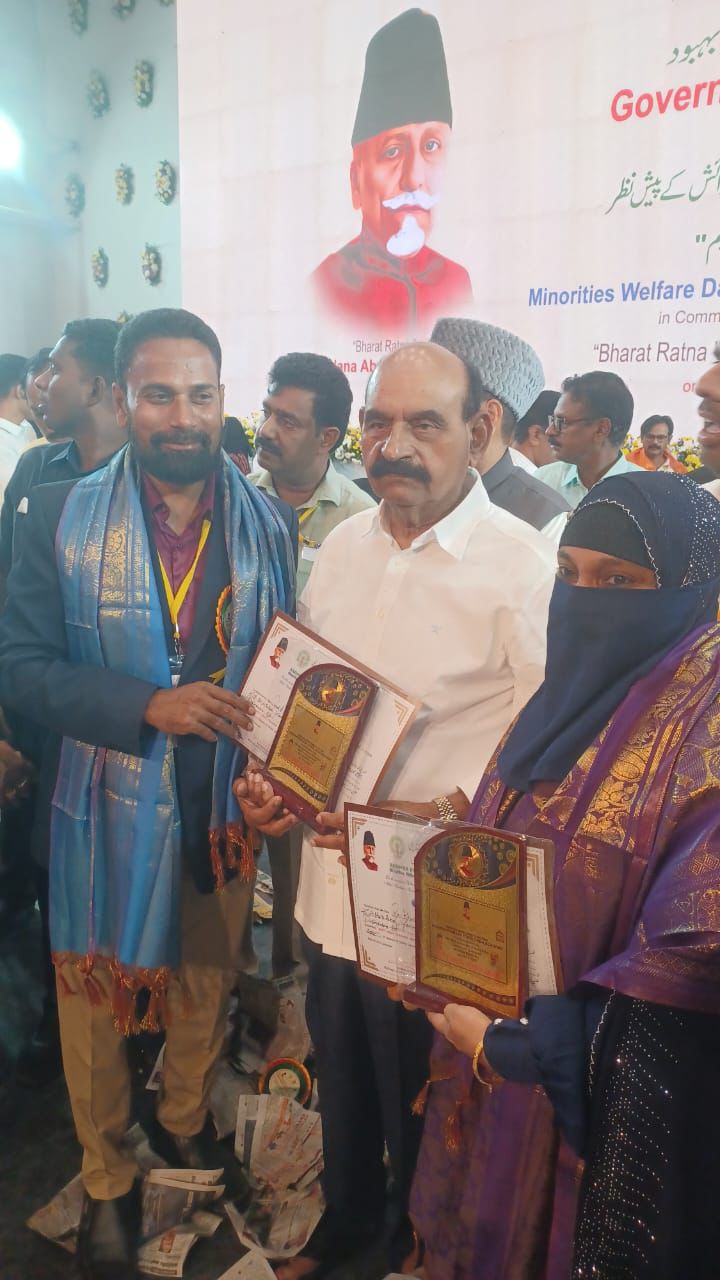
In celebration of National Education Day, the State Urdu Academy organised a special felicitation programme where teachers from ZPHS Urdu School, Yerragondapalem, a village in Prakasam district of Andhra Pradesh, were honoured with the State-Level Urdu Best Teacher Awards.
The awards were presented by the Minister for Minority Welfare, S.M.D. Farooq, to Syed Abdul Ghaffar (SGT Urdu), Shaik Khursheed Begum (SA SS), and Syed Shafi (SA Urdu) in recognition of their outstanding contributions to Urdu education.
Local residents, students, and parents extended their heartfelt congratulations to the award-winning teachers and expressed their hopes that they continue to bring more laurels in the future while nurturing many more bright students under their guidance.
source: http://www.radiancenews.com / Radiance News / Home> Awards> Pride of the Nation> Latest News> Report / by Radiance News Bureau / November 13th, 2025
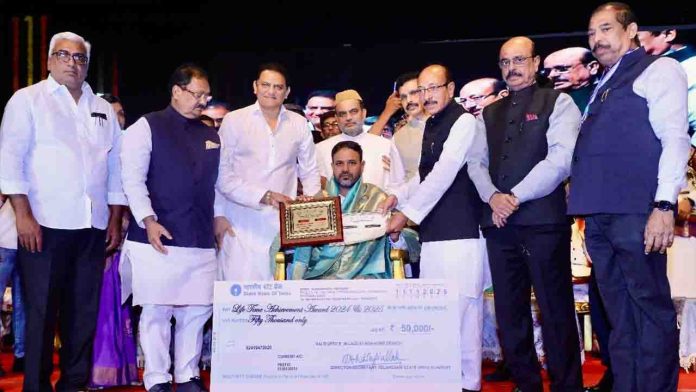
The Telangana Urdu Academy celebrated Minority Welfare Day at Ravindra Bharathi by presenting the first-ever Lifetime Achievement Award in the Digital Media category to veteran journalist Mohammed Akram Ali, popularly known as Azad Reporter Abu Aimal.
The award, instituted under the Revanth Reddy-led Congress government, marks the growing recognition of digital journalism’s role in promoting awareness and preserving Urdu culture. The award includes a memento, a citation, and a cash prize of Rs. 50,000, presented by Minister for Minorities Welfare Mohammed Azharuddin.
Mohammed Akram Ali was honoured for his decades-long contribution to digital journalism and his consistent efforts to advance Urdu language and literature through online media platforms. His work has been widely regarded as instrumental in connecting Urdu-speaking audiences with contemporary issues through accessible and credible digital channels.
The event was attended by several senior officials and community leaders, including Advisor for Minorities Welfare Md Ali Shabbir, Secretary of Minorities Welfare Department B. Shafiullah, Urdu Academy President Taher Bin Hamdan, Haj Committee Chairman Khurso Pasha, and CMFC Chairman Deepak John.
Syed Ghouse Mohiuddin, General Secretary of the Digital Media Publishers and Broadcasters Federation, congratulated Abu Aimal and praised the government for acknowledging digital media professionals.
The Telangana Urdu Academy announced plans to continue recognising contributors in emerging digital sectors to motivate younger generations and strengthen Urdu’s presence in modern media spaces.
source: http://www.radiancenews.com / Radiance News / Home> Latest News> Report / by Radiance News Bureau / November 12th, 2025
From A Dreamer’s World | Photo Credit: Special Arrangement
A brilliant blue fish glides in a patch of orange pumpkins, another lies still among lilac orchids hoping his camouflage allows him to blend in. These are a few finned beauties artist Shoeb Dastagir has depicted in his solo show A Dreamer’s World.
“I find fish quite calming and I can spend hours looking at them; that is why I began capturing them in my paintings,” says Shoeb, adding he spends a lot of time at the aquarium in Mysore Zoo. “I enjoy watching videos of aquatic life on my phone, too.”
He reels off their names — bumblebee goby, oscars and arowanas, tiger fish, a Brunei beauty and a shark — and how they are all a part of this show. “I am a Piscean, so no matter how hard life gets, fish are a calming refuge for me,” says the artist. “Fish are always calm, going about their lives despite the confines of their surroundings.”
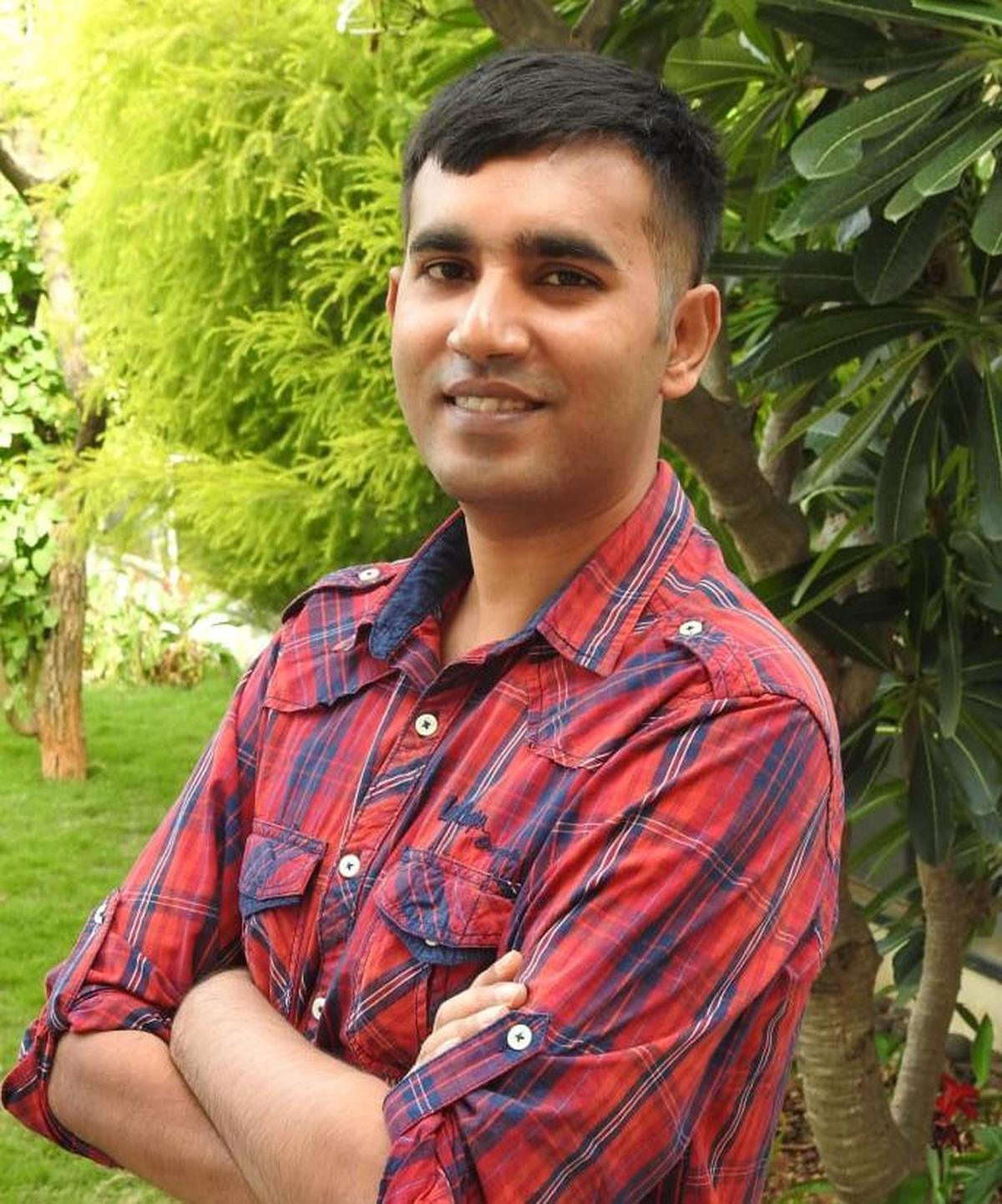
Shoeb Dastagir | Photo Credit: Special Arrangement
He talks about his love for “sunny colours such as tangerine orange, avocado green, icy blue and buttery yellows”. All these hues and more are to be found in his works that exude a touch of whimsy and play out in a fantastical land where an astronaut steps around teacups, fish nestle between blue pea and pearls, and an old-model television sits atop a bouquet of yellow roses.
Though Shoeb draws his inspiration from the natural world, a lot of his art is birthed in his vivid imagination that fuel his compositions of poetry, prose and songs as well. According to his mother Ayesha Dastagir, all these creative interests lead Shoeb to produce bigger and detailed paintings. “One can see a lot of mystical characters apart from the animals and fish, of course. I believe it is his subconscious, sensitivity and imaginary fantasy world that combine to produce something new and different.”
Most of the works in A Dreamer’s World have been executed using pastels and watercolours on paper over the the greater part of a year. Though Shoeb used to paint with oils and canvas, this change in medium came about when he moved from Bengaluru to Mysore, and working on paper seemed a more viable option as space was a constraint at the new place.
From A Dreamer’s World | Photo Credit: Special Arrangement
The artist, who signs his works as Schoeb, his official name which is often misspelt, is currently working on a series of portraits.
The upcoming / current exhibition comprises 24 pieces on display apart from a few others which are a part of the series and are available for sale at the gallery.
A Dreamer’s world by Shoeb Dastagir will be on display at MKF Museum of Art, Bengaluru from November 8-19. Entry free, Mondays closed.
source: http://www.thehindu.com / The Hindu / Home> Entertainment> Art / by Ruth Dhanraj / November 06th, 2025
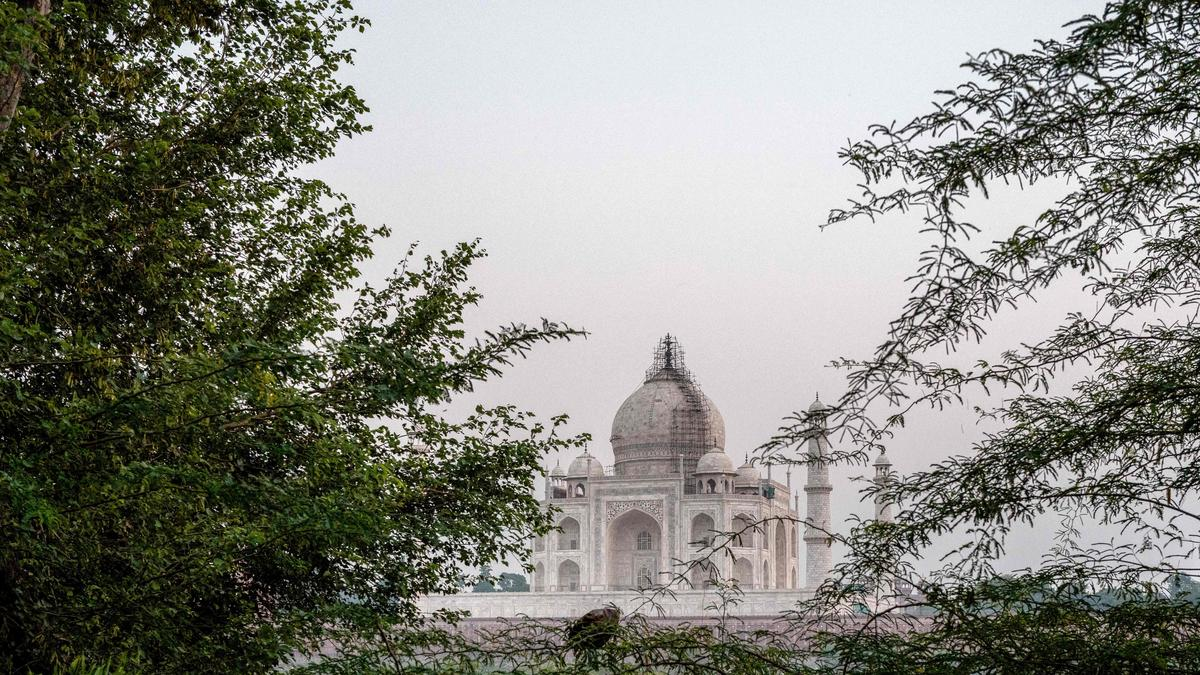
Tushar Goel’s film, ‘The Taj Story’, has reignited controversy over the Taj Mahal’s origins, claiming it is a Hindu temple rather than a mausoleum built by Mughal emperor Shah Jahan. The film’s debut highlights debates about the interplay of history and ideology in contemporary India.
Scaffoldings are pictured as restoration work goes on at the dome of the Taj Mahal in Agra on October 17. | Photo Credit: AFP
A little over 60 years ago, Purushottam Nagesh Oak slept and dreamt. He woke up and claimed that the Taj Mahal in Agra was actually a Hindu palace going back all the way to 4th century. Friends of Mr. Oak, an English teacher-turned-lawyer-turned-journalist but never a historian, told him that the Taj Mahal couldn’t have been a fourth century structure as the technology employed in building the Taj in the 17th century didn’t exist back then. The fantasist turned a pragmatist, and Oak brought his argument forward by a few centuries. The Taj was now claimed to be a Hindu temple. This was in 1989. He wrote articles and a book too, but found no support from historians. Even the Supreme Court dismissed his claims as “a bee in his bonnet” in 2000.
But post-2014, history is like a revolving door, you enter and exit at your ease and pleasure. You pick and choose, you circumvent and invent. Dress it up as a movie and claim you are looking at history anew. That is how we get a movie like Tushar Amrish Goel’s The Taj Story, starring former BJP MP Paresh Rawal; just like we had The Kashmir Files and The Bengal Files, starring Anupam Kher and Mithun Chakraborty, all ideological partners of the Bharatiya Janata Party (BJP).
With The Taj Story, Goel goes where no historian has gone. Proof, evidence and knowledge amount for nothing as the director makes a case for the Mughal monument being actually a Hindu temple, much like the BJP leader Sangeet Som who called it alternately a Shiva temple and a monument built by a man who incarcerated his father. Mr. Som obviously couldn’t make out a Shah Jahan from an Aurangzeb and hence got mixed up. Much like Oak, oops, Goel, who sees no difference between history and mythology, facts and fantasy.
Recorded history
Talking of facts, the Taj Mahal was built by the Mughal emperor Shah Jahan after his favourite wife Arjumand Bano Begum breathed her last after bearing the last of their 14 children. Its chief architect was Ustad Ahmed Lahori. The land for her last resting place was procured from Mirza Raja Jai Singh of Amber who had inherited it from Raja Man Singh, a celebrated general of Akbar, who was Shah Jahan’s grandfather. Shah Jahan compensated Jai Singh with four havelis from the royal property for the massive haveli in which rests Mumtaz Mahal. His firman to Jai Singh, the latter’s agreement and the Mughal emperor’s subsequent letter of granting him four havelis in lieu of one, are all part of history; unlike the claim of The Taj Story which talks in terms of a massacre and genocide of the locals for fulfilling the wishes of an emperor and his consort!
The work on the tomb started in 1632 with the finest craftsmen from across the country and West Asia. The chief mason was Mohammed Hanif from Baghdad who earned ₹1000 a month for his efforts. The pinnacle was built by Qayam Khan of Lahore and its Quranic inscriptions were done by Amanat Khan Shirazi. The mosaic work was done by local Hindu workers. Above all, some 20,000 workmen toiled for 22 years to build the monument to love. Its white marble came from Jaipur, lapis lazuli from Sri Lanka, crystal from China and coral from Arabia. The monument uses the double dome technique, previously seen only in the Humayun’s tomb in Delhi, and never seen in the country before the arrivals of the Turks.
Not the first time
Over the years, many have tried to appropriate credit for its beauty and majesty. In the 17th century, it was claimed by many in the West that the architect of the Taj was Venetian Geronimo Veroneo, a jeweller by profession. Then came the claim by Mughal Beg in Tarikh-e-Taj Mahal that it was designed by Muhammad Effendi, an architect supposedly sent by the Sultan of Turkey. Effendi though was as much an architect as Oak was a historian. In the mid 19th century it was claimed that the monument was the result of the genius of Frenchman Austin de Bordeaux, a jeweller. However, Austin died in 1632, the year the work on the Taj began. With his death all claims of Austin being the Taj’s architect were buried. And facts began to be raised.
As for fantasy, well there is Goel’s film, never mind its claim of presenting the “untold history of the Taj Mahal”. The film, replete with stereotypes of kohl-lined, skullcap-donning Muslims aims at building a nation’s memory on unreasoned mythology, far removed from the well argued debates of history. Much like Oak’s view that Christianity was nothing but Krishan-Niti. Not game for any ridiculous claims in an insipid film which opened with a mere 14% attendance in the first show? Watch M. Sadiq’s 1963-saga Taj Mahal. Sure, you would remember its song, ‘Jo wada kiya woh nibhana padega’, penned by Sahir Ludhianvi and sung with much love by Mohammad Rafi and Lata Mangeshkar. Sadiq’s film with Pradip Kumar and Bina Rai in the lead cast, made no effort at replacing history with mythology.
source: http://www.thehindu.com / The Hindu / Home> Entertainment> Movies> In the limelight / by Zia Us Salam / November 07th, 2025
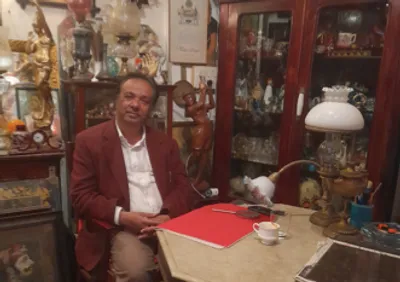
There are individuals in smaller cities who have taken upon themselves the task of archiving, preserving, narrating, and circulating historical narratives — all for the love of the place and history. Indore-based Zafar Ansari is one such person who has been painstakingly collecting historical artefacts on Indore since three decades.
Zafar Ansari in his Museum Office. Photo: C. Yamini Krishna
As I was preparing for my research visit to Indore for a study on the princely state of Indore, all I found online were a few articles from Free Press Journal on the city. It was just a glimpse of how much of the ‘national’ media coverage and public history writing is focussed on the metropolitan cities.
Absence, inaccessibility, decay of archives and historical artefacts are constant challenges faced by history scholars in India. The lack of historical consciousness, poor funding, disinterest, discrimination, and destruction of the archives based on the ideology of the ruling disposition are some of the known reasons why such problems exist. These challenges are acute as one moves beyond the metropolitan cities, into the smaller cities and towns.
History in India, has mostly been studied from the perspective of the nation and to such endeavour small places are often insignificant. Also due to the policy of housing all the state archives in capital cities and the absence of efforts to do neighbourhood or local/regional histories, smaller cities almost feel ‘history less.’
However, inspite of the institutional gap, voices from the smaller cities are not silent. Each time I have ventured into these cities in search of archives, I have always met individuals who have taken upon themselves the task of archiving, preserving, narrating, and circulating historical narratives — all for the love of the place and history.
Indore-based Zafar Ansari is one such person who has been painstakingly collecting historical artefacts on Indore since three decades. “It all started when I received the National Youth Award for my social activities in 1994. The then President Dr Shankar Dayal Sharma said, do something great, and then I decided I will build a museum for Indore,”Ansari says with a sparkle in his eye as he narrated his dream to make a museum for his beloved city Indore.
“This will be one of its kind museum, dedicated to the city, telling the story of the city,” he mentioned. His office in Barwani Plaza in Old Palasia, bustling with artefacts, feels like a portal into another time. As one spends time with these objects, they start speaking through the voice of Ansari.
A miniature maker for industries by profession, Ansari spends more than 60% of his income towards the museum. He never lets any historical object pertaining to Indore pass, without acquiring it, sometimes this means he has had to pay very high price. “It is almost like an addiction,” he says, “It has its flip sides. I have never been able to pay my daughter’s education fee before the last date.”
The history walks, myth-busting artefacts and rare photographs
Ansari is also committed towards sharing his collection. He conducts history walks in the city and curates specific objects from his collection to tell stories of the city. Ansari has recently conducted one such walk for some of the dignitaries who had visited India during the G20 summit. He regularly runs a history column in Dainik Bhaskar where he reintroduces stories of the past to Indore’s citizens.
“I don’t just write about Kings, but also about common people, their lives,” he says, what a historian would call the social history of the place.
Through his consistent effort of writing more than 300 essays on history, Ansari has built a cannon of public history for Indore. Sitting among those objects, he narrated how Indore (state) became a commercial centre due to its close connection with opium trade, “Opium would come from Mansur to Indore and then to Bombay. Many traders and merchants from Rajputana and Gujarat settled here to do opium trade with China. After the ban on opium, the trade was converted to cotton industry.”
Ansari is hopeful that his museum will be a pedagogic intervention. “History is not something to be taught in a classroom, it has to be taught in an archive or a monument or on field using objects and artefacts,” he notes. His work with the artefacts also helps him dispel certain myths and false narratives in circulation.
Ansari’s collection has helped writers like Geraldin Lenain to write books such as The Last Maharaja of Indore by providing access to many rare photographs.
A historian or an antiquarian
After meeting Ansari, I was wondering, if there is a term to describe this love for history, something like a cinephile in case of film.
A historian is often a tag used to describe someone who engages in the work associated with history making, professionally, i.e. as a main vocation. A history buff, focusses more on consumption of history and fails to capture the commitment shown by these keepers of a city’s lore. A collector, is often differentiated from an archivist as someone who is more involved in the process of acquiring artefacts, and is not primarily oriented towards providing access. Someone like Ansari, however, who harbours a hope to build a museum, would fall somewhere in between these two.
Cambridge Dictionary offers a word antiquarian, “a person who studies or collects old and valuable or rare objects.” Antiquarianism historically has often had a negative connotation, as someone in an almost ‘mindless’ pursuit of collecting objects and committed to the minute details of it. Historian, on the other hand, is someone who narrativised the past, with the focus on writing.
Historian Rosemary Sweet notes that history writing could be done for political or polemical purposes while antiquarians prided themselves to be impartial and staying true to the material. Antiquarians are often interested even in objects of everyday life which was not of interest to historians. Interestingly, Sweet points out that the contemporary practice of history, associated with archival study, which relies on the details presented by historical artefacts is very close to antiquarianism.
After searching for these variety of terms, I am still left with no word to capture the affective engagement with history which I experienced in the office of Ansari, where history is not just a vocation or a profession, where there is a lot at stake in telling stories of the past, a significant portion of one’s earnings. This voice of history is not a dispassionate, distant evaluation of the past, but is an expression of belongingness.
Deeply personal work like this has larger social implications, it is about communities taking the ownership of their own history, and inculcating historical consciousness among themselves. Such efforts go a long way in forming the first line of defence against vilification of history and weaponisation of history for political gains, of which we are seeing increasing incidence.
C. Yamini Krishna works on film history, urban history and Deccan history. She is a part of the Khidki collective. She currently teaches at FLAME University.
This work was done as a part of the Foundation Project is implemented by India Foundation for the Arts (IFA) under the Arts Research programme, made possible with support from BNP Paribas India.
source: http://www.m.thewire.in / The Wire / Home> Culture / by C Yamini Krishna / May 16th, 2024
Amirbai Karnataki is one of the earliest Kannada singer-actress who made it big in Hindi cinema. She went to Bombay when women artistes were labelled ‘fallen’, but with grit and passion Amirbai became a star and sang 380 songs in 150 Kannada and Hindi films.
Amirbai’s tale is one of inspiration
For someone who didn’t belong to the gramophone generation but the golden period of radio, Lata Mangeshkar, Asha Bhonsle, Mukesh, and Rafi ruled our hearts and constituted our imagination of a film song. The same AIR, during a light music programme, had played “Ninnane Neneyuta Ratriya Kalede”. This, was a carbon copy of Lata’s memorable “Saari Saari Raat Teri Yaad Sataye”, but the voice was starkly different. It had a heavy nasal tone, and the flawless rendition had a simplicity to it. The charming song left an indelible mark and I felt I had to recover her voice from pages that were unknown to me.
Amirbai Karnataki was an unheard voice for the Seventies: she was long gone, and had faded into the archives of black and white era of early films. She was someone who lived on in personal memories of people who had known and heard her.
Amirbai Karnataki (1912-65), who sang 380 songs in 150 films, was an early singer and actress of Hindi cinema. This singer who sang the unforgettable “Main to pavan chali hoon bole papiha” and “Bairan Nindiya Kyon Nahi Aaye”, was born in Bijapur in Karnataka. During the 1930s Amirbai was a prominent name along with stars like Suraiyya, Shamshad Begum, Noor Jahan and Zohrabai Ambalewali.
When Lata Mangeshkar came on to the scene, many of these singers moved into the background and for the later generations they remained unknown.
Born into a family of artistes, Amirbai’s parents Ameenabi and Husensaab worked for a theatre company and even ran one for many years. Growing up years for Amirbai and her five siblings was filled with music and theatre, what with many of her uncles and aunts being top musicians and actors in theatre. She lost her father early and her uncle, Hatel Saheb took care of all the children.
During those years, Bijapur was part of Mumbai Presidency and the sangeet natak tradition in these parts was flourishing. The famous Balagandharva’s company and several other theatre companies camped at Bijapur; Amirbai and her sister Goharbai, trained as they were in classical music, impressed these companies with their singing and they began to not only sing for several of them, but also act.
As Rahmat Tarikere writes in his biography of Amirbai Karnataki, Amirbai moved from Bijapur to Mumbai, from theatre to films. But the exact date and nature of these movements and transitions are hard to tell. The story of Amirbai is a sum total of several happenings in a historical period as there are few definitive documents to lead us to any accurate picture. Painstakingly put together by the biographer, Tarikere says that when Amirbai reached Mumbai (it was perhaps the year of Alam Ara’s release, 1931), women who worked in films, theatre and music were still seen as “fallen”.
Women artistes were often ridiculed as “free women” and among the several women performers, Amirbai and her sister Goharbai too, tried to free women of this stigma. In fact, families not only disowned such women, but there were instances of women being killed for choosing the arts.
In fact, Rahmat Tarikere says that the kind of fight these women put up with the social circumstances of those days is no less significant than the freedom struggle itself. If women artistes, in the later years, earned fame and reputation, it was because of the sacrifices these women made. Ironically, two very popular films “Basant” and “Kismet” in which Amirbai acted deals with the plight of actresses.
Amirbai became a very reputed singer and actress of her times. She was highly paid, and even built a theatre Amir Talkies in Bijapur. She travelled the length and breadth of North Karnataka giving programmes related to theatre and cinema.
A singer who sang some of the finest love songs, had a very unhappy love life though. Tarikere writes how her husband, a Parsi actor who played villain in those days, Himalayavala, abused her physically and emotionally. She had to suffer several assaults from him and even separation became a painful affair. Unable to recover from the trauma, she went into oblivion for several years, and later Badri Kanchawala, with his love and care brought back peace into her life.
At the age of 55, Amirbai passed away; Karnataka had been unified by then and the rest of Karnataka hardly knew of her. Even the newspapers reported her death four days later. It was only later that people have slowly learnt of Amirbai’s greatness and how Gandhiji was immensely fond of her rendition of “Vaishnava Janato”.
source: http://www.thehindu.com / The Hindu / Home> Features> MetroPlus / by Deepa Ganesh / February 27th, 2015
Writer Bolwar Mahamad Kunhi talks about literature and fests.
Karnataka : Bengaluru : 30/10/2017 : Bolwar Mohammed kunhi during The Bengaluru Literature festival in Bengaluru on Sunday. Photo : Sudhakara Jain.
Bolwar Mahamad Kunhi, 66, is the only Indian writer conferred with two Central Sahitya Academy Awards (2010 & 2016) for creative prose in Kannada. He received the Atta Gallata Bangalore Lit Fest 2017 Award for Kannada for his overall contribution on the concluding day of the Lit Fest on Sunday. With 250 short stories and a host of novels, with several directed towards children behind him, Kunhi a recipient of the Karnataka Rajyothsava Award and Karnataka Sahitya Academy’s Lifetime Achievement Award says, “Young writers should regularly read what seniors write and get inspired to find their own words and voice.” Kunhi, who said every recognition is a moment of inspiration to writers, spoke to MetroPlus regarding his life and writing. Excerpts:
Do you think such literary fests are important for the growth of literature?
Yes. Such festivals also add their share to other ingredients required for a healthy literary growth, look at the buzz they create, have you ever seen this kind of an unprecedented crowd? I am not as aware of the present statistics of other languages. This is my uncorroborated research. In recent times Kannada literature has seen a huge number of publications, possibly surpassing that of any other Indian language. The number of literary events or the number of Jnanapeeth awardees we have could surpass those from any other language. This could be another reason some Kannada writers have achieved celebrity status.
Is literature the voice of society?
Literature always augurs well for society and provides wisdom to humanity. All religious books, which I consider part of literature, are works of wisdom which have had a great impact on humankind. Literature also taught civic sense to man who lived like a wild animal. The conversations and dialogues in such events also propagate the same wisdom.
After Chand Ali in ‘Swathantrayada Ota’ who is the next character in your work awaiting attention?
In the last two years I have been busy in understanding two important characters for different reasons. First to write 1000 couplets about Ambedkar and second to write a novel on the Prophet’s beloved wife, Ayesha. The second has gained more traction in the last few months. When I wrote the first ever historic novel on Prophet Muhammad Oidiri two years ago, it was well-received. But most of the characters in Odiri were male. The thoughts, words, actions, and the attitude was male. I always wondered if the women of that time had opinions of their own. Did they ever voice what they felt? Even in solitude? This is the subject of the proposed novel titled Umma (Mother) inspired by the life of Ayesha. I am not sure which one will be completed first.
After Gorur Ramaswamy Iyengar who wrote on Gandhiji, your book on the Mahatma received instant recognition. How important is it for today’s children to read about Gandhiji?
To guide our children in the right way we show them role models. It is a shame we are unable to give them contemporary examples to encourage and mould their personality. The examples that we provide from history or mythology seem too overwhelming for them. Historical characters are kept on a pedestal and are inaccessible. Gandhiji maybe one example which children can relate to since they read and learn about him a lot and he is the most recent of those examples! To these children my book attempts to show that Mahatma Gandhi was not an unachievable superhuman. He was a common, simple boy, who grew up like most of us, as a darling to his parents, went to school, studied prescribed text books and qualified as a lawyer. As a young man he fought for the downtrodden and stood for truth, non-violence and social justice. I tried to depict him as a common man who lived an uncommon life to become a Mahatma.
Do female characters get more importance in your novels?
I don’t think so. Being feminist writer is not an easy way to popularity. Though I was born in a male-dominated community, I was brought up with the love of various women in my early life – my mother, my sisters and my first teacher. They were the ones who tolerated my anger, frustration and ego and loved me unconditionally. That guilt might be the reason women are central to my work. I dedicated my first story collection to ‘Appi Bayi’, the teacher who taught me to write alphabets. The second one was to my mother who I buried with the same hands that I dedicated it to. Another work was to my elder sister and another to my two daughters. My mega novel is dedicated to my beloved. All of this could be due the same guilt. May be my work as an emotional man resonates with like-minded people and thus gets appreciated.
How was your experience writing the screenplay for ‘Munnudi’ and ‘Athithi’?
My writing is like a sculptor’s. It takes shape with time. I don’t believe in inspirations. Cinema, definitely is not my medium. I wrote the screenplay under the persuasion and for the love of my friends P. Sheshadri, who bagged nine National awards in a row and Dattanna, an inimitable character actor. I wrote what I felt for both movies and they incidentally won national awards. I cannot comment on what else I might be able to do in cinema, at least not now.
Can you talk about your initiation to writing considering you have no writers in the family?
I joined Syndicate Bank in Gulbarga after my B.Sc. Much later when I was associated with the Sahitya Academy I discovered that most members had masters degrees. It enthused me into getting an MA in Kannada in the 1980s.
My desire to write was another one of such self-imposed challenges. During a casual conversation while playing carrom with writer Arooru Lakshmana Seth in Gulbarga, I asked him how he was able to visualise and write so much. His said “non-writers like me cannot understand the process.” That comment propelled me into writing a short story and getting published in Navbharat which was the beginning.
source: http://www.thehindu.com / The Hindu / Home> Books> Authors / by Ranjani Govind / October 30th, 2017
The recipient of Padmashri award for communal harmony had earned the sobriquet of ‘Karnataka’s Kabir’
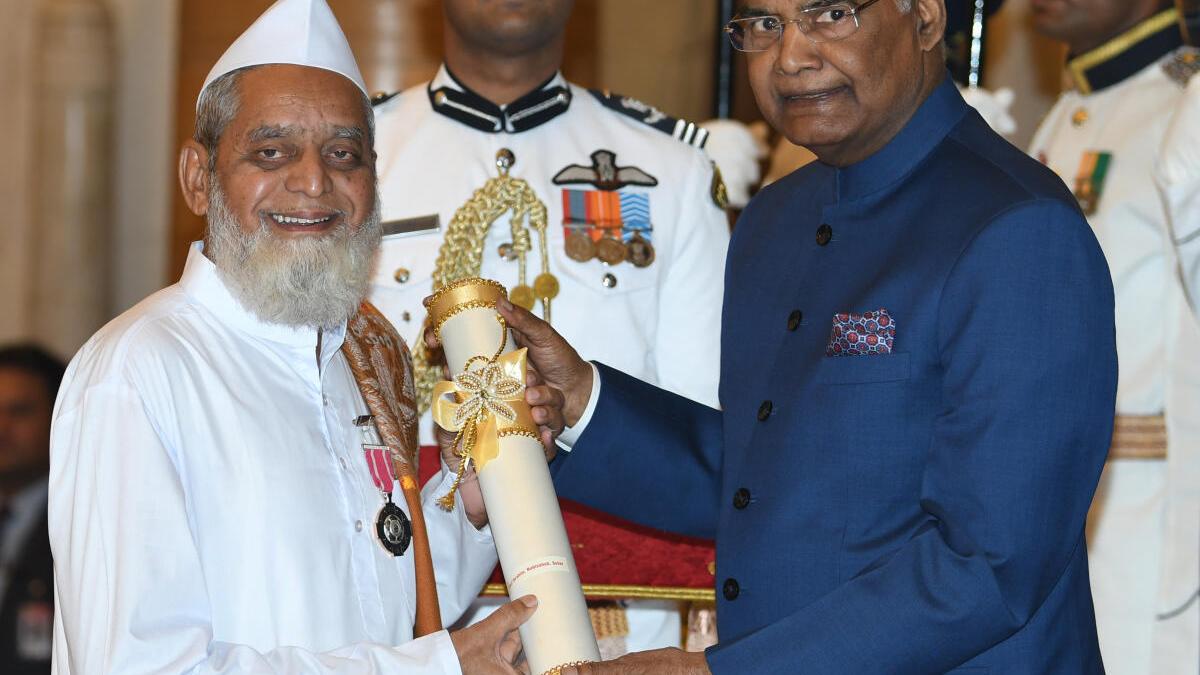
‘Karnataka’s Kabir’ Ibrahim Nabisaheb Sutar is presented the Padmashri award by President Ram Nath Kovind at Rashtrapati Bhawan, in New Delhi on April 2, 2018.
Ibrahim Sutar, polyglot folk singer, who toured India spreading the message of Hindu-Muslim unity, died in Mahalingpur in Bagalkot district on February 5. He suffered a massive heart attack around 6.30 in the morning. He died a few minutes later, family sources said. He was 82. He leaves behind his wife, son and two daughters.
The recipient of Padmashri award for communal harmony had earned the sobriquet of ‘Karnataka’s Kabir’.
The founder of ‘Bhavaikyate Bhajana Mela’ began his career as a Harikathe bhajan singer going around villages and towns. He regaled audiences with stories from Hindu and Islamic scriptures always leaving with a message of harmony, and need for ethics in personal life. He sang songs and gave lectures, quoting from multiple scriptures without the need to read from notes. He was equally well-versed in Kannada and Urdu.
In his later life, he emerged as a public speaker, visiting schools, colleges and Lingayat mutts to speak on vachana and dasa literature. He was honoured with the Karnataka Rajyotsava award in 1995, and the Padmashri in 2018.
Born in a poor weaver family in Mahalingpur, he dropped out of primary school to work as an assistant to a weaver. He developed a spiritual bent of mind early in life. He began attending lectures in the Sri Basavananda Swami mutt and participating in bhajans in Sadhu Maharaj temple. He was a member of the mosque committee that went around villages, asking the faithful to wake up early during the month of Ramzan. He studied Hindu and Islamic scriptures with equal zeal and developed a team of bhajan singers. The ‘Bhavaikyate Bhajana Mela’ performed across Karnataka and Maharashtra.
A routine performance was in the question–answer format interspersed with songs of dasa saints and vachanas . One of the team members came up with a question that sounded very ordinary, but had deep spiritual undertones, like: ‘Who is important in life – god or guru?’ Sutar used anecdotes from the Ramayana and Mahabharata, Islamic scriptures and stories from the life of prophets to give his opinion, that was directed at the audience, rather than the team member who kept asking questions.
source: http://www.thehindu.com / The Hindu / Home> News> India> Karnataka / by Special Correspondent / February 05th, 2022