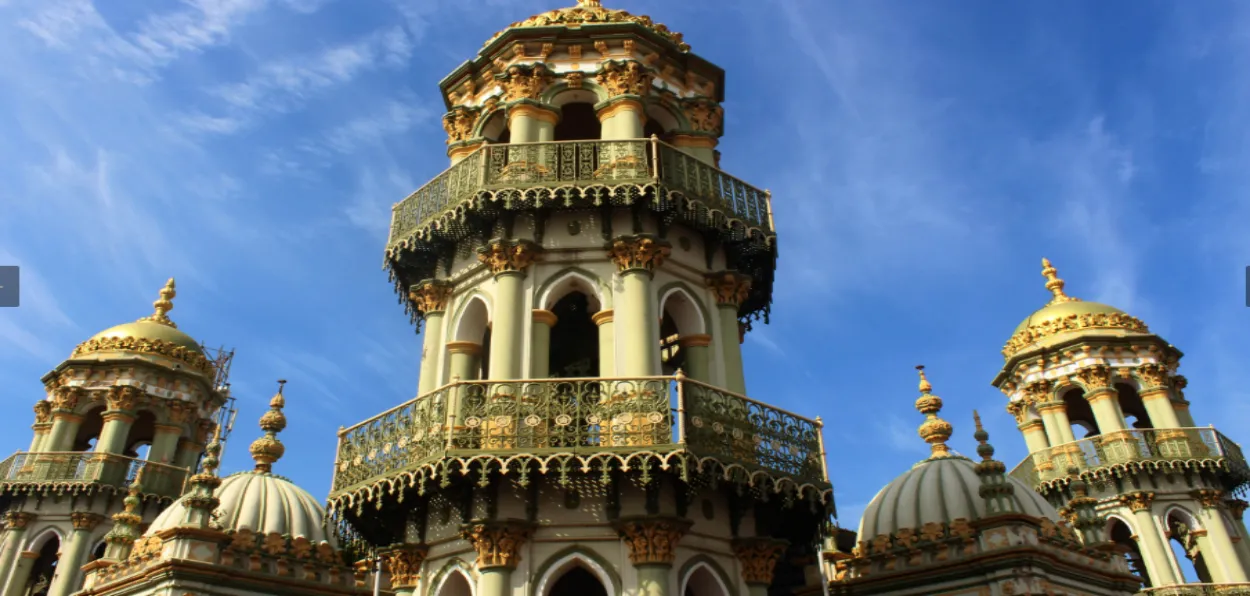
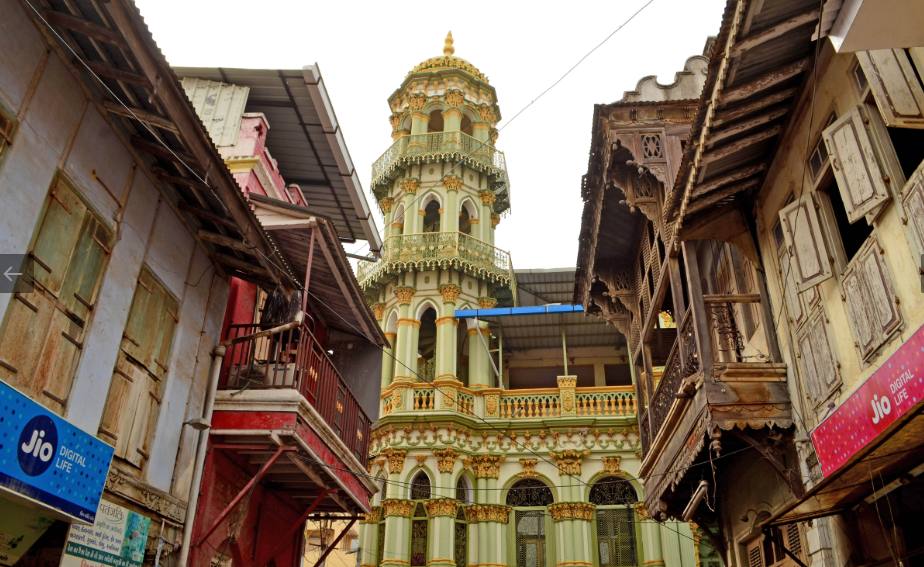
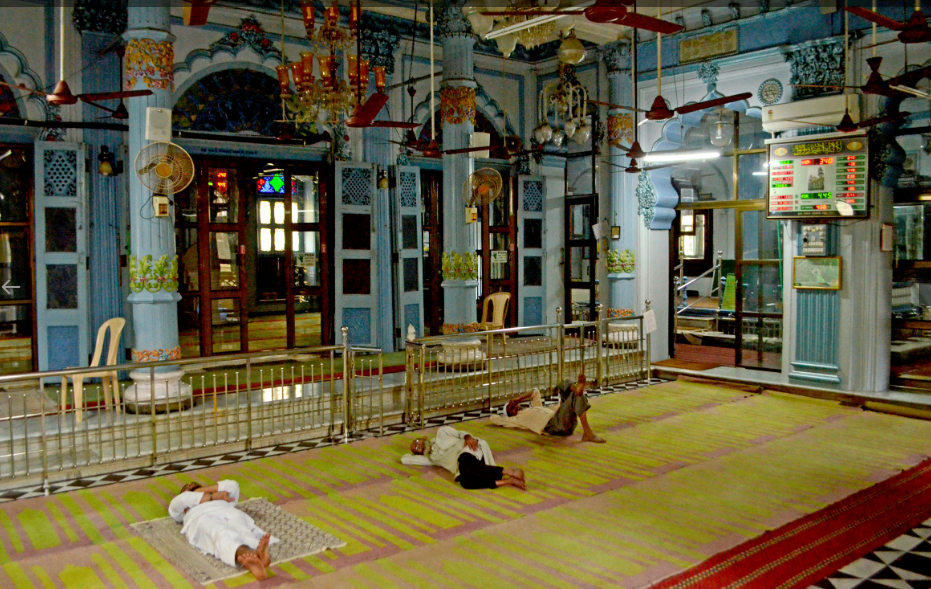
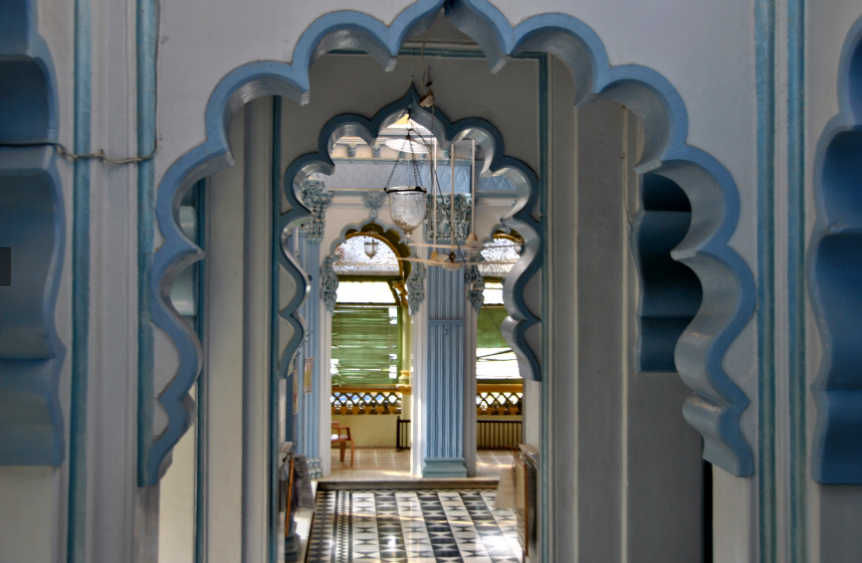
In Rander township of Durat city in Gujarat, there is an architectural marvel — a One Pillar Mosque called “Masjid-e-Quwwat-e-Islam.” This mosque upends the tradition of art associated with Muslims.
It’s not just a place of worship, but a unique fusion of history, culture, and architecture.
The quarter of the city where this mosque is located was once a major commercial centre of Surat. In ancient times, local merchants traded with Africa, Arab countries, and Burma. Around 1225 AD, Arab merchants from Kufa (Iraq) settled here. With their arrival began a fusion culture, and this influence is still visible.
The mosque, built in the 1800s, is a blend of architectural styles. It incorporates elements of Arabic, Mughal, Portuguese, and Dutch architecture.
The most striking aspect of the mosque is its structural design. It rests entirely on a single pillar. Four arches emerge from a pillar in the basement, and three minarets stand out, each 50 feet high. The entire mosque’s mezzanine and floor rest on this pillar.
Rander’s historical significance extends beyond trade. The region has also been home to Jain and Parsi communities. The port of Rander predated the port of Surat. Jain merchants traded with various countries here in the 1200s. Arab merchants arrived in 1225 and established their own place of worship.
According to Dr. Surendra Vyas, a renowned architect and archaeologist from Surat, “The first mosque in Gujarat was built in Rander.”
In his book, Dawn of Islamic Architecture in Gujarat, Dr Vyas states that approximately 1,300 years ago, two Arab traders came to Rander and built only a qibla (Facing towards Macca) wall. It had no minaret or a hauz-e-wuzu Tank for ablution). All the traders would gather in front of this wall and worship Allah. The graves of these two traders, inscribed with Arabic inscriptions, still stand in a nearby cemetery.
This mosque is also important in the folk life of Rander. Walking through it one can see glimpses of the ancient trading lifestyle. There are also Jain temples in the mosque and surrounding settlements, demonstrating that Rander has been a melting pot of religions and cultures.
According to Dr. Vyas, the study of over 70 mosques and buildings in Gujarat spanned three years. brought out details of the architectural techniques and art of the Rander mosque.
The mosque’s western wall, called the Qibla wall, faces the direction of Mecca. This wall remains an important part of the mosque’s design. Initially, there were no set times for prayer. People gathered by standing on high mounds or using booms. Later, the call to prayer began to be made from a minaret, and people began to pray at set times.
This single-pillar mosque design is significant not only for its architecture but also for its social and commercial history. It demonstrates how organised and modern the people of Rander were. Supporting such a massive structure on a single pillar is a unique architectural achievement.
Walking through the streets of Rander, you realise that it was not only a place of worship but also a cultural centre.
Traders from various countries visited here and conducted trade as well as religious rituals. Thus, the mosque strengthened Rander not only religiously but also socially and economically.
The streets surrounding the mosque are filled with stories of history. Rander’s port and trade activities remain important from a tourism and cultural perspective. Arab traders mingled with local society, sharing their art, culture, and trading experiences with the local community. As a result, mosques, temples, and other architectural structures can be seen in Rander today.
According to Dr Vyas, “There is an interesting reason behind the absence of a minaret at Rander. It is possible that this mosque was built as a private place of worship, so facilities like a hauz-e-wuzu and a minaret were not required. Water was available due to the presence of a pond or lake nearby.
From a modern perspective, this mosque is nothing short of a miracle. Standing on a single pillar for so long, it amazes every visitor.
source: youtube.com
source: http://www.awazthevoice.in / Awaz, The Voice / Home> Stories / by Ghulam Qadir / March 24th, 2026
Kerala artist Shabna Sumayya’s exhibition BECOMING 4.0: Yesterday’s Dreams explores memory, womanhood, and resistance, using deeply personal stories, especially her mother’s labour and generational experiences, to reflect on identity, survival, and the possibility of healing across generations.
From Aluva in Kerala’s Ernakulam district, Shabna Sumayya has quietly shaped a body of work that moves between painting, illustration, and writing with rare coherence. Her fourth solo exhibition, BECOMING 4.0, Yesterday’s Dreams, presented at the G. Sankara Kurup Memorial Museum, Kochi, from 29 January to 1 February, stood as both a culmination and a continuation, an exploration of memory, resistance, and the slow, ongoing process of becoming.
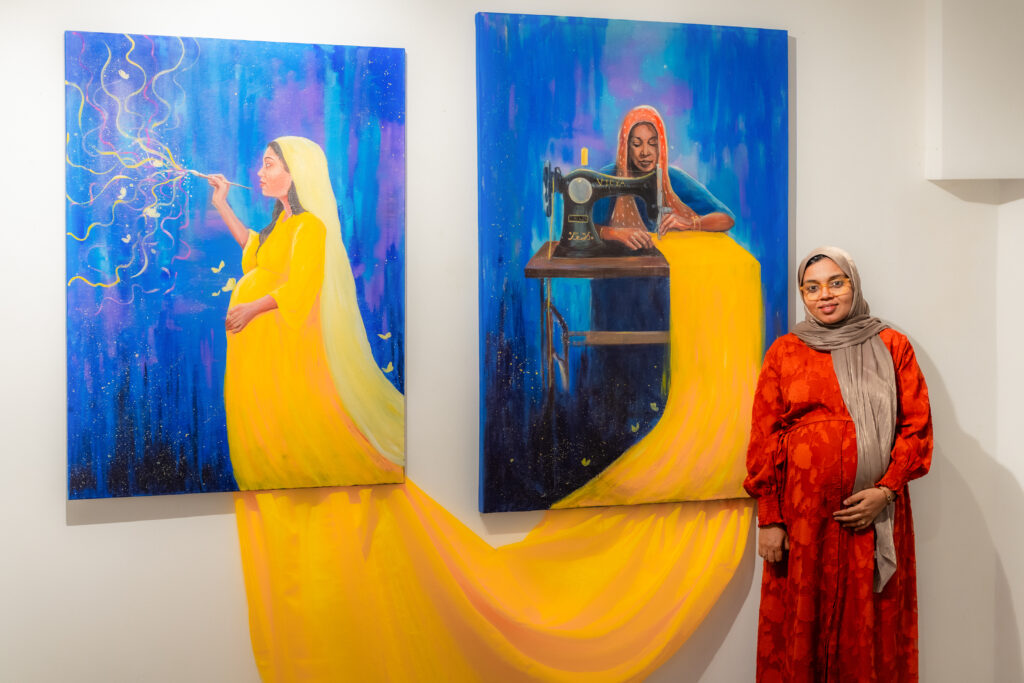
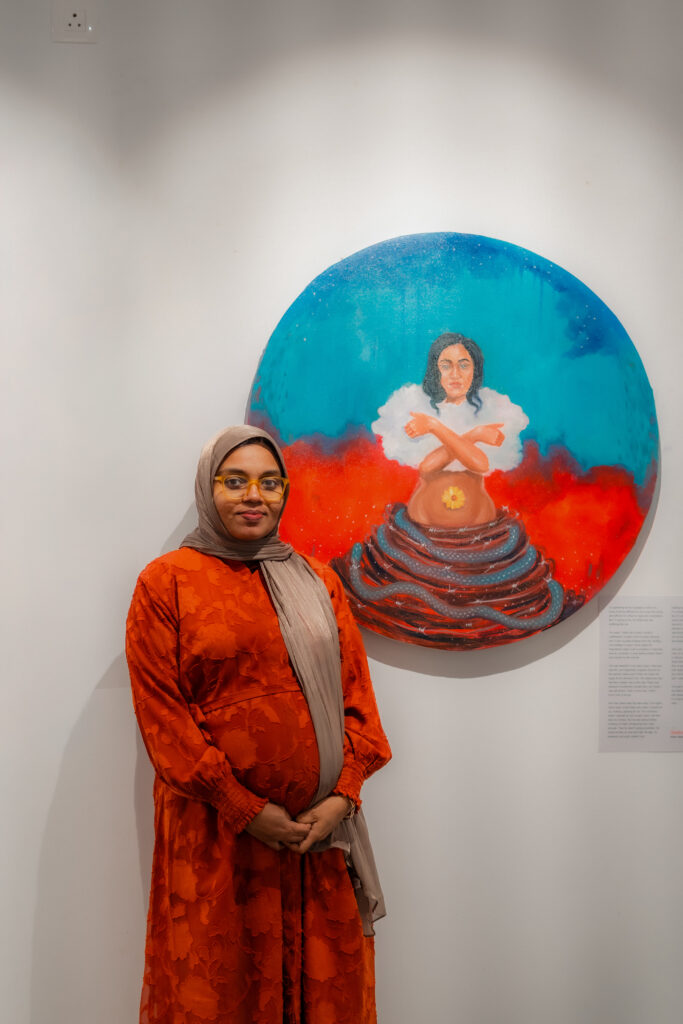
Across mediums, her work is anchored in lived experience. Memory forms the quiet backbone of her practice. Her art expands outward, touching upon resistance, womanhood, survival, and the negotiations that shape identity every day. For her, identity is not fixed; it is something worked through within families, communities, and systems marked by patriarchy and inequality. Her canvases reflect this fluidity. Women appear not as symbols, but as thinking, enduring presences who occupy space with dignity. Fields of yellow meet deep blues and reds. Survival itself becomes a language.
Women at the Centre
When asked why women, with their struggles, aspirations, and unspoken negotiations, consistently inhabit her canvases, Shabna answers with clarity. She paints what she has known most closely. The everyday lives of women are not distant subjects; they are realities she has observed and lived alongside. While she acknowledges that men, too, face hardship, she points out that women often carry additional burdens shaped by patriarchy. Survival becomes a form of resistance. It is from this vantage point that she thinks and creates. She does not exclude men from her work, but her instinct, her emotional gravity, returns to women, and she believes it likely always will. Her commitment extends beyond gender. From the beginning, she has been attentive to marginalised lives more broadly, minorities, oppressed communities, and those whose struggles are often overlooked. Contemporary events that disturb her, news that lingers in the mind, personal conflicts that leave marks, all of these enter the canvas.
For Shabna, art does not sit apart from life; it absorbs it. She hopes her work generates conversation. Many of the subjects she paints are the very ones people avoid, the difficult, the inconvenient, the quietly endured. Her desire is that viewers not only look, but speak; that they recognise themselves; that they feel permitted to open up. Silence, she suggests, is not neutral; it can be interrupted.
The Thread of Yesterday’s Dreams
One of the most resonant bodies of work in her recent exhibition emerged from an image she has long held onto: a photograph of her mother at a sewing machine. Her mother stitched for a living. That repetitive, skilled, necessary act becomes, in Shabna’s hands, a site of quiet defiance. The mother’s labour feeds not only a household, but a future. Stitching becomes a metaphor for repair, continuity, and endurance. The series, conceived around the idea of Yesterday’s Dreams, began to take shape in 2023. The earliest image in what would become the companion pieces was her mother. From there, she sought a bridge. A cradle appeared as the first connective gesture. Gradually, the narrative unfolded further, extending into the artist’s own body and presence. Two canvases, joined by fabric, materialised as companion works, mother and daughter tethered across time. What began as a literal thread transforms into something more enduring: lineage, intimate and unbroken.
The response to Yesterday’s Dreams has been deeply moving for her. One painting, in particular, drew unexpected attention. Coming from a lower middle-class background, she began to notice how many viewers shared similar histories. Messages arrived saying the image reminded them of their own mothers. The personal had become collective. That recognition, familiar and shared, surprised her.
In a recent Instagram caption, she writes: “I have told her now, and I hope she knows: my war against the past is over. I am choosing to live the dream we once manifested. Also, I feel like I have somehow broken the generational trauma too.” The words carry both defiance and tenderness. When asked whether such healing is truly possible for many women, she responds with measured clarity. Early wounds, misunderstandings, and conflicts, she says, do not vanish overnight. But as both children and parents grow, something shifts. Realising that parents, too, are evolving can soften the weight of earlier conflicts. What once felt rigid begins to melt. She considers herself fortunate to have parents capable of such growth and speaks of them with pride.
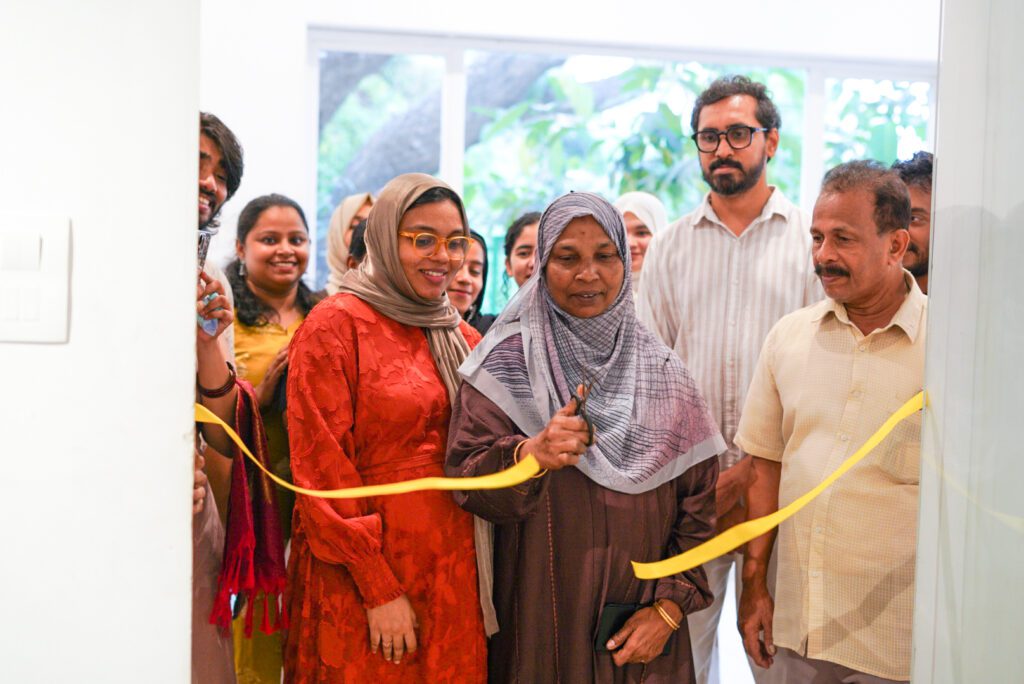
Shabna Sumayya’s mother’s response to the exhibition reflected this quiet evolution. Haju, reserved by nature, approached the painting, and even inaugurated the show, with shyness. Facing a crowd was not easy.
Her mother’s response to the exhibition reflected this quiet evolution. Haju, reserved by nature, approached the painting, and even inaugurated the show, with shyness. Facing a crowd was not easy. Yet after witnessing the appreciation and hearing the messages people shared, hesitation gave way to happiness. When Shabna read aloud the words visitors had written, her mother listened with visible joy. In that space between mother and daughter, between private history and public recognition, art bridged memory and becoming. And it is right there that Shabna Sumayya locates the possibility of breaking cycles.
source: http://www.maktoobmedia.com / MaktoobMedia.com / Home> Literature / by Ashika N / March 04th, 2026
Nishat & Misba turn Panache into one of Mysuru’s most loved fashion exhibitions…
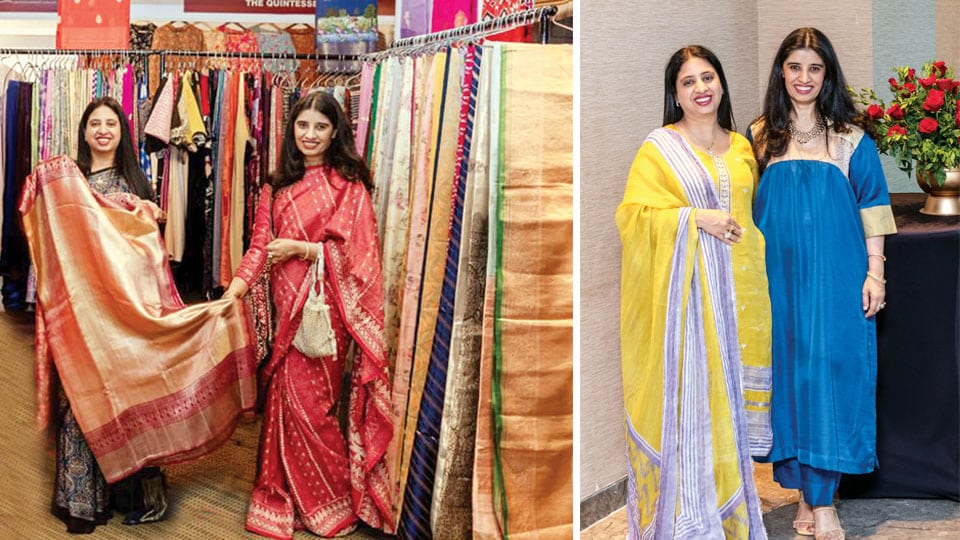
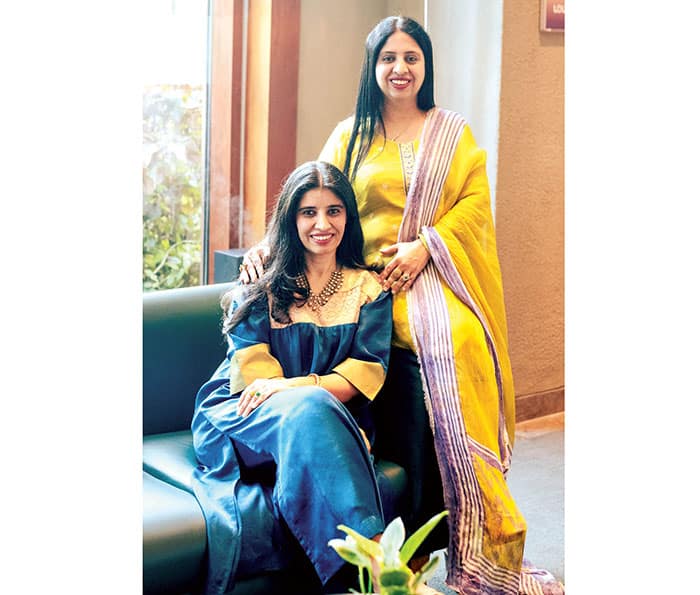
Nishat Mohsin and Misba Umrean, Co-founders of the fashion exhibition platform ‘Panache’, have been curating memorable fashion experiences in Mysuru for several years.
What began as a modest initiative has grown into one of the city’s most-loved fashion exhibitions, offering a thoughtfully curated experience while bringing designers and fashion enthusiasts under one roof.
Alongside its successful editions in Mysuru, ‘Panache’ has also travelled to Bengaluru and Coorg in collaboration with several high-end brands.
While successfully steering ‘Panache’, the duo also balances their entrepreneurial journey with family life and personal passions.
Nishat, born in Bengaluru & raised in Mysuru, is married to a businessman and is a mother of two who enjoys designing spaces and nurturing plants.
Misba, born in Mysuru and now based in Bengaluru, is a B.Com graduate, married to a Bengaluru-based professional and a mother of three who enjoys travel, adventure sports and cooking.
Speaking to Star of Mysore, the sisters open up about their journey, inspiration and vision behind ‘Panache’: “Fashion is not just about clothing, it’s about creativity, craftsmanship and giving designers a platform to shine.” —Ed
Star of Mysore (SOM): How did the fashion extravaganza Panache begin? And what inspired you both to venture into fashion exhibition curation?
Nishat Mohsin and Misba Umrean: ‘Panache’ was envisioned by Nishat in 2008 as an intimate platform connecting designers with fashion enthusiasts. When Misba joined in 2009, the exhibition gained new momentum and gradually evolved into a celebrated fashion destination.
Coming from business-oriented families, we always aspired to create something of our own. Our journey into exhibition curation is driven by a deep appreciation for fashion not just as clothing, but for the creativity and craftsmanship behind it. Through ‘Panache’, we’ve had the joy of bringing ideas to life while giving designers a platform to shine.
OM: Mysuru is known for its legacy of royalty and rich cultural identity. Do you think Mysureans have a unique fashion sense? And when it comes to style, what defines them more, silk sarees or contemporary fashion trends?
Nishat and Misba: Absolutely. Mysureans have a refined and graceful sense of style. Silk sarees hold a special place; they’re timeless, elegant and deeply rooted in tradition. At the same time, they embrace contemporary styles and modern silhouettes with equal grace. What makes their style truly distinctive is this seamless blend of heritage and modernity, marked by elegance and understated sophistication.
SOM: In your opinion, how has the representation of women in fashion events evolved over the years?
Nishat and Misba: The evolution has been remarkable. While women were once seen mainly as participants or models, today they lead as designers, entrepreneurs and key decision-makers, shaping the industry.
Fashion platforms have become powerful spaces for women to express their creativity and vision through their brands, and it’s inspiring to witness and contribute to this evolution.
SOM: How has the role of social media and digital platforms changed how fashion exhibitions are promoted and experienced?
Nishat and Misba: Social media have introduced a new dimension to fashion exhibitions. Promotions that once relied on word of mouth now reach audiences instantly. Digital platforms create anticipation even before the event begins, allowing us to connect with our audience early and extend the energy of the exhibition beyond its closing day.
SOM: What has been your most memorable exhibition moment? Have you encountered a last-minute crisis? How do you navigate them?
Nishat and Misba: Some of the most memorable moments are often the simplest. Watching a designer sell out, or a visitor finding exactly what they were looking for, is priceless.
Naturally, live events come with their share of challenges, from logistical hurdles to unexpected technical setbacks. Over the years, there have been many last-minute surprises and we address them with composure, teamwork & mutual trust.
Nishat Mohsin (sitting) with her younger sister Misba Umrean
SOM: How do you ensure smooth collaboration among teams and what defines the success of an exhibition for you?
Nishat and Misba: Effective collaboration begins with clear communication and mutual respect. We involve designers, production, and marketing teams from the very beginning. So, everyone feels aligned and valued.
For us, the success of an exhibition goes beyond numbers. It lies in the connections created when designers feel supported, visitors leave inspired and the continued trust people place in ‘Panache’ year after year.
SOM: How do you stay calm and manage stress when the event date is approaching?
Nishat and Misba: As the event date approaches, there is always a certain rush, but over the years with ‘Panache’, we have learnt that staying calm is a conscious choice. Careful planning helps minimise last-minute stress. A quiet prayer, deep breaths and trusting our team help us stay grounded and we believe that positive energy always reflects in the event.
SOM: What advice would you give someone who wants to break into fashion or event management?
Nishat and Misba: Fashion and event management may appear glamorous, but they require discipline, patience and emotional intelligence. Start small, build genuine relationships and stay consistent, as reputation is paramount. Above all, understand people, fashion is not just about clothing, but about emotions and confidence.
SOM: What message would you like to share with women this Women’s Day?
Nishat and Misba: To every woman, we would say that strength is not defined by others; it lies in your ambition and compassion. Celebrate your achievements without guilt, dream beyond your fears and never diminish yourself to make others comfortable. Your journey simply needs to be your own.
source: http://www.starofmysore.com / Star of Mysore / Home> Feature Articles> Top Stories / by Shadan Muneer / March 16th, 2026
An interview with Nazia Akhtar, the author of ‘Bibi’s Room: Hyderabadi Women and Twentieth-Century Urdu Prose.’
Translator Nazia Akhtar.
‘Bibi’s room’ refers to the space of a woman which purportedly belongs to her but is never hers. Bibi (an affectionate form of address for a woman in Urdu) represents all women whose identity is often ignored in lieu of her duties to her home.
A new book, Bibi’s Room : Hyderabadi Women and Twentieth-Century Urdu Prose studies the lives and works of three Hyderabad Urdu writers, Zeenath Sajida (1924-2009), Najma Nikhat (1936-1997), and Jeelani Bano (b. 1936). The title of the book emerges from an essay by Sajida and is an insightful giveaway into the tone and tenor of the book.
Nazia Akhtar, an Assistant Professor of Literature at the Indian Institute of Information Technology, Hyderabad had no formal education in Urdu or substantial training in literary translation. She learnt Urdu by reading Nikhat’s work and gradually acquired the confidence to expand the scope of her project. Over three years, she delved into the writings and lives of these three writers and studied their milieu and read and wrote about them. The narrative style is informative and educative: it outlines the writer’s personal lives, provides translation of some of their works, and an assessment of what they wrote about.
Akhtar manages to bring to life the stories in all their complexities. Sajida wrote on themes as diverse as gender, the follies and foibles of the Indian middle-class, the literary culture of Urdu circles, and the urban and natural landscapes of her beloved Hyderabad. Nikhat wrote short stories, and Akhtar says she was struck by her poignant depictions of the lives of both working-class and upper-class women in deodis, the urban mansions of the feudal elite of Hyderabad. Meanwhile, Bano, is critically acclaimed and is the recipient of many awards, including the Padma Shri in 2001. Apart from the versatility and longevity of her career as a writer of short stories on gender, class, and communalism, Bano has also written two novels.
Expertly weaving in the lives and stories of these oft neglected writers, Akhtar’s writing is seamless and observes, interprets and reports the cultural practices, status of women and socio-economic conditions of Hyderabad in a newly Independent India. In a conversation with Scroll.in, Akhtar discusses the writers and their expansive oeuvre.
Excerpts from the conversation:
When and why did you start working on the book? What was the idea behind writing a book on Urdu women writers of Hyderabad? The idea for this book came to me in around 2015. I had been working on literary texts in the context of Hyderabad for some time already. Over the years, I had noticed that there were many texts in Urdu that were written by women. As I began to read them and learn more about the writers and the world they lived in, I realised that there was a long tradition of women’s writing in Urdu in Hyderabad that we did not seem to know much about. I started working on this book in earnest when I received a New India Foundation fellowship in 2017. The fellowship made it possible for me to devote all my time to this project.
What made you zero in on these three Urdu writers, what was it about their work that drew them to you? I simply stumbled across two of these writers. The writings of Zeenath Sajida and Najma Nikhat were gifted to me by their respective children, who knew that I was interested in Hyderabad and the literature that was created here in the 20th century. I chose Jeelani Bano because of the longevity of her literary career, and the currency and relevance of her work to the present day.
I also came across other writers, of course, and many books can be written about them too. I chose these three in particular because, first and foremost, I liked them and wanted to write about them. Secondly, I wanted to represent a range of women’s Urdu prose from Hyderabad. These three writers wrote on a variety of themes across different genres but yet had enough in common between them to justify inclusion in one book.
You use the phrase, “thrice marginalised” which I found striking to describe these women writers. What do you mean by this? There is a triple neglect at work behind our forgetting of these Hyderabadi women writers of Urdu. First, they are neglected in the canonical literary historiography of Urdu, which gives short shrift to women’s writing. Apart from the excellent work of Nasiruddin Hashmi and Amena Tahseen, there is little engagement with this hundred-and-fifty-year-old tradition of women’s writing in Hyderabad.
Second, Urdu literary historiography (in both Urdu- and English-language texts) also overlooks Urdu literary traditions in the south, which is ironic given the crucial role the Deccan played in the development of Urdu as a literary language.
Finally, colonial attitudes have persisted in research, so that until recently, the assumption was that princely states were static, medieval entities, where nothing much happened by way of social and cultural progress. Recent research by scholars such as Siobhan Lambert-Hurley, Janaki Nair, and Razak Khan proves otherwise. Bibi’s Room is a part of this shift in perspective.
The themes and characters employed by these writers are inherently plural. They celebrate Hindu festivals, some have written in Telugu and use local character. This syncretic pluralism is fast vanishing today. Do you think that such thinking and writing has space in today’s India? There are still women writers and scholars of Urdu in Hyderabad and other parts of the country who hold on to plural and inclusive values in their journalism and scholarship. But yes, as a country, we are rapidly forgetting the shared, inclusive pasts on which our civilisation is based.
All these writers dispel the notion of a meek submissive Muslim women. You write how Zeenat Sajida’s classes were much sought after and celebrated by students. So in a way these women defy stereotypes. While reading, translating, and writing about them, what is the sense you get of them?
It is not necessary that a piece of writing will demonstrate a writer’s personality. Of course, literature depicts the worldview and priorities of writers, and that is visible in the writings of the three women profiled in this book. All three wrote about women’s lives and concerns, their specific gendered experiences and problems. They wrote about mothers and daughters and about the relationships between women and men, and certainly, they drew from their lived experiences to write about these. They wrote about their city and their country and the politics, society, history, and culture of these places. The context of their lives and location is implicit in their work.
But to find easy equivalences between their lives and writings is difficult. There are a couple of short stories by Nikhat which are clearly drawn from her life. We know this from the diary entries she left behind and from other sources of her life. Scholars have also pointed out that the witty and endearing narrator of Zeenath Sajida’s essays is clearly modelled on her own vivacious and irrepressible self.
All three writers were women with distinct and different personalities. While Sajida was outgoing and vivacious, Bano kept more to herself and was part of a close personal and social circle. Nikhat was a mother who gave up everything to raise her step-daughters. All three writers had to struggle with social and financial circumstances and restrictions and fought hard to achieve what they did, while at the same time, attempting to protect and care for their families and maintain their social and professional relationships and networks.
What has been the influence of these writers on Urdu writing and Hyderabad? Each of these writers has shaped Urdu literary culture in distinct ways. Zeenath Sajida is a prominent figure in a long history of women’s humorous writing, which has received some institutional support in Hyderabad but has been mostly ignored by scholars and translators of the wider world of Urdu literature.
Najma Nikhat held firmly to her Progressive ideals and continued to write in this idiom long after the Progressive Writers’ Movement had waned. She remained an important figure in the Progressive Writers’ Association of Hyderabad till the day she died in 1997.
Jeelani Bano’s skillful deployment of the ideals and principles of at least three schools of literature – Progressive writing, modernism, and abstractism (tajreediyat) – is an education in itself, both for other writers as well as literary scholars. Her two novels take on momentous and difficult chapters of Hyderabad’s history and depict the lives of people and the way these collective and public histories affect their individual and private lives.
How are these stories relevant in today’s India and Hyderabad? Thematically, these stories, essays, and novels deal with many issues associated with identity that are relevant to our country today. They remind us that there are old historical precedents for many of the questions and issues that are being raised today by women – all women in general, and Muslim women in particular. These texts give us an insight into how this generation of women thought and approached these things in the mid-twentieth century and what the environment – that is, the literary circles and socio-cultural networks of their time – were like.
They are also part of a long tradition of women’s writing in Urdu from Hyderabad that fictionally documents the history, landscapes, society, and culture of Hyderabad. These texts give us a sense of the specific history and identity of Urdu in the Deccan and help us to trace the history of specific modes of writing, thought, and engagement in Urdu in this region. The literary essays of Zeenath Sajida, for instance, are an example of a rich but relatively neglected tradition of non-fiction writing by Hyderabadi women on a diverse range of topics that also demonstrates experimentation and skilful use of existing or new literary genres.
source: http://www.scroll.in / Scroll.in / Home> Meet the Translators / by Mallik Thatipalli / November 26th, 2022
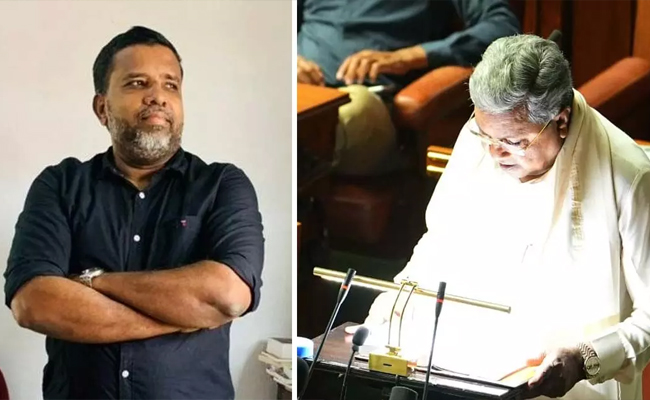
In a unique manner, Chief Minister Siddaramaiah quoted lines from a poem by B.M. Basheer, poet and News Editor of Vartha Bharati before the State Legislature on Friday.
Siddaramaiah, who was presenting the state budget for the current year, recited Basheer’s poem before announcing new initiatives on women and child development:
“Mother likes roses For she knows How difficult it is To bloom among thorns”.
source: http://www.english.varthabharati.in / Vartha Bharati / Home> Karnataka / by Vartha Bharati / March 06th, 2026
Bhatkal (Uttara Kannada District / Karavali , KARNATAKA :
The Editor of Naqsh-e-Nawayath, Mohammed Abdul Aleem Qasmi
The association of Bhatkal with the Arab world goes back to over a thousand years and this coastal town in Uttara Kannada takes immense pride in it. From clothes, perfumes to streets named after Arab cities, the Arab influence is visible. But one of the most enriching experiences of this tradition is the language of Nawayathi, which is a mix of Persian, Urdu, Arabic, Marathi and Konkani. The language is almost exclusive to Bhatkal, with only a few villages outside the town speaking this language. In the sixth of the nine-part series, Amit Kumar talks about the origins, history and legacy of Nawayathi and how it seeks to survive in the modern age.
“No matter where we go, we can identify our people. All it takes is a few words of Nawayathi,” says Maulavi Abdul Aleem Qasmi, the owner and editor of Naqsh-e-Nawayath, the only Nawayathi newspaper published in India. The 73-year-old resident of Bhatkal has been running the newspaper, published fortnightly, for the past 41 years, first as the owner and then as the editor after the demise of its founding editor Syed Abdul Rahim Irshad in 1996, after which the newspaper shifted from Mumbai to Bhatkal. Now run from an old building in Dubai market in Bhatkal, the fortnightly newspaper remains an important face of the language and the efforts to safeguard it. In fact, it is with a glint in his eye that Qasmi points out that even after all these changes, the newspaper, which has 16 pages, still sells about 3,000 copies per issue. About 80% of the copies are sent via post to its readers while the remaining are bought in the city. “The numbers have remained consistent and that makes me happy. The entire paper is proofread and published by two people,” he adds.
Bhatkalis offer a number of perspectives to now Nawayathi came into being. According to Qasmi, it is an amalgamation of nine languages (naw/nav=nine, ayath=language), although he is unable to suggest all the nine languages from which the language originated. In its current form, the language is closest to Konkani. Qasmi says that when the Arab traders came to India, a number of them settled here in Bhatkal due to its favourable climate and location. The descendants of these Arabs would later be identified as Nawayath.
The office of Naqsh-e-Nawayath, the only Nawyathi newspaper of India
While the language itself owed its roots to a number of languages, from the very beginning it used the Persian script. His newspaper, which once focussed on the most important news from the region, made the shift to more feature-based items over the past decade. “With the advent of the internet and the emergence of local websites and news channels, there was little for us in the form of news. So we now focus on Islamic teaching, columns from our readers and obituaries and marriages. In fact, now the obituaries and marriages sections are the main USP of our newspaper,” he adds.
Persian, Nawayathi and Urdu: How written documents evolved in Bhatkal
According to Maulana Abdul Aziz Kaziya, an expert on Nawayathi and a member of Nawayath Mehfil, an organisation which is working to restore the glory of the language, Nawayathi was not initially used in a written form. “Up to the 17th century, almost all our records and written material remained in Persian even though Nawayathi was the spoken language. It was only around the end of 17th century that the language began to be used in written form too in the Persian script. I have seen documents, contracts and official letters written from that period in Nawayathi,” he says. But with the 20th century, a new challenge faced the Bhatkalis. “When the Anjuman Hami-e-Muslimeen was established in 1919, they were faced with a decision,” says Kaziya. “They wanted to create an education system that would help students equip themselves with the modern world while retaining the core Islamic principles. So, they chose Urdu over Nawayathi and since then Urdu has become the de facto language of education here,” he adds. While it proved to be a positive for students, it nevertheless relegated Nawayathi to the status of a “home” language, Kaziya adds. “Even today, almost all families speak Nawayathi at home and amongst each other. But it was never, and is unlikely, to be taught in schools,” he says.
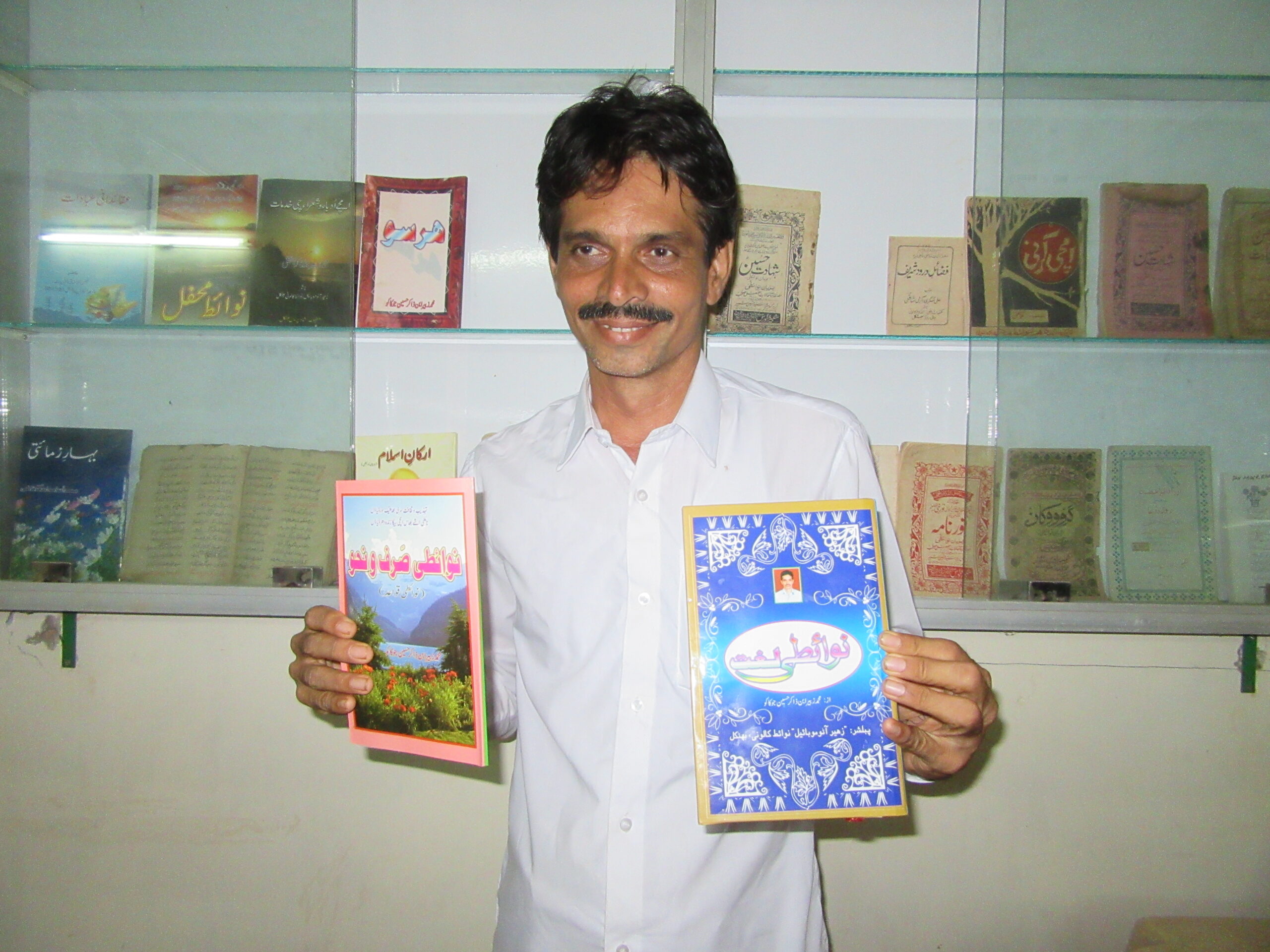
Mohammed Zubair Jukaku, who has written the first Nawayathi book on Grammar and a dictionary.
Scholars, poems and the future of the language
Aikage Sayyano-Khalabe Ismail (18th century): Nawayathi Dua
The original song has 143 verses. Here are the first ten.
Aikage Sayyano, mege sangta Allahche Pashi, Taufiq Mangta… Toge naito amige kiwro, Tekage waknuk napawe Iwro Toge postolo amchoge dhani Teka nai zodo upawanit koni Manat mokhat aslale to Zane Techege mazuk na-hale pane Izanak suzanak techege niamato Inwa gawrwa techege sifato Inauche gaurauche tekachge sazawar Techege athwen inauta janawar Mohammed nabiyacho karage wakan Allahge rakhnit tumchige Iman Gosacho mogyo amchege wari Yeko zan nahi techege pari Taikage fetaules amcher rabban Aplege kudrat ko karuk bayan Jibreel yawn teikage Sangile, Qur’an ghewn teicharge diwile
Translation: Listen, friends (female) I am going to tell you; I am going to pray to Allah for prosperity He is the master, we are the slaves; Words are not sufficient to praise him. He looks after us, he is our Lord; None is born equal to him. Whatever is in the mind and mouth (lips) he knows; Without his knowledge, the leaf does not move. His bounties are bestowed upon the small as well as the great; His attributes are to be found in both the rich and the poor. He is the only one fit to be praised and respected; His praises are sung by animals. Sing the praises of Prophet Muhammad; Allah will safeguard your faith. The Friend of God is unto us; There is no one like him. God sent him unto us; In order to reveal to us his Power. Gabriel came and revealed to him; He gave the Qur’an to him.
(From The Nawayaths of Kanara: Victor D’Souza, 1955)
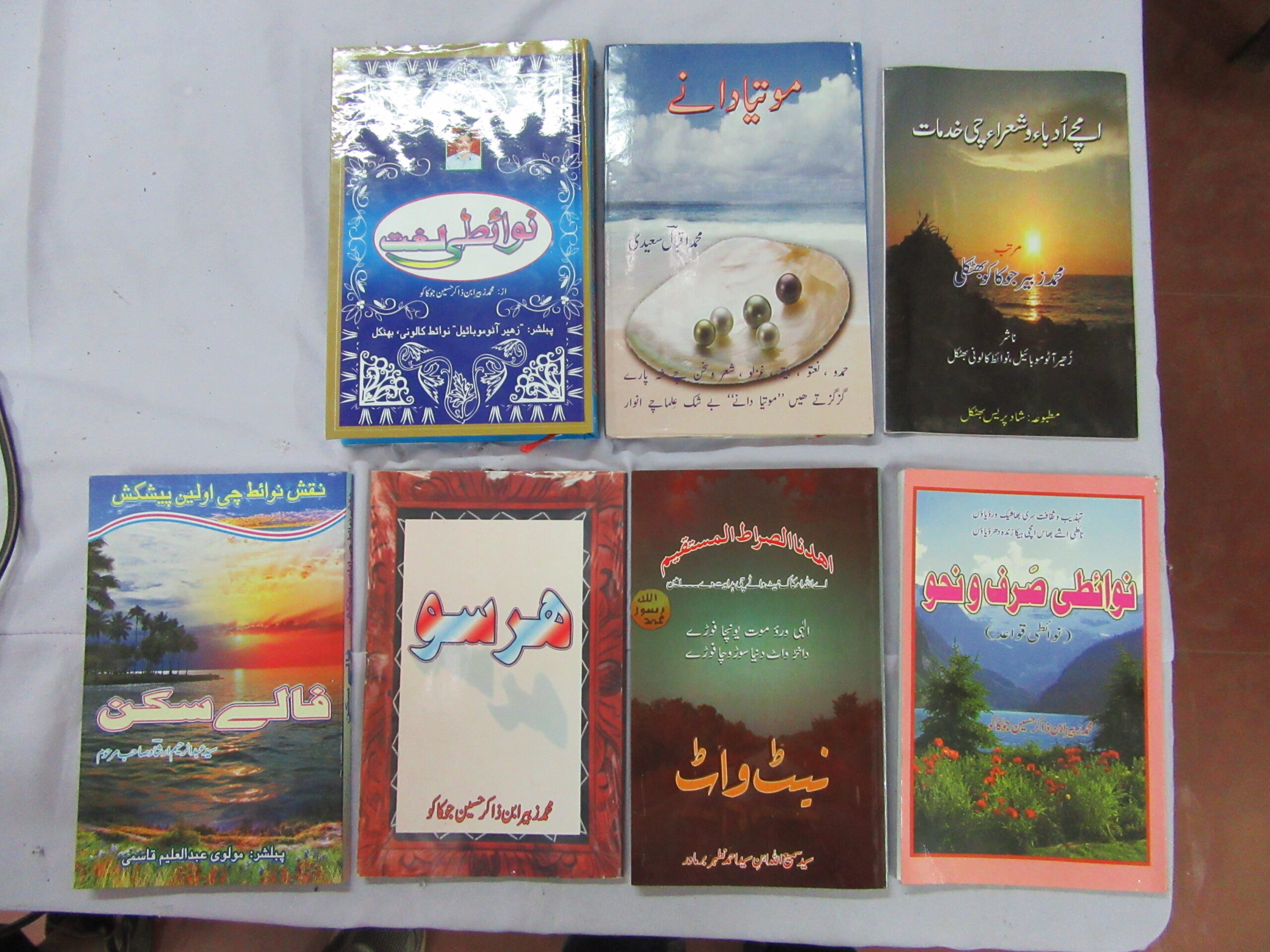
These lines are still taught to many children in Bhatkal as a dua (prayer). Nawayathi has been blessed with a number of eminent authors: Sairul Nisa, Maulud Nanna, Garvo Vakhan and Kaile Bayan among others, but you would struggle to find their books in Bhatkal today. The former editor of Naqsh-e-Nawayath, Syed Abdul Rahim Irshad is regarded by many as the most prominent author/contributor Nawayathi, and his book Faal-e-Sakhan is regarded as the first attempt to go beyond Islamic teachings/writings in Nawayathi and delve into the realm of imagination and poetry. However, you would be hard pressed to find a copy of even this book in Bhatkal.
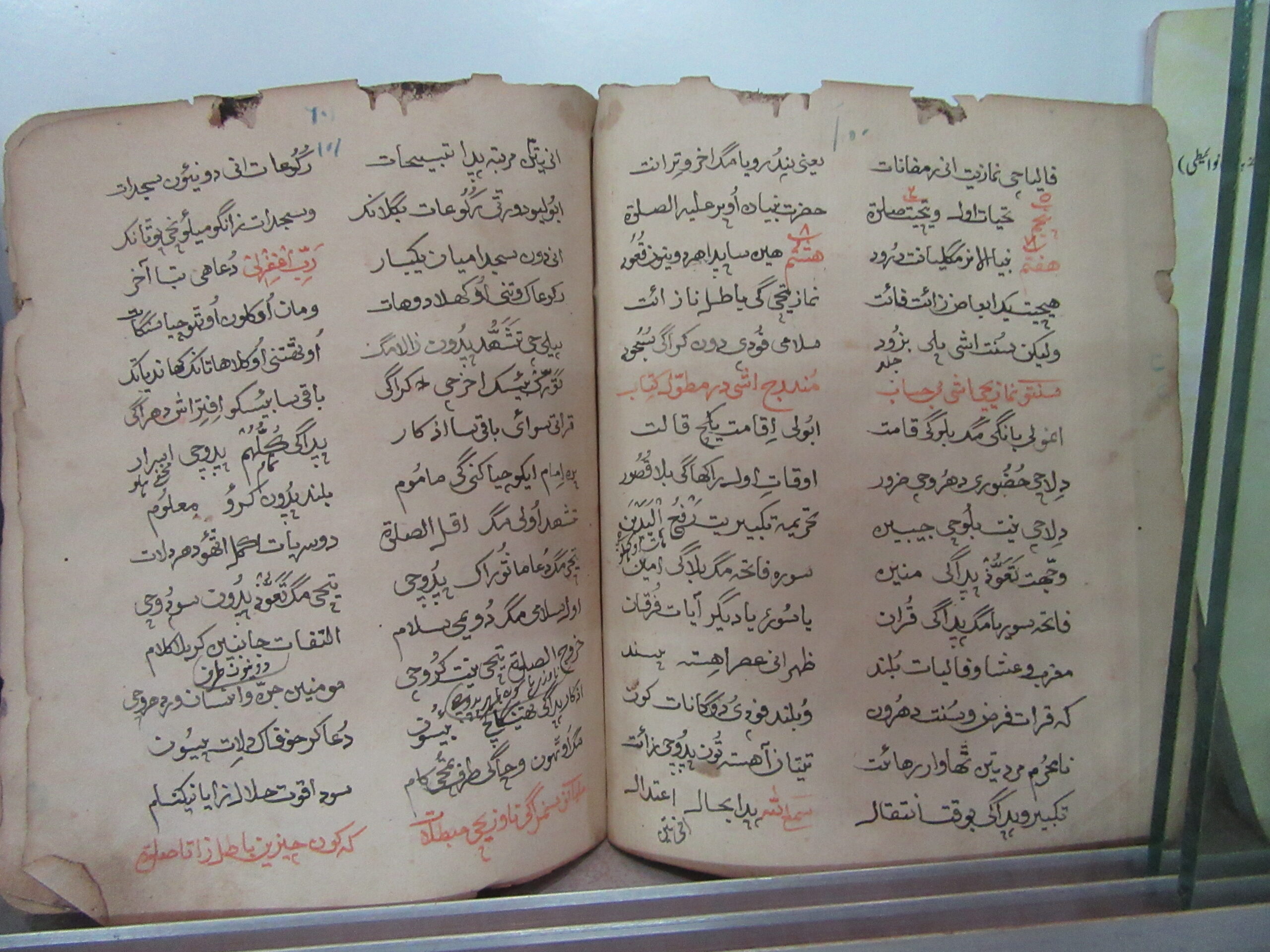
A manuscript of Nawayathi text preserved in the Nawayath Mehfil’s office.
While the language flourishes in the spoken form, it is clear that the same cannot be said of its written form and the literary works. According to Qasmi, the preference for Urdu and Arabic over Nawayathi has in some ways, negatively impacted the local language. “I doubt if the present generation has read much in Nawayathi since the local schools and madrasas give preference to Urdu, English and Kannada,” he adds.
In light of the decline in the status of Nawayathi, a committee called Nawayath Mehfil was formed about 12 years ago. Mohammed Zubair Jakaku, joint secretary of the Mehfil, has written four books in Nawayathi, including the language’s first-ever dictionary and a grammar book, says that there is an attempt to revitalise books written in Nawayathi, and that they are republishing old authors to ensure that these treasures are not lost forever.
A bunch of new books published in the Nawayathi language
The committee is working on reviving old Nawayathi texts along with working on a translation of Quran to Nawayathi. “We have Quran in 55 languages in our museum and I believe that a copy of the Nawayathi Quran will be a welcome addition to the same. This language is distinctly unique and a matter of pride for us. I hope we do justice to it,” says Qasmi. For now, the language looks safe in the hands of Bhatkalis and in a city that has been given undue attention for all the wrong reasons, it acts as a glue that keeps the society together.
source: http://www.twocircles.net / TwoCircles / Home>News / by TCN staff / January 24th, 2017
Bhatkal (Uttara Kannada District / Karavali), KARNATAKA :
Bhatkal:
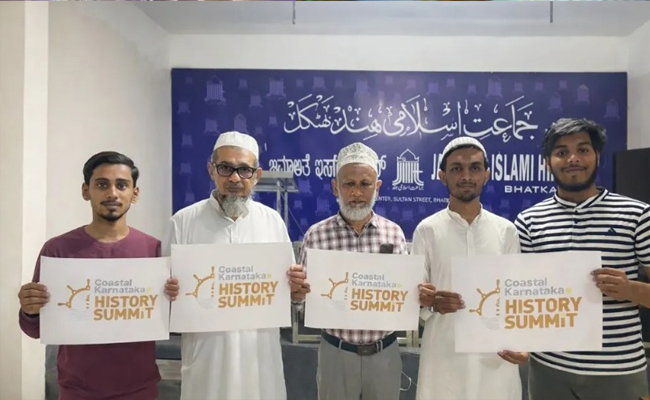
Preparations are under way for the upcoming Coastal Karnataka History Summit, with the official logo of the academic event unveiled at Dawat Centre by Students Islamic Organisation of India Bhatkal Unit in Bhatkal on February 22, 2026. The summit is scheduled to be held on May 5, 2026.
The initiative is being organised by the Centre for Education and Research & Analysis (CERA) with the aim of documenting and examining the historical evolution of Coastal Karnataka, including Uttara Kannada, Udupi, Dakshina Kannada and adjoining areas of Kasaragod.
At the launch event, the organisers released the official Call for Papers, inviting scholars, researchers, academicians and students to submit original and unpublished research.
Abstracts of 200 words, either in English or Kannada, must clearly mention the research question, methodology and key findings. The deadline for abstract submission is February 28, 2026. Selected participants will be informed by March 15, and full papers must be submitted by April 20.
The summit will centre around five broad themes. One section will explore the trade and economic networks of the coastal belt, including maritime routes, port towns, fisheries and commodity-based exchanges such as pepper trade. Another domain will examine social structures, caste formations and inter-community relations, along with the role of Islamic, Arab, Persian and local traditions in shaping the region’s cultural fabric.
A separate section will focus on the origin and growth of linguistic communities such as Tulu, Konkani, Beary, Moya Malayalam and Navayati.
Governance and administration under different rulers — including the Alupa dynasty, Rani Abbakka, Tipu Sultan, the Nawaith Sultans of Bhatkal and developments after Independence — will also be studied.
The fifth theme will highlight social reformers such as Narayana Guru, Syed Madani, Malik Deenar, Vakkom Moulavi, Sayyid Fazl Pasha and Kudmul Ranga Rao, and their contributions to education and social reform.
The logo launch programme was attended by senior journalist Dr. Haneef Shabab, JIH Bhatkal President Moulana Syed Zubair SM, SIO Bhatkal President Mohammed Zayan Bangali, Unit Secretary Githreef Rida Manvi and Media Secretary Mashaikh Talish.
Organisers said the summit intends to create a structured academic space for discussing the region’s layered past and bringing local histories into wider public and scholarly discourse.
For submissions and queries, researchers may contact coastalkarnatakahistorysummit@gmail.com.
source: http://www.english.varthabharati.in / Vartha Bharati / Home> Karavali / by Vartha Bharati / February 24th, 2026
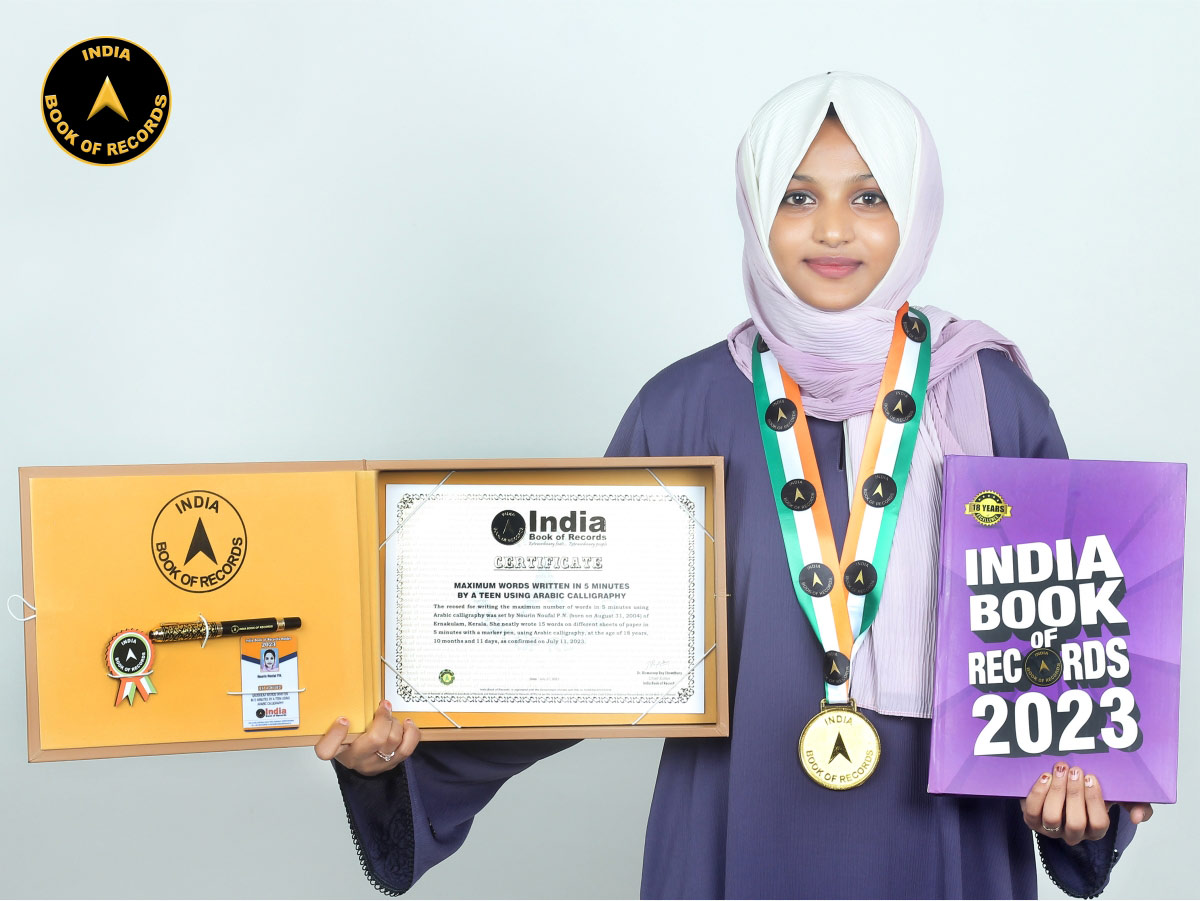
The record for writing the maximum number of words in 5 minutes using Arabic calligraphy was set by Nourin Noufal P.N. (born on August 31, 2004) of Ernakulam, Kerala.
She neatly wrote 15 words on different sheets of paper in 5 minutes with a marker pen, using Arabic calligraphy, at the age of 18 years, 10 months and 11 days, as confirmed on July 11, 2023.
source: http://www.indiabookofrecords.in / India Book of Records / Home> Human Story / by IBR Team / August 18th, 2023
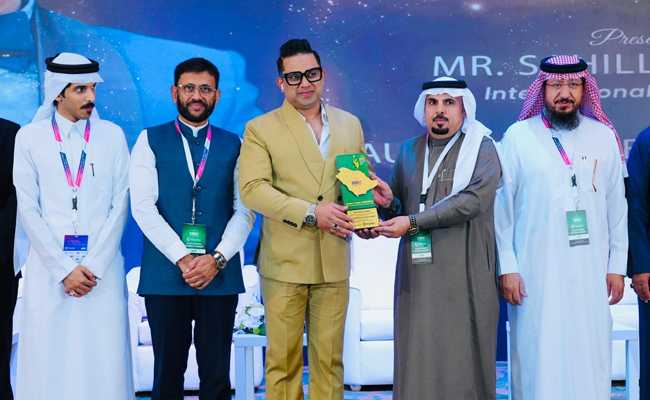
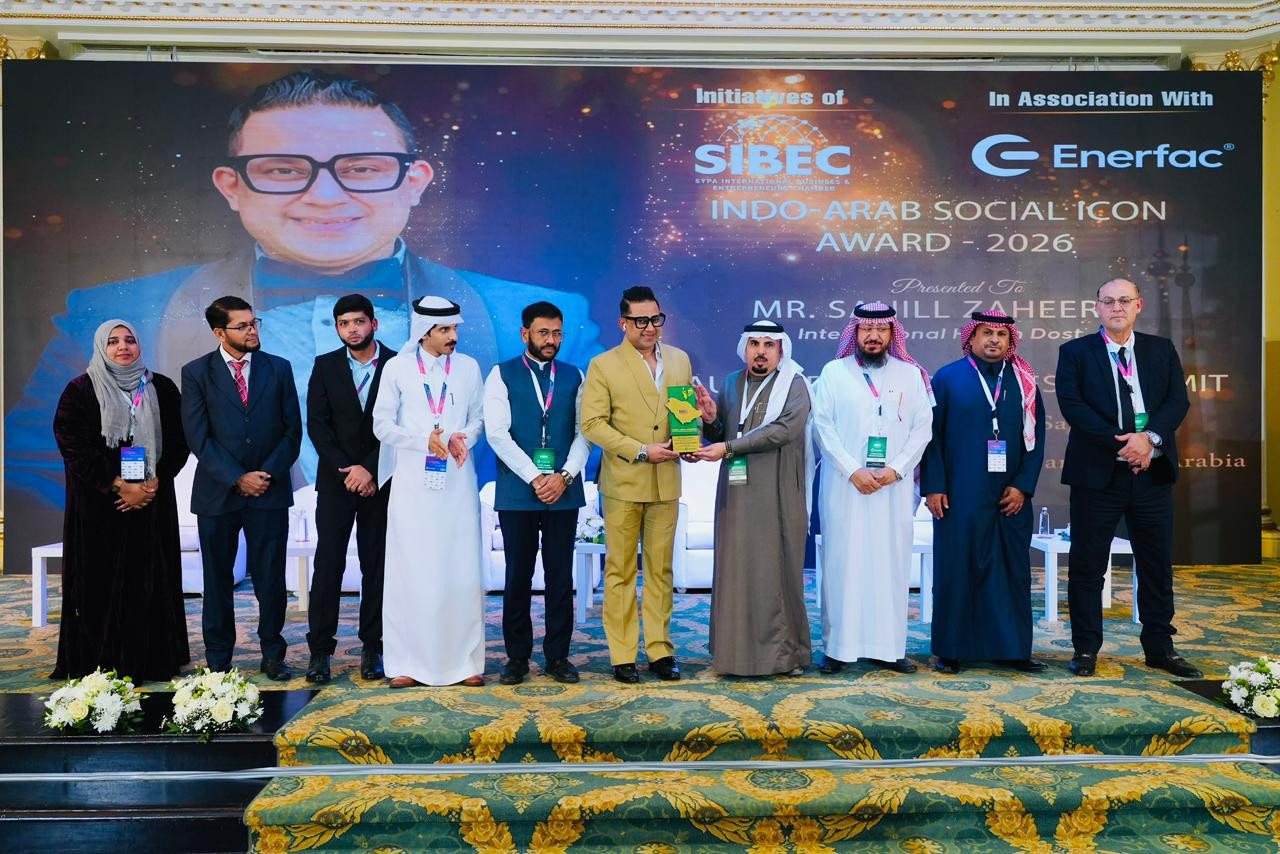
International host Sahill Zaheer was honoured with the Indo Arab Social Icon Award at an international gathering held in Al Khobar on February 7, where the Saudi Arabia Chapter of SIBEC – SYPA International Business & Entrepreneurs Chamber was officially launched.
SIBEC is a global business and economic collaboration platform that brings together entrepreneurs, investors and professionals to strengthen cross-border partnerships. The Saudi chapter launch was organised in association with Enerfac Solutions.
Enerfac Solutions, led by CEO Nazurudin Ahamed and Director Sivaprakash Umapathy along with its board members and team, describes itself as a company focused on ethical business practices and inclusive growth. The organisation has been supporting entrepreneurs, small and emerging businesses as part of its CSR initiatives, while encouraging partnerships and industry development. Company representatives said its approach centres on responsible business and ensuring that growth benefits the wider community.
Sahill Zaheer, who works as a host and event manager, has earlier been associated with Namma TV as a VJ and with Radio Mirchi 98.3 FM as an RJ. Over the years, he has hosted national and international shows, corporate events and award functions. He has shared stage space with singers such as Sonu Nigam, Udit Narayan and Shreya Ghoshal. He has also anchored events connected to cricket tournaments, including T10 and T20 formats and IPL-related programmes.
Recently, he hosted the Festival of Cricket – Women’s Edition in Al Khobar, described as the first women’s cricket celebration of its kind in the Kingdom of Saudi Arabia.
The award was presented in recognition of his contributions as a host and his involvement in international events connecting Indian and Arab audiences.
In the bustling streets of Jaipur at Haldio Ka Rasta, Johari Bazar, time suddenly seems to stand still. Amidst ancient stone walls, arched doorways and the stillness of history, stands the Salim Manzil, a majestic building which is a living legacy of more than two centuries.
The mansion houses a relic – a cap of Imam Hussain, the grandson and son-in-law of the Prophet Muhammad; it adds to its importance.
The story behind the ‘blessed cap’ reaching the haveli is interesting and part of its rich history.
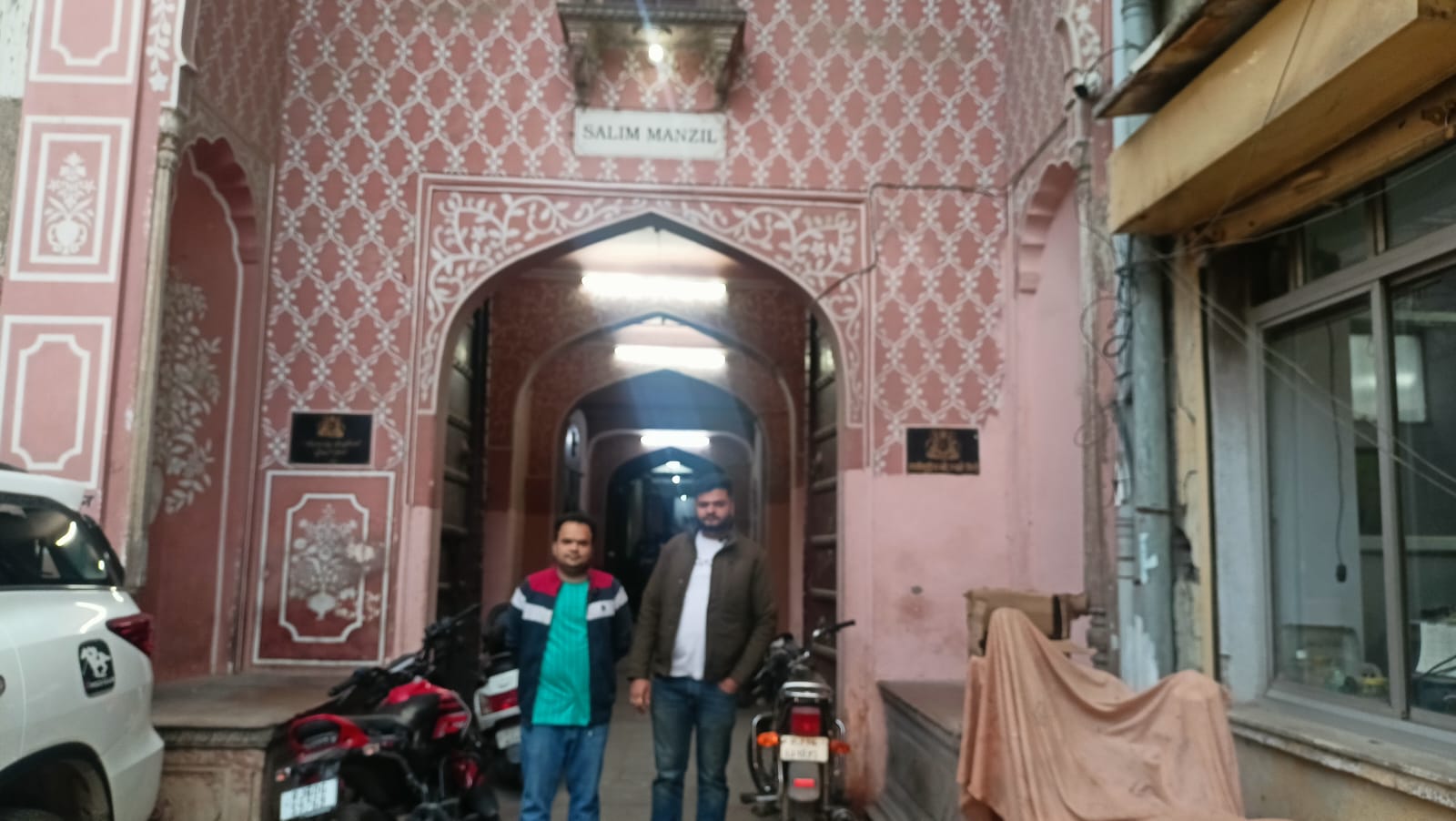
The entrance to Salim Manzil
In the early 17th century, an ancestor of today’s inmates of Salim Manzil treated an Iranian king. The King wanted to reward him with gold, silver and valuable gifts, but he declined the offer and instead requested the cap of Hazrat Imam Hussain.
The King presented the relic and a certificate with the royal seal to him as a reward.
Since 1876, this blessed hat has been preserved in Saleem Manzil in a special glass-framed box kept in a hall called “Kala-e-Mubaraq”.
Every year on the 9th and 10th of Muharram, it is opened to the public. In those days, Salim Manzil is turned into a pilgrimage centre, and its air filled with spirituality.
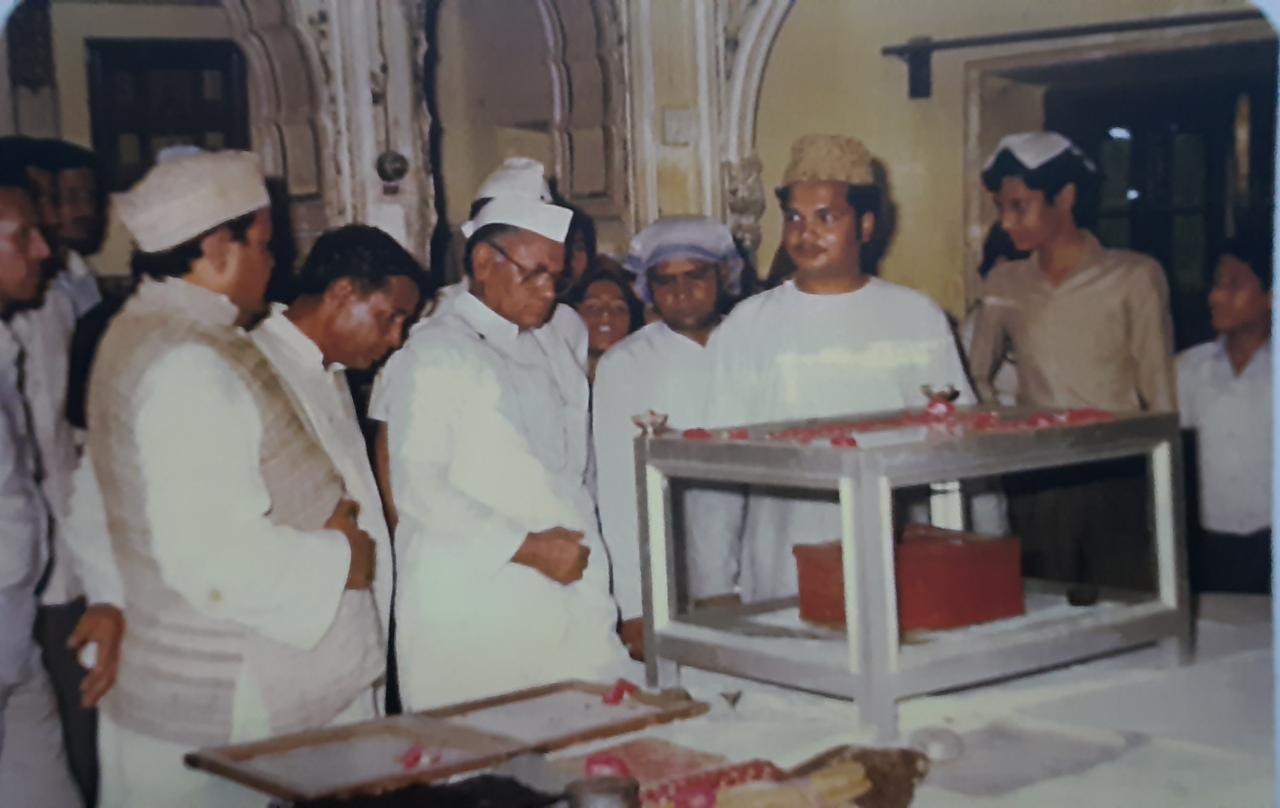
People viewing the Blessed Cap of Hazrat Imam Ali
Today, Moinuddin Khan, 33 and his younger brother, Hussamuddin Khan, 27, are living in the mansion. The two brothers are not only maintaining this legacy, but also modernising its upkeep and display of artefacts.
Moinuddin Khan says that his ancestors came to Jaipur from Delhi around 1812 AD. At that time, Maharaja Jagat Singh of Jaipur State granted them a fiefdom and honour to his elder brother, Hakim Wasil Ali Khan.
This honour was for Wasil Ali Khan’s academic and medical expertise, and he was admitted to the Royal Court. One of the ancestors was the head of the intelligence department of Jaipur State, a sensitive position. He was responsible for the State’s security, political activities and gathering information needed for administration.
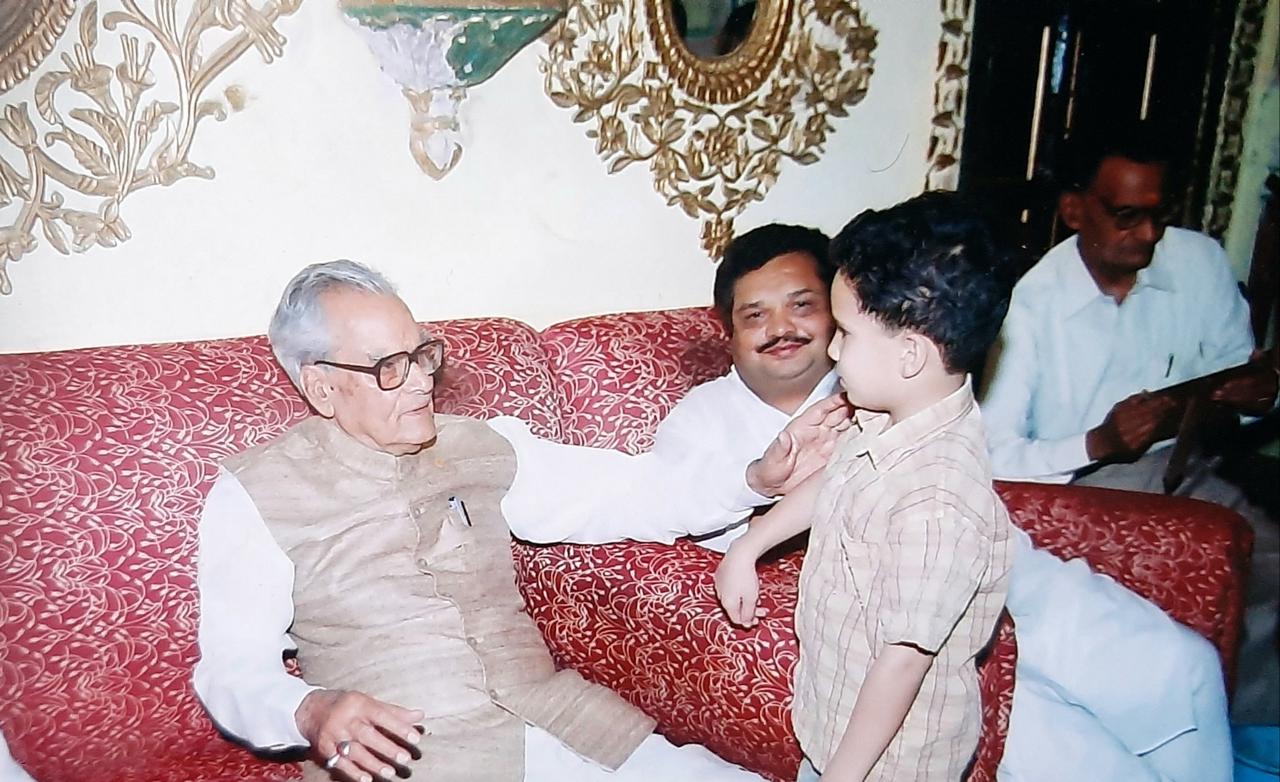
Bharion Singh Shekhawat with the inmates of Salim Manzil
Later, his son, Salim Ali Khan, worked in the same position.
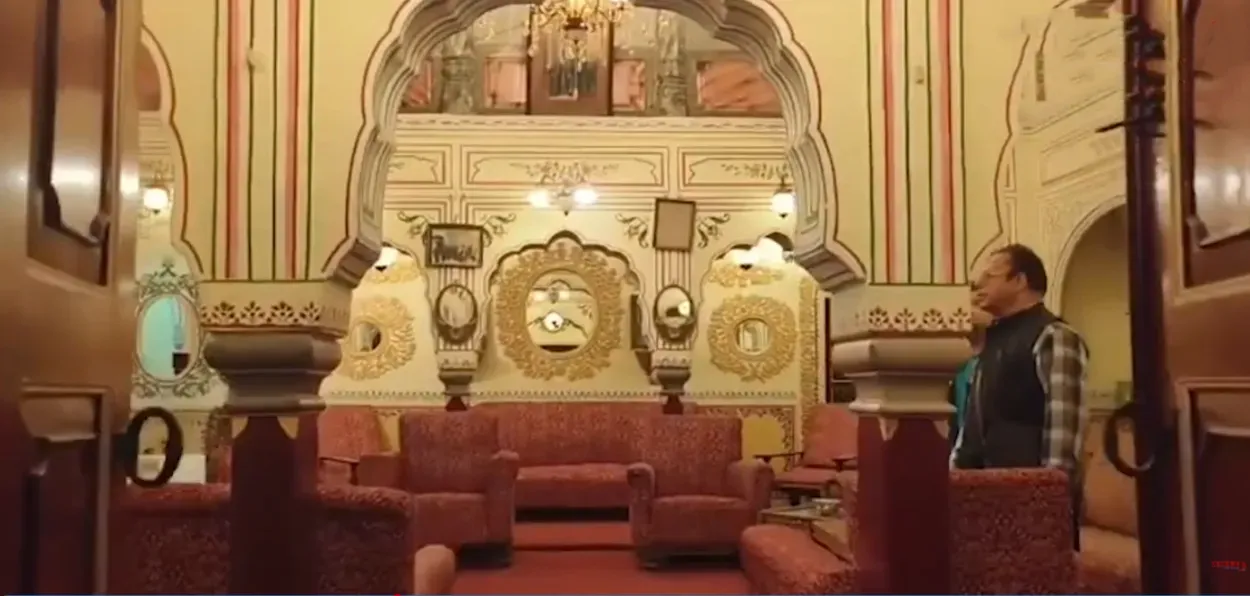
The construction of Saleem Manzil began in 1867, and it was completed within three years. Spread over an area of about a bigha, the building was gifted by the Maharaja of Jaipur. Even today, the haveli’s traditional Rajasthani carvings, arches, high ceilings and lattice windows are a testimony to the architectural craftsmanship of that era.
Over time, many havelis were converted into commercial hotels, but Saleem Manzil retained its original identity. The family also received offers to convert it into a hotel, but they preferred to preserve the spirit of the heritage rather than market it.
Visitors inside the Salim Manzil
The mansion has been used as a set by many filmmakers for movies and web series. Moinuddin says he acted for the role of Sri Krishna in one of the web series. “We have a strong foundation in religion, but we also remain connected with art and dialogue.”
A large hall is decorated, the rooms are filled with the fragrance of perfume and roses, and the pilgrimage begins with Milad Sharif.
Devotees from Gujarat, Maharashtra and other parts of the country also arrive here. In those days, Shia Muslims read prayers and distribute Tabarak.
Moinuddin says that we consider it more of a trust than an inheritance. It is both an honour and a responsibility for us.
Many important persons have visited Salim Manzil. They include President Giani Zail Singh, Chief Ministers Haridev Joshi and Shiv Charan Mathur, Bhairav Singh Shekhawat (Vice President), Natwar Singh (Minister), Najma Haibabullah (Rajya Sabha Chairperson), and Supreme Court Justice Gyan Sudha Mishra.
Head of the family, late Naseemuddin Khan, popularly known as Pyare Mian, founded the All-India Hakeem Ajmal Khan Memorial Society to perpetuate his family’s legacy of Unani medicine and social service.
Today, Moinuddin and Husamuddin Khan are trying to connect this heritage with modern dialogue. They are planning to build a new hall for better management of the pilgrimage during Muharram.
They are sharing information about this heritage with the world through social media and digital means for transparency.
Amid myriad historic monuments of Jaipur, Salim Manzil is unique since it not only preserves the relics of history but is also a pilgrimage centre.
source: http://www.awazthevoice.in / Awaz, The Voice / Home> Stories / by Farhan Israeli, Jaipur / February 21st, 2026