Category Archives: Bharat Ratna, Padma Vibhushan, Padma Bhushan, Padma Shri Award (since January 01st, 2024)

I received my wages for hard work of decades: Ghafruddin on Padma Shri

Alwar, RAJASTHAN :

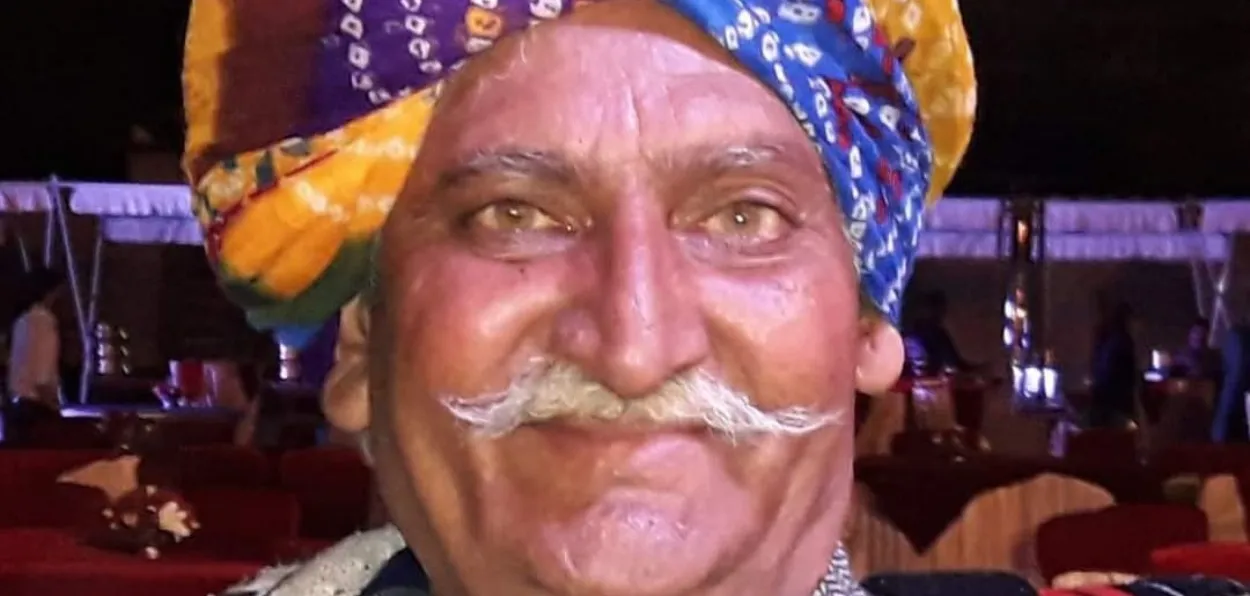
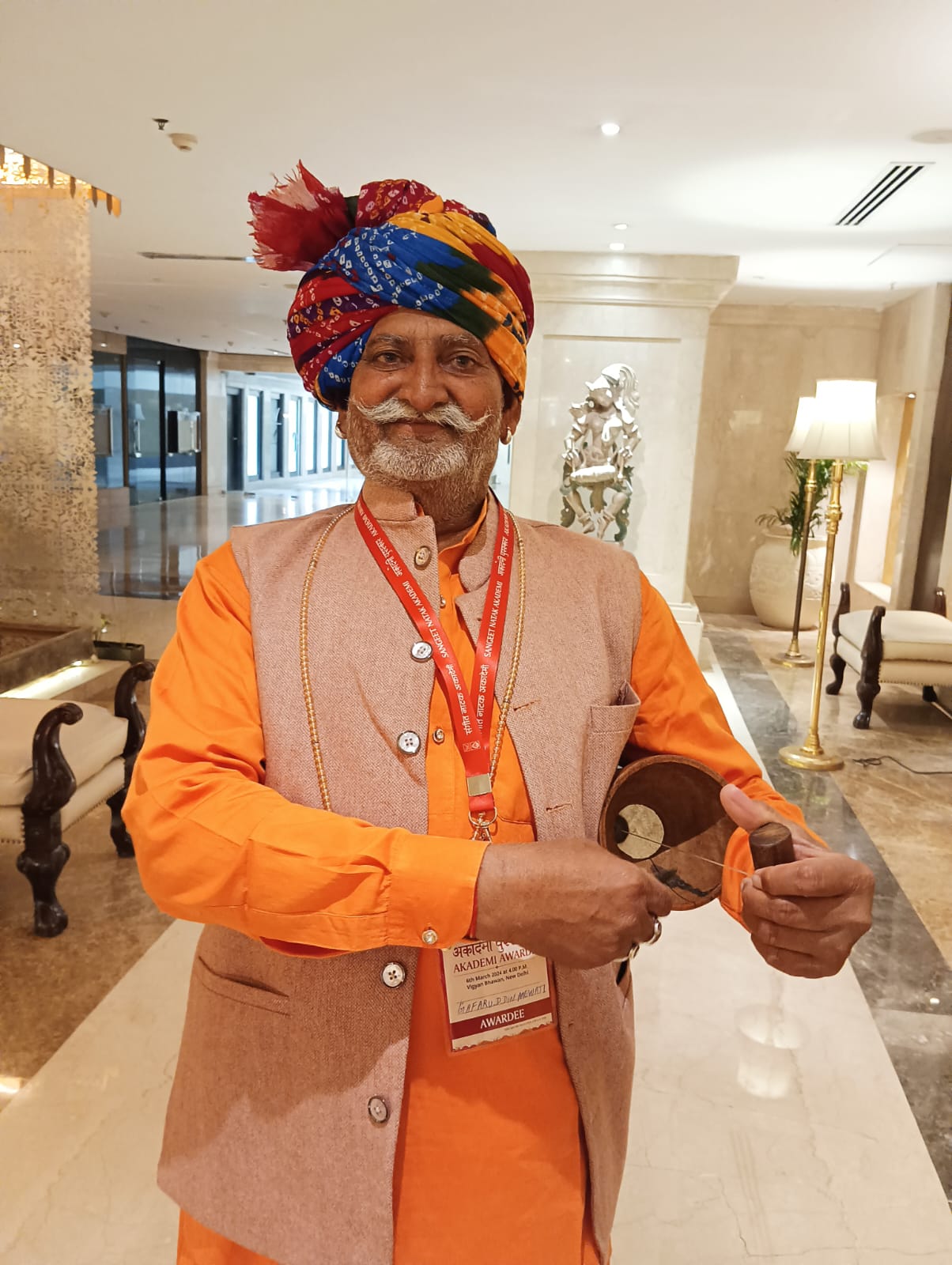
Gafaruddin Jogi Mewati

My joy is like that of a labourer who goes to work in the morning and receives his wages the same evening,” said Ghafruddin Jogi Mewati, a traditional singer, who has been selected for this year’s Padam Shri award by the government of India.  

Ghaffaruddin, 68, has showcased his art for more than half a century, from the rugged lanes of Mewat to the seven seas. As soon as the announcement of the coveted award poured in, Ghafruddin, a resident of Alwar, was overwhelmed with emotion.
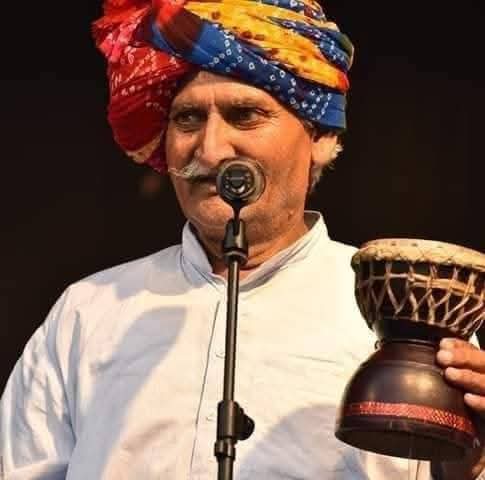
Memories of him wandering barefoot through the villages of Mewat, playing the bhapang (A traditional string instrument) and begging for flour, flashed in his mind. Today, he feels that he has received the wages for all that hard work he did to keep a traditional art form alive.

He feels the Padam Shri is not just an honour for an individual, but for the centuries-old Mewati culture, the legacy of the Jogi community, and the rhythm of the bhapang, which is on the verge of extinction.

The Mewat region, which straddles the borders of Haryana and Rajasthan, possesses a unique identity as a syncretic culture.

Here, the Jogi community, who are Muslims, has, for generations, sung episodes from the Mahabharata and other folk tales.

#WATCH | Folk artist Gafruddin Mewati Jogi, awarded the Padma Shri in the field of art, said the honour marks the culmination of a lifelong struggle.


He recalled learning and preserving the art by travelling with his father, passing it on to others, and continuing the… pic.twitter.com/xiYDWTOqSQ— DD News (@DDNewslive) January 26, 2026

Ghafruddin is one of the strongest exponents of this tradition. He says, “Stay connected to your language, culture, and folk art; that is our true identity.” For him, this honour is a debt he owes to the soil of Mewat, which nurtured him during his days of struggle.
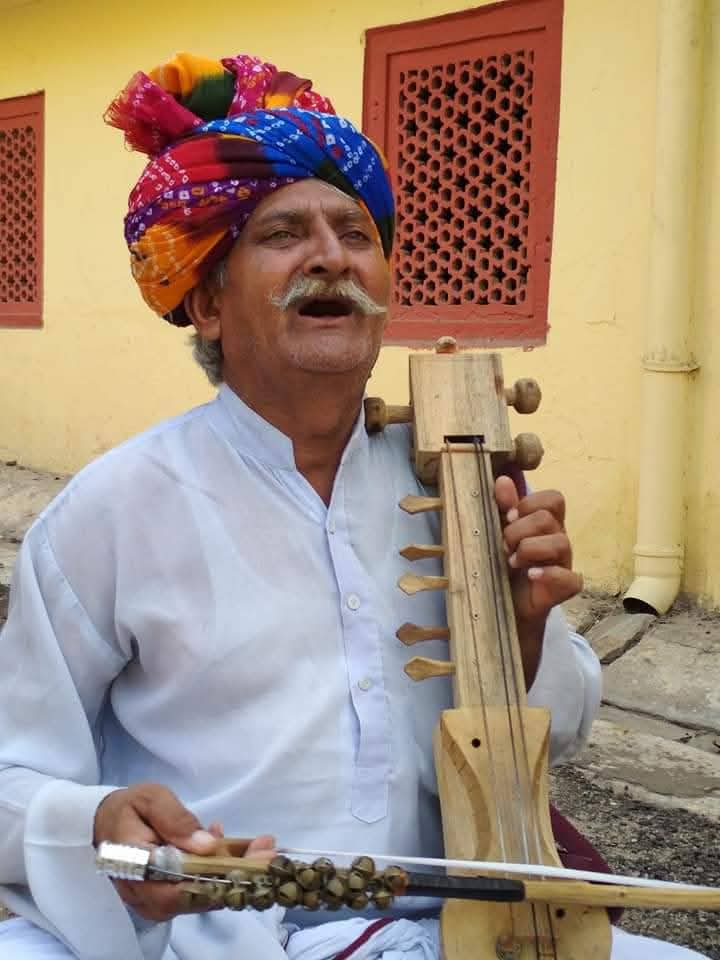
Born in Kaithwara village in the Deeg district of Rajasthan, Ghafruddin’s childhood was no less dramatic than a film script. His father, the late Budh Singh Jogi, was an accomplished artist. At the tender age of four, when children usually play with toys, his father placed a ‘bhapang’ in Ghaffaruddin’s hands.

The Bhapang, which resembles a small drum but has a single string, is considered an evolved form of Lord Shiva’s damru (a small hourglass-shaped drum). Playing it requires an extraordinary coordination of abdominal muscles, fingers, and vocal rhythm.

As a child, he learned by travelling from village to village with his father, sitting in village squares, and listening to folk tales.

They had to beg for grain and flour in villages to support the family. Those were difficult days, but the rhythm of the Bhapang never let him lose hope.

The most significant aspect of Gafruddin Jogi’s art is his rendition of the Mahabharata. Remarkably, a Muslim artist sings the epic of Lord Krishna and the Pandavas with such devotion and purity that the listener is completely captivated. Alwar and the surrounding areas are historically linked to ‘Viratnagar,’ where the Pandavas spent their period of exile.

When Gaffaruddin narrates these folk tales in the Mewati dialect, history comes alive. His art has proven that music and culture know no religious boundaries.
The year1992 marked a major turning point in his life. He travelled abroad and performed for the first time. There has been no looking back since then.

He carried the sound of Bhapang to over 60 countries, including England, Australia, Canada, France, and Dubai. When he played Mewati folk tunes at an event celebrating Queen Elizabeth’s birthday in London, even the foreign audience was captivated by the magical rhythm.

When the call on his mobile came, he initially thought someone was playing a prank on him, but when the news was confirmed, he was emotional. He dedicated the award to the Mewat region and the Jogi community.

#WATCH | Alwar, Rajasthan: On being conferred with the Padma Shri 2026 in the field of art, folk artist Gafruddin Mewati Jogi says, “I am very happy that the struggle of my life has finally yielded results, and I have received this recognition… For seven years, I went from… pic.twitter.com/66UQBRb4W5

— ANI (@ANI) January 25, 2026

Today, the eighth generation of his family is carrying on this art form. His son, Dr Shahrukh Khan Mewati Jogi, has not only learned music but also earned a PhD on the culture of Mewat. While many traditional art forms are fading away, Ghaffaruddin’s family is keeping this flame alive.

Ghafruddin Jogi Mewati wants to open a school for folk arts. He wants the government to provide him with land where he can teach the new generation the art of playing the Bhapang, Mewati folk singing, and their traditional stories.

He says that if the younger generation does not stay connected to its roots, we will lose our identity. He says receiving the Padma Shri is not the destination for him, but the beginning of a journey that he wants to continue until his last breath.

source: http://www.awazthevoice.in / Awaz, The Voice / Home> Stories / by Younus Ali, Alwar / January 28th, 2026

Muslim Mirror Releases List of 100 Most Influential Indian Muslims 2025; Young Faces Gain Prominence

INDIA :

Muslim Mirror’s 100 Most Influential Muslims of 2025

New Delhi: 

Muslim Mirror has released its much-anticipated annual list of the “100 Most Influential Indian Muslims of 2025,” spotlighting individuals who have made significant contributions to India’s public life across a wide spectrum of fields including politics, culture, education, business, media, religion, sports, and social service. Now in its second edition, the list aims to document influence not merely as power or popularity, but as sustained impact, leadership, and the ability to shape public discourse.

A defining feature of the 2025 edition is the growing prominence of younger achievers, signalling a visible generational shift within Indian Muslim leadership. Alongside established national figures, the list includes emerging voices who have built influence through grassroots activism, professional excellence, digital platforms, legal advocacy, education, and community engagement. Editors associated with the project said this was a deliberate attempt to recognise new centres of influence beyond traditional hierarchies.

The list reflects the diversity and plural character of Indian Muslim society, cutting across geography, ideology, profession, and language. From seasoned politicians and religious scholars to artists, entrepreneurs, academics, and social reformers, the compilation offers a broad snapshot of leadership trends at a time when issues of representation, constitutional values, and social justice remain central to national debate.

Representation Across Sectors

The 2025 list features several eminent academicians and intellectuals who have shaped higher education, policy discourse, and social research. Among them are Abul Qasim Nomani, Ameerullah Khan, Furqan Qamar, Shahid Jamil, and Ubaid-ur-Rahman, recognised for their contributions to education, public policy, and academic leadership.

In the business and entrepreneurship category, the list includes influential names such as Azad Moopan, Azim Hashim Premji, Farah Malik, Irfan Razack, M. P. Ahammed, Mecca Rafiq Ahmed, Meraj Manal, Syed Mohamed Beary, P. Mohammed Ali, Shahnaz Hussain, Tausif Ahmad Mirza, Yusuff Ali, and Ziaullah Sharif. Their inclusion underlines the growing economic footprint of Indian Muslim entrepreneurs, both domestically and globally, spanning sectors from retail and healthcare to infrastructure and consumer goods.

Community leadership remains a strong pillar of the list, with figures such as Arshad Madani, Mahmood Madani, Malik Motasim Khan, Mehmood Pracha, Syedna Mufaddal Saifuddin, Navaid Hamid, Pirzada Md Abbas Siddiqui, Qasim Rasool Ilyas, Sadatullah Husaini, Umer Ahmed Ilyasi, and Yusuf Mohamed Abrahani recognised for their roles in religious guidance, legal advocacy, social mobilisation, and institutional leadership.

Culture, Media, and Public Discourse

In arts and entertainment, globally recognised names such as A. R. Rahman, Aamir Khan, Mammootty, Munawar Faruqui, and Shah Rukh Khan continue to command immense cultural influence, shaping narratives that extend well beyond cinema and music into social consciousness.

The list also acknowledges the growing importance of media and journalism in shaping opinion and challenging dominant narratives. Journalists and commentators such as Arfa Khanam, Irfan Meraj, and Seema Mustafa are recognised for their consistent engagement with issues of democracy, minority rights, and constitutional values.

Religious and Intellectual Scholarship

A significant section of the list is devoted to Islamic scholars and religious thinkers, reflecting their continued influence on moral leadership and intellectual discourse. Names such as A. P. Aboobacker Musliyar, Qasim Nomani, Prof. Akhtarul Wase, Asghar Ali Imam Mahdi Salafi, Asjad Raza Khan, Ibraheem Khaleel Al-Bukhari, Javed Jamil, Khalid Saifullah Rahmani, Khaleelur Rahman Sajjad Nomani, Qamaruzzaman Azmi, Rashid Shaz, Shakir Ali Noori, Shamail Nadvi, and Yasoob Abbas find place for their scholarly work, writings, and public engagement.

Politics and Governance

The political category features leaders cutting across party lines and regions, including Asaduddin Owaisi, Ghulam Nabi Azad, Hamid Ansari, Mehbooba Mufti, Omar Abdullah, Salman Khurshid, Najeeb Jung, Syed Naseer Hussain, Engineer Rashid, Akhtarul Iman, Iqra Hasan, Zameer Ahmed Khan, Rakibul Hasan, K. Rahman Khan, Kadir Mohideen, Mohibullah Nadvi, Md Shafi, Agha Mahadi, Asim Waqar, and Sadiq Ali Shihab Thangal. Their inclusion reflects influence exercised through electoral politics, governance, diplomacy, and legislative advocacy.

Changemakers and Social Reformers

One of the most dynamic sections of the 2025 list is that of changemakers and social reformers, featuring individuals such as Safeena Husain, Shahabuddin Yaqoob Quraishi, Syeda Hameed, Zameer Uddin Shah, Mahbubul Hoque, Sabahat S. Azim, Mehmood Pracha, Faiz Syed, and Zahir Ishaq Kazi, among others. Many of these figures have earned recognition through long-term grassroots work rather than formal authority.

International Booker Prize 2025 winner Banu Mushtaq for Heart Lamp, along with renowned poet Wasim Barelvi, has been placed in the category of Literary Figures.

In sports, iconic names Sania Mirza and Irfan Pathan continue to inspire younger generations through excellence and public engagement beyond the playing field.

Beyond Rankings

The editors emphasised that the list does not claim to be exhaustive, nor does it measure influence solely through fame, wealth, or official position. Instead, it seeks to capture real-world impact, moral authority, intellectual contribution, and the ability to shape conversations within and outside the community.

The annual list has increasingly become a reference point for understanding evolving leadership patterns among Indian Muslims. By foregrounding both established figures and rising talents, the 2025 edition reflects continuity as well as change, underscoring how Indian Muslims continue to contribute meaningfully to India’s democratic, cultural, and social field.

source: http://www.muslimmirror.com / Muslim Mirror / Home> Indian Muslim / by Muslim Mirror / January 15th, 2026

How KA Abbas gave Amitabh Bachchan his big break in ‘Saat Hindustani’

Panipat (Undivided India), HARYANA / Mumbai, MAHARASHTRA :

Multi-hyphenate talent Khwaja Ahmed Abbas worked in Urdu, Hindi and English and across writing mediums. Abbas, who died in 1987 at the age of 71, wrote social realist screenplays for Raj Kapoor and V Shantaram, directed films, published short stories and plays,and contributed a long-running weekly newspaper column. Among the best-known films he directed are Neecha Nagar, Sheharaur Sapna and Saat Hindustani. Set in Goa and tracing the efforts of seven revolutionaries to free the state from Portuguese rule, Saat Hindustani marks the debut of Amitabh Bachchan. An essay from the anthology Bread Beauty Revolution, edited by Iffat Fatima and Syeda Hameed, relates Abbas’s encounters with the “tall young man” and future screen icon. Bread Beauty Revolution includes writings from Abbas’s memoir I Am Not An Island: An Experiment in Autobiography as well as essays, stories,poems, photographs and columns.

The story of Saat Hindustani came out of the Goa struggle reminiscences of my assistant, Madhukar, who would often regale us with the adventures he had while trekking up with the non-violent commandos to hoist the tricolour on every police station they came across…

I was so excited when I finished the screenplay that I telephoned all my friends and informed all my assistants, including Madhukar, to come and hear it in my fourth floor office on the very next day. That was a ritual which they never missed and I would get their suggestions for casting the film.

I wanted to prove by my casting that there was no particular Hindu or Muslim, Tamilian, Maharashtrian or Bengali ethnic type. To begin with, I would transform the smart and sophisticated and versatile Jalal Agha into the Maharashtrian powada singer. Even Jalal was shocked to hear this. But I reassured him that, with the proper make-up and get-up, nobody would recognize him except as a rural Maharashtrian folk singer. Madhukar, who hails from Meerut, would be a Tamilian; Sharma (Brahmin by caste) would also undergo a similar transformation; and Utpal Dutt, the cigar-chewing admiral,would be the tractor-driving Punjabi farmer. So far the casting was clear in mymind. On one of my visits to Kerala I had met Madhu, the handsome hero of the Malayalam screen, and he had approached me and expressed his desire to work in a Hindi film with me. I would make him the sensitive Bengali; I wouldn’t have to work much on his Bengali accent for he had lived with a Bengali family. Now only the Hindi and Urdu fanatics were left. Jalal one day brought with him his friend Anwar Ali (brother of the comedian Mehmood), in whose eyes I saw the Jana Sanghi fanaticism. So I decided to make him the Swayam Sevak who hates Urdu and speaks jaw-breaking Hindi. That left one Indian, the Muslim Urdufanatic. Since I wanted these boys to be of different ages and different heights, the one vacancy left was for a tall and handsome man. He had to be thin, also corresponding to the thin image of my friend, the late Asrarul Haque “Majaz”.

One day someone brought a snapshot of a tall young man and I thought that the boy was in Bombay. I said, “Let me see him in person.” “He will be here day after tomorrow evening.” Again, presuming he was in Bombay, I thought he must be working somewhere and wouldn’t be free till the evening. On the third day, punctually at 6 pm, a tall young man arrived who looked taller because of the churidar pajama and Jawahar jacket that he was wearing. This young man would one day be known as Amitabh Bachchan, the heart-throb of millions. But I did not know his name. Roughly, the following dialogue took place between us:

“Sit down, please. Your name.”

“Amitabh.” (Not Bachchan.)

It was an unusual name — so I asked, “What does it mean?”

“The sun. It’s also one of the synonyms for the Gautama Buddha.”

“Education?”

“B.A. from Delhi University.”

“Have you worked in films before?”

“No one has taken me so far.”

“Who were they?”

He mentioned very prominent names.

“What did they find wrong with you?” The boy spoke with frankness. “They all said I was too tall for their heroines.”

“Well, we have no such trouble. In a way we have no heroine in our film. Even if we had, that wouldn’t prevent me from taking you.”

“Taking me? Are you really going to take me? Without even a test?”

“That depends. First I must tell you the story. Then I must tell you your role and see if you will be enthusiastic about playing it. Then I shall tell you what we can afford to pay you. Only then, if you agree, shall we sign the contract.”

I read him out the complete story and saw his face become alive with interest. I asked him which role he would like to play. He told me the two which particularly impressed him. The role of the Punjabi, and the role of the Muslim. I told him he was perhaps a Punjabi, and that made him unfit to play that role. He asked me why. I gave him the reason, the reason for having a scrambled cast. The idea appealed to him greatly. He said, “I think, I know what you mean. Then I would like to play the Muslim role, specially because he is under a cloud of suspicion. And only at the end the suspicions are removed and he is proved a patriot.” Then I told him we could pay him no more than five thousand rupees,which was the standard figure for all the roles.

He seemed a little hesitant, and I asked him, “Are you earning more than that?”

“I was,” he said.

I asked him what he meant.

He said that he was getting about sixteen hundred a month in a firm in Calcutta.

“I resigned the job and came over.”

I was astonished. “You mean to say that you resigned a job of sixteen hundred rupees a month, just on the chance of getting this role! Suppose we can’t give the role to you?”

He said, “One has to take such chances” with such conviction that I said, “The role is yours.”

Then I called my secretary, Abdul Rehman, to dictate the contract. I asked the tall young man for his name and address.

“Amitabh—” after some hesitation, “Amitabh Bachchan, son of Dr H.R. Bachchan.”

“Stop,” I said. “This contract cannot be signed until I telegraph and get your father’s consent. He is a colleague of mine on the Sovietland Nehru Award Committee. I wouldn’t like to have a misunderstanding with him. I am afraid you will have to wait for two days more.”

“You can ask my Dad, but frankly, do I look like a runaway?”

I told him that runaways don’t have any particular look. So I dictated, instead of the agreement, a telegram to Dr Bachchan in New Delhi and asked him if he was willing to let his son become an actor. Two days later a telegram came reading “No objection where you are concerned.” This is the whole story about how Amitabh Bachchan came into films.

Excerpted with permission from Bread Beauty Revolution, edited by Iffat Fatima and Syeda Saiyidain Hameed, Khwaja Ahmed Abbas Memorial Trust and Tulika Books.

source: http://www.scroll.in / Scroll.in / Home> Book Excerpt / by Khwaja Ahmed Abbas / November 14th, 2015

Begum Qudsia Rasul must get her place in history: Speakers at book launch

UTTAR PRADESH :

Tehmina Punvani (second from left) with Salman Khurshid and Manish Tewari releasing the Book

Tehmina Punvani offered a rare glimpse into her grandmother’s life. Her grandmother, Begum Qudsia Rasul, was no ordinary woman; she was the only Muslim woman in the Constituent Assembly that drafted India’s Constitution in 1949.

The occasion was the launch of Begum Qudsia Rasul’s book, 24 years after her death.

Tehmina Punvani, a lawyer, is the daughter of Begum Qudsia’s daughter.

Speaking at the book launch in Delhi, Tehmina said, “For the world, she was a fearless political figure, but for me, she was my Ammijan, gentle, grounded and unwavering in her integrity.”

Punvani recalled the period when a fatwa was issued against Rasool for entering public life. While the family felt fear, Rasul was composed.

“If my conscience is clear, no decree can frighten me,’ she would say,” Punvani recounted, drawing applause from the audience.

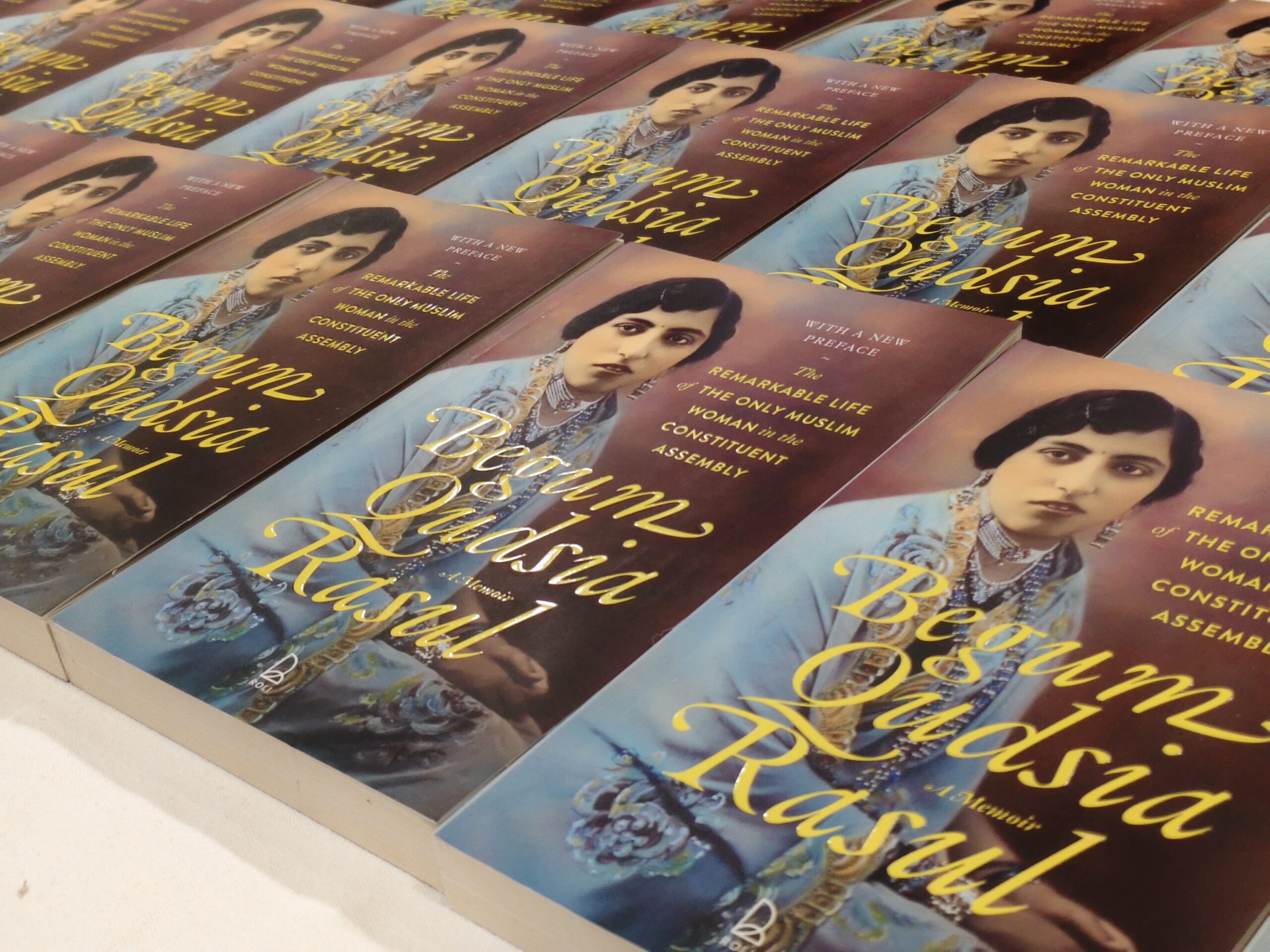
The book, Begum Qudsia Rasul – The Remarkable Life Of The Only Muslim Woman In the Constituent Assembly, is a relaunch of her autobiography “From Purdah to Parliament: The Memoirs of a Muslim Woman in Indian Politics” on the life and political legacy of this remarkable Muslim woman leader of India.

The Book Begum Qudsia Rasul – The Remarkable Life Of The Only Muslim Woman In the Constituent Assembly

The event brought together journalists, lawyers, and political leaders to revisit the contributions of a woman forgotten in mainstream historical narratives.

Moderated by journalist Nidhi Razdan, the panel featured Salman Khurshid, Indira Jaising, Manish Tewari, and senior lawyer Tehmina Punvani.

Begum Qudsia Rasul, born in 1909, was the only Muslim woman in India’s Constituent Assembly. A trailblazing politician, she opposed religious reservations, championed minority rights, and promoted women’s hockey.

Elected to the Rajya Sabha and Uttar Pradesh Assembly, she received the Padma Bhushan in 2000.

Besides being the only Muslim woman in the 1946 Constituent Assembly, she fought for minority equality and opposed religious reservations.

Qudsia Begum was also elected to the UP Assembly, Rajya Sabha and served as a minister.

She is credited with promoting women’s hockey, and a Hockey Cup is named after her. She was a trailblazing woman for giving up purdah. Besides her autobiography, she has authored a travelogue, Our Bapu, a book on Mahatama Gandhi and Hayat-e-Qudsi, about Bhopal’s Begums. 

Tehmina said that despite her political stature, Rasul stayed close to the grassroots. “She met women daily, listened to their concerns, and worked for them without fanfare. Activism, for her, was a duty, not an identity.”

Other speakers highlighted Rasul’s exceptional resilience in an era when Muslim women faced social barriers.

Former Union Minister Salman Khurshid explained that Qudsia had won from a general seat to the United Province Assembly despite many technical hurdles. “It was an extraordinary act of courage,” he said.

Congress MP Manish Tewari underlined the democratic significance of her public life: “Her presence in the Constituent Assembly reflected India’s openness at a time of enormous political and social turbulence.”

Noted lawyer Indira Jaising praised Rasul’s moral clarity and empathetic leadership, calling her “a rare combination of conviction and humility.”

Speakers were unanimous in calling for acknowledging Begum Qudsia Rasul’s contributions and a prominent place for her in India’s political history.

Rolli Books has published this book.

source: http://www.awazthevoice.in / Awaz, The Voice / Home / by Aasha Khosa, ATV / December 11th, 2025

Historian revisits Maulana Azad: A secular nationalist and nation-builder

Mecca, (Ottoman-SAUDI ARABIA / Kolkata, WEST BENGAL / DELHI :

Abul Kalam Ghulam Muhiyuddin (November 11, 1888-February 22, 1958), better known as Maulana Azad, was a writer-activist-statesman.

Historian S Irfan Habib speaks on Maulana Azad on his birth anniversary at an event organised by the Maulana Azad College alumni association in Calcutta on Tuesday / The Telegraph

Historian S. Irfan Habib, while delivering his Maulana Abul Kalam Azad memorial lecture titled “Revisiting Maulana Azad in Contemporary India” on Tuesday, rued how in today’s India, anytime he posts anything on social media on the freedom fighter, 80 per cent of the comments comprise hateful abuse.

“Full of abuse… 80 per cent of the comments. And from people who have no idea of who he was, what he stood for, and what he did for India,” said Habib, whose lecture on the Maulana on the icon’s 137th birth anniversary was organised by the Maulana Azad College alumni association to mark the college’s centennial.

Abul Kalam Ghulam Muhiyuddin (November 11, 1888-February 22, 1958), better known as Maulana Azad, was a writer-activist-statesman.

One of Mahatma Gandhi’s most trusted lieutenants and the youngest president of the Indian National Congress, he made crucial contributions to the freedom movement. He was also Independent India’s first education minister.

“I will speak about those issues relevant for today’s India. What he did for education, how he defined nationalism — today all those who have no idea of what nationalism is are nationalists — and how he defined Islam…. Islam too is in danger when we see what we believers have done to our own faith,” said Habib, former Maulana Azad Chair at the National University of Educational Planning and Administration, New Delhi.

Maulana Azad’s family moved from Mecca to Calcutta when he was two. He spent several decades of his life in this city, his residence on 5 Ashraf Mistry Lane of Ballygunge now a museum.

November 11 is celebrated as National Education Day to recognise his contribution in establishing the education foundations of India — from the Indian Institutes of Technology, the University Grants Commission, the All India Council for Technical Education, the Council of Scientific and Industrial Research, the Indian Institute of Science, and the Sahitya Akademi, the Sangeet Natak Akademi and the Lalit Kala Akademi, besides the Indian Council for Cultural Relations.

“Patriotism, nationalism and humanism, the difference between them Maulana tried to look at. In this (the belief in the culmination in humanism) he was very close to Gurudev Rabindranath Tagore, and he actually writes about it, that he believes in the idea of nationalism which was pitched by the idea of Tagore’s humanism and universalism,” said Habib.

“True relationship is only one, where the entire earth is one’s native land. This is necessary is today’s India, where we indulge in othering among own citizens, in the name of religion, caste, language, all sorts of issues, all sorts of divisive tools we use to divide Indians, while Maulana says mankind is one family and all humans are brothers, this is the idea of humanity of nationalism which Maulana left behind,” he added.

Habib underscored how the Maulana began as a pan-Islamist, speaking against the subjugation of Muslim nations by imperialist powers — a sentiment expressed strongly in his papers Al-Hilal and Al-Balagh, and it was because of his role as a fiercely upright journalist that the British Raj viewed him as one of the most dangerous persons in India.

Habib stated that after the Maulana was released from exile in Ranchi in 1920, he was torn between reading and writing in seclusion, or public life and the freedom struggle. It was soon after coming out of exile that the Maulana met Gandhi on January 18, 1920, for the first time.

“The meeting seemed to have had a profound impact on both… and they remained inseparable for the rest of his (Gandhi’s) life,” he said.

According to Habib, the Maulana fought on multiple fronts, not only against the British, but also Hindu and Muslim communalists.

“Maulana stressed on indivisible or composite nationalism, where he went back to early Islamic history, when the Prophet (Muhammad) created the first Muslim nation in Medina by aligning with the Yehudis (Jews). He saw no reason why Muslims could not join hands with Hindus and others in nation-forming…. He was appalled with communalists busy with sectarian campaigns when the need was to fight the British as a composite nationalist group,” Habib said.

“Maulana stood for a united India and remained steadfast in this resolve till the end. We are amid polarising politics where religion has become a distinct marker of identity…. The majoritarian nationalism being flaunted today runs contrary to the idea of composite nationalism espoused by Maulana all his life,” he added. “Maulana found the demand for Pakistan absurd as he was conscious of the fact that religion cannot be a binding factor for a nation.”

source: http://www.telegraphindia.com / The Telegraph Online / Home> West Bengal / by Meghdeep Bhattacharyya / November 12h, 2025

Irshad Mirza: Famous leather exporter of Kanpur, Irshad Mirza passes away, industry mourns

Kanpur, UTTAR PRADESH :

Irshad Mirza, a prominent Kanpur leather industrialist and chairman of Mirza International, has passed away at the age of 95. Irshad Mirza had been ill for a long time. His death has sent shockwaves through Kanpur and the industry.

Kanpur: 

Irshad Mirza, chairman of Mirza International, the country’s largest leather exporter, passed away at the age of 95. Irshad Mirza was ill for the past several years. He breathed his last on Sunday in a private hospital in Kanpur. As soon as the news of Irshad Mirza’s death spread outside the hospital, a crowd of people gathered at his residence in Civil Lines.

Irshad Mirza’s contribution to the leather industry can never be forgotten. He has been honored with several awards including Padmashree. Irshad Mirza was also called the pride of Kanpur. Irshad Mirza has also got his name registered in Forbes magazine.

Irshad Mirza founded Mirza International in 1979. Mirza International manufactures leather, finishing, and tanning. The leather produced by Irshad Mirza’s company was in high demand abroad. The leather produced by the company is exported abroad. He was also the former chairman of the Minority Commission. During this time, he contributed to the betterment of society. Irshad Mirza

His passing has caused a wave of mourning in Kanpur and the industry. He had a strong influence not only in the industry but also among social workers, political parties, and leaders. He also worked extensively for the betterment of society in Kanpur. He also taught how to work in the leather industry.

source: http://www.navbharattimes.indiatimes.com / Nav Bharat Times / Home> Hindi News (translated)> State> Uttar Pradesh> Kanpur / by Abishek Shukla / December 04th, 2022

‘Karnataka’s Kabir’ and Padmashri Ibrahim Sutar passes away

Mahlingpur , KARNATAKA :

The recipient of Padmashri award for communal harmony had earned the sobriquet of ‘Karnataka’s Kabir’

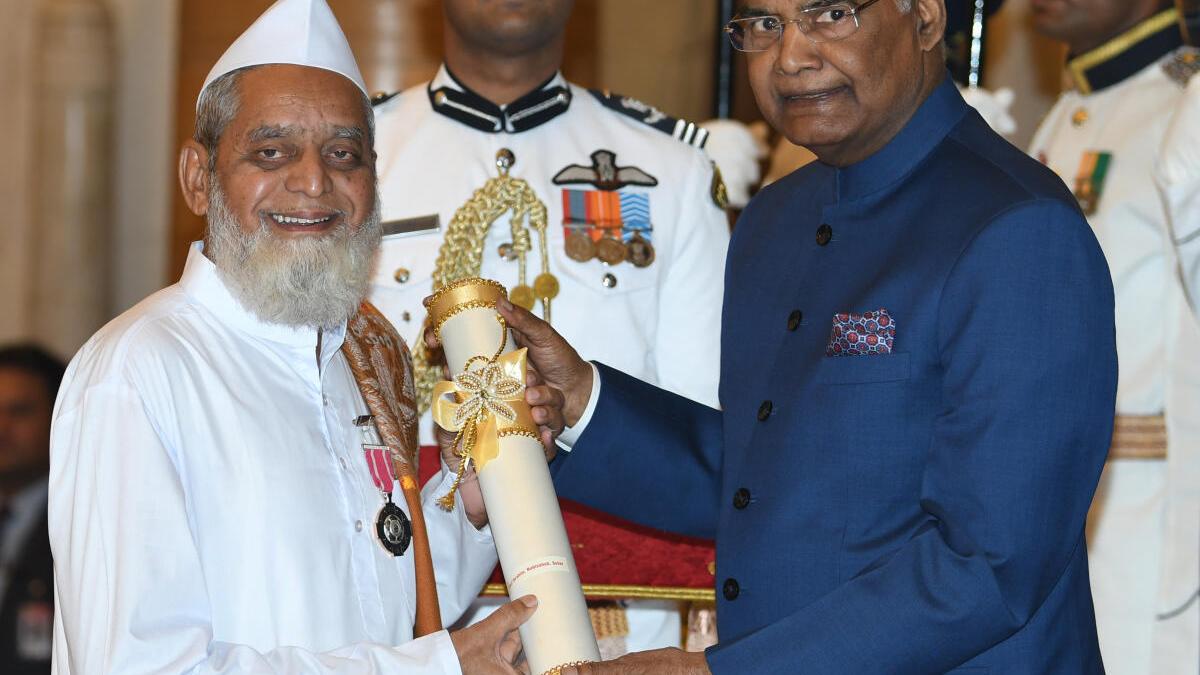
‘Karnataka’s Kabir’ Ibrahim Nabisaheb Sutar is presented the Padmashri award by President Ram Nath Kovind at Rashtrapati Bhawan, in New Delhi on April 2, 2018.

Ibrahim Sutar, polyglot folk singer, who toured India spreading the message of Hindu-Muslim unity, died in Mahalingpur in Bagalkot district on February 5. He suffered a massive heart attack around 6.30 in the morning. He died a few minutes later, family sources said. He was 82. He leaves behind his wife, son and two daughters.

The recipient of Padmashri award for communal harmony had earned the sobriquet of ‘Karnataka’s Kabir’.

The founder of ‘Bhavaikyate Bhajana Mela’ began his career as a Harikathe bhajan singer going around villages and towns. He regaled audiences with stories from Hindu and Islamic scriptures always leaving with a message of harmony, and need for ethics in personal life. He sang songs and gave lectures, quoting from multiple scriptures without the need to read from notes. He was equally well-versed in Kannada and Urdu.

In his later life, he emerged as a public speaker, visiting schools, colleges and Lingayat mutts to speak on vachana and dasa literature. He was honoured with the Karnataka Rajyotsava award in 1995, and the Padmashri in 2018.

Born in a poor weaver family in Mahalingpur, he dropped out of primary school to work as an assistant to a weaver. He developed a spiritual bent of mind early in life. He began attending lectures in the Sri Basavananda Swami mutt and participating in bhajans in Sadhu Maharaj temple. He was a member of the mosque committee that went around villages, asking the faithful to wake up early during the month of Ramzan. He studied Hindu and Islamic scriptures with equal zeal and developed a team of bhajan singers. The ‘Bhavaikyate Bhajana Mela’ performed across Karnataka and Maharashtra.

A routine performance was in the question–answer format interspersed with songs of dasa saints and vachanas . One of the team members came up with a question that sounded very ordinary, but had deep spiritual undertones, like: ‘Who is important in life – god or guru?’ Sutar used anecdotes from the Ramayana and Mahabharata, Islamic scriptures and stories from the life of prophets to give his opinion, that was directed at the audience, rather than the team member who kept asking questions.

source: http://www.thehindu.com / The Hindu / Home> News> India> Karnataka / by Special Correspondent / February 05th, 2022

Beacon of Education Reemerges In Gritty Grades of Kashmiri Girls

JAMMU & KASHMIR :

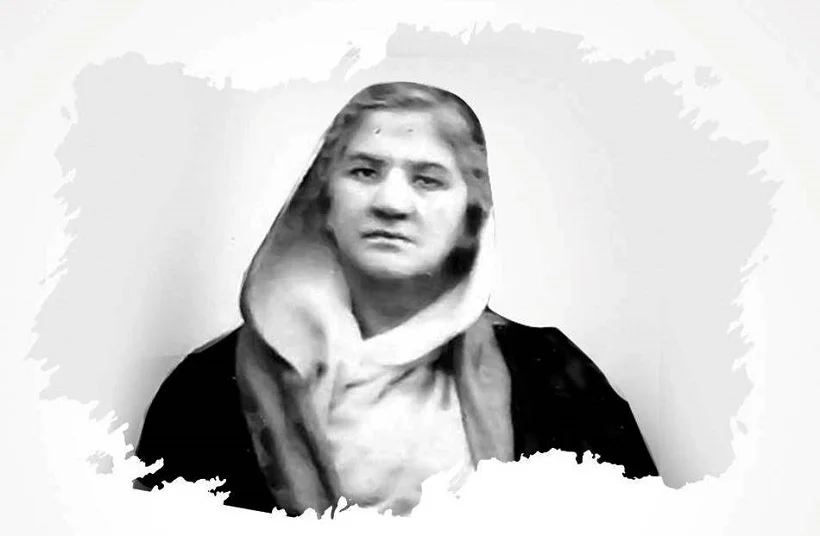
Begum Zaffar Ali

The legendary educationist of Kashmir whose door-to-door campaigning inspired generations of Kashmiri girls resurfaced in their recent academic feat.

IN his celebrated anthology, The Veiled Suite: The Collected Poem, Agha Shahid Ali details his grandmother’s “bleeding heart”—which ensured the educational empowerment of the masses in the valley.

Shahid’s poem, Prayer Rug in her memory, became a token introduction of “the lady with a lamp” — Begum Zaffar Ali.

this year my grandmother
also a pilgrim
in Mecca she weeps

as the stone is unveiled
she weeps holding on
to the pillars

Beyond the poem, however, there’s a staggering profile of the grand old lady of Kashmir—whose educational service made her legend.

“Firmly determined, my mother-in-law, Begum Zaffar Ali, was a self-made lady, who spent her life relentlessly advocating for women education and empowerment in the valley,” recalls Dr. Shaheena Agha, at her Rajbagh residence.

In the sweeping accolades being showered on the lockdown-hit girls whose recent grades once again made them the shining stars of Kashmir’s dented academia, Begum Zaffar Ali found a glorious mention for inspiring generations of girls in the valley.

“My mother-in-law was one of the first Kashmiri girls whose grit made her a beacon of educational excellence,” Shaheena continues.

“An untiring activist, Begum Zaffar helped Kashmiri women in one way or another. I take inspiration from her.”

In her 60s, Shaheena first met Begum Zaffar as a 26-year-old woman, when she married the celebrated educationist’s eldest son, Agha Nasir Ali, in 1986.

“It was an evening of mutual admiration and love,” she talks about the first interaction with her mother-in-law. “By then, she had already retired, but I was instantly moved by her illustrious persona.” 

Begum Zaffar can be easily identified as one of the most influential and meticulous women of her times. Her life, Shaheena says, was that of extraordinary persistence and intellect which brought girl education to the forefront and dispelled illiteracy and ignorance.

“As a champion of women rights, her tireless and unwavering contribution to social changes and reforms pertaining to girl education in the valley and upliftment came at a time when society was predominantly patriarchal and orthodox in its outlook and question of women liberation and education were still widely restricted,” Shaheena says.

Begum Zaffar Ali was born in 1900 in the distinguished Agha family of Srinagar with her maiden name, Syyeda Fatima Hussain. She was the eldest daughter of Khan Bahadur Aga Syed Hussain, the first matriculate of Kashmir.

Along with her siblings, she was homeschooled by a European Home Governess. While pursuing her education, she was married to her cousin, Agha Zafar Ali Qazalbaash, a scion of Afghan family. She continued her education after marriage.

While being a mother to three, she went ahead taking revolutionary strides and efforts which would go on to change the face of women’s emancipation and education in the valley and inspire thousands of young girls for years to come.

“She brought an era of renaissance and regeneration in the lives of the Kashmiri women,” says Nusrat Mehmood, a senior college lecturer who calls Begum her inspiration. “Her passionate, non-conforming and unorthodox life will continue to rekindle the spirit of excellence in people like me.”

In 1925, Begum Zaffar was invited to teach in a Girls Missionary High School run by Miss Mallinson and Miss Bose in old Srinagar’s Fateh Kadal area.

“During those times, being a teachress was seen as a stigma but nevertheless she joined the school to serve the cause of education,” lecturer Mehmood continues.

“Her door-to-door campaigning for education in an era of subjugation and poverty makes Begum one of the most unsung educationists of the world. Her academic pursuits and ambitions to bring social changes heralded a new hope.”

Such was the zeal and determination of Begum Zaffar that she simultaneously started philanthropy work towards the poor girl of the school and looked after their hygiene and overall development.

“She even encouraged both young and elderly women to seek education and personally volunteered to teach them,” says Mubashir Hussain, a social activist from Srinagar.

“Through the good offices of her father who was then Home and Judicial Minister in Maharaja’s regime, grants were sanctioned for the schools. Begum managed to get an extra sum of Rs 10 sanctioned for the maintenance of girls every month besides meals.”

Impressed by her progress in studies, her children’s home tutor encouraged her to sit for the matriculation examination as she, by then, had been teaching girl students of tenth standard for five years.

Begum Zaffar was reluctant initially as no woman from the valley till then had passed the matric exam. She finally broke the jinx by becoming the first matriculate woman of Kashmir in 1930 and went on to complete her graduation in Domestic Science and Liberal Arts from Lady Mclegon College, Lahore in 1938.

“Back then, parents were still debating whether to give only religious teachings to their girl child or give them modern education,” says Rameez Kashani, a history lecturer.

“To uplift Kashmiri women and free them from their ignorance and religious and social conservatism, Begum Zaffar led the movement of women emancipation in the valley where she could encourage girls to come forward and educate themselves.”

Later she was appointed as the Inspector of Schools in Kashmir and was the first Muslim in her administrative capacity, who went on delivering lectures in colleges and social gatherings.

As a great orator and popular figure, Begum Zaffar was a key member behind the foundation of Teachers Club and Ladies Club, whose members included Tara Devi, queen of Kashmir’s last monarch, Hari Singh.

“The club was central to bringing reform changes and participation in the lives of the Kashmiri women,” Kashani says.

Before the bloodcurdling fall of 1947, Begum Zaffar had served as the secretary of the All India Women’s Association but later resigned due to her displeasure with the association’s nationalist fervour.

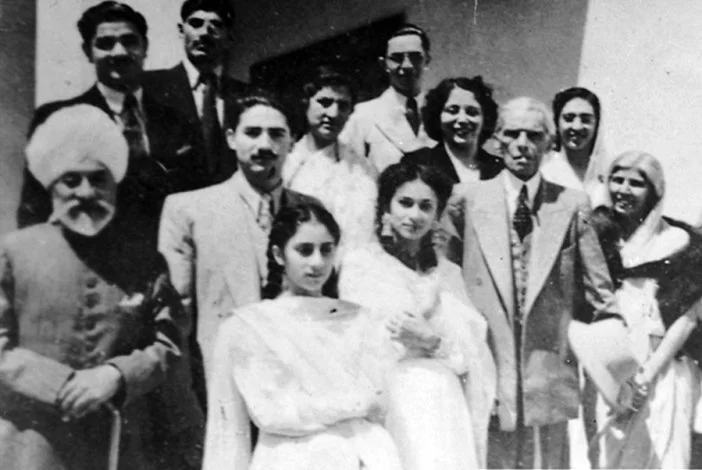
Back in 1944, she had famously hosted Mohammad Ali Jinnah and his sister, Fatimah Jinnah at Srinagar. She had organised a meeting of Kashmiri women with the stalwart’s shadow sibling at present day Lawns of Secretariat.

Begum Zaffar Ali with Mohammad Ali Jinnah in this pre-47 pic.

In her lifetime, Begum Zaffar held various offices and with her intellectual ability and leadership, she was the first Muslim in Kashmir to become a director in the Department of Education.

In her later days, she was also member of the Social Welfare Advisory Board, Jammu and Kashmir, and even became a legislator.

At personal level, Begum’s three sons went on to have distinguished public profiles. Her two sons, Agha Nasir Ali and Agha Shaukat Ali were civil bureaucrats.

While Agha Nasir retired as Labour Secretary of India in 1977, Agha Shaukat Ali, moved to Pakistan and joined Civil Services. Her youngest son Agha Ashraf Ali followed her footsteps and went on to become a top academician and educationist of the valley.

“It was Begum Zaffar Ali whom Sheikh Abdullah approached to convince her son, Agha Shaukat Ali to come back from Pakistan and join his cabinet,” Shaheena says. “During her lifetime, she longed to meet the same son when he moved to Pakistan. But New Delhi never granted a visa to her for meeting her son in the neighbouring country.”

When the same government awarded Padma Shri to her in recognition of her outstanding contribution to the field of social welfare in 1987, Begum famously declined the award in a televised Doordarshan interview.

“The Indian state excesses and gross human rights violations in Kashmir was the reason behind the non-acceptance,” historian Kashani says.

In her later years, the top educationist had been shuttling between Srinagar and Washington, to be with her exiled son.

In 1999, when she was staying with Agha Shaukat in the United States, the whole family, including her great grandchildren, had planned to celebrate her birthday as she was turning 100 year old.

“But sadly,” Shaheena says, “she passed away a month short of her illustrious century!”

source: http://www.kashmirobserver.net / Kashmir Observer / Home> In Depth> Special Report / by Rakshanda Afrin / March 11th, 2021

Punjab Police ex-DGP, prisons, Mohd Izhar Alam passes away

BIHAR / Chandigarh, PUNJAB :

Alam died after a cardiac arrest at a private hospital in Mohali; last rites at Sirhind on Wednesday.

Mohd Izhar Alam, a former DGP, prisons, of Punjab Police, was inducted into the Shiromani Akali Dal after his retirement. His wife, Farzana Nissara Khatoon, is a former SAD MLA from Malerkotla. (HT file photo)

Mohammad Izhar Alam, 73, a former director general of police, prisons, died after a cardiac arrest at a private hospital in Mohali on Tuesday.

He is survived by wife Farzana Nissara Khatoon, a former Shiromani Akali Dal MLA from Malerkotla, three sons and two daughters.

The 1972-batch Indian Police Service officer was a Padma Shri awardee.

He had a controversial stint during the decade of militancy in Punjab.

Despite opposition, former chief minister Parkash Singh Badal inducted Alam into the SAD on November 18, 2009, and appointed him chairman of the Punjab Wakf Board.

In the 2012 assembly elections, Farzana won the Malerkotla seat on the SAD ticket, defeating Razia Sultana of the Congress.

Chief minister Captain Amarinder Singh also mourned the former DGP’s death.

The last rites will be performed in Sirhind on Wednesday.

source: http://www.hindustantimes.com / Hindustan Times / Home / by HT Correspondent / July 06th, 2021