Adil Meraj: Co-founder of Gurucool. | Photo: By arrangement
The Padhai app will provide academic space for learning and to make quality education accessible for the underprivileged.
New Delhi :
Gurucool, a Delhi-based EdTech startup launched the Padhai app on Friday. The app seeks to provide an academic space for learning and to make quality education accessible for the underprivileged by providing more than 3500 curated open-source educational courses offered by platforms like MIT open courseware, Khan Academy, YouTube educators, and many more.
Adil Meraj and Khansa Fahad, the two alumni of Jamia Millia Islamia (JMI) started Gurucool in 2019. Gurucool is an educational networking platform that offers a suite of phygital (physical+digital) tools to connect learners and educators. The founders of Gurucool got into the limelight when they secured pre-seed funding of $150,000 (around 1 crore rupees) in November 2021.
“The Padhai app counters the price-tagged digital education offered by other ed-tech platforms while making digital education accessible and free for all,” Meraj told TwoCircles.net.
“The Padhai app provides information on scholarships, educational short videos similar to YouTube shorts called BITS, and other things of importance to learners. It offers curated courses in 8 regional languages,” Meraj said, adding that the app has live classes, study material, test series and questionnaires for K-12, competitive exams, and the skill India program.
The higher education department of the government of Bihar approved the Padhai app as a pilot project, he said. Conversations are on with several other governments to start the Padhai app on a pilot project basis.
Gurucool is an educational networking platform offering over 25 tools and a vast content pool for educators and learners to learn, network, and have fun with them. Gurucool aims to digitize education while not compromising on the need for physical classrooms. We are making education phygital, said Meraj.
Gurucool got pre-seed funding from the Indian-American angel investor, Parvez Jasani (CEO, Zulie Venture Inc.) and Aqib Hussain of FreeFlow Venture Builders. The ed-tech platform is estimated worth $ 2 million.
“When I spoke to Adil and Khansa for the first time I was super impressed with their vision and passion, and that made me invest in Gurucool instantly”, Parvez Jasani told TwoCircles.net.
Gurucool offers a vast content pool, empowering educators, schools, and colleges with minimal financial support and which are functioning especially among the marginalized groups. The schools and colleges can potentially build their digital infrastructure using Gurucool’s content.
The Ed-Tech platform follows the model of personalized learning by creating educational centres which implement the concept of a conference-based teaching ecosystem that has a 12:1 student-teacher ratio. These education centres have a club system, library, workshops, sessions, and smart classes among other things.
Gurucool aims to launch 50 centres in 15 cities across India in the upcoming year with each centre having an accommodating capacity of 600 students.
www.gurucool.xyz
Mohd. Umair Yunus is a fellow in the SEEDS-TCN mentorship program.
source: http://www.twocircle.net / TwoCircles.net / Home> Lead Story / by Mohd Umair Yunus, TwoCircles.net / August 13th, 2022
“The Musalmans of India are, and have been for many years, a source of chronic danger to the British Power in India.” – W W Hunter, an English official posted in India, in his famous book ‘The Indian Musalmans’, published in 1871.
After 1947, Indian scholars wrote a ‘nationalist’ history of the Indian freedom struggle and for unknown reasons, they excluded Muslims. For the last seven decades, we have been reading a history of the Indian Freedom Struggle that has largely overlooked the contribution of Muslims. The generations brought up over this narrative believe that either the Indian Muslims were pro-British or aloof from the freedom struggle.
Such falsehoods propagated in the name of history should be challenged.
The British imperialism in India was resisted by the Indians right from its outset and the Muslims were the flag bearers of this resistance. The British took over Bengal administratively and economically after defeating the royal armies at the Battle of Plassey (1757) and the Battle of Buxar (1764). With their win over the Nawab of Bengal, the British started exploiting the Indians of Bengal province in an unprecedented fashion. Their ruthless loot resulted in a famine in 1770, which accounted for the deaths of one-third of the total population of Bengal.
No wonder the first popular national resistance to foreign colonial rule arose in Bengal. A united front of Hindu Sanyasis and Muslim Fakirs rose up in arms against the British. The man who led this fight was, Majnu Shah, a Muslim sufi from Kanpur (Uttar Pradesh). Majnu was a devotee of Shah Madar, Kanpur, and took up the cause of poor peasants on the advice of another Sufi saint, Hamiduddin. Almost 2000 Fakirs and Sanyasis, under his command, would loot the treasures of the British and British-backed landlords to distribute the money and food among poor exploited masses. From 1763 till his death in 1786, Majnu was the most dangerous threat to the British Empire in India. Fakir and Sanyasi forces killed several officers and soldiers of the British in guerrilla wars. After his death, Musa Shah took up the leadership of the movement. Hindu Sanyasi leaders, like Bhawani Pathak, were also there and fought alongside but the colonial records considered Majnu as the most threatening leader because under him Hindus and Muslims fought a united war. The ruthless British suppressed this movement a few years after the death of Majnu but the spirit of nationalism could not be killed.
The suppression of the movement led by Fakirs in Bengal did not mean that they accepted defeat. Fakirs changed their strategy and joined Marathas and other anti-British forces at the turn of the 18th century. The first major mutiny by the Indian sepoys of the English East India Company Army in 1806 at Vellore, which is said to be the inspiration behind 1857, was planned by Holkars, sons of Tipu Sultan and brother of Nizam of Hyderabad with the help of Fakirs. In every cantonment in South India, Fakirs propagated the message of nationalism through religious sermons, songs and puppet shows. When the revolt broke out at several places including Vellore the Indian revolutionaries were led by Fakirs like Shaikh Adam, Peerzada, Abdullah Khan, Nabi Shah, and Rustam Ali. Scholar Perumal Chinnian writes, “the Southern conspiracy was supported by Fakirs and other religious mendicants. The conspiracy was established in all the army stations by them.”
Within a few years, the British faced another challenge in the form of three distinct movements led by Syed Ahmad Barelvi, Haji Shariatullah and Titu Mir respectively.
Born in Uttar Pradesh, Syed Ahmad toured a large part of the country and gained followers in Bihar, Bengal, and Maharashtra. His followers took up arms against the British and its allies in the areas adjacent to Afghanistan. The movement posed a challenge to the British for decades. The British painted the movement as a work of religious fanaticism while in reality, Syed Ahmad tried to forge an alliance with Marathas against the foreign rulers. After he died in 1831, Enayat Ali and Wilayat Ali, both from Patna, took up the leadership of the movement. The wars they led in the frontier region caused the death of thousands of soldiers of the British army.
Haji Shariatullah and his son Dudu Miyan took up arms in Bengal to resist the tyranny of rich landlords. They led peasants to revolt against the indigo planters and other British agents. The movement they led is known as Faraizi movement.
Titu Mir also led a movement of poor masses against the British-backed landlords. He formed his army and set up a popular administration. In 1831, Titu was killed during a battle with the British. Hundreds of his supporters were arrested and hanged, including his deputy, Ghulam Masum.
Meanwhile, the Movement started by Syed Ahmad remained a grave danger to British rule in India. Enayat Ali, Wilayat Ali, Karamat Ali, Zainuddin, Farhat Husain, and others led an armed struggle against the British. In Patna, as soon as the news of the revolt of 1857 reached, all the prominent leaders were arrested before they could act. Still, Pir Ali launched a revolt in Patna. Though not a part of the larger movement himself the British believed that he had their support. Pir Ali, Waris Ali, and other Muslim revolutionaries were executed in Bihar during the revolt of 1857.
The First War of the National Independence of 1857 had a long history of planning behind it. In 1838, the English government arrested Mubariz ud-Daula for plotting a nationwide revolt against the foreign rule. The investigations revealed that Raja Ranjit Singh, Gaekwars, Satara, Jodhpur, Bhopal, Patiala, Rohilla Pathans, and several nawabs, rajas and zamindars had agreed upon the plan. Raja Ranjit Singh had actually sent his troops to help Mubariz and contacted Persian and French powers for help. The plan, because of a few traitors leaked out, Mubariz was imprisoned where he died in 1854 and the revolt took place two decades later.
The role of Muslims in 1857 is no secret. The unity of Hindus and Muslims in 1857 threatened the British like never before and they resorted to a policy of divide and rule after that. Maulvi Ahmadullah Shah of Faizabad, Fazl-e-Haq of Khairabadi, Imdadullah Muhajir Makki of Muzaffarnagar, and Azimullah Khan, an associate of Nana Saheb, were prominent in propagating the need of taking up the arms against the colonial rule. For years before 1857, they were propagating these ideas among sepoys as well as civilians.
In Bihar, Kunwar Singh was leading the revolt of 1857. Zulfiqar was one of his most trusted comrades with whom Kunwar was discussing every plan. After liberating Arrah the civil government installed by Kunwar had his most trusted allies and there were several Muslims. The government had “Shaikh Ghulam Yahea as Magistrate. Shaikh Muhammad Azimuddin, an inhabitant of Milky Tola in the town of Arrah, was appointed Jamadar (treasurer) of the eastern thana: Turab Ali and Khadim Ali, sons of Dewan Shaikh Afzal, were made Kotwals (Police officers in charge of a city)”
The revolt did not succeed. Bahadur Shah was exiled to Burma, several were hanged and many more were transported for life to Andamans. But, the zeal for freedom did not die.
In 1863, tribals in North West Frontier Province stormed the British territories and entered into a war. The British, though registered a victory, had to face one of the stiffest military challenges. They lost more than a thousand of its English soldiers. Intelligence reports pointed towards a financier in Ambala. The man was Jafar Thanesri. During the raid police found several letters which established him as the principal financier of the war in NWFP. He channelled money, men and arms from different parts of the country to the war front. Yahya Ali of Patna and nine others were also charged for waging the war against the Queen. What followed was a series of arrests and trials across India.
People were arrested in Ambala, Patna, Malda and Rajmahal. Ahmadullah, Yahya Ali, Jafar, Ibrahim Mandal, Rafique Mandal and others were arrested and transported to Andamans. These revolutionaries celebrated martyrdom over life, hence the British decided not to hang them but to send them to the Andamans. In 1869, Amir Khan and Hashmat Khan were arrested in Kolkata. Norman, the Chief Justice, sentenced them to the Andamans. The sentence was avenged by Abdullah by assassinating Norman in 1871 and after a few months Sher Ali killed the viceroy, Lord Mayo, in the Andamans.
Bipin Chandra Pal, in his autobiography, credited these trials and killings as an important influence on his political career. Another famous revolutionary, Trailokya Chakravarty, noted, “the Muslim revolutionary brothers gave us practical lessons of unbending audacity and inflexible will and also advice to learn from their mistakes”.
In Maharashtra, Ibrahim Khan, a Rohilla leader, and Balwant Phadke launched a guerilla war against the British. They provided a tough resistance through the 1860s and 70s, and threatened the British in south India.
Meanwhile, in 1885, Indian National Congress (INC) was formed to voice the apprehensions of the emerging educated middle class. Badruddin Tayyabji and Rahmatullah Siani were two of the earliest members and presidents of Congress. Later on, M.A Ansari, Hakim Ajmal Khan, Hasrat Mohani, Abul Kalam Azad, and others remained associated with the largest political outfit of India.
In 1907, peasants in Punjab started agitation against the canal colonies. Along with Lala Lajpat Rai and Sardar Ajit Singh, Syed Hyder Raza was one of its prominent leaders. The movement is seen as a precursor to later Ghadar movement.
During the First World War (1914 – 18), the British intercepted three letters written on silk cloth. The letters were written by Maulana Ubaidullah Sindhi to Maulana Mahmood Hasan and pointed towards a global plan to overthrow the British rule in India. Ubaidullah was named as one of the most dangerous Indians for the British in the Rowlatt Committee Report. He formed armed groups, preached anti-British ideas and formed a provisional government in Kabul. The Prime Minister of the government was Maulana Barkatullah. The government had to have an army as well, which would attack India to free it. But, the plan failed because of the leaked silk letters and the end of the World War. The plan was called Silk Letter Movement and 59 freedom fighters, mostly Muslims, were charged for waging the war against the Empire. Maulana Abul Kalam Azad, Abdul Bari Firangi Mahli, Ubaidullah Sindhi, Maulana Mahmood, Husain Ahmad Madni and M.A Ansari were few of them. Maulana Mahmood and Madni were arrested in Makkah and imprisoned in Malta.
Maulana Abul Kalam Azad, who is often seen as a token Muslim in a largely Hindu dominated Congress, was a freedom fighter whom the British feared. His name occurred in different CID reports for planning armed revolutions. At least 1700 freedom fighters took oath to die for the cause of freedom as members of Hizbullah, a revolutionary organisation formed by Azad. Al-Hilal, a paper edited and published by him, was banned for propagating the revolutionary nationalist ideas. Azad established Darul Irshad, a madarsa, to popularise the anti colonial ideas. For his organization, Hizbullah, Jalaluddin and Abdur Razzak were prominent recruiters, who also united Hindu and Muslim revolutionaries of Bengal. No wonder, Azad was jailed many times and was the President of INC when the Quit India Resolution of 1942 was passed.
The Silk Letter Movement was not the only resistance movement during the World War. Ghadar Movement was another movement in which several Muslims took part and attained martyrdom. Rehmat Ali was hanged in Lahore for trying to instigate mutiny among soldiers. The efforts bore fruit in Singapore, when, in February, 1915, 5th Light Infantry consisting mostly Muslims from Punjab revolted. The soldiers captured Singapore for a few days. The revolutionaries were later defeated, captured and shot dead.
Another misconception prevalent among Indians is that the Bengali revolutionaries were Hindus. Interestingly, the revolutionary organizations with Hindu religious overtones, like Jugantar and Anushilan had many active Muslim members. Sirajul Haq, Hamidul Haq, Abdul Momin, Maksuddin Ahmad, Maulvi Ghayasuddin, Nasiruddin, Razia Khatun, Abdul Kader, Wali Nawaz, Ismail, Zahiruddin, Chand Miyan, Altaf Ali, Alimuddin, and Fazlul Kader Chowdhury were few of the Bengali Muslim revolutionaries who took up arms along with Hindus. Many of them were sent to Andamans or killed.
After the World War, the British introduced a draconian Rowlatt Act. The Indians protested against the act and many leaders were arrested. At Jallianwala Bagh people were massacred when they were protesting against the arrest of Saifuddin Kitchlew. The proportion of Muslims killed at Jallianwala was quite high. Around this time, 1919 onwards, Abdul Bari Firangimahli, Mazharul Haque, Zakir Husain, Mohammad Ali, and Shaukat Ali emerged as the mass leaders. Women like Bi Amma, Amjadi Begum, and Nishat al-Nisa also jumped into the freedom struggle.
In Tamil Nadu, Abdul Rahim organised the workers during the 1930s against the oppressive colonial rule. V. M Abdullah, Sharif Brothers, and Abdul Sattar were other prominent Muslim leaders in South India who led nationalist movements and braved torture and imprisonments.
Khan Abdul Ghaffar Khan led pathans posed a non-violent challenge to the British. In 1930, the British fired upon a crowd protesting against the arrest of Ghaffar Khan at Qissa Khwani Bazar, Peshawar. Hundreds of pathans laid their lives for the service of the motherland.
Faqir of Ipi, Mirza Ali Khan, and Pir of Pagaro, Sibghatullah, raised their armies in the 1930s in Waziristan and Sindh respectively to fight the British during the World War. In a larger scheme of things, Subhas Chandra Bose and Axis Powers allied with their armies in order to liberate India.
In 1941, Netaji Subhas Chandra Bose escaped from house arrest. The man who played an important role in the escape was Mian Akbar Shah. Netaji reached Berlin and formed a Free India Legion. Abid Hasan, became his confidant here and served as secretary. Abid was his only associate who accompanied him on a famous submarine journey from Germany to Japan. In 1943, Netaji formed Azad Hind Sarkar and Azad Hind Fauj. Here several Muslims like, Lt. Col. Aziz Ahmad, Lt. Col. M.K Kiani, Lt. Col. Ehsan Qadir, Lt. Col. Shah Nawaz, Karim Ghani, and D.M Khan became ministers with important portfolios. Azad Hind Fauj faced reverses in war and its soldiers were taken prisoners by the British. Rashid Ali’s imprisonment became a symbol of Hindu Muslim unity when Hindus and Muslims across the political affiliations came out on Kolkata road demanding his, and other Azad Hind Fauj soldiers, release in 1946. The police fired upon the protesters killing dozens of Indians. Elsewhere, in Mumbai and Karachi, the Royal Navy revolted in support of Azad Hind Fauj. Anwar Husain was one of the prominent martyrs of this revolt as Colonel Khan led the soldiers in revolt at Mumbai port.
India gained independence on 15 August, 1947. It was a costly affair. The cost was the Indian lives. The lives we paid were neither Hindu, nor Muslim. The lives belonged to the Indians. Those who laid their lives were Indians first, and Hindus or Muslims later. Here again, Muslim leaders like Allah Bux Somroo, K. A. Hamied, Faqir of Ipi, Abdul Qayyum Ansari, Abul Kalam Azad and others fought against the divisive communal politics of Muslim League to stop the partition. Tragically, more than seven decades later people have forgotten this important aspect of our freedom struggle and try to divide this great struggle along petty sectarian lines.
(The article is an updated version of an article published last year.)
source: http://www.awazthevoice.in / Awaz, The Voice / Home> Culture / by Saquib Salim / August 15th, 2022
Indians and other historians have either tried to whitewash the revolutionary movements for freedom or presented these as disjointed localised efforts.
Even the largest movement of Azad Hind Fauj led by Netaji Subhas Chandra Bose has been narrated in a staggered manner and an episodial manner like the battle of Burma (Mayanmar) and the battle of Imphal. The picture thus presented is of an army fighting at a frontier with no support elsewhere. This history needs to be revisited.
In 1930, Sayyid Sibghatullah Shah Al-Rashidi called Pir of Pagaro, a Muslim Saint from Sindh with a huge following, was arrested by the British Government for ‘creating disturbances’. He was accused of instigating anti-colonial feelings among his followers known as ‘Hurs’ (literally meaning free). The decision to send him to a prison away from Sindh rather shaped this anti-colonial Muslim saint into a nationalist revolutionary.
In the Bengal hail, he met several revolutionaries and realised that what he had experienced in his area was the same being experienced by others. He understood that British colonialism was destroying the nation and Hindu-Muslim unity was the only weapon to fight them.
From the prison, he started preaching nationalist messages. Sarah F. D. Ansari of the University of London in her book Sufi Saints and State Power: The Pirs of Sind, 1843 – 1947, writes, “messages strongly coloured with a radical nationalist tinge were smuggled out in the form of notes written in the margins and between the lines of books and magazines. They condemned the British for treating ‘Indians like donkeys’, loading them down with ‘England’s burdens’, and pointed out that the only reason why the British were able to rule over 300,000,000 people was that Indians were ‘cowards’.”
In 1936, when he returned to his seat at Khairpur in Sindh, Pir of Pagaro had turned a revolutionary.
He started establishing links with revolutionary leaders of Bengal as well as those living in Europe, especially Germany. He started inviting Congress leadership to his area and organise Hindu-Muslim unity meetings. We must keep in mind that it was 1938 and Subhas Chandra Bose was the President of Congress. Unsurprisingly when Subhas formed Forward Bloc after his famous differences with Mahatma Gandhi, Pir of Pagaro asked his followers to back Forward Bloc and denounced the stand of Congress.
In 1939, the centuries-old Hindu-Muslim unity of Sindh was severely shattered over the Manzilgah mosque dispute and the riots that followed. Pir of Pagaro ordered his large following of armed followers known as ‘ghazis’ to save Hindus from the Muslim fanatics. Sarah F. D. Ansari writes, “In his newspaper, the Pir-jo-Goth Gazette, he (Pir of Pagaro) called for Hindu-Muslim unity: ‘My forefathers’, he wrote, ‘treated Hindus and Muslims alike as a sacred trust. The same is my principle . .. Allah is the same as Parmatma, though with different names. I will be happy when I see temples and mosques together with only a wall dividing them and everyone [worshipping] according to their rights so that no one may have a grievance against the other’. In a similar vein, he denounced the Hindu Sabha and the Muslim League as divisive communal movements. Only when Hindus and Muslims combined would ‘peace . . . be achieved and satanic deeds . . . stopped’: Indians had to be ‘national minded’ and regard India as a country which belonged to all its inhabitants.”
An intelligence report dated October 1940 says, “Pir of Bharchundi is not liked by the Pir Pagaro, who disrespected the Pir of Bharchundi and sent him away from his ‘Kot’ when the Pir of Bharchundi last visited the Pir Pagaro… the reason for such treatment of the Pir to the Pir of Bharchundi was that the Pir of Bharchundi would not assist in getting the murderers of Hindus arrested.”
It further says, “Pir Pagaro has won great sympathy of the Hindus.” Sarah also points out how the Pir came out in support of a Muslim man’s right, who had earlier converted into Islam from Hinduism, to reconvert into Hinduism. “
Another intelligence report noted that Pir of Pagaro has enlisted at least 6,000 militants to fight with an oath to die for the cause. These militants were called ghazis. Ghazis had paraded and displayed their military skills in front of him during his visits to Jaisalmer and Jodhpur as well. The nationwide presence was a threat for the British. The report further noted, “the Pir was renewing his contacts with terrorists (terrorists was a term used by the English for revolutionaries) who had been in prison along with him in Bengal. His visits to Calcutta (Kolkata) were, it is said, performed for no other reason.”
The British apprehension was not wrong. Pir Pagaro had contacts with Bengali revolutionaries and Subhas. If Subhas raised an army on Eastern Front, Pir of Pagaro raised another on the Western Front. An intelligence report from 1941 noted, “He (Pir of Pagaro) has got his electric plant and radio set at which he and his followers hear Hindustani programs from Germany and then spread the German news in the villages which has a disquieting effect on the local people.” The report also pointed out that “the villainous activities of the Pir and his growing contempt of authority are becoming a byword throughout India”.
Pir of Pagaro was running an independent government in that region of Sindh with the help of his militia. The British Government arrested him in Karachi on the pretext of holding talks with him. His ghazis would not stop and kept attacking the British infrastructure. They were so much feared that the Legislative Assembly members did not want their names to become public for voting in favour of an act against Hurs (followers of Pir of Pagaro).
Sarah notes, “The level of fear which existed in Sind at the time even inside the Legislature was reflected in the session being held in camera. Members of the Assembly were not prepared to vote openly in favour of the act ‘lest they were marked down for the Pir’s future vengeance’.” The fear was not unfounded as soon after Ghazis killed the son of Hidayatullah, one of the tallest Sindh leaders in that Legislative Assembly, by derailing a train.
It did not take much time and within weeks Martial Law was declared. The British had to open a war front at the time of World War II. Sarah writes, “The area north of Sanghar and the Thar desert (Rajasthan) were thoroughly reconnoitered from the air; paratroopers and bombs were used against bands of armed men. Hur villages were raided, wells stopped up and their cattle herded into other districts.” On the other hand, the Pir was being tortured to ask his followers to put down their weapons.
Did the nationalists concede defeat? No. The Pir of Pagaro, Sibghatullah, embraced martyrdom at the gallows on 20 March 1943, after a sham of a court trial. Hurs kept fighting the British till 1946 even after their Pir was gone.
source: http://www.awazthevoice.in / Awaz, The Voice / Home> Culture / by Saquib Alim / July 23rd, 2022
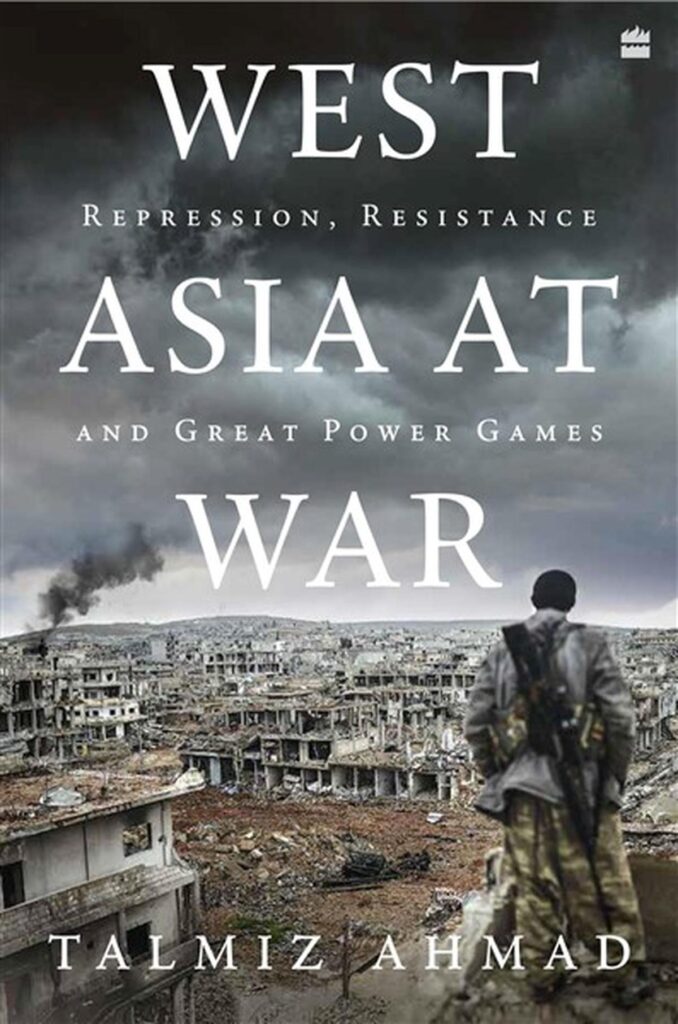
A veteran diplomat Talmiz Ahmad provides a rare non-Western narrative of complex undercurrents in West Asia, where inequality, politics over oil and regional rivalries are fuelling tensions
West Asia is a strategically critical region faced with confrontation and conflict amid growing economic prosperity. In his latest book, West Asia at War, Talmiz Ahmad, a former ambassador, brings out the diverse political, religious, military, socio-economic and cultural forces shaping the region. His long diplomatic career with postings there and wide-angled view from the headquarters gave him uncommon insights, which he pieces together in this book providing a rare non-Western view of complex undercurrents.
The exhaustive work traces the origins of the troubled region to the 17th century when Britain and France fiercely fought with each other over resources and zealously guarded their colonial empires. The new states that emerged in the wake of the Ottoman Empire’s fall also fell prey to this contestation. The discovery of large quantities of hydrocarbons at the beginning of the 20th century proved to be the region’s nemesis as it exposed it to outside competition and a rivalry between superpowers.
Internal bickering
Ahmad elaborates on the rise of Arab nationalism after World War II, tracing developments leading to the nationalisation of the Suez Canal by Gamal Abdel Nasser.
He explains how regional rivalries destroyed West Asia from within. The two major Arab powers, Egypt and Saudi Arabia, representing different ideological trends — revolutionary and conservative — played against each other. Further, the Saudi-Iran rivalry deepened Sunni-Shia hostilities. In a bid to fortify its standing in the region, Saudi Arabia’s call for ‘global jihad’ unwittingly propped up Osama bin Laden and Mullah Omar, with disastrous consequences. The Palestine cause unified the Arab world, but the constant internal bickering and feuding weakened their collective resolve for Palestine.
Gulf monarchies and the Muslim Brotherhood fiercely competed for the domination of political Islam. The massive oil revenues strengthened authoritarian regimes, whose economic control often conflated with people’s livelihood issues. With about 66% of 400 million Arabs redundantly poor and 10% controlling 61% of the wealth, the region is one of the most unequal in the world. Beyond the dazzle of Dubai, Doha and Riyadh, the author observes, is pervasive poverty, inequality and injustice that are alienating people and making them susceptible to fundamentalism, drugs, terrorism and extremism, further fuelling tensions within.
Ahmad rips apart the U.S. policy towards West Asia that is anchored in the influential ‘Israeli lobby’. Its twin objectives of securing oil flows and guaranteeing the security of Israel at the cost of Iran are deeply flawed and the much-maligned Iraqi WMD (weapons of mass destruction) programme is grossly exaggerated, he writes. The causal linkage to 9/11 and the injustice meted out to Palestine by Israel, backed by the U.S., are two examples of short-sighted policies which led to Islamophobia and fomented the fictitious idea of a ‘clash of civilisations’ as a living reality in the West.
India’s stand
The evolution of India’s policy towards West Asia is put in context by Ahmad. India’s leadership viewed the Palestine issue and the Suez crisis within the framework of the Arab nationalist struggle against British imperialism. Their common commitment to liberation movements drew them naturally to the Non-Aligned Movement. However, some perceptible changes in the approach in the last two decades stem from India’s newfound confidence as an emerging economy with the ability to buy large supplies of Gulf oil. India’s de-hyphenation of its relations between Palestine and Israel is pragmatic as well as in sync with the changing dynamics in the region. Closer ties with Israel also brought India the backing of the U.S. on several fronts. The strategic depth that our relations attained is attributed to Prime Minister Narendra Modi, who took a personal interest through frequent travels to the region to build solid economic partnerships as well as to secure the interests of our strong resident community.
The ongoing geo-political churn in the region is insightfully covered. Bahrain, Sudan, Morocco and the UAE seeking cautious normalisation of relations with Israel would have a salutary effect on both the regional stability and the survival of Israel. The realisation that Israel’s subversive activities against Iran could neither effect regime change nor completely disrupt its nuclear programme should prompt a dialogue between them.
The Shia-Sunni sectarian binary used for mobilising hostility and rancour is also losing steam. This apart, the author underlines that the prospect of a stable and prosperous West Asia is contingent on real internal reform that goes beyond optics and palliatives.
The perception that disengagement of the U.S. from the affairs of the region would have significant implications for itself and the security of West Asia is indisputable. China-Russia working in tandem and Iran-Turkey aligning their positions pose a serious challenge to U.S. hegemony in the region.
All Gulf countries have upgraded their economic relations with China. Ahmad underscores the point that while India is a natural partner of many in the region, it needs to be diplomatically agile to manage the challenges arising out of these new alignments in West Asia.
West Asia at War; Talmiz Ahmad, HarperCollins, ₹799.
The reviewer is an Indian Foreign Service Officer.
source: http://www.thehindu.com / The Hindu / Home> Books> Reviews> Politics / byDammu Ravi / July 23rd, 2022
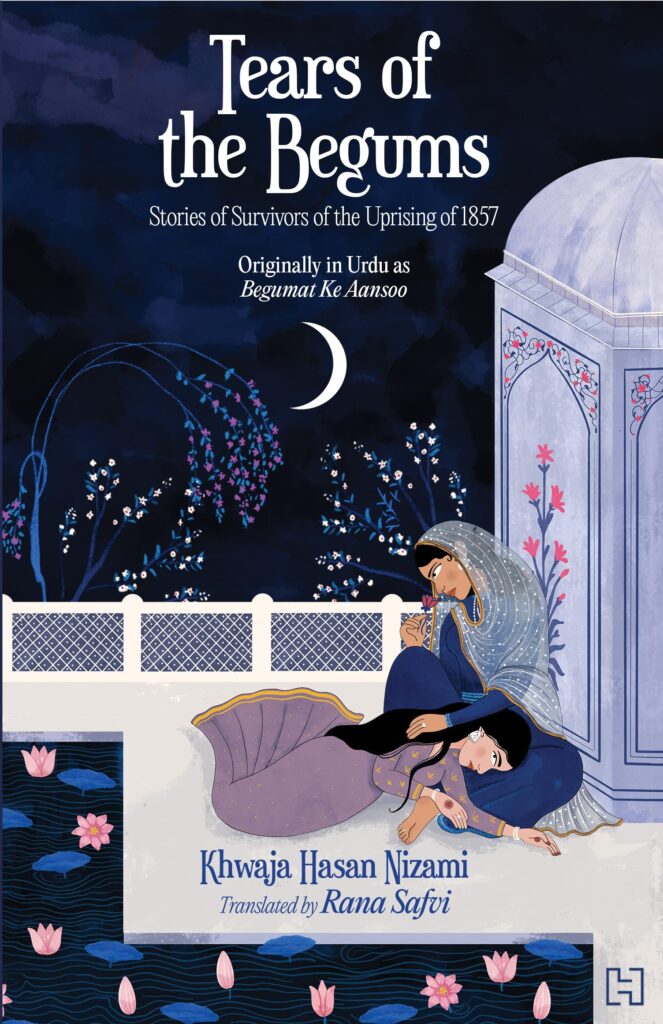
New Book , First ever English translation of Nizami’s invaluable Urdu book Begumat ke Aansoo
pix: amazon.in
Apart from the fifteen years that Sher Shah Suri snatched upon defeating Humayun, the flag of the grand Mughal Empire flew over Delhi undefeated for over 300 years.
But then, 1857 arrived and the mighty sword fell helpless in the face of a mightier British force.
After the fall of Delhi and Emperor Bahadur Shah Zafar’s tragic departure from the Red Fort in 1857, members of the royal Mughal court had to flee to safer places. Driven out from their palaces and palanquins onto the streets in search of food and shelter, the dethroned royals scrambled to survive. Some bore their fate with a bitter pride, others succumbed to the adversity.
Through twenty-nine accounts of the survivors of the Uprising of 1857, Khwaja Hasan Nizami documents the devastating tale of the erstwhile glorious royalty’s struggle with the hardships thrust upon them by a ruthless new enemy.
In vivid and tragic stories drawn from the recollection of true events, Nizami paints a picture of a crumbling historical era and another charging forward to take its place.
With the reminiscence of past glory contrasted against the drudgery of everyday survival, Tears of the Begums – the first ever English translation of Nizami’s invaluable Urdu book Begumat ke Aansoo – chronicles the turning of the wheel of fortune in the aftermath of India’s first war of independence.
source: http://www.amazon.in / Amazon / Home> Books> History> World / as on August 06th, 2022
Tarana Husain Khan doesn’t write women only as damsels in distress, she writes them as women who challenge.
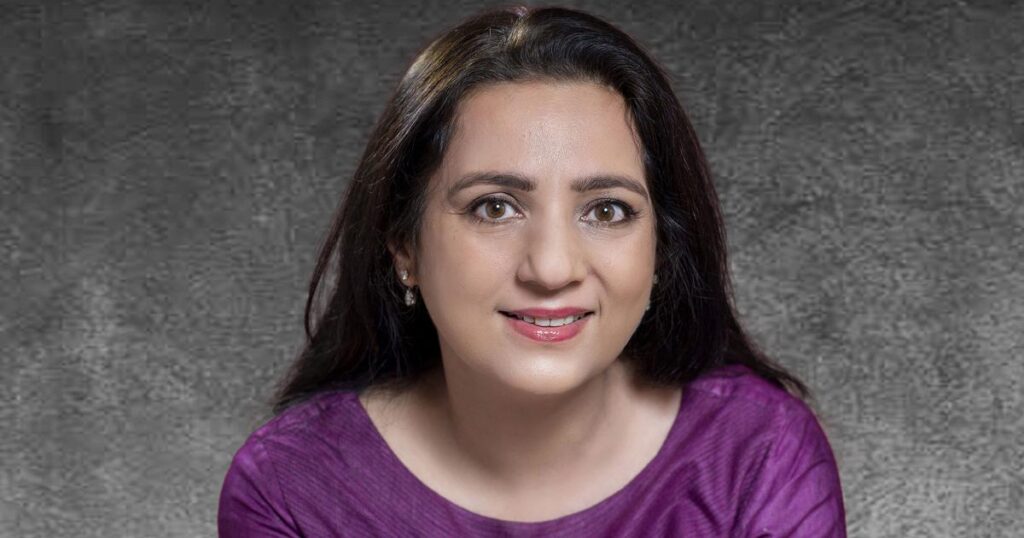
Tarana Husain Khan.
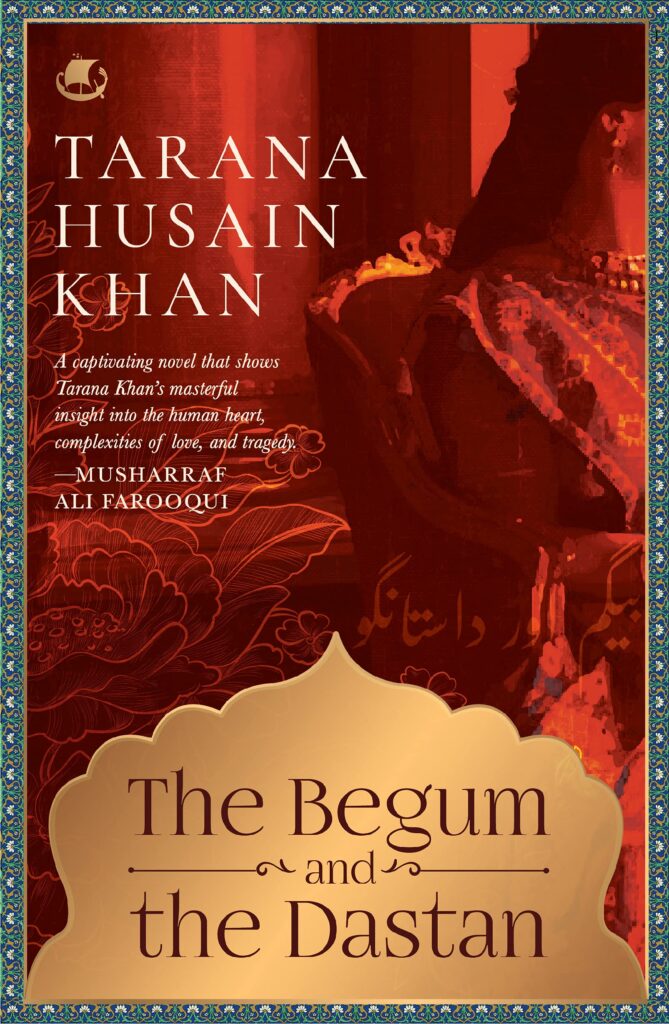
I don’t remember when my mother first told me, “Boys will be boys.” as an explanation. But I trusted it. The 20-year-old I am now knows it’s an eraser. A cleaning towel that wipes away the grim men produce. Over our words. Over our careers. Over our bodies. It’s an explanation that deletes a lived history with a swift and casual swipe. Tarana Husain Khan’s The Begum and the Dastan resists this erasure.
Khan’s character, Ameera’s grandmother, whom she calls Dadi, tells her the dastan about Feroza Begum, Ameera’s great-grandmother. Feroza Begum attended sawani celebrations at Nawab Shams Ali Khan’s Benazir Palace, defying her family, only to be kidnapped by the Nawab. Although the premise sounds simple, Khan crafts the dastan carefully, preserving the dynamics in Sherpur, a princely state, like one would sour pickle in a jar. Her writing serves as a citation for the overused “Show, don’t tell” technique, arranging the elements of time, location and character through a nuanced understanding of history.
She weaves together the stories of three women, Lalarukh, Feroza and Ameera, with the help of three dastangos, about Kallan Mirza, Ameera’s Dadi, and herself. Each story, within another story, surrenders as a cautionary tale. Sometimes, as a spoiler, that hands you the reins to ride through the rest of the story.
Blame slithers across each story, hissing at every woman who defies and exercises her need for independence. During the forced marriage to the Nawab, women around the bride were “tut-tutting over Feroza’s heartlessness”, believing she aborted her pregnancy from her previous marriage. The blame congeals on Feroza, a victim of forced abortion by the Nawab. In the rumours, the Nawab is a man she loves, not her abuser. The cruelty of these women steps outside the realm of gossip, nipping at Feroza’s right to refuse consent to her nikah.
“‘Feroza Begum, daughter of Altaf Khan urf Miya Jan Khan, your wedding has been arranged to Nawab Shams Ali Khan Bahadur, son of Nawab Murad Ali Khan Bahadur for a sum of two lakh rupees as meher. Do you agree?’
What if she just didn’t say anything?
‘She says “yes”!’ A middle-aged woman dressed in her bridal dress, suddenly shouted towards the curtains. Feroza turned towards the woman. The old lady in charge of her elbowed her ribs.
‘Uh?’ she turned sharply towards the offending lady.
‘I heard it too. She said “yes”!’ said the old lady, then another woman joined in bearing witness to her acquiesce and then another.”
“Why wouldn’t a divorced woman who aborted her child marry the Nawab?” is the rhetoric that these women echo. It’s a form of enabling, but Khan exerts dialogue, channelling prose to amplify Feroza’s reaction, forgotten amidst placeholder approval. She choreographs the myth “she asked for it” by excluding the chorus of the maulvi asking for consent thrice, as is tradition, to exacerbate the rumours that enable, and more terrifyingly, erase. Another dialogue chimes in to note this eager “consent” by Feroza. In these instances, Khan’s narrator, Dadi, is not just a storyteller; but an advocate for forgotten history.
But Khan doesn’t write women only as damsels in distress; she writes them as women who challenge. Feroza wears what she wants, despite the word that the patriarchy will impose on her: nautch. Khan examines how the question of her attire serves as a justification for the harassment. When Bibi, Feroza’s maid, asks her to “let it be”, as she was “wearing that dress”, Feroza doesn’t surrender to the blame. Instead, Feroza asks these questions: what if she was one of the common women? What if she was a nautch?
Khan tackles clothing not only as a form of rebellion but as an identifier of communion and the dismissal of “the other”. When Feroza sights a British woman wearing a “strange gown”, she argues that she should’ve worn “our dress” because she’s in “our country”. Other times, this divide is a form of empowerment.
“Strangely, guys don’t pester scarf-wearing girls with ‘I want to be your friend’ proposals. So us scarfed girls choose to talk to guys we like and make boyfriends on our own. It’s pretty cool that way, though I long to throw away the scarf and open up my hair like I used to at St Mary’s.”
Ameera’s perception of the scarf rewrites the reputation of the vilified veil, untying the folds that make it an oppressive tool while recognising how being “the other” means a kind of protection. A woman’s scarf, her dress, and her jewellery make an argument in this novel. But the expectations that pin a scarf around Ameera’s head, and a nath on Feroza’s nose, encourage a misplaced trust in the men in their lives.
Across the three stories in the novel, protagonists expect men to protect, not because they victimise themselves, but because that’s what’s taught to women: dependence is a desired trait. Khan acknowledges how patriarchy dribbles on the men, drawing out how Lalarukh, Feroza and Ameera feel betrayed by the men in their lives for not protecting them. The cadence of this betrayal morphs across the stories as Khan manipulates language like a glassblower does glass.
“I do believe that in this day and age nobody should bully you into selling your property – these are not the Nawab’s times; but if it was Jugnu’s fees and his exams, Abba would sell off the shops and chuck the case in a heartbeat. We females always depend on our fathers or males to rescue us – our default response to a crisis. Imagine, poor Feroza Begum’s father dumped her in the harem and ran away!”
Khan wields the tone of each story, carefully grafting the premise of a woman wronged in different periods and spaces. She uses the first-person perspective to narrate Ameera’s life, crumbling with her family’s negligence towards her, using a voice akin to a teenager simmering with anger. But for Lalarukh and Feroza, Khan, or rather Dadi and Kallan Mirza, uses the third-person perspective, a voice that is omniscient and viscous, dripping of superiority.
They narrate the violence of Nawab and Tareef Khan, Lalarukh’s kidnapper, without embellishments. The abusers are not kings or sorcerers in the chapters that harrow. They are written as, to no surprise, violators. Khan’s treatment of the dynamic between the Nawab and Feroza contradicts this claim sporadically. But when Feroza reciprocates the Nawab’s ‘love’ for her, he continues to dredge her in the limitations of his harem, remaining free himself, further testifying the degree of his abuse. Feroza is a flawed character, but she is not a flawed victim, and Khan asserts that.
Like Khan, both Dadi and Kallan Mirza are biased narrators, intervening to train their listener(s) to root for the protagonist. They collectively fuel a question: How does tradition, along with law, permit the violation of women? Unfortunately, the stories, or rather the lived experiences that ask this question, are muzzled. But the dastangos, both the real and the fictitious, bite through the labour that accompanies such storytelling. The story prompts the question: How can one write history without condoning it? In The Begum and the Dastan, history is an inspiration, a tool, and an anchor, but it is not a justification.
pix: amazon.in
source: http://www.scroll.in / Scroll.in / Home> Book Review / by Isa Ayidh / (book cover image edited in, amazon.in) /June 27th, 2021
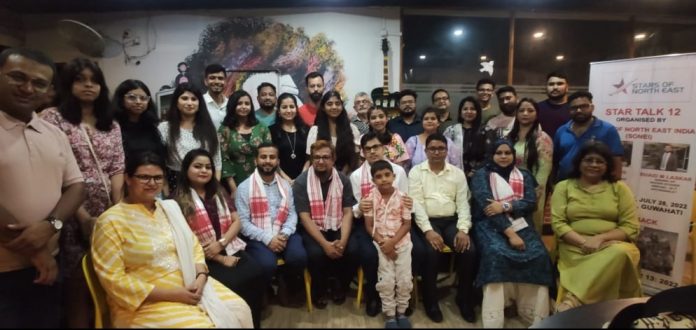
Members of SONEI along with guests pose for a group photo on the sidelines of the ‘Star Talk-12’ event held in Guwahati on Thursday.
Guwahati :
‘Star Talk-12’, an initiative of the Stars of North East India (SONEI), a registered public charitable trust and talent hunt platform, was held in Guwahati on Thursday.
The first appointed speaker of the event was Aman Wadud, a young lawyer who recently got his Masters in Law from the University of Texas under a Fulbright Scholarship. Besides sharing his American experience, Aman Wadud gave a very informative presentation of the evolution of Civil Rights in the USA.
The second appointed speaker, Suaid M Laskar, Head of Pan-India Sales, Admissify made a presentation to clear the common doubts people have about studying abroad. Laskar, who has been instrumental in facilitating overseas studies of more than 350 students from Assam, over the last five years, in countries like Australia, Germany, UK and USA, informed the audience that 93 per cent of the students who go abroad for studies belong to middle class families.
Abhishek Kumar, a graduate from Guwahati Commerce College, who is all set to study his Masters in Supply Chain Management at Cranfield University, UK also shared his experience on the occasion.
Alemoon Nessa of Bongaigaon, who recently received two national MSME awards along with a cash component of Rs eight lakh from the hands of Prime Minister Narendra Modi, was felicitated on the occasion.
Dr Faizuddin Ahmed, a physicist from Dhubri, who has made it to the Stanford list of world’s top 2% scientists, was also honoured on the occasion.
Shahnaz Islam, a budding poet whose book “Midnight’s melancholy” was launched from Sikkim recently, enthralled the audience by reciting a few poems from her book.
Mirza Arif Hazarika’s short film “Sorry” starring Barasha Rani Bishaya and Ravi Sharma is now live on Disney+Hotstar, a rare honour for an Assamese short film. Mirza shared his experiences of making the film.
Priyanka Paul Banerjee, an upcoming PR practitioner, was also felicitated along with other achievers at the event.
SONEI will complete eight years of its existence in September 2022 during which new projects will be announced in addition to its existing programmes in the field of education, promotion of skills, and social service.
The event was hosted by Samima Sultana Ali and Sharique Hussain.
source: http://www.muslimmirror.com / Muslim Mirror / Home> Education> Positive Story / by Special Correspondent / July 29th, 2022
A tribute to a polymath historian who recently passed away.
Dr Ziauddin Ahmed Shakeb at the Qutb Shahi tombs in Hyderabad, October 2013. Photo: Author provided
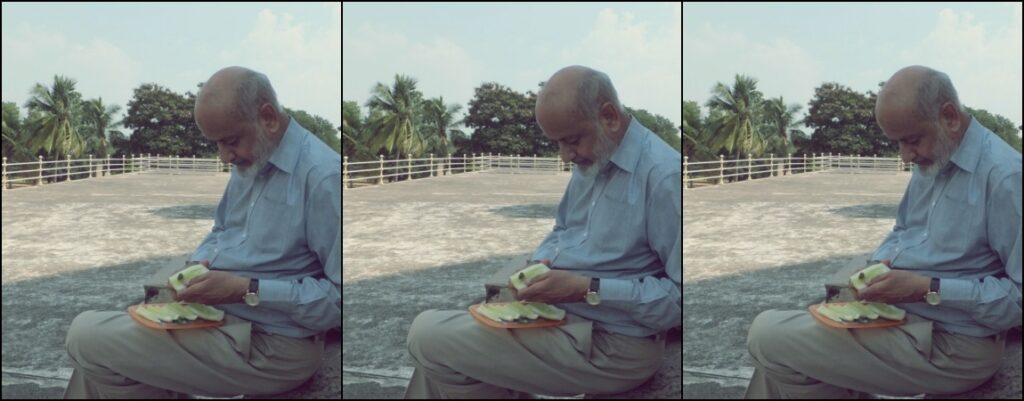
I first met Dr Mohammed Ziauddin Ahmed Shakeb in the summer of 2011, as a naïve PhD student who’d arrived in Hyderabad from Los Angeles wanting to “read Shah Jahan’s documents”. He asked me the very standard question asked of research students in India, “What is your topic?”
I only had a rather incoherent answer to give to Shakeb, the man who had, among other things, created the Mughal Record Room, in what is today known as the Telangana State Archives. Located in a nondescript building at the periphery of the Osmania University campus in the dusty precinct of Tarnaka, this institution has undergone numerous transformations over the course of a half-century of its existence in Hyderabad. But institutions were often narrow and unimaginative places for sustaining a towering figure such as Shakeb. He went on to have a long and eclectic life and career that consistently defied the logic and constraints of institutions, for he was himself an institution. The loss of Shakeb is thus far more than the loss of an individual.
His was a formidable generation of post-Independence intellectuals from different parts of the subcontinent who, from the 1950s, devoted themselves to preserving its languages, repairing and reconstructing our scattered archives and libraries, and re-imagining our past(s) long before colonialism. Shakeb embodied, above all, a boundless curiosity coupled with a complete disregard for trends, ‘schools,’ cliques, and fancy theories.
He was not interested in being a Marxist or a nationalist nor in chasing the Western academy’s greener pastures. In some ways, his foremost allegiance was to the detritus of the past itself – to what paper, ink, and materiality mean and what they can tell us about our past and present selves. He asked, what a document or manuscript had gone through over centuries, how had it come to be, and how can we best preserve thousands of paper fragments for future generations so we can continue to tell their stories?
This rare commitment to the study and preservation of archival knowledge led him to write the landmark catalog, Mughal Archives Vol I: A Descriptive Catalogue of the Documents Pertaining to the Reign of Shah Jahan, in 1977, followed by many publications for The British Library, State Archives Andhra Pradesh, and other repositories, universities, and auction houses. I remember asking Shakeb once why he was so committed to creating reference tools to access rare historical materials, and he answered, “because I know no one will care to read them in the future!” In some ways, he was right.
Today, when the stakes for writing about the subcontinent’s pasts are fraught and closely tied to an ongoing project of hollowing out academic institutions, it’s worth remembering a very different kind of Indian historian.
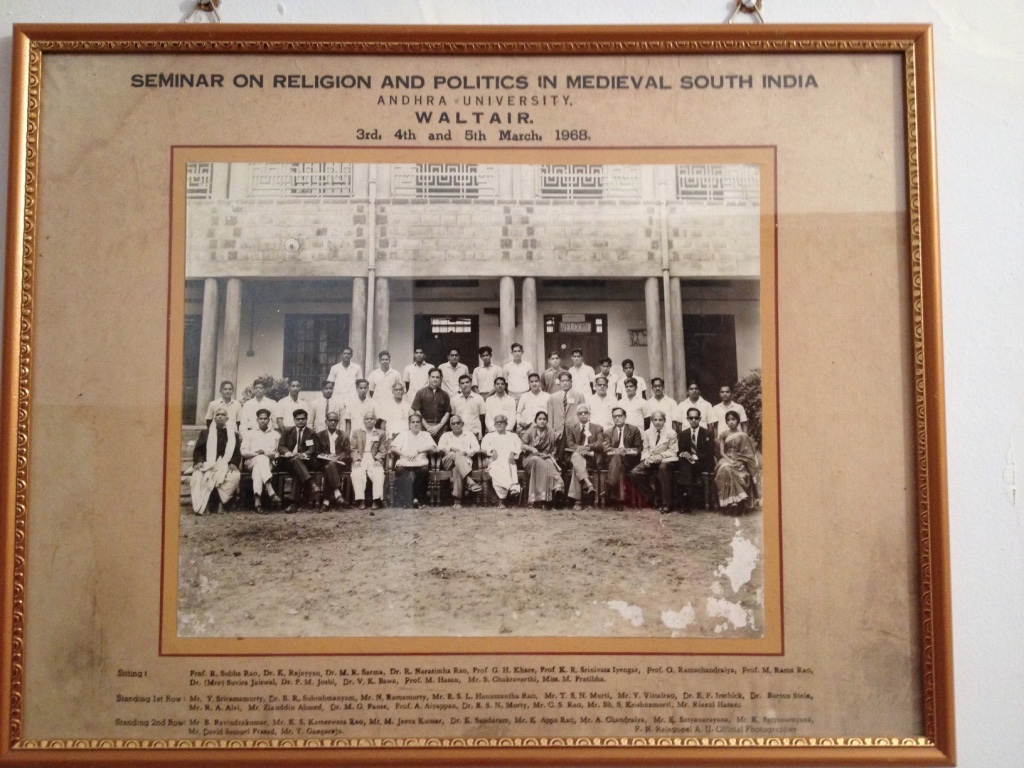
Shakeb standing in the second row, in a group photo from a conference in March 1968 at Andhra University, Visakhapatnam. Also pictured are G.H. Khare, Mohibbul Hasan, V.K. Bawa, P.M. Joshi, Suvira Jaiswal, Burton Stein, and Eugene Irschick, among others. Photo: Author provided
Born on October 21, 1933, Shakeb grew up in Hyderabad and Aurangabad. He studied Political Science and English at Osmania University before heading to Aligarh Muslim University in 1956 for his Masters, where he was taught by Mohammed Habib and S. Nurul Hasan. In 1962, he returned to the south where he was employed as an archivist at what was then known as the State Archives Andhra Pradesh. There, Shakeb acquired the unique training of deciphering documents and identifying their categories, genres, and forms from the last generation of the traditional jagirdari staff of the Nizam’s state who were retiring when he joined the archives. He also worked under Yusuf Husain Khan who had begun the work of processing Mughal administrative documents. The archives thrived under the directorship of committed scholar-administrators such as Hadi Bilgrami and V.K. Bawa.
As rich documentary caches from families, Sufi shrines, and samsthanams were discovered and deposited into state institutions, post-independence archivists and historians confronted challenges, including the reluctance of individuals to part with materials that had been in their homes for centuries. Debates and disputes ensued about what constituted a ‘valuable’ manuscript or document, how to classify materials, and to which regional-linguistic nationalism a remnant ‘belonged.’
These were debates that had already begun in the pre-Independence period, in the work of institutions like the Indian Historical Records Commission. Recent studies of the debates between Jadunath Sarkar and the Maratha historians have traced the longer history of such tensions. Part of the problem was the mutual suspicion between scholars oriented to modern social sciences and those with a more ‘traditional’ orientation and training. Shakeb, the archivist-historian, was at once both and neither.
At a distance from the halls of JNU and Aligarh, where the Mughal state’s merits were being debated, Shakeb inhabited yet another set of worlds. He was at ease reconstructing the household library of Chishti Sufi Abu’l Faiz Minallah in Bidar, discussing the southern India Cholas with the American historian Burton Stein, and discovering a shipwreck off the coast of Masulipatnam in the late 1960s.
Based on newly-processed materials, in 1976, he would complete his doctorate under P.M. Joshi at Deccan College in Pune, a connected history that examined circulation and political diplomacy between Safavid Iran, Mughal India, and the Golkonda sultanate. Shakeb’s study brought the question of mobility and exchange to the centre stage at a time when the norm was to study either the Mughal heartland (often synonymous with Delhi or the northern Indian plains) or select one province of the empire. After many years in archives and universities, Shakeb charted his own path beyond academia. His forensic ability for assessing manuscript provenance, material objects, and documentary genres, allowed him to thrive in other professional contexts, leading to work as a consultant for Christie’s in London.
But, to restrict myself to Shakeb the historian would fail to capture the range of subjects, languages, and disciplines over which he had complete mastery – Persian and Urdu literature, Islamic studies, geography, philosophy, linguistics, and art history. Shakeb always kept the historian’s arrogance in check by reminding her of the literary critic’s skills. The study of prosody and poetics was just as important for making sense of an India without and before English.
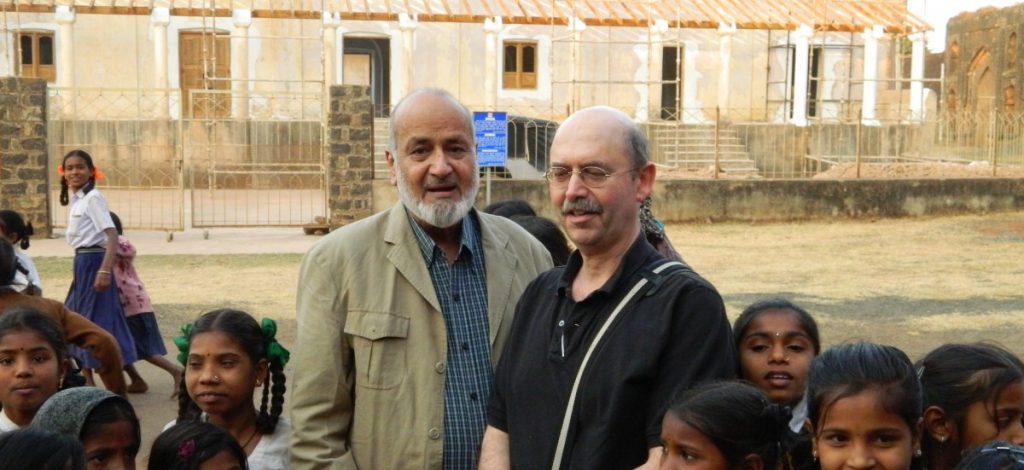
Dr Ziauddin Ahmed Shakeb (L) with his friend Dr Leonard Lewisohn (R) at Bidar fort in January 2012. Photo: Author provided
Literary circuits would light up the minute Shakeb landed back in Hyderabad (as they often would in London). He had been working for many years on translating Iqbal’s Persian poetry into Urdu. He was equally committed to the study of Bedil, Ghalib, Dagh, and Amir Minai. He would unveil to students the unique phonetics and cadence of Dakani, the pan-regional literary idiom of southern India, with many living poets and a long literary history, which he emphasised, is yet to be fully understood for its role in shaping classical and modern Urdu.
When he published his dissertation, Relations of Golkonda with Iran, in book form in 2017, he dedicated it to his grandchildren – Itrat, Taha, Mahamid, Khadija, Tawsin, Mahd, Istafa, Fatima, ‘Ali, Nuha – all of whom embody their dadasaab’s fortitude and resilience. I haven’t sufficient words to describe the patience of his wife, Farhat Ahmed, and the enormity of what she has taught me over many years about balancing the scholarly life with everyday living. It was this reminder that grounded Shakeb’s engagement with multiple worlds. His hands that treated every piece of archival paper like a newborn child. Lethal scoldings hurled at junior scholars too convinced of their own greatness. And, never forgetting to make fun of people who take themselves too seriously. With Shakeb’s passing, we are reminded how fragile the threads are that connect us to the past, and how dependent we are on a handful of such individuals. It’s difficult to imagine what, if anything, might come after such larger-than-life figures.
Subah Dayal is Assistant Professor at New York University’s Gallatin School of Individualized Study. Her research is on social and cultural histories of the Deccan and the Indian Ocean world.
source: http://www.thewire.in / The Wire / Home> English> Culture> History / by Subah Dayal / February 10th, 2021
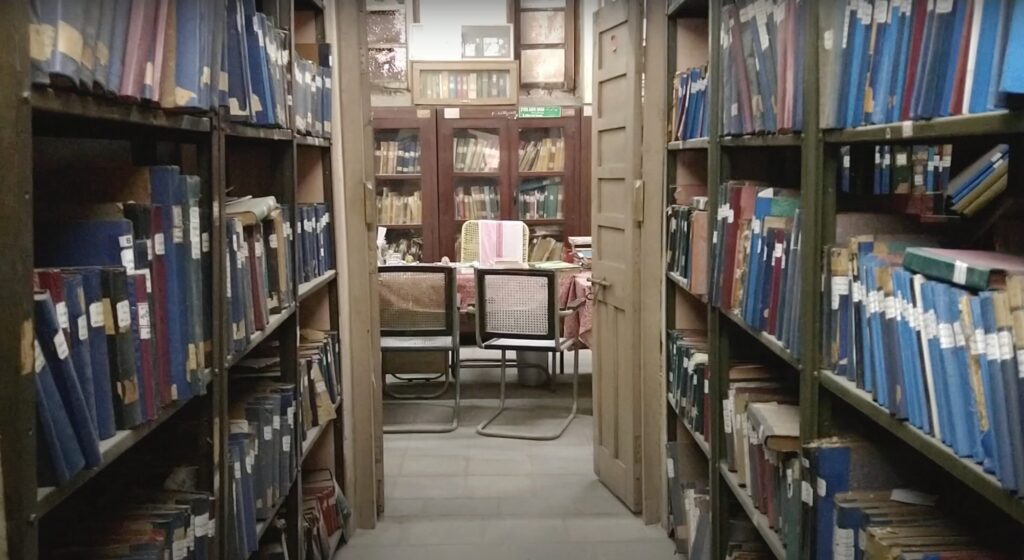
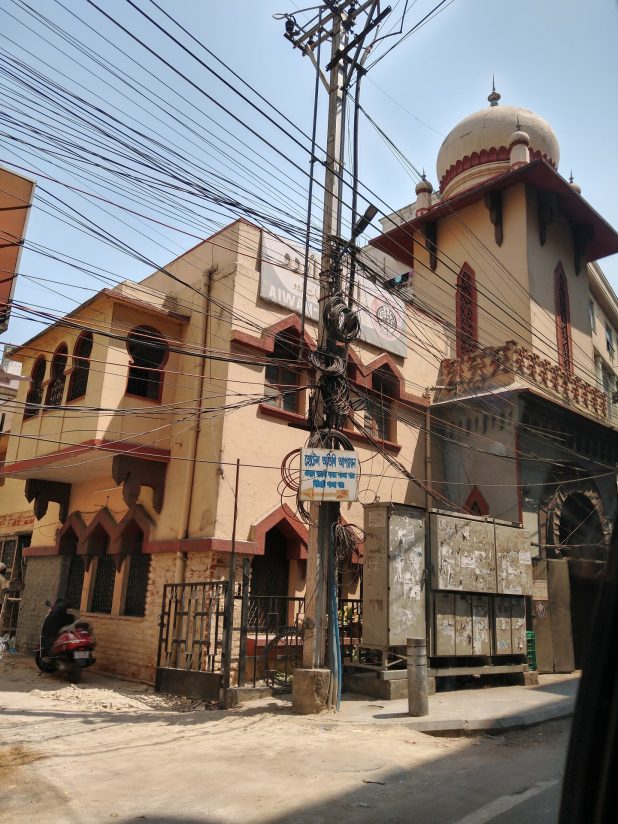
Barely visible from across the new Errum Manzil metro and crushed between rows of commercial buildings, lies an abandoned citadel of knowledge: Idara-e Adabiyat-e-Urdu.
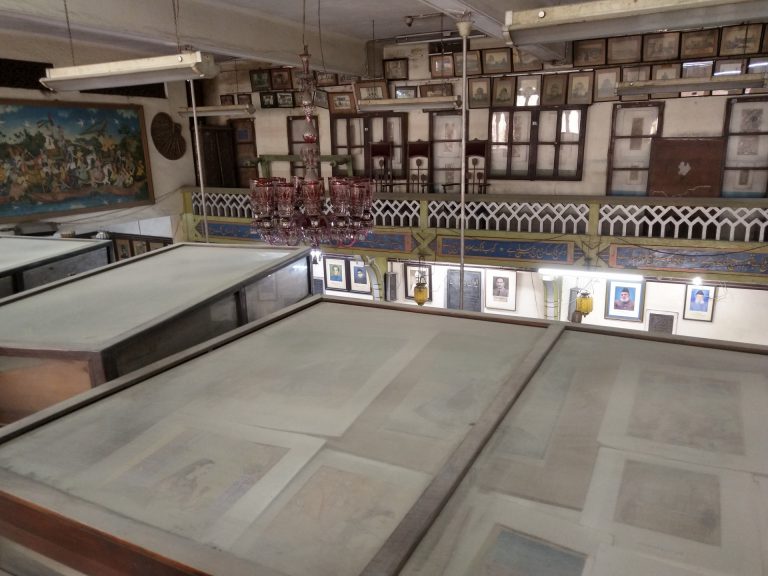
Once a core institution of the city for scholarship of the Deccan, this vast library and its museum, Aiwan-e Urdu – like much of Hyderabad’s heritage – exists in a state of disrepair. It is one of Hyderabad’s fast disappearing independent archival institutions connected to a time before – as ruins beneath the consumerist ravages of the new city. And yet, as we step inside, walk up the stairs to the library in its tower, rummage through dusty catalogues and forlorn books – it feels as though we have entered a magical portal into another world.
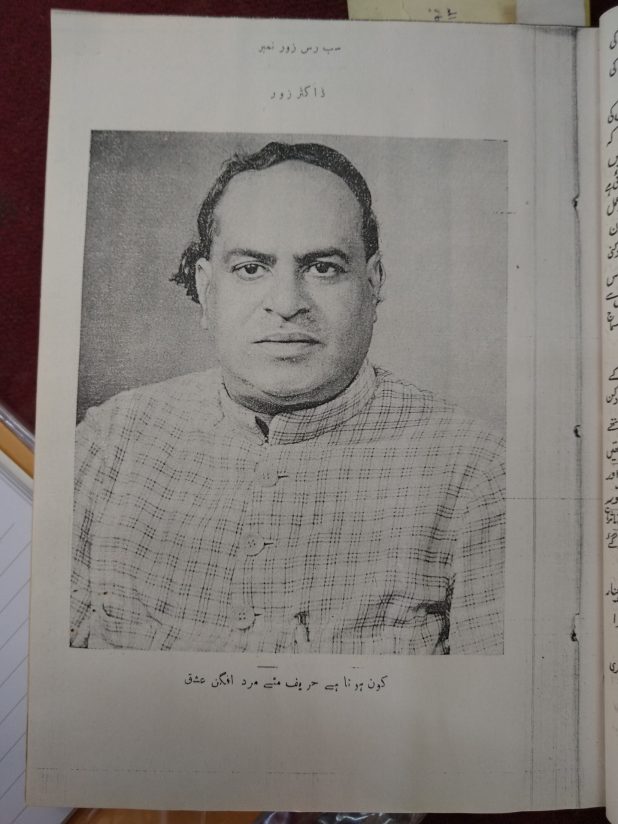
Established in 1931 by Syed Mohiuddin Qadri Zore (1905-1962), the most prolific scholar of the Deccan, and built upon lands donated by his wife, the illustrious poetess Tahniyatun-Nissa begum, the Idara houses a vast archival collection. That the library and museum continue to exist at all is due almost entirely to their 73-year-old son, Rafiuddin Qadri, who has devoted himself to managing this house of knowledge. Containing over fifty-thousand books and printed materials, including manuscripts and paintings and artefacts, the purpose of the Idara was to preserve the art, history, and multilingual Deccan literary cultures in Urdu Dakkhani, Persian, and Arabic.
At a cursory glance, the closed doors of the book shelves seem dense and inaccessible. But if one is willing to subject themself to the rigours of an erstwhile knowledge production circuit and has the patience to listen to its many stories rendered in multiple languages and idioms, these doors open up fascinating worlds.
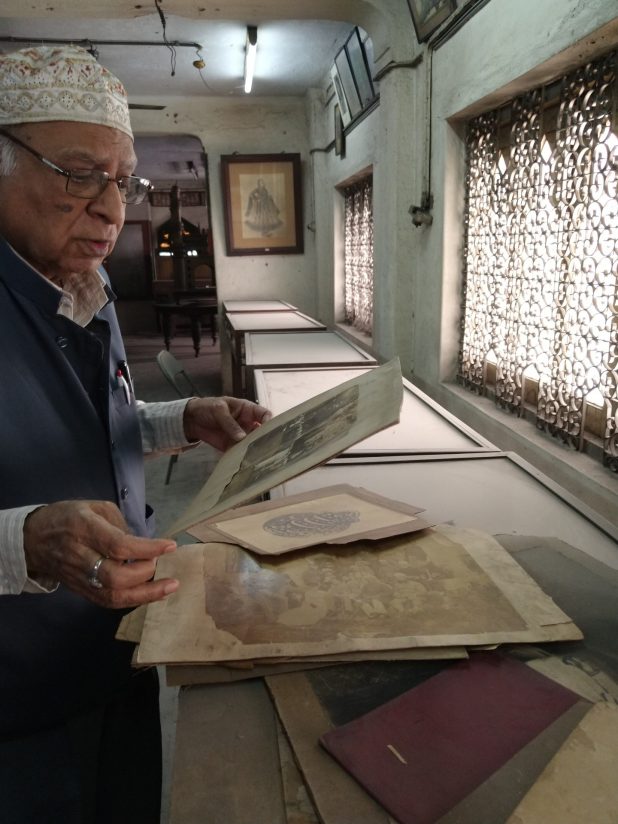
Here, beneath dusty glass encasements, is an original eighteenth-century painting of warrior queen Chand Bibi of the Deccan, and a book about Deccan Radio. The museum is typically kept locked and desperately needs restoration. A dusty lithograph of sixteenth-century Qutb Shahi tughra emerges in fragile condition, alongside an original photograph of Kishen Pershad, an erstwhile prime minister of Hyderabad State under the Asaf Jah Nizams. The museum contains rare royal firmans, inscriptions, maps and genealogical trees, arms and weapons, coins, old garments and cloaks that are not available anywhere else.
Behind this seemingly random collection from the past is the erudite vision of Zore, who was not only a scholar himself but also carefully curated and fostered the production of knowledge.
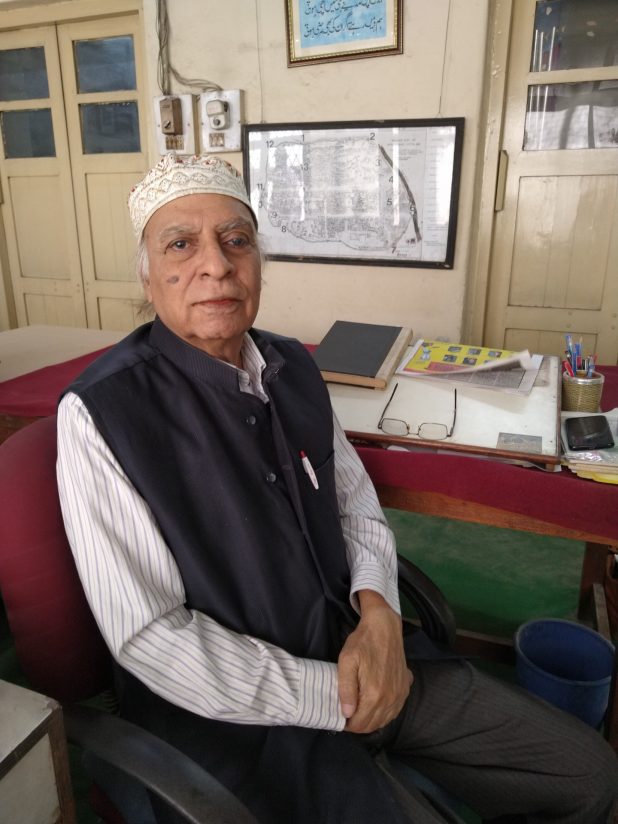
Rafiuddin Qadri at Idara-e-adabiyat-e-Urdu.
Zore’s son Rafiuddin Qadri sits at a desk in the main hall, surrounded by construction workers, painters, and piles of decaying books and magazines. The sound of traffic on the main road tends to drown out his voice. He is the last of a generation to remember why institutions such as the Idara emerged in Hyderabad during the early to mid-twentieth century. He is soft-spoken, donning his characteristic vest and topi. He carries a dignified scholarly attitude resonant with an earlier time. Exceedingly generous and patient, Qadri carries on a legacy that no longer is valued by the current trends of historical knowledge production in India.
Archives and libraries everywhere in India are under threat of some kind, as history literally rots away . Hence, when serious historians come across independent archival institutions and archivists devoted to the preservation of historical knowledge – like Rafiuddin Qadri – it is worth telling their story.
Once a core institution of the city for scholarship of the Deccan, this vast library and its museum, Aiwan-e Urdu – like much of Hyderabad’s heritage – exists in a state of disrepair.
Descended from a Sufi family of Qandhar and North Deccan, Rafiuddin Qadri’s ancestors came to Hyderabad in the late nineteenth century. His father, Syed Mohiuddin Qadri Zore maintained close ties and commitments to Sufism, both in institutional ways regarding his familial lineage and his philosophical approaches in terms of the spiritual values attributed to seeking out knowledge. Sufi dargahs have traditionally been not only spiritual centres but also major arenas of producing knowledge. At the same time, Zore was a modern visionary, establishing a major institution of learning in Hyderabad, in keeping with the time. “The dawn of the twentieth century was an era of renaissance in the Deccan,” and “a number of institutions such as Asafia Library, Osmania University, Dairatul Maarif, Dar-ul-Tarjuma, Salar Jung Museum, were established which contributed immensely to the production of knowledge about the history and culture of Hyderabad.” Zore was not only a major scholar-administrator – publishing hundreds of books and editing the magazine Sab Ras – he was a key figure who brought together intellectuals while establishing and overseeing the Idara, with the help of his friends, ranging from scholars to local politicians and administrators. This spirit lives on in Rafiuddin Qadri.
Rafiuddin Qadri at the Idara Museum.
Schooled as we have been in the contemporary formalities of accessing archives, when we asked if there was a fee we ought to pay to access the library, Rafiuddin Qadri said, “No, not at all,” and then explained his father’s legacy. “Knowledge should be free”, is the principal hallmark of the Idara. “It is completely against my father’s ethics that one should charge money to scholars as this is a place for them to study and learn freely.” This ethics of scholarship and the writing of history is lost as a result of the commercialisation of intellectual production as well as the privatisation of education in India. “It was meant for the youth of Hyderabad,” says Rafiuddin Qadri, about one of the main purposes of establishing the Idara. “The youth were involved in the world of politics constantly, at a very turbulent time,” referring to the anti-colonial nationalist movements of the 1930s and 1940s. “A quiet space of inquiry was needed where they could go to do intellectual work and to study.” The Idara, then, is a physical space and has served as a much-needed refuge from the noise of the world’s polemics, to think, ponder, reflect, and read, without the constant interruptions of the fast-paced intensity of daily urban life in India, and its demands.
‘Scholars come from all over the world. They say, how did Zore know I would need this document so many years later! He had preserved it!’
The extraction of knowledge out of India and into the corridors of more powerful contexts of intellectual knowledge production – such as academia in the West – has contributed to diminishing the role of those who have cultivated the very libraries and institutions so central to academic research about India. It is often suggested that only British libraries and archives are worth perusing when it comes to various aspects of India’s past, given the colonial codification of Indian knowledge – brought there often by way of loot – were preserved there. Moreover, popular histories of the Deccan for a commercial market dominated by elites and their publishing houses tend to overlook vast swathes of historical knowledge produced in languages other than English, such as Urdu. Zore had been vital to Hyderabad in creating a space, a physical place, a free and open library – of which there are few and far between today. The very idea of a library – one of the few spaces which anyone can visit without having to spend money – is itself a revolutionary idea in contexts such as India. The institution Zore created is today preserved by Rafiuddin Qadri, who belongs to the last generation of living reposit.
The Idara Museum.
Rafiuddin devotedly handles the materials, and carefully walks the corridors he has seen during the many seasons of his life. His eyes light up when he narrates the stories of researchers: “Scholars come from all over the world. They say, ‘how did Zore know I would need this document so many years later! He had preserved it!’”, he muses.
Deccan: A region that resists categorisation
“Even though local Indian historians may know more about the Deccan, they won’t get published as easily as outsiders in the top international presses.”
“This is true. But I feel like we do the same thing unfortunately. Produce knowledge for the West.”
“History as a profession in India seems so dead. The assault is coming from all sides. The propagandistic writing to fit the current ruling ideology, the evisceration of educational spaces, the lack of care, no thought.”
“It’s so depressing.”
“So, how do we talk about the Deccan amidst all this? No one seems to care.”
“Just keep going to the archives and keep writing.”
“Yes, Rafi Sahb is waiting.”
“Is he there now?”
“Yes, he is.”
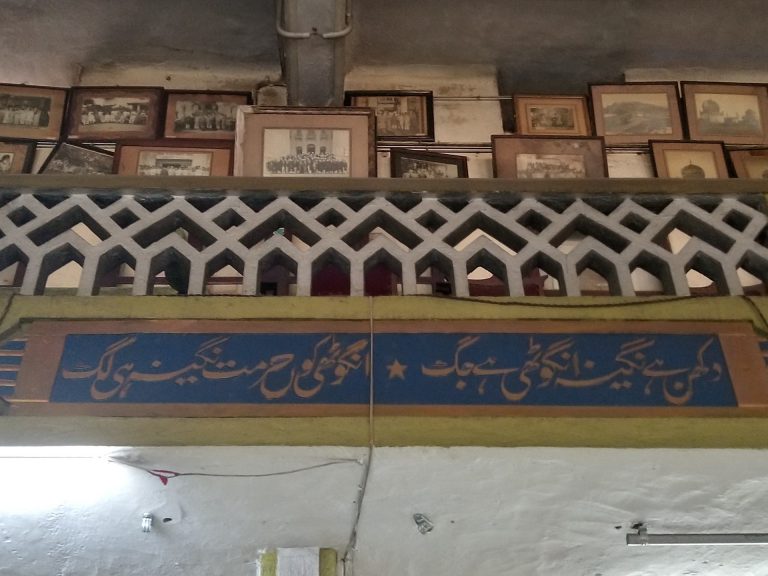
Calligraphy at the Idara-e-adabiyat-e-Urdu.
Rafiuddin Qadri points to the calligraphic poetry of Dakkhani Urdu gracing the high arches of the main hall of the Idara, with its main chandelier, overlooking what once was a clean and orderly library. “This place is not what it once was, there are very few people who are interested in doing serious work like this in Hyderabad,” he says. It is true. The archivists and knowledge-keepers of these earlier institutions are passing away while their knowledge is not being passed down. As we ask Qadri questions about our respective research projects, he says, “Did you ever meet Zia Shakeb?” We shake our heads. Qadri puts his hands to his head. “Oh, that is too bad. He knew so much. And now he is gone. So much is gone and lost.” In describing the history of the Idara-e-Urdu-e Adabiyat, Qadri also shares with us some old photographs detailing the networks of people instrumental to this library.
Zore imagined Idara, with a differently rooted aesthetic, as a space for people from different languages of the Deccan to work together, to have intellectual camaraderie without being subjected to the pressures of capitalist cycles of publish or perish production.
Qadri shuffles slowly between different rooms of the Idara, all under some kind of construction. He seemingly is displaced not only by time, but also between the once vibrant rooms of his family’s library. Over cups of chai, as we discuss historical research, he advises us about specific catalogues and indexes as he repeatedly issues unheeded calls for the library staff to retrieve particular titles.
What happens once these archives, knowledge, and the custodians of stories about the past are lost? One easy answer is that the region takes on a new identity, more sectarian, more oppressive and discriminatory, built around invented histories that weaponise pasts as archives diminish. Perhaps, a more creative and bolder answer would be, that we increasingly become a society alienated from oneself, lost and rootless – our understanding of history diminished by corporate and profit-making knowledge enclaves such as within the dystopia of a hi-tech city and financial district, Hyderabad’s rapidly developing new urban core. It is the responsibility of professional historians to keep stories of the past in circulation, in the hope that they might make us more empathetic, caring and humane.
Although Qadri claims his memory is fading and not what it once was, we marvel at his ability to recall catalogues, titles, essays, authors, scholars, poets, and multiple editions of books and magazines, produced about the Deccan between the 1930s and 1960s. This earlier period of scholarship about Dakhaniyat is largely ignored, as knowledge produced in the languages of this region, such as Urdu, is not considered as worthy as compared to knowledge produced in English.
The Deccan has long been configured as a region of hope in history, offering alternative ways of belonging, those that do not fit within the nationalist frames of India and Southasia overall.
It is in response to European dominance over the circuits of knowledge about India, that Zore imagined Idara, with a differently rooted aesthetic, as a space for people from different languages of the Deccan to work together, to have intellectual camaraderie without being subjected to the pressures of capitalist cycles of publish or perish production. Accessing the Idara today is not just about mechanically sifting through catalogues until you find what you need, and extracting it – but more about setting the pressures of clock-time aside and the arrogance of earned professional degrees aside, to learn from a life-long archivist. It means opening one’s self up to the humbling, slow and feeble processes of identifying voices in history, which are increasingly lost in the maddening clamour of the market and the deafening contours of nationalist totalitarianisms and fascisms of today.
Interest about the Deccan is growing in India, and new works of popular history have emerged in recent years. There has been some recent acknowledgement that the history of the Deccan has been marginalised, and as one headline pronounced, “Indian history without the Deccan is like European history minus France” for it seems that comparisons to Europe must be made, if Southasian regions are to exist at all within the historical imagination or reading public. Overall, it is the north-centric perspective of India’s historical narratives that continue to dominate Southasia’s study of the past. This is a perspective that largely ignores the Deccan region – today, home to the four linguistically organised states of Maharashtra, Telangana, Andhra Pradesh, and Karnataka. Southasian historians continue to favour and focus upon Punjab, Bengal, and Uttar Pradesh. Meanwhile, it is the Mughal era that dominates scholarship on Southasian Islam when turning to India’s medieval and early modern past. Turning to the Deccan region thus challenges the north-centric perspective of Mughal imperial development that dominates histories of India’s Persianate past.
Syed Mohiuddin Qadri Zore (1905 – 1962).
And yet, it is impossible for any serious scholar or historian undertaking research about Deccan or about Hyderabad – once India’s largest and wealthiest princely state – without coming across the legacy of Syed Mohiuddin Qadri Zore.
Rafiuddin Qadri points out a special issue in Sab Ras about his father in which the author points out that, “Dr. Zore gave voice to the Deccan,” during a period of time in India’s history when communal tensions were on the rise. His was a utopian project of “knowledge for the people,” about a region of Southasia with its own distinct role and shared pasts that cut across religious, linguistic, and communitarian identities. It is to Zore’s credit that the Deccan was situated at all in the historiography of the subcontinent, being one the first scholars to research and write seriously about this region. Zore’s legacy is astounding, and he is, in fact, a key figure in India’s intellectual history. Yet, he has been ignored by historians of India. To write about him means having to situate oneself between the missing pages of Southasian historiography and history, between emphasising the importance of ethical citational practices amidst fast disappearing archives.
The Deccan has long been configured as a region of hope in history, offering alternative ways of belonging, those that do not fit within the nationalist frames of India and Southasia overall. Nawab Ali Yavar Jung, the Vice-Chancellor of Osmania University in the first session of the Deccan History Conference held in April 1945, which was sponsored by Zore said “…the history of the Deccan is, in miniature, the history of India. It mirrors all the great reflexes of Indian History and throws its own reflection back on that larger screen…. Separateness in the midst of geographical unity, isolation in the midst of invasion, such have been its characteristics. The resistance of the south to northern pressure provides an instance of the centrifugal forces which baffled successive efforts to establish one and the same rule over the length and breadth of India…” The region carries the spirit of sovereignty and diversity and this was championed by Idara and Zore. Though not like what it once was, in Hyderabad Deccan there still continues the intermingling of the languages of Telugu, Urdu, and English, with a sprinkling of Marathi, Kannada and Tamil.
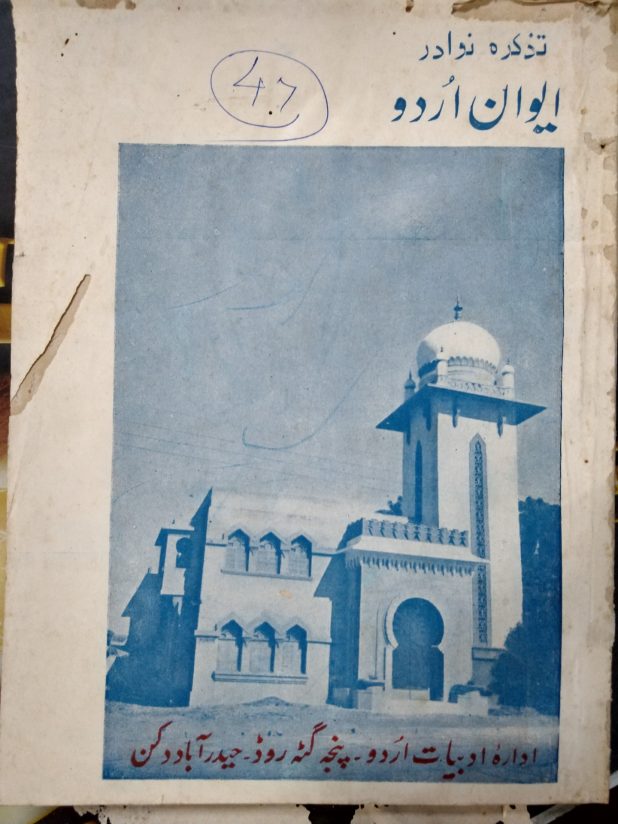
Archival image of Aiwan-e-Urdu.
The pluralism and cosmopolitanism of the Deccan is reflected in the physical building of the Idara itself, whose construction occurred in 1955, with the patronage of the Government of India, the Nizam Trust, and several other entities in and outside of Hyderabad, from the state of Andhra Pradesh to Kashmir – where Zore was eventually laid to rest. The Indo-Islamic architecture and designs are inspired by Qutb Shahi domes, Indic lotuses of Hindu mythology, Bahmani latticework, flowering buds of the Egyptian Nile, and Spanish minarets and arches, with a main front door meant to represent the gates and doorways of so many forts of India.
Not only was Zore among the chief intellectual architects of Dakhaniyat, he was responsible for building several educational institutions and was at the helm of vast intellectual production. His entire education through his Masters degree was completed in Hyderabad. Born in 1905, Zore was educated in a primary school in a Kayasth Pathshala, where he learned English, and where his fondness grew for poetry, public speaking and debate. By high school he had not only already established a debate society but also a small library. He later joined Darul Uloom and City College and ultimately the College of Arts and Social Sciences at Osmania University.
Descended from a Sufi family of Qandhar and North Deccan, Rafiuddin Qadri’s ancestors came to Hyderabad in the late nineteenth century.
Osmania University is the first university in India to introduce a vernacular language (Urdu) as the medium of instruction. It aimed, among other things, to translate knowledge, including science textbooks into Urdu, which was a remarkable project, and contributed to a cosmopolitan ‘worlding of the Deccan.’ There, Zore eventually became Head of the Department of Urdu, where he was a founding member of ‘Mujalla-e Osmania’, the first Bilingual English-Urdu magazine at Osmania University. He was the first to work seriously on Urdu-Hindi linguistics and phonetics, and later published a book called Ruh-e-Tanqid, which was one of the earliest works of Urdu literary criticism. Widely travelled, journeying to London, Paris, as well as to Germany – where he learned French and German and translated Dakkhani Urdu poetry into European languages – Zore also travelled extensively within India, and to Kashmir and wrote the first book about Dakhaniyat. A polyglot, linguist, and philologist par excellence, Zore had studied Sanskrit and Gujarati as well.
During the mid-1930s, he embarked upon a project to prepare an encyclopedia in Urdu, inviting Mohandas Karamchand Gandhi, Muhammad Ali Jinnah, Sarojini Naidu, and Jawaharlal Nehru to write for it – many of whom had met with Zore. Though the encyclopedia project itself was not realised, the attempt signalled the yearning to produce knowledge about the world for citizens of Hyderabad, to bring in a perspective from the Deccan and its relationship to the wider world. And yet, his legacy is in danger of being forgotten, as Zore’s understanding of the Deccan has never been included in the story of India. The Idara-e-Urdu-e Adabiyat and the Aiwan-e Urdu are institutions that themselves could form the subject of an entire PhD dissertation as well as serious scholarship about Hyderabad’s institutions.
Erasures: The city and the politics of historical memory
Hyderabad’s past is rendered almost invisible: over the past 75 years, there has been tremendous upheaval: from a former Muslim princely kingdom – capital of the Asaf Jahi dynasty – to its violent annexation by the Indian state and army in 1948; and then its incorporation into the state of Andhra Pradesh in 1956; its land reallocations by the linguistic state in the 1970s and 1980s; the neoliberal economic reforms of the 1990s; and then being cast as the capital of the new Telangana state in 2014, the same year India was met with the political triumph of Hindu nationalism. And, it is not only upheavals.
Hyderabad’s history is also marginalised by most historians of India, who have simply not paid close enough attention to this city and its past. Then, there is the fact that popular historians write of Hyderabad’s history in romanticised ways, subjecting its past to their own perspectives, whether nationalist or colonialist, while Hyderabad’s elites produce accounts imbued with relentless nostalgia. Since 1948, there has been a steady demolition of Hyderabad’s historical pasts, inaugurated by the Indian state as well as by a combination of other factors – including the increasing out-migration of the city’s elites who were once patrons of major institutions. They have been replaced by a new elite who care more for malls, sports cars, and bars – and see no value in patronage or cultivation of the arts, cultural activities, or historical knowledge.
Today, the erasure of Hyderabad’s pluralist past is occurring at a resounding pace. The assault upon this city’s history and the shared heritages of its people is tremendous. Buildings torn down, monuments subject to land-grabs by the state or by private entities, and the city’s heritage continues to be destroyed by new capitalist ventures, as the old sixteenth century urban core and the modernising reforms of the Nizams in the nineteenth and twentieth centuries, is decimated by hyper-development, political expediency, and the corrupt scions of progress.
Yet, at the same time, there do exist responses to these assaults by Hyderabad’s numerous heritage activist groups and citizen historians, who daily record, bear witness to, and struggle against the demolition of monuments. While they are few and far between, they frequently lack political backing. There are organisations and individuals on the ground in Hyderabad who are constantly challenging the assaults on Hyderabad’s heritage. Local heritage activists and citizen historians, to several social media groups which have cropped up in recent years, are imbued with a very strong historical consciousness – doing everything from pleading with authorities to preserve heritage, leading heritage walks, to writing extensively about it in newspapers, such as The Siasat Daily – which regularly contains articles about Hyderabad’s heritage. One has only to bend one’s ear and take the time to listen.
Existing alongside these erasures of Hyderabad, is the continued persistence of historical memory among the people of the region. They consistently recall the shared past of the city across different communities and frequently invoke history. Even such mundane activities as providing directions in Hyderabad, constitutes broken maps of history. Directions include not only present landmarks, but also the names of people, properties, and heritages that existed in those same places of an earlier time, for Hyderabad once had the characteristics more akin to small town life – rather than the megapolis it is today. The lanes of Hyderabad are full of oracles who narrate the past. One octogenarian asks, “in the Nizam’s rule, Hindus worked as prime ministers, can Muslims now even be peons of government offices?” voicing some facets of changes the city and the nation have seen. Once the Muslim elites’ lands were confiscated and thoroughly eviscerated by the state, through their displacement as well as their own migrations to the Global North, the past few decades have witnessed the arrival of a set of new elites to the city. They are all too happy to culturally appropriate the memory of the Nizam, while at the same time encroaching on lands in celebration of an “India Shining” with its new temples rooted in the free-market economy – just one endless shopping centre–part of a larger drive that is flattening and homogenising India.
Meanwhile, the politics of the memory of Hyderabad are complicated and are constantly reframed, sometimes they take the shape of the claiming of a shared “Ganga Jamuni Tehzeeb” (Hindu-Muslim culture or harmony), at other times, equating the entire Nizam period with communal rule. What is lost here in the polemics is the complexity of the Deccan, and the region’s capacity to uphold diversity and resist totalitarianism. Qadri’s and Zore’s Idara, and vanishing documents enable us to tell these stories of defiance in the face of erasure.
Women in history, women doing history
The role that women have played in the production of historical knowledge tends to be cast aside in the writing of institutional histories of India – where they are frequently rendered into a separate category of appraisal. In the anthology of poetry produced by Tahniyatun-Nissa begum (1911-1994), who donated her lands so that the Idara could be established, the poetess writes, “bahut baatein hain yun tou tahniyat dunya mein karne ki / hum apne shauq ki apni lagan kii baat karte hain,” “There are many things celebrated for discussion in this world/I follow my own desires, and speak of things which are close to me.” The couplet is an apt reminder of following one’s own individual path amidst that world’s demands for conformity. A devout woman, who was linked on her maternal side to the respected ‘ulema [religious scholars] of Firangi Mahal in Lucknow, Tahniyatun-Nissa begum was educated at Mahboobia Girls High School and went on to pass Senior Cambridge exams in the late 1920s. At the time, for Muslim women to be formally educated at this level, was itself a significant achievement.
Tahniyatun-Nissa begum wrote a great deal of poetry, her specialisation was in ‘Naat’, a genre of Urdu poetry in praise of the Prophet Muhammad. She is reputed to be among the first female poets to have a collection of published works in the Naat genre. There are at least three collections of her poetry, including Zikr-o-Fikr (1955), Sabr-o Shukr (1956), and Tasleem-o Raza (1959). Aside from her poetry, Tahniyatun-Nissa begum was devoted to sustaining the inner everyday workings of the library and museum. Qadri speaks of his mother fondly, recalling how the Idara was managed not by Zore alone, but with the magnanimity of Tahniyatun-Nissa begum. Her existence graces these halls, as he points to where she would organise gatherings for women who were scholars and writers in their own right, and even acknowledging the steps from which she once had a fall.
The Idara initially was a male space, but it was not long before the library began to open its doors to women. Qadri discusses how it was important to his parents that a place and space be made for women scholars. “Today, it seems that it is mainly women scholars who come to seek knowledge here,” he says, reflecting on the irony.
Hyderabad’s history is also marginalised by most historians of India, who have simply not paid close enough attention to this city and its past.
As Qadri unlocks the museum, hidden at the top of the tower of the Idara, it is the portraits of women that are most immediately noticeable, gracing the walls above the filigreed and cobweb-covered windows. They include notable women of Hyderabad State, such as Mah Laqa Bai Chanda, the 18th-century poetess of Urdu, and frequently known as the earliest major female poet of Urdu – though there were others before her. There are at least two portraits of her on the walls – she was a high-ranking court noble of the Asaf Jah state, talented in music, the arts, dance, as well as poetry and hunting. Her devotion to Maula Ali is evident by her mausoleum near the Maula Ali Dargah in the city.
There are paintings and sketches of Premamathi and Taramati – a kuchipudi dancer and the courtesans of the Quli Qutb Shah dynasty from the sixteenth century.
There exists today a serai (caravan station), named after one of them, the Taramati Baradari, built under the reign of Ibrahim Quli Qutub Shah. According to local legends, the sultan was awed by her voice when she sang for the weary travellers and the sounds of her song were carried by the breeze all the way to Golconda Fort.
At a short distance away, there is a mosque of Premamati – and both dancers are buried in the Qutb Shah mausoleum, north of the serai. There is also a portrait of Bhagmati, a legendary courtesan (and later queen of Muhammed Quli Qutb Shah, the founder of Hyderabad city in 1591). Bhagmati’s very existence, or lack thereof, is today the source of considerable controversy.
There is too, a rare portrait of the sixteenth-century warrior queen Chand Bibi, a regent of two Deccan Sultanates.
About Chand Bibi, Zore was critical of how she was dismissed by scholars of his time, writing in 1938 that the “king’s birth, pedigree and influence of Chand Sultana of Ahmadnagar who was his aunt should have been dealt with in a detailed manner…it was she who made him a man of letters, a broad-minded gentleman, generous king, and valiant warrior.” That there was an entire section dedicated to the women of the Deccan, during the early twentieth century – when there is yet to be any serious scholarly books today in English focused upon women and female power within the Deccan – itself indicates attempts for inclusivity within the imagination of the Idara.
Yet, beyond these more well-known names, the Idara itself opened its doors to female scholars and poets of the twentieth century. Qadri tells us the story of how women scholars were patronised by the Idara, and that the institution accommodated them as “gosha-purdah” women would come here to study and research. At the time, this was a novelty, signalling new forms of educational possibilities for women. Today, almost one hundred years later since the conception of the Idara, the historical profession in India continues to be dominated by men, who in turn, continue to produce visions of the past in which women do not exist, with the frequent claim that obtaining records of their existence is next to impossible. It is perhaps not a coincidence that today, we are two women inviting some reflection and further research about the Idara, with a reminder that the legacies and the lineages of the past continue into the present.
***
It is 8pm in the evening and we have finally found a quiet spot in the city. We have taken the steps up to Maula Ali pahaar, at the top of which is an old Shia shrine. We take our place upon an expansive rock formation, offering its vast open natural space to us, with some quiet space all around, and stare out to the city of lights below. As we dream and talk about the need to create and preserve spaces of plurality, free inquiry, openness, and camaraderie, the historical city of Hyderabad vanishes beneath us.
*** SARAH WAHEEN AND YAMINI KRISHNA
Sarah Waheed is Assistant Professor of History at University of South Carolina. She is the author of Hidden Histories of Pakistan: Censorship, Literature, and Secular Nationalism in Late Colonial India. She is a Fulbright Scholar writing her second book, about Chand Bibi and women of the Deccan: The Warrior Queen Who Died Thrice: Gender, Sovereignty and Islam in Premodern India. She can be reached at sarah.f.waheed@gmail.com.
C Yamini Krishna works on film history and urban history. Her work has been published in South Asia, Historical Journal of Film Radio Television, Widescreen, South Asian Popular Culture, The news minute, Caravan and Scroll. She currently teaches at FLAME University. She can be reached at yaminkrishn@gmail.com.
source: http://www.himalmag.com / Himal South Asian / Home>Commentary> Culture> India / by Sarah Waheed and Yamini Krishna / July 19th, 2022
Steering clear of the actor’s controversial life, a new biography focuses on India’s notion of stardom and celebrity instead
A recent bout of illness and feeling all round wretched had me turning to my favourite comfort food — Hindi movies (I refuse to call them Bollywood movies) from the 1990s. That I was simultaneously reading Devapriya Sanyal’s Salman Khan The Man The Actor The Legend, a deconstruction of bhai’s celebrity, proved an adequate road map to my film choices…
Rather than start with Salman Khan’s big, fat blockbuster, Maine Pyaar Kiya (1989), I chose Hum Aapke Hain Koun..! (1994), also directed by Sooraj Barjatya (who had made his directorial debut with Maine Pyaar Kiya). The film, which cemented Khan as a bonafide star, actually gave his co-star, Madhuri Dixit, higher billing, a fact which Sanyal’s book mentions.
Hum Aapke Hain Koun..! unlike that other game-changer of the ‘90s, Dilwale Dulhania Le Jayenge (1995), has not aged well, Dixit’s phulkari-inspired jacket notwithstanding. The film plays out like a loosely strung together series of incidents, songs and comic interludes. How is a dog playing an umpire at a cricket match supposed to be funny is one of those unsolved mysteries. And while we are on the topic, hope Tuffy, the dog, was treated right on set.
Defence of toxicity
Sanyal’s book mostly steers clear of all the scandals and controversies that followed Khan like faithful shadows. While there is mention of the 2002 hit-and-run case, his tumultuous relationship with Aishwarya Rai and its fallout, and the blackbuck hunting and Arms Act violations cases, the book focuses on decoding Khan and India’s notion of stardom and celebrity through his career.
What little we glimpse of Khan is through his good friend Kailash Surendranath’s reminiscences. Surendranath, who knew Khan from his days as an eager 15-year-old getting his first break in modelling for Campa Cola (remember?) to his decade-spanning superstardom, remembers Khan dropping by for late night paratha-bhurji (scrambled eggs) and his motto for working on his body — “When you have no work, work on yourself.”
An introduction sets out what Sanyal intends to do through the book in great detail. The shortest chapter is the one called ‘With Human Failings’, which lists Khan’s headline-grabbing misbehaviour. His public brawls and brushes with the law are explained away as the cost of celebrity, which does not cut much ice as one cannot sweep bad and outright criminal behaviour under the carpet of “boys will be boys”. The book is at its weakest when trying to defend Khan’s toxicity.
An engaging journey
On the other hand, Sanyal’s book is its most engaging when deconstructing Khan through his roles especially in the chapter, ‘The Journey from Prem to Chulbul Pandey’. The chapter introduces the concept of the Emploi, “a theoretical framework as developed by Erving Goffman in his book, Frame Analysis.” The emploi, Sanyal posits “is a category that accounts for the close interaction between performance and reception.”
Just as Amitabh Bachchan’s angry young man was invariably called Vijay (is his Jai in Sholay a diminutive for Vijay?) and Shah Rukh Khan’s many versions of Dilwale Dulhania Le Jayenge’s Raj went towards building an on-screen persona, so too does Salman’s Prem emploi create a film version of Salman Khan.
Sanyal traces Khan’s development through his 15 different portrayals of Prem. From the slender, doe-eyed Prem of Maine Pyar Kiya, the naughty ‘devar’ Prem in Hum Aapke Hain Koun..!, the Prem who sets things right in Hum Saath-Saath Hain (1999) and the slightly dim-witted Prem of Andaz Apna Apna (1994), who nevertheless gets the girl to the tongue-in-cheek narrator Prem of Ready (2011), the cheating-on-his wife Prem of No Entry (2005), the dating guru Prem of Partner (2007) and the travelling theatre artiste Prem of Prem Ratan Dhan Payo (2015), in his fourth collaboration with Barjatya.
Since the chapter details Khan’s journey from Prem to Chulbul Pandey, there is an analysis of the characters he played who are not named Prem, including Akash in that slightly cringy but melodious triangle Saajan (1991), Sameer in Sanjay Leela Bhansali’s exotically colourful Hum Dil De Chuke Sanam (1999), the obsessed lover, Radhe Mohan in Tere Naam (2003), the tapori Radhe in Wanted (2009), Devil in Kick (2014), Bajrangi in Bajrangi Bhaijaan (2015) and Tiger in Ek Tha Tiger (2012) and Tiger Zinda Hai (2017), Laxman in Tubelight (2017) Sultan in and as Sultan (2021), and of course the corrupt but loveable cop Chulbul Pandey in the Dabangg movies.
Sanyal, who teaches English literature at the University of Delhi, has written a thesis on the anatomy of fame with academic rigour— right down to how Khan’s perfect body also contributes to his iconography. Wish the book was better proofed as there are silly errors that grate coming on the back of such a well-researched book.
All looking for salacious details of Khan’s life will be disappointed while those seeking the magic in the bottle of stardom will not. And I am going back to watching Khan fight off the evil Crime Master Gogo in the delightful Andaz Apna Apna.
Salman Khan The Man The Actor The Legend; Devapriya Sanyal, Bloomsbury, ₹699.
mini.chhibber@thehindu.co.in
source: http://www.thehindu.com/ The Hindu / Home> Books> Review / by Mini Anthikad Chhibber / July 22nd, 2022

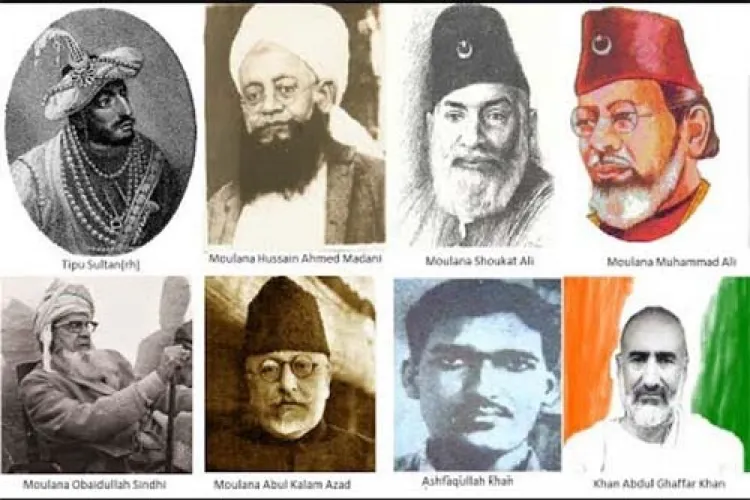
.webp)