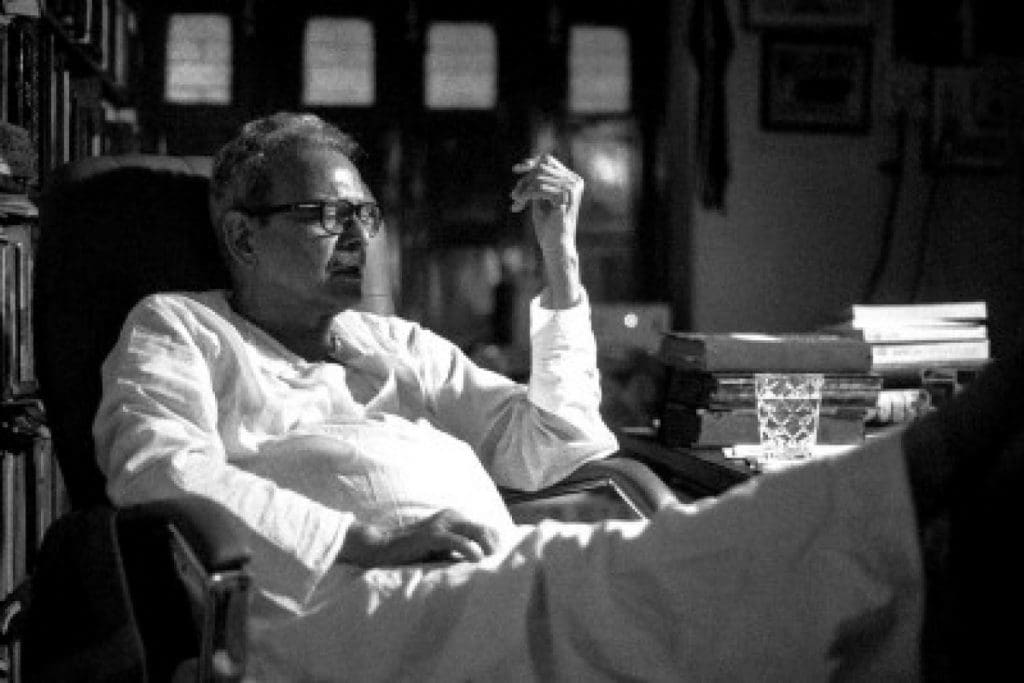
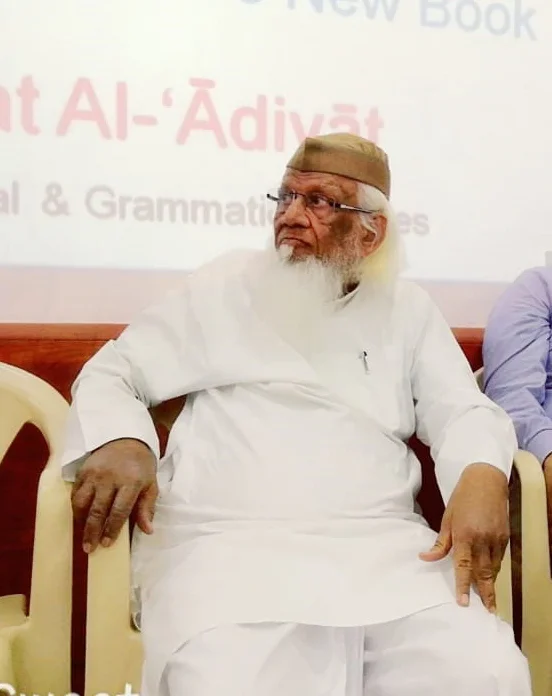
“It’s not just the world of Urdu, I feel I’ve been orphaned again,” historian Rana Safvi sent her condolences.
It's not just the world of Urdu, I feel I've been orphaned again.💔 Go well Sir. Allah Jannat mein jagah ata farmaaye Inna Lillahi wa inna ilayhi raji'un pic.twitter.com/zhcGb6nqWO
Writer and historian William Dalrymple took to Twitter to mourn the demise of Faruqi, calling him “one of the last great Padshahs of the Urdu literary world.”
Sanjiv Saraf, the founder of Urdu festival Jashn-e-Rekhta, also condoled the death of “the century’s most iconic figure in the realm of Urdu literature”.
“His demise has left us bereaved as an entire generation of literature lovers mourn this loss. I extend heartfelt condolences to his family and loved ones,” Saraf said.
“Shamsur Rehman Farooqui’s demise is a big loss to the world of scholarship, and adab. His work built many bridges across India’s diverse traditions. He was immensely valuable to us in so many ways and will be sorely missed, ” said CPIM general secretary Sitaram Yechury.
Shamsur Rehman Farooqui’s demise is a big loss to the world of scholarship, and adab. His work built many bridges across India’s diverse traditions. He was immensely valuable to us in so many ways and will be sorely missed. Heartfelt condolences. pic.twitter.com/CKy0Dan0Lq
“Am just gutted. Shamsur Rehman Faaroqui saheb has passed away. Innalillahi wa inna ilayhi rajeeon. May allah grant him jannat..aameen,” wrote journalist Rana Ayyub.
“His modernist style had irked the traditionalists and contemporaries in the sixties, seventies. But he wasn’t just a critic and theorist, whenever he took to fiction, he created magic. And, his Allahabad home had been the nucleus of Urdu literary world, for over half-a-century,” wrote journalist Shamsur Rehman Alavi in a condolence note.
His modernist style had irked the traditionalists and contemporaries in the sixties, seventies. But he wasn't just a critic & theorist, whenever he took to fiction, he created magic. And, his Allahabad home had been the nucleus of Urdu literary world, for over half-a-century.
A profile of his on Caravan Magazine alluded to his immense and immeasurable contribution to Urdu literature.
Shemsur Rehman began writing in 1960. Initially he worked for the Indian postal service (1960–1968), and then as a chief postmaster-general and member of the Postal Services Board, New Delhi until 1994. He was also editor of his literary magazine Shabkhoon and part-time professor at the South Asia Regional Studies Center at the University of Pennsylvania.
An expert in classical prosody and ‘ilm-e bayan (the science of poetic discourse), he has contributed to modern literary discourse with a profundity rarely seen in contemporary Urdu critics. His most recent books, The Mirror of Beauty (translated into English from the Urdu Kai Chaand The Sar-e-Aasmaan in 2006), and The Sun That Rose From The Earth (Penguin India, 2014), have been highly critically acclaimed. He is the recipient of numerous honors and awards. Most recently he was awarded the prestigious Saraswati Samman for his work She`r-e Shor-Angez, a four-volume study of the eighteenth-century poet Mir Taqi Mir.
He was awarded the Saraswati Samman, an Indian literary award, in 1996. The Government of India awarded him the civilian honour of Padma Shri in 2009.
source: http://www.maktoobmedia.com / Maktoob Media / Home> India / by Maktoob Staff / September 25th, 2020
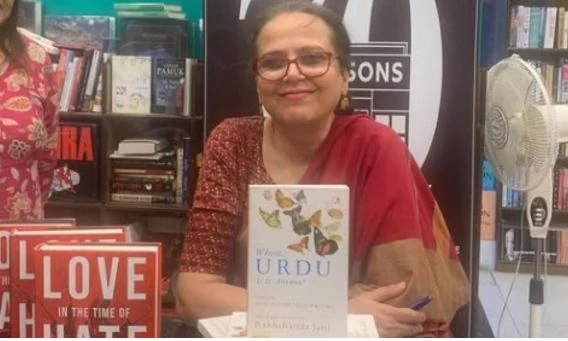
Literary historian Dr Rakhshanda Jalil has once again reminded Indians that Urdu is deeply rooted in the country’s soil and belongs to all communities, not only Muslims. In a detailed interview with the Indian Express about her new anthology Whose Urdu Is It Anyway?, Jalil traced the rise, decline, and contested identity of Urdu in modern India.
She explained that Urdu developed through centuries of cultural exchange, drawing from Persian, Arabic, Turkic, and local dialects, and eventually became the lingua franca of North India. From courtrooms to markets, it was a language spoken across caste and creed. Yet, political movements in the early twentieth century began to link Hindi with Hindu nationalism, sidelining Urdu and associating it exclusively with Muslims.
Jalil underlined how Partition worsened this perception. With Pakistan adopting Urdu as its national language in 1947, Urdu was treated as “enemy property” in India. This shift, she argued, accelerated the decline of Urdu and restricted its public identity. Today, while the government occasionally honours Urdu writers, stereotypes and misinformation continue to reduce Urdu to a religious marker rather than a shared cultural heritage.
Her anthology features sixteen short stories by non-Muslim Urdu writers such as Krishan Chander, Rajinder Singh Bedi, and Gulzar. The collection challenges the misconception that Urdu belongs only to Muslims. Jalil believes that Urdu is “as Indian as anybody or anything can be regarded as Indian” and insists that the language is willing to belong to anyone who values it.
Despite fears about its future, she remains optimistic. Urdu continues to thrive in poetry, Bollywood lyrics, and growing digital platforms. While fewer people read its script, its cultural resonance persists. Echoing Manto, Jalil recalled his words that no human effort can kill a language. Urdu, she said, will remain part of India’s consciousness for years to come.
Dr Rakhshanda Jalil is a noted literary historian, translator, and cultural commentator with over 25 books to her credit. She is widely recognized for her work on Urdu literature and the Progressive Writers’ Movement.
source: http://www.radiancenews.com / Radiance News / Home> Arts & Culture> Focus> Report / by Radiance News Bureau / August 29th, 2025
The release of Daneesh Majid’s book The Hyderabadis at the India International Centre ignited a sharp discussion on history, memory, and identity. The event marked the 77th anniversary of Operation Polo, when the princely state of Hyderabad was annexed in 1948.
The book captures ten stories from that turning point to the present day, focusing on ordinary families. Former R&AW chief A.S. Dulat, academic Mujibur Rehman, journalist Dinesh C. Sharma, and author Ruben Banerjee joined Majid on the panel. Wajahat Habibullah, India’s first Chief Information Officer, surprised the audience by claiming that former Prime Minister P.V. Narasimha Rao was ashamed of his Muslim heritage, linking it to his view of the Nizam’s rule as tyrannical.
Majid explained his motivation to write, saying Hyderabad’s Muslims shifted from being a ruling minority to a numerical minority in democratic India. He recalled advice from Siasat.com editor Mir Ayub Khan to highlight not only achievements but also the struggles faced by Muslim families after the annexation.
Dulat stressed that Hyderabad’s culture extends far beyond its clichés. He highlighted its pluralism, saying Hindus and Muslims traditionally shared deep friendships. Journalist Sharma noted that while the creation of Andhra Pradesh diluted Hyderabadi culture, the city’s multilingual legacy preserved its tolerant spirit.
Not all responses were celebratory. Habibullah compared Hyderabad’s inter-community relations unfavorably with Lucknow. Historian R. Mahalakshmi criticized the absence of women’s voices in the book and urged Majid to include them in future work.
source: http://www.radiancenews.com / Radiance News / Home> Latest News > Report / by Radiance News Bureau / September 20th, 2025
Senior writer, multilingual scholar and progressive thinker Prof. M. Karimuddin (95) passed away at his home in Ganjam, Srirangapatna on Saturday morning due to age-related illness.
Karimuddin, who was unmarried, had served as a Kannada professor and later as a principal in government degree colleges in Mysore, Mandya, Madikeri and elsewhere before retiring.
A student of Kuvempu, he had studied Kannada, English, Urdu, Persian, Arabic and Sanskrit.
He had written many works including Orphan Muslims, Sanchita Chintana, and Baalu Baddu. Many of his thought-provoking speeches on All India Radio were popular. ‘Prof. Karimuddin’s Life and Literature’ was the text for students of class 9 who were studying Kannada as a second language in Urdu medium.
A good orator, Karimuddin was actively involved in farmer, Dalit, pro-Kannada, progressive, and anti-idiotic movements even in his later years. His ancestors were relatives of Tipu Sultan.
Karimuddin, who retired as a Kannada professor at Maharaja’s College, Mysore, was well-versed in Kannada grammar, Old Kannada and New Kannada literature.
He had also done a lot of research on Tipu Sultan. It is said that he had written many collected works on the history of Tipu Sultan.
His friend Prof. Nanjaraja Urs expressed his condolences, saying that his death is a huge loss to the Kannada nation.
Chief Minister’s condolences
“I am saddened to hear the news of the death of senior writer and popular professor Prof. M. Karimuddin. A simple gentleman, Prof. Karimuddin used to help educate the children of the poor. I also share in the grief of his family. I pray that God may grant peace to his soul.”
– Chief Minister Siddaramaiah
ಹಿರಿಯ ಸಾಹಿತಿ ಮತ್ತು ಜನಪ್ರಿಯ ಪ್ರಾಧ್ಯಾಪಕರಾಗಿದ್ದ ಪ್ರೊ.ಎಂ.ಕರಿಮುದ್ದೀನ್ ಅವರ ಸಾವಿನ ಸುದ್ದಿ ತಿಳಿದು ದು:ಖವಾಯಿತು.
ಸರಳ ಸಜ್ಜನರಾಗಿದ್ದ ಪ್ರೊ. ಕರಿಮುದ್ದೀನ್ ಅವರು ಬಡವರ ಮಕ್ಕಳ ಶಿಕ್ಷಣಕ್ಕೆ ನೆರವಾಗುತ್ತಿದ್ದರು. ಅವರ ಕುಟುಂಬ ವರ್ಗದ ದು:ಖದಲ್ಲಿ ನಾನೂ ಭಾಗಿಯಾಗಿದ್ದೇನೆ.
When a journalist is eulogized in a function by speakers after speakers wherein a book critically analysing his works and personality is being released then it is but natural that tears of joy start rolling down the journalist’s cheeks.
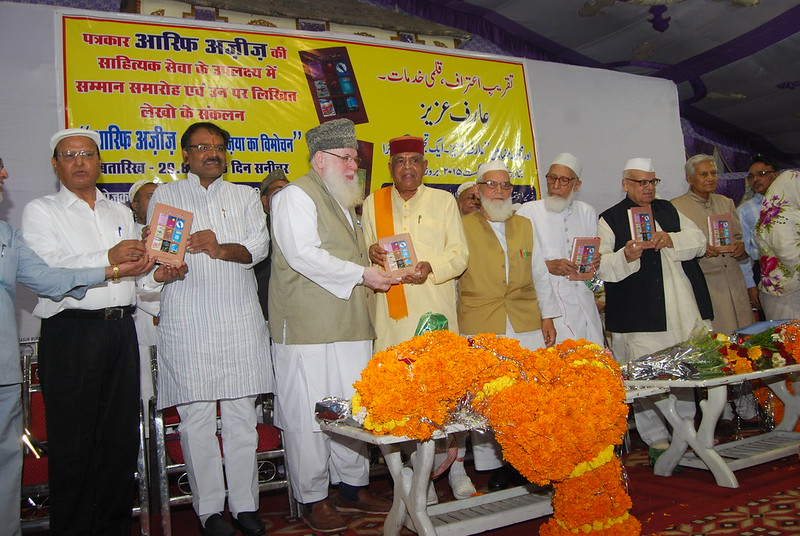
Such was the case with the well-known Urdu journalist Arif Aziz of Bhopal when at the fag end of the function of releasing the book on him entitled “Arif Aziz – Ek Tajzia” (Arif Aziz – An Analysis) here he was asked to speak after the dignitaries on the dais one by one lauded his journalistic and literary services spanning over 40 years. He was overwhelmed by the occasion as the cup of love was brimming or even overflowing. When he rose to address the assemblage he found his voice virtually chocked and eyes welled up with tears. He was seen sobbing involuntarily while standing mute for a minute or two as volunteers ran helter-skelter to fetch water so that he could wet his parched throat. Another volunteer fetched a tissue paper to help him wipe off his tears and gain composure to be able to speak a few words on the occasion.
Arif Aziz, the “Son of the Soil”, struggling for words told the jam-packed Hindi Bhavan auditorium in a chocked voice that whatever has been said about his works and personality is an exaggeration. He is not an iconic figure to be showered such praises upon him by his well-wishers.
“Whatever I did in my life as a journalist I did it with all my honesty and sincerity and saw to it that the profession to which he belonged does not get blotted by his actions”, he added.
He gave credit for his success to his journalist colleague Ashfaque Mashhadi Nadwi. The book concept on him is the brain child of Ashfaque Mashhadi and Urdu litterateur Dr. Akhlaque Asar. It was brought into reality by another journalist colleague Inamullah Khan Lodhi and Arif Aziz’s daughter Mardia Arif, who is also a writer in her own right, as they painstakingly compiled the write-ups and essays on him, he revealed.
“Hajji Mohammad Haroon, president of Jamiat-e-Ulma-e-Hind, Madhya Pradesh unit, placed the icing on the cake by organising such a grand function for me that I did not deserve”, he remarked.
Without any doubt the book releasing function was a glamorous and glittering with eminent writers, columnists cutting across language barriers, and famed personalities who graced the occasion.
Arif Aziz’s friends, well-wishers and relatives also thronged the venue in large numbers to make it a most memorable occasion. Not only this outstation relatives, fans and Urdu lovers in large numbers too made it a point to attend the function to make it a memorable one. Apart from Delhi people from Indore, Sagar, Vidisha, Ashta, Sironj, Sehore etc. participated in the function. The representatives of a number of literary organisations and individuals poured out their love for Arif Aziz on the occasion and mobbed him with bouquets, garlands and gifts. Congress MLA Arif Aqueel draped him with a shawl around his shoulders to honour him. About a dozen tiny-tots also did not lag behind and felicitated him with flowers.
It is noteworthy that as the function was moving along telephonic congratulatory messages of Arif Aziz’s friends and fans from across the border poured in hailing his exemplary journalistic journey.
It has been seen that one’s services are usually extolled after one’s death but Arif Aziz is fortunate enough that his untiring efforts were recognized in his lifetime and he saw this all with his own eyes.
The 384 pages book “Arif Aziz — Ek Tajzia” is a voluminous bunch of essays on the personality, services and dedication of authentic, revered writer and Urdu journalist Arif Aziz. It has been compiled by journalist Inamullah Lodhi and Mrs. Mardiya Arif.
The function of the release of the book was organised under the aegis of Maulana Barkatullah Bhopali Education and Social Welfare Society, Bhopal with its president Hajji Mohammad Haroon and his team leaving no stone unturned to make the occasion of the book release a big and a grand success.
Arif Aziz is Special Correspondent of “Nadeem”, the oldest Urdu daily of Bhopal. He is a voracious writer and has authored nine books on various subjects. Daily columns written by him are reproduced by over a dozen national and international Urdu newspapers. He has written over 20,000 articles in the last 40 years of his journalistic life. He has been decorated with All India Hakeem Syed Qamarul Hasan Award of Madhya Pradesh Urdu Academy and 30 other national and state level awards.
The books authored by Arif Aziz include: 1. Nabz-e-Dauran — Anthology of more than 70 essays on Political, Social & Current topics (1994); 2. Zikr-e-Jameel — Comprising of 38 Bio-Sketches published by Madhya Pradesh Urdu Academy, Bhopal (1995); 3. Qadr-o-Qeemat — Anthology of more than 45 critical essays and research papers (1997); 4. Talash-o-Ta’assur — 19 Critical and research papers (1999); 5. Masajid-e-Bhopal — Historical facts of the mosques of world & especially of Bhopal (2003); 6. Had-de-Nigah — An Anthology of 51 Essays on political science & current topics ((2004); 7. Suraj, Chand, Sitare — comprising of 47 Bio-Sketches published by M.P. Urdu Academy, Bhopal (2004); 8. Musafir-e-Haram — Hajj Pilgrimage description (2006) and 9. Azad Hind Mein Urdu Sahafat — from 1947 to 2006 under the project of Makhanlal Chaturvedi Patrkarita Vishvidhayalaya, Bhopal (2010).
The function was presided over by renowned theologian (Aalim-e-Deen), Hazarat Maulana Mohammad Saeed Mujaddadi (popularly known as Peer Saeed Miyan), Rector Dar-ul-Uloom, Taj-ul-Masajid, Bhopal while the chief guest on the occasion was Aziz Qureshi, ex-Governor of Uttrakhand, Uttar Pradesh and Mizoram.
Other guests and dignitaries who participated in the function included: BJP-ruled Madhya Pradesh Home Minister Babulal Gaur; BJP Lok Sabha member from Bhopal Alok Sanjar; Congress MLA Arif Aqueel; Urdu litterateur Prof. Afaq Ahmad; Dr. Tariq Zafar, Vice Chancellor Bhoj Open University, Bhopal; Dr. Khalid Mehmood, ex-Head of Urdu Department, Jamia Millia Islamia, Delhi; Barkatullah University Arabic Prof. Hassan Khan; Maulana (Dr.) Iqbal Masood Nadwi (Islamic Centre, Canada); Senior journalists Masoom Moradabadi (Editor, Urdu daily Jadid Khabar, & fortnightly Khabardaar Jadid, Delhi); Siraj Naqvi, (Rashtriya Sahara, Delhi) and Rajkumar Keswani (Bhopal). Introduction about the book was presented by Prof. Afaq Hasan Siddiqui.
Hazarat Maulana Mohammad Saeed Mujaddadi, Aziz Qureshi, Babulal Gaur, Alok Sanjar, Prof. Afaq Ahmad, Dr. Khalid Mehmood, Alok Sanjar, Dr. Tariq Zafar, and Hajji Mohammad Haroon released the book amidst thunderous applause.
Masoom Moradabadi, Editor of Urdu daily Jadid Khabar & fortnightly Khabardaar Jadid, Delhi, while lauding Arif Aziz and his works strongly pleaded that the veteran journalist be honoured with the Padam Shree award for his yeoman services in the field of Urdu journalism for the last 40 years. He compared him with legendry India’s Freedom Struggle’s first journalist martyr Moulvi Muhammad Baqir, who was editor of Delhi Urdu Akhbar and a great advocate of Hindu Muslim unity. Freedom Fighter Maulvi Baqir was arrested for revolt and without being tried, on September 16, 1957 was tied to the mouth of a canon and was publicly blown up in front of the Khooni Darwaza in Delhi.
Siraj Naqvi, another senior journalist of Rashtriya Sahara, Delhi, also urged that Arif Aziz must be decorated with the Padam Shree award in recognition of his services by the government of the day.
Dr. Tariq Zafar, Vice Chancellor of Bhoj Open University, read out a citation in recognition of Arif Aziz’s services and presented it to him.
Speaking as a chief guest on the occasion Aziz Qureshi while extolling the contribution of Arif Aziz in Urdu journalism and literature lamented that after India’s Independence in 1947 Urdu language has languished due to government’s apathy which history will never forgive. Without batting an eye lid he said that in a calculated move after Independence a campaign was launched to wipe out Urdu. He revealed the campaign was started by the then Union Home Minister Pandit Govind Ballabh Pant, who was responsible for the establishment of Hindi as an official language of the Central government and a few states while dumping Urdu into oblivion. The process started from Uttar Pradesh and is still continuing despite court’s order declaring Urdu as second official language in the state.
In another revelation on the occasion Qureshi informed that after the first war of independence in 1857 the ruler of Bhopal Begum Sikandar Jahan had declared Urdu, in place of Persian, as the official language of her government for the convenience of her Hindu subjects. In the development of Urdu language the contributions of Hindus cannot be ignored, he added.
Maulana Saeed Mujaddadi while presiding over the function blessed Arif Aziz for fulfilling his responsibilities with all sincerity. He prayed he would continue to strive to serve the Muslim community through his journalistic efforts and the Almighty Allah (S) will guide him in all his endeavours.
Home Minister Babulal Gaur, special guest on the occasion, also lauded Arif Aziz’s simple life, his write-ups on social issues and dedication to Urdu journalism. He said he never indulged in yellow journalism for material gains.
At the outset Hafiz Qari Hashim Ansari recited verses from the Holy Quran. Urdu poets Iqbal Baidaar and Zafar Naseemi rendered poetic tributes in praise of Arif Aziz which was applauded by the audience. Khalique Siddiqui and jeweller Sheetal Bhai Soni presented gifts to him on the occasion. In the end Adv. Mohammad Kaleem proposed a vote thanks.
source: http://www.twocircles.net / TwoCircles.net / Home> India News> Indian Muslim> Literature> Top Story / by Pervez Bari, TwoCircles.net / September 04th, 2015
Acknowledging that he is from a well-settled family and did not encounter with much hardships in life, Nizar says he has heard stories of hardship and struggle from older generations, forming the crex of his books.
Nizar Ilthumish, author and assistant professor, says he draws all his characters as reflections of the people around him and the language he uses in his books also reflects their dialects .
In an exclusive conversation with Timeline Daily, Nizar explains that all his characters speak in the language he envisions, which can be challenging for readers from southern Kerala to understand, and despite this, he incorporates those dialects and usages.
A recipient of the SK Pottekkatt Award 2024 and Camel International Award, Nizar is famous for his works like Noorul Muneerul and Poornnananda. When asked about depicting bygone eras, although he is relatively from the younger generation, Nizar describes, “Though I didn’t experience those times, stories passed down through generations shape my writing. “I gather tales from my parents and grandparents, storing them in my mind to weave into my stories.”
Acknowledging that he is from a well-settled family and did not encounter with much hardships in life, Nizar says he has heard stories of hardship and struggle from older generations. He says their stories, combined with the writer’s imagination, form the crux of his narratives.
Nizar also addresses caste differences within society, including in the Muslim community. He points out that people criticized him for opening up that society still chooses marriage partners based on occupation and family status. The Osan community, for instance, faces challenges in finding partners due to societal prejudices. He claims that caste differences exist not only among Hindus but also within Islam, despite claims of equality.
The author during the interview also discussed his books, their plots, and the reflection of social realities. He stresses the importance of marketing for writers in today’s social media-driven world. “I have learned to establish myself as an author through Instagram Reels,” Nizar said, adding that he challenges the thinking that digitalization harms reading habits, citing the selling rate of his books.
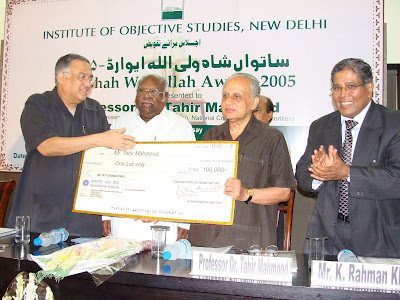
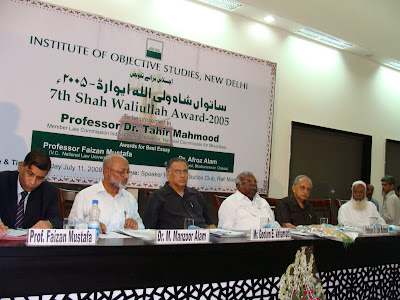
Vahanvati presenting the cheque to Tahir Mahmood with A R Laxamanan, and Rajya Sabha Deputy Chairman, K Rahman Khan
New Delhi:
The seventh Shah Waliullah Award was conferred on eminent legalist and an authority on Muslim Law Dr Tahir Mahmood today in New Delhi by Institute of Objective Studies (IOS).
The award carrying a shawl and a check of Rs one lakh was presented to Dr Mahmood, who is currently Member, Law Commission of India and former Chairman of the National Commission for Minorities, by Attorney General of India Goolam E Vahanvati in the presence of Deputy Chairman, Rajya Sabha, K Rahman Khan, Law Commission of India Chairman, Justice A R Lakshmanan, IOS chairman Dr Manzoor Alam and Lok Sabha Member Maulana Asrarul Haque Qasmi.
In his award accepting speech Dr Tahir Mahmood, author of several books and Muslim and general law, offered his gratitude to the IOS for selecting him for the prestigious award as it is named after renowned Islamic scholar and reformer Shah Waliullah Muhaddis Dehlvi and deciding to present it to him by the eminent jurist and present Solicitor General Goolam E Vavanvati in the presence of K Rahman Khan and other dignitaries.
Islamic law was distorted by the British judiciary, and what is today found in text books in the name of Islamic law, is in fact far from the true Islamic law, said Dr Mahmood who has spent about 50 years on working on Muslim Law – first 20 years since 1959 on studying it through original sources and next 30 years teaching and writing on Muslim Law.
Prof Faizan Mustafa, V-C, National Law University, Bhubaneshwar, IOS chairman Dr Manzoor Alam, Attorney General of India Goolam E Vahanvati, Justice A R Laxamanan, chairman, Law Commission of India, Dr Tahir Mahmood, Maulana Asrarul Haque Qasmi, MP, Lok Sabha
He announced to donate the award money to the Indian Association of Scholars of Religion and Law (ASRAL-India), a group he set up to create a platform for engagement between religion and law.
IOS instituted the award in 1999 to commemorate the outstanding services of Shah Waliullah to promote the Islamic values and to honour eminent scholars who have done outstanding work in Social Sciences, Humanities, Law and Islamics.
This was the 7th award for the year 2005. The first award for the year 1999 was conferred posthumously on Maulana Syed Abul Hasan Ali Nadvi on November 3, 2000. The second award went to Qazi Mujahidul Islam Qasmi, the renowned Islamic scholar and an authority on Islamic fiqh and the third to Prof Nejatullah Siddiqui, eminent Islamic economist.
source: http://www.twocircles.net / TwoCircles.net / Home> Indian Muslim / by Mumtaz Alam Falahi, TwoCircles.net / July 11th, 2009
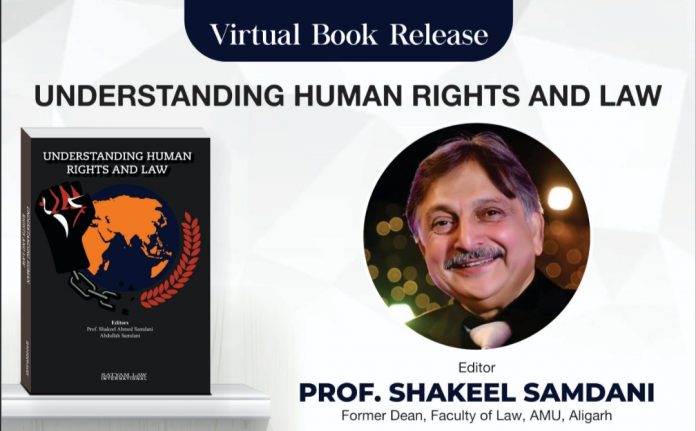
A virtual book release event was organized for the last book of Late Prof. Shakeel Samdani (Former Dean, Faculty of Law, Aligarh Muslim University, Aligarh) titled “Understanding Human Rights and Law” which has been published by Satyam Law International Publishers, New Delhi. This book has been jointly edited by Prof. Shakeel Samdani and Abdullah Samdani.
Presiding over this event, Prof. Tariq Mansoor, Vice Chancellor, AMU, Aligarh said that, Prof. Samdani was a good teacher, researcher and above all, a versatile and a very talented public speaker. He remembered his speech when he represented the AMU teachers at Sir Syed Day 2020 and said that he was the only person who gave an extempore speech. He further said that he was surprised to see Prof. Samdani’s popularity after he received so many tributes from people outside Aligarh.
Discussing about the human rights book, Prof. Mansoor said that he has written forward for this book along with Justice K G Balakrishnan, Former Chief Justice of India. He said that we cannot have a civilized society without an educational system and a sound legal system. He said that this book contains 20 well researched articles from academicians, judges, lawyers, researchers and students. He congratulated Late Prof. Samdani and Abdullah Samdani for bringing an edited book on a very important topic.
While delivering his key note speech, Prof. Faizan Mustafa, Vice Chancellor, NALSAR University of Law, Hyderabad, said that my relationship with Prof. Samdani very close. He shared many old incidents from Prof. Samdani’s life, including his popularity with the students of Aligarh Muslim University. He said that Prof. Samdani was very keen for human rights.
Prof. Mustafa explained in detail about his perception of human rights which has been influenced by the Western perspective. He also discussed in detail about the article on Marxism theory which has been written by Prof. Mohibul Haque in this book. He further stated that, this book can be very useful if we have our commitment towards human rights. At last, he said that he sees a young, talented scholar in Abdullah Samdani who can carry forward the legacy of his father, Prof. Shakeel Samdani.
Speaking in this event, Prof. Md. Zafar Mahfooz Nomani, Dept. of Law, AMU congratulated the family members of Prof. Shakeel Samdani for organizing this event. He said Law Faculty, AMU has lost a gem in the face of Prof. Samdani.
Prof. Nomani quoted from the introduction of this book which was written by Prof. Samdani that “as a teacher it is not only to understand human rights, but to spread awareness among other about human rights”. He said that Prof. Samdani tried his best in his lifetime to spread awareness about the educational mission of Sir Syed Ahmad Khan and with this book he wanted to spread the concept of human rights to others.
Speaking in this event, Dr. Dilshad Ahmad, President of Indian Forum for Education, Riyadh, Saudi Arabia said that Prof. Samdani was a very dynamic person. He always wanted the upliftment of Muslim community. He discussed in detail about how Prof. Samdani motivated the NRI students of Saudi Arabia to pursue legal field as their career in a webinar organized by his forum. He said that whatever Prof. Samdani advised he used to give examples from Quran and Sunnah to support it. Dr. Dilshad also discussed in detail about the important topics which the book Understanding Human Rights and Law have discussed.
Speaking in this event, Prof. Asim Siddiqui, Chairperson, Dept. of English, AMU said that this event was due in the lifetime of Prof. Samdani but due to his unfortunate death this event was delayed. He congratulated the family members of Prof. Samdani for organizing this event. He said that Prof. Samdani was a very cheerful person who was always ready to laugh and he has not seen a dull moment in Prof. Samdani’s lifetime.
Discussing about this book Prof. Siddiqui said that he became aware about various aspects of human rights due to this book. He said that he is a professor of literature, but this book has beautifully explained about human rights and anyone who reads this book can understand the concept of human rights from the legal angle. At last, he said that most of the arguments in quoted in this book have been supported by empirical data.
Speaking in this event, Dr. Aruj Qayum, Senior Paediatrician, Newham University Hospital, London said that COVID has taken one of our most accomplished persons in the form of Prof. Shakeel Samdani. He shared his experience with Prof. Samdani in London and said that, Prof. Samdani was a very big fan of Sir Syed Ahmad Khan and he showed me the place where Sir Syed lived during his visit in London. He further said that Prof. Samdani was an institution in itself. He said that Prof. Samdani has discussed in detail about human rights which are available in Islam.
Speaking in this event, Adv. Shariq Abbasi, Supreme Court of India, New Delhi said that Prof. Samdani was bestowed with the capacity to do big things in a short span of time. He gave the example of an event in which Former Chief Justice of India addressed the students of AMU, that Prof. Samdani successfully organized this event in a short period of only 12 hours. He said Prof. Samdani had deep and great concern about the human rights throughout the world and this book has reflected his concern. He said that seven important aspects of human rights have been wonderfully covered in this book.
Last speaker, Dr. Shad Ahmad Khan, University of Buraimi, Oman said that he is having very mixed feeling of joy and sadness whenever he looks at this book. He said that he had shared a very special bond with Prof. Samdani from his student life. He said that today’s event is more than a book release ceremony and we can celebrate it as a tribute to Prof. Samdani for his contributions throughout his life.
This event was hosted and moderated by Mr. Abdullah Samdani. Dr. Ayesha Samdani started this event by reciting verses from the Holy Quran and Sarah Samdani welcomed the guests in this book release event. Prof. Mohibul Haque, Dept. of Political Science, AMU, Mrs. Anjum Tasneem, Adv. Shoeb Ali, Mr. Salman, Mr. Hunain Khalid, Mr. Farhan Javed and Mr. Danish Iqbal played a very important role in making this event a great success.
source: http://www.muslimmirror.com / Muslim Mirror / Home / by Muslim Mirror Network / December 29th, 2021
Raffat Begum was a gifted poet and wrote with the pen name ‘Asmat’ and took advice from Azhar Inayati, a renowned poet of Rampur. She also wrote several barsaati folk songs celebrating monsoons as did Nawab Raza.
The names of brides have vanished from wedding cards in Rampur. So, we are cordially invited to the wedding of ‘Arif Khan, S/o Samiullah Khan to the daughter (no name) of Wahidullah Khan’. Even the names of women are concealed from vocalization by disrespectful male lips. The nameless miasma enveloping our girls is a recent trend in Muslim etiquette of this erstwhile princely state. It negates the ninety year journey the women of the city have traversed–all the tiny and large steps of emerging out of the zenanas, educating themselves and finding a voice. Maybe the unnamed daughter getting married was educated at one of the local women’s colleges established by the erstwhile Nawabs and has ambitions that involve a becoming.
The emancipative journey of Rampur women began with the decision of a queen – Raffat Zamani Begum, wife of Nawab Raza Ali Khan– to leave the confines of the harem and become something more than a name. Nawab Raza (1930-1947), an enlightened ruler fully supported his wife in her decision and was possibly influenced by her in his very western and ‘modern’ outlook. As the princesses and female members of the royal family followed Begum Raffat, there was a filtered down liberation among the women and girls of upper classes, and over the years a snowball effect that touched the lives of the of all classes of Rampur women.
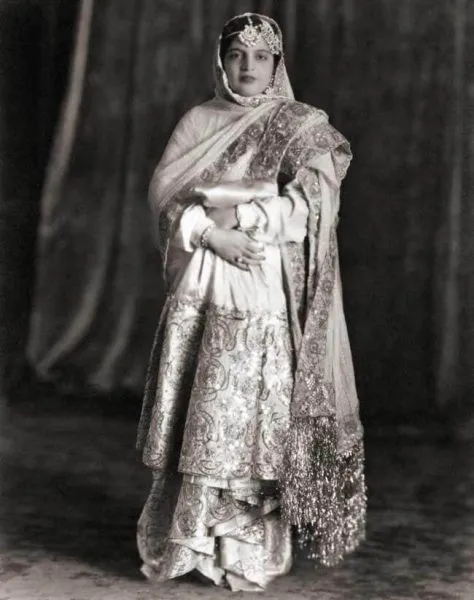
Raffat Begum was the daughter of Sir Abdus Samad Khan, Prime Minister of Rampur under the colonial rule, an impeccable gentleman who traced his antecedents from the Najibabad royal family. She was married to the crown prince, Raza Ali Khan, when she was five and he was six years old. The little bride sat on her grandmother’s lap, her heavy nath supported by her grandmother’s palm as the nikah ceremony was performed. The young daughter in law was granted all the paraphernalia of the future queen while still living with her father and had to attend court on special occasions. At a time when brides were given a new name and a title, her name was changed from Askari Begum to Raffat Zamani Begum.
When Raffat was thirteen, her father in law, Nawab Hamid Ali Khan (1894-1930) demanded that the rukhsati (going away ceremony) be performed. Raffat’s father insisted that they wait at least till the groom had completed his education. Raffat Begum wrote, and is quoted in her sister Jahanara Begum’s memoir, that the relations between the two gentlemen became strained. Finally, Nawab Hamid walked on foot from his Khas Bagh palace to the bride’s house, ‘Rosaville’, and the ceremony which usually took days was performed in a few hours; Raffat Begum left her paternal home amidst songs extolling the valiant Rohilla Nawabs and martyrs of ancient battles.
The teenage couple began their married life often separated by the political intricacies and rules of the harem. Oral history says that they were not allowed to live together for seven years and Raffat Begum was declared infertile after her first son was born. Raza was forced to take a second wife by his father and stepmother. The women of Raffat Begum’s family did not practice strict purda. Her mother was the daughter of the regent of Rampur, General Azamuddin Khan (1888-1891) who had earned the ire of the maulvis of the time for his ‘kristaan’ viewpoint and his championing of female education. Some say he was murdered because of his radical outlook. It is therefore unsurprising that the educated Raffat Begum rejected the claustrophobic harem life she had endured for the first ten years of her married life as soon as Nawab Raza came to power. The couple showed a proclivity towards the ‘modern’ and western lifestyle in all areas and Raffat Begum became a major mover in the drastic transformation of the Rampur durbar, the zenana and Rampur culture. Though not documented in written histories, the influence of Raffat Begum on the dress, cuisine and court etiquettes finds testimony in oral history.
We get a vivid description of the Begum in her stepdaughter , Mehrunnisa Begum’s memoir, ‘An Extraordinary Life.’
Home tutored in English, Persian and Urdu, Raffat Begum entertained distinguished guests at royal banquets and sat for official pictures––the first pictures of women from the royal family. She wore latest western dresses, make up and was a chain smoker –– a ‘modern’ thing to do. In fact, she encouraged her children to smoke as it was considered fashionable. However, some women continued to live in the royal zenana ––more out of lack of choice and under confidence–– but there was no constraint on their movement. Given that Nawab Raza’s predecessor, Nawab Hamid confined his women to a sequestered life behind the laal purda, this was the beginning of a drastic change in the thought process and lifestyle of elite Rampur women.
The young princesses were sent to a boarding school after being brought up by British nannies in a strictly regimented nursery. Emulating the new trend, the elite landowning families and those associated with the court started educating their sons and daughters at boarding schools. So, my mother and her siblings were sent to La Martinere in the 1950s. The 1960’s saw Rampur’s first female doctors, teachers, writers and lawyers ––aspirational models for young girls studying in government colleges now housed in the old palaces and zenanas of yore. Nawab Raza gave a lot of emphasis to education particularly female education and the girls from ordinary families were now sent to girls’ schools in the city after initial misgivings. Covered rickshaws and thelas (carts) transported the burqa clad young ladies to schools. My mother became a doctor in 1967 and the women of my family practiced a flexi-veil where they would cover their heads, sit in curtained cars in Rampur and don sarees and bellbottoms outside of Rampur.
Raffat Begum was a gifted poet and wrote with the pen name ‘Asmat’ and took advice from Azhar Inayati, a renowned poet of Rampur. She also wrote several barsaati folk songs celebrating monsoons as did Nawab Raza. Some of her poetry was published.
Begum Noor Bano, her daughter in law and ex-Member of Parliament, recalls the after-dinner dastan sessions with the children and grandchildren gathered around their beloved ‘Mummy’. The dastans were later written down by a scribe.
Mapara Begum, a court singer, says she would give importance to the lowliest person and welcome everyone with warmth. Which is why she was fondly called Raaj Maata, the queen mother of Rampur.
A few years after Nawab Raza’s death in 1966, Raffat Begum moved back to her father’s place, Rosaville, with her retinue of servants. It was an empty house. Her parents had passed away and her brothers and sisters had left in pursuit of their lives and careers. Life had come a full circle. She passed away at Rosaville in 1986 – an elegant begum, spirited and dignified till the end. Her plaintive lines are still echo on the lips of old timers:
“Aisey beemaar ki dava kya hai,jo batata nahi hua kya hai;
Kaun suntan hai is zamaney mein, kis se kahiye iltija kya hai.”
How can a person who cannot describe her ailment find a cure?
Even if I could find words for my pleas, would my entreaties find listeners.
Receiving yet another invite to the marriage of an anonymous daughter, I tried to remember the names of the wives of acquaintances and distant relatives. I came up with Naeem mamu ki biwi, Munney sahib ki ammi etc. etc. We are all guilty of using the blanket term bhabhi or khala to address the married women of various ages; we are introduced as wives, mothers and granddaughters. I used to laugh at the old style of explaining connections––‘Munney mian ki beti Shaddan Khan ke ghar mein hai’, indicating that Munney mian’s nameless daughter is married to Shaddan Khan. We have accepted an anonymous existence here and it is only logical that our girls get shrouded in namelessness on their wedding day.
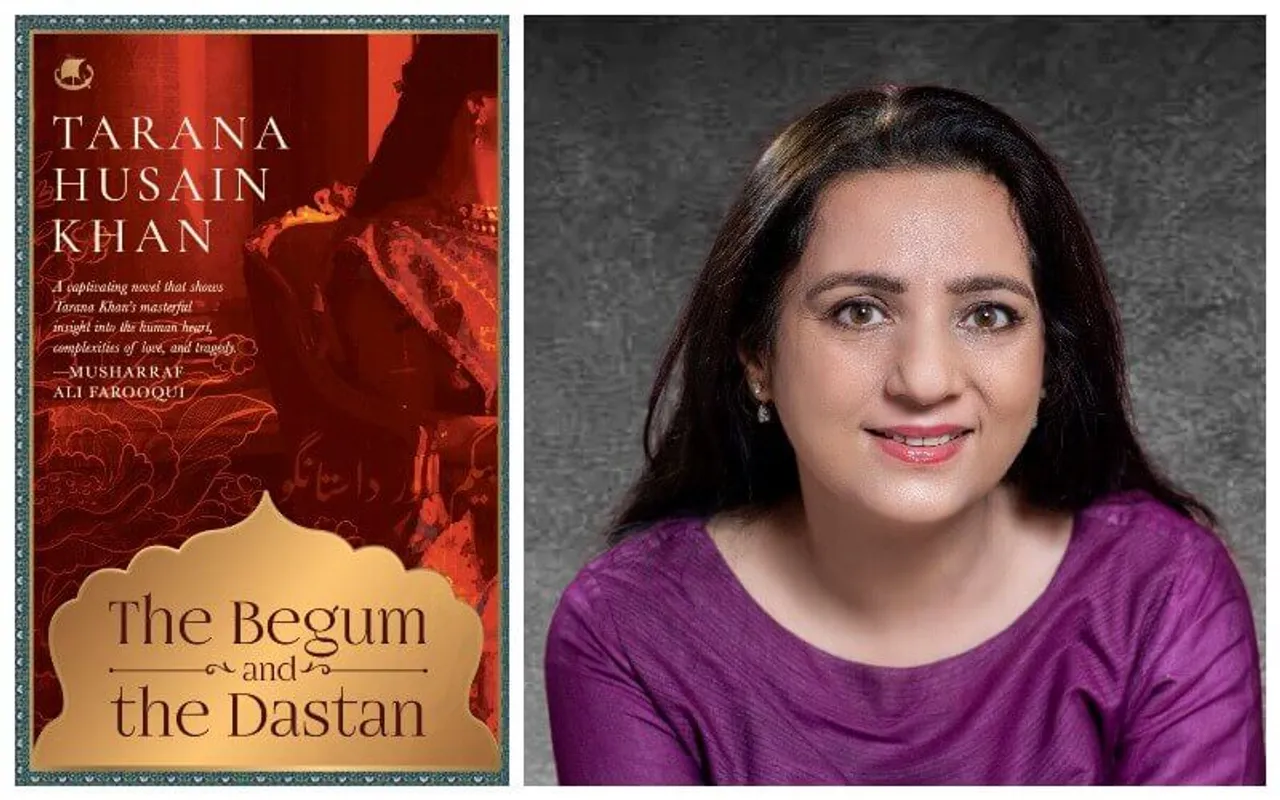
Tarana Husain Khan is a writer and researcher based in Rampur. Her historical fiction ‘The Begum and the Dastan’ has been recently published by Tranquebar. The views expressed are the author’s own.
source: http://www.shethepeople.com / SheThePeople / Home> Books / by Tarana Husain Khan / March 02nd, 2021
He has written scores of books in Arabic, English and Urdu. One of his unique books is Attibyan which helps in teaching Qur’an to neo-Muslim brothers and sisters.
New Delhi :
Dr. V. Abdur Rahim, world renowned Islamic scholar, multilinguist, author, teacher and translator passed away in the holy city of Madinah on Thursday.
Author of several popular books on teaching Arabic language, Dr. Abdur Rahim was laid to rest in Jannat al Baqi cemetery near the Prophet’s Mosque after Friday noon prayers, reports reaching here said.
Dr. Abdur Rahim has written scores of books in Arabic, English and Urdu. One of his unique books is Attibyan which helps in teaching Qur’an to neo-Muslim brothers and sisters. The scholar was closely associated with Chennai-based Islamic Foundation Trust (IFT) and a majority of his books have been published by it.
Dr. Abdur Rahim was born in the small town of Vaniyambadi in Tamil Nadu in 1933. After completing his secondary school studies, he joined Presidency College, University of Madras where he majored in English language and literature. He graduated in 1957. In 1964, he joined the prestigious Al-Azhar University in Cairo, from where he completed his M.Phil. and Ph.D. in Arabic philology.
Dr. Abdur Rahim adopted innovative teaching methodologies and pedagogical approaches, which revolutionised the teaching of Arabic. He joined the Islamic University of Madinah in 1969, where he played a pivotal role in the program of teaching Arabic as a foreign language. He also imparted his knowledge at various institutions, including the Islaamic University Omdurman Sudan, Khartoum University Sudan, and Arabic Institutions in Germany, Washington D.C., and British Guyana.
His most significant contribution to Arabic education was the development of the renowned Madinah Arabic Course. This comprehensive series of textbooks and audiovisual materials simplified the complexities of the Arabic language, making it accessible to learners from diverse linguistic backgrounds. His teaching not only facilitated learning but also promoted intercultural dialogue and understanding.
Beyond his teaching endeavors, Dr. Abdur Rahim served as the Director of the translations section at the King Fahad Qur’an Printing Press in Madinah, where he contributed to translating and interpreting the Qur’an into various languages, ensuring its accessibility to people worldwide.
In recognition of his exceptional contributions to Arabic language education, Dr. V Abdur Rahim was honored with the prestigious President of India Award. This recognition celebrated his tireless efforts in promoting Arabic language learning and fostering cultural understanding through linguistic knowledge.
source: http://www.clarionindia.net / Clarion India / Home> India / by Team Clarion / October 21st, 2023