Tag Archives: Masoom Moradabadi – Editor – Jadeed Khabar

Book on Bhopal’s noted Urdu journalist ‘Arif Aziz – Ek Tajzia’ released

Bhopal, MADHYA PRADESH :
Bhopal: 

When a journalist is eulogized in a function by speakers after speakers wherein a book critically analysing his works and personality is being released then it is but natural that tears of joy start rolling down the journalist’s cheeks.

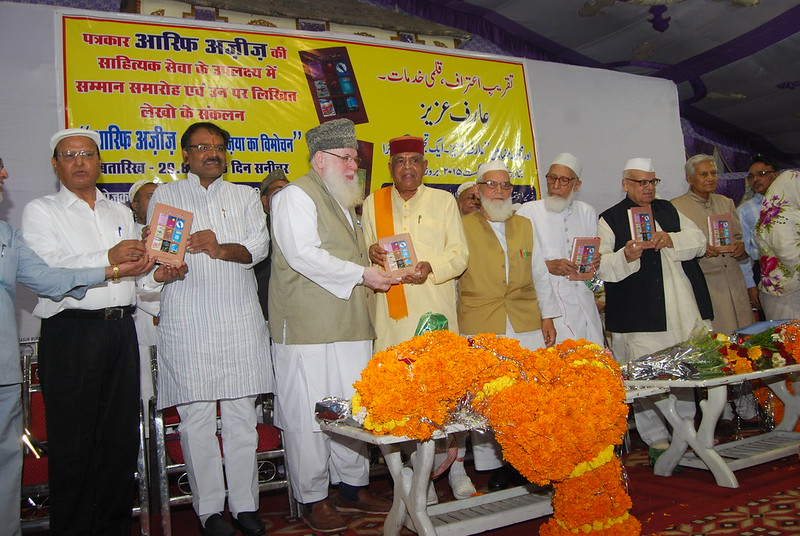
Such was the case with the well-known Urdu journalist Arif Aziz of Bhopal when at the fag end of the function of releasing the book on him entitled “Arif Aziz – Ek Tajzia” (Arif Aziz – An Analysis) here he was asked to speak after the dignitaries on the dais one by one lauded his journalistic and literary services spanning over 40 years. He was overwhelmed by the occasion as the cup of love was brimming or even overflowing. When he rose to address the assemblage he found his voice virtually chocked and eyes welled up with tears. He was seen sobbing involuntarily while standing mute for a minute or two as volunteers ran helter-skelter to fetch water so that he could wet his parched throat. Another volunteer fetched a tissue paper to help him wipe off his tears and gain composure to be able to speak a few words on the occasion.

Arif Aziz, the “Son of the Soil”, struggling for words told the jam-packed Hindi Bhavan auditorium in a chocked voice that whatever has been said about his works and personality is an exaggeration. He is not an iconic figure to be showered such praises upon him by his well-wishers.

“Whatever I did in my life as a journalist I did it with all my honesty and sincerity and saw to it that the profession to which he belonged does not get blotted by his actions”, he added.

He gave credit for his success to his journalist colleague Ashfaque Mashhadi Nadwi. The book concept on him is the brain child of Ashfaque Mashhadi and Urdu litterateur Dr. Akhlaque Asar. It was brought into reality by another journalist colleague Inamullah Khan Lodhi and Arif Aziz’s daughter Mardia Arif, who is also a writer in her own right, as they painstakingly compiled the write-ups and essays on him, he revealed.

“Hajji Mohammad Haroon, president of Jamiat-e-Ulma-e-Hind, Madhya Pradesh unit, placed the icing on the cake by organising such a grand function for me that I did not deserve”, he remarked.

Without any doubt the book releasing function was a glamorous and glittering with eminent writers, columnists cutting across language barriers, and famed personalities who graced the occasion.

Arif Aziz’s friends, well-wishers and relatives also thronged the venue in large numbers to make it a most memorable occasion. Not only this outstation relatives, fans and Urdu lovers in large numbers too made it a point to attend the function to make it a memorable one. Apart from Delhi people from Indore, Sagar, Vidisha, Ashta, Sironj, Sehore etc. participated in the function. The representatives of a number of literary organisations and individuals poured out their love for Arif Aziz on the occasion and mobbed him with bouquets, garlands and gifts. Congress MLA Arif Aqueel draped him with a shawl around his shoulders to honour him. About a dozen tiny-tots also did not lag behind and felicitated him with flowers.

It is noteworthy that as the function was moving along telephonic congratulatory messages of Arif Aziz’s friends and fans from across the border poured in hailing his exemplary journalistic journey.

It has been seen that one’s services are usually extolled after one’s death but Arif Aziz is fortunate enough that his untiring efforts were recognized in his lifetime and he saw this all with his own eyes.

The 384 pages book “Arif Aziz — Ek Tajzia” is a voluminous bunch of essays on the personality, services and dedication of authentic, revered writer and Urdu journalist Arif Aziz. It has been compiled by journalist Inamullah Lodhi and Mrs. Mardiya Arif.

The function of the release of the book was organised under the aegis of Maulana Barkatullah Bhopali Education and Social Welfare Society, Bhopal with its president Hajji Mohammad Haroon and his team leaving no stone unturned to make the occasion of the book release a big and a grand success.

Arif Aziz is Special Correspondent of “Nadeem”, the oldest Urdu daily of Bhopal. He is a voracious writer and has authored nine books on various subjects. Daily columns written by him are reproduced by over a dozen national and international Urdu newspapers. He has written over 20,000 articles in the last 40 years of his journalistic life. He has been decorated with All India Hakeem Syed Qamarul Hasan Award of Madhya Pradesh Urdu Academy and 30 other national and state level awards.

The books authored by Arif Aziz include: 1. Nabz-e-Dauran — Anthology of more than 70 essays on Political, Social & Current topics (1994); 2. Zikr-e-Jameel — Comprising of 38 Bio-Sketches published by Madhya Pradesh Urdu Academy, Bhopal (1995); 3. Qadr-o-Qeemat — Anthology of more than 45 critical essays and research papers (1997); 4. Talash-o-Ta’assur — 19 Critical and research papers (1999); 5. Masajid-e-Bhopal — Historical facts of the mosques of world & especially of Bhopal (2003); 6. Had-de-Nigah — An Anthology of 51 Essays on political science & current topics ((2004); 7. Suraj, Chand, Sitare — comprising of 47 Bio-Sketches published by M.P. Urdu Academy, Bhopal (2004); 8. Musafir-e-Haram — Hajj Pilgrimage description (2006) and 9. Azad Hind Mein Urdu Sahafat — from 1947 to 2006 under the project of Makhanlal Chaturvedi Patrkarita Vishvidhayalaya, Bhopal (2010).

The function was presided over by renowned theologian (Aalim-e-Deen), Hazarat Maulana Mohammad Saeed Mujaddadi (popularly known as Peer Saeed Miyan), Rector Dar-ul-Uloom, Taj-ul-Masajid, Bhopal while the chief guest on the occasion was Aziz Qureshi, ex-Governor of Uttrakhand, Uttar Pradesh and Mizoram.

Other guests and dignitaries who participated in the function included: BJP-ruled Madhya Pradesh Home Minister Babulal Gaur; BJP Lok Sabha member from Bhopal Alok Sanjar; Congress MLA Arif Aqueel; Urdu litterateur Prof. Afaq Ahmad; Dr. Tariq Zafar, Vice Chancellor Bhoj Open University, Bhopal; Dr. Khalid Mehmood, ex-Head of Urdu Department, Jamia Millia Islamia, Delhi; Barkatullah University Arabic Prof. Hassan Khan; Maulana (Dr.) Iqbal Masood Nadwi (Islamic Centre, Canada); Senior journalists Masoom Moradabadi (Editor, Urdu daily Jadid Khabar, & fortnightly Khabardaar Jadid, Delhi); Siraj Naqvi, (Rashtriya Sahara, Delhi) and Rajkumar Keswani (Bhopal). Introduction about the book was presented by Prof. Afaq Hasan Siddiqui.

Hazarat Maulana Mohammad Saeed Mujaddadi, Aziz Qureshi, Babulal Gaur, Alok Sanjar, Prof. Afaq Ahmad, Dr. Khalid Mehmood, Alok Sanjar, Dr. Tariq Zafar, and Hajji Mohammad Haroon released the book amidst thunderous applause.

Masoom Moradabadi, Editor of Urdu daily Jadid Khabar & fortnightly Khabardaar Jadid, Delhi, while lauding Arif Aziz and his works strongly pleaded that the veteran journalist be honoured with the Padam Shree award for his yeoman services in the field of Urdu journalism for the last 40 years. He compared him with legendry India’s Freedom Struggle’s first journalist martyr Moulvi Muhammad Baqir, who was editor of Delhi Urdu Akhbar and a great advocate of Hindu Muslim unity. Freedom Fighter Maulvi Baqir was arrested for revolt and without being tried, on September 16, 1957 was tied to the mouth of a canon and was publicly blown up in front of the Khooni Darwaza in Delhi.

Siraj Naqvi, another senior journalist of Rashtriya Sahara, Delhi, also urged that Arif Aziz must be decorated with the Padam Shree award in recognition of his services by the government of the day.

Dr. Tariq Zafar, Vice Chancellor of Bhoj Open University, read out a citation in recognition of Arif Aziz’s services and presented it to him.

Speaking as a chief guest on the occasion Aziz Qureshi while extolling the contribution of Arif Aziz in Urdu journalism and literature lamented that after India’s Independence in 1947 Urdu language has languished due to government’s apathy which history will never forgive. Without batting an eye lid he said that in a calculated move after Independence a campaign was launched to wipe out Urdu. He revealed the campaign was started by the then Union Home Minister Pandit Govind Ballabh Pant, who was responsible for the establishment of Hindi as an official language of the Central government and a few states while dumping Urdu into oblivion. The process started from Uttar Pradesh and is still continuing despite court’s order declaring Urdu as second official language in the state.

In another revelation on the occasion Qureshi informed that after the first war of independence in 1857 the ruler of Bhopal Begum Sikandar Jahan had declared Urdu, in place of Persian, as the official language of her government for the convenience of her Hindu subjects. In the development of Urdu language the contributions of Hindus cannot be ignored, he added.

Maulana Saeed Mujaddadi while presiding over the function blessed Arif Aziz for fulfilling his responsibilities with all sincerity. He prayed he would continue to strive to serve the Muslim community through his journalistic efforts and the Almighty Allah (S) will guide him in all his endeavours.

Home Minister Babulal Gaur, special guest on the occasion, also lauded Arif Aziz’s simple life, his write-ups on social issues and dedication to Urdu journalism. He said he never indulged in yellow journalism for material gains.

At the outset Hafiz Qari Hashim Ansari recited verses from the Holy Quran. Urdu poets Iqbal Baidaar and Zafar Naseemi rendered poetic tributes in praise of Arif Aziz which was applauded by the audience. Khalique Siddiqui and jeweller Sheetal Bhai Soni presented gifts to him on the occasion. In the end Adv. Mohammad Kaleem proposed a vote thanks.

source: http://www.twocircles.net / TwoCircles.net / Home> India News> Indian Muslim> Literature> Top Story / by Pervez Bari, TwoCircles.net / September 04th, 2015
Role of North Indian Muslims in Partition; Ather Farouqui picks holes in that largely held belief

INDIA :

Urdu periodicals, with their dwindling readership, often showcase uninspiring articles, predictable poetry, and pedestrian fiction.

Amidst mediocrity all around, there exists a pressing need for thoroughly researched and academically rigorous articles that challenge erroneous, yet widely accepted notions about the world around us.

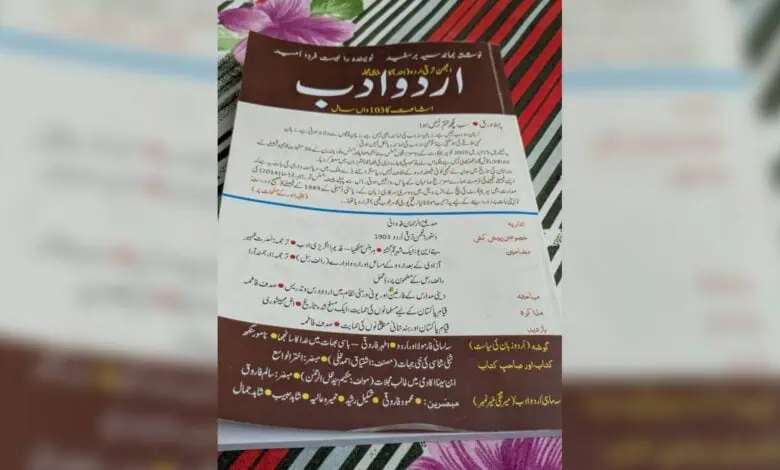
Some literary journals, including Bunyad (Lahore), Urdu Adab (Delhi), Isbaat (Mumbai), and Istefsaar (Jaipur), go beyond what common sense dictates. The latest issue of Urdu Adab, a quarterly publication of Anjuman Tarraqi Hind, bears testimony to this, as its content stimulates the intellect of its readers with a sense of exuberance.

The astutely edited journal by Ather Farooqui features three equally incisive and thoroughly researched articles on the much-maligned role of North Indian Muslims during the Partition, Madrassa students and understanding literature, and Namwar Singh’s tirade against Urdu. Unlike other run-of-the-mill literary journals in Urdu, the journal focuses on the dynamics and politics of language, which refers to the social and political implications of language use and the power dynamics inherent in cultural discourse. Also, it explores consequential questions related to culture and social consciousness. The influence of language on identity and the power dynamics inherent in cultural discourse also come under scrutiny in enriching academic discourse.

The overwhelming support of Muslims in the United Province for the Muslim League in the 1946 assembly elections, which was a sort of referendum on the partition issue, is often regarded as a truism; however, it does not sit well with veteran journalist and author Anil Maheshwari. Urdu Adab presents an article by him, “Support of Muslims for the Formation of Pakistan: A Distorted History: in light of the results of the decisive assembly elections in UP in 1946. Anil’s article, based on archival research, challenges the commonly held belief that the 1946 elections were a clear mandate for the Muslim League. He marshals many pieces of credible evidence that deflates the myth and suggests a more valid interpretation of the results.

Joining Ayesha Jallal (1994) and Christopher Jafferlot (2015), as well as a plethora of celebrated historians, Anil points out that Muslims in the United Province Assembly elections of 1946 did not vote overwhelmingly for the Muslim League. Voters comprising only 5% of the Muslim population cast their votes for the Muslim League, according to the official report of the 1946 elections. Placing the 1946 elections in the context of the universal adult franchise, he points out that only 3% of Indians could vote for the central assembly, while in the provincial assemblies, only 13% were allowed to vote. The article appeared in a reputed periodical, Economic and Political Weekly, laced with incisive interpretation, cogently concludes, “Had the partition of 1947 not occurred, Muslims would have constituted approximately one third of the population of an undivided Indian subcontinent. This demographic would have secured a majority in three to four states, providing them with a substantial and equitable stake in the political framework.”

A promising historian, Muhammad Sajjad, in his perceptive book on Muslim politics in Bihar, also connotes the same conclusion.

With an occasional rhetorical flourish, Anil inveighs against left historians for perpetuating this sort of falsehood.

Irfan Habib, Mazharul Hasan, and Bipan Chandra, too, did not place the onus entirely on Muslims, and HM Serwai’s book, Partition of India: Legend and Reality, provides an alternative understanding.

The article is supplemented with a stimulating critique by Sadaf Fatima, who holds the view that our reputed historians have glossed over the facts, thereby fostering anti-Muslim discourse. One tends to agree with the opinion that Indian Muslims got closely associated with Pakistan. The author seems too harsh when she accuses left historians of holding Jinnah mainly responsible for the partition, as they took Nehru’s side for personal interests.

It is a rare occurrence in Urdu periodicals for an article to spark such a polemical debate as Sadaf Fatima’s piece on madrassa graduates and the teaching of Urdu at universities. There is no denying the fact that most of the Urdu faculty at various universities are the product of oriental syllabi, who lack even rudimentary literary and aesthetic indoctrination. Curiously, the Madrassa’s students get admitted to a postgraduate course in Urdu literature. Sadaf Fatima makes this point pertinently and asserts, “It is incontestable that students are well short of foundational awareness about literature who join university as a postgraduate student of Urdu or opt for Urdu as an optional subject at the graduate level after graduating from a madrasa. Urdu literature does not appear in the syllabi of the madrassas. Urdu literature draws its sustenance from a literary culture that is composed of several local cultures and linguistic practices, reflecting centuries of shared heritage.

A student joining a madrassa at the age of 7 or so has no inkling of the cultural ethos of Urdu, which exists in his milieu.” Her cognate observation sparked controversy, and a smear campaign was launched against her and the editor, Ather Farooqui. Some well-meaning authors and journalists, including Ashar Najmi, Shakeel Rasheed, and Masoom Moradabadi, saw reason in her arguments. It is perplexing to see many vituperative postings on social media.

The author, while expressing deep concern for madrassa-educated students occupying positions in Urdu departments, made it clear that the solution does not lie in prohibiting their direct admission to courses in Urdu literature. There is an urgent need to equip students with literary and aesthetic sensibilities when they join the courses.

An exclusive section is devoted to the politics of the Urdu language, featuring two articles: “Three Language Formula” by Ahter Farooqui and a translation of “Basi Bhaat mein Kuda ka Sanjaha” by the prominent Hindi critic Namwar Singh. An avant-garde Hindi journal, Hans, published Namwar’s highly unreasoned and zealous article in 1987, and Athar Farooqui produced its Hindi text with the translation. In the introductory note, the editor points out that it unfailingly lays bare deep-seated venom against Urdu. Despite being committed to a shared linguistic and cultural legacy, Namwar Singh was bent upon declaring modern Hindi a separate language and restricting Urdu to Muslims only. It is the first instance when a cardholder Marxist critic launched a tirade against Urdu. The editor picked up many holes in the article; this aside, it has the traces of Namwar Singh’s speculative intelligence.

Ather Farooqui spelt out the contours of the three-language formula without taking recourse to official jargon and statutory regulations. An accomplished translator, Arjumand Ara produced an excellent translation of Ralph Russel’s insightful and detailed article on the Problems of Urdu and Urdu Organisations after the partition. Feedback on Russell’s article is also included.

Ather Farroqui deserves accolades for bringing out such an intellectually stimulating function.

source: http://www.siasat.com / The Siasat Daily / Home> Opinion / by Shafey Kidwai / June 21st, 2025

Saiyid Hamid remembered

Faizabad, UTTAR PRADESH / NEW DELHI :

New Delhi:

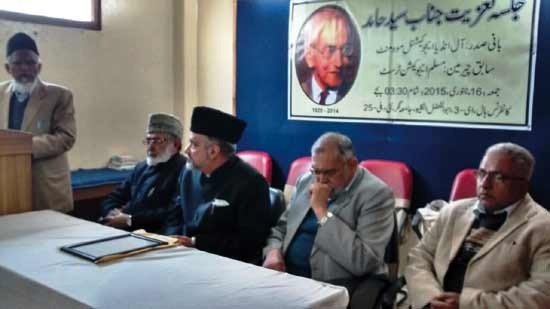
At a condolence meeting jointly organised by All India Educational Movement (AIEM) and Muslim Education Trust (MET), here on 16 January, rich tributes were paid to Saiyid Hamid, the founder-President of AIEM and former Chairman of MET for over a decade. This was one of dozens of such condolence meetings held across India to pay tributes to Saiyid Hamid.

(L to R) Abdul Rashid (speaking), Syyed Mansoor Agha, Dr Syed Farooq, Dr Zafarul-Islam Khan, Masoom Muradabadi
(L to R) Abdul Rashid (speaking), Syyed Mansoor Agha,
Dr Syed Farooq, Dr Zafarul-Islam Khan, Masoom Muradabadi

Dr Syed Farooq, patron of AIEM and Chairman of Himalaya Drugs Company, Dr Zafarul-Islam Khan, Editor of the Milli Gazette and President of AIMMM, Parwaz Rahmani, Editor of Urdu bi-weekly “Dawat”, Masoom Moradabdi, Editor of daily Jadeed Khabar, Syyed Mansoor Agha, Senior Urdu journalist and Vice President of AIEM, Abdul Rashid, former Deputy Secretary to Govt. of India and General Secretary AIEM, Mozaffar Ali, Secretary of MET,  Rafiq Ahmad, Secretary of Human Welfare Foundation (HWF) and Maualana Ataur-Rahman Qasmi, Director of Shah Waliullah Institute spoke on the occasion.

Presiding over the meeting, Dr Syed Farooq said that the best tribute to the departed soul will be to continue his mission which is far from complete. He was a visionary and a dedicated person, said Dr Farooq. Dr Zafarul-Islam Khan said, after his retirement from civil services, Saiyid Hamid devoted himself fully for the cause of the community. This is rare as there are hundreds of high-ranking Muslim civil servants who are living their own lives after retirement and show no interest in helping their community. Saiyid Hamid was a person of conviction. He greatly valued the capabilities of others.

Parwaz Rahmani said, some of Saiyid Hamid’s actions as the VC of AMU invited criticism but nobody can deny that whatever he said or did was done with sincerity and in good faith. He had a versatile and attractive personality. Maualana Ataur-Rahman Qasmi said Saiyid Hamid was a man of great stature. He always extended a helping hand but never compromised with his principles to oblige anybody.

Masoom Moradabadi said, the character of leadership Saiyid Hamid provided is in contrast to others. He did not rely upon complaining. Instead, he struggled using self-strength and managed to carve a way-out and helped the community. He advised the community to realise their inherent capabilities, mobilise their available resources and stand on their own two feet. Syyed Mansoor Agha said,  Hamid Saheb was an education activist and a great admirer of Sir Syed’s vision of education. He believed in an inclusive approach and stressed upon educating the community. He drew our attention towards the importance of health and hygiene and the dire need of social reforms. He was a big votary for promotion of communal harmony. He was a person of knowledge and action and a rare humanist of our times. Underlining Saiyid Hamid’s deep interest in people’s welfare activities,  Rafiq Ahmad said, even during his serious illness, he took keen interest in the affairs of HWF and always obliged us with guidance and granted us audience whenever we approached him. Saiyid Hamid was the founder-Chairman of HWF and served in that capacity until his last breath. The HWF is running several charitable institutions including Al-Shifa Hospital and a chain of Scholar Schools including one at AbulFazl Enclave in Delhi.

Concluding the meeting, Mozaffar Ali said, a the first chairman of MET, Saiyid Hamid shaped the mission which is successfully helping thousands of students to receive higher education in spite of financial constraints. The meeting ended after passing a condolence resolution which said Saiyid Hamid was “a visionary who guided Indian Muslims like a beacon for decades to improve their lot, is no more among us.”

source: http://www.milligazette.com / The Milli Gazette / Home> Online News> Special Report / Online February 13th, 2015 / Print issue : 1-15 February 2015