Category Archives: Books – Holy Quran, Koran / Translations, Commentaries / by Indian Muslims (wef. February 11th, 2025)

 Maulana Abdul Majid Daryabadi 

Dariyabad (Barabanki), UTTAR PRADESH / NEW DELHI :

Maulana Rabey Nadwi releasing a book on Daryabadi; to his right stands Maulana Anzar Shah Kashmiri and to his left is Haryana governor, Akhlaqur Rahman Qidwai

New Delhi:

Delhi’s Shah Waliullah Institute and National Council for the Promotion of Urdu Language (NCPUL) jointly organised a national seminar on the life and services of Maulana Abdul Majid Daryabadi, a famous writer and mufassir of the Qur’an, on 15 January at Rajinder Bhawan, New Delhi.

Haryana governor, Dr Akhlaqur Rahman Qidwai presided over the seminar. Prominent among those who attended were Maulana Syed Rabey Hasani Nadwi, Maulana Anzar Shah Kashmiri, Maulana Wali Rahmani, Dr Hamidullah Bhat and Mohsina Qidwai.

Maulana Nadwi in his speech said that Maulana Daryabadi was a philosopher, researcher, man of letters, critic, and a man of high moral values who worked for the betterment of the nation. Maulana Daryabadi was the editor of Sidq-e Jadeed. India has been the cradle of different cultures and civilisations. We should move forward on the principles laid down by Maulana Abdul Majid, that is unity in diversity, which has been an important feature of our country. Maulana Daryabadi rendered unmatched services to the country, community and religion and we should benefit from his views and lofty ideals, he added.

Dr Akhlaqur Rahman Qidwai praised the services of Shah Waliullah Institute. He said that Maulana Daryabadi’s philosophy was relevant even today. He hoped that both the country and the community would continue to benefited from his views and writings.

The participants presented 17 scholarly papers on different aspects of the life and services of Maulana Daryabadi. Maulana Mohammad Wali Rahmani, Khwaja Hasan Sani Nizami, Dr Hashim Qidwai, Prof. Yaqubur Rahman and Prof. Siddiqur Rahman Qidwai presented papers among others.

Dr Hashim Qidwai, Mohsina Qidwai and Habiba Qidwai talked about their close relationship and shared moments with Maulana Daryabadi and narrated some incidents of his great life.

Dr Hamidullah Bhatt and Khawaja Hasan Sani Nizami assured their cooperation to the Shah Waliullah Institute in any project undertaken on Maulana Daryabadi. 

Scholars who presented papers felt that though they had covered many aspects of Maulana Daryabadi’s life, yet there were many other aspects of his life that needed to be studied.

Two books, one written by Maulana Ataur Rahman Qasmi in Urdu, Imam Shah Waliullah and his Philosophy and Ideology and the other, Muslim Personal Law and Uniform Civil Code authored by (late) Maulana Minnatullah Rahmani, were released at the seminar. Shah Waliullah Institute organised an exhibition of books published by it.  «

source: http://www.milligazette.com / The Milli Gazette / Home> 1-15th February 2005

Obituary: Maulana Muhammad Salim Qasmi, an ocean of knowledge

Deoband, UTTAR PRADESH :

With scarcity of good ulama, the passing away of Maulana Muhammad Salim Qasmi, rector of Al-Jamia Al-Islamia Darul Uloom Waqf, Deoband, has sent a sense of gloom across India.

People have written obituaries describing his death as the loss of the last chain in the golden series of Khanwada-e-Qasmiyat, a metaphor used to describe the great legacy whose history got prominence with establishment of Darul Uloom in Deoband in 1867 against the backdrop of persistent British onslaught on Indians on the one hand and its ugly design to kill ulama in large numbers on the other hand, to mitigate the impact of resistance against the Colonial power.

Maulana Salim Qasmi was a witness to the British cruelty on Indians and the Indian ulama during the eventful years if Independence. He had lived those times as a young student of India’s most prominent madrasa that had been a great centre of anti-British movements like the Silk Letter Movement.

Being the great-grandson of Maulana Muhammad Qasim Nanautwi, Salim Qasmi knew well the role he had to play to live up to the reputation and expectations both of his family and its followers and admirers spread over countries and continents. He rightly did so. His demise thus has rightly been described as the end of that golden chain. However, as there are others from the same family trying to carry forward both the academic and social and historical legacy, will they be able to do justice with that, only time will tell.

Muhammad Salim was born on 8 January, 1926 at Deoband and received primary education from many teachers. He completed his studies in 1948 from Darul Uloom Deoband where his teachers included great luminaries like Maulana Hussain Ahmad Madani, Maulana Aizaz Ali, Allama Ibrahim Balyawi, Maulana Syed Fakhrul Hasan Moradabadi.

He is said to be the last surviving disciple of Maulana Ashraf Ali Thanwi from whom he studied Mizan, an important book of Arabic grammar. Soon after passing out, he was appointed a teacher there. However, later, due to a serious conflict and crisis then in Darul Uloom, he along with some other colleagues, decided to stay away from it and established Darul Uloom Waqf which he nurtured till his last breath. Besides looking after its administrative affairs as a rector, he also taught Bukhari Sharif, the well-known book of hadith. Earlier, he had taught Muslim Sharif, another important book of hadith.

Some of the key positions he held at the time of his death are as follows:

Chief Rector, Al-Jamia Al-Islamia Darul Uloom Waqf, Deoband,

Vice-President, All India Muslim Personal Law Board,

Member, Aligarh Muslim University Court,

Member of Advisory Board and Managing Committee, Darul Uloom Nadwatul Ulama,

Member of Advisory Board, Mazahir Uloom Waqf, Saharanpur,

Permanent Member of the Fiqh Council, Al-Azhar,Cairo,

President, All India Muslim Majlis-e-Mushawarat (before two fractions of it finally united),

Patron, Kul Hind Rabta-e-Masajid,

Patron, Islamic Fiqh Academy, India.

About his written contribution to the domain of knowledge, the website of Darul Uloom Waqf Deoband mentions that besides being:

… one of the top speakers of ulama, his articles and writings are also much admired. Some of the books are worthy to be mentioned here like (1) Mabaadi al-Tarbiyat al-Islami (Arabic), (2) Jaiza Tarjama Quran Karim, (3) Taajdar-e-Arz-e-Haram ka Paigham, (4) Mardaan-e-Ghaazi, (5) Ek Azeem Tarikhi Khidmat, (6) Safar Nama-e-Burma.

(7) The book Khutbat-e-Khatibul Islam (a collection of his speeches) has been published in 5 volumes. Moreover, there are many articles and scripts awaiting publication.

Formally, Maulana received bai’at (a reformative and self-actualization method historically in vogue for quite long as an Islamic tradition in certain schools of thought) at the hand of Maulana Shah Abdul Qadir Raipuri. However, he received much of the training from his glorious father, Qari Muhammad Tayyib (d. 17 July, 1983)

A remarkable trait of his personality was to maintain the dignity of a true aalim (religious scholar) by not partaking in sectarian lines as is the wont of some Ulama. He was therefore respected among all sections of Muslims and his views were very well received. Maulana Salim did not create the binary division of education between religious and modern. He believed that ‘the source of all streams of knowledge is one’.

In recognition of his services to the domain of knowledge and ideas Maulana Salim was honoured with many awards, some of which are as follows:

Nishan-e-Imtiyaz (Mark of Distinction) from the Government of Egypt for being a distinguished aalim of the Indian Sub-Continent,

Imam Muhammad Qasim Nanotwi Award,

Shah Waliullah Award.

Prominent leaders and ulama from different countries have expressed grief over the demise of Maulana Salim Qasmi. In her telephonic message, External Affairs Minister Sushma Swaraj said that Maulana Salim’s love for education was amazing. Outside the country he worked as an exemplary ambassador of education. Congress President Rahul Gandhi said Maulana Salim Qasmi illuminated the world through education and he would touch people through simplicity. Samajwadi Party chief, Mulayam Singh Yadav said that Maulana never asked anything for himself. He was a crown prince of education whose absence would be felt long.

Former Justice of Pakistan’s Shariah Court, Mufti Taqi Usmani described Maulana Salim Qasmi as an ocean of knowledge. His death is a huge loss to the Islamic world. The simplicity with which he lived is rare, he said adding, “His service in the field of education is a golden chapter”.

Member of Parliament and AIUDF President Maulana Badruddin Ajmal Qasmi termed the demise of Maulana Salim Qasmi as ‘end of an era’ whose enumerable services are worth to be written in golden words. Senior leaders Ahmad Patel, Ghulam Nabi Azad, Syed Shahnawaz Hussain and others also sent their condolence messages.

Maulana Syed Rabey Hasani Nadwi, President of All India Muslim Personal Law Board, who had closely worked with Maulana Salim Qasmi and had also been his classmate at Darul Uloom Deoaband, wrote an article in which he stated that Maulana Salim Sahab had acquired many of the qualities of his father Qari Tayyib Sahab and his great grandfather Maulana Qasim Nanautwi. He worked in a similar way from whom different sections of ummah benefitted. His death therefore has caused concerns about the void in the ummah and in religious circles.

Maulana Arshad Madani described Maulana Salim Qasmi’s death as a loss which does not seem to be filled in near future. “Whenever there is a crisis he would be remembered’ he said. The responsibility to protect the institution that he established falls on all of us.

Prof Humayun Murad said that Maulana knew well how to avoid confrontation and find peaceful and constructive ways. Darul Uloom Waqf Deoband is its living example.

Maulana Muhammad Sayeedi, nazim, Mazahir Uloom Waqf said, “In the passing away of Maulana Salim Qasmi, Mazahir Uloom has been deprived of one of its true guide and patron”. He was its member since 1988. Mufti Muzaffar Husain would trust him a lot and his suggestions were highly helpful.

As against the commonly held opinion of ulama who do not tire of speaking about the division of knowledge between religious and modern or worldly, Maulana Salim Qasmi, in June 2013, had in a public programme, very categorically said that all the available forms of knowledge are from Allah. There is nothing as religious and worldly knowledge.

Maulana Qasmi said that the division of knowledge (between religious and worldly) is a political creation because all streams of knowledge flow from God. He then asked heads of madrasas to invite people of other faiths to their madrasas and exchange views and, share their problems with them also.

As I write this obituary, his soft-spoken words remind me of the sincerity with which he would draw the attention of the people to real issues and to the approaches that need to be adopted to find their solution.

Maulana Salim Qasmi was among the important personalities who had set up the Darul Uloom Waqf. His colleagues Maulana Muhammad Nayeem Deobandi died a little over a decade ago on 23 August, 2007, Shaikhul Hadith Maulana Syed Anzar Shah Kashmiri died 10 years ago on 26 April, 2008, Mufti Khursheed Alam died on 7 February, 2012, while Maulana Salim’s younger brother Maulana Muhammad Aslam Qasmi, an outstanding orator, died about five months ago on 13 November, 2017. Finally, this great son of the great Khanwada-e-Qasmiyat passed away on 14 April, 2018. He is survived by four sons and two daughters.

May the Almighty grant him an exalted place in Jannah!

The author is a PhD Fellow at the Academy of International Studies, Jamia Millia Islamia and is also doing an online program “Contending Modernities” of the University of Notre Dame, USA.

source: http://www.twocircles.net / TwoCircles.net / Home> Articles> Indian Muslim> Lead Story / by Manzar Imam for TwoCircles.net / April 28th, 2018
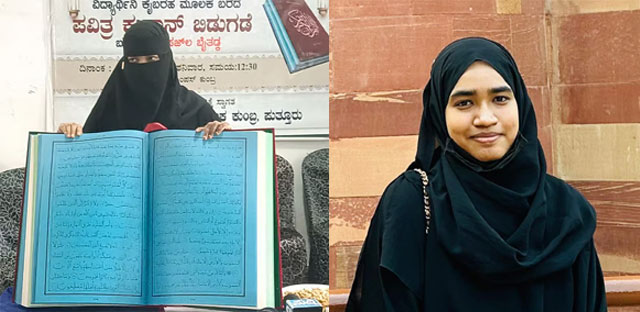
Kadaba: Student Fathima Sajla Ismail creates record by handwriting Quran in five years

Baitadka ,Kaniyur Village (Kadaba Taluk, Dakshina Kannada District) , KARNATAKA :

Kadaba :

A remarkable achievement by a student from Kumbra’s Markazul Huda Women’s College has drawn attention, as she meticulously handwritten the entire Quran using an ink pen.

The achiever, Fathima Sajla Ismail, a BCom student, hails from Baitadka in Kaniyur village of Kadaba taluk and is the daughter of Ismail and Zahra Jasmine. She dedicated nearly five years to this extraordinary work, beginning in January 2021 and completing it in August 2025.

For the handwritten manuscript, Sajla used white, light blue, and light green papers, along with a black ink pen. The Quran consists of 604 pages, bound with a red and gold-coloured protective cover, and weighs about 14 kg.

“Writing a single page would take me around four hours. On some days, I managed to write two pages in eight hours. In total, I completed the work in 302 days, spending 2,416 hours,” shared Sajla.

The unveiling of the handwritten copy and recognition of her achievement took place at Markazul Huda Women’s College in Kumbra.

The manuscript was officially released by Yaseen Sakhafi Al Azhari, a Mudarris from Markaz Knowledge City, Kerala.

source: http://www.daijiworld.com / Daijiworld.com / Home> Top Stories / by DaijiWorld Media Network – Kadaba (headline and name edited) / August 18th, 2025

‘Nawayath Quran Tarjuma’ Book Launch

Bhatkal (Uttara Kannada), KARNATAKA :

Late. Janab Usman Hassan Mohtesham, translator of Tarjumah Quran Shareef in Nawaity of Moulana Syed Abul Aala Moududi was the recepient of Viqare Islamia an highest academic award of Islamia Anglo Urdu High School Bhatkal.

He had served in the Department of Health Dubai for 30 years and is the father of Dr.Imran Mohtesham, Mangalore.

source: http://www.facebook.com/syed.zakir (Syed Zakir S.M) / February 18th, 2025

Assamese version of Azad’s Quran released

Guwahati, ASSAM :

Guwahati :

The Assamese version of Maulana Abul Kalam Azad’s Tarjuman Al Quran, Volume-I Al Fatiha, translated by Komoruzzaman Ahmed, was released here yesterday by educationist and former vice chancellor of Rajib Gandhi University, Arunachal Pradesh, Dr A C Bhagabati.

Maulana Azad, besides being a well-known political figure, is a scholar of Islamic learning and Quran. He had translated the Quran into Urdu with commentary as Tarjuman Al Quran to help the common people understand the holy book, as it was understood by the people during Prophet Mohammad’s lifetime.

The book had originally been translated to English by Dr. Syed Abdul Latif during the life time of Maulana Azad. The book, released on June 2, is an Assamese translation of the main Volume-I, Al Fatiha of the Tarjuman Al Quran, where Maulana Azad presented the main principles of the Quran by analyzing each of the Seven Sentences of Sura Al Fatiha in detail.

The meeting was presided over by film-maker Abdul Majid.

The welcome address was made by Wasbir Hussain, author and journalist.

Addressing the meeting, Dr Ayesha Ashraf Ahmed, author and former professor of Shillong College talked about the core philosophy of the Quran. Author Ahmed also addressed the gathering.

source: http://www.assamtribune.com / The Assam Tribune / Home> Archives / by Staff Reporter / September 15th, 2010

An exemplary achievement by SRZ Maahir-ul-Quran Hyderabad’s founder and president, Hazrat Qari Muhammad Abdul Rahman Shahid

Hyderabad, TELANGANA :

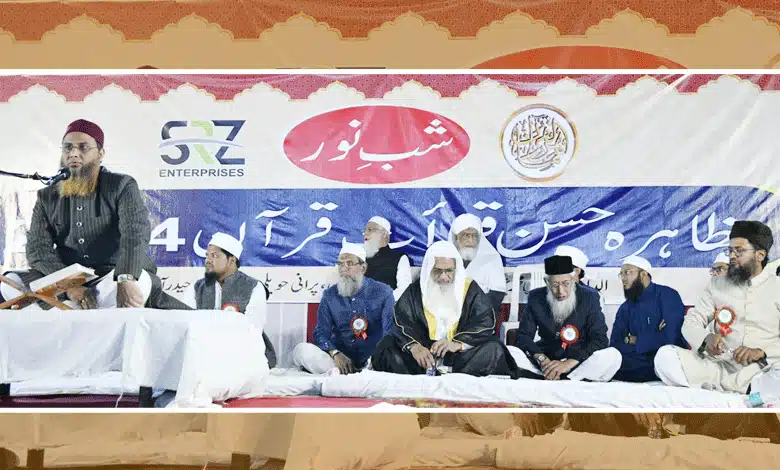
Hazrat Maulana Ghiyas Ahmad Rashadi Sahib, President of Safah Bait-ul-Mal and Manbar-Mihrab Foundation, was felicitated for his completion of the Tafsir al-Quran by Qari Muhammad Abdul Rahman Shahid Sahib and his brothers.

On the evening of December 31, 2024, a grand “Shab-e-Noor” Quranic Recitation event was held at the vast Dar-ul-Shifa Football Ground in the city. The event was presided over by Ustaad-ul-Qura’ Hazrat Maulana Qari Muhammad Ali Khan Sahib (may his blessings last) with the patronage of Mufti Hafiz Sadiq Mohiuddin Sahib (may his blessings last). The event featured renowned internationally acclaimed Qaris from the city, who presented their recitations.

Hazrat Maulana Jafar Pasha Sahib, Hazrat Maulana Hassan Farooq Sahib, respected Mir Zulfiqar Sahib (Charminar MLA), and respected Riyaz-ul-Hassan Afandi Sahib (MLC) participated as distinguished guests.

The Qaris presented their remarkable recitations until 2 AM, with a large crowd of both common people and elites in attendance.

Hazrat Maulana Ghiyas Ahmad Rashadi Sahib, President of Safah Bait-ul-Mal and Manbar-Mihrab Foundation, was felicitated for his completion of the Tafsir al-Quran by Qari Muhammad Abdul Rahman Shahid Sahib and his brothers.

The program concluded with a special prayer from Ustaad-ul-Qura’ Hazrat Maulana Qari Muhammad Ali Khan Sahib.

source: http://www.munsifdaily.com / Munsif News 24×7 / Home> Hyderabad / by Syed Mubashir / January 01st, 2025

Delhi’s Historic Madrasa Rahimiya Struggles to Protect Its Rich Legacy

DELHI :

The centuries-old Islamic educational centre, birthplace of the Urdu Qur’an translation, struggles to protect its legacy amid growing Hindu-led development projects.

New Delhi :

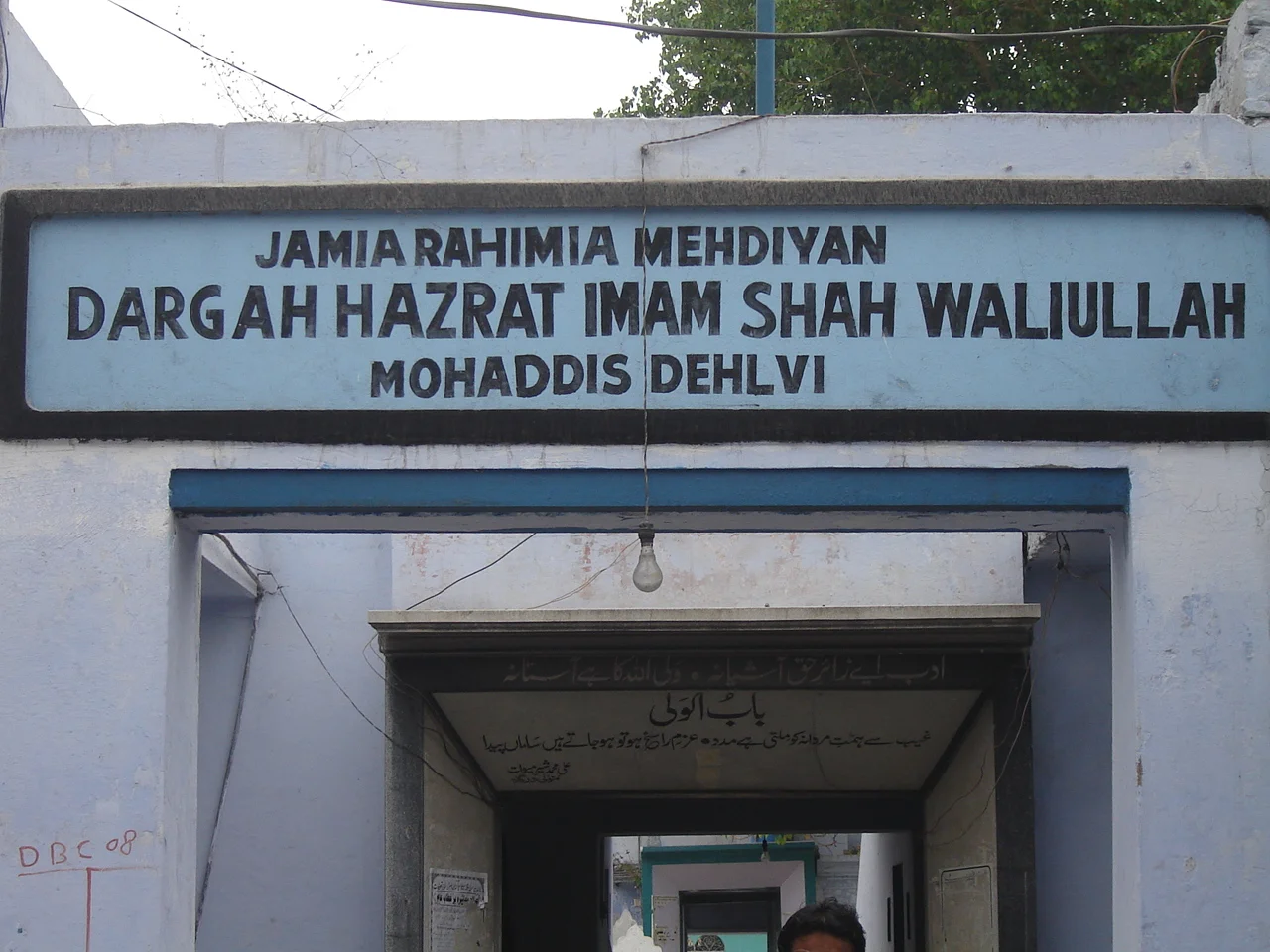
Hidden along the busy Bahadur Shah Zafar Highway, Mehdiyan — home to the revered Madrasa Rahimiya, also known as Jamia Rahimia — stands as one of Delhi’s oldest Islamic learning centres. Established by Shah Abdul Rahim, father of the famed scholar Shah Waliullah Muhaddith Dehlvi, this madrasa has for centuries served as a vital institution nurturing Islamic scholarship. However, today its existence is threatened by creeping urban development dominated by Hindu groups, threatening to erase a vital piece of Muslim heritage.

“Madrasa Rahimiya was not just a school; it was a movement to bring Muslims closer to the Qur’an’s true teachings,” explains Mufti Muhammad Sabir, a Hadith instructor at the madrasa. “But its history is being erased by those who prioritise development over our heritage.”

Madrasa Rahimiya holds a proud place in history, especially for pioneering the first Urdu translation of the Qur’an. In the late 1700s, Shah Abdul Qadir, a key scholar educated under his father and others, undertook the translation project at the Akbarabadi Mosque. This effort laid the foundation for making Islamic scripture accessible to millions of Urdu-speaking Muslims across India, who were otherwise unable to understand the original Arabic text.

“Shah Abdul Qadir’s translation was revolutionary, yet it faced strong opposition from scholars who considered translating the Qur’an sacrilegious,” says Maulana Sabir. “Despite this, his work endured and shaped generations.”

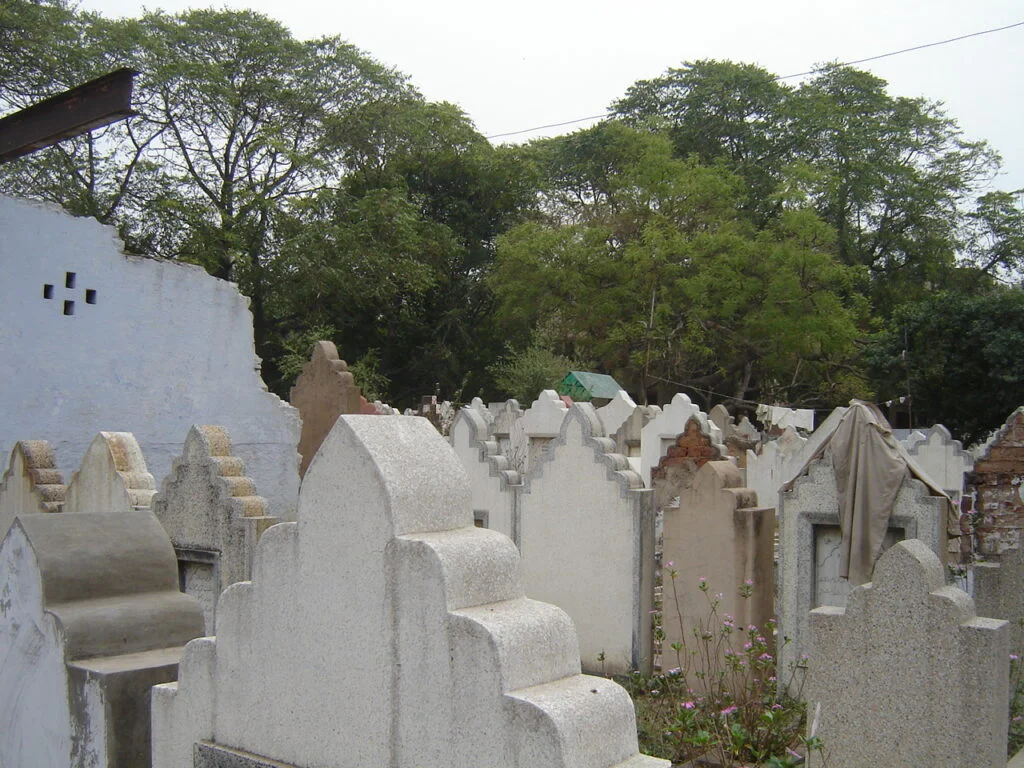
But this rich history has not been free from hardship. After the 1857 War of Independence, British colonial forces destroyed the Akbarabadi Mosque and shuttered the madrasa. The adjoining Mehdiyan cemetery, the resting place of Shah Waliullah and his family members, was drastically reduced. Historian Rana Safavi laments, “Mehdiyan was once a vast necropolis for saints and commoners alike. Now, much of it is lost to encroachment, with what remains used merely as a washing place.”

In the 1960s, Delhi’s expanding urban sprawl posed new threats. Plans to demolish Mehdiyan to build flats and houses were only halted because of the heroic resistance of Ali Muhammad, known locally as Sher-e-Mewat. “He lay down in front of bulldozers and even Pandit Nehru’s car to protect these sacred shrines,” recalls resident Bilal Ahmed. “He broke his leg but ensured our heritage survived.” Jawaharlal Nehru himself was moved by Ali Muhammad’s determination and ordered the preservation of these sites, which were later enclosed by a boundary wall.

Yet, the madrasa’s survival is once again at risk. Critics point out that the latest wave of urban planning, heavily influenced by Hindu groups, disproportionately targets Muslim heritage areas. Historian Zafar Khan asserts, “Hindu groups have long viewed places like Mehdiyan as obstacles to their vision of a ‘modern’ Delhi. This is not just about land — it’s an attempt to erase Muslim identity.”

Local Muslims feel the marginalisation acutely. “Our history is being systematically sidelined,” says Ayesha Begum, a teacher at Jamia Rahimia. “While Hindu temples receive government protection and funding, our sacred sites are neglected, ignored, or demolished.” She highlights the glaring lack of state support for the madrasa compared to the ample aid granted to Hindu religious institutions.

Despite the ongoing pressures, Madrasa Rahimiya endures as a symbol of resilience and faith. Its small mosque and student quarters continue to operate, preserving the teachings that Shah Waliullah and his predecessors established centuries ago.

“We teach the same Qur’an and Hadith that Shah Waliullah did,” says Mufti Sabir. “No matter the encroachment or neglect, that legacy will not disappear.”

The battle to save Mehdiyan reflects wider tensions in India, where Muslim cultural and religious heritage frequently confronts Hindu nationalist agendas. For now, the madrasa stands firm — a testament to Delhi’s Muslim scholars’ enduring spirit and their steadfast commitment to preserving Islamic knowledge and identity.

source: http://www.clarionindia.net / Clarion India / Home> Culture> Editor’s Pick> India / by Mohammed Bin Ismail / May 24th, 2025

Maulana Nurul Qasmi’s campaign helps project positive image of Islam, Muslims

ASSAM :

Maulana Nurul Amin Qasimi

Unlike the majority of Muslim youths from Assam who pass out from Darul Uloom Deoband, an Islamic university and seminary in Uttar Pradesh, who often end up joining mosques, madrassas, and other institutions to teach the holy Quran and other Islamic practices, Maulana Nurul Amin Qasimi choose a different path.

He launched a mission to remove misconceptions about Islam and the Muslim community.  He has been preaching Islam in the right form with exceptional and innovative thoughts across Assam.

Many videos of Maulana Nurul Amin Qasimi have already received widespread attention on social media. In these videos, Maulavi is seen explaining the importance of education to the Muslims, the essence of Islam, and translating various verses of the Quran into local Assamese languages for easy understanding of the people.

He has been rendering his inspiring speeches at mosques, Edgars, madrassas, public functions, and other influential platforms.

Maulana Nurul Amin Qasimi during a social campaign

Maulana Nurul Amin Qasimi has recently published the Assamese interpretation and translation of the Holy Quran for Assamese readers. He has also launched the Assamese translation of the Holy Quran in audio format with his voice-over as many people do not read books nowadays due to lack of time.

He has also founded the Islamic Research and Study Center in central Assam’s Tezpur town with a few young men who had received Islamic education with progressive thoughts for society.

Maulana Nurul Amin Qasimi received his primary education from Sootea Higher Secondary School in central Assam’s Sonitpur district and then enrolled himself in Khutaktia Dini Alia Madrasa in Lakhimpur district for Islamic education. After studying there for six years, he enrolled in HojaiJalalia Madrassa. He passed his high school leaving certificate examination or Class 10 final exam in general education while studying at a madrassa in Jalalia Madrasa in Hojai.

After four years of study, he received the rest of his Islamic education at Darul Uloom Deoband Madrasa in Uttar Pradesh. After completing his Islamic education, he started teaching at Markazul Ma-Arif in central Assam’s Hojai district.

While teaching, Qasimi successfully passed his higher secondary examination or Class 12 final exam in general education. He then graduated from Ruphi College and obtained his postgraduate degree from Gauhati University. He is now studying for his PhD at Gauhati University.

In an interview with Awaz-The Voice, Maulana Nurul Amin Qasimi said: “We are Assamese Muslims and we live as Assamese Muslims. There is sometimes confusion about Islam and it is because of some Muslim people that others develop misunderstandings about Islam. Some followers of Islam misinterpret the religion because of their lack of knowledge.

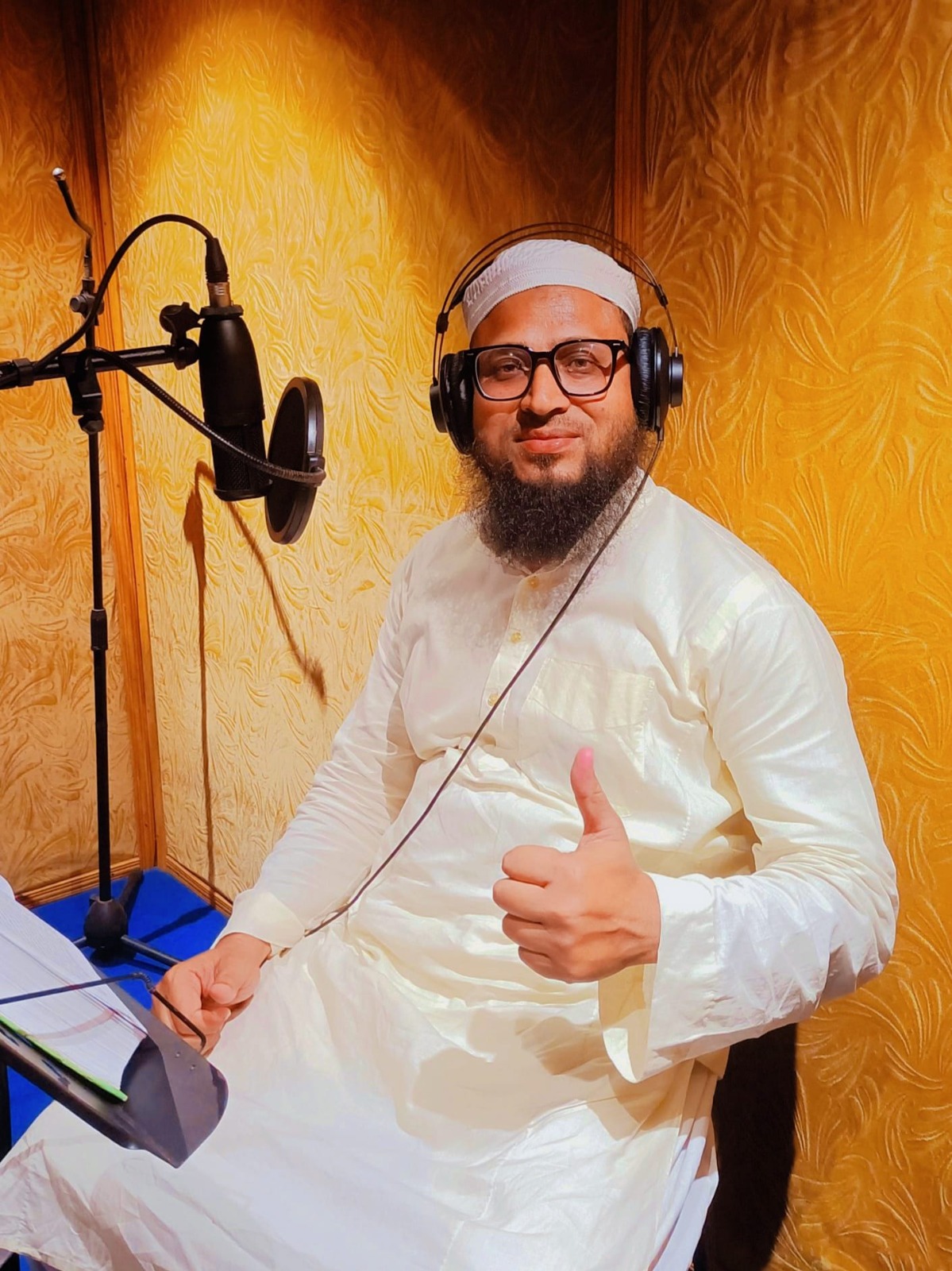
Maulana Nurul  Amin Qasmi recording Holy Quran in Assamese

“I felt the need to enlighten people about the Holy Quran and the true words of Prophet Mohammad. We must present Islam in its true form in our local language. That is why I am making this effort. The Holy Books are in Arabic so it is our responsibility to explain it to everyone in our language.”

When Muslims congregate for the mandatory Jumma Namaz (Friday prayers), the Imam (head priest) gives a sermon called khutbah. He speaks about the principles of Islam, one’s duty towards society, the call for good deeds, respect for other religions, etc. Since the khutbah is rendered in the Arabic language in many mosques, it is difficult for the locals to understand the true meaning of these verses.

“I thought that if the messages of peace, humanity, or statements in khutbah were explained in the simple local language that people could understand, they would benefit and the misconceptions about Islam removed. There are ideological differences over reciting khutbah in Arabic. Some say that it should be explained in the mother tongue. But, according to our Islamic law, since the tradition of reciting the khutbah in Arabic has been going on since the time of the Prophet, it has not changed in some places,” the imam said.

Maulana Nurul Amin Qasimi said it’s important to learn modern general education along with Islamic education. “Muslim society is quite backward in education. In Muslim society, Maulanas or Ulemas are respected and considered religious leaders. So, if Ulemas advise on education, I think everyone will follow them and derive benefits. Our religious leaders have a lot to do in this regard. These matters get less importance in religious congregations. It is compulsory to take the basic education of Islam, but we should also be educated to be good citizens and individuals ready for the future,” he said.

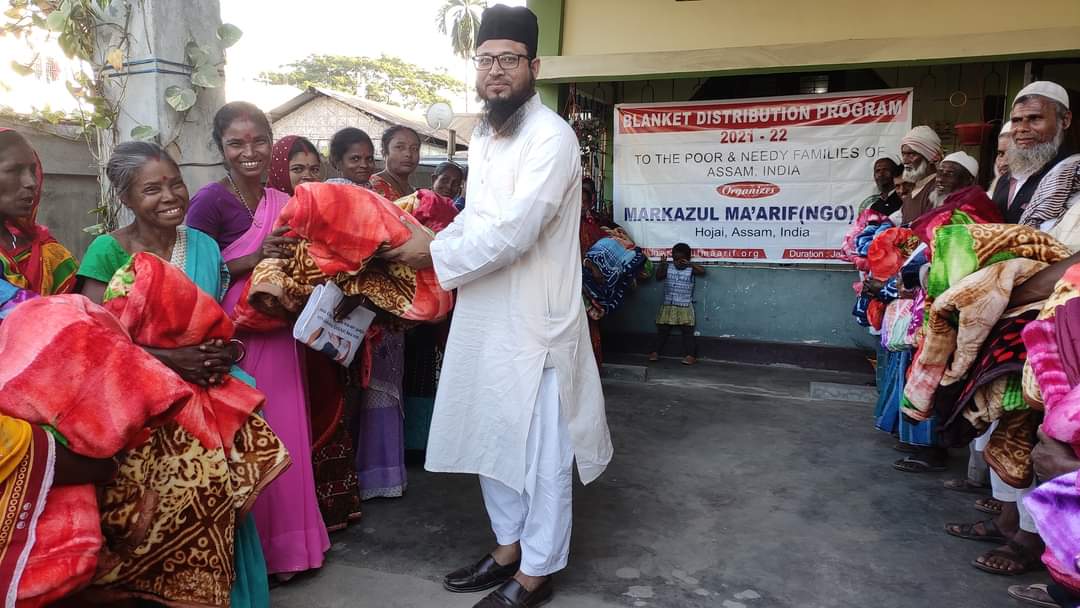
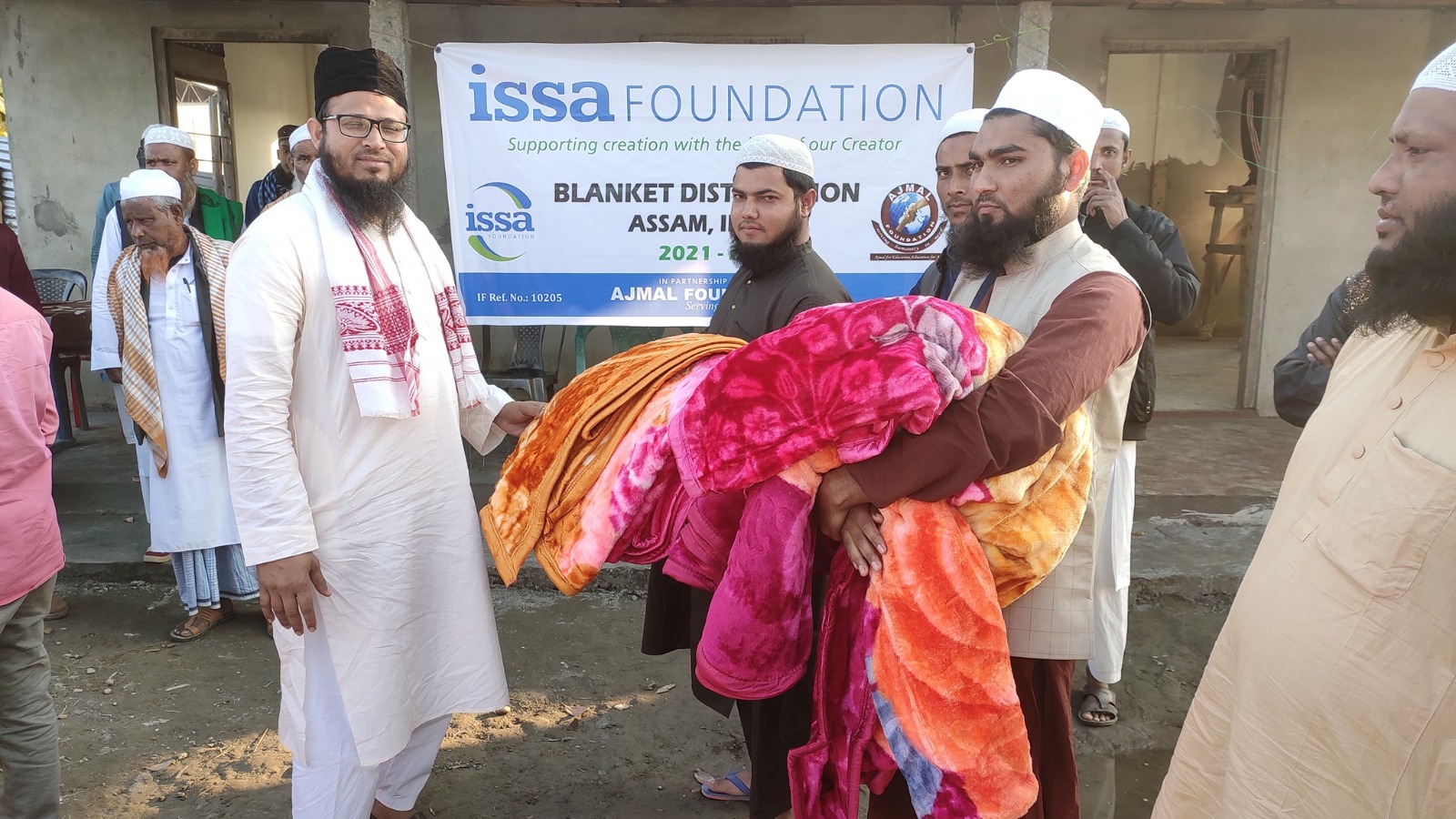
Maulana Nurul Amin Qasimi Distributing blankets

Maulana Nurul Amin Qasimi has been consistently speaking along the same lines in all the religious gatherings he is invited to. “Our Prophet Mohammad commanded us to go up to China for education. The first word of the Holy Quran is Ikra (read). Since our Prophet has allowed us to go to China for education, but, there is no scope for Islamic education in China. So our Prophet has, at the same time, laid special emphasis on IT and modern education besides Islamic education. Now only 4% of Muslim children study in madrassa.

“Not all Muslim children study in madrassa and not all need to study. The 4% must become Maulanas or Hafizs because they will have to uphold the religion in the future. We must educate the remaining 96% of the students’ modern education and establish them as good members of society,” he said.

Apart from the children studying in madrassas or receiving modern education, the Maulana said it is also necessary to think about school dropouts. He said the Muslim community could be rescued from its present condition only through education.

source: http://www.awazthevoice.in / Awaz, The Voice / Home> Stories / by Daulat Rahman, Guwahati / June 15th, 2025

Dr Ameer Althaf’s ‘Athaatchigal’ Book Release Next Sunday @ Podanur

Coimbatore, TAMIL NADU :

From Accounts Manager to Accomplished Author

Former NTC official Ameer Althaf, who played with numbers as accounts manager at the central government organisation had a passion for penning books.


And his creativity came to the fore with his maiden book on 300 year long history of Coimbatore Muslims in 2014.


Taking the next step, Ameer took up intensive research on Holy Quran. His seven year effort bore fruits with his four part book ‘Athaatchigal Thirukkuran Kalai Kalanjiam’ which has lots of interesting info which he collected during his indepth study visiting universities in Mecca, Medina and Malaysia. No doubt, this creative work is his magnum opus. Moreover, this book is a must in the book shelf of every household.


Retired apex court judge F M Ibrahim Kalifullah and former Madras High Court judge K N Basha will release the book in the presence of leading luminaries of Coimbatore and experts in their chosen domain from across the globe.


The event sponsored by Dhaanish Ahmed Institute of Technology (DAIT) and Al Azhar Educational Trust is to be held at Podanur Thendral Mahal on Oct 20 evening.


Interestingly, Ameer’s research papers on Holy Quran were presented and published in global forum like Umma-al Qura University in Mecca, King Fahad University in Madina, University Malaya, Islamic Science University Malaysia besides universities in Istanbul, Jordan, Qatar, Mali.


His four decade central government service and three decade research on Holy Quran made him go places across the globe. Significantly, he became to be known as International Holy Quran researcher.


Others who are part of the event includes Moulavi Alhaj M A Abdur Rahim, president, Coimbatore-Nilgiris-Tirupur district Jamathul Ulema Sabai, Moulavi Alhaj M A Mohammed Imdhadi, president, Coimbatore city Jamathul Ulema Sabai, social activist Aloor Shanavas, Coimbatore district United Jamaath president Alhaj A R Basheer Ahamed, Tamil Nadu Haj organisors association president Alhaj A Mohamed Rafeek, Iqra Educational Trust president Alhaj H E Iqbal Sait, Project Manager in Kuwait Haji M A Azad will address the audience at the book release event.


Himayathul Muslimeen Sunnath Jamaath, Podanur secretary Haji KTS Riyas Kapoor will propose the vote of thanks.

Other dignitaries who will speak at the event include Holy Quran translator Prof Mohamed Khan baqavi, TN state Jamathul Ulema deputy general secretary Moulavi Alhaj K M Ilyas Riyaji, Chennai Anna Salai Makkah Masjid chief imam Moulana M Mohammed Mansoor Kasimi, Madras University HoD Arabic, Persian and Urdu Dr A Zakir Hussain Baqavi and senior network consultant, Abudhabi Dr Mohamed Ibrahim.

source: http://wwwkovaimetro.in / Kovai Metro / Home> Coimbatore / by Shefa Rafi / October 13th, 2019

Deaf-Mute Kashmiri Girl Handwrites Entire Quran, Inspires Nation with Unwavering Faith

Batara Gawalo Village,(Bhalesa, Doda District), JAMMU & KASHMIR :

In the serene, mountainous terrain of Bhalesa in Jammu and Kashmir’s Doda district, where life flows gently with nature, a remarkable tale of faith and perseverance has emerged — one that is touching hearts across the country, reported the Chenab Times.

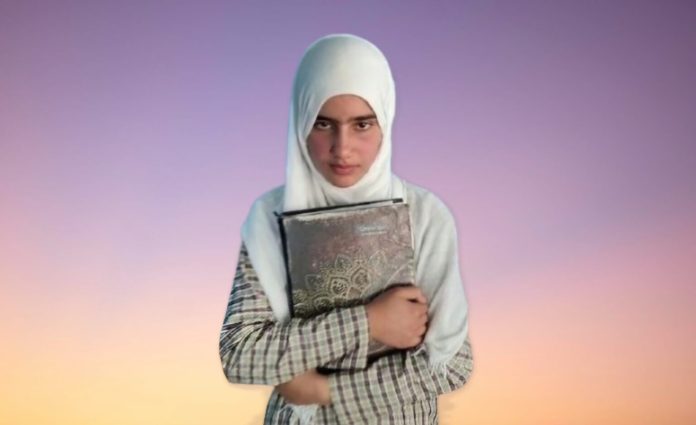
Mavish Arif, a 16-year-old Class 10 student from the remote village of Batara Gawalo, has achieved an extraordinary spiritual milestone: she has handwritten the entire Quran Sharif. What makes her achievement even more awe-inspiring is that Mavish was born deaf and mute.

In a world consumed by distractions and noise, Mavish’s silent journey of devotion speaks volumes. Over a span of nine months, without any formal guidance or assistance, she meticulously copied the Quran from start to finish, line by line, in the solitude of her home. Her determination, fueled by a deep spiritual purpose, astonished not only her family but the entire region.

Her parents, emotional and proud, shared how she immersed herself in this divine task, refusing help — not out of pride, but from an unwavering sense of purpose. Her days were spent absorbed in transcription, her hands speaking the language her voice could not.

This self-motivated act of worship, especially by a differently-abled young girl, has been hailed as unprecedented by local educators and scholars. Her school, Government Girls Higher Secondary School in Gandoh, has quietly supported her, and its principal, Mr. Ajeet Singh, expressed deep admiration:

“Mavish may be unable to speak, but her actions have roared louder than words. She has become a role model not just for students but for our entire community.”

The villagers of Bhalesa are united in pride and joy. Elders, neighbours, and teachers alike see her as a symbol of unwavering focus in a world that too often celebrates superficiality.

“In today’s time, when goals are often fleeting and attention is short-lived, this girl’s devotion is a lesson in spiritual resilience for all of us,” shared one elder.

Despite limited resources and geographical isolation, Mavish’s story radiates with spiritual brilliance and personal triumph. Her journey is not just a personal achievement, but a beacon of hope and inspiration for the entire nation.

Without uttering a word, Mavish Arif has etched a legacy — not just on paper, but deep in the hearts of everyone who learns of her devotion. Her story is one of faith, fortitude, and the silent strength of a pure soul on a sacred mission.

source: http://www.radiancenews.com / Radiance News / Home> Latest News> Markers of Excellence / by Radiance News Bureau / June 06th, 2025