University Women’s Polytechnic Students Shine at National Project Competition, Win First Prize at MITAOE, Pune
Aligarh:
Students from the University Women’s Polytechnic, Aligarh Muslim University (AMU), made a mark at the 8th National Level Poster Presentation and Project Competition, TechnoPHILIA’25, held recently at MIT Academy of Engineering, Pune.
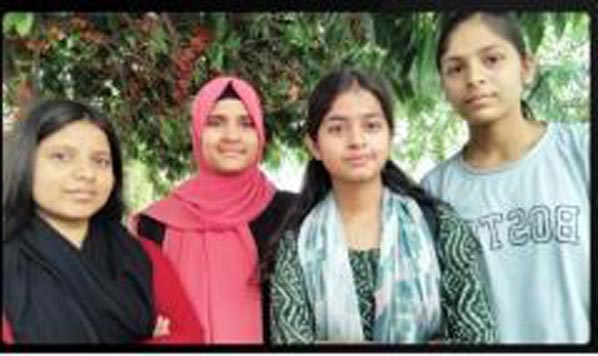
Competing against participants from over 25 institutions across India, the AMU team, “LISA VocalTech,” clinched the first prize in the Diploma Category, along with a cash award for their innovative project titled “LISA: A Voice-Controlled Lift.”
The team comprised final-year Diploma in Electronics and Communication Engineering students – Shalini Kumari, Kashish Khushi, Nargis Khatoon, and Shailly Bhardwaj – who developed the project under the mentorship of Mr. Mohd Kashif. Their creation, a voice-activated lift system, is designed to improve accessibility for the elderly, visually impaired, and physically disabled, earning praise from judges for its practical utility and inventive design.
This achievement highlights AMU’s commitment to academic excellence and its encouragement of student participation in national-level technical events.
source: http://www.radiancenews.com / Radiance News / Home> Education> Focus / by Radiance News Bureau / April 09th, 2025
Noor Jahan and her cousin Wajeeda Tabassum co-founded Shesrig Ladakh, an art conservation practice that restores and conserves ancient wall paintings, religious manuscripts, thangka (Buddhist scroll) paintings and metal works.
How do you protect and preserve culture? It’s a question Noor Jahan – a 32-year-old expert in art conservation and heritage management from Leh – has grappled with for a decade.
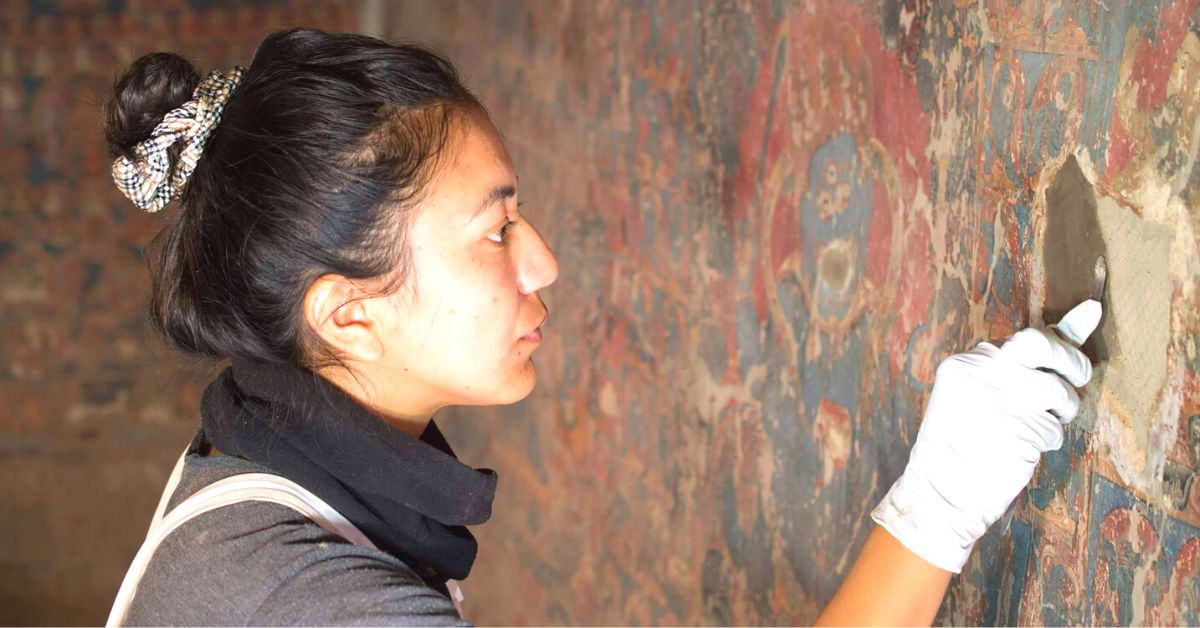
Through Shesrig (meaning ‘heritage’) Ladakh, an art conservation practice she founded with her cousin Wajeeda Tabassum, Noor performs critical restoration and conservation work on ancient wall paintings, religious manuscripts, thangka (Buddhist scroll) paintings and metal works.
“My real interest lies in working on ancient wall paintings and thangka paintings,” says Noor Jahan in a lengthy conversation with The Better India.
Backed by a Master’s degree from the Delhi Institute of Heritage Research and Management (DIHRM) and a PhD from the National Museum Institute, she has worked on wall paintings dating back to the late 8th century and Buddhist thangkas from the 19th century. Also, since 2019, she has run Shesrig on her own following Wajeeda’s departure for foreign shores.
What’s more, Noor is also the goalkeeper for the Indian women’ ice hockey team. Earlier this year, she helped India finish second in the Union Women’s Ice Hockey Tournament in Dubai. Noor reckons that she has a few more years left before she “officially retires” from the sport.
By all accounts, it’s an extraordinary way of life, and this is her story.
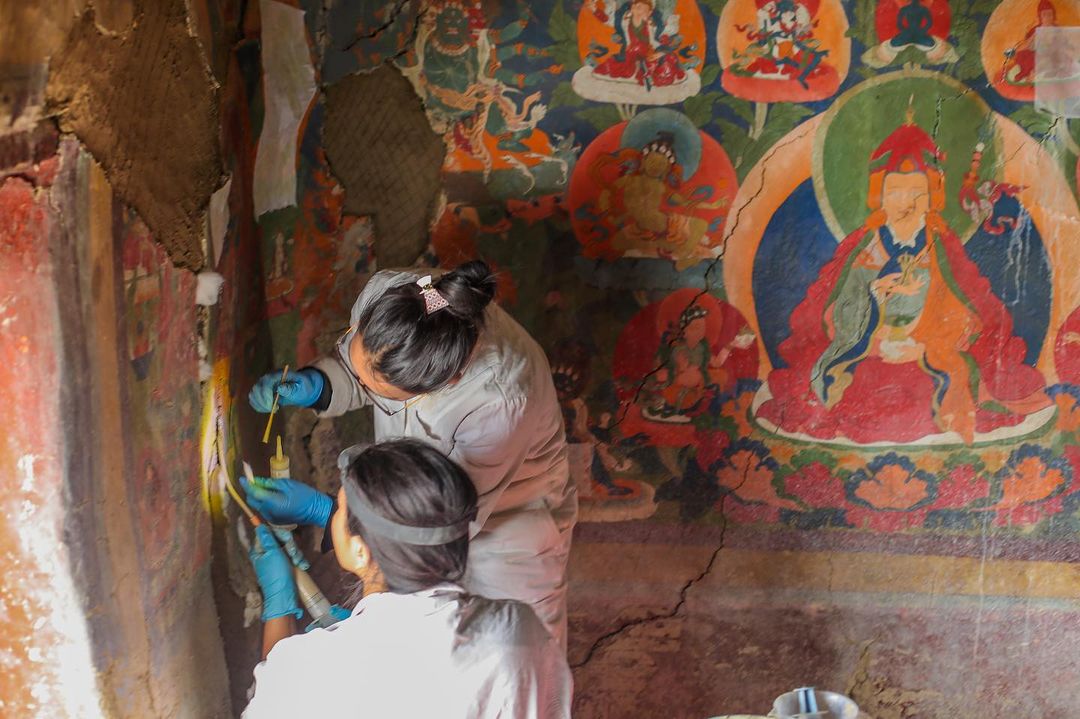
Noor Jahan working on old wall painting in Saspol caves, Ladakh
A serendipitous journey
There was a void in Noor’s life after earning her bachelor’s degree in commerce from Delhi University. Going through the motions, she had no passion for what she was learning. To reflect on what was next and enjoy a short holiday, she left for Leh after graduation in 2011.
It was during a walk through Leh’s crowded old town, when she met a few foreign conservators from the Tibet Heritage Fund working on an old Buddhist temple. Intrigued by what they were doing, Noor engaged in a short chat with them which would change her life.
After returning to Delhi, she began reading up on art conservation and learnt that she could pursue higher studies in this field.
What also sealed the decision to get into this field for Noor were memories from her childhood.
“My mother is from Hunder village in Nubra. Every holiday, we would always visit Nubra to meet my maternal grandparents. The bus would stop at this location called Chamba on the main road from where you had to walk inside the village. This particular route holds great importance in my life now because there are many stupas along the way. Every time I would look up at these pathway stupas, I would see these old paintings. But each passing year, some part of these paintings would disappear. When I applied for this course at DIHRM, the first thing I thought about were these paintings and the conservation work I could do someday,” she recalls.
Allied with a strong desire to come back home, starting this course brought passion back into her life. “Everything I was studying there found a purpose in Ladakh,” she says.
Noor Jahan found purpose in preserving Ladakh’s heritage
Finding Shesrig
Following the first year of her Master’s programme in 2012, Noor and Wajeeda opted to do their internship with the Himalayan Cultural Heritage Foundation (HCHF), a Leh-based non-profit. Helping them find projects to work on was Dr Sonam Wangchok, founder secretary of HCHF.
During this internship, the first major project Noor got involved in was a wall painting at Diskit Gompa, a 14th-century Buddhist monastery in Nubra Valley.
She recalls in an Instagram post, “The internship entailed working on the restoration of wall paintings from the 17th century under the supervision of art conservators from [the] Czech Republic. This was my first hands-on experience where I had the opportunity to conserve sacred Buddhist art and the opportunity to stay at the monastery itself. I think that internship changed my life forever as I not only got to work on the most beautiful wall paintings but gave me the opportunity to meet and interact with the monks at the monastery who took me and Wajeeda in as their own.”
Conserving ancient wall paintings is a delicate process
After completing her Master’s programme in 2013, Noor came back to Leh to work with other organisations like Art Conservation Solutions and Achi Association, amongst others, as a freelancer. In 2014, she worked on her first project outside Ladakh at the Golden Temple in Amritsar with Heritage Preservation Atelier, and also commenced her PhD at the National Museum Institute. Despite these landmark moments, she knew this sort of freelance work wasn’t sustainable.
“Working in these organisations was a great learning experience and helped me to capture some of the finer nuances of conservation. Even today with Shesrig, I collaborate with most of them. But this kind of work wasn’t sustainable, i.e. it was limited to summer months,” she says.
“In the summer, I would work on many projects. But the moment winters came, all these organisations would stop their work in Ladakh. I really wanted to start something of my own in Leh, while working sustainably and throughout the year,” she adds.
Thus, in 2017, Noor and Wajeeda founded Shesrig Ladakh and rented out a historic structure called Choskor House as their base in Leh’s old town, which they had to first restore.
This three-storied structure is located right behind the Jama Masjid (mosque) in the centre of Leh along the hillslope. It belongs to a renowned family of traders, who along with other important families, once led important trade missions to Lhasa from Ladakh.
“Even though Choskor House was really old, we decided to rent it. To restore it, we had initially consulted some architects, but there came a point when it became difficult because of costs and time constraints. That’s when we reached out to Achi Association India, a sister organisation of Achi Association (a Swiss-based organisation), which took over the project of restoring this structure backed by funding from the German Embassy. They helped with establishing the studio in which we currently operate. We started working inside our studio only this year,” says Noor.
“It’s important to see your heritage as an inheritance that has great value,” says Noor Jahan
Conserving ancient wall paintings is a delicate process
Conserving wall paintings
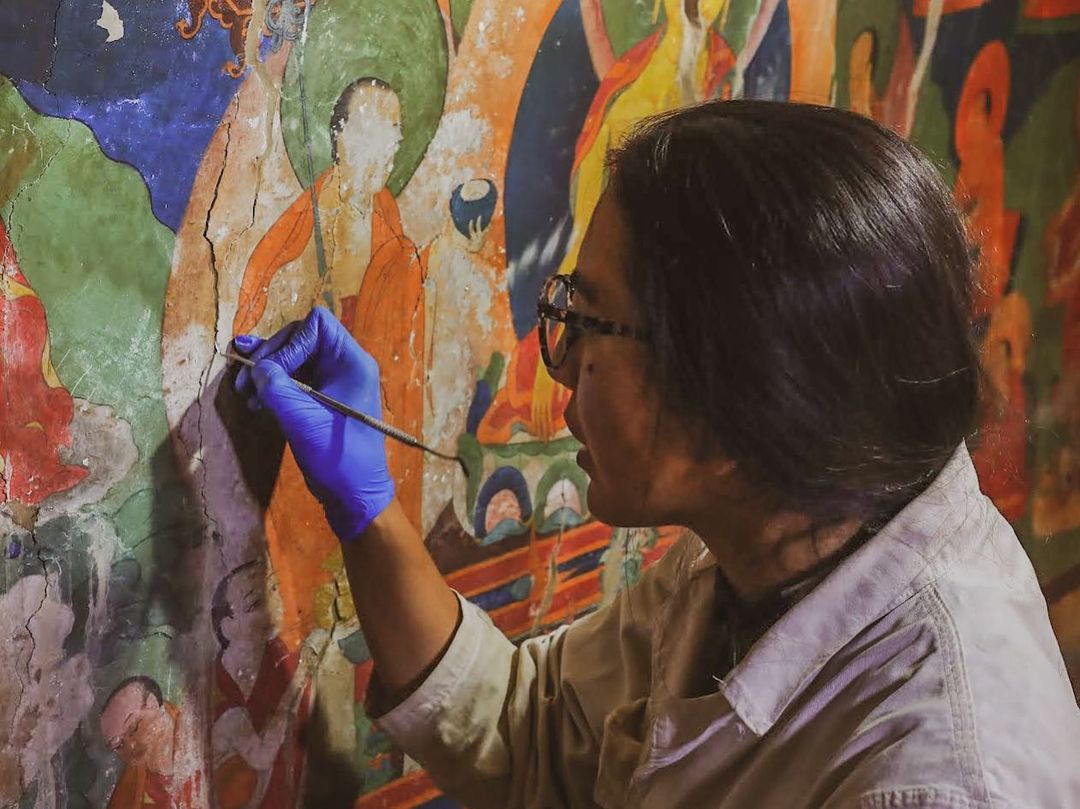
Conservation and restoration are different acts. Noor explains, “In conservation, people do not recreate anything new. So, if there are losses in a given wall painting, there is no recreation but only stabilisation. Restoration, meanwhile, seeks to recreate some of those losses.”
Some of the fundamental challenges in conserving or restoring old artworks include physical access to remote sites and obtaining the necessary materials that they largely import.
Noor gives us an example of a project they worked on in collaboration with the Himalayan Cultural Heritage Foundation in June 2020 to illustrate her point. The site was Chomo Phu, a small one-room Buddhist shrine near Diskit Monastery, Nubra.
“It’s quite a steep hike up from Diskit Monastery, and there is a gorge inside the valley where this shrine is located. There was no place for accommodation. Instead, we pitched tents next to the shrine and had to improvise basic facilities. We camped in that valley for about 25 days since it was not practical or possible for us to hike from there to the monastery or the village every day,” she recalls.
Before, during and after the project, Noor and her team do extensive documentation work. During this phase, they closely examine the kind of deterioration the wall painting has undergone.
In this particular case, there were a lot of over-filling and historical fills done in the past. These fills were done in such a way that it was obscuring a lot of the original painting and sometimes even overlapping it. They had to carefully remove those historic fills.
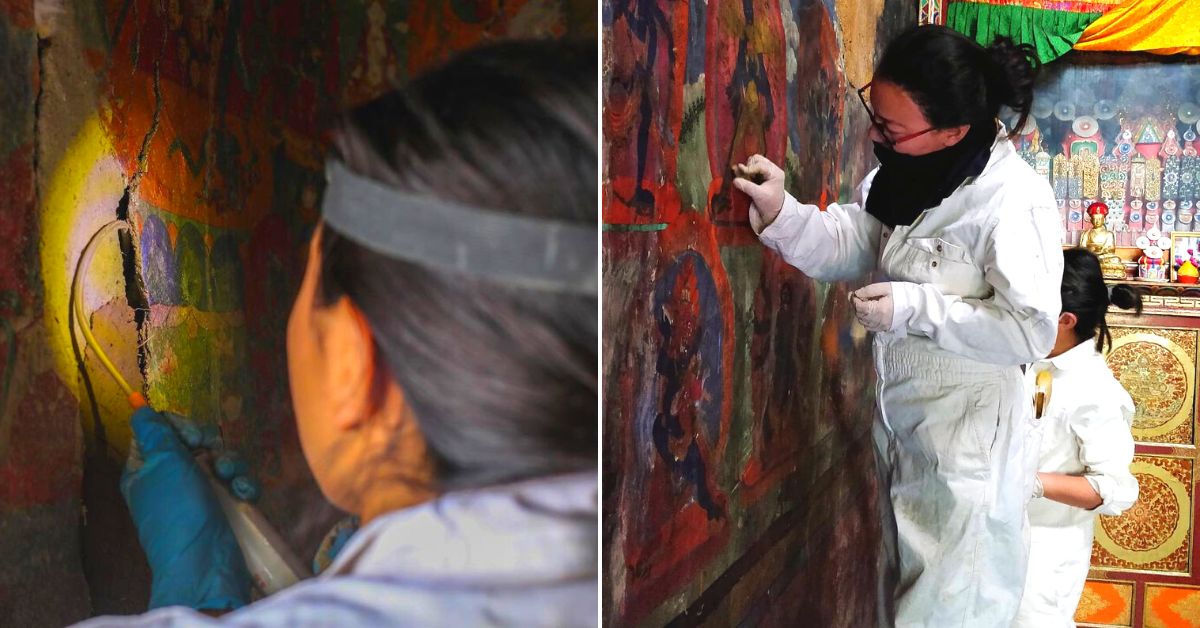
“Another issue with wall paintings is that there are a lot of detachments. In the event of any structural movement or water seepage, the plaster gets detached from the support, thus creating these hollow areas inside the painting. You can discover these hollow areas through a percussion test (a method for the structural inspection of wall paintings). We then perform grouting, i.e. fill the gaps between the painting and the support structure,” she notes.
Apart from these, there are cases where the paint layer gets delaminated. To address this, they use a consolidant and then stick the paint layer back to the surface.
“Of course, there is cleaning work which is done. The paintings are largely glue-bound tempera (also called secco, which are paintings on dry surfaces). In this kind of technique, the pigment is usually mixed with the binder and then applied to the walls. With water infiltration, the binder becomes weak causing delamination of the paint layer,” explains Noor.
“This damage primarily occurs because of water. We make sure not to perform any wet cleaning, i.e. don’t use any solvents to clean the wall painting. We only employ dry cleaning. There are various types of conservation-grade sponges which we work with and soft brushes to remove the dust or any mud infestations,” she adds.
A major point of contention with wall paintings is retouching work (reworking small areas of a painting to cover damage or to mask unwanted features).
Without getting too deep into the subject, when it comes to wall painting conservation work, Noor and her team largely stick to what she calls “conservation or stabilisation work”.
“It’s important to see your heritage as an inheritance that has great value,” says Noor Jahan
Restoring old thangkas
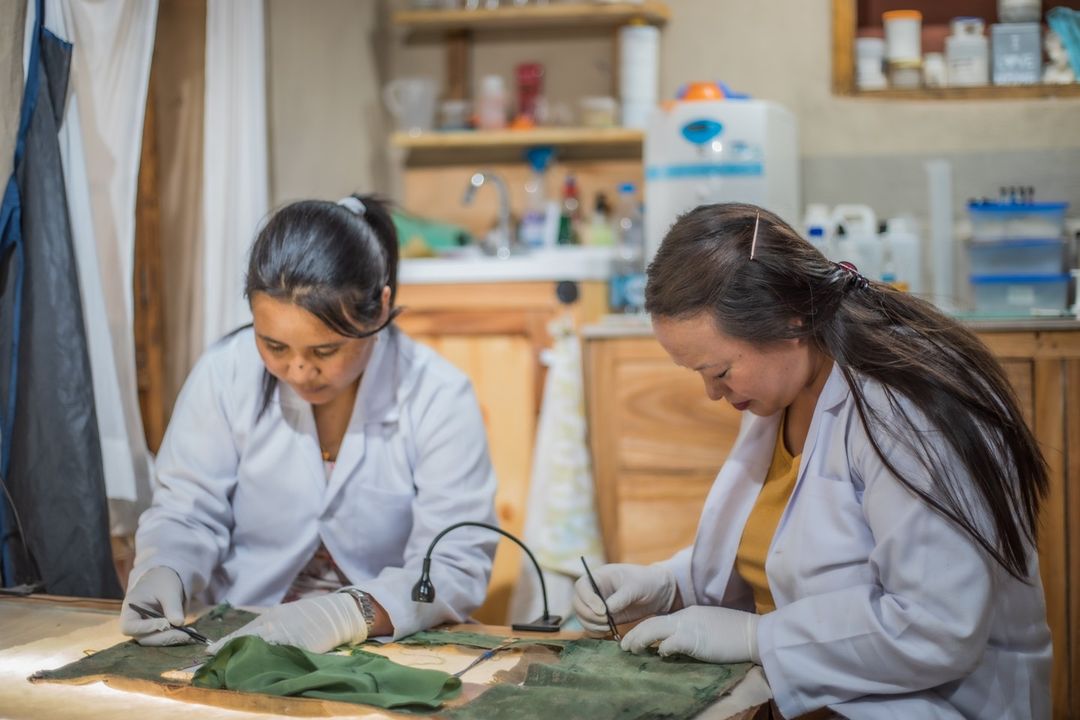
This year most of the thangkas that were brought in for restoration at Shesrig’s studio came from private households. Each thangka arrives in a different condition.
In thangka paintings, you have a textile-based canvas made of cotton fabric or any other material used by the artist in the centre. These thangkas also usually have either silk or brocade borders. Most thangkas they got into their studio this year had silk borders.
Step 1: “Since the thangka has come directly from the chod-khang (prayer room) to our studio, we first take it to a nearby monastery, where a de-consecration ceremony is done,” she says.
Step 2: The next step is to bring the thangka back to the studio, perform extensive documentation work including photographic documentation and understand what kind of problems are visible. Accordingly, they prepare a treatment plan.
Step 3: Usually the centrepiece of the thangka is stitched with a textile border. They separate both elements because the fabric at the border is completely different from the canvas in the centre. Following separation, they work on the border and centre piece canvas separately.
Step 4: Once the separation is done, the first step is cleaning the soot. “In thangkas, there are times (only when required), when we go for mild solvent cleaning but once again dry cleaning methods are preferred. Also, solvents can sometimes be harsh. We have started preparing gels which are much milder and do not adhere to the surface for the cleaning process,” she says.
Step 5: What if there are big losses or tears on the thangka painting? “We make a similar kind of ras-jee (the local term used for the textile canvas of a Thangka painting) in the studio. We use pieces of that ras-jeeto mend the tears. Otherwise, in thangkas, we also see a lot of cracks. To fill the cracks, we use the markalak (local clay mixed with mild adhesive) to fill those cracks because that’s part of the original technique of preparing a thangka. We follow the same methods while restoring it as well,” she explains.
Step 6: Once this is done, if there is any consolidation work required or a paint layer is coming off, they fix those problems. Sometimes, they mend the tears fibre by fibre, which requires very delicate hands. Also, if there are any small losses or paint losses, they do subtle retouching work using natural colours or the colours originally used on the thangka.
Conservation of Thangsham (the local term used for the textile border of a Thangka painting)
Step 7: Meanwhile, there is another team which is working on the textile border known as thangsham locally. There is a particular method of washing the textile using conservation-grade detergents.
“We don’t dip it straight into the water. Instead, we use wet sponges to clean it very meticulously. Sometimes these borders are also torn or otherwise in a bad condition, for which we mend them using patchwork with silk, brocade or whatever material was originally used. We have a stock of raw silk, which is white. We dye it as per the thangka’s requirements. If the thangsham, for example, is blue, we will dye the silk blue and do the patchwork from the inside. We perform the process of dyeing ourselves at the studio,” she explains.
Step 8: Once both elements are ready, they stitch the centrepiece canvas and the border back together, following which a consecration ceremony is done and then returned to the client.
Once again, depending on the state in which the thangka is sent, it takes anywhere between a fortnight to two months or more to restore a thangka. It also depends on manpower.
“Most of the time, we work in groups of two or three women on one thangka, and depending on the scale of the task, it takes about a month or two if the damage is extensive,” she says.
Given that most of the conservation work she does with Shesrig Ladakh relates to Buddhist heritage, questions have emanated from either side of the religious divide.
But is her faith an obstacle in this line of work?
“Most of the time, they don’t see my Muslim faith as an obstacle to the work that I do. For the most part, I’m not treated as an outsider or not from the community. In fact, it has been the opposite, where I am given more respect and love, especially in monasteries,” she says.
However, recently she heard someone say, ‘What is this Muslim girl doing here?’ “Look, this is how the world around us is moving. As Muslims in India, we know what’s going on. But I do not take these comments personally because I have to do what I know how to do,” she says.
Noor Jahan: “I have to do what I know how to do”
But such ad-hominem comments don’t necessarily come from the Buddhist community. She even notes how members of her religious community pass judgement on her line of work.
“Sometimes, people from the community approach my family to complain about my work, but fortunately they have been very understanding,” she notes.
Another struggle Noor deals with is the significant lack of awareness in Ladakh about art and heritage conservation as a field. “Even though they support me, my parents and some friends still don’t understand the kind of work I do. They still think this is a ‘hobby’ to me and don’t take me seriously. Even though the conversation in Ladakh about restoration and conservation has progressed a little, there are still people who think that this work can be done for free. This is something, I hope, changes with time as the conversation around this subject grows,” she says.
Remarkable achievements highlight talent and determination in Bihar’s intermediate results.
New Delhi :
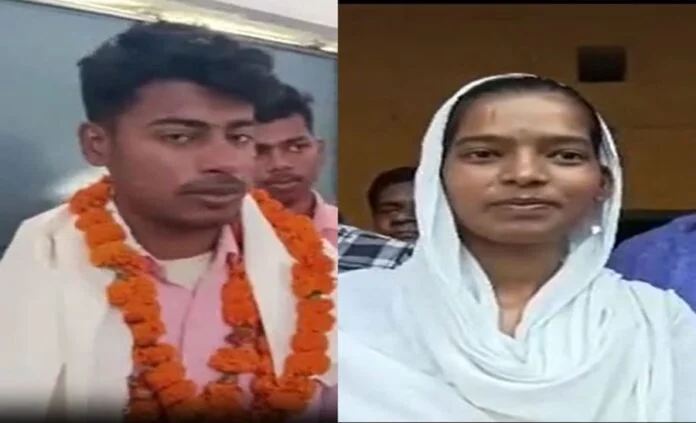
The Bihar School Examination Board (BSEB) on Tuesday revealed the 2025 Class 12 exam results, and this year, two Muslim students from modest backgrounds have made headlines by securing the first and second positions. Shakib Shah from Buxar district and Rukaiya Fatima from Begusarai have not only made their families proud but also demonstrated the power of hard work and ambition in overcoming challenges.
Shakib Shah, a student at Plus Two High School Koransarai in Buxar, achieved an impressive 473 out of 500 marks, securing the top position in the Arts stream. His 94.6% score has ignited celebrations in his village, with locals and teachers praising him as a source of inspiration. “I studied hard every day, and my teachers supported me throughout. My dream is to crack the Bihar Public Service Commission (BPSC) exam and serve as an administrative officer,” Shakib told Zee Media, his determination evident in his words.
Following the announcement of his results, Shakib received a flood of congratulations at his home in Koransarai. Teachers from his school, along with the District Education Officer, visited the school to honour their star student. “Shakib has always been a focused student. His success is a testament to his hard work and the guidance he received here,” said one of his teachers, beaming with pride.
Meanwhile, Rukaiya Fatima, a student at BN High School Teyai in Begusarai’s Teghra subdivision, earned the second position with 471 marks, achieving 94.2% marks. The daughter of Mohammad Abu Salem, a bidi trader from Kolkata, Rukaiya comes from a family of seven sisters, where she is the third child. Despite her father’s modest income and the challenges of supporting a large family, Rukaiya’s resolve to excel never wavered. “I want to become an IAS officer and work for the poor. Education is my way to change my family’s future,” she shared with local reporters.
Rukaiya’s success has brought joy to her community in Begusarai. Her school principal described her as a diligent and bright student who balanced her studies with household responsibilities. “She would often stay back after classes to clear her doubts. Her success shows what girls can achieve with determination,” the principal remarked.
The Bihar Board 12th exams, held between 1 and 15 February 2025, saw over 12.92 lakh students appear across 1,677 centres in the state. This year’s results reflect an overall pass percentage of 86.50%, with the Arts stream recording 82.75%. Shakib and Rukaiya’s stellar performances stand out, not only for their academic brilliance but also for their powerful message of resilience and hope.
For Shakib, topping the state is just the beginning. Growing up in a simple family in Koransarai, he credits his family’s encouragement and his own disciplined routine. “My parents never let me feel any pressure. They just told me to do my best,” he said. His ambition to join the administrative services stems from a desire to uplift his community and tackle local issues like education and employment.
Rukaiya’s journey is equally inspiring. Despite growing up in a family with limited resources, she often studied by candlelight during power cuts. Her father, Mohammad Abu Salem, expressed his pride over the phone from Kolkata: “I always knew Rukaiya was special. She has made us all proud, and I hope she achieves her dream of becoming an IAS officer.” Rukaiya’s six sisters also look up to her, with the youngest saying, “I want to study hard like Rukaiya Apa.”
The success of these two students has also highlighted the untapped potential within Bihar’s Muslim community, which often faces socio-economic challenges. Local leaders and educators have hailed their achievements as a beacon of hope. “Shakib and Rukaiya have shown that talent knows no boundaries. Their success will inspire countless others,” said a senior official from the BSEB during the result announcement press conference in Patna.
However, their triumphs stand in contrast to the broader narrative in Bihar, where tensions between communities have occasionally erupted. Critics have often pointed to the state’s history of communal friction, exacerbated by divisive politics and economic disparities. Some have accused Hindu groups of marginalising minority achievements in educational settings. Yet, Shakib and Rukaiya’s success challenges these narratives, proving that merit and perseverance can overcome prejudice.
To celebrate their achievements, the BSEB has announced cash prizes and scholarships for the toppers, with Shakib set to receive £2 lakh and Rukaiya £1.5 lakh, along with laptops to support their future academic pursuits. These rewards, doubled from last year, reflect the state’s commitment to nurturing talent. “We are proud of all our students, and these two have set an exceptional standard,” said BSEB Chairman Anand Kishore.
As Bihar celebrates its top achievers, the stories of Shakib Shah and Rukaiya Fatima resonate beyond their exam results. Their journeys embody the dreams of millions in a state where opportunities are scarce, and their success serves as a shining example of the transformative power of education. For now, the spotlight remains on these remarkable individuals, whose stories are only beginning to unfold.
source: http://www.clarionindia.net / Clarion India / Home> Editor’s Pick> Indian Muslim / by Mohammad Bin Ismail, Clarion India / March 26th, 2025
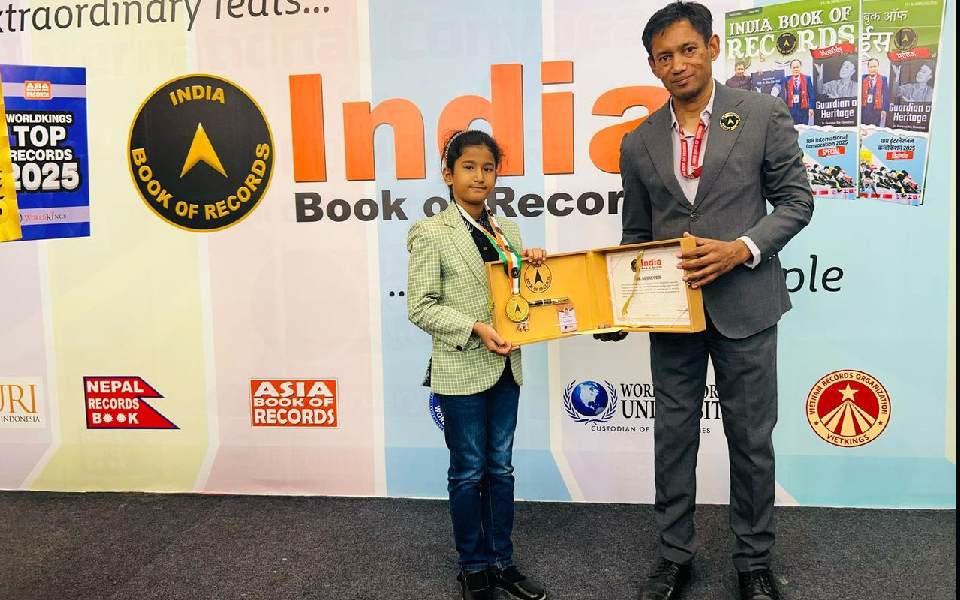
Eva Fathima Basheer, a Grade 3 student of GEMS Millennium School, Sharjah, has been recognised by the India Book of Records for her exceptional feat of reading English storybooks for the longest uninterrupted duration by a child.
At just nine years old, Eva read aloud from six English storybooks for 4 hours, 31 minutes, and 38 seconds without a break. She received the India Book of Records Achievers Award for this accomplishment at a ceremony held on 29 March 2025 at the organisation’s centre in Faridabad, Haryana.
Apart from this record, Eva has excelled in academics, securing gold medals in various national and international Olympiads conducted by reputed institutions. She is also actively involved in extra-curricular and social activities, including cleanliness drives, environmental awareness campaigns, fundraising efforts, and promoting safety practices.
Eva’s interests extend to writing stories, poems, and articles, as well as drawing and singing.
She hails from Aramboor in Sullia, Dakshina Kannada, and currently lives in Sharjah with her parents.
source: http://www.english.varthabharati.in / Vartha Bharati / Home> Gulf / by Vartha Bharati / March 29th, 2025
Rumana Ali was also honored by the Citizen Rights Forum for her contributions
Pune:
Social worker Rumana Ali has been appointed as the General Secretary of the Women’s Wing for the Minority Front of the Pune City Bharatiya Janata Party (BJP).
The official appointment ceremony was held on Saturday, October 19, at City Lawn, Parge Nagar, Kondhwa. The event was presided over by Imtiaz Momin, head of the BJP Minority Front for Pune City.
The ceremony saw the attendance of several notable figures, including Khwaja Iqbal, Maulana Idris Qari, Satpal Parge, Isak Pansare, Taufiq Shaikh, Nitin Boke, Nurjaha Shaikh, and Sameer Pathan. During the event, Rumana Ali was also honored by the Citizen Rights Forum for her contributions.
Addressing the gathering, Rumana Ali expressed her commitment to working in alignment with the policies and objectives of the BJP. She emphasized her dedication to the party’s vision.
Imtiaz Momin, speaking at the event, highlighted that the BJP is dedicated to social advancement through grassroots engagement, which has led to increased trust and support for the party.
Earlier, BJP spokesperson Ali Daruwala was appointed as a senate member on the governing council of Dr. P.A. Inamdar University, Pune.
In his new role, Daruwala will play a key part in overseeing the institution’s governance, focusing on academic policies and strategic initiatives on behalf of the government. His involvement is anticipated to enhance the university’s alignment with public policy and strengthen its regulatory framework.
source: http://www.thebridgechronicle.com / The Bridge Chronicle / Home> News / by Salil Urunkar / October 20th, 2024
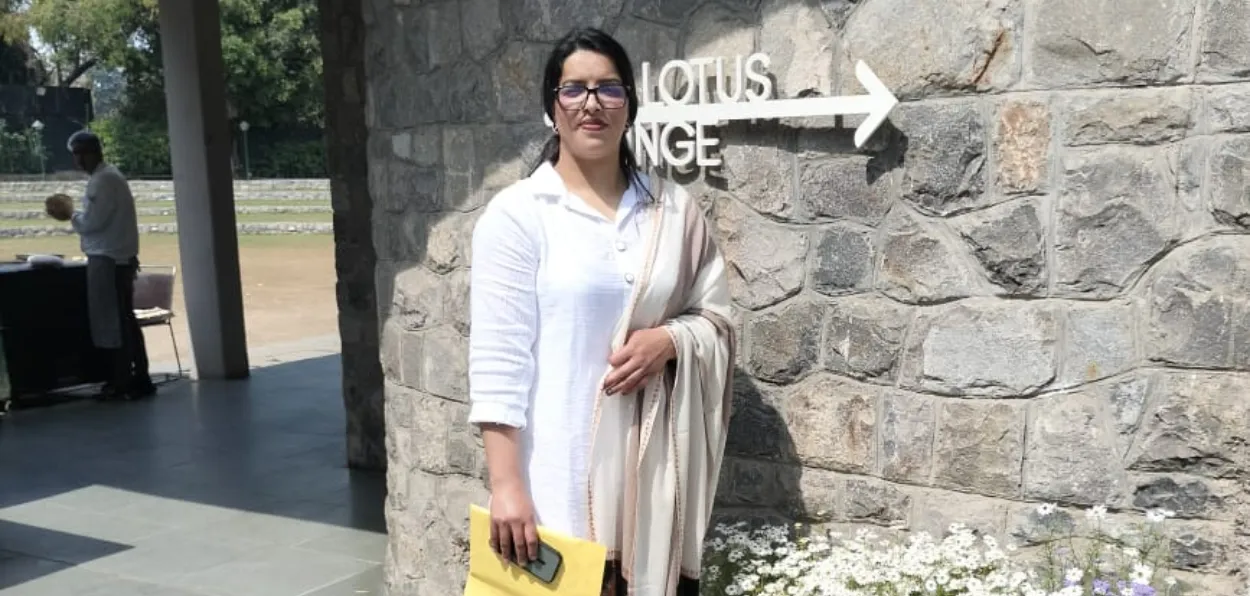
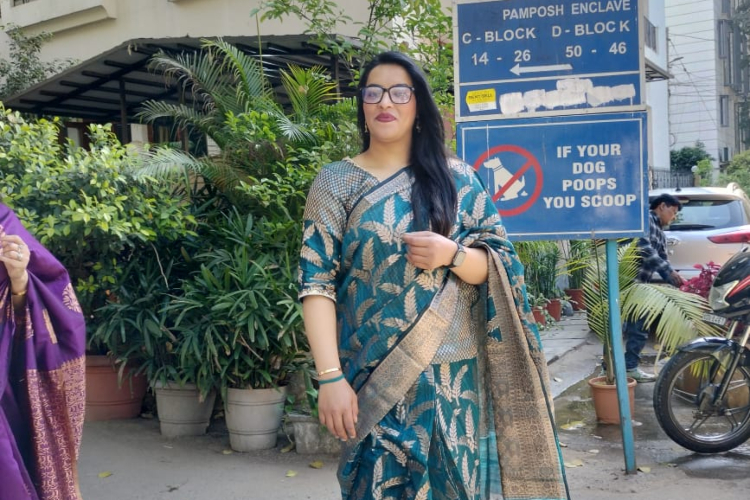
A remarkable woman from North Kashmir is breaking stereotypes and inspiring change in Kashmir. Advocate Tabassum who prefers to be known as Advocate Sibgat, a lawyer-cum-wrestler, is not just fighting legal battles in the courtroom but also empowering women by educating them about their rights and guiding them toward a brighter future.
Sibgat’s journey has been anything but conventional. She hails from the village Tujar Sharif, close to the apple town of Sopore which was once the hub of terrorism.
Losing her mother at a young age in 2012, she stepped into a leadership role within her family. Despite societal norms that often frown upon step-relations, she urged her father to remarry.
Defying expectations, she and her sibling embraced their stepmother wholeheartedly. “Our society doesn’t easily accept the concept of step-relations. But I insisted and got my father married again. We accepted our stepmother as our own; she did the same for us. I made sure the revolution began at home,” she recalled.
This belief in challenging societal norms shaped her into the woman she is today. Sibgat pursued law to fulfill her late mother’s dream of seeing her in the black coat. Now, as an advocate at the Srinagar High Court, she dedicates her life to making legal awareness accessible to the people, especially women.
“Women in our society have always been kept secondary. They are taught to live under the dominance of their fathers and later their husbands. Why is that so? Women must have control over their own lives and be able to make their own decisions,” says Sibgat. Through her legal practice, she educates and consults women on their rights, encouraging them to stand up for themselves and fight against injustices.
Beyond her legal career, Sibgat is also a national-level arm wrestler, competing in the 75kg and 95kg categories and the winner of several medals in the sports. She was even selected for international competitions but could not participate due to personal and professional commitments. “Paron ko khol zamana udaan dekhta hai, Zameen pe baith ke kya aasmaan dekhta hai?” she says, emphasising the importance of ambition and perseverance.
For a woman from Kashmir, excelling in sports, especially a physically demanding one like arm wrestling, is no small feat. “I was always inclined towards sports, but in my area, it wasn’t easy for women to pursue it. I want to pass on this strength to young girls and encourage them to break barriers,” she stated passionately.
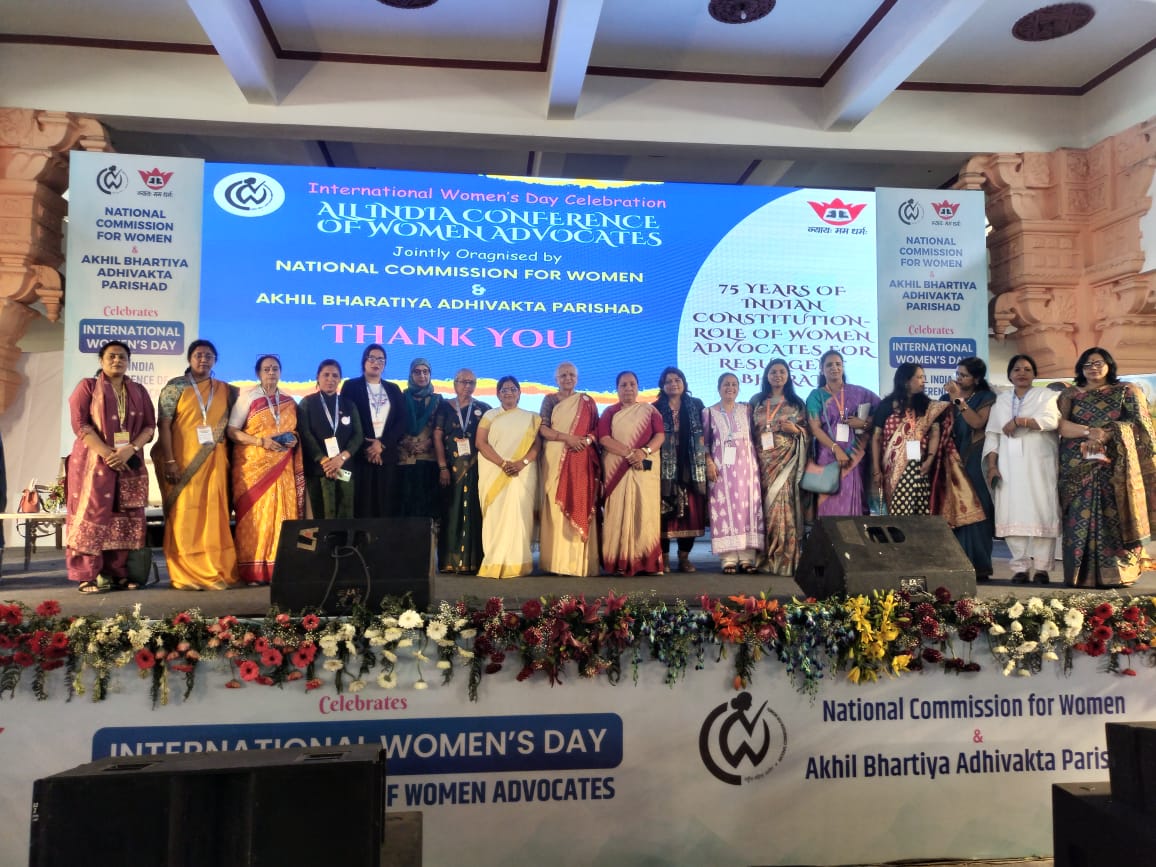
Advocate Tabassum alias Sibgat attending a conference of Women advocates in Delhi
Her commitment to societal well-being extends beyond law and sports. Recognizing the growing influence of digital spaces, Sibgat is spreading cyber awareness.
“Youth is an essential part of our society; they are taking over social media and cyberspace. It is crucial to educate them about cyber laws and digital safety,” she explained.
Advocate Sibgat’s story is one of resilience, determination, and change. Whether in the courtroom, on the wrestling mat, or in society, she continues to fight for justice and empowerment. Her unwavering spirit is a beacon of hope for women in Kashmir and beyond, proving that no societal norm is too rigid to be challenged and no dream too big to be pursued.
source: http://www.awazthevoice.in / Awaz, The Voice / Home> Stories / by Vidushi Gaur, New Delhi / March 24th, 2025
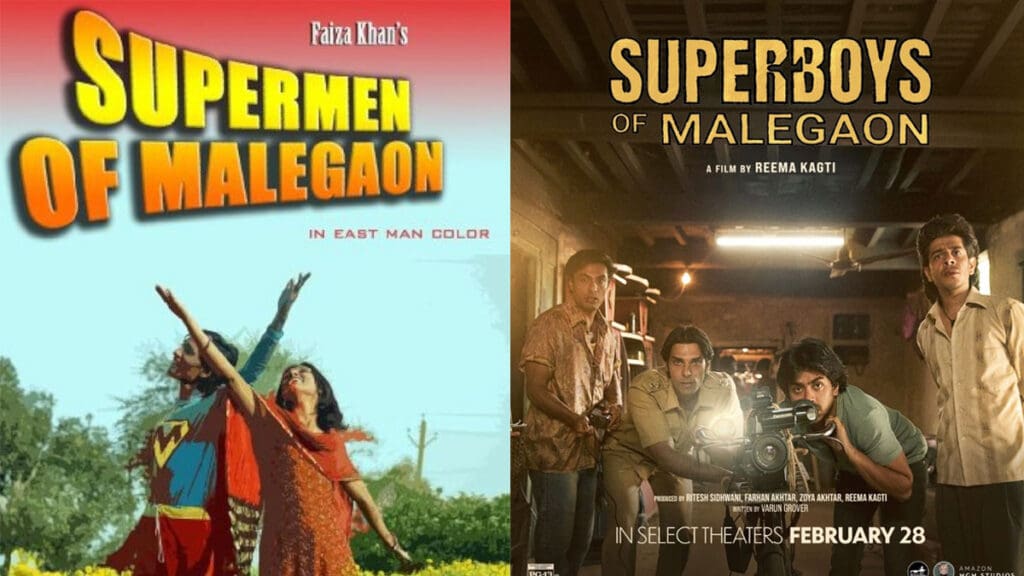
Cinema, at its best, is an act of discovery—a way to reveal untold stories, amplify unheard voices, and explore cultures beyond mainstream narratives. Faiza Ahmad Khan’s celebrated documentary, Supermen of Malegaon (2012), did precisely that. It offered an authentic, heartfelt portrayal of a town’s passion for cinema, honestly capturing Malegaon’s people’s struggles, aspirations, and resilience.
Enter Superboys of Malegaon , a film emblematic of mainstream Hindi cinema’s exploitative tendencies—appropriating genuine experiences into sanitized narratives.
Superboys of Malegaon fails ethically and creatively, offering no fresh perspective while recycling Khan’s original vision. The filmmakers behind Superboys claimed “life rights” yet sidelined Khan when she sought acknowledgement, providing only a perfunctory shout-out at the film’s end—masking intellectual theft. This echoes the controversy involving Dalit writer Yashica Dutt, whose work was appropriated without credit in the series Made in Heaven. Powerful creators (also the same) behind these productions repeatedly draw from marginalized voices without meaningful acknowledgement, silencing concerns when challenged.
Such incidents highlight mainstream Hindi cinema’s transactional activism—superficially engaging marginalized spaces for fleeting relevance, prioritizing optics over authenticity. Some argue that under a politically charged climate with a right-wing fundamentalist government at the centre, this diluted portrayal is the best achievable representation—but accepting superficial representation as an acceptable standard of progress only normalizes mediocrity and stifles genuine change, further entrenching injustice rather than challenging it.
Erasing Malegaon’s complexity
Supermen of Malegaon succeeded precisely because it didn’t shy away from reality. Malegaon is more than just a quirky small town—it’s a working-class Muslim community shaped by poverty, systemic discrimination, and communal violence, including devastating bomb blasts in 2006 and 2008, initially blamed on local Muslims but later linked to Hindu nationalist groups (such as those implicated in investigative reports and legal proceedings, including the Malegaon blasts cases, as detailed in various court judgments and media investigations). This complex history has continued to profoundly impact residents, whose filmmaking is not merely artistic expression but an act of resistance and survival.
However, Superboys strips away these critical layers, presenting Malegaon as an optimistic yet sanitized locale devoid of historical context or socio-political nuance. Even the town’s distinctive dialect—a rich blend of Marathi, Urdu, and Dakhani—is diluted to a more palatable version. The film carefully constructs picture-perfect frames, evading the filth and squalor that define the neglected streets of Malegaon. This visual sanitization is emblematic of the state’s apathy towards Muslim ghettos—neighbourhoods that are frequently labelled ‘Pakistan’ as a means of deliberate alienation and justification for withholding even the most basic amenities.
Christoph Jaffrelot and Laurent Gayer, in Muslims in Indian Cities, document the systemic oppression and deprivation faced by Muslims in these spaces, reinforcing how Superboys dilutes Malegaon’s reality into an aestheticized, palatable narrative for mainstream consumption.
While some applaud the mere presence of Muslim characters, depicting a predominantly Muslim town without engaging its realities constitutes tokenism, not meaningful representation. Authentic storytelling demands acknowledging the community’s lived experiences, struggles, and resilience—precisely what Superboys avoids.
Flattening reality
Ironically, Superboys of Malegaon, despite proclaiming, “Writer baap hota hai,” suffers from a weak screenplay devoid of the sweat, grime, and authenticity central to Malegaon’s sole filmmaker featured in the film, Nasir Shaikh.
Excessive close-ups, overly polished aesthetics, and sanitized set designs further detach the film from reality, undermining grassroots storytelling. Casting choices deliberately select bodies that cannot represent those that labour—bodies that do not carry the marks of a lifetime of struggle, calloused hands, or the weight of exhaustion.
The film’s music, rather than reinforcing the struggles of Malegaon, renders them more palatable, smoothing over the jagged edges of survival. Crucially, the plotline completely erases a key detail from Faiza Ahmad Khan’s documentary—that every child born in Malegaon sleeps to the lullaby of the working mill. The hum of the power looms is the constant soundscape of the town, an unbroken rhythm of survival and labour. Superboys silence this ever-present industrial echo, replacing it with a more sanitized, digestible version of struggle that aligns with Hindi cinema’s broader tendency to aestheticize hardship while stripping it of its deeper socio-political implications.
Additionally, Superboys completely sidesteps critical caste dynamics influencing Malegaon’s filmmakers, isolating characters from the complex social hierarchies shaping their reality. This omission reflects mainstream Hindi cinema’s broader reluctance to engage meaningfully with caste or class, further flattening the film’s portrayal.
Industry machinery of mediocrity
Mainstream Hindi cinema’s insular ecosystem—an interconnected network of privileged filmmakers, critics, and cultural commentators—enables such mediocrity. Films like Superboys evade genuine criticism because their perception is managed by an influential elite. Glowing reviews, interviews, and festival accolades form a self-sustaining validation loop disconnected from authentic evaluation, shielding Superboys from any meaningful critique. Instead of being judged against the documentary it so evidently draws from, or the socio-political realities it claims to depict, the film is celebrated within elite industry circles that determine cinematic ‘success’ on the basis of marketability rather than integrity. The same privileged class that overlooked Faiza’s Supermen of Malegaon, now eagerly praises its sanitized counterpart.
Ultimately, Superboys of Malegaon isn’t a tribute—it’s appropriation. Mainstream Hindi cinema frequently silences creators lacking resources to challenge this imbalance. The filmmakers had the opportunity to respectfully acknowledge Khan’s vision but instead rebranded it as their own, altering the title likely for legal convenience rather than ethical accountability.
Contrasting this with other films that have successfully adapted documentary narratives into feature films, one can observe how respectful adaptations can retain the depth and authenticity of the original. For instance, Joshua Oppenheimer’s The Act of Killing (2012) directly influenced the narrative choices of the Indonesian feature film Solo, Solitude (2016), which recontextualized the atrocities explored in the documentary through a more personal fictionalized lens while preserving the socio-political depth. Similarly, City of God (2002), though not a direct remake, was heavily inspired by real-life events documented in News from a Personal War (1999), translating raw documentary insights into an electrifying yet authentic cinematic experience.
In contrast, Superboys strips away the very essence that made Supermen of Malegaon so compelling. Where films like Solo, Solitude and City of God retained the unsettling truths and urgency of their documentary counterparts, Superboys prioritizes aesthetics over authenticity, sanitizing uncomfortable truths for a wider audience. By ignoring the socio-political fabric that shaped Malegaon’s filmmakers, it reduces lived experiences to an easily consumable narrative devoid of the structural forces that shape them.
In a just world, such dishonesty would have consequences. Unfortunately, powerful creators routinely rewrite narratives without accountability. To experience the magic of Malegaon in its raw and real form, watch Supermen of Malegaon—a film that not only respects its subjects but builds a narrative that rejects neatness and celebrates their wins—a film that authentically respects its subjects, allowing their voices to be genuinely heard. Superboys, by contrast, reminds us of mainstream Hindi cinema’s continued failure toward meaningful representation.
Zeeshan Hasan Akhtar is a Mumbai-based theatre practitioner and screenwriter whose work interrogates identity, caste, class, and memory through intimate yet politically charged storytelling.
source: http://www.maktoobmedia.com / Maktoob Media / Home> Features / by Zeeshan Hasan Akhtar / March 21st, 2025
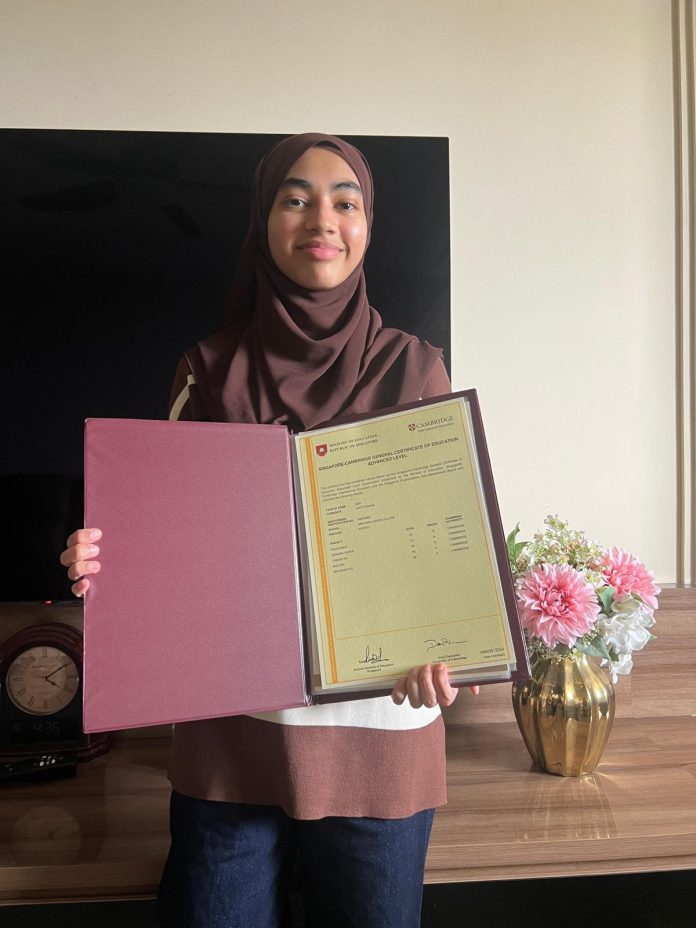
Ms. Zainab Irfan Sheth, daughter of leading emergency physician of Singapore General Hospital Dr Irfan Abdurrahman Sheth and Muniba Irfan Sheth, a native of Modasa Town of Gujarat State of India, has achieved maximum achievable rank points which are 90/90 in 12th grade exams of Singapore. She is now eligible to get admission in all the faculties including the reputed medical school of Singapore for further studies. May Allah bless her to get more and more success in future endeavours, too.
Ms. Zainab’s maternal uncle Dr Iftekhar Malek, who is a practising doctor in Modasa for many years, says that her achievement is a proud moment for our family as well as for the whole of the Muslim community.
Her other maternal uncles, Dr Shahid Malek and Dr Shakib Malek, are also practising Anaesthetist and Orthopaedic Surgeon respectively, providing services in their fields.
Zainab’s grandfather Late Abdurrahman Sheth, was a famous CA and her grandpa Late Nisharahmed Malek was an educationist associated with various educational institutions in Modasa.
On this occasion of Ms. Zainab’s brilliant success in academics, the whole family is proud and happy, expressing gratitude to Allah Subhanahu wa Ta’ala for the same.
source: http://www.radiancenews.com / Radiance News / Home> Focus> Pride of the Nation> Markers of Excellence / by Radiance News Bureau / February 24th, 2025
Till about 30 years ago we used to have a flourishing devotional movie culture in the country. These films were usually made on a shoe string budget with non-stars. Despite their amateurish direction, hackneyed plots and tacky sets, the films did well at the box office largely because of a couple of hummable devotional songs which every film packed in, and a segment of the oft unlettered audience that accepted every thing in the name of faith. If in the ‘60s, we had a film like “Jahan Sati Wahan Bhagwan”, it was followed a few years later by “Ganga Sagar” and “Har Har Mahadev”. The biggest though was “Jai Santoshi Maa” which surprised everybody with its record run at the box office. Many in the audience crossed the line between reel and real by bowing in front of the film’s hoardings, bringing along pooja thalis to cinema halls and the like. The devout lived the film.
Parallel to this Hindu devotional stream was a sub stream of Muslim devotionals. If Hindu devotionals were usually released in those parts of the cities where immigrant blue collar workers resided, Muslim devotionals, almost entirely predictably, played at show houses near places of Muslim predominance.
This relation between cinema and demography was unique, and lasted till the time a film packed in enough masala or message to transcend boundaries of class or religion. Something which Hindu devotional “Jai Santoshi Maa” did with felicity. “Mere Gharib Nawaz”, “Niaz aur Namaz” and “Dayar-e-Madina” too reaped a rich harvest at the box office.
Incidentally, keeping in mind that a big chunk of the audience – Muslims – stayed away from cinemas in the month of Ramadan, big banners avoided releasing their films during the time of fasting, waiting for the more celebratory mood around Eid. The Muslim devotionals though ran during this time, the assumption being that these films, like the Hindu mythologicals, were not regarded as entertainment but an extension of faith.
The success of “Dayar-e-Madina” was particularly impressive with the Urdu language film even managing a run at a cinema hall like Chanakya, otherwise renowned for playing the best of Hollywood in Delhi’s super elite zone.
Then, in a fine advertisement for the nation’s secular culture, the film often showed at a cinema a week after it had shown “Jai Santoshi Maa”. At Old Delhi’s Jagat cinema too it had a fine run. The cinema was located close to the historic Jama Masjid with a couple of other masjids in the vicinity.
Director A. Shamsheer’s film had a limited run. However, the local clerics sent in an application to the management of Jagat requesting for an extension to the film. They saw the film, not as a ruse of Satan to lead the faithful astray, but as a vehicle for inner satisfaction.
Why not, the film begins with Qari Mohammed Mewati’s complete azan followed by a little lecture on the five principles of Islam. “The life of Huzur (Prophet) is like the Quran. He practised what he preached and preached what he practised. Zakat is the poor due. Pay zakat, it cleans your wealth,” says the school master in customary fashion before being dragged away by other demands of life.
Soon though the film, with commentary by Kamal Amrohi, changes tracks developing into the timeless tale of “twins separated at birth”. Here, two girls go their own ways after having lost their mother at the time of birth. One is adopted by her aunt, the other stays home. One develops into a believer, the other, in a perfect cliché, is all about fashion, tennis, guys and the like. Yet they manage to meet as lovers, as adults, giving a typical twist to the tale. In between Shamsheer remembers that the film is about belief. So, every now and then, he takes recourse to faith; a verse from the Quran here, a reference to a hadith there.
Not to forget the likeable song “Madad Kijiye Taajdar-e-Madina”. Incidentally, the film’s music by Mohammed Shafi stayed on in the memory of cinegoers long after the film’s bow office showing was over. A couple of cassette-sellers in the neighbourhood of cinema chose to play “Madad Kijiye Tajdaar e Madina” in the voice of Mohammed Rafi to attract the faithful. Interestingly, the female version of the song, by Asha Bhonsle, perfectly melodious, met with a lukewarm reception on the streets of Old Delhi.
The film had enough clichés to last half a dozen such ventures: ghararas, burqas, mushairas, sherwanis, paan-chewing men, age-old havelis with lattice work, etc. That it still worked at the box office says as much about the director’s ability to carry a moth-eaten tale as the viewers’ eagerness to watch a Muslim devotional. Not just “Dayar-e-Madina”, many men and women around Jagat waited for the 1973 film “Alam Ara” to grace the hall. No such luck. They learnt their lesson. So in 1977 when “Niaz aur Namaz” was shown at any hall in the vicinity, they trooped along. A devotional could not be missed.
source: http://www.thehindu.com / The Hindu / Home> Features> Friday Review> Blast from the Past / by Ziya Us Salam / July 09th, 2015
Under Ansariya’s leadership, Prakasam has become the first district in Andhra Pradesh to establish a vigilance committee on bonded labour.
District Collector A Thameem Ansariya IAS
Nellore :
In the dusty villages and industrial pockets of Prakasam, a quiet revolution is underway. District Collector A Thameem Ansariya has made it her mission to eradicate bonded labour, rescuing the exploited and restoring their dignity. With a rare blend of authority and compassion, she is enforcing the law and transforming lives, proving that governance driven by justice can be truly impactful.
Under Ansariya’s leadership, Prakasam has become the first district in Andhra Pradesh to establish a vigilance committee on bonded labour, setting a precedent in tackling the issue. More than a bureaucratic milestone, the initiative is a lifeline for the voiceless, ensuring legal action against violators and rehabilitation for victims.
Her approach is multifaceted—aggressive rescue operations, strict enforcement, and large-scale awareness campaigns. “Every government stakeholder must take responsibility of this issue. We will ensure strict action against violators to make Prakasam free from bonded labour,” Ansariya said.
Recently, officials rescued two minors trafficked from Madhya Pradesh to an aquaculture unit in Karavadi village near Ongole. Stripped of their wages and phones, they were trapped—until Ansariya intervened. She directed Ongole Revenue Divisional Officer Lakshmi Prasanna to lead the rescue, ensuring the children were issued release certificates and reunited with their families.
In another operation, eight workers were freed after being trapped for eight years in a timber unit, while two others were rescued from a shrimp farm after six months of forced labour. These are not isolated but part of a system Ansariya has built—one that combines surprise inspections, swift rescues, and rehabilitation to dismantle exploitation at its roots.
Ansariya believes that prevention is as crucial as rescue. Between February 10 and 16, her administration launched an awareness campaign that reached over 13,404 people. Posters, rallies, and mobile LED displays carried the message that exploitation has no place in Prakasam. Workshops brought workers, law enforcement, and industries together, fostering accountability and equipping vulnerable communities with the knowledge to resist bonded labour traps. “Awareness is our shield,” she said, underscoring her proactive approach.
The Vigilance Committee, chaired by Ansariya, spearheads inspections, legal proceedings, and rehabilitation efforts. Rescued workers receive financial aid and employment support, while offenders face prosecution.
Prakasam Collector Ansariya, a 2015-batch IAS officer, previously served as Srikakulam Municipal Commissioner and Annamayya Joint Collector. She has been married to Srikakulam Collector Manajir Jilani Samoon, she stands as an inspiration to young women aspiring to join civil service, proving that perseverance can shape meaningful leadership.
source: http://www.newindianexpress.com / The New Indian Express / Home> Good News / by D Surendra Kumar / March 09th, 2025