Hyderabad, TELANGANA / SAUDI ARABIA / California, U.S.A :
Hyderabad:
Syed Burhan Badshah Quadri alias Salik, a well-known media person in the Kingdom of Saudi Arabia, lost a five-year long and painful battle with cancer in Santa Clara, California, the USA, on Thursday (December 22).
Burhan, as he was known among most of his friends, came from a traditional and elite family of Hyderabad. He was 74 years old.
His father Syed Kaleemullah Qadri was the last Subedar of Hyderabad of the Nizam era. After the Police Action of 1948 he was arrested and released after some time. After he was reinstated he worked as head of several departments before his superannuation.
Burhan is survived by his wife Shahnaz and four children–two daughters and two sons.
Burhan after completing his bachelor’s degree with the Nizam College had joined Nizams Sugar Factor as a management trainee and moved over to the Kingdom of Saudi Arabia somewhere in the mid-seventies.
Within few years of him arriving in the Kingdom, he became one of the topnotch executives from India. He worked with several companies and finally began his own advertising agency Zee Ads which counted many major companies among its clients. He was one of the few Indian executives in the Kingdom at that time who owned a BMW and lived comfortable, if not luxurious, life. The company had to be closed down owing to some managerial issues. From there started the next phase Burhan’s life.
Among a host of his close friends who are deeply bereaving his loss are Mohammad Majid Ali, Nadir Yar Khan, Zahyr Siddiqi and Syed Inamur Rahman Ghayur.
Burhan a photographer by passion took keen interest in the political developments taking place in India and expressed his opinion without any hesitation. His talk which he considered free and frank was painful for many of his friends. Among his favourite personalities was Nawab Mir Osman Ali Khan, the last Nizam of Hyderabad. He would never keep quiet if he heard any negative comment about the Nizam. In his eyes the Nizam was a symbol of tolerance, development and Hindu-Muslim unity.
It is not yet known when and where he would laid to rest.
source: http://www.siasat.com / The Siasat Daily / Home> Obituaries / by Mir Ayoob Ali Khan / December 23rd, 2022
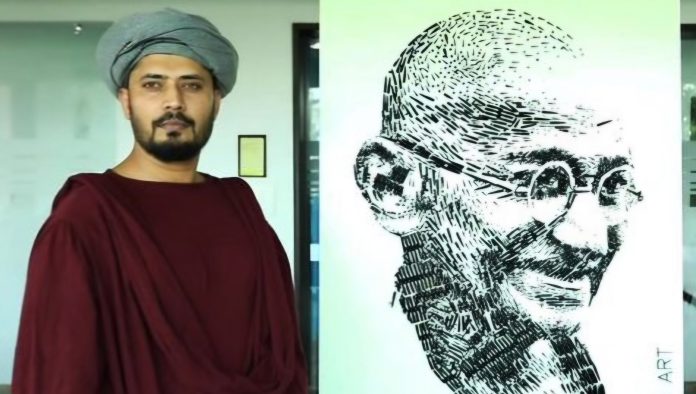
Wajid Khan Artist with the portrait of Mahatma Gandhi he made with nails.
Few artists are as passionately obsessed with Mahatma Gandhi as Wajid Khan, whose love and reverence for Gandhi manifest in extraordinary ways through his art. Wajid’s devotion to the Father of the Nation is evident not only in the subjects of his artwork but also in the innovative techniques he uses to create them. Whether by assembling nails, arranging goggles, or using other unconventional materials, Wajid Khan’s portrayal of Gandhi is a testament to his deep admiration.
Wajid Khan a multifaceted artist—a portraitist, sculptor, inventor, and patent holder—known for pushing the boundaries of traditional art. He specializes in creating intricate works of art using unconventional materials such as iron nails, bullets, metal, stones, automobile parts, medical equipment, iron rods, and more. His passion for creativity is boundless, and his art often reflects his deep emotions and thoughts about the world and the figures who have shaped it.
Among his many talents, Wajid’s ability to carve canvases using iron nails has garnered international acclaim. His work has earned him places in prestigious records such as the Guinness Book of World Records, Limca Book of Records, and Asia Book of Records. His artistic prowess is admired from Mumbai to Dubai, captivating both art connoisseurs and the general public with his exceptional nail art.
Although Wajid has made portraits of numerous iconic personalities, including Indira Gandhi, Jawaharlal Nehru, Sardar Patel, Dhirubhai Ambani, and Nelson Mandela, his fascination with Mahatma Gandhi stands out. His first portrait, fittingly, was of Gandhi—a powerful expression of his love and passion for the man who led India to independence. Wajid meticulously used thousands of iron nails to craft this portrait, each nail symbolizing the unwavering dedication and perseverance Gandhi embodied throughout his life.
Wajid’s connection to Gandhi goes beyond artistic inspiration. His admiration for Gandhi stems from the values of patience and truth that Gandhi represented. “There are many qualities in Gandhiji that impressed me deeply,” Wajid shared in an interview. “His power of patience and his commitment to truth are what stand out the most. For me, those who hold onto patience and never lie are truly great individuals.”
One of the moments that left an indelible mark on Wajid was when he visited a museum and saw letters written by Gandhi in which the leader openly admitted his mistakes. “It takes a big heart to admit one’s mistakes in public,” Wajid reflected. “I greatly admire Gandhi’s patience and steadfastness.”
Wajid’s connection to Gandhi also has personal roots. He fondly recalls stories from his grandfather, who would attend Gandhi’s meetings during the freedom movement in India. “My grandfather used to tell us about the time when he was very young and would participate in Gandhi’s meetings. Enthusiastic crowds would gather to listen to Gandhi, and when they returned, they were always calm and composed,” Wajid recounted. The calm demeanor Gandhi inspired in his followers left a profound impact on Wajid, influencing both his life and his art.
In one of his most ambitious projects, Wajid demonstrated the extent of his dedication to honoring Gandhi. He organized an event where 6,000 people were gathered in a stadium, carefully arranged in a formation that created a massive portrait of Gandhi. This live depiction showcased not only Wajid’s artistic genius but also his ability to bring people together to celebrate Gandhi’s legacy.
Wajid Khan’s artistic journey is a remarkable blend of creativity, innovation, and an unyielding devotion to Gandhi’s principles. Through his portraits, sculptures, and inventive techniques, he continues to keep the spirit of Gandhi alive, inspiring others with the same values of patience, truth, and perseverance that Gandhi embodied.
source: http://www.muslimmirror.com / Muslim Mirror / Home> Indian Muslim> Positive Story / by Syed Zubair Ahmad / October 02nd, 2024
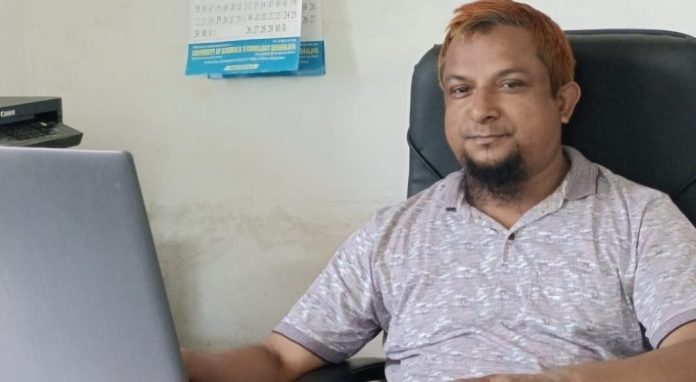
In a remarkable achievement, Dr. Faizuddin Ahmed, an Assistant Professor in the Department of Physics at the University of Science and Technology Meghalaya (USTM), has once again been recognized among the world’s top 2% scientists by Stanford University, USA.
This marks the fifth consecutive year that Dr. Ahmed has received this prestigious honor, showcasing his unwavering contributions to scientific research, reported The Hindustan Times.
Despite ongoing political scrutiny of USTM, a Muslim-owned university, by Assam Chief Minister Himanta Biswa Sarma, the institution has continued to excel academically.
Under the leadership of founder Mahbubul Hoque, USTM has nurtured a diverse student body, with 80% of its students being Hindu. Dr. Ahmed’s recognition further affirms the university’s commitment to academic excellence and inclusivity.
The list, published on September 16, 2024, highlights global scientific excellence, with Dr. Ahmed being honored for his groundbreaking research in Theoretical Physics, particularly in the areas of General Relativity and quantum mechanics. Over the course of his career, he has published 165 research papers in top-tier Scopus-indexed journals, including the European Physical Journal C, Journal of Cosmology and Astroparticle Physics, and Annals of Physics.
Expressing his gratitude, Dr. Ahmed stated, “Being recognized by Stanford University for five consecutive years is a humbling experience. This honor is a testament to the value of persistence, research, and the pursuit of knowledge. I owe a great deal of gratitude to USTM and my colleagues for their unwavering support.”
Dr. Ahmed’s academic journey began at Bholanath College, Dhubri, where he completed his undergraduate degree in 2006. He went on to pursue his master’s and PhD at Gauhati University, receiving his doctorate in 2016.
His consistent recognition on the global stage not only highlights his individual brilliance but also positions USTM as a hub for scientific research and innovation, standing tall against the political challenges it faces.
source: http://www.radiancenews.com / Radiance News / Home> Latest News> Pride of the Nation / by Radiance News Bureau / September 21st, 2024
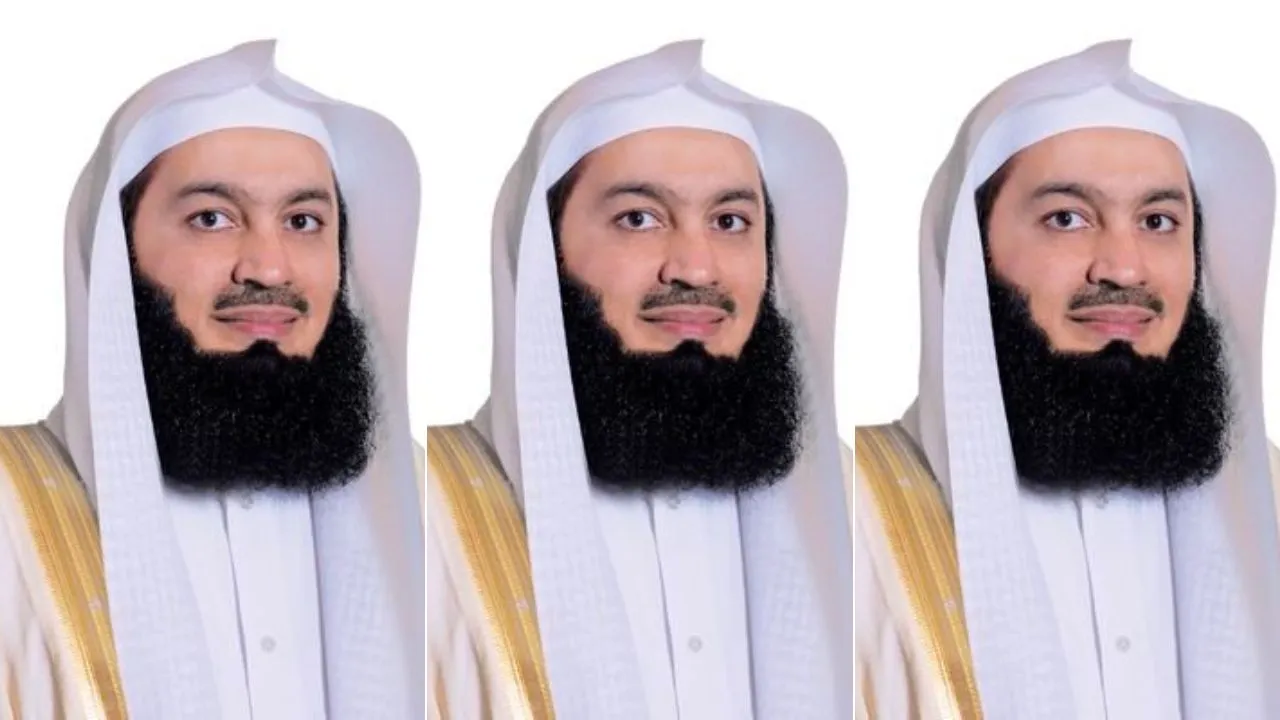
Mufti Ismail Menk is a renowned Islamic scholar, preacher, and motivational speaker from Zimbabwe. He is known for his lectures on various Islamic topics, including the importance of understanding the Quran and the Hadith, and how to apply Islamic teachings in daily life.
Early Life and Education
Mufti Menk was born in Harare, Zimbabwe, in 1975. He comes from a family of Islamic scholars, with his grandfather and father both serving as imams. From a young age, Menk had a strong interest in Islamic studies and began studying the Quran and Hadith under the guidance of his father and other scholars in his community.
In 1992, Menk traveled to Saudi Arabia to further his studies in Islamic theology and jurisprudence. He studied at the Islamic University of Madinah, where he earned a degree in Islamic studies.
Personal Life
Mufti Menk is married and has children. He is known for leading a simple and humble lifestyle, and is dedicated to spreading the teachings of Islam to as many people as possible.
Career
After completing his studies in Saudi Arabia, Menk returned to Zimbabwe, where he began giving lectures and leading Friday prayers at the mosque in his hometown of Harare. He quickly gained a reputation as an inspiring and knowledgeable speaker, and began giving lectures and leading workshops across the country.
In addition to his work in Zimbabwe, Menk is also a popular speaker at Islamic conferences and events around the world. He has delivered lectures and led workshops in countries such as the United Kingdom, the United States, South Africa, and Australia. He has also been invited to speak at many universities and Islamic institutions worldwide.
Mufti Menk is also active on social media and has a large following on platforms such as Twitter, Facebook, and YouTube. He regularly posts videos and articles on various Islamic topics, and is known for his concise and easy-to-understand explanations of complex concepts.
Mufti Menk is also the director of the Daarul Ilm of Zimbabwe, a non-profit organization that runs madrasahs, orphanages and schools in Zimbabwe.
Overall, Mufti Menk is a respected and influential Islamic scholar and preacher, known for his ability to make Islamic teachings accessible and relevant to people of all backgrounds. His work has helped to promote understanding and harmony within the Muslim community, and his lectures and writings continue to inspire and guide people on their spiritual journey.
Mufti Menk on Social Media
source: http://www.thecognate.com / The Cognate / Home> Business / by The Cognate News Desk / January 12th, 2023
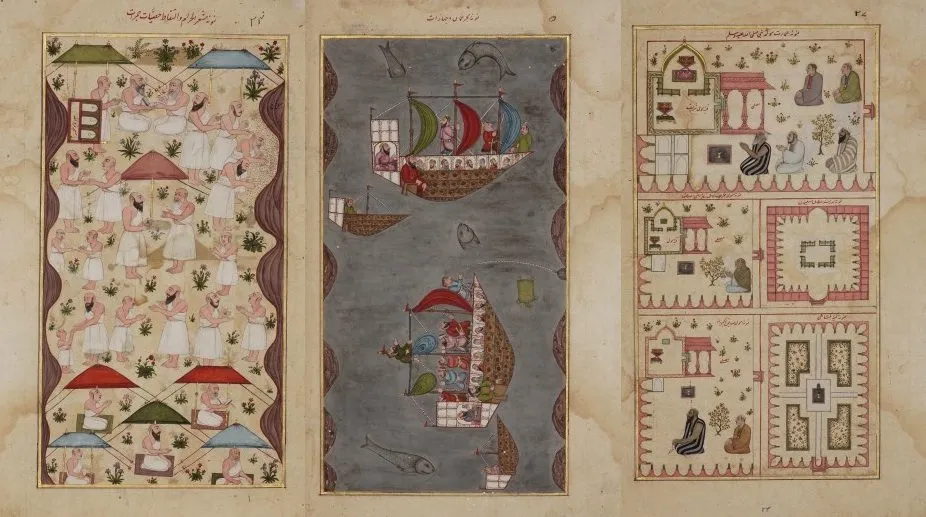
The Salamat Ras departed Surat in India on the 20th September 1676, carrying hundreds of pilgrims from Gujarat. On board was Safi ibn Vali; unlike the other pilgrims, his journey was sponsored by Zib al-Nisa, daughter of the Mughal emperor Aurangzeb (1658-1707). Along with completing his Hajj, Safi ibn Vali was given the task of creating a Hajj guidebook for future pilgrims. Presumably aimed at Indian pilgrims like himself, the ‘Anis al-Hujjaj’ (The Pilgrim’s Companion) contains advice regarding all aspects of the pilgrimage, including the journey to Jidda by sea.
His book is but one of many surviving pilgrimage guidebooks, from various parts of the Islamic world, forming a long-established tradition. They are typically accompanied by diagrammatic views of the holy sites, and Anis al-Hujjaj is no different in this respect. What sets it apart, however, is its use of colourful illustrations depicting various scenes of the pilgrimage, as well as the remarkable accuracy of its maps.
Safi ibn Vali’s Anis al-Hujjaj (‘Pilgrims’ Companion’), possibly Gujarat, India, circa 1677–80. Ink, gold and opaque watercolour on paper; modern leather binding. 3 separate folios show here side by side. Nasser D. Khalili Collection of Islamic Art. Copyright Nour Foundation. Courtesy of the Khalili Family Trust.
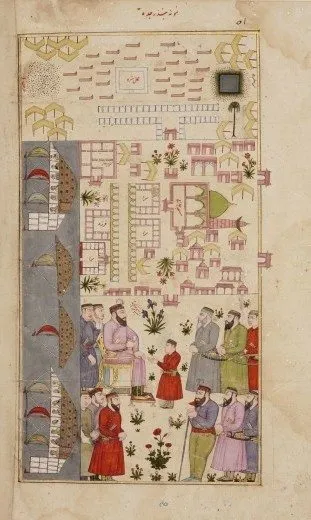
The illustration below is a map of Jidda. Jidda was a major port for pilgrims arriving for Hajj, and is thought to have been founded by Caliph Uthman in 647 AD. Safi ibn Vali, arriving at the port himself, maps major parts of the city. Archaeologist Dr Geoffrey King examined the map and found that the vast majority of places and landmarks depicted lie in the same position today.
Nasser D. Khalili Collection of Islamic Art. Copyright Nour Foundation. Courtesy of the Khalili Family Trust.
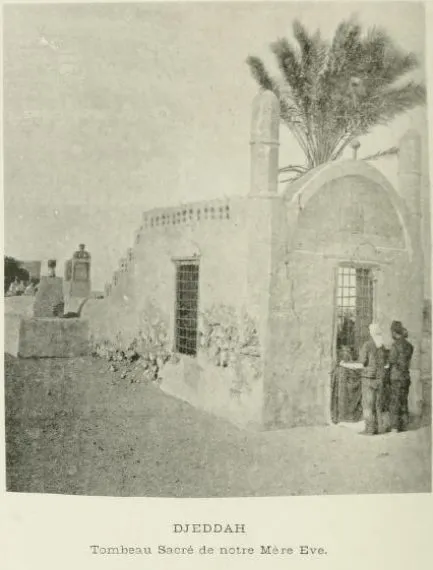
The upper section of the map depicts Hawa cemetery, thought to be the burial place of Eve, the mother of humanity. While the pink markers represent other graves, the black square indicates the head side of the resting place of Eve (peace be upon her), the white square her naval, and the gravelly area her feet. In Safi ibn Vali’s time, her grave, which is more than 100 feet in length, would have been marked by some sort of edifice. It is possible that the structure that can be seen in the image below, an illustration from 1894, or one similar to it, was what he saw two centuries earlier. The structure is no longer standing; it was destroyed in 1975 and covered with concrete by Saudi religious authorities.
Illustration of the Tomb of Eve in 1894, Jidda.
The middle section of Safi ibn Vali’s map shows the old city of Jidda. When examining the area, Dr King found that everything was accurately placed; a parade of shops and houses in the old city, as well as the surrounding roads, are all found in the same position today. There is however, one surprising discrepancy; an obvious landmark was mapped by Ibn Vali on the wrong side of the road. The green-domed Shafi’i mosque is shown in the Anis al-Hujjaj on the east side of the main street, whilst today it can be found on the west side; “This confuses me- was this main street in Jidda on a different alignment when the Anis al-Hujjaj was composed, or is it a simple error?” Given the remarkable accuracy of the map in every other way, King says this discrepancy is especially puzzling. The Shafi’i mosque is the oldest mosque site in Jidda; its floor is well below street-level, a fact that, according to Dr King, indicates that it predates the Shafi’i period. The oldest standing part of the mosque today is its Ayyubid minaret, dating back to the 13th century.
Nasser D. Khalili Collection of Islamic Art. Copyright Nour Foundation. Courtesy of the Khalili Family Trust.
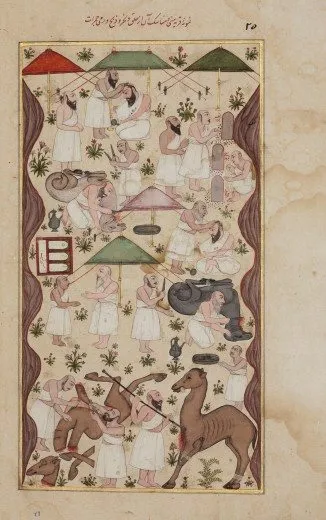
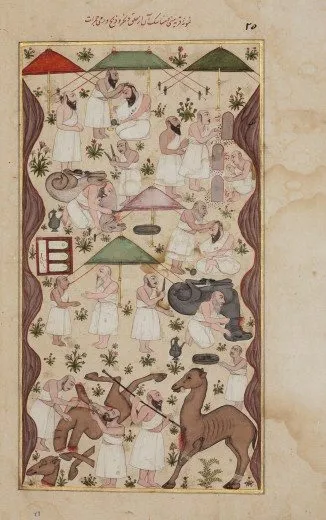
Since there is no question over the identity of the mosque depicted by Safi ibn Vali, further research needs to be conducted to reach a clear conclusion over the discrepancy. In the foreground of the Jidda map, the governor of the city is shown welcoming pilgrims. There are numerous such illustrations in Safi ibn Vali’s book, depicting various scenes of the Hajj. On the folio below, pilgrims are shown on the day of Eid al-Adha. In the top right hand corner, pilgrims in ihram throw stones at the three pillars representing shaytan, while others have their heads shaved after completing the rites of the Hajj. In the foreground, animals are being slaughtered for the Eid sacrifice.
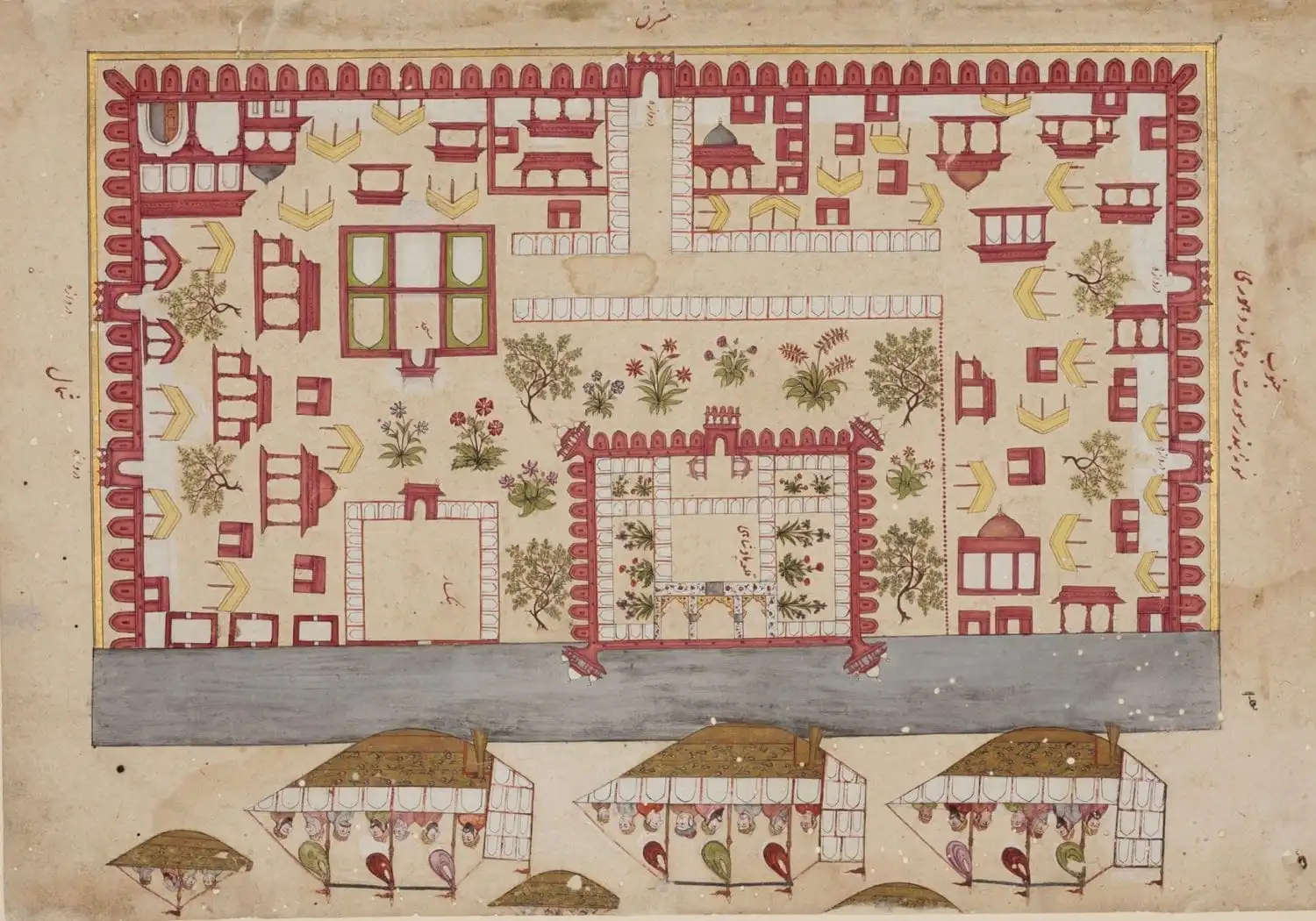
Safi ibn Vali also made mention of various holy places to visit that are not part of the Hajj itself. The illustration below is a typical diagrammatic view found in the tradition of Hajj guidebooks. According to the captions, the building in the upper section marks the birthplace of the Prophet Muhammad (peace and blessings be upon him). In Ibn Vali’s time, the blessed area was marked by a small mosque with a courtyard and dome. Today a simple library building built in the 1950’s stands over the area. Depicted beneath the upper section are the birthplaces of Lady Fatima and Abu Bakr al-Siddiq (may God be pleased with them both) as well as the Madrassa of Sultan Sulayman and a Sufi lodge of the Bektashi order. The clothes worn by the visitors indicate their various nationalities.
Nasser D. Khalili Collection of Islamic Art. Copyright Nour Foundation. Courtesy of the Khalili Family Trust.
While Safi ibn Vali’s Anis al-Hujjaj is not unique in its function, the accuracy of its map of Jidda, and possibly others, such as Surat in India and Mocha in Yemen, which are also represented, is remarkable, setting it apart from other guidebooks of the same genre. Its colourful illustrations give the viewer a sense of the energy of the pilgrimage, as well as the diversity of the pilgrims represented. Given that many of the sites Ibn Vali illustrates no longer exist in the same form, his work takes on added historical importance, preserving a past all but lost to modernity.
Bibliography
L. York Leach, Paintings from India, The Nasser D. Khalili Collection of Islamic Art, volume VIII, London 1998, cat.34, pp.124–9.
J.M. Rogers, The Arts of Islam. Masterpieces from the Khalili Collection, London 2010, cat.332–41, pp.284–7.
source: http://www.sacredfootsteps.com / SacredFootsteps.com / Home>Asia> Arabia> History / by Zara Choudhary
The new management committee for the school was announced on Tuesday and will be headed by Shahnas Abdul Jaleel as chairperson.
The other members were Sajida Husna, Sumaiya Sangreskop, Shahzeen Eram, Pashim Ali and Syed Zafer Ali.
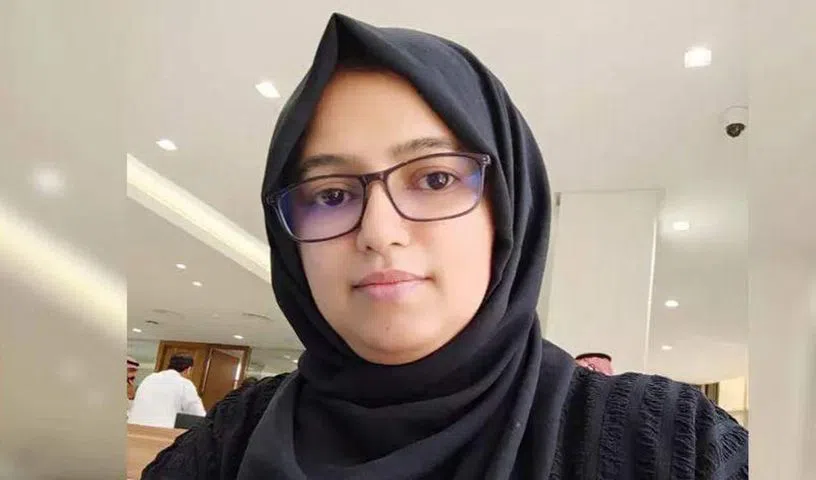
Photo of Shahnas Abdul Jaleel
Jeddah:
In a significant development, the governing body of the Indian International School, Riyadh (IISR) is now led by women, with four of the six members being women.
The new management committee for the school was announced on Tuesday and will be headed by Shahnas Abdul Jaleel as chairperson. The other members were Sajida Husna, Sumaiya Sangreskop, Shahzeen Eram, Pashim Ali and Syed Zafer Ali.
The four women in the management committee are in addition to principal Meera Rahman. Previously all management committees had seven members, however, this time only six members were named. Shahnas is a software engineer working in Saudi Arabia and is a native of Ernakulam in Kerala and is a mother of two. Her husband also works as a software engineer.
The women in leadership roles in the school is expected to change the dynamics, especially in matters of the academic affairs of the students. The community-run schools under the patronage of the Indian Embassy play a pivotal role in Indian community affairs in the Kingdom. It is noteworthy to mention that earlier, Dr. Hemalatha Mahalingam was nominated as chairperson of Jeddah’s Indian International School.
Interestingly, social reforms unleashed by Saudi Arabia’s Crown Prince Mohammed Bin Salman have brought sweeping changes in the Kingdom wherein women benefitted the most. The country, where women for decades had a restricted role in public, is now embracing their potential.
source: http://www.telanganatoday.com / Telangana Today / Home> India / by Irfan Mohammed / September 06th, 2024
Following a remarkable performance of 2 minutes and 59.05 seconds at the World Athletics Championships in Budapest on Saturday night,…
Following a remarkable performance of 2 minutes and 59.05 seconds at the World Athletics Championships in Budapest on Saturday night, the Indian 4×400 meter relay team consisting of Muhammed Anas, Amoj Jacob, Muhammed Ajmal Variyathodi, and Rajesh Ramesh gained widespread recognition.
This lesser-known relay group not only shattered the Asian record but also accomplished a historic feat by becoming the first Indian team to qualify for a World Championship final.
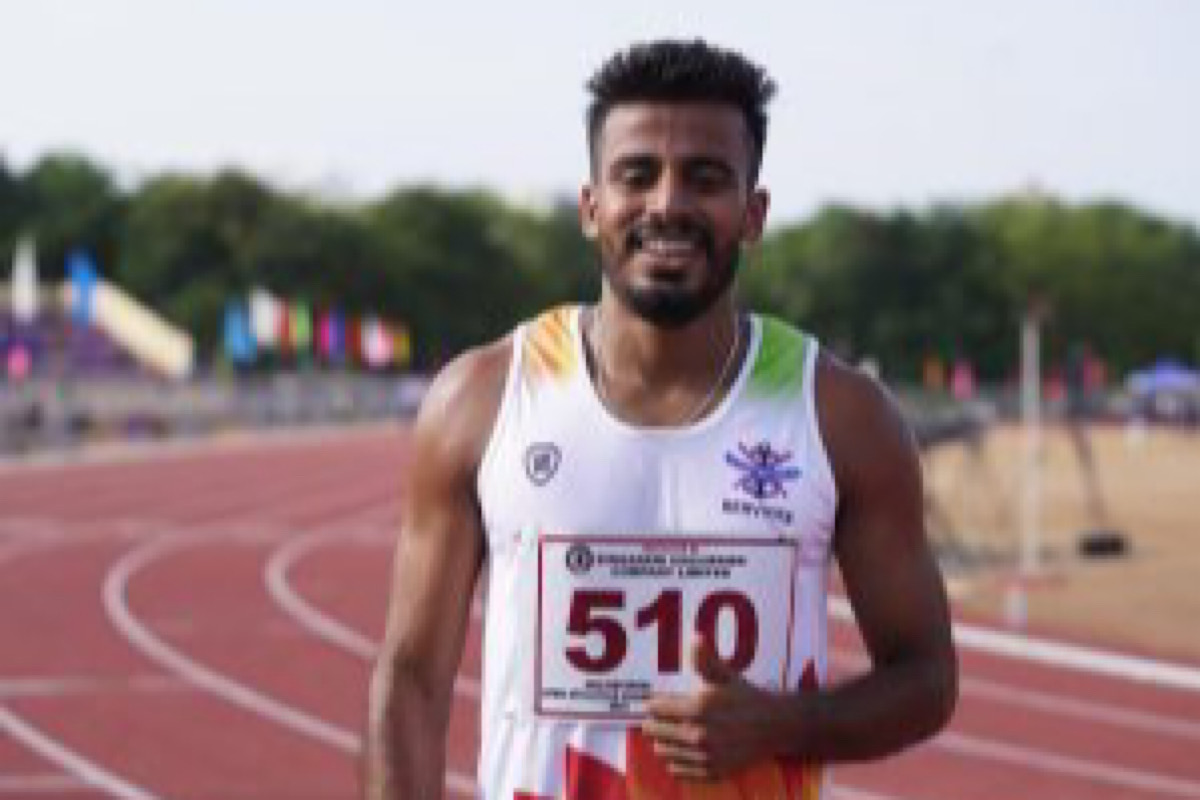
Muhammed Ajmal, a 24-year-old Indian track and field athlete, specializes in 400m sprints. His motto is straightforward: “Hear the bang and just run.” Gradually making his mark in the national scene, he aspires to progress further and achieve significant success in the international arena.
More about Muhammed Ajmal Variyathodi:
Born on June 1, 1998, in Palakkad, Kerala, Muhammed Ajmal initially embarked on his sports journey as a soccer player while growing up in Palakkad. He participated at the U-19 state level in football until his coach, Nandakumar sir, recommended that he shift his focus to running. This marked the beginning of Ajmal’s transition from a 100m sprinter to his current role as a 400m sprinter.
Indian athlete Muhammed Ajmal originally started as a 100m sprinter but eventually transitioned to the 400m category under the guidance of his coaches. In his very first 400m race, he achieved an impressive time of 46.91 seconds, securing the gold medal at the National Services Championships held in Bhubaneswar.
Muhammed Ajmal discussed his transition in an interview, saying, “In India, there’s a higher chance of competing in international events in the 400m. Otherwise, you need to be exceptional as a sprinter to make it in the 100m.”
His goal is to surpass the national record set by another athlete from Kerala, Mohammed Anas, who achieved a time of 45.21 seconds.
At the 7th International Sprint & Relay Cup held at Atatürk University Stadium in Turkey, Ajmal secured the third position with a timing of 46.04 seconds. In 2021, he clinched the gold medal at the Inter-Services Championship with a time of 46.91 seconds. He had a strong start in 2022 by winning gold at the Indian Grand Prix, finishing in 46.78 seconds.
He followed up his success by earning a silver medal at the National Inter State Senior Athletics Championship. There he improved his timing to 46.48 seconds. Ajmal is now dedicated to performing well at the upcoming Commonwealth and Asian Games later this year.
Muhammed Ajmal’s Athletic Accomplishments:
Muhammed Ajmal has emerged victorious at the National Athletics Championship on two occasions.
He secured a gold medal at the Indian Grand Prix in the year 2022.
In 2021, he earned a gold medal at the National Federation Cup.
Interesting Tidbits about Muhammed Ajmal:
His initial aspiration was to become a soccer player.
He shares a strong friendship with the national record holder, Mohammad Anas Yahiya.
Major Achievements:
1x In the Top 8 at World Championships
1x Asian Championships Silver medallist
Alongside, 1x In Top 8 at Commonwealth Games
1x In the Top 8 at Asian Championships
2 x National Champion
1 x Current Asian Record holder – 4x400m
source: http://www.thestatesman.com / The Statesman / Home> Who Is / by Statesman Web / August 28th, 2023
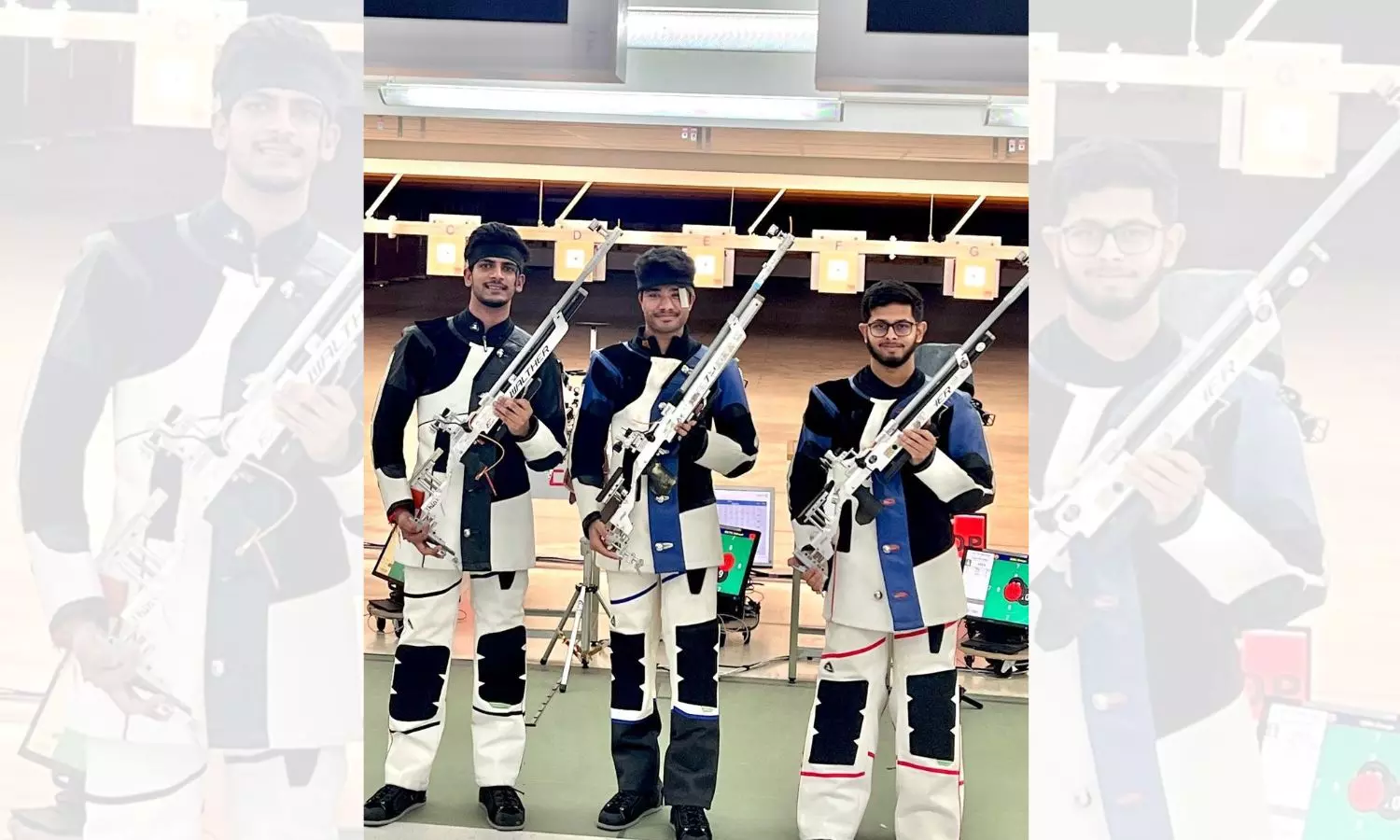
World Deaf Shooting Championship: Dhanush breaks world records as India sweeps men’s air rifle event (Photo: X) / (L to R) Shourya Saini, Dhanush Srikanth (Centre) and Mohammed Murtaza Vania
New Delhi :
India dominated the men’s 10m air rifle event on day two of the second World Deaf Shooting Championship in Hanover, Germany, with Dhanush Srikanth, Shourya Saini, and Mohammed Murtaza Vania making a clean sweep of the medals.
Dhanush set two world records in a single day, first by scoring 632.7 in the qualification round, followed by a stunning 251.7 in the final.
His performance left Shourya, who secured the silver with a score of 249.9, trailing by a significant margin.
Mohammed Murtaza Vania claimed the bronze with a score of 226.2.
In addition to their success in the men’s event, India also shone bright in the women’s category with Mahit Sandhu and Natasha Joshi winning silver and bronze respectively, adding to the country’s medals tally.
The Indian contingent had already secured four medals on the first day of the competition, including one gold, two silver and a bronze.
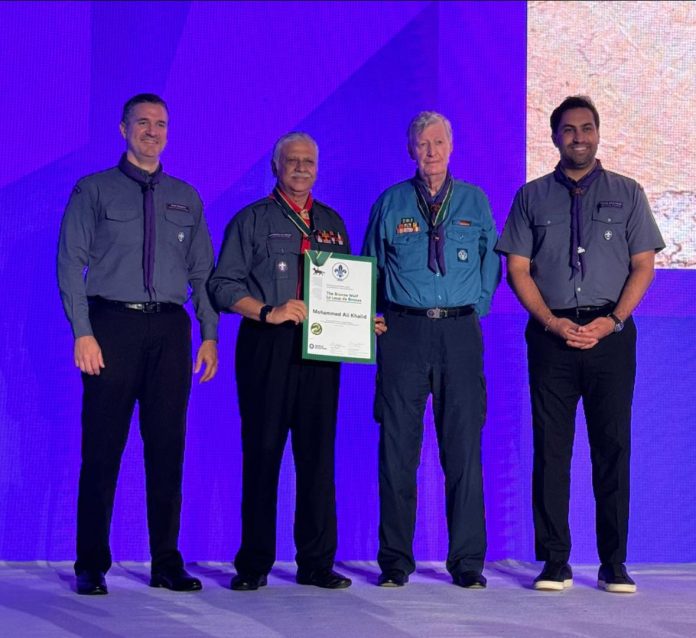
Mr. Mohammed Ali Khalid, a retired Karnataka Administrative Service officer, has been awarded the prestigious Bronze Wolf, the highest international accolade in the field of Scouts and Guides.
This honour, established in 1935, has been conferred upon only 395 individuals worldwide, with Mr. Khalid, Vice-chairperson of the Asia-Pacific Scout Committee, being the fifth Indian recipient.
The Bronze Wolf is awarded for exceptional services to world Scouting, recognising Mr. Khalid’s extraordinary contributions to regional and global task forces aimed at strengthening the scout movement. His dedication to the Scouts and Guides has earned him numerous national and international awards, with the Bronze Wolf being his crowning achievement.
Previous Indian recipients of the award include Smt. Lakshmi Mazumdar (1969), Sardar Lakshman Singh (1986), Ranga Rao (1994), and L.M. Jain (2008). Mr. Khalid’s recognition adds another feather to India’s cap in the global Scouting community.
The award was presented to Mr. Khalid at the World Scout Conference in Cairo, August 23, 2024. His lifelong commitment and professional excellence continue to inspire young people, embodying the values of discipline and service central to the Scout movement.
source: http://www.radiancenews.com / Radiance News / Home> Pride of the Nation> Awards> Focus / by Radiance News Bureau / August 30th, 2024
The group is looking to tap the fast-expanding air traffic between India and the Gulf.
Kerala-based travel service operator Alhind Group with a strong presence in the United Arab Emirates (UAE) is set to launch its airline, aiming to provide economical air travel options for residents.
The group, which has been a significant player in the travel industry for over three decades, has received the Civil Aviation Ministry’s initial nod to start an airline — Alhind Air.
The chairman, Mohammad Haris announced that the Group is in the final stages of obtaining the required approvals.
“Last week, we had a meeting with officials at the Cochin International Airport Limited (CIAL); we submitted all documents required for landing permission at the airport,” he said. “We had earlier received the no objection certificate (NOC) to start the airline. We are hoping to begin operations by January 2025, if not earlier,” said Haris as quoted by Khaleej Times.
Initial operations and fleet
According to the reports, Alhind Air will start its initial operations with three Atr-72 turboprop aircraft, focusing on regional routes in southern India, including connections between Cochin, Bengaluru, Thiruvananthapuram and Chennai with an initial investment of ₹200 crores to ₹500 crores as it adds more planes into the fleet.
“We will have five ATR planes in total to fly on regional routes. We have secured all support from Cochin International Airport for our operations. Once this process is completed, the exercise for hiring pilots, cabin crew, engineers and other ground staff will start, a top official of the group told CNBC-TV18.
The group’s promoter revealed that the Alhind Group offers services including air ticketing, holiday packages, Haj-Umrah services, visas, and money exchange. The group already boasts a turnover of ₹20,000 crore and has a robust sales network that could facilitate the successful launch of the airline.
Pertinently, Alhind Group is one of the leading players in the travel and tourism industry in India and abroad.
The strategic launch into the aviation sector is anticipated to enhance completion, potentially lowering airfares and improving service quality for travellers.
Mohammad Haris stated that the group which is also the General Sales Agent (GSA) for many airlines is looking to tap the fast-expanding air traffic between India and the Gulf.
source: http://www.siasat.com / The Siasat Daily / Home> News> India / by Sayima Ahmad , (Headline edited) / August 22nd, 2024