Disability rights activist Arman Ali represented India at a professional exchange programme offered by the United States, its consulate in Kolkata announced.
Ali took part in the US
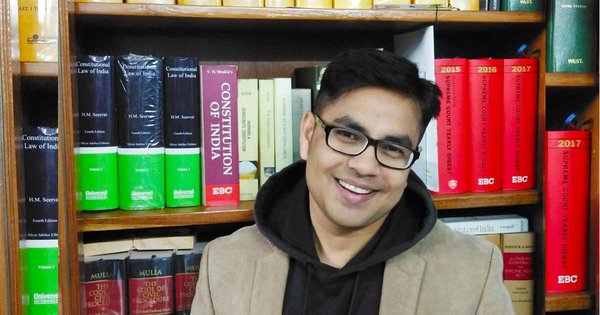
Arman Ali (left), presently the executive director of the National Centre for Promotion of Employment for Disabled People in New Delhi, is also on the board of NGO Shishu Sarothi in Guwahati. Photo courtesy: Facebook/Nipun Malhotra
Department of State’s International Visitor Leadership Programme (IVLP), which was held virtually this year owing to the COVID-19 outbreak.
The programme commemorated 30 years of the Americans with Disabilities Act and, apart from Ali, Fadi El Halabi from Lebanon and David Anyaele from Nigeria wwere chosen as representatives, the statement said.
In the virtual programme, representatives gave online presentations and took part in meetings and cultural activities. Ali delivered a presentation on his work and contributions in a virtual discussion hosted by the Graduate School USA and Harkin Institute at Drake University in Des Moines, Iowa.
The Gold Star initiative highlights the work of IVLP alumni who have made a significant impact in their home communities, and this year focused on alumni doing exceptional work in advancing disability rights.
Ali, presently the executive director of the National Centre for Promotion of Employment for Disabled People in New Delhi, is also on the board of NGO Shishu Sarothi in Guwahati.
In the previous years, representatives had visited the US to experience the country and cultivate relationships with their American counterparts, the statement added.
source: http://www.connectedtoindia.com / ConnectedToIndia.com / Home> News> Global / CtoI News Desk / July 29th, 2020
RIDING ON TOP, TWO MAVERICKS KEEP THEIR GAMES ON POINT. LA POLO GETS IN CONVERSATION WITH ARJUNA AWARDEE, SIMRAN SINGH SHERGILL AND SHAMSHEER ALI
They could very well be professional archenemies on the field, but off the field, Syed Shamsheer Ali and Simran Singh Shergill are remarkably comparable as they both would make for perfect Indian polo poster boys.
Though the two have a similar passion for the sport, they both have a very different approach towards life – while one comes across as a simpleton the other one balances the mood with his flamboyance. At LA POLO, when we spent an entire day with the two highly proficient players to discover their stories and, we couldn’t help but wonder how the two peas in a pod were just the right personalities to grace the cover of our first edition.
Syed Shamsheer Ali, +5 (current) handicap player He has played polo for more than 25 years now, and if his memory serves him correctly he played his first tournament at the age of 11. At a very young age, Syed Shamsheer Ali along with his brothers Bashir and Hamza were trained by Nawab Syed Shujat Ali to become polo champs and, till date, the discipline and dedication instilled by his abba (father) are his biggest strength.
Mr Ali recalls his early days and says, “We had a very strict upbringing, I still hit the bed by 9 pm to wake up early the next day. I fell from the horseback at the age of 10, when my father told me not to stop and keep playing. I had a pony named Biscuit and while growing up we never allowed any late nights. Our childhood was spent in stables, practising the game and I have never touched alcohol or cigarettes in my life because we followed a strict diet to stay fit. Polo is a demanding game and requires a lot of discipline, which was taught to us by our father. I started playing when I was 11. In the year 2000, I played at the Jaipur zonal playoff for India against Singapore, Pakistan, New Zealand and we won the three games. We won against Pakistan and it was a crucial game for us because winners qualified for the main event at the World Cup. It was a turning point in my life as I became a 4 goal player that time, and around 80,000 people watched that game and cheered us till the end. I was 12 when I played my first international tournament in Columbia with my brother. For the 2003 World Cup, we were taken to Argentina by the Indian Polo Association for the match and the exposure changed a lot in me as a player. I still remember my first salary as a polo player was from Sehgal Studs; and it was INR 30,000 for the first week and I was just 17 at that time. That was also the year I got married to my wife Nazia.”
lapolo.in
“On the field, you have to fight it out, but off the field, you have to be a gentleman,” says the Hyderabadi top notch as he mentions that he would like to pass on the lesson of sportsmanship to the next generation of players who aspire to take this professionally. “Polo is a very competitive sport and could be very dangerous. My advice to youngsters is that they shouldn’t be attached to the sport so much that it affects their well-being – winning and losing is a part of this game and it shouldn’t get to their heads.”
The biggest challenge for a polo professional in India is to source the right kind of horses as 70 to 80 percent of the game depends on the horses. Mr Ali says, “Polo in India has changed over the years and people have bought horses from abroad. It started with Major Adiraj Singh getting horses for McDowell’s and Jindals and Sahara followed suit. Whereas, we still buy Indian horses and groom them to play against these horses. On an average, it takes at least two to three years to train a horse depending on the temperament of the horse. There aren’t many horse trainers in India, and some of the best horses are trained by the 61st cavalry of Indian Army. I have around 10 home bred horses. I had a mare named Triveni that stayed with me for the longest time and it was an excellent Indian breed. We were in Argentina for six years and returned sometime back.”
A typical polo season in India is for six months, and during summers the horses are fed and trained well for the next season. Mr Ali adds, “We need more publicity for polo, as people don’t know about the game. It is not covered on TV and people in South India are hardly aware of it. We need more sponsors coming in to support polo, so people can maintain the stables without selling their horses. The discussions of a Champions Polo League is on right now and all the players have come forward to support Mr Chirag Pariekh as he is trying to get the arena polo format on TV. The new format could be the T 20 version of polo, with a smaller ground, bigger balls and people can watch it closely. Aspirants and professionals playing right now need money to survive, and even though there are a handful of teams like Jindal, Sahara, Sona etc doing very well we need more attention.” In his free time, Mr Ali plays tennis with his daughter and travels with this family. He also claims to be a foodie and loves to eat sushi, fish, biryani and haleem.
Simran Singh Shergill, +6 (current) handicap player His love for horses as a kid brought him closer to the world of polo, and today the 6 feet 2 inches Simran Shergill Singh is one of the finest players in the country with 6 handicaps. He has also received the prestigious Arjuna Award in 2019 from India’s President, Mr. Ram Nath Kovind. The passion for polo started as a hobby and turned into a profession for this happy-go-lucky man, and he has no qualms about how his life shaped up. He says, “My father was in the army and he was posted in the President’s Bodyguard regiment, which is a horse regiment. As a kid, I was very fond of horses and I started going there to ride, then started with show jumping and later got interested in playing polo. Then I stopped for a bit and finished my school. I went to Hansraj college in Delhi and finished my MBA at IMT. As soon as I finished my school, I met mister Jindal at a cinema hall and asked him if I could come and ride in the summer. Once the polo season started, there was a team short of a player and I played a game that time. My game was noticed by someone and then I was asked to play somewhere else and so it started for me. A year later, in 2003 we were sent to Argentina for training in polo and that was very beneficial for me and there I played my first international tournament. I got 2 goals in a year, which was considered very good and I started getting job offers.”
Mr Shergill considers buying his first set of horses as a memorable incident in his life, and he says that in the past years of playing polo he has developed an unconditional love for horses. “In polo, every player has to develop a rapport with the pony and one of my favourites is a mare called Pines from New Zealand. It belongs to Mr Jindal and it’s one of the finest horses in India right now.
Also, two horses that have played with me for a very long time were named Jimmy and Carrot, and I was extremely fond of them. Around 70 to 75 per cent game of polo revolves around horses, so the team with better horses has a higher chance of winning. Horses like athletes need to be trained properly, fed properly and exercised properly. They get hurt too, so they have to be treated well.”
“When I play polo I don’t feel like I’m going to work, it’s not a 9 to 5 job but more like a lifestyle for us,” mentions Mr Shergill, adding, “My first salary was 12,000 and after that I started saving money to play it seriously. I feel I am still young, and I could get better at playing so that’s what I would like to do. I am not a stressful person by nature and I try to lead my life as simple as possible. My biggest fears are injuries and bankruptcy. I am not a very ambitious person by nature and I am very content at my work, although I am very competitive and I would like to get better at my game.” The skilled rider highlights some of the most challenging aspects of the game and says, “It is an expensive game, it’s not accessible to everyone. It is a very dangerous sport; the main concern is not to get injuries. Most of us have got injuries while playing — broken bones, concussions and other issues are quite common with players. Even in summers, when horses are not playing we have to take care of them and our lives revolve around horses. The only misconception people have about polo is the glamour aspect of the game, which is good for the publicity but there are a lot of things that need to reach out to people. In cities like Jaipur the game is covered in sports pages, but in Delhi and other cities it is getting more coverage on the party page, so the seriousness of the game shouldn’t be mixed with the social aspect of it.” Mr Shergill is married to a lovely lady named Francesca and has a son named Veer, who loves to spend time with him at the polo farms. He claims to be a foodie and tells us that he does wonders with eggs, but to keep a check on his weight he has to run around a lot.
TWO HORSEMEN
A self made and a meant to be made. Two different backgrounds playing on the same ground. A reigning member of the team Jindal Panthers – Simran Singh Shergill and a player backed up by the game of polo – Shamsheer Syed Ali. Speaking less and rich of the journey that goes beyond play and sway off the field. Of hidden quest and dramas that lie behind their cloaked masks. They put it on in public. The spotlight follows and then goes in dark. Thrilled hearts cheer and in time they disappear. The mallets swing on horses with wings. The trophy commemorates and victory celebrates. And hidden are the gaps and phases of the all attractive ubiquitous sport. Those inner workings which remain untold. The nights spent in stables remain as fables. Unheard. A conjugation of uncommon species. The outcome is?
lapolo.in
“Horses are my teachers of both theory and practical classes of psychology,” says Simran, wearing a modest mask this time. “Our lives are on the line each time we ride on fine horses in the rectangular field.” Shamsheer Ali- Artistry and horse riding have little in common unless you are Shamseer Syed Ali. His mornings starts with the tapping of balls on the mallet while jogging in his farm at Hyderabad. Growing among the brothers carrying the same profession, he is the eldest of all three. His grandmother kept his name “Chamma” and some people call him “Shama” too. He says the horses want your devotion to them and “I give all my time to them, playing or practising.”
The time for sitting on the saddle and playing polo arrived very early in his life. He was 11 when he first played his polo match for India against New zealand, South Africa, Singapore and Pakistan. Qualifying all of them he ascended India to the finals of the world cup in 2000. At 12 when he played the game on international grounds in Columbia.
lapolo.in
Emphasizing on the hardships of his journey, he has seen things shattering in daylight. “Owning and breeding horses for 6 years which are born for polo in Argentina and losing everything on a gunpoint left us with no choice than to return to India with no establishment.” He expresses melancholy.
Now he has grown responsible and humble, may be marrying at 17 has inculcated one of the things in him “ On the field you fight it out. Off the field, you are a gentleman.”
Simran Singh Shergill
When life gives Simran Singh Shergill fascination turned into reality, he becomes unstoppable until he squeezes everything out of it. The commentator mentions his name repeatedly as he gallops with his horse after the ball to send it into the goal post and he misses the shot for a few moments, the tapping sound of horseshoe stops and the crowd shifts its expression to quietness. And Simran screeches his own name gazing at the skies. He has been more harsh on himself than the cacophonous times in the journey of his life. People might expect the highest handicap (+6) polo player in the whole of Asia to be drifting off success money and laurels. But he is riding off for a long game, watching life beyond the fields.
“I would always want to be an untamed child”, Simran says as he sits in a polo field that appears alone and silent as the visitors make their way to the royal after party sitting against the red sun which is about to disappear too. He looks ban and slightly dark. “I have hated losing, on the fields, and in life”. Probably it’s why he has won most of his matches playing for Jindal Panthers in his 23 ( and counting) years career. As the dusk starts to cover him inch by inch, he is filled with a variety of expressions on remembering tales of his childhood days, “For four years, I was left with a bike and few mallets and no horses. So I used them on my bike and rode all the way to Jindal Forms in Noida after my schooling hours.” Now he rides on one of the finest horses and his favourite-from New Zealand pines. Playing a royal dream which has always demanded thoroughbred horses and huge expense to feed and buy accessories for the game, it’s been a memorable journey that uncovers the story of a student of class 11th with limited resources covering a desolated way that made him one the most celebrated players in the history of Indian polo .
Born into a family dedicated to Indian Army, gained him access to ride horses and embrace them as his father was posted to a regiment called president’s bodyguard. Little he has started learning and loving the ponies, that he was restricted to ride them anymore because his father was posted outside Delhi. Ever since he was a slightly chubby new rides horse, he has been allured to swing mallets and control horses in every possible manner. But this fascination of his had to wait. At an early age of 13, he started with show jumping and eventually secured 2nd place in the nationals. But that never appealed to him. “Luck can be mustered with passion and dedication ”. He says imploringly almost childlike, “It has happened to me. And it got me far.” There’s A charming side to disclose , if you`re for it, in his confident demeanor. He faced a sudden encounter with Naveen Jindal in his school days cinema hall. He had always knew of his polo farm, and the very next moment, he didn’t stop himself of enquiring if he can come and ride in his summer vacations. The nostalgia for whipping and riding had just taken a step closer to the far end. And his game started getting bigger and noticeable with every passing month.
A year later, he was sent to Argentina for training in polo. A professional polo player took command of his horse and his team.
Of their toughest time and recovery
Shamsheer: We never knew it was coming. To shatter everything. One good day turned bad when my brother and I were robbed of everything on a gunpoint in Argentina. And the universe conspired against us. We left for India without any horses and resources. But you see, these thighs have got an endless rigidity riding horses, so kneeling was hard for us. All the three brothers unitedly brought horses to make a fresh and tough start.
Simran: Injuries are what really ties you down. There was a big international match in Delhi and I was selected to play for the Indian team. But I was injured a week before that. Someone hit me with the mallet and I tried to play a match but the pain became irresistible after the half time. And the recovery time kept me off the field for long.
Rivals of each other or someone else
Shamsheer: Simran and I both were at the same handicap. We like to compete but he is far better mounted than me with the horse power he has. Playing for the Jindals opens the gate of a stable that shelters the best horses in the country.
Simran: In the past few years, I have seen rivalry and competence both. There is Chamma (Shamsheer) who possesses an unique and useful talent of tapping the ball on a mallet and riding across the polo field keeping it in the air. When I was at -2 handicap, he was already at +1 handicap (number line in polo goes from -2 to +10). When I reached +2, Chamma was at number 5. There is competence but speaking of rivalry, it is with my best ally Abhimanyu Pathak. Playing together and against at times has inculcated a deep insight of each other’s skill and strength.
A fear more than the opponents on field
Shamsheer: In this most aggressive and contact sport I see two things coming when the sport gets personal sometimes. With horse- At parallel speeds you can push or hit each other to the sides. With Body – You can go and hit another player with your shoulders. Both the tricks don’t make you liable for a foul.
Simran: It’s only when everyone leaves the field safely, I am relieved.
The age when first salary came into pocket
Shamsheer : I was 17 when a patron paid me 30,000 after playing for a week for them.
Simran : The winters or season of polo gave me an opportunity to play in some tournaments and they used to pay me 12000 with the completion of every series, helping me to buy horses gradually.
Who should become a polo player
Shamsheer : People who love horses. I wouldn’t say it’s expensive, it’s quite affordable if you visit a polo club. You just have to pay a nominal fee to ride along with a mallet and ball and make a head start for polo.
Simran : There is no place in sports or otherwise for mediocrity. Anyone who wants to make sports a profession must strive for excellence. It’s important to chase your passion and not the things that come along with it. A polo player is playing the most royal game and he must be fixed on his game. A polo player seeing his life without polo.
Shamsheer: The imagination is all black at this stage. But I would have invested in real estate or have started a company. Would have done something big only.
Simran: Every tradition has its own beginning and my family followed one – joining Indian Army. I always think it’s a great way of earning a living. I could have joined it too. A disciplinary fascination is there in me.
As a messenger of polo
Shamsheer: They say, the dog is the best friend of a man but I would say that even horses can be the same. You run vigorously on them, turn in any direction, stop at any instant. They listen to us. One should come and witness the blend of understanding between a man and an animal.
Simran: This is a game you play more off the field. Playing for self grooming. I meet my groom more than my parents. Knowing him for more than 15 years. And that keeps me grounded. If his daughter is getting married and my horse falls sick, I spend the whole night in the stable. We work in the dark to perform in light.
source: http://www.lapolo.in / La Polo / Home> Polo-Tournaments
Social workers today, repatriated the mortal remains of prominent social worker Nandi Nazar, from UAE to India, a free service that he provided to hundreds during his lifetime.
Nandi Nazar, aged 61, passed away early Sunday morning due to a heart attack, according to community sources. Born on January 1, 1958 in Kozhikode, Nandi Nazar would’ve turned 62 this New Year.
Fondly called Nandi ‘Ikka’ meaning big brother, he came from Koyilandi in Kozhikode district in Kerala, India and had been in UAE since 1992. Photo Courtesy: Nandi Nazar FB
Musliyar Kandy Abdul Nazar popularly known as Nandi Nazar, offered voluntary services through a community welfare group called Change a Life, Save a Life for this, through which he touched the lives of people in UAE as well as in India.
Hundreds of Indian community members, businessmen and friends and family members came together to pay final respects to the veteran businessman and social worker, fondly called Nandi ‘ikka’, meaning older brother among Malayali Muslims.
Well respected in the community, the prominent social worker supported various community activities of Dubai Police and the Indian Consulate in Dubai. Phot Courtesy: Nandi Nazri/ FB
Nazri helped several people who sought visa amnesty or were in any kind of distress. He was very vocal in his support of the provision of free repatriation services of mortal remains and of bedridden patients.
During the devastating Kerala floods in 2018, Nandi and his associates sent tonnes of relief materials to victims in his home state.
Community members and Indian social workers shocked at his untimely passing, gathered together and held a special memorial prayer for the deceased who is survived by his wife, two daughters and a son.
source: http://www.connectedtoindia.com / Connected to India / Home> News> UAE / Ctol News Desk / Decemeber 30th, 2019
The late former British secret agent Noor Inayat Khan plays a Veena.(File/AFP)
English Heritage described her as “Britain’s first Muslim war heroine in Europe”
Khan was the first female wireless operator sent to Nazi-occupied France but was captured, tortured and shot dead
London :
A woman of Indian-origin dubbed “the spy princess” on Friday gets a new memorial in Britain honoring her espionage work and refusal to betray secrets in World War II.
English Heritage is putting up a Blue Plaque honoring Noor Inayat Khan outside 4 Taviton Street in the Bloomsbury area of central London where she lived from 1942-43.
In 2012, Queen Elizabeth II’s daughter Princess Anne unveiled a bronze bust of Khan in nearby Gordon Square Gardens.
Her biographer, Shrabani Basu, said Khan, born into a princely Indian Sufi family and descended from Tipu Sultan, the 18th century ruler of Mysore, was an “unlikely spy.”
She believed in non-violence and religious harmony but gave her life in the fight against fascism when her adopted country needed her, she said. “It is fitting that Noor Inayat Khan is the first woman of Indian origin to be remembered with a Blue Plaque,” said Basu, who wrote “Spy Princess: The Life of Noor Inayat Khan.”
“As people walk by, Noor’s story will continue to inspire future generations. In today’s world, her vision of unity and freedom is more important than ever.”
Khan was the first female wireless operator sent to Nazi-occupied France but was captured, tortured and shot dead aged 30 at the Dachau concentration camp in September 1944.
English Heritage described her as “Britain’s first Muslim war heroine in Europe.” She was killed after refusing to give away secrets under repeated torture by the Gestapo.
Khan was posthumously awarded the George Cross and is one of only four women to have directly received Britain’s highest non-combat award for gallantry.
English Heritage has acknowledged that the proportion of women celebrated by its blue plaque scheme remains “unacceptably low.” It is planning to unveil tributes to the secret agent Christine Granville at a west London hotel where she lived and the sculptor Barbara Hepworth in north London.
Another is planned for the headquarters of the National Union of Women’s Suffrage Societies, which campaigned successfully for women to be allowed to vote.
source: http://www.arabnews.com / Arab News / Home> World / by AFP / August 29th, 2020
Coinciding 74th Independence Day on Aug. 15, scholars recollect help of Turkey to India’s national freedom struggle
Abdul Hameed Nomani, General secretary of the All India Muslim Majlis Mushawarat
New Delhi:
Celebrating country’s 74th Independence Day on Aug. 15, under the shadow of recent communal riots in capital Delhi and anti-citizenship law stir, many Indian scholars have called for recalling the role of Muslims during India’s freedom struggle.
Author and scholar Waseem Ahmed Saeed said over time, the contribution of Muslim freedom fighters in India has been forgotten.
In his book titled Kala Pani: Gumnam Mujahideen-e-Azadi 1857, Saeed said from the 1757 Battle of Plassey in Bengal, Tipu Sultan’s Seringapatam battle in South India in 1799 to the massive revolt in 1857 against the British was led by Muslims.
Saeed, who has authored a book on the subject in the Urdu language, said while India’s official history celebrates Udham Singh for killing Michael O’Dwyer, the lieutenant governor of Punjab in India, in revenge for the 1919 Jallianwala Bagh massacre in Amritsar, it does not recognize Sher Ali Afridi, who killed Lord Mayo, British viceroy and governor-general of India from 1869-1872.
Speaking to Anadolu Agency, many Muslim scholars and historians said the role of their ancestors in the freedom struggle has been overlooked.
According to Syed Jamaluddin, director of historical research projects at the Institute of Objective Studies, a think tank, there is no adequate coverage of the role of the Indian Muslims in the national movement.
“The contribution of Muslim revolutionaries, poets and writers is not known today. Similarly, little is known about the contribution of people like Ali Musliyar and Bi-Amma, who made significant contributions,” he told Anadolu Agency. He is currently editing a book on the Muslim role in India’s freedom struggle.
Saeed recalled in his book that it was the ruler of Bengal Siraj-ud-Daulah, who first fought and lost to the British in 1757, which became a cornerstone for the imperial power to colonize India.
He said that even after losing this battle, there were many rebellions led by Muslims until 1850.
Muslim revolts against British
Jamaluddin mentions the Fakir-Sannyasi rebellion, a joint revolt against colonial power by Muslim and Hindu ascetics, for preventing them from collecting religious tax from locals. It started in 1764 and continued until the 1850. He said the rebellion even spread its wings to southern India’s Madras (now Chennai) presidency.
But most prominent and popular movements that hit the British hard in the early 20th century in the subcontinent was the Reshmi-Rumaal Tehreek (Silk Cloth Movement) led by Maulana Ubaidullah Sindhi with the help of Turkey, Germany, and Afghanistan.
Speaking to Anadolu Agency, a prominent Muslim scholar Abdul Hameed Nomani said that despite his best efforts, Sindhi’s contribution has not been included in the official Indian history.
Along with an Indian prince Raja Mahender Pratap Singh, Sindhi, and Maulvi Barkatullah had established the exiled government of India in Afghanistan in 1915.
“The movement picked up around the same time when Subhash Chandra Bose [renowned Indian freedom fighter] was allying with Germany and Japan to oust the British from India. While Bose is celebrated nationwide, not much is known about Sindhi and his supporters,” said Nomani, who is also the general secretary of the All India Muslim Majlis Mushawarat, an umbrella group of prominent Muslim organizations.
It was named Silk Cloth Movement because Sindhi and other leaders used to send letters and directions to their cadres written on silk cloth.
Later, Sindhi went to Turkey and joined the country’s national struggle.
“The movement led to the formation of Indo-German-Turkish mission to encourage local tribes on the borders of Afghanistan to attack Britishers and their interests. While the key figures were arrested by the British, the movement remains a key event in the freedom history,” he added.
He said even though in 2011 the government released a postal stamp to commemorate Sindhi’s movement, there has been no vigor to record the sacrifice of Sindhi and his allies Mahmud Hasan and Husayn Ahmad.
“Only passing reference has been made about the role of Muslims in India’s national struggle,” rued Nomani.
source: http://www.aa.com.tr / Anadolu Agency / by Cheena Kapoor / August 14th, 2020
Jameel Khan Patan clinched gold, bronze in world championship
For over two decades, Jameel Khan Patan has been waging a grim battle against all odds even while quietly collecting medals on the international stage; 18 gold, 12 silver and 18 bronze, to be precise. That’s not all. The martial arts champion also has to his credit four gold, two silver and six bronze medals in World Cups since 2016.
Yet, this spirited Hyderabadi continues to run from pillar to post in search of financial support to sustain his passion. “With the specific goal of making it to the 2020 Tokyo Olympics in which karate is being introduced, I am still pursuing my love for martial arts,” he says.
For someone who earns a modest salary by training some schoolchildren in and around Toli Chowki, all that he looks for is some kind of support that would help him realise his goal of making it to the Olympics. “Compared to the support I got in the US with special exemptions to train and compete, the response back in my hometown has been disappointing,” says Jameel.
“Well, I am not from a high-profile sporting discipline but a medal in any World Cup is not presented on a platter. You have to put in a lot of effort. I fail to understand what more I must achieve to get sponsorship,” the 43-year-old asks.
Despite his latest gold win in the adult breaking division, bronze in black belt forms and black belt weapons division in the World Cup final last month in Virginia, he is “struggling to overcome the fact that he remains an unknown personality in the world of sports when so many incentives are being showered on others”. “All I can hope is for some positive response even as I try my best to make it to Tokyo.”
source: http://www.thehindu.com / The Hindu / Home> News> Cities> Hyderabad / by V.V. Subrahmanyam / Hyderabad – February 26th, 2019
Do not miss this exhibition that extols the contribution of 20th-century Indian Muslim women
An interesting travelling exhibition is set for a re-run in New Delhi once the pandemic containment rules are eased further. Titled ‘Pathbreakers: The 20th Century Muslim Women of India’, it showcases 21 Indian Muslim women who broke the proverbial glass ceiling and refused to be stereotyped. The exhibition was earlier held in the national capital in 2018.
Speaking to the media in 2018, Syeda Hameed, chairperson of Muslim Women’s Forum (MVF), the organisation which assembled the exhibition, had said that the main idea was to bring to the forefront a galaxy of Indian Muslim women who contributed to nation building in various ways but largely remained unrecognised and unsung.
The women featured in the earlier exhibition include Anis Kidwai, Atiya Fyzee, Attia Hosain, Aziza Fatima Imam, Fathema Ismail, Hamida Habibullah, Hajrah Begum, Masuma Hosain Ali Khan, Mofida Ahmed, Mumtaz Jahan Haider, Qudsia Zaidi, Qudsia Aizaz Rasul, Razia Sajjad Zaheer, Saeeda Khurshid, Safia Jan Nisar Akhtar, Saliha Abid Hussain, Sharifa Hamid Ali, Siddiqa Kidwai, Surayya Tayabji, Tyeba Khedive Jung, and Zehra Ali Yavar Jung. Most of them left their marks in fields as diverse as politics, literature and social work.
Muslim Women’s Forum / 5 months ago / facebook.com
Tyeba Khedive Jung, the first Indian Muslim woman to receive a university degree in 1894, wrote a feminist novel ‘Anwari Begum’ way back in 1905 that spoke about women’s emancipation, and also chaired an annual conference of Brahmo Samaj, a Hindu reformist organisation. Sharifa Hamid Ali was a member of the Constituent Assembly. Although the jury is still out about who designed the Indian National Flag, according to many it was Surayya Tayabji who was responsible for the inclusion of the Ashok Chakra. Qudsia Zaidi, among other things, is famous as the founder of the Hindustani Theatre in 1955, said to be Delhi’s first post-independence professional theatre troupe. Fathema Ismail was instrumental in opening rehab clinics for children suffering from polio.
The exhibition was visiting Bengaluru just before the COVID-19 related lockdown was implemented.
source: http://www.outlookindia.com / Outlook Traveller / Home> Explore > Story / by Uttara Gangopadhyay /August 14th, 2020
Triben generally refers to the confluence of the three rivers Ganga, Yamuna and the illusive Saraswati near Allahabad.
But the Hooghly district of West Bengal also houses another Tribeni, where the Bhagarati or Hooghly River disintegrates into three branches. The three branches are Hooghly, Sarswati and Jamuna (Kanchrapara Khal).
Zafar Khan Gazi Masjid, Tribeni, Hooghly
So like the Prayag near Allabahad, the Tribeni of Hooghly has also attracted pilgrims for centuries and is mentioned in ancient Bengali literature like the Mansamangal and Chandimangal .
Today Tribeni is located about 70 km north of Kolkata on the Bendel – Katwa rail line and is approachable both from Howrah and Sealdah by train.
Dargah of Zafar Khan, with a grave outside it, Tribeni
Today the prime attraction of Tribeni is the Dargah of Zafar Khan Gazi. The dargah is located on a small mound over looking the Hooghly river.
It is housed inside a walled complex which also contains a mosque and several other scattered tomb. It remains an active religious site.
The mosque is not only the oldest Mosque in West Bengal but also happens to be the oldest Islamic structure in the whole of undivided Bengal.
Zafar Khan was a general of Delhi Sultan Feroze Shah, who invaded Hooghly in the late 13th century, he defeated the local Hindu king and established the Turkish rule in Bengal.
Zafar Khan settled in Tribeni as he was mesmerized by the beauty of the Hooghly River. The locals started considering him as a learned man and he came to be know as Zafar Khan Gazi. But soon after Zafar Khan was killed in a battle with another Hindu king of the region.
Inside the Zafar Khan Gazi Dargah. L: Eastern Chamber, R: Western Chamber with Zafar Khan’s grave at the extreme right
The Dargah was constructed in 1315 and is located on the eastern end of the walled complex. It has two chambers and the roof has long collapsed. The western chamber contains the grave of Zafar Khan along with the graves of his two sons Ain Khan Ghazi and Ghain Khan Ghazi. The fourth grave in the complex and the wife of Ughwan Khan, another son of Zafar Khan Gazi.
The eastern complex houses the grave of Zafar Khan’s third son Barkhan Ghazi. He is buried along with and his two sons Rahim Khan Ghazi and Karim Khan Ghazi. The identity of one tomb remains unknown but it shape suggests it belongs to a woman.
The Dargah is located on a high plinth and both the chambers are approached by flight of stairs. Both the chambers are provided with Jali screens allowing sunlight to filter into the chambers.
Both the mosque and the dargah are built with a combination of stone and bricks, some thing quiet unusual in the land famous for terracotta.
Both the most unique feature of the Dargah and the Mosque is the presence of several Hindu motifs and symbols in its walls.
Hindu ornamentation from the outer walls of the Dargah of Zafar Khan Gazi, Tribeni, Hooghly
Both the structure contains stone panels of Hindu deities but most of them have been chiseled off leaving an faint imprint. It is quiet likely these motifs were removed from abandoned or demolished Hindu Temple and were used in the construction of the Mosque and Dargah.
Mosque of Zafar Khan Gazi, Tribeni
The rectangular Mosque measures 76 feet by 36 feet and dates back to 1292. It has five arched entrance in the front and two aisles create 10 squares, each of which is topped by a dome. Sadly only 6 of the 10 domes can be seen to this day.
The Zafar Khan Mosque, Tribeni. L: Central Mihrab, C: An Arabic Inscription and R: Arched aisle
There are five mihrabs on the western wall, out of which three are more or less intact. The central mihrab is ornamental and is made of stone. The two miharab flanking the central mihrab is made of bricks with beautiful terracotta ornamentation. Like the Dargah the Mosque also contains ornamentation from temples.
Ornamentation inside the Zafar Khan Gazi Mosque, Tribeni, Hooghly
A trip to Tribeni is never complete without the visit to nearby Bansberia Bansberia famous for its Haneswari Temple and Ananta Basudev Temple.
source: http://www.rangandatta.wordpress.com / Rangan Datta / Home> Bengal Archaeology, Bengal History, General / by Rangan Datta / photographs : www.rangan-datta.info / December 01st, 2016
Hyder Ali, who is famously known as ‘the Nepoleon of South India’ for his relentless fighting against the conspiracies of the East India Company and its henchmen and for checkmating the British ambitions of expansion in South India, was born in 1722 at Devanahalli village, Karnataka state. His father was Fateh Mohammad Ali and mother Mujidan Begum.
Though he did not have any formal learning, he received training in martial arts. Hyder Ali was sharp in intellect, strong in will, capable of handling multiple tasks simultaneously and was brave at heart.
He had participated in Devanahalli war in 1749 as a young soldier of Mysore State. Recognizing his gallantry, Nanjaraj, the Minister of Mysore kingdom, honoured Hyder Ali with the title of ‘Khan’ and promoted him as the Chief of a battalion in the Mysore army.
They attacked Mysore several times with the help of the East India Company.
Though Hyder Ali suffered initial losses, he resisted them successfully and proved a virtual nightmare to East India Company. Even then, the British rulers provoked Hyder Ali again which led to the second Mysore war in July 1780. He went to the battlefield along with his son, Tipu Sultan.
While Hyder Ali captured the Arcot, his son Tipu defeated the East India Company troops and captured Kanjeevaram, which was about 50 miles from Madras. This sent shivers to Warren Hastings, the Governor General of East India Company.
He immediately sent additional troops from Culcutta, Madras with abundant funds under the control of his Commander General, Sir Eyre Coote. While fighting against the foreign enemy on one side, Hyder Ali and Tipu Sultan taught a befitting lesson to Malabar Nayars and chieftains, who revolted against him with the active support of Nizam of Hyderbad.
Hyder Ali, while leading his troops towards successive victories, fell ill and died in the battlefield on 7 December, 1782, near Narasingarayuni Peta village, which is now in Chitoor district of Andhra Pradesh.
source: http://www.siasat.com / The Siasat Daily / Home> Featured News / by Nihad Amani / August 22nd, 2020
Indian businessman honoured for his philanthropic work by UAE government
The excellence certificate and citation was handed over to Merchant by Shaikh Saif bin Zayed Al Nahyan, Deputy Prime Minister and Minister of Interior. Image Credit: Supplied
Dubai:
The UAE Ministry of Interior on August 19 honoured Indian businessman Firoz Goulam Merchant for his exemplary community services.
The excellence certificate and citation was handed over to Merchant by Shaikh Saif bin Zayed Al Nahyan, Deputy Prime Minister and Minister of Interior, in the presence of senior police officers and government officials.
Since 2008, Merchant, the proprietor of Pure Gold Jewellers, launched a philanthropic movement called the Forgotten Society. Spearheading this initiative, Merchant worked tirelessly with several correctional institutions in the country to identify debt-ridden prisoners and assisted them in repaying debts to the tune of millions, thereby securing their release and providing free air passage to their respective countries.
A deeply humbled Merchant told Gulf News: “It was a very proud moment for me to be acknowledged by the government of the land. I would like to express my gratitude to the UAE Government for this honourable recognition for my humble efforts to support the community.”
source: http://www.gulfnews.com / Gulf News / Home> UAE / by Staff Report / August 20th, 2020