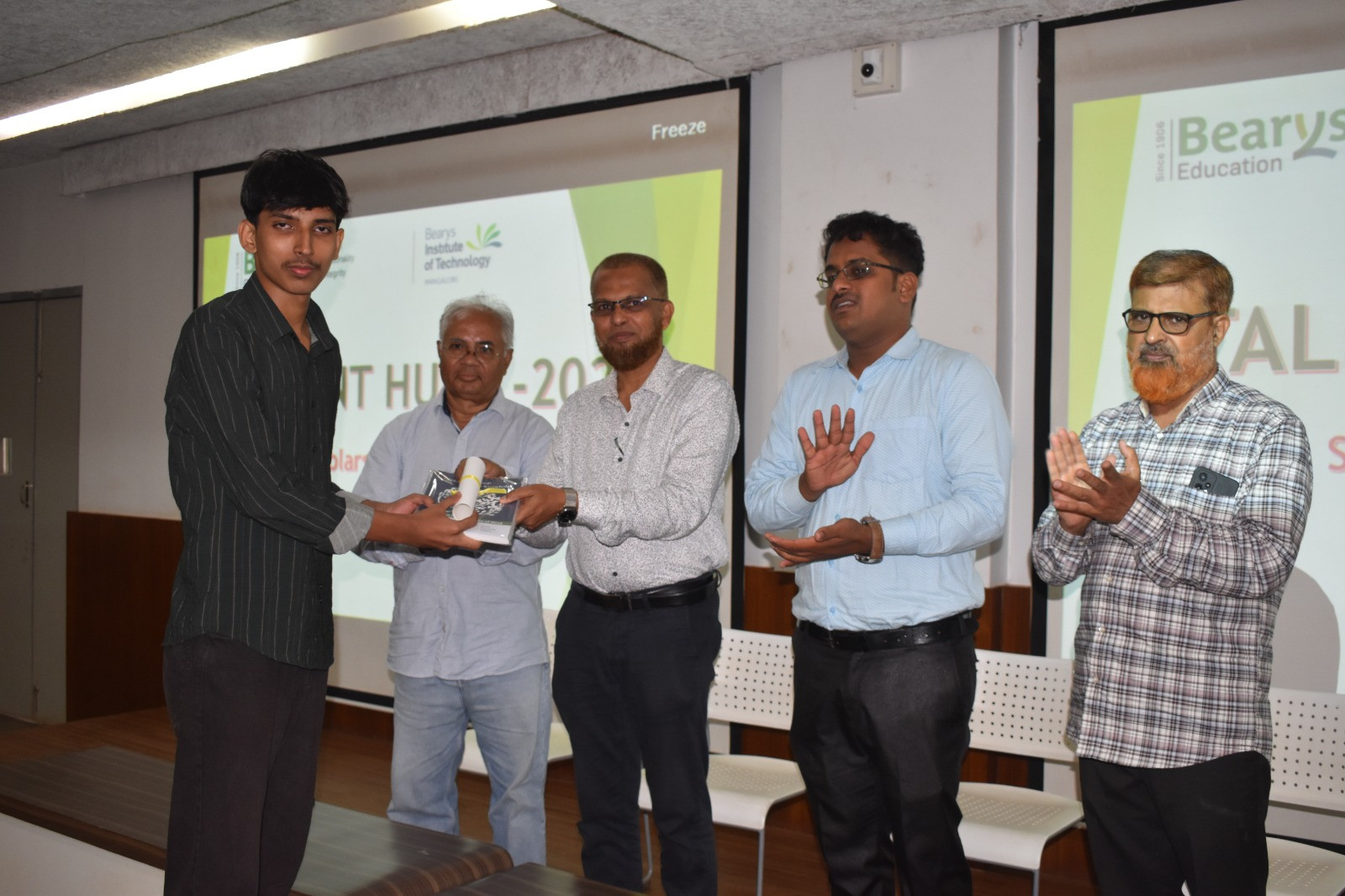
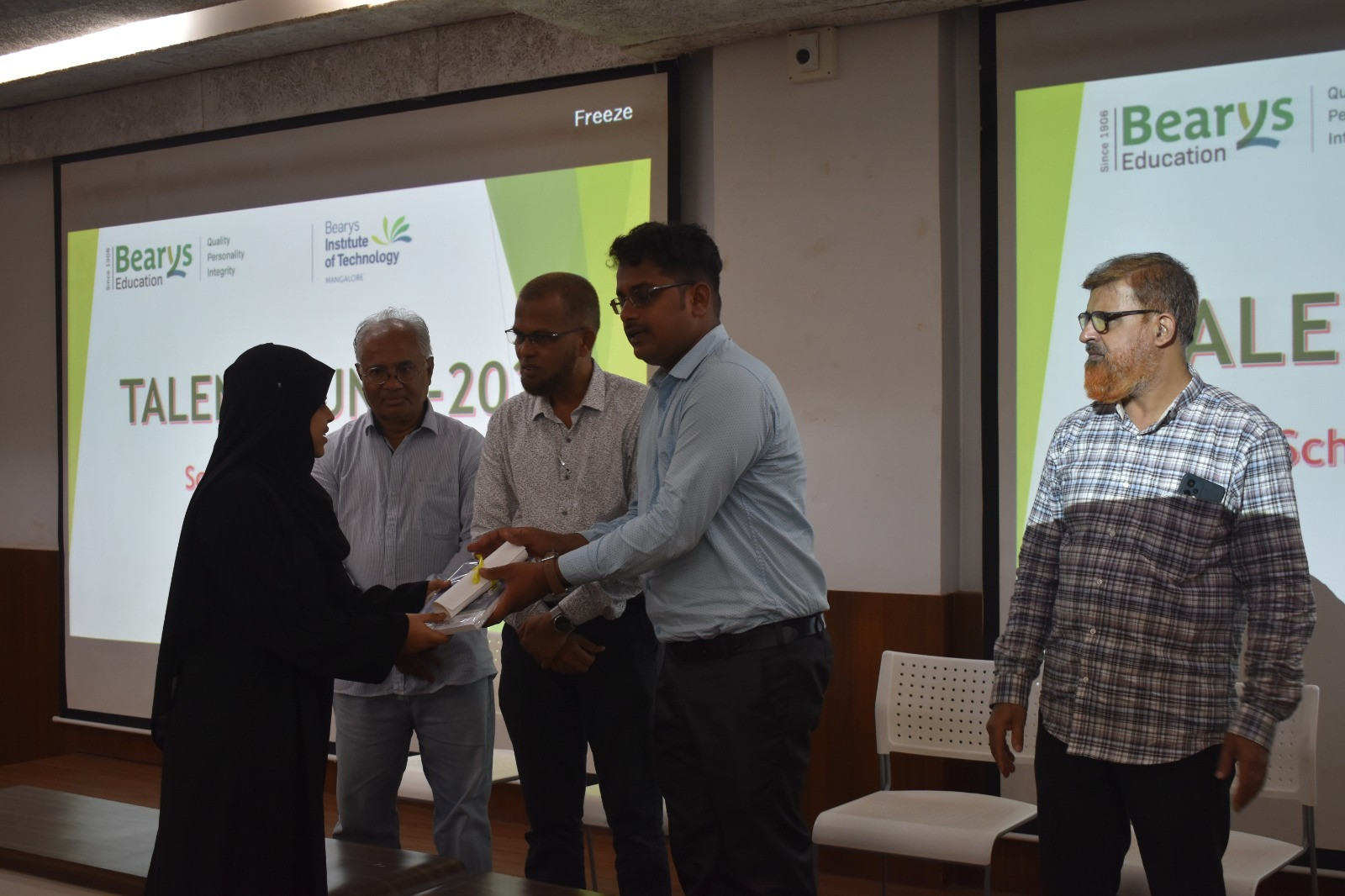
Bearys Institute of Technology (BIT), in association with BEADS, successfully organized the Talent Hunt 2025, an in-house entrance examination aimed at identifying and nurturing young talent among II PUC science students. The event was held on April 12, 2025, at the BIT campus, Bearys Knowledge Campus (BKC), near Mangalore University, Innoli.
The event commenced with a warm welcome address by Dr. Anjum Khan, Faculty of Basic Science, who highlighted the significance of early academic encouragement for budding engineers and architects.
The keynote address was delivered by Dr. S.I. Manjur Basha, Principal of BIT, and Architect Khaleel Abdul Razak, Principal of BEADS. They emphasized the value of integrated learning, innovation, and the vision behind offering generous scholarships to meritorious students through such initiatives.
A large number of students participated in the Talent Hunt exam, and up to 100% scholarships were awarded to the most outstanding performers, with all participants receiving a minimum of 10% scholarship on tuition fees.
The results were officially announced by Heena, HR at BIT.
Among the top achievers, Ibrahim Nasim from Yenapoya PU College, Udyavara, secured a 100% scholarship, while Ayishath Sahla (Anugraha PU College, Vitla) and B U Khadeejath Thabsheera (Dr. APJ Abdul Kalam PU, Ira) were awarded 50% scholarships each.
Seven other students received 25% scholarships for their exceptional performance.
The event concluded with a vote of thanks delivered by Prof. Joyson from the Department of Basic Science.
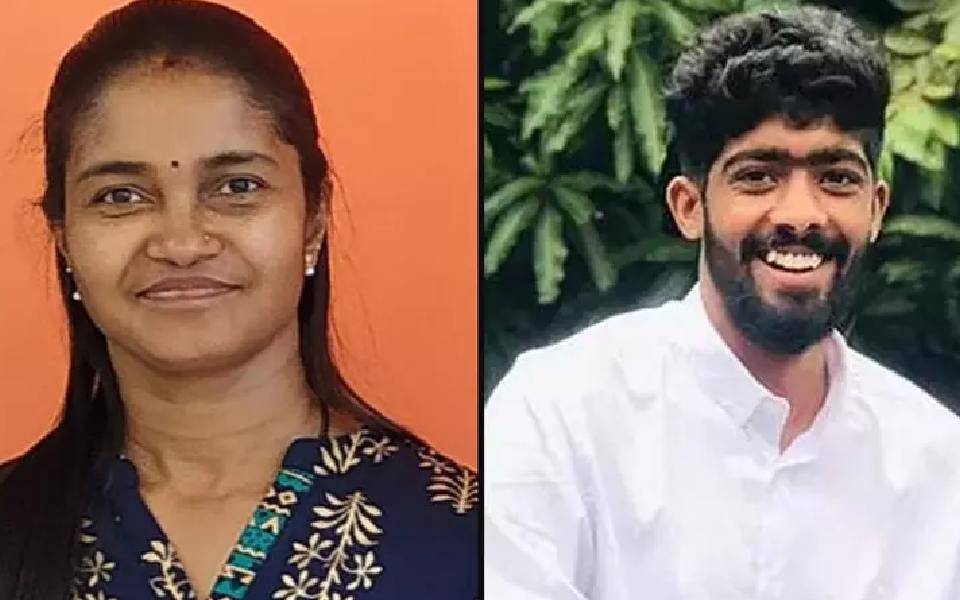
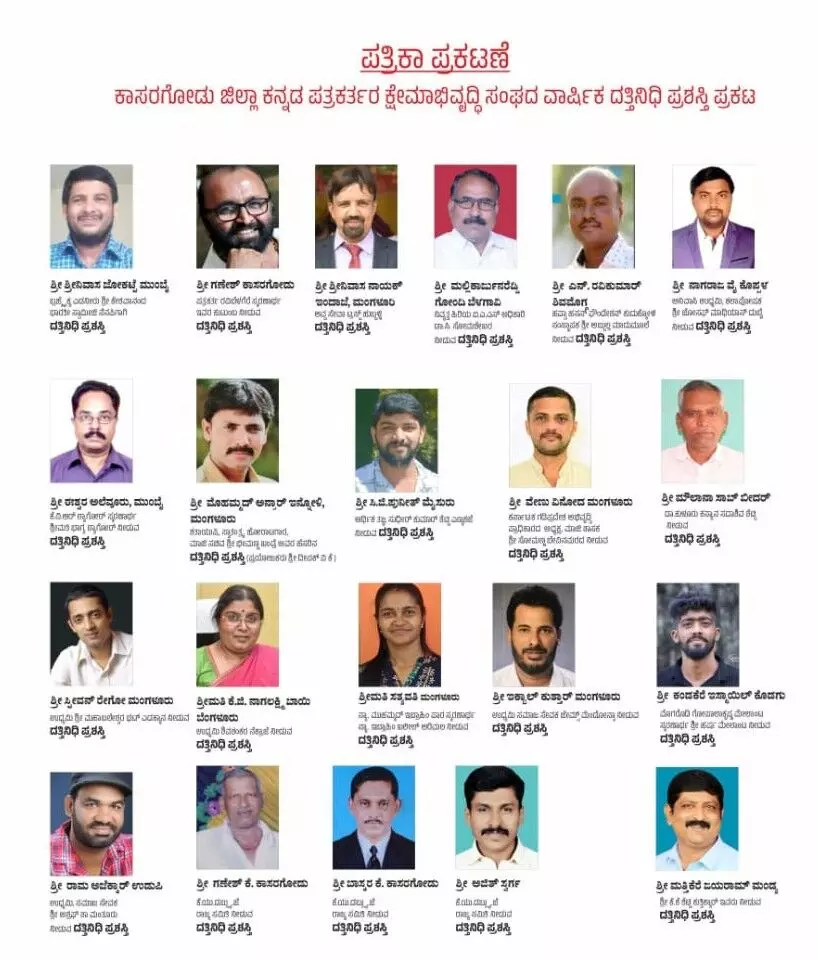
The Kasaragod District Kannada Journalists’ Welfare Association has announced the recipients of its annual Endowment Fund Awards. This year, 21 journalists have been selected for recognition, including Vartha Bharathi Mangaluru Bureau’s senior reporter Satyavati, and Kodagu special correspondent Kandakere Ismail Kodagu.
The award ceremony will take place on May 3 at the Seethangoli Alliance Hall in Kasaragod district. Each endowment award comprises a cash prize, an award certificate, and a memento.
The names of the awardees according to a press release issued by the association are as follows,
Satyavati will be honoured with the Lawyer Muhammad Ibrahim Pare Memorial Award, while Kandakere Ismail Kodagu will receive the Mogarodi Gopalakrishna Melanta Endowment Award. Srinivasa Jokatte from Mumbai, who will receive the Brahmakya Edneer Sri Keshavananda Bharathi Swamiji Memorial Award, and Ganesh Kasaragodu, who will be awarded the Journalist Ravi Belagere Memorial Endowment Award.
Srinivasa Nayak Indaje will be awarded with the Avva Trust Hubballi Endowment, Mallikarjuna Reddy Gondi of Belagavi with Retired senior IAS officer Dr. C. Somashekara Endowment, N. Ravikumar with Hawva Hasan Foundation Kudkoli Endowment, Nagaraja Y. Koppala with Non-resident businessman and art patron Joseph Mathias Dubai Endowment, Iswara Alevoor from Mumbai with KVR Tagore Memorial Award, and Muhammad Ansar Inoli with Freedom Fighter and Former Minister Bhimanna Khandre Endowment.
Others receiving awards include C.J. Puneeth of Mysuru (Economist Sudhir Kumar Shetty Enmakaje Endowment), Venu Vinod of Mangaluru (Somanna Bevinamarad Endowment), Maulana Saab Bidar (Kuluru Kanyana Sadashiva Shetty Endowment), Steven Rego of Mangaluru (Mahabaleshwar Bhat Edakkana Endowment), and KG Nagalakshmi Bai of Bengaluru (Sivashankar Nekraje Endowment).
Also recognized are Iqbal Kuthar (James Mendonsa Endowment), Rama Ajekar (Ashraf Shah Manthur Endowment), Ganesh Kasaragod (KWJ State Committee Endowment), Bhaskar K. Kasaragod (KWJ State Committee Endowment), Ajith Swarga (KWJ Endowment), and Mattikere Jayaram of Mandya, who will be awarded the K.K. Shetty Kuttikar Endowment.
The Kasaragod District Kannada Journalists’ Welfare Association, active for over two decades, works in collaboration with pro-Kannada organizations to promote and preserve Kannada language, culture, and art. The association also acts as a cultural bridge between Kannada and Malayalam-speaking journalists.
The May 3 ceremony will be chaired by the reception committee head K.K. Shetty Kuttikar.
The event will be graced by dignitaries including Karnataka Legislative Council Speaker Basavaraj Horatti, Agriculture Minister Chaluvaraya Swamy, Forest Minister Eshwara Khandre, Karnataka Border Area Development Authority Chairman Somanna Bevinamarada, Chief Minister’s Media Advisor K.V. Prabhakar, Karnataka Working Journalists’ Association President Shivananda Tagadoor, and Kasaragod District Kannada Development Authority President Ravi Naikap, read an official statement.
source: http://www.english.varthabharati.in / Vartha Bharati / Home> Karavali / by Vartha Bharati / April 22nd, 2025
Tipu Sultan’s largesse to temples as recorded in the 19th century Inam Registers of Malabar shows that he was sensitive to the religious sensibilities of Hindus.
Karnataka Chief Minister Siddaramaiah paying tribute to Tipu Sultan in Bengaluru on November 10.
The Congress government in Karnataka led by Chief Minister Siddaramaiah has marked the birthday of Tipu Sultan on November 10 as “Tipu Jayanti” for the past three years. While Tipu is honoured as a freedom fighter for opposing the British in the Anglo-Mysore Wars and dying on the battlefield in 1799, there are intense protests against this event as well. The protests are led by a wide array of bodies that draw their support from the Hindutva ideology spearheaded by mainstream politicians of the Bharatiya Janata Party in Karnataka. They allege that Tipu was a religious bigot whose reign was marked by the plunder of temples and forceful conversions of Hindus to Islam.
There are allegations that Tipu forcefully converted non-Muslims in three parts of his domain: first, among the Kodavas of Kodagu in modern Karnataka; then among the Nairs of Malabar in present-day north Kerala; and the Christians of Mangalore (now Mangaluru) in coastal Karnataka. Frontline has discussed the broad reign of Tipu Sultan and his legacy (“Contested legacy”, December 11, 2015) and scrutinised the allegations of religious excesses made against him in Kodagu (“Tipu-Fact & Fiction”, January 6, 2017). This essay attempts to analyse the allegations made against Tipu Sultan in Malabar.The Inam registers
Deep inside the Regional Archives of Kozhikode, amid lakhs of valuable documents, is a set of seven registers dating to the 19th century, compiled by J.W. Robinson, the Inam Commissioner of Malabar. The seven British-era taluks the Inam registers pertain to are Ernad, Choughuat, Old Betatnad, Calicut, Kurumbranad, Valluvanad and Wynad. (These taluks have been absorbed into various districts in modern Kerala.) An “inam” is a gift, and inam land is land given as a tax-free grant to an institution or an individual, usually in perpetuity unless it is rescinded, as happened all over India through various land reform laws after Independence. The registers have archived for posterity the minutiae of the process of renewal of inams in the region.
The registers are long and broad and the calligraphy is stylised to the point that at first glance all that one can discern is a series of neatly slanted squiggles.
The register pertaining to Choughuat taluk (also known as Ponnani) lists nine temples whose inam lands were renewed. Of this, the largest land grant (of 613.2 acres) that was renewed belonged to the Guruvayur temple in central Kerala. A close perusal reveals that the text lists the beneficiary as Uralers, or trustees, of the “Guruvayur Kshetram”.
The extended note reads: “A sum of Rs.1,428-9-2 [rupee-anna-paisa] appears to have been allowed for the support of the temple by Tippu Sultan and continued by the British Government upto 1841, when the necessary examination was made and the money allowance commuted into a grant of the lands yielding an annual assessment equivalent to the money grant. The lands are still held as inams and are accordingly confirmed as such for such time as the conditions of the inam are fulfilled under date the 20th Nov. 1841.” This note was endorsed by G.A. Ballard, the then Collector of Malabar, and subsequently confirmed by W.J. Blair, the then Officiating Inam Commissioner of Malabar, on June 20, 1866. In other columns relating to this entry, a mention is made that the inam was first granted by Tipu Sultan in 1776-77 and verified by the British administration of Malabar. The basis of the British confirmation was the pioneering “paimash” (survey) land revenue records prepared by the Brahmin administrative clerks of the Mysore rulers, who wrote in the Modi script, the precursor to the Devanagari script used to write modern Marathi.
The Archives have around 500 bundles of these land revenue records, each around 100 pages. The pages are slightly frayed but the script is legible. These records in the Modi script are a gold mine for academics interested in the land reforms carried out by Hyder Ali and Tipu Sultan in Malabar, which had a long-term impact on Kerala society.
What is more germane to our times, when Tipu’s legacy is hotly debated, is that the Inam Registers contain detailed records of the substantial land grants he made to several temples. This is valuable evidence to counter reductive Hindutva propaganda that alleges that Tipu was a religious bigot whose ambitious expansionist ventures were only a jehad to spread Islam by destroying temples and forcefully converting Hindus in the region.
According to an estimate made by Muhamad Ismail, details of which are available in his unpublished PhD thesis, 6,931.03 acres of land were given as inam by Tipu Sultan. Of this, 5,434.07 acres were given to Hindu institutions and individuals, while 1,494.27 acres were given to Muslim institutions and individuals (“Religious Policy of Tipu Sultan: Malabar Region”, Unpublished Doctoral Thesis, 2016).
Grants were made under three categories: devadayam grants to 48 temples, dharmadayam grants to seven “sathrams”, and grants to three individuals (see table). Considering that local Muslims known as “mappilas” made up about a quarter of the population of Malabar, this stark disparity in the largesse of a “religious bigot” is startling. If anything can be argued through these land grants, it is that like in other parts of his kingdom, Tipu was keenly sensitive to the religious sensibilities of Hindu citizens in Malabar as well. He wanted to establish a long-term presence in Malabar, and his perspicacity is evident in his support to temples.The Mysorean interlude
The late 18th century was a period of transition in Indian history. The Mughals were in a state of continuous decline and the East India Company had emerged as a major player in the affairs of the subcontinent after the Battle of Plassey in 1757. The Marathas had established their sway over vast swathes of the subcontinent as well. In peninsular India, various powers were battling for expansion of their territories. Hyder Ali, a faujdar (military commander) in the Mysore Army, rose to become the de facto ruler of Mysore in 1761. His territory was threatened by the Marathas, the Nizam of Hyderabad, the Nawab of the Carnatic and the English under the aegis of the East India Company. The French were also an important power that could not be ignored.
North Kerala at the time was broken up into several small principalities. An early estimate states that there were four important kingdoms and 42 principalities across Kerala. Hyder invaded Malabar through Mangalore and Cannanore (now Kannur) in February 1766. Hyder was embroiled in the affairs of Malabar indirectly from the time he was in Dindigul. The Raja of Palghat (now Palakkad), who had a constant feud with the Zamorin of Calicut (now Kozhikode), reached out to him for help, providing Hyder the excuse he needed to come to Malabar as he had always wanted access to a long coastline and a share in the lucrative trade of spices. His fort in Palakkad, around which the modern town has developed, also dates to this era. Tipu, the eldest son of Hyder, who would have been a teenager at the time, accompanied his father on this campaign.
Hyder’s invasion was successful and he swiftly conquered the minor principalities of Malabar. The Zamorin of Calicut, defeated and forced to pay a tribute, committed suicide. The disunity among the rulers of Malabar and the disciplined approach of the Mysorean Army led by its cavalry were responsible for this easy victory for Hyder, who intended to march all the way down south to Travancore via Cochin), but the monsoon hindered his plans. He returned after appointing a governor called Madanna and fixing tributes for the local chieftains. Soon after, his outposts in Malabar were threatened by a rebellion led by the Nairs, who formed the fighting corps of the Kerala kings.
While this rebellion, which some historians see as a native resistance to a foreign ruler, was quelled, it did lead to Hyder severely restricting the privileges of the Nairs. Many upper caste Hindus, including the Namboodiris, the Nairs and chieftains, fled to Travancore during Hyder’s invasion.
Over the next few years, Hyder was fighting the marauding Marathas and the First Anglo-Mysore War (1767-69) and could turn his attention to Malabar again only at the end of 1773. This time, many local chieftains who had not been regular with their tributes were not reinstated, and Malabar came to be directly ruled as a province of the Mysore kingdom. Hyder’s plan of attacking Travancore was again left incomplete. A detailed land survey was done by Sreenivas Rao, the governor in charge of civil affairs, and the land records at the Regional Archives of Kozhikode date back to this era.
When Hyder came to Malabar, several European powers, led by the East India Company, were already deeply involved at various levels in local affairs as they all had trading outposts along the coast of Malabar. They included the English, the Dutch, the French, the Portuguese and the Danes. Among them, the English and the French had substantial trading interests from their bases in Tellicherry (now Thalassery) and Mahe. During the Second Anglo-Mysore War (1780-84), Tipu was in Malabar fighting the English. He was about to score a crucial victory when he received the news of Hyder’s death. Tipu swiftly returned to Seringapatam (now Srirangapatna), but his territory in Malabar was restored to him as per the Treaty of Mangalore in 1784. Malabar remained a part of Tipu’s domain until the end of the Third Anglo-Mysore War in 1792, but he had lost control over it by 1790. It eventually became a part of the Madras Presidency as Malabar district.Impact of Mysorean rule
“The great significance of the Mysorean occupation of Kerala for more than 25 years, lies in the fact that it marked an era of transition from the medieval to the modern,” writes C.K. Kareem in his book Kerala Under Haidar Ali and Tipu Sultan (1973). Although Malabar was officially part of the Mysore kingdom between 1766 and 1792, the Mysore rulers had only limited control for many years. Tipu ruled the region directly only for six years. While the period of direct rule was short, it had a long-term impact on Malabar society. Hyder and Tipu brought about an integration of the small principalities of Malabar for the first time and a feudal system of administration was replaced by centralised rule, much like it had been done in Travancore. A network of roads was built in the region for the first time. Trade and industry flourished during the time and European merchants who had secured favourable terms from the Malabar chieftains suffered as Tipu imposed a state monopoly on a number of items, including pepper. He also attempted to build a navy here and appointed the ruler of Cannanore as the chief of his naval force.
Perhaps the greatest impact of Hyder and Tipu was in the area of land administration. In this area one can also see the displacement of dominant castes, which gave rise to accusations of religious bigotry. Historians have written about how there were no land taxes in Malabar before it came under Mysore rule. The “jenmis” (landed aristocracy) were the absolute owners of land with the tiller having no claims. The Mysorean rulers shook up this system and settled land revenue claims directly with the tiller. In this way, Hyder and Tipu can be seen as early reformers in land administration. The rulers ensured that temple land remained untaxed. Land settlement became easy because the landowners—the Namboodiris, the chieftains and the Nairs—had fled from Malabar to Travancore. The tenants, who were mainly mappilas or lower caste Hindus, benefited from this.
Tipu also saw himself as a social reformer and attempted to change some of the traditional aspects of Nair society. For instance, he was appalled when he found out that Nair women cohabited with several men. He was also disgusted by the practice of lower caste women not being permitted to cover their breasts. Tipu forbade these practices, which was resented by the Nairs, who saw this as an encroachment on their religious and social rights.
Nairs and Namboodiris comprised a fifth of the population of Malabar and the upheaval wrought about by Hyder and Tipu in the caste and class privileges of these two communities led to social upheaval. The Namboodiris and the Nairs suffered the most during the time of Tipu. These two castes were severely affected by the political, social and economic reforms undertaken by Tipu. Kareem writes: “It was, therefore, the economic and social reforms that paved the way for the accusations of religious bigotry brought against Tipu Sultan.” It was also easy to see the issues of land and social reform along religious lines, as the main beneficiaries of Tipu’s land reforms were the mappilas. Some scholars have also made connections between the social upheaval caused due to the Mysorean interlude and the mappila rebellion of 1921.Problematic sources
Mark Wilks, an officer of the East India Company who participated in the final storming of Srirangapatna in 1799, recorded in his work that Tipu warned the Nairs that if they continued to adhere to their regressive caste practices and disobeyed his commands he would march all of them to Srirangapatna and convert them to Islam. The aspect of Tipu threatening conversion is strangely not contained in the account of Mir Hussain Ali Khan Kirmani, the avid court chronicler of Hyder and Tipu’s reigns who tinged his histories with an Islamic slant and never failed to present Tipu as a champion of Islam. The early works of writers like Wilks provided the basis for later writers like William Logan, who, as Collector of Malabar, wrote the two-volume Malabar Manual in 1887. Much of the allegations against Tipu regarding religious violence in Malabar come from this writer.
Thus, if one were to examine closely the various sources that vilify Tipu in Malabar, they are usually of two kinds: first, British writers who found in Tipu their arch villain and exaggerated aspects of his religious policy, and second, the writings of local upper castes who had lost considerable privileges during the Mysore rule.
However, there are young historians like M.P. Mujeebu Rehman, assistant professor in the Department of History at the University of Calicut, and Abhilash Malayil, a PhD student at the School of Humanities and Social Sciences, Indian Institute of Technology Mandi, who have assessed the Mysorean interlude in Malabar history objectively by faithfully historicising the period rather than seeing it in the surcharged communal atmosphere of contemporary politics.
Rehman writes in his book The Other Side of the Story: Tipu Sultan, Colonialism and Resistance in Malabar (2016): “The falsified image of Tipu Sultan, popularised fervently by the colonial writers, in fact was of ‘religious bigotry’. They had realised the fact that no other stereotypes could be so sensitively worked out among the Hindu believers than that of religious bigotry. Both colonial and nationalist historians highlighted religious aspects of Mysorean interventions concealing its political or economic aspects. For instance, they maintained that Tipu invaded Malabar and hundreds of thousands of native non-Muslims were hanged, circumcised or exiled. Several such statements have reverberated even in contemporary discourse without any substantial evidence other than the colonial narratives.”
Muhamad Ismail writes: “It is high time that we reinvestigate on the basis of true historical records, however meagre they may be, everything that has been unleashed against Tipu Sultan and the Mysore administration. It has been proved by recent historians engaged in the study of the Sultan’s history that the descriptions of the widespread arson, loot and violence that the Hindus of Malabar faced at the Mysorean interlude were mostly fallacies of imagination or the result of the retaliation of the Sultans against rebels.”
Tipu was aware that he was a Muslim king while his subjects were mainly Hindu and he legitimised his reign through generous support to temples in his domains. As the Inam Registers have shown, Tipu gave generously to the temples of Malabar as well and none of his actions suggest that he was a religious bigot.
S. Rajendu, a Palakkad-based historian and author of Mysore Padayottam–Irunnoottiyanpathu Varshangal (Mysore Rule-250 Years) (2017), says: “There are instances of Hyder and Tipu plundering temples but that was only because wealth was hoarded in the temples in Malabar. There was no conception of nation or religion at the time that motivated the ruler’s actions.”
This become evident when we see that mappilas like Athan Gurukkal of Manjeri also revolted against Tipu in 1788-89 and Tipu suppressed this rebellion with the help of Ravi Varma, who belonged to the Zamorin’s family.
Tipu intended to have a long-term base in Malabar and even began to build a fort at a place that he founded some distance from Calicut called Farooqabad (now Feroke). Construction began at the site when Tipu visited Malabar in 1788, but it was never finished as Tipu’s forces were driven out before it could be. Locals who have seen the site say that the foundations and initial constructions are still visible, but access to the site is now blocked as the path leading to the fort falls in a site that is being legally contested. A sign from the Kerala Department of Archaelogy at a locked gated passage greets visitors attempting to look for the fort of Farooqabad, the capital that Tipu planned for his province of Malabar.
Soon, Tipu would cede his claim on Malabar and in 1799, this last bulwark against the great expansion of the East India Company, would be killed on the battlefield.
source: http://www.frontline.thehindu.com / The Hindu / Home> India> History / by Vikhar Ahmed Sayeed in Kozhikode / December 21st, 2017
The discovery of 1,700 Mysore rockets belonging to the 18th century gives a fillip to the argument that Tipu Sultan was a progressive king who made great advances in arms technology and was a formidable bulwark against the British East India Company in south India.
Rudrappa Shejeshwara, the curator of the Government Museum (Shivappa Nayaka Palace), Shivamogga, showing the rockets.
THE Congress-Janata Dal (Secular) coalition government in Karnataka has decided to continue the commemoration of the 18th century Mysore ruler Tipu Sultan’s birthday on November 10 as Tipu Jayanti. Ever since the Tipu Jayanti celebrations began in 2015 when the Congress, headed by Siddaramaiah, was in power in the State, the Bharatiya Janata Party (BJP) and right-wing Hindutva groups that accuse Tipu Sultan of being a religious bigot have opposed them vehemently.
As preparations for this year’s event began, Pratap Simha, the BJP Member of Parliament from Mysuru, asked Chief Minister H.D. Kumaraswamy not to go ahead with Tipu Jayanti as it hurt Hindu religious sentiments.
The allegations that Tipu Sultan was a religious bigot were examined in detail in the previous issues of Frontline . The article titled “Contested legacy” (December 11, 2015) provided an overview of Tipu Sultan’s reign and his role in fighting the British East India Company. The article “Tipu–Fact & Fiction” (January 6, 2017) discussed the accusation that Tipu Sultan had forcibly converted Kodavas of Kodagu, and “Tipu in Malabar” (January 5, 2018) examined the charge that the Mysore ruler had committed religious excesses in what is today north Kerala.
Tipu Sultan and, before him, his father, Hyder Ali, ruled Mysore for a brief period, between 1761 and 1799, but left a lasting impression on society and polity in the region. Both of them consistently opposed the British and fought four wars (known as the Anglo-Mysore Wars) against the East India Company. Hyder Ali was a perceptive and ambitious leader, but Tipu Sultan’s fame transcended that of his father. Tipu Sultan died on May 4, 1799, battling British soldiers, thus establishing his legacy as one of India’s earliest fighters against colonialism. It is for this reason that he is still feted.
Ever since Tipu Jayanti began to be marked, there has been an overwhelming focus on Tipu Sultan’s religious policies, with scores of articles written on the theme, but what has not been examined substantially is another important aspect of his reign. During his brief rule, he attempted to bring about significant modernisation in a number of areas through the establishment of an industrial state. This includes advances in arms technology, a continuation from Hyder Ali’s time that would eventually have a global impact.
Of all the advances that Tipu Sultan and Hyder Ali made in creating a modern army with lethal weapons, the rockets that were used against the British during the Anglo-Mysore Wars have left an indelible impression for two reasons. First, the rockets caused tumult and bedlam in enemy ranks. English soldiers have chronicled this aspect of Tipu Sultan’s warfare. For instance, the use of these rockets was the chief reason for the victory of the Mysore Army in the Battle of Pollilur (1780) in the Second Anglo-Mysore War. Rockets were also used subsequently, as documents show. Tipu Sultan’s army even had dedicated companies of rocket men. Colonel Bayly, a British officer, writes vividly about the havoc these Mysorean rockets caused as his regiment faced off Tipu Sultan’s army on April 5, 1799.
He wrote: “The ground of encampment was on the upper part of an inclined plane, at the foot of which, on the opposite bank of the River Cauvery, stood the proud fortress of Seringapatam, at three miles’ distance, from whence they already began to throw shot from guns of a huge calibre, and so pestered were we with the rocket boys that there was no moving without danger from these rocket missiles…. The rockets and musketry from upwards of 20,000 of the enemy were incessant. No hail could be thicker. Every illumination of blue lights was accompanied by a shower of rockets, some of which entered the head of the column, passing through to its rear causing deaths, wounds and dreadful lacerations from the long bamboos of twenty or thirty feet, which are invariably attached to them. The instant a rocket passes through a man’s body it resumes its initial impetus of force, and will thus destroy ten or twenty until the combustible matter with which it is charged becomes expended. The shrieks of our men from these unusual weapons was terrific; thighs, legs, and arms left fleshless with bones protruding in a shattered state from every part of the body, were the sad effects of these diabolical engines of destruction” (“Diary of Colonel Bayly: 12th Regiment” by Colonel Bayly, 1896).
The second reason is that Tipu Sultan’s rocket was the progenitor of the superior “Congreve” rocket, which was subsequently used by the British in the 19th century. The Mysorean rockets were found after the fall of Srirangapatnam and were transported to England, where they were studied closely.
About this, Roddam Narasimha, an aerospace scientist, writes that the Mysore “…rockets made an extraordinary impression on the British, and led, from 1801, to what would now be called a vigorous research and development programme (at the Royal Woolwich Arsenal). Sir William Congreve made systematic studies of propellants, analysed performance applying Newton’s laws, developed a series of rockets of different sizes and characteristics, made a comparative cost analysis and published three books on the subject. Rockets were soon systematically used by the British during the Napoleonic Wars and their confrontation with the U.S. during 1812-14.” ( Rockets in Mysore and Britain, 1750-1850 A.D. by Roddam Narasimha, 1985.)
Monumental find
Considering that these rockets marked a profound moment in the history of armaments, there were surprisingly few extant samples available. Only five iron-case Mysore rockets were known to be available for more than two centuries. Of these, three were housed at the Government Museum, Bengaluru, while two were at the Royal Artillery Museum, Woolwich Arsenal, in England. The three kept in Bengaluru were incomplete as they were mere shells. So, when in July this year a cache of 1,700 iron-case Mysore rockets from Hyder Ali’s or Tipu Sultan’s era was found, it was nothing short of a monumental discovery.
“The rockets were found in and around a large well owned by a farmer named Nagaraja Rao in Nagara village,” said Rudrappa Shejeshwara, the curator of the Government Museum (Shivappa Nayaka Palace) in Shivamogga. Nagara is around 80 kilometres from Shivamogga town in western Karnataka and was an important town in the 18th century. The site was chosen for excavation as a chance discovery at the same location a few years ago had revealed 160 rockets. They were not identified immediately, but were recognised subsequently as the famed Mysore rockets of Hyder Ali and Tipu Sultan. The State’s Department of Archaeology, Museums and Heritage, sanctioned an expedition and this led to the discovery of a larger cache of rockets.
The rockets are housed at the Government Museum in Shivamogga. They are not uniform and vary in length, measuring between half a foot and one foot. The small ones weigh about half a kilogram while the larger ones can almost weigh up to 2 kg. While some can be grasped easily, there are a few that are so thick that it is not possible to grasp them. It is remarkable that the farmer did not sell the rockets, which look like unusual pestles, as scrap. Nagaraja Rao actually had the foresight to communicate the information to the Archaeological Department.
While the fact that the Mysore rockets were a pioneer in arms technology is known, detailed tests on the rockets had not been conducted before simply because there were not enough samples to conduct tests. With the Shivamogga find, it became possible for the first time to conduct a thorough examination to find out what made these projectiles provide a fillip to the strength of the Mysore Army. Nidhin G. Olikara, an independent researcher based in Shivamogga, and Shejeshwara have sought to study just this aspect. They have co-authored a paper on their recent findings (“Rockets from Mysore under Haidar Ali and Tipu Sultan: Preliminary Studies of ‘Tipu Rockets’ from the Nagara Find” by Rudrappa Shejeshwara and Nidhin G. Olikara published in Journal of the Arms and Armour Society , Vol. XXII, No.6, September 2018).
Olikara explained how the rockets worked. He picked up a piece of paper and made a cylinder out of it. “Steel plates were folded into cylindrical tubes like this. Then, they were coated with clay, as this would act as a thermal insulator, and then stuffed with saltpetre and sealed at both ends with metal discs,” he said, as he cut two circular strips of paper and wedged them on the ends of his paper tube.
Pointing to the rockets, in which a tiny hole that has been sealed can be discerned, he said: “A fuse, most probably made of silk as these rockets were used even during the rainy season, was then tightly inserted perhaps by using a tool, which we found at the site. The rocket would then be tied to a bamboo staff with leather strips,” Olikara said. He pointed to a painting by Robert Home, called “Mysore rocket man”, which is currently in the collection of the Victoria and Albert Museum in London. “Once the fuse was lit, the rocket would travel for two to three miles,” he said.
The Mysore rulers, he said, used different kinds of rockets. While some would fly through the air before landing on enemy ranks, others would whoosh through the enemy lines at knee level. There were also swords attached to some of these bamboo poles, thus making them deadlier as they scythed through the disciplined lines of East India Company soldiers.
What is more interesting about these rockets is that they were not cast from a mould but forged from steel sheets that contained a very low level of carbon, which in itself was a grand technological advancement for the time.
Olikara and Shejeshwara write: “There can be no doubt that the Mysorean Rocket with its ferrous metal case and deployment in large numbers was unparalleled anywhere else in the world. It represented the pinnacle of Mysore’s technological prowess and its capability to experiment and innovate. It also showed that Mysore possessed the prerequisites to manufacture iron-cased rockets on an industrial scale. As a consequence of such qualities, Mysore was able to stem the colonial tide for twenty years whilst internecine strife was sweeping most other Indian states into the subjection of Britain.”
Why were so many rockets found in Nagara? Nagara was an important town of the Keladi empire. Hyder Ali conquered it in 1759, expanding the power and wealth of the Mysore kingdom substantially. Thus, it is not surprising that Hyder Ali and, subsequently,Tipu Sultan set up a manufacturing unit in the region.
T. Venkatesh, Commissioner, Karnataka’s Department of Archaeology, Museums and Heritage, who oversaw the discovery in July, concurred with this. He said: “While we are not yet certain about why the rockets were found at this location, we strongly suspect that a manufacturing unit must have been located in the vicinity.”
Ajay Kumar, an independent researcher based in Shivamogga, painstakingly began to work with the knowledge that a manufacturing unit had to be present in the region. Using Google satellite imagery, he identified spaces close by that had large quantities of iron slag. Going back and forth from contemporary chronicles of the 18th century to travelling around in the region, Ajay Kumar took six months to piece together his findings.
“To manufacture these rockets, you needed iron ore, saltpetre, bamboo, silk wicks, strips of leather, limestone, charcoal and clay. Based on my research, I have identified five sites in the villages of Tammadihalli and Chittihalu [pronounced as Chattanhalli by locals], which are 60-65 km from Nagara, as possible manufacturing units. We can also see pieces of iron in these iron slags that must have been part of the tuyere required for iron smelting,” he said.
It is unclear why these rockets were discarded in a well, but the serendipitous finding tangibly reinforces the idea of Tipu Sultan as a progressive king who used modern weapons. He was the last bulwark against the East India Company’s push to rule India directly.
At an event held in Bengaluru on October 30, the BJP’s national spokesperson, Sudhanshu Trivedi, said Tipu Sultan was a killer of Hindus. He said he would urge the Union Railways Minister to rename Tipu Express, which runs between Bengaluru and Mysuru.
The BJP’s opposition to the celebration of Tipu Sultan’s legacy stems from his Muslim identity. But it is not possible to disregard the various contributions he made to the region and to rocket technology. Hyder Ali and Tipu Sultan made a deep impact in the area of southern Karnataka, which formed the nucleus of their kingdom.
source: http://www.frontline.thehindu.com / The Hindu / Home> India> Discovery of Mysore Rockets / by Vikhar Ahmed Sayeed recently in Shivamogga / November 08th, 2018
In Tamil Nadu, opposing illegal mining can be fatal. Most murders are buried as accidents, while the mafia thrives on political backing.
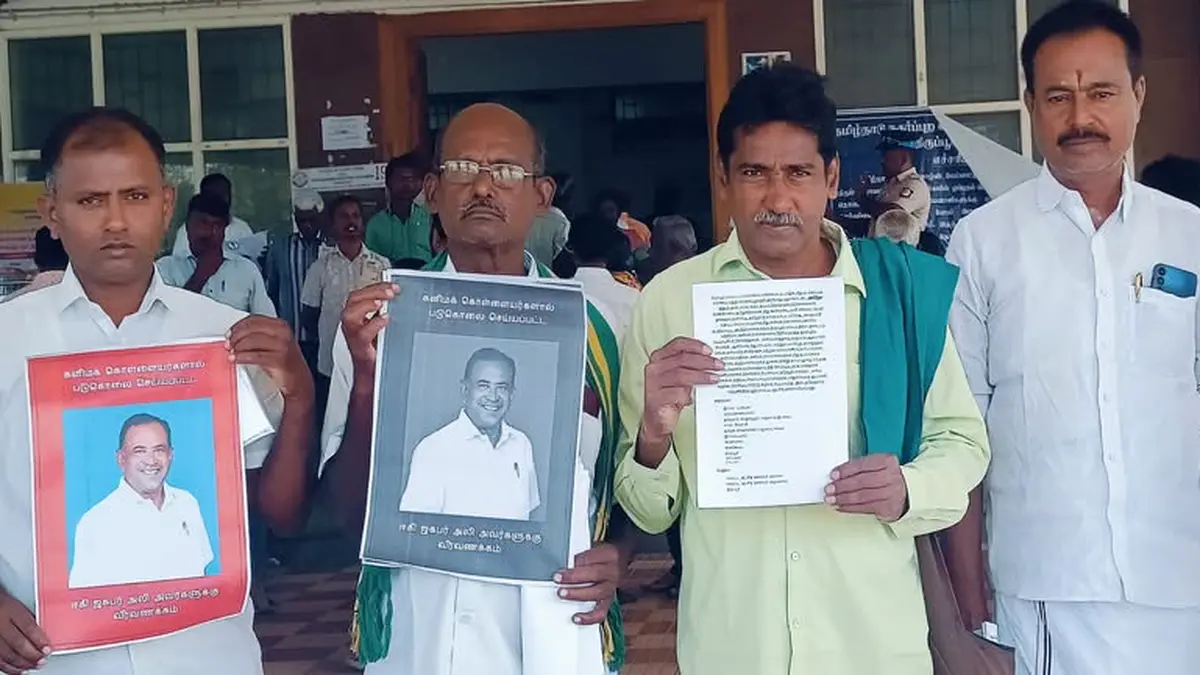
Anti-quarry activists carrying portraits of Jagabar Ali, who was killed by the mining mafia, at Tiruppur Collectorate. | Photo Credit: By Special Arrangement
Tamil Nadu has seen a spate of cold-blooded murders of activists who oppose mining across categories—whether the mining of stone, granite, river sand, or beach sand. Powerful gangs operate these businesses, concentrated in Madurai, Pudukottai, Tirunelveli, Erode, and Krishnagiri districts, and they deal with all opponents ruthlessly, whether they are residents, activists, whistle-blowers, or officials. There is an enormous amount of money at stake, which ensures that concerns about ecological damage, biosphere disruption, or the loss of livelihoods and habitats barely register.
Frontline studied a list of deaths and found an ominous pattern of targeted violence, official apathy, and impunity for the mining mafia. The first sinister pattern is that monstrous 40 tonne or 60 tonne dumper and tipper trucks are the most common dispensers of death. Paid killers are used sometimes, but most of these mafia-orchestrated murders are staged to look like hit-and-run accidents. In many cases, they are quietly recorded as such, leading to widespread allegations of collusion between the Tamil Nadu Police and the gangs.
The killing of 58-year-old Jagabar Ali, whose story our lead piece records, followed the same script: he was run over by a tipper lorry on January 17, 2025. After offering namaz at a mosque, Ali was returning home on his motorcycle when a truck rammed into him head-on on an otherwise deserted street. He was killed instantaneously.
Ali is the latest in a growing list of deaths of those who fight the mining mafias. R. Jeganathan, a farmer from Kuppam in Karur district, who had demanded the closure of illegal stone quarries in his neighbourhood, was run over by a quarry truck near K. Paramathi in September 2022.
The incident took place one day after the quarry, located at Kalipalayam village near Kuppam, was shut down. The truck that rammed into his scooter and killed him on the spot belonged to the same quarry.
R. Jeganathan, a farmer from Karur, who had demanded the closure of illegal stone quarries in his neighbourhood, was run over by a truck in 2022. | Photo Credit: By Special Arrangement
Activists such as R.S.A Mughilan, convenor of the Tamil Nadu Environment Protection Movement, as well as Jeganathan’s family and friends staged a series of protests in Karur demanding a probe. The police finally arrested three people, including the quarry owner, detaining them under the Goondas Act.
In 2022, an activist named Mani was run over by a lorry at Kavalkinaru in Tirunelveli district. The case was closed after being labelled an accident. On May 12, 2024, Natarajan, a farmer from Sarkar Kathankanni village near Uthukuli in Tiruppur district, narrowly escaped a similar attempt on his life.
The Uthukuli Police initially refused to even register a complaint. After five hours of persistence, the police gave Natarajan a CSR (Community Service Register) copy. When there were further protests, the police reluctantly registered an FIR on August 26, 2024, 100 days after the attempt on his life. “The police are now pressing me to sign a document claiming that the culprits are ‘untraceable’. I have refused. They are very much here, loitering in the neighbourhood. I live in fear,” he told Frontline.
B. Tamilselvan, an environmental activist from Erode district, escaped death when thugs hired by illegal quarry miners assaulted him in 2022. | Photo Credit: By Special Arrangement
On May 4, 2022, B. Tamilselvan, an environmental activist from Ekkadampalayam in Chennimalai in Erode district, escaped death when thugs, hired by illegal quarry miners, assaulted him with iron rods at an Internet centre. Tamilselvan had raised the issue of illegal quarrying at a village gram sabha meeting, which led to the closure of a quarry. Police filed a case against some unidentified people the next day. Nothing happened thereafter, and illegal quarrying continued.
Tamilselvan claimed that a local All India Anna Dravida Munnetra Kazhagam (AIADMK) functionary who owned the quarry was behind the attack. He told Frontline: “We knew the assailants. But the police did not take it seriously. We had to fight to get the FIR registered. I am still suffering from the injuries I sustained on my shoulders and head.” The Tamil Nadu Police have closed many such cases as “accidents”. “We have to fight to even get them registered as ‘suspicious deaths’,” said Venkalapalayam Natarajan, an anti-quarry activist.
It is not just stone quarry operators—illegal river sand smugglers also adopt the hit-and-run method to eliminate those who challenge their operations, with their victims even including high-ranking government officials and police personnel. For instance, in April 2003, Revenue Inspector R. Shanmugasundaram was run over and killed by a lorry transporting sand illicitly mined from the Palar riverbed near Palayaseevaram in Kancheepuram district.
In September the same year, Tahsildar G. Punniyakodi lost his life when he tried to stop a lorry illegally transporting blue metal from Erumaiyur, also in Kancheepuram. He too was run over.
On December 11, 2004, R. Venkatesan, Deputy Tahsildar of Tirukazhukundram, was killed when a sand-laden lorry ran him over at Manapakkam village.
On July 20, 2014, G. Kanakaraj, 43, a head constable attached to Thakkolam Police Station near Arakkonam in Vellore district, was run over by a lorry when he attempted to stop a tractor that was transporting sand illicitly mined from the Kosasthalaiyar river. Five officials, including the Tahsildar of Aavudaiyarkoil, Ravichandran, and four of his assistants, had a miraculous escape when a lorry rammed into their car near Pudukottai in September 2014.
Similarly, the killing of Srivaikundam’s Village Administrative Officer, Y. Lourdu Francis, on April 25, 2023, by a river sand mafia sent shock waves across the State and led to widespread protests by revenue officials. Francis, an upright officer, was opposing illegal quarrying in the Thamirabarani river and had registered a case against illicit sand miners in the village.
In the case of Francis, the police completed the investigation quickly and filed a charge sheet, with legal proceedings also moving quickly, and the Principal District Judge of Thoothukudi awarding life imprisonment to two miners on September 15, 2023. But this was one of the rare cases where the police, revenue, and mining departments worked in tandem to bring the culprits to justice.
Most of the time, the killers get away scot-free. Not surprising, given that a background check on those behind most of the attacks and murders often reveals the surreptitious involvement of individuals with political affiliations or links to their cronies.
If Jagabar Ali was a member of the AIADMK, the farmer Jeganathan was a Dravida Munnetra Kazhagam (DMK) supporter who served as the party’s branch secretary and was also a close associate of senior party functionaries. But, as in Ali’s case, the DMK maintained a stony silence over Jegannathan’s murder.
The truth is that the lucrative business of mining stone, granite, and beach and river sand is in the hands of individuals who have strong connections to politicians of all hues.
source: http://www.frontline.thehindu.com / The Hindu / Home> Environment> Illegal Mining / by Ilangovan Rajasekharan / April 23rd, 2025
The Hyderabad Institute of Excellence (HIE) has once again proven its academic prowess with an impressive performance in the IIT-JEE Mains 2025. Around 85% of the students from the institute’s prestigious ‘Super 40’ batch have qualified for the IIT-JEE Advanced 2025, reported the Siasat.
Among the top achievers, Mohammed Aman Mustafa Khan stood out by securing an outstanding 99.831 percentile, earning him an All India Rank (AIR) of 244 in the IIT-JEE Mains 2025.
The HIE, a residential junior college known for its 100% success rate in intermediate examinations, offers a focused academic environment for students aiming for careers in engineering, medicine, or defense through the NDA. Situated on a sprawling 115-acre campus, the institute boasts world-class facilities including international-standard sports infrastructure, a gym, swimming pool, horse riding tracks, and more.
The remarkable results this year are a testament to the institute’s dedicated mentoring and comprehensive academic strategy.
source: http://www.radiancenews.com / Radiance News / Home> Latest News> Report / by Radiance News Bureau (headline edited) / April 20th, 2025
Prof. Abdul Qavi Desnavi (November 1, 1930 – July 7, 2011)
Bhopal:
A two-day National seminar is being organised on “Prof. Abdul Qavi Desnavi Hyat Aur Adabi Khidmat” here on April 1 and 2 at Mulla Ramuzi Sanskriti Bhavan, the headquarters of Madhya Pradesh Urdu Academy, (MPUA).
The seminar is being organised by Ilma Education Society, Bhopal under the joint aegis of National Council for the Promotion of Urdu Language, (NCPUL) and MPUA.
Mr. Kailash Sarang, former Rajya Sabha member, will inaugurate the seminar on April 1 at 10 am which will be presided over by Urdu litterateur Prof. Afaq Ahmad.
AThe guests of honour on the occasion include: Mr. Aziz Qureshi, ex-member of Lok Sabha, Mr. Iqbal Majeed, Prof. Shakoor Khan, Prof. Muzaffar Hanafi and Prof. Ateequllah.
Prof. Afaq Husain Siddiqui will deliver the keynote address in the inaugural function while Kausar Siddiqui, director of the organising committee shall welcome the guests. Mr. Ali Mutaqqui Desnavi, the eldest son of late Prof. Abdul Qavi Desnavi will propose vote of thanks.
After the inaugural function there would be two sessions on April 1 and three on the next day. Two-and-a-half dozen scholars and writers from all over India will present their papers in different sessions of the seminar.
They include: Prof. Muzaffar Hanafi (Delhi), Mr. Ayub Waqif (Mumbai), Master Akhtar, Mr. Arif Aziz & Dr. Arjumand Bano Afshan (all three from Bhopal), Prof. Ateequllah (Delhi), Prof. Khalid Mahmood (Delhi), Maulana Syed Sharafat Ali Nadwi (Bhopal), Dr. Yaqoob Yawar (Banaras), Mr. Iqbal Masood, Mr. Rasheed Anjum & Dr. (Mrs.) Razia Hamid (all three from Bhopal), Dr. Saifi Sironji (Sironj), Prof. Manzar Husain (Ranchi), Prof. Afaq Ahmad (Bhopal), Dr. Maula Baqsh (Delhi), Mr. Naseem Ansari (Bhopal), Mr. Zia Farooqui, Mr. Ashfaq Mashhadi, Mr. Khalid Abidi, Dr. Mahtab Alam & Mr. Javed Yazdani (all six from Bhopal), Dr. Mohammad Nauman & Dr. Khalid Mubashshir (both from Delhi), Dr. Abdul Waheed Khan (Jabalpur), Mr. Naeem Kausar, Mr. Khursheed Akhtar (both from Bhopal), Dr. Shan Fakhri (Sironj), Mr. Habib Ahmad & Mr. Inamullah Lodhi (both from Bhopal).
Meanwhile, it may be stated here that Prof. Abdul Qavi Desnavi (November 1, 1930 – July 7, 2011) was an Indian eminent Writer, Critic, Bibliographist, Linguist and Scholar of Urdu language. He has authored more than 50 books on Urdu literature. His books were also translated in other languages. His important work was about Maulana Abul Kalam Azad, Mirza Ghalib, Allama Muhammad Iqbal and litterateurs of Bhopal.
He was recipient of several awards. He received Senior Fellowship from the Union Ministry of Culture, Govt. of India. His great treatise was a voluminous book on one of India’s frontline freedom fighter and first Union Education Minister Maulana Abul Kalam Azad over 900 pages titled “Hayat-e-Abul Kalam Azad” which he penned in the year 2000. It was acclaimed nationally and internationally.
Desnavi was born in Nalanda Prof. Desnavi was born on November 1, 1930 in village Desna of block Asthawan in Nalanda district Bihar. He belonged to the family of Great Muslim scholar Syed Sulaiman Nadvi, who was one of the eminent historian and biographers of the Islamic Prophet Muhammad (PBUH), during his times. He was the second son of late Prof. S. M. Saeed Raza, who was Professor of Urdu, Arabic and Persian languages in St. Xavier’s College, Mumbai. His elder brother was Prof. Syed Mohi Raza and younger brother was Syed Abdul Wali Desnavi.
Education Prof. Desnavi had his primary education in Arrah town of Bihar state. After completing his graduation & post-graduation in First Division from St. Xavier’s College, Mumbai, he joined Department of Urdu in Saifia Post Graduate College, Bhopal in February 1961. He went on to become Professor and Head of the Urdu Department of Saifia Post Graduate College. He was well-known literary figure in India and in the Urdu world.
His shining disciples Many scholars, poets and teachers of today such as lyricist Javed Akhtar, Poet Mushtaq Singh, Prof. Muzaffar Hanafi, Selani Silwatte, Prof. Khalid Mehmood, Prof. Mohammed Naumaan Khan, Prof. Afaq Husain Siddiqui, poet Iqbal Masood, Dr. Iqbal Masood Nadvi, Ahsanuddin Farooqui, Khurshid Akhtar, Mohammed Naseem, Dr. Qamar Ali Shah, Prof. Yaqoob Yawar, Maulana Syed Sharafat Ali Nadvi, Prof. Arjumand Bano Afshan etc. were under his tutelage during their student days in Bhopal and are now sparkling in the Urdu world. Under his guidance many students attained Ph.D. degrees.
He retired in 1990. He was also holding many Honorary positions such as: • Additional Principal of Saifia Post Graduate College, Bhopal.(1983–1985); • Secretary of Madhya Pradesh Urdu Academy, Bhopal (1991–92); • Elected Member Majlis-e-Aam Anjuman Taraqqui Urdu (Hind), New Delhi (1979–1984); • Member of All India Anjuman Taraqui Urdu Board, New Delhi, (1977–1978); • Member of Program Advisory Committee, All India Radio, Bhopal (1978–1979); • Member Executive Council, Barkatullah University Bhopal, (1980–1982); • Chairman of Board of Studies, Urdu, Persian & Arabic, Barkatullah University Bhopal, (1977–1980) and (1984–1985); • Dean Faculty of Arts, Barkatullah University Bhopal, (1980–1982) & • Member Working Committee, Taj-ul-Masajid, Bhopal (1997-2007)
Awards Prof. Desnavi received many awards in his lifetime such as Shibli Award, Mumbai, 1957; Senior Fellowship, Ministry of Education & Culture, Government Of India for 4 Years, 1979-1983; Sanad “Imteyaz Meer” All India Meer Academy, Lucknow 1981; Nawab Siddique Hasan Khan Provincial Award, Bhopal 1986; Bihar Urdu Academy Award, for recognition of Urdu services (1988–89) & (1989–90); All India “Parvez Shahidi Award” West Bengal Urdu Academy, Calcutta 1998.
His books The books Prof. Desnavi authored to enrich the Urdu literary world included: Ek Aur Mashriqi Kutub Khana (1954); Hasrat Ki Siyasi Zindagi (1956); Aur Hindustan Jag Utha (1963); Allama Iqbal Bhopal Mein (1967); Mazameen Lisan-un-Sidque (1967); Bhopal Aur Ghalib (1969); Ghalibyaat (1969); Nuskha-e-Bhopal Aur Nuskha-e-Bhopal Sani (1970); Qadir Nama-e—Ghalib (1971); Anis Numa (1973); Ek Shahar Panch Mushahir (1973); Nazr—e-Sajjad (1974); Mota’ala—e—Khotoot—e—Ghalib 1975, (Edition 2nd 1979); Saat TahrireiN (1975); Hindustan MeiN Iqbaliat (1976); Talash-o—Taasur (1977); Mehdi Hassan Efadi (1977); Iqbal Uneesween Sadi MeiN(1977); Mirza Salaamat Ali Dabeer (1977); Bachon Ka Iqbal (1978); Iqbal Aur Dilli (1978); Abdul Haque Banam Mahvi (1980); Nazr-e-Takhallus (1981); Mota’ala-e-Ghobar-e—Khatir (1981); Dhanpat Rai Nawab Rai Premchand (1981); Iqbal Aur Darul Iqbal Bhopal (1983); Iqbaliat Ki Talash (1984); Yadgar—e—Sulaiman (1984); Iqbaliat Ki Talash Publisher, Globe Publishers, Urdu Bazar Lahore, Pakistan (1985); Armoghane-Saifia (Co—Editor) (1986); Abul Kalam Azad (1987); Maulana Abul Kalam Mohiuddin Ahmad Azad Dehlavi (1988); Mahanama Lisan-un-Sidque (1988); Yadgar—e—Azad (1989); Mataihiyat (1989); Talash—e—Azad; Talash-e-Azad, Shaqsiyat, Khidmat, Chand JhalkiaN (1990); Jawaharlal—o—Azad (Co—Editor) (1990); Ajnabi Shahar (1992); Fakhernama (Co—Editor) (1997); Urdu Shairi Ki Gayarah AwazaiN; Masreen wa Mutaliqat Azad; Hayat Abul Kalam Azad (2000); Bombai Se Bhopal Tak (2004); Dur Dais Se (2005); MaiN Urdu Hoon (2006).
His books translated in other languages are: Abul Kalam Azad in Hindi language Translated by Janki Prashad Sharma, Publisher Sahitya Akademi (1987); Abul Kalam Azad in Punjabi language Translated Inder Singh Raz Publisher Sahitya Akademi (1988); Abul Kalam Azad in English language translated by Syeda Syedain Hamid Publisher Sahitya Akademi(1991); Abul Kalam Azad in Maithili language translated by Fazlur Rehman Hashmi, Publisher Sahitya Akademi (1994)
The awards Prof. Desnavi received on his books are: Saat TahrireiN – Uttar Pradesh Urdu Academy Lucknow, 1975; Uneesween Sadi Mein Iqbal – Bihar Urdu Academy Patna, 1977; Mota’ala-e-Khotoot Ghalib – Bihar Urdu Academy Patna, 1979; Mota’ala-e-Ghobar-e-Khatir – Bihar Urdu Academy Patna, 1981; Iqbaliat Ki Talash – Bihar Urdu Academy Patna, 1984, Abul Kalam Azad Academy, Bihar Urdu Academy Patna, 1987; Yadgar—e—Sulaiman – Maghribi Bengal Urdu Academy Calcutta, 1984; Talash—e—Azad – Uttar Pradesh Urdu Academy Lucknow, 1991; Talash—e—Azad – Bihar Urdu Academy Patna, 1991; Talash—e—Azad – West Bengal Urdu Academy Calcutta, 1993; Urdu Shairi Ki Gayarah AwazaiN – Uttar Pradesh Urdu Academy, Lucknow, 1993; & Urdu Shairi Ki Gayarah AwazaiN – Bihar Urdu Academy, Patna, 1993.
Under his guidance the Ph.D. degrees were awarded by Barkatullah University to • Dr. Muzaffar Hanafi – “Shad Arfi Shaksiat Aur Fun” 1974 Published – 1977; • Dr. Hadiqa Begum – “Abdul Rehman Bijnori Hayat Aur Khidmat” 1981 Published – 1984; • Dr. Naseem Shanvi- “Urdu Tanquid Ka Marxi Dabistan” 1981; • Dr. Mohammed Ayub Khan – “Iqbal Aur Gazal Goi” 1982; • Dr. Safia Wadood – “Takhalus Bhopali Hayat Aur Khidmat” 1984 Published – 1993; • Dr. Arjumand Bano – “Riasat Bhopal Aur Mushahir Urdu” 1989; • Dr. Shan Ahmed Fakhri – “Sironj Ki Khidmat” 1990 Published – 1999; • Dr. Yaqoob Ali Khan – “Taraqqui Pasand Shairi Aik Jaiza” 1990 Published – 1997 and • Dr. Mohammed Naumaan Khan – “Bhopal MeiN Urdu Inzamam Ke Baid”1990.
Poems The poems composed on Prof. Desnavi include: • Pasban-e-Urdu by Rahbar Jaunpuri; • Nazre Abdul Qavi Desnavi by Arshad Siddiqui; • Anjuman Ilm-O-Kamal by Zafar Sahbai; • Herf-e-Khuloos by Kausar Siddiqui; • Shan-e-Imtiaz by Zafar Naseemi; • Qandil-e-Hikmat, Abdul Qavi Desnavi by Wafa Siddiqui;
• Kharaj-e-Tehsin by Arman Akberabadi; • Pahchaan Hai Saifia by Kamil Baihzadi; • Prof. Abdul Qavi Desnavi by Mateen Qurashi Shaheed and • Aik Nazem by Iqbal Masood.
Last breath Prof. Desnavi died at about 5 am on 7 July 2011 in a private hospital where he was admitted following complaints of old age related diseases. He is survived by his wife, three sons and four daughters and a large number of relatives and literary friends to mourn his loss.
(pervezbari@eth.net)
source: http://www.twocircles.net / TwoCircles.net / Home> Indian Muslim> Literature / by Pervez Bari, TwoCircles.net / March 30th, 2012
Toiyeb has been officially recognized as the State Topper of Jammu & Kashmir, with his name listed on the JEE website’s official state toppers list.
Kashmir’s first-ever historic feat: RISE student secures All India Rank 152 in JEE Main 2025
Srinagar :
In a monumental academic breakthrough for Jammu & Kashmir, Toiyeb Ashiq, a student of RISE, has scripted history by securing All India Rank 152 in JEE Main 2025. This is the highest rank ever achieved by any student from Kashmir in the prestigious national-level engineering entrance exam — a moment of immense pride for the region and a landmark achievement in Kashmir’s academic journey.
In addition to his outstanding overall rank, Toiyeb has been officially recognized as the State Topper of Jammu & Kashmir, with his name listed on the JEE website’s official state toppers list. What makes this feat even more remarkable is that he also scored a perfect 100 out of 100 in Mathematics, a testament to his exceptional analytical skills and deep conceptual understanding. This likely places him among the top scorers in the subject across the entire country.
Toiyeb’s journey with RISE began in Class 10, when he joined the institute’s intensive three-year program. His academic brilliance shone through early on when he emerged as the CBSE Class 10 Board Topper in 2023. Since then, he has shown unwavering commitment to academic excellence, combining intelligence with hard work, and ambition with humility.
RISEis an educational institution based in Srinagar with a mission to uplift the academic aspirations of Kashmiri youth founded by three IITians Mubeen Masudi, Imbesat Ahmad and Salman Shahid. What started as a modest initiative has now become a powerhouse of talent development — producing IITians, doctors, and scholars. RISE has played a pivotal role in transforming the academic landscape of the Valley by providing top-quality coaching, mentorship, and exposure to national-level opportunities.
Despite the overwhelming praise and admiration pouring in, Toiyeb remains remarkably grounded and laser-focused on his next goal. “I am happy, but this is just a step,” he said modestly after the results. “My full focus is on the JEE Advanced exam coming next month.”
His mentors at RISE believe that this is just the beginning of his journey.
Salman Shahid, Co-founder of RISE, and a graduate from IIT Kharagpur said, “Toiyeb’s achievement is not just a rank — it is a message to every student in Kashmir that with hard work, the right guidance, and belief in yourself, nothing is impossible. He represents the future we believe in: brilliant, hardworking Kashmiri youth reaching the highest levels of academic success. This is a historic moment not just for RISE, but for the entire Valley.”
This achievement is not only a personal milestone for Toiyeb, but a defining moment for the entire education community in Jammu & Kashmir. It signals a shift — from limited access and opportunity to national-level competitiveness and success.
source: http://www.greaterkashmir.com / Greater Kashmir / Home> Education / by GK Web Desk / April 19th, 2025
Chhotu Chaiwalla was in Nahur when burglars broke into his Wadala house.
Burglars broke into the house of 26/11 hero Mohamed Taufiq Sheikh, popularly known as Chhotu Chaiwalla, and stole the tthe trophies he had received for his bravery during the 2008 Mumbai terror attack. They also took away a TV, jewellery, cash and documents from Sheikh’s house in Wadala.
According to the FIR registered by Sheikh, he has two houses – one in Wadala and the other in Nahur. On October 31, Sheikh had left his Wadala house to live in Nahur as he was scheduled to attend a wedding in Kalyan on November 2.
At 11 am on Monday, Sheikh received a call from his neighbour in Wadala about the suspected theft in his house. The neighbour told him that the door of his house appeared to be dented
“I was about to leave for Kalyan when I received the call. I immediately cancelled the plan, and headed to Wadala. On reaching Wadala, I found that the latch of the door was broken and the door was dented. I then opened the lock and entered the house only to find it ransacked. The iron cupboard had been broken. A lot of items were missing from the house, , including two trophies that I had received after 26/11 terror attack. Other items that the burglars took away included a TV, gold earrings, some cash, brass utensils, clothes that I had bought recently and documents of my children”, Sheikh said.
Sheikh told Mirror that there could be other items, too, missing from the house as he has not able to assess the damage since his wife and children are away.
Shaikh approached the police which registered an FIR under relevant sections of Indian Penal Code for housebreaking and theft.
Sheikh said that he was already in financial stress due to the lockdown, and the burglary has added to his problems. “I am most hurt by the loss of the trophies which were so dear to me.”
Mirror had earlier reported how after being driven to frustration by lack of business and mounting debt, Sheikh was all set to wind up his life in Mumbai and return to Bihar.
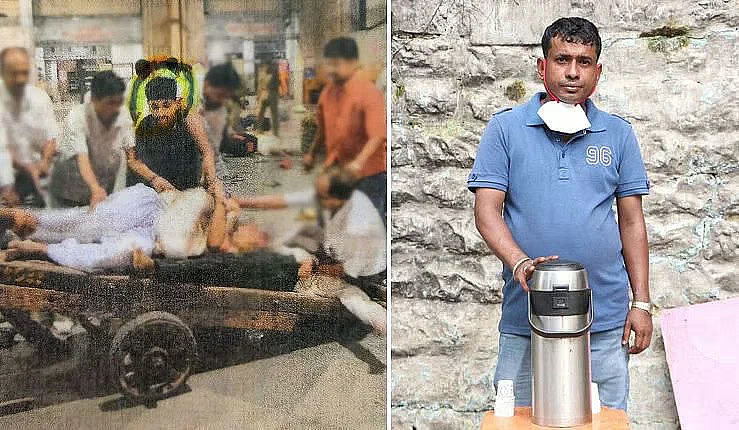
Sheikh, who took the injured from CSMT’s long-distance section on a hand-cart to St George’s Hospital while Ajmal Kasab and Ismail Khan were still targeting people in the suburban section of the station, had not only seen his life’s savings disappear during the lockdown, but also a debt of over Rs 3 lakh accumulate.
Sheikh had a narrow escape in the 26/11attack. He was standing outside the station master’s cabin when Kasab and Khan began firing. He hid in the cabin and played dead when Kasab came in spraying bullets.
source: http://www.mumbaimirror.indiatimes.com / Mumbai Mirror / Home> Mumbai> Crime> 26/11 Hero / by Sachin Haralkar and Vallabh Ozarkar / November 03rd, 2020
The famous chai wala is now grappling with a significant setback in his tea business, burdened by loans amounting to approximately ₹20 lakh.
Mohammad Taufik Shaikh | File pic
Mumbai:
Mohammad Taufik Shaikh, also known as Chhotu Chai Wala (38), gained recognition for his heroic actions during the 26/11 attacks when he saved around 10 individuals. Unfortunately, he is now grappling with a significant setback in his tea business, burdened by loans amounting to approximately ₹20 lakh.
Chottu chai wala’s heroic tale
Operating a tea stall near Saint George Hospital outside Chhatrapati Shivaji Maharaj Terminus, Shaikh was aged 25 during the Mumbai terrorist attack. Initially thinking the loud sounds were firecrackers due to an India vs South Africa cricket match, he soon realised the severity of the situation. Taking swift action, he closed the ticket counter gate, warned others, and evacuated the area, claiming he faced three bullets fired by Kasab.
Recalling the incident, he mentioned, “The first bullet broke the office window, the second hit the table, and then I had to lie down on the floor. Later, I called my wife, telling her I was in danger and might not survive. I contacted the Railway police on the phone.”
He continued, “After some time I came out of the station and saw people lying on the floor, bullets had hit them. I carried those who were alive.” He also assisted an injured officer and admitted him to the Railway Hospital in Byculla.
The subsequent pandemic dealt a severe blow to his business, almost shutting it down. To survive, he borrowed money, accumulating a debt of around ₹20 lakh. Despite attempting to mortgage his MHADA home, banks refused to provide loans. Struggling, he shared, “Currently, I am doing my business on credit.”
Financial support promised post 26/11
Post the 26/11 incident, promises of financial support poured in, with many railway officers assuring him of a job. Despite being felicitated by the Railway in Delhi, he realized later that the job offer never materialized.
Reflecting on the experience, Shaikh emphasized the need for individual alertness, stating, “Terrorists do not have any religion, they have the mentality to die or to kill people. I pray that an attack like this never occurs again.”
Residing in Nahur with his family, Shaikh came to Mumbai at an early age from Mujhaffarpur, Bihar, due to financial difficulties after losing his mother.
source: http://www.freepressjournal.in / The Free Press Journal / Home> Mumbai / by Megha Kuchik / November 23rd, 2023