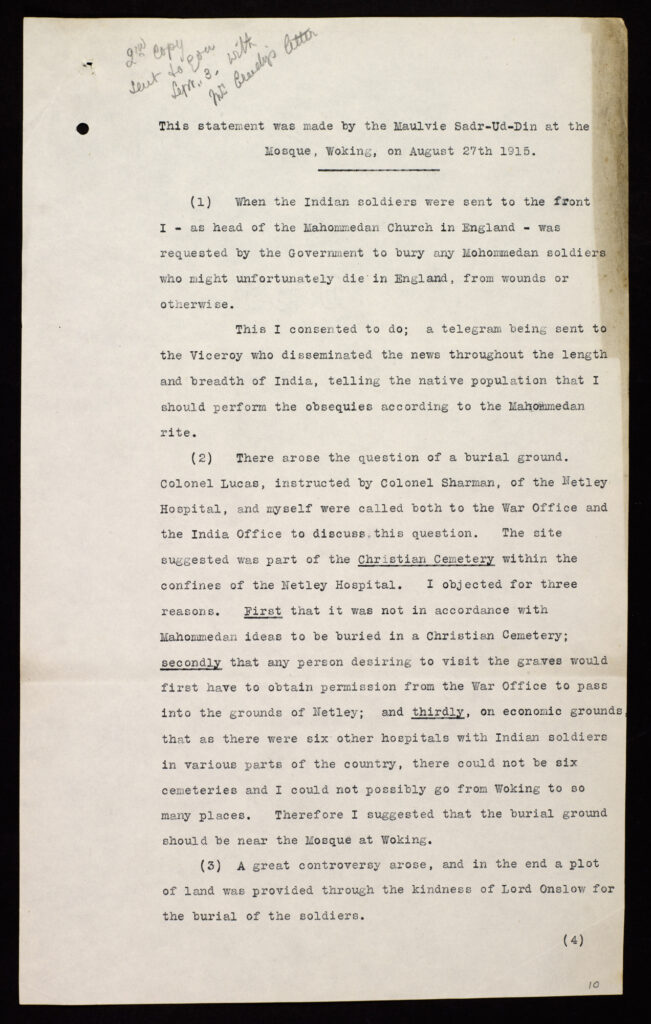
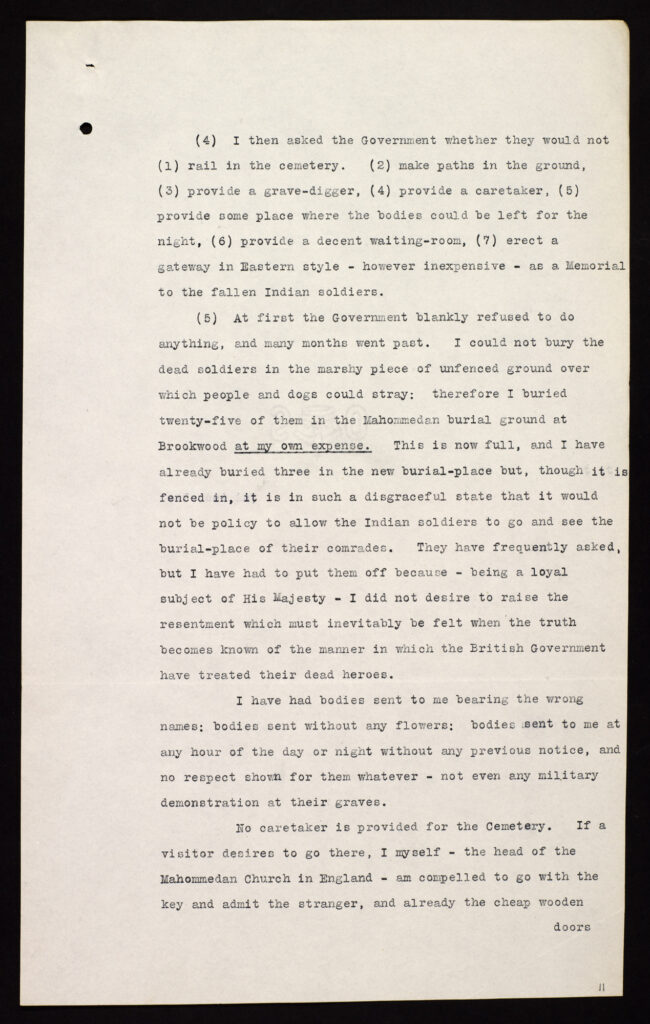
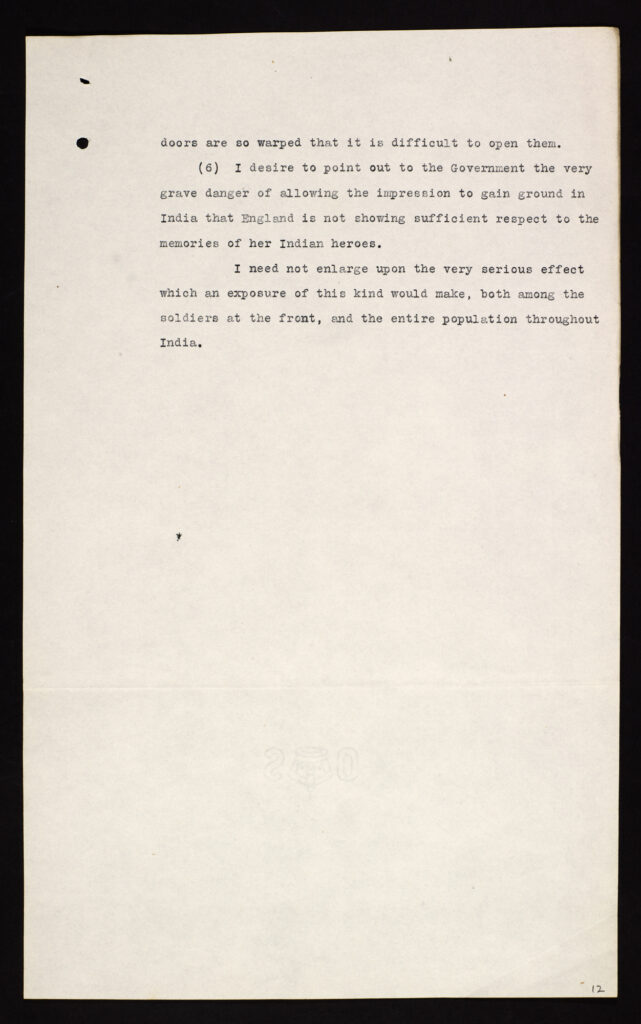
This statement, made by Maulvi Sadr-Ud-Din, provides an insight into the treatment of Muslim Indian soldiers who had fought during World War One and died in hospitals in Britain. Sadr-Ud-Din, from the Shah Jahan Mosque at Woking, was charged with overseeing their burial in England.
What does the statement reveal?
From 1915, there were nine sites in the South of England set up specifically for the treatment of wounded Indian soldiers. This included the Dome Hospital in Brighton and the convalescent camp at Barton-on-Sea. These were hospitals of high standards with up-to-date medical facilities, as well as services dedicated to catering for every religious need.
The Maulvi’s statement, however, raises issues with the posthumous treatment of soldiers who died in these hospitals. He states that the bodies of Muslim soldiers were often sent to him with the wrong name; without flowers; or with no provision for a military demonstration at the grave. Although Sadr-Ud-Din had been allocated a plot of burial land at Woking on Horsell Common, he describes it being in a poor state and maintains that his requests for improvements have been ignored.
Sadr-Ud-Din warns of the ‘grave danger of allowing the impression to gain ground in India that England is not showing sufficient respect to the memories of her Indian heroes’. His concluding words hint at the unease in Indian-British relations at this time and, in particular, the growing nationalist movement which was campaigning against British rule. In response, the government – in a public-relations exercise – commissioned improvements to the burial site at Woking.
These improvements were led, in part, by the suggestions made in Sadr-Ud-Din’s statement. These included a permanent enclosure of the piece of land; making paths in order to distinguish between grave and ground; to employ members of staff in the everyday running of the cemetery; and to build three structures: a morgue, a waiting room and a gateway to not only simplify the burial process, but to also give the area precedence. The gateway, at Sadr-Ud-Din’s request, was designed ‘in Eastern-style […] as a Memorial to the fallen Indian soldiers.’
The majority of these requests were realised, although the morgue and waiting room were never built.
________
source:
Full title:Correspondence about Moulvi Sadruddin, Imam of the Woking Mosque, and the burial of Muslim soldiers in England.
source: http://www.bl.uk / British Library / Home> Collection Items / (This item I feature in ‘All South Asians in Britain Collections’ and ‘All World War One Collection Items’ / (date viewed July 09th, 2022)
Navabharat Night High School, considered the first night school in the country, has been serving society for last 8 decades.
Mangaluru :
As a high school boy, Khalid Mohammed used to often find illiterate people knocking on his doors to read letters for them. The visitors were mostly elderly and disadvantaged whose children had migrated from Mangaluru to Mumbai and elsewhere in search of greener pastures.
It was then that the young Khalid, motivated by Mahatma Gandhi’s call for adult education movement, decided to teach such people how to read and write. Mohammed, a tin maker in the neighbourhood who was also not educated, was generous enough to spare his courtyard for a few hours each day for the noble cause.
Five adults — Khader, Krishna, Kusappa, Rahiman and Mohammed himself — were the first students when the night school came into existence on March 15, 1943.
Buoyed by the good response, the next year Khalid started primary classes in a building opposite KRK Shet Building on BEM High School Road in Mangaluru and named it Noubahar Night School. Gradually, middle and high school classes were added. Later, during its golden jubilee celebration in 1992, the school managed to get its own three-storeyed building on Car Street.
Called Navabharat Night High School now, it is run by the Navabharat Education Society. Said to be the first night school in the country and the only one still functioning, it is celebrating 80 years of its existence this year. Khalid, who was an English teacher at Badriya High School for a while, later became the headmaster of the night school and continued in the same post till he passed away a few years ago. The school, which does not charge any fee from students, has seen a lot of transformation over the last eight decades.
During its initial years, the school got a stream of adults who did not know how to read or write. Later it started getting adults who had dropped out of schools due to financial constraints but wanted to complete their schooling to get a job or promotion. Those who study here write the SSLC examination by enrolling as private candidates.
The institution now has over 60 students, who are mostly children of labourers. Almost all these kids go to day schools, but also come to the night school as their parents are away at work in the evenings.
Dr Vaman Shenoy, president of the Navabharat Education Society, beams with pride when he says many students from here have gone on to become doctors, engineers, advocates and also are employed abroad. There was a time when the school used to brim with 250-300 students, who used to stand outside the doors and windows of classrooms to listen to lectures. Bicycles used to be parked on both sides of the narrow road in front of the school building in Bunder.
The school has not received any government grant since its inception and runs only on donations. “Our founder Khalid Mohammed’s son Dr AR Nazeer who is a professor at a university in Saudi Arabia, Dr Vinay Hegde of Nitte, Kind Foundation, Canara Foundation and others contribute to the cause,” said M Ramachandra, secretary of the Society. Ramachandra himself was a student at the school. He later became its manager before he became secretary. “I dropped out of school after Class 8 because of poverty. After a gap of five years, I joined the night school,” he says.
The free school has six teachers and two office staff. Dinesh Kumar, a clerk at Canara College, has been teaching at the night school for the last 25 years. “I wanted to contribute something for society and that is the reason I am here,” he says. He teaches at the school from 6 am to 8.30 pm. Varkady Ravi Alevoorya, the present headmaster, says they have not kept the count of the total number of students educated in the school, but it could be in thousands.
“The student strength has dwindled over the last few years as the government now lays a lot of stress on education and makes regular follow-ups on absentee students to bring them back. But we still keep our doors open as there may be people who still need our help,” he adds. The school has a computer centre and also teaches Yakshagana. Dr AR Naseer says the school belongs to the public and they need to take it forward.
“As a teenager, my father was drawn to Mahatma Gandhi’s adult education movement which led him to start this school. It was the first home for my father and he used to spend most of his time here,” he recalls.
source: http://www.newindianexpress.com / The New Indian Express / Home> Good News / by Vincent D’Souza, Express News Service / June 26th, 2022
There’s no stopping Jumaila Haris, a 38-year-old mother of three who is on a path-breaking journey of exploring and teaching heavy vehicle driving, reports Vishnuprasad K P.
Malappuram :
At 38, Jumaila Haris is on a mission to explore a new path. Well, not just to find a way forward in her life. Rather something that would break barriers and inspire women to unshackle themselves.
A mother of three, she recently obtained a heavy vehicle licence. Her next target is driving tanker lorries. And she wants to help fellow women improve their driving skills. The Marakkara resident has already set that process in motion in her area.
“I used to commute on private buses during my school days. The one thing that amazed me was the manner in which the mighty vehicles were controlled by the drivers. I made up my mind then that I would drive these big vehicles one day,” Jumaila says.
However, she had to wait two decades before her dream could be realised. “Some women believe marriage ends their freedom to strive towards their goals. But if you find a supportive life partner, marriage is not going to be a barrier in pursuing your dreams,” she says.
Putting her knowledge to good use, Jumaila has started helping other women gain the confidence required to take control of the steeringwheel in any condition. “Many women obtain driving licences after picking up the skills from a driving school. However, they won’t be able to drive through narrow roads, hilly areas, and roads that are chock-a-block. After completing training, they give me some fees that they are capable of providing. I am planning to help more such women,” she says.
She is set to apply with the motor vehicles department to acquire a licence to drive tanker lorries. “Driving tanker lorries will help me improve my skills further,” she says.Jumaila married Onathukkattil Haris in 2000. For the past six years, she has also been working as a volunteer at the palliative care centre under CH Centre, Marakkara.
She obtained a four-wheeler licence in 2009. “My husband was working in the Gulf. So I had to manage the family affairs mostly by myself. My driving skills helped me in many ways as I could move around on my own. I was also able to take the elderly people in my family to hospitals. Also, I doubled as a driver of the palliative centre when the regular driver went on leave,” she says.
Jumaila has three daughters, Fathima Rinsha, Fathima Gazal and Ayisha.
source: http://www.newindianexpress.com / The New Indian Express / Home> Good News / by Vishnuprasad KP, Express News Service / July 03rd, 2022
Over the past few years, and particularly after their recent tussle with the government over the statue of Bangabandhu Sheikh Mujibur Rahman, the Ulama’s involvement in politics has come back under scrutiny in Bangladesh. Since the 10th century, the Ulama have been exercising strong authority over religious issues; yet they have been accused of failing to respond to modernity and to the changes in society.
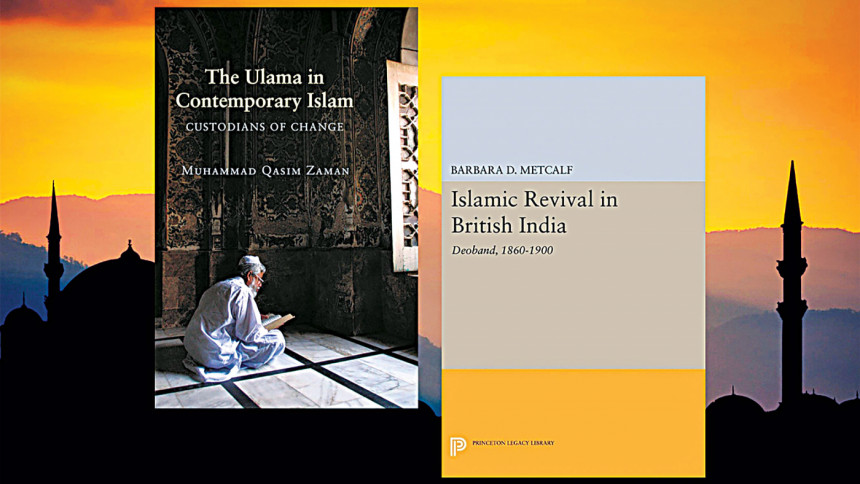
Against this backdrop, the actions, discourses, and history of the Ulama are well worth looking into. Muhammad Qasim Zaman’s The Ulama in Contemporary Islam: Custodian of Change (2002) and Barbara D Metcalf’s Islamic Revival in British India: Deoband, 1860-1900 (2016), both published by the Princeton University Press, are two outstanding studies in this regard. While Metcalf looks into the emergence, proliferation, and responses of the Deobandi Ulama to “modernity” when Muslim power in India was declining, Zaman looks at their strategy to establish authority in British India and Pakistan.
Shifting sands of influence
In pre-British India, religious education was a private enterprise and individual tutelage was the usual mode of the dissemination of religious knowledge. This tradition was to change with the emergence of the Farangi Mahall Ulama as custodians of Muslim intellectual traditions.
The Lucknow-based Farangi Mahall Ulama were known by the family of Mulla Hafiz, who received a land grant from Mughal Emperor Akbar sometime in the sixteenth century. He was the ascendant of Qutbu’d – Din (d. 1691), a Mughal courtier who participated in the collection of Fatawa-yi ‘Alamgiri’. The latter is a collection of Fatwa to be used in the Mughal courts. The family and students who took lessons from this family were known by the name of Farangi Mahall. The activities of the Ulama of Farangi Mahall, however, were confined to producing graduates for princely services. Their most significant contribution was their systemisation of the curriculum—dars-i-Nizami—for religious education. As Metcalf informs us, this curriculum came to Bengal when a Farangi Mahall graduate was appointed as the first principal of the madrasa yi ‘Aliyah’, Calcutta in 1780.
Farangi Mahall’s dominance declined and the centre for religious studies shifted from Lucknow to Delhi by the late 18th century. The person who played a key role in this shift was Shah Waliyu’llah, who advocated for more social and political responsibilities for the Ulama as opposed to those of the Farangi Mahall. Waliyu’llah’s successors had studied legal codes and written fatwa for the Muslim community, which had once become the main tool to disseminate religious instructions when the British were about to establish political authority over India. Besides claiming centrality of the hadith in the interpretation of the sharia, Shah Waliyu’llah discouraged blindly following the rulings of the earlier generations (taqlid). He suggested going back to the Quran or Sunnah for legal solutions.
The 1857 revolution landed heavily upon the revivalist movement initiated by Shah Waliyu’llah. Suspecting the Ulama’s involvement, British colonisers took all religious institutions in Delhi under their control. Fourteen hundred people were shot by British soldiers in Kuchah Chelan, where Shah Abdul Aziz (son of late Shah Waliyu’llah) used to preach, according to Metcalf. The Delhi-based Ulama were forced to move to the countryside and establish a madrasa at Deoband in 1867.
After the revolution, Deoband became the centre for Muslim intellectuals. They introduced formal religious education for Muslims in British India. Students had separate classrooms and a library, and the curricula were organised according to departments, such as Arabic, Persian, and others. A formal examination system was introduced and successful students were issued certificates of award. Graduates came from different corners of India. Most significantly, these graduates went back home and set up madrasas in their respective localities. By the end of the 18th century, nearly every town held the presence of the Deobandi Ulama.
One well known Deobandi Ulama was Muhammad Ashraf Ali Thanawi (1863-1943), who authored Bahishti Zewar (1981)—among the most popular books for Muslims of India, and masterminded the Dissolution of Muslim Marriages Act 1939—the first reformist legislation for Muslims of British India.
In the late 19th century, the Ulama played a crucial role in upholding the pride of their religion and their community through publications and public debate on religious issues. Their intellectual exercise peaked with the invention of print technology, multiplying the scale of the transmission of knowledge all over India. Publishing in local languages such as Urdu, instead of Arabic, was one of their effective strategies to establish authority. This also served as a medium of communication between common Muslims and the Ulama, and helped renew Muslim traditions against local customs. Following the birth of Pakistan on August 14, 1947, the Ulama consolidated their authority and forced the then government not to pass a law against sharia. Over the next few years, their continuous efforts would force the Pakistani government to establish a Supreme Sharia Board to oversee any inconsistencies between sharia and laws passed by the parliament.
The historiography of these two books may be compared with Geoffrey G Field’s Blood, Sweat and Toil: Remaking the British Working Class, 1939-1945 (Oxford University Press, 2011), in which Field understands “class” from multi-dimensional approaches including its relationship with the state, society, and family. Similarly, Barbara Metcalf and Qasim Zaman define the Ulama as a class by providing a social and intellectual history of their presence in South Asia. Metcalf highlights their hardships in the post-1857 revolution and the silent “intellectual” revolution of the Deobandi Ulama. Hers is an excellent cultural history. Despite being published earlier, Zaman fills in what Metcalf’s study left to be addressed: it focuses on how the Ulama have played an active role in different social and political contexts, particularly in post-colonial Pakistan. He disapproves of the allegation that the Ulama are against changes. The common mistake that most studies make, says Zaman, is not to consider the social and political context within which the Ulama work. To him, the flexibility of sharia depends on a socio-political context. Zaman suggested that the Ulama do not respond to changes as not because they do not like it but because of their fear of losing authority over religious issues in a modern state.
None of the above-mentioned studies, however, concerns the Ulama of Bangladesh. The growing presence of the Bangladeshi Ulama in the public sphere, particularly their increasing involvement in the political issues, merits investigation into—in Zaman’s words—their “transformation, their discourses, and their religio-political activism.” Could the Ulama in Bangladesh inherit the wind of the Islamic intellectual traditions? The question deserves to be addressed amongst others.
Dr Md Anisur Rahman is a legal historian at Asian University for Women. His research interests include Islam in Asia and South Asian Islamic Law and Society.
source: http://www.thedailystar.net / The Daily Star / Home> Reviews / by Md. Anisur Rahman / January 28th, 2021
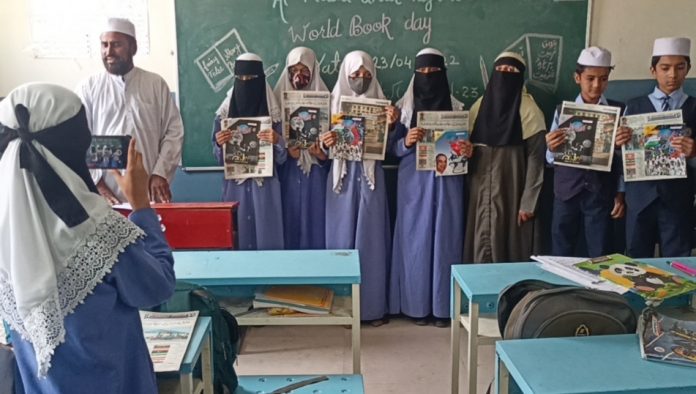
On World Book Day, the Maryam Mirza Mohilla (neighbourhood) library movement commemorated the occasion with zeal. Several book reading and distribution activities were held in city mosques and Urdu schools under the auspices of the Read & Lead Foundation.
The Foundation’s President, Mirza Abdul Qayyum Nadvi, announced the commencement of a “Book at Home, Book at Every Home” campaign at the event. He stated that the book-reading awareness campaign is only getting started because today’s young generation is losing interest in reading due to the introduction of new electronic gadgets, particularly smart phones
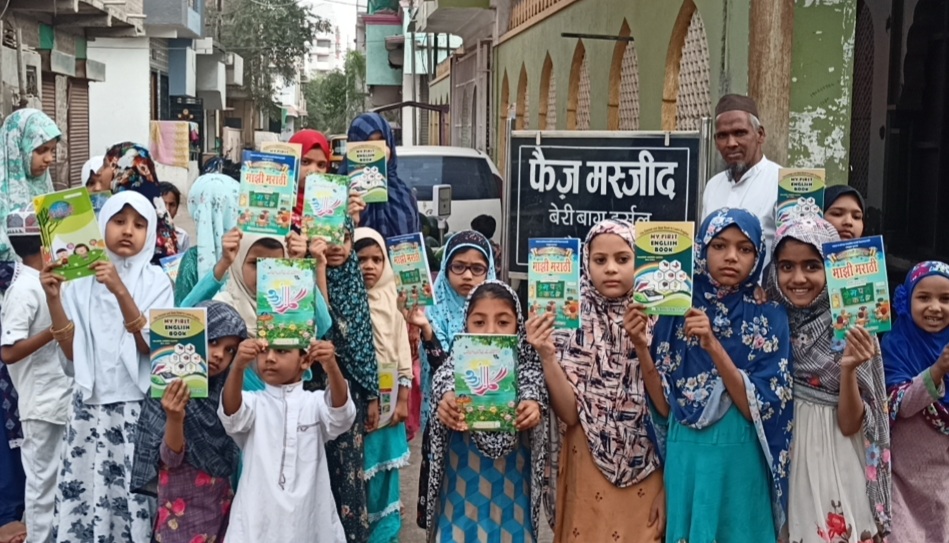
Urdu, Marathi, English books were distributed to the children members of Maulana Syed Abul Hassan Ali Nadvi Mohalla Library situated in Masjid Faiz Beri Bagh, Harsol area of Aurangabad.
It should be noted that for the past year in Aurangabad, 28 libraries have been working under the aegis of the Read & Lead Foundation in various sections of the city, slum mosques, Urdu schools, and neighbourhoods. More than 5,000 children are connected to these libraries.
It’s worth noting that eleven (11) of the 28 libraries are dedicated to children are located in mosques. Masjid Shadab Hina Nagar, Ahmadi Masjid, Shatabdi Nagar, Maulana Hasrat Mohani Mohalla Library, Misrarwadi, Qazi Iqbaluddin Mohalla Library, Bismillah Masjid, Madrasa Falah Darin Ghulam Mustafa, Sher Khan Pathan Mitra Mandal Library, Narey Village Mohalla Library and other places. In addition to this, Al-Huda Urdu High School Baijipura, Dr. APJ Abdul Kalam Mohalla Library Baijipura and other libraries celebrated World Book Day.
Maulana Sheikh Yusuf Nadvi, Imam of Masjid Faiz, where the Maulana Syed Abul Hassan Ali Nadvi Mohalla Library is located, stated that he would do everything in his power to ensure that the library benefits the children and women of the area as much as possible. After Friday prayers, he also declared the start of the door-to-door book drive.
Sheikh Nargis Fatima, Headmistress of Al-Huda Urdu High School, stated that her school’s students and instructors would be more active in the campaign and would offer all available assistance. Farhat Jahan, a school teacher, and other teachers took part in the presentation and offered their opinions..
Children’s monthly periodicals such as “Bachu ki Dunia,” “Umang,” “Taleemi inquilab,” “Majhi Marathi,” “Meri English Kitab,”,” “Gulzar Urdu,” and other books, magazines, and journals were distributed to members of the aforementioned libraries.
source: http://www.muslimmirror.com / Muslim Mirror / Home> Positive Story / by Special Correspondent / April 26th, 2022
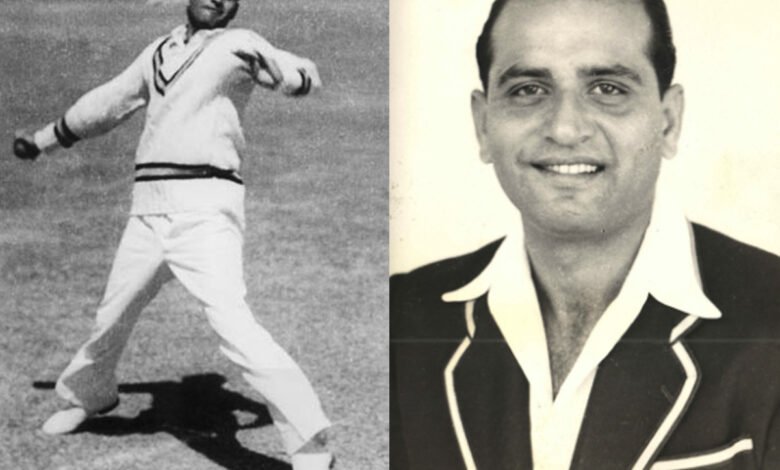
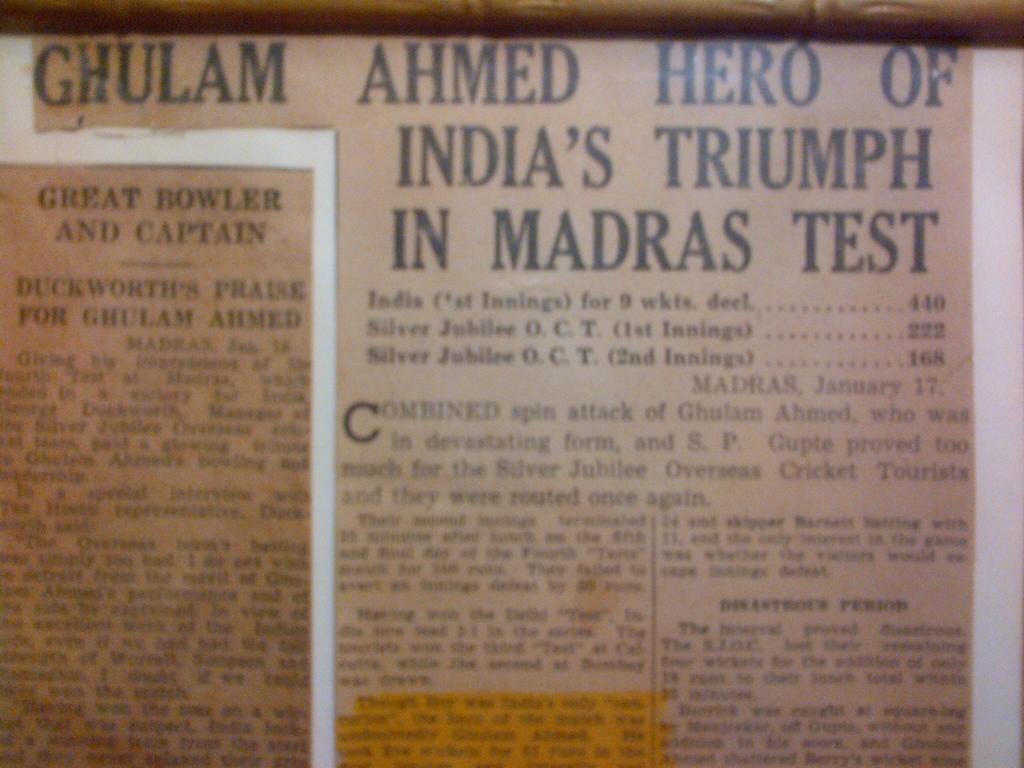
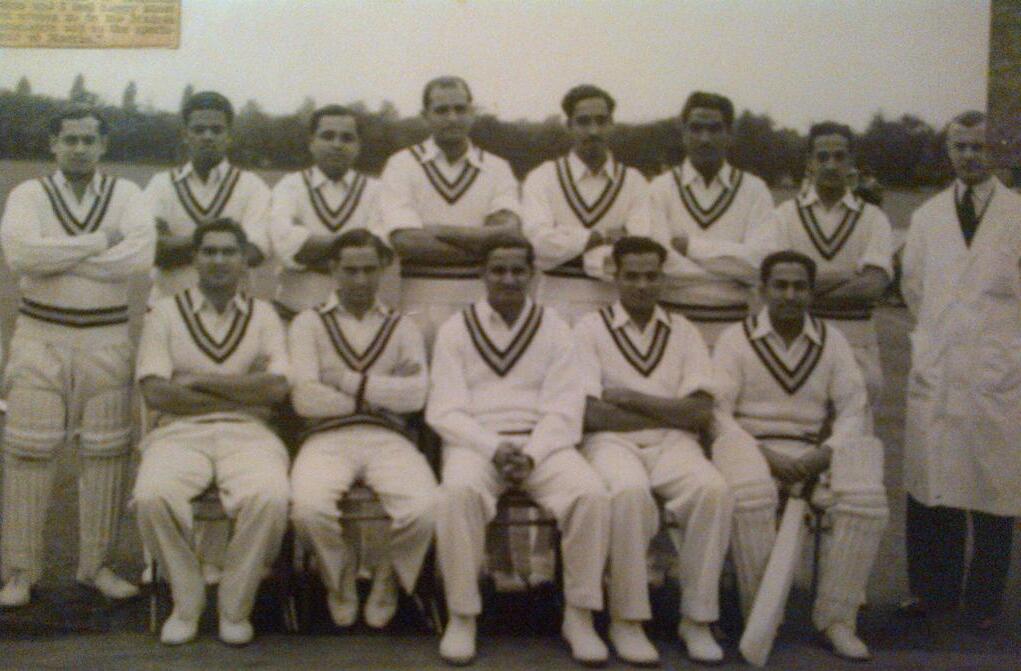
The contribution of Ghulam Ahmed to cricket in Hyderabad and India is extremely difficult to quantify in mere words.
He was a legendary player, inspirational leader, far thinking administrator and a very capable manager. Whichever role he played, he did so with a measure of excellence that was unmatchable. The Greek philosopher Aristotle once said: “Excellence is never an accident. It is always the result of high intention, sincere effort and intelligent execution. Choice, not chance, determines our destiny.” The words can be applied most aptly to the life and career of Ghulam Ahmed, one of Indian cricket’s most accomplished off spinners and administrators, whose 100th birth anniversary falls on 4th of July, 2022.
But any person who knows about the family from which Ghulam Ahmed emerged, will not be surprised by the fact that this gentleman cricketer achieved so much in his lifetime.
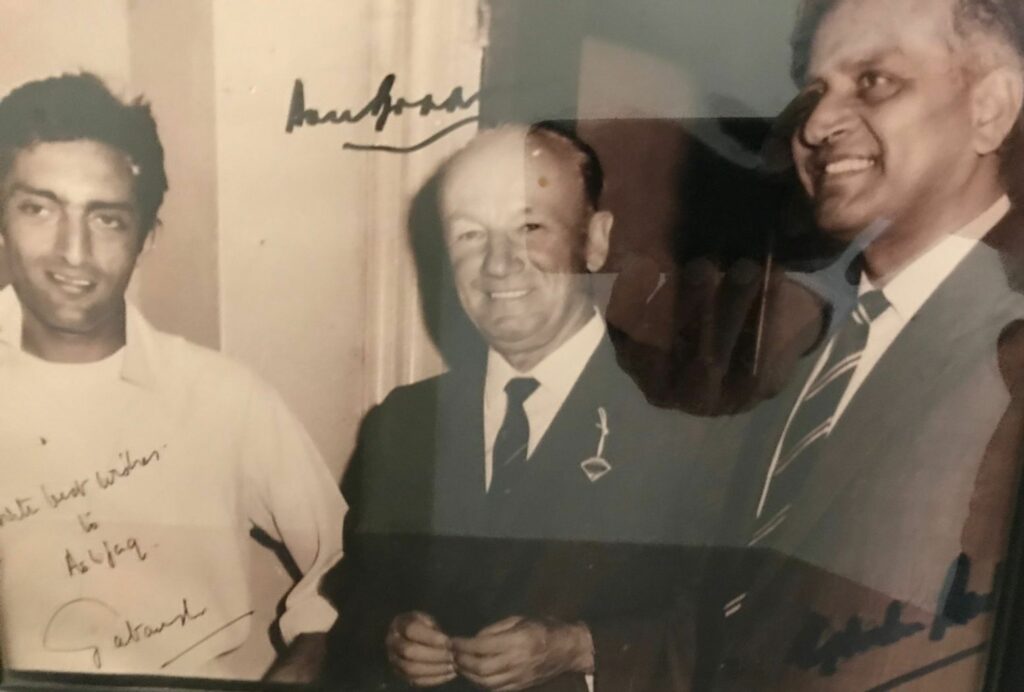
In a way, this illustrious family can be called the first family of Hyderabad sports. Others who are connected to the Razvi family are Pakistan’s former captain Asif Iqbal, India’s former captain Mohammed Azharuddin and tennis champion Sania Mirza. Since Sania’s husband is an ace Pakistan cricketer Shoaib Malik, he too is connected to this family by marriage. So that makes it two captains of India, two captains of Pakistan and a tennis Grand Slam winner in doubles and mixed doubles, all belonging to or connected to one family.
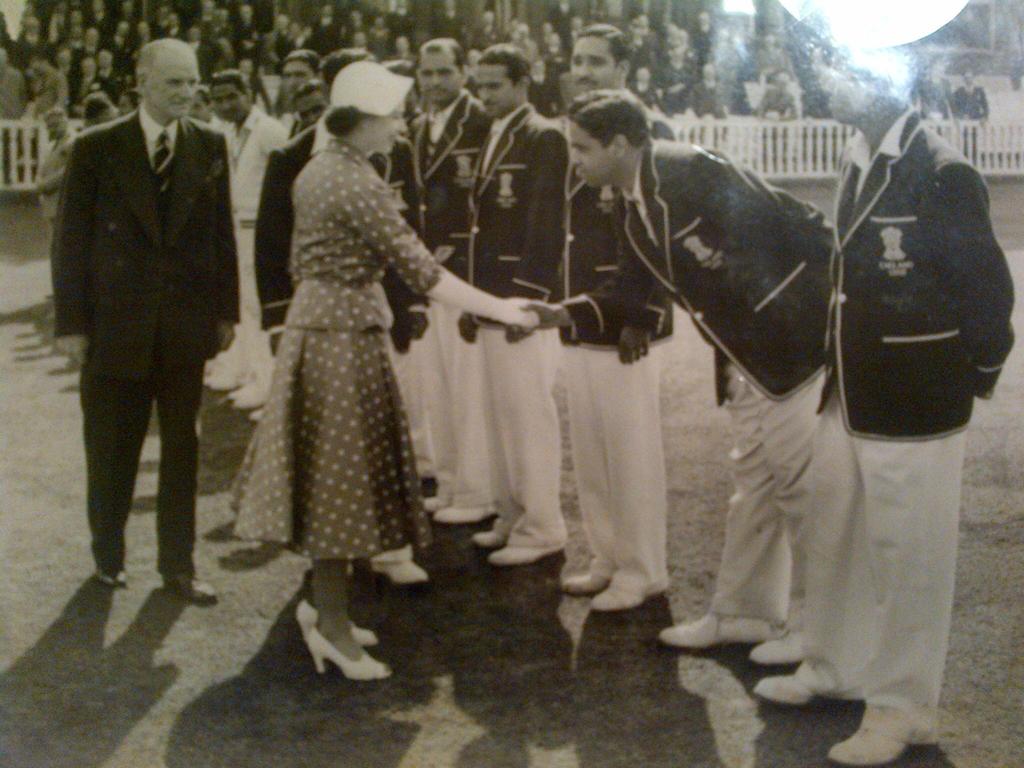
Ghulam Ahmed meets the queen
We all know about the famous off spinner’s exploits on the cricket field. But what was he like as a person? Was he a disciplinarian or was he indulgent? Was he a strict parent or a friendly person who could be addressed as Dad? After siasat.com spoke to several persons who knew him well, an interesting picture emerged.
Apparently Ghulam Ahmed was a person whose character and conduct were unblemished. It was his most outstanding trait. He was painstakingly honest and fair in his thought and judgement. If he made a decision, everyone would accept it because they knew his reputation for being impartial and equitable. As a parent he was not the old fashioned taskmaster. Instead he obtained the love, affection and friendship of all his children. As a person he stuck to his principles but did so with a measure of kindness and tact that earned the willing cooperation of his colleagues.
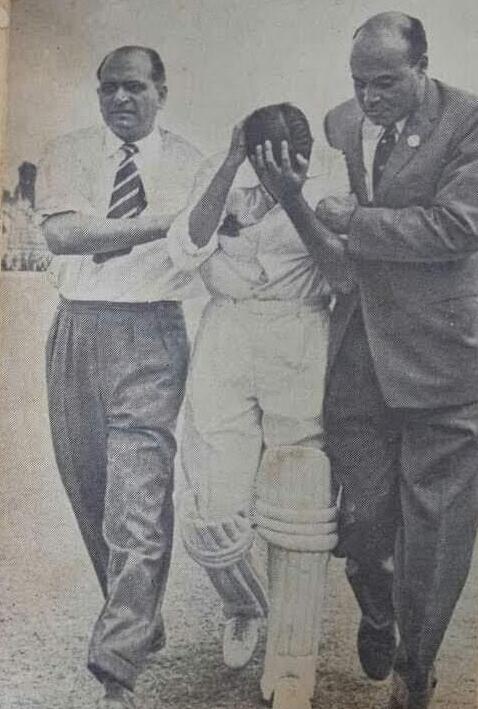
When Nari Contractor was injured
He hailed from a family wherein the male members had mostly served in the civil services. Ghulam Ahmed himself chose the same path. He was the chairman of the A.P. Public Service Commission and then also the Hyderabad Race Club. He handled sensitive issues with graceful prudence. He had a large group of friends and was well loved and respected by all. Often there would be large gatherings of his friends at his house. The men would play cards and sometimes go out on hunting trips which was a popular pastime among young men of those days.
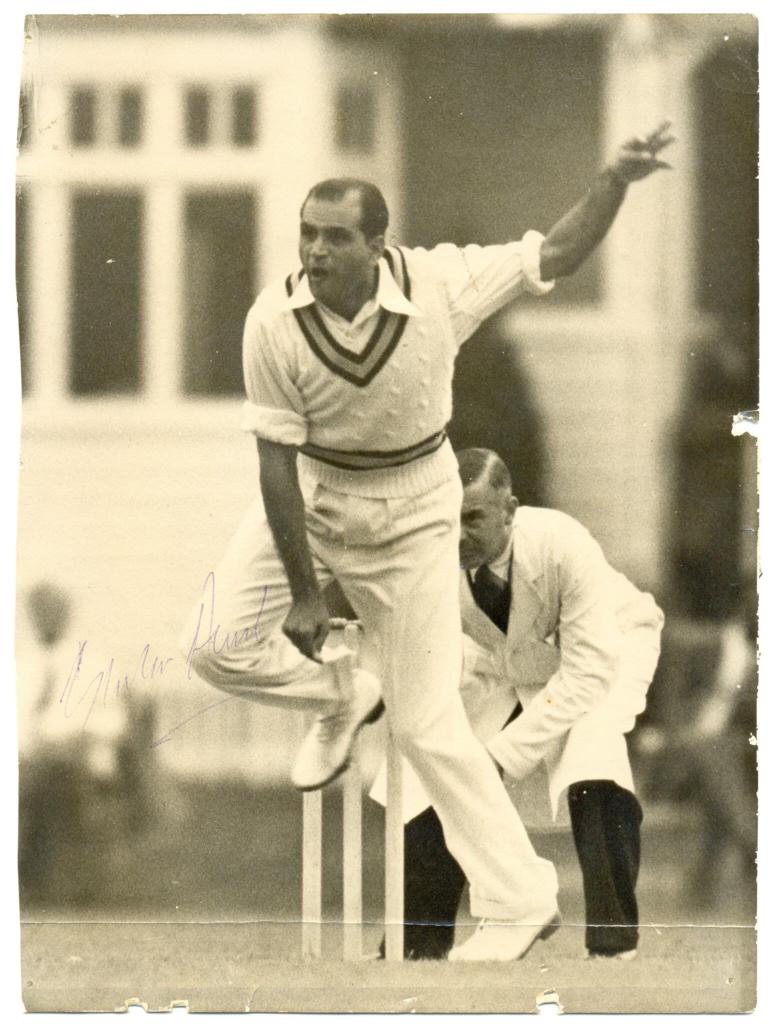
Ghulam Ahmed studied at the famous Madrasa-E-Aliya and then at Nizam College. In his cricket career, his seniors were the well known brothers S.M. Hussain and S.M. Hadi. The latter was an all round sportsman who excelled at many sports while the former was a member of the Indian cricket team. When he was a raw beginner, he once sought permission to bowl against Hussain. After he was allowed to do so, he bowled the experienced batter with his very first delivery leaving Hussain highly impressed.
Later Ghulam Ahmed grew up and became a very renowned player himself. He grew to be very close to some of the most famous names of those days. They often dropped in at his house. Cricket administrators such as M.A. Chidambaram, M. Chinnaswamy and Kishan Rungta visited him regularly.
The legendary Lala Amarnath, Test cricketers C.D Gopinath, Hemu Adhikary and Polly Umrigar – all these people used to visit his house.
Later, Ghulam Ahmed also served as a cricket administrator both in Hyderabad as well as the BCCI.
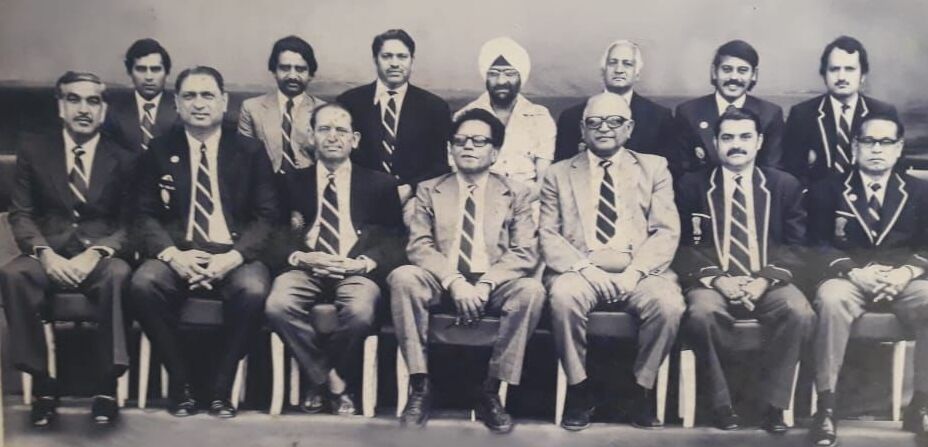
Besides serving as the Secretary and Vice President of the BCCI, he was the Chairman of the BCCI selection committee which selected the Indian team that won the World Cup in 1983. He was also given honorary membership of the prestigious Marylebone Cricket Club (MCC).
When Ghulam Ahmed passed away after a long and illustrious life, encomiums flowed in from all parts of the world.
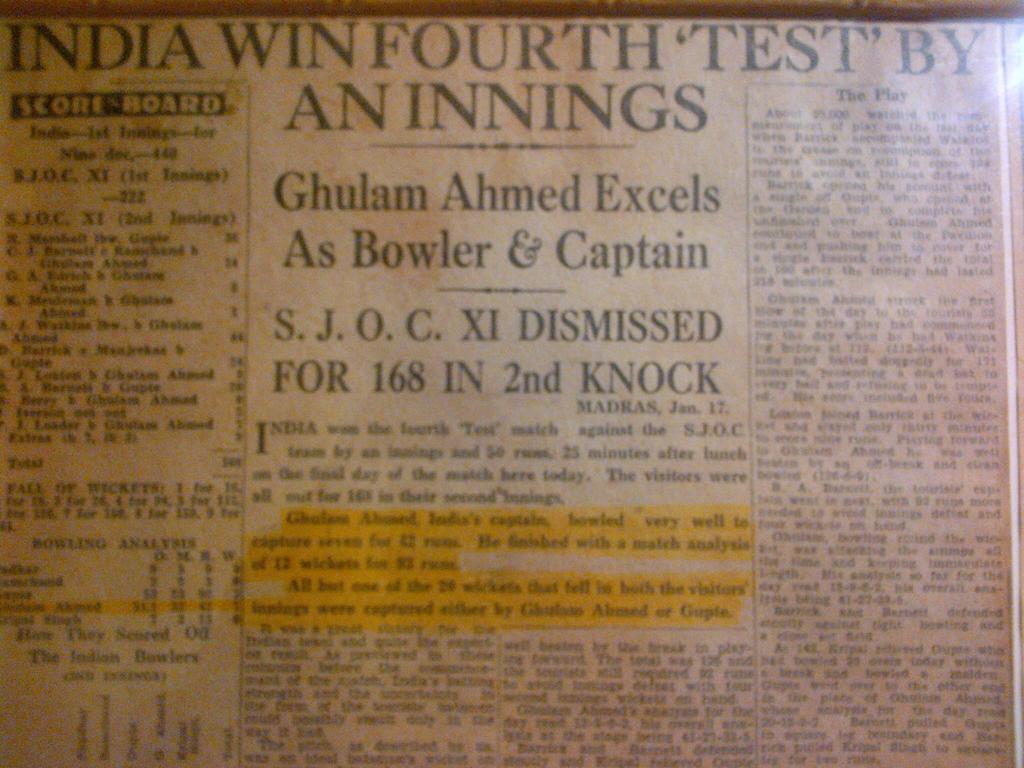
This is what The Independent (UK) wrote: “His smooth action enabled him to bowl for long spells while his clever flighting and variations of pace, length and line brought him comparisons with Jim Laker. He made his debut at 17 for Hyderabad but the second world war interrupted his further progress so that he did not appear in Test cricket until 1948 when he was chosen for the third Test against West Indies in Calcutta. He captained India against New Zealand in 1955 and also twice against the West Indies in 1958-59.”
In Shakespeare’s play Caesar, the character of Mark Antony says about his dear departed friend: “Here was a Caesar! When comes such another?” Meaning that Rome will probably never have another outstanding and upright personality like Caesar. The same can be said of Ghulam Ahmed. Like Caesar, Ghulam Ahmed too can never be replaced. His 100th birth anniversary is an occasion to remember with pride and affection, the excellent achievements of the man who was the first cricketer from Hyderabad to lead the nation in the international cricket arena.
source: http://www.siasat.com / The Siasat Daily / Home> News> Sports / by Abhijit Sen Gupta / July 04th, 2022
Shabnam Riyaz, a Malayali qawwali singer, enthralled audience at the World of Women event underway at Kovalam Art and Craft Village.
Kochi:
Qawwali music imbibes the essence of Sufism. The ecsatcy that audience enjoy when the qawwals sing at a gathering is unexplainable. Although the genre has been traditionally male-dominated, Malayali playback singer turned qawwal Shabnam Riyaz is quite popular among the country’s Sufi singers. Recently, she performed at a qawwali concert in the ongoing World of Women (WoW) 2022 event at the Kovalam Art and Craft Village.
Her all-woman qawwali group Layali Sufiya showcased an energy-packed performance.
Shabnam says fusion helps audience relate more with the qawwali genre. Thrilled to be back on stage after the pandemic-induced lull, Shabnam, who is an ardent fan of Ustad Nusrat Fateh Ali Khan, says pure rendition of qawwali music is quite rare in Kerala, though it is common in northern India.
“Though I perform qawwali fusion for my audience, I focus more on traditional pieces. Most people hear Sufi music and think ghazals. Qawwali is an ecstatic form of music infused with divinity,” she says. Qawwalis often showcase vibrant, physically exhilerating performances, that many audience find bizzare. “I have seen many trolling popular Sufi singers, the Nooran sisters. But when you devote yourself to qawaali, it is hard to control your moves,” adds Shabnam who also offers Sufi music classes. She belives Sufi music was passed down to her from her great-grandfather, Vavaasan, a bhagavatar in Kollam who excelled in qawwalis.
The Ochira native has been living in Thiruvananthapuram for over a decade now and was the trainer for Khateeja, A R Rahman’s daughter.
According to Shabnam, there are very few qawwals still, because it is a strenuous style of singing. “After a performance, we may need at least three days of voice rest. Many girls who approached me lacked the stamina for it,” adds Shabnam whose dream is to create qawwali music using Carnatic compositions. She is the voice behind popular tracks like Vennila Chandanakinnam and Shukira.
source: http://www.newindianexpress.com / The New Indian Express / Home> Cities> Kochi / by Arya U R, Express News Service / March 12th, 2022
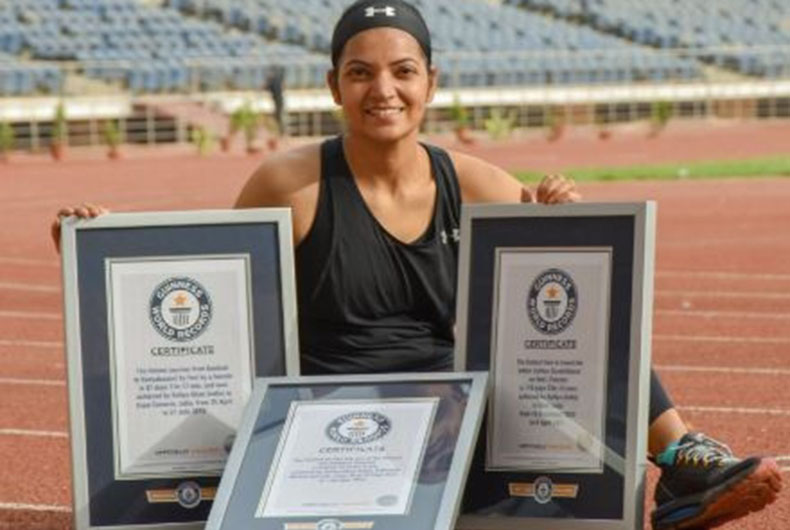
Calling it ‘The Tribute Run’, Sufiya Sufi is dedicating this challenge to the Bravehearts of the Indian Army.
Guinness record holder Sufiya takes on Siachen to Kargil run; to salute sacrifices of Indian Army.
New Delhi:
Indian Ultrarunner Sufiya Sufi ‘Runner’ is no stranger to challenges. After entering the Guinness Book of World Records for the third time earlier this year, Sufiya is now set for her next challenge — a run from Siachen Base to Kargil War Memorial.
Calling it ‘The Tribute Run’, she is dedicating this challenge to the Bravehearts of the Indian Army who have made unmatched sacrifices for our country. The 7-day-long expedition will begin at Siachen War Memorial on July 17 and conclude at Kargil War Memorial, on July 23, ahead of the 23rd Kargil Vijay Diwas.
During the 470 km long expedition, Sufiya will navigate through difficult terrain and hostile conditions. The run will begin at an altitude of 3400m, reaching up to 5359m at Khardung La with oxygen levels dropping 40 to 60 percent and temperature dipping much below zero degrees.
Commenting on her upcoming run, the Under Armour athlete said, “Ever since I have taken up the discipline, I have worked continuously towards pushing my limits and encouraging more people to take up running.
“My upcoming run is special and close to my heart and through this run, I want to pay tribute to the deeds of our soldiers and their selfless service to our nation.”
“As I prepare for this run, I have a great team, be it my coaches or Under Armour, who have supported and motivated me to take up every challenge including this expedition. I have put in the work training continuously for the past 6 months.”
In 2018, Sufiya took up running to break away from her aviation job, to relax and de-stress. Since then, she has entered the Guinness Book of records three times and has set several benchmarks for ultrarunning in India.
She holds the records for covering the Manali-Leh stretch on foot in the year 2022, the fastest time by a female to complete the Golden Quadrilateral in 2021, and the fastest woman to traverse from Kashmir to Kanyakumari in 2019. Sufiya has been an Under Armour Athlete since her first big achievement in 2020.
source: http://www.ummid.com / Ummid.com / Home> Life & Style / by IANS / June 28th, 2022
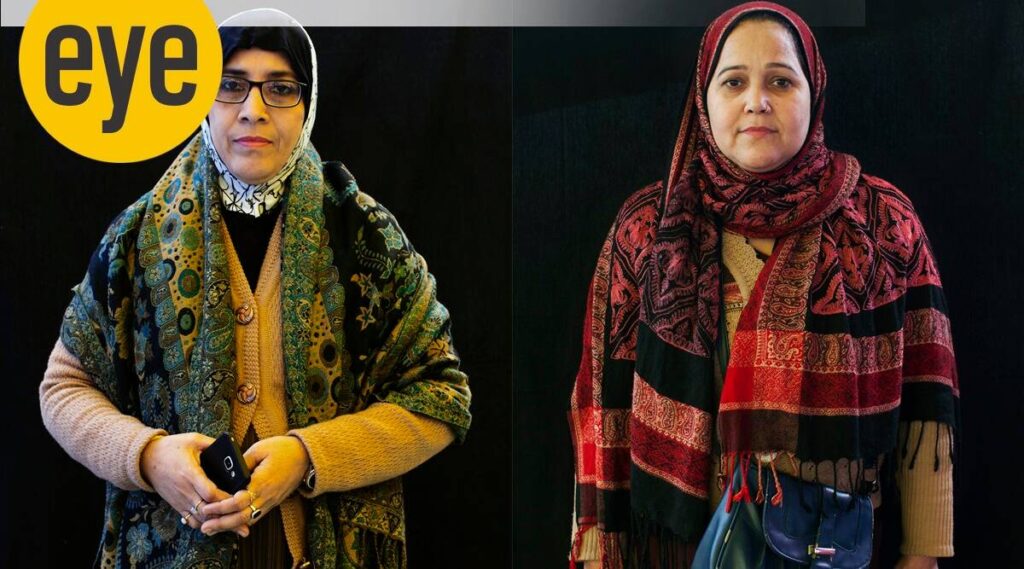
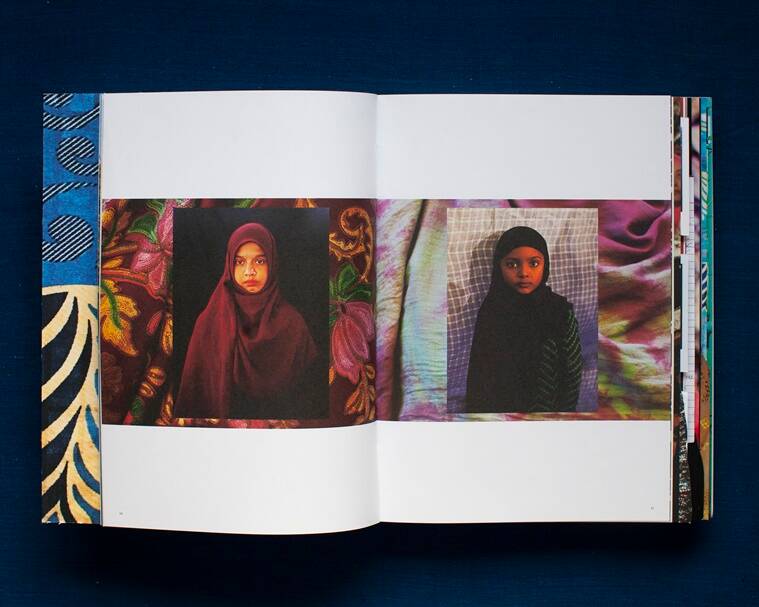
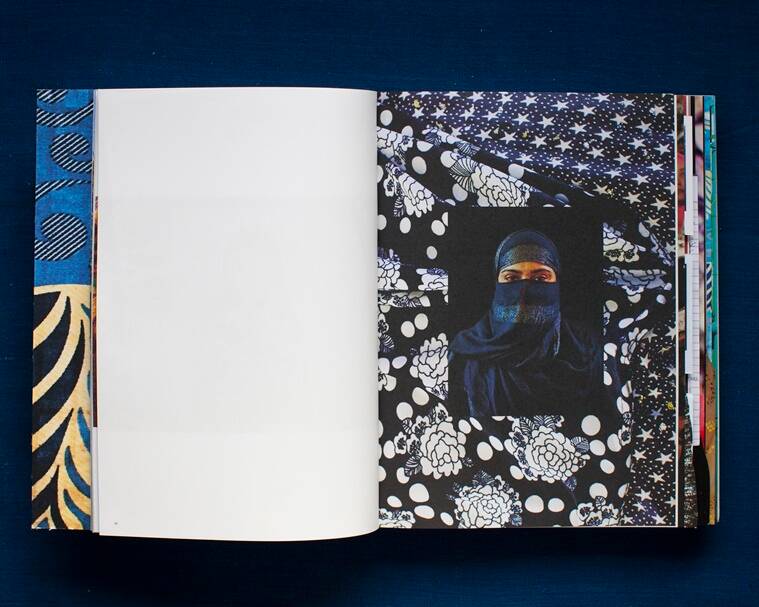
The photo-book ‘Har Shaam Shaheen Bagh’, comprising visual stories of resilience and resistance, isolates individuals from the image of the mass movement as was seen on prime-time news and press photographs.
Portraits from Har Shaam Shaheen Bagh (Credit: Prarthna Singh)
Who is the perfect protester? We imagine raised fists, hurt faces, angry stances. We imagine climbing barricades, braving tear gas. If we go by this visual vocabulary, Har Shaam Shaheen Bagh (Every Evening Belongs to Shaheen Bagh) takes us by surprise. With over 150 portraits of non-violent protesters, the photo-book gently challenges the imagery of contemporary resistance movements.
Har Shaam Shaheen Bagh is Mumbai-based photographer Prarthna Singh’s first solo photo-book (she had earlier teamed up with the authors of Sar: The Essence of Indian Design in 2016). In December 2019, after the Delhi police reportedly assaulted students of Jamia Millia Islamia University who were challenging the Citizenship Amendment Act (CAA), a sit-in protest led by Muslim women started in Shaheen Bagh. Under a tent, with hundreds of women and children on any given day, the peaceful protest lasted for 100 days, until the pandemic struck.
Har Shaam Shaheen Bagh; By Prarthna Singh; 143 pages; Rs 3,300
Singh joined the anti-CAA protest in January 2020, spending most of her time on ground. Known for her women-centric narratives and portraiture work, she taps into her speciality to create portraits in an on-site photo studio, cobbled together with whatever was available at Shaheen Bagh. The result is these portraits of women, either looking directly at the camera or away, but always with a sense of pride. Poised and calm, the unnamed sitters indicate trust in the space, the purpose and the photographer.
Har Shaam Shaheen Bagh is Mumbai-based photographer Prarthna Singh’s first solo photo-book (she had earlier teamed up with the authors of Sar: The Essence of Indian Design in 2016).
Our collective memory of Shaheen Bagh, as is often the case with resistance movements, is of the masses, as seen on prime-time news and press photographs. Indeed, mass resistance movements give rise to the most recognisable images in the documented history of the world. Vulnerability and resilience coalesce into one defining moment — people standing up to power and confrontation, whether it’s one man blocking a row of tanks or a girl offering a flower to an armed soldier. Har Shaam Shaheen Bagh trades the monumental for the intimate, asking us to reconsider what we mean by “iconic”. It isolates individuals from the sea of faces, almost as if to say that a movement’s power lies not in numbers but in the will of its people.
Har Shaam Shaheen Bagh takes the form of a personal diary or a scrapbook.
Har Shaam Shaheen Bagh takes the form of a personal diary or a scrapbook. It contains drawings, a painting by artist Sameer Kulavoor, whose company Bombay Duck Designs has also designed the book, verse and a letter from one of the protesters, available in Urdu, English and Hindi. Some pages are deliberately uneven, recalling the makeshift quality of the Shaheen Bagh tent. While the book’s cost makes it inaccessible to some socioeconomic groups, Singh has shared copies with the protesters. A portion of the book sales goes towards Jeevan Stambh, an NGO working on the rehabilitation of the victims of the Jahangirpuri demolition last month.
During the pandemic, the Delhi police cleared the Shaheen Bagh site, painting over its graffiti and dismantling its art installations. In a country that is determined to erase and rewrite its history, one could say that a photo-book on a citizen protest is as good as an act of protest itself.
source: http://www.indianexpress.com / The Indian Express / Home> Books & Literature / by Benita Fernando / New Delhi – May 21st, 2022