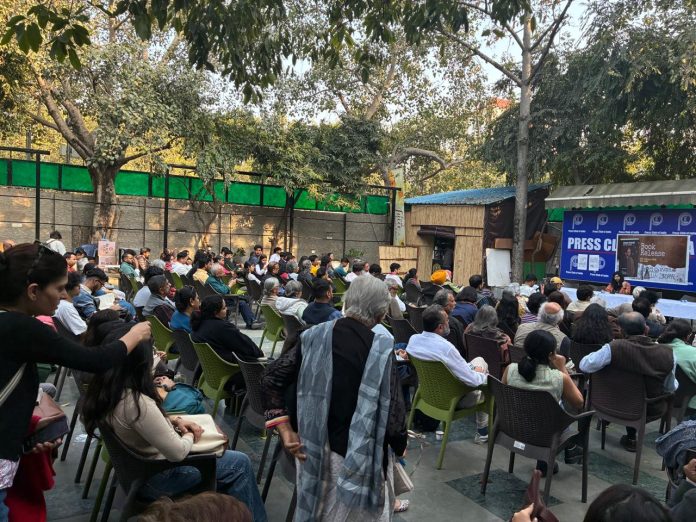
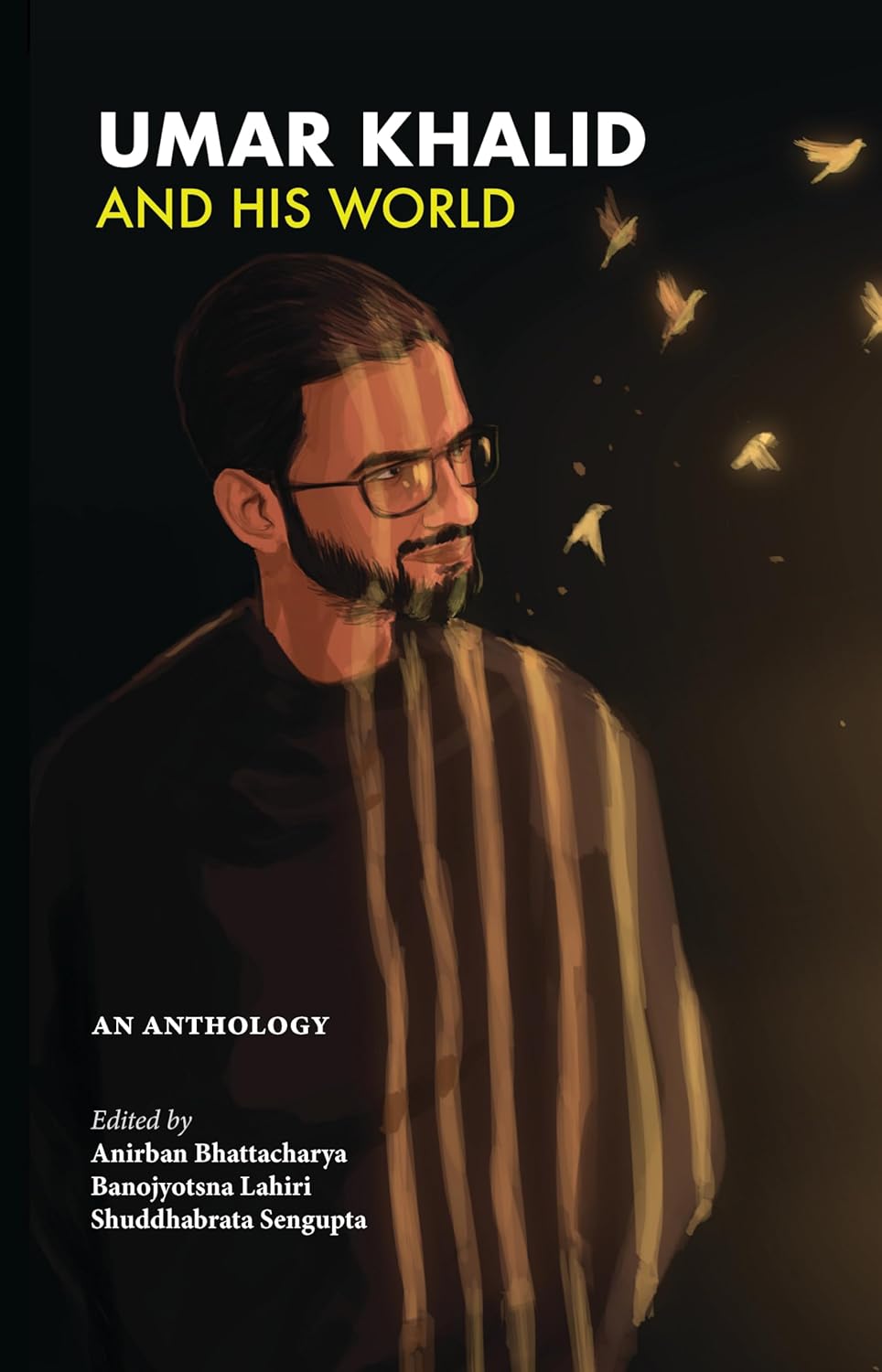
An overflowing audience of the young and the very old at the Press club of India, New Delhi, on Tuesday witnessed the release of a book on Umar Khalid, a JNU scholar now in jail these last six years.
The book titled Umar Khalid and His World: An Anthology, published by Three Essays Collective, is edited by Anirban Bhattacharya, Banojyotsna Lahiri, and Shuddhabrata Sengupta.
It is an anthology of writings by and about the incarcerated activist, featuring contributions from various public figures, intellectuals, and friends. The anthology is curated by researcher/activist Anirban Bhattacharya, writer and activist Banojyotsna Lahiri (who is also Umar Khalid’s partner), and artist/writer Shuddhabrata Sengupta.
The book features letters, essays, and reflections, including writings from Umar Khalid himself, along with contributions from Romila Thapar, Ramachandra Guha, Anand Teltumbde, and Kunal Kamra. It highlights themes of resistance, the injustice of prolonged detention, and the political atmosphere in India.
source: http://www.radiancenews.com / Radiance News / Home> Review Article> Book Release> Focus / by Radiance News Bureau / February 17th, 2026
Muslim Mirror’s 100 Most Influential Muslims of 2025
New Delhi:
Muslim Mirror has released its much-anticipated annual list of the “100 Most Influential Indian Muslims of 2025,” spotlighting individuals who have made significant contributions to India’s public life across a wide spectrum of fields including politics, culture, education, business, media, religion, sports, and social service. Now in its second edition, the list aims to document influence not merely as power or popularity, but as sustained impact, leadership, and the ability to shape public discourse.
A defining feature of the 2025 edition is the growing prominence of younger achievers, signalling a visible generational shift within Indian Muslim leadership. Alongside established national figures, the list includes emerging voices who have built influence through grassroots activism, professional excellence, digital platforms, legal advocacy, education, and community engagement. Editors associated with the project said this was a deliberate attempt to recognise new centres of influence beyond traditional hierarchies.
The list reflects the diversity and plural character of Indian Muslim society, cutting across geography, ideology, profession, and language. From seasoned politicians and religious scholars to artists, entrepreneurs, academics, and social reformers, the compilation offers a broad snapshot of leadership trends at a time when issues of representation, constitutional values, and social justice remain central to national debate.
Representation Across Sectors
The 2025 list features several eminent academicians and intellectuals who have shaped higher education, policy discourse, and social research. Among them are Abul Qasim Nomani, Ameerullah Khan, Furqan Qamar, Shahid Jamil, and Ubaid-ur-Rahman, recognised for their contributions to education, public policy, and academic leadership.
In the business and entrepreneurship category, the list includes influential names such as Azad Moopan, Azim Hashim Premji, Farah Malik, Irfan Razack, M. P. Ahammed, Mecca Rafiq Ahmed, Meraj Manal, Syed Mohamed Beary, P. Mohammed Ali, Shahnaz Hussain, Tausif Ahmad Mirza, Yusuff Ali, and Ziaullah Sharif. Their inclusion underlines the growing economic footprint of Indian Muslim entrepreneurs, both domestically and globally, spanning sectors from retail and healthcare to infrastructure and consumer goods.
Community leadership remains a strong pillar of the list, with figures such as Arshad Madani, Mahmood Madani, Malik Motasim Khan, Mehmood Pracha, Syedna Mufaddal Saifuddin, Navaid Hamid, Pirzada Md Abbas Siddiqui, Qasim Rasool Ilyas, Sadatullah Husaini, Umer Ahmed Ilyasi, and Yusuf Mohamed Abrahani recognised for their roles in religious guidance, legal advocacy, social mobilisation, and institutional leadership.
Culture, Media, and Public Discourse
In arts and entertainment, globally recognised names such as A. R. Rahman, Aamir Khan, Mammootty, Munawar Faruqui, and Shah Rukh Khan continue to command immense cultural influence, shaping narratives that extend well beyond cinema and music into social consciousness.
The list also acknowledges the growing importance of media and journalism in shaping opinion and challenging dominant narratives. Journalists and commentators such as Arfa Khanam, Irfan Meraj, and Seema Mustafa are recognised for their consistent engagement with issues of democracy, minority rights, and constitutional values.
Religious and Intellectual Scholarship
A significant section of the list is devoted to Islamic scholars and religious thinkers, reflecting their continued influence on moral leadership and intellectual discourse. Names such as A. P. Aboobacker Musliyar, Qasim Nomani, Prof. Akhtarul Wase, Asghar Ali Imam Mahdi Salafi, Asjad Raza Khan, Ibraheem Khaleel Al-Bukhari, Javed Jamil, Khalid Saifullah Rahmani, Khaleelur Rahman Sajjad Nomani, Qamaruzzaman Azmi, Rashid Shaz, Shakir Ali Noori, Shamail Nadvi, and Yasoob Abbas find place for their scholarly work, writings, and public engagement.
Politics and Governance
The political category features leaders cutting across party lines and regions, including Asaduddin Owaisi, Ghulam Nabi Azad, Hamid Ansari, Mehbooba Mufti, Omar Abdullah, Salman Khurshid, Najeeb Jung, Syed Naseer Hussain, Engineer Rashid, Akhtarul Iman, Iqra Hasan, Zameer Ahmed Khan, Rakibul Hasan, K. Rahman Khan, Kadir Mohideen, Mohibullah Nadvi, Md Shafi, Agha Mahadi, Asim Waqar, and Sadiq Ali Shihab Thangal. Their inclusion reflects influence exercised through electoral politics, governance, diplomacy, and legislative advocacy.
Changemakers and Social Reformers
One of the most dynamic sections of the 2025 list is that of changemakers and social reformers, featuring individuals such as Safeena Husain, Shahabuddin Yaqoob Quraishi, Syeda Hameed, Zameer Uddin Shah, Mahbubul Hoque, Sabahat S. Azim, Mehmood Pracha, Faiz Syed, and Zahir Ishaq Kazi, among others. Many of these figures have earned recognition through long-term grassroots work rather than formal authority.
International Booker Prize 2025 winner Banu Mushtaq for Heart Lamp, along with renowned poet Wasim Barelvi, has been placed in the category of Literary Figures.
In sports, iconic names Sania Mirza and Irfan Pathan continue to inspire younger generations through excellence and public engagement beyond the playing field.
Beyond Rankings
The editors emphasised that the list does not claim to be exhaustive, nor does it measure influence solely through fame, wealth, or official position. Instead, it seeks to capture real-world impact, moral authority, intellectual contribution, and the ability to shape conversations within and outside the community.
The annual list has increasingly become a reference point for understanding evolving leadership patterns among Indian Muslims. By foregrounding both established figures and rising talents, the 2025 edition reflects continuity as well as change, underscoring how Indian Muslims continue to contribute meaningfully to India’s democratic, cultural, and social field.
source: http://www.muslimmirror.com / Muslim Mirror / Home> Indian Muslim / by Muslim Mirror / January 15th, 2026
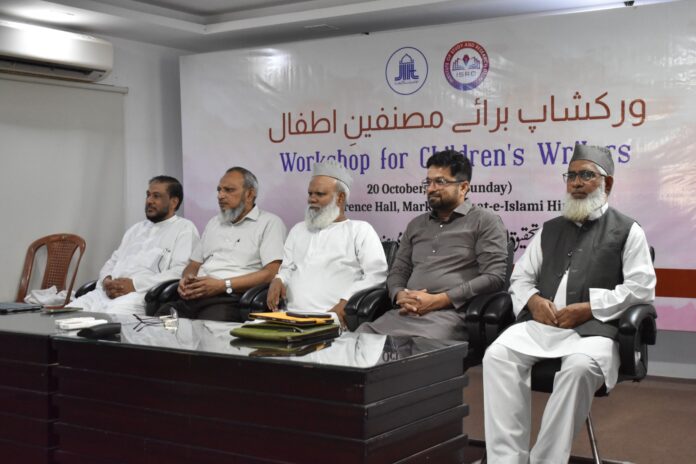
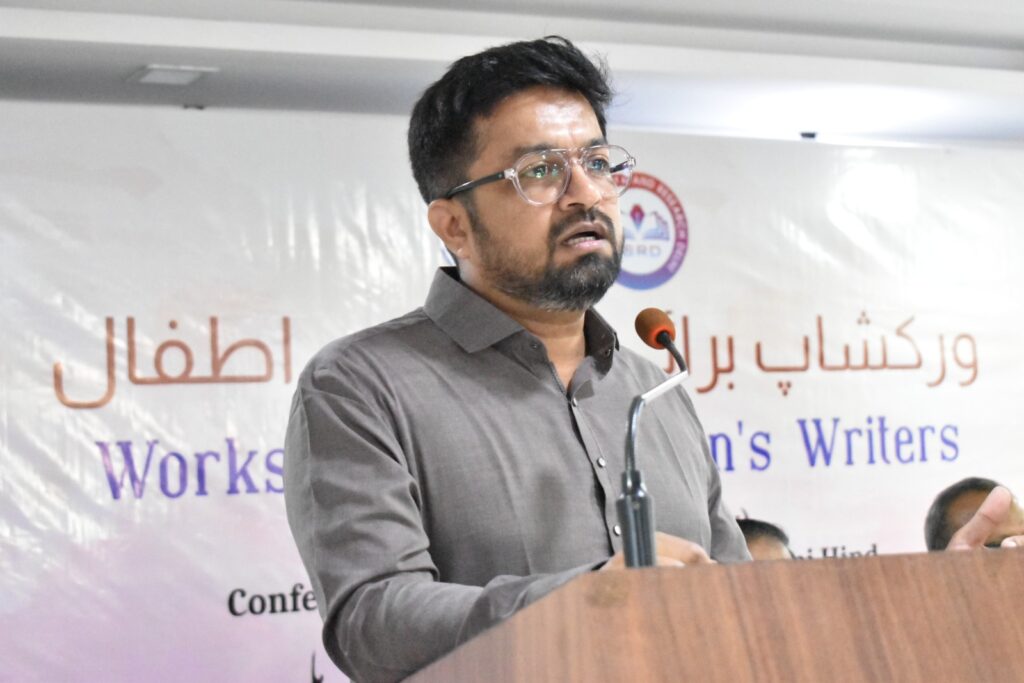
A recent workshop for children’s writers and authors, organized by the Institute of Study and Research Delhi (ISRD), highlighted the urgent need for quality Islamic literature for children and called for initiatives to train the youth and new generation in this endeavour.
Held at the Jamaat-e-Islami Hind headquarters here, the workshop was attended by over 50 research scholars and individuals interested in children’s literature, affiliated with institutions such as Jamia Millia Islamia, Jawaharlal Nehru University, National Council for Educational Research and Training (NCERT), and the Education Department of the Delhi Government, with nearly half of the participants being women, some of whom have been working in the field of children’s literature for several decades. ISRD, which conducted the workshop, has been actively promoting Islamic thought and encouraging writing and authorship through various programmes for the last more than five years.
Speaking on the occasion, AIMPLB spokesperson and editor of the monthly Urdu magazine Afkar-e-Milli Dr Syed Qasim Rasool Ilyas, critically reviewed children’s Islamic literature under the title “Reimagining Children’s Islamic Literature: A Critical Analysis for Modern Needs.” He emphasized that today, the primary goal of acquiring knowledge and education has become mainly about obtaining good jobs and accumulating wealth, which fosters a materialistic approach and attitudes among children. He stressed that education should focus on developing children into good human beings, ethical individuals, and righteous Muslims.
ISRD secretary Asif Iqbal presented a survey conducted among 254 children in the area to understand their reading habits. Through a PowerPoint presentation, he highlighted key findings, noting that children demonstrate a keen interest in reading books and still place high value on printed materials. Both parents and teachers should adopt a positive and proactive role in fostering children’s reading habits. He pointed out that children tend to read more in Hindi and English compared to Urdu, indicating a need for special attention in this area, likely due to education in English schools.
While it is true that screen time on mobile devices reduces children’s reading time, authors and publishers should consider how to capture children’s attention through mobile platforms to make their content accessible.
The survey revealed that children enjoy reading adventure stories, Islamic history, and fiction, with a particular interest in Islamic heroes in the current context. Parents provide children with books, and they often receive books as gifts. Notably, children are also purchasing books with their pocket money, which is commendable and should be encouraged further. There remains a significant preference for reading printed books compared to e-books and audiobooks.
However, the question persists: to what extent are we meeting the needs of children in the community? While it is a fact that children engage with online games, social media, and various internet content, they also recognize that books play an essential role in their lives, and they express a desire to read. They prefer simple and accessible language along with colourful, graphic books available at affordable prices. Authors and publishers should focus on these aspects.
In his presidential address, renowned Islamic scholar and author of more than 100 books, Dr Muhammad Raziul-Islam Nadvi, Secretary of Jamaat-e-Islami Hind, emphasized that children’s authors should keep three key principles in mind: (1) While writing stories, consider the tastes and psychology of children, subtly incorporating Islamic values, teachings, and culture into their works; (2) present credible material, particularly regarding Islam, and avoid incorrect or misleading information; (3) use very simple and accessible language.
Dr Raziul-Islam Nadvi noted that during the initial period of Jamaat-e-Islami Hind, its members produced quality religious literature for children, but there has been a decline in this area over time. However, he affirmed that renewed attention is now being given to this vital aspect.
Renowned children’s author Mohammad Siraj Azeem, founder secretary of All India Adab-e-Atfal Society Delhi, delivered a lecture titled “Exploring Pluralistic Society and Its Impact on Children Amid Increasing Extremism.” He highlighted several factors contributing to extremist tendencies in children: 1) the destruction of the joint family system, 2) parents’ indifferent relationships and callous connections with their children, 3) uncontrolled technological advancements and excessive use of electronic gadgets, including mobile devices by children, and 4) various pressures from parents, the environment, or technology. Addressing the question of how tendencies towards violence arise in children, he urged parents to connect well with their children, give them ample attention, and focus on their all-round training and nurturing, as parents serve as crucial role models for their children, thus they should demonstrate the best conduct and behaviour.
The workshop commenced with welcoming remarks from Mr Saleemullah Khan, Delhi state president of Jamaat-e-Islami Hind. Following this, experts delivered insightful lectures on various aspects of children’s literature.
Maulana Inaamullah Falahi, associated with the JIH Markazi Taleemi Board, spoke on “The Need and Importance of Children’s Literature in the Light of Islamic Values.” Dr Shadab Musa, JIH Assistant Secretary, presented on ‘Understanding Stages of Cognitive and Intellectual Development in Children’.
Dr Faizan Shahid discussed “The Effects of Short Stories on the Psychological, Social, and Moral Growth of Children .”
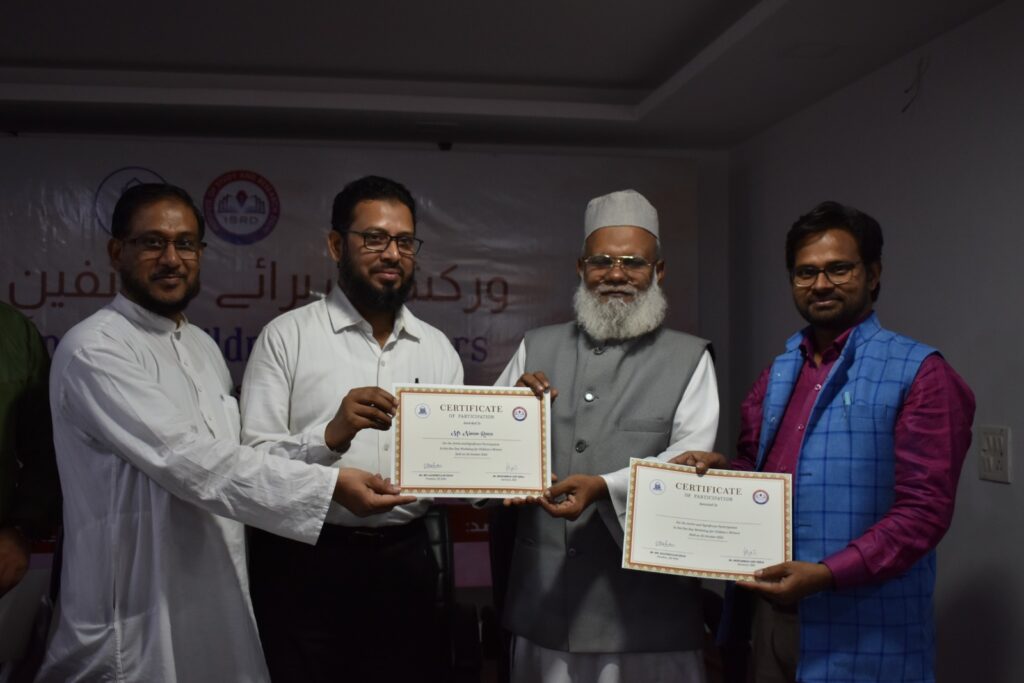
The workshop consisted of three sessions, moderated by Noor-ul-Islam Rahmani, Naim Raza, and Muhammad Maaz. All participants were awarded certificates.
source: http://www.indiatomorrow.net / India Tomorrow / Home> Education / by admin india tomorrow / October 23rd, 2024
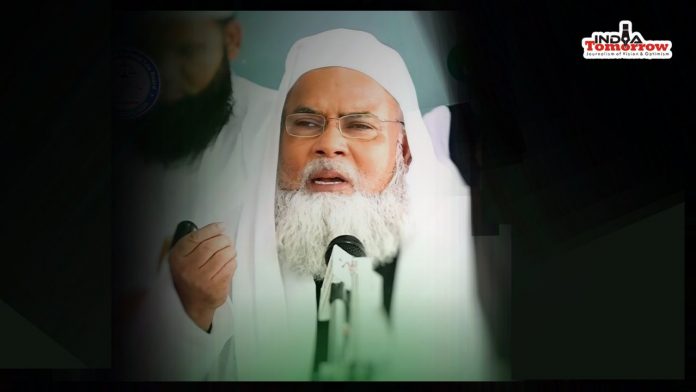
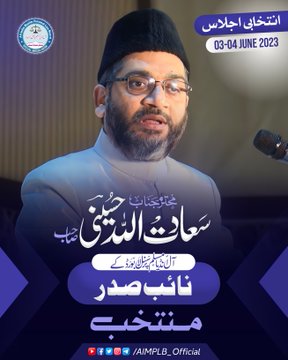
A top Islamic scholar – Maulana Khalid Saifullah Rahmani – was elected fifth president of the All India Muslim Personal Law Board (AIMPLB), with Jamaat-e-Islami Hind president Syed Sadatullah Husaini and Gulbarga-based Maulana Khusro Hussaini as vice-presidents.
Maulana Khalid Saifullah replaced Maulana Rabey Hasani Nadawi who passed away in April this year.
Maulana Fadl al-Rahim Mujaddidi has been elected as the General Secretary. He will be supported by secretaries – Maulana Umrain Mahfouz Rahmani, Maulana Syed Bilal Hussaini Sahib, Maulana Yasin Ali Usmani Sahib, and Maulana Ahmed Faisal Rahmani.
The board elections took place in the town of Mhow near Indore during the board’s executive committee meeting on June 3 and 4.
Maulana Khalid Saifullah was elected unanimously. There are 251 members of the board, including 51 executive members.
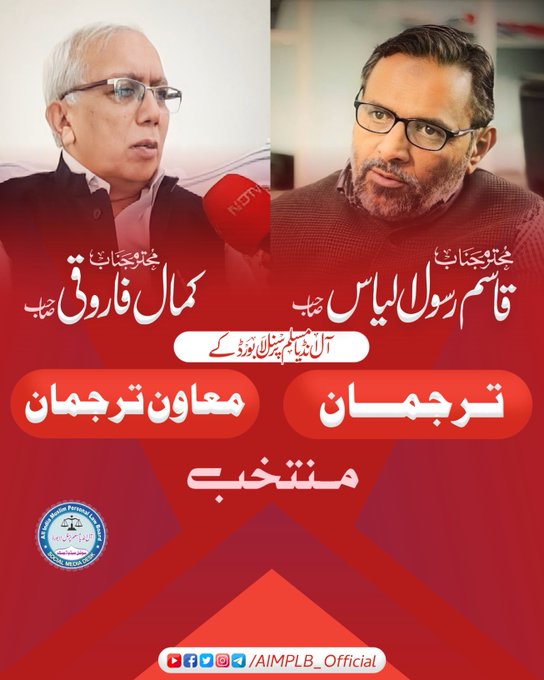
Welfare Party of India (WPI) president Dr. Syed Qasim Rasool Ilyas has been elected as the spokesperson and Kamal Farooqui, a practicing chartered accountant and former chairman of Delhi Minorities Commission, has been elected as deputy spokesperson.
Maulana Khalid Saifullah Rahmani was elected through consensus. A proposal was mooted by Hazrat Maulana Muhammad Sufyan Qasmi Sahib of Darul Uloom, Deoband, and subsequently supported by Maulana Shahid Hosni and Maulana Syed Mahmood Madani. All members unanimously voted for Moulana Rahmani.
After Wali Rahmani’s death, Moulana Khalid Rahmani was appointed as the interim general secretary of the All India Muslim Personal Law Board. He is also a member of the Legal Council of the All India Muslim Personal Law Board and serves as the general secretary of the Islamic Fiqh Academy in New Delhi.
He regularly contributes as a columnist for the Friday edition of Munsif and holds the position of editor for the Islamic juristic quarterly journal – Behs-o-Nazar – which was originally founded by Mujahidul Islam Qasmi.
Born in 1956 in Darbhanga district in Bihar, he has a rich educational background in Islamic studies and is renowned for his insightful teachings on various aspects of Sharia law. He began his education at home and then spent two years at Madrasa Qasimul Uloom Hussainia. He pursued further studies at Jamia Rahmani in Munger, where he earned his degree.
He was enrolled in the Dawra-e-Hadith program at Darul Uloom Deoband where he focused on the study of Hadith within the Dars-e-Nizami curriculum. He successfully completed his studies and graduated from Darul Uloom Deoband in the year 1395 AH (according to the Islamic calendar) or 1975 as per Gregorian calendar. Later, he specialized in Islamic law and jurisprudence at Amarat-e-Sharia in Patna.
He has been a student of Anzar Shah Kashmiri, Mahmud Hasan Gangohi, and Muhammad Salim Qasmi, and also benefited from the guidance of his uncle Mujahidul Islam Qasmi.
Established in 1973, AIMPLB serves as an authoritative body responsible for interpreting and implementing Muslim personal law in India. It comprises distinguished scholars, jurists, and community leaders who work collectively to uphold and protect the rights of Muslims in matters pertaining to marriage, divorce, inheritance, and other aspects of personal and family law.
source: http://www.indiatomorrow.net / India Tomorrow / Home> Breaking News / by admin india tomorrow / June 06th, 2023