Tag Archives: Suhail Anjum

Zafarul-Islam Khan Honoured with Shah Waliullah Award

NEW DELHI :

It is a great privilege for me to accept this honour from the Shah Waliullah Institute. Honestly, I was reluctant at first and had declined this recognition multiple times.

New Delhi :

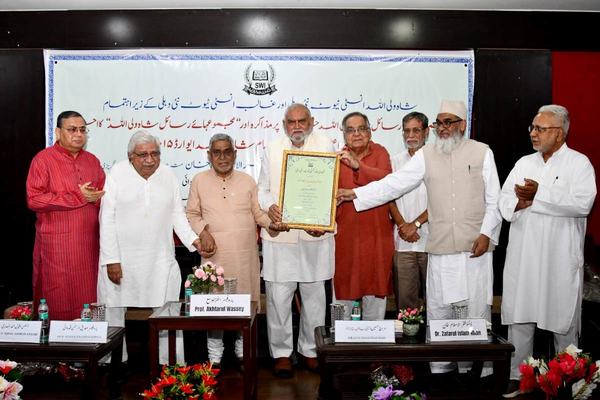
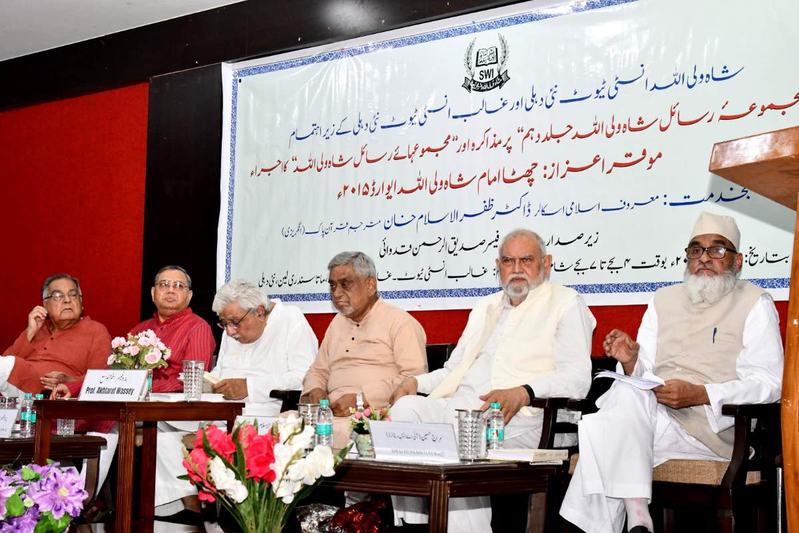
In a momentous event, renowned Islamic scholar, author, senior journalist, and former Chairman of the Delhi Minorities Commission, Dr. Zafarul-Islam Khan, was awarded the prestigious Sixth Imam Shah Waliullah Award here on Monday. The ceremony took place amidst a distinguished seminar on the theme of ‘Epistles of Shah Waliullah’ at the Ghalib Institute here.

Jointly organized by the Shah Waliullah Institute and the Ghalib Institute, the seminar sought to celebrate and highlight the scholarly and intellectual legacy of Imam Shah Waliullah. A special highlight of the event was the launch of the tenth volume of his acclaimed series of epistles, offering attendees an intimate glimpse into his teachings and enduring contributions to Islamic sciences.

A diverse assembly of eminent scholars, intellectuals, and thinkers from across the country participated in the event, engaging in profound discussions about the contemporary relevance of Shah Waliullah’s message, writings and teachings.

Senior journalist Suhail Anjum introduced the Shah Waliullah Institute and provided an overview of the newly launched the tenth volume of Shah Waliullah’s epistles, sharing insights into the publication process, ongoing scholarly discussions and past and future programmes of the Shah Waliullah Institute.

Anjum also felicitated Mufti Ataur Rahman Qasmi highlighting his unwavering dedication to research and publish the scholarly legacy of Shah Waliullah. He highlighted Mufti Saheb’s long-standing scholarly pursuits, first as a teacher for fourteen years at the Dargah Shah Waliullah madrasah near Shah Waliullah’s shrine in Delhi’s Mehdiyan area.

During this period, Mufti Saheb developed a deep spiritual and intellectual bond with the great scholar, gaining profound insights into his contributions to Quranic sciences and other fields. Inspired by this connection, Mufti Saheb established the institute to make Shah Waliullah’s invaluable legacy accessible to all. Some of these writings were published long ago or still lie as manuscripts in libraries. Under this initiative, Mufti saheb has already published ten volumes of Shah Waliullah’s writings. The tenth volume of this series was released during the event.

Expressing humility and honour, Dr Zafarul-Islam Khan said, “It is a great privilege for me to accept this honour from the Shah Waliullah Institute. Honestly, I was reluctant at first and had declined this recognition multiple times. However, I succumbed in the face of Mufti saheb’s insistence for a number of reasons. Paramount among these is my nearly forty-year-long association with Mufti Saheb, dating back to 1984 when I returned from abroad.

At that time I visited Mehdiyan and made a spiritual bond with Shah Waliullah and with Mufti saheb who at the time taught at the madrasah there. He said that another reason is that this award is associated with Shah Waliullah, the greatest Islamic scholar produced by India. In fact, he may be regarded as the greatest non-Arab Islamic scholar of all ages. He said that long ago he wrote a modest book in Arabic on Shah Waliullah trying to attract people’s attention to the ocean of knowledge which he was and remains till this day. He said that Shah Waliullah’s monumental work Hujjatullah al-Balighah stands out as an unparalleled masterpiece in the Islamic literature. It is printed, reprinted and studied in the Arab World till this day. Dr. Khan underscored the importance of Hujjatullah al-Balighah as a treasure trove that provides a deep, balanced and comprehensive understanding of Islamic sciences.
Dr Khan commended Mufti Saheb’s tireless efforts in unearthing and publishing many of Shah Waliullah’s manuscripts and texts that were hidden and forgotten. The current tenth volume stands as a testament to this scholarly dedication. He stated that his personal and scholarly bonds with Mufti Saheb and Shah Waliullah motivated him to accept this award. He added that there is a third reason for accepting the award and that is the fact that the award is given in recognition of the Glorious Quran, his translation of the Islamic holy text which tries to offer an authentic version of the Quran based on most authentic Arabic sources.

Dr Khan said there is a great responsibility on our shoulders: to try to understand and disseminate Shah Waliullah’s teachings and present them in modern language and style. Reflecting on Shah Waliullah’s revolutionary impact, Dr. Khan highlighted his translation of the Quran into Persian—a daring act at the time, which many scholars at the time considered a blasphemy. Even today, some argue that the Quran cannot be translated into any language. But if that was true, how would the 85% of Muslims outside the Arab world understand the divine message? Therefore, it is imperative that the Quran be translated into all languages—be it Assamese, Burmese, Chinese, or any other so that the common Muslim and non-Muslim could read and understand Allah’s last message to humanity. He pointed out that Western scholars, despite their scholarly rigour, often distorted the meanings of the Quran in their translations. Therefore, it is the duty of Islamic scholars to offer correct and accurate rendering of the divine text. Dr. Khan said he dedicated eleven years to accomplish his translation of the holy Islamic text. He said he fully devoted the three years during the COVID19 pandemic to complete this work. He regarded the award as a motivation to himself and all scholars to continue scholarly pursuits.

Mufti Ataur Rahman, chairman of the Shah Waliullah Institute, addressed the gathering sharing insights into how the idea of an institute dedicated to Shah Waliullah was conceived and narrated the journey since founding the institute. He took a moment to acknowledge the previous recipients of the Shah Waliullah Award: the first was given to Maulana Abdul Karim Parekh from Nagpur in 2007; the second and third to Maulana Akhlaq Hussain Qasmi and Maulana Faqihud-Din in 2010; the fourth to Maulana Muhammad Salim Qasmi in 2013; and the fifth to Maulana Qamaruz-Zaman Ilahabadi in 2014.

The event was enriched by the presence of distinguished speakers including Muhammad Adeeb, former Member of Parliament, Mr. Siraj Hussain, former vice chancellor of Jamia Hamdard, Justice Iqbal Ahmad Ansari, former Chief Justice of Patna High Court, Prof. Khalid Mahmood and Khwaja Muhammad Shahid among others.

The proceedings were presided over by the chairman of the Ghalib Institute Prof. Siddiqur Rahman Kidwai who lauded Mufti Ataur-Rahman’s exemplary work and extended warm felicitations to Dr. Zafarul-Islam Khan for his well-earned recognition.

source: http://www.milligazette.com / The Milli Gazette / Home> News> Community News / by Zillur-Rahman Haider / June 30th, 2026

Global Urdu Day Awards 2025 Announced

DELHI :

Prof. Bilqis Bano to receive Lifetime Achievement Award, Dr. Raouf Khair to be honoured with Allama Iqbal Award.

New Delhi:

An important meeting of the Global Urdu Day Awards Committee (organised by the Global Urdu Day Organising Committee) was held under the chairmanship of senior journalist Jalaluddin at Daryaganj here.

The awards jury included Dr. Syed Ahmed Khan, Ashraf Ali Bastavi (Chief Editor, Asia Times, New Delhi), Suhail Anjum (former correspondent, Voice of America), and Javed Akhtar (Editor, D.W. Urdu, Germany, Delhi Bureau).

As per tradition, the awardees for the upcoming Global Urdu Day on 9 November 2025 have been selected.

The recipients are Prof. Bilqis Bano (Department of Biochemistry, Faculty of Life Sciences, Aligarh Muslim University) – Lifetime Achievement Award; Dr. Raouf Khair (Hyderabad) – Allama Muhammad Iqbal Award for Literature; Prof. Kauser Mazhari (Jamia Millia Islamia, New Delhi) – Mirza Ghalib Award for Poetry; Prof. Zehra Khatoon (Jamia Millia Islamia, New Delhi) – Maulana Ali Mian Award for Urdu-Persian Language;  Dr. Aqeel Ahmad (Secretary, Ghalib Academy, New Delhi) – Maulana Abdul Majid Daryabadi Award for Language and Literature;  K.L. Narang Saqi (New Delhi) – Kunwar Mahendra Singh Bedi Award for Literature; Yaseen Momin (Mumbai) – Qazi Mohammad Adeel Abbasi Award for Promotion of Urdu Language; Syeda Talat Nasreen (TN Bharti, New Delhi) – Noor Jahan Sarwat Award for Journalism; Syed Zubair (Muslim Mirror, New Delhi) – Maulana Usman Farqaleet Award for Journalism; Maulana Abdul Hameed Numani (New Delhi) – Maulana Sanaullah Amritsari Award for Column Writing; Abdul Mannan (Editor, Yojana Urdu, New Delhi) – Maulana Mohammad Muslim Award for Journalism; Jamshed Khan (Aaj Tak, New Delhi) – Ameen Sayani Award for Electronic Media; Saurabh Shukla (Red Manak, New Delhi) – Pandit Devnarayan Pandey Award for Journalism; Abid Anwar (UNI Urdu, New Delhi) – Mahfuzur Rahman Award for Journalism; Shohrat Ansari (Khalilabad, U.P.) – Imdad Sabri Award for Journalism; Hafeezur Rahman (Sharq Adeel, Marahra, Etah District, U.P.) – Ismail Merathi Award for Poetry; Mohammad Yamin Zaki (Editor, Hilal, Rampur) – Dr. Zakir Hussain Award for Children’s Literature; Farooq Ahmad (Doordarshan, Delhi) – Ilmat Yasin Award for Promotion of Urdu; Prof. Dr. Ziaur Rahman Siddiqui (Aligarh) – Mazharuddin Khan Award for Teaching; Master Iqbal Ahmad (Former Headmaster, Jamia Middle School, New Delhi) – Maqbool Ahmad Siddiqui Award for Best Teacher; Prof. Abdul Majid Mohammad Siddiq Siddiqui (Malegaon) – Maulana Azad Award for National Integration; Prof. Khalid Mubashshir (Jamia Millia Islamia, New Delhi) – Hafeez Merathi Award for Naat Poetry; Dr. Ibrahim Afsar (Meerut) – Naseeruddin Hashmi Award for Urdu Research; Dr. Azeer Ahmad (Islampur, West Bengal) – Maulvi Abdul Haq Award for Literature; Dr. Nihal Nazim (Moradabad) – Dr. Abul Faiz Usmani Award for Promotion of Literature; Dr. Abu Saad Asari (Jhanda Nagar, Nepal) – Indo-Nepal Friendship Award; and Hidayat Publications, New Delhi (Syed Abul A’la Subhani) – Munshi Naval Kishore Award for Publishing.

Dr. Syed Ahmed Khan, the convener of the Global Urdu Day Organising Committee, expressed hope that the selected awardees will continue to play a significant role in the promotion of the Urdu language.

source: http://www.radiancenews.com / Radiance News / Home> Pride of the Nation> Awards> Latest News / by Radiance News Bureau / July 15th, 2025

Renowned Journalist Jalaluddin Aslam’s Anthology ‘Naqd-o-Nazar’ Released at Ghalib Academy

INDIA :

New Delhi:

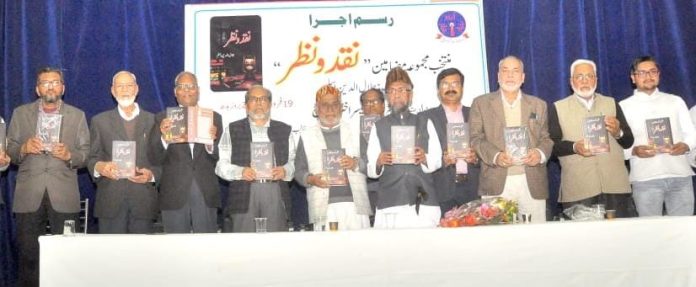
Veteran journalist and writer Jalaluddin Aslam was honored at Ghalib Academy with the release of his selected anthology of essays, Naqd-o-Nazar. The event brought together distinguished scholars, journalists, and literary figures, who acknowledged Aslam’s lifelong dedication to writing and journalism.

Padma Shri awardee Professor Akhtarul Wasey, delivering the presidential address, praised Jalaluddin Aslam’s remarkable contribution to literature and journalism. “He has devoted his entire life to the service of pen and paper. Even in his advanced years, his commitment to writing remains unshaken,” he remarked. Prof. Wasey further emphasized that Naqd-o-Nazar reflects Aslam’s deep thoughts and ideological perspectives and should reach a wider readership.

Renowned journalist Masoom Moradabadi highlighted the humanitarian aspect of Aslam’s life, stating, “The essays in his latest book reflect his deep concern for the nation and community. His life has been marked by selfless service to the needy and deserving.” He underscored that Aslam’s engagement in journalism and literature has always been driven by sincerity rather than financial motives.

Senior journalist Suhail Anjum commended Aslam’s contributions to Urdu language and literature through journalism and writing. “His anthology Naqd-o-Nazar is of archival significance and serves as a valuable resource for researchers,” he stated.

Editor of Urdu Book Review, Mohammad Arif Iqbal, noted that Naqd-o-Nazar contains thought-provoking essays, demonstrating Aslam’s intellectual depth and analytical prowess.

Dr. Syed Ahmed Khan, national president of the Urdu Development Organization, acknowledged Aslam’s silent yet profound contributions to the Urdu language. “Few writers and journalists have served Urdu as selflessly as he has,” he asserted.

Dr. Aqil Ahmed, Secretary of Ghalib Academy, extended his congratulations to the author and urged him to publish his unpublished works as well. Several other prominent figures, including Feroz Hashmi, Javed Rahmani, Dr. Mufti Anwar Javed Dehlvi, and K.L. Narang Saqi, also lauded Aslam’s literary journey.

Among the notable attendees were Maulana Arshad Sirajuddin Maki, Dr. Khurshid Alam, Hakim Aftab Alam, Mohammad Naushad Nadwi, Israr Ahmed Ujini, Danish Rahman, Faizan, Rehan, Zeeshan, Mohammad Owais, Mohammad Hanif, Nadeem Arif, and Mohammad Imran Kannauji.

The event concluded with a vote of thanks by Dr. Abu Zaid.

source: http://www.radiancenews.com / Radiance News / Home> Arts & Culture> Focus / by Radiance News Bureau / February 20th, 2025

Book on Indo-Kuwait Relations by late Dr Abdul Qadir Shams launched in Delhi

NEW DELHI / INDIA:

Hindustan aur Kuwait (Tarīkhī, Ilmì aur Thaqafatī Rishte’ by Dr Abdul Qadir Shams launched in Delhi.

New Delhi:

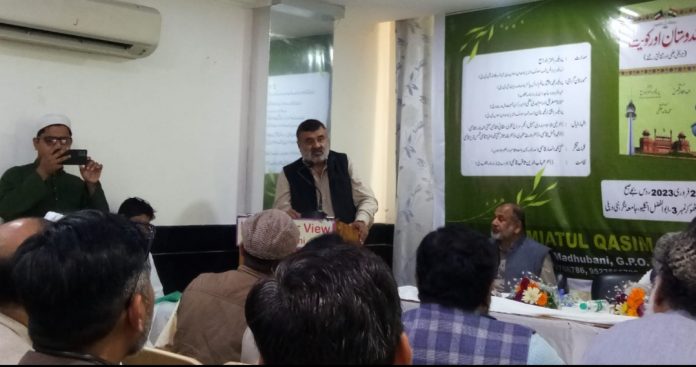
Hindustan aur Kuwait (Tarīkhī, Ilmì aur Thaqafatī Rishte) i.e. India and Kuwait: Historical, Academic and Cultural Relations in Urdu, a book crafted out of the doctoral thesis of late Dr Abdul Qadir Shams Qasmi (1972-2020) originally titled ‘Ulūm-e-Islamī ki Tahqīq-o-Isha’at mein Wazārat-e-Auqaf Kuwait ka Kirdar by Mohammad Khalid Azmi (residing in Kuwait) was launched at Hotel River View, Jamia Nagar, New Delhi on Saturday, 25 February, 2023. The launch programme witnessed a good number of participants from media, academia and other spheres.


The participatns appreciated Khalid Azmi for his timely efforts to turn the thesis into a book with helpful additions to focus on the bilateral role of India and Kuwait in the academic and cultural domains.

The event was presided over by Prof Akhtarul Wasey, Islamic scholar and former president of Maulana Azad University, Jodhpur. Academics and media persons including Dr Raziul Islam Nadwi, Professor Iqtidar Mohammad Khan, Maulana Asghar Ali Imam Mehdi Salafi, Dr Waris Mazhari, Dr Khalid Mubashshir, Dr Mohammad Ajmal, Suhail Anjum, Siraj Naqvi shared their views.


Dr Shahabuddin Saqib Qasmi, senior sub-editor, Urdu daily Inquilab, conducted the event, organised by Qari Zafar Iqbal Madni of Jamiatul Qasim Darul Uloom -il Islamia, Supaul, Bihar.

Mufti Mohammad Ansar Qasmi of Jamiatul Qasim presented vote of thanks.

It should be noted that author and senior journalist, Dr Abdul Qadir Shams Qasmi, had died of cardiac arrest on 25 August, 2020, during Covid-19.

source: http://www.muslimmirror.com / Muslim Mirror / Home> Books / by Manzar Imam / February 27th, 2023