Tag Archives: Dr Zafarul Islam Khan – Chairman – Delhi Minorities Commission

Zafarul-Islam Khan Honoured with Shah Waliullah Award

NEW DELHI :

It is a great privilege for me to accept this honour from the Shah Waliullah Institute. Honestly, I was reluctant at first and had declined this recognition multiple times.

New Delhi :

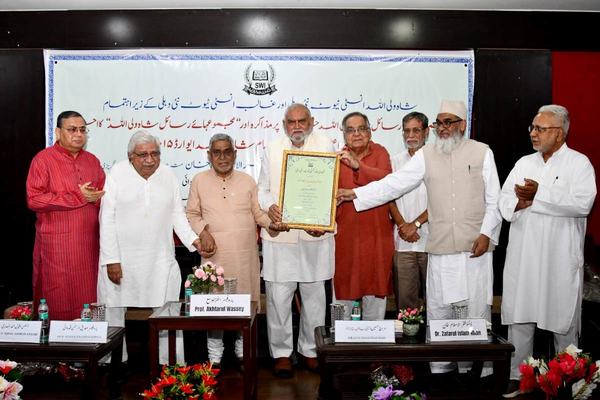
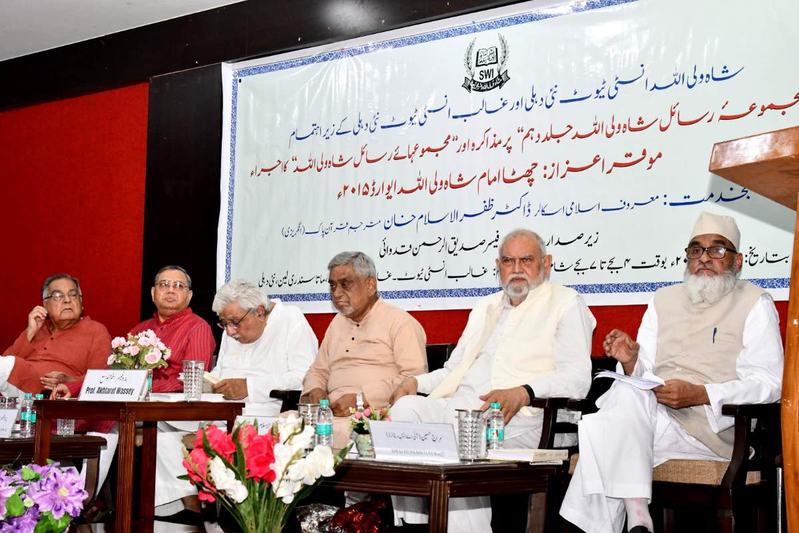
In a momentous event, renowned Islamic scholar, author, senior journalist, and former Chairman of the Delhi Minorities Commission, Dr. Zafarul-Islam Khan, was awarded the prestigious Sixth Imam Shah Waliullah Award here on Monday. The ceremony took place amidst a distinguished seminar on the theme of ‘Epistles of Shah Waliullah’ at the Ghalib Institute here.

Jointly organized by the Shah Waliullah Institute and the Ghalib Institute, the seminar sought to celebrate and highlight the scholarly and intellectual legacy of Imam Shah Waliullah. A special highlight of the event was the launch of the tenth volume of his acclaimed series of epistles, offering attendees an intimate glimpse into his teachings and enduring contributions to Islamic sciences.

A diverse assembly of eminent scholars, intellectuals, and thinkers from across the country participated in the event, engaging in profound discussions about the contemporary relevance of Shah Waliullah’s message, writings and teachings.

Senior journalist Suhail Anjum introduced the Shah Waliullah Institute and provided an overview of the newly launched the tenth volume of Shah Waliullah’s epistles, sharing insights into the publication process, ongoing scholarly discussions and past and future programmes of the Shah Waliullah Institute.

Anjum also felicitated Mufti Ataur Rahman Qasmi highlighting his unwavering dedication to research and publish the scholarly legacy of Shah Waliullah. He highlighted Mufti Saheb’s long-standing scholarly pursuits, first as a teacher for fourteen years at the Dargah Shah Waliullah madrasah near Shah Waliullah’s shrine in Delhi’s Mehdiyan area.

During this period, Mufti Saheb developed a deep spiritual and intellectual bond with the great scholar, gaining profound insights into his contributions to Quranic sciences and other fields. Inspired by this connection, Mufti Saheb established the institute to make Shah Waliullah’s invaluable legacy accessible to all. Some of these writings were published long ago or still lie as manuscripts in libraries. Under this initiative, Mufti saheb has already published ten volumes of Shah Waliullah’s writings. The tenth volume of this series was released during the event.

Expressing humility and honour, Dr Zafarul-Islam Khan said, “It is a great privilege for me to accept this honour from the Shah Waliullah Institute. Honestly, I was reluctant at first and had declined this recognition multiple times. However, I succumbed in the face of Mufti saheb’s insistence for a number of reasons. Paramount among these is my nearly forty-year-long association with Mufti Saheb, dating back to 1984 when I returned from abroad.

At that time I visited Mehdiyan and made a spiritual bond with Shah Waliullah and with Mufti saheb who at the time taught at the madrasah there. He said that another reason is that this award is associated with Shah Waliullah, the greatest Islamic scholar produced by India. In fact, he may be regarded as the greatest non-Arab Islamic scholar of all ages. He said that long ago he wrote a modest book in Arabic on Shah Waliullah trying to attract people’s attention to the ocean of knowledge which he was and remains till this day. He said that Shah Waliullah’s monumental work Hujjatullah al-Balighah stands out as an unparalleled masterpiece in the Islamic literature. It is printed, reprinted and studied in the Arab World till this day. Dr. Khan underscored the importance of Hujjatullah al-Balighah as a treasure trove that provides a deep, balanced and comprehensive understanding of Islamic sciences.
Dr Khan commended Mufti Saheb’s tireless efforts in unearthing and publishing many of Shah Waliullah’s manuscripts and texts that were hidden and forgotten. The current tenth volume stands as a testament to this scholarly dedication. He stated that his personal and scholarly bonds with Mufti Saheb and Shah Waliullah motivated him to accept this award. He added that there is a third reason for accepting the award and that is the fact that the award is given in recognition of the Glorious Quran, his translation of the Islamic holy text which tries to offer an authentic version of the Quran based on most authentic Arabic sources.

Dr Khan said there is a great responsibility on our shoulders: to try to understand and disseminate Shah Waliullah’s teachings and present them in modern language and style. Reflecting on Shah Waliullah’s revolutionary impact, Dr. Khan highlighted his translation of the Quran into Persian—a daring act at the time, which many scholars at the time considered a blasphemy. Even today, some argue that the Quran cannot be translated into any language. But if that was true, how would the 85% of Muslims outside the Arab world understand the divine message? Therefore, it is imperative that the Quran be translated into all languages—be it Assamese, Burmese, Chinese, or any other so that the common Muslim and non-Muslim could read and understand Allah’s last message to humanity. He pointed out that Western scholars, despite their scholarly rigour, often distorted the meanings of the Quran in their translations. Therefore, it is the duty of Islamic scholars to offer correct and accurate rendering of the divine text. Dr. Khan said he dedicated eleven years to accomplish his translation of the holy Islamic text. He said he fully devoted the three years during the COVID19 pandemic to complete this work. He regarded the award as a motivation to himself and all scholars to continue scholarly pursuits.

Mufti Ataur Rahman, chairman of the Shah Waliullah Institute, addressed the gathering sharing insights into how the idea of an institute dedicated to Shah Waliullah was conceived and narrated the journey since founding the institute. He took a moment to acknowledge the previous recipients of the Shah Waliullah Award: the first was given to Maulana Abdul Karim Parekh from Nagpur in 2007; the second and third to Maulana Akhlaq Hussain Qasmi and Maulana Faqihud-Din in 2010; the fourth to Maulana Muhammad Salim Qasmi in 2013; and the fifth to Maulana Qamaruz-Zaman Ilahabadi in 2014.

The event was enriched by the presence of distinguished speakers including Muhammad Adeeb, former Member of Parliament, Mr. Siraj Hussain, former vice chancellor of Jamia Hamdard, Justice Iqbal Ahmad Ansari, former Chief Justice of Patna High Court, Prof. Khalid Mahmood and Khwaja Muhammad Shahid among others.

The proceedings were presided over by the chairman of the Ghalib Institute Prof. Siddiqur Rahman Kidwai who lauded Mufti Ataur-Rahman’s exemplary work and extended warm felicitations to Dr. Zafarul-Islam Khan for his well-earned recognition.

source: http://www.milligazette.com / The Milli Gazette / Home> News> Community News / by Zillur-Rahman Haider / June 30th, 2026
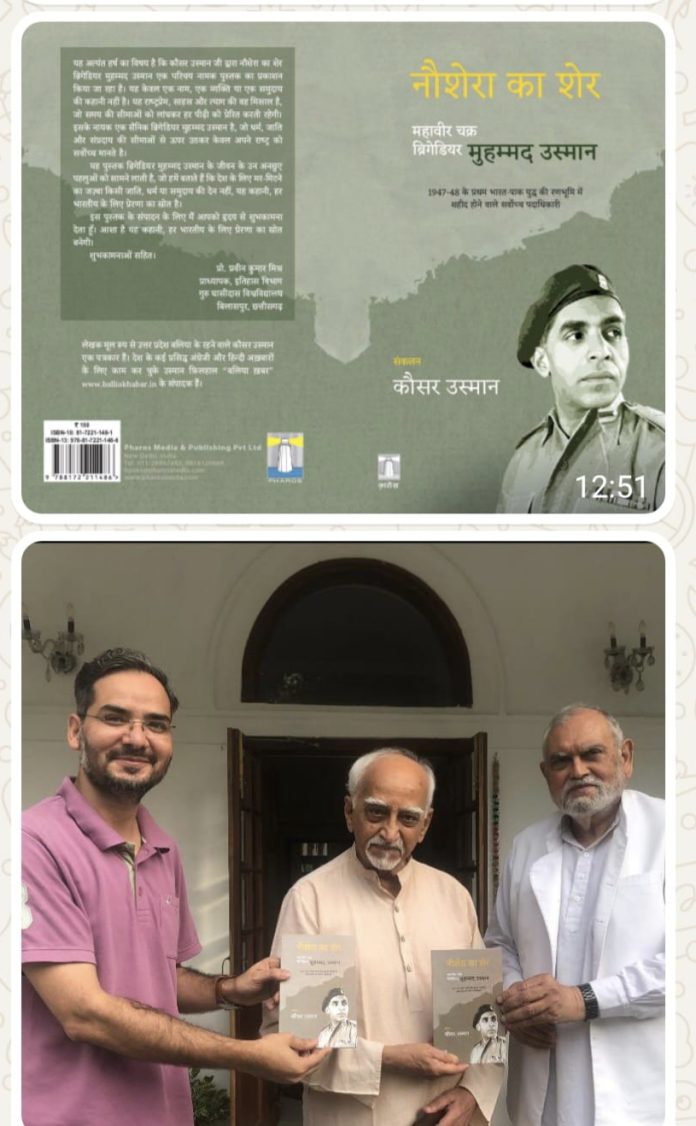
Grand Launch of ‘Naushera ka Sher’ Honouring Brigadier Mohammad Usman : Former Vice President Hamid Ansari Releases the Book

Azamgarh / Naushera, UTTAR PRADESH :

New Delhi:

A grand launch event was held in the capital today for the book “Naushera ka Sher — Brigadier Mohammad Usman”, celebrating the life of the 1947–48 war hero. Authored by senior journalist Kauser Usman from Ballia, Uttar Pradesh, the book honours Brigadier Usman, famously known as the “Hero of Heroes.”

The book was officially released by former Vice President of India, Mr. Hamid Ansari, who is also a family member of Brigadier Usman. Speaking at the event, Mr. Ansari said,

“Brigadier Usman was more than a soldier — he symbolised patriotism, courage, and sacrifice. Kauser Usman’s book is a fitting tribute and an inspiration for future generations.”

Brigadier Mohammad Usman was one of the few Indian Army officers who laid down his life during the India-Pakistan war of 1947–48, without retreating. He was posthumously awarded the Maha Vir Chakra, India’s second-highest wartime gallantry honour.

Author Kauser Usman said,

“This book is my humble tribute to a national hero. Brigadier Usman’s life, simplicity, and service to the nation continue to guide us.”

Dr. Zafarul Islam Khan, former Chairman of the Delhi Minorities Commission, also attended the event.

The book is published by Pharos Media Publishing Pvt. Ltd., New Delhi.

source: http://www.radiancenews.com / Radiance News / Home> Art & Culture / by Mohd Naushad Khan / July 11th, 2025

India Islamic scholar Maulana Wahiduddin Khan dies of COVID-19

Azamgarh, UTTAR PRADESH / NEW DELHI :

Tibetan spiritual leader Dalai Lama and Maulana Wahiduddin Khan, right, in New Delhi [File: Mohd Zakir/Hindustan Times via Getty Images]
Tibetan spiritual leader Dalai Lama and Maulana Wahiduddin Khan, right, in New Delhi [File: Mohd Zakir/Hindustan Times via Getty Images] / pix: aljazeera.com

Ninety-six-year-old Khan, who authored more than 200 books including a two-volume commentary on the Holy Quran, died on Tuesday.

Indian Islamic scholar and peace activist Maulana Wahiduddin Khan has died in the capital New Delhi after contracting novel coronavirus, his family members announced on Tuesday.

Ninety-six-year-old Khan was recently admitted to a hospital in New Delhi after testing positive for COVID-19.

“The great Islamic scholar Maulana Wahiduddin Khan breathed his last, late this evening. Doctors failed to revive his sinking heart. Pray for his maghfirat [penitence] and high station in Paradise. Amin,” Zafarul Islam, Khan’s eldest son, tweeted on Tuesday.

The author of more than 200 books, Khan has been honoured with several awards. This year, he was awarded the Padma Vibhushan, India’s second-highest civilian honour.

___________________

Twitter

Zafarul-Islam Khan @khan_zafarul . 2H

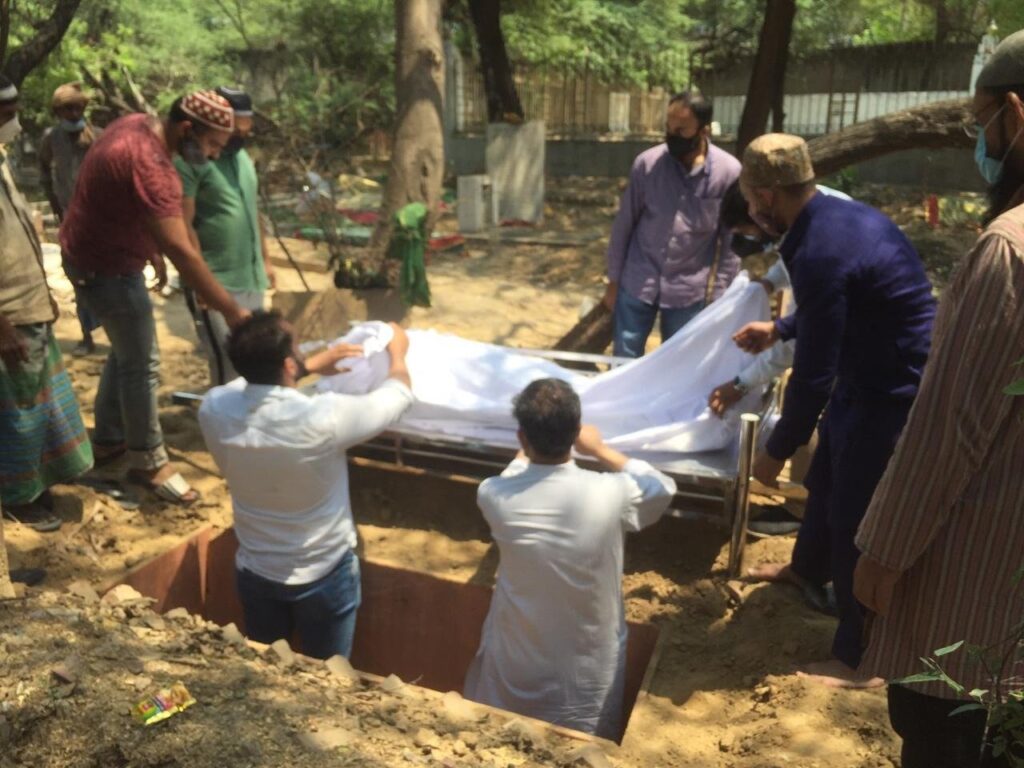
Islamic scholar Maulana Wahiduddin Khan was buried at noon today in Panjpeeran Qabristan near Basti Hazrat Nizamuddin. Buried in same qabristan are his mother Zaibunnisa n wife Sabi’a Khatoon. Seen are his grandsons lifting his body to place in grave. Pl pray for his maghfirat.

2:06PM – Apr 22, 2021

____________

Born in Azamgarh, India, in 1925, Khan has been internationally recognised for his contributions to world peace.

In 2009, Georgetown University in Washington, DC’s list of 500 Most Influential Muslims of 2009 named him “Islam’s spiritual ambassador to the world”.

In 2001, he established the Centre for Peace and Spirituality to promote and reinforce a culture of peace. Khan went on a 15-day Shanti Yatra (peace march) through the western Maharashtra state in the wake of the demolition of the 16th-century Babri Mosque by Hindu hardliners in the state of Uttar Pradesh in 1992.

He also wrote a two-volume commentary on the Holy Quran.

Indian Prime Minister Narendra Modi said he was “saddened” by the news of Khan’s loss.

“He will be remembered for his insightful knowledge on matters of theology and spirituality. He was also passionate about community service and social empowerment. Condolences to his family and countless well-wishers. RIP,” Modi wrote on Twitter.

Indian President Ram Nath Kovind said he was “deeply grieved” by the demise of Khan, saying: “Maulana Wahiduddin made significant contributions to peace, harmony and reforms in the society. My deepest condolences to his family and well-wishers.”

source: http://www.aljazeera.com / Al Jazeera / Home> News / source: News Agencies / April 22nd, 2021

Let’s talk about how Tablighi Jamaat turned Covid hate against Muslims around

NEW DELHI :

After all those days of hate, there was redemption for Tablighi Jamaat in the end. Some say it was in keeping with what Quran teaches.

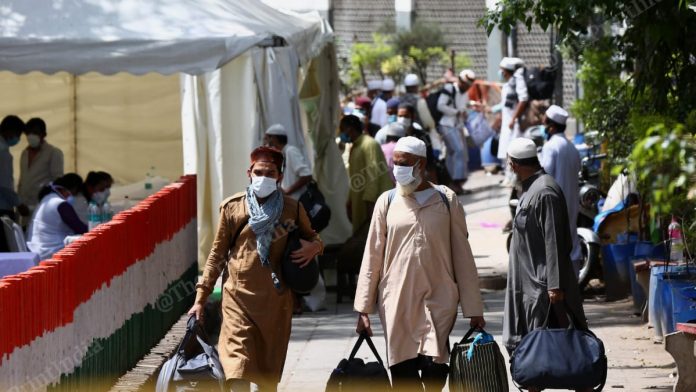
Nearly 4,000, including foreigners, had attended the Tablighi Jamaat event in Delhi (representational image) | Photo : Suraj Singh Bisht | ThePrint


Elisabeth Kubler-Ross’s seminal work, Death and Dying, describes the five distinct stages of grief: denial, anger, bargaining, depression and acceptance. While the Swiss-American psychiatrist was speaking about the series of emotions terminally ill patients go through, the first of the five stages that she postulated possibly holds true for a section of India’s people when the country was trying to come to terms with COVID-19 in the initial days of the pandemic.

The spread of the virus in the early months had then exposed the country’s second-largest religious group to a vulnerability born out of denial. Indiscretion and reckless behaviour by members of the Tablighi Jamaat had purportedly led to a spurt in coronavirus-positive cases, not only in Delhi but also in many other parts of the country.

An international gathering of Tablighis — preachers or a society to spread the faith —had taken place in New Delhi’s Nizamuddin area in March 2020, drawing hundreds of foreign nationals from Thailand, Nepal, Myanmar, Indonesia, Bangladesh, Malaysia, Sri Lanka and Kyrgyzstan. Despite a government order prohibiting large gatherings, more than 4,500 people had assembled at the Tablighi Jamaat Markaz (headquarters).

Media reports had quoted government sources as saying that since 1 January 2020, over 2,000 foreigners from 70 countries had arrived in India to participate in Jamaat activities. As the Covid-19 lockdown came into force on 25 March 2020, over 1,000 were left stranded in Nizamuddin.

Within days, a state of panic had set in as reports of Covid-19 deaths and positive cases started coming in from various parts of the country. By early April, private television news channels had begun insisting that over 30 per cent of the corona-positive cases had the “Tablighi Virus.”

Political factors were at play too. The country was already in ferment over the Citizenship Amendment Act and the National Register of Citizens.

The Tablighis’ state of alleged ignorance was dubbed a “Himalayan” blunder as a heavy dose of media onslaught, Islamophobia and blame game followed. As Najmul Hoda, a Chennai-based IPS officer, lamented on his Facebook wall, Covid-19 looked like a common cold in comparison to the plague of communal hatred.

Tablighi virus, Corona Jihad, stories of discrimination, Quran, divine injunction, Muslim society, deadly virus, Covid-19, Muslim clergy, Indian Muslims, social distancing, community prayers, letter of appreciation.

Political factors were at play too. The country was already in ferment over the Citizenship Amendment Act and the National Register of Citizens. Shaheen Bagh and its women protesters were making international headlines and the February 2020 riots in Delhi had deepened the sectarian divide, exacerbating religious tensions. It was in this situation that the Tablighi Jamaat held its congregation. According to data shared by Equality Labs (a digital human rights group) with TIME magazine, the hashtag ‘Corona Jihad’ appeared nearly 300,000 times.

The online attack became more and more vicious as reports of people leaving for different parts of the country from the Markaz poured in. For days, “Tablighi virus” and “Corona Jihad” trended on Twitter. Our entire focus shifted from fighting and containing COVID-19 to fighting the Tablighis and the Muslims, who the general population started equating as one and the same. Those were the initial days of our COVID-stricken lives, unsure of what awaited us and we were quick to blame the Markaz for all our misery.

The usual practice of portraying Muslims as the other came into play, as did indulging in victimhood.

In the midst of this Islamophobic onslaught, many articles and tweets expressed fears of a Muslim apartheid. The usual practice of portraying Muslims as the other came into play, as did indulging in victimhood.

“Social media, as ever, remained truculent and toxic. Generally speaking, Muslims continue to use social media space to indulge in their victimhood addiction,” observed Najmul Hoda.

While the community needed to address the elephant in the room and could not be absolved of its responsibility for wrongful acts by the Tablighis, the polarised discourse that was unleashed in mainstream media impacted the psyche of the general population. Most Muslims came out against the Jamaat, but the entire community was still clubbed together and labelled the “Superspreader”.

But the way the Tablighi Jamaat’s role and, by extension, of the entire Muslim population’s involvement in the spread of the virus was covered by the mainstream media, it suddenly felt that Covid-19 had a religion.

The Tablighis were guilty for sure for the congregation of thousands of people despite the prohibitory orders, and of not reporting cases, but the wave of hatred failed to see that the Tablighi Jamaat is not the sole representative of India’s 170 million Muslims and its actions should not be linked with the larger community. It is also pertinent to note that the Tablighi Jamaat preaches a narrow interpretation of Islam to some sections of Muslim society.

But the way the Tablighi Jamaat’s role and, by extension, of the entire Muslim population’s involvement in the spread of the virus was covered by the mainstream media, it suddenly felt that COVID-19 had a religion.

Soon, stories of discrimination against the poorer sections among Muslims started coming out. NDTV reported how vendors in Mahoba district of Uttar Pradesh were allegedly targeted and stopped from selling vegetables by people who accused them of being members of the Tablighi Jamaat and of spreading the coronavirus.

Old sociological problems, such as overcrowded ghettos, lack of hygiene and low levels of awareness, became handy tools again to stigmatise the community.

The Bharatiya Janata Party (BJP) MLA from Deoria in Uttar Pradesh, Suresh Tiwari, warned people against buying vegetables from Muslims. The defiant leader was later asked to explain his comment by his party chief.

A video shared widely on Facebook and on Twitter purportedly showed Muslims intentionally sneezing on each other. It was later debunked by the fact-checking website AltNews.

Tablighi virus, Corona Jihad, stories of discrimination, Quran, divine injunction, Muslim society, deadly virus, Covid-19, Muslim clergy, Indian Muslims, social distancing, community prayers, letter of appreciation

Several video clips purportedly showing COVID-positive members of the Tablighi Jamaat misbehaving with hospital staff and other patients found space on prime-time debates. Old sociological problems, such as overcrowded ghettos, lack of hygiene and low levels of awareness, became handy tools again to stigmatise the community.

The reaction from the community was at times defiant, while some took to social media to counter the hate being peddled with tweets that were either equally toxic or full of self-pity.

A closer look at the role the Muslim clergy played reveals a far more constructive engagement than what has been projected by the mainstream media.

It was at this point that the Muslim clergy, intellectuals and other community leaders stepped in. On 2 April, seven signatories — Dr. Zafarul Islam Khan, Chairman, Delhi Minorities Commission; Prof. Akhtarul Wasey, President, Maulana Azad University, Jodhpur; Prof. Mohsin Usmani Nadwi, President, Human Welfare Society; Prof. A.R. Kidwai, Director, K.A. Nizami Center for Quranic studies, AMU; Masoom Moradabadi, Secretary, All India Urdu Editors Conference; Zaheeruddin Ali Khan, Managing Editor, Daily Siasat, Hyderabad, and Prof. Iqtedar Mohd. Khan, Deptt. Islamic Studies, Jamia Millia Islamia, Delhi — issued an appeal to the government to take into consideration the “genuine constraints faced by certain people.” They argued that it was not a time to find fault. “Any attempt to give it a sectarian twist would weaken our battle against the deadly virus,” they said.

A closer look at the role the Muslim clergy played reveals a far more constructive engagement than what has been projected by the mainstream media. As early as 6 March, Maulana Khalid Rasheed Firangimahli, Lucknow-based Imam, Eidgah, had asked mosque-going Muslims to take preventive measures against Covid-19, and told them to avoid congregations and coughing and sneezing in public.

Firangimahli was among many religious heads across the country who issued fatwas saying that the fight against the coronavirus was a religious obligation.

A broad consensus that was worked out decided against special Eid prayers at Eidgahs and at mosques, etc. Islamic seminaries, such as the Darul Uloom, Nadwa and Deoband, issued fatwas asking the faithful to offer Eid prayers at home.

A major challenge came during the month-long period of Ramadan — that began in the last week of April — in terms of enforcing social distancing and avoiding guests at the breaking of fast (iftar) and at community prayers (tarahwih), etc. But enforcing a sense of discipline among 170 million people sharply divided on sectarian and linguistic lines was done with remarkable ease and voluntary compliance.

As Ramadan is closely followed by Eid, suspension of the customary Eid prayer posed another hurdle. However, a broad consensus that was worked out decided against special Eid prayers at Eidgahs (where special Eid prayers are held) and at mosques, etc. Islamic seminaries, such as the Darul Uloom, Nadwa and Deoband, issued fatwas asking the faithful to offer Eid prayers at home.

The results were so good that Uttar Pradesh Chief Minister Yogi Adityanath called up Firangimahli in Lucknow and congratulated him, saying that Eid prayers throughout the state had been observed without any incident of the virus spreading. The state government also issued a letter of appreciation.

Those members of the Tablighi Jamaat who had tested positive for the virus, and have since been cured, came forward in huge numbers to donate their blood plasma — containing anti-viral antibodies — and helped cure many affected people.

Eid ul-Fitr 2020 saw the largest ever participation of women in family prayers. That prompted Najmul Huda, the IPS officer, to say “thanks” to the virus for bringing gender equality to every Muslim home. “May it get institutionalised. Corona, I can’t really say thank you to you, but it’s thanks to you,” he wrote .

There were other positives too. Charity acted as a great succor as appeals were issued to channelise Ramadan and Eid shopping for the needy. Maulana Naeem Ur Rahman Siddiqui, secretary of the Islamic Centre of India, claims that zakat — or charity — saw a rise of over 50 per cent as compared to the previous year.

Not to forget, the redemption and acknowledgement that came after all those days of hate. If the members of the Tablighi Jamaat were guilty of ignorance in the initial phase of the pandemic, they turned adversity they had wrought upon themselves into opportunity in the form of penance. Those who had tested positive for the virus, and have since been cured, came forward in huge numbers to donate their blood plasma — containing anti-viral antibodies — and helped cure many affected people.

Some say it was in keeping with what the Quran teaches — that divine injunction is not for returning evil with good, but with the best. It says: “Good and evil are not equal. Repel (evil) with what is best, and you will see that the one you had mutual enmity with, will become the closest of friends.” (41:34)

Rasheed Kidwai is Visiting Fellow at Observer Research Foundation (ORF). He tracks politics and governance in India. Naghma is Senior Fellow at ORF. She tracks India’s neighbourhood — Pakistan and China — alongside other geopolitical developments in the region. Views are personal.

This article was first published by ORF.

source: http://www.theprint.in / The Print / Home> Opinion / by Rasheed Kidwai and Naghma Sahar / July 12th, 2020