Hanipora Village (Pulwama District),JAMMU & KASHMIR :
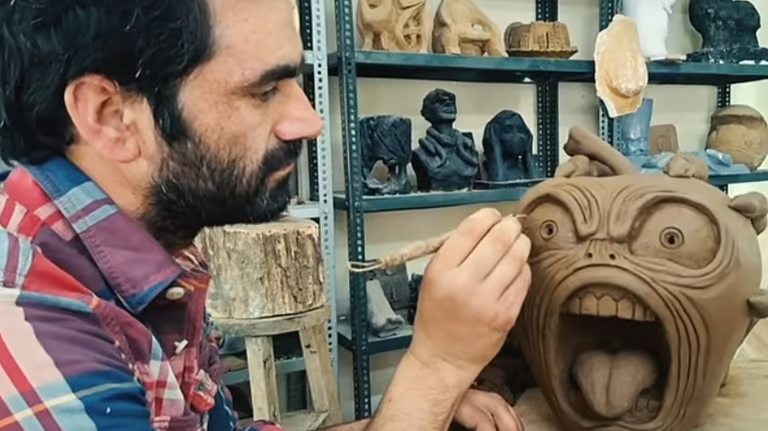
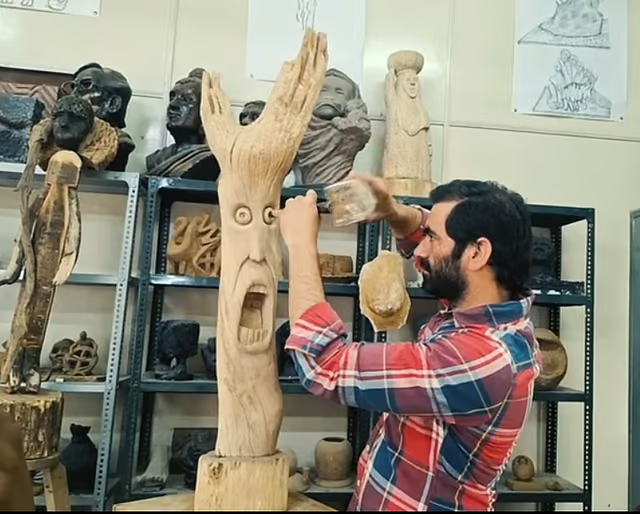
Hearing and speech-impaired, hardships of life never robbed this Pulwama man of his passion for art as he sculpted his way to new heights, Fayaz Wani narrates.
29-year-old Suhail Mohammad Khan / Photo | Special arrangement
Jammu :
The popular saying “where there is will, there is a way” rings true for 29-year-old Suhail Mohammad Khan, a resident of Hanipora village in Jammu & Kashmir’s Pulwama district, who has overcome his deafness and inability to speak through his art. Versatile as he is, he has mastered several different forms of art.
His hard work, determination and never-say-die attitude have made him a source of inspiration for others. An architectural designer, painter, sculptor and sketch artist, Suhail wears many hats. But his path to success has been anything but easy.
Suhail lost his ability to hear and speak when he was just a child. However, that did not diminish his passion for drawing and painting. He always enjoyed rustling up sketches and paintings of his friends. As years passed, he began to explore other forms of art, including sculpture, printmaking and cake designing, instead of confining himself to one specific genre.
After passing out of school, Suhail joined the Institute of Music and Fine Arts at University of Kashmir. His talent and passion soon earned him admiration from his peers and the artistic community.
Describing his journey as an artist, a friend of Suhail beams with pride, saying, “He is an all-rounder who can create anything in art. For him, nothing is impossible. Suhail literally speaks through his art. He does painting, sculpture, videography and photography. His work is realistic and based on creativity. Although he is deaf and dumb, his work is very realistic.”
Ask this friend if Suhail, who communicates through sign language, faces any difficulty in his everyday life because of his inability to hear or speak, and pat comes his reply: “He doesn’t need to speak or introduce himself to anybody. He speaks through his works. His art does all the talking. We must appreciate the courage and passion he has displayed in the face of adversity. After all, he is living proof that nothing is impossible and that anything can be conquered by sheer persistence.”
Contrary to the popular belief that a disability can seal one’s fate, Suhail remains way ahead of many people who are not even differently abled. He did India proud in the International Snow Sculpture Contest held in January this year in Colorado, US. Only 12 teams from the world participated in the contest. Suhail and his team toiled for four days in freezing temperatures ranging from -25 °C to -35°C to craft their sculpture.
Titled ‘Mind in Meditation’, Team India’s masterpiece stood out for its elegance and precision. India secured third position in the competition.
source: http://www.newindianexpress.com / The New Indian Express / Home> The Sunday Standard / by Fayaz Wani / April 20th, 2025
“My father died of cancer when I was in the 9th grade. My family was in deep grief and faced a mountain of difficulties. My mother worked as a household help to ensure my younger brother continued his studies.
“My conditions inspired me as I took difficulties as an opportunity. I expressed myself through my paintings, which were appreciated.
Today, my paintings and portraits are appreciated in America, Europe, and Gulf countries,” Adnan Ansari, a student pursuing an M.Com degree from Aligarh Muslim University, told Awaz- Voice over the phone.
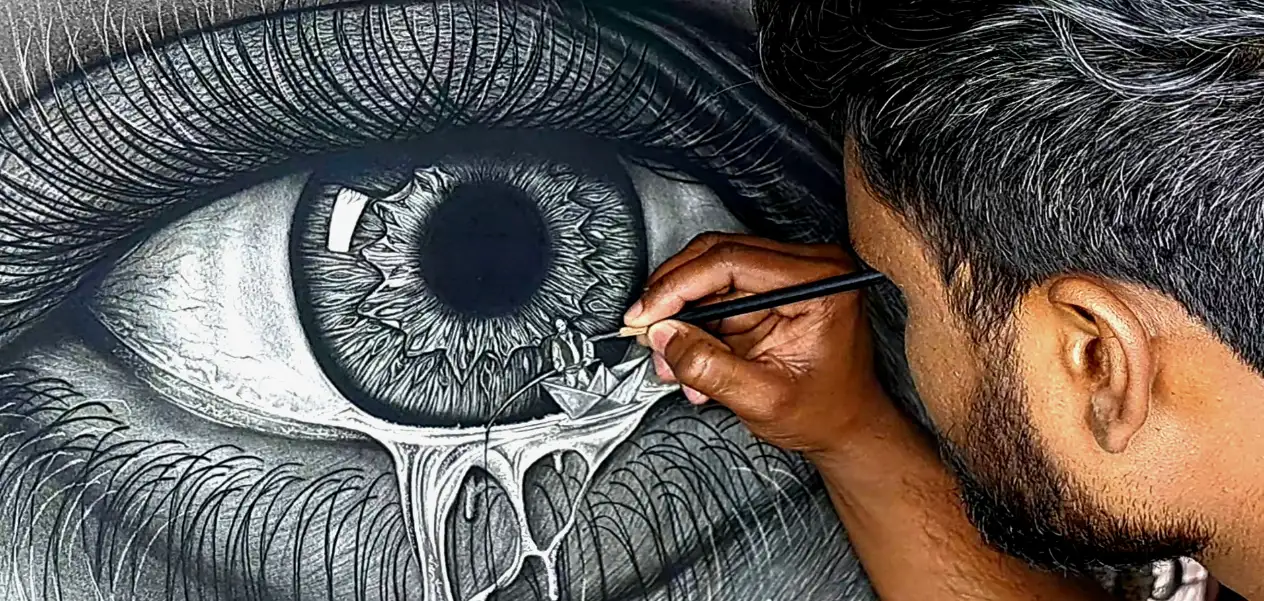
Adnan had been fond of drawing since his school days, and to support his family, he took up his hobby as a profession. After his father passed away, his mother had to take care of the family all by herself. During the COVID-induced lockdown, I worked on my drawing skills at home using a pencil and paper.
Adnan Ansari at work
After this, Adnan created his Instagram page and uploaded his paintings on it. He received appreciation for his art. “Appreciation for one’s work is fine, but I cannot fill stomachs or run the family,” he said.
Soon after, Adnan completed his schooling at Aligarh Public School, one of his juniors placed an order over the phone for his portrait.
“That was my first earning. I received Rs 200 as remuneration. I never looked back. I was encouraged to make better paintings as I realised that I would start earning. My hard work and dedication have paid off, and today I am at a stage where my paintings are in demand even abroad.”
Today his Instagram page is doing well. “My followers are increasing, and I upload all my works for sale on it.”
He receives all his orders through Instagram. “I currently have orders for paintings from America, UK, Canada, and Saudi Arabia,” said Adnan. So far, his most expensive painting has been for Rs 40,000.
Adnan Ansari with some of his works
Adnan said that he has been trying to understand life from his perspective and process his feelings on canvas. That process makes him serve people through his art. His paintings reflect the maturity of his imagination.
According to him, copying something and making it exactly like it is not the definition of art.
Adnan said that he could make a painting of any kind, even from the oldest torn photographs. “For example, if you give me a colour or black and white photograph, I will make it exactly like the original, which will make you feel that this one is better, no matter how old the photograph is, if there is even 10 to 15 percent imagination in it, then I can make it.”
Adnan told Awaz-The Voice that his mother, Rashida Begum, is not educated and has a small income through doing small household work, which is not enough for the family. His younger brother Bilal Ansari is in school.
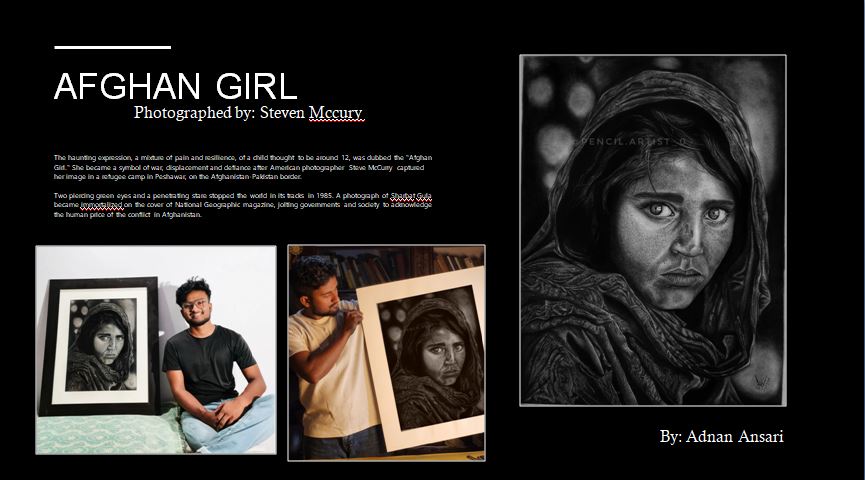
Adnan Ansari’s art
Adnan Ansari told Awaz-The Voice that he was thankful to former Aligarh MP Jamal Khwaja for providing him with a place to live. “We do not have a house and a Jamal Khwaja for whom my mother works, has kindly given a portion of his bungalow for my family to live.”
Adnan told Awaz-The Voice that I am currently doing post-graduation from Aligarh Muslim University. Along with this, I am improving my art through social media. However, my work is more understood and liked abroad. But I hope that one day I will get a big honor at the national and international level, and I am working hard for that.
Adnan said, “I started with pencil and sheet, so till now whatever paintings I have made, I have used only charcoal pencil, charcoal powder, eraser, cutter scale, knife. Now that I have money, I am also using canvas, light, computer, camera.”
Adnan said that the youth should bring out the talent hidden within them and try to move forward using whatever facilities are available to them. It is not necessary to have big things to make it big, one should bring out the hidden talent and work hard honestly. One day, success is inevitable.
Adnan Ansari’s works
Adnan said, “I mostly like to make a painting which has a story behind it. I keep looking at the paintings of some international-level artists and photographers to get inspired to do my work.”
Adnan Ansari is also a state-level under-19 football champion; he also edits videos on a freelance basis. Adnan wants to build his studio where he can showcase his art and video editing skills and create digital artwork.
Adnan Ansari says that first he prepares a digital layout and sends it to his clients. He does all this through Touchbook software. After approval, he draws it on canvas with a pencil.
Adnan says the price he prices his paintings as per his assessment of the hard work that has gone into each one. “I earn enough to run my household. I am now buying modern tools for my work. I see myself as a big artist of India in the next 5 years.”
Adnan has received many awards for his art. His works were also on display at the National Art Exhibition, where he received a lot of appreciation. Adnan also actively participates in youth fests and other competitions.
source: http://www.awazthevoice.in / Awaz, The Voice / Home> Stories / by Onika Maheshwari, New Delhi / April 09th, 2025
Bengaluru, KARNATAKA / New York, U.S.A / Mumbai, MAHARASHTRA :
Rummana Hussain’s conceptual artistic imprint on the state of India is relevant now more than ever. Dealing in the currency of feminist expression, postcolonial thought and perennial ideas, Rummana’s India is both doubly colourful and doubly dark.
In an inaugural show in its new West Village location, New York’s Institute of Arab and Islamic Art presents The Tomb of Begum Hazrat Mahal an exhibition encapsulating Rummana Hussain’s artistic ruminations about the space our bodies occupy in present and past through one of India’s most prominent Muslim woman.
Bangalore-born Rummana Hussain (1952-1999) was a pioneer in conceptual and performance-based political art in India during the 1980s and 1990s.
She was part of the Sahmat collective, a platform for liberal, secular engagés multidisciplinary artists including Safdar Hashmi, Bharti Kher, and Manjeet Bawa among others.
In this recreation of The Tomb of Begum Hazrat Mahal (1997), the respectful visitor enters a one-room shrine.
“In seeing The Tomb of Begum Hazrat Mahal today, I remembered Hussain’s bold feminist reclamation of her Muslim body through the reincarnated aura of Begum Hazrat Mahal to question monolithic identity, national narratives, and systemic marginalisation”
Various objects signify a site of lamentation, pride, and remembrance.
On the floor, occupying a central location, 12 votive-like papaya halves sit atop a mattress of uncooked rice, evoking both an altar to womanhood and fertility, and a symbolic funerary pyre.
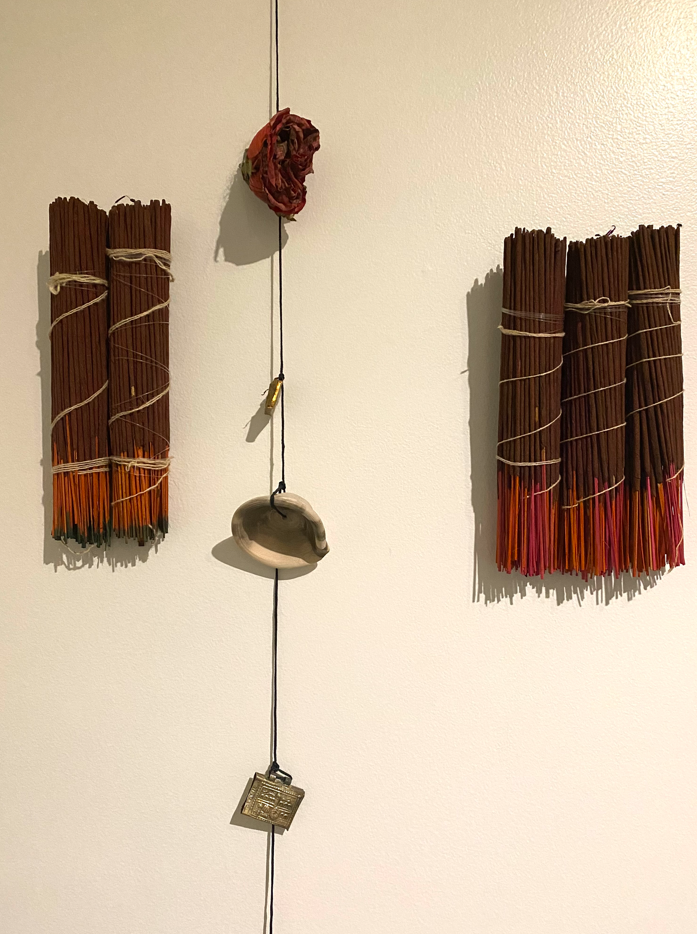
In front of them stands an installation of offerings comprising amulets, dried roses, shells, and incense sticks, tied in a rope.
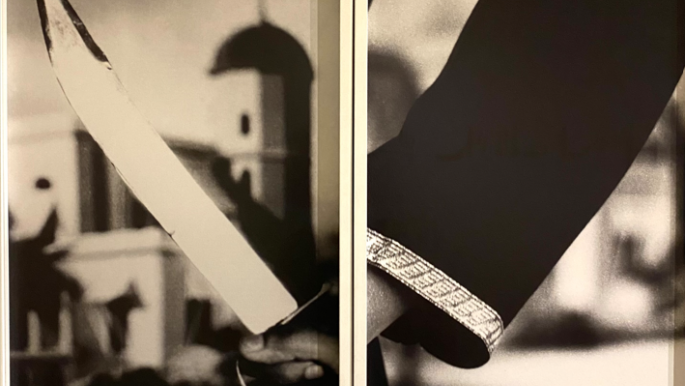
Against the three other walls is a calligraphic sculpture from rusty metal that reminds of a sacred spell and the embodiment of time, and an image frieze of detailed black and white triumphant photographs showing a woman’s arms, wrists, and hands.
In one of these frames, a woman raises her fist up as if calling others to join in. In another, she holds an ominous knife. Images of flames are interjected between the simulacra of archives.
The room is devoted to a woman, an invisible physical body which radiates from each of the static objects. Begum Hazrat Mahal (1820-1879), née Muhammadi Khanum, was born into a poor family.
She was sold and entered the royal harem of art-loving Wajid Ali Shah, the last king of Awadh, a kingdom that occupied the area of the present-day northern Indian state of Uttar Pradesh. Trained as a harem attendant, she would eventually rise to become the king’s concubine – one of his favourites. Beyond her charms, Begum Hazrat Mahal owes her entrance on the historical stage foremost to her political prowess and courage.
The British-owned East India Company operated in Awadh since the early 19th century. The Company increased its grip in 1856, when it directly seized control of Awadh, citing poor governance and the need to uphold the rule of law to justify their annexation (an excuse known as the “Doctrine of Lapse”).
A Chief Commissioner was rapidly appointed. This caused the king to leave Lucknow and seek refuge in Calcutta. The Queen Mother of Awadh petitioned Queen Victoria in person for her son’s rights, in vain. Wives, including Begum Hazrat Mahal were left behind in occupied Lucknow.
After this brutal annexation, discontent grew in several parts of India against the British and the interference of the Company, culminating in a mutiny and revolt in May 1857. Rebels looked to Awadh’s Crown Prince as a successor to his absent father when they captured Lucknow.
But Birjis Qadr, the son of Begum Hazrat Mahal and Wajid Ali Shah, was still a child then, too young to assume power. In his stead, Begum Hazrat Mahal took over Awadh’s revolutionary affairs, actively leading the armed revolt during her regency, towards the reinstatement of Indian rule over Awadh in July 1857.
She continued resisting British rule well after the retaking of Awadh by the occupying troops in 1858, as she refused various offers of collaboration. She died in exile in Kathmandu, Nepal, as an unwavering freedom fighter. Today, a humble stele near Kathmandu’s Jama Masjid marks her tomb.
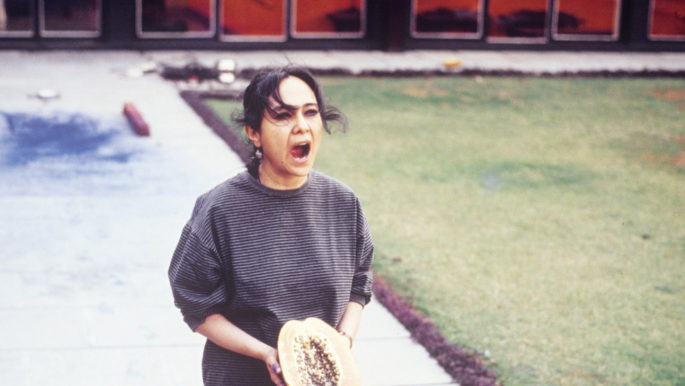
Rummana Hussain, Living on the Margins, 1995, performance at the National Centre for Performing Arts, Mumbai
When Rummana Hussain first showed The Tomb of Begum Hazrat Mahal to the public in 1997, it was during a period marked by the tragic aftermath of inter-communal violence.
During the 1980s, radical Hindu nationalists campaigned to build a temple on the site believed to be the birthplace of Rama, where a mosque had been erected since the 16th century.
They took to the streets of Ayodhya, Uttar Pradesh, en masse in 1992. Security lost control of the crowd which eventually stormed into the site, demolishing the mosque.
This ignited weeks of violent clashes between Hindu and Muslim communities, causing the deaths of thousands. A later investigation on the destruction of Babri Masjid in Ayodhya pointed out the responsibility of leaders and supporters of the right-wing Bharatiya Janata Party (BJP), the political party of India’s incumbent Prime Minister, Narendra Modi.
Babri Masjid launched a turning point in Hussain’s artistic journey towards a more intimate, politically-conscious form of expression. In Dissected Projection (1993), she explored the multilayered meaning of ruins and dislocation through an allegorical work that exposes a fracture, a shattered piece of terracotta.
In her show Multiples and Fragments (1994), Hussain engaged with historical and domestic oppression in an installation of pigmented pieces of fabric on a clothesline, to denounce the colonial extraction of indigo in India and unpaid housework traditionally performed by women and girls. Labour is always physical and violence first hurts the most vulnerable.
In her 1995 performance Living on the Margins, Hussain screamed while holding papaya halves, shapes that represent a universal vessel and the female anatomy.
Her works have been exhibited in the India Pavilion of the Venice Biennale in 2019, and in multiple institutions across India, Canada, Australia, Mexico, the United Kingdom and the United States during her lifetime and posthumously.
In seeing The Tomb of Begum Hazrat Mahal today, I remembered Hussain’s bold feminist reclamation of her Muslim body through the reincarnated aura of Begum Hazrat Mahal to question monolithic identity, national narratives, and systemic marginalisation. She wanted to say, we can turn the hate in love, we can turn the oppressed, the victims, into heroes they will one day celebrate. We can tell our own stories. They matter.
Outside, scores of brunch-goers live, love, laugh. If it’s dissonance we are meant to acknowledge, I acknowledge it. I closed my eyes in the silent white cube of the Institute of Arab and Islamic Art and saw images of the relentless violence and bullying Muslim women continue to face in Narendra Modi’s India.
In this reconstituted tomb, it’s hard to feel alone. Around me swarmed many other ghosts, of ordinary Muslim women – from Afghanistan to Iran and beyond – crushed and slain in their contemporary defence of freedom and justice against oppressors. Many have been killed in their fight.
A shrine calls for a quiet prayer, I realised.
Farah Abdessamad is a New York City-based essayist/critic, from France and Tunisia.
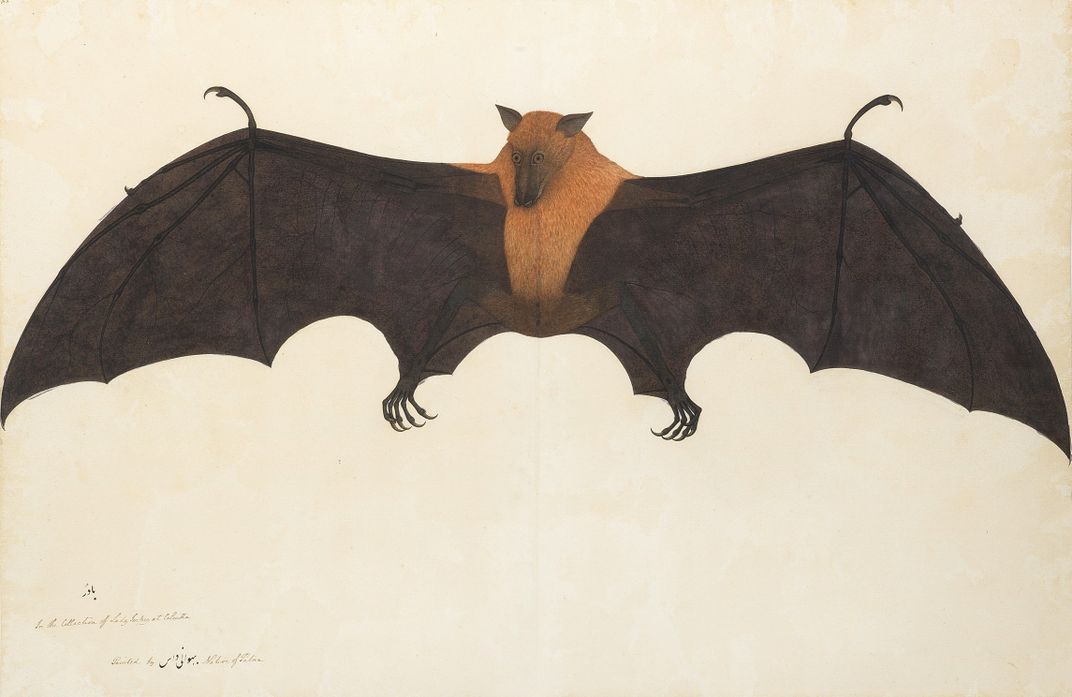
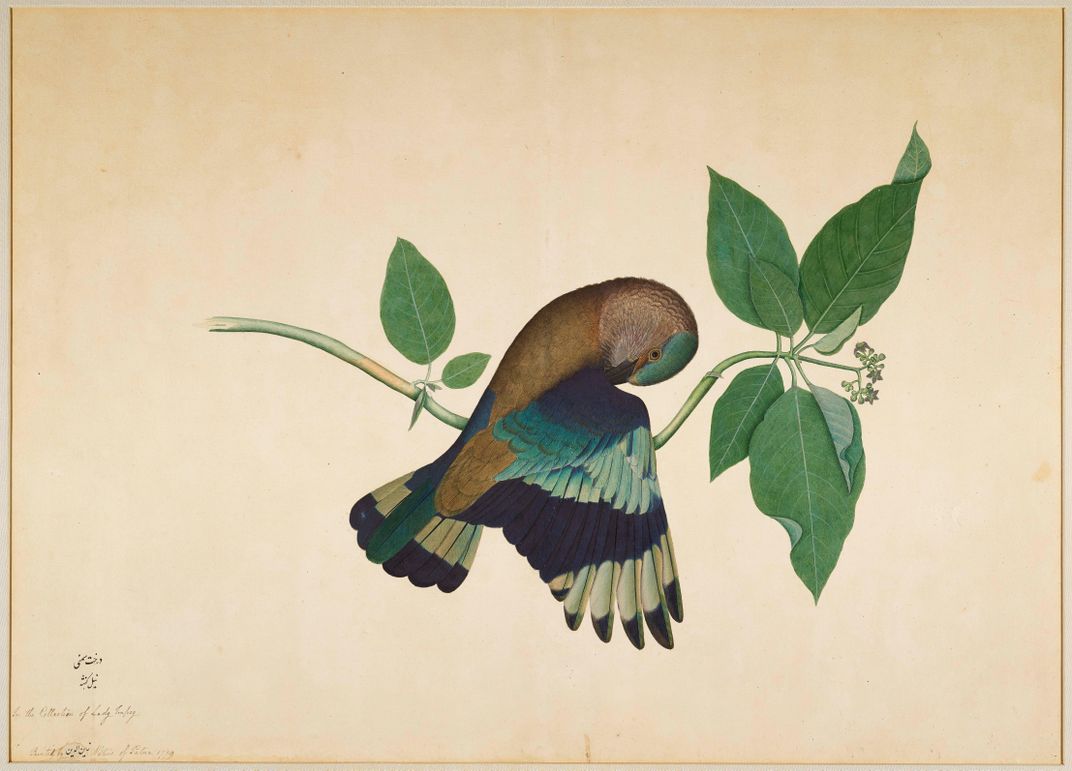
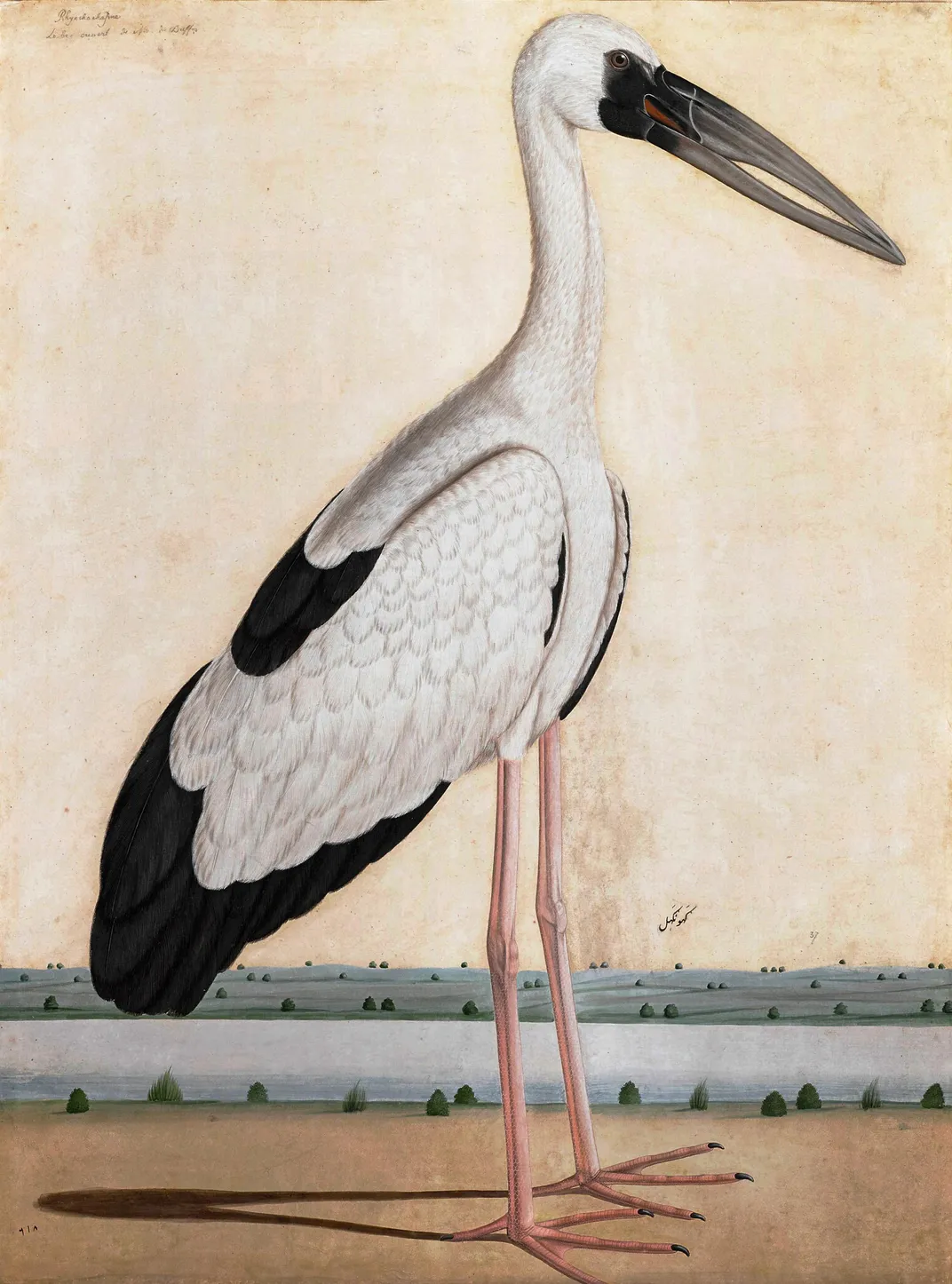
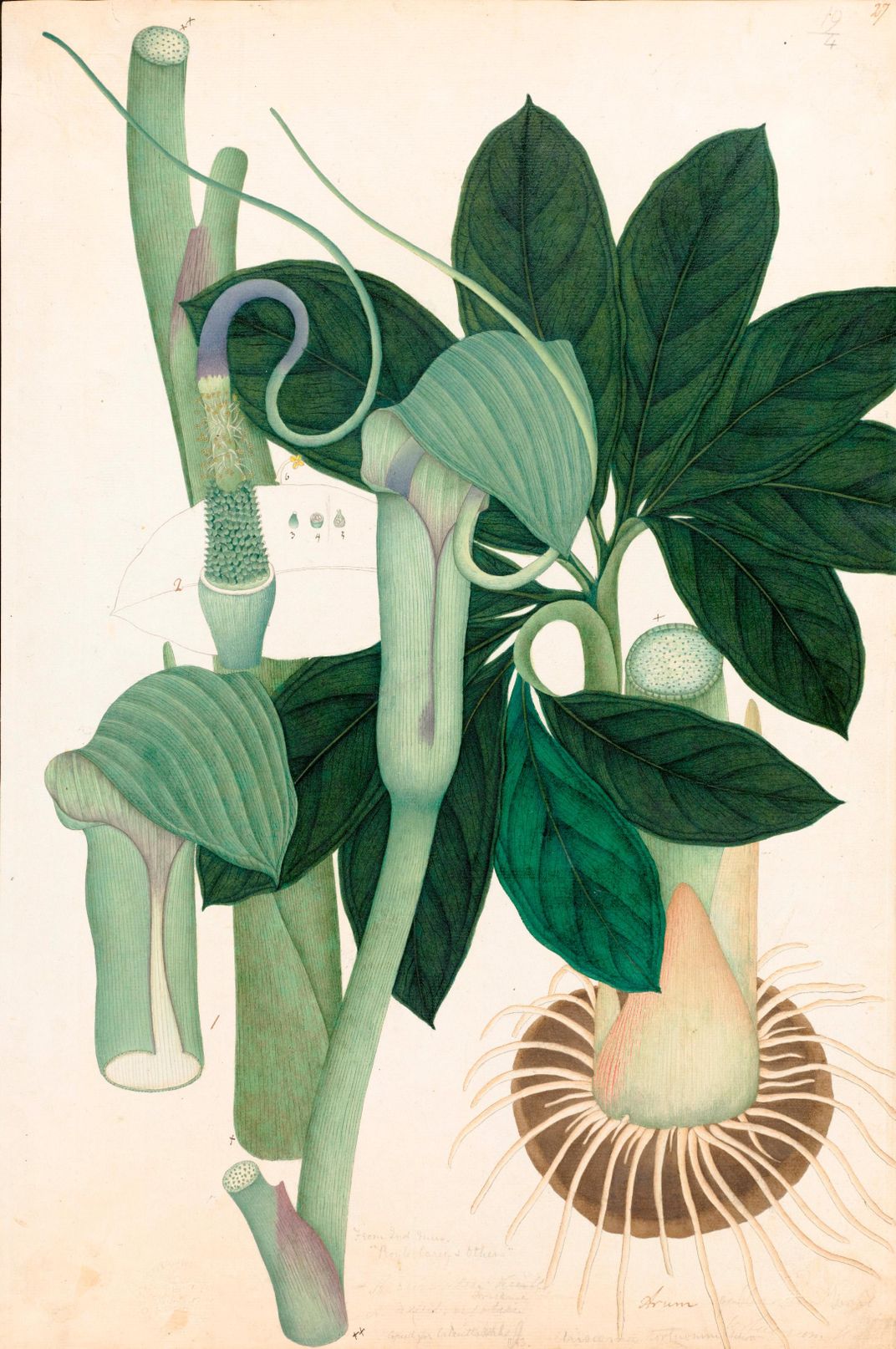
In the late 1770s, a British colonial official named Sir Elijah Impey and his wife, Lady Mary, commissioned the Indian artist Shaikh Zain ud-Din to catalog a private menagerie, including various bird species, the couple had assembled at their home in Calcutta. Using paper and watercolors from England, Zain ud-Din, a Muslim from the city of Patna, modeled his work after English botanical illustration, but he also brought to the job his training in the ornate Mughal artistic tradition—and his own distinctive style. Today critics praise the quality of the colors and the composition, in which a bright, simple background offsets the keenly wrought details of plants and animals. “Everything is incredibly precise and beautifully observant,” says Xavier Bray, director of London’s Wallace Collection, which this month mounts the first UK exhibition of works by Indian artists commissioned by officers of the British East India Company.
The expat aristocrats who patronized Zain ud-Din and his fellow artists had been sent abroad to help manage their country’s growing empire, but once there many, like the Impeys, fell in love with the subcontinent, as well as its flora and fauna. “These paintings,” Bray says, “were made into albums to be leafed through back home, on a rainy day, drinking Earl Grey tea.”
History failed to record much about Zain ud-Din’s life beyond his watercolors for the Impeys. But the new show, which includes 99 paintings of nature studies, portraits and landscapes by 18 artists, makes an argument that he and his contemporaries should be recognized on their own merits, as some of India’s greatest painters. “Anything with a colonial air about it is now considered politically incorrect,” Bray says. “But what we’re trying to do is bring back these extraordinary artists who have been almost completely forgotten.”



:focal(5160x3330:5161x3331)/https://tf-cmsv2-smithsonianmag-media.s3.amazonaws.com/filer/0c/d1/0cd129c2-7c42-455e-8e45-6ae7b7da7fce/dec2019_d01_prologue.jpg)