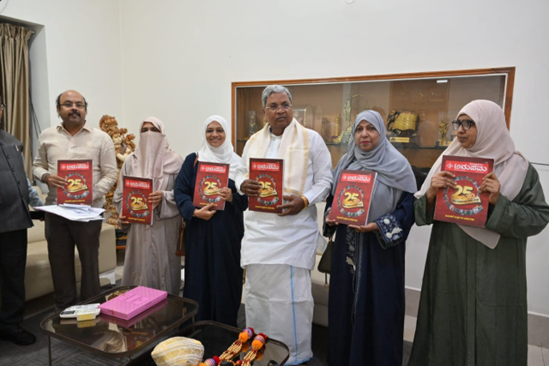
Anupama, the state’s only women’s monthly Kannada magazine run entirely by Muslim women, has completed 25 years. To mark this milestone, Chief Minister Siddaramaiah released a special silver jubilee issue, reflecting on its 25-year journey of success, in Bengaluru on Thursday.
Speaking at the event, the Chief Minister congratulated the team, saying, “There are only a handful of Muslim women in journalism. In such a scenario, it is highly commendable that the Anupama Women’s Monthly, run by women from the Muslim community and has successfully completed 25 years.”
Shahnaz M., the editor of Anupama, also spoke at the occasion. “The implementation of the ‘Guarantee’ schemes for women in the state has brought about significant changes in their lives. On behalf of the Anupama team and all women, I extend my gratitude to the government led by CM Siddaramaiah for their commitment to women’s development,” she stated.
The event was attended by Naseer Ahmed (Political Secretary to the CM), MLA Dr. Yathindra Siddaramaiah, BMTC Vice-Chairman Niket Raj Maurya, and Anupama’s sub-editors Samina Uppinangady, Sajida Momin, and Kulsum Abubakkar. Other notable attendees included S.M. Muthalib, Faisal Ismail, and Saleem Bolangadi.
source: http://www.radiancenews.com / Radiance News / Home> Latest News> Report/ by Radiance News Bureau / January 10th, 2026
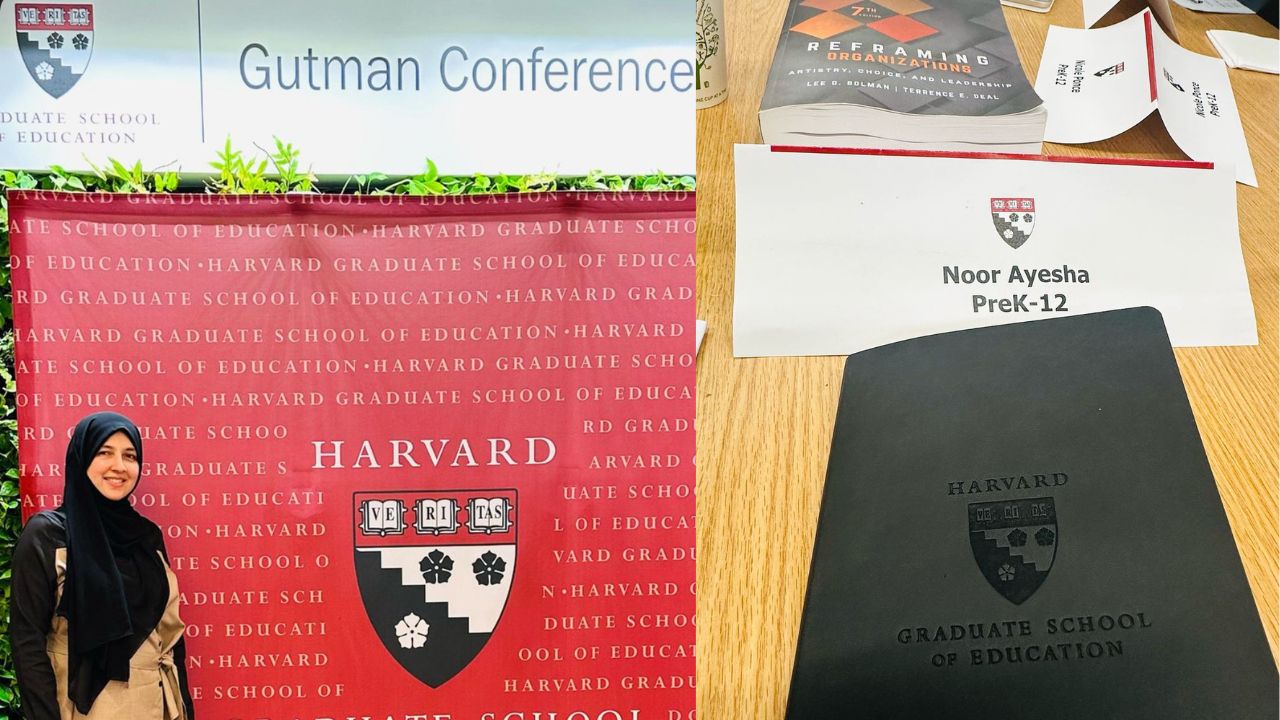
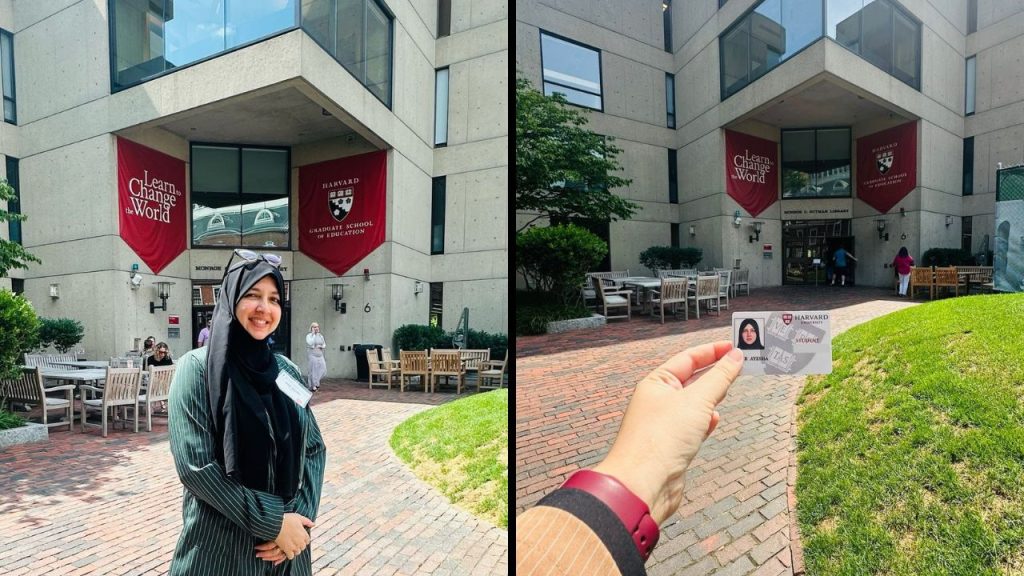
Bangalore’s own Noor Ayesha, an award-winning educator and visionary school leader, has been admitted to Harvard University for advanced postgraduate studies in Education Leadership. She joins the globally renowned Harvard Graduate School of Education to further her lifelong mission of transforming education through value-based learning and holistic child development.
Founder, Vice-Chairperson, and Managing Director of the Iqra Group of Schools in Bangalore, Karnataka, India, which includes Iqra International School, Iqra Juniors, and Iqra British Academy. For over a decade, her schools have redefined education by blending academic excellence with character formation, nurturing young minds to become not only successful learners but also compassionate, ethical citizens.
Her admission to Harvard marks a historic milestone, not just for her but for the entire region, as it highlights the global recognition of her impactful work in education. Noor’s leadership journey continues to inspire educators, parents, and youth, especially young women leaders striving to create change through education.
Quoting the famous line from the Spider-Man movie, Noor often reminds her team: “With great power comes great responsibility,” and she adds her powerful extension: “With great responsibility comes even greater accountability.” She believes educators carry the moral responsibility of shaping future generations and must be held accountable for the world they help create.
“As educators, we hold the power to shape the future,” says Noor. “My goal is to establish value-based schools across the world that nurture responsible, purpose-driven individuals who will lead with integrity and compassion.”
Her selection by Harvard is a proud moment for Bangalore, and a testament to the power of purpose-driven leadership in education.
source: http://www.thecognate.com / The Cognate / Home> Education / by The Cognate News Desk / August 11th, 2025
When she joined the Indian Combat Academy (ICSA) on Bannerghatta Road to learn Jujitsu and self-defence, little did Nabila Birjis (29), know that this would be a turning point in her life.
Bengaluru :
When she joined the Indian Combat Academy (ICSA) on Bannerghatta Road to learn Jujitsu and self-defence, little did Nabila Birjis (29), know that this would be a turning point in her life. On April 2, she turned out to be the only girl selected from Karnataka to compete in the South Asia Open Jujitsu Championship 2019, in Chennai.
Born and brought up in Mysuru, she moved to Bengaluru seven years ago to work for an architecture firm. At the age of 25, after undergoing rigorous training under coach Jitesh Banjan, she started competing seriously. So far, she has won six golds at the national-level JAI Jiu Jitsu events under 68kg and 70 kg categories; two silver medals at South Asian Championships; and gold at Body power Expo Open Weight.
She is also the only Indian woman to have secured two silver medals at South Asia Open Jujitsu Championship 2019. “I always wanted to achieve something in sports. My mother Noor Fathima Khan, HOD and professor at Maharanis Science College, Mysuru wanted me to complete my graduation before pursuing sports. I started my sporting career only at 25.”
It was not easy for Birjis in the field. She has quit her job, moved cities, so she could be able to devote more time for training. “I remember when I travelled for three hours just to be able to train for an hour. After struggling for years, I now seem to have struck some sort of balance between being an architect and an athlete,” she added.
Jujitsu is a team sport, and the biggest challenge she finds is to keep up with the energy levels of younger athletes. To stay fighting fit, she follows a strict sports diet. For Birjis, losing teaches more than winning. “My loss at the South Asia Championship has taught me how to move forward. My teammates have always encouraged me to do better. I will learn from my previous experiences,” she added.
source: http://www.newindianexpress.com / The New Indian Express / Home> Bengaluru / by K Rathna / August 20th, 2019
In the bustling city of Bangalore, where the convergence of tradition and modernity creates a unique educational landscape, Dr Nafeesa Ahmed stands as a beacon of transformative leadership in the field of education. Dr Nafeesa has carved out a unique path for herself as the Director of the Presidency Group of Institutions while also carrying on her father, Dr Nissar Ahmed’s legacy of excellence and innovation.
Dr Nafeesa Ahmed, Director, Presidency Group of Institutions, Bengaluru, Karnataka
Dr Nafeesa’s educational journey is nothing short of impressive. A graduate of Mount Carmel College, Bangalore, she holds a Bachelor of Business Management (BBM) degree and pursued postgraduate studies in English literature at Bangalore University. Her commitment to education led her to earn a bachelor’s degree in education from IGNOU. Venturing beyond Indian shores, Dr Nafeesa enriched her perspective with a Master’s in International Management from Royal Holloway, University of London. This international exposure was instrumental in shaping her understanding of global education trends.
Her dedication to continuous learning took her to the prestigious Harvard School, where she honed her skills in management and leadership. Dr Nafeesa’s academic prowess is underscored by her diverse qualifications, including a BBM, a B.Ed., an MA in English Literature, and a Master’s in International Management. Her educational journey serves as an inspiration, reflecting the importance of a broad and holistic approach to learning.
Leadership at the Presidency Group of Institutions
Taking the reins as the Director of the Presidency Group of Institutions, Dr Nafeesa has led the K-12 chain of elite institutions with a commitment to “Equal Opportunity in Diversity.” Her vision is to provide high-quality, affordable education to students from diverse backgrounds. Focusing on aspects like course structure, pedagogical innovation, and outcome-based evaluation, she has fostered a conducive teaching and learning environment.
During the challenging times of the pandemic, Dr Nafeesa displayed exemplary leadership by seamlessly transitioning the education system from physical to virtual and eventually to a mixed classroom approach. Her leadership has been pivotal in ensuring that the team of highly-qualified educators delivers the finest education to students.
Accolades and Achievements: A Trailblazer in Education
Dr Nafeesa’s journey is adorned with prestigious awards and recognitions, attesting to her significant contributions to the field of education. Notably, she received the Economic Times Power Icon Award for “Exceptional Contribution in Education” in 2020 and was honoured as “The Education Icon of the Year 2021” by Education Today. Her recognition as a ‘Speaker’ at the “APAC 5th Global Education & Skill Conclave” and features in Women Entrepreneurs and Education World India showcase her as a thought leader in the education domain.
A crowning achievement in her illustrious career is the conferral of a Ph.D., Philosophiae Doctor Honoris Causa (HC) in Education Management by Ecole Superieure Robert De Sorbon (ESRDS), France, Europe. The recognition, awarded at The House of Lords, London, is a testament to Dr Nafeesa’s global impact and commitment to educational excellence.
As Dr Nafeesa Ahmed continues to shape the future of education, her journey stands as an inspiration, showcasing the transformative power of visionary leadership in the realm of academia. In the words of Dr Nafeesa, “My loved ones have been my rock through thick and thin. Having their back has been crucial to my success.” Indeed, her success radiates not only through personal accolades but also through the positive impact she has had on the lives of countless students and educators.
source: http://www.outlookindia.com / Outlook / Home> Brand Studio / by The Outlook Bureau / March 08th, 2024
Tasneem Fathima Khaleel has had a successful career in academia. However, quite remarkably, she came back to where she started – teaching. M A Siraj reports.
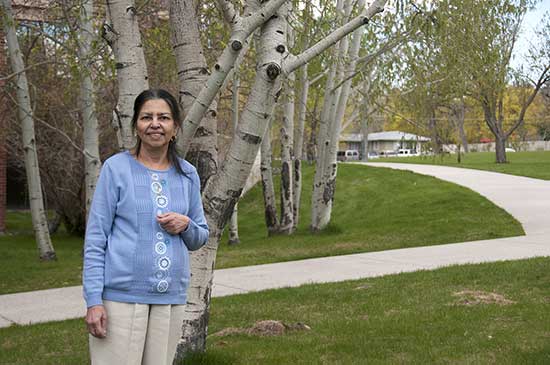
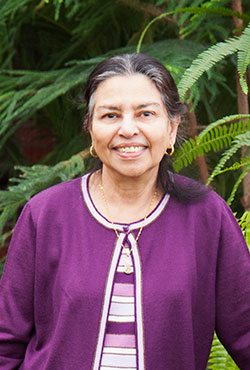
Few people end their careers where they first began; Professor Tasneem Fathima Khaleel is among those few. “I am excited about the opportunity to finish my career in the classroom. And, with a little help, I will be teaching in a new state-of-the-art…facility,” says Tasneem, the first-ever woman to have obtained a doctorate in the State of Mysore in 1970. Prior to returning as a professor of Botany, she served as the dean of faculty at College of Arts & Sciences for a decade at the Montana State University at Billings (MUSB).
Paving a new path
Tasneem has been teaching Botany in the United States for over 40 years and has received many awards for her teaching and research. She has headed, or has been a member on as many as 23 different academic bodies or advisory councils in the US. For her contribution to research, with nearly 50 research publications on subjects ranging from cyto-embriology to plant reproduction, she was awarded the ‘Outstanding Research Award’ in 1995 by the Montana Research Academy and has also won the Faculty Excellence Award five times.
The year 2014 was a special year for Tasneem – she had the rare honour of an award being named after her, for mentoring at the MUSB. Reno Charette, director for American-Indian Education, was adjudged the winner of the first ‘Prof Tasneem Fathima Khaleel Award for Mentoring’.
Tasneem studied in Bengaluru, before heading to the US in 1975 after marriage. An alumna of Central College, Bengaluru, she has coveted every opportunity to visit her ‘City of Gardens’ – which she ruefully admits is more a part of nostalgia rather than reality.
A passionate researcher, she recalls that very few women could be seen in higher studies in those days. Only a couple of them were pursuing PhD while she was registered in Bangalore University as well as teaching biology as an assistant professor at the University of Agricultural Sciences at Hebbal between 1968 and 1975. Her study of ‘Flora at the GKVK Campus’ and ‘Weeds in Karnataka’ are still quoted as seminal works.
Writing her own destiny
Tasneem had finished her BSc and MSc by the time she was barely 19 years old. Wanting to be a teacher, she had put in her application, but was rejected, as the dean told her, “You look like a school girl, how would the students take you seriously?”
Instead, he directed her to register for a PhD programme, which had just been started in the Bangalore University. The Doctorate took longer than usual to complete because there was lack of guidance and direction, and the programme had several fits and starts.
Finally, at 26 when she got her her doctorate, she was being looked as ‘a confirmed spinster’ in her own cultural surroundings. Marriage was nowhere on her mental radar. It took her brother several sittings to convince her of getting married.
Tasneem travelled a long and twisted path – one shaped by her culture and her drive to excel, to become the distinguished professor that she is today. For most Americans who had only preliminary idea of Islam, a woman with covered head and such drive for excellence and perseverance was a combination of incongruities. “Women have rights in Islam. Muslim women didn’t even have to fight for those rights. The religion has given them those rights,” she says.
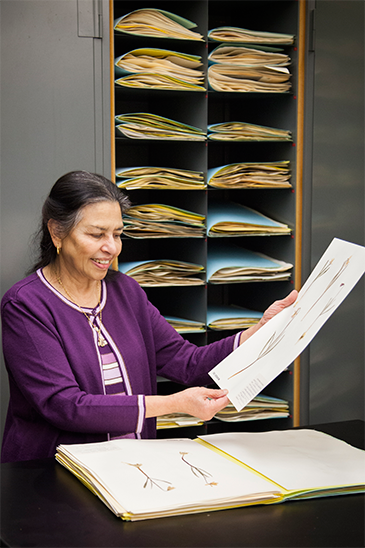
Dr Stn Waitr, her successor, says, “Dean Khaleel has raised the level of rigour, excellence and success in the College of Arts & Sciences to a standard that should serve as a model for the entire institution.” Interestingly, Tasneem even built a herbarium at the MUSB, which has around 17,000 specimens and is currently engaged in digitising it. She recalls with pride that she was the most productive member on the faculty of science at the MSU, which has nearly 22,000 students today in two campuses. Tasneem’s most significant discovery was the finding of mammalian steroids in plants, which she says, are responsible for sex expression in plants.
Author of four books, 10 external and 17 internal grants at the MSUB, Tasneem is excited about beginning her teaching career once again. “It had never ended. I had maintained a room in my department building, even while I headed the faculty,” she says.
source: http://www.deccanherald.com / Deccan Herald / Home> Content / by M.A. Siraj / June 26th, 2015
After teaching for over 40 years, Dr. Tasneem Khaleel is retiring
MSUB readies to part with long-time Professor Dr. Khaleel
Retirement party in honor of Dr. Khaleel set for 2 p.m., April 26 in the Beartooth Room in the Student Union Building. Food and refreshments will be served.
MSU BILLINGS NEWS SERVICES — Hanging on the wall in Dr. Tasneem Khaleel’s office are the many awards and accolades marking the dedication and service she has given to Montana State University Billings over the past several decades.
Khaleel is retiring at the end of this semester and her presence and legacy will be with the science department and University for years to come.
Dr. Christine Shearer, dean of the College of Arts and Sciences, said that without the dedication and perseverance of Khaleel, the College and its students would not be where it is today.
“Dr. Khaleel has devoted her professional career to Montana State University Billings in a variety of capacities. She has been a tireless researcher and developer of the internationally-renowned Herbarium, a deeply committed advocate for the sciences and science education, a leader of a complex and diverse unit, and has been a staunch supporter and mentor of female scientists and academic professionals in all disciplines,” Shearer said. “Her tenacity and resilience advanced the College of Arts and Sciences and its programs, including the establishment of the Women’s and Gender Studies Center, which serves the university and the community. Her involvement in Girls-n-Science impacted hundreds of young women planning STEM careers.”
Khaleel has been paving the way for women in STEM since the beginning of her career. She has the honor of being the first woman recipient of a Ph.D from Bangalore University, India, where she graduated with a degree in Botany in 1970.
In 1976, Khaleel would begin her tenure with MSUB, as would her signature project: the establishment, maintenance, and management of the internationally known MSUB Herbarium.
“The Herbarium is one of my professional accomplishments that I am most proud of,” Khaleel said.
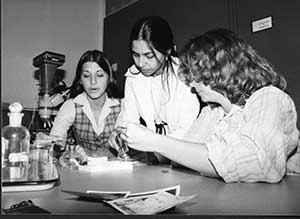
Dr. Tasneem Khaleel, center, assists Heidi Carter, left, and an unknown student during a lab experiment. (Photo circa 1980)
Post-retirement, she will continue being involved in the herbarium, which includes some 16,000 vascular plant specimens, some of which date back to the late 1800s and early 1900s. The Herbarium serves as a tool for basic research in plant systematics, ecology, phytogeography, and evolution.
While Khaleel’s career is highlighted by the 11 years she served as dean for the College of Arts and Sciences, from 2004 to 2014, she has no regrets to returning to the classroom before retirement.
Throughout her time on campus, she moved up from an assistant professor to department chair and says coming full circle made her last two years with students, “the best.”
“I wanted to retire as a faculty member,” Khaleel said. “Having that time as Dean allowed me to hear so many perspectives that my focus shifted when I returned to the classroom. My focus shifted from teaching to learning, to becoming a mentor and being more supportive.
For the last eight years the Tasneem and Shafiq Khaleel Endowment for Scholarships to Science has provided $1,000 awards to two students.
source: http://www.msubillings.edu/ucam/releases.2017/2017apr19Khaleel.htm / University Communications and Marketing / April 19th, 2017 / Montana State Univeristy Billings
My Ph.D is from India, at Bangalore University and I was the first woman to get a Ph.D from that university. I started education at a very young age because I started school when I was about 3. In those days there was not an age limit to start school, when your parents felt you were ready they took you to school. From then on it was up to you. When I started off, there was no kindergarten or pre-school, it was first grade. I sat on the teacher’s lap most of the time because I was so little.
Why did you study botany?
When I was a student in India, botany was a man’s field. They did not really take women in graduate courses for botany because they look at botany as a field science. Since the graduate seats were so limited they didn’t take a whole lot of graduate students. They thought if they took in a girl student, the only option for her would be to teach botany, not go out to the field. They still looked at women in those days as better at home and in the classroom than in the field. That was a challenge for me. I just wanted to prove to them one could be in the field as well.
When did you know you wanted to become an educator?
Oh I loved teaching right from the beginning. One of the reasons you do your masters in any discipline in India was so that you can teach in college. When I graduated with my masters degree in botany, I was 19 years old at the time and so I went off to find a job. There was one person who was in charge of recruiting and allocating all of the lecturer positions. So I talked to him and said, I need a job but he took one look at me and said, you look like you just came out of high school. He didn’t think I would be impressive enough in front of a classroom and to be able to control a classroom, the kids wouldn’t take me seriously. So I sat there and cried, I wanted the job and he refused to give me something that I had a passion to teach. I didn’t want to keep all the knowledge to myself. So then he said how about if you went and did a Ph.D. and then came back a few years later and by then you will have grown up a bit. I took him up on that option but there was no Ph.D. program at the university so he said he would help start one, which he did. And then we got the university grant fellowship to support me and I did my Ph.D. By then I wasn’t interested in going to him anymore to teach because people were after me to come and teach being I was the first woman with a Ph.D. there.
Tell us about your passion, building the herbarium at MSUB?
The value of the herbarium is based on what plant collections you have in it. When I first came here there were just two wooden cabinets here, with maybe 500 specimens. And they said, this is your herbarium. It was shocking because where I came from there is a whole building dedicated to the herbarium. So I challenged myself to build a herbarium here. The very first grant I wrote was to buy herbarium cabinets. The next step I did was to call out to local agents here who had small collections to see if they were willing to consolidate to a central location. The US Forest Service, United States Department of Agriculture, Bureau of Land Management and Rocky Mountain College were all very willing to give collections and we incorporated those in our herbarium. Over the years, the herbarium is a part of the national database with about 16,000 specimens.
Of the classes you teach, what is your favorite?
All of my classes are my favorite classes. I love teaching. I teach freshman biology, in fact that’s one of my most favorite classes to be honest. That’s when students are first starting out and I’m introducing them to biology for the first time and to get them excited about that. I really enjoy doing that and it gives me opportunities to mentor students because they’re just starting out. My second most favorite is plant systematics, they are both equally enjoyable classes for me. I just love teaching botany.
source: http://www.msubillings.edu/snapshots/2015-16/Khaleel.htm / msubillings.edu / by Cassie Winter, University Communications and Marketing / October 09th, 2015 / Montana State Univeristy Billings
Professor Tasneem Khaleel is an extraordinary educator, who has set the standard for excellence among her peers and captured the hearts and impacted the lives of her students through exceptional teaching and caring.
For four decades, Professor Khaleel’s leadership in the Department of Biological and Physical Sciences has been innovative and visionary, influencing generations of science students.
Her absolute passion for supporting her students as well as MSUB’s mission have been recognized with numerous honors and awards. But, this year Dr. Khaleel is the recipient of an award she says she is proudest of—the inaugural Faculty Award for Exceptional Support of Students with Disabilities.
Tasneem’s positive nature and friendly manner are a welcoming presence, explained by her student nominator.
“Dr. Khaleel’s guidance has helped me adapt to college life. She patiently taught me how to use lab equipment and spent extra hours in the lab helping me with my assignments. I have talked to other students with disabilities, and they agree that she goes the extra mile to assure they have a fair chance,” her student nominator said.
“This reward is very meaningful to me,” she said. “These students are special to me. Anybody can teach an ‘A’ student—they just need pointed in the right direction. But to bring a student who has no confidence in their abilities due to his/her disability, who has to compete with the ‘A’ students in class, and to have the courage to come to class everyday. I think this is the biggest reward of teaching.”
She adds that she thinks it takes more courage on the part of the student than that of the instructor.
“The least the instructor can do is be supportive and give these students the self assurance they need to perform. Nothing is beyond their abilities.”
She is an example of someone who does not treat her role simply as a checklist of duties, but a mentor who uses her position to educate, inspire and encourage those around her.
As one colleague notes, “Tasneem is an exemplary educator and leader: She is innovative, she thinks about teaching and learning far beyond her own discipline, and she inspires others to do the same.”
source: http://www.msubillings.edu/faculty/2016/khaleel.htm / Montana State University Billings
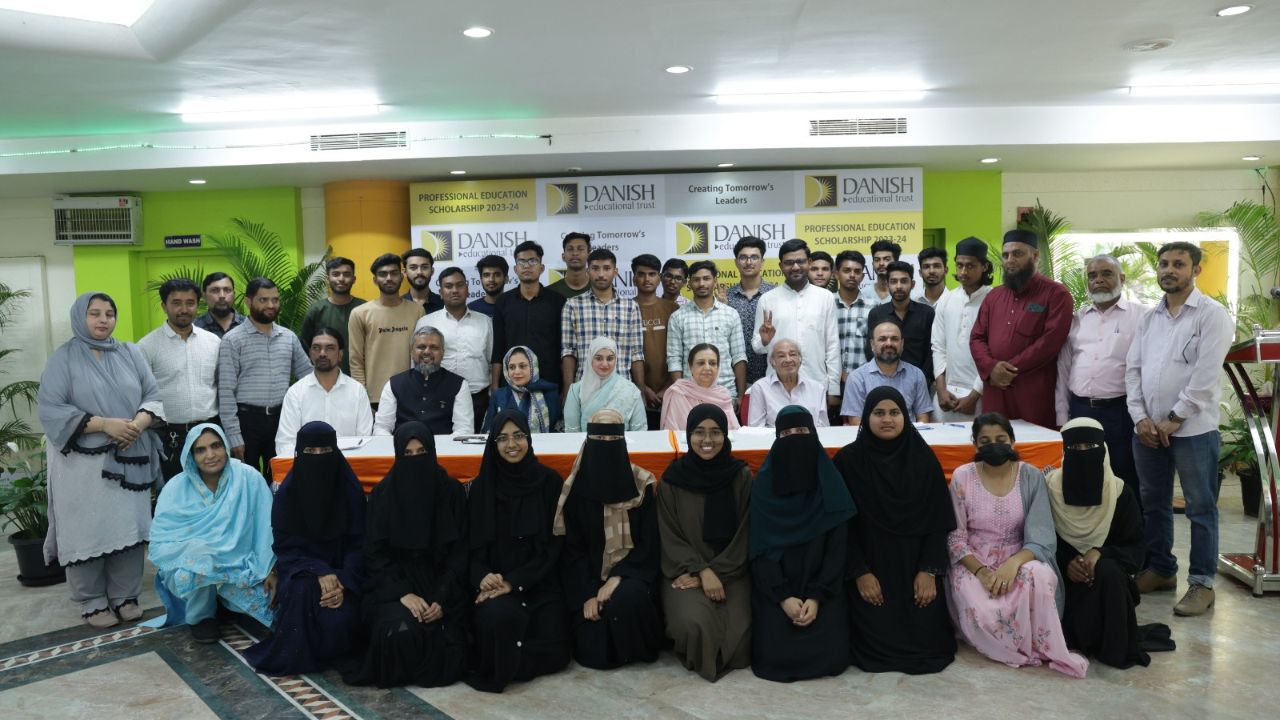
In a bid to bolster access to professional education for economically disadvantaged students, Bengaluru-based Danish Education Trust (R) awarded scholarships to 624 students pursuing professional education across Karnataka with a total scholarship amount of Rs. 1,60,00,000/- for the academic year 2023-24. The Trust selected students through an online application process at www.danishtrust.in.
The scholarship recipients are pursuing various professional courses, including Engineering, MBBS, Law, Journalism, Pharmacy, BUMS, BAMS, BHMS, Veterinary Science, Agriculture, and B.Ed, and are from economically underprivileged backgrounds.
Danish Educational Trust (R) was established in March 2006 by a group of concerned citizens led by philanthropist Mrs. Husna Sheriff, with the belief that education is the seed for development and progress. Since its inception, the Trust has continued its scholarship scheme for poor and needy students pursuing higher education.
Over the years, the Trust has sponsored the education of more than 4000 students, and this year’s scholarship program is another step in empowering young minds to achieve their educational dreams.
Expressing her pride in the trust’s achievements, Mrs. Husna Sheriff emphasized the importance of empowering young minds through education. “We firmly believe in providing a platform for students to thrive academically, regardless of their socioeconomic background. By investing in their future, we are sowing the seeds for a brighter tomorrow,” she remarked.
Looking ahead, Danish Educational Trust envisions expanding its reach further, with plans to increase the scholarship amount to Rs. 1.8 crore and support over 750 students in the upcoming academic year 2024-25. Such ambitions underscore the trust’s unwavering dedication to fostering equitable access to education and nurturing the leaders of tomorrow.
source: http://www.thecognate.com / The Cognate / Home> Education / by Shaik Zakeer Hussain / March 14th, 2024
Bibi Tabassum and Suraiya Quraishi who embroidered the Quran.
Bengaluru :
This is a miracle. An awe-inspiring phenomenon took place in this city a few days back, as two sisters- Bibi Tabassum and Suraiya Quraishi- embroidered the sacred Quran onto 604 pages of plush velvet cloth.
Showing excellent craftsmanship, they used needles and threads to meticulously prepare an embroidered holy Quran. This embroidered Quran, prepared under the watchful guidance of an Alim-e-deen (religious scholar), is not only easily legible but also heavenly captivating.
Bibi Tabassum, the younger of the two sisters, holds a great fondness for doing embroidery ever since she was a child. In the beginning, she used to embroider only small verses of the Quran, but one day, an idea graced Bibi Tabassum’s mind – to intricately embroider the entire holy Quran. This took her on a laborious journey, one fueled by love and devotion.
Expressing extreme gratitude to Allah for giving them the opportunity to prepare this embroidered Quran, Bibi Tabassum says that she aspires to gift this embroidered holy Quran to a library in the holy city of Madina.
Venturing on this embroidery voyage of the Quranic verses along with her elder sister Suraiya Quraishi, Bibi Tabassum started with the first inaugural Surah of the Quran i.e. Surah Al-Fatiha, and continued diligently. The last surah- Surah An-Nas marked the culmination of their hard labour.
This embroidered holy Quran is divided into five volumes, and each volume consisting of six chapters. It went through a meticulous binding process by the skilled hands of its creators.
Initially, in the detailed process of embroidery, Bibi Tabassum used to inscribe the verses of the Quran with a pencil on the velvet cloth, followed by both the sisters intricately weaving threads along those sacred lines.
Carrying on the demands of daily life, both sisters, driven by unwavering dedication, used to finish their household chores and then engage in the embroidery work of the holy Quran.
To ensure the utmost accuracy of the embroidered work, a learned religious scholar closely scrutinized each verse upon the completion of a page. Bibi Tabassum says, ‘After completing every page of the embroidered holy Quran, we would show that to our scholar and do any correction if required.”
In the aftermath of this big achievement, family members are thoroughly elated for the two sisters. They say that the two sisters have utilized their time for a very noble endeavour. Extending heartfelt gratitude, they thank Allah for the manifestation of this lovely artwork, which stands as a testament to the beautiful blending of devotion and artistry.
source: http://www.indiatomorrow.net / India Tomorrow / Home> News> Society / by India Tomorrow (headline edited) / February 05th, 2024