In a period marked by suspicion and sharp communal divides, a quiet act of integrity by a Muslim scrap dealer in Faridabad has drawn attention for its moral clarity.
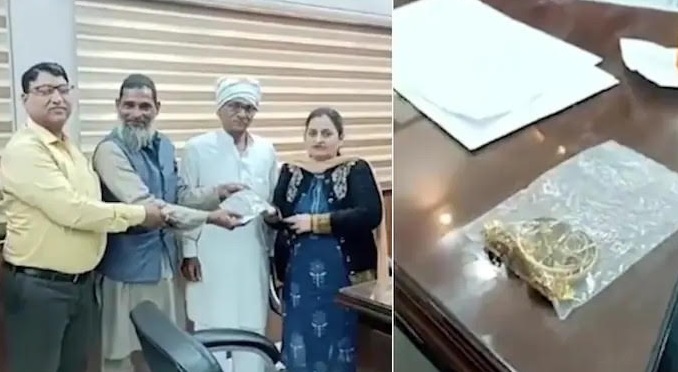
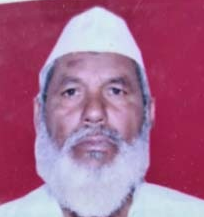
Haji Akhtar Khan, a kabadi trader in Ballabhgarh, returned gold jewellery worth around Rs 15 lakh to its Hindu owner nearly four months after unknowingly buying it as scrap. The jewellery, weighing close to 100 grams, had been accidentally mixed with household waste during a Diwali clean up and sold along with other discarded items.
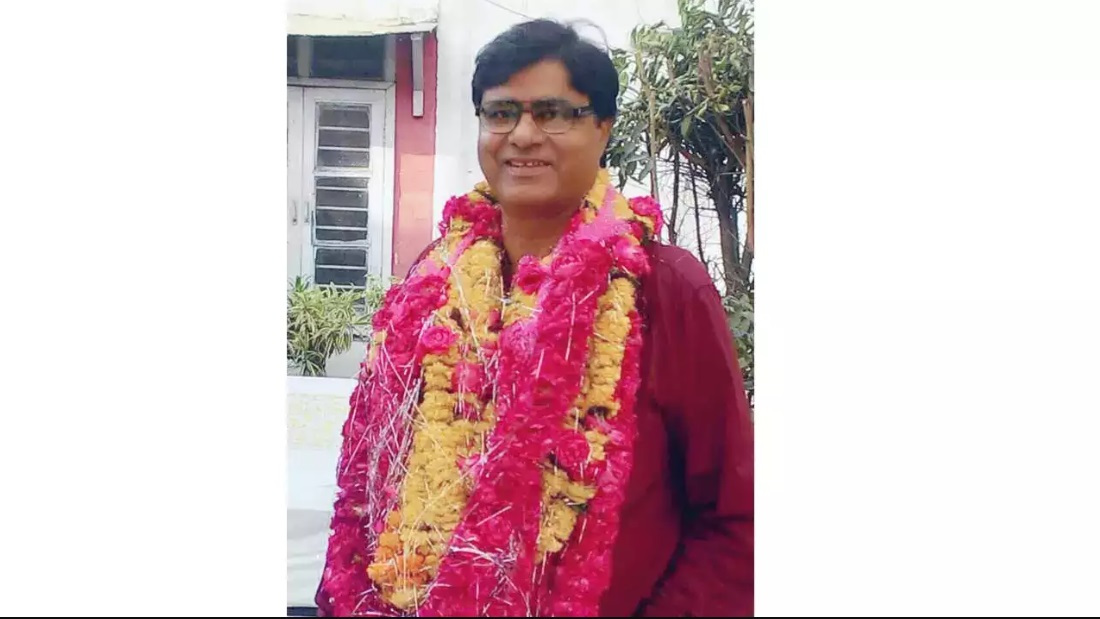
The ornaments belonged to Ashok Sharma, a resident of Ballabhgarh. Weeks after selling the scrap, the Sharma family realised that a small packet containing gold jewellery was missing. The loss caused distress, since the ornaments represented years of savings and family memory. By then, the scrap had already passed into the informal recycling chain.
Khan had purchased the scrap in bulk, a routine practice in the trade. Months later, while sorting stored material in his warehouse, he noticed a packet hidden among old items. On opening it, he discovered gold jewellery. The find came at a time when Muslims in several regions face frequent suspicion in public life and trade.
Instead of treating the discovery as an unexpected gain, Khan chose a different path. When Sharma later approached him with inquiries, Khan admitted finding the jewellery and promised to return it without delay.
To maintain transparency, the handover took place at the office of ACP Ballabhgarh Jitesh Malhotra, in the presence of police officials. The moment carried visible emotion for the Sharma family, who received back their belongings intact. Police officers present described the act as rare and worthy of recognition.
Those familiar with Khan describe him as a practising Muslim who has performed Hajj and regards honesty as central to faith and livelihood. In Islamic teaching, amanah or trust holds deep importance, especially in trade and public dealings. Khan reportedly said the discovery felt like a trust placed upon him and returning it remained a duty before God.
The episode unfolded against a broader backdrop of heightened communal tension, economic boycotts, and stereotyping directed at Muslims in public discourse. In such an environment, everyday acts often receive communal labels. Khan’s decision challenged such narratives through conduct rather than argument.
Faridabad, part of the National Capital Region, mirrors many of north India’s social complexities. It hosts factories, migrant labour, and small traders from diverse communities. In this setting, an ordinary scrap transaction turned into a moment of shared trust between neighbours of different faiths.
For Ashok Sharma and Haji Akhtar Khan, the exchange rested on honesty rather than identity. The story has since circulated locally as an example of lived communal harmony. It offered a reminder that ethical choices remain possible even amid strained social conditions.
What began as a Diwali mistake ended with restored faith in human conscience. The return of the jewellery did more than correct a loss. It affirmed dignity, trust, and coexistence through a simple decision guided by principle.
source: http://www.radiancenews.com / Radiance News / Home> Latest News> Report / by Radiance News Bureau / February 23rd, 2026
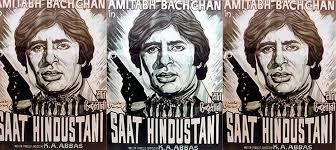
Multi-hyphenate talent Khwaja Ahmed Abbas worked in Urdu, Hindi and English and across writing mediums. Abbas, who died in 1987 at the age of 71, wrote social realist screenplays for Raj Kapoor and V Shantaram, directed films, published short stories and plays,and contributed a long-running weekly newspaper column. Among the best-known films he directed are Neecha Nagar, Sheharaur Sapna and Saat Hindustani. Set in Goa and tracing the efforts of seven revolutionaries to free the state from Portuguese rule, Saat Hindustani marks the debut of Amitabh Bachchan. An essay from the anthology Bread Beauty Revolution, edited by Iffat Fatima and Syeda Hameed, relates Abbas’s encounters with the “tall young man” and future screen icon. Bread Beauty Revolution includes writings from Abbas’s memoir I Am Not An Island: An Experiment in Autobiography as well as essays, stories,poems, photographs and columns.
The story of Saat Hindustani came out of the Goa struggle reminiscences of my assistant, Madhukar, who would often regale us with the adventures he had while trekking up with the non-violent commandos to hoist the tricolour on every police station they came across…
I was so excited when I finished the screenplay that I telephoned all my friends and informed all my assistants, including Madhukar, to come and hear it in my fourth floor office on the very next day. That was a ritual which they never missed and I would get their suggestions for casting the film.
I wanted to prove by my casting that there was no particular Hindu or Muslim, Tamilian, Maharashtrian or Bengali ethnic type. To begin with, I would transform the smart and sophisticated and versatile Jalal Agha into the Maharashtrian powada singer. Even Jalal was shocked to hear this. But I reassured him that, with the proper make-up and get-up, nobody would recognize him except as a rural Maharashtrian folk singer. Madhukar, who hails from Meerut, would be a Tamilian; Sharma (Brahmin by caste) would also undergo a similar transformation; and Utpal Dutt, the cigar-chewing admiral,would be the tractor-driving Punjabi farmer. So far the casting was clear in mymind. On one of my visits to Kerala I had met Madhu, the handsome hero of the Malayalam screen, and he had approached me and expressed his desire to work in a Hindi film with me. I would make him the sensitive Bengali; I wouldn’t have to work much on his Bengali accent for he had lived with a Bengali family. Now only the Hindi and Urdu fanatics were left. Jalal one day brought with him his friend Anwar Ali (brother of the comedian Mehmood), in whose eyes I saw the Jana Sanghi fanaticism. So I decided to make him the Swayam Sevak who hates Urdu and speaks jaw-breaking Hindi. That left one Indian, the Muslim Urdufanatic. Since I wanted these boys to be of different ages and different heights, the one vacancy left was for a tall and handsome man. He had to be thin, also corresponding to the thin image of my friend, the late Asrarul Haque “Majaz”.
One day someone brought a snapshot of a tall young man and I thought that the boy was in Bombay. I said, “Let me see him in person.” “He will be here day after tomorrow evening.” Again, presuming he was in Bombay, I thought he must be working somewhere and wouldn’t be free till the evening. On the third day, punctually at 6 pm, a tall young man arrived who looked taller because of the churidar pajama and Jawahar jacket that he was wearing. This young man would one day be known as Amitabh Bachchan, the heart-throb of millions. But I did not know his name. Roughly, the following dialogue took place between us:
“Sit down, please. Your name.”
“Amitabh.” (Not Bachchan.)
It was an unusual name — so I asked, “What does it mean?”
“The sun. It’s also one of the synonyms for the Gautama Buddha.”
“Education?”
“B.A. from Delhi University.”
“Have you worked in films before?”
“No one has taken me so far.”
“Who were they?”
He mentioned very prominent names.
“What did they find wrong with you?” The boy spoke with frankness. “They all said I was too tall for their heroines.”
“Well, we have no such trouble. In a way we have no heroine in our film. Even if we had, that wouldn’t prevent me from taking you.”
“Taking me? Are you really going to take me? Without even a test?”
“That depends. First I must tell you the story. Then I must tell you your role and see if you will be enthusiastic about playing it. Then I shall tell you what we can afford to pay you. Only then, if you agree, shall we sign the contract.”
I read him out the complete story and saw his face become alive with interest. I asked him which role he would like to play. He told me the two which particularly impressed him. The role of the Punjabi, and the role of the Muslim. I told him he was perhaps a Punjabi, and that made him unfit to play that role. He asked me why. I gave him the reason, the reason for having a scrambled cast. The idea appealed to him greatly. He said, “I think, I know what you mean. Then I would like to play the Muslim role, specially because he is under a cloud of suspicion. And only at the end the suspicions are removed and he is proved a patriot.” Then I told him we could pay him no more than five thousand rupees,which was the standard figure for all the roles.
He seemed a little hesitant, and I asked him, “Are you earning more than that?”
“I was,” he said.
I asked him what he meant.
He said that he was getting about sixteen hundred a month in a firm in Calcutta.
“I resigned the job and came over.”
I was astonished. “You mean to say that you resigned a job of sixteen hundred rupees a month, just on the chance of getting this role! Suppose we can’t give the role to you?”
He said, “One has to take such chances” with such conviction that I said, “The role is yours.”
Then I called my secretary, Abdul Rehman, to dictate the contract. I asked the tall young man for his name and address.
“Amitabh—” after some hesitation, “Amitabh Bachchan, son of Dr H.R. Bachchan.”
“Stop,” I said. “This contract cannot be signed until I telegraph and get your father’s consent. He is a colleague of mine on the Sovietland Nehru Award Committee. I wouldn’t like to have a misunderstanding with him. I am afraid you will have to wait for two days more.”
“You can ask my Dad, but frankly, do I look like a runaway?”
I told him that runaways don’t have any particular look. So I dictated, instead of the agreement, a telegram to Dr Bachchan in New Delhi and asked him if he was willing to let his son become an actor. Two days later a telegram came reading “No objection where you are concerned.” This is the whole story about how Amitabh Bachchan came into films.
Excerpted with permission from Bread Beauty Revolution, edited by Iffat Fatima and Syeda Saiyidain Hameed, Khwaja Ahmed Abbas Memorial Trust and Tulika Books.
source: http://www.scroll.in / Scroll.in / Home> Book Excerpt / by Khwaja Ahmed Abbas / November 14th, 2015
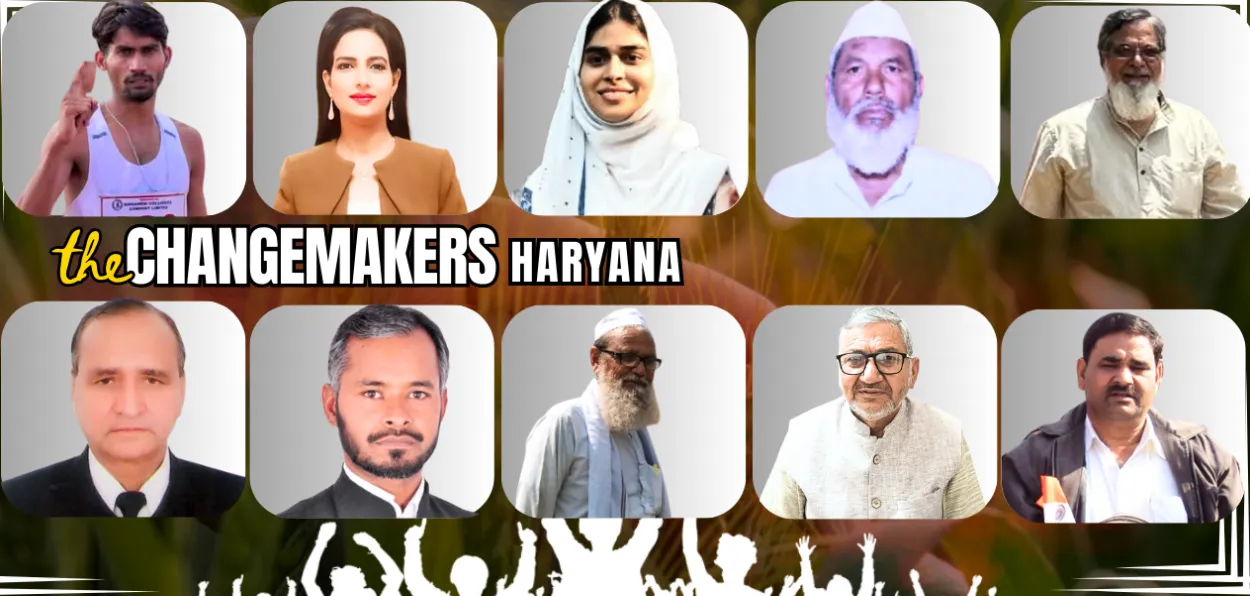
Awaz-The Voice presents ten notable Change Makers from Haryana, who are bringing about positive changes in the state known for its agricultural produce. These are men and women who have struggled against odds and emerged as sources of great inspiration. In this series, we focus on personalities from the most backward areas. Through these stories, we aim to feature people who are working selflessly for the public.
Haji Ibrahim Khan
Haji Ibrahim Khan of Mewat has launched many water conservation campaigns for three and a half decades. As president of Aravalli Jal Biradari, he has been fulfilling his responsibilities with sincerity. He says, “Since childhood, we have seen extreme water scarcity. Women suffer the most because they manage all household chores and walk long distances to fetch water. My inspiration came from ‘Waterman’ Rajendra Singh. I first built a dam between two hills near Ghatta Shamshabad. It solved the drinking water crisis for villagers. Later, with the help of Tarun Bharat Sangh, we built several johads (ponds) in villages like Pat Khori, Firozpur Jhirka, Giyasanian Bas, Mewli, and others, including on hilltops for wild animals.”
Parvez Khan
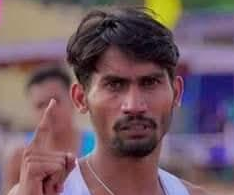
Parvez Khan of Mewat has proven that talent can take you anywhere. He rose from a small village to reach the United States. In May 2024, he won a gold medal in the 1500m race at the SEC Outdoor Track and Field Championship in Louisiana, finishing in 3 minutes 42.73 seconds. His personal best, however, is 3 minutes 38.76 seconds, achieved in California. He also won third place in the 800m race.
Mumtaz Khan
Mumtaz Khan from Chandeni village in Nuh has become the voice of Mewat. She has participated in many social movements and has raised her region’s issues through the media as well. Chandeni is known for education and women’s empowerment initiatives, and this credit goes to people like Mumtaz.
She says, “Since childhood, I have been raising the voice of Mewat from various platforms. I actively took part in movements related to district formation, fair compensation for farmers, and issues of education, health, and employment.”
Siddiq Ahmad Mew
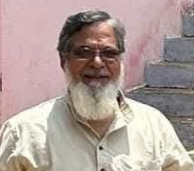
Dr Siddiq Ahmad Mew is a renowned writer and social worker from Haryana. He has done extensive work on the history of Mewat. He says, “My first article on the history of Mewat was published in 1991 in HaryanaSamvad, the magazine of the Information and Public Relations Department. After that, many more articles followed. In 1997, my first book, Mewat: A Quest was published. In 1999, my second book Mevati Culture came out. Since then, I have been writing books, and by 2025, my 12 books on the history, culture, and folklore of Mewat have been published. Three poetry collections have also been published, while two more are under publication. Apart from this, about 200 of my poems have appeared in ten collaborative poetry anthologies.”
Mohammad Rafiq Chauhan
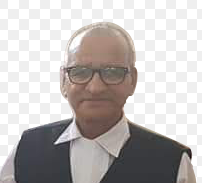
Mohammad Rafiq Chauhan from Karnal is an advocate and a social worker. He runs the voluntary organisation, Haryana Muslim Khidmat Sabha, which works to raise awareness on education, health, environment, and women’s rights. He is so committed to the cause of Women’s rights that at times, when he finds the victim is unable to pay his fee, he contests their cases free of cost and doesn’t even charge for the stationery.
Rukhsana
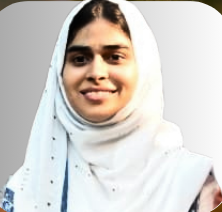
Rukhsana from Sunari village in Nuh is working as a magistrate in Gurugram. After two failed attempts, she cracked the West Bengal Judicial Services examination, securing third rank. Her success has inspired many girls across Haryana and the country, especially those who believe that a girl’s world is limited to the four walls of her home, to work towards independent careers.
Rafiq Ahmad
Rafiq Ahmad from Indri in Karnal is the first Muslim graduate of Karnal. He devoted his life to public welfare, especially the construction and restoration of mosques. He says, “Many mosques and Eidgahs were built between 1960 and 1962. My life was spent working for these causes. Many people joined this mission, and gradually a caravan grew.” He believes that it is important to convey the true spirit of Islam.
Rajesh Khan Machchhari
Rajesh Khan Machchhari from Sonipat is a lawyer and a well-known social worker. Since 2006, he has been president of the Qabristan Intizamiya Sangharsh Samiti, which manages graveyards, ensures water and electricity supply, removes encroachments, builds boundary walls, and buries unclaimed bodies.
Aslam Khan
Aslam Khan from Gurugram is the founder of Haryana Anjuman Charitable Trust, which helps the poor and orphans. This trust began after Aslam witnessed patients suffering without money while seeking treatment for his mother, who had cancer. Deeply moved, he decided to create a trust for the needy. In 2003, the organisation was formally registered and has since attracted many supporters.
Hoshiar Khan
Hoshiar Khan from Hisar is the president of the Muslim Welfare Committee. The organisation works for the welfare of the Muslim community, raising issues related to reservations, basic amenities, and community rights.
Due to the lack of mosques in Hisar, Eid prayers are organised in Krantiman Park with expenses borne by the committee.
source: http://www.awazthevoice.in / Awaz, The Voice / Home> The Changemakers / by ATV / posted by Aasha Khosa / December 06th, 2025
‘Ironman of India’ Sabir Ali, who won the decathlon gold at the 1981 Asian Athletics Championships in Tokyo, passed away.
Ali won eight consecutive Open National titles in the gruelling event between 1979 and 1985. The Railways star was unbeatable at the Inter-State meets too – he represented Haryana — which he won twice in 1979 and 1981. His pet event was the javelin throw. Ali won a bronze and silver at the World Railway meets in 1981 and ’85 and was honoured with the Arjuna Award in 1981. Ali, who grew up in Delhi, is survived by his wife, son and daughter.
‘Ironman of India’ Sabir Ali, who won the decathlon gold at the 1981 Asian Athletics Championships in Tokyo, passed away. He was 67. Ali, who retired from Railways, won the title in the Japanese capital with a tally of 7,253 points beating Japan’s Nobuya Saito (7,078) and China’s Zu Qilin (7,074). He also won two silver medals at the South Asian Federation Games held in Kathmandu and Dhaka.
What is Decathlon :
Decathlon is a combined athletic event consisting of 10 track and field disciplines. Under this, various competitions are held over two days, including the 100-meter race, long jump, shot put, high jump, and 400 meters on the first day, while the 110-meter hurdle race, discus throw, pole vault, javelin throw, and 1,500 meters on the second day
source: http://www.currentaffairs.adda247.com / Adda 247 Current Affairs / by Sumit Arora (and edited – What is Decathalon) / January 27th, 2023
The total number of Muslims winning the 2024 Haryana elections is 02 more than their tally in 2019 and 2014
Nuh MLA Aftab Ahmed with LoP Rahul Gandhi in a file photo.
2024 Haryana Assembly Election Results:
A total of 05 Muslims – all from the Congress party, have won the 2024 Haryana Assembly elections results of which were announced on Tuesday October 08, 2024.
The total number of Muslims winning the 2024 Haryana elections is 02 more than their tally in 2019 and 2014.
Haryana has a Muslim population of about 7%, and the state assembly has a total of 90 seats. Based on their population and the number of seats in the state assembly, representation of Muslims should have been higher.
List of Muslims who won the 2024 Haryana Elections
Mannan Khan (Mamman Khan) of Congress (Ferozepur Jhirka)
Aftab Ahmed of Congress (Nuh)
Mohd Ilyas of Congress (Punhana)
Akram Khan of Congress (Jagadhri)
Mohd Israeil of Congress (Hathin)
Aftab Ahmed, sitting MLA, former minister and Vice President of Haryana Congress, has defeated Tahir Hussain of Indian National Lok Dal (INLD) by more than 46,000 votes.
On the other hand, Mamman Khan defeated Naseem Ahmed, a BJP candidate, by 98,441 votes to win the Ferozepur Jhirka seat.
Congress candidates Mohammad Ilyas defeated Rahish Khan (Independent) and Mohd Aizaz Khan of BJP in Punhana.
Mohd Israel defeated his immediate rival Manoj Kumar of BJP in Hathin seat andTayub Hussain urf Nazir Ahmed. Akram Khan won the Jadaghdri assemby seat defeating Kanwar Pal of BJP.
According to the final result announced by the Election Commission, the ruling BJP has won 48 seats, Congress has won 38 seats, Indian National Lok Dal (INLD) has won 02 seats and Independent candidates have won 03 seats.
A party needs the support of at least 45 MLAs to form government in the state. Results, however, indicate that the state will have a hung house.
source: http://www.ummid.com / Ummid.com / Home> Haryana Elections Results 2024 / by Ummid.com News Network / October 08th, 2024
Chahalka Village (Tanadu Kasba, Mewat District), HARYANA :
Parvez Khan on the track
Nuh, a Meo Muslim dominated district of Haryana burst in celebration as the son of the soil Parvez Khan won a major sports title in the USA on Saturday.
Parvez won the 1500m title at the SEC Outdoor Track and Field Championship 2024 of Collegiate Athletics held in Louisiana, USA.
Parvez, 19, hails from the Chahalka village of Tawadu Kasba, and is studying in the US on scholarship from the University of Florida. On Saturday, he clocked 3 minutes and 42.73 seconds to win the race at the LSU Bernie Moore Stadium in Baton Rouge. His personal best is 3:38.76, which he achieved in California last month.
Parvez said, “Yes, representing India in the Olympics is on my mind. But qualifying for Paris is difficult because I am far behind others. However, I will give my 100 percent to reach there.”
Nuzhat Gull, secrertary of J&K Sports Council posted this video of Parvez Khan’s race to victory on X:
“I do my workout every day. People believe in me, so I am doing well day by day to execute my plans well and hopefully, I will achieve the Olympic standard.”
Later, Parvez competed in the 800m race and finished third with a time of 1:46.80, just seven-tenths behind his personal best in Florida in March.
Parvez is the National Games 2022 champion in the 1500m during which he broke the 28-year-old record of sports.
The locals are ecstatic and proud of Parvez’s achievements and are pouring in at his home to congratulate his parents.
Parvez’s brother Khalid said that in the SEC Track and Field Outdoor Championship 2024 held in Florida, America, Parvez participated in the 1500 m and 800 m competition on behalf of the University of Florida, in which more than two dozen athletes from different zones of America participated.
As soon as he got success in the 1500 meter heat event on Saturday, the people of the area expressed happiness and congratulated his family members on becoming the champion.
Growing up in Chahalka, a village in Haryana’s Mewat district, about 50 kilometers south of New Delhi, Khan was raised with limited financial resources.
His father, Nafees Ali, supports the family by cultivating wheat and fodder on the five acres of land he shares with his brothers.
Despite adverse financial conditions, Khan had aspirations beyond the limits of his village. His parents didn’t attend school.
His parents initially dissuaded him from sports and they thought there was no future for him there. “There are no players in my village, but I have always been someone who wants to do things differently.
Khan was inspired to run during physical preparation for army recruitment. He didn’t have a coach. Often even in adolescence, he used to outshine his older competitors.
Realizing the need for better training opportunities, Khan moved to New Delhi at the age of 13. He joined the coaching at the Jawaharlal Nehru Stadium and thus started his athletic journey.
Despite doubts about meeting academic standards, Khan’s talent as a sprinter continued to blossom. His notable achievements include winning gold in 800 meters at the Under-16 Nationals and a bronze medal at the Under-18 Khelo India Games.
However, it was Khan’s victory in the 1500m at the Open National Championships in Warangal in 2021 that brought him into the spotlight. He got selected for the Indian Navy.
In 2022, Khan won the gold medal in 1500m at the National Games where he clocked his personal best of 3:40:89. This win paved the way for him to join the Indian national camp and subsequently train at the Olympic Training Center in Colorado, USA.
source: http://www.awazthevoice.in / Awaz, The Voice / Home> Story / by Yunus Alvi, Nuh / May 13th, 2024
The first mutiny of World War I was led mostly by young men from villages of Hisar, Rohtak, Meham and Gurgaon districts of Haryana. The Singapore Mutiny, which is known as the first mutiny of WW-I and left an indelible mark on India’s freedom struggle, started on February 15, 1915. It was led by Muslim soldiers who belonged to British army’s 5th Light Infantry Brigade.
Even as the world observes the centenary of the Great War, the sacrifice of these soldiers has been all but forgotten as most of the soldiers and their descendants migrated to Pakistan after Partition.
The brigade mainly comprised Rajput Muslims and Pathans and had been sent from Madras to replace the Yorkshire Light Infantry in Singapore. They reached there in October 1914 and were to leave for Hong Kong in February. On the day of embarkment, a rumour spread that they were actually being sent to Turkey and would have to fight Muslims there.
Singapore Mutiny shook the foundation of British rule in Asia
A rumoured triggered the Singapore revolt. The sepoys killed British officers and seized ammunition. The mutiny went on for 5 days. Eight hundred Indian sepoys of the British army killed 47 British nationals; 200 sepoys faced court martial; 73 were given a range of punishments.
As many as 41 sepoys were shot by a firing squad in front of 15,000 spectators at Outram Prison in Singapore.
In his book “The Mutiny in Singapore”, author Sho Kuwajima has argued that the mutiny not only caught the British off-guard but also shook the foundation of British rule in Singapore and forced the British to reconsider their strategy in Asia.
“The mutiny had a great impact on India’s freedom struggle. Freedom fighters, including Ghadarites were vindicated when finally in 1946, the British decided to leave following the naval revolt of February 19, 1946 when they felt that their protective shield, the armed forces, had itself turned against them,” said historian Malwinder Jit Singh Waraich, who has penned a number of books on the freedom struggle.
Four of those executed in public were from Jamalpur (Hisar), three from Jatusana (Gurgaon) and two from Balyali (Hisar). According to Phul Chand Jain’s Swatantarta Sainik Granth Mala, most of these people belonged to Jamalpur, Paten, Balyali, Kirawad and Balliya Ali in Hisar; Jatusana, Karmpur and Kheri Nangal in Gurgaon; Garhi, Kani and Kahnaur in Rohtak. One sepoy each was from Muzaffarnagar in Uttar Pradesh, Karnal and Nabha in Punjab.
“These villages were gripped by violence of Partition, so, there is not much trace of their memories now,” says documentary filmmaker Daljit Ami, who is making a film on the Singapore Mutiny and has visited these villages a number of times. In the course of his research, he came across just one man who had heard about these heroes and their Haryana connection.
According to historians, the Singapore Mutiny was followed by the Russian soldiers’ mutiny in 1917 and a series of mutinies in the French armies.
source: http://www.timesofindia.indiatimes.com / The Times of India / Home> News> India News / by Sarika Sharma / TNN / July 05th, 2014
December 19 is celebrated as ‘Mewat Day’, for it was on this day in 1947, soon after the partition of India, that Mahatma Gandhi’s appeal to the Meo Muslims living in what is today the border areas of Haryana, UP, and Rajasthan, made them shun their desperation to move to Pakistan.
The community members were all packed with some belongings after facing harassment and violence at the hands of officials in the post-partition mayhem that had gripped both India and Pakistan. Lakhs of Mewatis got together and declared they would go to Pakistan when Mahatma Gandhi came on the scene. He assured to protect the life and property of Mewatis and give them full respect.
At the time of the partition of India, Mewat, Gurgaon, and Faridabad of Haryana were ruled by the British, and Alwar, Bharatpur of Rajasthan by the kings. At the time of partition, like other parts of the country, Mewat also saw communal violence.
At this stage freedom fighters Abdul Hai, Himmat Khan, and a few other Muslim leaders came to know of a conspiracy to force Mewati Muslims to leave India for Pakistan and they met Mahatma Gandhi and invited him to visit Mewat.
Mahatma Gandhi reached Ghaseda village of Mewat on 19 December 1947. He was accompanied by many leaders including the then Chief Minister of Punjab Gopi Chand Bhargava, Ranbir Singh Hooda, father of former Chief Minister Bhupinder Singh Hooda.
Mahatma Gandhi’s speech on 19th December 1947 in the village of Ghaseda before lakhs of Mewatis is historic. He said, “Today my sayings do not have the same power as it would have earlier.
“But what I say any as much impact as it would have earlier, today not a single Muslim would need to leave the Indian Union, nor would any Hindu-Sikh be required to leave their homes in Pakistan and seek refuge in the Indian Union.
A sorrowful Bapu said: “My heart is filled with sorrow after hearing what is happening here. All around arson, looting, killing, coercive religious conversion and kidnapping of women, and demolishing temples, mosques and gurudwaras is madness. If this is not stopped, both communities will be annihilated.”
Historian Siddiq Ahmed Meo, who has 10 books on the history of Mewat to his credit, says, “Gandhiji also read out the complaints sent to him by Mewati Muslim representatives to the assembled crowd.”
He assured the Mewatis that they would be given full respect. If any government official commits any atrocity with the Mewatis, then the government will take strict action against him. Gandhiji said, “I will be happy if my words can console you a little.”
He expressed grief over the Muslims who were expelled from the princely states of Alwar and Bharatpur.
Gandhiji said in his speech, “A time will come in India when all hatred will be buried in the ground and both societies will be able to live in peace.”
Mewat’s social worker Fajruddin Besar says, after Gandhiji’s assurances, the Muslims reversed their decision. “If they were not stopped at that time, there would be not a single Muslim in Haryana and Rajasthan today.” He says Gandhiji did a big favour to the Muslims by stopping them from going to Pakistan. “Today, Muslims in India are living a life of more peace and respect than in Pakistan. In Pakistan, there is always fighting among Muslims.”
In 2007, chief minister Bhupinder Singh Hooda declared Ghaseda an ideal village and renamed it Gandhi Gram Ghaseda. He also released about Rs 10 crore for development works in the village.
This year Congress leader Rahul Gandhi will also reach the village on December 22 and celebrate Mahatama Gandhi’s visit to the village on that day.
source: http://www.awazthevoice.in / Awaz, The Voice / Home> India / by Yunus Alvi, Nuh (Haryana) / December 19th, 2022
The 23-year-old Ramandeep clocked 3:00.04s and clipped more than 13 minutes from Priyanka Goswami’s earlier national record of 3:13.19s.
Juned Khan of Haryana and Ramandeep Kaur of Punjab. (Photo | Twitter/ ians india)
The 23-year-old Ramandeep clocked 3:00.04s and clipped more than 13 minutes from Priyanka Goswami’s earlier national record of 3:13.19s, set in the World Athletics Race Walking Championships in Muscat last month. Goswami did not take part in the 35km event on Sunday. She had taken part in the 20km event on Saturday but could not finish the race.
Ramdeep’s Punjab team-mate Manju also came inside Goswami’s earlier national mark to take the silver in 3:07.49s.
In the men’s 35km event, 22-year-old Juned pulled away from Ram Baboo and Chandan Singh after the 20km mark to lower the national record by five minutes, clocking 2:40.16s. Eknath Sambhaji Turambekar, who held the earlier national record of 2:45.17s, was among the four who were bunched in the lead till the 20km mark but dropped out after being second with 10km to go.
The 35km race walk event was introduced in India only last year in the wake of World Athletics’ decision to do away with the 50km event after the Tokyo Olympics.
Uttarakhand’s Sachin Bohra edged out Gujarat’s Rohit Kumar Yadav by a mere second to win the men’s U-20 10km crown with a time of 43:12s. Deepika Sharma of Rajasthan won the women’s U-20 10km race with a time of 51:32s
The Results:
Men’s 35km:
1. Juned Khan (Haryana) 2:40.16;
2.Ram Baboo (Uttar Pradesh) 2:41.30;
3. Chandan Singh (Uttarakhand) 2:42.02.
Women’s 35km:
1. Ramandeep Kaur (Punjab) 3:00.04;
2. Manju (Punjab) 3:07.49;
3. Payal (Uttarakhand) 3:15.47.
Men U-20 10km:
1.Sachin Bohra (Uttarakhand) 43:12;
2. Rohit Kumar Yadav (Gujarat) 43:13;
3. Aditya Negi (Uttarakhand) 44:27.
Women’s U-20 10km:
1. Deepika Sharma (Rajasthan) 51:32;
2. Bharti Bhadana (Haryana) 52:23;
3. Indu (Haryana) 52:40.
source: http://www.newindianexpress.com / The New Indian Express / Home> Sports> Others / by PTI / April 18th, 2022