Tag Archives: Muslims of Kannur District

Shama Mohammad: Battling patriarchy and breaking barriers

Cherukollayi (Kannur District), KERALA :

Shama Mohammad, AICC spokesperson

Shama Mohammad, AICC spokesperson and now over a decade in politics, knows all too well the obstacles women face in Indian politics. The numbers speak for themselves: despite the passage of the Women’s Reservation Bill, no Muslim woman from Congress was given a Lok Sabha ticket in 2024, and only two serve as MLAs nationally.

“The biggest obstacles for a woman to progress or survive in politics, especially in Kerala, are men,” she says bluntly. “When I started my journey in Kerala district politics, men in the party felt I can’t make it. And when I started making it, they didn’t like it.”

Shama lists three roadblocks on her way: “First, I am not a dynast, second, I am a woman, and third, I’m a Muslim.”

Unlike Congress, Muslim women like Sofia Firdous in Odisha or Kaneez Fatima in Karnataka, both backed by political families, Shama has no dynastic support. “You won’t find a single Muslim woman in politics who is fighting her way ahead on her own,” she says.

While a party like the Trinamul Congress has actively promoted women — with three out of its five MPs in West Bengal being women — Congress continues to lag,” she adds. (Trinamul Congress has the highest representation of women in Lok Sabha at 38 per cent compared to 13 per cent women by Congress and BJP.)

Her journey into politics didn’t happen overnight. A dentist and then a reporter with ZEE News, Shama grew up in Kuwait, watching debates on BBC, Al Jazeera and other channels with her father, who was passionate about world affairs. “The interest I have today is inherent, as politics is ingrained in my family,” she says.

Known today as a feisty and articulate spokesperson, she developed her political voice over years of actively taking an interest in national and international news, watching and then taking part in media debates, and later, hands-on work in Kerala district politics.
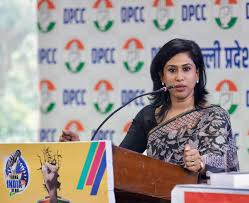
Her media career eventually brought her closer to politics. “I remember watching Manish Sharma, Abhishek Manu Singhvi — my colleagues in AICC now — fighting it out in a war of words on TV evening after evening,” she recalls.

While her job at ZEE News didn’t give her much chance to cover politics, her colleagues recognised her passion, and one of them sent her to meet Randeep Surjewala in the Congress media department. She was soon working for the party, travelling between Pune, where her husband and children were, and Delhi for television debates. “There was no Zoom or Skype then; one had to be physically present for the debates,” she says.

Amidst her work in the media department, she also decided to start working at the district level for the party in her home state of Kerala. But that came with its own challenges.  “All this took a huge toll on my children,” she admits. Her elder son was just 14, and her younger was 11 at the time. “But work meant leaving them even as my husband was away in Abu Dhabi again.” Balancing family and political ambitions was a struggle, yet she persisted.

Despite the hurdles, Shama’s commitment to change pushed her on. “I came to politics because I saw rapists, extortionists, and other anti-social elements in Parliament, and we only complain without doing anything about it. So, I wanted to be part of the change,” she says. As a Muslim, she has faced criticism for her faith and assumptions about her patriotism. But this has only made her more resilient: “Because I’m a Muslim, I have to go to Pakistan, I’m a jihadi, I’m anti-national… and I have to take all this,” she adds.

While her progress within the party remains limited due to patriarchy, Shama has turned her energy to grassroots work in Kannur, Kerala, through her Zoya Charitable Trust. “Why I came to politics was to help people, and my trust is in doing precisely that,” she says.

The trust, started in 2018, initially focused on renovating schools, especially following the floods of 2019. It has recently launched a sports school in the district, best known for athlete PT Usha, and another sports school is coming up with funding from the Panchsheel Group, a real estate group. Beyond sports, the trust works on healthcare, education, and women’s empowerment.

Asked what she would like to change about Congress, Shama doesn’t hold back: “Give more tickets to women. Give capable and hardworking women representation as the TMC does.” She knows change is slow, but remains undeterred. “Kerala has 51 per cent women, and if I’m sidelined, I take it as a challenge,” she says. For Shama, being a Muslim and a woman in politics is not just a struggle; it’s a motivation for her to keep pushing, both within her  party and through her work at the grassroots.

With Kerala heading once again into election mode, the left-led coalition and the Congress-led coalition will be pitted against each other. Whether her words and vision for women’s representation in politics will become reality remains to be seen, but Shama Mohammad continues her journey, determined to make a difference.

source: http://www.awazthevoice.in / Awaz, The Voice / Home> Stories / by Sreelatha Menon / March 09th, 2026
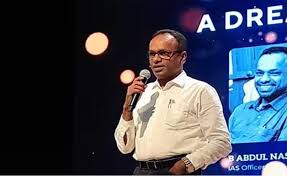
From Orphanage to IAS: Abdul Nasser of Kerala Overcomes Poverty, Hardship

Thalassery (Kannur District), KERALA :

Abdul Nasser’s childhood in orphanages and years of working multiple jobs show his courage and determination. His phenomenal rise proves that dedication can defeat all obstacles

New Delhi :

Abdul Nasser’s life began in the modest town of Thalassery in Kerala’s Kannur district. His early years were shadowed by tragedy when his father passed away when Nasser was only five years old. This loss pushed the family into severe financial difficulties. His mother, striving to make ends meet, took on various jobs to feed her children, but the hardship was such that Nasser and his siblings had to spend a large part of their childhood in orphanages.

Nasser spent about 13 years in various orphanages across Kerala. Despite the challenges of living without parental support and the difficulties of orphanage life, he never lost his desire to learn. At times, he ran away from these institutions, but the pull of education and a better future brought him back each time.

Speaking about his early struggles, Nasser once said, “I never allowed my circumstances to define me. Each time I faced hardship, I reminded myself that education was my way out.”

While still a child, Abdul Nasser took on multiple jobs to support his education and ease his family’s burden. When he was just ten, he began working as a cleaner in a local hotel. His hard work earned him additional responsibilities, and soon he was also helping as a supplier at the same hotel. To raise more funds for his studies, he also distributed newspapers, took up tuitions, and worked as a phone operator.

This early experience of juggling work and education shaped Nasser’s character and showed his commitment to personal growth. “Every job I did was a step towards my dream. I never allowed fatigue or failure to stop me,” he explained in a recent interview.

Despite these difficulties, Nasser’s dedication to education remained strong. He completed his graduation at a government college in Thalassery, a significant achievement for someone from his background. Determined to further his knowledge, he earned a postgraduate degree in 1994.

Education was not just a personal achievement for him but also a beacon of hope for those in similar difficult situations. His academic success inspired many young people in Kerala facing financial or family hardships.

After completing his postgraduate degree, Nasser entered the Kerala Health Department as a government employee. His sincerity, hard work, and dedication quickly became apparent to his superiors. He earned respect and opportunities through his honest approach to public service.

In 2006, Nasser took the Kerala State Civil Services Examination. His success led to his appointment as Deputy Collector, an important administrative post. His work was marked by sensitivity and a focus on social welfare, which earned him special recognition. In 2015, he was named the best Deputy Collector in Kerala, a clear sign of his dedication and impact.

Traditionally, entry into the Indian Administrative Service (IAS) requires passing the Union Public Service Commission (UPSC) examination, considered one of the most difficult exams in India. However, Abdul Nasser’s journey took a different path.

Because of his consistent performance, leadership skills, and administrative ability, the Kerala government promoted him to the IAS cadre in 2017 without requiring the UPSC exam. This rare achievement highlights the respect he had earned within the government.

“This promotion showed me that honest work and dedication can break barriers. It was a moment of great pride not just for me but for all those who struggle silently,” Nasser said.

After becoming an IAS officer, Abdul Nasser was appointed to key roles, including Kollam District Collector and Housing Commissioner in the Kerala Government. In these positions, he continued to serve the public with the same passion and commitment that had defined his career.

Nasser’s life story is more than just personal success. It sends a powerful message to all young people facing difficulties: with determination and hard work, one can rise above any circumstance.

People who know Abdul Nasser well speak highly of his journey and character. A fellow officer commented, “Nasser’s rise is an example of true grit and dedication. His background shows how difficult it is to succeed, yet he has done it with humility and hard work.”

A local social worker added, “His life encourages so many children who have lost their families or face poverty. He proves that where there is will, there is a way.”

Abdul Nasser’s story stands out because it breaks common stereotypes about who can succeed in the Indian civil service. Coming from a background without financial support or family guidance, many would have given up. Instead, Nasser found ways to keep moving forward.

In a society where many young people struggle to access education and opportunities, Nasser’s life offers hope and inspiration.

“I want every child growing up in hardship to know that their past does not determine their future. Keep working, keep believing,” he said.

source: http://www.clarionindia.net / Clarion India / Home> Editor’s Pick> India> Indian Muslims / by Team Clarion / June 20th, 2025