Tag Archives: Muslims of Telangana

How the pandemic is depriving lovers of Urdu literature of their environment for enjoyment

INDIA:

Discussions and debates, critiques and readings, held at haunts of Urdu books and writing around the country have been interrupted rudely.
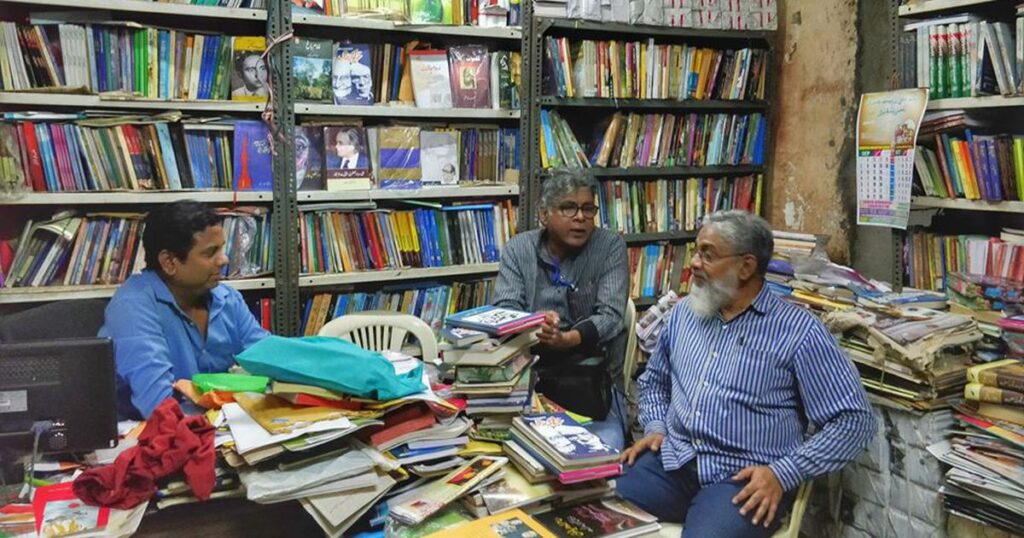
(From left) Shadab Rashid, Urdu drama writer Aslam Parvez, and Shakeel Rasheed at Kitabdaar | Mahtab Alam

In Malegaon

On the first Saturday of every month, the textile city of Malegaon in northern Maharashtra used to become home for lovers of Urdu literature, who meet to discuss, debate and critique new writings in the language, mostly by local writers. Organised under the aegis of Anjuman Muhibban e Adab (Association of Literature Lovers), the gathering began at around 9 pm, and went on till midnight.

Between 30 and 50 people – both writers and readers – would come together, a number that would at times go up to as many as 100 or even 150. Asif Iqbal Mirza, the secretary of the Anjuman, said the practice began 25 years ago on the suggestion of local journalist and editor Samiullah Ansari, who published new Urdu fiction in his weekly, Hashmi Awaz.

Over the years, the publication had emerged as a popular local magazine for young and budding writers to publish their works. The weekly, now in its 35th year of publication, had a considerable fan following and readership at the time. Ansari then suggested that admirers of the magazine form a group comprising readers as well as writers.

The group was initially named Anjuman Muhibban e Hashmi Awaz (Association of Admirers of Hashmi Awaz), but within a few years, its following grew to encompass more than just the readers of the magazine, and in 1998 it was rechristened Anjuman Muhibban e Adab, Malegaon. “Ansari sahib formed the Anjuman so that writers could get their new works critiqued by readers before getting them published in the weekly,” Mirza ssid.

Back then, Mirza himself wrote for a local children’s newspaper called Khair Andesh. But his association with the Anjuman helped him grow into a prolific Afsana Nigar, a short story writer. He was 17 when the group was formed; in the past 25 years, he has written and published more than 200 short stories in different publications.

Apart from Anjuman Muhibban e Adab, there are two more literary groups in Malegaon that held regular meetings until the lockdown was declared in March. No such meetings have been held since then. “Unlike earlier, we now have enough time to read and write. But the irony is we don’t have the opportunity to discuss and publish them,” said Mirza, who also runs a printing business. Several local publications had to halt their issues, including Hashmi Awaz, owing to the lockdown.

According to Mirza, although social media outlets such as WhatsApp and Facebook have, to some extent, helped to keep in touch with fellow writers and readers, the literary life of Malegaon has come to a standstill, since a large number of local writers and readers came from the working class and worked in local looms. “The year 2020 is the silver jubilee of my literary career. I had plans to publish a collection of my short stories, but thanks to the pandemic, that will not happen this year,” Mirza said with a great sense of despair.

In Mumbai

Both readers and writers have felt a deep loss during the pandemic. His love of books took Shakeel Rasheed, editor of the Urdu daily Mumbai Urdu News, to various bookshops in and around the Mohammad Ali Road area of Bombay. “Visiting bookshops was a part and parcel of my life. I feel a deep loss when I don’t visit them,” he said. For him, bookstores are not just spaces to buy books, but they also served as addas for readers and writers. As soon as some relaxations were in place, he rushed to the stores. “Par ab pahle wali baat nahi rahi,” said Rasheed. “Things are not as they were before.” The pandemic has made it more difficult to meet new people.

Shadab Rashid’s Kitabdaar publications and bookstore in Temkar Street of Nagpada was one such adda for Urdu writers in Mumbai, as was Maktaba Jamia on Sandhurst Road West. Today, Kitabdaar and a few other bookshops have opened their stores for a few hours every few days, while Maktaba Jamia remains closed. “Due to lack of public transport and fear of the pandemic, people cannot come to Kitabdaar,” Shadab said. He also edits the quarterly literary magazine Naya Waraq, founded by his late father and noted journalist and writer Sajid Rasheed.

Shadab Rashid said the lockdown brought significant hardships and losses to Urdu publishers and distributors. “It is not that people don’t want to read Urdu books anymore – the problem is they cannot buy them,” he said. “I have received lots of online orders, but I cannot fulfill them because I rely on postal services as they are the cheapest means of delivery, but the services are not fully functional yet.” His online Urdu bookshop kitabdaar.com is one of the few digital distribution platforms for Urdu books exclusively in India. Another such platform, urdubazaar.in, was recently launched from Delhi.

Owing to the discontinuation of physical interactions between readers and writers, people have lost touch with each other, since not all Urdu writers are active on social media, Shakeel Rasheed told me. “We have lost many good writers during this period and found out about their demise several days later,” he added. “Moreover, we could not participate in their last journeys.”

In Hyderabad

Another writer recounted similar thoughts after the death of noted Urdu satirist Mujtaba Hussain in Hyderabad on May 27. Hussain was awarded the Padma Shri in 2007 for his contributions to Urdu literature, but in December 2019, he announced he was returning the award to protest the enactment of the contentious Citizenship Amendment Act. “[T]he democracy for which I fought is under attack now and the government is doing that,” he had said, “that’s why I don’t want to associate the government with me.”

In Hyderabad, another centre of Urdu writing, literary activities have come to a similar halt due to the pandemic. Publications like Shagoofa, a monthly magazine of satirical writing, have been temporarily discontinued since the lockdown.

In Delhi

In Delhi, too, the pandemic has left an adverse impact on Urdu writing. Khan Rizwan, a poet and a known “addebaaz” from Delhi, loved participating in and organizing adabi addas (literary gatherings). He misses visiting the Nai Kitab book store, located in one of the many bylanes of Jamia Nagar, which is one of the famous addas for Urdu lovers in the city. Run by veteran writer and publisher Shahid Ali Khan, Nai Kitab is a haven for young and old writers alike, Rizwan said, as Shahid sahib treated them alike. “It is not just a bookshop but an institution where one got to meet noted writers and lovers of Urdu literature,” he said.

Rizwan would visit the shop at least twice a week, and meet a new literature enthusiast or writer, or find out about a new book or risala /parcha (journal/magazine). “I miss the black tea and chips that Shahid sahib served us with love and affection,” he recalled. “He is a storehouse of information, and several veteran writers were his friends, so he would tell us stories all the time.”

I couldn’t agree more with Rizwan. I have been visiting Nai Kitab once every few months for more than a decade now, and on each of my visits, after asking khabar-khairyat, Shahid sahib would say, “Achcha aap bahut dino baad aayen hain, ye nayi kitaabein aayi hai dekh lein (Since you’ve come after a long time, here are some new books).” Last year, when I visited the bookshop around this time, he directed me towards dozens of books written by noted Urdu satirist Fikr Taunsvi and Shaukat Thanvi. I immediately bought all of them, as they were usually out of print and seldom available.

As the person in charge of the Maktaba Jamia, the publication division of Jamia Millia Islamia in Bombay, Shahid Sahib befriended writers and poets like Jan Nisar Akhtar, Meena Kumari, Sahir Ludhianvi and Jagan Nath Azad. Some of them were regular visitors to the Maktaba Jamia. Though he moved to Delhi after serving the Maktaba for several decades, he did not stop hosting literature lovers. He then founded Nai Kitab publishers and a quarterly journal by the same name.

It was in 2007 at his bookshop that I first chanced upon Shamsur Rahman Faruqi’s celebrated novel Kai Chand The Sare Aasman, later translated into English as The Mirror of Beauty by the author himself. The novel went on to become a major critical and commercial success.

Faruqi was also associated with the Nai Kitab journal as chairperson of its advisory council and would visit the shop once in a while. The journal eventually stopped publication owing to Shahid sahib’s failing health, but he continued with the bookstore as it was like “oxygen for him”, he had once told me.

Waiting for freedom

Some writers have managed to turn the lockdown into a creatively productive period. “Personally, the pandemic has proved as a blessing in disguise as I read books I wanted to for years and finish other important work, such as recording videos of Urdu literature lectures,” says Khalid Mubashir, a poet and assistant professor of Urdu literature at Jamia. He quickly added, however, this was not common, as most writers and poets were stuck at home, either because of their age or in fear of the pandemic. “Moreover, not all writers have access to technology and books like I do. I am fortunate enough to have friends who helped me with technology to do something substantial during this period.”

Mubashir’s videos, as many as 60 of them, are each about 30 minutes long, and cover the history, evolution and development of Urdu and its literature in the subcontinent. Though the lectures are prepared keeping in mind the need and syllabus of Urdu literature students, ordinary Urdu lovers can also benefit from them. All lectures are available on the YouTube channel Safeer e Adab.

Similarly, although younger poets like Mohammed Anas Faizi from old Delhi have been trying to keep Urdu literature gatherings going by using social media, online addas do not have the feel and impact of offline and in-person gatherings. “Technology and social media can only help to a certain extent. Online gatherings, mushairas and addas cannot substitute for the real ones, no matter how well they are done,” he said.

With apologies to Faiz Ahmad Faiz, what the Urdu writers, poets and addebaaz seem to be telling the pandemic is:

Gulon Mein Rang Bhare Baad e Nau Bahar Chale
Chale Bhi Jao Ki Gulshan Ka Karobar Chale

Mahtab Alam is a multilingual journalist and until recently was the executive editor of The Wire Urdu. His Twitter handle is @MahtabNama.

This series of articles on the impact of the coronavirus pandemic on publishing is curated by Kanishka Gupta.

source: http://www.scroll.in / Scroll.in / Home> Publishing and the Pandemic / by Mahtab Alam / July 14th, 2020
Hyderabad: Haziq and Mohi Rare Books planning to sell collection

Hyderabad, TELANGANA :

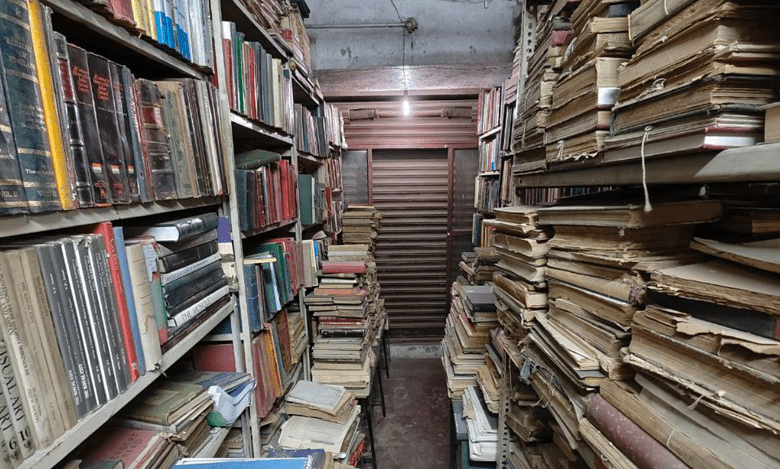
Among the patrons of Haziq and Mohi Rare Book Sellers, back when its founder Awad Bafana was running it, also includes author (of White Mughals) William Dalrymple.

 An inside view of Haziq and Mohi rare book sellers. (Image: Yunus Lasania)

Hyderabad: 

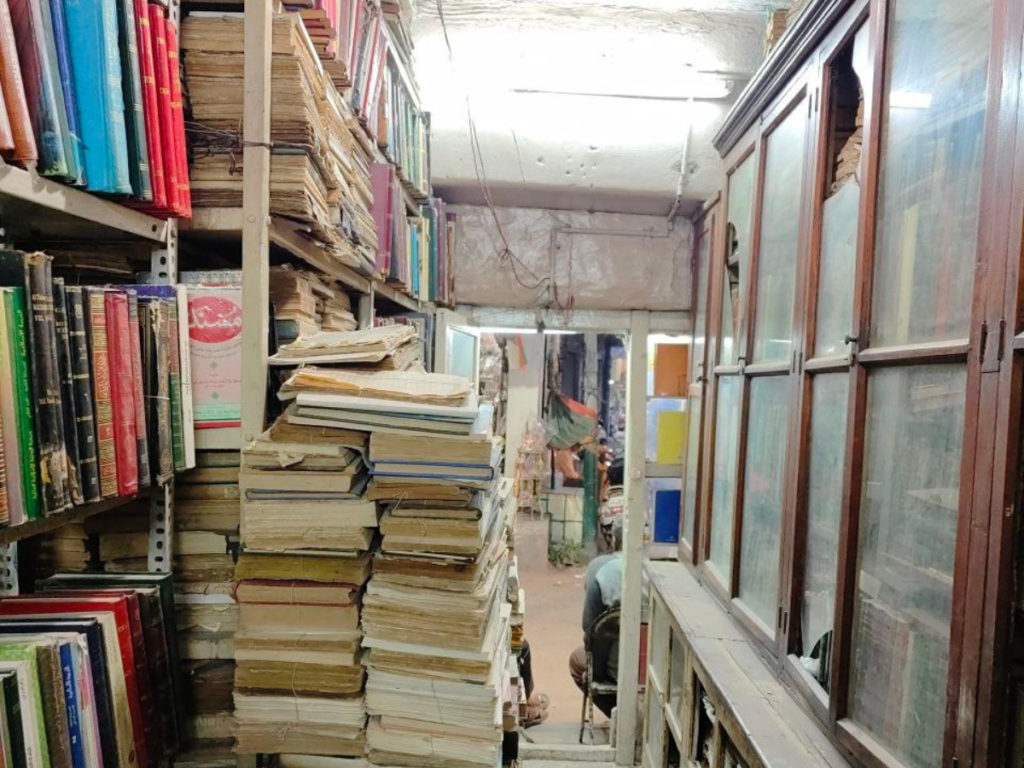
For over four decades, Awad Bin Mohd Bafana ran a book store selling rare books in the Old City. A man of Arab descent, he had inherited the books from his grandfather’s personal library. Over a period of time, it became a go-to place for research scholars, and anyone else looking to buy something interesting and old. Haziq and Mohi Rare Book Sellers today is one of those ‘secrets’ that many love to discover among the city’s heritage.

Awad Bafanna, as he was known, passed away suddenly in 2015 over half a decade ago at the age of 74. He left behind thousands of books in his shop, which only he mentally kept track of. His nephews who run the shop today in Hyderabad, painstakingly have only managed to organise a section of the collection. “There was no inventory but he knew exactly where every book was in his head,” said Ibrahim, one of his nephews.

One can understand the enormity of the rare book collection at Haziq and Mohi while walking through it. There is literally space for only one person to walk in its hallway, and to then turn right into another section. Thankfully, Awad Bafana’s family have partially sorted out books based on subjects like history, politics, on Hyderabad etc. The bookstore is a haven for bibliophiles and research scholars who require particular titles.

A favourite of collectors and scholars

Among the patrons of Haziq and Mohi Rare Book Sellers, back when Awad Bafana was running it, also included author (of White Mughals) William Dalrymple. Ibrahim and his brothers still receive calls from abroad for specific books customers want. Awad Bafana’s grandfather had worked as a Jamadar in Barkas. for the Al-Quaiti family that headed the Yemeni community in Hyderabad.

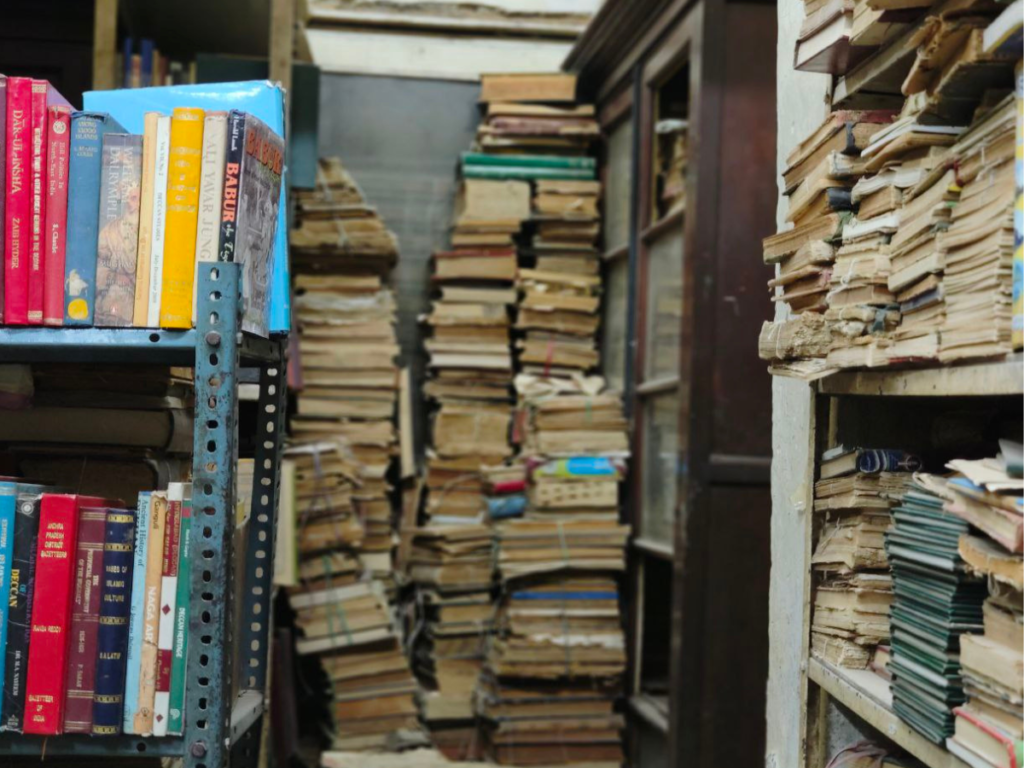
Haziq and Mohi rare book sellers. (Image: Yunus Lasania)

Hyderabad’s Barkas, where their descendants live even today, is believed to be a corrupt word of the word barracks. It is essentially a mini Yemen of sorts and is a go-to place for foodies who want to eat authentic Yemeni cuisine.

Partial book collection up for sale

Now, seven years Mr. Bafanna’s demise, Awad Bafana’s extended family that runs Haziq and Mohi Rare Book Sellers is looking to part with a chunk of its collection. The Bafana family runs the rare book store in Hyderabad’s old city near the Chowk Ki Masjid at Hussaini Alam road. The collection is huge, and the family still has to go through the entire thing in order to catalogue it.

“We are not selling away all our books, nor are we shutting down the store. However, there are some monetary requirements at home due to which we decided to do this. Anyone who is interested can come take a look and discuss it with us,” Ibrahim told Siasat.com.

Haziq and Mohi has a treasure trove of books in mainly Urdu, English, Persian and Arabic. Many book lovers who wander there usually end up sticking around for hours, mostly going back with books they never knew they wanted in the first place. The collection of rare books include several official gazettes, and other publications that are even a century old. One will have to sift through it to even figure out what is there.

Anyone interested in purchasing the collection that is up for grabs can contact the Bafana family for the same (finding it is easy on Google Maps) on +919160161301.

Haziq and Mohi rare book sellers. (Image: Yunus Lasania)

source: http://www.siasat.com / The Siasat Daily / Home> News> Hyderabad / by Yunus Lasania / December 14th, 2022

Intelligence and education of Hyderabad’s Hakim helped raise level of Indian football

Hyderabad, TELANGANA:

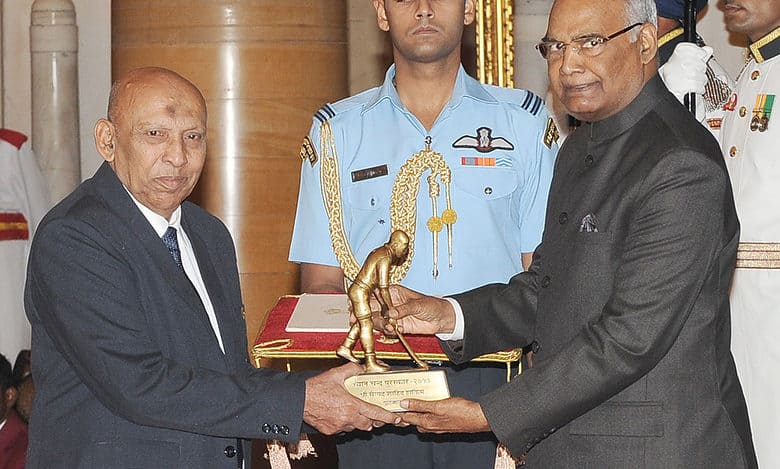
 The President, Shri Ram Nath Kovind presenting the Dhyan Chand Award, 2017 to Shri Syed Shahid Hakim for Football, in a glittering ceremony, at Rashtrapati Bhavan, in New Delhi on August 29, 2017. Photo: Wikipedia

The name of Syed Shahid Hakim is familiar to the entire football fraternity of India. He was one of the most accomplished personalities who graced Hyderabad and Indian football as a player, referee and coach. Indeed it would not be wrong to say that there were few people in India who could match his knowledge and acumen about the different aspects of football. Besides being a well known personality in football, he also served as an officer in the Indian Air Force.

Being one of the sons of the great coach S.A. Rahim, he grew up in a football related environment. Hakim belonged to that period when Hyderabad was at the zenith of Indian football. He played with the illustrious players of India. Among his teammates were the famous goalkeeper Peter Thangaraj, D. Kannan, S.A. Latif, Yousuf Khan, S. Narayanan, H H Hamed and others. All these players were from the twin cities of Hyderabad and Secunderabad.

As a player, Hakim’s talent bloomed at an early age. He was at his peak in the late 1950s. He was a member of the Hyderabad state team which won the Santosh Trophy in 1957. Due to his prodigious talent and his rising status in Indian football, he was selected to represent India in the Pre-Olympic tournaments in Jakarta, Singapore and Malaysia.

It was not a surprise when he was also selected in the Indian team for the 1960 Olympic Games in Rome. That was the last time that India qualified for the Olympic Games. Although India narrowly failed to enter the knockout stage of the tournament, the Games were a great learning opportunity for Hakim.

The close interaction that Hakim had with the world’s best players and coaches gave his keen intelligence some valuable insights into the tactics and training of European and South American players. These he later put into use when guiding his own trainees. This is where his education and learning proved to be a big asset. Having studied at All Saints HS, Nizam College and then Osmania University, his level of education was above many other footballers. This enabled him to interact easily with foreigners and learn from everything that he observed.

Later, after he joined the Indian Air Force, he played for the defence services team and went on to be appointed captain of the All India Services team.

After retiring from the game as a player, he continued to serve Indian football in various capacities. He became a well known referee who was among the best in India. Starting from 1970 he continued to serve as a referee for many years. In 1974 he was selected to be a member of the FIFA Referees panel which was a great honour for an Indian referee.

Thereafter, he officiated in 33 international matches and it is a record which is still not broken. No other Indian referee has officiated in 33 international matches.

But that was not the end of his distinguished career. Thereafter, Hakim became a reputed coach and coached the Indian team from 1980 to 1982 for the Merdeka Cup and Delhi Asian Games along with other coaches.

When he was 80, he fell prey to the rampaging COVID pandemic but recovered. However, despite winning the battle against the dreaded virus, his life did not last long thereafter. He suffered two strokes in rapid succession and passed away in Gulbarga where he had been admitted to a hospital in August 2021. His death left a void in Indian football which will perhaps never be fulfilled.

source: http://www.siasat.com / The Siasat Daily / Home> News> Hyderabad / by Abhijit Sen Gupta / December 09th, 2022

Mohd Hafeez repairs vehicles without eyesight

Kashibagh (Warangal District), TELANGANA :

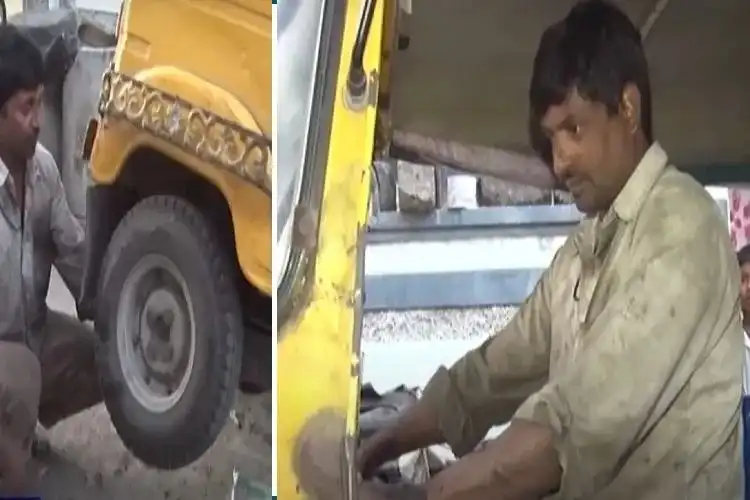
Mohammad Hafeez repairing auto rickshaw

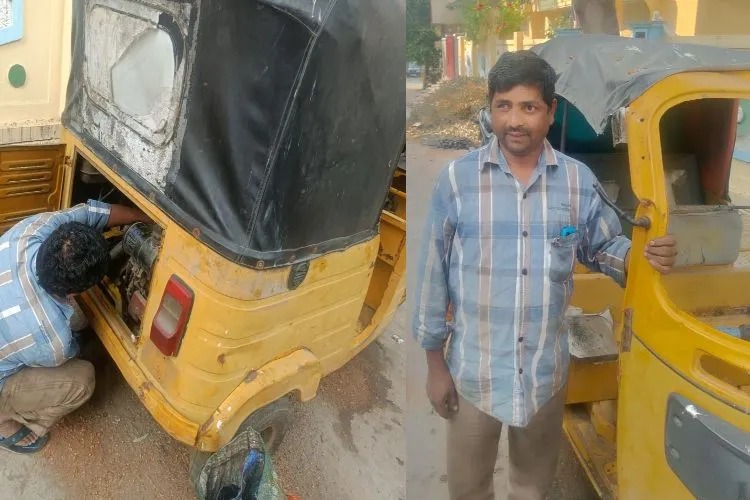
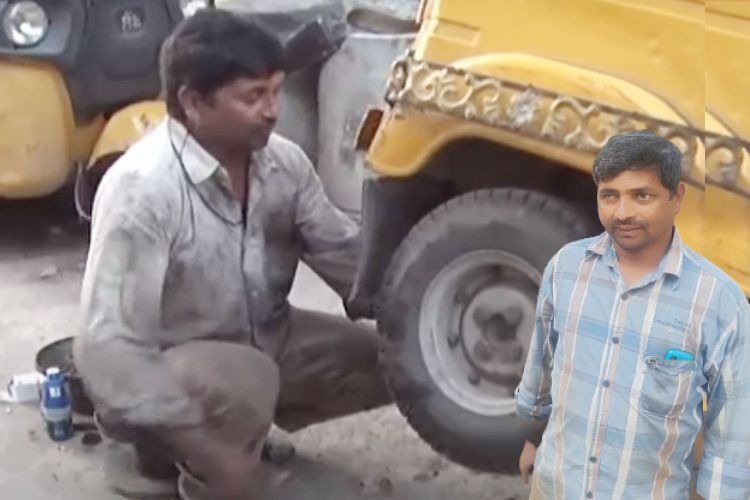
It may sound unbelievable but is true. Mohammad Hafeez, who is blind in both eyes, is a much sought-after auto mechanic. He lives his life with dignity and is not paralyzed due to a lack of physical vision.

Muhammad Hafeez, a resident of Kashibagh, Warangal district,  was not born blind; he lost his eyesight in two accidents and yet he never gave up on life.

Not to break under a spell of tragedies and misfortunes, Mohammad Hafeez is good at detecting the problem in a vehicle through its acoustics. The sound of its parts is what makes him understand the problem in a vehicle that has come for repair.

The 50-year-old Muhammad Hafeez was leading a happy life as an auto electrician when a heavy thing fell on his head in 2003. Due to the accident, he suffered a serious injury and ended up losing sight in his left eye. This badly affected his income.

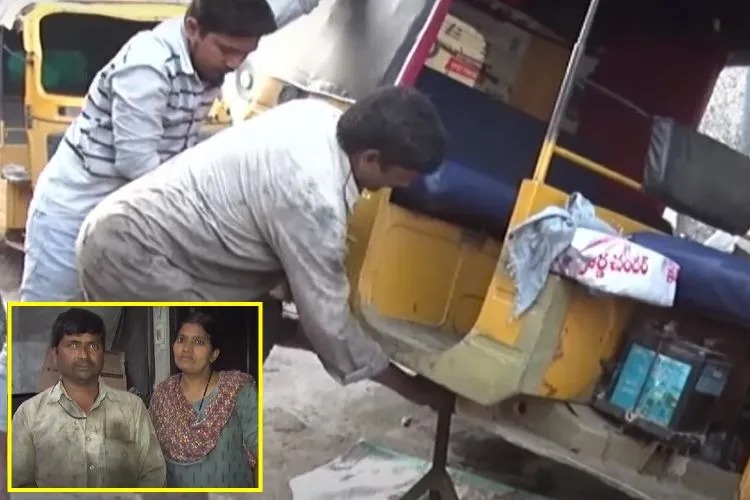
Mohammad Hafeez with his wife

However, he did not give up. With the support of his family and well-wishers, he bought an autorickshaw and started driving it to support his family. However, fate had something else in store for him.

Another tragedy rocked Mohammad Hafeez’s life. In 2005, a burning firecracker hit his right eye and he again lost his vision for life.

Mohamad Hafeez comes from a poor background. His father MD Afzal Anu works as a private security guard in Mamula Bazaar, while his mother Meher Nisa is a housewife and suffers from heart disease.

Mohammad Hafeez started working as an electrician in 1994. His wife Nazima works as an Anganwadi worker.

 After her husband lost his eyesight. Nazima was offered this job on a humanitarian basis.

They have a daughter, Afsana, and a son, Muhammad Muzamil. Afsana works in Hotel Gachibowli in Hyderabad, while Muhammad Muzamal is a first-year student of the ITI. The family lives in a rented house. Muhammad Hafeez earns five hundred rupees a day.

Speaking with Awaz The Voice, Mohammad Hafeez said that he is alive today because of top police officer B Somati. When he met with an accident in the year 2003, the then DSP B Somati reached the spot in time and shifted him to MGM Hospital, Warangal.

Muhammad Hafeez said that he is alive today because of Somati Madam’s timely help and he thinks of her as a messiah.

Mohammad Hafeez with an auto that he has repaired

He said that after the accident, the then member of the Legislative Assembly Biswa Raju Saria, Mayor Erabili Sorna, and a few corporators donated an autorickshaw to him. “I started the second innings of my life as an auto driver. My other eye was also damaged in the accident and I was permanently blind, although my eye was operated open I could never regain my vision.”

Mohammad Hafeez did not give up and started learning auto repair work. He detects the engine malfunction by the sound of the car and repairs the car by touching the parts with his hands.

Muhammad Hafeez said that he learned the job for one and a half years. He was happy to support the family by paying for auto repairs and the education of his two children. He said his wife was very supportive.

Mohammad Hafeez said that any work is difficult but not impossible. He said that the youth, especially the disabled, should look for ways to live a dignified life based on their strengths and abilities instead of depending on someone and extending a helping hand.

He said he is supporting his family by working hard. He asked all the good-hearted humans and the rich to come to the help of others so that people like him get encouragement.”.

source:http://www.awazthevoice.in / Awaz, The Voice / Home> India /by Sheikh Muhammad Yunus, Hyderabad / by awazthevoice.in / December 09th, 2022

Unique autograph museum of Hyderabad’s Imtiazuddin

Hyderabad, TELANGANA :

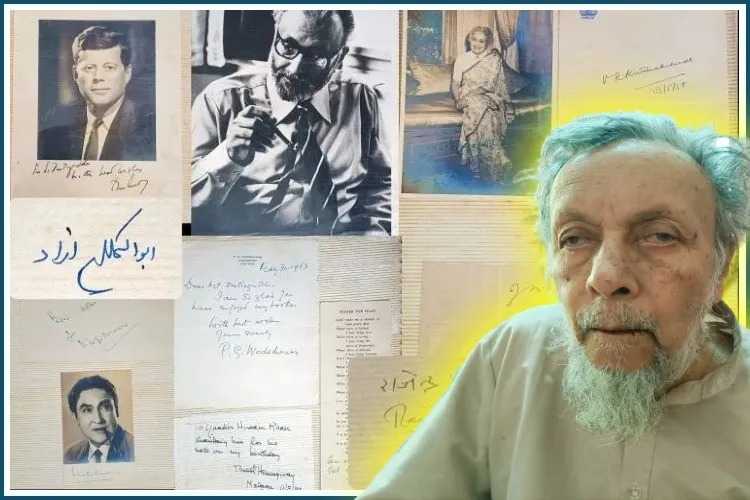
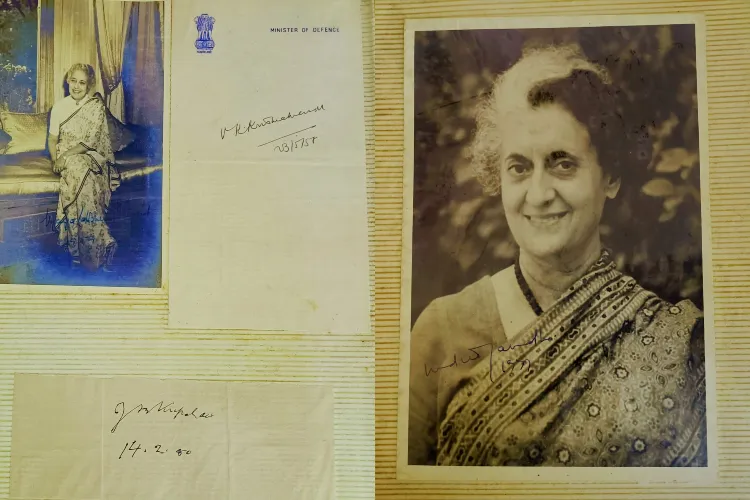
Syed Imtiazuddin with his collection of autographs

Syed Imtiazuddin of Hyderbad has turned his hobby of collecting autographs of famous personalities into a body of work that is bound to be of great historic value for the future generations.

His collection of autographs of important world and Indian personalities has reached up to 200 so far.

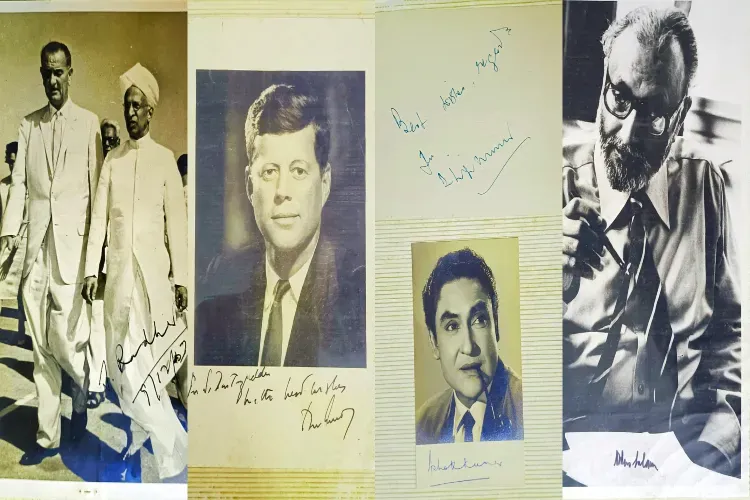
The famous people whose signatures are part of Syed Imtiazuddin’s proud collection include Nobel laureates, politicians, writers and poets of Urdu and English, the heads of state and prime ministers of many countries, and film stars.

His passion for collecting the signatures of important and famous people transcends borders. Syed Imtiazuddin says he had to be patient while waiting for the signatures of famous personalities to whom he wrote letters requesting the same inside India and abroad.

Syed Imtiazuddin narrated an interesting incident from his student days. He was a 7th-grade student at Gandhi Bhavan Middle School, Nampally, Hyderabad. He says it was triggered when he was learning a chapter on India’s renowned Nobel laureate, Physicist-scientist Sir C.V. Raman. Dr. Raman discovered what is now known as the ‘Raman Effect.’

awazthevoice
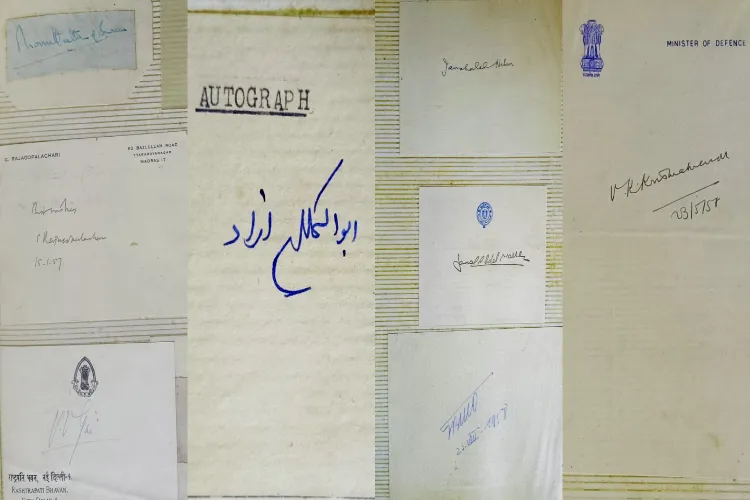
Dr Rajendra Prasad’s signature in Urdu

When the school teacher was imparting the lesson on the life of Sir C. Raman in the classroom, Imtiaz Ahmed thought of if only he could write to the great scientist. He tried to search for his mailing address with no success.

Finally, he did write to Sir C V Raman and posted it to on the address: Sir CV Raman, Bangalore.’ In the postcard addressed to the scientist, he wrote, ‘I was very impressed when I read about you today and I want your signature.’

To his pleasant surprise, a few days later he received a letter from Sir CV Raman. Dr Raman appreciated his passion.

Syed Imtiazuddin says that this was the first ‘happy and memorable day’ for him and it sparked his passion for getting autographs from celebrities.

After receiving Raman’s reply letter and signature, his happiness knew no end.

awazthevoice
Prime Minister Indira Gandhi’s signature

Syed Imtiazuddin said that he passed the class 10 examination from a famous school – Chadar Ghat High Schoo and graduated from Osmania University.

He worked in the Andhra Pradesh State Electricity Department (APSEB) and simultaneously completed his MBA. He retired as Superintending Engineer in year 2001.

The famous poet of Hyderabad, Shaz Tamkant was Syed Imtiazuddin’s elder brother. Shaz Tamkunat was invited to mushairas in Delhi, Lucknow, and other states of the country

Syed Imtiazuddin says, “When Shaz went to Delhi to participate in Mushaira, he also carried an autograph book with him, in which he obtained the signatures of many well-known poets.”

Seeing this, I also decided to follow him. In late 1957, I wrote to the former President of India Dr. Rajendra Prasad expressing my desire to meet him. I received a reply from the Rashtrapati Bhawan that the President is due to visit Hyderabad in June 1958 and I would come to him there at his residence.”

awazthevoice
A glimpse of Syed Imtiazuddin’s collection

“As the day of my meeting with Dr Rajendra Prasad was approaching, my anxiety knew no bounds. When I got the message that Rajendra Prasad had come to Hyderabad, I reached Hyderabad Resident with my elder brother Shaz Tamkant and met Rajendra Prasad. I was very happy to meet him. Even Rajendra Prasad appreciated my passion. He had already kept his signatures – in Hindi and English – on an expensive paper ready for me.”

The President also penned his signature in Urdu on his request.

Syed Imtiazuddin is fond of Allama Iqbal’s poetry. He is invited for delivering talks in the ‘Mahfil Iqbal Shanahi’ held every Wednesday.

Syed Imtiazuddin obtained the signatures of more than 200 personalities including Lord Mountbatten, the last Viceroy of India and first Governor-General of India.

Apart from them, the forty-second president of the United States, Jimmy Carter, the second president of Egypt, Gamal Abdel Nasser, the former president of Yugoslavia Josip Broz Tito, the Thirty-fifth US President John F. Kennedy, Indonesia’s first President Abdul Rahim Sukarno.

awazthevoice
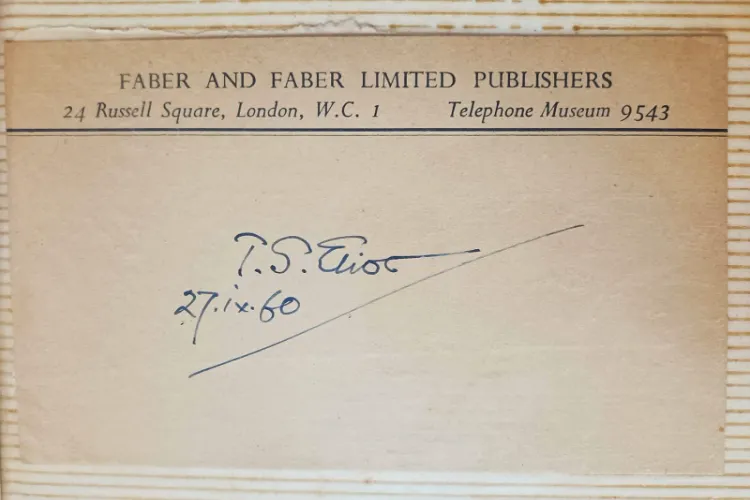
Signature of Writer T S Eliot

Israel’s first Prime Minister David Ben-Gurion, former King Hussein bin Talal of Jordan, famous American actress Elizabeth Taylor, her husband, famous Hollywood actor Richard Burton, Mother Teresa, and Charlton Heston, the hero of the famous American film The Ten Commandments.

Syed Imtiazuddin also obtained signatures from Pakistan’s first Nobel laureate Dr. Abdus Salam. Many of these personalities presented him with their photo as a gift.

Among the Indian leaders’ collection, Syed Imtiazuddin has the signatures of Pandit Jawaharlal Nehru, Indira Gandhi, Dr. Zakir Hussain, Maulana Abul Kalam Azad, Vijaya Lakshmi Pandit, VK Krishna Menon, Moraraji Desai, V. V. Giri, Dr. Sarvapalli Radhakrishnan, Neelam Sanjeeva Reddy.

Syed Imtiazuddin says he feels literature, film, and sports are close to human life and this is the reason why most of his collection relates to personalities from these fields.

He has an unenviable collection of signatures of TS Eliot, American writer John Steinbeck, British mathematician and Nobel laureate Bertrand Russell, Novelist Ernest Hemingway, Dr. AJ Cronin (Scotland), American writer Pearl S. Buck, English writer Aldous Huxley, Josh Malihabadi, Rashid Ahmad Siddiqui, Jigar Moradabadi, Faiz Ahmed Faiz, Khalilur Rahman Azmi, Sohail Azimabadi, Ahmad Nadeem Qasmi, Makhdoom Mohiuddin, Qaratul Ain Haider Krishna Chandra, Rajendra Singh Bedi, Maulana Syed Abul Hasan Ali Nadvi and Maulana Abdul Majid Dariyabadi.

Besides he has the signatures of Bollywood legends Dilip Kumar, Ashok Kumar, Sunil Gavaskar, Sachin Tendulkar, and Amitabh Bachchan.Syed Imtiazuddin said he used to study at an American library near the famous Muazzam Jahi Market in Hyderabad. While going through the book “Who’s Who in America” made him familiar with many top personalities.

Syed Imtiazuddin says success comes only if a person has passion and true dedication to a cause.

source: http://www.awazthevoice.in / Awaz, The Voice / Home> India / by Abdul Rahman Pasha, Hyderabad / by awazthevoice.in / November 26th, 2022

Indigo pilot Aafrin Hirani’s inspiring journey from grocery store to cockpit

Indervelli Mandal (Adilabad District), TELANGANA:

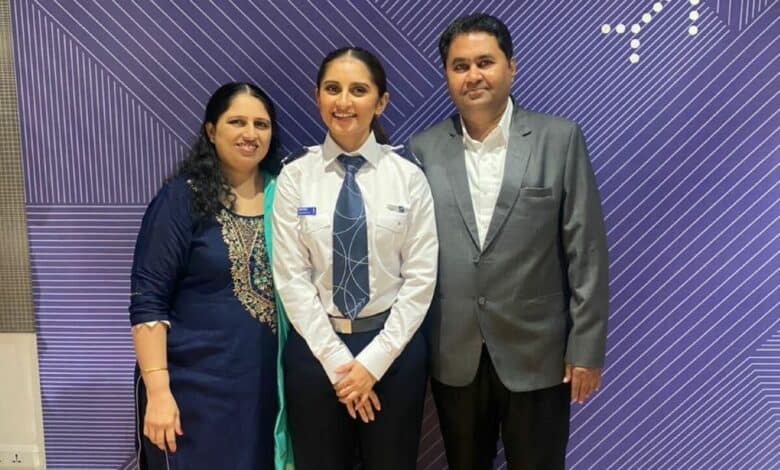
A few months ago, she was appointed as the first pilot of Indigo Airlines.

 Indigo pilot Aafrin Hirani [Twitter]

Hyderabad: 

The journey of 28-year-old Indigo pilot Aafrin Hirani from her family’s grocery store to the flight cockpit is a motivation to youngsters, especially girl students.

Aafrin who is the daughter of Aziz Hirani, owner of a grocery store located in Indervelli Mandal, Adilabad district is now a pilot of Indigo Airlines.

As becoming a commercial pilot was her dream since her childhood, she opted for Aeronautical Engineering after completing intermediate from a college in Hyderabad.

Later, she was selected for two-year rigorous training in Australia. Though she completed training in 2020, she waited for two years as the appointment process was halted due to the pandemic.

A few months ago, she was appointed as the first pilot of Indigo Airlines. After the appointment, Aafrin said that the encouragement and support received from her parents helped her in achieving success.

After her appointment as an Indigo pilot, she became the second woman commercial pilot from Adilabad. Earlier, Swathi from the same district was appointed as a commercial pilot and she was the source of inspiration for Aafrin.

Who is the commercial pilot?

A commercial pilot is a trained professional who flies airplanes or helicopters for the transportation of passengers, cargo, emergency rescue, etc.

They are skilled enough to handle aircraft and ensure passengers’ safety in different weather conditions.

In order to become a commercial pilot, obtaining a Commercial Pilot License from the Directorate General of Civil Aviation (DGCA) is mandatory.

This license is given to those who are medically fit and successfully undergo training at a flying school.

Indigo airlines

Indigo is a low-cost airline headquartered in Gurgaon, Haryana. Its domestic market share as of August 2022 was 57.7 percent.

The airline not only operates domestic but also international flights. As of July 2022, it operates over 1500 flights daily to 98 destinations in India and abroad.

source: http://www.siasat.com / The Siasat Daily / Home> News> Telangana / by Sameer Khan / October 17th, 2022

Shotgun Shooting World C’ship: Muffadal Deesawala, Bhavtegh Gill win junior skeet mixed team bronze

Hyderabad, INDIA /Osijek,CROATIA :

The Indian duo beat the American pair of Aidin Burns and Mikena Grace Fulton 5-1 in the second bronze medal match.

Muffadal Zahra Deesawala & Bhavtegh Singh Gill | ISSF YouTube

Muffadal Zahra Deesawala and Bhavtegh Singh Gill won India’s third medal of the International Shooting Sport Federation Shotgun World Championship in Osijek, Croatia. The duo picked up a bronze in the Skeet Mixed Team Junior event here at the Olympic Shooting Range ‘Pampas’ on Tuesday.

They beat the American pair of Aidin Burns and Mikena Grace Fulton 5-1 in the second bronze medal match. They were declared winners by Golden Hit after Bhavteg and Mufaddal shot seven out of eight targets in the last series, enough to ensure that the Americans cannot win the series after Burns missed one out of his four targets.

The first pair to six points usually wins the match but the Indians were up 5-1 already and a tied last series would have given the Indians the point needed to win.

Deesawala and Gill finished sixth in the qualifiers shooting a combined 132 out of 150 targets. Deesawala shot 62 out of 75 and Gill shot 72 out of 75 shots to secure the last position for the bronze medal matches.

The British pairing of Mitchell Brooker Smith and Sophie Herrmann won the Gold in the event beating Haolei Zhao and Dan Wang of China 6-4.

Areeba Khan, on Tuesday, had won India’s second medal of the World Championship after the Junior Men’s Trap Team had won a gold. 

Bhowneesh Mendiratta had also won a Paris Olympic quota, India’s first for the 2024 Games, earlier in the championship. He finished fourth in the event.

source: http://www.scroll.in / Scroll.in / Home> The Field> Shooting World Championships / by Scroll Staff / October 04th, 2022

Don’t Sell Your Old Two-Wheelers; 23-YO Engineer Converts Them Into EVs in Just 2 Days

Hyderabad, TELANGANA :

EV by Maaz Khan
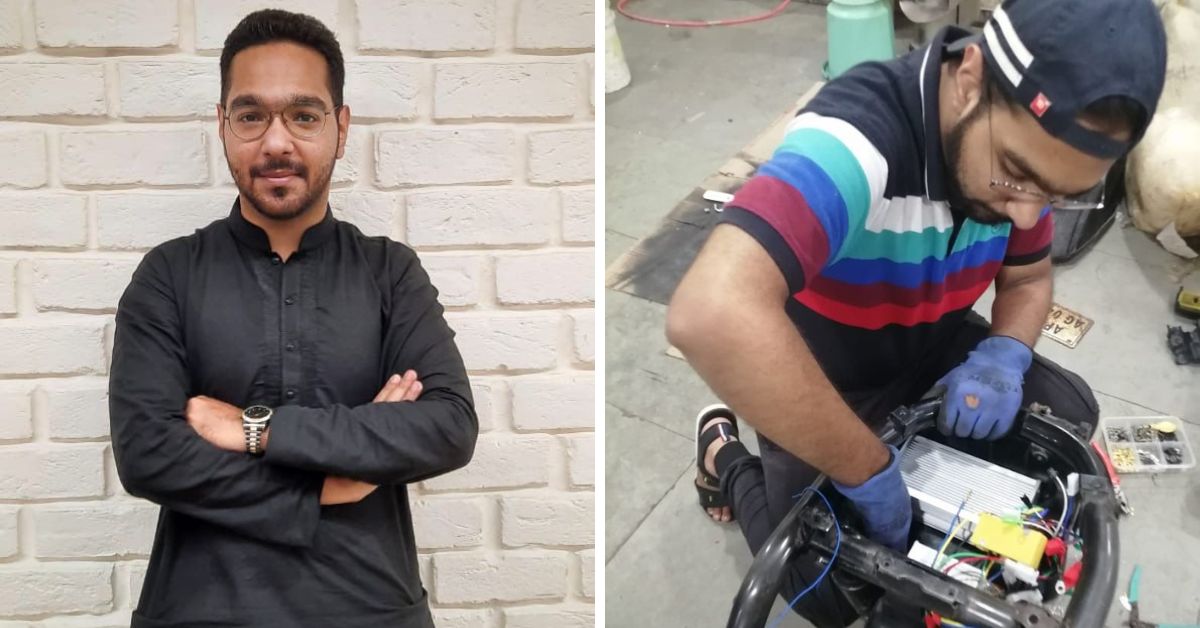
Hyderabad engineer Maaz Ahmed Khan founded his startup Torq Electric to convert old two-wheelers into electric vehicles.

In 2021, Maaz Ahmed Khan was still a mechanical engineering student when his interest in electric vehicles began brewing . “It started when I got into the EV subject of the syllabus in final year,” he recalls, adding that he would look closely into the working of these machines and formulate his own ideas to make his own version of them. 

But the 23-year-old’s idea was not to build a new design. Instead, it was to convert existing fuel vehicles — which would otherwise be turned to scrap — into fully functioning EVs. 

The then final year student of Methodist College of Engineering and Technology, Telangana, started looking for someone’s help to start building on his vision. This brought him to a non-academic startup incubator EdVenture Park, which focuses on student innovations. He applied for a job here and was selected. 

With their support, the youngster began working on his dream project, eventually founding Torq Electric in March 2021.

“A few years ago, I happened to attend the launch of Tata Nexon. Even though the vehicle excited me, I also thought, ‘Why should we buy a new EV if there exists a technology to convert existing vehicles?’,” he tells The Better India. 

He continues, “I also had ‘electric vehicles’ as a subject in college. I learned that after 15 years of running, the fuel usage of any vehicle goes up and it contributes to greater pollution. Instead of turning it to scrap, you can convert it.” 

On 27 August 2021, Maaz came up with the prototype of a two-wheeler EV, which he built by transforming an old petrol scooter and spending Rs 60,000. The model was covered widely by the media and popularised further through the internet, he recalls. 

Electric Vehicle by Engineering Student
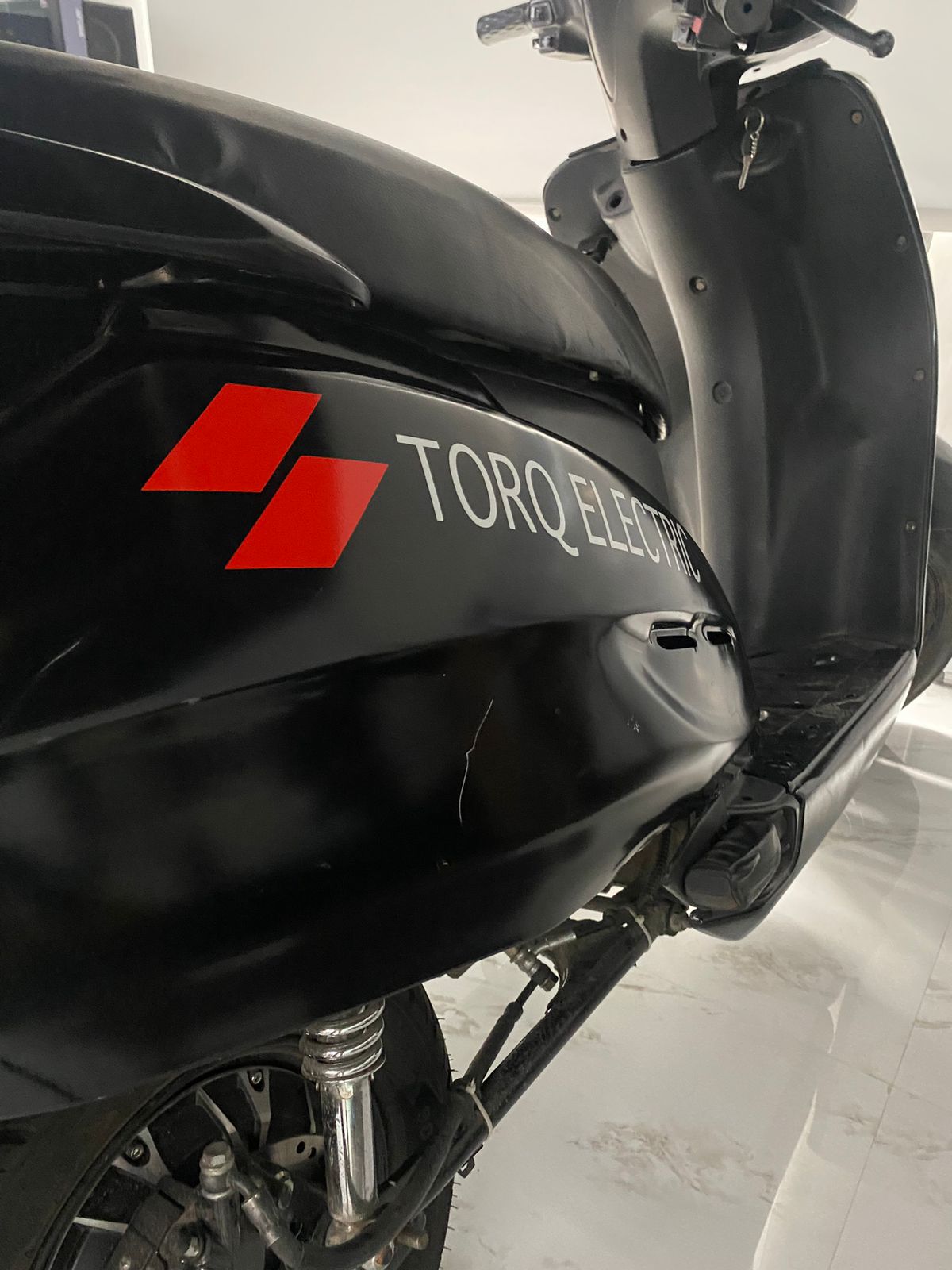
The EV by Torq Electric.

“Even then, it took time to gain people’s trust. A few months later, I managed to get some customers. A majority of them were unwilling to let go of their two-wheelers due to emotional attachments and similar reasons. Converting these into electric vehicles seemed like a great idea to keep your old favourite bike,” he explains. 

Maaz says he has so far converted seven bikes, and received orders for 15 more. 

Additionally, he helps engineering students to take up college projects related to EV and supports them with the related technical know-how. 

For a greener future

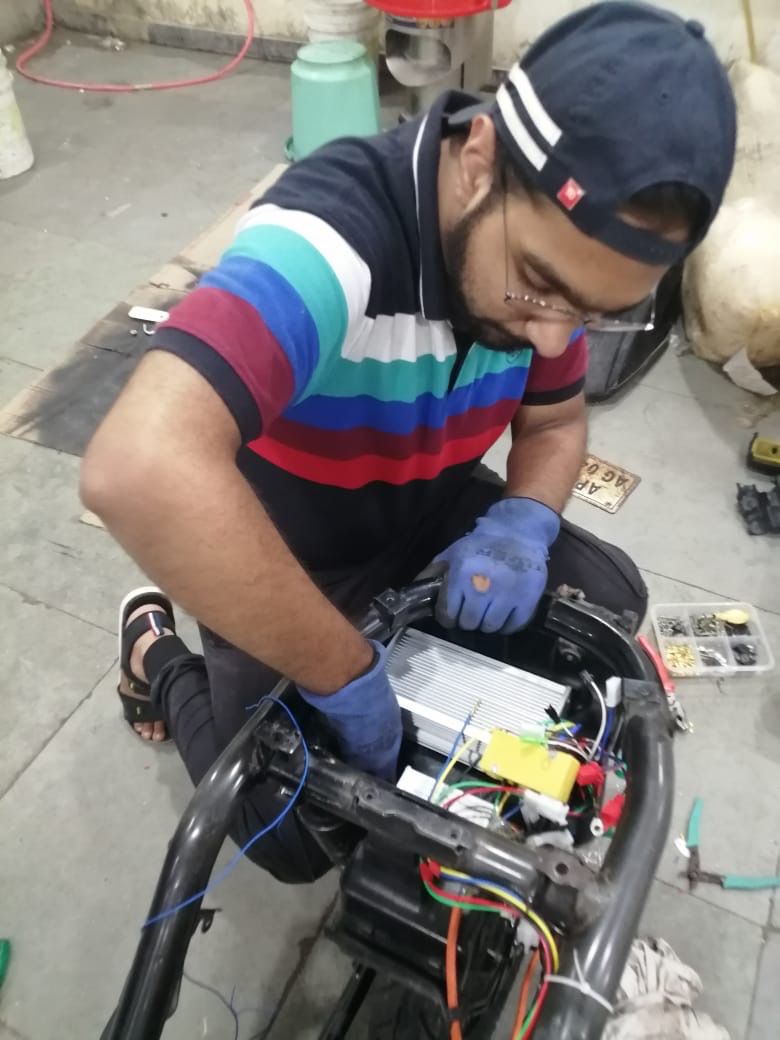
Even though it takes just 5-7 hours to convert a two-wheeler into an EV, Maaz asks for two days to check and ensure the vehicle’s safety after riding. 

Electric Vehicle by Engineering Student
Maaz busy at work.

He provides two types of models — fully electric and hybrid vehicles. Those who wish to keep fuel as an option can opt for the latter. He says the price to convert any type of two-wheeler into a fully electric EV is Rs 50,000. For hybrid, he charges Rs 55,000.

“In fully electric two-wheelers, the engine and fuel tank are replaced with a powerful motor and batteries. In hybrid conversion, a motor and battery are added to the existing engine. This gives the flexibility of driving on both electric power and engine power,” says the engineer.

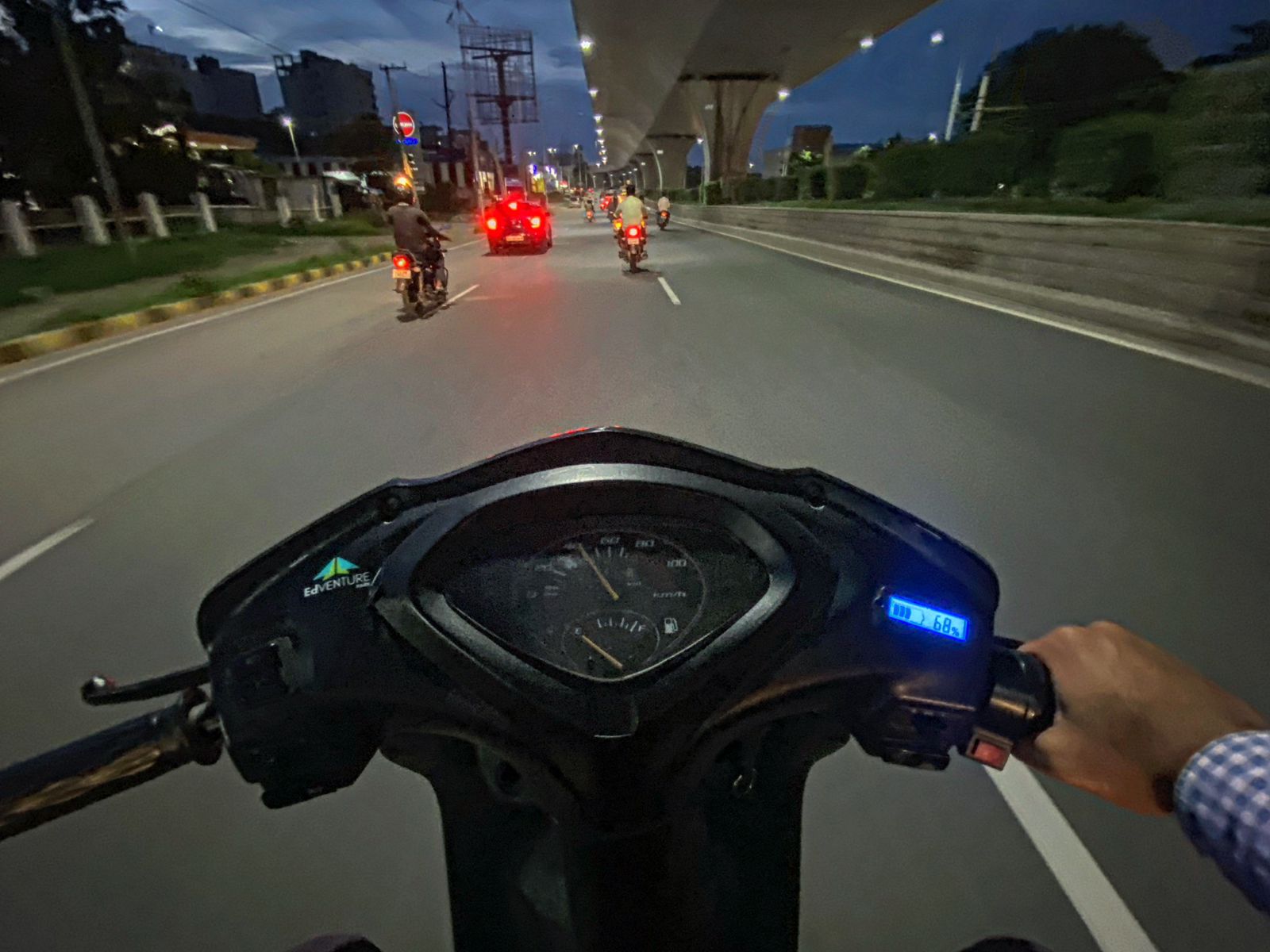
The base variant of the vehicle takes about three to four hours to charge, and can run up to 75 km at an average speed of 45 km/hr, Maaz says. Customers can also give their preferences, for which prices may differ.

“EVs are in their early days in India. But undoubtedly, they are the future. It is important to be aware of the pollution from fuel vehicles. Soon, we might be living in a country where breathing feels like smoking a cigarette. But we can prevent this by showing responsibility. Like shifting from plastic bags to cloth bags, or using public transport, opting for an EV is a great step,” Maaz says.

Electric Vehicle by Engineering Student
The electric vehicle built by Maaz.

Through his company, he aims to create sustainable living through automotive manufacturing, with the vision to create an eco-friendly world. 

Even though his current innovation is receiving great response, the engineer’s dream is to launch his own design of an EV, exclusively for Indians. He also plans to extend the current innovation to three and four-wheelers.

Electric Vehicle by Engineering Student
Maaz Ahmed Khan — the engineer.

“The rise in fuel prices has most affected the auto drivers of the country. After a little research, I discovered that if they switch to EVs, they can save around Rs 400 a day. This accounts for Rs 12,000 a month. Thus, my plan is to launch an innovation pertaining to three-wheelers,” he shares.

Visit his website www.torqelectric.com

Edited by Divya Sethu

Photo Credits: Maaz Ahmed Khan

source: http://www.thebetterindia.com / The Better India / Home> English> Electric Vehicles – Sustainability / by Anagha R Manoj / September 20th, 2022

Mohammed Yasin, A Calligrapher and Painter Par Excellence, is No More

Mogalgidda (Mahbubnagar District) / Hyderabaad, TELANGANA :

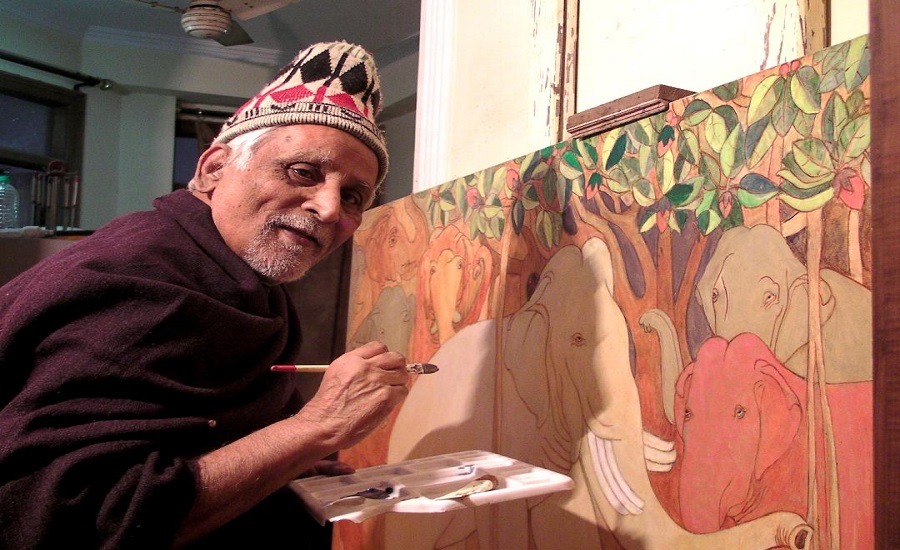
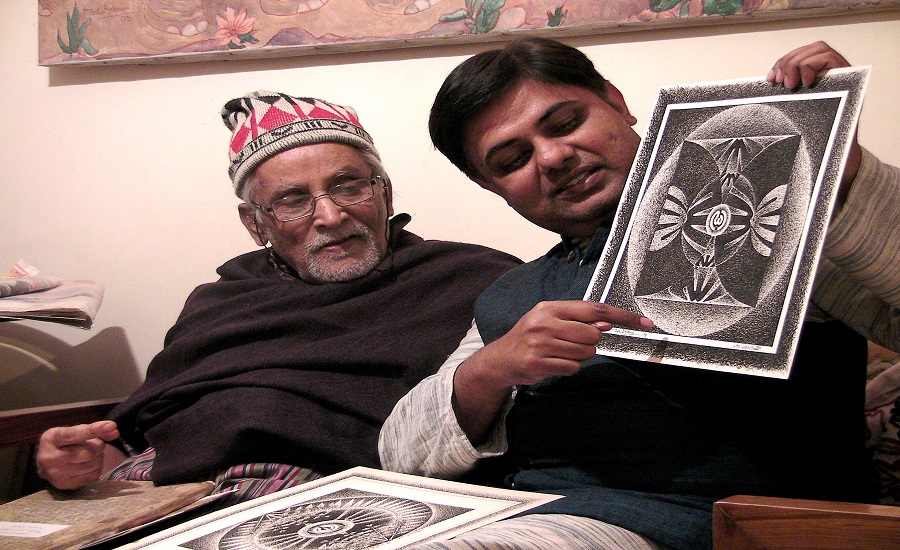
Mohammed Yasin, veteran painter and one of the best calligraphers in the subcontinent.

OBITUARY

Yasin’s early works have explored all available mediums from lithography, etching, aquatint, engraving, dry point, serigraphy, mezzotint water colours, oils, gouache and egg tempera.

“85-year-old veteran artist Mohammed Yasin’s character impresses as a person and his characteristics as an artist. Perhaps the distinction is unreal, for, in his case, it is the same integrity that reveals itself in the structure of life and in self-expression through art.”

These were the words said a few years ago by a noted art critic for Mohammed Yasin, veteran painter and one of the best calligraphers in the subcontinent, who passed away on August 19.

Yasin was born in Mogalgidda, a village near Shadnagar, 30 km from Hyderabad. As a young school boy, he felt an aptitude for Art when he was just 14 years old. After passing his elementary and intermediate drawing examinations, he moved to Hyderabad city with his family members from his birthplace Mogalgidda.

Showcasing art work.

Though quiet in his demeanour, Yasin has had seriously tragic experiences. His father passed away when he was only 14 months old. He was brought up under his mother’s care and guidance. He had to grow up with many hardships. While as a boy, he was affected by tuberculosis of the spine which has left a limp which necessitates the use of a stick to aid in walking. But through a sustained musing, he has won an inner serenity.

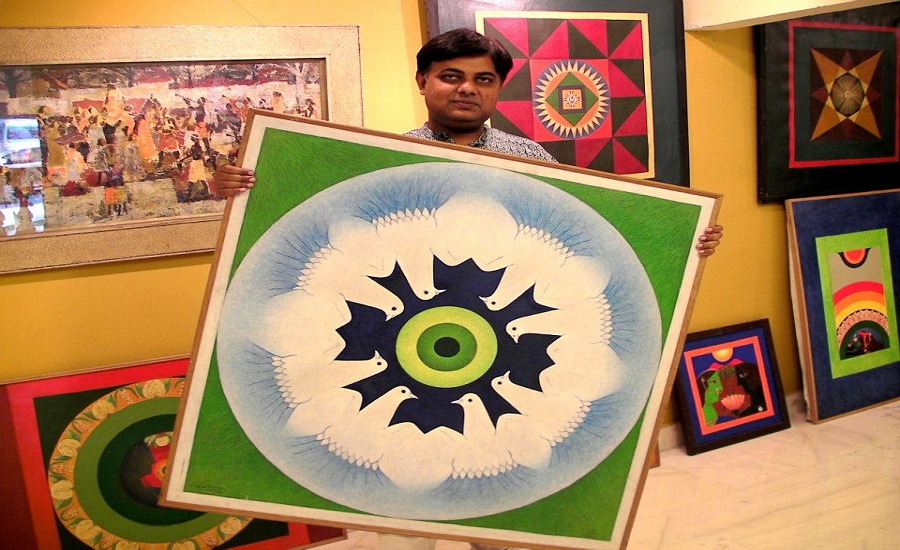
Art works displayed in an art gallery

His most important contribution goes to the art of calligraphy. He chose to work in an abstract symbolic manner. Geometrical elements like the circle within the square, concentric circles, etc. comprise the basic structure emphasizing a symmetrical arrangement and abstract formal values–calm and quiet but they are, nevertheless, active fields. They seem to be deeply influenced by the Buddhist art. They generate impulses of colour and focus attention on the symbolic images they contain.

The use of circle, square, triangle adds to his innovation a transparency, a water colour. The orthodox prohibition of representational figuration in art made the Islamic tradition turn to calligraphy. Yasin has brought to this tradition a modernist love of abstraction and monumental geometricism.

His early works have explored all available mediums from lithography, etching, aquatint, engraving, dry point, serigraphy, mezzotint water colours, oils, gouache and egg tempera.

His works are very poetic and also dramatic; actually they are calligraphic in nature. Tantric symbolism, Sufi mysticism, echoes of the miniature schools, shades of thankas and pictorialised Arabic Calligraphy are all inspirations which could be identified in Yasin’s work.


Aseem Asha Usman is founding director of Aseem ASHA Foundation, and has been documenting the life and works of the veteran calligrapher and painter.

source: http://www.clarionindia.net / Clarion India / Home / by Aseem Asha Usman / August 20th, 2020

These youngsters want to make Hyderabad the hub of robotics

Hyderabad, TELANGANA :

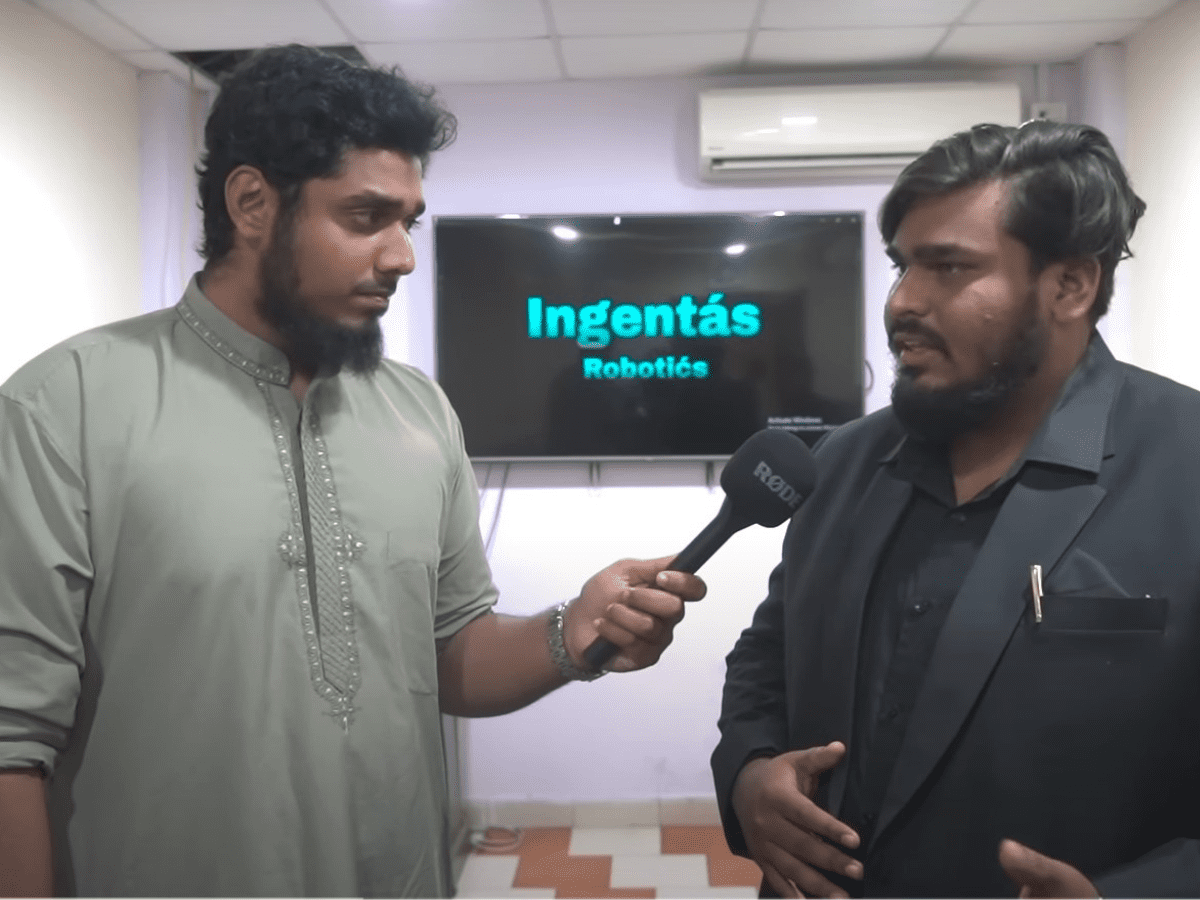
Ingentas is teaching people everything from basic batteries, jumper wires, buzzers, and sensors to the robotic arm, NASA’s Mars rover, and A.I.-driven drones.

Hyderabad: 

Realizing that any type of access to learning robotics and artificial intelligence is not available to most people, Ingentas started off in 2021 with its vision to empower local communities by teaching them technologies that will be more relevant in the future. It’s a first-of-its-kind workshop in Hyderabad, completely run by engineering graduates and students that aims to make the city a hub of robotics.

Tahami Mundewadi, who has been in the field of robotics for the last four years is the founder and CEO of Ingentas. Speaking to Siasat.com, he said that joining the Robotics club at Muffakham Jah College of Engineering (MJCET) helped him learn and grow more in the pursuit of his passion.

“Everything from a vacuum cleaner to the robotic arm used to build cars, all are based on robotics and artificial intelligence, we are living in an interesting time where even surgeries are being performed by robots,” Mundewadi remarked.

He further added that the world is moving at a very fast pace in this direction and that we have to be in this race and compete with the others.w

Ingentas is teaching people everything from basic batteries, jumper wires, buzzers, and sensors to the robotic arm, NASA’s Mars rover, and A.I.-driven drones.

Mundewadi stated, “you don’t necessarily have to be an engineering student to learn robotics, anything with passion can come.”

Furthermore, the CEO of Ingentas added that he believes that in 50 years everything will be based on robotics. “And to make anything mainstream in society we have to begin from the school level and that’s why we have classes from third-grade level all the way to advanced post-graduate level,” he remarked.

source: http://www.siasat.com / The Siasat Daily / Home> News> Hyderabad / by Usama Hazari / August 06th, 2022