Tag Archives: Muslims of UP

Collective efforts lead to the betterment of the nation: Farooq Siddiqui

UTTAR PRADESH :

Lucknow :

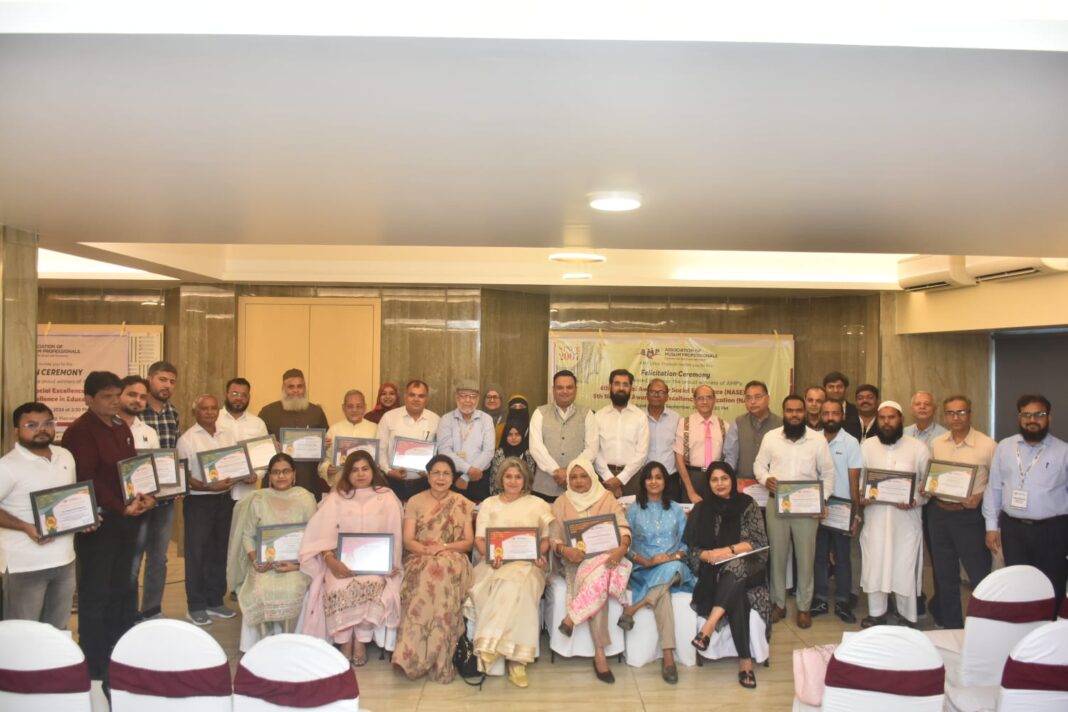
The Uttar Pradesh Chapter of the Association of Muslim Professionals (AMP) organized an ceremony at Hotel Arif Castle for the recipients of the 4th National Awards for Social Excellence and the 8th National Awards for Excellence in Education from Uttar Pradesh.

Among special guests were senior gastro surgeon Dr. Waliullah Siddiqui from Apollo Hospital and Mirza Mubeen Baig from Gautam Budh Nagar. Distinguished educationist and career counsellor Dr. Amrita Das was to attend as the chief guest but could not participate due to health issues, so former senior bureaucrat Zahra Chatterjee filled the role.

The programme began with a recitation from the Holy Quran by Maulana Muhammad Rehan Qasmi.

The welcome address was delivered by AMP’s Zonal Head for Central Zone, Syed Shoaib. AMP’s State Head, Shaheen Islam, introduced the audience to AMP’s objectives and activities, mentioning that this non-governmental, non-political, and non-profit organization was founded in 2007. Over the years, AMP has been engaged in educational, social, economic, and developmental activities aimed at empowering marginalized communities.

Guest of honour Mirza Mubeen Baig emphasized that working for NGOs is becoming increasingly challenging, and only those organizations that serve selflessly and with sincerity will succeed. He stressed the need for collaboration among serious NGOs to benefit from each other’s experiences.

Dr. Waliullah Siddiqui congratulated the awardees for their contributions to education and social services, highlighting that the responsibility for educating and nurturing children lies with both parents and teachers. In today’s changing times, this responsibility has grown even more significant. He shared personal lessons from his life, crediting his parents for playing a central role in his achievements.

Speaking as the chief guest, retired IAS officer Zahra Chatterjee praised AMP’s work and said that every individual’s contribution is crucial for the nation’s development. She stressed the need to reach out to the last individual to ensure educational awareness and economic stability.

Farooq Siddiqui, Head of AMP’s National Coordination Team, addressed the audience, stating that these awards aim to encourage individuals and organizations committed to transforming the nation through their selfless services. He emphasized the importance of collective efforts and mutual cooperation, noting that the welfare of the country and nation lies in unity and partnership.

The vote of thanks was delivered by Mohammad Mohiuddin, Chapter Head of AMP Lucknow, and the event was hosted by Dr. Sumbul Shakeel.

The recipients of the National Awards for Social Excellence included the Best NGO awardees:

Tauheedul Muslimeen Trust, Institute of Social Harmony and Upliftment.

Among the Change Maker Awardees were:

Professor Dr. Nuzhat Hussain from Lucknow, Dr. Mohammad Mubashir, Sabiha Ahmed, Balbir Singh Maan, Dr. Kaleem Ahmed Khan from Kanpur, Dr. Saba Yunus, Shahid Kamran Khan, Sagheer Khaksar from Balrampur, Dr. Saleem Mohammad Khan and Naseem Ahmed Khan from Aligarh, and Ramesh Chandra Srivastava from Ayodhya.

The recipients of the National Awards for Excellence in Education included:

Professor Mirza Mohammad Sufiyan Baig, Professor Naseem Ahmed Khan, Ausaf Azeem Kirmani from Aligarh, Mohammad Shahid Khan, Dr. Mohammad Shamim, Samiullah Ansari from Kanpur, Chitra Maheshwari from Lucknow, Dr. Roohi, and Maulana Mohammad Rehan Qasmi.

Lifetime Achievement Awardees included senior teacher Sheila Lawrence from Lucknow and Jamaluddin Khan from Kanpur.

A large number of attendees were present at the event, including Dr. Anis Ansari (former IAS), Mohammad Khalid Ashu, Mujtaba Khan, Najm-ul-Hasan Rizvi Najmi, Dr. Uzma Mubashir, Syed Abrar, Rizwan Ansari, Mohammad Zeeshan, Mohammad Imran, Javed Akbar Khan Lodi, Shahenshah Ansari, Fahad Mahmood, Ayesha Mahmood, Alma Siddiqui, Ayesha Alvi, Zaheer Baig, and Aqib Rauf.

source: http://www.indiatomorrow.net / India Tomorrow / Home> Education / by India Tomorrow / September 03rd, 2024
Reflections on a Mission: A Visit to Vision International Academy, Phulat

Kodangallur, KERALA / Fulat(Phulat)Village (Muzaffarnagar District), UTTAR PRADESH :

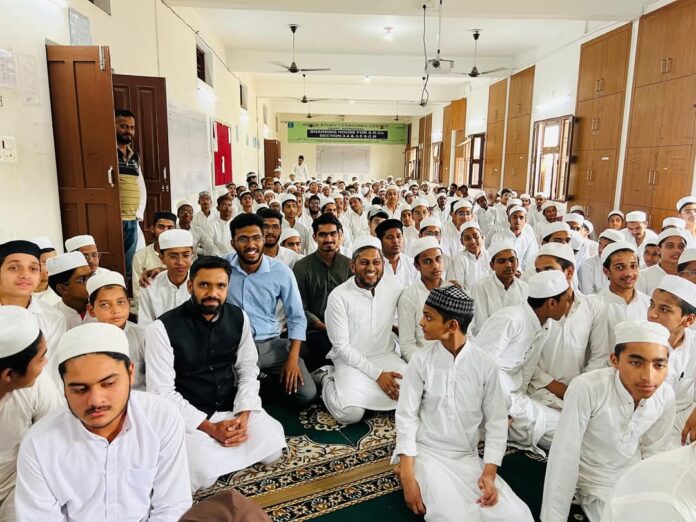
Recently, I had the opportunity to visit Vision International Academy (VIA), situated in the village of Fullat in Muzaffarnagar district, Uttar Pradesh. It was a journey I had long awaited. Spending time with the children there—even briefly—was a moving experience. Before me sat over 300 Huffaz—young children who had committed the Qur’an to memory. But the academy is not merely a Hifz institution. As the name “Vision” suggests, it embodies a deeper insight into human potential, blending spiritual excellence with academic brilliance.

Mammooty Anjukunnu

That evening, while returning to Darul Uloom Deoband, I received a call from Babukka. He sounded emotional. He had called to express his joy—not just about my visit to Vision or meeting the students—but about something much greater. Because what I had visited was not just another educational center. It was a mission. A dream. And behind it stood the journey of a visionary man.

Let me tell you that story.

A man from Kodungallur, Kerala—Ameer Ahmad Babu Manappat—never imagined that his life would take a turn into the field of Islamic education. A former student of Aligarh Muslim University, he was first struck by the concept of Hifz during a visit to Delhi. Intrigued, he began exploring madrasas in SaharanpurDeoband, and surrounding areas of North India. He wanted to understand the intellectual capacity of Huffaz. People had told him these children possessed extraordinary memory and brilliance.

However, while interacting with them, he found something amiss. These bright children, despite having memorized the entire Qur’an, were often unaware of the world outside. And he, in turn, was a stranger to theirs. This encounter exposed a painful reality: two different worlds existed—and there was a vast, unbridged distance between them.

In North India, the term “madrasa” is broad and includes Hifz centers, Arabic colleges, and basic religious schools. Many children are enrolled in such madrasas without access to formal education. They might learn basic arithmetic or science, but there’s little focus on academic rigor or integration. Most teachers remain confined to their own disciplines. The idea of combining Qur’anic and modern education barely exists.

Ameer Babu, grandson of Kerala’s renowned Muslim reformer Manappat Kunhahammad Haji, felt a growing sense of responsibility. He believed that Huffaz—gifted with sharpened intellect and memory—deserved access to high-quality general education. Their potential, he thought, could be channeled for the upliftment of society and the community.

He spent months researching and, with experts, developed an innovative bridge course—an academic fast-track that compresses eight years of schooling into one. After two more years, students would be ready for the 10th-grade public examination.

Many doubted his vision. He met numerous religious scholars and explained the idea, but most dismissed it. “We already teach school subjects,” they would say. “What more do you want?”

In reality, over 35,000 Huffaz graduate annually from madrasas in Uttar Pradesh alone. Yet less than 10% of them appear for the 10th-grade board exams. Most do not pursue further education. Many end up in manual labor, small trades, or low-income jobs.

Still, Ameer Babu did not abandon his mission.

His journey brought him to Fullat, near the UP-Delhi border, home to a vast madrasa campus named Jamia Shah Waliullah, founded by Maulana Kaleem Siddiqui, a renowned scholar and spiritual leader. The madrasa is located in the birthplace of Imam Shah Waliullah Dehlawi, one of the greatest Islamic scholars in Indian history.

When Ameer Babu shared his vision with the people there, he was told, “Let Hazrat come, he will help you.” Soon, Hazrat arrived—dressed in white, with a radiant smile and graceful demeanor. It was Maulana Kaleem Siddiqui himself.

After listening carefully, Maulana asked Ameer Babu:

“Ameer Saab, what do you want?

Land?
Buildings?
Some support?”

Then he stood up, led him to a nearby three-acre plot of land adjacent to the madrasa, and asked: “Is this enough?”

That was the beginning.

In August 2017, Ameer Babu admitted 76 Huffaz in the first batch. The results were astounding. These students, with their incredible memory skills, were able to learn up to 1,500 words a week. They completed an entire year’s academic syllabus in just 13 to 18 days, using innovative learning techniques. Simultaneously, their Qur’anic memorization was maintained through a dedicated revision system (daura).

Under the Open School system, the first batch achieved a 92% pass rate in the 10th-grade board exams. Encouraged, they transitioned to the more rigorous UP State Board—and the pass rate rose to 96%. Then, Vision shifted to the CBSE curriculum, and the first batch passed with a 100% success rate.

Classes were expanded to include Plus One and Plus Two, with both Science and Humanities streams. Today, more than 300 Huffaz are enrolled at VIA.

Among its graduates:

  • 2 are now in medical colleges
  • 7 in engineering colleges
  • 8 in law schools
  • Over 50 in various Arts & Science colleges

Vision’s students now come from across seven Indian states. They are fluent in English, academically competitive, and grounded in Qur’anic values.

Last year, during Ramadan, 235 VIA students led Taraweeh prayers as Imams in 17 Indian states, including Kerala—showcasing both their spiritual and intellectual discipline.

Some of these students have now joined the SAFI Institute in Kerala, where Ameer Babu serves as Vice Chairman—an ongoing experiment in integrated education. His goal is to nurture a generation of confident, competent Muslim youth who carry the Qur’an in their hearts and knowledge in their minds.

During my visit, Babukka shared with me his dream—to build 100 such institutions across India for Huffaz. I responded with a story.

In 1992Balbir Singh, a leader in the mob that demolished the Babri Masjid, returned to his village a hero. But his father rejected him. His wife left. Disgraced and broken, he eventually arrived at Maulana Kaleem Siddiqui’s khanqah in Fullat. There, he broke down and wept. He embraced Islam and became known as Mohammad Aamir.

Following Maulana’s advice, Aamir joined Tablighi Jamaat for four months. Later, he told Maulana:

“Hazrat, I was one of those who demolished Babri Masjid. I must build 100 mosques to atone.”

Before his death in 2021, Mohammad Aamir fulfilled that dream.

Now, from the same khanqahAmeer Babu has set out on his own mission—to build 100 schools for Huffaz.

When Maulana Kaleem Siddiqui’s dawah efforts began shaking the status quo, the authorities arrested him under fabricated charges. That is a different story altogether.

But Ameer Babu carries on, undeterred.

He serves— the Qur’an, and those who carry it within.

source: http://www.muslimmirror.com / Muslim Mirror / Home> Education> Positive Story / by Mammooty Anjukunnu / June 07th, 2025