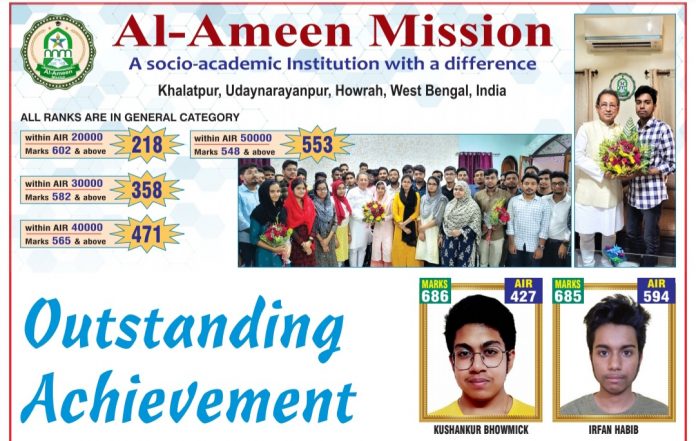
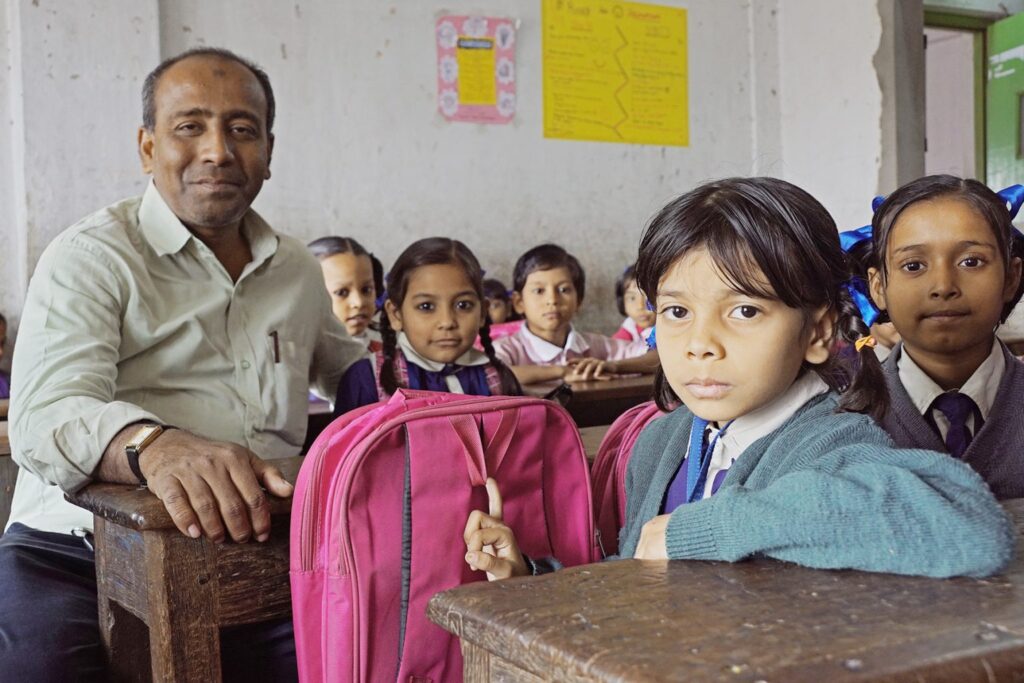
More than 500 students from the Al-Ameen Mission’s 70 branches in West Bengal passed the National Eligibility-cum-Entrance Test (NEET) 2022 with flying colours.
M Noorul Islam, head of the Institution said, “I have had the biggest success this year, as the number of Al Ameen Mission students who have secured 600 and above points in the NEET is around 200.”
Last year, 510 Al Ameen coaching academy students passed the NEET and were accepted into various medical colleges.
According to Islam, the number is likely to be higher this year as his team finalises the list.
Islam said that that the majority of the students are from rural areas and come from remote villages throughout West Bengal.
Kishankur Bhumika, a non-resident student, is this year’s Al-Ameen topper. He received 686 out of 720 points in the NEET and was ranked 427 at the All India level.
Irfan Habib, son of farmer Abdul Subhan of Devcharai village in Tafanganj, Cooch Behar, has received the highest marks among the mission’s resident students. He received 685 points and is ranked 594th in the all-India list. Aside from that, many Al Amneen Mission students scored more than 650 points on the NEET.
Akhtari Parveen, a female student at Al-Ameen Mission, is among the achievers . She has been a student at Al Ameen Mission’s Khalatpur campus since Class VII. She got 653 marks in NEET with the help of Al Ameen Mission and her all-India rank is 3915.
Al-Ameen Mission, based in Howrah, has produced over 3500 doctors (MBBS & BDS) and 3000 engineers, in addition to scores of researchers, administrative officers, teachers, and professors.
Nurul Islam founded the organisation, which now operates 70 coaching institutes in 20 West Bengal districts.
The organisation educates 17,000 residential students and employs over 3000 teachers and non-teaching staff. The main campus of Al-Ameen Mission is in the West Bengal district of Howrah, at Khalatpur (Udaynarayanpur).
“We utilize Zakat and Sadaqah funds to achieve our goal and play our role in nation building. We urge the community members to support our efforts ” Islam told Muslim Mirror.
“Most of the students who have qualified NEET from Al Ameen Mission belong to very poor backgrounds and weaker sections of society. We nurture their talent, develop their intellect and provide them a good environment so that they could come out with their best,” he said.
source: http://www.muslimmirror.com /Muslim Mirror / Home> Indian Muslim> Positive Story / by Muslim Mirror / September 10th 2022
This IAS officer held a career counselling camp at the recent Islampur Book Fair.
This IAS officer held a career counselling camp at the recent Islampur Book Fair.
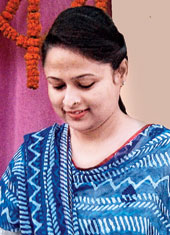
In the few months following her first posting at Goalpokhar-I in November 2014, Shama Parveen, “BDO Mam” as she is addressed by many, has become a source of inspiration to several, especially young women belonging to the minority community.
She is the first woman IAS officer in North Dinajpur district from the minority community.
Shama, a 2013 batch officer from Kanpur, had wanted to do something for the underprivileged. At Goalpokhar-I, one of the most impoverished areas of North Dinajpur, she began to act on her dreams.
Goalpokhar is largely agriculture-based. There are no industries here and not a single college in the block. People from the minority community comprise roughly 80 per cent of the block’s population.
During her short stint — she is waiting for a transfer order — Shama has, on her own, held career counselling sessions by visiting schools in her area. She told the young girls as well as their parents that if she could make it, these girls could too.
“The main impediment for the girls from my community are members from their own families. It is a popular belief that we cannot do well in higher studies. Whenever I meet the guardians, I tell them their daughters have the capacity to do well in higher studies. Please stand beside them. I tell them, let them shine. I am a woman from a humble background and if I can achieve what I have, so can these girls,” said Shama, who hails from a middle-class family. Her father is a businessman and her mother a homemaker.
Shama said her younger sister is studying civil engineering and her brother is a schoolteacher. She said her father is proud of both his daughters.
“When I started preparing for the civil service exams, I went to a tutorial in Delhi. But I realised that it was not the proper way, it was a kind of cheating. I left the tutorial and began preparing at home. I concentrated on reading media reports and hunting up events and data on the Internet. I had done my masters in history and that remains my favourite subject. I tell young people to read books as they are the cornerstone of success,” Shama added.
Choudhury Abdul Karim, minister for library services and mass education and Islampur MLA, could not praise the young bureaucrat enough. “She is an inspiration for the women of our community,” Karim said.
Rashid Alam, resident of Lodhan in Goalpokhar, said that this year’s Madhyamik exams were being conducted smoothly mainly because of the efforts of the BDO. Examinations have often been conducted here among allegations of cheating and violent reactions.
Shama’s interactions with school students have prepared the way for peaceful examinations. “She has been keeping a watch. My daughter is sitting for her Madhyamik and all arrangements are being overseen by the BDO. We know that she will be promoted and leave the block. But she will remain an inspiration for all of us,” he said. The students of the schools that Shama has visited fondly recall her quiet manners and gentle way of persuading them to carry on their studies.
“Once she came to our school. The manner in which she spoke to us was very impressive. I do not know about the others but I am determined to pursue higher studies. I used to be convinced that higher secondary would be as far as I would be able to study. Almost all girls here do not go to college as the two colleges are far away in Islampur or Dalkhola. But BDO Mam has kindled a tremendous urge in me to study,” said Arjuna Khatun, a resident of Goagaon, a village in the block.
Shama’s formula of success is simple. “If you have nek irada (honest resolve), it can help you achieve anything,” she said.
source: http://www.telegraphindia.com / The Telegraph Online / Home> West Bengal / by Mehdi Hedaytullah / March 09th, 2015
The memorial has now become a pilgrimage point for locals
Half a century back, a Kali temple was built by the Border Security Force (BSF) as a war memorial at the request of two soldiers — a Christian and a Bengali Muslim — at the Border Outpost (BOP) in Srinagar, Tripura, which has now become a pilgrimage point for locals.
Major P. K. Ghosh, who was then commanding four border outposts (BOP) of BSF at Srinagar, Amlighat, Samarendraganj and Nalua in the southern part of Tripura bordering Chittagong division, in erstwhile east Pakistan, has chronicled the story in ‘Borderman’, the BSF journal.
When contacted, Major Ghosh said the Srinagar BOP was located in a very important strategic position and after the revolt by the East Bengal Regiment in 1971 against Pakistan, BSF aided the rebels in forming the first Muktibahini (Liberation army) in Srinagar.
“The MMG post at Srinagar BOP was playing a crucial role in thwarting the Pakistani army. It was the forward observation post near the Chittagong-Noakhali area. Exchange of fire was nothing new in that area, but it intensified when the liberation war started picking up”, Major Ghosh told PTI telephonically.
He said since the MMG post was causing major damage to the Pakistani side, it became a precision target for the enemy.
“A precision target receives continuous firing of shells over a period of an hour or so, it is likely to get damaged. On that day, they fired 100 shells in ten minutes”, Major Ghosh recalled.
“There were three members of the detachment at the post including a Nepali Christian, Constable Rehaman (a Bengali Muslim) and Constable Banabihari Chakraborty. The situation at the spot was terrible, and I asked them not to step out of the bunker,” he said.
As the situation became worse, Constable Chakraborty asked the others to pray to goddess Kali. “They did that without even considering their religious beliefs. The post was saved due to its position near a pond and marshy land and heavy rain a night ago. A bamboo tree also prevented the shells from torching the bunker and they ended up as air bursts”, Major Ghosh said.
When the BSF decided to build a war memorial at the spot, the Christian and the Muslim soldiers requested that a Kali temple be built instead.
“Building a Kali temple for a war memorial is very unconventional. But BSF did that to honour the request of the soldiers,” Major Ghosh said.
The funds were collected from locals and the Bangladeshis also joined in constructing the Kali temple in 1972.
“We named it Rann Kali (War Kali) temple to honour their faith. At a time of religious intolerances, such examples stand as a beacon of hope”, he said.
source: http://www.thehindu.com / The Hindu / Home> News> National> Other States / by PTI / Srinagar (Tripura) / July 03rd, 2022
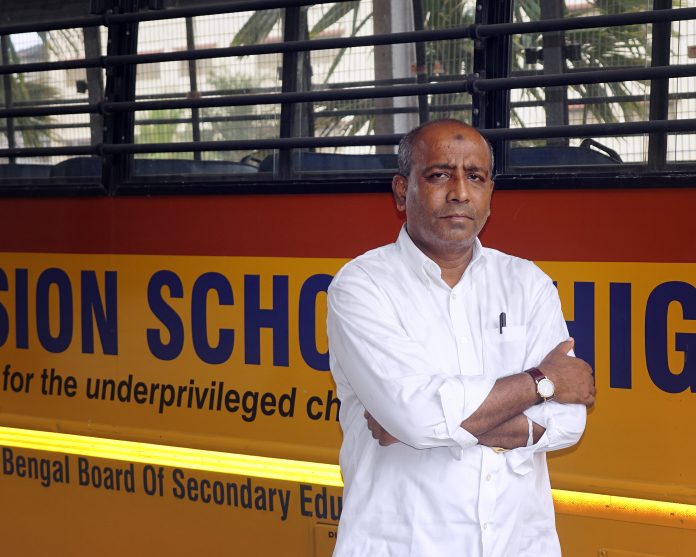
Educator and social reformer Mamoon Akhtar. | Photo by Partho Burman
More than 6000 kids from underprivileged families are benefiting from schools run by Mamoom Akhtar in West Bengal.
Kolkata :
It was the summer of 2001. Mamoon Akhtar, a slum dweller from Tikiapara, was returning home during the afternoon when a child named Ahmed, aged 7, ran up to him and pleaded with him to free his mother from a man who was forcing his mother to sell narcotics, something she despised. With the assistance of the police, he intervened to resolve the conflict. Before leaving, Akhtar inquired about Ahmed’s activities. “Sir, I want to learn,” the boy replied.
His response moved Akhtar. He recalled an incident from his school days when he was asked to leave his school for not paying his fees.Despite his traumatic childhood, Akhtar was able to finish high school.
Akhtar invited Ahmed to study at his home. He handed the young Ahmed a pencil and a notebook. On the second day, Ahmed returned with three children. On the third day, he arrived with four more.
This sparked hope in Akhtar. He asked his mother for permission to set up an informal school in a 300-square-foot room at his home and she agreed. He cleaned the room and bought a polythene sheet for the kids to sit on. “In addition, I set up a blackboard. That’s how it all started back in 2001. How a small street encounter transformed my life,” Akhtar told TwoCircles.net.
To ensure that no child is denied an education due to a lack of funds, he founded Samaritan Help Mission (SHM) in 2001, where he started providing quality education to children from economically disadvantaged families in Tikiapara, Howrah district, a neighbourhood where 80 per cent of the population is Muslim. Children, who previously did not attend school, are doing so now.
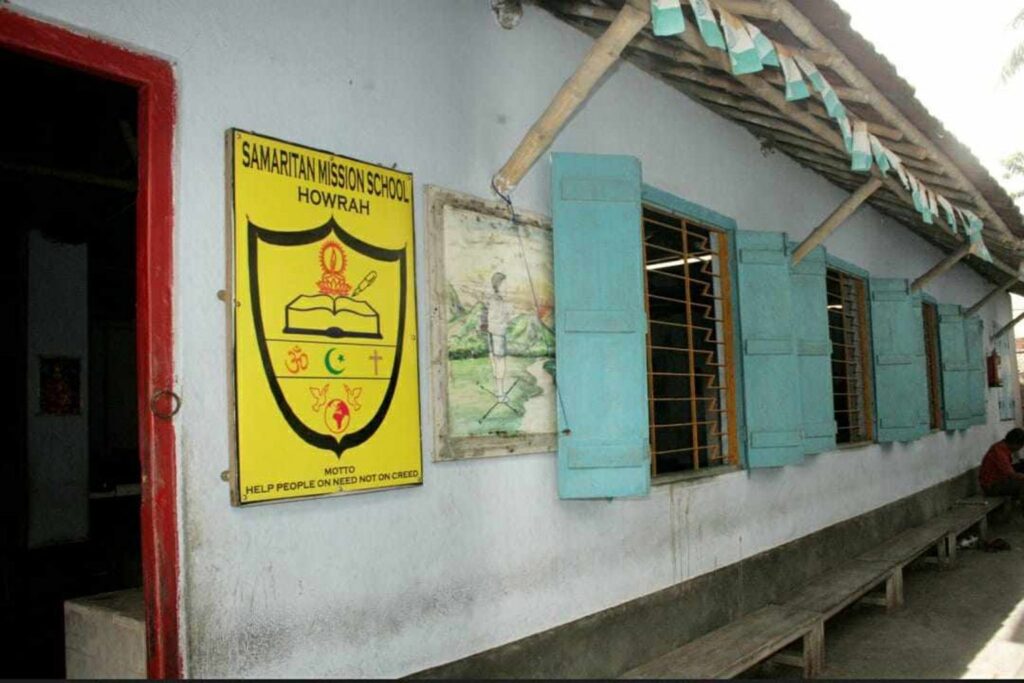
Samaritan Mission School was the first school set up by Mamoom Akhtar. | Photo by Partho Burman
Mamoon did not have a stable source of livelihood at the time, but he wanted to make sure he didn’t disappoint the children. He continued to conduct classes and began collecting newspapers and old books from his neighborhood. He sold them to raise funds for the slum pupils’ stationery. He invited several of the community’s college-going girls to join him in the classroom. He made them an offer of Rs 100 every month. He also requested his students to make a monthly contribution of Rs 5 for their education. They may bring in newspapers and old books instead of Rs 5 if they couldn’t afford it, he told them.
“I didn’t want the kids to believe they were destitute, so they are getting help. They needed to believe that their education was earned and that they deserved it. So, whether it’s Rs 1 or Rs 5, I implore them to pay,” he said.
“The school was administered by the poor for the poor,” Akhtar, who will turn 50 this year, said.
Mamoon Akhtar with the students of his school. | Photo by Partho Burman
In 2003, he came across a newspaper cutting while taking a walk. It included a photograph of a woman with some children. She was Lee Alison Sibley, an actress, social crusader and the wife of the American Consulate General in Kolkata. He sent her a letter asking for assistance. She responded with gratitude but declined to provide any assistance. Mamoon thanked her with a second letter.
Lee Alison Sibley eventually supported the cause and gave Rs 10000. “As a Muslim, I informed her that I don’t work for just Muslims. I solely work for the benefit of humanity. Because I think that hunger and poverty have no religion,” Mamoon recalled.
An article about her visit was published in a newspaper and Ramesh Kacholia, a Mumbai resident read it. He then sent his son to contribute Rs 11000 to him. For SHM, this was a watershed moment.
A co-educational English medium institution named Samaritan Mission School was founded in 2006. In 2008, the state of West Bengal granted it certification.
Akhtar told TwoCircles.net that many of the students at his school came from economically challenged backgrounds. Their fathers work as rickshaw pullers or daily labourers and some of them are in prison. “But their children are receiving a good education and performing well. I may not be able to do so for the country, but I will do all in my power to eliminate illiteracy in Tikiapara,” he said.
Three schools with 6500 students are now in operation. Samaritan Mission School High, Rebecca Belilious English Institution – a primary school and Samaritan Public School, which is located in Bankra, Howrah district, 10 kilometers from Tikiapara. Another school is coming up in the same complex at Bankra by January 2023. The total number of students is projected to reach 10,000. The exterior work on these schools has been completed.
Children receive education from nursery to grade 12. The medium of education is English, with Bengali as the secondary language. Howrah Municipal Corporation approached him to administer the inactive Tikiapara Municipal School based on his model of work. Akhtar took over the school in 2019, and in less than a year, it grew to 400 kids. It was once an Urdu-medium school, but it has since been transformed into an English-medium school.
Gradually, the social reformer broadened the scope of Samaritan Help Mission’s services to include health, sports, women’s livelihood and elderly care. 600 households get rations and medication every month from SHM. He started a vocational training programme as a source of income for widowed and divorced women. Around 400 women are employed as dressmakers.
Mamoon is the only son among five siblings and comes from a poor family. His father worked as a competent fabricator in the iron industry, while his mother took care of the family. Married with four kids, three of whom are students at his school. “I am a firm believer in the ideas of Prophet Mohammad and Swami Vivekananda. I read a lot about them,” Mamoon concluded.
www.samaritanhelpmission.org
Partho Burman is an award-winning independent journalist based in Kolkata. He writes inspirational, motivational and environmental stories. He tweets at @ParthoBurman
soure: http://www.twocircles.net / TwoCircles.net / Home> Lead Story / by Partho Burman / March 14th, 2022
Modelling professional, rugby player and dermatologist among role models.
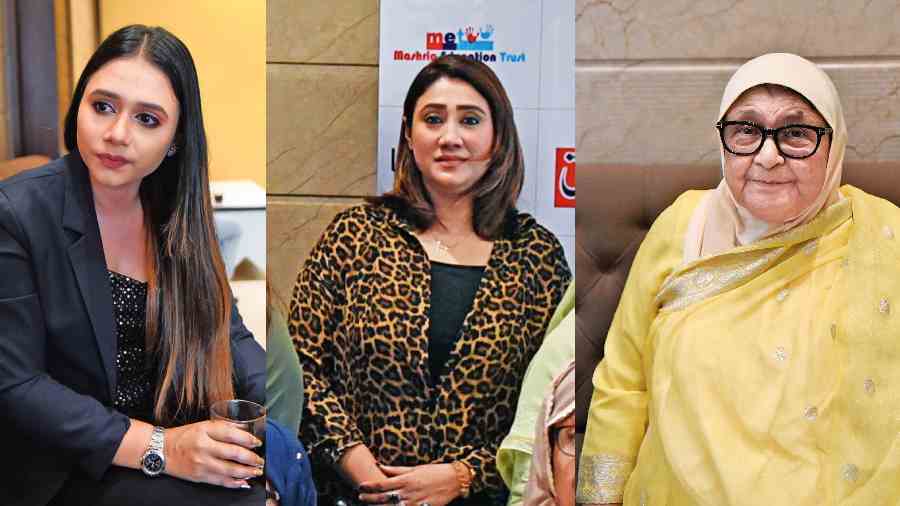
(From left) Bilkes Perveen, Saba Ali Firoz and Suraiya Rahman. Gautam Bose
A young woman set a condition to her would-be husband that she would marry only if she was allowed to pursue sports after wedding.
A girl whose neighbours once complained she wore jeans pursued her dream and became a fashion model, an entrepreneur and an anchor-presenter.
Several Muslim women who refused to tread the steps that many others wanted them to — get married, have children and live a domestic life — are now successful professionals. They came together at a gathering on Thursday afternoon.
The women will be feted by the NGO Friends of Alumni of Colleges Educational Institutes and Schools (FACES) and Mashriq Education Trust next week.
The Telegraph listened to some of their stories:
Bilkes Perveen
Anchor, model and entrepreneur
She was once frowned upon for wearing jeans. Bilkes, in her early 30s, who grew up on Convent Road in central Kolkata, said she was probably the only girl in her community in the neighbourhood who wore a pair of jeans.
“My neighbours were not happy with me wearing jeans. It was a very conservative space where I grew up,” she said. But she didn’t budge.
When she was 18, Bilkes took a night-shift job. She would go to her workplace wearing jeans or trousers. “I was 18. I wanted to be financially independent. Relatives and neighbours questioned why I took a night job. They wanted me to marry and have a kid instead of working. Fortunately, my parents stood by me,” Bilkes said on Thursday.
Life had better in store for her. At 19, she took up a job with a bank. It is while working there that she found her future husband, Tanmay Chatterjee. “Tanmay has always been very supportive. He wanted me to be a role model for others. After marriage I set up a company named Perveen and Chatterjee,” she said.
Bilkes wants to help women who have dreams but are afraid of defying the moral police. “My company trains Muslim women in personality development,” she said.
Bilkes herself hosts events as anchor and is also a model for a sari brand. “I am today happy with what I am doing,” she said.
Saba Ali Firoz
Rugby player and stylist
Saba had set a condition to her husband before marriage — she would pursue sports, her passion.
“My husband was fine with it,” said the 39-year-old mother of two.
She continues to do it despite unsolicited comments meant to fetter her. “I had to wear short skirts for playing, for which I had to hear comments like ‘you are not Sania Mirza’. Wearing a short skirt is a taboo,” she said.
Daughter of a retired police officer, Saba, a resident of Metropolitan off EM Bypass, got inducted into sports from her early teens by her father. “I did sprints and long jumps. It was my father who inspired me to take up athletics.”
Saba’s interest in sports spans disciplines. She has represented her club CCFC in rugby. She has played darts, badminton and tennis. She has also inculcated the passion for sports in her kids. Her 15-year-old son has represented the state in swimming and her 9-year-old daughter is training in swimming and basketball.
Imran Zaki, president of Faces, one of the organisers of Thursday’s get-together, said Muslim women were usually not encouraged by the society to take up sports and continue that after marriage. “It is to Saba’s credit and her will that she has managed to do what she loves. She is the one to emulate,” said Zaki.
As a professional, Saba runs her own studio at her home. She is a stylist and a make-up artist.
Suraiya Rahman
Gynaecologist and owner of a hospital
Suraiya earned her MBBS degree from Bihar in 1967. She was the only Muslim woman in her batch. She later completed her MD from Kolkata in 1975. Again she was the only Muslim woman in her batch.
“There were objections from relatives and acquaintances. They thought it was disgraceful for a woman to go to a convent school and a medical college,” she said. “But my parents never let those objections reach me. My younger sister is a gynaecologist,” she said.
If Suraiya was a rare example in her student days, she is one even now. At 76, Suraiya is running a hospital on Dilkusha Street near bridge number 4 in Park Circus. She does procedures, looks after the daily administration and advises junior doctors. “I am only 76,” she said when applauded for being so active at her age.
Farah Khan, director, Mashriq Education Trust, said: “Suraiya Rahman is a role model for the entire community. So many young doctors from our community, both women and men, look up to her.”
source: http://www.telegraphindia.com / The Telegraph, Kolkata / Home> My Kolkata / News> Women’s Empowerment / by Subhajoy Roy / June 10th, 2022
Thirty-two-year old Zeeshan Majeed from Kolkata, West Bengal has not only distributed food during the Covid-19 lockdown but also distributed masks, medicine and oxygen cylinders at times of crisis. For his noble work, he was featured as a Covid Warrior in IPL 2020. He is included among the Covid Warriors in the Limca Book of Records – 2020-22 as well.
Kolkata :
He has been feeding hungry people since he saw a child at a government hospital picking up food from a drain and eating it. Thirty-two-year old Zeeshan Majeed, a footwear manufacturer in Kolkata, started feeding 40 people with meals cooked by his mother once a week, but today more than 1500 people receive food daily from his Anti-Hunger Squad Foundation.
Zeeshan became a social activist after witnessing an accident on the street. It all began when he was on his way to work. He saw a young boy who had met with an accident and lay unconscious on the street near Sealdah railway station on April 15, 2018.
Something strange caught his attention, so he stopped to help. In the chaos, he spotted rag-pickers attempting to grab his mobile and laptop bag, which were lying scattered along with the motorcycle. He was a bit scared to help, but he recovered his courage and rushed the unconscious boy to the nearby Nil Ratan Sircar Medical College and Hospital.
At the hospital, he was shocked to notice the child. He later learned that many rural residents from deprived backgrounds in West Bengal travel to the capital city of Kolkata for treatment at the government hospitals. They arrive with their families and relatives. Some of these people can’t even afford to buy food, medication or accommodation. Most of them live on the streets for days and months.
Zeeshan went home with a heavy heart and recounted the story to his mother. He insisted on offering meals for the needy while he knew that her mother couldn’t possibly cook for this many people. “I asked if she could prepare meals for at least 40 people and I would take care of the rest. Her answer was yes. We decided that every Sunday my mother would prepare food and I would deliver it to people temporarily living on hospital premises or pavements,” Majeed told TwoCircles.net.
Starting a charity On May 20, 2018, he established the Anti-Hunger Squad Foundation, a charitable organisation. It started as a weekly event called ‘Dawat E Aam’ at NRS Hospital. Every week, the menu had a variety of dishes, such as simple hotchpotch, rice with vegetables, vegetable pulao, or rice with soya chunks curry. The menu consisted only of vegetarian meals since the recipients belong to diverse communities, which were served during the lunch hour.
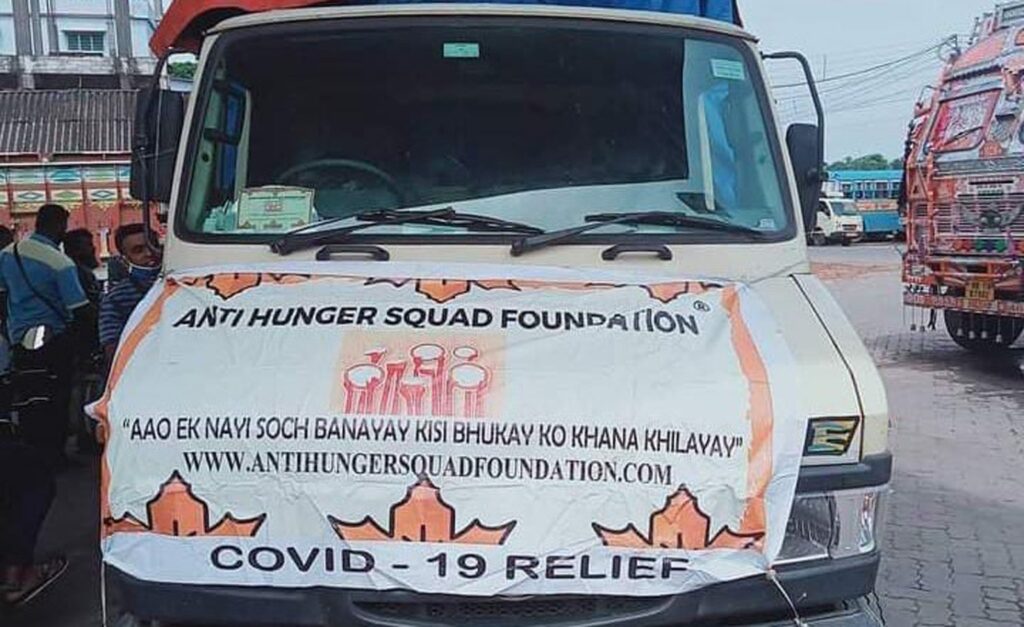
This vehicle carries Anti-Hunger Squad Foundation’s relief materials.
This weekly event has become a part of a daily routine since April 28, 2019, when he started receiving phone calls from different places. Helped by funds from friends, family and through social media, he launched the dinner service. He does not accept cash donations directly from his donors rather engages restaurant kitchens to prepare meals for donors, which he collects and distributes. It gets difficult for him to prepare lunch and dinner on his own, despite having a kitchen.
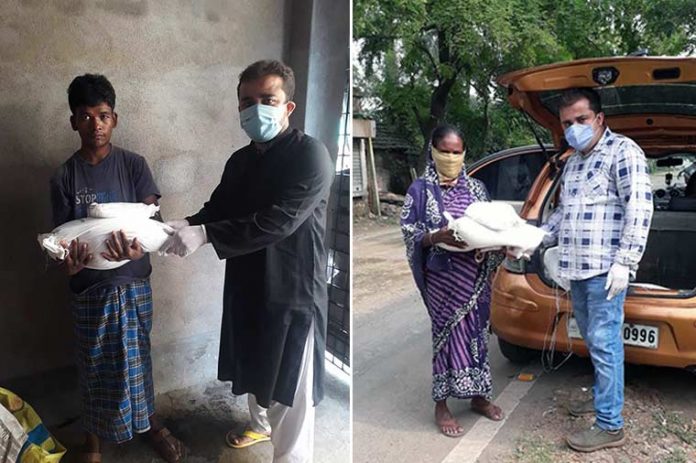
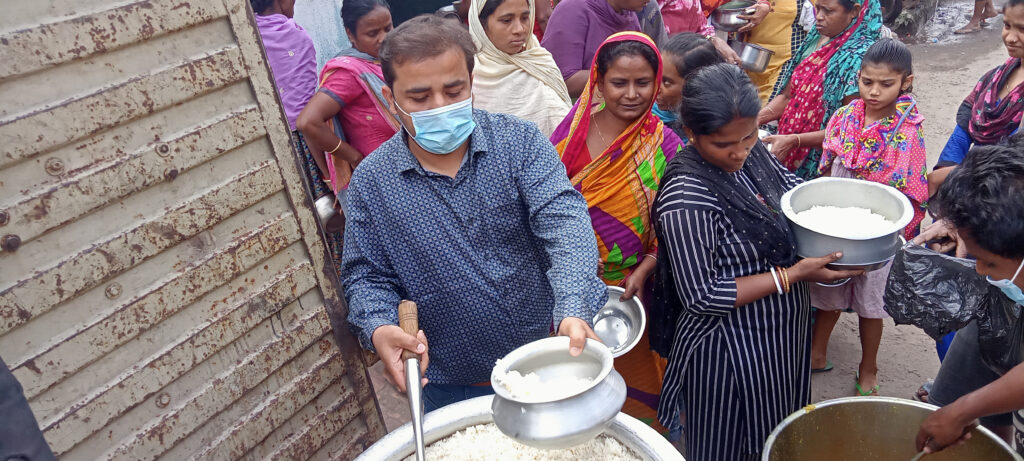
Covid warrior Among the people he has fed are women, children and the elderly. Whether they are beggars, slum dwellers, destitute or prostitutes, all have benefited from his food distribution services. The underprivileged received food standing in a row during the Covid-19 lockdown while the middle-class people felt shy and refused to queue. They suffered the most during the lockdown.
Zeeshan wanted to help them, so he created a ‘Secret Santa’ project for them with a helpline. On his social media platforms, he advertised that those in need of the ration kit could send him a text. Their ration kits would be delivered to their homes without revealing their identities.
Zeeshan Majeed serving food to hungry people.
During the first lockdown, more than 1000 ration kits were distributed in Sonagachi, Kolkata’s sex-workers area. Ten kilograms of rice and five kilograms of pulses were included in the kits. Furthermore, the Anti-Hunger Squad Foundation distributed over 1200 kits each day under the Secret Santa project. Over 5000 people were helped.
This Samaritan from Kolkata has not only distributed food but also masks, medicine and oxygen cylinders at times of crisis. For his noble work, he was featured as a Covid Warrior in IPL 2020. He is included among the Covid Warriors in the Limca Book of Records – 2020-22 as well.
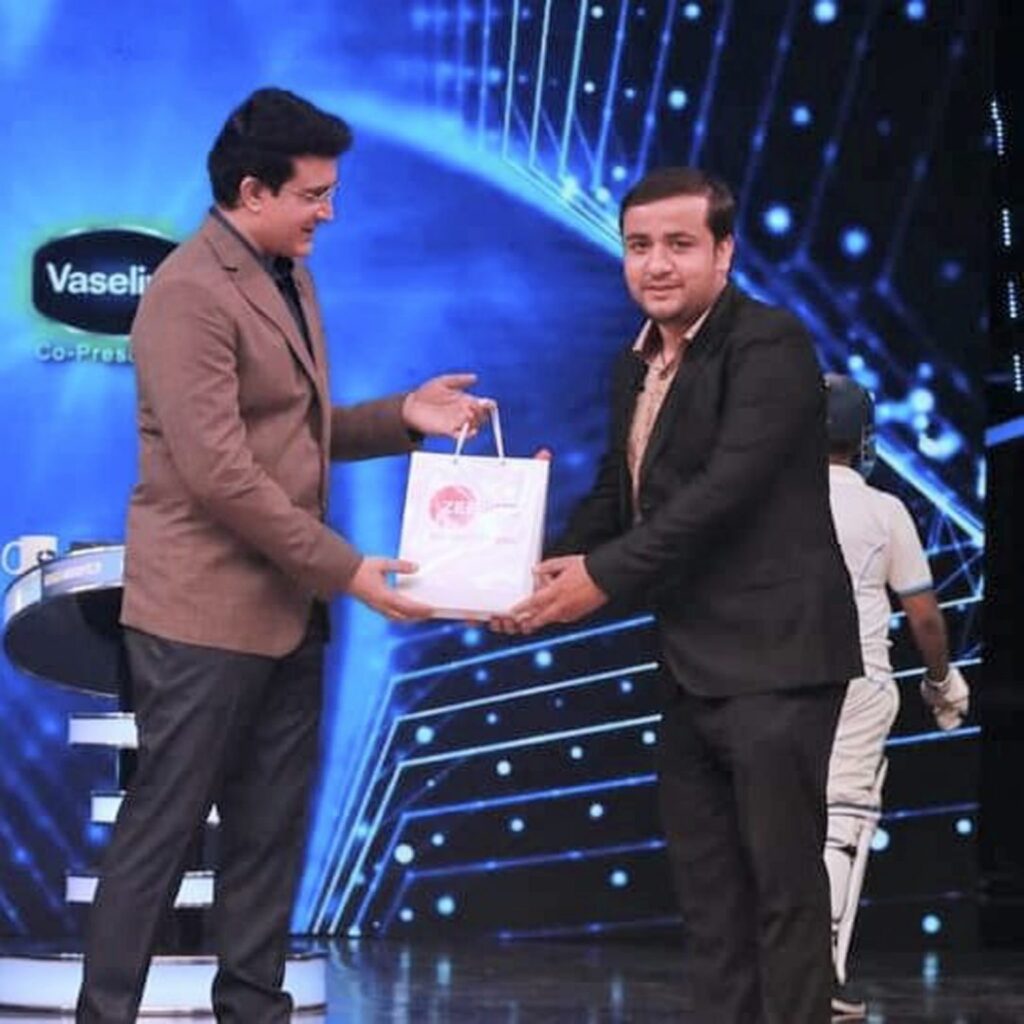
Former Indian Cricket Captain Sourav Gangulay presenting a gift hamper to Zeeshan Majeed.
“I always had two police guards with me during the Janata curfew or lockdown periods,” he said, acknowledging the maximum support he received from the Kolkata Police. “Their presence allowed me to distribute food properly while maintaining social distance with chalk marking, increasing sanitization awareness. Sometimes on the footpaths, beggars or physically challenged people would form a queue while some forlorn person would hand out disposable plates,” recalls Zeeshan, the owner of Golden Plastic, a footwear manufacturing company in Topsia.
His charitable foundation provided relief materials during natural disasters, such as floods or cyclones. He distributed food during the Amphan cyclone in May 2020 at Chandipur, Gosaba, Patharpratima, Basanti in Sundarban, as well as Harapur, Nalmuri, Bantala, Bhojerhat, Ghatakpukur in South 24-Parganas and other locations. When cyclone Yaas hit in May 2021, the food kits were also distributed to people in Mandarmuni, Purshottomnagar in East Midnapore and other Sundarban islands.
Zeeshan was born and brought up in Kolkata. He is the only son of Tarique Majeed and Nazli Tarique, who have four children. He finished his tenth standard in 2005 at Saifee Golden Jubilee English Public School and completed his 12th standard in 2007 from the same school. He graduated with a degree in commerce from Maulana Azad College in 2012, as well as an MBA degree in marketing from Sikkim Manipal University in 2015.
Zeeshan told TwoCircles.net, “Two days in my life are valuable—the day I was born and the day I discovered why I was born. Despite trying many things in life, including a job and a business, I never achieved satisfaction. That changed when I started distributing food.”
A Ballygunge resident, Zeeshan got married in October 2019. He plans to expand his charitable mission to the global level with this tagline – ‘Aao Ek Nayi Soch Banayay Kisi Bhukay Ko Khana Khilayay’ (Let’s think differently and help feed the hungry).
“I wish to serve people of the world. There are many people around the world who rarely get a square meal. If I have an opportunity, I will ensure that no one sleeps hungry,” he added.
Partho Burman is an award-winning independent journalist based in Kolkata. He writes inspirational, motivational and environmental stories. He tweets at @ParthoBurman.
source: http://www.twocirlces.net / TwoCircles.net / Home>Lead Story / by Partho Burman, TwoCircles.net / December 30th, 2021