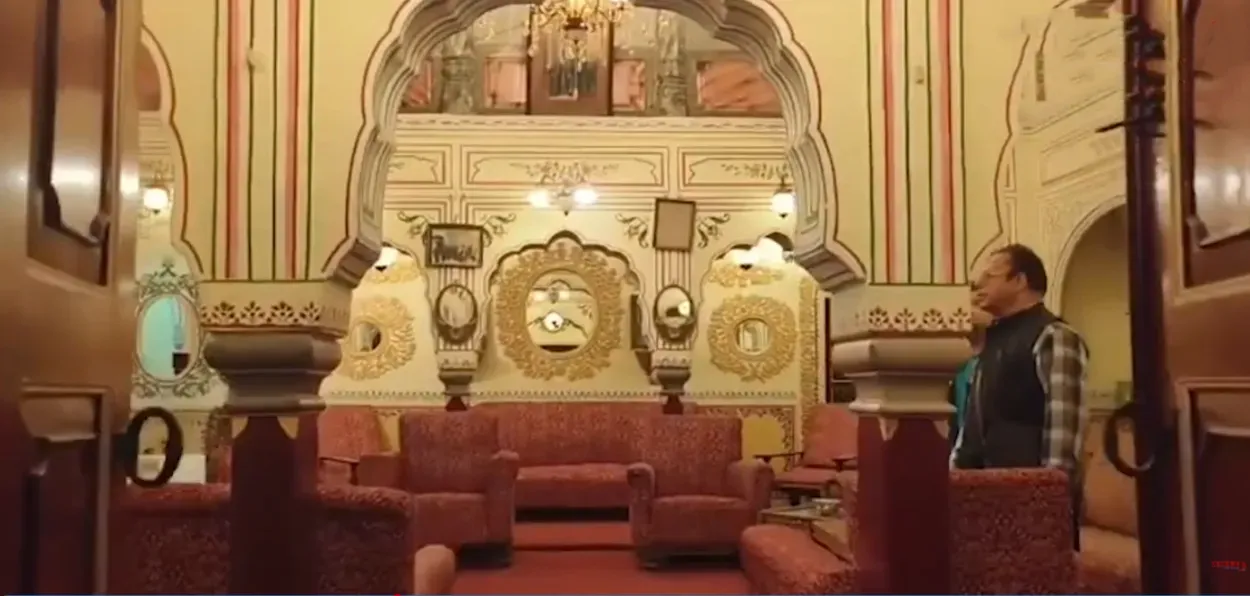
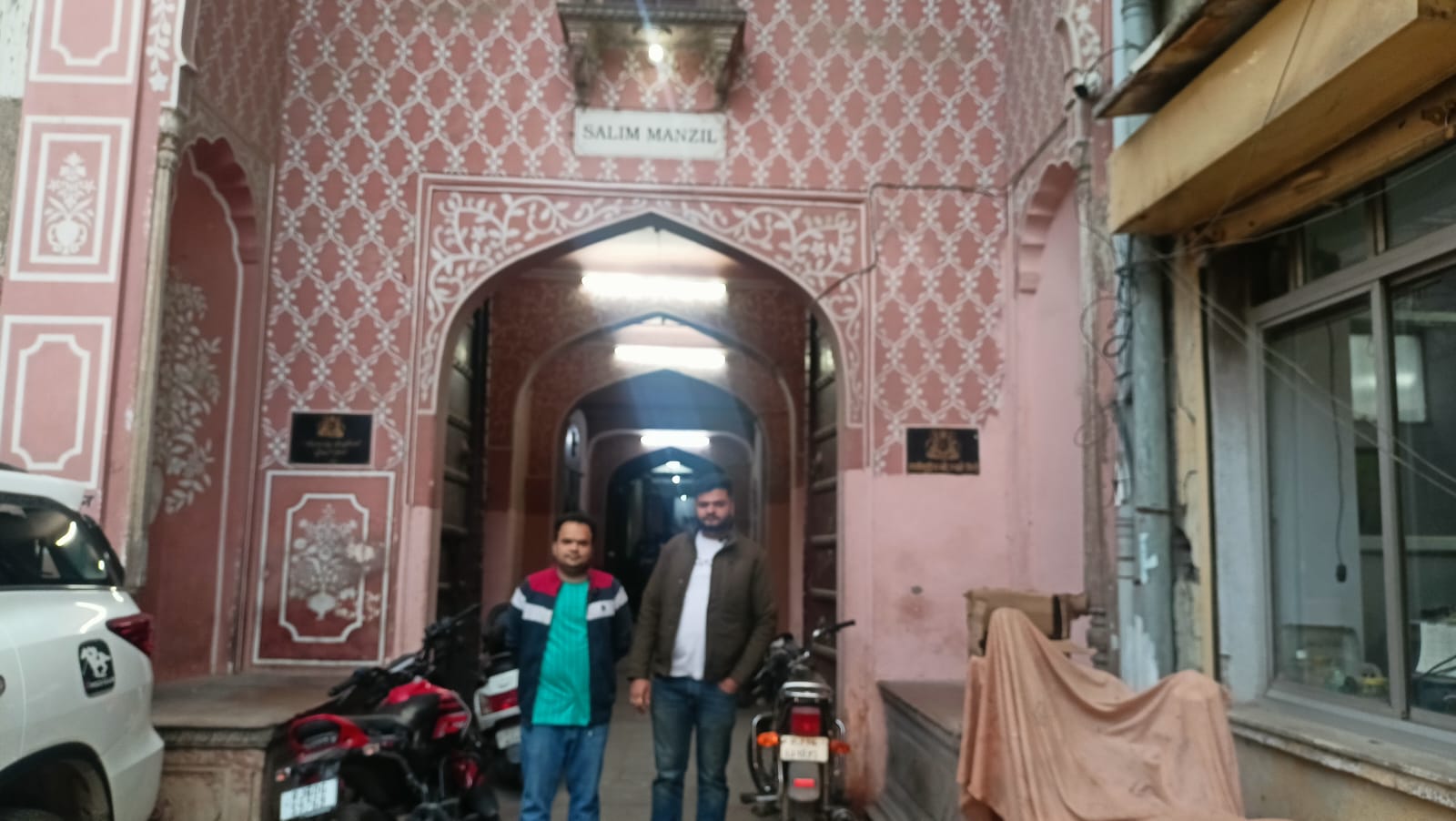
In the bustling streets of Jaipur at Haldio Ka Rasta, Johari Bazar, time suddenly seems to stand still. Amidst ancient stone walls, arched doorways and the stillness of history, stands the Salim Manzil, a majestic building which is a living legacy of more than two centuries.
The mansion houses a relic – a cap of Imam Hussain, the grandson and son-in-law of the Prophet Muhammad; it adds to its importance.
The story behind the ‘blessed cap’ reaching the haveli is interesting and part of its rich history.
The entrance to Salim Manzil
In the early 17th century, an ancestor of today’s inmates of Salim Manzil treated an Iranian king. The King wanted to reward him with gold, silver and valuable gifts, but he declined the offer and instead requested the cap of Hazrat Imam Hussain.
The King presented the relic and a certificate with the royal seal to him as a reward.
Since 1876, this blessed hat has been preserved in Saleem Manzil in a special glass-framed box kept in a hall called “Kala-e-Mubaraq”.
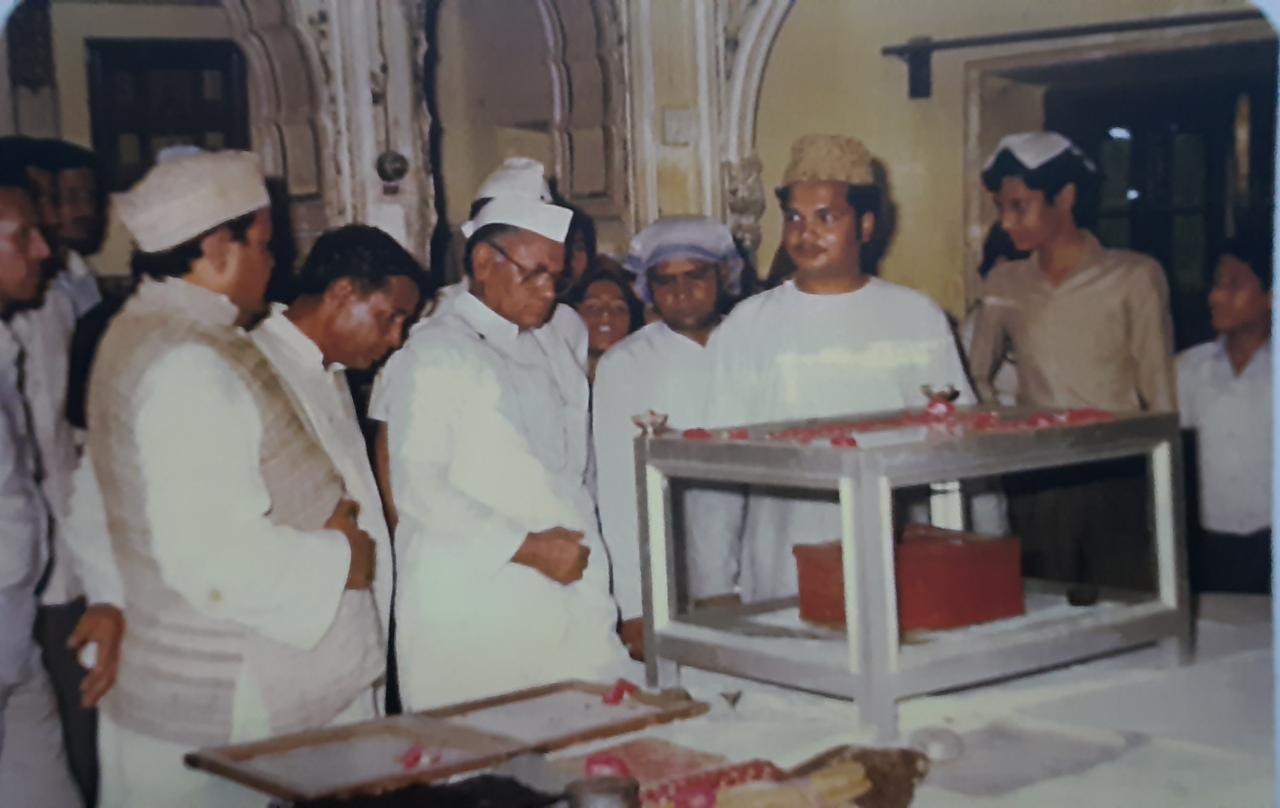
Every year on the 9th and 10th of Muharram, it is opened to the public. In those days, Salim Manzil is turned into a pilgrimage centre, and its air filled with spirituality.
People viewing the Blessed Cap of Hazrat Imam Ali
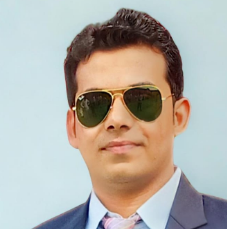
Today, Moinuddin Khan, 33 and his younger brother, Hussamuddin Khan, 27, are living in the mansion. The two brothers are not only maintaining this legacy, but also modernising its upkeep and display of artefacts.
Moinuddin Khan says that his ancestors came to Jaipur from Delhi around 1812 AD. At that time, Maharaja Jagat Singh of Jaipur State granted them a fiefdom and honour to his elder brother, Hakim Wasil Ali Khan.
This honour was for Wasil Ali Khan’s academic and medical expertise, and he was admitted to the Royal Court. One of the ancestors was the head of the intelligence department of Jaipur State, a sensitive position. He was responsible for the State’s security, political activities and gathering information needed for administration.
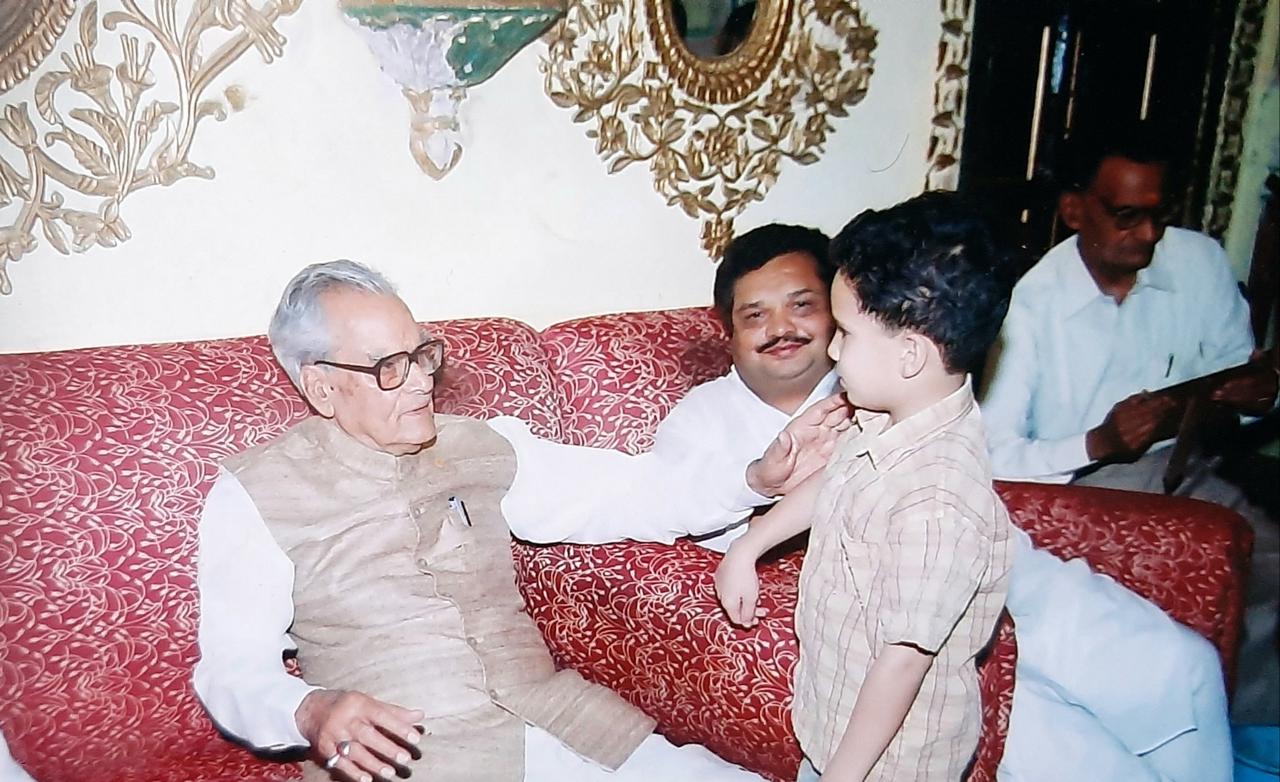
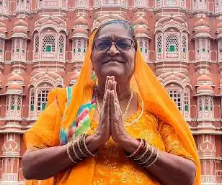
Bharion Singh Shekhawat with the inmates of Salim Manzil
Later, his son, Salim Ali Khan, worked in the same position.
The construction of Saleem Manzil began in 1867, and it was completed within three years. Spread over an area of about a bigha, the building was gifted by the Maharaja of Jaipur. Even today, the haveli’s traditional Rajasthani carvings, arches, high ceilings and lattice windows are a testimony to the architectural craftsmanship of that era.
Over time, many havelis were converted into commercial hotels, but Saleem Manzil retained its original identity. The family also received offers to convert it into a hotel, but they preferred to preserve the spirit of the heritage rather than market it.
Visitors inside the Salim Manzil
The mansion has been used as a set by many filmmakers for movies and web series. Moinuddin says he acted for the role of Sri Krishna in one of the web series. “We have a strong foundation in religion, but we also remain connected with art and dialogue.”
A large hall is decorated, the rooms are filled with the fragrance of perfume and roses, and the pilgrimage begins with Milad Sharif.
Devotees from Gujarat, Maharashtra and other parts of the country also arrive here. In those days, Shia Muslims read prayers and distribute Tabarak.
Moinuddin says that we consider it more of a trust than an inheritance. It is both an honour and a responsibility for us.
Many important persons have visited Salim Manzil. They include President Giani Zail Singh, Chief Ministers Haridev Joshi and Shiv Charan Mathur, Bhairav Singh Shekhawat (Vice President), Natwar Singh (Minister), Najma Haibabullah (Rajya Sabha Chairperson), and Supreme Court Justice Gyan Sudha Mishra.
Head of the family, late Naseemuddin Khan, popularly known as Pyare Mian, founded the All-India Hakeem Ajmal Khan Memorial Society to perpetuate his family’s legacy of Unani medicine and social service.
Today, Moinuddin and Husamuddin Khan are trying to connect this heritage with modern dialogue. They are planning to build a new hall for better management of the pilgrimage during Muharram.
They are sharing information about this heritage with the world through social media and digital means for transparency.
Amid myriad historic monuments of Jaipur, Salim Manzil is unique since it not only preserves the relics of history but is also a pilgrimage centre.
source: http://www.awazthevoice.in / Awaz, The Voice / Home> Stories / by Farhan Israeli, Jaipur / February 21st, 2026
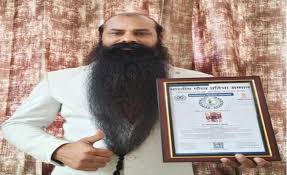
Dr Mohammad Ishaq, a well-known physician from Shahpura in Rajasthan, has been honoured with the Indian Pride Talent Award 2026 for his unique work in beard and moustache art, promotion of local culture, and dedicated social service. The award was presented during a virtual programme organised recently by Jeevan Jagruti Seva Sansthan, Jaipur.
Dr Ishaq, also known as ‘Mr Beard Man’ of Shahpura, is not only recognised for his distinctive designer beard and moustache styles but also for his efforts to take Rajasthani art and culture to national and international platforms. The award, organisers said, was given for his “art, cultural contribution, and service to society”.
The news of the award has created a sense of happiness across Shahpura. Residents, social workers, and youth groups have congratulated Dr Ishaq, calling the honour a matter of pride for the town.
“This award is not just for me, it belongs to Shahpura,” Dr Mohammad Ishaq said. “Whatever I have achieved is because of the love and support of the people.”
Locals say Dr Ishaq’s journey shows how talent rooted in local culture can earn global recognition.
National Fame
Dr Mohammad Ishaq Khan is a medical professional by training, but his identity goes far beyond his clinic. Over the years, his designer beard and moustache styles have become his signature. Through this art form, he has represented Shahpura and Rajasthan across India.
He has won several awards at local, state, and national levels. Recently, he secured first position in a moustache competition held at the internationally known Pushkar Fair, where participants from across the country and abroad took part.
“Pushkar was special,” he said. “Winning there gave me confidence that our traditional styles still have value.”
Dr Ishaq is widely credited as the first person to introduce funky and designer beard styles in India as a separate competitive category.
After his participation, beard and moustache competitions across the country began, including dedicated categories for funky and designer beard styles.
According to organisers of the India Beard Club, this change helped attract new talent and gave a fresh direction to traditional competitions.
“Dr Ishaq changed the way these competitions are seen,” said an organiser associated with the India Beard Club. “He brought creativity and discipline together.”
National Championship
One of the most important achievements in his career came at the India Beard Club National Championship, where around 60 participants from different states competed.
Dr Mohammad Ishaq secured first place in the designer beard category, bringing national attention to Shahpura.
“That moment was unforgettable,” he recalled. “Standing on that stage, I felt I was carrying my city and my culture with me.”
Beyond competitions, Dr Ishaq has worked to promote Rajasthani art, culture, and traditional appearance through his beard and moustache styles.
Last year, he played a small group role in the Bollywood actor Saif Ali Khan’s film Laal Kaptaan. Though brief, the appearance was important for him.
“Cinema reaches people everywhere,” he said. “I wanted our Rajasthani look to be seen by a wider audience.”
Shahpura Beard Club
To support young artists and keep traditional art forms alive, Dr Ishaq established the Shahpura Beard Club last year.
The club aims to guide new artists, organise local events, and provide a platform for those interested in beard and moustache art.
“Many young people have talent but no guidance,” he said. “The club is meant to support them and keep our culture alive.”
Members of the club say Dr Ishaq personally mentors newcomers and encourages discipline and respect for tradition.
Alongside his artistic work, Dr Mohammad Ishaq has also been deeply involved in public life. He has served as a municipal councillor in Shahpura for the last ten years.
During this time, he has taken part in health camps, cleanliness drives, and local welfare programmes.
“Service to society is part of my duty,” he said. “Being a doctor and a councillor gives me a chance to help people in different ways.”
Residents say he is easily approachable and regularly attends to public concerns.
Faith, Culture, and Service
Community leaders say Dr Ishaq’s work challenges stereotypes and presents a positive image of Indian Muslims.
“He represents our culture with dignity,” said a local social worker. “His success shows that Muslims are contributing positively in every field.”
Dr Ishaq himself believes culture and service go hand in hand.
“My beard is not just fashion,” he said. “It reflects identity, tradition, and self-respect.”
The Indian Pride Talent Award is given to individuals who have made meaningful contributions in their respective fields while also serving society.
Organisers said Dr Ishaq was chosen for his rare combination of art, cultural promotion, and social commitment.
“He has turned a traditional art into a modern platform,” said a representative of Jeevan Jagruti Seva Sansthan. “At the same time, he remains connected to social work.”
Celebration Across the City
After the announcement, congratulatory messages poured in from across Rajasthan and beyond. Local traders, youth groups, and cultural organisations welcomed the honour.
“Shahpura feels proud today,” said a shopkeeper. “He has taken our city’s name to places we never imagined.”
Dr Mohammad Ishaq says he wants to continue promoting culture and guiding young talent while staying active in social work.
“Awards give encouragement, but the real work continues,” he said. “I want to do more for society and for our culture.”
His journey, supporters say, proves that dedication, creativity, and service can go together.
As Shahpura celebrates its “Mr Beard Man”, Dr Mohammad Ishaq’s story stands as an example of how local identity, when carried with pride and purpose, can earn national and international respect.
source: http://www.clarionindia.net / Clarion India / Home> Editor’s Pick> India / by Team Clarion / February 11th, 2026
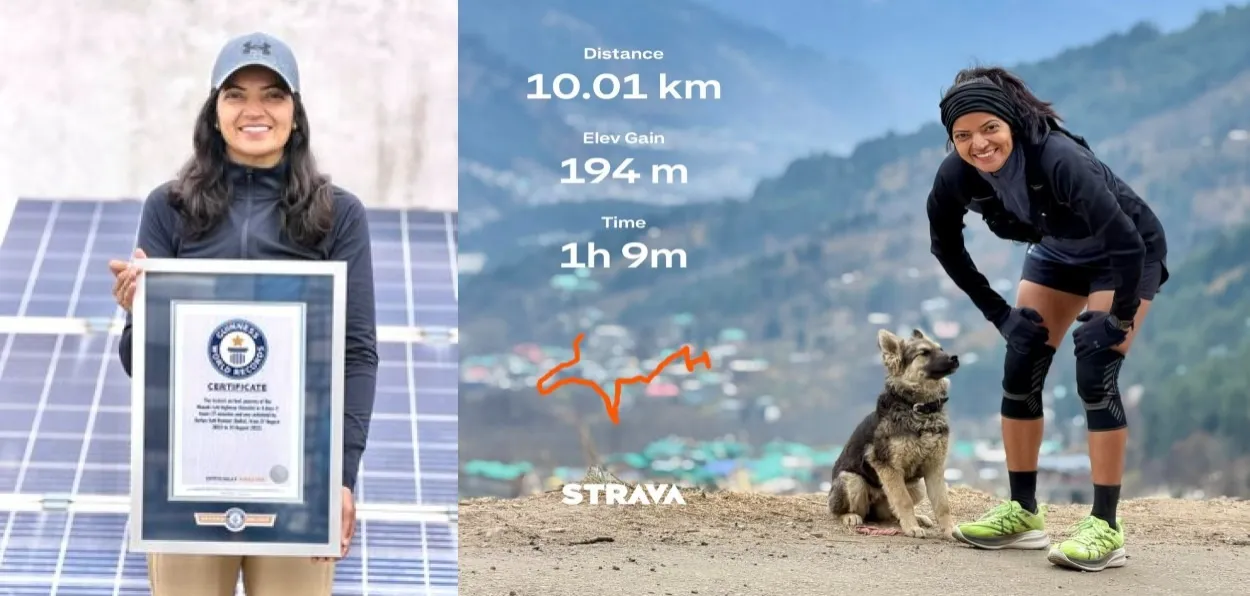
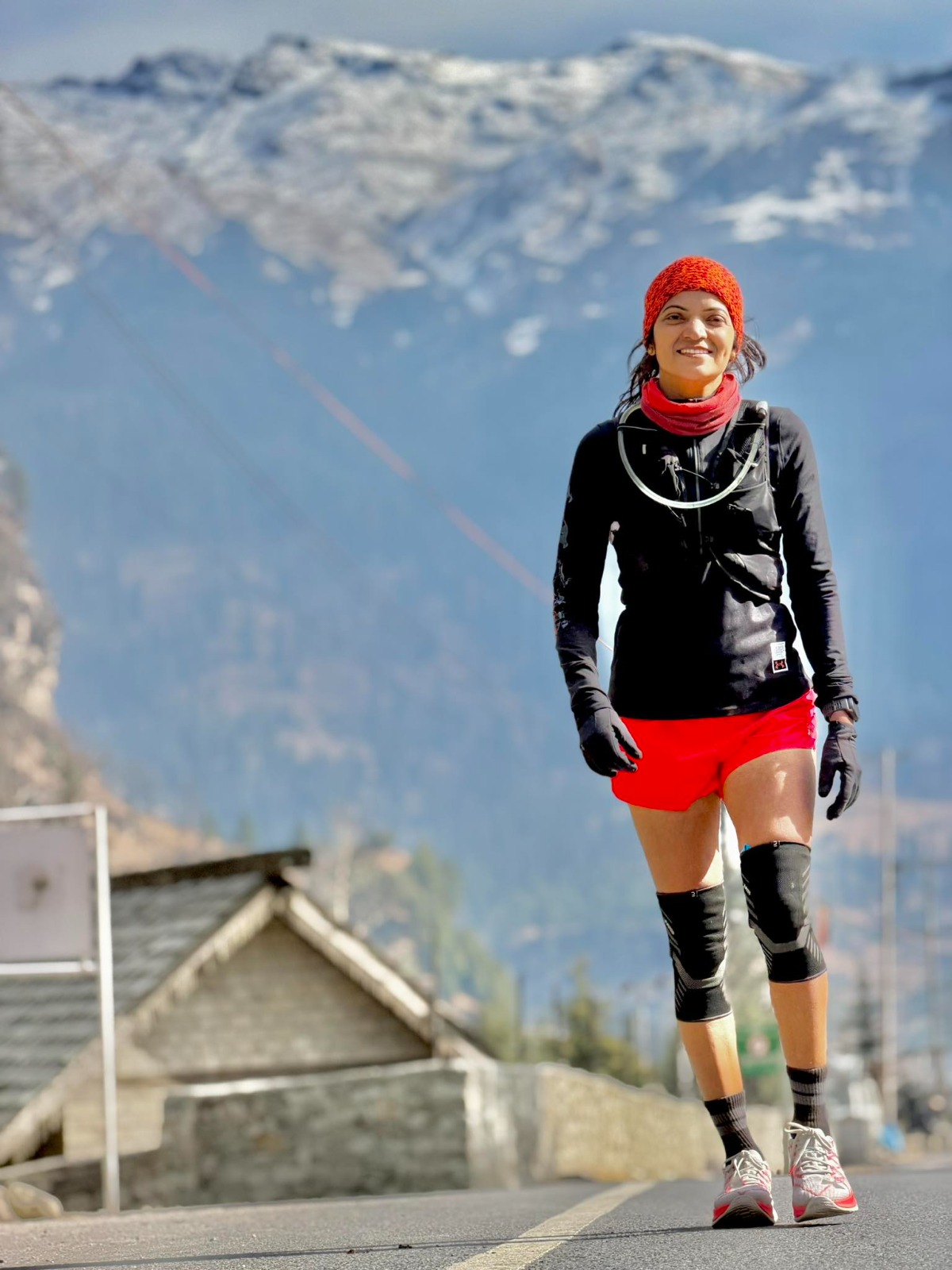
Indian ultra-distance runner Sufiya Sufi, 38, from Ajmer, Rajasthan, has officially received her Guinness World Record certificate for completing the formidable Manali–Leh high-altitude run in 98 hours and 27 minutes, a feat no woman in the world has accomplished before.
The record, formally approved by Guinness World Records in 2023, spans nearly 480 kilometres across some of the most treacherous terrain in the Himalayas. The route crosses five high mountain passes, involves a cumulative elevation gain of over 8,500 metres, and exposes runners to freezing temperatures and dangerously low oxygen levels. The challenge is widely regarded as one of the toughest endurance runs on the planet.
Although the achievement was validated in 2023, the physical certificate reached Sufi only in early 2026, following prolonged delays related to international delivery logistics and customs clearance. Once the certificate arrived, her accomplishment drew renewed admiration from the global running community, sponsors, and the wider public. Supporters celebrated the milestone as another defining moment in an already extraordinary athletic journey.
Sufiya Sufi on Manali-Leh run
Sufiya Sufi’s record-setting run on the Manali–Leh route represents a remarkable benchmark in endurance sports. The challenge begins in Manali, a Himalayan hill town in Himachal Pradesh, and winds its way through rugged, unforgiving landscapes before culminating in Leh, Ladakh. Along the way, runners cross legendary high-altitude passes such as Rohtang Pass and Tanglang La, where temperatures often plunge well below zero and oxygen levels drop dramatically.
At such extreme altitudes, even the most experienced athletes struggle to breathe, recover, and maintain pace. Completing this journey on foot in under 100 hours is considered exceptional. By finishing in 98 hours and 27 minutes, Sufi not only met the challenge but surpassed it, becoming the fastest woman ever* to traverse this Himalayan stretch on foot.
Despite the physical run being completed and officially recognised in 2023, the nearly two-year delay in receiving the certificate became a story in itself. Sufi later spoke about the delay publicly, addressing it with humour and gratitude rather than frustration.
In a post on the social media platform *X*, she described her accomplishment as the fastest-ever run from Manali to Leh across all five high passes. She also expressed heartfelt thanks to her sponsors, support crew, and well-wishers who stood by her throughout months of preparation and recovery. Members of the running community and followers on social media responded with admiration, highlighting the sheer brutality of the terrain and the mental toughness required to succeed.
Day 03 done with 03 KM.
01 to 100 Km Running Challenge.
No Speed, No pace, Just showing up everyday with 01 Km stronger mindset.
Daily effort. Daily discipline. Daily belief. This is how 1% turns into something unimaginable. pic.twitter.com/mYSxRTZJIu
Sufiya Sufi’s journey is as compelling as the record itself. Born in *1987 in Ajmer, she spent nearly 10 years working in the aviation industry. Running initially entered her life as a way to stay fit and break free from the monotony of a demanding job. Over time, what began as a fitness routine evolved into a deep passion for endurance sports, eventually redefining her professional and personal identity.
Her rise as an ultra-runner has been marked by a series of achievements. In 2018, she earned her first Guinness World Record for running the most marathons by a woman in a single calendar year*. This milestone established her as a serious force in long-distance running.
She went on to complete the Kashmir to Kanyakumari run, covering approximately 4,000 kilometres in 87 days, another Guinness-certified feat. Shortly thereafter, she conquered the Golden Quadrilateral, a 6,002-kilometre route linking India’s major highways, in just 110 days, securing yet another world record.
Sufiya Sufi’s journey is as compelling as the record itself. Born in *1987 in Ajmer, she spent nearly 10 years working in the aviation industry. Running initially entered her life as a way to stay fit and break free from the monotony of a demanding job. Over time, what began as a fitness routine evolved into a deep passion for endurance sports, eventually redefining her professional and personal identity.
Her rise as an ultra-runner has been marked by a series of achievements. In 2018, she earned her first Guinness World Record for running the most marathons by a woman in a single calendar year*. This milestone established her as a serious force in long-distance running.
She went on to complete the Kashmir to Kanyakumari run, covering approximately 4,000 kilometres in 87 days, another Guinness-certified feat. Shortly thereafter, she conquered the Golden Quadrilateral, a 6,002-kilometre route linking India’s major highways, in just 110 days, securing yet another world record.
Each of these runs required not only exceptional physical endurance but also rigorous mental conditioning, logistical planning, and resilience. Sufi has often credited her family for their unwavering support, especially her partner, who frequently serves as part of her on-ground support crew.
She has spoken about the challenges of acclimatising to high altitudes, training in extreme conditions, and preparing her body for prolonged exposure to thin air and severe cold.
Sufi’s expanding list of accomplishments has drawn the attention of corporate partners as well. In October 2024, Hindustan Zinc Limited appointed her as a brand ambassador, reflecting growing corporate confidence in her ability to inspire communities and promote fitness as a sustainable lifestyle choice.
Looking beyond national records, Sufi has set her sights on even larger international goals. According to previous interviews and public statements, she plans to undertake a “Run Around the Globe” expedition, covering tens of thousands of kilometres across multiple continents. She envisions the project not merely as an athletic challenge, but as a global mission promoting *Humanity, Oneness, Peace, and Equality, collectively referred to as HOPE.
Sufiya Sufi’s journey stands as a powerful testament to human resilience, courage, and the transformative power of unwavering determination. Her transition from a stable career in aviation to pushing the limits of endurance in the harshest Himalayan conditions reflects a profound belief in personal growth and self-discovery.
In a world often dominated by narratives of division and despair, her story offers a rare and uplifting reminder of what is possible through perseverance, discipline, and purpose. Her achievements celebrate not only athletic excellence, but also the boundless potential of the human spirit.
source: http://www.awazthevoice.in / Awaz, The Voice / Home> Stories / by Aasha Khosa / February 03rd, 2026
Ilin Fatima, a young Muslim from Ajmer, has made history by becoming the city’s first female Chartered Accountant (CA), marking a milestone for her family and the local Muslim community. Her achievement reflects a blend of strong upbringing, determination, and a steadfast commitment to education.
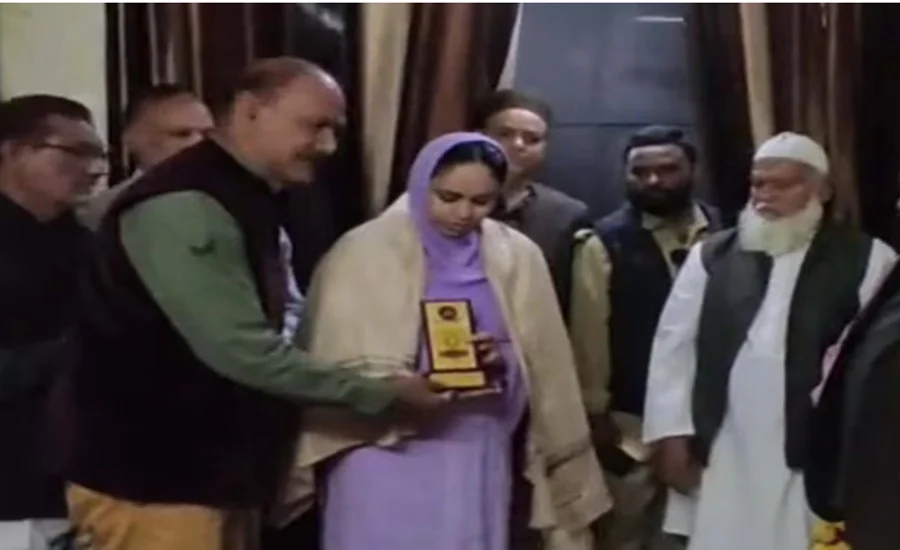
Fatima was welcomed with widespread enthusiasm by the Muslim Welfare and Education Committee of Ajmer in Rajasthan, where she was felicitated for her dedication and resilience. Community members gathered to celebrate, expressing pride not only in her personal success but also in what it signifies for Muslim families across Ajmer and the state.
Her father, Abdul Hameed Khan, spoke about the significance of this accomplishment with deep gratitude to Allah. “I have three daughters, and I ensured they were educated according to Shariah law,” he said. “My daughters have succeeded in both religious and worldly knowledge. I urge every parent to prioritise education for their children. Even if you have to eat half a loaf of bread, make sure your children receive quality education.”
He referred to a Hadith (sayings of Prophet Muhammad) and emphasised the value of knowledge: “Acquire knowledge even if one has to go to China. Education is essential, and people often overlook its importance. My daughter’s success is a reminder of the power and necessity of learning.”
The community’s response has been overwhelming. Leaders and members of various organisations, including Syed Rab Nawaz Jafri, UD Khan, Dr Syed Mansoor Ali, Haji Nafees Ahmed, Advocate Manzoor Ali, Hasan Mohammad, Akram Siddiqui, Farid Hussain, and Aqeel Ahmed of the Ajmer Muslim Welfare and Education Committee have all praised Fatima’s dedication and accomplishment.
A committee spokesperson remarked, “Ilin Fatima’s achievement serves as an inspiration not only to her family but to the entire city. Her commitment to education demonstrates that the progress of daughters is vital for the development of society. When girls are educated, communities prosper, and real success is achieved.”
Ilin Fatima’s historic success is likely to encourage more Muslim families to prioritise education for their daughters, breaking barriers and inspiring future generations. Her journey is a testament to perseverance, faith, and the unwavering support of a family that values both religious and worldly knowledge.
“Her hard work shows that with determination, guidance, and faith, anything is possible,” the committee official added. “She has set an example for all young Muslim girls in Ajmer and beyond.”
As Ilin Fatima steps into her professional career, her story stands as a beacon of hope and a reminder of the transformative power of education within the Muslim community in India.
source: http://www.clarionindia.net / Clarion India / Home> Editor’s Pick> India> Indian Muslim / by Mohammad Bin Ismail / November 10th, 2025
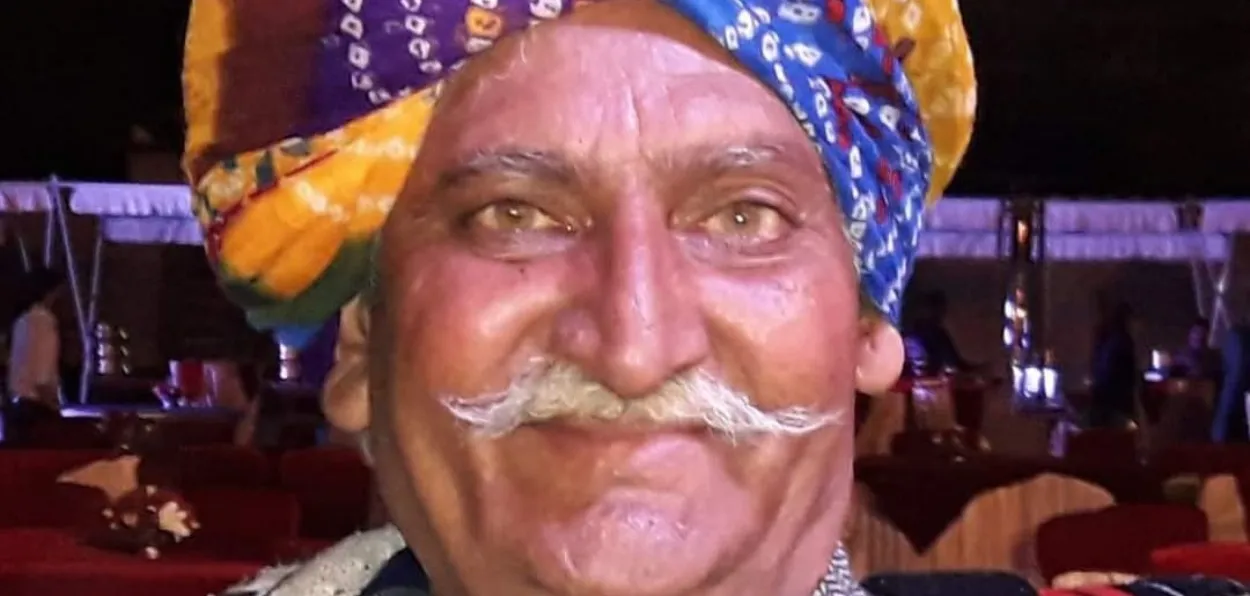
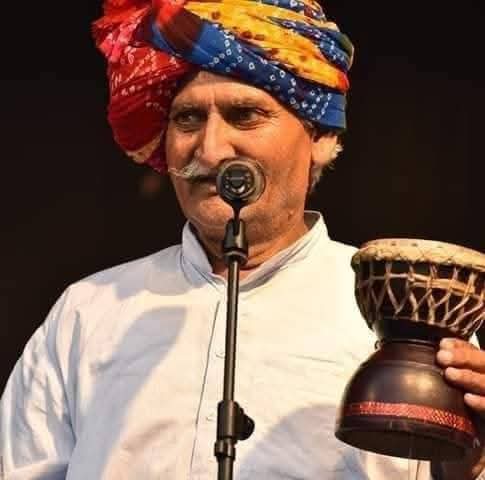
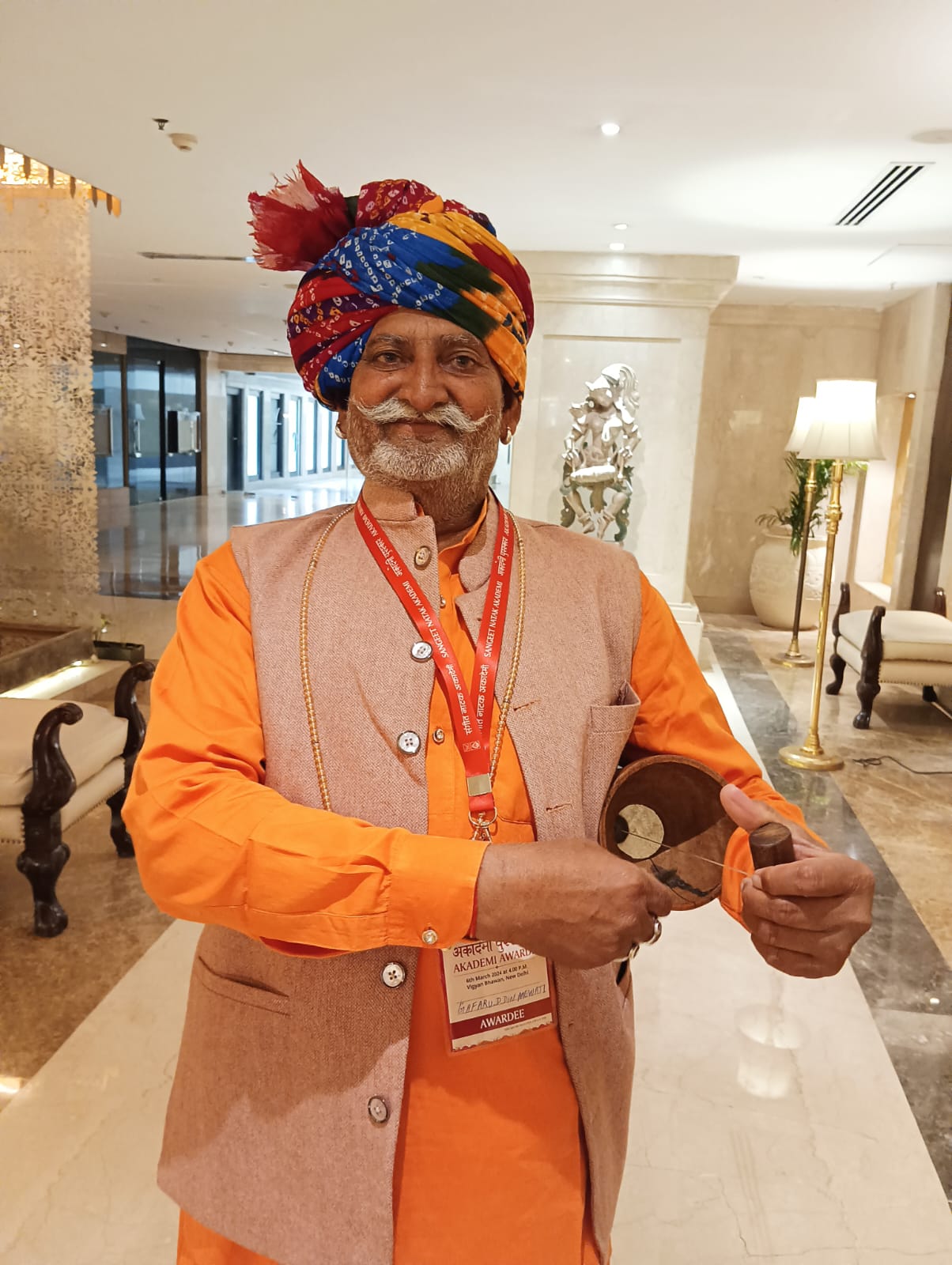
My joy is like that of a labourer who goes to work in the morning and receives his wages the same evening,” said Ghafruddin Jogi Mewati, a traditional singer, who has been selected for this year’s Padam Shri award by the government of India.
Ghaffaruddin, 68, has showcased his art for more than half a century, from the rugged lanes of Mewat to the seven seas. As soon as the announcement of the coveted award poured in, Ghafruddin, a resident of Alwar, was overwhelmed with emotion.
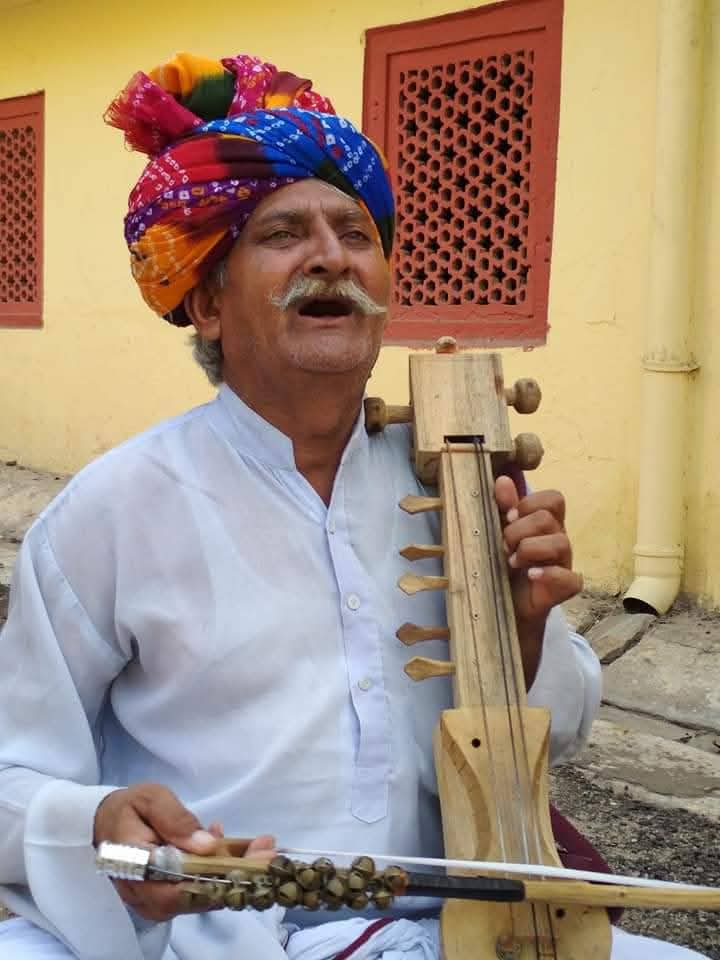
Memories of him wandering barefoot through the villages of Mewat, playing the bhapang (A traditional string instrument) and begging for flour, flashed in his mind. Today, he feels that he has received the wages for all that hard work he did to keep a traditional art form alive.
He feels the Padam Shri is not just an honour for an individual, but for the centuries-old Mewati culture, the legacy of the Jogi community, and the rhythm of the bhapang, which is on the verge of extinction.
The Mewat region, which straddles the borders of Haryana and Rajasthan, possesses a unique identity as a syncretic culture.
Here, the Jogi community, who are Muslims, has, for generations, sung episodes from the Mahabharata and other folk tales.
#WATCH | Folk artist Gafruddin Mewati Jogi, awarded the Padma Shri in the field of art, said the honour marks the culmination of a lifelong struggle.
He recalled learning and preserving the art by travelling with his father, passing it on to others, and continuing the… pic.twitter.com/xiYDWTOqSQ— DD News (@DDNewslive) January 26, 2026
Ghafruddin is one of the strongest exponents of this tradition. He says, “Stay connected to your language, culture, and folk art; that is our true identity.” For him, this honour is a debt he owes to the soil of Mewat, which nurtured him during his days of struggle.
Born in Kaithwara village in the Deeg district of Rajasthan, Ghafruddin’s childhood was no less dramatic than a film script. His father, the late Budh Singh Jogi, was an accomplished artist. At the tender age of four, when children usually play with toys, his father placed a ‘bhapang’ in Ghaffaruddin’s hands.
The Bhapang, which resembles a small drum but has a single string, is considered an evolved form of Lord Shiva’s damru (a small hourglass-shaped drum). Playing it requires an extraordinary coordination of abdominal muscles, fingers, and vocal rhythm.
As a child, he learned by travelling from village to village with his father, sitting in village squares, and listening to folk tales.
They had to beg for grain and flour in villages to support the family. Those were difficult days, but the rhythm of the Bhapang never let him lose hope.
The most significant aspect of Gafruddin Jogi’s art is his rendition of the Mahabharata. Remarkably, a Muslim artist sings the epic of Lord Krishna and the Pandavas with such devotion and purity that the listener is completely captivated. Alwar and the surrounding areas are historically linked to ‘Viratnagar,’ where the Pandavas spent their period of exile.
When Gaffaruddin narrates these folk tales in the Mewati dialect, history comes alive. His art has proven that music and culture know no religious boundaries.
The year1992 marked a major turning point in his life. He travelled abroad and performed for the first time. There has been no looking back since then.
He carried the sound of Bhapang to over 60 countries, including England, Australia, Canada, France, and Dubai. When he played Mewati folk tunes at an event celebrating Queen Elizabeth’s birthday in London, even the foreign audience was captivated by the magical rhythm.
When the call on his mobile came, he initially thought someone was playing a prank on him, but when the news was confirmed, he was emotional. He dedicated the award to the Mewat region and the Jogi community.
#WATCH | Alwar, Rajasthan: On being conferred with the Padma Shri 2026 in the field of art, folk artist Gafruddin Mewati Jogi says, “I am very happy that the struggle of my life has finally yielded results, and I have received this recognition… For seven years, I went from… pic.twitter.com/66UQBRb4W5
Today, the eighth generation of his family is carrying on this art form. His son, Dr Shahrukh Khan Mewati Jogi, has not only learned music but also earned a PhD on the culture of Mewat. While many traditional art forms are fading away, Ghaffaruddin’s family is keeping this flame alive.
Ghafruddin Jogi Mewati wants to open a school for folk arts. He wants the government to provide him with land where he can teach the new generation the art of playing the Bhapang, Mewati folk singing, and their traditional stories.
He says that if the younger generation does not stay connected to its roots, we will lose our identity. He says receiving the Padma Shri is not the destination for him, but the beginning of a journey that he wants to continue until his last breath.
source: http://www.awazthevoice.in / Awaz, The Voice / Home> Stories / by Younus Ali, Alwar / January 28th, 2026
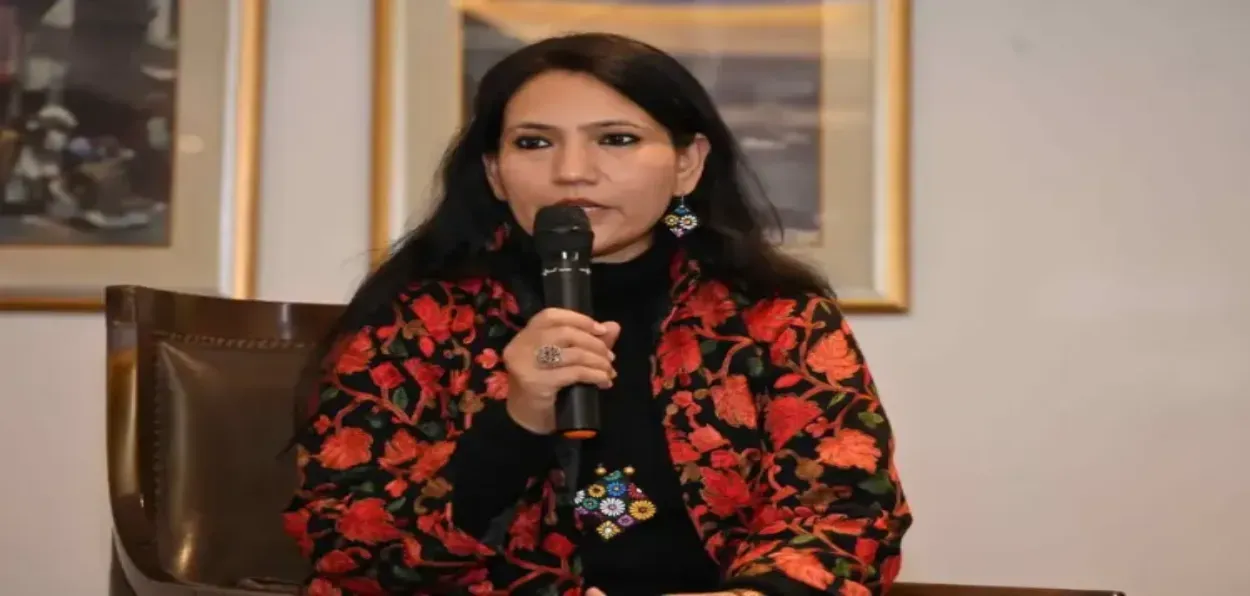
Coming from a small town and making a mark on the national scene, writer-journalist Tasneem Khan brings women’s concerns to the forefront through her journalism and literature. Her narratives are sensitive, clear, and attempt to offer solutions. Her writing and television programmes do more than narrate women’s struggles; they challenge social mindsets and inspire change.
Here are excerpts from an exclusive conversation with her:
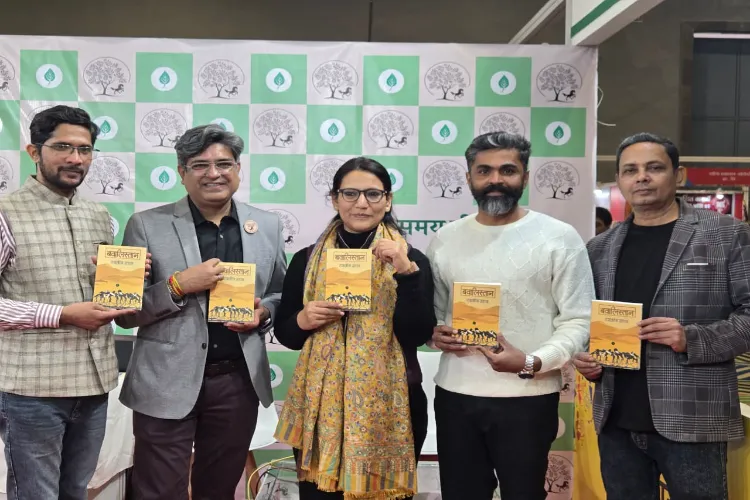
Let’s begin with Bwalistan. What is it about?
Bwalistan is a collection of stories rooted in Rajasthan, particularly its desert life. These stories belong to a distinct literary tradition that deeply portrays the complexities and struggles of life in the Thar Desert. Rajasthan’s desert is not just a physical landscape—it is defined by its people, culture, traditions, and way of life, all of which give it a unique identity.
Coming from a small town, it isn’t easy to make a mark in journalism and literature. How did your journey begin?
A: It’s true that paths have never been easy for women. I come from Didwana tehsil in Rajasthan’s Nagaur district. Though I grew up in a small town, my parents were educated, and our home had a culture of reading and learning. My mother’s love for books shaped me deeply. Growing up among books sharpened my ability to think, debate, and reason. I also won several awards during my school and college years.
When did you choose journalism as a career?
I formally entered journalism in 2005. From the very beginning, I was drawn to women-centric issues. I consistently wrote on gender sensitivity, domestic violence, and women’s social rights. For me, journalism is not just about reporting news; it is about engaging in dialogue with society.
Your television programmes gained special recognition. Could you tell us about them?
A: I hosted a programme called Samar Shesh Hai, which discussed women’s social and political concerns. Later, my regular show on Patrika TV, Aadhi Duniya, Poori Baat – with Tasneem Khan, became quite popular. The aim was to present women not merely as victims, but as thinking, reasoning individuals.
For which report did you recently receive the Ladli Media Award?
I received the award for my show “When Will Domestic Violence Go into Lockdown?”, presented by Population First and UNFPA. The jury felt the report exposed a harsh truththat during lockdown, women faced another terrifying pandemic inside their homes: domestic violence.
Your writing focuses less on complaints and more on solutions. How did this approach develop?
I don’t want to merely describe women’s pain. I believe writing should point toward solutions. If even one woman finds a way forward through my work, I would consider my life meaningful.
You began novel writing in 2015. How special is Mere Rehnuma to you?
A: Mere Rehnuma is extremely close to my heart. Published by the Jnanpith Trust, it was selected in a young writers’ competition. I became the second woman writer from Rajasthan whose debut novel was published by Jnanpith. Through this novel, I tried to establish that women’s empowerment cannot come through financial independence alone without a change in social mindset, empowerment remains incomplete.
Research has been conducted on this novel. How did that feel?
A: It was a matter of great pride that Mere Rehnuma became the subject of PhD and MPhil research. It reaffirmed my belief that my writing has connected at both academic and social levels.
Could you tell us about your other works and awards?
A: My short story collection Dastaan-e-Hazrat Mahal was published in 2019 and earned me the Chandrabai Award. In 2021, I received the Shakuntalam Award from the Rajasthan Progressive Writers’ Association. My stories have been translated into several languages. Rukh-e-Gulzar was translated by the Indian Translation Council, while The Blue of Silence was published in a Pakistani Urdu magazine and won the Mirror Award. My story My Share of Moonlight will soon appear in a collection by Oxford University Press.
What is your writing process like?
I observe people around me very closely their characters, pain, and struggles shake me from within. Until that restlessness finds words, I find no peace. That unrest gives birth to my stories.
What role did your parents play in your life?
My parents have been my greatest support. At difficult turns, they always encouraged me. I firmly believe parents’ education plays a decisive role in shaping a child’s future. I have seen many girls unable to move ahead simply because their parents did not value education.
The heroine of Mere Rehnuma is in search of liberation. How do you view this liberation?
A: For me, liberation is not just personal; it is social. Until society learns to accept strong women, their freedom will remain incomplete. If my writing can guide even one woman in this direction, that will be my greatest achievement.
You recently interacted with readers during the ‘Chaturang #LockdownLive’ session on Facebook. How was that experience?
The Rajasthan Forum organised the session. I spoke openly about my education, career, and literary journey. I emphasised that becoming a writer requires years of preparation, deep reading, and psychological analysis of society. I also read excerpts from my novel Ai Mere Rehnuma. The interaction was deeply personal and immensely inspiring for me.
Tasneem Khan’s journey shows how words, when driven by empathy and purpose, can challenge patriarchy, reshape thought, and quietly spark a revolution, one story at a time.
source: http://www.awazthevoice.in / Awaz, The Voice / Home> Stories / by Onika Maheshwari, New Delhi / January 19th, 2026
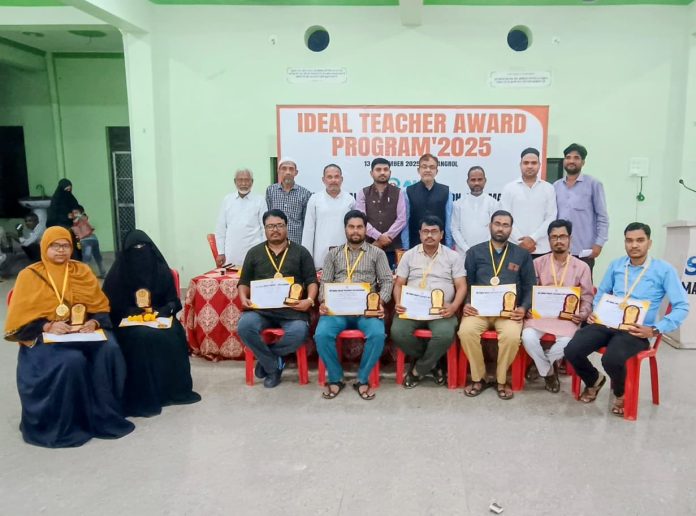
The All India Ideal Teachers Association (AIITA) Unit Mangrol, district Baran, Rajasthan, organized the Ideal Teacher Award 2025 to honor the contributions of educators in the community. The event brought together teachers, dignitaries, and residents to recognize the vital role of teachers in shaping students and society.
Applications were invited from educators across schools and madrasas. A seven-member committee evaluated candidates based on moral character, punctuality, religious integrity, contribution to student development, social engagement, and community impact. After a rigorous selection process, ten educators were chosen for recognition. They were awarded certificates, shields, and medals. The awardees included Rafiq Ahmad, Ejaz Hussain, Mohammad Iqbal, Fakhruddin (Siswali), Tarannum Parveen, Mohammad Saleem (Principal, Madrasa Suiwalan), Mohammad Irfan (Anjuman Madrasa), Meraj Ahmad, Wahid Anwar, and Rizwana Kausar.
A highlight of the ceremony was the Lifetime Achievement Award presented to Tahir Hussain for his decades of service to education. His work was described as leaving a lasting impact on the community and inspiring both teachers and students.
The event was attended by prominent figures including AIITA State President Khalid Akhtar, who spoke on the moral and social responsibilities of teachers, and Media Secretary Dr. Raheem Khan, who encouraged the use of technology in classrooms. State Secretary Yunus Ansari and other guests also expressed appreciation for the teaching community.
The program concluded with words of thanks from Unit Secretary Haider Ali Ansari and Unit President Mohammad Irfan. The ceremony reinforced the value of education and highlighted the role of teachers as community leaders.
source: http://www.radiancenews.com / Radiance News / Home> Latest News> Report / by Radiance News Bureau / September 17th, 2025
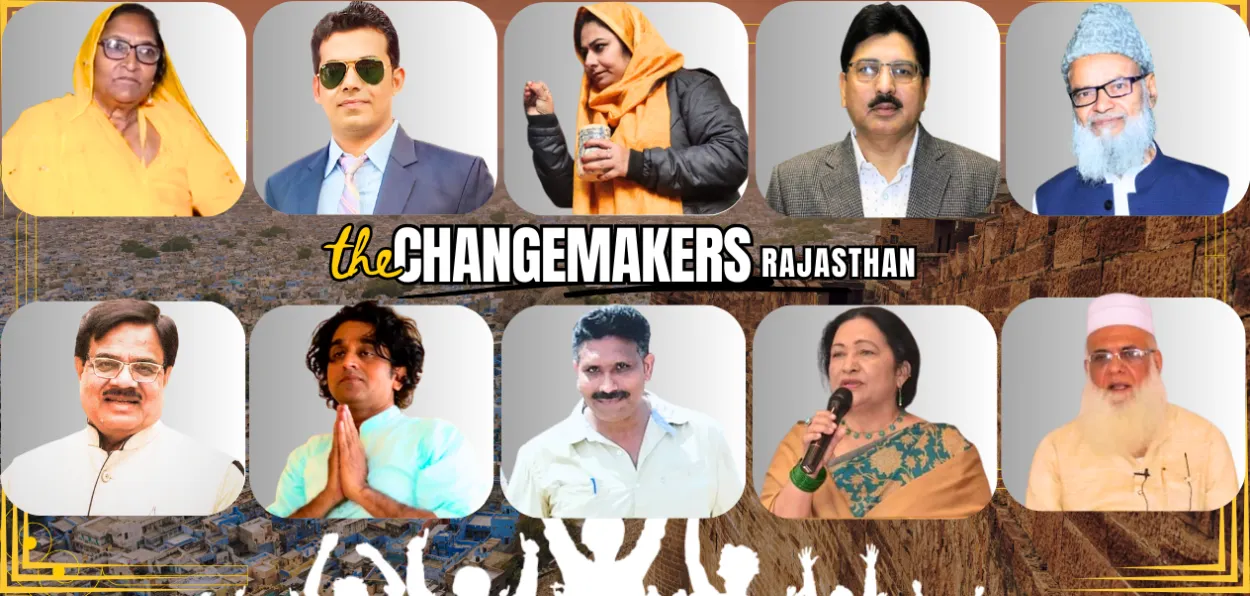
Rajasthan is known for its sandy deserts, historical monuments, especially forts, vibrant culture, and above all, its brave people, some of whom are inspiring others and changing society for the better. Under our series ‘The Changemakers’, Awaz-The Voice, brings you ten such personalities of Rajasthan, who have done extraordinary and pioneering work. Batool Begum: A living legacy of musical heritage.
Batool Begum: Woman who took traditional music to the world
One name that resonates in the streets of Jaipur is that of Batool Begum. Born in Kerap village of Nagaur district, Rajasthan, this extraordinary singer is a living legacy of Indian classical music. Batool developed a deep passion for music in her childhood. Despite facing social and economic challenges, she continued her singing.
Her melodious voice and her passion for music not only earned her recognition as an artist but also proved that talent can break all barriers. Her art is a source of inspiration for her community and the entire Rajasthan.
Abdul Salam Johar: A lac bangle maker who received global recognition
The vibrant spirit of India’s Pink City, Jaipur, doesn’t only emanate from its colours and people but also from the traditional handicrafts that are made and sold here. Bangles worth lakhs are made in these streets, which are a symbol of the traditional beauty and hard work of thousands of its people.
Abdul Salam Johar is one such artist who not only preserved the traditional art of the State but also brought about a social change in a major way. Coming from the Manihar community, Johar was born in a family with little means, but his dreams were extraordinary. Seeing the struggles of his grandfather Hafiz Mohammad Ismail and parents Haji Abdul Aziz and Hajjan Qamar Jahan, he made hard work, dedication, and social service the main mantra of his life.
He began his journey from his ancestral shop ‘Indian Kangan and Colour Store’ located in Tripolia Bazaar of Jaipur, and today his wares are being sold under brands ‘Johar Design’, ‘Johar King’ and ‘Indian Crafts’ in the global markets. He is not only a successful entrepreneur, but also a social reformer who took his community and traditional art to new heights.
Abdul Latif ‘Arco’: A confluence of business and social service
Abdul Latif, who lives in Chini ki Burj in the capital Jaipur, and is known as ‘Arko’ in Rajasthan, is one such special personality. Born in a small village of Chomu in 1946, Abdul Latif’s father, Rahmatullah, and mother, Hafijan, taught him hard work, honesty, and the passion to help people, which became the basis of his life.
His company, Abdul Razzaq & Company (ARCO), is today a big name for social service along with electric motors, fans, and coolers. Apart from this, his hotel, ARCO Palace, is a symbol of his hard work and foresight. Abdul Latif’s story is not just of a businessman, but of a person who chose to work as a changemaker by combining his business and social responsibilities.
Qazi Nishat Hussain: A new voice breaking stereotypes
The voice rising from a small office located in the narrow streets of Johri Bazaar in Jaipur, the capital of Rajasthan, is today inspiring society to change. This voice is of Nishat Hussain, Rajasthan’s first Muslim female Qazi, social worker, and a strong advocate of the rights of Muslim women.
Her life journey is an example of courage, struggle, and change, which not only made thousands of women aware but also gave them a new direction to live.
Born in Sitabari Mohalla of Karauli district, Nishat’s childhood was spent in an environment of communal harmony. His family was the only Muslim family in the neighbourhood. There were three temples in front of her house. She says, “We did not know who was a Hindu and who was a Muslim.” In a backward area like Karauli, where girls’ education was not given importance, Nishat created history. She became the first Muslim girl in the district to pass the tenth standard, that too as the only Muslim student among 1200 girls. Today, she has become a torchbearer of the rights of Muslim women.
Captain Mirza Mohtasim Baig and Ruby Khan: An Inspiring couple in social service
An inspirational couple, Captain Mirza Mohtasim Baig and his wife Ruby Khan, hail from Jaipur. Captain Mirza is the first Muslim pilot of Rajasthan and has been operating national and international flights for the last 25 years. At the same time, his wife Ruby is an active social worker and politician.
Both believe that if one wants to bring change in society, then he has to take the initiative. Together, they had organised medical camps, documentation camps, free ration distribution, and offered financial help to families in the marriage of their daughters. The couple is an epitome of change brought about by spirited people.
Dr. Arif Khan: The village scientist who created history
Thirty-four years ago, a child was born in the small village of Masani in the Hanumangarh district of Rajasthan. Today, he is Dr. Arif Khan, a scientist who has brought laurels to India. In his village, most of the people toiled in the fields. His father, Advocate Farid Khan, wanted his son to become a doctor. His mother and grandfather also had the same dream. But there were few schools in Masani, and the path to making dreams come true was difficult. Still, Arif had a passion to do something extraordinary in his life.
With his hard work and dedication, he became a bio-scientist and brought glory to his family and village. His research on milk and food products brought a wave of change. His story proves that if the intentions are strong, then even a boy from a small village can become a scientist and make the country feel proud.
Mainuna Nargis: First Shia Muslim woman in art conservation
In a vast country like India, art conservation is important since it not only preserves history but also connects future generations to our heritage. Mainuna Nargis, the country’s first and so far the only Shia Muslim woman art conservator, does the same work. Born in Bahjoi, a small town in Moradabad district of Uttar Pradesh, Maimuna’s childhood was ordinary, but her dreams were extraordinary. Rajasthan has now become Mainuna’s second home.
Her father, a Policeman in UP, always encouraged her. After studying Fine Arts from Aligarh Muslim University (AMU), she did a diploma in Museology, which became the most decisive turning point in her life. Maimuna’s story is not just of professional success, but a story of passion, struggle, and self-confidence, which revived the broken pieces of history.
Yoga Guru Naeem Khan: Global journey from music to yoga
The life journey of Yoga Guru Naeem Khan, who rose from the streets of Jodhpur, the cultural capital of Rajasthan, to spread his spiritual aura on international platforms, is a unique example. He rose from a common man to a global yoga guru and presented yoga as a universal energy beyond religion, culture, and boundaries.
Naeem Khan was born in a family where music was in every breath. His grandfather, Ustad Umardin Khan, was the court musician of the Jodhpur royal family, while his maternal uncle was Padma Bhushan-awarded Sarod player Ustad Sultan Khan. However, with changing times, that traditional flame of music started to fade. Naeem and his brother got involved in business, but yoga gave Naeem a new direction, and he took it to a global platform.
Syed Anwar Shah: A man who introduced girls to education
Thirty years ago, a dream was born in a small room in Jaipur, which has today become the light of education for thousands of girls. This is the story of Syed Anwar Shah, whom people fondly call Master Anwar Shah. He not only dreamt of his daughter’s education, but also made it a means of progress for the daughters of society.
Today his educational institution, Al-Jamia-tul Alia, is spreading the message of knowledge and Islamic ethics not only in Jaipur, but also in the whole of India and abroad. After completing his M.A. in Public Administration from Rajasthan University in 1980, he dedicated his entire life to the welfare of society and the service of education. In 1995, when his daughter Alia was born, he decided to set up an institution for the education of girls, which would impart both worldly and divine teachings.
Today, his effort has become a boon for thousands of families.
Padma Shri Shakir Ali: Patron of Miniature Painting
It’s no exaggeration to say that Jaipur is the art capital of Rajasthan. And in the field of miniature painting, the name of Syed Shakir Ali comes to the fore spontaneously. This genre of painting is an identity of the state of Rajasthan.
Padma Shri awardee Syed Shakir Ali is not only a great practitioner of this art, but he is also the guardian of that heritage, which is an integral part of the cultural identity of Rajasthan. Born in 1956 in Jalesar village of Uttar Pradesh, Shakir Ali’s family soon settled in Jaipur, where his art got a new direction.
Today, he has given recognition to this traditional art of Rajasthan not only in India but also on international platforms.
source: http://www.awazthevoice.in / Awaz, The Voice / Home> The Changemakers / by Aasha Khosa, ATV / September 14th, 2025
At 59, a motor mechanic in Rajasthan dedicates his life to helping 19,000 poor families, distributing free ration kits and gifts to Hindus and Muslims alike, proving that service knows no religion.
New Delhi / Dungarpur :
In the heart of Dungarpur city in Rajasthan, a remarkable story of selfless service and unity is quietly unfolding. Haji Noor Mohammad Makrani, a car mechanic by trade, has become an inspiring figure of humanity and brotherhood, breaking barriers of religion and caste with his unwavering dedication to the poor and needy.
For many years, Noor Mohammad has devoted himself to social service through the public welfare group “MMB Group,” inspired by the spirit of the Mastan Shah Baba Dargah, where he is actively involved. His mission has touched the lives of over 19,000 families, distributing free ration kits and providing essential support during every festival, including Holi, Diwali, Eid, Bakrid, and Ramadan.
“Service is the biggest religion,” says Noor Mohammad, whose commitment has not waned even at the age of 59. His efforts go beyond just ration distribution; he has donated blood 40 times and regularly distributes clothes, food, and daily necessities to the destitute across Dungarpur. He also cares for animals and birds, ensuring they have food and water.
“Noor Mohammad does not see anyone’s caste or religion. His heart is open to all,” shares Asrar Ahmed, former minister of state, praising the man whose actions unite communities. Non-Muslim residents of Dungarpur also express deep respect and support for him, showing that goodwill crosses all divides.
“As long as I live, I will continue this service,” Noor Mohammad states firmly, embodying the true spirit of brotherhood in a time when such examples are rare.
At the Mastan Shah Baba Dargah, Noor Mohammad regularly collaborates with government officials, social workers, and local leaders to organise public welfare programmes. His work stands as a shining example in an age where division often dominates headlines.
This story of Noor Mohammad Makrani is a reminder that humanity and kindness can prevail over differences. His life’s work inspires many to see beyond religion and caste and to embrace the shared responsibility to care for the less fortunate.
“Noor Mohammad’s service has helped our family during hard times. His help is given without any conditions,” says Rahim Khan, a beneficiary.
“In these times, it’s rare to find someone who works for all communities alike. He truly represents brotherhood,” remarks Suman Patel, a local Hindu resident.
Noor Mohammad’s journey shows that compassion and dedication can build bridges where others see only walls.
source: http://www.clarionindia.net / Clarion India / Home> India> Indian Muslims / by Mohammad Bin Ismail / July 15th, 2025
Maulana Azad University’s extensive survey of basic education and students’ enrolment in 30 villages of Jodhpur district as part of the Annual Status of Education Report (ASER)-2024 has found a notable increase in private school enrolment, and a sharp decline of children at age 3 who do not attend pre-school or early childhood education programmes.
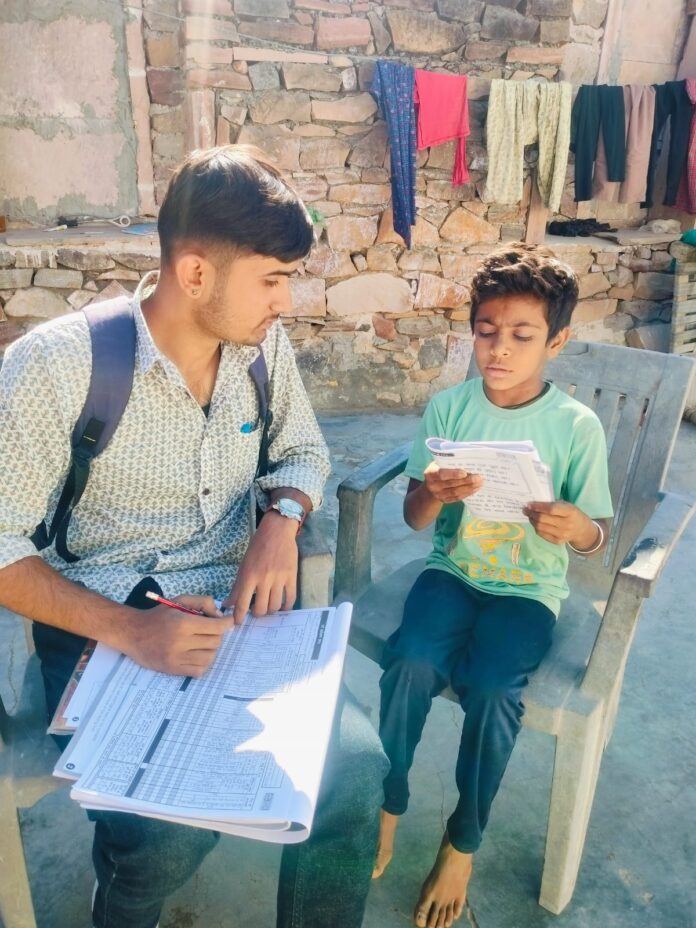
However, the survey has found a continued challenge with learning outcomes, particularly in basic reading and arithmetic, meaning that while more children are going to school, many of them are still not learning at the expected level for their age and grade. The survey shows that children in primary classes often cannot solve basic arithmetic problems such as simple addition, subtraction, multiplication, or division.
Maulana Azad University, Jodhpur, is the first and the largest Muslim-run private higher educational institution in Rajasthan.
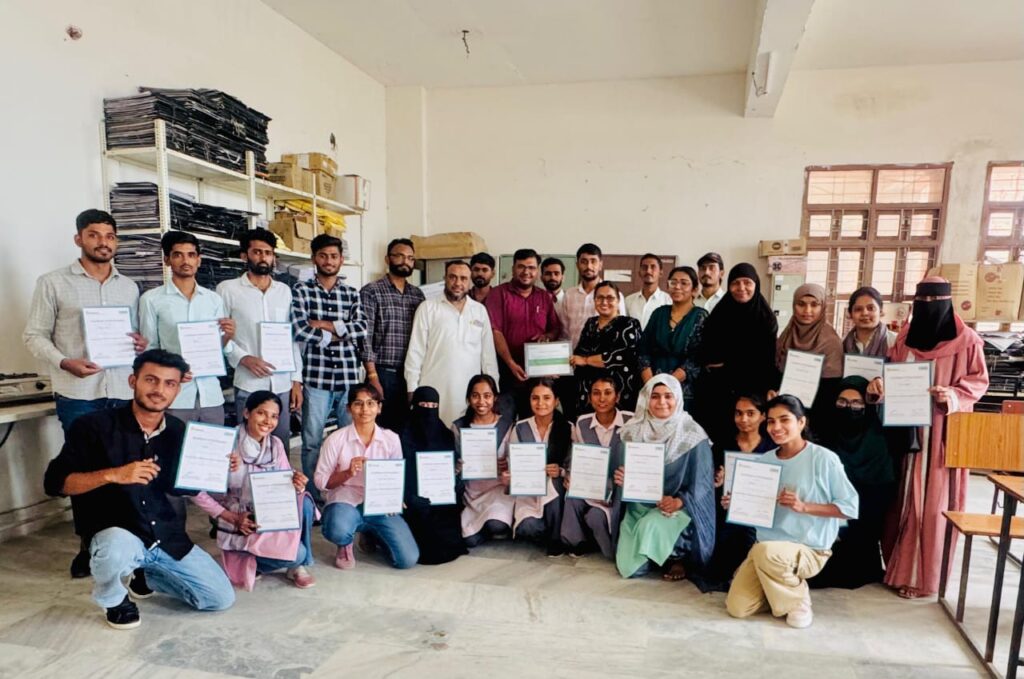
The survey was conducted by a total of 60 students of the university. The survey report was released by a non-governmental organisation, Pratham. The students who took part were drawn from the sixth semester and were felicitated at a function in the university here in the first week of July.
The Jodhpur-based university has already set up a Minorities Research Chair for conducting targeted studies and research on the issues, problems and challenges confronting the minority communities in Rajasthan, as part of its initiatives to generate new avenues. The research chair will make important recommendations after its studies.
Maulana Azad University was established by the Marwar Muslim Educational & Welfare Society (MMEWS) at Bujhawar village on the outskirts of Jodhpur in 2013. The institution of higher education is now imparting education to more than 15,000 students belonging to Muslim and other less privileged communities in multiple disciplines of study.
ASER Team Convener Raju Ram Bishnoi said the main points of conclusion of ASER-2024 were an increase in student and teacher attendance, use of smartphones among the youth, focus on pre-school enrolment, learning level challenges and gender gaps in enrolments for the subjects of science, technology, engineering and mathematics.
Bishnoi said the ASER-2024 survey in Jodhpur district assessed enrolment and basic reading and arithmetic abilities of children aged 3 to 16 years in the rural areas. The digital access and skills of children aged 14-16 years were also tested time, with smartphone-based tasks. At the national level, the survey was conducted in 17,997 villages in 605 districts and a total of 6.49 lakh children were reached.
The proportion of older children, in the age group of 15 to 16 years, not enrolled in school has been steadily declining in recent years. About 7% boys and girls of this age group are not enrolled in schools at present. Nationally, more than 90% of rural adolescents have access to a smartphone. About 70% of adolescents in this age group can perform basic digital tasks such as setting alarms, searching for information on the Internet, finding specific online content and sharing with others.
Dean of the university’s Education Department, Dr. Samina, said the ASER survey was switched in 2016 to an alternate year model, as part of which a “basic survey” is conducted every two years in the rural areas of all districts, with smaller surveys focusing on other age groups and regions in the intervening years.
The villages covered in the extensive survey were situated in Bawari, Bhopalgarh, Bilara, Mandor, Luni, Osian, Bap, Phalodi, Balesar and Shergarh blocks of Jodhpur district.
Misbah Noor, a III year student of B.Sc., B.Ed. (combined) at Maulana Azad University, told India Tomorrow that she spent two days at Uchiyarda village in Mandor block to study the educational scenario. Misbah was given a certificate of participation for the survey report submitted by her.
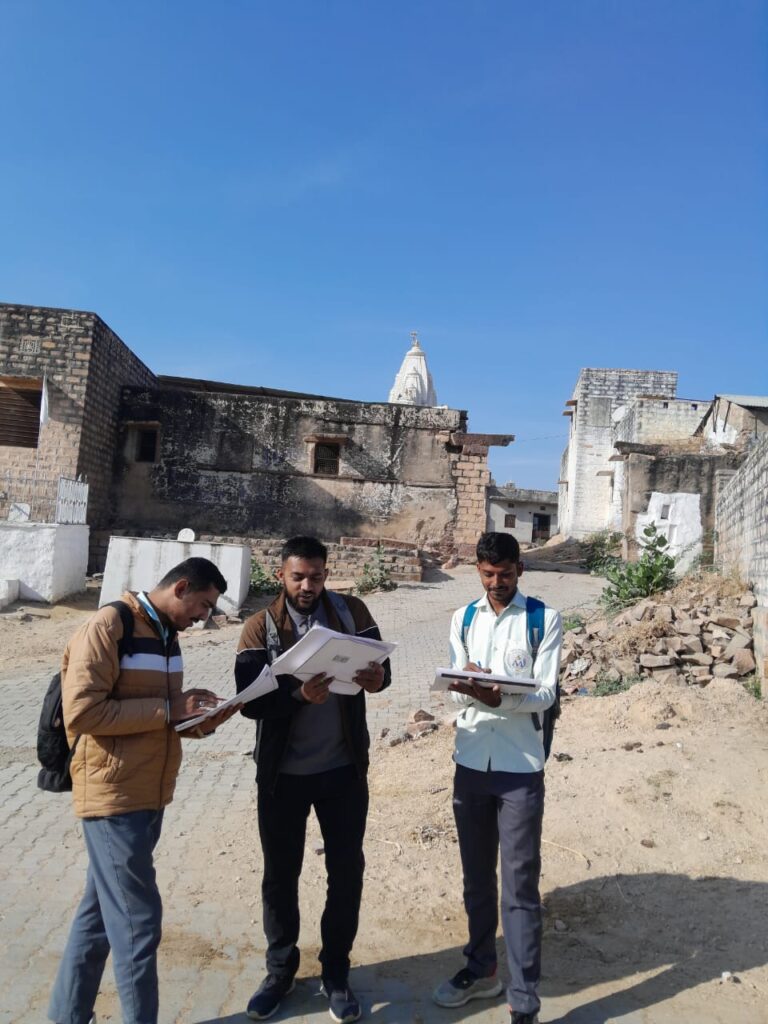
Another student, Afzal Khan, said he went to Bilara block’s Pichiyak village for the survey, in which he recorded the efficiency levels of young children after interacting with them. Afzal is studying for B.Ed. (Urdu) in the university. The surveyors selected 20 houses in each village and tested the basic reading and arithmetic abilities of children aged between 5 and 16 years, besides testing digital literacy skills of adolescents between 14 and 16 years.
Mauala Azad University’s Chairperson and noted educationist Mohammed Atique said the university was willing to work with the government agencies and non-government organisations for works at the grassroots level for the benefit of future generations. Atique said all kinds of support, including financial, would be extended for such works.
University’s officiating Registrar Mohammed Amin, who has earlier worked with several international NGOs, said the ASER surveys had helped out the government, which had incorporated their recommendations in its educational programmes. “I have had the experience of working with ASER since 2010. Our university has made a significant contribution to the exercise with the active participation of students,” he said.
The MMEWS, established in 1929 during the pre-Independence era, runs as many as 330 educational, health and social institutions. Atique, 77, has been instrumental in easing the lives of more than 45,000 youths through these institutions working in varied fields of education, health care, community development, rural development, waste-to-wealth initiatives and skill development programmes during the last four decades.
The then ruler of Jodhpur princely state, Maharaja Umaid Singh, was the patron of MMEWS and had gifted a school named ‘Durbar Muslim School’ to the Society in 1936. The Rajasthan government allotted five acres of land to the MMEWS in 1978, on which the Maulana Abul Kalam Azad Muslim Senior Secondary School was constructed.
Since then, the MMEWS has established several institutions, including the Industrial Training Institute, Nursing College, Pharmacy College, B.Ed. College, Mai Khadija Hospital, Rahmatul-Lil-Alameen Blood Bank, Marwar Adarsh Gaushala and Bujhawar Veterinary Hospital. The MMEWS established the university in 2013 with the intention of providing higher education to the most deprived and marginalised sections of society.
The first president (Vice-Chancellor) of Maulana Azad University was the noted Islamic scholar from New Delhi, Akhtarul Wasey. The current president, Jameel Kazmi, hailing from Jaipur, has taken steps for interdisciplinary studies while maintaining the indigenous ethos and the spirit of plurality in the university’s functioning.
About 50,000 students have so far passed out from the MMEWS group of institutions and become doctors, engineers and business people and entered other professions as well. Some of them have also established nursing homes and clinics in remote rural areas, which are often ignored in the government’s development plans. Maulana Azad University has set the motto, “Gain Knowledge and Serve Mankind”, for itself.
source: http://www.indiatomorrow.net / India Tomorrow.net / Home> Education / by India Tomorrow Correspondent / July 13th, 2025