Renowned Scholar and Former Jamia Dean Recognized for Five Decades of Academic and Social Contributions
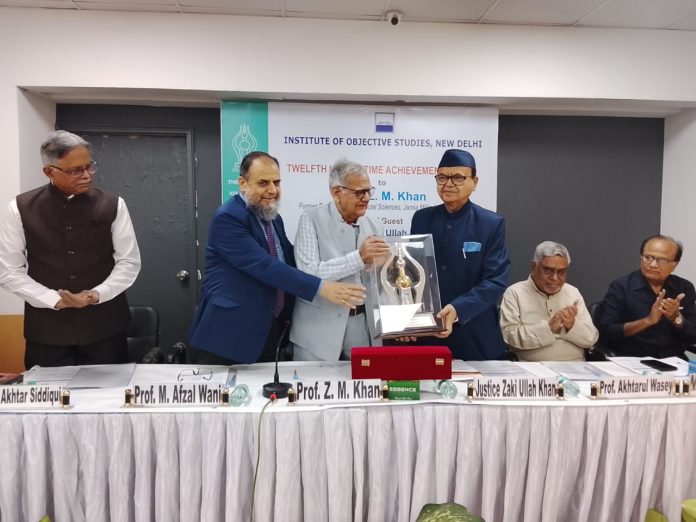
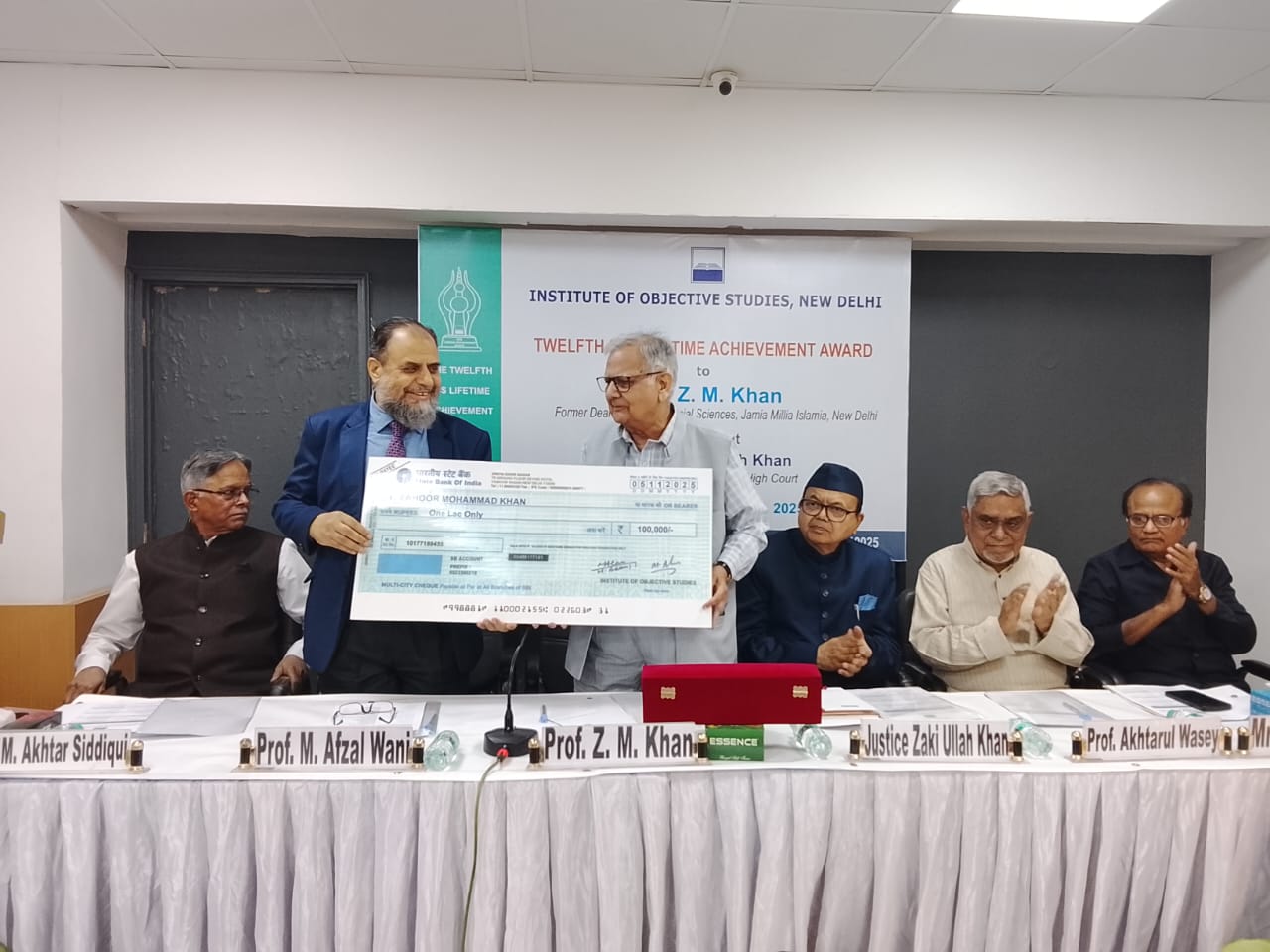
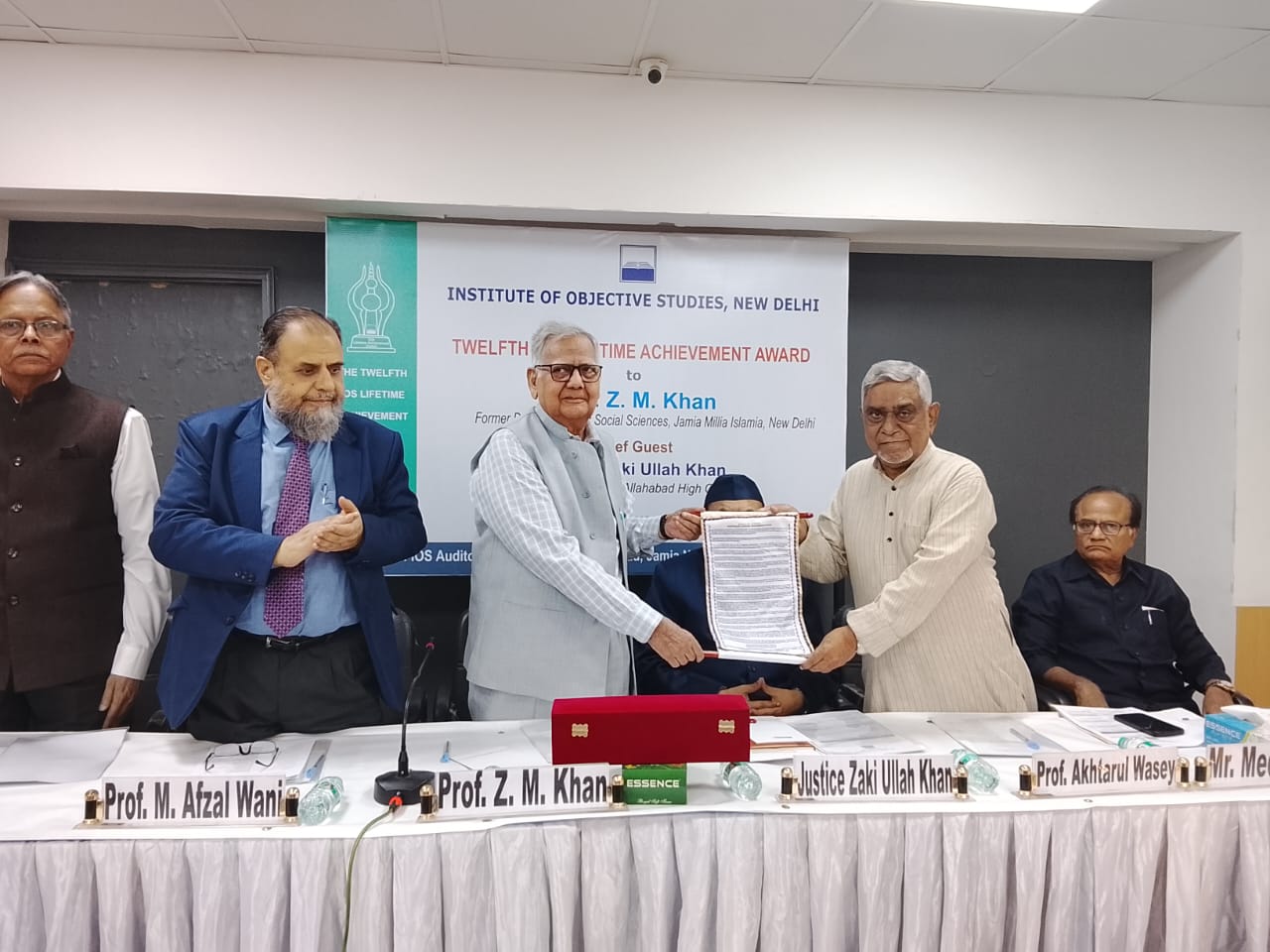
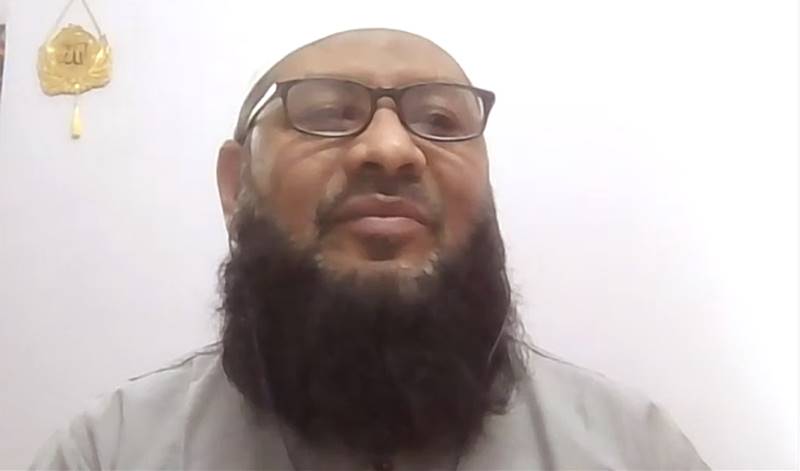
In a grand ceremony held in the capital, the Institute of Objective Studies (IOS) conferred the prestigious IOS Lifetime Achievement Award upon Professor Zahoor Mohammad Khan (Z.M. Khan)— an eminent scholar, researcher, author, and former Dean of Social Sciences at Jamia Millia Islamia.
Prof. Khan, who also served as the former Secretary General of IOS, was presented with a citation, memento, and a cash prize of ₹1 lakh in recognition of his outstanding services to education, research, and social development.
Prof. Khan’s illustrious career spans over five decades, marked by his multifaceted roles as an academician, researcher, author, and institution builder. He has authored eight books and dozens of research papers, contributing significantly to the study of political science and sociology in India. During his 23-year tenure as Secretary General of IOS, the institution evolved from a modest initiative into a nationally respected think tank. He also played a pivotal role in launching the IOS Scholarship Programme, which has supported numerous students and researchers over the years.
The IOS Lifetime Achievement Award, instituted in 2007, aims to recognize individuals, organizations, or voluntary groups who have rendered exceptional service to the nation and society, irrespective of religion, caste, or creed.
Previous recipients of this distinguished award include former Chief Justice of India A.M. Ahmadi, Dr. A.R. Kidwai, Prof. B. Sheikh Ali, A.G. Noorani,, Prof. Akhtarul Wasey, Prof. Mohsin Usmani Nadwi Maulana Hakim Abdulllah Mughaisi, and K. Rahman Khan, among others. Prof. Khan’s inclusion in this eminent list was greeted with enthusiastic applause from the audience.
Expressing his gratitude upon receiving the honour, Prof. Z.M. Khan said, Faith in God and the spirit of service are the most precious blessings one can receive. Faith brings with it a sense of responsibility and accountability to the Creator — that is the greatest reward of life. He also acknowledged the crucial role of institutions such as Delhi University, Jawaharlal Nehru University, Jamia Millia Islamia, and the Institute of Objective Studiesin shaping his academic journey.
The ceremony was chaired by Prof. M. Afzal Wani, Chairman of IOS, and graced by Justice Zakiullah Khan (former Judge, Allahabad High Court) as the chief guest.
Distinguished guests included Prof. Akhtarul Wasey (Jamia Millia Islamia & former Vice Chancellor, Maulana Azad University, Jodhpur), Prof. M. Akhtar Siddiqui, Mr. M. Afzal (former MP), and Prof. Furqan Ahmad.
The event began with a recitation from the Holy Quran by Dr. Nighat Husain Nadwi, a welcome address by IOS Secretary General Mohammad Alam, and was conducted by Prof. Hasina Hashia Vice Chairperson of IOS, who also delivered the vote of thanks.
The event not only celebrated Prof. Khan’s extraordinary contributions but also reaffirmed IOS’s commitment to honouring individuals who have significantly influenced India’s intellectual and moral landscape.
source: http://www.radiancenews.com / Radiance News / Home> Latest News> Report / by Radiance News Bureau / November 07th, 2025
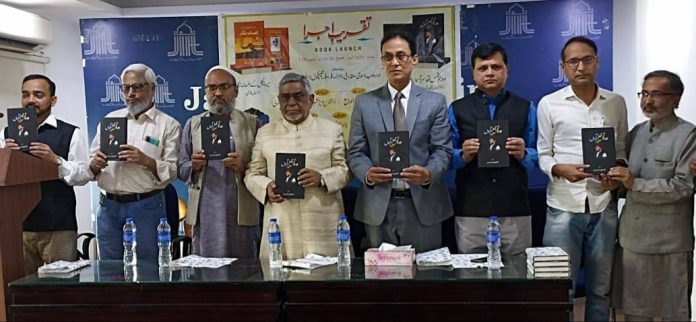
A sense of ‘Think global, act local’ prevailed at the launch of two significant books “Who jo Shams tha Sar-e-Aasmaan” and “Seemanchal ke Afsana Nigar.” The launch was jointly organized by Forum for Intellectual Discourse and Idara Adab-e-Islami, Delhi on Sunday, 7 November, 2021 at the headquarters of Jamaat-e-Islami Hind.
The book “Who Jo Shams tha Sar e Assmaan” was compiled by Dr Noman Qaisar and Mohd Islam Khan and has 41 Urdu articles and six poems on the life and services of journalist Dr Abdul Qadir Shams who died during Covid-19 on 25 August, 2020. It also has four write-ups in English.
Another book “Seemanchal ke Afsana Nigar” is an effort to document the life and works of dozens of fiction writers of Seemanchal.
Presiding over the programme renowned Islamic scholar and former President of Maulana Azad University, Jodhpur, Prof Akhtarul Wasey said that the work done by Abdul Qadir Shams was ‘unusual’. “Shams used to sleep in Delhi but dreamed of Seemanchal.” The void left with his demise would always be felt in my life, said Wasey, who is also the Professor Emeritus of Islamic Studies at Jamia Millia Islamia. Seemanchal ke Afsana Nigar will be an indispensable work in the history of short-story writing. Prof Wasey also congratulated the Forum for Intellectual Discourse stating that the need for such an organization like the Forum could never be felt more strongly than the present times. He wished the Forum success.
Special guest, editor general at NCERT, Dr Perwaiz Shaharyar expressed happiness over organizing a meeting for a journalist in which a large number of people from media were present whose responsibility had grown manifold as the nation was confronted with difficult situations. He called the book a ‘valuable addition to literature’. Prof Abu Bakar Abbad had his reservations for confining any segment of Urdu literature to a specific region as Urdu was a global language. The protagonists, however, had their own arguments for identifying geographical regions, as was also the case with Seemanchal, a region long ignored by most literary aficionado.
Abdul Mannan, editor of monthly Yojana reasoned that the creative facets of Seemanchal remained shrouded because their writers usually shied away from the limelight. In that context, he considered Ehsan Quasmi’s work exceptional.
Chief guest, senior journalist Siraj Naqvi, who had worked with Abdul Qadir Shams for over a decade said that Shams new the art of maintaining relationships. Despite all the difficulties, the smile on his face would dispel worries. Author, critic and famous litterateur Haqqani Al-Qasmi paid a glowing literary tribute to his childhood friend Abdul Qadir Shams which moved the audience. He said Woh jo Shams tha… is not merely a collection of articles but teardrops flowing directly from the hearts.
Dr Waris Mazhari, Assistant Professor, Jamia Hamdard; Dr Khalid Mubashshir, Assistant Professor, Jamia Millia Islamia; Dr Ahmad Ali Jauher, Assistant Professor, Indira Gandhi National Open University; Dr Jasim Uddin Qasmi of Delhi University, Jamshed Adil Alig and Dr Zain Shamsi also shared their views. Uzma Shaheen, daughter of late Abdul Qadir Shams paid a rich tribute to her father.
Manzar Imam of Forum for Intellectual Discourse moderated the three-hour long programme which had begun with Qur’anic recitation of Abdur Rahman, followed by welcome remarks of Dr Mohammad Ajmal, Assistant Professor, Centre for Arabic and African Studies, Jawaharlal Nehru University. It ended with a vote of thanks by journalist Abid Anwar.
source: http://www.muslimmirror.com / Muslim Mirror / Home> Books / by Manzar Imam / November 10th, 2021
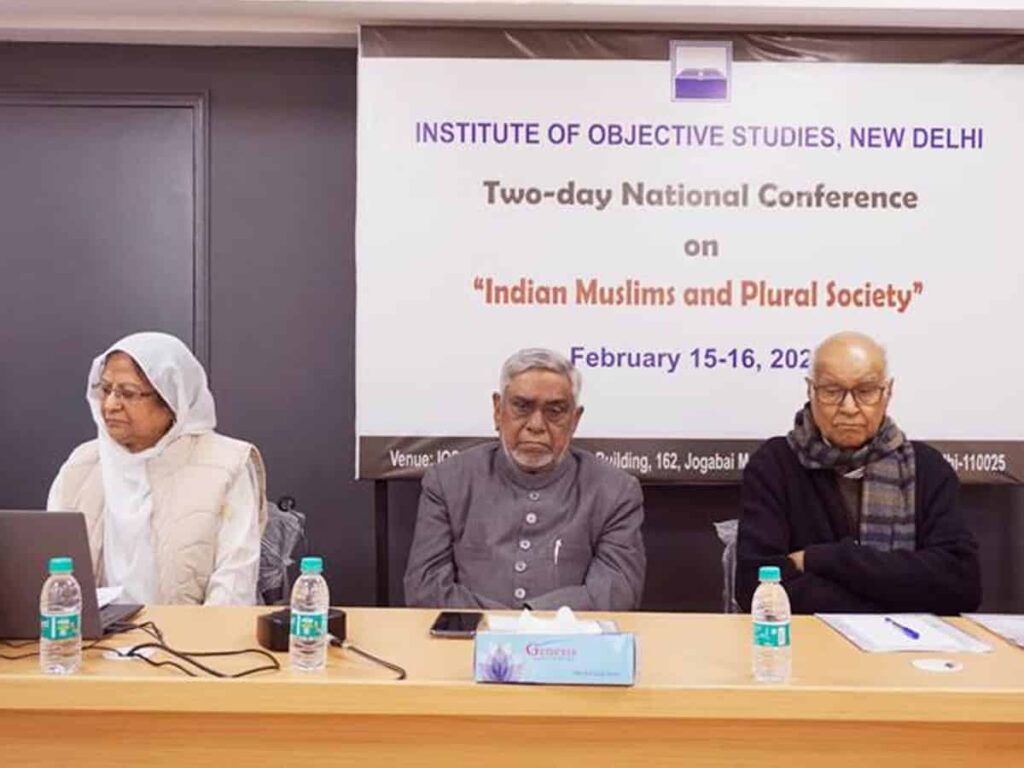
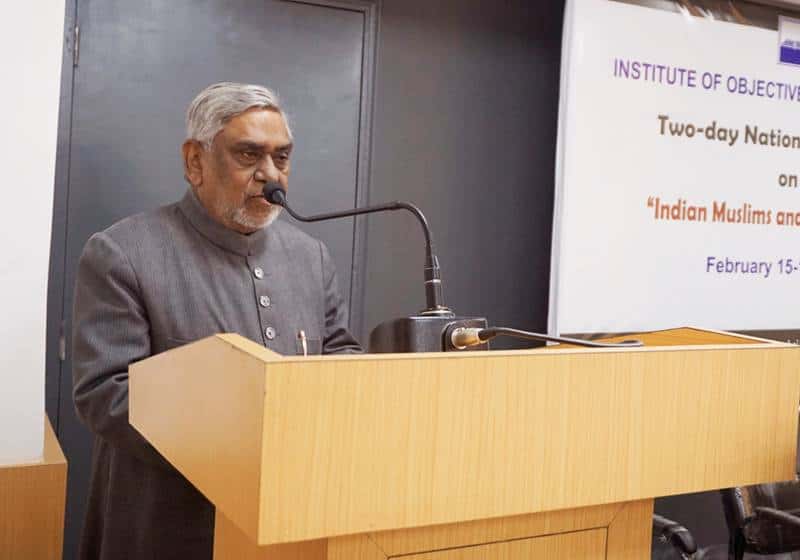
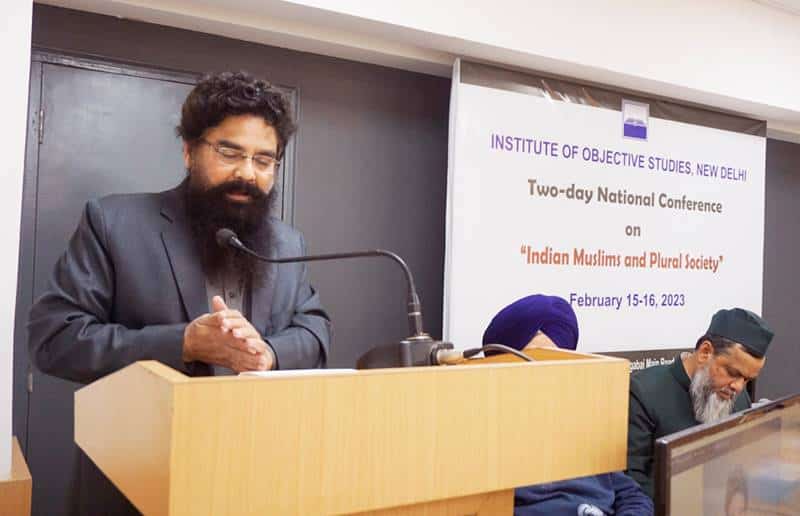
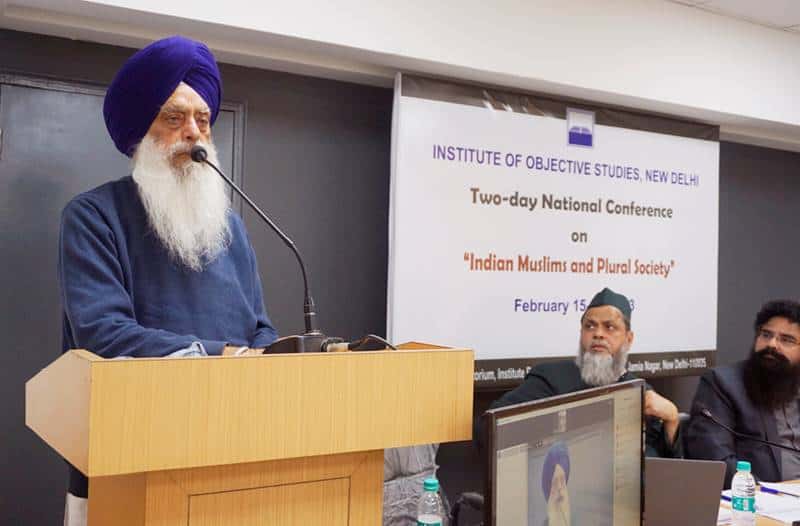
Institute of Objective Studies, New Delhi, organised a two-day National Conference on “Indian Muslims and Plural Society” in hybrid mode from February 15 – 16.
Inaugural session
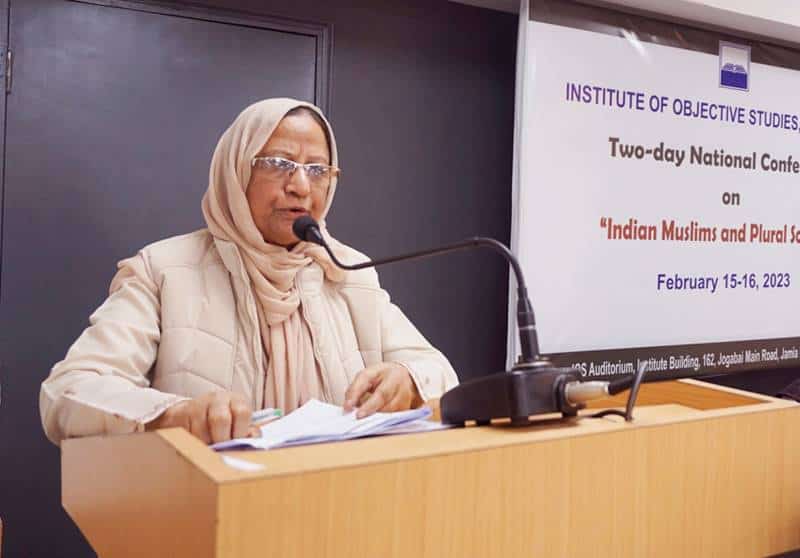
The inaugural session commenced with Prof Haseena Hashia, Assistant Secretary General, IOS, welcoming the guests and participants.
Prof M.H Qureshi, an eminent Geographer, talked about India witnessing numerous migrations over the last several centuries. “We have Nordics, Mediterranean, and Mongols—people from Central Asia, Persia and even Arabs who arrived in India through its southern-western coastal region. Therefore, India has immense diversity, he said.
He said that the Arabs came to the Kerala coast and brought many traditions that became part and parcel of India.
Professor Mehrajuddin Mir, former Vice-Chancellor of the Central University of Kashmir, said that the concept of pluralism was how to live together, tolerate others’ thoughts and ideas, and even understand opponents’ miseries for solutions to live in diversity. All religions have various sects, and thus, their practices differ. The conflicts are, therefore, intra-religious, interreligious and social, he noted.
Professor Mir quoted Indian Defence Minister, Rajnath Singh, who recently spoke about how one Imam and one Pundit shaped his career to understand brotherhood and oneness.
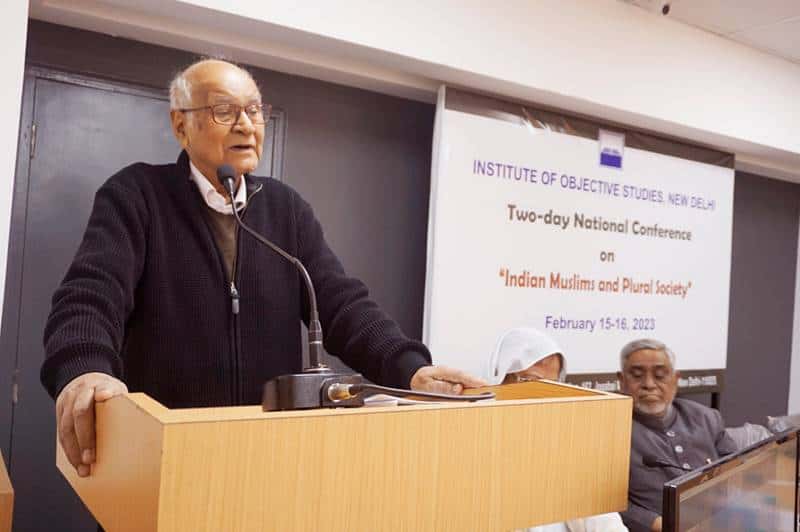
Professor Akhtarul Wasey, former President, Maulana Azad University, Jodhpur, Rajasthan, in his presidential address, said that Muslims came to India as traders and invaders. But once they came here, they delved into the culture and traditions of India and became one who enriched the nation to encourage pluralism. Muslims have contributed to India’s prosperity.
He said that how Dr. APJ Abdul Kalam became a global personality of Indian origin—a Muslim. The country couldn’t think of its missile programme without his theoretical contributions, he said.
Technical Session I
The 1st Technical Session began with the theme, “Genesis of Pluralism in India.” Professor Arshi Khan, Department of Political Science, AMU, Aligarh, as Moderator & Chairperson.
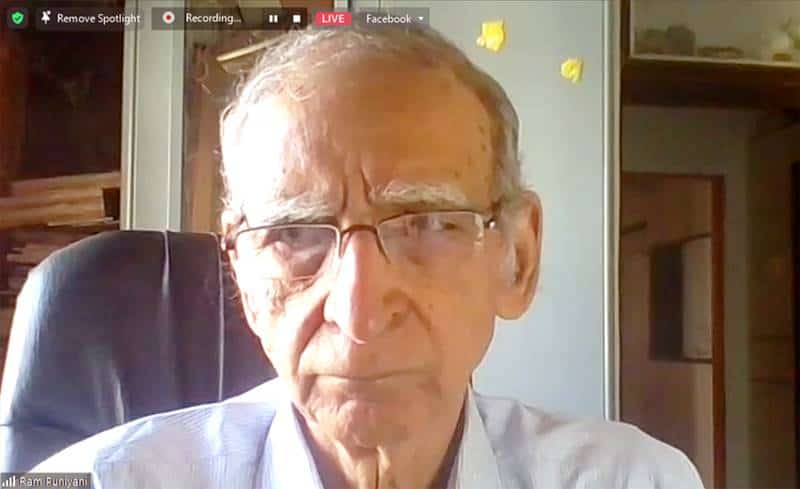
Dr. Ram Puniyani, Human Rights Activist and Writer, said, “There is a misconception in the country, especially against Muslims.” The alliance of civilizations defines plurality. Religions don’t have any nationality. They are universal. The Kings in India, whether Muslim or Hindu, ruled the nation for centuries with people of different faiths as their core governance teams. There was nothing like Muslim Kings or Hindu kings then, he explained.
He observed that calling Indian cultures as Hindu is a bigoted idea. Leaders like Jawaharlal Nehru, Mahatma Gandhi and Maulana Abul Kalam Azad brought secular spirits into the country. We have Sufi and Bhakti traditions that describe the morality of religions and humanity in India.
Professor Mohammad Sohrab, MMA Jauhar Academy of International Studies, Jamia Millia Islamia, New Delhi, described pluralism as a definition both from a conceptual and theoretical perspective. Primarily a religious and moral philosophy, pluralism was the acceptance of diversity. It is more than tolerance of differences. The conception of ‘We’ was essential to assess pluralism through organic social bonding. Pluralism in the Islamic context of acceptance and the country’s scenario today should be understood in the context of how the nation’s spirit developed in Madinah during the time of the Prophet, he elaborated.
He said that pluralism demands that your neighbour be considered an asset, not a liability. Diversity with pluralism creates resilience, but diversity without pluralism brings disaster, he concluded.
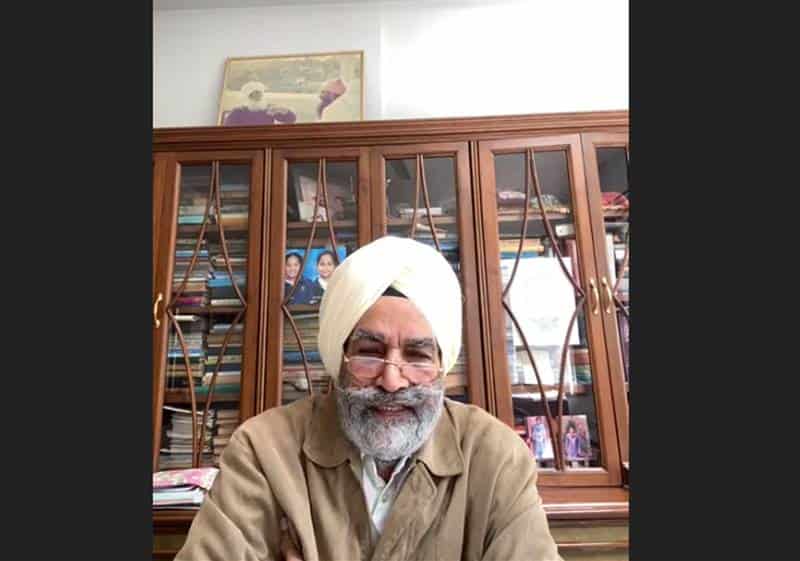
Gurtej Singh, IAS, Chandigarh, spoke about how India’s constitutional and political federalism paved the way for the constitution. The atrocities against Sikhs and their resistance were part of history, he said. The examples of pluralism can be understood from the Guru Granth of Sikh religion.
His book Sikh and Indian Civilization sheds light on how Sikhs were projected during partition.
Sanjay K. Rai, a social activist from Lucknow, mentioned that “diversity doesn’t accept dictators.” He highlighted the importance of multicultural societies. Linguistic Pluralism was the need of the hour in today’s context. Societies with pluralism also impact by technological growth. Communities can’t be defined through one particular race or culture. He felt that there can’t be nation-building and growth without taking Muslims along who constitute 15-20% population in India. The One Nation, One Culture concept can only work in some countries. One can’t find books on Hitler in Germany today. Mussolini’s home has been destroyed in his country as people don’t want him to be remembered. It symbolizes how those going against pluralism perish from the leaflets of history, he concluded.
Mr. Gurdeep Singh, a Sikh leader from Bhatinda, Punjab, stressed that it was high time to focus on the future, in view of the experiences of the past and present to grow in a plural society. Mistakes could be there in the past, but remembering those only won’t solve the purpose. It will hinder progress. He warned that today’s rulers in India were breaking the very ascent of Indian culture and unity.
He said that when Kashmiri Muslims are tortured, others in the country feel their pain.
Dr. Lubna Naaz from the Department of Islamic Studies, Women’s College, AMU, spoke on “An Islamic Perspective on Peaceful Coexistence.”
Technical Session-II
Focused on the theme, Role of Islam to Strengthen Pluralism in India, the Technical Session II started under the Chairperson, Professor M. Ishaque from the Department of Islamic Studies, Jamia Millia Islamia.
Maulana Abdul Hameed Nomani, Former General Secretary, All India Muslim Majlis-e-Mushawarat, Delhi, highlighted that two things are required to be properly understood: the Creator, and the Creator’s motive. He said that Sufis always made one feel the independence to think and lead life. Islam always propagates the rights of neighbours, relatives and much more. Sufi Khwaja Moinuddin Chisti wore similar dresses like Indian Sadhus to ascertain people of his time, irrespective of their religious faiths, connected with him.
He said that Swami Dayanand and Raja Ram Mohan Roy kept Hindu philosophy out of their movements but promoted social reforms in the societies applicable to all faiths for social betterment. “Faith is vital, like Allah’s mercy, unlike social practices that change with time,” he said. India’s beauty was in its diversity of religious thoughts. In pre-Islam Arab tribes kept fighting for generations on a single issue of their forefathers, but the scenario has changed. Islam accepts variety in pluralism, from religious to traditional to social practices. Islam as a religion must not change its basic principles. It is a Sanatan religion with firm principles, he concluded.
Prof Faheem Akhtar Nadvi, Head of the Department of Islamic Studies, MANUU, Hyderabad, emphasized that the role of Islam in strengthening pluralism in India is vital. Pluralism is a society where people of all religions reside and respect each other. India is one of the best examples where pluralism has stayed for centuries. He emphasized that India will grow only when pluralism is projected in practice.
To be Continued..
source: http://www.siasat.com / The Siasat Daily / Home> Featured News / by News Desk (headline edited) / February 25th, 2023
After all those days of hate, there was redemption for Tablighi Jamaat in the end. Some say it was in keeping with what Quran teaches.
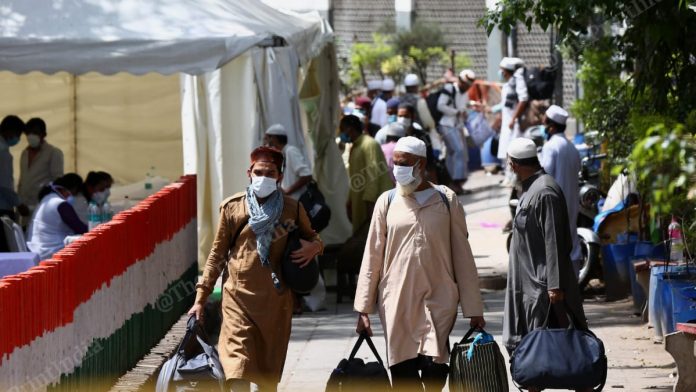
Nearly 4,000, including foreigners, had attended the Tablighi Jamaat event in Delhi (representational image) | Photo : Suraj Singh Bisht | ThePrint
Elisabeth Kubler-Ross’s seminal work, Death and Dying, describes the five distinct stages of grief: denial, anger, bargaining, depression and acceptance. While the Swiss-American psychiatrist was speaking about the series of emotions terminally ill patients go through, the first of the five stages that she postulated possibly holds true for a section of India’s people when the country was trying to come to terms with COVID-19 in the initial days of the pandemic.
The spread of the virus in the early months had then exposed the country’s second-largest religious group to a vulnerability born out of denial. Indiscretion and reckless behaviour by members of the Tablighi Jamaat had purportedly led to a spurt in coronavirus-positive cases, not only in Delhi but also in many other parts of the country.
An international gathering of Tablighis — preachers or a society to spread the faith —had taken place in New Delhi’s Nizamuddin area in March 2020, drawing hundreds of foreign nationals from Thailand, Nepal, Myanmar, Indonesia, Bangladesh, Malaysia, Sri Lanka and Kyrgyzstan. Despite a government order prohibiting large gatherings, more than 4,500 people had assembled at the Tablighi Jamaat Markaz (headquarters).
Media reports had quoted government sources as saying that since 1 January 2020, over 2,000 foreigners from 70 countries had arrived in India to participate in Jamaat activities. As the Covid-19 lockdown came into force on 25 March 2020, over 1,000 were left stranded in Nizamuddin.
Within days, a state of panic had set in as reports of Covid-19 deaths and positive cases started coming in from various parts of the country. By early April, private television news channels had begun insisting that over 30 per cent of the corona-positive cases had the “Tablighi Virus.”
Political factors were at play too. The country was already in ferment over the Citizenship Amendment Act and the National Register of Citizens.
The Tablighis’ state of alleged ignorance was dubbed a “Himalayan” blunder as a heavy dose of media onslaught, Islamophobia and blame game followed. As Najmul Hoda, a Chennai-based IPS officer, lamented on his Facebook wall, Covid-19 looked like a common cold in comparison to the plague of communal hatred.
Tablighi virus, Corona Jihad, stories of discrimination, Quran, divine injunction, Muslim society, deadly virus, Covid-19, Muslim clergy, Indian Muslims, social distancing, community prayers, letter of appreciation.
Political factors were at play too. The country was already in ferment over the Citizenship Amendment Act and the National Register of Citizens. Shaheen Bagh and its women protesters were making international headlines and the February 2020 riots in Delhi had deepened the sectarian divide, exacerbating religious tensions. It was in this situation that the Tablighi Jamaat held its congregation. According to data shared by Equality Labs (a digital human rights group) with TIME magazine, the hashtag ‘Corona Jihad’ appeared nearly 300,000 times.
The online attack became more and more vicious as reports of people leaving for different parts of the country from the Markaz poured in. For days, “Tablighi virus” and “Corona Jihad” trended on Twitter. Our entire focus shifted from fighting and containing COVID-19 to fighting the Tablighis and the Muslims, who the general population started equating as one and the same. Those were the initial days of our COVID-stricken lives, unsure of what awaited us and we were quick to blame the Markaz for all our misery.
The usual practice of portraying Muslims as the other came into play, as did indulging in victimhood.
In the midst of this Islamophobic onslaught, many articles and tweets expressed fears of a Muslim apartheid. The usual practice of portraying Muslims as the other came into play, as did indulging in victimhood.
“Social media, as ever, remained truculent and toxic. Generally speaking, Muslims continue to use social media space to indulge in their victimhood addiction,” observed Najmul Hoda.
While the community needed to address the elephant in the room and could not be absolved of its responsibility for wrongful acts by the Tablighis, the polarised discourse that was unleashed in mainstream media impacted the psyche of the general population. Most Muslims came out against the Jamaat, but the entire community was still clubbed together and labelled the “Superspreader”.
But the way the Tablighi Jamaat’s role and, by extension, of the entire Muslim population’s involvement in the spread of the virus was covered by the mainstream media, it suddenly felt that Covid-19 had a religion.
The Tablighis were guilty for sure for the congregation of thousands of people despite the prohibitory orders, and of not reporting cases, but the wave of hatred failed to see that the Tablighi Jamaat is not the sole representative of India’s 170 million Muslims and its actions should not be linked with the larger community. It is also pertinent to note that the Tablighi Jamaat preaches a narrow interpretation of Islam to some sections of Muslim society.
But the way the Tablighi Jamaat’s role and, by extension, of the entire Muslim population’s involvement in the spread of the virus was covered by the mainstream media, it suddenly felt that COVID-19 had a religion.
Soon, stories of discrimination against the poorer sections among Muslims started coming out. NDTV reported how vendors in Mahoba district of Uttar Pradesh were allegedly targeted and stopped from selling vegetables by people who accused them of being members of the Tablighi Jamaat and of spreading the coronavirus.
Old sociological problems, such as overcrowded ghettos, lack of hygiene and low levels of awareness, became handy tools again to stigmatise the community.
The Bharatiya Janata Party (BJP) MLA from Deoria in Uttar Pradesh, Suresh Tiwari, warned people against buying vegetables from Muslims. The defiant leader was later asked to explain his comment by his party chief.
A video shared widely on Facebook and on Twitter purportedly showed Muslims intentionally sneezing on each other. It was later debunked by the fact-checking website AltNews.
Tablighi virus, Corona Jihad, stories of discrimination, Quran, divine injunction, Muslim society, deadly virus, Covid-19, Muslim clergy, Indian Muslims, social distancing, community prayers, letter of appreciation
Several video clips purportedly showing COVID-positive members of the Tablighi Jamaat misbehaving with hospital staff and other patients found space on prime-time debates. Old sociological problems, such as overcrowded ghettos, lack of hygiene and low levels of awareness, became handy tools again to stigmatise the community.
The reaction from the community was at times defiant, while some took to social media to counter the hate being peddled with tweets that were either equally toxic or full of self-pity.
A closer look at the role the Muslim clergy played reveals a far more constructive engagement than what has been projected by the mainstream media.
It was at this point that the Muslim clergy, intellectuals and other community leaders stepped in. On 2 April, seven signatories — Dr. Zafarul Islam Khan, Chairman, Delhi Minorities Commission; Prof. Akhtarul Wasey, President, Maulana Azad University, Jodhpur; Prof. Mohsin Usmani Nadwi, President, Human Welfare Society; Prof. A.R. Kidwai, Director, K.A. Nizami Center for Quranic studies, AMU; Masoom Moradabadi, Secretary, All India Urdu Editors Conference; Zaheeruddin Ali Khan, Managing Editor, Daily Siasat, Hyderabad, and Prof. Iqtedar Mohd. Khan, Deptt. Islamic Studies, Jamia Millia Islamia, Delhi — issued an appeal to the government to take into consideration the “genuine constraints faced by certain people.” They argued that it was not a time to find fault. “Any attempt to give it a sectarian twist would weaken our battle against the deadly virus,” they said.
A closer look at the role the Muslim clergy played reveals a far more constructive engagement than what has been projected by the mainstream media. As early as 6 March, Maulana Khalid Rasheed Firangimahli, Lucknow-based Imam, Eidgah, had asked mosque-going Muslims to take preventive measures against Covid-19, and told them to avoid congregations and coughing and sneezing in public.
Firangimahli was among many religious heads across the country who issued fatwas saying that the fight against the coronavirus was a religious obligation.
A broad consensus that was worked out decided against special Eid prayers at Eidgahs and at mosques, etc. Islamic seminaries, such as the Darul Uloom, Nadwa and Deoband, issued fatwas asking the faithful to offer Eid prayers at home.
A major challenge came during the month-long period of Ramadan — that began in the last week of April — in terms of enforcing social distancing and avoiding guests at the breaking of fast (iftar) and at community prayers (tarahwih), etc. But enforcing a sense of discipline among 170 million people sharply divided on sectarian and linguistic lines was done with remarkable ease and voluntary compliance.
As Ramadan is closely followed by Eid, suspension of the customary Eid prayer posed another hurdle. However, a broad consensus that was worked out decided against special Eid prayers at Eidgahs (where special Eid prayers are held) and at mosques, etc. Islamic seminaries, such as the Darul Uloom, Nadwa and Deoband, issued fatwas asking the faithful to offer Eid prayers at home.
The results were so good that Uttar Pradesh Chief Minister Yogi Adityanath called up Firangimahli in Lucknow and congratulated him, saying that Eid prayers throughout the state had been observed without any incident of the virus spreading. The state government also issued a letter of appreciation.
Those members of the Tablighi Jamaat who had tested positive for the virus, and have since been cured, came forward in huge numbers to donate their blood plasma — containing anti-viral antibodies — and helped cure many affected people.
Eid ul-Fitr 2020 saw the largest ever participation of women in family prayers. That prompted Najmul Huda, the IPS officer, to say “thanks” to the virus for bringing gender equality to every Muslim home. “May it get institutionalised. Corona, I can’t really say thank you to you, but it’s thanks to you,” he wrote .
There were other positives too. Charity acted as a great succor as appeals were issued to channelise Ramadan and Eid shopping for the needy. Maulana Naeem Ur Rahman Siddiqui, secretary of the Islamic Centre of India, claims that zakat — or charity — saw a rise of over 50 per cent as compared to the previous year.
Not to forget, the redemption and acknowledgement that came after all those days of hate. If the members of the Tablighi Jamaat were guilty of ignorance in the initial phase of the pandemic, they turned adversity they had wrought upon themselves into opportunity in the form of penance. Those who had tested positive for the virus, and have since been cured, came forward in huge numbers to donate their blood plasma — containing anti-viral antibodies — and helped cure many affected people.
Some say it was in keeping with what the Quran teaches — that divine injunction is not for returning evil with good, but with the best. It says: “Good and evil are not equal. Repel (evil) with what is best, and you will see that the one you had mutual enmity with, will become the closest of friends.” (41:34)
Rasheed Kidwai is Visiting Fellow at Observer Research Foundation (ORF). He tracks politics and governance in India. Naghma is Senior Fellow at ORF. She tracks India’s neighbourhood — Pakistan and China — alongside other geopolitical developments in the region. Views are personal.
This article was first published by ORF.
source: http://www.theprint.in / The Print / Home> Opinion / by Rasheed Kidwai and Naghma Sahar / July 12th, 2020