Tag Archives: Shamsur Rahman Faruqi – Author of Books

Shamsur Rahman Faruqi, My Awe-Inspiring Friend and Father

Prayagraj (formerly Allahabad), UTTAR PRADESH / NEW DELHI :

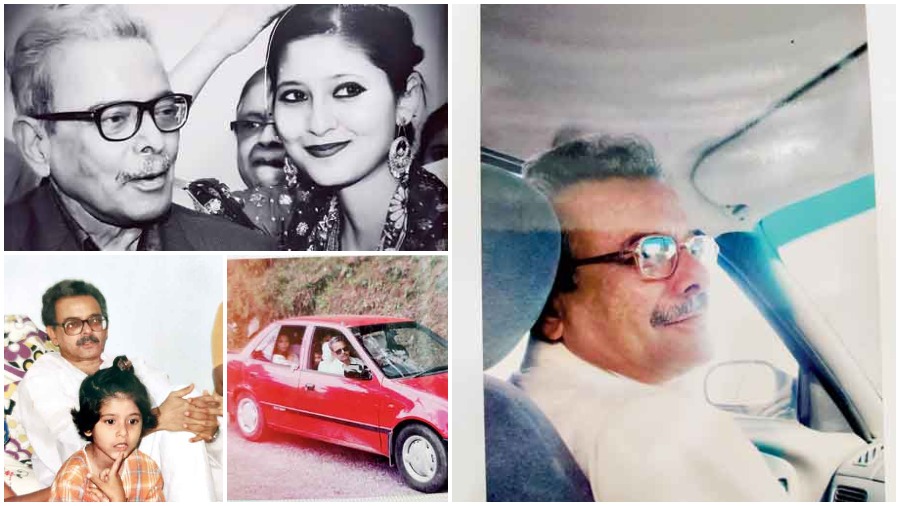
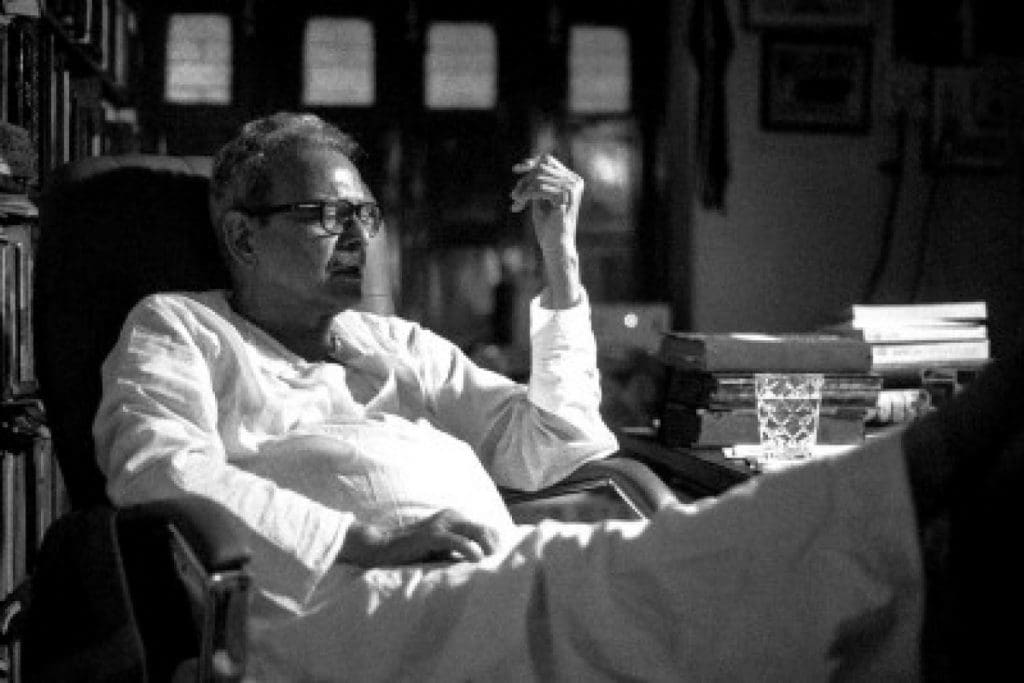
Shamsur Rahman Faruqi with Baran Farooqi. Photos courtesy: Baran Farooqi

Abba was the magician who introduced me to the wide and varied wonders of the world, taught me everything about life and its customs and kept me enamoured of his extraordinary personality. I was awe- struck by his learning, his cool, confident air and the way and adulation he commanded sat comfortably on his shoulders.

And may there be no sadness of farewell 

When I embark;

Alfred Lord Tennyson

Yeh meri akhiri bimari hai (this is my last illness),” spoke Abba with a wry smile on his face. He was addressing Dr Nandani Sharma, a homeopath in Shivalik, Malviya Nagar (New Delhi), whom we were all very fond of and trusted. That evening we had taken him there since he had expressed a desire to actually see her and not consult her over a video call to ask about the chances of curing the fungal infection which had invaded his eye during his stint at Fortis Escorts hospital where he had been hospitalised after having tested Covid positive. None of us had imagined that it was a matter of just a few days before he would be gone, transited peacefully and in full preparation of “seeing his pilot face to face.” Dr Nandani assured him that he still had long to live and accomplish some more as she was confident her medicines would be able to control the fungus. This conversation had taken place in her driveway as Abba was not able to walk since he had returned from hospital and so it was decided that instead of him having to go into her clinic, he would be seated on his wheelchair near the car and she would examine him. We returned upbeat from Dr Nandani’s place but it was as if Abba knew better than Dr Nandani this time. He had been sent the summons and he had answered them with acceptance and great sporting spirit. So, he laughed at our jokes in his weak strength and held out his hands or arms to embrace whenever he saw me or my sister or my daughters enter the room. He would kiss my hands and softly caress my head if he happened to be sitting, bolstered by the electrically operated bed we had arranged, half a dozen pillows and bolsters around him.

Of late, in fact, right from the time he would send voice notes from the hospital, he would often repeat, “I love you” or “know that I love you.” Of course, we had never had any doubts about this ever because Abba was the master of expression. A vocal person, he taught me how I need to say “thank you” even to my own parents if they got me something and to house helps and friends for services rendered or acts of kindness. I once overheard him reproaching my mother for never doing salam to him first when he got home from office or smilingly extending her hand of welcome. Always cheerful and smiling when he came home from office, he expected everyone else at home to be as smiling and welcoming as he was. Each time any of us would enter his room for something, he would beam aaiye aaiye (do come in) and show his pleasure. He used to call me “funny face” sometimes, which didn’t seem very amusing to me but I knew I was supposed to show a sense of humour and not sulk over little things. I finally asked him one day, “Why do you call me funny?” He answered that funny faces are those who are delightful and make him feel happy and full of mirth. Once, when I made him fill out my columns of questions like, who is your best friend, what’s your favourite colour, what are you scared of and so on, (this was a raging activity in my school those days that you took autographs of people in your autograph book for no reason and also made them fill columns which were made in a double page of a register.) I remember almost all his answers to this day but I’ll speak of only a couple, to the question, “If you had a wishing wand, what would you wish me to be?” he had answered “Queen of Sheba.” I immediately understood this is something divinely great and luminous and so on, since I didn’t really know who queen of Sheba was at that time. In the answer to the question, “what are you scared of?” he had answered “centipedes,” making me aware that he was human and vulnerable in his own way.

I have wandered far from what I was initially talking about — his illness and his demeanour during those days. After stretching out his hands and making me sit close, he told me one day that the time for him to leave this world had come and that I should allow him to go. That the ceaseless struggle that we were putting up to withhold him was futile and he was convinced about his departure. He needed to go back to his spacious and open house where his favourite pet dog Bholi and others were, and he wanted the birds to sing near his window before he ceased to breathe. On those nights when he was awake and not faint with weakness, I would sit by him and read out his WhatsApp messages to him and also make him listen to the voice notes people had sent. He chose to respond to one or two voice notes or emails and messages every day. He would speak the voice notes himself and dictate the written messages or emails. He once made me write a mail to CM Naim sahib though there wasn’t one from him that day and also to Frances Pritchett, informing them about his health. One of the voice notes that he sent to Amin Akhtar (a relative of ours who has been assisting him in his library-cum-office and miscellaneous affairs for many years) was about the local graveyard which Abba’s efforts had helped restore and put in order after his return to Allahabad after retirement. He asked Amin to go to my mother’s grave and convey his salam there. He also asked Amin to see if it was still possible if he could be laid to rest right next to her, but in case anyone objected, he reminded Amin, he had chosen a remote corner of the graveyard for himself as a second choice. Amin responded next day tearfully that he had carried out his instructions and that there was no question of anyone objecting to his burial next to his wife. He had written the ayat he would like to be written on his tombstone and given it to Amin many years back already. I felt heart-broken at these conversations but I, too, knew that they must happen and not be left unfinished, for the day of parting may come if it had to, and there was nothing anyone would be able to do about it. 

I marvel at Faruqi’s (as he would like to refer to himself, sometimes  even calling himself “saala Faruqi” or “Fraudie”), courage and foresight for the way he bore his illness. He was also very kind and forbearing towards us, always succumbing to our pleas for making him eat or drink something despite being terribly averse to both ideas. Every time he would ask when we were planning to go back to Allahabad with him, and my sister or I would give a date a week or two away, he would nod patiently and agree. Ever since Ammi passed away, Abba had been careful to hand over all that she had left behind as money or property to both of us, saying this belongs to you both as she was your mother. But when it came to caring for us and endowing us with gifts or maintaining the large house, he acted as the perfect father. Never once did he ask us to bear any financial burden of any kind, be it the property Ammi left behind — he continued to pay property tax for it — or other charities that she was used to doing at her native village. 

Unselfish by nature, and generous towards the world and its people, he once told me that he had spent his life with the aim to be of help to any number of human beings he came across in the journey of his life, particularly during his career in civil service. I have never known or seen, nor do I ever hope to see, another more good-hearted person who is also competent, capable and one of the greatest literary minds of the century. Abba loved exploring new things and enjoy them if the children so wanted. Any new joke, and we wanted to share it with him, a new piece of machinery or a gadget and he would be curious to know about it, any adventurous outing, and he would want to be a part of it. In fact, most of the interesting outings in my and my daughters’ lives were either planned by him or planned for him. It was just last winter that we all went to Kochi together to explore the backwaters of Kerala and spend some part of winter there to avoid the low temperatures up North. As he grew older, he had begun dreading the winters, as they confined him to his room and restricted his hours in the study. There were arrangements to keep his room, his study, and even his bathroom warm, but the cold got to him since he was finicky about wearing “inners” and heavy quilts bothered his frail body with their weight.

Apart from travelling to new places and exploring places of historical interest or natural beauty, Abba had a penchant for stylish and tasteful clothes and good food (which he always ate very little of, but wanted to be served in good quantity). However, he had this little thing in his head about what are supposedly “manly” dishes and which foods are meant to be consumed only by women. Consequently, I never saw him relishing anything even slightly sour. He was supremely dismissive of achar and chutneys or chaat of any kind. Even remotely foul-smelling vegetables were banned in our house, not to speak of home-made sirka or ghee being extracted from malai. I once witnessed a bitter exchange he had with my mother for having gotten mooli achar prepared in the courtyard of our house. This was even worse than cooking sabzi out of the mooli! Like any other subversive spouse, Ammi would sneak such things into the house and eat them secretly when he was in office. 

Abba was a great animal lover, too. As children, having animals and birds around us was as natural as breathing and it must never have occurred to us that in the eyes of the world, we qualified as “animal lovers.” At any given time in our lives, there were always dogs, cats, turtles, mynahs, peacock chicks or grown peacocks, pigeons, partridges, quails and finches and other singing birds. Abba would often send a tid-bit or two to his pets (I said “send” because the house was really so huge in area that things had to be delivered from one place to another) and tell the person he had chosen for the task, “greet him with my salam and say that Faruqi sahib has sent this. We knew a lot about birds, which ones could be tamed or caged and which couldn’t be bred in captivity. He also had a collection of coffee-table type books on birds and animals and some of the exciting times of my childhood were certainly made of browsing through those books. Sea creatures like starfish, octopus or dolphins intrigued me greatly and I was enamoured by pictures of the mighty ocean. I longed for a trip to a coastal town but my wish was deferred for quite some time as my parents had already been to places like Bombay and Calcutta many times and were more focussed on the hills or animal and bird sanctuaries. 

Abba played his favourite musical records of ghazals and classical ragas in the mornings which were spent enjoying three to four cups of bed tea. The tea, which would be brewed in an elegant tea pot and had a bitter aroma, would cool gradually as he read the morning papers. The music would continue to play up until he was almost ready for breakfast. Gradually though, I, too, developed a taste for singers like Farida Khanum, Iqbal Bano, Mehdi Hassan, Kishori Amonkar, and artists like Hari Prasad Chaurasiya, Ustad Bismillah Khan and other such maestros. My sister and I were also subjected to regular doses of mushairas and seminars which we had to duly attend along with our parents; I was still wearing frocks at that time. By the time I grew up, I had sat on the laps of many a great Urdu writer, poet or artist. I grew particularly familiar with Naiyer chacha (Naiyer Masud), Shamim chacha (Shamim Hanfi), Shahryar chacha and Balraj Komal uncle. The critic Khalil-ur-Rahman Azmi was someone I don’t clearly remember but I recall Abba grieving over him so much that Ammi had to chide him about moping a couple of times.

Abba was the magician who introduced me to the wide and varied wonders of the world, taught me everything about life and its customs and kept me enamoured of his extraordinary personality. I was awe- struck by his learning, his cool, confident air and the way and adulation he commanded sat comfortably on his shoulders. He lived a life of grace and élan. Once, when on one of our usual summer holiday road trips, when we were touring Uttar Pradesh and Himachal, there was an incident which impacted me for the rest of my life. It so happened that the road we were on was broken severely, blocked, you may say, so Abba decided to take a detour through another path, which was on the lower side of the road, beside the fields. It was a water-logged path but he estimated that our Ambassador car would be able to successfully wade through it. But to our chagrin, the car got stuck in the slush beneath and water began to enter the car at a high speed! The car seemed to be floating in the water, I began to bawl loudly saying, “Hum doob jayenge, hum doob jayenge, (I’m going to drown, I’m going to drown).” I got one of the most unexpected and loud scoldings of my life from him at that time, “Abey tu apne liye ro rahi hai sirf! Aur baqi tere ma baap aur behen? (Stop crying and saying such a selfish thing! Why are you worried about only yourself drowning and not your parents and your sister?)”. I wiped my eyes and looked at him, bewildered. It was a lesson I have remembered to this day — unselfishness and courage. 

So close, so friendly and participative and yet so distinguished and awe-inspiring! They don’t make men like you any longer, Abba. I conclude my piece again from the poem quoted above. Abba would sometimes teach us English poetry, too, apart from Urdu and Persian. Abba had read out the poem to me many, many years ago and explained it to me. Alfred Lord Tennyson’s “Crossing the Bar” was one of his top favourite poems of the English language. I remember his voice almost choking at the sombre grandeur and sonority of the poem:

For tho’ from out our bourne of Time and Place

The flood may bear me far,

I hope to see my Pilot face to face

When I have crost the bar.

Perhaps, the very same lines were echoing in his mind when he breathed his last, in full control of his senses, aware and courageously ready for the journey across.

source: http://www.thepunchmagazine.com / The Punch Magazine / Home> Non fiction – Essay / by Baran Farooqi / February 28th, 2021
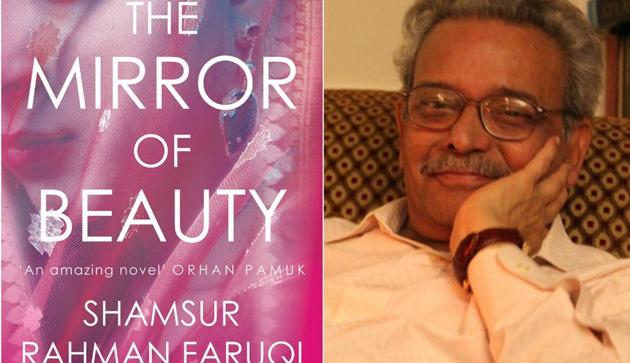
Padshah of Urdu; People mourn death of Shemsur Rehman Faruqi

Prayagraj (formerly Allahabad), UTTAR PRADESH :

Legendary Urdu poet and critic Shamsur Rahman Faruqi passed away on Friday at his Allahabad home, a month after recovering from COVID-19.

His daughter Mehr Farooqi tweeted about her father’s demise: “We reached Allahabad and father transitioned peacefully,” she wrote.

“It’s not just the world of Urdu, I feel I’ve been orphaned again,” historian Rana Safvi sent her condolences.

Writer and historian William Dalrymple took to Twitter to mourn the demise of Faruqi, calling him “one of the last great Padshahs of the Urdu literary world.”

Sanjiv Saraf, the founder of Urdu festival Jashn-e-Rekhta, also condoled the death of “the century’s most iconic figure in the realm of Urdu literature”.

“His demise has left us bereaved as an entire generation of literature lovers mourn this loss. I extend heartfelt condolences to his family and loved ones,” Saraf said.

“Shamsur Rehman Farooqui’s demise is a big loss to the world of scholarship, and adab. His work built many bridges across India’s diverse traditions. He was immensely valuable to us in so many ways and will be sorely missed, ” said CPIM general secretary Sitaram Yechury.

“Am just gutted. Shamsur Rehman Faaroqui saheb has passed away. Innalillahi wa inna ilayhi rajeeon. May allah grant him jannat..aameen,” wrote journalist Rana Ayyub.

“His modernist style had irked the traditionalists and contemporaries in the sixties, seventies. But he wasn’t just a critic and theorist, whenever he took to fiction, he created magic. And, his Allahabad home had been the nucleus of Urdu literary world, for over half-a-century,” wrote journalist Shamsur Rehman Alavi in a condolence note.

Legendary

A profile of his on Caravan Magazine alluded to his immense and immeasurable contribution to Urdu literature.

Shemsur Rehman began writing in 1960. Initially he worked for the Indian postal service (1960–1968), and then as a chief postmaster-general and member of the Postal Services Board, New Delhi until 1994. He was also editor of his literary magazine Shabkhoon and part-time professor at the South Asia Regional Studies Center at the University of Pennsylvania.

An expert in classical prosody and ‘ilm-e bayan (the science of poetic discourse), he has contributed to modern literary discourse with a profundity rarely seen in contemporary Urdu critics. His most recent books, The Mirror of Beauty (translated into English from the Urdu Kai Chaand The Sar-e-Aasmaan in 2006), and The Sun That Rose From The Earth (Penguin India, 2014), have been highly critically acclaimed. He is the recipient of numerous honors and awards. Most recently he was awarded the prestigious Saraswati Samman for his work She`r-e Shor-Angez, a four-volume study of the eighteenth-century poet Mir Taqi Mir.

He was awarded the Saraswati Samman, an Indian literary award, in 1996. The Government of India awarded him the civilian honour of Padma Shri in 2009.

source: http://www.maktoobmedia.com / Maktoob Media / Home> India / by Maktoob Staff / September 25th, 2020

Translating India: How Ka’i Chand The Sar-e Asman became The Mirror of Beauty

INDIA:

In a new Translating India series, ten noted translators will share their experiences of translating from their respective languages. In this first part, Urdu critic and writer, Shamsur Rahman Faruqi writes about how he translated his Urdu novel into English.

Shamsur Rahman Faruqi translated his Urdu novel Ka’i Chand The Sar-e Asman, which was about the mother of the famous poet Dagh, into English. It was published in 2014 as The Mirror of Beauty.(Facebook)

My name is Ka’i Chand The Sar-e Asman. In English, somewhat arbitrarily, I am called The Mirror of Beauty. I am an Urdu novel, a little above 850 pages long. My English avatar is nearly a thousand pages worth of prose of a somewhat quaint register, or registers.

I was somewhat horrified when an author approached me with the proposal to translate me into English. I said: “I hope you aren’t going to do to me what the Bard did to Bottom in A Midsummer Night’s Dream as he casually turned him into a donkey — “Bless thee, Bottom, bless thee. Thou art translated!”

“No, no,” he cried with a tight voice. “Do you doubt my proficiency…?”

“Yes, that too could bear some scrutiny, but my doubt mainly springs from the nature of the beast.”

“You believe I created a monster,” he fumed, somewhat red-faced.

“Do not misunderstand me. In fact, you know very well what you created, and I am quite comfortable with it. Let me remind you…”

“Yes, I know,” he said somewhat testily. “I made you somewhat exotic. I wrote you in about ten different styles, or registers. In general, you are highly Persianised; Arabic is just round the corner almost everywhere. Your narrative language is mostly archaic, so also the dialogues. Most of your women speak what is now called Begamati Zaban, that is, they use words which only women used. You have courtly language in play on almost all occasions in life, from speaking of love to being belligerent, even warlike. Irritatingly, or most piquantly-spicily, your pages are peppered with poetry in Persian or Urdu.”

“Yes, and the professional and technical details, some of them almost untranslatable,” I said.

“Yet you seem to be missing the chief point here,” he said, with his nose in the air.

“And pray, what’s that?” I must confess that I was somewhat nettled by his superior air.

Read the curtain raiser to the Translating India series here.

“Incompatibility,” he said. “English and Urdu are incompatible, and just not grammatically. Urdu’s a genius, especially in the creative modes, is given to elaboration, intensification, abstraction. And Urdu has many more words for emotions; English for all its vastness is remarkably destitute in this area. Take ‘love’, for instance. How many words can you think of in English, including Latinisms and archaisms, to convey the idea of love? Well, just one, or maybe another two or three if you stretch the matter. Urdu has at least 18 words to express the emotion of love. Apart from love too, Urdu’s language of formal discourse has numerous words expressing the same idea with different degrees of intensity or emphasis or nuance. English and Urdu make strange bed-fellows, almost always.”

I felt dispirited. So I will remain hidden behind Urdu’s veil, almost like Lucy, who though fair as a star, lived unknown. But I brightened at the thought that I won’t suffer the mutilation that almost all translations turn out to be. So I said: “Well, then you are saved the trouble of undertaking this back-breaking job, I hope?”

“No”, he smiled his artful, almost crafty smile. “You forget that I am the author, not just some hack pulling an ancient rickety cart of translation.”

“So?”

“First thing,” said he, “As author-translator, I can take liberties, within reasonable limits. I am aware that I am the author of the Urdu novel, I am not composing an original novel in English. But I’ll not let the Urdu text hang too heavy on my translator’s intuitions. Like all translators I’ll give up certain things (like the 18 or so words for love), but will also add certain things.

‘When I sit down to do the English version, I am able to visualise the spirit of the Urdu and almost see it passing into the English words that came to me as I put them then on the page.’

“Most importantly, I’ll exchange the archaic Urdu with a deliberately archaic, passionately and shamelessly 19th century English. I will not permit the entry of a word or usage which came into the language after the time of Victoria, that is, mid to late 19th century. The flavour of the specialised languages and registers of Urdu I’ll give up in favour of translating literally all Urdu words and phrases and make them sound natural to the narrative. I will render the ‘excesses’ of the Urdu into English.”

“And what will you do about the poetry?”

“Well, I am the author, and thus share a bit of the original author’s persona when I quote his poetry.”

It seemed to me that he bared his teeth, somewhat like a dog teasing and enjoying a favourite bone.

“I will translate faithfully, but I’ll use a compromise language – a little modern, a little archaic – to suit the environment of the narrative. And remember, the poetry that I have quoted (and I even wrote some of it, under the names of Dagh, or his mother) is entirely in harmony with the narrative. So, without doing violence to the original, I should produce passable English poems, effective and genuine in their own right.”

“I fear your labours may result into transcreation of some sort,” I said somewhat timidly.

“Transcreation? I defy transcreation. You either translate or create. When I am done, you open any page of the translation, you will recognise the relevant Urdu text instantly.”

“That is something that most translators from Urdu have despaired of,” I said. “How do you hope to do it?

“For one thing, I am fully steeped into the Urdu – its moods, its inner complications, its special characteristics. And I have lived with you for a long time before you came into existence. When I sit down to do the English version, I am able to visualise the spirit of the Urdu and almost see it passing into the English words that came to me as I put them then on the page.”

“But you haven’t even started, how do you know you can do it?”

“Come back after a couple of years and see for yourself.”

A recipient of Saraswati Samman (1996) and Padma Shri (2009), Shamsur Rahman Faruqi is a leading Urdu critic and theorist. The views expressed are personal.

source: http://www.hindustantimes.com / Hindustan Times / Home> Books / by Shamsur Rahman Faruqi, IANS – Indo Asian News Service / February 10th, 2018

How the pandemic is depriving lovers of Urdu literature of their environment for enjoyment

INDIA:

Discussions and debates, critiques and readings, held at haunts of Urdu books and writing around the country have been interrupted rudely.

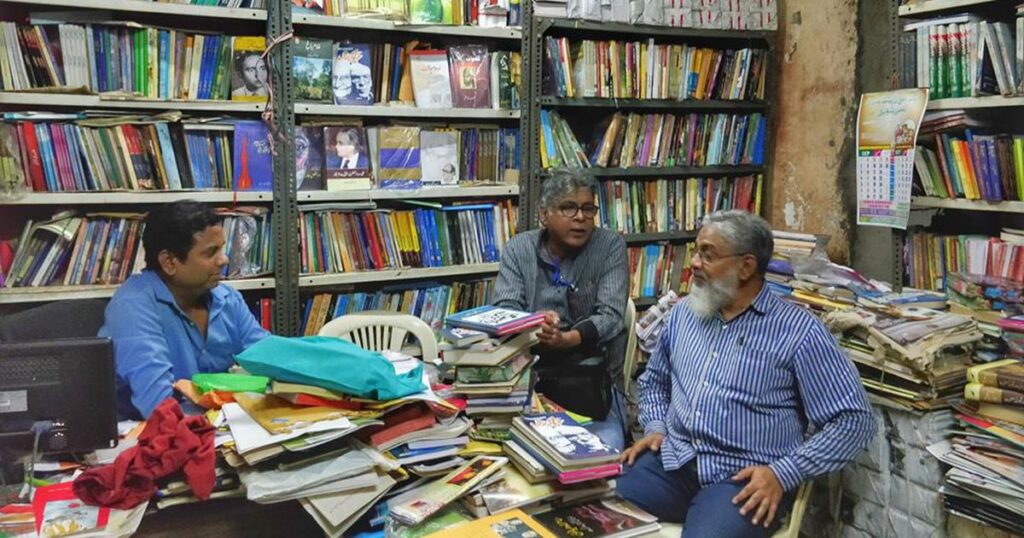
(From left) Shadab Rashid, Urdu drama writer Aslam Parvez, and Shakeel Rasheed at Kitabdaar | Mahtab Alam

In Malegaon

On the first Saturday of every month, the textile city of Malegaon in northern Maharashtra used to become home for lovers of Urdu literature, who meet to discuss, debate and critique new writings in the language, mostly by local writers. Organised under the aegis of Anjuman Muhibban e Adab (Association of Literature Lovers), the gathering began at around 9 pm, and went on till midnight.

Between 30 and 50 people – both writers and readers – would come together, a number that would at times go up to as many as 100 or even 150. Asif Iqbal Mirza, the secretary of the Anjuman, said the practice began 25 years ago on the suggestion of local journalist and editor Samiullah Ansari, who published new Urdu fiction in his weekly, Hashmi Awaz.

Over the years, the publication had emerged as a popular local magazine for young and budding writers to publish their works. The weekly, now in its 35th year of publication, had a considerable fan following and readership at the time. Ansari then suggested that admirers of the magazine form a group comprising readers as well as writers.

The group was initially named Anjuman Muhibban e Hashmi Awaz (Association of Admirers of Hashmi Awaz), but within a few years, its following grew to encompass more than just the readers of the magazine, and in 1998 it was rechristened Anjuman Muhibban e Adab, Malegaon. “Ansari sahib formed the Anjuman so that writers could get their new works critiqued by readers before getting them published in the weekly,” Mirza ssid.

Back then, Mirza himself wrote for a local children’s newspaper called Khair Andesh. But his association with the Anjuman helped him grow into a prolific Afsana Nigar, a short story writer. He was 17 when the group was formed; in the past 25 years, he has written and published more than 200 short stories in different publications.

Apart from Anjuman Muhibban e Adab, there are two more literary groups in Malegaon that held regular meetings until the lockdown was declared in March. No such meetings have been held since then. “Unlike earlier, we now have enough time to read and write. But the irony is we don’t have the opportunity to discuss and publish them,” said Mirza, who also runs a printing business. Several local publications had to halt their issues, including Hashmi Awaz, owing to the lockdown.

According to Mirza, although social media outlets such as WhatsApp and Facebook have, to some extent, helped to keep in touch with fellow writers and readers, the literary life of Malegaon has come to a standstill, since a large number of local writers and readers came from the working class and worked in local looms. “The year 2020 is the silver jubilee of my literary career. I had plans to publish a collection of my short stories, but thanks to the pandemic, that will not happen this year,” Mirza said with a great sense of despair.

In Mumbai

Both readers and writers have felt a deep loss during the pandemic. His love of books took Shakeel Rasheed, editor of the Urdu daily Mumbai Urdu News, to various bookshops in and around the Mohammad Ali Road area of Bombay. “Visiting bookshops was a part and parcel of my life. I feel a deep loss when I don’t visit them,” he said. For him, bookstores are not just spaces to buy books, but they also served as addas for readers and writers. As soon as some relaxations were in place, he rushed to the stores. “Par ab pahle wali baat nahi rahi,” said Rasheed. “Things are not as they were before.” The pandemic has made it more difficult to meet new people.

Shadab Rashid’s Kitabdaar publications and bookstore in Temkar Street of Nagpada was one such adda for Urdu writers in Mumbai, as was Maktaba Jamia on Sandhurst Road West. Today, Kitabdaar and a few other bookshops have opened their stores for a few hours every few days, while Maktaba Jamia remains closed. “Due to lack of public transport and fear of the pandemic, people cannot come to Kitabdaar,” Shadab said. He also edits the quarterly literary magazine Naya Waraq, founded by his late father and noted journalist and writer Sajid Rasheed.

Shadab Rashid said the lockdown brought significant hardships and losses to Urdu publishers and distributors. “It is not that people don’t want to read Urdu books anymore – the problem is they cannot buy them,” he said. “I have received lots of online orders, but I cannot fulfill them because I rely on postal services as they are the cheapest means of delivery, but the services are not fully functional yet.” His online Urdu bookshop kitabdaar.com is one of the few digital distribution platforms for Urdu books exclusively in India. Another such platform, urdubazaar.in, was recently launched from Delhi.

Owing to the discontinuation of physical interactions between readers and writers, people have lost touch with each other, since not all Urdu writers are active on social media, Shakeel Rasheed told me. “We have lost many good writers during this period and found out about their demise several days later,” he added. “Moreover, we could not participate in their last journeys.”

In Hyderabad

Another writer recounted similar thoughts after the death of noted Urdu satirist Mujtaba Hussain in Hyderabad on May 27. Hussain was awarded the Padma Shri in 2007 for his contributions to Urdu literature, but in December 2019, he announced he was returning the award to protest the enactment of the contentious Citizenship Amendment Act. “[T]he democracy for which I fought is under attack now and the government is doing that,” he had said, “that’s why I don’t want to associate the government with me.”

In Hyderabad, another centre of Urdu writing, literary activities have come to a similar halt due to the pandemic. Publications like Shagoofa, a monthly magazine of satirical writing, have been temporarily discontinued since the lockdown.

In Delhi

In Delhi, too, the pandemic has left an adverse impact on Urdu writing. Khan Rizwan, a poet and a known “addebaaz” from Delhi, loved participating in and organizing adabi addas (literary gatherings). He misses visiting the Nai Kitab book store, located in one of the many bylanes of Jamia Nagar, which is one of the famous addas for Urdu lovers in the city. Run by veteran writer and publisher Shahid Ali Khan, Nai Kitab is a haven for young and old writers alike, Rizwan said, as Shahid sahib treated them alike. “It is not just a bookshop but an institution where one got to meet noted writers and lovers of Urdu literature,” he said.

Rizwan would visit the shop at least twice a week, and meet a new literature enthusiast or writer, or find out about a new book or risala /parcha (journal/magazine). “I miss the black tea and chips that Shahid sahib served us with love and affection,” he recalled. “He is a storehouse of information, and several veteran writers were his friends, so he would tell us stories all the time.”

I couldn’t agree more with Rizwan. I have been visiting Nai Kitab once every few months for more than a decade now, and on each of my visits, after asking khabar-khairyat, Shahid sahib would say, “Achcha aap bahut dino baad aayen hain, ye nayi kitaabein aayi hai dekh lein (Since you’ve come after a long time, here are some new books).” Last year, when I visited the bookshop around this time, he directed me towards dozens of books written by noted Urdu satirist Fikr Taunsvi and Shaukat Thanvi. I immediately bought all of them, as they were usually out of print and seldom available.

As the person in charge of the Maktaba Jamia, the publication division of Jamia Millia Islamia in Bombay, Shahid Sahib befriended writers and poets like Jan Nisar Akhtar, Meena Kumari, Sahir Ludhianvi and Jagan Nath Azad. Some of them were regular visitors to the Maktaba Jamia. Though he moved to Delhi after serving the Maktaba for several decades, he did not stop hosting literature lovers. He then founded Nai Kitab publishers and a quarterly journal by the same name.

It was in 2007 at his bookshop that I first chanced upon Shamsur Rahman Faruqi’s celebrated novel Kai Chand The Sare Aasman, later translated into English as The Mirror of Beauty by the author himself. The novel went on to become a major critical and commercial success.

Faruqi was also associated with the Nai Kitab journal as chairperson of its advisory council and would visit the shop once in a while. The journal eventually stopped publication owing to Shahid sahib’s failing health, but he continued with the bookstore as it was like “oxygen for him”, he had once told me.

Waiting for freedom

Some writers have managed to turn the lockdown into a creatively productive period. “Personally, the pandemic has proved as a blessing in disguise as I read books I wanted to for years and finish other important work, such as recording videos of Urdu literature lectures,” says Khalid Mubashir, a poet and assistant professor of Urdu literature at Jamia. He quickly added, however, this was not common, as most writers and poets were stuck at home, either because of their age or in fear of the pandemic. “Moreover, not all writers have access to technology and books like I do. I am fortunate enough to have friends who helped me with technology to do something substantial during this period.”

Mubashir’s videos, as many as 60 of them, are each about 30 minutes long, and cover the history, evolution and development of Urdu and its literature in the subcontinent. Though the lectures are prepared keeping in mind the need and syllabus of Urdu literature students, ordinary Urdu lovers can also benefit from them. All lectures are available on the YouTube channel Safeer e Adab.

Similarly, although younger poets like Mohammed Anas Faizi from old Delhi have been trying to keep Urdu literature gatherings going by using social media, online addas do not have the feel and impact of offline and in-person gatherings. “Technology and social media can only help to a certain extent. Online gatherings, mushairas and addas cannot substitute for the real ones, no matter how well they are done,” he said.

With apologies to Faiz Ahmad Faiz, what the Urdu writers, poets and addebaaz seem to be telling the pandemic is:

Gulon Mein Rang Bhare Baad e Nau Bahar Chale
Chale Bhi Jao Ki Gulshan Ka Karobar Chale

Mahtab Alam is a multilingual journalist and until recently was the executive editor of The Wire Urdu. His Twitter handle is @MahtabNama.

This series of articles on the impact of the coronavirus pandemic on publishing is curated by Kanishka Gupta.

source: http://www.scroll.in / Scroll.in / Home> Publishing and the Pandemic / by Mahtab Alam / July 14th, 2020

Why India Must Remember its First Muslim Jurist

Delhi, Mughal Period / Sitapur, British India:

The first Muslim judge of a high court in colonial times, Syed Mahmood’s professional conduct offers a counterpoint to the declining standards in Indian judiciary.

WHEN Justice Abdul Nazeer addressed the 16th national council meeting of the RSS-affiliated Akhil Bharatiya Adhivakta Parishad at Hyderabad last December, he said, “Great lawyers and judges are not born but made by proper education and great legal traditions, as were Manu, Kautilya, Katyayana, Brihaspati, Narada, Parashar, Yajnavalkya, and other legal giants of ancient India.” In the symposium on “Decolonisation of the Indian Legal System”, Justice Nazeer also said the “continued neglect of their great knowledge and adherence to the alien colonial legal system is detrimental to the goals of our Constitution and against our national interests…”.

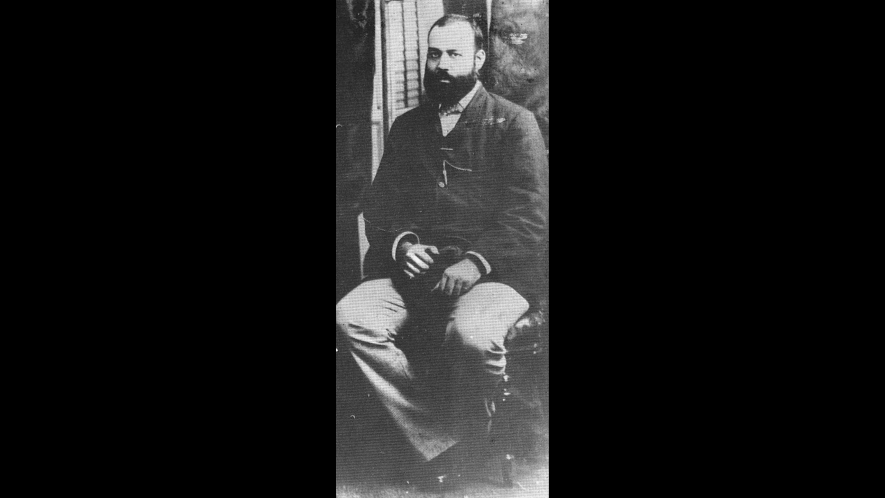
Perhaps Justice Nazeer should have also recalled 19th-century jurist Justice Syed Mahmood (1850-1903). A pioneer in bold assertions against the colonial judiciary, he produced incisive legal commentaries that reflect an audacious dissenter’s point of view. Writing in an Urdu newspaper, his father, Sir Syed Ahmed Khan, narrates Mahmood’s resignation from the Allahabad High Court in 1893 to “protect the self-respect of Indians against the racism of British judges”.

In that era, conceptions of nationhood were still evolving in India. Indian judges would not muster the courage to contest the racism of the imperial power or fellow European judges. But Mahmood did, in intrepid ways. Khan founded the Mohammedan Anglo-Oriental (MAO) College at Aligarh in 1877 and figures prominently but contentiously, stereotyped as a British loyalist and separatist in debates on contemporary nationalism. Mahmood supported his father’s modern education project, but unfortunately, his contributions are largely ignored by historians and the legal fraternity.

By 1920, MAO College, now Aligarh Muslim University, was the most prominent residential university in the country. Its history department has been a premier centre for advanced studies for a half-century. In 1889, primarily on Syed Mahmood’s initiative and his gifts in terms of books, journals and cash, AMU established a law department. Yet, he was neglected in its research. Only in 1973, seven years after the centenary of the Allahabad High Court, the Aligarh Law Journal brought out Mahmood’s contributions, and legal scholars reflected on his high calibre as a lawyer and judge.

The good news is, in 2004, Alan M. Guenther did his doctoral thesis on Mahmood at McGill University, Canada, which is available online for the public to access. His meticulous and well-researched account touches almost every aspect of Mahmood’s public life. Guenther also published an extended essay in 2011on Mahmood’s views on English education in 19th-century India. (In 1895, Mahmood had written a book on the theme for his speeches at the Educational Conference.)

In 1965, Asaf Ali Asghar Fyzee (1899-1981) complained, “Syed Mahmood’s contributions to the transformation of Muslim law in India have been largely neglected by historians and survive primarily as footnotes in legal texts on Muslim law.” Guenther, too, observes, “…overshadowed by the life and writings of his illustrious father, Ahmad Khan, his legacy has not received the attention it deserves. A large part of his father’s achievements in the reform of education, in fact, would not have been possible without the assistance of Syed Mahmood. But when he reached the age at which his father had made his most significant achievements, [Mahmood] had his life cut short.”

Mahmood had laid out his life plans clearly. S. Khalid Rashid, writing in 1973, reports that Mahmood decided early on that, like his ancestors, he would devote the first third of his life to educating himself, the second to earn a living, and the last to “retired study, authorship and devotion to matters of public utility”. But Guenther writes about how Mahmood’s health had deteriorated through alcohol abuse and disease. He died before he turned 53, broken by forced retirement, estranged from his father (who had died five years previously), stripped of responsibilities at the college he had helped found, separated from wife and son, and in poverty. He was selling personal items to repay debts. “His father’s numerous writings and letters are still republished, but Syed Mahmood’s contributions to Muslim thought are hidden in bound volumes of the Indian Law Reports and brittle files of government correspondence,” Guenther writes.

One aspect of Mahmood’s last years is captured by Prof. Iftikhar Alam Khan’s Urdu books, Sir Syed: Daroon-e-Khana (2006, 2020) and the recent Rufaqa-e-Sir Syed: Rafaqat, Raqabat wa Iqtidar Ki Kashmakash. These accounts expose the smear campaigns of the three companion successors of Sir Syed—Samiullah, Mohsin-ul-Mulk and Viqar-ul-Mulk—against Syed Mahmood as they vied for the secretary’s post at MAO College. Often European members of MAO College conspired with them. Exploiting his weaknesses and eccentricities, they ousted him to get a hold over college affairs, compounding his hurt during his tragic final years.

SYED MAHMOOD’S ROLE IN SIR SYED’S EDUCATIONAL ENTERPRISE

Having returned to India in 1872 after studying in England, Mahmood took time out of his budding legal career to assist his father’s reform work, particularly setting up MAO College. He prepared a detailed plan along the lines of his experiences in Cambridge. His specific aim, explained in February 1872, was to produce future leaders of India through an educational institution whose residential nature would be “as indispensable an education as the course of study itself”. The aim was to create a society of students and teachers quite different from the rest of society.

He travelled with his father to Punjab in 1873 and spoke at a rally to promote the project. In 1889, Sir Syed introduced a motion to nominate Mahmood as joint secretary of the board of trustees of MAO College by highlighting his assistance despite the opposition he faced. In particular, he considered his son’s influence the primary factor that persuaded European professors to come to India and teach there.

European staff members confirmed this around six years later when there was renewed opposition to Mahmood continuing as joint secretary. The principal, Theodore Beck (1859-1899), testified, “Syed Ahmad….acknowledged his reliance on Syed Mahmood for advice in all matters, and his imprint could be noted in the correspondence relating to the school. He declared his firm conviction that Syed Mahmood was the one person who shared his vision for the college, and apart from him, no one would be able to administer the school in keeping with that vision.” However, Samiullah (1834-1908) disagreed with Sir Syed on this count. As a result, a tussle for power began in the college management. The power-play could explain why AMU felt inhibited in bringing out a biography of Mahmood, a research gap that Guenther’s doctoral thesis fills. He has extensively relied on important correspondences of Mahmood preserved in the London India Office (British) Library.

SYED MAHMOOD’S TRYST WITH MUSLIM LAW

Mahmood is a forgotten pioneer of the transformation of Muslim law in modern South Asia. In 1882, at just 32, he became the first Muslim judge of the high courts in British India. He delivered numerous landmark decisions that shaped Muslim law, the law in general, and its administration.

Earlier, he blazed a trail his younger contemporaries followed in their judicial roles in British India. He was one of the first Indian Muslims to study in England and train in the English system of jurisprudence, the first Indian to enrol as a barrister in the High Court of Judicature at Allahabad in 1872, the first appointed as a district judge in the restructured judicial system of Awadh in 1879 and the first Indian assigned as a puisne judge to the High Court at Allahabad. He was the first Muslim in any High Court of India. He cleared a path for Indian Muslims to participate in administering justice in India. But his contribution is not limited to creamy career opportunities for Muslim youngsters. His lasting legacy is how Muslim law is perceived and administered in South Asia today.

CHAMPION OF ACCESSIBLE JUSTICE

An abiding concern of Mahmood was the cost of administration of justice. Court procedures were lengthy and expensive, and the “mass of law” was complicated. Distance from courts was another concern, for which he proposed a network of village courts for “on-the-spot” adjudication. He sought to make justice accessible through unpaid tribunals and honorary munsifs. He prepared a comprehensive draft for this, Guenther informs.

Furthermore, he attacked the [racial] mindset and court fees and stamp duties on legal documents. He ruled in August 1884 and February 1885 that “…if justice costs the same amount [to the] rich and poor, it follows that the rich man will be able to purchase it, whilst the poor man will not.” He declared, more than once, that British judges in India were too quick to find fraud.

In a speech at the Allahabad Bar in April 1885, Mahmood raised the language issue in judicial transactions, saying laws should be in languages intelligible to the masses. He insisted on the vernacular in arguments, pleadings and justice delivery and translated verdicts so that people unfamiliar with English could rest assured that judgments are reasoned. Of course, the issue of judicial language continues to be debated, and for this, acknowledgement is due to Mahmood.

AN INDIAN DISSENTER IN THE HIGH NOON OF BRITISH COLONIALISM

Mahmood is known most for outstanding dissenting judgements. In volume 2 of his 2021 book, Discordant Notes, Justice (retd.) Rohinton F. Nariman writes that Mahmood was known for detailed judgments, some of which stand out for thoroughness and fearless language. Mahmood would refer to the original Sanskrit versions when ruling on Hindu laws and the Arabic texts for Muslim laws, rather than using interpretations of the relevant texts.

From the 1860s to 1880s, during the codification of laws, he sought limits on importing British laws and protested that the local context was getting overlooked. His concern was not just the laws but their efficacy and adaptability within India’s cultural diversity.

Guenther observes, “…throughout his life, he identified himself as a Muslim as well as an Indian and a subject of the British crown, and that he was actively involved in the education and improvement of the Indian Muslim community. At the same time, Mahmood… [made] efforts to promote harmony between people of diverse backgrounds, and…[supported] initiatives that improved the situation of all Indians, regardless of religious affiliation…”

An anecdote from Altaf Hali’s Hayat-e-Javed (1901), cited by Shamsur Rahman Faruqi (2006), is worth sharing. “Contrary to the culture of sycophancy and genuflecting before the English colonial authority….Syed Ahmad Khan and his high-profile and brilliant son Syed Mahmud strived to conduct themselves as if they were equal to the English….Syed Ahmad Khan had stayed away from the [1867 Agra] Durbar because Indians had been given seats inferior to the English. A medal was to be conferred on Syed Ahmad Khan at that Durbar. Williams, the then Commissioner of Meerut, was later deputed to present the award to Syed Ahmad Khan at Aligarh railway station. Willams broke protocol and showed his anger at having to do the task under duress and said that government orders bound him, or he wouldn’t be presenting the medal to Syed Ahmad Khan. Syed Ahmad Khan accepted the medal, saying he wouldn’t have taken the award, except that he too was bound by government orders.”

Indian democracy is an outcome of anti-colonial nationalism, and dissent is its core component: Mahmood’s dissent contributed to nationalism in his time. In 2022, the V-Dem Institute described India as an electoral autocracy where dissent is being criminalised, and the judiciary is failing to contain the majoritarian upsurge. Mahmood’s professional conduct is an encouraging counterpoint to the degeneration in the Indian judiciary.

WHAT DID MAHMOOD THINK OF THE INDIAN NATIONAL CONGRESS?

According to Guenther, though Mahmood never joined the Congress, he was “equally aloof” from the anti-Congress propaganda his father indulged in. “…a rare catholicity characterised his views on most of the controversial questions,” he writes. He adds, “His acceptance among the Hindus [elites] generally was demonstrated by the fact that they tried to send him as their representative to the Imperial Legislative Council, though he never received that appointment.”

Nonetheless, like his father, Mahmood harboured class and regional prejudices. Guenther reveals an article Mahmood wrote in The Pioneer on 4 September 1875, suggesting the government must strive to with the sympathies of the “higher classes of natives”. When challenged to defend his position by “Another Native” in the same newspaper two weeks later, Mahmood responded that people in Punjab and the North-western Provinces [now Uttar Pradesh] were, historically speaking, of “much greater political significance” than those of Lower Bengal. Gunther cites his write-up: “…any educational system that succeeded in ‘attracting the Bengalee and fail(ed) to exercise any influence upon the higher classes of the Rajpoot, the Sikh, and the Mussulman’ must be regarded as a failure.”

Considering the socio-regional composition of top functionaries of AMU, even impartial insiders would testify that it still harbours regional and sub-regional prejudices. The Sir Syed Academy is releasing many publications during the ongoing centenary celebration of AMU. Publishing Guenther’s dissertation may be a fitting tribute to Mahmood, who must be regarded as a prominent co-founder of MAO College.

Mohammad Sajjad teaches modern and contemporary Indian History at Aligarh Muslim University. Md. Zeeshan Ahmad is a lawyer based in Delhi. The views are personal.

First published by Newsclick.

source: http://www.theleaflet.in / The Leaflet / Home> History / by Mohammad Sajjad and Zeeshan Ahmad / April 01st, 2022

Ode to Shamsur Rahman Faruqi

Azamgarh / Allahabad , UTTAR PRADESH :

Granddaughter of India’s greatest Urdu poet pens a poignant tribute to her late grandfather

“And He was transfigured before them; and His face shone like the sun, and His garments became as white as light.”— Matthews 17:2-9

My family keeps trying to talk me into mourning the loss of my grandfather, who I lovingly call ‘Bhai’, as did everybody else who knew him. I can’t exactly put this into words and I can’t make people understand that mourning his death is an insult to the madness, the magic, the man, the movement, the miracle, the marvel, the Master. Why don’t you understand that this loss isn’t the kind for me to cry about? This is the kind of loss for me to die about.

When I was a kid, I used to love watching The Lion King. I like to believe that literature and media that you absorb during childhood, shapes your personality as an adult. I always made sure I skipped the scene of Mufasa’s death, with a bewildered and heart-broken Simba trying to wake his father up. It was because I always feared that this day would come, and I would see myself trying to awaken Bhai from eternal, unending sleep. And it did, it happened. And now I am here, and he is there — out there, up there. He is missing from me.

Are they still memories if they’re engraved in my heart, etched on my mind and tattooed on my skin? I like to believe they’re a part of me, my body, an extension to my entity, and as long as I shall live so shall they. So many people argue that he wasn’t my father. They’re right. Because to me, he is God. He is the giver, the provider, creator, the all-encompassing, the all-knowing, the omnipresent.

Provider, because he gave me everything I have and survive on, from my passion and love for animals to my affinity towards literature, music, art. We would stand inside his aviary, enough to accommodate two human beings, where he kept his birds. He would clean and wash their water bowls with his beautiful, wrinkly, holy hands and then he would pick up a bird in the palm of his hands — sometimes a cockatiel, sometimes a budgie, sometimes a quail — and show me, directing my gaze with his finger, the feather patterns, and beak shapes, explaining how a certain type of bird crushes the seed with which exact part of its beak. All-knowing, because he knew everything, quite literally. Anything and everything.

Driving home from a homeopathic clinic, we would have long conversations about The Battle of Karbala, and pretty much every historic event that ever occurred on the face of this planet. We talked about the possibilities of the existence of mermaids — how perhaps, in the course of evolution, a third of the primate population went towards the water and even into it, and developed webbed limbs and tails. We talked about the Fer-De-Lance, we sat and browsed through pictures of wildlife. We discussed dog breeds and how they evolved. He always told me (before the world went ‘vocal for local’) that nothing can beat the hounds of India — the Rajapalayam, The Chippiparai, The Rampur, and the Mudhol. He always had an eye out for the Saluki (a superior type of sighthound that originated in the Fertile Crescent), and would say to me, “Abey Saluki hai kya kahin pe? Saluki mile kahin toh batana, hum le lenge.”

On his birthday in 2019, I had gifted him a deep grey, white-speckled Cockatiel who he named Sooty. He stayed in Bhai’s room, and the two whistled to each other all day. Bhai would talk to him lovingly, and Sooty would chirp back in adoration. When Bhai got sick, Sooty mysteriously died. I had begun to believe that like Bhai’s previous dogs and other pets, Sooty too had died of loyalty in an attempt to take the impending death upon himself. Bhai always believed that wafadaar jaanwar aane wali museebat ko apne sar le lete hain. While it is unlike me — and everyone else in my family — to respond to the death of an animal, that too a beloved pet, with gladness and optimism, Sooty’s sudden passing had given us some hope. We were counting on life to make Bhai get better and to help us get through this untimely qayamat.

Grandfather — this word always gave me the same serotonin release you get from a warm blanket, a cup of hot chocolate, biting through the layers of a Ferrero Rocher, the morning of the day of Id, seeing my birthday cake for the first time.

And now it’s all gone, all taken away away from me. It is so ironic and at the same time baffling how our worst fears manifest right before our eyes. I didn’t allow myself to watch enough of The Lion King growing up because I was afraid if I looked at it then it would somehow happen. And now I see how everything unfolded just like it did in the movie. Covid attacked us like Uncle Scar. And while all of us got Covid, he somehow took it upon himself and while we lived, he left.

My animals in Delhi found me, picked me up, and saved my life, just like Timon and Pumba did with orphaned Simba in The Lion King. I think I have managed to figure out where this affinity comes from and why it has always been this way — the need to be around animals in order to survive. It was just another gift, another tool, another strength my Grandfather was equipping me with and conditioning me for, so that I may be able to carry on someday in his absence, and so that I have a purpose, a reason to live till the time he and I can finally reunite.

Only mourning him isn’t enough, isn’t fair, isn’t needed. His existence was a celebration of life, a creation of art, and his death was transfiguration. He didn’t just lay there still. He sublimated, became one with what he loved most, nature. He united with a power that was of the same immense magnitude that only he alone in this world was made of. If one should live, one should live like this. Not in the lap of luxury but in the embrace of nature. Not in bursts of passion, but in the steadiness of an unwavering purpose. Not for moments of moping, but for the unfazed ambition of the human spirit.

Lead my longing heart

To the high ground, to the clear view

And in awe I’ll be there

Beholding You…

source: http://www.telegraphindia.com / The Telegraph Online / Home> Culture / by Tazmeen Amna Siddiqui / March 04th, 2021

Shamsur Rahman Faruqi Dies a Month After Recovering from Covid-19

NEW DELHI / Allahabad, UTTAR PRADESH :

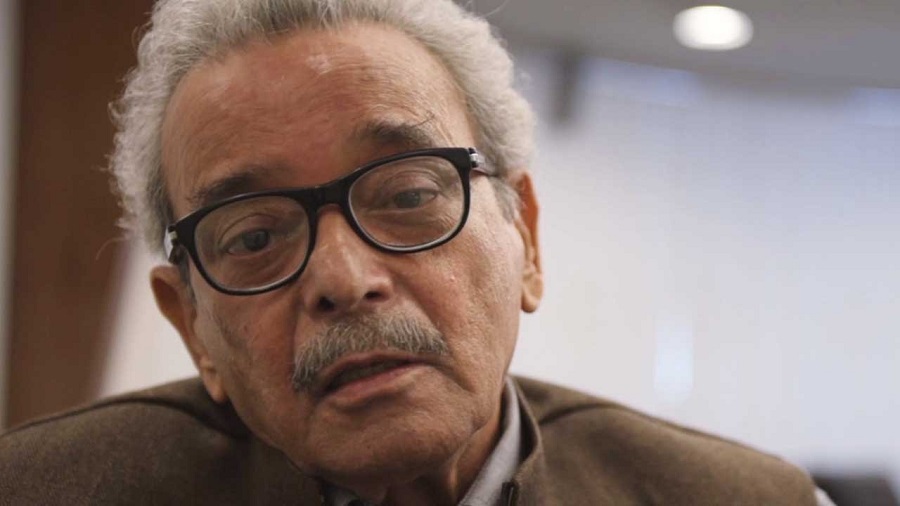
Shamsur Rahman Faruqi.

The legendary Urdu critic and Padma Shri awardee has contributed immensely to modern literary discourse

New Delhi :

Legendary Urdu writer and critic Shamsur Rahman Faruqi died in Allahabad, Uttar Pradesh, on Friday. His death came after a month of recovering from Covid-19. Faruqi, 85, was discharged from a hospital in Delhi on November 23.

“He had been insisting to go back to his home in Allahabad. We reached here only this morning and within half an hour he passed away at around 11,” Faruqi’s nephew and writer Mahmood Farooqui told PTI.

He used to live in Delhi after retiring as a chief postmaster-general and member of the Postal Services Board in 1994.

Faruqi was born on 30 September 1935 in Uttar Pradesh.

Author of several books, Faruqi has contributed to modern literary discourse with a profundity rarely seen in contemporary Urdu critics. His books of fiction, The Mirror of Beauty (translated into English from the Urdu Kai Chaand The Sar-e-Aasmaan in 2006), and The Sun That Rose From The Earth (Penguin India, 2014), have been highly critically acclaimed.

He used to edit a literary magazine Shabkhoon which he himself had launched. He is also credited with reviving “Dastangoi”, a 16th century Urdu oral storytelling art form.

Faruqi was the recipient of numerous honours including Padma Shri, Sahitya Akademi award and Saraswati Samman award.

His burial will take place at Ashok Nagar cemetery in Allahabad at 6 pm on Friday.

Writer William Dalrymple took to Twitter to mourn the demise of Faruqi.

“RIP, Janab Shamsur Rahman Faruqi saheb, one of the last great Padshahs of the Urdu literary world. This is such sad news,” Dalrymple said.

Sanjiv Saraf, the founder of the famous Rekhta portal, also condoled the death of “the century’s most iconic figure in the realm of Urdu literature”.

“His demise has left us bereaved as an entire generation of literature lovers mourn this loss. I extend heartfelt condolences to his family and loved ones,” Saraf said.

source: http://www.clarionindia.net / Clarion India / Home> India / by Team Clarion / December 25th, 2020