Tag Archives: Urdu Writers of India

National seminar on Prof. Abdul Qavi Desnavi on Apr. 1-2 in Bhopal

Desna Village (Block Asthawan – Nalanda District), BIHAR / Mumbai, MAHARASHTRA / Bhopal, MADHYA PRADESH :

Prof. Abdul Qavi Desnavi (November 1, 1930 – July 7, 2011)

Bhopal:

A two-day National seminar is being organised on “Prof. Abdul Qavi Desnavi Hyat Aur Adabi Khidmat” here on April 1 and 2 at Mulla Ramuzi Sanskriti Bhavan, the headquarters of Madhya Pradesh Urdu Academy, (MPUA).

The seminar is being organised by Ilma Education Society, Bhopal under the joint aegis of National Council for the Promotion of Urdu Language, (NCPUL) and MPUA.

Mr. Kailash Sarang, former Rajya Sabha member, will inaugurate the seminar on April 1 at 10 am which will be presided over by Urdu litterateur Prof. Afaq Ahmad.

AThe guests of honour on the occasion include: Mr. Aziz Qureshi, ex-member of Lok Sabha, Mr. Iqbal Majeed, Prof. Shakoor Khan, Prof. Muzaffar Hanafi and Prof. Ateequllah.

Prof. Afaq Husain Siddiqui will deliver the keynote address in the inaugural function while Kausar Siddiqui, director of the organising committee shall welcome the guests. Mr. Ali Mutaqqui Desnavi, the eldest son of late Prof. Abdul Qavi Desnavi will propose vote of thanks.

After the inaugural function there would be two sessions on April 1 and three on the next day. Two-and-a-half dozen scholars and writers from all over India will present their papers in different sessions of the seminar.

They include: Prof. Muzaffar Hanafi (Delhi), Mr. Ayub Waqif (Mumbai), Master Akhtar, Mr. Arif Aziz & Dr. Arjumand Bano Afshan (all three from Bhopal), Prof. Ateequllah (Delhi), Prof. Khalid Mahmood (Delhi), Maulana Syed Sharafat Ali Nadwi (Bhopal), Dr. Yaqoob Yawar (Banaras), Mr. Iqbal Masood, Mr. Rasheed Anjum & Dr. (Mrs.) Razia Hamid (all three from Bhopal), Dr. Saifi Sironji (Sironj), Prof. Manzar Husain (Ranchi), Prof. Afaq Ahmad (Bhopal), Dr. Maula Baqsh (Delhi), Mr. Naseem Ansari (Bhopal), Mr. Zia Farooqui, Mr. Ashfaq Mashhadi, Mr. Khalid Abidi, Dr. Mahtab Alam & Mr. Javed Yazdani (all six from Bhopal), Dr. Mohammad Nauman & Dr. Khalid Mubashshir (both from Delhi), Dr. Abdul Waheed Khan (Jabalpur), Mr. Naeem Kausar, Mr. Khursheed Akhtar (both from Bhopal), Dr. Shan Fakhri (Sironj), Mr. Habib Ahmad & Mr. Inamullah Lodhi (both from Bhopal).

Meanwhile, it may be stated here that Prof. Abdul Qavi Desnavi (November 1, 1930 – July 7, 2011) was an Indian eminent Writer, Critic, Bibliographist, Linguist and Scholar of Urdu language. He has authored more than 50 books on Urdu literature. His books were also translated in other languages. His important work was about Maulana Abul Kalam Azad, Mirza Ghalib, Allama Muhammad Iqbal and litterateurs of Bhopal.

He was recipient of several awards. He received Senior Fellowship from the Union Ministry of Culture, Govt. of India. His great treatise was a voluminous book on one of India’s frontline freedom fighter and first Union Education Minister Maulana Abul Kalam Azad over 900 pages titled “Hayat-e-Abul Kalam Azad” which he penned in the year 2000. It was acclaimed nationally and internationally.

Desnavi was born in Nalanda
Prof. Desnavi was born on November 1, 1930 in village Desna of block Asthawan in Nalanda district Bihar. He belonged to the family of Great Muslim scholar Syed Sulaiman Nadvi, who was one of the eminent historian and biographers of the Islamic Prophet Muhammad (PBUH), during his times. He was the second son of late Prof. S. M. Saeed Raza, who was Professor of Urdu, Arabic and Persian languages in St. Xavier’s College, Mumbai. His elder brother was Prof. Syed Mohi Raza and younger brother was Syed Abdul Wali Desnavi.

Education
Prof. Desnavi had his primary education in Arrah town of Bihar state. After completing his graduation & post-graduation in First Division from St. Xavier’s College, Mumbai, he joined Department of Urdu in Saifia Post Graduate College, Bhopal in February 1961. He went on to become Professor and Head of the Urdu Department of Saifia Post Graduate College. He was well-known literary figure in India and in the Urdu world.

His shining disciples
Many scholars, poets and teachers of today such as lyricist Javed Akhtar, Poet Mushtaq Singh, Prof. Muzaffar Hanafi, Selani Silwatte, Prof. Khalid Mehmood, Prof. Mohammed Naumaan Khan, Prof. Afaq Husain Siddiqui, poet Iqbal Masood, Dr. Iqbal Masood Nadvi, Ahsanuddin Farooqui, Khurshid Akhtar, Mohammed Naseem, Dr. Qamar Ali Shah, Prof. Yaqoob Yawar, Maulana Syed Sharafat Ali Nadvi, Prof. Arjumand Bano Afshan etc. were under his tutelage during their student days in Bhopal and are now sparkling in the Urdu world. Under his guidance many students attained Ph.D. degrees.

He retired in 1990. He was also holding many Honorary positions such as: • Additional Principal of Saifia Post Graduate College, Bhopal.(1983–1985); • Secretary of Madhya Pradesh Urdu Academy, Bhopal (1991–92); • Elected Member Majlis-e-Aam Anjuman Taraqqui Urdu (Hind), New Delhi (1979–1984); • Member of All India Anjuman Taraqui Urdu Board, New Delhi, (1977–1978); • Member of Program Advisory Committee, All India Radio, Bhopal (1978–1979); • Member Executive Council, Barkatullah University Bhopal, (1980–1982); • Chairman of Board of Studies, Urdu, Persian & Arabic, Barkatullah University Bhopal, (1977–1980) and (1984–1985); • Dean Faculty of Arts, Barkatullah University Bhopal, (1980–1982) & • Member Working Committee, Taj-ul-Masajid, Bhopal (1997-2007)

Awards
Prof. Desnavi received many awards in his lifetime such as Shibli Award, Mumbai, 1957; Senior Fellowship, Ministry of Education & Culture, Government Of India for 4 Years, 1979-1983; Sanad “Imteyaz Meer” All India Meer Academy, Lucknow 1981; Nawab Siddique Hasan Khan Provincial Award, Bhopal 1986; Bihar Urdu Academy Award, for recognition of Urdu services (1988–89) & (1989–90); All India “Parvez Shahidi Award” West Bengal Urdu Academy, Calcutta 1998.

His books
The books Prof. Desnavi authored to enrich the Urdu literary world included: Ek Aur Mashriqi Kutub Khana (1954); Hasrat Ki Siyasi Zindagi (1956); Aur Hindustan Jag Utha (1963); Allama Iqbal Bhopal Mein (1967); Mazameen Lisan-un-Sidque (1967); Bhopal Aur Ghalib (1969); Ghalibyaat (1969); Nuskha-e-Bhopal Aur Nuskha-e-Bhopal Sani (1970); Qadir Nama-e—Ghalib (1971); Anis Numa (1973); Ek Shahar Panch Mushahir (1973); Nazr—e-Sajjad (1974); Mota’ala—e—Khotoot—e—Ghalib 1975, (Edition 2nd 1979); Saat TahrireiN (1975); Hindustan MeiN Iqbaliat (1976); Talash-o—Taasur (1977); Mehdi Hassan Efadi (1977); Iqbal Uneesween Sadi MeiN(1977); Mirza Salaamat Ali Dabeer (1977); Bachon Ka Iqbal (1978); Iqbal Aur Dilli (1978); Abdul Haque Banam Mahvi (1980); Nazr-e-Takhallus (1981); Mota’ala-e-Ghobar-e—Khatir (1981); Dhanpat Rai Nawab Rai Premchand (1981); Iqbal Aur Darul Iqbal Bhopal (1983); Iqbaliat Ki Talash (1984); Yadgar—e—Sulaiman (1984); Iqbaliat Ki Talash Publisher, Globe Publishers, Urdu Bazar Lahore, Pakistan (1985); Armoghane-Saifia (Co—Editor) (1986); Abul Kalam Azad (1987); Maulana Abul Kalam Mohiuddin Ahmad Azad Dehlavi (1988); Mahanama Lisan-un-Sidque (1988); Yadgar—e—Azad (1989); Mataihiyat (1989); Talash—e—Azad; Talash-e-Azad, Shaqsiyat, Khidmat, Chand JhalkiaN (1990); Jawaharlal—o—Azad (Co—Editor) (1990); Ajnabi Shahar (1992); Fakhernama (Co—Editor) (1997); Urdu Shairi Ki Gayarah AwazaiN; Masreen wa Mutaliqat Azad; Hayat Abul Kalam Azad (2000); Bombai Se Bhopal Tak (2004); Dur Dais Se (2005); MaiN Urdu Hoon (2006).

His books translated in other languages are: Abul Kalam Azad in Hindi language Translated by Janki Prashad Sharma, Publisher Sahitya Akademi (1987); Abul Kalam Azad in Punjabi language Translated Inder Singh Raz Publisher Sahitya Akademi (1988); Abul Kalam Azad in English language translated by Syeda Syedain Hamid Publisher Sahitya Akademi(1991); Abul Kalam Azad in Maithili language translated by Fazlur Rehman Hashmi, Publisher Sahitya Akademi (1994)

The awards Prof. Desnavi received on his books are: Saat TahrireiN – Uttar Pradesh Urdu Academy Lucknow, 1975; Uneesween Sadi Mein Iqbal – Bihar Urdu Academy Patna, 1977; Mota’ala-e-Khotoot Ghalib – Bihar Urdu Academy Patna, 1979; Mota’ala-e-Ghobar-e-Khatir – Bihar Urdu Academy Patna, 1981; Iqbaliat Ki Talash – Bihar Urdu Academy Patna, 1984, Abul Kalam Azad Academy, Bihar Urdu Academy Patna, 1987; Yadgar—e—Sulaiman – Maghribi Bengal Urdu Academy Calcutta, 1984; Talash—e—Azad – Uttar Pradesh Urdu Academy Lucknow, 1991; Talash—e—Azad – Bihar Urdu Academy Patna, 1991; Talash—e—Azad – West Bengal Urdu Academy Calcutta, 1993; Urdu Shairi Ki Gayarah AwazaiN – Uttar Pradesh Urdu Academy, Lucknow, 1993; & Urdu Shairi Ki Gayarah AwazaiN – Bihar Urdu Academy, Patna, 1993.

Under his guidance the Ph.D. degrees were awarded by Barkatullah University to • Dr. Muzaffar Hanafi – “Shad Arfi Shaksiat Aur Fun” 1974 Published – 1977; • Dr. Hadiqa Begum – “Abdul Rehman Bijnori Hayat Aur Khidmat” 1981 Published – 1984; • Dr. Naseem Shanvi- “Urdu Tanquid Ka Marxi Dabistan” 1981; • Dr. Mohammed Ayub Khan – “Iqbal Aur Gazal Goi” 1982; • Dr. Safia Wadood – “Takhalus Bhopali Hayat Aur Khidmat” 1984 Published – 1993; • Dr. Arjumand Bano – “Riasat Bhopal Aur Mushahir Urdu” 1989; • Dr. Shan Ahmed Fakhri – “Sironj Ki Khidmat” 1990 Published – 1999; • Dr. Yaqoob Ali Khan – “Taraqqui Pasand Shairi Aik Jaiza” 1990 Published – 1997 and • Dr. Mohammed Naumaan Khan – “Bhopal MeiN Urdu Inzamam Ke Baid”1990.

Poems
The poems composed on Prof. Desnavi include: • Pasban-e-Urdu by Rahbar Jaunpuri; • Nazre Abdul Qavi Desnavi by Arshad Siddiqui; • Anjuman Ilm-O-Kamal by Zafar Sahbai; • Herf-e-Khuloos by Kausar Siddiqui; • Shan-e-Imtiaz by Zafar Naseemi; • Qandil-e-Hikmat, Abdul Qavi Desnavi by Wafa Siddiqui;

• Kharaj-e-Tehsin by Arman Akberabadi; • Pahchaan Hai Saifia by Kamil Baihzadi; • Prof. Abdul Qavi Desnavi by Mateen Qurashi Shaheed and • Aik Nazem by Iqbal Masood.

Last breath
Prof. Desnavi died at about 5 am on 7 July 2011 in a private hospital where he was admitted following complaints of old age related diseases. He is survived by his wife, three sons and four daughters and a large number of relatives and literary friends to mourn his loss.

(pervezbari@eth.net)

source: http://www.twocircles.net / TwoCircles.net / Home> Indian Muslim> Literature / by Pervez Bari, TwoCircles.net / March 30th, 2012
Renowned Urdu writer Abul Lais Javed passes away

Sasaram, BIHAR / Abul Fazal Enclave, NEW DELHI:

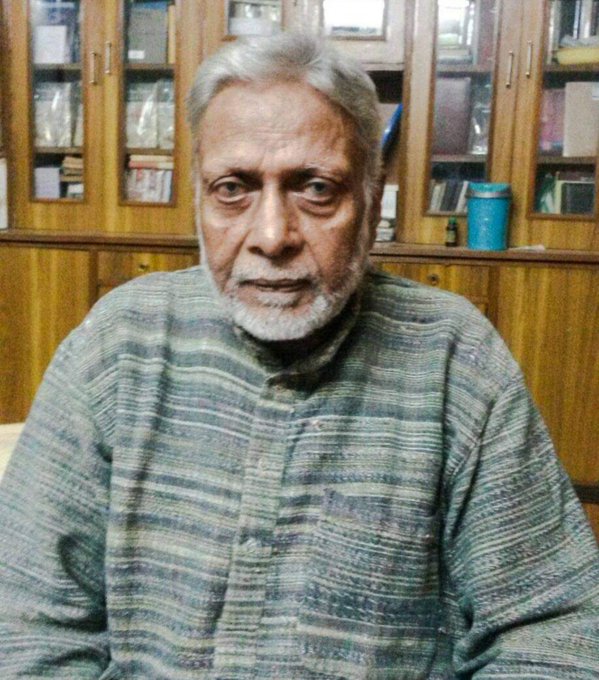
Renowned Urdu writer Abul Lais Javed passes away

Renowned Urdu writer Abul Lais Javed passed away today in Al Shifa Hospital at 5.15 pm after prolong illness, according to a close family friend.

Author of several books and a retired Bihar Government senior employee, he was unwell for the last many months and was suffering from prostate cancer and other ailments.

He was 85 years old.

After retirement, Abul Lais Javed settled in Abul Fazal Enclave with his family and devoted his time to writing Urdu books.

Very recently, he wrote a book on history of Akbarpur in Sasaram his hometown.

Namaz-e-Janaza and tadfeen is to take place on Tuesday at 9 am in Shaheen Bagh graveyard, said a reetired Jamia school teacher Mohammed Shamim, very close to the family.

He was admitted in Al Shifa for the last one week. He was a resident of H17 Abul Fazal Enclave.

source: http://www.theokhlatimes.com / The Okhla Times/ Home> Local / by the okhla times / May 22nd, 2023

How the pandemic is depriving lovers of Urdu literature of their environment for enjoyment

INDIA:

Discussions and debates, critiques and readings, held at haunts of Urdu books and writing around the country have been interrupted rudely.

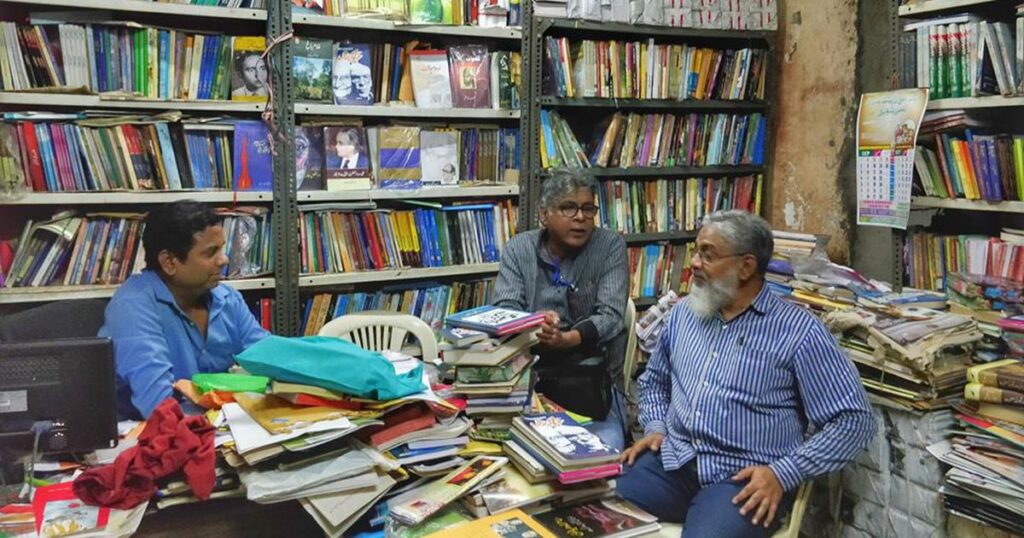
(From left) Shadab Rashid, Urdu drama writer Aslam Parvez, and Shakeel Rasheed at Kitabdaar | Mahtab Alam

In Malegaon

On the first Saturday of every month, the textile city of Malegaon in northern Maharashtra used to become home for lovers of Urdu literature, who meet to discuss, debate and critique new writings in the language, mostly by local writers. Organised under the aegis of Anjuman Muhibban e Adab (Association of Literature Lovers), the gathering began at around 9 pm, and went on till midnight.

Between 30 and 50 people – both writers and readers – would come together, a number that would at times go up to as many as 100 or even 150. Asif Iqbal Mirza, the secretary of the Anjuman, said the practice began 25 years ago on the suggestion of local journalist and editor Samiullah Ansari, who published new Urdu fiction in his weekly, Hashmi Awaz.

Over the years, the publication had emerged as a popular local magazine for young and budding writers to publish their works. The weekly, now in its 35th year of publication, had a considerable fan following and readership at the time. Ansari then suggested that admirers of the magazine form a group comprising readers as well as writers.

The group was initially named Anjuman Muhibban e Hashmi Awaz (Association of Admirers of Hashmi Awaz), but within a few years, its following grew to encompass more than just the readers of the magazine, and in 1998 it was rechristened Anjuman Muhibban e Adab, Malegaon. “Ansari sahib formed the Anjuman so that writers could get their new works critiqued by readers before getting them published in the weekly,” Mirza ssid.

Back then, Mirza himself wrote for a local children’s newspaper called Khair Andesh. But his association with the Anjuman helped him grow into a prolific Afsana Nigar, a short story writer. He was 17 when the group was formed; in the past 25 years, he has written and published more than 200 short stories in different publications.

Apart from Anjuman Muhibban e Adab, there are two more literary groups in Malegaon that held regular meetings until the lockdown was declared in March. No such meetings have been held since then. “Unlike earlier, we now have enough time to read and write. But the irony is we don’t have the opportunity to discuss and publish them,” said Mirza, who also runs a printing business. Several local publications had to halt their issues, including Hashmi Awaz, owing to the lockdown.

According to Mirza, although social media outlets such as WhatsApp and Facebook have, to some extent, helped to keep in touch with fellow writers and readers, the literary life of Malegaon has come to a standstill, since a large number of local writers and readers came from the working class and worked in local looms. “The year 2020 is the silver jubilee of my literary career. I had plans to publish a collection of my short stories, but thanks to the pandemic, that will not happen this year,” Mirza said with a great sense of despair.

In Mumbai

Both readers and writers have felt a deep loss during the pandemic. His love of books took Shakeel Rasheed, editor of the Urdu daily Mumbai Urdu News, to various bookshops in and around the Mohammad Ali Road area of Bombay. “Visiting bookshops was a part and parcel of my life. I feel a deep loss when I don’t visit them,” he said. For him, bookstores are not just spaces to buy books, but they also served as addas for readers and writers. As soon as some relaxations were in place, he rushed to the stores. “Par ab pahle wali baat nahi rahi,” said Rasheed. “Things are not as they were before.” The pandemic has made it more difficult to meet new people.

Shadab Rashid’s Kitabdaar publications and bookstore in Temkar Street of Nagpada was one such adda for Urdu writers in Mumbai, as was Maktaba Jamia on Sandhurst Road West. Today, Kitabdaar and a few other bookshops have opened their stores for a few hours every few days, while Maktaba Jamia remains closed. “Due to lack of public transport and fear of the pandemic, people cannot come to Kitabdaar,” Shadab said. He also edits the quarterly literary magazine Naya Waraq, founded by his late father and noted journalist and writer Sajid Rasheed.

Shadab Rashid said the lockdown brought significant hardships and losses to Urdu publishers and distributors. “It is not that people don’t want to read Urdu books anymore – the problem is they cannot buy them,” he said. “I have received lots of online orders, but I cannot fulfill them because I rely on postal services as they are the cheapest means of delivery, but the services are not fully functional yet.” His online Urdu bookshop kitabdaar.com is one of the few digital distribution platforms for Urdu books exclusively in India. Another such platform, urdubazaar.in, was recently launched from Delhi.

Owing to the discontinuation of physical interactions between readers and writers, people have lost touch with each other, since not all Urdu writers are active on social media, Shakeel Rasheed told me. “We have lost many good writers during this period and found out about their demise several days later,” he added. “Moreover, we could not participate in their last journeys.”

In Hyderabad

Another writer recounted similar thoughts after the death of noted Urdu satirist Mujtaba Hussain in Hyderabad on May 27. Hussain was awarded the Padma Shri in 2007 for his contributions to Urdu literature, but in December 2019, he announced he was returning the award to protest the enactment of the contentious Citizenship Amendment Act. “[T]he democracy for which I fought is under attack now and the government is doing that,” he had said, “that’s why I don’t want to associate the government with me.”

In Hyderabad, another centre of Urdu writing, literary activities have come to a similar halt due to the pandemic. Publications like Shagoofa, a monthly magazine of satirical writing, have been temporarily discontinued since the lockdown.

In Delhi

In Delhi, too, the pandemic has left an adverse impact on Urdu writing. Khan Rizwan, a poet and a known “addebaaz” from Delhi, loved participating in and organizing adabi addas (literary gatherings). He misses visiting the Nai Kitab book store, located in one of the many bylanes of Jamia Nagar, which is one of the famous addas for Urdu lovers in the city. Run by veteran writer and publisher Shahid Ali Khan, Nai Kitab is a haven for young and old writers alike, Rizwan said, as Shahid sahib treated them alike. “It is not just a bookshop but an institution where one got to meet noted writers and lovers of Urdu literature,” he said.

Rizwan would visit the shop at least twice a week, and meet a new literature enthusiast or writer, or find out about a new book or risala /parcha (journal/magazine). “I miss the black tea and chips that Shahid sahib served us with love and affection,” he recalled. “He is a storehouse of information, and several veteran writers were his friends, so he would tell us stories all the time.”

I couldn’t agree more with Rizwan. I have been visiting Nai Kitab once every few months for more than a decade now, and on each of my visits, after asking khabar-khairyat, Shahid sahib would say, “Achcha aap bahut dino baad aayen hain, ye nayi kitaabein aayi hai dekh lein (Since you’ve come after a long time, here are some new books).” Last year, when I visited the bookshop around this time, he directed me towards dozens of books written by noted Urdu satirist Fikr Taunsvi and Shaukat Thanvi. I immediately bought all of them, as they were usually out of print and seldom available.

As the person in charge of the Maktaba Jamia, the publication division of Jamia Millia Islamia in Bombay, Shahid Sahib befriended writers and poets like Jan Nisar Akhtar, Meena Kumari, Sahir Ludhianvi and Jagan Nath Azad. Some of them were regular visitors to the Maktaba Jamia. Though he moved to Delhi after serving the Maktaba for several decades, he did not stop hosting literature lovers. He then founded Nai Kitab publishers and a quarterly journal by the same name.

It was in 2007 at his bookshop that I first chanced upon Shamsur Rahman Faruqi’s celebrated novel Kai Chand The Sare Aasman, later translated into English as The Mirror of Beauty by the author himself. The novel went on to become a major critical and commercial success.

Faruqi was also associated with the Nai Kitab journal as chairperson of its advisory council and would visit the shop once in a while. The journal eventually stopped publication owing to Shahid sahib’s failing health, but he continued with the bookstore as it was like “oxygen for him”, he had once told me.

Waiting for freedom

Some writers have managed to turn the lockdown into a creatively productive period. “Personally, the pandemic has proved as a blessing in disguise as I read books I wanted to for years and finish other important work, such as recording videos of Urdu literature lectures,” says Khalid Mubashir, a poet and assistant professor of Urdu literature at Jamia. He quickly added, however, this was not common, as most writers and poets were stuck at home, either because of their age or in fear of the pandemic. “Moreover, not all writers have access to technology and books like I do. I am fortunate enough to have friends who helped me with technology to do something substantial during this period.”

Mubashir’s videos, as many as 60 of them, are each about 30 minutes long, and cover the history, evolution and development of Urdu and its literature in the subcontinent. Though the lectures are prepared keeping in mind the need and syllabus of Urdu literature students, ordinary Urdu lovers can also benefit from them. All lectures are available on the YouTube channel Safeer e Adab.

Similarly, although younger poets like Mohammed Anas Faizi from old Delhi have been trying to keep Urdu literature gatherings going by using social media, online addas do not have the feel and impact of offline and in-person gatherings. “Technology and social media can only help to a certain extent. Online gatherings, mushairas and addas cannot substitute for the real ones, no matter how well they are done,” he said.

With apologies to Faiz Ahmad Faiz, what the Urdu writers, poets and addebaaz seem to be telling the pandemic is:

Gulon Mein Rang Bhare Baad e Nau Bahar Chale
Chale Bhi Jao Ki Gulshan Ka Karobar Chale

Mahtab Alam is a multilingual journalist and until recently was the executive editor of The Wire Urdu. His Twitter handle is @MahtabNama.

This series of articles on the impact of the coronavirus pandemic on publishing is curated by Kanishka Gupta.

source: http://www.scroll.in / Scroll.in / Home> Publishing and the Pandemic / by Mahtab Alam / July 14th, 2020