Mumbai, MAHARASHTRA :
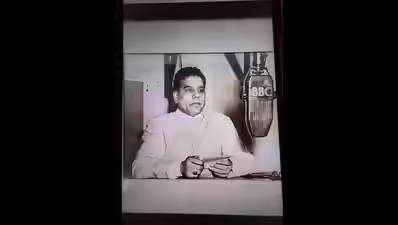
Barrister Mohammed Yaseen Nurie who served as a Minister in B.G. Kher’s cabinet
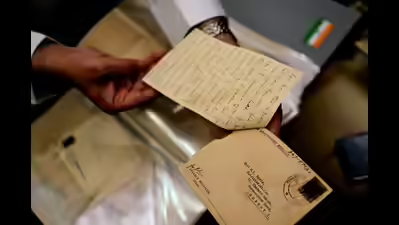
The lane leading from the iconic Mahim Dargah to Mahim police station has an important address: Nurie Villa. But you may never know it unless you enter the haveli-like home and meet its owner Owais Shakir Nurie. At the house’s delightfully decorated drawing room, Owais, 54, pores over a heap of old letters carefully kept in folders.
Look carefully as these letters, mostly typed but many handwritten too, reveal a lot about what Owais calls “the unsung hero, the forgotten freedom fighter who took Pakistan founder Muhammed Ali Jinnah head on.” These letters are addressed to Barrister Mohammed Yaseen (M Y) Nurie (1895-1971), Owais’s grandfather who lies forgotten in the saga of freedom struggle.
If our freedom movement, especially the years after Quit India Movement leading to Independence pockmarked by partition, was strikingly eventful, Nurie must occupy the place of an important player. Educated at Mohammedan Anglo-Oriental College (Aligarh Muslim University since 1920), Barrister from England, incarcerated for two years during Quit India Movement (1942), opposed Jinnah so much that he called Nurie “my fiercest competitor”, elected MLA from Ahmedabad in the 1937 provincial elections for the Bombay province which included Gujarat, made minister of public works in the B G Kher cabinet, Nurie played multiple roles and yet remains largely unsung.
Letters written to him by luminaries like Jawaharlal Nehru, Sardar Vallabhbhai Patel, Lal Bahadur Shastri, Morarji Desai, Syed Mahmud (External Affairs Minister), V K Krishna Menon (Defence Minister), S K Patil (Transport and Communications Minister), testify to Nurie’s importance in national and Maharashtra’s politics.
Yet, if Nurie does not figure immediately in the national imagination created and promoted, post-Independence, through careful curation and diligent deletion, blame it on the “syndicate” within the Congress party which suffered Indira Gandhi’s wrath for opposing her politics.
“Since my grandfather was in the syndicate led by the likes of K Kamraj and Morarji Desai, he too was denied positions in the 1960s and a place in the government-backed history projects,” says Owais, a govt contractor. “My father (Shakir Nurie) had seen how his father and the family suffered for siding with the Syndicate.”
The family was evicted from its rented Colaba home. “Nobody knew that there existed a tranche of letters, photographs and other documents related to my grandfather’s role in the freedom struggle and his interactions with so many important leaders till I opened the cloth bundle dumped at our Bewar (Rajasthan) haveli,” says Owais.
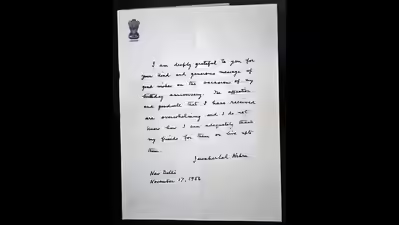
In his handwritten letter (November 17, 1956), Nehru profusely thanks Nurie for his birthday wishes. Through a 31st July, 1954 letter from Istanbul (Turkey), a director friend informs Nurie how Mehboob Khan-directed, Dilip Kumar-starrer Aan (1952) was a huge success in Egypt and he wants to show it in Turkey too.
Among the Nurie papers is a detailed protest letter Nurie lodged against a proposal to turn the historic Khilafat House in Byculla into a musafirkhana for Haj pilgrims. “It was due to his protest that the Khilafat House did not become the Haj House (it came up much later near Crawford Market). Nurie sahab had served the Khilafat Movement and knew its importance in our national life,” observes Khilafat House’s trustee Rauf Pathan, currently engaged in the redevelopment of this iconic building.
Owais thanks his friend Sunil Bhatia who drew his attention to the blog created by the Ministry of Culture as part of its initiative on “unsung heroes” under the Azadi Ka Amrit Mahotsav. Ministry officials jumped with excitement when they saw some of the letters and requested Owais to collect and add more credible information to the project on Nurie’s life.
At a meeting in 2018 in Ahmedabad, held by businessman Zafar Sareshwala, a Hindu businessman felicitated Owais after he learnt he carried the Nurie legacy, the freedom fighter who opposed Jinnah and, as PWD minister (1937-39), must have overseen work on Queen’s Necklace , Marine Drive.
source: http://www.timesofindia.indiatimes.com / The Times of India / Home> News> City News> Mumbai News / by Mohammed Wajihuddin / May 24th, 2026