When he is not writing a novel, he writes stories for children. And, when he is not penning these stories, he may compose poetry for a change of taste or suddenly come up with a book on personalities of his city.
Wakeel Najeeb is not just among the most prominent authors, he is the most prolific writer in the region. For people interested in Urdu litrature across the country, when the conversation shifts to this region, it’s his name that instantly comes to minds.
And a visit to Nagpur is incomplete until one meets him. In the serpentine lanes near his house, ask anyone–an elderly man or a young boy, everyone knows him and can guide you about the address or directly take you to his house.
Th writer is at the centre of Urdu literary activities in Nagpur. On my visit to the town, I tried to locate his house and almost everyone I came across on way, was ready to take me to his place. Apart from novels, he has several collections of stories and short-stories, poems and two travelogues to his name. Also, there is a collection of plays and hold your breath–20 novels.
He is among the few authors who have focused on writing for the children. Many of his novels are for children apart from nazms and stories. Though he started his literary journey with ‘afsana’ [short story], he got more fame because of writing for children as he also gets published in the magazines across India.
“Somehow a label was put on me that I write stories for children and a I am writer exclusively for kids, though I have collections of short stories and have written fiction, not just for children”, he explains. Of course, Najeeb, has written extensively and also writes critical pieces, essays and articles.
His most recent work is a book, ‘Meri Basti, Mere Log’. The book contains his write-ups on interesting personalities he saw around him as he grew up and others in his city. The profiles include people from diverse fields–wrestlers to clerics and writers to sufis. Already hundreds of copies of the book have been sold.
“Frankly, I do my best to publicize my books. When I write, my aim is to make people aware about the book. You see this, he points towards the banner outside his house, which announces publication of his book. People come to know, arrive and buy”, he further says.
That’s a far cry from the writers who bemoan lack of readers or rue that there books are not being sold. Born on July 1, 1946, Wakeel Najeeb, studied at the local Urdu school. He went on to become a teacher and retired as principal of Islamia School. He is socially active, associated with institutions, literary groups and attends their meets. And, literally holds the literary fort in the region.
source: http://ww.newsbits.in / Newsbits.in / Home> Special / by Shams Ur Rehman Alavi, Bhopal / December 22nd, 2021
Kazi Jalil Abbasi was a leader, freedom fighter and politician who witnessed key events of twentieth century–not just as an observer but as someone who took active part in public life, participated in movements and after independence went on to fight elections and become a legislator, minister and Parliamentarian.
When a large number of Muslims from Uttar Pradesh including elite and the community leaders, were leaving the country, he remained committed to his political ideology, kept opposing communalism and led from the front–fighting and raising his voice democratically in independent India.
Uttar Pradesh, the heartland and the most populous state in the country, had been the battleground for Congress and Muslim League before 1947. It had seen competitive communalism, inter-religious tensions and riots. On the ground, situation in UP was complex and different from other states.
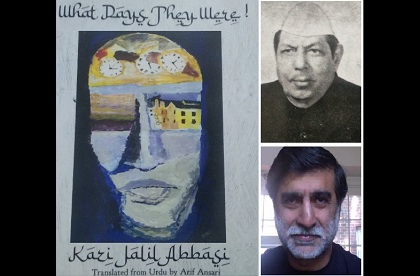
Kazi Jalil Abbasi’s autobiography is insightful and reveals a lot about the period and the struggles. Abbasi was born in Bayara in Basti district in1912. He studied in different schools in Gonda, Unnao and Basti before he joined the Aligarh Muslim University (AMU) from where he was expelled.
All these circumstances, his idealism, role in freedom struggle are part of the book. He was against the political stand of Muslim League. The books also provides information about Congress’ organisation and the politics in UP, its leaders. There are interesting anecdotes about top leaders, ranging from Rafi Ahmad Kidwai to Indira Gandhi.
The autobiography titled ‘Kya Din The!’ was originally published in Urdu.
Arif Ansari has now translated it in English. Ansari is settled in Washington DC. The book that runs into nearly 350 pages is a must-read for anyone who is interested in the era, important events and the post-partition situation in Uttar Pradesh.
More than seven decades after India achieved independence, the role of innumerable martyrs and freedom fighters who gave their blood and offered lives for the motherland, needs to be remembered.
Many of them got harsh punishments, didn’t get proper last rites, remain forgotten and even those whose sacrifices are known, don’t have monuments or memorials built in their memory.
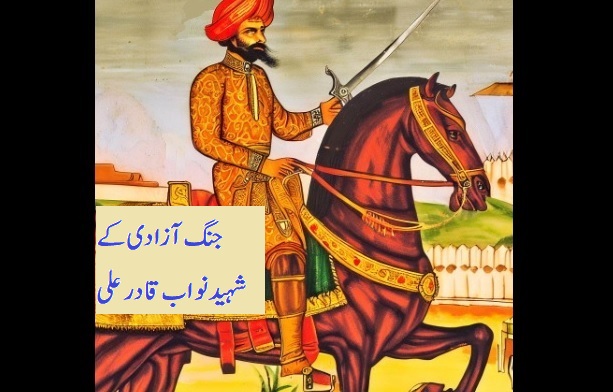
The martyrdom of Nawab Kadar Ali, and his companions, who planned attack on residency and to take on the East India Company forces in Nagpur, also needs to be recalled. They were hanged here for their role in 1857–the first war of independence.
Though there is no monument named after them and no big memorial, they remain heroes in public memory. The fort that had been a base of 118 Infantry Battalion for years, is opened on three days including August 15 and January 26. Thousands of people arrive on these days, and also pay visit to the grave and offer their respects.
The flame for independence was already lit. History books mention that soon after Meerut, the anger was palpable among soldiers and citizens in this region too. On June 13 1857, a large gathering took place near Mission High School. The soldiers too were anxious and ready.
Scared, some of the East India Compnay officials ran towards Kamptee Cantonment, while others went inside the Sitabuldi Fort. It was due to treachery that the attack plans had been leaked and the news reached British officers. More EIC forces were called from other places to control and overpower the rebels.
Rani Baka Bai, wife of late Raghoji II, was supporting the British and issued a warning that anyone abetting or aiding the revolutionaries would be arrested and handed to the East India Company. It’s a long story and how the soldiers and citizens suffered, refused to name the leaders of the movement.
Historical texts say that the signal of a fire balloon was decided. But after the traitors gave information to East India Company officers, Plowden, the commissioner, ordered a regiment to move into the city. The irregular calvary at Tali was dismayed. Major Arrow tried to get information from ring leaders but no one gave names.
Baka Bai summoned all her relations, and dissuaded them with threats. This chilled the spirit of public. However, later when Company officials’ strengthened their hold, the rebels were identified. Arms were collected and after inquiry, Dildar Khan, Inayatullah Khan, Vilayat Khan and Nawab Kadar Ali were tried and executed.
KILLED, HANGED, BURIED IN A COMMON PIT
The Gazetteer briefly mentions that ‘tucked away between the easter walls of the inner fort and the barracks is a large grave known as Nav Gazah Baba…the grave of Nawab Kadar Ali…and his eight associates..who were killed and hanged by the ramparts of the fort due to their role in the war of independence”.
“They were all buried in a common pit, nine yards long. The fort recalls to our mind the memory of the brave soldiers who fought in an attempt to preserve the independence of the mother land”. It was treachery that was responsible for the arrests and the punishment. Those who helped the British, got ‘jagirs’ as rewards.
Ghulam Rasool ‘Ghamgeen’, the poet, wrote these lines in Farsi :
Choo.n Qadar Ali Khan Ameer Kabeer Shud-az-tohmat, ahl-e-balwa aseer
Duaa’e shahaadat ba-raahe Khuda shab w roz mi kard aa.n mahtada … … Khirad guft ee.n misra-e-silk-e-noor Za-daar-e-jafaa shud ba-daar-e-suroor
The last couplet of this long Persian verse, brings out the ‘tarikh’, the year of execution. The complete verse is mentioned in Dr Mohammad Sharfuddin Sahil’s book ‘Tarikh-e-Nagpur’. It shows the impact of the hangings on the people in the region. Nagpur is geographillcally considered to be a part of Central India and is the biggest city in Vidarbha region of Maharashtra.
The fort for a long period remained the base of 118 Infantry Battalion of Territorial Army. Every year, on August 15 and January 26, fort is opened for public so that it can pay respect to the freedom fighters. It’s also opened on May 1 i.e. Maharashtra Day. [Illustration is representive]
source: http://www.newsbits.in / NEWS Bits / Home> Top News / by Shams Ur Rehman Alavi / August 15th, 2021
Nanil Village (Anantnag District), JAMMU & KASHMIR :
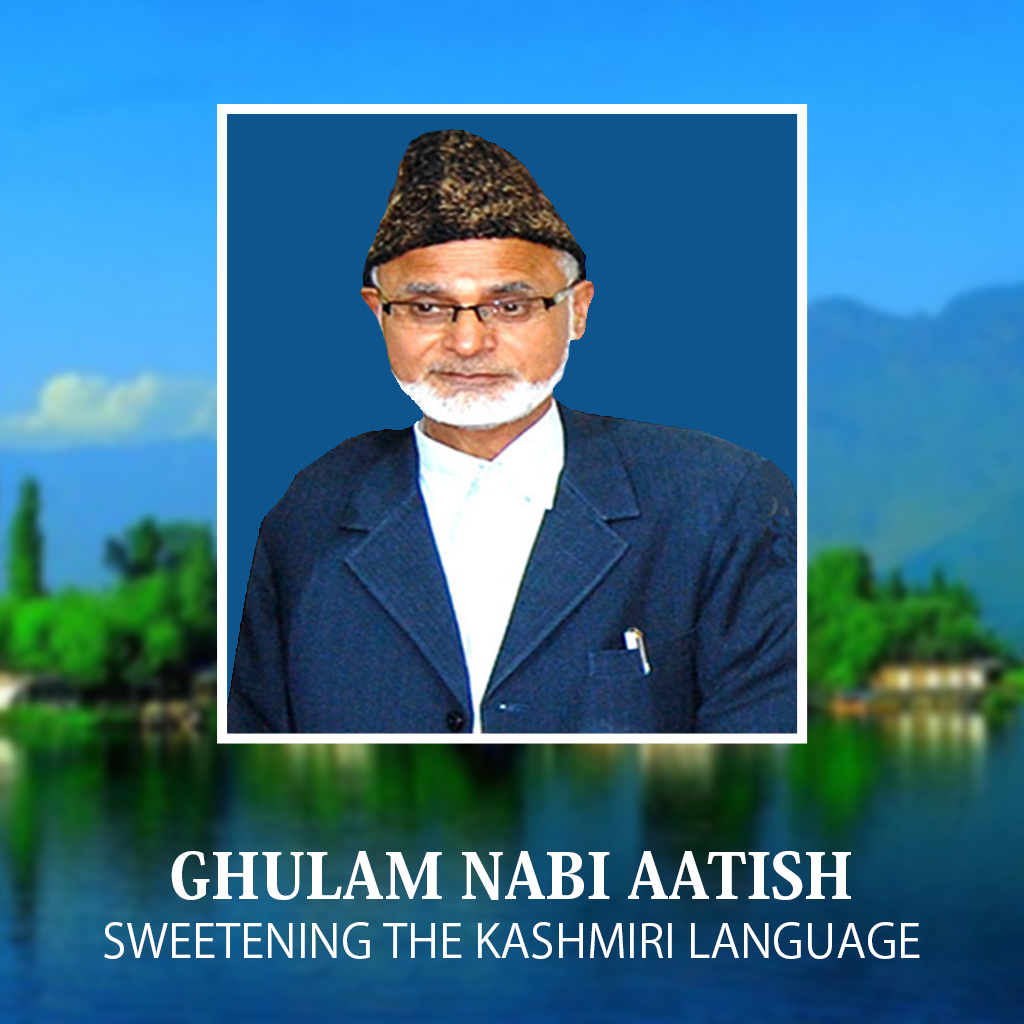
Ghulam Nabi Pandith alias Ghulam Nabi Aatash
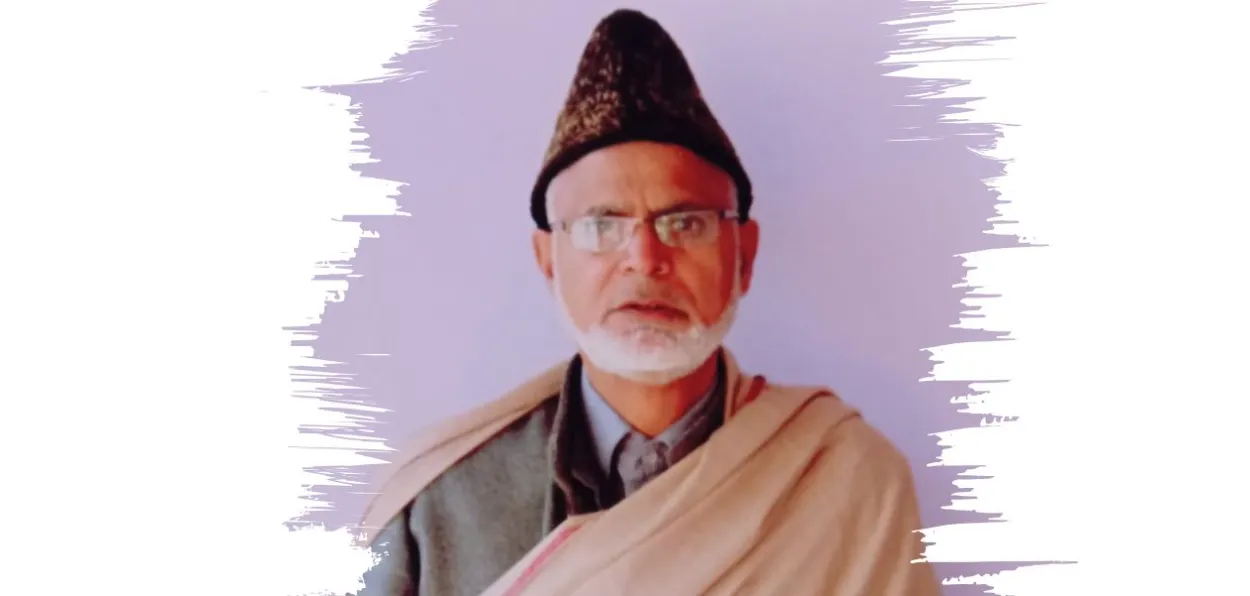
“Jayakanthan has focussed on the downtrodden people of South India. His works highlight the life and aspirations of the poor”, said Ghulam Nabi Pandith, known by his penname Ghulam Nabi Aatash, whose book has been selected for the annual Translation Prize for the 2024 Sahitya Akademi award.
Speaking with Awaz-the Voice from his home in Nanil village of the Anantnag district, about 70 km South of Srinagar, Aatash said “This (Jayakanthan’s) novel among his umpteen works also focuses on the same issues like the social and religious life of the people”.
Ghulam Nabi Pandith, popularly known by his penname Ghulam Nabi Aatash has been selected for the Sahitya Akademi Prize 2024 for his translation of the well-known Tamil writer Jayakanthan’s novel Oru Manidhan Oru Veedu Oru Ulagam” about the life of the poor people in South India. The book’s title in Kashmiri is “Akh Insaan, Akh Gharre, akh Duniya” (A Man, A Home, A World).
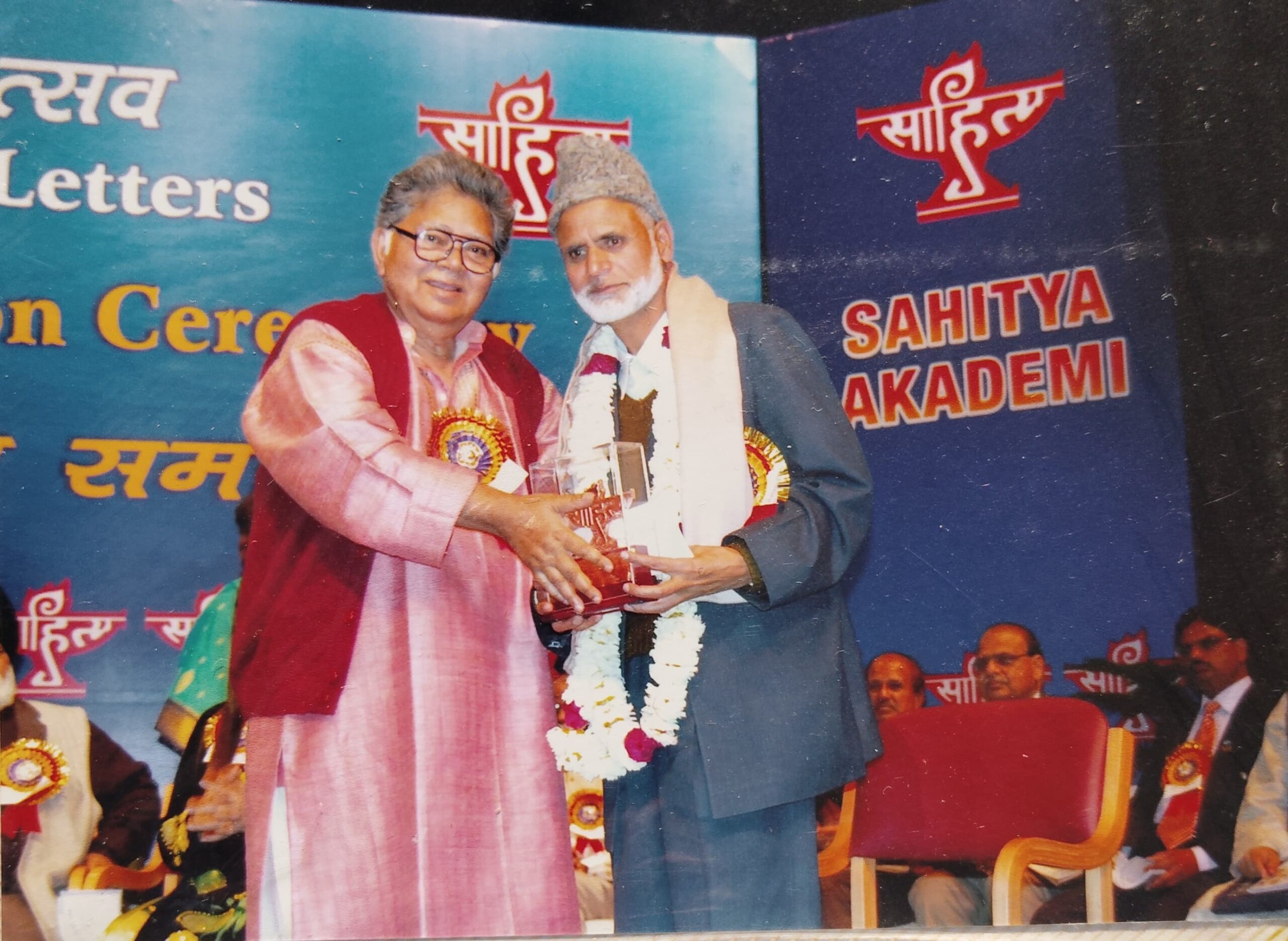
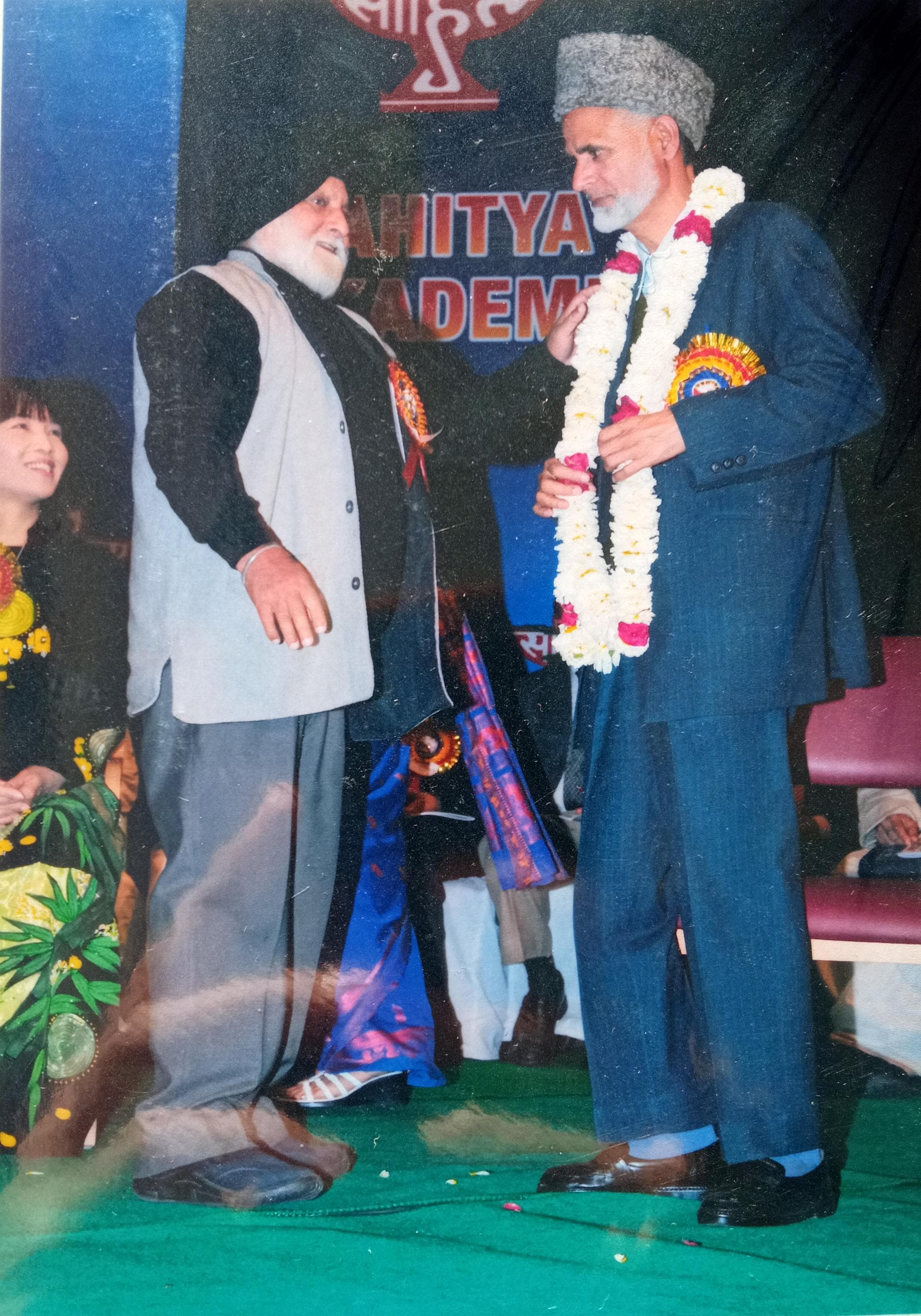
Ghulam Nabi Aatash receiving his Sahitya Akademy Award on an earlier occasion
He said the recipient of the Jnanpith in 2002 and Padma Bhushan in 2009, Jayakanthan is known for his works, many of which have been translated into different languages.
However, this is not the first Sahitya Akademi award for the Kashmiri writer and poet, Aatash, 76, who has been active in the literary circles of the Valley for over five decades.
His falling health during the past two decades has not deterred his literary activities.Despite this and praticularly his poor eyesight, Aatash has at least 10 manuscripts ready to be published. These include two books in Urdu and eight in Kashmiri languages. He told Awaz-The Voice that he would get his works published soon.
So far his 80 works including poetry collections, Research and Criticism, Folklore, Children’s literature, translations, and monographs have been published.
He was conferred the Sahitya Akademi award for Kashmiri language in 2008 and Bal Sahitya Puraskar (Sahitya Akademi) in 2011 for children’s literature. He was also the recipient of the international Soviet Land Nehru Award in 1981.
He first got the Best Book award from the J&K Academy of Art, Culture, and Languages in 1979 at the age of 30 year for his Kashmiri poetry collection “Zool Amaaran Hund (Illumination of my wishes)”.
He received the Best Book Award from the J&K Academy of Art, Culture, and Languages in Kashmiri criticism and research work “Sarmaaye teh Saam”. So far he has received at least 19 awards from literary and academic institutions and many felicitations from literary organizations and educational institutions.
These include at least 14 works in Kashmiri folklore and 13 works in children’s literature. His notable works include translations of foreign travelers’ travelogues on Kashmir. At least ten such works include “Kashmir ghair mulky sayaahoon kay safar naamon mein” (Kashmir in the travelogues of foreign travellers) and a publication in the English language entitled “Intangible Cultural Heritage of Kashmir.
As a school teacher, he nurtured his literary activities along the banks of the Lidder stream flowing from the upper reaches of Pahalgam in South Kashmir into river Jhelum.
Aatash retired as a Lecturer in higher secondary school 18 years ago.
Aatash taught in different schools at various levels for more than three decades during which he also worked as Zonal Coordinator of SSA, District Coordinator of Cultural Education Wing, Provincial Level Teacher Trainer/Resource Person.
He also helped many Ph D scholars and researchers in accomplishing their assignments.
Aatash was a member of the Expert committee constituted by the J&K Board of School Education for deciding the syllabus and textbook of Kashmiri language, and played a vital role in conceiving, compiling, and drafting all the textbooks”.
He has worked as a member of the Revision Committee of Urdu textbooks as well.
source: http://www.awazthevoice.in / Awaz, The Voice / Home> Stories / by Ehsan Fazili , Srinagar / March 19th, 2025
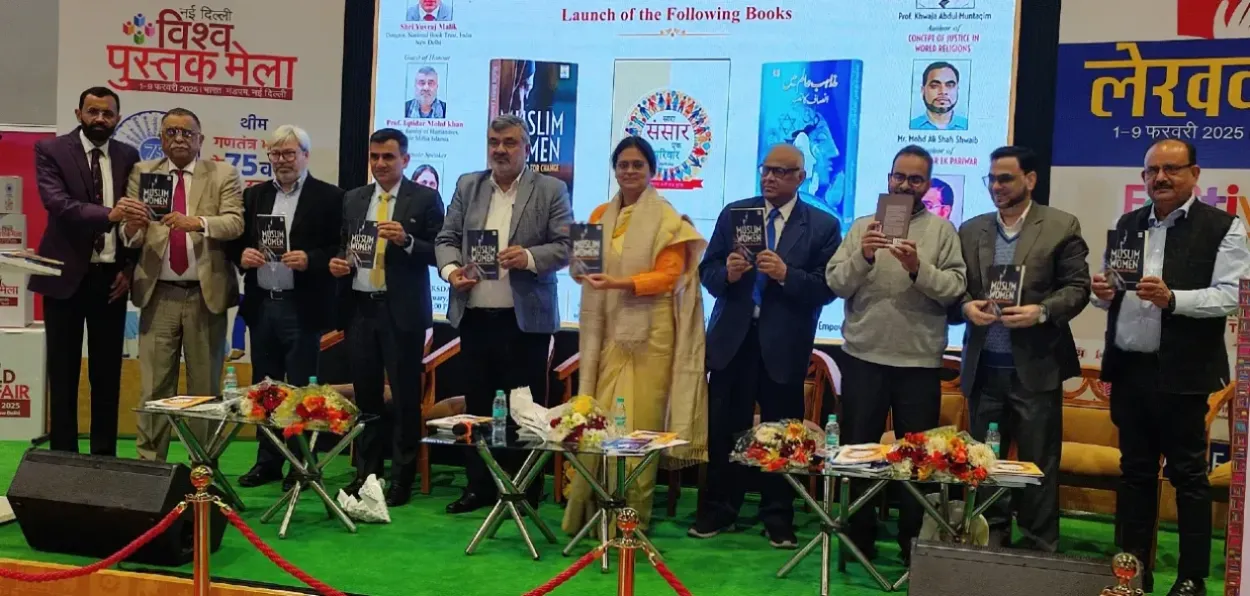
Muslim Women: A Manifesto for Change by Dr. Muhammed Maroof Shah is an insightful book that examines the challenges faced by Muslim women in India and offers practical solutions grounded in both religious teachings and social progress. The author balances tradition with progress, advocating for a model of empowerment that remains deeply rooted in Islamic values while promoting justice and gender equality, making this work a crucial addition to discussions on women’s rights in Muslim communities.
The book is divided into eight chapters, each addressing key issues that affect Muslim women. Rather than simply identifying problems, Shah provides practical solutions based on religious principles, ethics, and social policies. He touches on struggles like limited access to education, financial dependence, domestic challenges, and restrictions on movement. The book encourages both religious scholars and modern thinkers to engage in discussions rather than opposing each other and encourages communities to work together toward progress.
The author raises an important question—should discussions focus on rights or duties? He argues that understanding and fulfilling duties naturally lead to the realization of rights. His approach promotes fairness, where women can participate in society while respecting cultural and religious values.
Maroof Shah deeply engages with Islamic teachings to show how religion can be used to empower rather than limit women. He argues that many restrictions placed on women stem from cultural traditions rather than religious doctrine. His proposed roadmap for change includes the establishment of Women’s Welfare Funds, increased access to quality education, and a cultural shift towards recognizing women’s contributions beyond traditional roles.
The book also explores the financial burdens linked to marriage. Shah criticizes extravagant wedding traditions that place unnecessary pressure on women and their families. He suggests reforms to the Nikah Nama (marriage contract) to better protect women’s rights and encourage simpler and more affordable wedding customs. By reducing financial burdens in marriage and ensuring fairer agreements, women can become more stable and independent. Furthermore, he highlights how financial problems often limit women’s freedom to make choices and advocates for legal frameworks that allow control over finances and assets.
Another significant aspect of Shah’s book is his discussion of women’s well-being beyond legal and social rights. He talks about mental health, emotional support, and strong family relationships that help rather than confine women. Many struggles come from rigid social expectations, and the author calls for a shift in these norms to create healthier and more supportive communities.
He also urges religious institutions to play an active role in advocating for women’s rights, suggesting that mosques and Islamic schools can become platforms for educating people about gender justice, domestic violence, and financial independence. He further emphasizes the importance of media representation, encouraging more stories of empowered Muslim women to be highlighted in literature, film, and TV.
One of the greatest strengths of Muslim Women: A Manifesto for Change is its balanced perspective. The author finds a middle ground that resonates with a broad audience, acknowledging feminist concerns while reaffirming religious and ethical values, making the book relevant to scholars, activists, and policymakers. A recurring theme throughout the book is the importance of open dialogue—between men and women, religious scholars and reformers, and between tradition and modernity.
Shah emphasizes that meaningful progress comes from discussion rather than ideological confrontations. The book does not remain purely theoretical but offers practical steps to improve the condition of Muslim women, such as marriage reforms, financial education, and community welfare programs. Moreover, he provides examples from Islamic history where women played key roles in scholarship, leadership, and business, demonstrating that Islam encourages women’s participation in all areas of life.
The Book makes a significant contribution to the discourse on women’s rights in Muslim societies. By advocating for reform while staying grounded in religious and ethical values, Shah presents a compelling vision for progress. His emphasis on dialogue, action, and ethical responsibility makes this book an essential read for anyone interested in gender justice within an Islamic framework.
It encourages constructive discussions and practical reforms, offering hope for a more inclusive and rightful future for Muslim women. This book is highly recommended for academics, policymakers, social reformers, and Muslim communities seeking a balanced perspective on women’s empowerment.
The Khusro Foundation is a widely recognized organization in India and beyond, dedicated to fostering peace, harmony, and unity through literature and education. It has established a strong reputation for its efforts in promoting cultural understanding and truthful information about Islam. A major initiative of the foundation is the publication of high-quality literature in Urdu, Hindi, and English, to inspire, integrate, and unite the people of India.
It actively works to promote communal harmony, tolerance, and understanding among individuals from diverse faiths, religious practices, and cultural backgrounds. It is committed to generating and disseminating accurate information about Islam to counter misconceptions and misinformed narratives. By fostering dialogue and intellectual engagement, it strives to build a more inclusive and informed society.
The printing quality of the book is excellent, with a well-designed layout, clear typography, and high-quality paper. The attention to detail complements the depth and importance of the content, enhancing the reading experience.
The author is a former research fellow with INTACH and CCRT
source: http://www.awazthevoice.in / Awaz, The Voice / Home> Stories / by Dr Ruchika Arora / February 13th, 2025
‘When patients know their rights, hospitals will be more receptive to their demands’
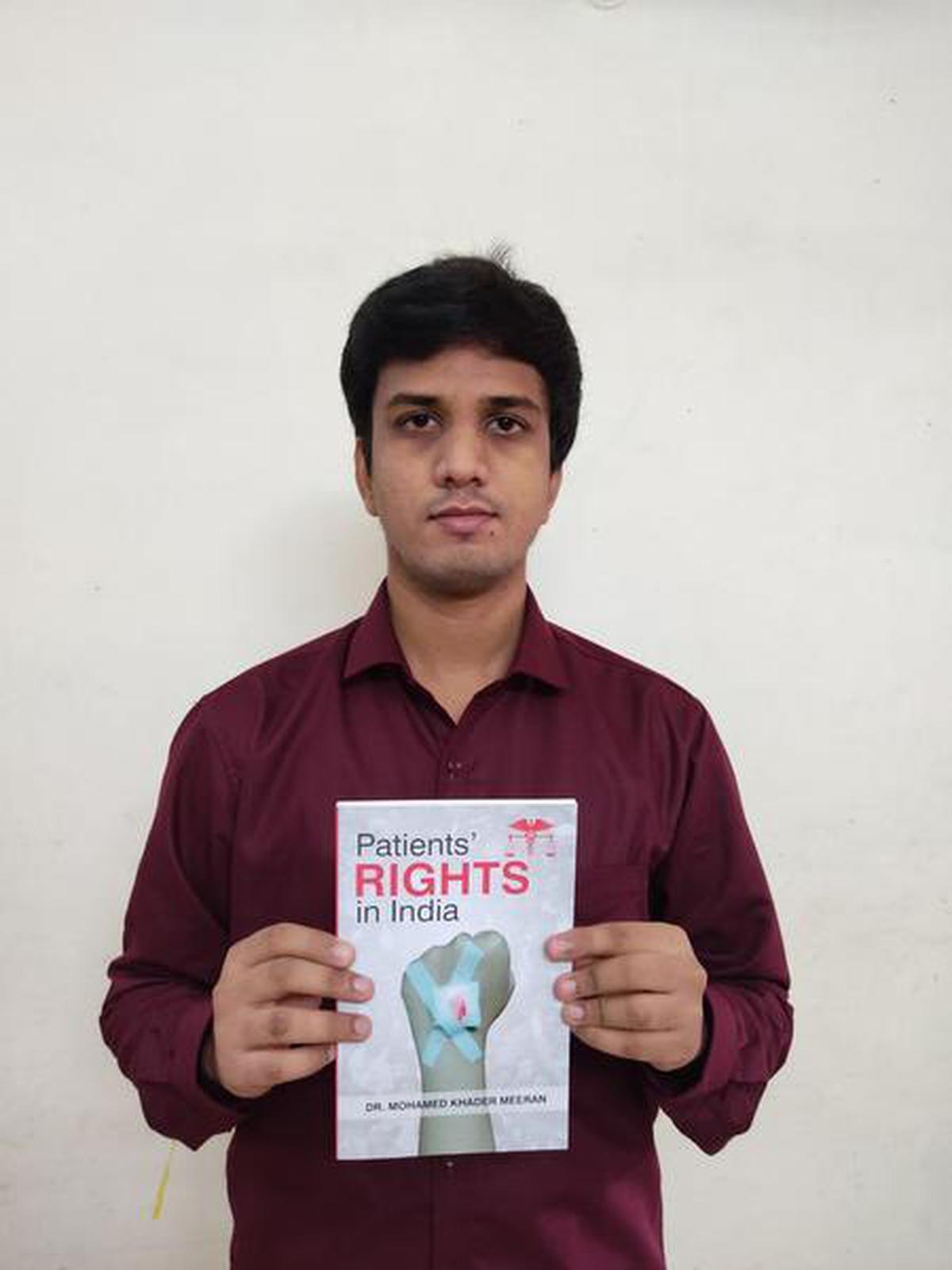
Dr. Mohamed Khader Meeran with a copy of his book ‘Patients rights in India.’
A medical graduate-cum-public rights activist in the city has brought out a handbook to raise awareness of patients’ rights, in the hope that people and healthcare providers can resolve issues amicably.
Mohamed Khader Meeran, 27, who completed his MBBS degree from Mahatma Gandhi Institute of Medical Sciences, Sevagram, in Maharashtra in 2020, and is a NEET aspirant for postgraduate studies, was inspired to write ‘Patients’ rights in India’ to specify the legal means of redress available in the wake of rising number of complaints related to hospitals and treatment options, especially during the pandemic.
He has been in the news for his advocacy work, notably for filing a public interest litigation (PIL) in Madras High Court, to launch online right to information (RTI) filing facility in Tamil Nadu State’s government departments in 2017. “Last year, there was a lot of misinformation being circulated about COVID-19. Patients’ health status details, which were meant to be confidential, were leaked through social media. Many hospitals were overcharging. Initially I was getting calls from within Tamil Nadu [for help], but as I had studied in Maharashtra, and was part of many student unions, we began coordinating with doctors there, to arrange for beds. This is when we felt that a handbook would be useful to tell patients about their rights,” Dr. Meeran told The Hindu .
Among the issues covered in the book are right to information; safe and quality treatment; seeking a second medical opinion, and so on. Initially published last year in Tamil, the English version of ‘Patients’ Rights …’, which was launched in October this year, is more detailed, with sections on government-sponsored health insurance schemes and contact details for grievance resolution.
“There are both legal and ethical angles when a patient comes for treatment. Since ethics is a vast field, I have narrowed it down to specific issues, such as cost of definitive treatment for ailments according to the patient’s paying capacity. We are focusing on how financial compensation can be accessed by patients,” said Dr. Meeran.
In real world
Case studies and legal rulings on medical issues help readers to understand how these rights work in the real world.
A chapter on alternative medicine calls for greater understanding between practitioners of Ayurveda, Yoga and Naturopathy, Unani, Siddha and Homeopathy (AYUSH) and modern medicine. “There are evidence-based treatments for some ailments in both systems, but alternative therapists should understand their limits, and advise their patients to seek assistance from modern medicine when necessary,” said Dr. Meeran.
When the patients know their rights, hospitals and medical authorities will be more receptive to their demands, he feels. “Patients’ rights are not taught in medical schools, because of which violence against healthcare professionals is rampant in India. This book could help reduce such instances,” he said.
source: http://www.thehindu.com / The Hindu / Home> News> Cities> Tiruchirapalli / by Nahla Nainar / December 03rd, 2021
Somewhere in 1951 Ghulam Nabi Pandit, a student of class 5 at a government school in Anantnag, had a daily chore of buying bread, filling…
pix: facebook.com/ Mumkin hai Yeh
Somewhere in 1951 Ghulam Nabi Pandit, a student of class 5 at a government school in Anantnag, had a daily chore of buying bread, filling water in Hookah, lighting stove for tea, and other such work assigned by the teachers.
For the last five years he had never understood a word from any of the books taught in the school. Branding him as good for nothing, many a time his teachers suggested his father to put the boy in some carpet weaving shop. However that summer something stuck to a pandit teacher at his school. He asked him ‘what are you supposed to do with your life, class 5 examination is round the corner, do you have any preparation?’ The boy answered in negative. The teacher told him to come to him during recess. The boy duly followed.
The teacher started teaching him right from the begening – class Ist books. It was primarily Urdu, little bit of Maths and English. The practice remained for next four to five months till the annual examination time. During this time he was taught all the books from Class 1-5 and surprisingly the boy was actually a genius and picked up fast every word that was taught to him.
Pandit cleared the class 5th examination much to the shock and surprise of other teachers, and even villagers.
After that there was no looking back and he cleared all examinations with flying colours. In class 10th he was one of the toppers in his district and he went on to have a distinguished career as an educationist and writer spanning around five decades and still going.
The transformation of Ghulam Nabi Pandit to renowned writer Ghulam Nabi Aatash is an inspirational story which shows how a teacher can turn an ordinary student into a legend.
“Sometimes I wonder how all this happened,” said Ghulam Nabi Aatash who was recently honoured at a function at Jammu Kashmir Academy of Art Culture and Languages. “In class 6, as if it was command of Allah to others, I was made Secretary of Bazme Adab, a literary forum. You can imagine just one year ago I was lighting stove and filling water in hookah in school and now I was writing proceedings of the elite gatherings.”
Though Aatash was lucky at many times, but it was his hard work and dedication that helped to capitalise on that luck. At the Bazme Adab, Aatash leaned towards writing, art and culture. He even became part of dramatic club. Much like other poets and writers, Kashmir and its social history attracted Aatash. Seeing his writing his Pandit teacher gave him pen name Aatash, who told him that it symbolise sour taste which has emerged after a lot of bitterness of life.
His family situation was not good either but he picked the best out of those difficult times.
“My mother was bedridden for seven years but she had amazing memory. She knew tonnes of folklores, phrases and traditional songs. I could connect my literary leaning and information from my mother. In addition to it my posting as a teacher in far off places and learning from their culture increased my knowledge,” said Aatash.
Known as the biggest name in Kashmiri Folklore, Aatash’s work in this genre has helped preserve a trove of knowledge for posterity. His books like Koshur Louke Shairi Vakhnay ti vetchnay (Kashmiri Folk poetry, research, analysis and its study in social perspective, Koshur Look Voture, Tahqeeq ti Tajheez (Kashmiri folklore research and analysis in historical and sociological perspective), Koshur Folklore, (Kashmiri folklore Research and analysis) and various volumes of Kashmiri folksongs, Kashmiri sayings and Kashmiri folktales indicate the amount of work Aatash has put in its endeavour.
“Folklore helps to understand the history of a nation. Its customs and working of society,” said Aatash. “Every word and phrase has sea of knowledge in it.”
In addition to the books, Aaatsh has published more than 100 entries in Kashur Encylclopedia Folklore, giving him a special name among the literary giants.
It is said that whenever JKAACL, Radio Kashmir or Doordarshan get stuck on some topic in Kashmiri and there seems to be no way out, they approach Aatish who within no time produced a quality paper based one research for them.
Parallel to his literary career, Aatash also progressed on his academic career which started first as a private school teacher and then as a government school teacher, which ultimately ended in his retirement as a lecturer in Kashmiri language. Most of his higher studies were done after his appointment as a teacher. He did his MA in Kashmiri and B.Ed from University of Kashmir.
Not only a folklorist, Aatash is a poet, critic, researcher, compiler and an expert on children’s literature too. His Khencha Mencha series for children has been well received in academic circles.
In 2013 he wrote a Kashir Shur Adbich Sombran, (An anthology of Children’s literature in Kashmiri). He was awarded Bal Sahitya Puriskar for children literature in 2011.
His expertise was utilised by Board of School Education (BOSE) roping him in as a member of expert committee for preparation of syllabus and text books of Kashmiri language from class 1st to 12. What could have taken half a decade or even a decade to complete, Aatash managed to complete the work, along with other members, in just 18 months.
“If you ask me about my pen, I would attribute a great deal of its refinement to Prof Amin Kamili and his legendary magazine Naeb. This quality magazine gave me a platform and its strict editing gave me a direction,” said Aatash. “Once Kamili saheb sent me back my draft seven times, before finding it worthy to publish. In todays time such a thing is unheard of.”
In 1978 when Aatash wrote a poetic collection Zool Amaran Huend (Illumination of longings), he thought nobody will like it. But the book ended up winning best book award for the year 1979. “At that time I was a simpleton. I didn’t even knew that books get award too. Somebody told me that JKAACL is accepting books for award but when I went to their office they said that date is already over and we had advertised it in radio and newspapers too. I replied that I neither have newspaper of radio access and somehow they accepted my entry,” said Aatash. “And then out of sudden I got the award.”
In 1981 together with S L Pardesi he translated Russian poet Alexander Pushkin’s poems into Kashmiri. The book received Soviet Land Nehru Award for the in the same year.
In Research and Criticism, one of the best books of Aatash is his Kasheer Hazrat Sheikh Noor-u-Din Reshi sends kalamas manz, (Kashmiri compilation about Kashmir as reflected in the poetry of Hazrat Sheikh Noor-u-Din Reshi RA) published in 1994. He has also been instrumental in bringing to fore some forgotten brilliant writers of Kashmir like Shamus Din Ahmad, Iqbal Nath Vanpoh, Abdul Ghani Thokar and others.
He has written two books in Urdu language too, Kashmiri Lok Adab (Kashmiri folk literature) and Kashmir Angrazi Sayahaon kay Safar Namoo me (Kashmir as reflected in the travelogues of British visitors). Two more books in urdu are unpublished and seven more in Kashmiri languages in different genres await publication.
A cancer survivor, Aatash is workaholic making the most of his time. He has to his credit more than 40 books and hundreds of research articles. From 1978 on an average he has published one book every year, an astonishing achievement for anybody. Attesting to his worth, a biography titled Ghulam Nabi Aatish Shakhsiyat Te Adbi Khidmaat has been written by Gulzar Ahmad Rather.
“I have done my work for Kashmiri language and culture now it is time for us to follow what we say” said Aatash who is pained to see the present condition of his beloved language. “People say that Kashmiri language is not under threat but look at houses only elders speak Kashmiri and not youngsters. What will happen in next 20-30 years nobody will speak Kashmiri. We demand government to preserve it but it is for us to preserve it. It pains me when I see youngsters speaking in atrocious urdu instead of natural Kashmiri.”
source: http://www.greaterkashmir.com / Greater Kashmir / Home> Opinion and Editorial / pix: edited …source: facebook.com/Mumkin Hai Yeh / May 12th, 2018
Kilakarai (Ramanathapuram District) , TAMIL NADU :
Legends abound in Tamil folklore about the ‘merchant prince’ Shaikh Abdul Qadir, popularly known as Seethakathi. He was one of the earliest regional traders to do business with the Dutch and the British in the 17th Century. A generous patron of the arts, he supported poets Umaru Pulavar, Padikasu Thambiran, Kandasamy Pulavar, and others.
Cultural confluence: The prayer hall of the Grand Jumma Masjid, which is central to the landscape of Kilakarai. It was built in the 17th Century in the Dravidian style of architecture. | Photo Credit: Special Arrangement
In Tamil, Seethakathi is a byword for philanthropy. The adage ‘Seththum kodai kodutthan Seethakathi’ (Even in death, Seethakathi donated generously) is often used to refer to a person’s exemplary munificence. But who was Seethakathi, or rather, Shaikh Abdul Qadir, who also sported the title, Vijaya Raghunatha Periyathambi Marakkayar, endowed by Kilavan Sethupathi?
Legends abound in Tamil folkloric narratives about this ‘merchant prince’ of the coastal town of Kilakarai, in the present day Ramanathapuram district, whose name is variously spelled as ‘Seydakadi’ or ‘Sidakkali’. Actual evidence of his enterprise and influence, however, has survived only in a handful of records and inscriptions of the late 17th Century.
In memoriam
Kilakarai continues to commemorate its famous son. The main thoroughfare here is called ‘Vallal Seethakathi Salai’, and a grand memorial arch in his name on the outskirts welcomes visitors. An annual ‘Seethakathi Vizha’ is organised with panegyric poems and speeches in his honour.
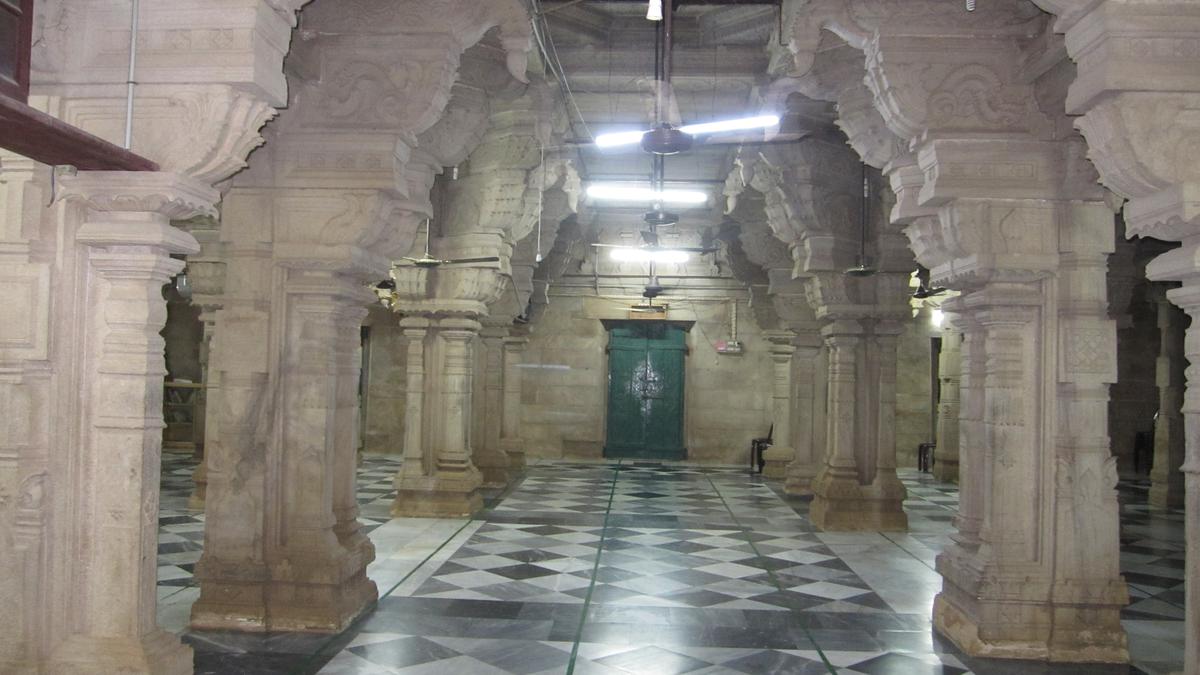
Central to Kilakarai’s landscape, though, is the Grand Jumma Masjid, built in the Dravidian style of architecture, where Seethakathi is interred.
The mosque, said to have been commissioned by Seethakathi or built during his lifetime in the 17th Century over two decades, also houses the graves of his elder brother ‘Pattathu Maraikkar’ Mohamed Abdul Qadir, and the domed mausoleum of the saint-scholar Shaikh Sadaqatullah (known locally as Sadaqatullah Appa), to whom Seethakathi was close, both as disciple and friend. Seethakathi also commissioned the grave of his younger brother Sheikh Ibrahim Marakkayar in Vethalai.
“This mosque has 110 pillars made with stone quarried from the seashore in Valinokkam village. Its style is typical of southern Indian buildings of its time, and is of great interest to researchers because of its unique structure. All the pillars are embellished with floral patterns, and some of them are naturally embedded with seashells,” A.M.M. Kader Bux Hussain Siddiqi Makhdoomi, the town Qazi and ‘Mutawalli’ (administrator) of the Grand Jumma Mosque, told The Hindu.
Blending with locals
According to research by S.M. Hussain Nainar (1899-1963), who was a professor of Arabic, Urdu and Persian at the University of Madras and Sri Venkateswara University, Tirupati, Arabs and Persians had been trading with the Indian peninsula even before the advent of Islam. Over time, the Arab traders settled along the coast of southern India, and with the coming of Islam, became assimilated with the local population. Most Tamil-speaking Muslims in these regions have Arab ancestry.
Islam’s influence in the Deccan has been noted from the end of the 13th Century, but it peaked only after the mid-17th Century, in the reign of Mughal Emperor Aurangzeb (1658-1707).
Born to Malla Sahib Periya Thambi Marakkayar and Syed Ahmed Nachiyar, as the second of three sons, Seethakathi hailed from Selvarkulam. The Marakkayars (an abbreviated form of Marakala Rayar) were one of the five early Tamil Muslim communities (the others being Sonakar, Labbai, Turki and Rowther) mentioned in historical texts.
The Marakkayar community was known for its maritime trade, and Seethakathi made his fortune in dealing with pepper, rice, pearls and handloom textiles, among other commodities.
Seethakathi was a close friend of Vijaya Raghunatha Thevar, or Kilavan Sethupathi, a loyal vassal of Chokkanatha Nayak, who helped Thirumalai Nayak in his war against the Mysore army.
Sethupathi cut off ties with Madurai in 1792 and built the Ramalinga Vilasam palace to fortify his position in the region. The palace, set in the middle of a moated campus, has a stone tablet that bears Seethakathi’s name.
The title, ‘Vijaya Raghunatha Periya Thambi’, denoted the affection and trust that Seethakathi enjoyed of his royal friend.
Mughal ‘khalifa’ in Bengal
It is also said Shaikh Sadaqatullah’s mention of Seethakathi’s generosity and character to Emperor Aurangzeb resulted in the ‘merchant prince’ being sent to Bengal as the Mughal ‘khalifa’ (regent). However, Seethakathi decided to resign after a while, as the new environment did not suit him.
Seethakathi’s acumen helped him become one of the earliest regional traders to do business with the Dutch and the British in the 17th Century. He is known to have maintained ventures from the Coromandel Coast to Sri Lanka (Ceylon). The British made contact with Seethakathi in the mid-17th Century.
Nainar’s 1953 book Seethakathi Vallal refers to the correspondence, in 1686-1690, between Seethakathi and the British East India Company’s agents William Gyfford and Elihu Yale negotiating trade in pepper and rice. The Dutch, too, interacted with Seethakathi, first as business rivals, and then as collaborators.
Patron of arts
Seethakathi was a generous patron of the arts, with poets like Umaru Pulavar, Padikasu Thambiran and Kandasamy Pulavar among the many supported by him.
Umaru Pulavar wrote the Seera Puranam, a 5,000-stanza verse biography of Prophet Muhammad in Tamil. Nainar’s book also contains two extant literary works about him: Seethakathi Nondi Nadagam (a Tamil mono-drama) and Thirumana Vaazhthu (felicitation written for Seethakathi’s wedding).
“Over time, many myths have become attached to Seethakathi. As archival documents show, he was a successful businessman and ‘rental farmer’ for the powers of the day. More systematic research of old records would help to highlight the role of Tamil Muslims like Seethakathi in Indian history,” said J. Raja Mohamed, historian and former curator of Pudukottai Government Museum.
source: http://www.thehindu.com / The Hindu / Home> News> India> Tamil Nadu> In Focus / by Nahla Nainar / October 27th, 2023
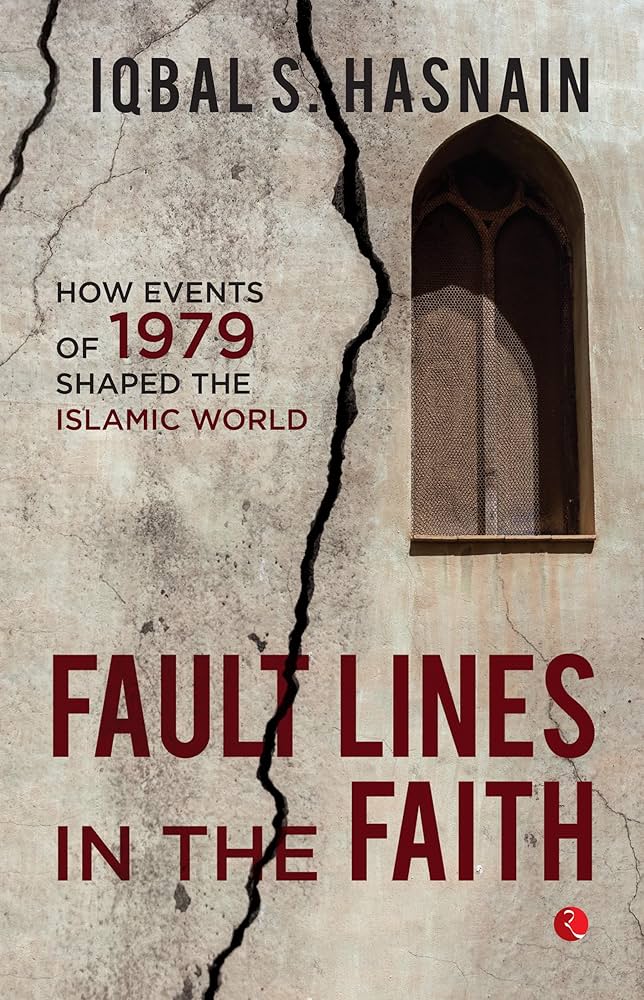
Padma Shri awardee Iqbal Syed Hasnain’s ‘Fault Lines in the Faith: How Events of 1979 Shaped the Islamic World’ was the topic of an animated discussion at Delhi’s IIC earlier this month.
The ‘Fault Lines in the Faith’ book discussion at IIC | Photo: Heena Fatima | thePrint
New Delhi:
A series of three momentous events irrevocably changed the social, religious, and political fabric of the Islamic world. And they all took place in 1979. This is the central argument of Padma Shri awardee Iqbal Syed Hasnain’s book Fault Lines in the Faith, which became the topic of a lively discussion among academics and history buffs at Delhi’s India International Centre on an early February evening.
Presiding over the panel discussion in IIC’s conference room, Hasnain, who is also an eminent glaciologist, elaborated on the three “fault lines” that sent shockwaves far beyond their immediate contexts.
First, the Islamic Revolution in Iran cleaved the Muslim world along sectarian lines with the establishment of the first Shia state. Second, the siege of Mecca ignited the conservative Sahwa (Islamic awakening) movement in Saudi Arabia, blending Muslim Brotherhood and Salafist ideologies. And third, the Soviet invasion of Afghanistan led to the birth of violent extremist groups like al-Qaeda and its offshoots.
“All these three pivotal points led to the surge of fundamentalist or Islamist jihad,” said Hasnain. He added that what began as a “normal struggle between invading forces and local communities” warped from nationalism to a violent ideological shift with devastating repercussions.
Iqbal S Hasnain | Photo: Twitter/@Rupa_Books
Hasnain further elaborated on the global impact of these events by sharing personal anecdotes from his time studying in the UK. He said he encountered strong anti-Western sentiment among students from Middle Eastern countries during his glaciology programme at the University of Manchester in the 1990s.
During Friday prayers in a large hall, he said, student speakers often delivered khutbahs (sermons) against Western culture and American exploitation of their regions, with some even advocating for jihad. As American involvement in the Middle East increased, especially with the invasions of Afghanistan and Iraq in the early 2000s, this hostility intensified.
pix: amazon.in
During the book discussion, audience members raised questions about Hasnain’s narrative. One participant, Sumanjeet Choudhary, a retired corporate executive, inquired why there wasn’t more opposition to jihadist activities despite Islam’s rich history and the presence of prominent leaders.
Hasnain countered this view with the example of Morocco’s King Mohammed VI, who has urged Moroccans worldwide to embrace tolerance and reject Islamist extremism.
“King Mohammed VI came out and he stopped the funding [of madrasas] from Saudi Arabia. He changed the whole narrative in the madrasas,” Hasnain said. He acknowledged, however, that while there is an ongoing debate within Muslim communities and their leadership about how to address extremism, it is “not very visible”.
Ripple effects
Hasnain’s book traces the rise of anti-pluralism, misogyny, and severe intolerance within the Arab world. The 1979 Shia Islamic Revolution in Iran, he said, shook the Sunni Arab world. In response, Saudi Arabia, fearing a Shiite revival, actively promoted puritanical Wahhabi Salafism, a strand of Islam that’s deeply hostile not only to Shias but also to Sunni Sufis. He, however, implicates the West as well. In February 1989, after nearly a decade of occupation, the Soviet army left Afghanistan, leaving behind a fractured nation, where tribal warlords and mujahideen groups engaged in an intense tussle for power. The US, having lost interest, “abandoned” the region, he added, leaving a vacuum for the likes of Osama bin Laden to fill.
Ultimately, Hasnain argues that the events of 1979 triggered a chain reaction, including 9/11, the US invasions of Afghanistan and Iraq, and the rise of al-Qaeda and ISIS. In 2021, in what seems like an eerie echo of the past, the US withdrew its troops from Afghanistan, leaving it with no democratic foundation and back in the grip of the Taliban.
When a participant asked about the impact of the 1979 events on India, Hasnain answered that the after-effects “were not limited to West Asia”, with radicalisation spreading to all corners of the world. “In India, to some extent, it was [mitigated] because India practiced a more moderate form of Islam , Hanafi Sufi Islam, which emphasised trade,” he added.
However, as more Indians went to work in Saudi Arabia, they were influenced by Salafi ideology, Hasnain said. For instance, those who’d grown up celebrating Eid-e-Milad (Prophet Muhammad’s birthday) stopped doing so after stints in Saudi Arabia, where Wahhabis do not observe such festivities.
One of the panel’s members was former Indian ambassador to Qatar KP Fabian. Chiming in, he said that it was important tomonitor developments in Muslim-majority countries, given India’s sizeable Muslim population. There may be political borders but “ideas come without a visa”, he pointed out, and vigilance is essential. He also claimed that Arab countries are keeping an eye on India’s Muslims. “They are watching us,” Fabian said. “They are also discreet.”
(Edited by Asavari Singh)
source: http://www.theprint.in / The Print / Home> Features> Around Town / by Heena Fatima / pix of book edited – source amazon.in / February 29th, 2024
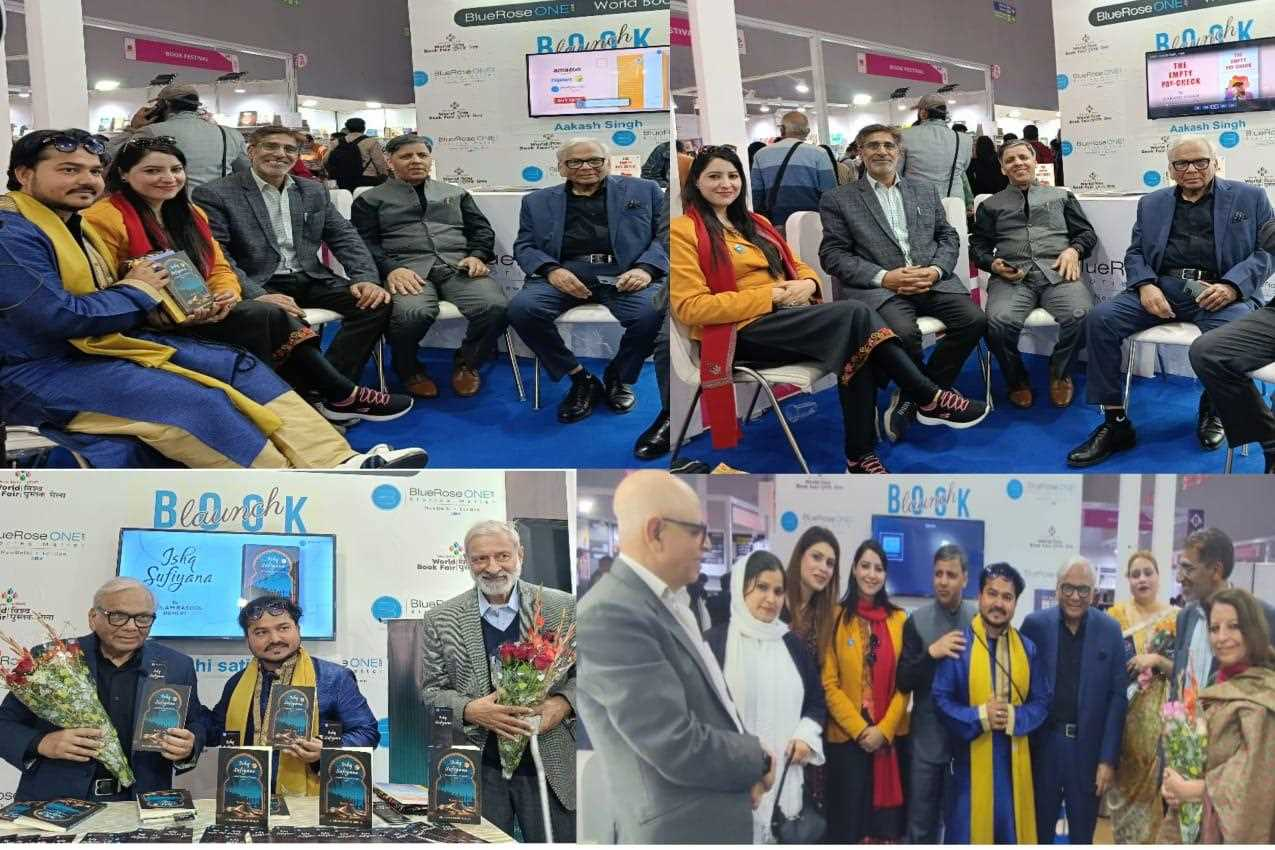
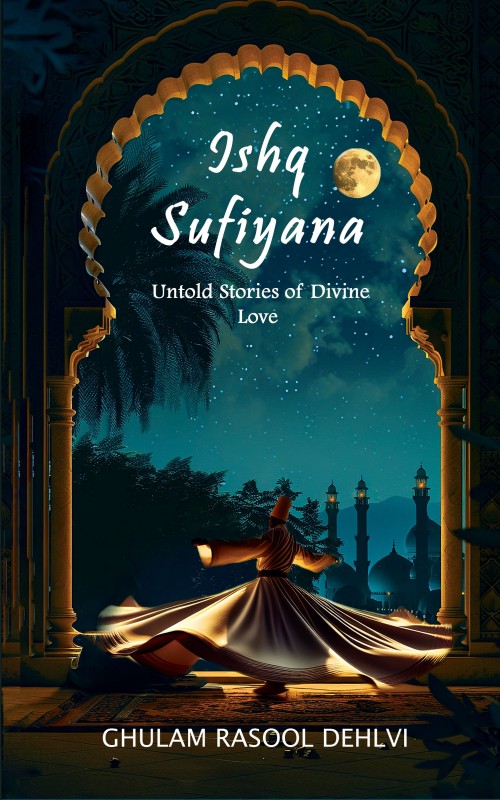
On the concluding day of the World Book Fair 2025, held in at Bharat Mandapam / Pragati Maidan New Delhi from February 1 to February 9, the book “Ishq Sufiyana: untold stories of divine love” by young writer and intellectual Ghulam Rasool Dehlvi was officially launched.
Ishq Sufiyana: Untold Stories of Divine Love / by Ghulam Rasool Dehlvi / image: blueroseone.com
The book launch ceremony took place at Stall No. 12 in Hall No. 6, with several distinguished personalities in attendance.
Notable figures present at the event included Kamlesh Sharma, former Secretary General of the Commonwealth and former Indian Ambassador to the United Nations (New York and Geneva), Padma Shri Professor Iqbal Hasnain, former Vice-Chancellor of Calicut University, Professor Madhu Khanna, former Director of the Department of Comparative Religions and Spirituality, Jamia Millia Islamia, Dr. Shahid Rasool, Dean of Academics at the Central University of Kashmir, Dr. Anita Benjamin, Founding Director of the Rashtriya Christian Mahasangh, Farooq Wani, Chief Editor of the daily Brighter Kashmir, Syed Abid Gowhar, renowned broadcaster and journalist from Jammu & Kashmir, Tasleema Akhtar, human rights activist, Tahmeena Rizvi, researcher, Dr. Rachika Arora, Syed Affan Yasawi, among others.
During this vibrant event, all the distinguished guests shared their thoughts about the book and its author. Ishq Sufiyana is a unique blend of reality and imagination. It creatively presents the real-life stories of thirty renowned Sufi saints of India.
The book among other Sufi intellects also highlights four revered saints and spiritual figures from the Kashmir Valley, Mir Syed Ali Hamdani (RA), Sheikh Noor-ud-Din Noorani (Nund Rishi) (RA), Sheikh Hamza Makhdum (RA) and Lal Ded (Lalla Arifa)
Additionally, Ishq Sufiyana includes a collection of narratives based on Sufism, ethics, and spirituality, many of which have been previously published in various newspapers and journals. The book aims to inspire seekers of all religions and spiritual traditions to dive into the ocean of divine love. The values and teachings of the personalities featured in the book remain relevant today, helping individuals grasp the depths of divine love that transcend worldly boundaries.
Ghulam Rasool Dehlvi is a well-known Sufi scholar, researcher, critic, speaker, and author based in Delhi. He is fluent in Urdu, Arabic, and Persian and is a trained scholar in Indo-Islamic traditions. He has received in-depth education and training in various spiritual orders, particularly the Naqshbandi, Qadiri, and Chishti Sufi traditions.
He has also undergone spiritual training and initiation under Turkish-origin Naqshbandi Sufi Sheikh Ashraf Effendi (Founder of Sufi Land, Germany). Pir Zia Inayat Khan (Global Head of the Inayati Chishti Sufi Order), American Sufi guide Pir Shabda Khan (Director, Sufism International, USA). He has studied under several esteemed Sufi scholars and spiritual elders in India. Recently, he was invited as a scholar-in-residence at the Bawa Muhaiyaddeen Fellowship (Philadelphia) and the Awliya Council of North America (New York, USA).
He has also served as an advisor on Islamic affairs for the National Security Council Secretariat, New Delhi.
Moreover, he has participated as a permanent representative of UN-affiliated NGOs at the United Nations Human Rights Council in Geneva, Switzerland.
The author is also an independent writer, poet, translator, and commentator.
source: http://www.brighterkashmir.com / Brighter Kashmir / Home> Breaking News / by Abid Gowhar / image of publication edited by blueroseone.com / February 12th, 2025