Category Archives: World Opinion

Ex-VP Hamid Ansari’s ‘Challenges to a liberal polity’ book review: The politics of being Indian

Kolkata, WEST BENGAL / NEW DELHI :

A collection of speeches and articles by former vice-president Hamid Ansari, offering engaging insights into our democracy.
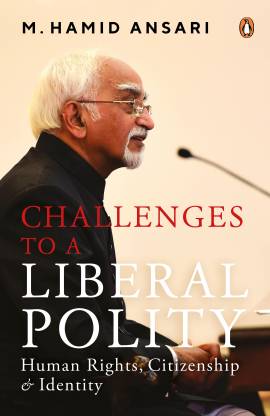
Challenges to A Liberal Polity: Buy Challenges to A Liberal Polity by Ansari  M. Hamid at Low Price in India | Flipkart.com
Challenges to a Liberal Polity: Human Rights, Citizenship & Identity / by M Hamid Ansari / Publisher Penguin / Pages 277 /Price 799 INR

For the past decade, public discourse in India has remained sharply focused on challenges to the liberal polity and the threats that have grown to human rights. Issues of citizenship and identity are entwined inextricably in this. It is in this context that Challenges to a Liberal Polity: Human Rights, Citizenship & Identity assumes not only topicality but also a significance that can be overlooked only at the readers’ own peril.

Hamid Ansari is a distinguished diplomat, academic, statesman and also, the often misused word, a public intellectual. He has, in his long career, worn many hats. He has served as the Indian ambassador to Afghanistan, Vice-Chancellor of the Aligarh Muslim University (AMU), Chairman of the Minorities Commission and the Vice President of India. Throughout his life, Ansari has never shied away from speaking his mind—bluntly if need be.

The author has, at times, been exposed to unfair criticism and deliberately humiliated by persons in high office who should have known better. When bidding him farewell, PM Narendra Modi was unnecessarily sarcastic—some thought gracelessly—by mentioning that Ansari had spent most of his diplomatic career in Islamic countries and perhaps he would be more comfortable now that he was relieved of the burden of the constitutional position to freely voice criticism of whatever he didn’t agree with. The PM conveniently forgot that the former vice-president served with distinction as India’s permanent representative in the United Nations and as Chief of Protocol when Indira Gandhi was the prime minister in an era of dynamic Indian diplomacy. But, let us not digress.

This volume is a collection of speeches, forewords and articles contributed by the author on subjects that overlap and cover a vast time span from the turn of the century to the present day. The introduction is stimulating and thought-provoking. It presents a distilled essence of state-of-the-art research in political science and Indian society. This prepares the readers for what is to follow.

The book is divided into three sections. The first section deals with human rights and group rights. The subsections or mini-chapters can be read profitably as independent essays. Of particular interest are the ones titled––‘India and the Contemporary International Norms on Group Rights’, ‘Minorities and the Modern State’ and ‘Majorities and Minorities in Secular India: Sensitivity and Responsibility’.

The second section is titled ‘Indian Polity, Identity, Diversity and Citizenship’. This is more substantial than the preceding segment and covers a range of topics that should engage readers with different interests and ideological orientations. Examples include ‘Identity and Citizenship: An Indian Perspective’, ‘Religion, Religiosity and World Order’, ‘Two Obligatory -isms: Why Pluralism and Secularism is Essential to our Democracy’. There are shorter pieces like ‘The Ethics of Gandhi’ and ‘The Dead Weight of State Craft’, ‘India’s Plural Diversity is Under Threat: Some Thoughts on Contemporary Challenges in the Realm of Culture’. How one wishes that these themes had been explored in greater detail.

To some it may appear that this is nitpicking, but this is the hazard of compiling a collection of comments and observations made on commemorative occasions such as inaugurating or concluding a seminar, a workshop or writing a short preface. Ansari is primarily a scholar, who is deeply distraught by the happenings around him and is restless to share his constructive thoughts and not just the distress and despair. The tone is always cautiously optimistic.

The concluding section deals with ‘Indian-Muslim Perception and Indian Contribution to Culture of Islam’. The essays on ‘Militant Islam’, ‘Islam and Democratic Principle’ and ‘India and Islamic Civilisation: Contributions and Challenges’ deserve to be read by all Indians, particularly the young. One may disagree with the author, but it is impossible to imagine that any meaningful dialogue can take place between the majorities and minorities in India without an understanding of how the ‘other’ thinks and perceives the world.

His convocation addresses delivered at Jamia Millia Islamia (where he taught) and the AMU (his alma mater) have a different flavour. The tone is personal and evokes shared nostalgia. The final essay is a review of India and muslim world.

The book has substantial end-notes that provide useful bibliographical information. One can flip through these pages to pursue the themes dealt in the book according to one’s own inclination and at leisure.


This book is for all. The general reader, who has no scholarly pretensions, too can turn the pages of this book with great pleasure. Many a time, the author peppers the prose with Urdu couplets that hook the reader to his line of arguments. One such piece is his Fakhruddin Ali Ahmed Memorial lecture. Most people remember this vice-president as the supine individual who signed on the dotted line with dimmer when Indira Gandhi declared Emergency at midnight. Ansari, however,  has used the book brilliantly to make some hard- hitting comments that are im- possible not to take on the chin.

The chapter begins with: Yaad-e-maazi azaab hai yaa rab/ Chheen le mujhse hafiza mera (The memory of the past is torturous, O God/Take away my memory from me), and concludes with: “Can the amnesia, the compromises and the misconceptions of recent and not-so-recent past be overcome?” Yes, only if meaningful alternative is offered. We do stand at the crossroads.

source: http://www.newindianexpress.com / The New Indian Express / Home> Lifestyle> Books / by Pushpesh Pant / Express News Service / November 06th, 2022
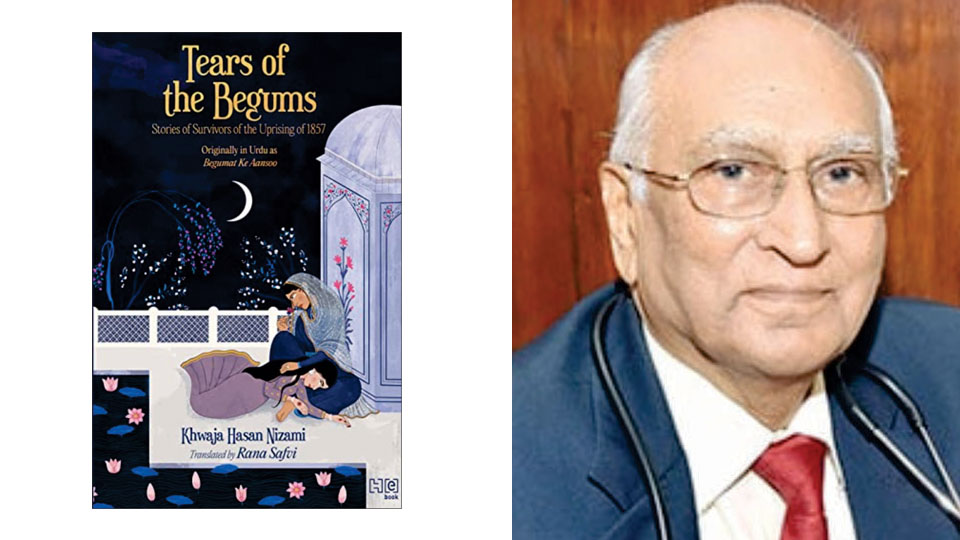

Poignant Real-Life Stories

xxx

When Nobles became non-entities, Princes became paupers and Begums were reduced to beggars…

  • Title: Tears of the Begums: Stories of Survivors of the Uprising of 1857  (Originally in Urdu  as ‘Begumat Ke Aansoo’)
  • Author: Khwaja Hasan Nizami
  • Publisher: Hachette India
  • Year of Publication : 1922 
  • Translator : Ms. Rana Safvi  (2022)
  • Pages: 212+xii
  • Price: Rs. 499

The Sepoy Mutiny (or the First War of Independence as we call it) started in 1857, over the issue of the greasing of the cartridges used in the guns of Indian soldiers of the East India Company army. It was known by the Urdu word “Ghadar” meaning rebellion or revolt. 

The rebellion spread rapidly in North India particularly around Lucknow and Delhi. The rebellious soldiers killed a large number of British officers, women and children. They adopted as their leader the surviving Mughal emperor Bahadur Shah Zafar without his consent. He was only a namesake Emperor who was on a generous pension given by the East India Company, and did not have any power beyond the precincts of the Red Fort, nor had the money to help the soldiers.  He was reluctant to take on the British army  but  was helpless and had to go with the demands of rebellious soldiers.

Though initially the British had a setback,  they quickly regrouped and took over Delhi. The Red Fort had about 3,000 royal families all of whom were descendants of the present and past emperors. The emperor’s court life was filled with pomp and grandeur, though he had no real authority. 

Bahadur Shah himself was a refined and gentle soul and a poet. Delhi was ruled by the English Resident. The lives of  the royals living in the “Lal Qila” was lavish with big mansions, large number of servants and slaves. Ghadar was a watershed moment in Indian history and the grand and elegant Mughal culture ended suddenly and dramatically.

Kulsum Zamani Begum was the beloved daughter of the last emperor Bahadur Shah. On the night he left the fort, he sent her and her family away entrusting them to the care of Khuda (God). Within a few days of leaving the Red Fort they were looted of all their money, jewels and even their expensive clothes. Finally on the way some villagers give them shelter in a thatched hut. The company soldiers were looking for the emperor’s descendants to arrest and punish. They escaped to Hyderabad, where they were given shelter by Nawab Lashkar Jung,  who had given shelter to many Mughal royals who had escaped from Delhi.

In a few years the British had their way and the Princess was advised to leave Hyderabad. Some of the well-wishers of the Mughals arranged for her to travel to Mecca.  One of the slaves she had freed while she was the Princess in Delhi had migrated to Mecca and had become an extremely wealthy merchant there.  He looked after her very well and made her family stay comfortable.

The Ambassador of Turkey  learnt  that the Emperor’s daughter had taken refuge in Mecca and arranged a pension for her from the Sultan of Turkey. She lived comfortably in Mecca for a number of years.  Ultimately she longed to return to her beloved Delhi.  When she went  back to Delhi, the English Governor  out of compassion, arranged a pension for her family. The British who had taken away her dad’s empire, gave her in return a grand compensation of ten rupees a month.

Sakina Khanum was the daughter-in-law of Nawab Faulad Khan. Nawab died while fighting the company soldiers during the Ghadar. When his body was brought  home by the soldiers, Sakina was writhing in severe labour pains. The Nawabs’ son had died four days earlier in the war, and his wife had passed away two years ago. Sakina delivered a boy with the help of the servants, while the corpse of the Nawab  was lying in the front yard, without even a shroud.  She had to run away from their mansion at midnight, taking a few jewels, some cash which was in the house and her new-born baby. The four maids who were in the house went with her. 

After a few days, the maids stole all the money and jewels and deserted her. They even took away the new-born son of the Princess.  She tried to eke out a living by working as a maid in households. Unfortunately for her, she had no skills needed for domestic help. After all she was the daughter-in-law of a Nawab and had lived in luxury with many servants and slaves at her command. She was frequently thrown out of many homes where she worked,  as she could not work hard enough.

Finally, the Princess became a beggar for her living. After a few years, one afternoon she was begging in front of a wedding house. She was exhausted due to the hot summer sun. She had not eaten for many days and was extremely hungry. As she was begging, one young handsome boy came out of the wedding hall. Hearing her wails, he sat in front of her and gave her the food he was carrying for himself.  The boy spoke to the beggar and consoled her and told that his mother was a maid in the wedding house. 

As he was speaking with her, his mother came out and Sakina immediately recognised her as her maid who had deserted her and realised that the boy  who fed her was her own son. After many years Sakina the beggar Princess had been reunited with her long lost son.

Qismat Baig worked as a chef at the palatial Taj Mahal hotel in Bombay. He was a recluse and an irascible and difficult man.  None knew his antecedents.  Whenever asked  about himself he would answer that he was a Badshah and walk away. The Maharaja of Bhavnagar would frequently stay at the Taj Mahal Hotel whenever he was in Bombay, and he immensely enjoyed the food cooked by Qismat Baig.

One day  the Maharaja expressed his desire to meet the chef.  Qismat  Baig, who never liked to meet anyone, was persuaded to visit him. When the king asked Qismat Baig as to who he was, Baig gave a long philosophical discourse.  Surprised at the erudition of the chef, the king persuaded him to tell his story.  Baig started recounting his long sad story. He was the son of the last Mughal Emperor Bahadur Shah born to a slave girl.  He was named Timur Shah after the great ancestor of the Mughals. The emperor had provided well for him and his mother and they lived comfortably in luxury with servants and maids. As a young boy he was well educated and would often visit a Dargah near his home in the evenings and had imbibed Sufi mysticism and Dervish practices.

When Ghadar started, his mother lost everything. He worked as an assistant to a cook and learnt the culinary art.  Misfortune always haunted him.  He lost his mother, wife and children to illnesses and became alone in the world. Living in Delhi made him very sad and migrated to Bombay where Timur Shah changed his name to Qismat Baig, a man of destiny.  The son of the Mughal Emperor had become  a Bawarchi (chef) in a hotel.

These are some of the poignant real-life stories in the book “Tears of the Begums”. Khwaja Hasan Nizami was a young man at the time of Mutiny. In later years he became a writer. He personally interviewed many survivors of nobility and recorded their  tragic stories. It was published as  a book “Begumat Ke Aansoo” in 1922.  Ghadar was a cataclysmic event in the narrative of India. It ended the centuries of pomp of the Mughal Court and the wealthy refined and elegant lives of the aristocracy. Nobles became non-entities, Princes became paupers and Begums were reduced to beggars. The sad stories in the book bring “Aansoo” to the eyes of the readers.

source: http://www.starofmysore.com / Star of Mysore / Home> Feature Articles / by Dr. C.D. Sreenivasa Murthy / October 11th, 2022

Shahib Somwarpet Ameer: The next big name in the World of Mini Football

Kodagu, KARNATAKA:

Shahib Somwarpet Amir son of Ameer Konnur Bashir Shab, runs a dry fruit shop and represented India as a Vice Captain in Socca World Cup 2022, held in Hungry, Budapest.

Shahib hails from Karnataka and is 27 years old. Born in Kodagu, Bangalore, Shahib comes from a middle-class family. His father is a small businessman and his mother, Noorjan Somwarpet Ameer is a homemaker. Shahib has one brother and two sisters. Shahib is 5.4 ft tall.

Shahib started his football career with Kodagu League and is currently playing for ADE football club super division at Karnataka state football association.

Shahib completed his D-license coaching license in the year of 2018 from the all-India football federation and has played several matches so far and has been popularly named Goal Machine.

Some of his list of matches include the Karnataka state team in the 49th junior national championship Dr.B.C.Roy Trophy as a defender and secured one score.

Played for Pre-University State-Level Football Tournament in Belgaum as an attacking midfielder and secured 8 scores.

Played State Level Under 17 Football Championship at Bijapur as a captain.

Represented Mangalore University Football team at the University of Calicut and Kerala as a Midfielder.

Represented Bangalore University football team at Pondicherry. Played Karnataka state PYKKA football championship held at Tumkur ( Karnataka ) in 2010 as a vice-captain.

Represented Karnataka state football team in all India Sub Junior Football Championship as a captain at Chandigarh.

Played for the postal department football club at A division in the year at Karnataka state football association as a Striker. Played for the postal department football club at A division in the year 2019 and 2020 at Karnataka state football association.

Represented the super division team Madaam FC at Gujarat State Football Association as a midfielder.

Represented India at an Indo-Nepal international friendly match under Indian Sports Federation in the year 2021 as a captain.

Represented KV Sports India at SIAM FC International Week Trails and International Tournament Football Championship in Bangkok ( Thailand ) as a captain.

Talking about his recent tour in Budapest Shahib says, “Football is not just a sport it is like emotion for me. I feel blessed that I could participate in Socca World Cup 2022. I will be forever thankful to Mr. Kartik Vashist, who guided me to fulfill my dreams. I dedicate my achievements to my family and God. Having said that, I worked hard to reach where I am today and would continue to do so. I wish to stay fit for a longer period and play for India. This year my focus will be to play ISL as it would be helpful for young players like us to achieve our goals”

Shahib’s message for all the young talent trying their luck in football is to stay fit, work hard and above all believe in god, respect your parents, and keep patients. Shahib is a huge fan of Cristiano Ronaldo.

https://www.instagram.com/shahib_07/?igshid=YmMyMTA2M2Y%3D

source: http://www.newspatrolling.com / News Patrolling / Home> Top News / by Mahende / October 17th, 2022

A Hyderabad woman went to Oxford in the 1930s. It wasn’t the most remarkable part of her story

Hyderabad / BRITAIN:

A Hyderabad woman went to Oxford in the 1930s. It wasnt the most remarkable part of her story

Muhammadi Begum was a student of Osmania University, Hyderabad, where she topped the Bachelor’s examination in 1932.

Highlights

  • Having received a scholarship from the Nizam for higher education, Muhammedi Begum, a young woman from Hyderabad, travelled to Oxford University in 1934.
  • What makes her story even more remarkable is that she maintained an extensive record of her four years abroad.
  • Her diary has been translated from Urdu into English, and published, by her daughters

In 1934, a young woman from Hyderabad travelled to Oxford University in England to study, accompanied by her husband. She had received a scholarship from the Nizam of Hyderabad to pursue her higher education (for which she studied French, Arabic and English). During the nearly four years she spent in the UK, she had two children, travelled around Europe and established a pattern of living that would hold her in good stead her entire life.

The young woman was Muhammadi Begum, student of Osmania University, Hyderabad, where she topped the Bachelor’s examination in 1932. She was married to Delhi-born, Syed Jamil Husian, an alumnus of the Aligarh Muslim University.

Those days, women travelling abroad to pursue education was a rarity; although what made Muhammadi Begum’s story remarkable is a diary that she maintained at Oxford which recounted everything from her day-to-day concerns to reflections on the state of society.

Muhammadi Begum’s diary remained under a shroud till the year of her passing, in 1990. The little note-book, where she detailed her daily life as she lived across continents, was eventually a precious find. It went to her cousin first and meandered in the family, till it caught the attention of her eldest daughter towards the end of the decade.

“I was pleasantly surprised and was taken aback by it,” said Zehra Ahmad, Muhammadi Begum’s eldest daughter. “I came across the diary after she passed away. I would’ve asked her many questions if I knew about its existence.”

What followed over the years was translation (as Muhammadi wrote in Urdu), editing, followed by COVID-induced delays in publishing, before A Long Way from Hyderabad saw the light of the day in 2022. Zehra translated the book along with her sister Zainab Masud.

Translating the diary was no mean feat, as Muhammadi Begum made detailed records, even writing in the margins. The sisters read it multiple times, transcribed it, and then translated it – all of it laborious and time consuming.

Kulsoom Husein, her youngest, who came out of retirement to edit and rework her mother’s diary said, “The tone of the diary is true to her experience. It was a new experience for her to travel to England as few women did so in those days.”

Muhammadi and her husband Jamil. Photo courtesy Husain Family Archives

Charting new paths

Muhammadi Begum belonged to a well-known family of writers. Her mother, Qaiseri Begum, was the granddaughter of famous writer Moulvi Nazeer Ahmed, who’s work Mirat-ul-aroos is often dubbed as Urdu’s first novel. Qaiseri Begum, herself was a prolific writer whose memoirs Kitab-i-Zindagi details changes in Indian social history from the 1880s to the 1960s.

The diary successfully encapsulates the journey of a young couple making their way in the London of 1930s. Her observations are detailed, precise and provide an invaluable peek into the world at the time – be it shopping at Harrod’s, visiting the Victoria and Albert Museum, eating ice-cream at a restaurant in Elliston & Cavell or taking walks in University Parks in Oxford, it paints vivid vignettes of pre-World war- II London.

The diary, according to Ahmad, who also spoke for her other sister and co-translator Zainab, brought her mother alive. “Everything she wrote was an accurate account of herself; her worries for her baby or exams, her management of the household and juggling her studies with a baby. She was on the move all the time and led a full and active life,” said she.

The writing is assured and confident. It stays true to what it is intended to be — a record of its keeper’s time in a foreign land. It comments on the English way of life (an interesting nugget is the usage of blackcurrant jam to treat colds), the trials of learning French and the easy camaraderie between students from India. Her letters to her mother Qaisari Begum were even published in a Hyderabad Urdu daily, Ismat.

It also showcases Muhammadi Begum as an independent woman with agency. Travelling in Europe along with a toddler can be a daunting task at any time, but she managed it with a remarkable spirit. It is in fact this spirit that would hold her in good stead later in life, when at 42 she lost her husband and had to look after many children.

A Long Way from Hyderabad can be nostalgic. It’s all about an era gone by, of Urdu publications in Hyderabad which have long ceased to exist (Rahbar and Tehzeeb) or local traditions like Kalzana, a medicine made from chalk and calcium, and given to pregnant women.

What she wrote holds relevance even today, as her struggles (with food, culture and money) are similar to ones faced by many students studying abroad. The diary also strikes a balance between everyday details of life, reflections of the time and personal observations.

Pages from Muhammadi Begums diary in original Urdu script. Photo by Daniel Majchrowicz

A record of the time

Records of women travellers are rare. The few accounts which exist are those of Sikandar Begum, the ruler of Bhopal who wrote of her pilgrimage to Mecca in 1869, Maimuna Sultan who wrote an account of London in 1911 and Atiya Fyzee who published her travel writings in Zamana-I Tehsil in 1921. Typically, the women who published at the time were queens, politicians or activists; Muhammadi Begum was none of them and hence her account stands out because of its simplicity and honest rendition of her life.

Her writing is as much a record of her own life as it is of the times she lived in. The Independence movement was on in full throttle and she along with her husband eagerly took part in discussions with friends. She actively participated in cultural exchanges even though she was reluctant to lend her sarees to curious British women.

“My mother was very stirred by the experiences she had. Technology, in the form of planes and ship liners, was just coming up and when she visited the science museum she was struck by the difference in Indian and British kids. While rote learning was accepted in India, the children there were curious to explore scientific apparatus and experiments. She makes a mention of all these in her daily jottings,” observed Husein.

Indeed, the travel account shows that concerns have not changed much between 1935 and 2022. The author lamented the state of Indian museums on a visit to the V and A Museum and was entranced by a Buddha statue. She worried about land prices shooting up in Hyderabad and wondered if the family could afford to buy a house — valid concerns even after a century.

She throws light on the comfortable relationship between her and her husband. Muhammadi Begum’s husband, Jamil, took leave of absence from his work as a civil servant in Hyderabad to travel with his wife. According to Ahmad, her father was a hands-on parent. “He looked after the baby with her, which was unusual for the time. Also, they shared an equitable relationship,” she said. “He was an admirer of Gandhi and she looked up to Iqbal, which led to many discussions around each. They both liked exploring places and had a wide circle of friends.”

The years in Oxford had a lasting impact on her, as throughout her life she remained fond of open air, long strolls and staying independent. In fact, later in life, she took in paying guests in Lahore when she retired from her job and needed to supplement her income.

(L) Book cover by ClayPotStudio, featured photo courtesy Syed Jamil Husain. (R) Begum. Photo from Husain Family Archives.

A nod to the past

In producing the book, Muhammadi Begum’s daughters became closer, as Husein noted, “We exchanged information about relatives mentioned and forgotten. My elder sisters have translated and I reworked the text — so it was a collaborative effort. My daughter, Amena, helped with research on key figures who were at Oxford at that time, such as educationist Sir Michael Sadler and GM Sufi, a retired University of Delhi registrar and historian, and Miss Bharti Sarabhai, who hailed from a prominent Indian civil rights activist family.”

With an account of food, state of women, culture, feelings and a life well lived, A Long Way from Hyderabad, is a perfect addition to the archives of writing from pre-Independent India. It provides a reliable record of the times gone by. It also shows the lasting impact of the written word and its ability to transcend time.

source: http://www.news9live.com / News Nine / Home> Arts & Culture / by Mallik Thatipalli / June 03rd, 2022

Former British Air Force officer of Hyderabad Squadron travels to city where Nizam was born

BRITISH INDIA / Bath, U.K :

Raymond George Rees-Oliviere (Photo: Supplied)

“I have great respect for the Nizam of Hyderabad. He stood by us when it mattered most and donated millions of pounds to help Britain’s air force. It was because I have a deep regard for the Nizam that I am making this trip to Hyderabad. Now that I am here I feel a sense of happiness and satisfaction.”

These words were spoken by Raymond George Rees-Oliviere, a former air force officer of the 110 Squadron in Britain. This squadron was one that was set up during the First World War in 1917 with the money donated by the Nizam.

It was called the Hyderabad Squadron and retained that name after the Royal Flying Corps was merged with the Royal Naval Air Service to form the Royal Air Force. During the Second World War, the Nizam donated more funds and two more squadrons were set up. But the 110 Squadron was the first of these and it was the one in which Raymond served in the 1960s.

“I want to relate a very unusual coincidence that happened before I came to Hyderabad,” continued Raymond. “I live in the city of Bath. For my Visa application to travel to India, I had to go to Cardiff because the processing is done there. It turned out that the Indian gentleman, who was the Visa officer, was from Hyderabad. He asked me why I wanted to travel to Hyderabad and that is when I told  him my story. How the Nizam had donated a sum of money which set up the 110 Squadron in which I had served. The gentleman was overjoyed when he heard these facts. He granted me a Visa in no time. Moreover, although I had asked for two months, he granted me six months,” said Raymond.

Raymond belongs to a family of Englishmen who lived in India for generations. His father and grandfather lived in India and Raymond was born in India in 1937. He studied at the Goethals Memorial School in the town of Kurseong in Darjeeling district. When he was ten years old the family moved back to England. There he completed his education and then joined the Air Force.

During his air force career he served as a gunner and as helicopter crewman during the Malaysian Confrontation of 1962 to 1966. He had many hair raising tales to relate but all of these cannot be retold in this article.

After retiring from the air force, he continued to work in the aviation sector. He worked in aerospace and defence in the UK and in Oman and France. He then served as Principal Airworthiness Specialist in Saudi Arabia for seven years. His dedication was given respect and recognition in Saudi Arabia. He received a letter of recommendation from the Ministry of Defence and Aviation, Civil Aviation Presidency in Jeddah. Later he worked in Norway and Germany. He worked for well known companies such as Rolls Royce, BAE Systems, Raytheon and British Airways.

He was also a keen sportsman. During his service he played hockey, boxing and rugby. In boxing he was coached by the famous Harper brothers. His fellow boxers included Jack and Brian London. The latter became world famous and was the top challenger to Muhammad Ali in 1966. However he was defeated by Ali. Another of Oliviere’s boxing teammates was Dick McTaggart who took part in the 1956 and 1960 Olympic Games and won a bronze and a gold medal.

In this hectic journey of life, he got married to Margaret and had four children. His first child was a daughter whom the couple named Tracy. She was born in Singapore in 1964. Next came Lee, Alison and Alexandra, all born in the UK. He and his wife remained married for 61 years until she passed away last December.

But for many years Raymond also cherished another dream. He wanted to visit Hyderabad and see for himself the land which was once ruled by the 7th Nizam. That dream finally materialised when he landed at the Rajiv Gandhi International airport on 28th October 2022. During a brief stay in Hyderabad he took the opportunity to visit the historical landmarks and sample the Hyderabadi cuisine.

“My life has come full circle. What began with the connection to the Nizam at the beginning of my air force career has now been completed with my visit to Hyderabad. Although my stay here was brief, I have enjoyed myself thoroughly and made very good friends. I have found that the people of Hyderabad are excellent hosts. I will carry back with me fond memories of this delightful city,” concluded Raymond who will also be going to Kurseong to catch up with his old school mates.

source: http://www.siasat.com / The Siasat Daily / Home> News> Hyderabad / by Abhijit Sen Gupta / October 31st, 2022

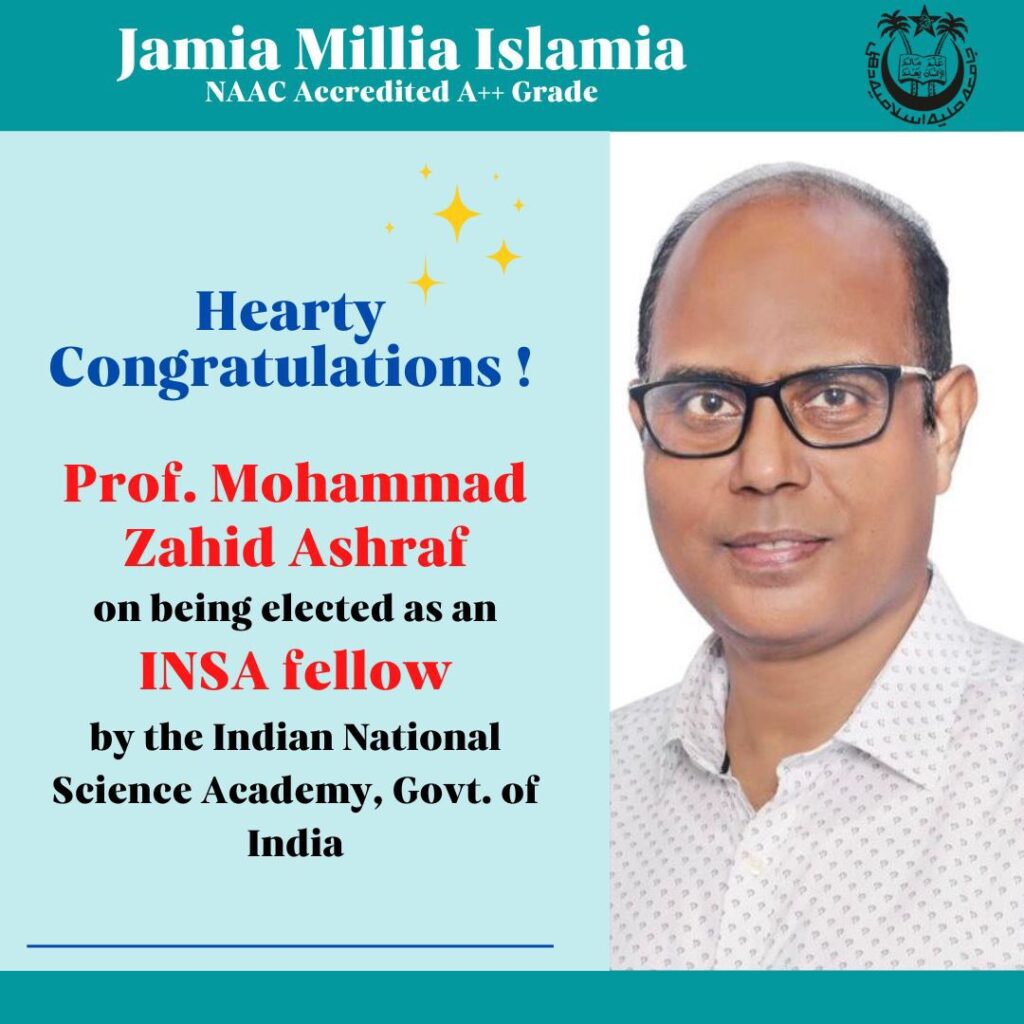
JMI Professor Mohammad Zahid Ashraf elected as fellow of Indian National Science Academy (INSA)

Aligarh, UTTAR PRADESH:

pix: twitter.com / @jmiu_official

The Indian Nation Science Academy (INSA) has elected Prof. Mohammad Zahid Ashraf, Head, Department of Biotechnology, Jamia Millia Islamia (JMI), as a fellow of the academy. His fundamental work on the role of high-altitude hypoxia in the development of cardiovascular and blood clotting disorders has been recognised with the coveted fellowship.


The Indian National Science Academy, one of the most renowned academies in the nation, was founded to promote science in India and utilise scientific knowledge for the benefit of humanity and the nation. As a fellow of the Academy, Prof. Ashraf will work to further the scientific cause of the nation. To his credit, Prof. Ashraf is now elected fellow of all three national science academies – the Indian National Science Academy, the Indian Academy of Sciences, and the National Academy of Sciences.


JMI Vice-Chancellor Prof Najma Akhtar, who has recently been conferred with Padma Shri Award, congratulated Prof. Ashraf for his outstanding accomplishments. She further mentioned that Prof. Ashraf’s achievements will motivate other faculty members for excelling in research and contribute to the nation’s progress.


Prof. Ashraf is best known for his unique work on high altitude induced blood clotting disorders. His research has had a substantial impact on both fundamental and applied aspects of cardiovascular biology and human diseases. He is a pioneer in the field of highaltitude thrombosis and has done seminal work in unravelling the enigma of blood clotting in response to hypoxia. His remarkable efforts have enriched our understanding
of the prevalence, mechanism, genetics, diagnostics, and development of therapeutics for hypoxia- induced thromboembolic disorders.


Prof. Ashraf’s contribution to the research community is well acknowledged. He is the recipient of the 2020 Visitor’s Award by Hon’ble President of India for biological sciences, The Ramachandran National Bioscience Award by DBT and the Basanti Devi Amir Chand Award of ICMR, among several other accolades.

Prof. Ashraf also holds membership of the prestigious Guha Research Conference and various scientific committees.

source: http://www.jmi.ac.in / Jamia Millia Islamia / Home / by Press Relations Officer, JMI (headline edited) / October 19th, 2022

Jamia Hamdard Pro VC Ahmed Kamal among top 2% scientists of the world

Hyderabad, TELANGANA / NEW DELHI :

Prof Kamal is also ranked 2nd in India in the subject of Medicinal and Biomolecular Chemistry.

New Delhi: 

Professor Ahmed Kamal, Jamia Hamdard Pro-Vice Chancellor has been named among top 2 per cent cientists in the world by Stanford University.

Prof Ahmed Kamal has also been ranked among top 0.10 per cent scientists in India with 537 papers in his name and with a worldwide subject rank of 83 among scientists.

Prof Kamal is also ranked 2nd in India in the subject of Medicinal and Biomolecular Chemistry.

Prof Ahmed Kamal has been named among top scientists globally in the subject-wise analysis conducted by a team of scientists at Stanford University USA which was led by Dr. John PA Ioannidis.

The analyses used citations from Scopus with data assessing scientists for career-long citation impact up until the end of 2019 and for citation impact during the single calendar year.

Prof Ahmed Kamal has filed more than 368 patents. Five of his US patents that have been licensed to a pharmaceutical company and are under the process of clinical development.

Prof Kamal’s research interests mainly focus on the design and synthesis of gene-targeting compounds as new anti-cancer agents and their targeted delivery. He has designed and developed a large number of target based new molecules as potential cytotoxic agents for the treatment of various cancers mostly inspired from natural products. New chemical entities for anti-tubercular and anti-microbial activities are also his research avenues.

Prof Kamal is also proficient in the development of new efficient synthetic methodologies including solid phase, resin bound reagents and chemo-enzymatic strategies that are useful in both basic and applied pharmaceutical chemistry. He has won several honours and awards for his research work.

Prof Kamal has over 540 publications, more than 10000 citations, 30 review papers and 10 book chapters in the areas of medicinal chemistry and biocatalysis.

source: http://www.ummid.com / Ummid.com / Home> Science & Technology / by Ummid.con News Network / November 03rd, 2020

Kerala: League of Islamic Universities ‘Climate Summit’ concludes on positive notes

Kozhikode, KERALA:

League of Islamic Universities launches climate action on campuses
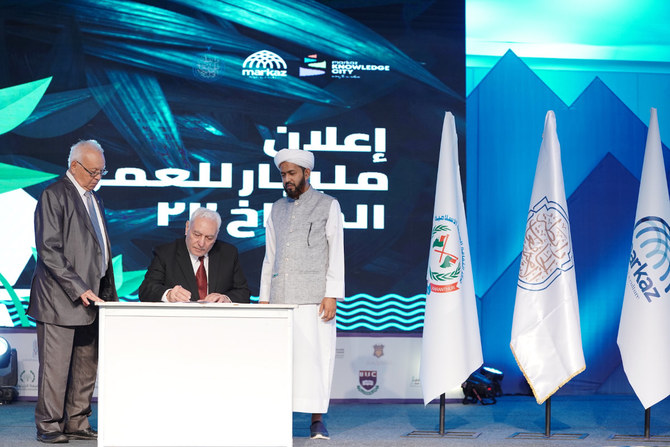
Dr. Osama Al-Abed, secretary-general of the League of Islamic Universities, signs the Malabar Declaration on climate action in Kozhikode, India, on Oct. 20. (Photo courtesy: LIU)

On October 27, the ‘Malaibar Declaration for Climate Action’ held by the League of Islamic Universities based in Cairo and Jamia Markaz Kozhikode in Markaz Knowledge City concluded.

Members including 200 universities from 60 countries, were present at Jamia Markaz, an Islamic university in Kozhikode, Kerala, for the International Climate Action Summit which was held between October 17-20.

Dr. Osama Al-Abed, secretary general of the league, opened the event by urging global stakeholders to use fresh approaches to combat climate change because the globe is currently “facing challenges that are structurally different from the past.”

As a consequence of talks on many facets of the main issue, Dr. Al Abdu and Muhammed Abdul Hakim Azhari, the rector of Jamia Markaz, jointly made the following declaration: The Partnership of University Leadership in Mitigating the Climate Change.

The declaration includes a request for environmental science to be taught in member universities’ curricula, for financial and human resources to be set aside for research into tackling climate challenges, as well as for new technology to be developed for the same.

“We thought that the real community who has to work on climate change is students. In every country, if the universities go for some course on climate then the future generation would be working on climate change,” Jamia Markaz rector Dr. Abdul Hakeem Al-Kandi told reporters.

“Students, who are the future leaders, when they are getting aware of climate change, (they) will impact the whole world.” he said.

Al-Kandi stated that the league would create an environmental studies centre in Calicut, India.

The goal of the university league’s activity, according to environmentalist and Markaz Law College principal Dr. C. Abdul Samad, who organised the summit, was to engage community members in various societies and make them stakeholders in saving the environment.

“Introducing environmental science courses in universities is important as the young leaders need to be educated to think about nature and climate change, and its impact,” he said.

“It is the new generation that can preserve the diversity of nature and respect the environment. The whole idea is to save the planet for the future,” he further stated.

At the summit, 63 research papers on diverse facets of the main issue were presented. A hundred trees were planted on the Knowledge City Campus by university leaders as part of Jamia Markaz’s afforestation programme and in support of the summit.

source: http://www.muslimmirror.com / Muslim Mirror / Home> Environment> Indian Muslim> Positive Story / by Muslim Mirror Staff / October 27th, 2022

MANUU Prof. Dr.Salman A Khan features in Stanford’s top International Scientists list

Hyderabad, TELANGANA :

Dr Salman also featured in Stanford’s list in the years 2020, 2021 and continues to be in the prestigious top international scientists list’ of 2022.

Hyderabad: 

Dr. Salman Ahmad Khan, Professor in chemistry and Dean, School of Science, Maulana Azad National Urdu University (MANUU) featured in the prestigious Stanford University’s list of top 2% International Scientists third year in a row.

The list is also known as ‘Updated Science wide Author database of Stanford Citation Indicators’.

The database was released by Stanford University, USA and published by Elsevier BV on 10 October 2022.

Dr Salman also featured in Stanford’s list in the years 2020, 2021 and continues to be in the prestigious “top international scientists list’ of 2022 in recognition of his exceptional research work.

The selection was among top 100,000 scientists by c-score (with and without self-citations) or a percentile rank of 2% or above in their field from all over the world and was classified into 22 different fields and 176 subfields.

Prof. Syed Ainul Hasan, Vice-Chancellor, MANUU congratulated Prof. Salman. He said that Dr Salman’s achievement highlights our research competencies and university is on a path to find innovative solutions to complex problems of society through quality research work.

Prof. Salman A Khan has published 185 research Articles in reputed journals like Elsevier, Springer, Wiley and has also published 4 books and 2 book chapters.

He completed his PhD from Jamia Millia Islamia University New Delhi.

Back in 2020, Jamia Islamia’s Prof Imran Ali was selected as leading scientist in India in the field of Analytical Chemistry by the Standford University in the US.

In the same year, Professor Ahmed Kamal, Jamia Hamdard Pro-Vice Chancellor was also named among top 2 per cent cientists in the world by Stanford University.

source: http://www.ummid.com / Ummid.com / Home> Science & Technology / by ummid.com news network (headline edited) / October 20th, 2022

Sajida breaks into male bastion to become first woman music technician

Hyderabad, TELANGANA:

Sajida Khan has served in many Tamil, Telugu and Malayalam films as a sound engineer over the past 10 years

Hyderabad:

Since the time Indian women got the liberty to pursue jobs, most have fulfilled their ambitions by working in the government sector, banks and multinational companies. However, Sajida Begum from the Maula Ali suburb of Hyderabad, Andhra Pradesh, has broken a new glass ceiling by establishing herself in ‘musical acoustics and audio engineering.’ She has not just learnt the ropes of the industry, but become an expert in her field.

For the same reason, President Ram Nath Kovind presented her the ‘Ladies Award’ recognising her as “India’s first female music technician” in 2018.

Every part of her life journey reflects her love for music.  

Interest in sound mixing and engineering

Sajida says she wanted to enter the music industry right from her school days. Alongside pursuing studies, she would often participate in competitions held at Hyderabad’s famous Ravindra Bharathi Theatre. She demonstrated her talent at various programmes and contests on Doordarshan and All India Radio as well.  

She recounted an incident when a folk singer from Andhra, once, spotted her passion and told her about the various genres of music — folk, classical, Bollywood, and others. Her interest grew and she became determined to try something new.

Sajida says that she completed an animation course and then a PG diploma in the subject while finishing her XIIth Standard studies.

Meanwhile, she had the opportunity to go to a studio with her friend. Here, she displayed such great technical knowledge of the devices and equipment, that the owners were impressed and offered her a job. She worked here as an assistant to the music director for about five years.

Making a mark in the industry over a decade

Talking about her current projects, Sajida says she aims to bring as many stories on the digital audio format as possible. This allows authors and societies to preserve their knowledge. She has recently helped 40 children record their poems in audio format.

Sajida has served in many Tamil, Telugu and Malayalam films as a sound engineer over the past 10 years. She has done dubbing, background music and complete audio mix. Besides, she is responsible for the success of several jingles, music albums and TV serials.

She has worked with leading film directors like Dasari Narayana Rao, Teja and Puri Jagannadh.

The only female music technician in the country, Sajida has also found her way into the ‘International Audiobook.’ This is a collection of interviews with women achievers in the audio field from across the globe. It’s called ‘Women in Audio.’

Despite this, Sajida says that it will still take some time for India and the world to recognise the contributions of women sound engineers.

Encouraging more women to venture into the field

Sajida says there’s no gender discrimination in the music industry. In fact, she got more work and with more confidence from her employers due to her being a woman. She said families must encourage their girls if they take interest in music, just like her parents did.

For Muslim women she said, a lot of them get into Mehndi application, beautician and tailoring courses; but they can explore fields beyond these as well. Muslim women need to be provided education so they are empowered and made more aware of all the career avenues available to them.

Sajida said she wishes to start her own post-production studio and a music school. She would like to employ as many women as she can in them, she said.     

source: http://www.awazthevoice.in / Awaz The Voice / Home> Women / by awazthevoice.in / January 24th, 2021