He is truly a forgotten warrior of the freedom movement. Few know about him and fewer are familiar with his name but delve into the pages of history and you realise that he deserves a better place.
He participated in the Indian Rebellion of 1857 in the Battle of Shamli between the British and the anti-colonialist ulema. The scholars were ultimately defeated at that battle.
He was Mohammad Qasim Nanautawi.
Nanautawi was born in 1832 into the Siddiqui family of Nanauta, a town near Saharanpur in Uttar Pradesh.
He was schooled at Nanauta, where he memorised the Quran and learned calligraphy.
At the age of nine, Nanautawi moved to Deoband where he studied at the madrasa of Karamat Hussain. The teacher at this madrasa was Mehtab Ali, the uncle of Mahmud Hasan Deobandi.
On the instruction of Mehtab Ali, Nanautawi completed the primary books of Arabic grammar and syntax.
Thereafter, his mother sent him to Saharanpur, where his maternal grandfather Wajihuddin Wakil, who was a poet of Urdu and Persian, lived.
Wakil enrolled his grandson in the Persian class of Muhammad Nawaz Saharanpuri, under whom, Nanautawi, then aged twelve, completed Persian studies.
In 1844, Nanautawi joined the Delhi College. Although was enrolled in the college, he would take private classes at his teachers’ home, instead of the college.
Nanautawi stayed in Delhi for around five or six years and graduated, at the age of 17.
After the completion of his education, Nanautawi became the editor of the press at Matbah-e-Ahmadi.
During this period, he wrote a scholium on the last few portions of Sahihul Bukhari.
Before the establishment of Darul Uloom Deoband, he taught for some time at the Chhatta Masjid. His lectures were delivered at the printing press. His teaching produced a group of accomplished Ulama, the example of which had not been seen since Shah Abdul Ghani’s time.
In 1860, he performed Haj and, on his return, he accepted a profession of collating books at Matbah-e-Mujtaba in Meerut. Nanautavi remained attached to this press until 1868.
In May 1876, a Fair for God-Consciousness was held at Chandapur village, near Shahjahanpur.
Christians, Hindus, and Muslims were invited through posters to attend and prove the truthfulness of their respective religions.
All prominent Ulama delivered speeches at the fair. Nanautawi repudiated the Doctrine of the Trinity, speaking in support of the Islamic conception of God.
Christians did not reply to the objections raised by the followers of Islam, while the Muslims replied to the Christians word by word and won.
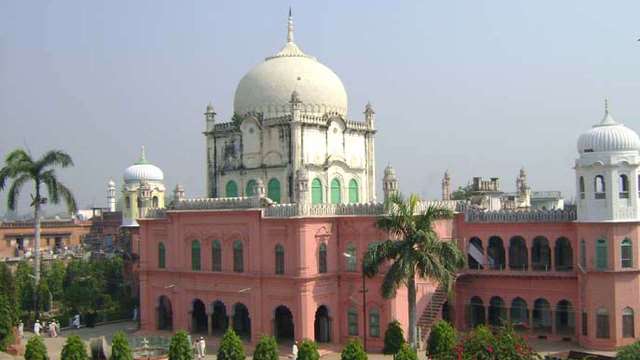
Mohammad Qasim Nanautawi established the Darul Uloom Deoband in 1866 with the financial help and funding of the Muslim states within India and the rich individuals of the Muslim Indian community.
He conformed to the Sharia and worked to motivate other people to do so. It was through his work that a prominent madrasa was established in Deoband and a mosque was built in 1868. Through his efforts, Islamic schools were established at various other locations as well.
His greatest achievement was the revival of an educational movement for the renaissance of religious sciences in India and the creation of guiding principles for the madaris (schools).
Under his attention and supervision, madaris were established in several areas.
Under Muhammad Qasim Nanautvi’s guidance, these religious schools, at least in the beginning, remained distant from politics and devoted their services to providing only religious education to Muslim children.
Nanautawi died on 15 April 1880 at the age of 47. His grave is to the north of the Darul-Uloom.
Since Qasim Nanautawi is buried there, the place is known as Qabrastan-e-Qasimi, where countless Deobandi scholars, students, and others are buried.
Significantly, the elders of Deoband took more and more part in the struggle for the independence of the country.
After the establishment of Darul-Uloom, the period of participation in national politics began.
Darul-Uloom, Deoband, was a centre of revolution and political, training. It nurtured such a body of such a body of self-sacrificing soldiers of Islam and sympathisers of the community who themselves wept in the grief of the community and also made others weep; who themselves tossed about restlessly for the restitution of the Muslims’ dignity and caused others also to toss about.
They shattered the Muslims’ intellectual stagnation, they broke up the spell of the British imperialism, and, grappling with the contemporary tyrannical powers, dispelled fear and anxiety from the minds of the country.
They also kindled the candle of freedom in the political wilderness.
It is a historical fact that the political awakening in the beginning of the twentieth century was indebted to Deoband and some other revolutionary movements in the country, and the revolutionary freedom-lovers who rose up there were the products of the grace from the spring of thought of Deoband.
Then, after the establishment of Pakistan, the Indian leaders of Deoband guided the Indian Muslims in utterly adverse circumstances and helped keep up their spirits high. — IANS
source: http://www.muslimmirror.com / Muslim Mirror / Home / by Amita Verma / July 31st, 2022
After the Second World War, soldiers of the Azad Hind Fauj (Indian National Army) were captured by the British forces. They were charged with treason and tried by tribunals as war criminals. Indians protested against this treatment given to the freedom fighters of Azad Hind Fauj.
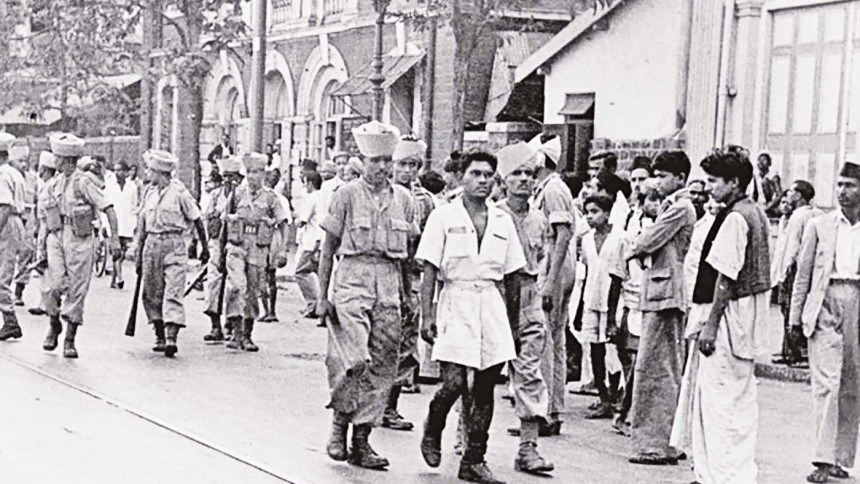
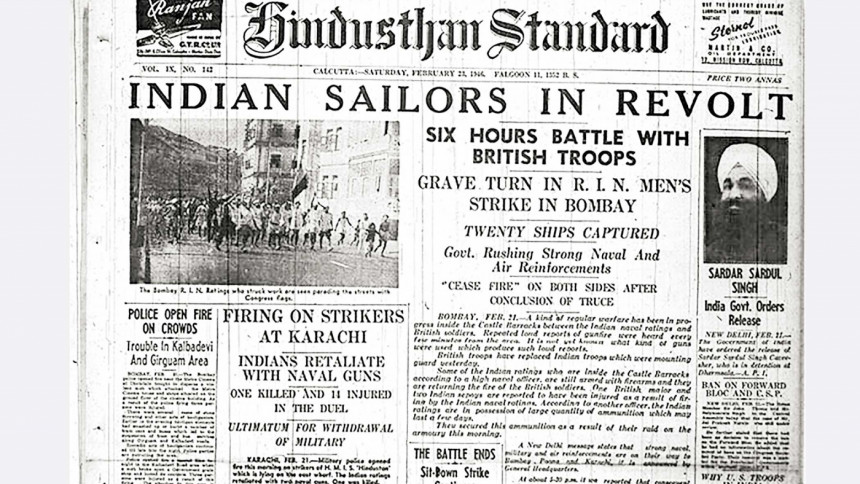
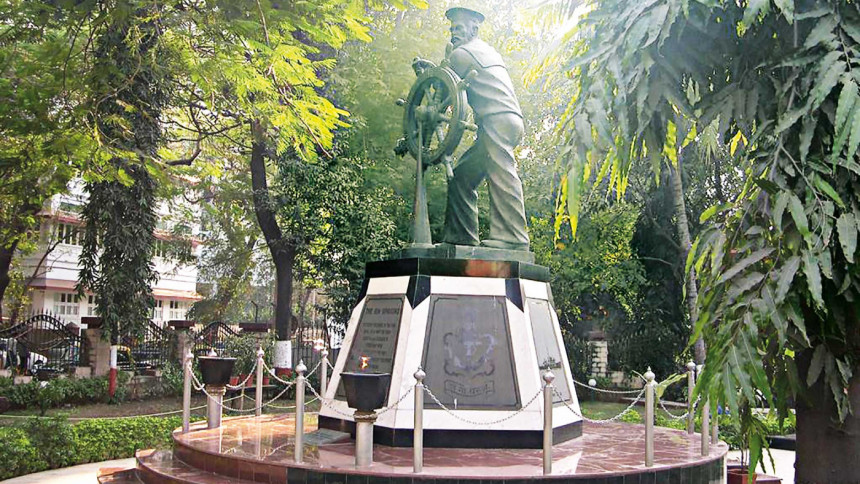
In February, 1945, soldiers and officers of the Royal Indian Navy mutinied in Mumbai and Karachi. English officials including the Viceroy took this mutiny as a sign of leaving India. The British forces killed many to quell the mutiny, many of which were Muslims.
Here, we are sharing names of the few Muslims we know, who attained martyrdom for taking part in the mutiny or supporting it.
Abdul, Ali, Din Mohammad: born 1929, took part in the popular demonstrations in support of the revolt by ratings of the Royal Indian Navy, received a bullet wound in firing by the police at Nagpada, Bombay, on 23 February 1946, died the same day.
Abdul Aziz: born 1921, domestic servant, hit by bullet in the premises of his employers as a result of firing by the police at Bombay on people demonstrating in support of the revolt by ratings of the Royal Indian Navy on 22 February 1946, died the same day.
Abdul Razak: born 1916, took part in the popular demonstrations in support of the revolt by ratings of the Royal Indian Navy, received a bullet wound on 22 February 1946 in firing by the police near Crawford market, Bombay, died on 24.2.46.
Abdul Rehman: born 1911, employee of private firm, hit by a bullet as a result of firing by the police at Doctor’s Street, Bombay, on people demonstrating in support of the revolt by rating of the Royal Indian Navy on 22 February 1946, died the same day.
Abdul Gani: born 1901, took part in the popular demonstrations in support of the revolt by ratings of the Royal Indian Navy, received a bullet wound in firing by police at Bombay on 22 February 1946, died the same day.
Abdul Karim: born 1926, took part in the popular demonstrations in support of the revolt by ratings of the Royal Indian Navy, received a bullet wound in firing by the police near Crawford Market, Bombay, on 22 February 1946, died the same day.
Abdul Sattar, Mohmmad Umar: born 1924, took part in the popular demonstrations in support of the revolt by ratings of the Royal Indian Navy, received a bullet wound in firing by the police on 22 February 1946 at Bombay, died the same day.
Abdulla, Abdul Kadar: born 1921, took part in the popular demonstrations in support of the revolt by ratings of the Royal Indian Navy, received a bullet wound in firing by the police at Bern- bay on 22 February 1946, died the same day.
Abdulla, Safi: born 1933, took part in the popular demonstrations in support of the revolt by ratings of the Royal Indian Navy, received a bullet wound on 22 February 1946 in firing by the police at Fort, Bombay, died in hospital the same day.
Adamji, Mohamed Hussain: born 1924, son of Allauddin Adamji, took part in the popular demonstrations in support of the revolt by ratings of the Royal Indian Navy, received a bullet wound on 22 February 1946, in firing by the police at Bombay, died in hospital.
Ali Mohammad: born 1906, hit by bullet in firing by the police at Dadar, Bombay, on people demonstrating in favour of the revolt by ratings of the RIN on 22 February 1946, died the same day.
Anwar Hossain: a student of Lahore College, hoisted the flags of revolt in the rating vessel Bahadur in Karachi, died with flags in hand on 23 February 1946.
Asgar Ismail: born 1934, received a bullet wound in firing by the police on people demonstrating in support of the revolt by ratings of the Hoyal Indian Navy on 23 February 1946, near the Paxsi Statue, at Byculla, Bombay, died on the spot.
Asghar Miya, Nawsati: born 1916, took part in the popular demonstrations in support of the revolt by ratings of the Royal Indian Navy, received a bullet wound in firing by the police near the J. J. Hospital, Bombay, on 23 February 1946, died in hospital.
Aziz, Chhotu: born 1921, took part in the popular demonstrations in support of the revolt by ratings of the Royal Indian Navy, received a bullet wound in firing by the police at Bombay on 23 February 1946, died in hospital the same day.
Dilawar, Abdul Malik: born 1931, son of Dilawar Muzawar, student, hit by bullet in firing by the police at Dongri, Bombay, on people demonstrating in support of the revolt by ratings of the Royal Indian Navy on 22 February 1946, died the same day.
Fida Ali, Kayam Ali: born 1933, received a bullet wound in firing by the police near J. J. Hospital, Bombay, on people demonstrating in favour of the revolt by ratings of the Royal Indian Navy on 23 February 1946, died the same day.
Gulam Hussain, Ali Mohammad: born 1906, took part in the popular demonstrations in support of the revolt by ratings of the Royal Indian Navy, received a bullet wound in firing by the police’ at Bombay on 22 February 1946, died the same day.
Haroon, Hamid: born 1931, took part in the popular demonstrations in support of the revolt by ratings of the Royal Indian Navy, received a bullet wound in firing by the police at Bombay, on 23 February 1946, died the same day.
Ibrahimji, Yusufali: born 1910, received a bullet wound in firing by the police at Bombay on people’s demonstrations in support of the revolt by ratings of the Royal Indian Navy on 22 February 1946, died the same day.
Ismail Hussain: born 1932, hit by bullet as a result of firing by the police at Bombay on people demonstrating in support of the revolt by ratings of the Royal Indian Navy on 22 February 1946.
Ismail, Rahimtulla: bom 1911, took part in the popular demonstrations in support of the revolt by ratings of the Royal Indian Navy, received a bullet wound in firing by the police near the Imperial Bank, Abdul Rehman Street, Bombay, on 22 February 1946, died the same day.
Jamal Mohammed: born 1926, took part in the popular demonstrations in support of the revolt by ratings of the Royal Indian Navy, received a bullet wound in firing by the police at Bombay on 22 February 1946, died the same day.
Khuda Bakhsh, Pyare: born 1876, hit by bullet as a result of firing by the police at Bombay on people demonstrating in support of the revolt by ratings of the Royal Indian Navy on 23 February 1946, died the same day.
Manzoor Ahmed: born 1906, took part in the popular demonstrations in support of the revolt by ratings of the Royal Indian Navy, received a bullet wound; in firing by the police at Bombay on 22 February 1946, died in hospital the same day.
Mohammed, Aboobakar: born 1928, took part in the popular demonstrations in support of the revolt by ratings of the RIN, received a bullet wound in firing by the police near Crawford Market, Bombay on 22 February 1946, died in hospital the same day.
Mohammed Aziz: born 1911, took part in the popular demonstra- lions in support of the revolt by ratings of the Royal Indian Navy, received a bullet wound in firing by the police at Bombay on 22 February 1946, died in hospital the same day.
Mohammed Hussain: born 1931, son of Mulla Gulam Ali Abdul Hussain, took part in the popular demonstrations in support of the revolt by ratings of the Royal Indian Navy, received a bullet wound in firing by the police near J. J. Hospital, Bombay, on 22 February 1946, died the same day.
Mohammed Sheik, Sayed Hassan: born 1921, took part in the popular demonstrations in support of the revolt by ratings of the Royal Indian Navy, received a bullet wound in firing by the police near Null Bazar police station, Bombay, on 22 February 1946, died the same day.
Mohiddin, Sheik Ghulam: born 1928, took part in the popular demonstrations in support of the revolt by ratings of the Royal Indian Navy, received a bullet wound in firing by the police at Parel, Bombay, on 22 February 1916, died the same day.
Mohmed Samikh, Taja-Urkh: born 1920, hit by bullet as a result of firing by the police at Kamathipura, Bombay, on people’s demonstration in support of the revolt by ratings of the Royal Indian Navy on 23 February 1946, died the same day.
Moula Bakhsh, Abdul Aziz: born 1906, took part in the popular demonstrations in support of the revolt by ratings of the Royal Indian Navy, received a bullet wound in firing by the police at Kamathipura, Bombay, on 22 February 1946, died the same day.
Siddik Mohamed: born 1921, son of Isak Mohamed, took part in the popular demonstrations in support of the revolt by ratings of Royal Indian Navy, received a bullet wound in firing by the police at Kamathipura, Bombay, on 23 February 1946, died the same day.
Sulemanji, Zakiuddin: took part in the popular demonstrations in support of the revolt by ratings of the Royal Indian Navy, received a bullet wound in firing by the police at Bombay on 22 February 1946, died in the hospital the same day.
Taj Mohamed, Fazal Mohamed: born 1930, took part in the popular demonstrations in support of the revolt by ratings of the Royal Indian Navy, received a bullet wound in firing by the police near the Salvation Army office at Bombay, on 22 February 1946, died the same day.
Vazir, Mohamed: born 1891, took part in the popular demonstrations in favour of the revolt by ratings of the Royal Indian Navy, received a bullet wound in firing by the police near Hindmata Cinema, Bombay, on 22 February 1946, died the same day.
source: http://www.heritagetimes.in / Heritage Times / Home> Featured Posts> Freedom Movements / by Mahino Fatima / August 14th, 2021
One of the most important but undervalued events of India’s independence movement was the naval revolt of 1946, about which Indian historian Sumit Sarker wrote, “Had this insurrection succeeded, India’s struggle for freedom might have taken a different turn.” From February 18 to 23 that year, more than 20,000 ordinary sailors, known as ratings, and low-ranking officers of 74 warships and 20 installations took part in a strike, which was termed as a mutiny or rebellion.
After Bengal lost its independence at Palashi’s Mango grove in 1757, the British Raj in India faced two major armed revolts: the first one was exactly after one hundred years, the military revolt of 1857, and the second one was 189 years later, the naval mutiny. Both in 1757 and 1857, the freedom fighters were defeated by the arms and tactics of the British rulers, but the naval mutiny failed because of the politicians in India then. It was not only the ratings’ mutiny that the political leadership had decided not to support – the civilian uprising triggered by the naval mutiny, too, was condemned by them. The scale of the civilian uprising, if it happened in a post-colonial era, would have created a revolution or at least caused the fall of the government of the day.
Three days after the mutiny ended and the civilian uprising was crushed with brutal force, the then British Prime Minister Clement Atlee told the House of Commons on February 26, 1946, “I regret to inform the House that grievous loss of life, injury and destruction of property have resulted from all these disturbances. In Bombay, there have been 223 deaths and 1,037 persons have been injured. The total damage includes the looting or destruction of nine banks, 32 government grain and cloth shops which the public can ill-afford to lose, 30 other shops, 10 post offices, 10 police stations and 1,200 street lamps. The number of vehicles destroyed is not yet estimated. In Karachi, there have been seven deaths and 21 cases of injury. In Madras, up to last night, one person has been killed and another seriously injured” (Source: Hansard).
Mr Atlee in his statement said, “Both Congress and Muslim League leaders cooperated in condemning and attempting to stop the disturbances, but the Communist Party issued a manifesto at midnight on Thursday thanking the public for its support.” It perhaps explains why, to this day, the political classes of the three countries born from the partition of India are not willing to admit their failure and give those mutineers and civilian martyrs their due credit. Therefore, in 2021, there was no big event in the subcontinent to mark the 75th anniversary of the naval revolt.
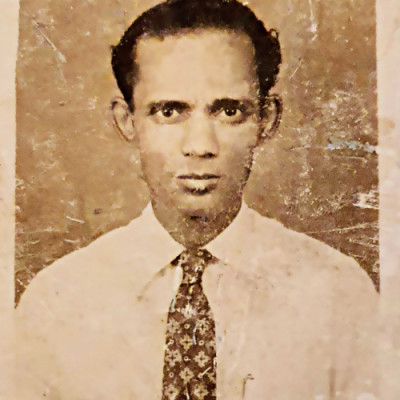
Mohammad Dewan Ali Nazir, Royal Indian Navy, Index no: 34499.
On a personal level, it’s ironic that, despite studying history at the country’s two top universities, I, too, did not take much interest in it during my student life. When I first heard of the rebellion from a mutineer, I had already taken a job and started my professional journey devoid of in-depth history. The mutineer I am talking about was my father, who spoke about his role and feelings about the lost cause during one of my short home visits. My father, Mohammad Dewan Ali Nazir (Royal Indian Navy, RIN, Index no: 34499) was one of the last 3,500 sailors and 300 sepoys who refused to surrender until the last on board of HMIS Akbar.
They were detained after surrendering and were released in August of that year. The mediation and the assurances given by the leaders of both Congress and Muslim League turned out to be nothing but betrayal. Though the uprising was a challenge to the Empire, shaking up the British imperial order, the leaders of the nationalist movement waiting to form an interim government through negotiations were not ready to derail that prospect.
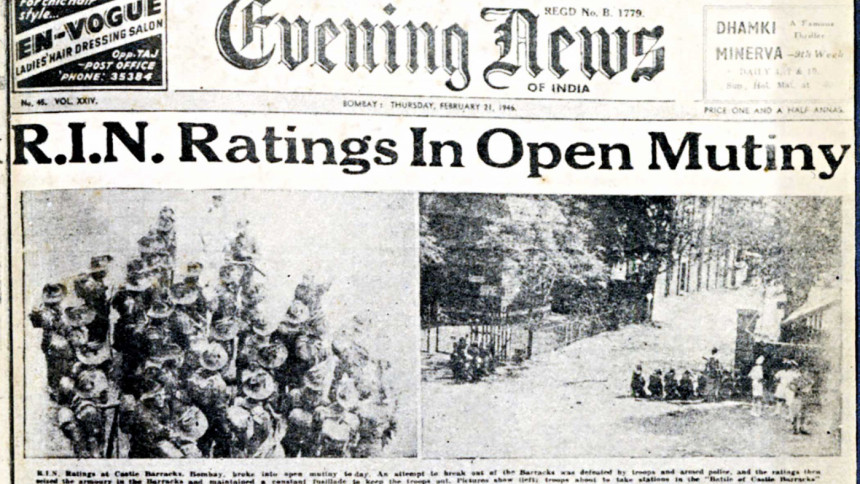
Newspaper clipping of the Evening News.
The leaders of the Congress and the Muslim League did not want a revolution – they wanted a peaceful transfer of power. Among the leading politicians, only Congress leader Aruna Asaf Ali extended her support to the ratings’ strike and tried to persuade her party leaders to take a stand in favour of the strikers, but failed in the face of opposition from Vallabhbhai Patel. On February 22, Vallabhbhai Patel sent a message to the rebels to surrender. Only the Communist Party of India came forward in support of the naval revolt and called a general strike. Reading the memoir of one of the key figures of the revolt, Balai Chand Dutt (BC Dutt), and a few other publications, one can easily imagine how much frustration and pain those mutineers felt because of the national leaders’ silence, which they saw as a betrayal. Perhaps it explains why my father, too, lost interest in politics and didn’t speak much about the heroic uprising that ended in a tragedy.
Those nationalist leaders, including Gandhi, Jawaharlal Nehru and Muhammad Ali Jinnah, advised them “not to mix up ‘political demands along with service demands’; to ‘remain calm’ and to formulate to the naval authorities their service demands.”
But from the very beginning, those naval ratings were raising political demands – particularly, the Quit India slogan.
Their Charter of Demands asked for: 1. Release of all Indian political prisoners; 2. Release of all Indian National Army personnel unconditionally; 3. Withdrawal of all Indian troops from Indonesia and Egypt; 4. British nationals to leave India; 5. Actions against the commanding officer and signal bosonshead for rough treatment of the crew; 6. Release of all detainees (naval ratings); 7. Speedy demobilisation of the RIN ratings and officers; 8. Equal status with the British navy regarding pay, family allowances and other facilities; 9. Best class of Indian food; 10. No return of clothing kit after discharge from service; 11. Better treatment from officers to subordinates; and 12. Installation of Indian officers and supervisors. (Source: Meanings of Failed Action: A reassessment of the 1946 Royal Indian Navy uprising by Dr Valentina Vitali, University of East London, UK.)
Autobiographies of two rebels – BC Dutt and Biswanath Bose – suggest that the then (undivided) India could have been a different place if the revolt of that day had succeeded. The rise of communal politics, the division and instability that is spreading in the states and society, would not have happened.
BC Dutt was one of the organisers of the HMIS Talwar, the ship where the mutiny started. He was arrested and tried for writing a new slogan on a ship on February 1, three weeks before the start of the February 18 mutiny. His book, The Mutiny of the Innocents, contains details of how political literature and pro-independence activities were organised much before their strike.
Biswanath Bose’s RIN Mutiny, 1946 also gives detailed descriptions of how the revolt unfolded. But politicians argued that the revolt was mostly due to the resentment among Indian ratings over low wages, poor quality of food and housing, which was lower than that of the Whites, and racial discrimination.
After the mutiny of 1857, the British rulers banned the entry and discussion of political leaflets in all forces, but BC Dutt used to secretly discuss political documents in the ship HMIS Talwar. Two months before the mutiny, on the Naval Day on December 1, when it was open for public visit, they wrote various slogans, including “Quit India” and “Jai Hind” on the ship. Explaining the reason why the mutiny failed, BC Dutt wrote that while all Europeans and Indians were stunned by the course of events and wondering if it was a revolt, unfortunately the political parties had nothing to say. When it was time to lower the British Union Jack and fly the Indian flag, they felt unprepared.
Newspaper clipping of the Hindusthan Standard
On February 22, 1946, when the nationalist leaders were busy arranging the ratings’ surrender, Prime Minister Clement Attlee told the parliament that the sailors had given political slogans and demanded that a political leader be given a chance to speak. He also said in the statement that Congress had nothing to do with the insurgency, but the communists and leftists could try to exploit sympathy.
William Richardson, a British researcher, writes in The Society for Nautical Research that the political movement for India’s independence was at the root of the revolt (The Mutiny of the Royal Indian Navy at Bombay in February 1946, May 1993).
Author of the book 1946: The Unknown Mutiny, Promod Kapoor wrote that the navies fell between the two aspirations of the two rulers. One side wanted their impending departure not to be tarnished by the stigma of rebellion. On the other hand, when power was imminent, the other rulers were anxious to see if there were any signs of chaos in the armed forces. Because in the future, they would have to manage these forces.
Politicians assured that no one would be punished, no compensation would be paid, and steps would be taken to meet the demands. In reality, the opposite had happened. Rebel leaders were arrested, tried and punished. Other rebels were told to grab third-class train tickets to return home and to never return to Bombay again. Showing various excuses, deductions were made from salary arrears even for minor damages in their uniforms.
Biswanath Bose’s book gives a glimpse of how frustrated and angry these rebels became with the behaviour of the government and the breach of promises by the political leaders. He wrote, “If patriotism is a crime, then we must be criminals.” Expressing his frustration for not being reemployed in the Indian Navy, he wrote a letter to Prime Minister Nehru asking if there was any law banning his return to the force due to dismissal for taking part in the freedom movement, and how, as a leader of the Congress, Nehru could be the prime minister.
Nationalist leaders were so reluctant to give the mutineers their due credit, that the Indian government banned the Bangla play Kallol (Sound of the Wave), based on the mutiny, by playwright Utpal Dutt, and he was imprisoned. The play was first performed in 1965 in Calcutta at the Minerva Theatre and it drew large crowds.
At the beginning of the naval strike, a Central Strike Committee (NCSC) was formed by the representatives of the ships stationed in Bombay. The committee renamed the Royal Indian Navy as The Indian National Navy. The committee was chaired by Signalman MS Khan, and Madan Singh was the vice-president. One remarkable element of the naval rebellion was the unity of various faiths among both the naval force and the civilians who took to the street. They raised slogans “Hindu-Muslim unite” and “Inquilab Zindabad” on the streets of Bombay.
BC Dutt’s book also speaks of this communal harmony. He wrote, “We are from different regions, and from families of Hindu, Muslim, Christian and Buddhist, but after spending years in the Navy, we sailors have become Indians. The irony is that the politics of communal division and hatred is now intensifying across the subcontinent.
(After leaving the job of a naval instructor, my father joined the office of Indian Civil Supply, and after a short stay in Kolkata, he was transferred to East Bengal. He retired as a magistrate and died on August 29, 2001.)
Kamal Ahmed is an independent journalist and writes from London, UK. His Twitter handle is @ahmedka1
source: http://www.thedailystar.net / The Daily Star / Home> In Focus / by Kamal Ahmed / July 25th, 2022
In the darkest hour of partition, when the whole of East Punjab was engulfed in a frenzy of communal violence, the town remained calm. And has stayed that way ever since.
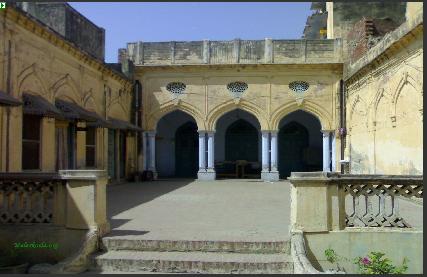
Idgah, Malerkotla: a remembered history of co-existence. Credit: Mohd. Imran, GNU license
Ten years ago, my wife Amarinder and I moved to Bathinda, her home town, to manage a rural school started by her family. For me, a Tamil speaking person originally from Bangalore, it marked a sea change of place and culture. As I gradually acquainted myself with the new rhythms of everyday life in present-day Punjab, I came across sights such as abandoned monuments and ruins battling undergrowth and living Sufi dargahs (shrines) that spoke of the past in an intriguing manner.
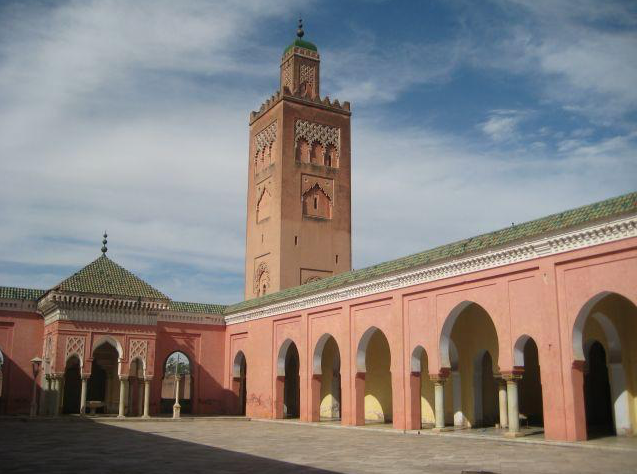
It was the shrines that first caught my attention. During my travels in Punjab, I noticed Sufi shrines frequented by people from all communities, the famous Haji Ratan Dargah in Bathinda being one such example. If asked about any dargah dotting the local landscape, people would refer to its past and say that the Muslims who had looked after it originally had all left. In Bathinda itself, of the two schools that were well known before partition – the Khalsa School and Islamia School – the latter no longer exists, for the city has a minuscule Muslim population. In the erstwhile princely state of Kapurthala, the regal Moorish Mosque built in 1930 by Jagatjit Singh for his Muslim subjects – 60 % of the population then – is mostly deserted except for the odd tourist.
The overall demographic of Punjab in the pre- and post-partition period is revealing: Muslims comprise 1.9% of Punjab’s population today in contrast to 51% in undivided Punjab. The Muslim families that one came across in several villages of rural Punjab weren’t usually locals but migrants from Uttar Pradesh or Bihar. My curiosity about Punjabi Muslims remained unabated.
The inner courtyard of the Moorish Mosque, Kapurthala. Credit: Wikimapia
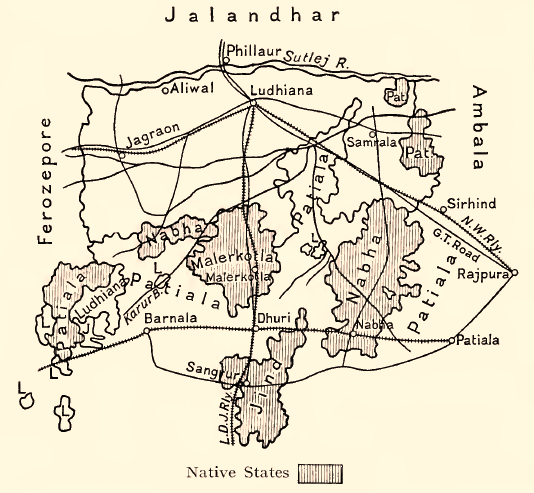
It was during a discussion with my wife’s late grandfather that I first heard the name of Malerkotla – Punjab’s only ‘Muslim pocket’ as he put it, located in Sangrur District. A princely state before Independence, in fact the only Muslim ruled state in erstwhile East Punjab, it was now the sole Muslim majority city in Punjab, he said. And then he told me something that left me stunned: In the darkest hour of partition, when the whole of East Punjab, including the princely states of Nabha, Jind and Patiala, was engulfed in a frenzy of communal violence, Malerkotla remained calm. Not just that, it became a life-saving refuge for Muslims on their way to Pakistan. Anybody I spoke to on this topic echoed the same sentiment.
Around that time I happened to watch Ajay Bhardwaj’s Punjabi documentary, Rabba Hun Ki Kariye (Thus Departed Our Neighbours), based on the memories of the partition generation. In the film, a resident of Malerkotla recounts how Muslims were chased by mobs till the borders of the state and no further, as if something stopped them from crossing the line.
What I gleaned from conversations, articles and scholarly writings was that even after independence, during several critical flash points in the history of the state and the nation, such as during the years of militancy in Punjab or the Ramjanambhoomi movement leading to the Babri Masjid demolition, Malerkotla remained committed to the spirit of communal harmony that has been a defining aspect of its history. An aspect all communities choose to remember as part of their local history, folk memory and heritage.
Not that this place has been in an eternally idyllic state. As scholar Anna Bigelow notes in an illuminating paper, the conditions that provide fodder for social conflict and make communities “riot-prone” in South Asia have existed in Malerkotla as well, be it flash points between religious groups or economic and political rivalries between communities. The difference, she emphasises, lies in the proactive intent of “local authorities and residents to make the unique history of the town a symbolically significant resource for community building and pluralism in the present.”
Living in times of increasing intolerance for the notion of pluralism, this aspect struck me as being of immense importance. Among the myriad strands that make up local histories and folk memory, some are positive and create common ground, while others are contentious. That the communities of a particular place should choose to recognise their shared history of mutual cooperation as their biggest strength and work towards resolving conflicts in the interests of mutual co-existence was incredible.
A 1911 map of Ludhiana District showing Malerkotla and the neighbouring princely states. Credit: Government of India
Unravelling the 500 year old skein of Malerkotla, ruled by nawabs of Afghan Pathan descent, was an instructive exercise. In 1454, the Maler settlement was granted to the Sufi saint Shaikh Sadruddin Sadar-i-Jahan, commonly known as Haider Shaikh, by the Lodis who preceded the Mughals in Delhi. The princely state of Malerkotla (the fortress city) came into being in 1657 when Haider Shaikh’s descendant, Bayzid Khan was given the title of nawab by the Mughals.
Thereafter, the fortunes of the tiny princely state kept see-sawing as it went through a series of alignments and realignments in a time of shifting politics common to the region in the 18th century – local kingdoms fought each other repeatedly in different permutations, sometimes on the say-so of more powerful powers, be it the Mughals, Marathas, invaders such as Ahmad Shah Abdali, or Maharaja Ranjit Singh. With the gradual waning of Mughal power after Aurangzeb, the nawabs sought to assert their independence – in the mid-18th century they supported Ahmad Shah Abdali. During the time of Ranjit Singh (1799 – 1839), they allied with the Sikh kingdoms of Nabha, Jind and Patiala to stay out of his grasp, ultimately accepting British protection in 1809. In January 1872, during the Kuka rebellion by the Namdharis, who were opposed to the British, 69 members of the sect, including some women and children, were strapped to a cannon and blown away on the orders of the British Resident. The nawab of the day was still a minor.
As independence brought British rule to an end and partition became a reality, Malerkotla, the sole Muslim ruled state in erstwhile East Punjab, found itself in a vulnerable position. Yet it survived virtually intact.
The most common explanation given by locals and people across Punjab is the role played by Malerkotla’s celebrated ruler, Nawab Sher Mohammad Khan (1672-1712), during a significant period of Sikh history. It was a time when the increasing following commanded by the Sikh gurus posed a serious challenge to Mughal authority. Although the nawab supported the Mughals in their campaigns against the Sikh gurus, he protested the decision of the Mughal governor to brick alive two sons of Guru Gobind Singh who were captured in Sirhind in 1705. In the nawab’s eyes, it was an un-Islamic act to punish the children when the battle was against their father.
Though this nuanced and principled stand fell on deaf ears, Malerkotla came to command a special place in the hearts of Sikhs. In the popular imagination, Guru Gobind Singh’s blessings ensured that the princely state remained virtually untouched by the communal violence that engulfed the neighbouring Sikh kingdoms. The protective power of saints across denominations, including figures such as Haider Shaikh, is also cited as one of the reasons for its good fortune.
Bigelow adds that the enlightened policies pursued by the Nawabs at critical junctures fostered the spirit of harmony and co-existence in the kingdom. For example, when Bayzid Khan established the foundation of Malerkotla, he summoned a Chishti Sufi saint, Shah Fazl, and a Bairagi Hindu saint, Baba Atma Ram, to bless the site, thereby declaring his faith in pluralism.
Nawab Sher Mohammad Institute of Advanced Studies in Urdu, Persian and Arabic, started in 1988. Credit: Abdur Punjabi/Wikimedia Commons, CC BY-SA 3.0
The princely state is a thing of the past, but Malerkotla continues to be in a league of its own even in democratic India (at the time of independence, it had a population of 85,000 in an area of 432 sq km). The fact that it has survived in its present demographic form is an indicator that the spirit of co-existence is still alive: as per the 2011 Census, Muslims, a minority in India and a tiny minority in Punjab, comprise 68% of the city’s population of 1.35 lakh; Hindus, the majority community across India, are placed at 20%, while Sikhs, who comprise the majority in Punjab, are only 10%. The current MLA, Farzana Alam (Akali Dal), has the distinction of being Punjab’s first non-Punjabi state legislator (she is originally from Uttar Pradesh).
Punjab has witnessed communal conflicts between Hindus and Muslims, and Sikhs and Muslims as well as between Hindus and Sikhs in more recent times during the days of militancy. Malerkotla has not been entirely free of flash points arising out of these developments.What sets it apart is that the focus of local authorities and community leaders at all times has been not only to defuse the situation but to approach it in a way as to foster greater solidarity, in keeping with its heritage.
Over a period of time, integrative practices like communal celebration of festivals, visits to each other’s sacred sites and mixed residential localities and joint businesses have helped immensely. Heritage organisations too have done their best to keep alive the memory of the city’s plural traditions. Bigelow cites two examples to illustrate how incidents threatening to upset the peace have been contained: In the aftermath of the Babri Masjid demolition in 1992, some Muslim youths vandalised a Hindu temple and Jain Sabha hall. Local Muslim leaders promptly checked them; some Muslims came forward to pay for the damage, while the Muslim MLA ensured that funds from the state were used for the complete restoration of the damaged buildings. The local Hindus too opted to work with local peace committees. The final message that was sent out was that there was no place for such acts in Malerkotla.
In the other incident, the destruction of the Bamiyan Buddhas by the Taliban in 2000 led to several anti-Muslim actions – in one place the Quran was burnt, at another place pig meat was hurled into a mosque. To protest the Bamiyan Buddhas’ destruction and the local acts against Muslims, the Hindus, Muslims and Sikhs went on a general strike for a day. Says Bigelow, a potentially divisive issue was “transformed into an act of symbolic solidarity against a variety of injustices.”
In the ultimate analysis much of the credit goes to the general population which has proved to be far wiser than it is sometimes perceived to be. The lived reality of Punjab’s sole Muslim-majority city, echoing aspects of a Punjabiyat that once exemplified the region, is a pointer to the fact that pluralism is the strongest weave for a democracy like India, and the strongest antidote to the intolerance of majoritarianism.
Karthik Venkatesh runs a rural school in Bathinda, Punjab
source: http://www.thewire.in / The Wire / Home> Culture / by Karthik Venkatesh / January 16th, 2016
A tribute to a polymath historian who recently passed away.
Dr Ziauddin Ahmed Shakeb at the Qutb Shahi tombs in Hyderabad, October 2013. Photo: Author provided
I first met Dr Mohammed Ziauddin Ahmed Shakeb in the summer of 2011, as a naïve PhD student who’d arrived in Hyderabad from Los Angeles wanting to “read Shah Jahan’s documents”. He asked me the very standard question asked of research students in India, “What is your topic?”
I only had a rather incoherent answer to give to Shakeb, the man who had, among other things, created the Mughal Record Room, in what is today known as the Telangana State Archives. Located in a nondescript building at the periphery of the Osmania University campus in the dusty precinct of Tarnaka, this institution has undergone numerous transformations over the course of a half-century of its existence in Hyderabad. But institutions were often narrow and unimaginative places for sustaining a towering figure such as Shakeb. He went on to have a long and eclectic life and career that consistently defied the logic and constraints of institutions, for he was himself an institution. The loss of Shakeb is thus far more than the loss of an individual.
His was a formidable generation of post-Independence intellectuals from different parts of the subcontinent who, from the 1950s, devoted themselves to preserving its languages, repairing and reconstructing our scattered archives and libraries, and re-imagining our past(s) long before colonialism. Shakeb embodied, above all, a boundless curiosity coupled with a complete disregard for trends, ‘schools,’ cliques, and fancy theories.
He was not interested in being a Marxist or a nationalist nor in chasing the Western academy’s greener pastures. In some ways, his foremost allegiance was to the detritus of the past itself – to what paper, ink, and materiality mean and what they can tell us about our past and present selves. He asked, what a document or manuscript had gone through over centuries, how had it come to be, and how can we best preserve thousands of paper fragments for future generations so we can continue to tell their stories?
This rare commitment to the study and preservation of archival knowledge led him to write the landmark catalog, Mughal Archives Vol I: A Descriptive Catalogue of the Documents Pertaining to the Reign of Shah Jahan, in 1977, followed by many publications for The British Library, State Archives Andhra Pradesh, and other repositories, universities, and auction houses. I remember asking Shakeb once why he was so committed to creating reference tools to access rare historical materials, and he answered, “because I know no one will care to read them in the future!” In some ways, he was right.
Today, when the stakes for writing about the subcontinent’s pasts are fraught and closely tied to an ongoing project of hollowing out academic institutions, it’s worth remembering a very different kind of Indian historian.
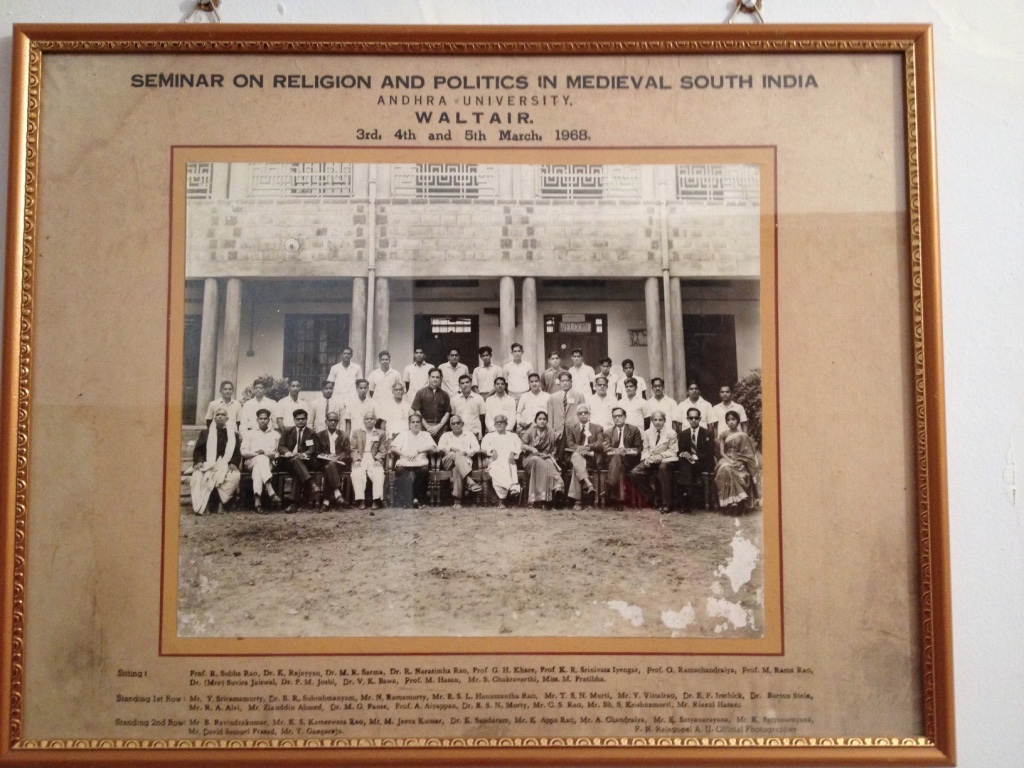
Shakeb standing in the second row, in a group photo from a conference in March 1968 at Andhra University, Visakhapatnam. Also pictured are G.H. Khare, Mohibbul Hasan, V.K. Bawa, P.M. Joshi, Suvira Jaiswal, Burton Stein, and Eugene Irschick, among others. Photo: Author provided
Born on October 21, 1933, Shakeb grew up in Hyderabad and Aurangabad. He studied Political Science and English at Osmania University before heading to Aligarh Muslim University in 1956 for his Masters, where he was taught by Mohammed Habib and S. Nurul Hasan. In 1962, he returned to the south where he was employed as an archivist at what was then known as the State Archives Andhra Pradesh. There, Shakeb acquired the unique training of deciphering documents and identifying their categories, genres, and forms from the last generation of the traditional jagirdari staff of the Nizam’s state who were retiring when he joined the archives. He also worked under Yusuf Husain Khan who had begun the work of processing Mughal administrative documents. The archives thrived under the directorship of committed scholar-administrators such as Hadi Bilgrami and V.K. Bawa.
As rich documentary caches from families, Sufi shrines, and samsthanams were discovered and deposited into state institutions, post-independence archivists and historians confronted challenges, including the reluctance of individuals to part with materials that had been in their homes for centuries. Debates and disputes ensued about what constituted a ‘valuable’ manuscript or document, how to classify materials, and to which regional-linguistic nationalism a remnant ‘belonged.’
These were debates that had already begun in the pre-Independence period, in the work of institutions like the Indian Historical Records Commission. Recent studies of the debates between Jadunath Sarkar and the Maratha historians have traced the longer history of such tensions. Part of the problem was the mutual suspicion between scholars oriented to modern social sciences and those with a more ‘traditional’ orientation and training. Shakeb, the archivist-historian, was at once both and neither.
At a distance from the halls of JNU and Aligarh, where the Mughal state’s merits were being debated, Shakeb inhabited yet another set of worlds. He was at ease reconstructing the household library of Chishti Sufi Abu’l Faiz Minallah in Bidar, discussing the southern India Cholas with the American historian Burton Stein, and discovering a shipwreck off the coast of Masulipatnam in the late 1960s.
Based on newly-processed materials, in 1976, he would complete his doctorate under P.M. Joshi at Deccan College in Pune, a connected history that examined circulation and political diplomacy between Safavid Iran, Mughal India, and the Golkonda sultanate. Shakeb’s study brought the question of mobility and exchange to the centre stage at a time when the norm was to study either the Mughal heartland (often synonymous with Delhi or the northern Indian plains) or select one province of the empire. After many years in archives and universities, Shakeb charted his own path beyond academia. His forensic ability for assessing manuscript provenance, material objects, and documentary genres, allowed him to thrive in other professional contexts, leading to work as a consultant for Christie’s in London.
But, to restrict myself to Shakeb the historian would fail to capture the range of subjects, languages, and disciplines over which he had complete mastery – Persian and Urdu literature, Islamic studies, geography, philosophy, linguistics, and art history. Shakeb always kept the historian’s arrogance in check by reminding her of the literary critic’s skills. The study of prosody and poetics was just as important for making sense of an India without and before English.
Dr Ziauddin Ahmed Shakeb (L) with his friend Dr Leonard Lewisohn (R) at Bidar fort in January 2012. Photo: Author provided
Literary circuits would light up the minute Shakeb landed back in Hyderabad (as they often would in London). He had been working for many years on translating Iqbal’s Persian poetry into Urdu. He was equally committed to the study of Bedil, Ghalib, Dagh, and Amir Minai. He would unveil to students the unique phonetics and cadence of Dakani, the pan-regional literary idiom of southern India, with many living poets and a long literary history, which he emphasised, is yet to be fully understood for its role in shaping classical and modern Urdu.
When he published his dissertation, Relations of Golkonda with Iran, in book form in 2017, he dedicated it to his grandchildren – Itrat, Taha, Mahamid, Khadija, Tawsin, Mahd, Istafa, Fatima, ‘Ali, Nuha – all of whom embody their dadasaab’s fortitude and resilience. I haven’t sufficient words to describe the patience of his wife, Farhat Ahmed, and the enormity of what she has taught me over many years about balancing the scholarly life with everyday living. It was this reminder that grounded Shakeb’s engagement with multiple worlds. His hands that treated every piece of archival paper like a newborn child. Lethal scoldings hurled at junior scholars too convinced of their own greatness. And, never forgetting to make fun of people who take themselves too seriously. With Shakeb’s passing, we are reminded how fragile the threads are that connect us to the past, and how dependent we are on a handful of such individuals. It’s difficult to imagine what, if anything, might come after such larger-than-life figures.
Subah Dayal is Assistant Professor at New York University’s Gallatin School of Individualized Study. Her research is on social and cultural histories of the Deccan and the Indian Ocean world.
source: http://www.thewire.in / The Wire / Home> English> Culture> History / by Subah Dayal / February 10th, 2021
‘RISING BEYOND THE CEILING’ releases list of Seventy Inspiring Muslim Women of Kerala
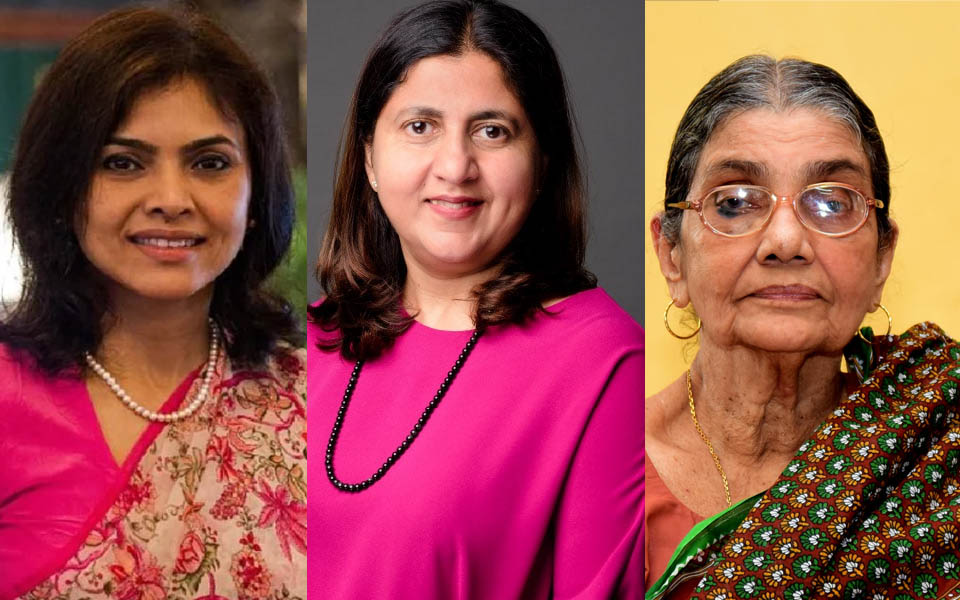
Nagma Mallick(L), Shabana Faizal(M) and Sara Aboobacker(R)
Kerala:
‘Rising Beyond the Ceiling’ (RBTC), an initiative born out of the need to change the stereotypical narrative about Muslim women in India has released its list of seventy Inspiring Muslim Women of Kerala. The list includes names like Shabana Faisal, Nagma Mohamed Mallick, Sara Aboobacker, and others.
“The seventy RBTC Honorees from Kerala celebrated in this book have displayed exemplary accomplishments in various fields. They are flying planes, serving as Civil Police Officers in the state, joining the national Indian Police Service, and leading as District Police Chief. They are contributing to nation-building in the Indian Foreign Service, Indian Administrative Service, and Indian Information Service and as Education Administrators, Directors of Departments of Industry.” RBTC said in its statement.
“They are contributing in leadership positions as managing directors, CEO, vice-chairperson, founders. They are influencers and singers, having an individual social media following of over 1 million and have been recognized in international and national awards including YouTube’s Golden Play Button,” it further added.
Global Inspiration Shabana Faizal:
Shabana Faizal, Chief Corporate Officer (CCO) and Vice-Chairperson of KEF Holdings UAE has been listed in the category of ‘Global Inspirations’.
“Shabana started her entrepreneurial career in 1995, when she set up Sophiya’s World – luxury and special items studio – in Calicut, following her marriage to Faizal E Kottikollon, chairman of KEF Holdings.” RBTC wrote about Shabana.
“Shabana has a driving passion to make a difference in the lives of the underprivileged, which led to the setting up of the Faizal and Shabana Foundation. The Foundation carries out campaigns to improve education, healthcare, sustainable livelihood, humanitarian assistance, youth development, and housing in India and the UAE. Her most recent passion project was the revamp and enhancement of the GVHSS in Nadakkavu, Kerala which has empowered more than 2,400 young girls to believe in themselves and their dreams and impacted the lives of more than 69,000 students across 65 schools in Kerala.” It further added.
Shabana is the daughter of a well-known entrepreneur and philanthropist late B.Ahmed Haji Mohiuddeen from Thumbay, Mangalore.
Impassioned author and writer Sara Aboobacker:
Kannada fiction writer Sara Aboobacker has been listed in the category of ‘Impassioned authors and writers’ adding that her stories narrate Muslim lives in the areas bordering Karnataka and Kerala, focusing on the inequities and injustices meted out to women by the male society.
“Aboobacker’s books largely focus on the lives of Muslim women living in the Kasaragod region, bordering the Indian states of Kerala and Karnataka. She focuses on issues of equality and injustice within her community, critiquing patriarchal systems within religious and familial groups. Her writing style is direct and simple, and she has stated that she prefers a realist approach to literature, prioritizing the expression of social concerns over stylistic embellishments. Her books have dealt with complex subjects such as marital rape, communal and religious violence, and individual autonomy.” RBTC wrote about Aboobacker.
Sara Aboobacker has received many prestigious literary awards, such as the Karnataka Sahitya Akademi Award, 1984; Anupama Niranjan Award, 1987; Rathnamma Heggade Mahila Sahitya Award, 1996, etc. She has seven novels, four collections of short stories, and one collection of essays to her credit. The Library of Congress has acquired eight of her works.
Leader in Administration Nagma Mohamed Mallick:
First Muslim woman in Indian Foreign Service (IFS) Nagma Mallick who is currently serving as Additional Secretary in the Ministry of External Affairs, has been named in the category ‘Leadership in Administration’ for contributing to nation-building in the Indian Foreign Service.
“An IFS officer of the 1991 batch, Nagma Mallick has served as the High Commissioner of India to Brunei from 2015 to 2018, and as India’s Ambassador to Tunisia between 2012 to 2015. Earlier she served as a staff officer to Prime Minister I.K. Gujral, then served as the first woman Deputy Chief of Protocol (Ceremonial). During her career in the IFS, Ms. Mallick has also served in France, Middle East, Sri Lanka, and Nepal.” It wrote about Nagma.
The list features a total of seventy Muslim women from Kerala and their stereotype-shattering stories of courage hard work and resilience. The list includes names like Airline pilot Afra Abdullah, IAS Officer Adeela Abdullah, Student Activist Aysha Renna, Life Coach Sahla Parveen and others.
About RBTC:
Rising Beyond The Ceiling (RBTC) is an initiative born out of the need to change the stereotypical narrative about Muslim women in India. It is a celebration of the achievement, endeavor, and diversity of Indian Muslim women. RBTC shines a spotlight on Muslim women’s contributions to nation-building in a variety of ways and professions. Founded in April 2020 by Dr. Farah K. Usmani, this initiative aims to make Muslim women’s stories more visible, provide positive role models for future generations, nurturing young women’s confidence and ambition in all spheres. RBTC works across various platforms- the website, publications, multimedia as well as an outreach young women’s mentorship programme.
RBTC is putting together inspiring profiles from fourteen states in India that are home to nearly eighty percent of the country’s hundred million Muslim women population. Besides state and national levels, there is also an RBTC 100 list under finalization of Global Inspirations which includes women who have done their initial studies in Indian institutions and are now making their mark in countries across the globe. A compendium of Inspirations from the Past compendium of those amazing Muslim women who are not with us now, but on whose shoulders we stand today. We are also excited about our amazing Under-30 Youth Inspirations list. RBTC will continue to institute annual Muslim women honorees lists to share the stories of achievements, courage and resilience.
source: http://www.english.varthabharati.in / Vartha Bharati / Home> India / by Rising Beyound the Ceiling / January 30th, 2022
The unit is being run under medical supervision of Dr Shoeb Ali Khan, leading consultant nephrologist and a kidney transplant surgeon.
A patient undergoes dialysis at the unit
Hyderabad :
Probably for the first time in the world, a mosque in Hyderabad has allotted space on its premises for establishing a full-fledged haemodialysis unit. Masjid-e-Mohammadia, located in Langar Houz area now houses a state-of-the-art free dialysis centre that mainly caters to the weaker sections of the society, regardless of caste and creed.
The centre, set up by two NGOs – Helping Hand Foundation and SEED US, has five latest Fresenius brand machines and will acquire five more machines in the next three months. The swanky centre, designed like a corporate hospital, has a separate access for dialysis patients and it is equipped with high quality equipment, clinical care as well as facility to manage onsite emergencies.
The unit is being run under medical supervision of Dr Shoeb Ali Khan, leading consultant nephrologist and a kidney transplant surgeon.A medical doctor, ANMs, dialysis technicians and an ambulance will be available at the centre from 8 am to 8 pm on any given day. “We have invested about Rs 45 lakh for the initial setup of this unit. About Rs 2 lakh per month will be managed by Helping Hand Foundation,” said Mazhar Hussaini of SEED.
To register for free dialysis, one can call Ph: 9603540864.
source: http://www.newindianexpress.com / The New Indian Express / Home> Good News / by Express News Service / July 22nd, 2022
Nai Manzil gives school-dropouts from minority communities a second chance to complete their education and learn a marketable skill.
Sameera was just 14 years old when she dropped out of school. Soon afterwards, her impoverished parents arranged her marriage, after which she stayed at home to cook and clean for her husband’s family, like all the other women in her small fishing community in Kerala’s Malappuram district.
When the Government of India’s Nai Manzil – New Horizons – program came calling, offering school-dropouts from minority communities a second chance to complete their education and learn a marketable skill, her husband let her join.
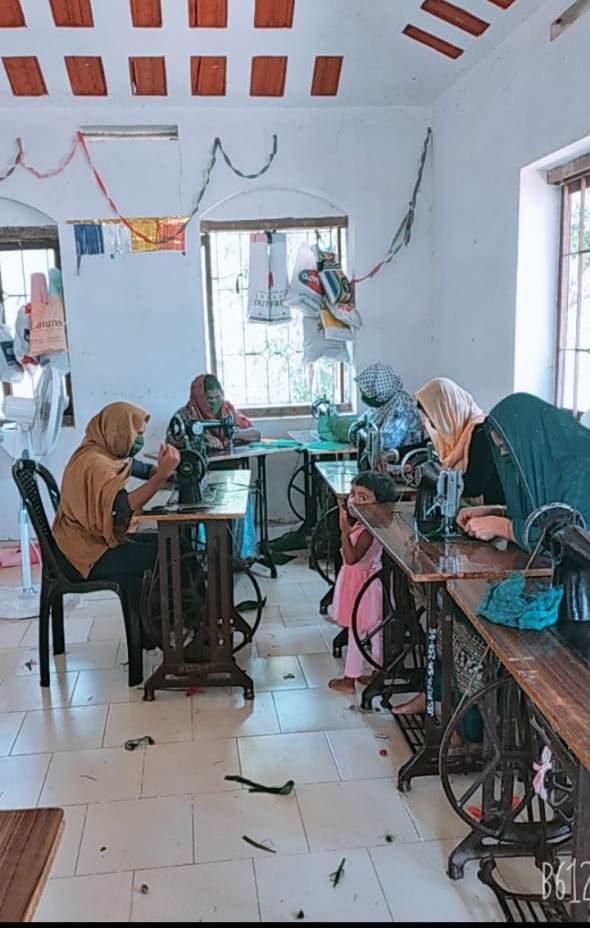
A year and a half later, Sameera, along with three other women from the program set up Bismil Tailoring, a home-based venture that took in sewing assignments from the community. “Our customers appreciated our work, and we were earning good money,” recalled Sameera.
However, barely a few months after they had started, a lockdown was imposed to contain the COVID-19 pandemic. Orders dried up, taking a heavy toll on the nascent enterprise.
A tailoring unit run by women from the Nai Manzil program in Malappuram, Kerala.
The women’s earnings help their families weather the crisis
When we spoke to Sameera four months later, we were naturally surprised to hear an optimistic young voice at the other end of the line. Confidence bubbled out of her, and although not everyone in her unit was able to resume work, they had received several orders for masks, and she was sure that their tiny unit would bounce back as soon as the lockdown was lifted.
Her education and training, as well as her exposure to the outside world, had instilled in her a new self-assurance that she could make a go of things, despite the temporary setback. This was bolstered by the fact that she was able to keep her small family afloat during the crisis, even though her fisherman husband had been unable to go out to sea since the pandemic started.
Sameera’s story is echoed in 32-year old Kausar Jahan, mother of three, who lives with nine other family members in the eastern city of Hyderabad. Although Kausar was just 17 years old when she got married and had to drop out of school. Nai Manzil’s training enabled her to get a job at a government hospital providing bed-side care to patients.
Today, while millions of lives and livelihoods have been severely impacted by the pandemic, Kauser is able to help support her family with the Rs 4,000 she still receives, even though her employers have asked her to stay at home until the worst is over. While this is just half her earlier salary, it has proved to be a lifeline for her 9-member household, more so since her electrician husband has been unable to get work during the crisis.
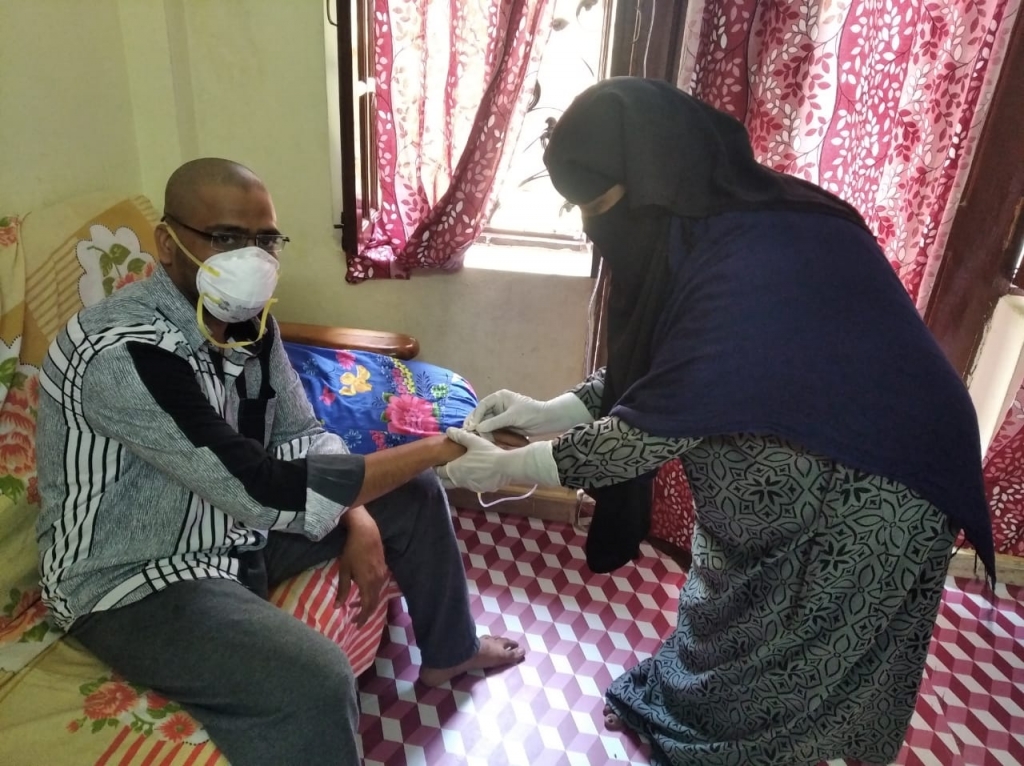
Kausar is now using her training to provide free health services to her community in the old city of Hyderabad, administering injections and checking blood pressure.
Both women look at the plight of others in their communities and shudder to think what would have become of their families had they not received Nai Manzil’s life-changing education and training.
And, it’s not just their families who have benefitted. Kausar is now using her training to provide free health services to her community in the old city of Hyderabad, administering injections, checking blood pressure, interpreting test reports, and nudging those who are seriously unwell to visit a doctor.
Sameera too is deeply involved in promoting the welfare of her small fishing community in Kerala. She is also supporting the wider population by helping with the common kitchen that has been set up to feed out-of-work migrants and other poor individuals affected by the pandemic.
A woman trained by Nai Manzil providing health care in Hyderabad.
Education, skills and exposure brings life-changing empowerment
Having seen her peers transform into co-founders of their tailoring unit – many of whom had never stepped out of their homes before or were the regular victims of domestic abuse – Sameera firmly believes that education, skills and exposure can herald life-changing empowerment, enabling the women to blossom and bring out their full potential.
While Sameera plans to study further and become a better entrepreneur, she wants the other women to grow along with her. Aware that not all her peers enjoy the same level of family support that she is fortunate to have received, she believes that religious leaders – who wield great influence within her community – can be a powerful force for change. In fact, it was these religious leaders who inaugurated the classes she attended.
More than half of Nai Manzil’s beneficiaries are women, with Muslim women constituting the majority. The first batch of beneficiaries completed their training in 2017, after which many have moved on to salaried jobs or self-employment. So far, more than 50,700 minority women have benefited from the educational and skilling provided by the program.
More than half of Nai Manzil’s beneficiaries are women, with Muslim women constituting the majority.
India’s Ministry of Minority Affairs is now hard at work to reduce the impact of the pandemic on minority communities across the country by expanding their opportunities for education and employment.
Over the last five years we have repeatedly witnessed the game changing nature of the Nai Manzil program. Given the huge demand for platforms that integrate education and skilling, the program marks the start of something truly transformational for minority communities across the country.
The World Bank is supporting the Nai Manzil program run by India’s Ministry of Minority Affairs, with a loan of $50 million. The program provides school dropouts from minority communities in 26 states and 3 union territories with six months of education and three months of skills training, followed by a further six months of support to help them establish themselves.
source: http://www.blogs.worldbank.org / World Bank Blogs / Home> Covid 19 / by Marguerite Clarke & Pradyumna Bhattacharjee / August 21st, 2020
A community historically considered to be “half Hindu” and “half Muslim” has lost its vibrant tradition in the city of Amritsar.
Matam in Amritsar on September 10, 2019. Photo: Nonica Datta
Amritsar :
As battle lines are being redrawn and strengthened over borders, many shared and eclectic cultural practices and spaces in the subcontinent are forgotten. Certain stories are being gradually erased from the shards of memory and history.
In the month of Muharram this year, on the day of Ashura, I decided to recover the lost narrative of Hussaini Brahmins – also known as Dutt/Datt/Datta Brahmins – and their intimate connection with the taziya procession in the city of Amritsar. In the pre-Partition days here, the taziya juloos, a grand public commemoration, would not start without the presence and participation of Hussaini Brahmins.
Before 1947, my grandfather, Padma Shri Brahm Nath Datta ‘Qasir’, a Hussaini Brahmin and a well-known Urdu-Persian poet, would initiate the taziya procession in Farid Chowk, in Katra Sher Singh, in his beloved city of Amritsar. There was a prominent Shia mosque in the area from where the taziyas were commenced and brought to the historic Farid Chowk.
The grand procession would then move towards the Imambara and Karbala maidan, near the Kutchery, which was a meeting point for all the processions coming from several imambaras. The final convergence of the taziyas was momentous. It is believed that this was close to the pivotal site, known as Ghoda pir, where the legendary steed, Zuljanah, of Imam Husain was said to have been buried.
Hussaini Brahmins: bringing two cultures together
In pre-Partition Amritsar, the taziya procession would start only after the Hussaini Dutt Brahmins lent their shoulder to carry the taziyas forward through the city. In 1942, Dr Ghulam Nabi, a prominent dentist of the city who had a clinic in Hall Bazar, rushed to the first floor of my grandfather’s house in Katra Sher Singh at Farid Chowk. He was from the Shia community and a close friend of my grandfather. He said with urgency, “Dutt Sahib, we are all waiting. Aap kandha doge tab taziya uthengee.”
A community which was historically considered to be “half Hindu” and “half Muslim”, the Hussaini Brahmins traditionally brought two cultures together. Often referred to as either Shia Brahmins or Hussaini Brahmins, phrases such as “Wah Dutt Sultan, Hindu ka dharm, Mussalman ka iman’; and ‘Dutt Sultan na Hindu na Mussalman” became a part of folklore.
Mohammad Mujeeb, the distinguished historian writes, “they [Hussaini Brahmins] were not really converts to Islam, but had adopted such Islamic beliefs and practices as were not deemed contrary to the Hindu faith.” Family narratives reveal that the name of Imam Husain was recited during mundans of young Dutt Brahmin boys, and halwa was cooked in the name of bade (Imam Husain) at weddings. Until the Partition in 1947, the Dutts were commonly called Sultans in different parts of the subcontinent.
Ashura in Amritsar on September 10, 2019. Photo: Nonica Datta
The genealogical map of Hussaini Brahmins covers their settlements in Kufa in Iraq around the time of the historic Battle of Karbala (680 A.D.), and later in Balakh, Bokhara, Sindh, Kandahar, Kabul and Punjab. Their scribal and military traditions and commercial and marriage networks attached them to regional courts during the 17th and 18th centuries and they were mostly found in Gujarat, Sindh, Punjab and Northwest Frontier.
It was in this context that many Hussaini Dutt Brahmins expanded their influence into the city of Amritsar. For instance, historical evidence testifies that before the accession of Maharaja Ranjit Singh, Mai Karmon Dattani, the wife of a leading Dutt, was appointed the ruler of Katra Ghanaiyan in Amritsar. She was reputed to have presided over her court, dispensing even-handed justice at a public place which has been immortalised by her name, and is known as Mai Karmun ki Deohri, later a prominent bazar (known as Karmon Deori) in the city. She is remembered as the “Joan of Arc” of Amritsar.
However, what is most remembered in history is the historic link of the Hussaini Brahmins with Karbala in Iraq, as underscored by British ethnologist Denzil Ibbetson. T. P. Russell Stracey in 1911 provides a fascinating account:
“From the Kavits of the clan, it is evident that the ancestors of the Datts were once in Arabia. They participated in the Karbala War between the descendants and followers of Hazrat Ali and Yazid Sultan, the son of Amir Muaviya. They were friends of Hasan and Hussain, the martyred grandsons of the Prophet, the incidents connected with which furnish the material for the passion play of the Shias at every Muharrum.
When these princes fell, a brave warrior of the Datts named Rahib, resolutely but unsuccessfully defended the survivors. The slaughter of his band, however, compelled him and the small remnant to retire to India through Persia and Kandahar.”
Legend has it that on his return from Arabia, Rahib Dutt brought with him the Prophet’s hair, which is kept in the Hazratbal shrine in Kashmir. Nohas and Kavits, recorded in local vernacular histories, oral narratives and British ethnographic literature, endorse the glorious appeal of Karbala and Muharram among Hussaini Brahmins:
“Laryo Datt [Dutt] dal khet ji tin lok shaka parhyo Charhyo Datt dal gah ji Garh Kufa ja luttyo.”
(The Datt warrior alone fought bravely in the field, and plundered the fort of Kufa.)
“Baje bhir ko chot fateh maidan jo pai Badla liya Husain, dhan dhan kare lukai.”
(When they won the field, the drum was beaten; Husain was avenged and the people shouted “bravo”, “bravo”.)
“Rahib ki jo jadd nasal Husain jo ai Diye sat farzand bhai qabul kamai.”
(The seven sons of Rahib (Datt) throwing in their lot With the faithful few on hapless Husain’s side, Died as Datts fighting, deeming their death But friendship’s welcome sacrifice.)
Finally:
“Jo Husain ki jadd hai Datt nam sab dhiyayo, Arab shahr ke bich men Rahib takht bathayo.”
(Off-spring of Husain! forget not thy father’s friend Rahib, once enthroned in Arabia’s city ere thy father’s end. Wherefore the name of Datt recite In thy prayers to Allah, at morn and night.)
Muharram as late as the 1940s was a moment to commemorate the sacrifice of the sons of Rahib Dutt for Imam Husain. The Hussaini Brahmin was an indispensable presence on such a sombre occasion of collective and shared mourning. Partition sealed the fate of this community, as they were left abandoned on both sides of Punjab.
In Pakistan Punjab, they were seen as non-Muslims, in Indian Punjab they were perceived as being closer to Muslims. The horrific politics of the border entered the portals of my ancestral home, too. Brahm Nath Datta Qasir’s house at Katra Sher Singh in Farid Chowk, Amritsar, was set on fire by Hindu fanatic groups in 1947.
It seems there was no Muharram procession in Amritsar in 1947. At least, it didn’t happen in Farid Chowk. In the tragic transformation of Amritsar as a border city, Hussaini Dutt Brahmins were amongst its worst victims. Their fluid identity came under siege as the politics of aggressive religious identities shattered their porous cultural world.
The Dutts’ enduring link with Imam Husain, Karbala and Muharram came under threat. But all was not lost. Some of them did openly identify with their Hussaini Brahmin heritage.
Not very long ago, Indian actor Sunil Dutt, while making a donation in the Shaukat Khanum Hospital in Lahore, recorded his commitment to Karbala and said :
“For Lahore, like my elders, I will shed every drop of blood and give any donation asked for, just as my ancestors did when they laid down their lives at Karbala for Hazrat Imam Husain.”
Needless to say that Sunil Dutt was intimately connected with the cultural landscape of Amritsar too.
Ashura in Amritsar
I reached Amritsar early on the morning of Ashura, on September 10. My first instinct was to visit the Imambara at Farid Chowk in Katra Sher Singh and to trace some crucial sites connecting the gaps between Hussaini Brahmins and Amritsar. This was like looking for a needle in a haystack.
However, I was lucky to find locals who knew about the city’s pluralistic culture and gladly directed me to a lone surviving Imambara, Anjuman-e-Yadgaar Husain, in Lohgarh, just about five minutes away from Farid Chowk. Currently known as the Kashmiri Imambara, it stands on Gali Zainab (named after Imam Husain’s sister), and now renamed as Gali Badran.
As I walked into this self-enclosed, small inconspicuous structure, which houses the Raza Mosque inside its precincts, I saw a large number of policemen and the Rapid Reaction Force.
I was warmly welcomed by the caretaker of the Imambara, Syed Abdullah Rizvi, popularly called Abbuji. He told me that the structure is nearly 110 years old, and was built by Syed Nathu Shah and was regularly maintained by local Shia and Hussaini Brahmin families of Amritsar before 1947.
Abbuji was touched to meet me as a Hussaini Brahmin in the majlis. He enquired whether I had a mark of a cut on my throat (in folklore, the Hussaini Brahmins are known to have a faint line across their throats as a symbol of having sacrificed their lives for Imam Husain). The story of Dutt Brahmins was shared in the assembly (majlis):
“It was Rahib’s mother, who instructed him to sacrifice his seven sons for Imam Husain. Rahib’s mother had been blessed with seven boys by Imam Husain. As a token of her gratitude to Maula Husain, she implored Rahib to sacrifice his own sons. So he did.”
A mourner, Amit Malang, told me, “Unfortunately, Hussaini Brahmins left for Delhi and Bombay. What did they do for Amritsar?” He said sarcastically, “Aj kisi Hussaini Brahmin ki himmat hai ki voh haath kharha kare (Can any Hussaini Brahmin dare to raise his hand today?).”
His angst was shared by many who felt that the community which could have probably preserved the vibrant tradition of the city had abandoned them. Abbuji, a cementing force, a favourite amongst Hindus, Muslims and Sikhs in the congregation, said, “Imam Husain means haq (rights) and aman (peace). We want to convey this message to Amritsar.”
I then awaited the taziya procession.
Muharram within the four walls at Imambara Amritsar on September 10, 2019. Photo: Nonica Datta
A lost narrative of Juloos-e-Ashura
“Ab koi juloos nahi nikalta. Juloos-e-Ashura Imambare ke andar hi hota hai. Muharram yahin Imambara ki chardiwari mein hota hai (Now there is no procession. Muharram is confined to the four walls of the Imambara),” Abbuji said. Zaheer Abbas, a Shia from Lucknow who has been living in Amritsar since 1980, added: “The grand shared tradition of Muharram in Amritsar was destroyed by successive wars: 1947, 1965, 1971. Partition didn’t end in 1947.”
Abbas said that the Shia mosque in Farid Chowk had been razed to the ground in 1948-49. Almost all the imambaras, over a hundred in number, were taken over (kabza) or dismantled. Abbuji added:
“Although the government took over the Karbala maidan, until recently the most prominent route for the Muharram procession was via the famous Sikri Banda Bazar to the present Imambara; taziya and alam would be brought there with much passion. But Bajrang Dal stopped it. Sunnis also didn’t support us. Now there is no procession: Ab ham darwaze diware band karke matam karte hain (Now we perform the mourning ceremony by shutting the doors and walls).”
Farhat, a sole Punjabi Muslim mourner, said that with the exodus of Hussaini Brahmins and Shias, the matam had lost its Punjabi flavour.
Abbuji asked me to write about the lost narrative of Hussaini Brahmins in Amritsar.
The openly public commemoration of Muharram in Delhi, Lucknow, Saharanpur, and even in nearby Malerkotla, Patiala, Jullundur and Jammu contrasts sharply with the slow erasure of this inclusive tradition in Amritsar. A city where Muharram was associated with the sacred geography of Imam Husain and Shia beliefs, such as Ghoda pir, Hussainpura, Gali Zainab and Yadgaar-e-Husain Imambara, the marginalisation of this vibrant cultural practice is heartbreaking.
I was shocked to see that the performance of Muharram and carrying of taziyas was confined to the four walls of a tiny Imambara under the watchful eye of the police. Perhaps, if the Hussaini Brahmins had stayed on, this would not have happened!
Around 5 pm, after “Alvida Ya Husain”, and a solemn meal of masar dal and rice – no meat is served on the day of martyrdom– I left the Imambara, lost in thoughts. I wanted to revisit Farid Chowk in remembrance of my grandfather and the eclectic community forged via the taziya procession that has now disappeared from the open spaces of the city.
I stood on the edge of Farid Chowk in Katra Sher Singh. Karmon Deori was close by; a street named after the famed warrior woman, from the Hussaini Dutt Brahmin clan, in 18th-century Amritsar, and a significant route for the pre-Partition Muharram juloos. There was no sign of any commemoration whatsoever.
As I returned to Delhi, leaving behind the taziyas and alam in the Yadgaar-e-Husain Imambara, the lament of the community of mourners almost crying for the shoulder of the Hussaini Brahmins continues to haunt me.
The reality is that the community, whose ancestors are believed to have sacrificed their seven sons for Imam Husain, has migrated to different parts of the world as global citizens. Many have simply discarded their Hussaini Brahmin identity and started to represent themselves as “Brahmins” – a construct that is miles away from what the community originally represented.
Nonica Datta teaches history at Jawaharlal Nehru University.
source: http://www.thewire.in / The Wire / Home> Religion> Culture> History / by Nonica Datta / September 30th, 2019
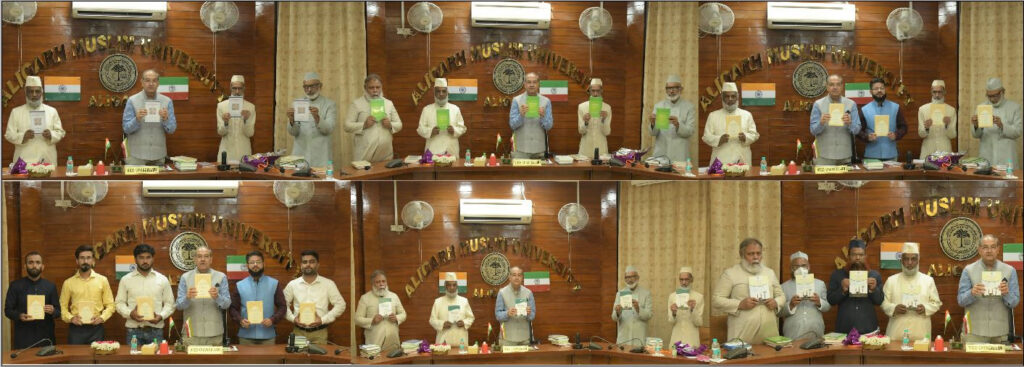
Eight books published by the K A Nizami Centre for Quranic Studies, Aligarh Muslim University (AMU) addressing key themes on the history of South Asian Muslims, diverse responses to the scholarly contributions and rationalist traditions of Islamic scholarship were released today at the Vice Chancellor’s Office.
They are ‘Contemporary Islamic Scholarship in South Asia: An Assessment’, ‘Humanness of Prophets: The Quranic Prophetology’ and ‘Contribution of Dar-ul-Uloom Deoband to Tafasir’ by Dr Abdul Kader Choughley; ‘Dil Jo tha Zulmat Kadah, Ma’ah-e-Munawwar Hogaya’ by Dr Mohammad Haris Mansoor; ‘Qurani Ulum ka Irtiqa Ahd-i-Islami ke Hindustan Mein’ by Prof Zafarul Islam; ‘How to Promote the Study of Quran among Women’, edited by Dr Nazeer Ahmad Ab. Majeed and Dr Arshad Iqbal; ‘Tarjumani Rahmani’ by Prof A R Kidwai and ‘Allah ki Kitab ki Paanch Mangay’ by Prof Fazlur Rahman Gunnouri.
“These books will answer some of the most frequently asked questions about traditions in Islamic faith, offer a new understanding on the works of Islamic scholars, explore key Islamic events and provide an understanding of important traditions in Islamic philosophy and the intellectual movement that emerged from South Asian Islam”, said AMU Vice Chancellor, Prof Tariq Mansoor while releasing the books.
Prof A R Kidwai (Honorary Director, K A Nizami Centre for Quranic Studies) pointed out: “The K A Nizami Centre has published over 80 titles on Quran-related scholarship since 2013. Publications of the Centre represent contemporary literature on furthering Quranic understanding and research in Hindi, English and Urdu by authors from various disciplines including translations from various languages”.
source: http://www.amu.ac.in / Aligarh Muslim University / Home / by Public Relations Department / Aligarh, July 13th, 2022