Tag Archives: Indian Freedom Fighters

Remembering Asaf Ali: A Forgotten Hero of the Freedom Struggle

Seohar Town (Bijnor District), BRITISH INDIA / NEW DELHI :

For too long, a handful of names have dominated the history of the years leading up to 1947 with Gandhi, Nehru, Jinnah, Patel being the most-often cited.
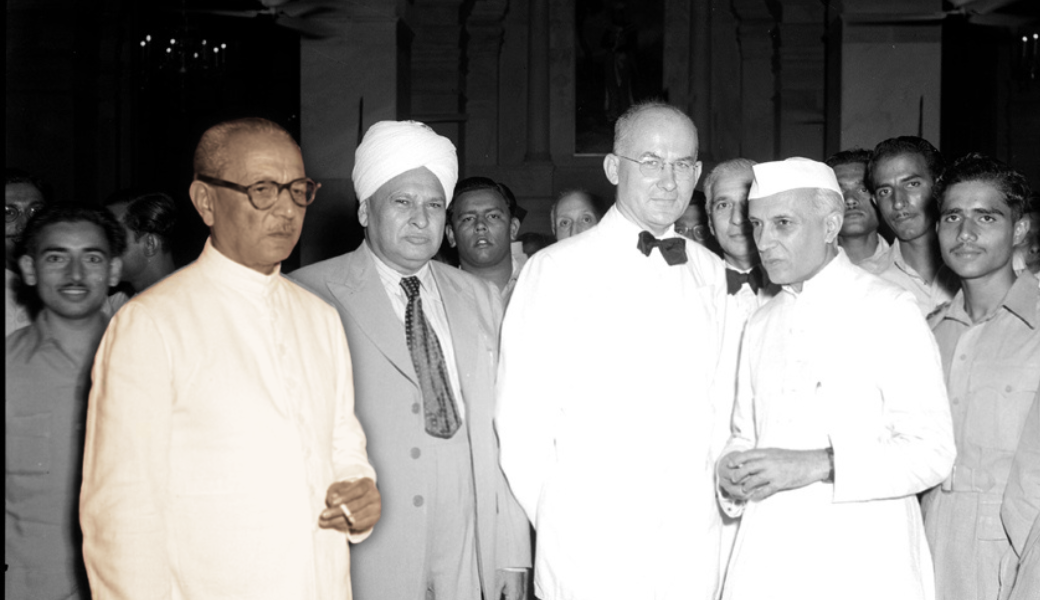
Pandit Jawaharlal Nehru and others at Governor-General‘s Dussehra reception held at Government House, New Delhi on September 29,1949. At extreme left is Asaf Ali, the then Governor of Orrisa. Edited via Canva. Photo: Photo Division, Govt. of India

For several years I worked in a publishing company situated on the bustling Asaf Ali Road, a road that serves as a cordon sanitaire between the squalor of Old Delhi and the (relative) order of New Delhi. Once an important business hub, by the time I went to work there in the late 1980s, this long stretch of colonnaded corridors with a warren of densely-packed offices wore an unmistakably grubby, down-at-heel look. At the head of the road, stood the statue of Asaf Ali in a derelict enclosure near Delhi Gate (or Dilli Gate as the locals pronounced it). The dark statue, generously speckled with startlingly white droppings from the many pigeons that frequent this neighbourhood, looked forlorn, especially so with the shervani-clad, bespectacled figure standing with hands clasped in a peculiarly supplicatory posture.
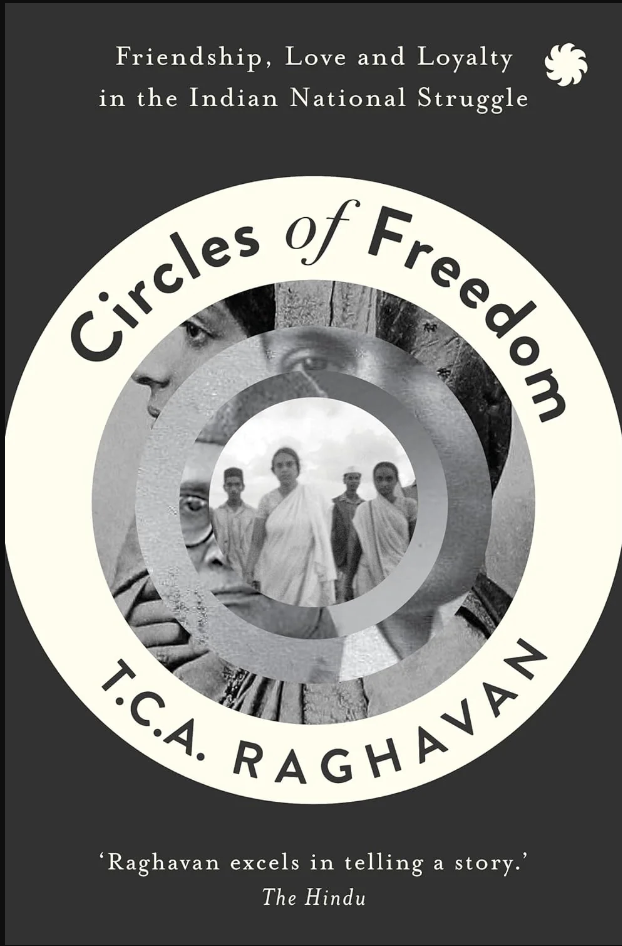
TCA Raghavan, Circles of Freedom: Friendship, Love and Loyalty in the National Freedom Struggle,
Juggernaut (2024)

I must confess that in the four years I worked at Asaf Ali Road and passed this statue twice a day, morning and evening, it evoked no curiosity in me and I knew virtually nothing about Asaf Ali. Perhaps, his wife Aruna Asaf Ali’s name seemed more familiar given that she was still alive and active. I suspect I was not alone in this. For most people in Delhi, Asaf Ali is a forgotten footnote from long-ago history lessons, one of the many ‘obscure’ people who were part of the national freedom struggle. If the situation is so dismal in Delhi, where he had lived and worked, a city that had been home to his ancestors, I suspect it can only be worse in the rest of the country.

In writing Circles of Freedom: Friendship, Love and Loyalty in the National Freedom Struggle, TCA Raghavan corrects an old wrong. For far too long the tall poppies of the freedom movement have overshadowed the countless others who devoted their entire lives to the cause of independence and struggle against colonial rule. For too long, a handful of names have dominated the history of the years leading up to 1947 with Gandhi, Nehru, Jinnah, Patel being the most-often cited.

Over the past decade, with history being rewritten by new, dominant players, new names are being invoked and icons fashioned from often slender resources. In this unseemly clamour for space and recognition, some names have almost slipped through the crevices of the popular imagination, neglected and overlooked by the professional historian or, at best, relegated to the lowest rungs in a carefully crafted hierarchy of heroes. A park or a road named after the lesser-known evokes neither curiosity nor interest in their lives and the place they occupied in the shaping of a young nation. Asaf Ali (1888-1953) is one such person.

Raghavan’s book, however, is not a straightforward biography for it is not about Asaf (as the author calls him) alone. Instead, he chooses to tell his story through five protagonists who were inextricably tied by the threads of friendship and solidarity: Asaf Ali, Sarojini Naidu, Syud Hossain, Syed Mahmud and Aruna Asaf Ali. While Aruna enters this narrative quite late when she marries the much older Asaf, the other four meet in England just before the Great War where the three men have gone to study and Naidu, recuperating from an illness, is the erudite diva, eloquent poet, ardent nationalist and a veritable magnet for impressionable young men dreaming impossible dreams.

Over the next four decades, they meet, write long letters to each other, take a lively interest in each others’ lives and careers but ‘what gave meaning to their lives,’ as Raghavan notes in his conclusion, ‘was the great enterprise they chose to become part of’. And so it was the freedom struggle that not just formed the core of their relationship but also, in effect, shaped their lives. Were it not for this one singular, overwhelming zeal to seek freedom for their country, they could very well have lived other lives: Naidu would have remained a dulcet-voiced poet, both Asaf and Mahmud successful and wealthy barristers, Hossain a journalist and Aruna a do-gooder with no special qualifications. But such were the exigencies of the times that all five were caught up in different ways and different degrees with the national freedom struggle and that singular ‘great fight’ defined their lives.

With three extremely well-received books behind him – Attendant Lords: Bairam Khan and Abdur Rahim – Courtiers and Poets in Mughal India, The People Next Door: The Curious History of India’s Relations with Pakistan and History Men: Jadunath Sarkar, G. S. Sardesai, Raghivir Sinh and Their Quest For India’s Past – Raghavan, a former diplomat, can recreate history with the aplomb of a master story-teller and the meticulousness of a professional historian. Here, he weaves the events of the tumultuous years leading up to Independence with the lives of his five principal characters, keeping Asaf at the centre of his concern. Through Asaf, he teases out the nuances and dilemmas of the moderate Muslims in India who refused to be enamoured by the lures and promises of the Muslim League and remained steadfast in their devotion to the Congress and, by extension, Nehru. 

The extreme deference that the nationalist Muslim leaders displayed towards Nehru is noted; each time a Muslim leader attempted to bring the ‘communal problem’ to Nehru’s notice, the latter would brush aside these concerns by saying, ‘The real problem is a political problem – the conflict between an advanced organisation like the Congress and a politically reactionary organisation like the League.’ Concerns of leaders such as Asaf who believed ‘self determination was preferable to a union that was forced’ were disregarded. Mindful of the suspicion that Muslim leaders within the Congress evoked amongst their colleagues, Raghavan notes, ‘Because he was a Muslim, the impression among some was that he was a fifth columnist for the League’. The coming of independence didn’t make it any easier for those Muslims who chose to stay on in India. Nationalism increasingly began to mean thinking and living in the Congress way and none other. Those who lived or thought another way came to be regarded as anti-national, a phenomena we see repeated in the New India that is Bharat, except that it is the ruling Bharatiya Janata Party that has replaced the ideological hegemony of the Congress.

Different readers will possibly take different things from this book: the broad brush strokes that delineate milestone moments from modern Indian history, Gandhi’s irresistible call to Quit India, the unfurling of the national flag at Gowalia Tank by a young Aruna that catapults her to national fame, the detailed account of jail-life for a group of high-profile, political prisoners inside the Ahmadnagar fortress, a meticulous dove-tailing of accounts from different sources and disparate perspectives to create a bright, colourful and immensely readable patchwork quilt of modern Indian history, and much else in this engrossing book.

I, however, was left with an ineffable sadness and a sense that the more things change, they remain the same – at least for India’s Muslims. Despite his many sterling qualities of heart and mind, despite a fine legal education, Asaf neither made a mark as a lawyer or a politician. Though seemingly destined for greatness, having aided fate by preparing himself assiduously for a life devoted to the larger good, Asaf never quite scaled the heights he aspired to. The few successes that came his way, such as a seat in the Constituent Assembly (from Delhi) or fighting high-profile cases such as those of Bhagat Singh or Shaikh Abdullah, were marred by controversy or a smaller share in the limelight than he felt he deserved. The mantle of statesmanship that should have fallen on him with the passing of Dr Ansari and Hakim Ajmal Khan, both national leaders from Delhi like him, and a seat at the high table that should have been offered to him as a veteran Muslim leader, did not happen.

Given the price paid by far taller leaders in the Congress – such as C. Rajagopalachari and Bhulabhai Desai – for showing initiative and thus offending the party high command, shows the extent to which the Congress, not unlike the League, was becoming a personality-dominated organisation. Asaf’s case was compounded – to use a modern expression – by the optics; his timorousness, his ‘going to pieces’ fretting with worry over his wife during his long years of incarceration, his marital woes, the shadow of mistrust and suspicion that clung to him all his life combined to create a persona that failed to inspire confidence.

For all his loyalty to Nehru, Asaf was not chosen for any cabinet position or placed on any important committee. Instead, he was sent as Ambassador to Washington, brought back to serve as Governor of Orissa and then sent again as Ambassador to Sweden where he died barely a few months into his tenure.

Just as being a moderate Muslim defined Asaf’s public persona, so did his marriage to Aruna. From a political novice she rapidly transformed into a stormy petrel causing immense anxiety, consternation and eventually a sadness in her husband. Raghavan is to be credited for staying steadfastly away from prurient gossip and portraying the changing contours of the marriage objectively: ‘… in fact the relationship had started changing quite early in the marriage and here Aruna’s own political journey was the driving factor.’ Reading between the lines of Raghavan’s carefully crafted text, one picks up the whiff of misogyny in the higher echelons of our national leadership. While acknowledging Aruna’s bravery and patriotism, Gandhi saw her as a ‘perpetual rebel’ and Nehru went so far as to call her ‘hysterical’ on one occasion – something Aruna never forgot.

Incidentally, Gandhi, who was vehemently opposed to inter-religious marriages and had opposed his son Manilal’s relationship with Fatima (a Gujarati Muslim) and Hossain’s alliance with Nehru’s sister Sarup Rani (later known as Vijay Lakshmi Pandit), endorsed Asaf’s marriage to Aruna. Read Circles of Friendship to find out why.

Rakshanda Jalil is a Delhi-based writer, translator and researcher. 

source: http://www.thewire.in / The Wire / Home> Books / by Rakshanda Jalil / August 29th, 2024
Freedom fighter’s family preserves 73 year old national flag

Demow (Sivsagar District), ASSAM:

The first national flag hoisted in Demow after independence, 73 years ago has still been preserved well by the family of freedom fighter Commander Mohd. Maulobi Mohd. Hussain.

source: http://www.sentinelassam.com / The Sentinel / Home / by Sentinel Digital Desk / August 14th, 2019

Jallianwala Bagh: A symbol of Muslim, Hindu, Sikh Unity

Jallianwala Bagh, (Amritsar), PUNJAB:

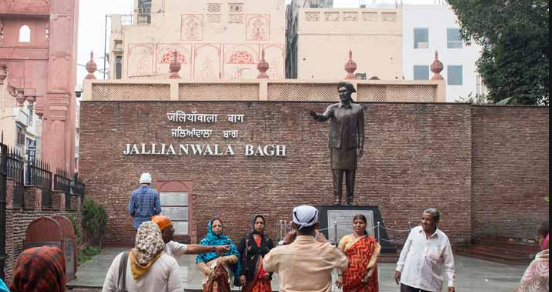
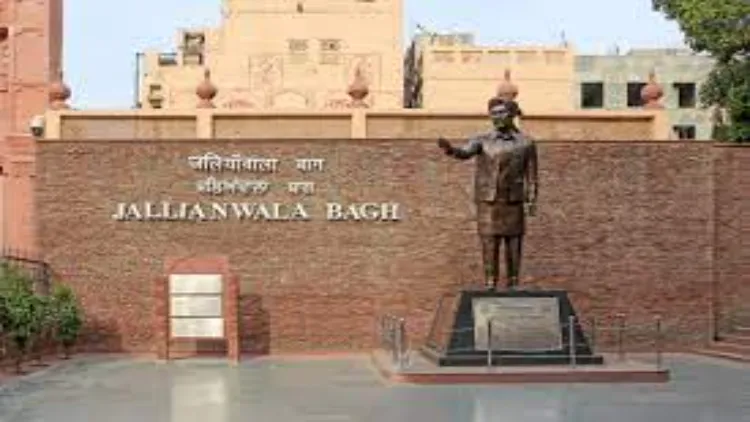
Jalianwala Bagh
Jalianwala Bagh

In popular memory, historical narratives are more often than not laced with silence, neglect, nostalgia and heroism thus blurring the line between history and fiction. Public memory tends to remember the selective events according to ideological or political conveniences while the whole narrative in its context is often forgotten.

The Jallianwala Bagh Massacre is one such event which stands out in public memory as a solitary incident. Popular imagination puts the killing of hundreds of Indians on 13th April, 1919 at Amritsar as an event completely disassociated from time and space. It is needed that the massacre should be read in context with the time and space.

Why did the people gather at Jallianwala Bagh?

Indian leadership in general supported the war efforts of the British during the World War – I (WWI) on a promise that the country would be granted self rule or some kind of political autonomy after the war would be over. The British, after the war, backtracked on the promise. Rather to check the nationalist voices brought a Rowlett Act in force which enabled police to imprison Indians without evidence. Several Indian Muslims were aggrieved at the humiliation of Turkey and the British believed that it was their only challenge. With the Rowlett Act at their disposal these Pro-Khilafat voices could be easily suppressed. They did not foresee the possibility of Hindus joining hands with the Muslims, and vice versa and pose a problem for their colonial rule.

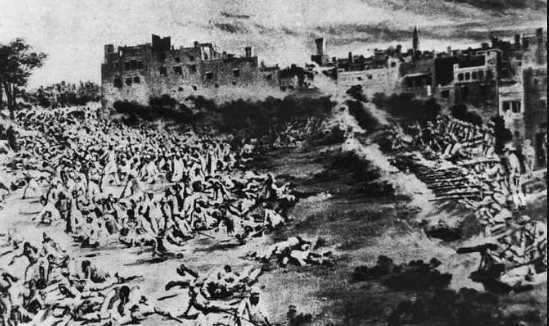
An artist’s depiction of the scene of massacre

On 18th March, 1919, the Rowlett Act was passed. Mahatma Gandhi along with other nationalist leaders termed it a Black Act and called for a protest movement against the same. The day chosen for protests and strikes was the 30th March that was later changed to 6th April. In Delhi a protest was held on 30th, because of lack of communication, and the police did not hesitate from firing upon the unarmed people. More than 50 protestors were killed in Delhi. The British had cleared their intention of using violence against the non-violent protesters.

On 6th April protests and strikes were held across the country, yet Punjab displayed an exemplary zeal of nationalism. What disturbed the British most was the fact that orthodox Hindus of Arya Samaj and orthodox Muslims of different Wahabi and pan-Islamist organizations joined hands against the British. The most popular leaders of Punjab at the time – Dr. Saifuddin Kitchlew and Dr. Satyapal, were prohibited from making public statements but still unity could not be broken. At different places people were fired upon but the nationalist sentiments could not be killed.

On April 9, Muslims came out to celebrate Ram Navami across Punjab. This was becoming too much for the British. In Amritsar Saifuddin and Satyapal oversaw a grand Ram Navami procession where Muslims were as zealous as Hindus were. It led the British to arrest the two leaders and sent them to an unknown location. The people gathered at the Deputy Commissioner’s office to register their protest and they were fired upon. Many were killed. The fear of a Hindu-Muslim unity was so frightening for the British that even after Jallianwala Massacre they arrested and killed Muslims for participating in Ram Navami celebrations.

Ghulam Jilani, who was an Imam of a mosque, was arrested on 16th April with Khair Din for leading the Ram Navmi processions. Police tortured them in the most horrific and inhuman fashion by inserting sticks up in their anus until their excreta and urine would not come out. Khair Din died of the torture while Jilani survived to narrate the ordeal. More than a hundred Muslims were tortured in this manner to celebrate Ram Navmi. 

On the other hand in Lahore, on receiving this news, in an unprecedented manner more than 25,000 Hindus and Muslims gathered in Badshahi Mosque and Hindu leaders, like Rambhaj Datta, addressed the people from the pulpit of the mosque. In Lahore, not only the British used bullets but also brought their loyalists into the picture.

A few sold out Indians like the leaders of Muslims League issued statements that allowing Hindus into the mosque and addressing from pulpit amounted to the sacrilege. Still, most of the Muslims in Punjab were supporting the war cry of the protestors: Hindu-Musalman ki Jai (Victory to Hindu-Muslims).

Visitors clicking pictures at Jallianwala Bagh

It was noted in a government report tabled at the British Parliament, “It (Hindu-Muslim) union had only one purpose, a combined attack on the government.”

Meanwhile, on 13 April, the Baisakhi Day, a meeting was scheduled at Jallianwala Bagh, near Golden Temple, to protest the arrests of Saifuddin and Satyapal. Hindus, Muslims and Sikhs gathered at the Bagh. Colonel Dyer with his troops entered the place and fired upon the unarmed protesters. A gory story of blood, death and massacre happened that each and every Indian knows by heart. Hundreds of Indians died. The tale of this massacre became folklore and inspired generations of revolutionary Indians like Bhagat Singh, Ram Mohammad Singh Azad and others. But, what we miss out is that the British did not stop at this. Punjab remained a laboratory of British atrocities.

The next day, April 14, people in Gujranwala woke up to find a beheaded calf at a public place. It did not take a rocket science to decipher a sinister plot to cause enmity between Hindus and Muslims. People gathered and protested such malicious attempts of the government to disturb the peace. Frustrated at their failed attempt and seeing that the unity has strengthened even further, army airplanes were called in to bomb the city. Yes, you are reading it correctly.

Within two decades of the invention of aero planes and less than a decade of its first military use in WWI when the technology was novel even for armies the British used it upon the innocent civilians of Punjab. A fleet of three planes dropped bombs and fired machine guns on the city and adjacent rural areas. Bombs were dropped at schools, hostels, mosques, marriage ceremonies etc. The government report specifically mentioned that the district is dangerous because followers of Arya Samaj and orthodox Muslim Wahabis like Fazal Ilahi and Zafar Ali Khan had joined hands. An armoured train with machine guns mounted in it was also used to kill along the railway tracks in Gujranwala.

The tales of torture, suppression and killings was repeated allover Punjab. While Jallianwala Bagh rightly gets its mention in our books and survived the public memory the causes behind it and a long trail of violence proceeding and succeeding the event have been forgotten. The very fact that the British used their worst form of violence to counter Hindu-Muslim unity itself speaks about the power of this unity. We need to remember the cause for which our forefathers and foremothers had laid down their lives.

(Saquib Salim is a historian-writer)

source: http://www.awazthevoice.in / Awaz, The Voice / Home> Story / by Saquib Salim / 2021

English, Urdu books on contribution of Indian Muslims in freedom movement released

NEW DELHI :

Patna: 

In a glittering ceremony, two books on Muslims’ contribution in India’s Freedom movement were launched here in Patna on 17th December. The function was presided over by Harsh Mandar, former IAS officer and human rights defender in the country.

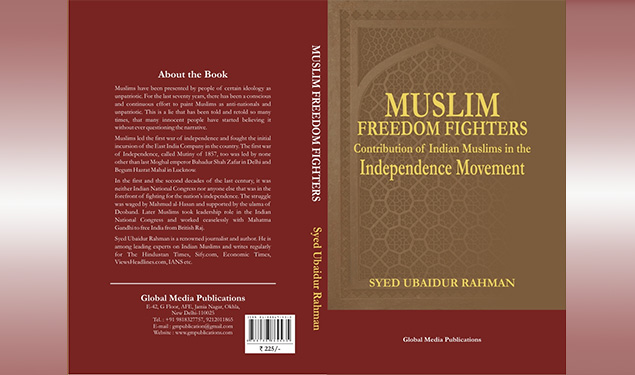
The books ‘Muslim Freedom Fighters: Contribution of Indian Muslims in the Independence Movement’ and its Urdu version ‘Muslim Mujahideen-e-Azadi aur Tehrik-e-Azadi Mein Unki Khidmat’ have been authored by Delhi based author and journalist Syed Ubaidur Rahman.

The two books try to fight the oft-repeated allegations that Muslims are anti-national and have not contributed for the freedom of the nation. The books nail the lie and prove that Muslims not just participated in the freedom movement, they went on to lead the freedom struggle for a long time. The first war of Independence or Mutiny of 1857 was led by Mughal emperor Bahadur Shah Zafar in Delhi and Begum Hazrat Mahal in Lucknow. The Independence Movement in the first two decades of the twentieth century was led by Mahmud Hasan and ulama of Deoband and they had respect and support of everyone including Hindus and Muslims.

If anyone has any doubt about the Muslim contribution in the freedom movement, the fact that the Indian National Congress had as many as nine Muslims as its president till the year 1947 will remove such doubts.

While speaking on the occasion, Harsh Mandar said that the divisive forces in the country are trying to divide the nation on the basis of religion and faith. He said that the danger from such forces for the national fabric and its unity has become grave.

Harsh Mandar added that the threat to the communal amity in the country was never so high as is today as divisive forces are doing every thing to pit one community against the other and create a fear psychosis among the majority community prompting it to turn it against minorities.

Khursheed Mallick, a Chicago based urologist, philanthropist and director of IMEFNA said that the book is a timely reminder to the nation that Muslims and Hindus both sacrificed for the nation and this fact must be clearly told to our young generation. He said Muslims sacrificed heavily for the cause of the freedom of the nation and efforts must be made to tell the history.

Syed Ubaidur Rahman, the author of the two books, while speaking on the occasion said Muslims have been rather loath to write about the sacrifices they have made for the cause of the Independence and freedom. He said Muslims suffered badly throughout the freedom movement. They were the worst suffers in the wake of the mutiny of 1857 and its aftermath when Muslims were hounded across North India and beyond. Tens of thousands of Muslims lost their lives for the freedom.

Syed added that ulama of Deoband played a stellar role in the freedom movement. Unlike the common perception, they were secular to the core and when they established a government in exile in Kabul in 1915, they appointed Raja Mahendra Pratap as its President and Maulana Barkatullah Bhopali as its Prime Minister.

The book documents the lives of forty renowned Muslim freedom fighters including, Shaikhul Hind Maulana Mahmud al-Hasan, Maulana Barkatullah Bhopali, Hakim Ajmal Khan, Maulana Ubaidullah Sindhi, Maulana Abul Kalam Azad, Maulana Mohammad Ali Jauhar, Dr Maghfoor Ahmad Ajazi, Dr Mukhtar Ahmad Ansari, Ashfaqulla Khan, Maulana Hasrat Mohani, Maulana Muhammad Mian Mansoor Ansari, Asaf Ali, Husain Ahmad Madani, Aruna Asaf Ali (Kulsum Zamani), Peer Ali Khan, Saifuddin Kitchlew, Mohammed Abdur Rahiman, Captain Abbas Ali, Abdul Qaiyum Ansari, Prof. Abdul Bari, Moulvi Abdul Rasul, Nawab Syed Mohammed Bahadur, Rahimtulla Mahomed Sayani, Syed Hasan Imam, Sir Syed Ali Imam, M.C. Chagla, Yusuf Meherally, Justice Fazal Ali, General Shah Nawaz Khan, Allama Fazle Haq Khairabadi, Maulana Shaukat Ali, Syed Mahmud, Maulana Mazharul Haque, Badruddin Tyabji, Col Mehboob Ahmed, Begum Hazrat Mahal, Maulana Shafi Daudi, Rafi Ahmed Kidwai, Syed Mohammad Sharfuddin Quadri, Batak Mian

The book launch function was organized at Anjuman Taraqqi Urdu and was presided over by Abdul Qaiyum Ansari, chairman of Anjuman Taraqqi Urdu Bihar.

Name of the Book: Muslim Freedom Fighters: Contribution of Indian Muslims in the Independence Movement
Author: Syed Ubaidur Rahman
ISBN: 81-88869-43-0
Price Rs 225/-
Global Media Publications
E-42, G. Floor, AFE, Jamia nagar, Okhla, New Delhi-110025

source: http://www.ummid.com / Ummid.com / Home> India / by ummid.com News Network / December 12th, 2017

The forgotten mutiny for India’s independence

BRITISH INDIA :

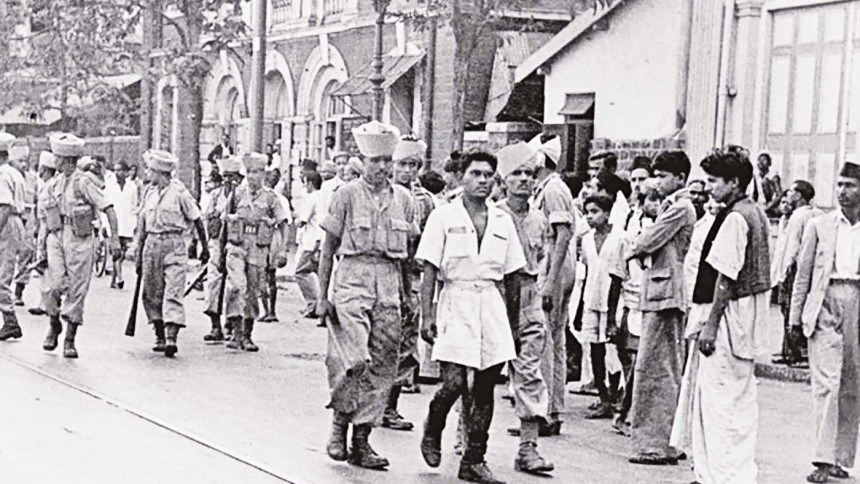
A sailor being arrested after the Naval mutiny.

One of the most important but undervalued events of India’s independence movement was the naval revolt of 1946, about which Indian historian Sumit Sarker wrote, “Had this insurrection succeeded, India’s struggle for freedom might have taken a different turn.” From February 18 to 23 that year, more than 20,000 ordinary sailors, known as ratings, and low-ranking officers of 74 warships and 20 installations took part in a strike, which was termed as a mutiny or rebellion.

After Bengal lost its independence at Palashi’s Mango grove in 1757, the British Raj in India faced two major armed revolts: the first one was exactly after one hundred years, the military revolt of 1857, and the second one was 189 years later, the naval mutiny. Both in 1757 and 1857, the freedom fighters were defeated by the arms and tactics of the British rulers, but the naval mutiny failed because of the politicians in India then. It was not only the ratings’ mutiny that the political leadership had decided not to support – the civilian uprising triggered by the naval mutiny, too, was condemned by them. The scale of the civilian uprising, if it happened in a post-colonial era, would have created a revolution or at least caused the fall of the government of the day.

Three days after the mutiny ended and the civilian uprising was crushed with brutal force, the then British Prime Minister Clement Atlee told the House of Commons on February 26, 1946, “I regret to inform the House that grievous loss of life, injury and destruction of property have resulted from all these disturbances. In Bombay, there have been 223 deaths and 1,037 persons have been injured. The total damage includes the looting or destruction of nine banks, 32 government grain and cloth shops which the public can ill-afford to lose, 30 other shops, 10 post offices, 10 police stations and 1,200 street lamps. The number of vehicles destroyed is not yet estimated. In Karachi, there have been seven deaths and 21 cases of injury. In Madras, up to last night, one person has been killed and another seriously injured” (Source: Hansard). 

Mr Atlee in his statement said, “Both Congress and Muslim League leaders cooperated in condemning and attempting to stop the disturbances, but the Communist Party issued a manifesto at midnight on Thursday thanking the public for its support.” It perhaps explains why, to this day, the political classes of the three countries born from the partition of India are not willing to admit their failure and give those mutineers and civilian martyrs their due credit. Therefore, in 2021, there was no big event in the subcontinent to mark the 75th anniversary of the naval revolt.

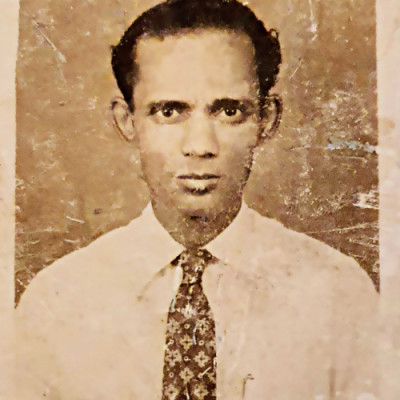
Mohammad Dewan Ali Nazir, Royal Indian Navy, Index no: 34499.

On a personal level, it’s ironic that, despite studying history at the country’s two top universities, I, too, did not take much interest in it during my student life. When I first heard of the rebellion from a mutineer, I had already taken a job and started my professional journey devoid of in-depth history. The mutineer I am talking about was my father, who spoke about his role and feelings about the lost cause during one of my short home visits. My father, Mohammad Dewan Ali Nazir (Royal Indian Navy, RIN, Index no: 34499) was one of the last 3,500 sailors and 300 sepoys who refused to surrender until the last on board of HMIS Akbar.

They were detained after surrendering and were released in August of that year. The mediation and the assurances given by the leaders of both Congress and Muslim League turned out to be nothing but betrayal. Though the uprising was a challenge to the Empire, shaking up the British imperial order, the leaders of the nationalist movement waiting to form an interim government through negotiations were not ready to derail that prospect.

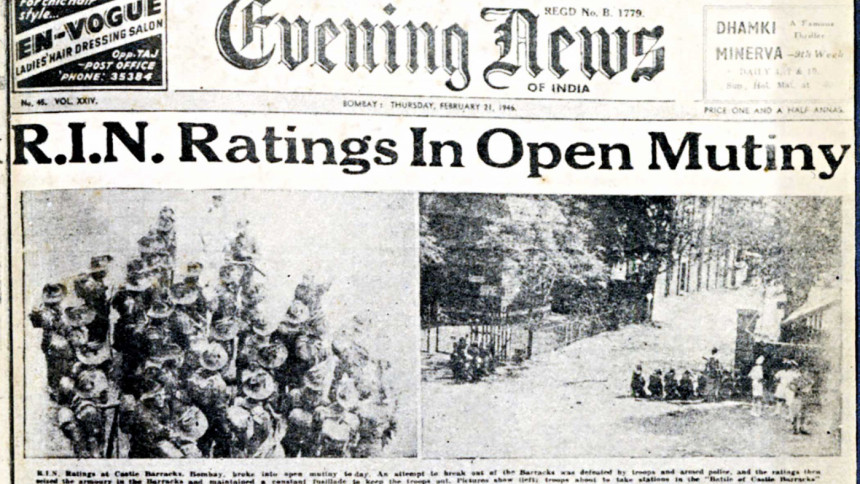
Newspaper clipping of the Evening News.

The leaders of the Congress and the Muslim League did not want a revolution – they wanted a peaceful transfer of power. Among the leading politicians, only Congress leader Aruna Asaf Ali extended her support to the ratings’ strike and tried to persuade her party leaders to take a stand in favour of the strikers, but failed in the face of opposition from Vallabhbhai Patel. On February 22, Vallabhbhai Patel sent a message to the rebels to surrender. Only the Communist Party of India came forward in support of the naval revolt and called a general strike. Reading the memoir of one of the key figures of the revolt, Balai Chand Dutt (BC Dutt), and a few other publications, one can easily imagine how much frustration and pain those mutineers felt because of the national leaders’ silence, which they saw as a betrayal. Perhaps it explains why my father, too, lost interest in politics and didn’t speak much about the heroic uprising that ended in a tragedy. 

Those nationalist leaders, including Gandhi, Jawaharlal Nehru and Muhammad Ali Jinnah, advised them “not to mix up ‘political demands along with service demands’; to ‘remain calm’ and to formulate to the naval authorities their service demands.”

But from the very beginning, those naval ratings were raising political demands – particularly, the Quit India slogan.

Their Charter of Demands asked for: 1. Release of all Indian political prisoners; 2. Release of all Indian National Army personnel unconditionally; 3. Withdrawal of all Indian troops from Indonesia and Egypt; 4. British nationals to leave India; 5. Actions against the commanding officer and signal bosonshead for rough treatment of the crew; 6. Release of all detainees (naval ratings); 7. Speedy demobilisation of the RIN ratings and officers; 8. Equal status with the British navy regarding pay, family allowances and other facilities; 9. Best class of Indian food; 10. No return of clothing kit after discharge from service; 11. Better treatment from officers to subordinates; and 12. Installation of Indian officers and supervisors. (Source: Meanings of Failed Action: A reassessment of the 1946 Royal Indian Navy uprising by Dr Valentina Vitali, University of East London, UK.)

Autobiographies of two rebels  – BC Dutt and Biswanath Bose – suggest that the then (undivided) India could have been a different place if the revolt of that day had succeeded. The rise of communal politics, the division and instability that is spreading in the states and society, would not have happened.

BC Dutt was one of the organisers of the HMIS Talwar, the ship where the mutiny started. He was arrested and tried for writing a new slogan on a ship on February 1, three weeks before the start of the February 18 mutiny. His book, The Mutiny of the Innocents, contains details of how political literature and pro-independence activities were organised much before their strike.

Biswanath Bose’s RIN Mutiny, 1946 also gives detailed descriptions of how the revolt unfolded. But politicians argued that the revolt was mostly due to the resentment among Indian ratings over low wages, poor quality of food and housing, which was lower than that of the Whites, and racial discrimination.

After the mutiny of 1857, the British rulers banned the entry and discussion of political leaflets in all forces, but BC Dutt used to secretly discuss political documents in the ship HMIS Talwar. Two months before the mutiny, on the Naval Day on December 1, when it was open for public visit, they wrote various slogans, including “Quit India” and “Jai Hind” on the ship. Explaining the reason why the mutiny failed, BC Dutt wrote that while all Europeans and Indians were stunned by the course of events and wondering if it was a revolt, unfortunately the political parties had nothing to say. When it was time to lower the British Union Jack and fly the Indian flag, they felt unprepared.

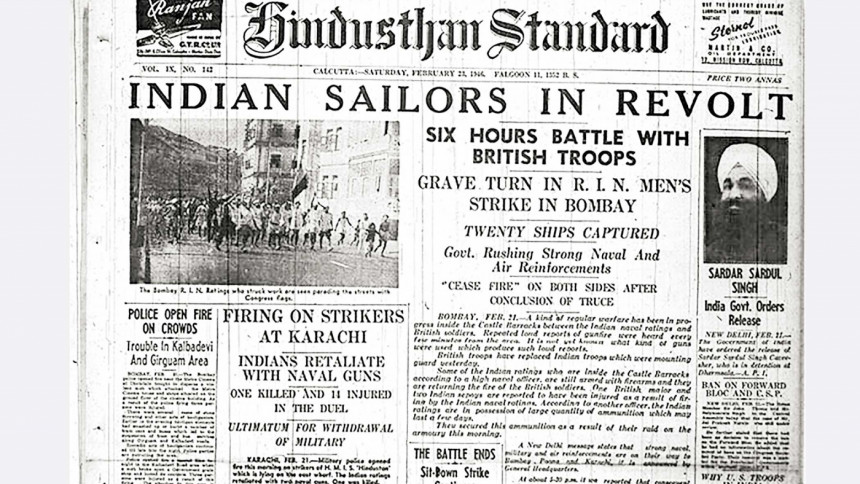
Newspaper clipping of the Hindusthan Standard

On February 22, 1946, when the nationalist leaders were busy arranging the ratings’ surrender, Prime Minister Clement Attlee told the parliament that the sailors had given political slogans and demanded that a political leader be given a chance to speak. He also said in the statement that Congress had nothing to do with the insurgency, but the communists and leftists could try to exploit sympathy.

William Richardson, a British researcher, writes in The Society for Nautical Research that the political movement for India’s independence was at the root of the revolt (The Mutiny of the Royal Indian Navy at Bombay in February 1946, May 1993).

Author of the book 1946: The Unknown Mutiny, Promod Kapoor wrote that the navies fell between the two aspirations of the two rulers. One side wanted their impending departure not to be tarnished by the stigma of rebellion. On the other hand, when power was imminent, the other rulers were anxious to see if there were any signs of chaos in the armed forces. Because in the future, they would have to manage these forces. 

Politicians assured that no one would be punished, no compensation would be paid, and steps would be taken to meet the demands. In reality, the opposite had happened. Rebel leaders were arrested, tried and punished. Other rebels were told to grab third-class train tickets to return home and to never return to Bombay again. Showing various excuses, deductions were made from salary arrears even for minor damages in their uniforms.

Biswanath Bose’s book gives a glimpse of how frustrated and angry these rebels became with the behaviour of the government and the breach of promises by the political leaders. He wrote, “If patriotism is a crime, then we must be criminals.” Expressing his frustration for not being reemployed in the Indian Navy, he wrote a letter to Prime Minister Nehru asking if there was any law banning his return to the force due to dismissal for taking part in the freedom movement, and how, as a leader of the Congress, Nehru could be the prime minister.

Nationalist leaders were so reluctant to give the mutineers their due credit, that the Indian government banned the Bangla play Kallol (Sound of the Wave), based on the mutiny, by playwright Utpal Dutt, and he was imprisoned. The play was first performed in 1965 in Calcutta at the Minerva Theatre and it drew large crowds.

At the beginning of the naval strike, a Central Strike Committee (NCSC) was formed by the representatives of the ships stationed in Bombay. The committee renamed the Royal Indian Navy as The Indian National Navy. The committee was chaired by Signalman MS Khan, and Madan Singh was the vice-president. One remarkable element of the naval rebellion was the unity of various faiths among both the naval force and the civilians who took to the street. They raised slogans “Hindu-Muslim unite” and “Inquilab Zindabad” on the streets of Bombay.

BC Dutt’s book also speaks of this communal harmony. He wrote, “We are from different regions, and from families of Hindu, Muslim, Christian and Buddhist, but after spending years in the Navy, we sailors have become Indians. The irony is that the politics of communal division and hatred is now intensifying across the subcontinent.

(After leaving the job of a naval instructor, my father joined the office of Indian Civil Supply, and after a short stay in Kolkata, he was transferred to East Bengal. He retired as a magistrate and died on August 29, 2001.)

Kamal Ahmed is an independent journalist and writes from London, UK. His Twitter handle is @ahmedka1

source: http://www.thedailystar.net / The Daily Star / Home> In Focus / by Kamal Ahmed / July 25th, 2022