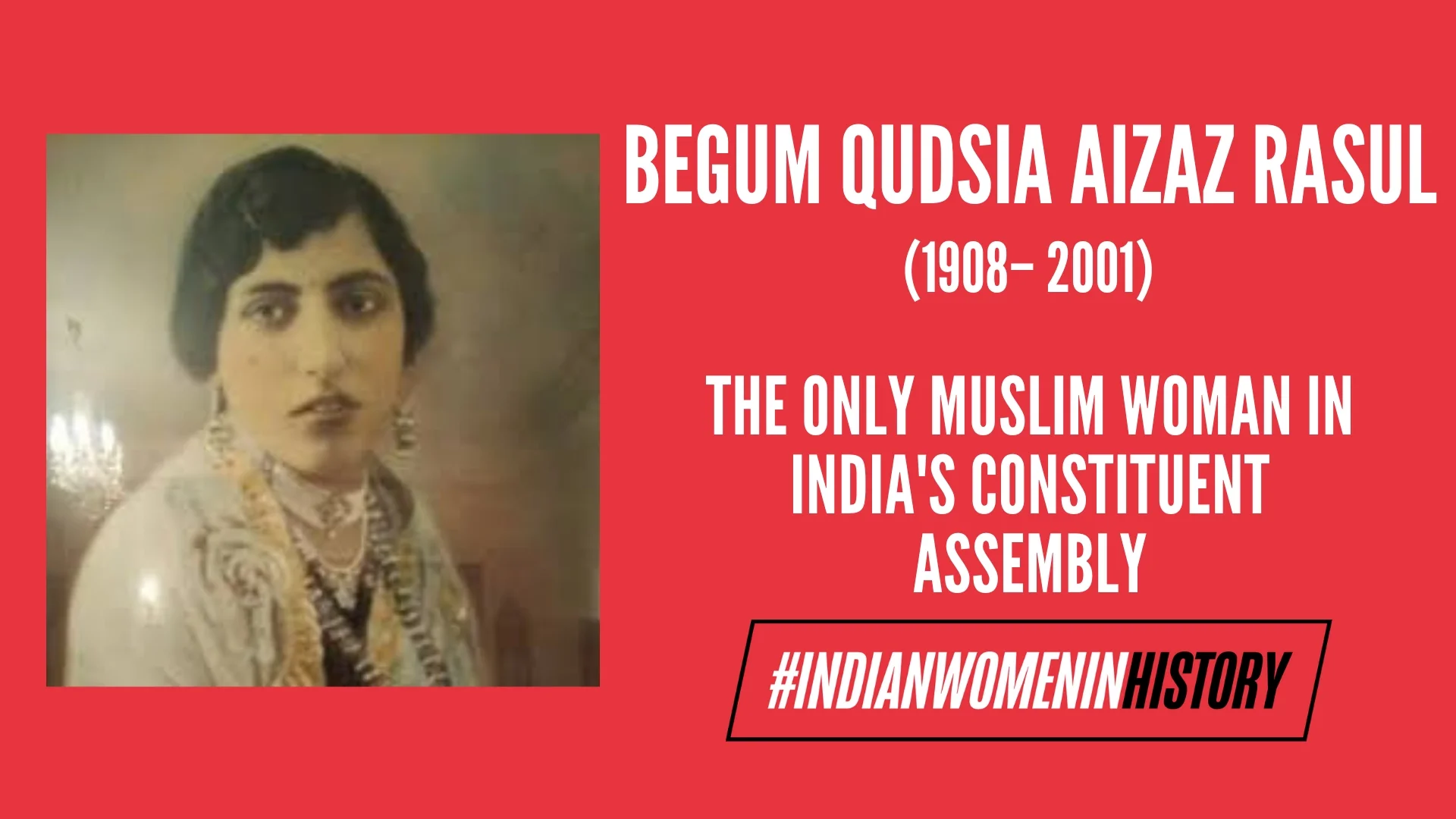
Begum Qudsia Aizaz Rasul was one of the 28 Muslim League members to join the Constituent Assembly of undivided India, and she was the only Muslim woman to be a part of the assembly.
Begum Qudsia Aizaz Rasul was born to the royal family of Malerkotla (situated in erstwhile united Punjab) on 4th April, 1908. Her father was Nawab Zulfiqar Ali Khan. Qudsia had a progressive upbringing and was encouraged from a very early age to lead a modern life, as opposed to several stringent restrictions imposed upon other contemporary Muslim women, such as that of the purdah.
She got married at quite an early age to Nawaab Aizaz Rasul from the erstwhile province of Awadh. Her husband held the position of a taluqdar, or a landowner. Qudsia had political exposure both before and after marriage, and her formal political participation took place after she got married.
Qudsia, along with her husband, joined the Muslim League in mid-1930s, soon after the passing of theGovernment of India Act in 1935. This was also her official entry into electoral politics, as she contested in the elections of 1937 from the U.P. legislative assembly, where she successfully held her seat till 1952. Aizaz was one of the very few female candidates to have contested and won from a non-reserved constituency during the pre-independent times.
“
She was the first Indian woman to achieve such feats, and this was truly commendable and noteworthy at a time when most formal political positions were almost implicitly reserved for men.
“
As an MLA, she also held several important posts, such as the Leader of Opposition (1950 to 1952) and the Deputy President of the Council (1937 to 1940). She was the first Indian woman to achieve such feats, and this was truly commendable and noteworthy at a time when most formal political positions were almost implicitly reserved for men. Moreover, to rise to prominence at a politically significant province such as the U.P. indeed made Qudsia Aizaz Rasul a trailblazer.
She is well known for her progressive, anti-feudal stances, such as the abolition of the zamindari system. Qudsia was a strong advocate for the abolition of communal electorates as well, as she believed it divided the society more than it united – which was counterproductive for the Indian electoral candidates at a time when there was an urgent need of a united Indian front to oppose the colonial rulers. She went on to create a strong and convincing case for the abolition of electoral reservations for religious minorities during her tenure as a member of the Constituent Assembly.
Qudsia was one of the 28 Muslim League members to join the Constituent Assembly of undivided India, and she was the only Muslim woman to be a part of the assembly. Her contributions in the assembly debates remain monumental till date and have been recorded in many official sources.
“
Her contributions in the assembly debates remain monumental till date, and have been recorded in many official sources.
“
After the dissolution of the League, she joined the Indian National Congress, and served as a member of the Rajya Sabha from 1952 to 1958. Later, she became a member of the legislative assembly of Uttar Pradesh from 1969 to 1989.
Other Achievements
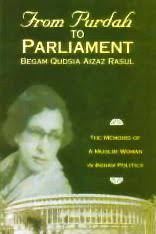
Begum Qudsia Aizaz Rasul is also well known for her autobiography, titled From Purdah to Parliament: A Muslim Woman in Indian Politics. It provides excellent insights into the intersectional aspects of organised politics as it functions in our country. Other than this, she also wrote a travelogue titled Three Weeks in Japan.
Besides her literary prowess, Qudsia had also served as the President of the Indian Women Hockey Federation for over fifteen years, and went on to become the President of the Asian Women’s Hockey Federation.
Begum Qudsia Aizaz Rasul was awarded the Padma Bhushan in 2000 for immense, invaluable contributions to the field of social work.
Bandipora District / Hazratbal (Srinagar), JAMMU & KASHMIR :
Has 20 patents in his name, winner of 5 medals
Innovation is the process of turning ideas into manufacturer and marketable form and this maxim has been proven by M-Tech degree holder Jahangir Arshid of North Kashmir’s Bandipora district.
He has over 20 patents in his name, out of which five of them have won him gold medals. Jahangir, 27, is currently pursuing Artificial Intelligence and Machine Learning (AIML) at the University of Texas in the United States, and runs an institution called “Kashmir Innovates”, popularly known as KASHOVATIC, in Hazratbal, Srinagar.
Presently, he is working on a unique patent like “Spoon” that would check the concentration of salt in any dish that our womenfolk prepare in their kitchens.
The idea to determine the reading of salt in units was evolved after students often complained of not getting the taste of salt in their meals. Jahangir has six students of 9th to 12th standards assisting him at his Bandipora workshop, besides continuing with their learning.
Giving a reason for taking up the “Spoon” project, Jahangir said that, “In the dishes that our sisters and mothers prepare, the salt content either remains low or more. This encouraged students to create an electric device which will check the concentration of salt on the basics of 10th-level science, which teaches us the basis of conductivity and resistance.” Jahangir further said, “Spoon will show the reading of units of salt when it is put in the utensil containing the meal to be prepared and accordingly the quantity of salt can be added.” Describing it as a prototype, Jahangir said companies that accept it can take it and redesign it as per their requirement before marketing it.
“Presently, it works in battery mode and we are trying to make it battery less so that there is no need to charge it time and again,” Jahangir said, adding that it would take the boys at least two more months to reach perfection.
“We will make it on “Speck Effect”, which reacts to temperature and generates voltage and, when one dips the spoon in any hot dish, it will automatically show the content of salt,” Jahangir, adding, “We will change to super capacitor charge for it to run and work on its own.”
Jahangir said that “Spoon” will not only solve kitchen problems, but also help hypertensive people decide how much salt they should take.
He said that Adnan Farooq, Tabish Mushtaq, Tabasum Manzoor, Amaan, Seerat Jan and Zainab-un-nisa are presently on the job to take “Project Spoon” to its logical conclusion.
Jahangir’s first unique innovation was a “Baby Peace and Foretelling Device”, a diaper-shaped item meant for children and paralytic patients, giving advance signals about a baby or a paralytic patient about to go for a “Peep”. He said a nurse or attendant would get a message in advance when a patient wants to go for a “peep” and accordingly she can move the latter to the washroom.
Different companies from Japan, including Unicharm and Unitear, have shown interest after seeing our patents. “We have signed a Memorandum of Understanding (MoU) with them and are in constant touch rather than being in queue for medical research. Recently, we received an email stating that ‘we found your technology unique throughout the globe,’” said Jahangir.
“With the encouragement from Japanese companies, we have started a chain of innovations and presently we are working on more than 20 patents,” he added.
“Five of these patents are of international level and have won me four gold and one silver medal. We have also won the Medal of Honor from the Association of European Innovators, which are being run by the Republic of Serbia and the Republic of Portugal,” Jahangir said
Gold medals have been won for the baby peace and foretelling device, self-cleaning utensils, brain interface for specially-abled persons and hardware automation system for examinations. The patent for stabilisation and transformation frequency control won a silver medal.
“After achieving success, we started a patent institution where we teach our students how to make these patents and how to apply basic science to remove the problems of common people,” Jahangir said.
“The motive of KASHOVATIC is to develop an innovative culture and scientific temperament in the Kashmir Valley which would help students of 9th and 10th standards to differentiate and find out what is piquant in society and attracts them in a big way. Developing a scientific temperament and attitude will encourage them to innovate, take responsibility and help society deal with its many problems,” he added.
More than 150 students have given us innovations through “KASHOVATICS”. “Recently, we got approval from the Association for Information Communication Technology (AICT),” he said, adding that “our institute is running successfully and our efforts are bearing fruit, as there is a lot of exposure in Srinagar.”
He said that under the National Education Policy (NEP) 2022, the promotion of innovative products needs enhancement of structure and development so that innovators can bring about a revolution in society. Jahangir further said that engineers who have completed their studies have great potential and could be great innovators in society.
“Not only engineers, but every student could be an innovator, but the need of the hour is to look at problems in a way that we can give solutions and that kind of thinking can make us innovators. Only innovation could take us forward in this world,” he concludes.
source: http://www.brighterkashmir.com / Brighter Kashmir / Home / by Qaisar Ahmad / March 10th, 2022
A new study has revealed narratives of syncretism that counter the politically motivated and polarised versions of the Valley’s history.
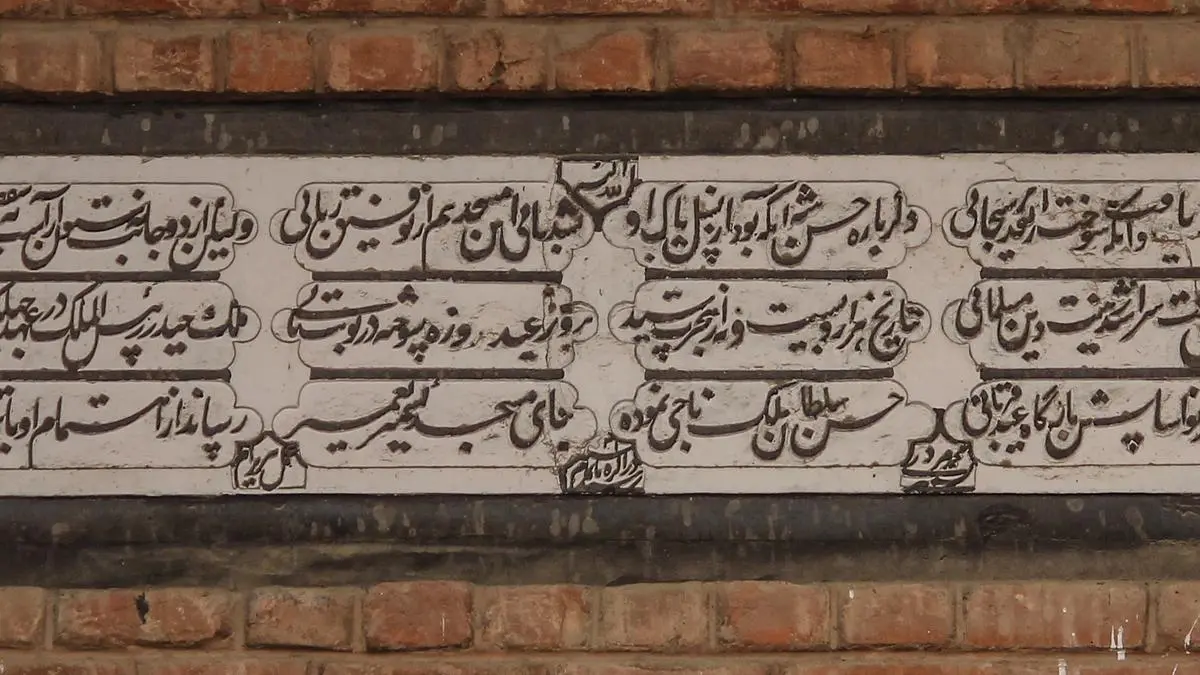
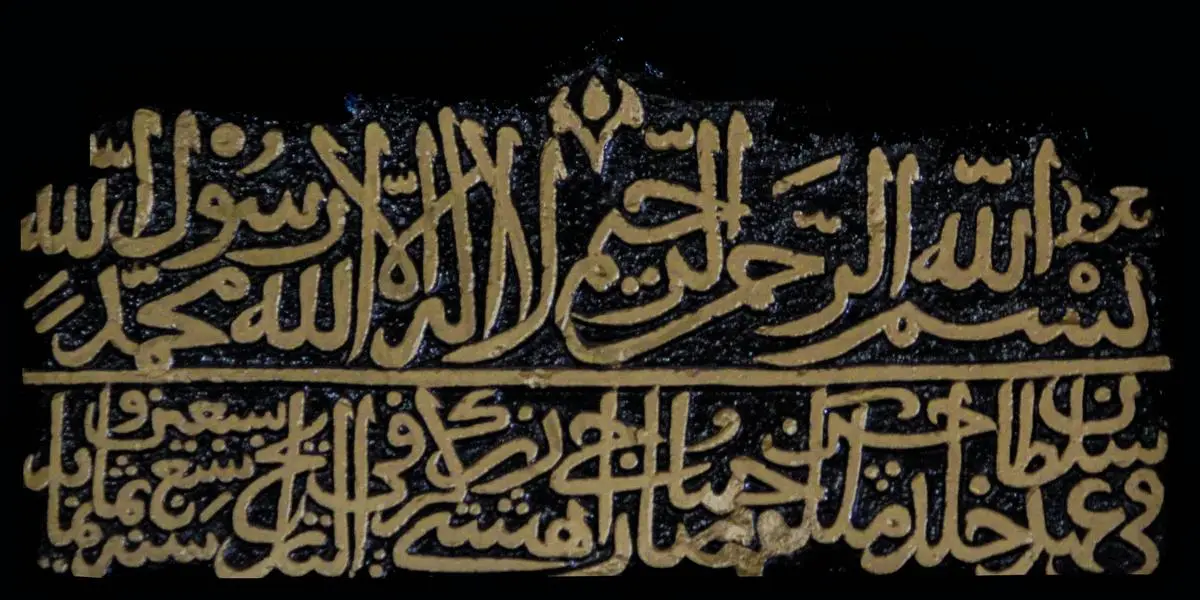
The 17th century limestone slab in the walls of Jamia Masjid in Srinagar. At the bottom, a small engraving reads, “the work of Hari Ram”. | Photo Credit: Tabish Haider, Barakat Trust
Strolling inside the quadrangle of Kashmir’s 600-year-old Jamia Masjid, worshippers stop to take pictures of the mosque’s large steeple, its outlines sharpened against the backdrop of Hari Parbat, the famous fort-hill of Srinagar. What they usually overlook is a limestone plaque with Persian inscriptions embedded in the wall just above the mosque’s entrance.
In January 2024, when the Srinagar-based art historian Hakim Sameer Hamdani (he is currently the Design Director of the Jammu and Kashmir chapter of the Indian National Trust for Art and Cultural Heritage) examined the slab, he found that it mentioned names of medieval-era sultans and their governors involved in the repeated repair and rebuilding of the mosque since its original construction in 1402. At the bottom, he noticed the name of the engraver: Hari Ram. Hamdani told Frontline: “Based on our investigation, it appears that Hari Ram, who inscribed the text on the limestone plaque, was a master carver in the Mughal atelier. There is no information about Hari Ram in any Mughal source. But from this slab we know now that he was Hindu and part of the overall Mughal patronage system.”
The Jamia mosque was constructed during the reign of Sultan Sikandar Shah Miri in 1402, a few decades after the Turkic-origin Shahmirid dynasty took over the reins of the kingdom from the royal house of the Loharas, who were Hindus. In Kashmir’s narrative tradition, the mosque is invested with great symbolism: Jamia Masjid embodies not just the crowning of Islam as the State religion of Kashmir after eight centuries of Hindu rule, but also the start of the spread of a culture heavily influenced by Persia.
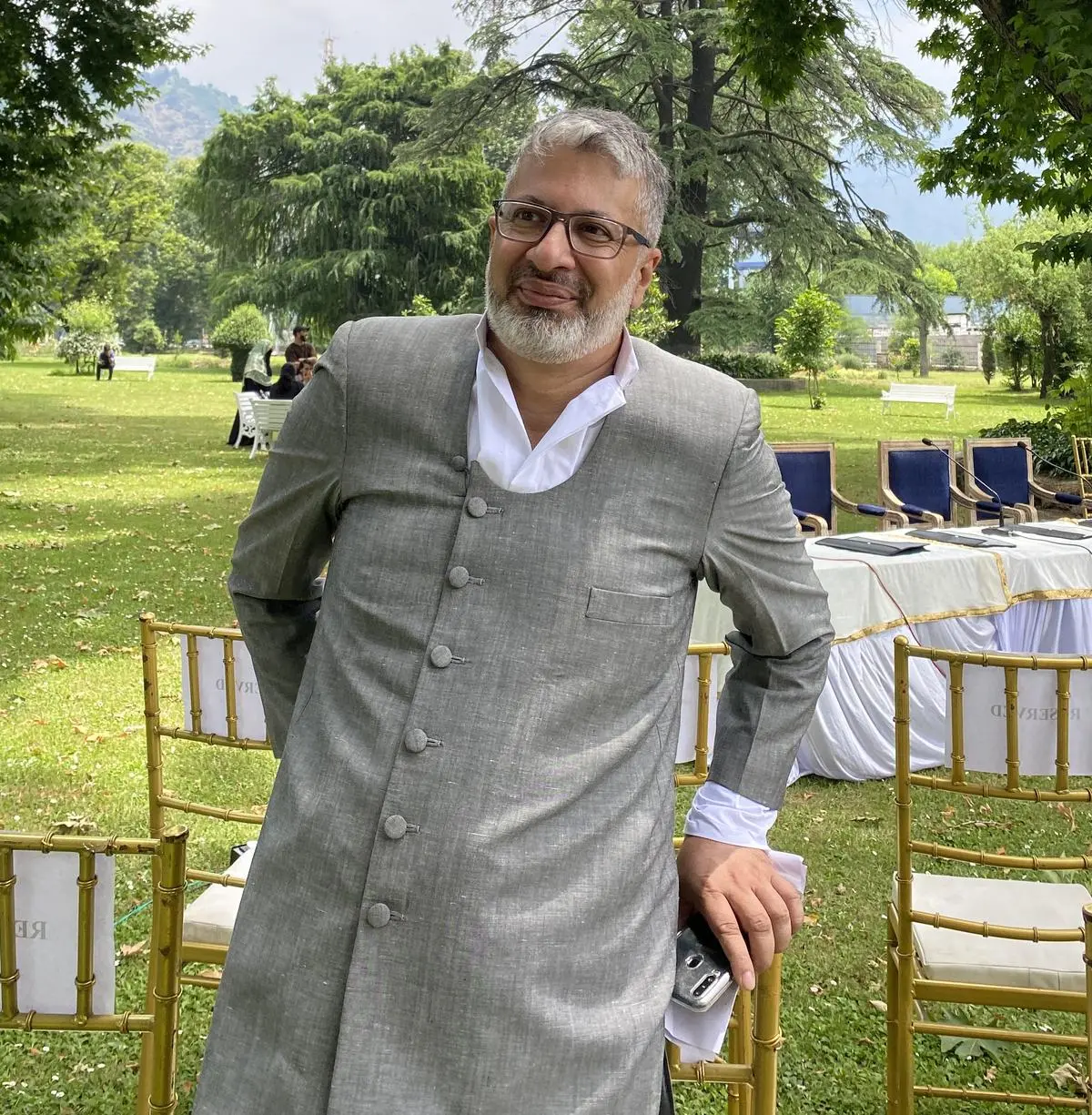
Hakim Sameer Hamdani, Srinagar-based architect and art historian who led the documentation project. Hamdani is Design Director with INTACH, Jammu & Kashmir. | Photo Credit: By Special Arrangement
The medieval era in Kashmir, particularly the 14th and 15th centuries, when it gradually transitioned to Islam, has been sought to be presented in contemporary political and cinematic discourse as a period of widespread persecution of Hindus. The movie The Kashmir Files (2022), for example, has a scene where the protagonist describes the Kashmir of yore as a thriving seat of Hindu learning until it was despoiled by Islamic rulers in the 14th century. However, historic epigraphs such as the one in Jamia Masjid and elsewhere in Srinagar point to a culture that was more syncretic than confrontational.
With such discoveries, Hamdani’s project intends to counter the politically motivated narratives around Kashmir’s history. He embarked on the project earlier in 2024, roping in a team of heritage architects and graphic designers from Srinagar. The team consisted of Umar Farooq (Assistant Professor, Department of Architecture, Islamic University of Science and Technology, or IUST, Jammu and Kashmir), who surveyed the inscriptions; Tabish Haider (cultural activist and Young India Fellow, 2022, at Ashoka University), who took life-size images of the plaques; Mehran Qureshi (Assistant Professor, Department of Architecture, IUST), who investigated the epigraphs and translated them into English; and Taha Mughal (a specialist in preservation), who rendered them into measured drawings. The team has examined several epigraphs, dating from the 15th to the 19th centuries, engraved in various heritage sites across the Valley. While the majority of them are in Persian, there are texts in Arabic and Sharda (an ancient script of Kashmir) as well.
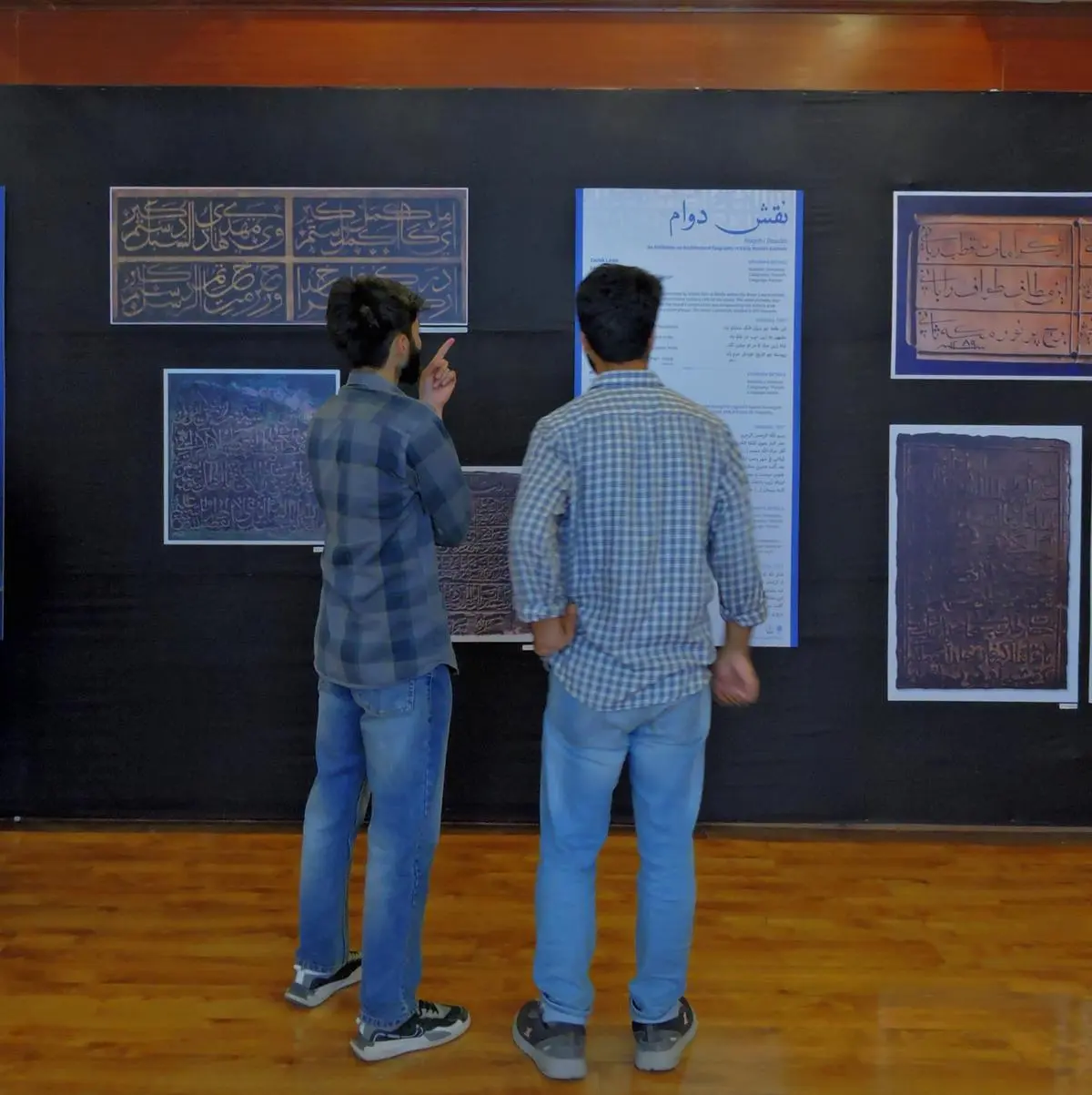
Many of these inscriptions have been rendered almost undecipherable by the passage of time—the main reason why they had escaped the attention of historians so far. Hamdani and his team used technology and linguistic expertise to decipher their content and to bring the information to the public domain for the first time. Of the over 100 slabs that the team has investigated across Kashmir, the details of 40 were catalogued and put on display in an exhibition, “Naqsh-i-Dawaam”, held in Srinagar in June 2024. Hamdani is currently writing a coffee-table book that will make the findings accessible to readers across India and the world. Qureshi is further expanding the scope of the investigation by surveying similar inscriptions found in medieval-era tombstones in Kashmir. Qureshi’s work is sponsored by the Netherlands-based Prince Claus Fund while the grant for Hamdani’s project came from London’s Barakat Trust, which researches the art, architecture, and history of the Islamic world.
_______________
Highlights
A documentation project undertaken by Srinagar-based architect and art historian, Hakim Sameer Hamdani, has added layers to Kashmir’s history, challenging its unipolar representation in popular narratives.
———— Of the over 100 slabs that Hamdani’s team has investigated across Kashmir, the details of 40 were catalogued and put on display in an exhibition, “Naqsh-i-Dawaam”, held in Srinagar in June 2024.
———— Hamdani is currently writing a coffee-table book that will make the findings accessible to readers across India and the world.
________________________________
“The idea was to add a layer of nuance to Kashmir’s history,” Hamdani said while talking about his project. “We tried to flesh out what we already knew about the transmission of knowledge and culture from the Central Asian regions into Kashmir at the onset of the Sultanate period in the 14th century.”
Adding layers
The investigation has added layers to the understanding of Kashmir’s history. Take the Jamia Masjid slab, for instance. It dates back to 1622, when Jahangir was the emperor of Hindustan. In 1589, Jahangir’s father, Akbar, had forced Kashmir to surrender its sovereignty to the larger Mughal Empire. This created resentment, sparking off rebellion and political unrest that continued for years until a semblance of stability was achieved during Jahangir’s rule. To mark the end of hostilities, Jahangir commissioned a renovation of the mosque and installed the slab, which attempts to naturalise him as the legitimate ruler of Kashmir.
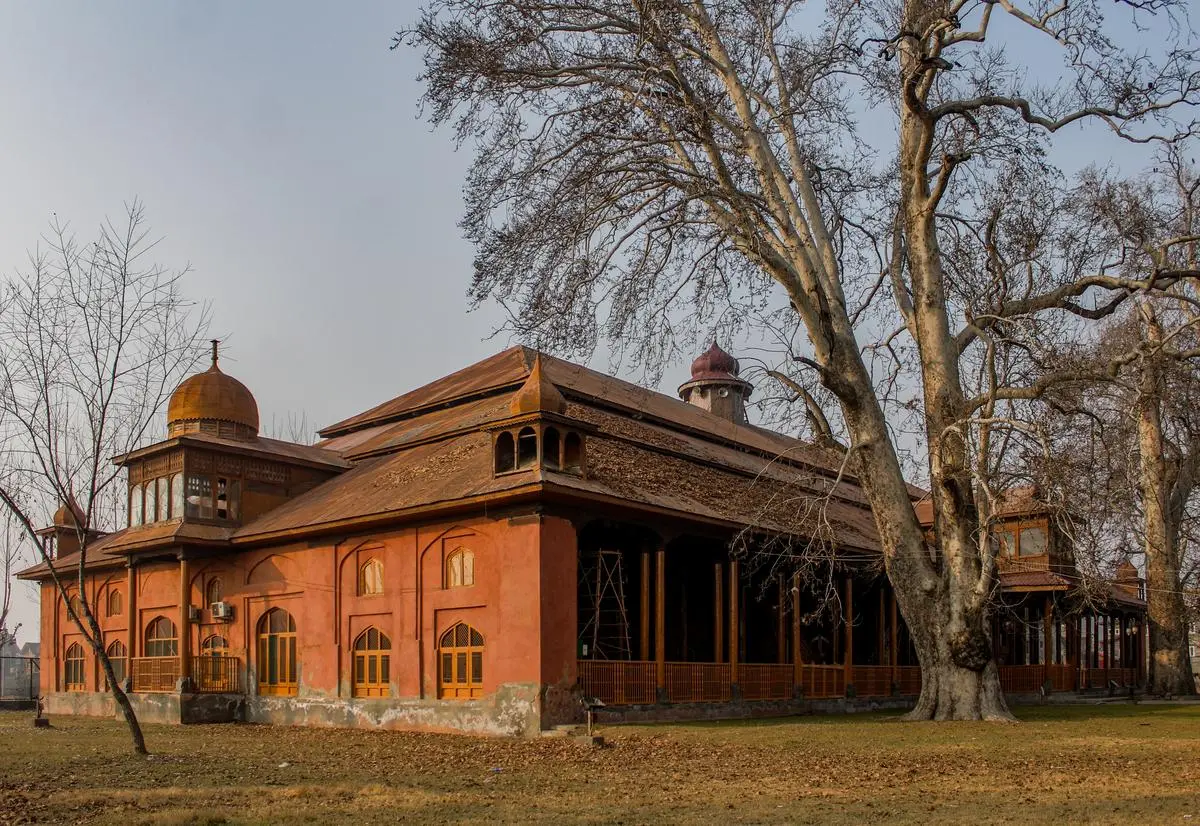
The 15th century Aali Masjid, Srinagar’s second largest mosque. It combines Mughal, Kashmiri and Safavid architectural styles. | Photo Credit: Tabish Haider, Barakat Trust
Hamdani said: “The text seeks to connect Jahangir to a historical project, showing him as continuing the work of the sultans of Kashmir, who reigned before the Mughal annexation.” The association of a Hindu craftsman with a major imperial programme tells us something about the prevailing milieu, where royal patronage could be sought and obtained regardless of the craftperson’s religious affiliation.
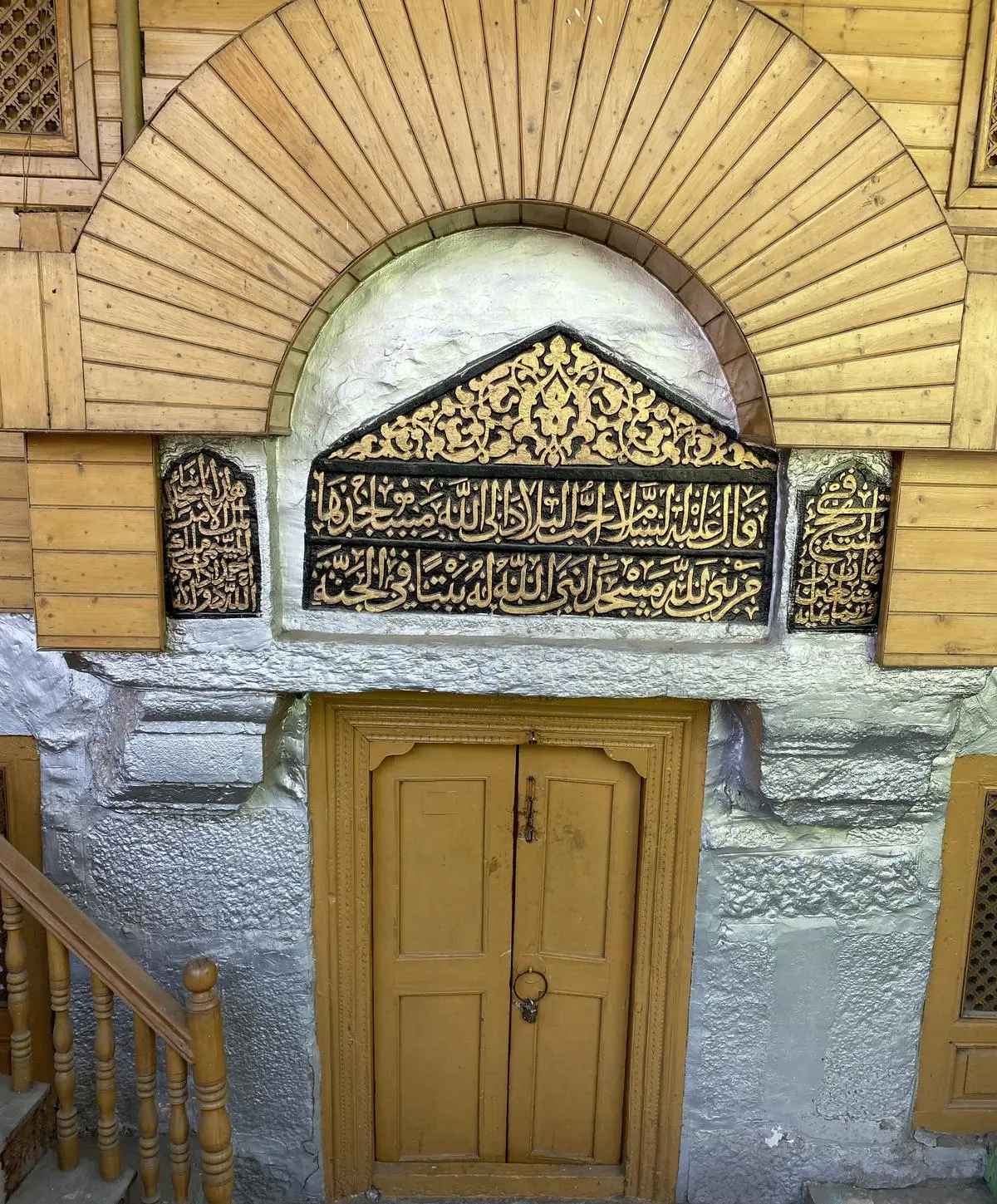
The idea of exploring epigraphs to unravel history came to Hamdani when he was working on his thesis on Islamic architecture at the School of Planning and Architecture, New Delhi, six years ago. As part of his study, he examined extant Islamic epigraphs in the monuments and buildings of Kashmir. Among the ones he analysed was an Arabic hadith (essays on the words and actions of the Prophet Muhammad) etched on the 15th century hospice of a Sufi mystic, Malik Ahmad Itoo, located at Safa Kadal in Srinagar city. It is a small hermitage on the banks of the Jhelum river. The verses, engraved on the shrine’s tympanum, remind the faithful of the spiritual rewards that would accrue to the builder of a mosque.
The Persian slab inside Aali Masjid which identifies the architect of the mosque as Raja Bihisti Zargar. | Photo Credit: Tabish Haider, Barakat Trust
Hamdani said: “Such inscriptions, commonly seen in Kashmiri shrines, are different from medieval Islamic epigraphy found in Delhi.” Speaking of the latter, the scholar Anthony Welch said that their “principal function in late-twelfth-century India was to warn the non-Muslim majority to accept Islam” (in his 2008 essay, “The Emperor’s Grief: Two Mughal Tombs”). The epigraphs associated with early Islam in Kashmir, by comparison, are devoid of such hegemonic overtones. “Their stress is rather on cultivating personal piety,” Hamdani said.
His project has thrown up unexpected stories that often go against the recorded textual histories of Kashmir. Consider the case of Aali Masjid, Srinagar’s second largest mosque. The 15th century mosque embodies a fusion of Iranian, Mughal, and Kashmiri architectural styles. Added during a renovation in the 17th century, the balusters of its portico rest on distinct stone bases reminiscent of those of Safavid pavilions in Iran; the technique was brought to Kashmir by the Mughals. Although the 1887 Persian text Tarikh-e-Hasan—thought to be an authoritative commentary on Kashmir’s medieval history—attributes its construction to Ali Shah, the eighth sultan of the Shahmirid dynasty, the stone slab restored by Hamdani names a different patron: Sultan Hasan Shah, who reigned 50 years later. The epigraph identifies Raja Bihisti Zargar as the architect of the mosque.
Startlingly, the same name was once engraved on a stone pillar inside Srinagar’s Shankaracharya temple. Today, no trace of this inscription remains in the temple, but it is important to remember its existence in view of recent attempts to polarise sentiments by creating a controversy over the name of the Shankaracharya hill, also called Takht-e-Suleiman.
The Shankaracharya temple is one of the oldest temples in Kashmir, mentioned by Kalhana, author of the 12th century Sanskrit text Rajatarangini (River of Kings), which gives a history of Kashmir. The Rajatarangini remained a text in progress for a long time, with Brahmin court historians adding bits to it at different periods. After Kalhana, Jonaraja took it up in the 15th century, followed by Srivara and Shuka in the 16th century.
The hadith inscription on the shrine of Sufi mystic, Malik Ahmad Itoo, in Srinagar. It is one of the earliest surviving Islamic epigraphies in Kashmir. | Photo Credit: Shakir Mir
Hamdani’s team was able to access a preserved facsimile of the temple epigraph in a book titled Illustrations of Ancient Buildings in Kashmir (1869), based on a survey conducted under the Archaeological Survey of India by Henry Hardy Cole. In the survey, Cole suggested that the inscriptions (there were more than one) were linked to repair work done in the temple in the 16th century. But he could not identify the ruler under whose leadership the work was carried out.
Cole was not the only one whose interest was piqued by the presence of Persian inscriptions inside a Hindu temple. The British explorer Alexander Cunningham (1814-93) also mentioned them in his “Essay on the Arian Order of Architecture in Temples of Kashmir” (1848), which says that he had copied out an inscription (a different one at the same site): “but since then it has been so completely defaced by the Dogar [Dogra] soldiery that I could with difficulty trace the name of Takht-i-Suliman”.
Later, in 1875, a group of European travellers made another attempt to decode the writings, scrawling a rudimentary translation in their diary. “This idol… was made by Haji Hashti… in the year 54 of the Samut (Samvat) or Hindoo era,” they wrote, adding that “the foot of the back part of the pillar states that he who raised up this idol was Quajah Rukm, son of Mirjan.”
The case seems to be have been buried in 1935 after it received a clumsy dismissal from an antiquarian, Pandit Anand Koul, who concluded: “Islam was unknown in that remote period when this temple was built, so there could not have been a Khwaja or a Mir then…. Nor would a Muhammadan build a temple as his own” (Archaeological Remains in Kashmir, 1935).
The restored epigraphs were put on display at an exhibition in Srinagar in June 2024. | Photo Credit: Tabish Haider, Barakat Trust
But when Hamdani’s team examined the Aali Masjid slab, a different story emerged: the Muslim architect (Raja Bihisti Zargar) responsible for designing the mosque was the same one who oversaw the repair of the Shankaracharya temple in the 16th century. This suggests that even in the late Sultanate era, often depicted as a period of widespread destruction of Hindu places of worship, Muslim rulers continued to extend their patronage to Hindu cultural spaces. Understandably, the Dogra militia had tampered with this evidence in the 19th century.
Folds of history
Another epigraph documented by Hamdani was written in Sharada on the limestone wall of a 15th century almshouse at Khonmoh in Srinagar, built by a Hindu merchant, Purnaka. The text seems to heap praises on one of the Shahmirid kings by describing him as the son of the “illustrious Sakandra” (Sultan Sikandar). The effusive language used for Sikandar by a Hindu merchant is especially significant because the sultan was depicted as an iconoclast by the contemporary Brahmin chronicler Jonaraja in Rajatarangini. Jonaraja’s characterisation of Sikandar was perpetuated by colonial historiographers. In his 1848 booklet, Cunningham invoked the “destroying hand of Mahomedan [sic] bigotry” to explain the ruin into which Kashmir’s ancient temples had fallen.
But the Khonmoh inscription reveals that there existed a multiplicity of narratives around Sikandar in the 15th century and not all of them told the same story. “We are not denying that persecutions have happened in the past,” Hamdani said. “Our project drives home the point that history never uncoils in a linear way. History has many folds, each one with layers and textures of its own.”
Shakir Mir is a freelance journalist based in Srinagar. He was previously a correspondent with The Times of India.
source: http://www.frontline.thehindu.com / Frontline / Home> Arts & Culture> Heritage> History / by Shakir Mir ./ September 13th, 2024
The Padma Bhushan awardee, who hailed from Jodhpur, died of kidney failure in Mumbai.
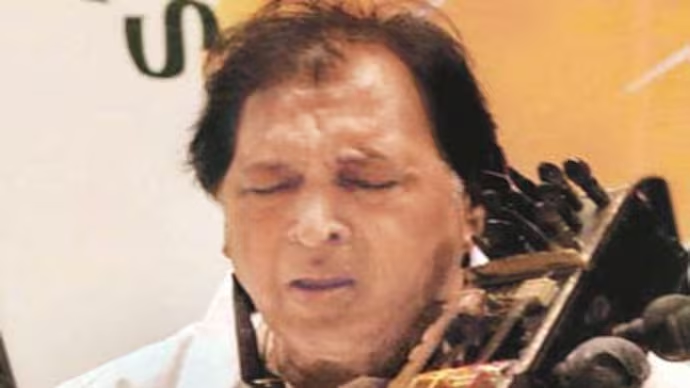
Sarangi maestro and classical singer Ustad Sultan Khan, the soulful voice behind hits such as Piya basanti re and Albela sajan, passed away in Mumbai on Sunday after kidney failure.
The Padma Bhushan awardee, 71, who hailed from a family of sarangi players in Jodhpur, was on dialysis for the past three months and died on his way to the hospital, family sources said.
Khan is survived by his second wife Bano, son Sabir – also a well-known sarangi player – and two daughters. His funeral will take place in Jodhpur on Monday.
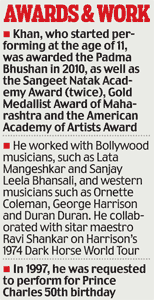
Credited for reviving the sarangi, Khan is famous for his extraordinary control over the instrument and his husky voice. He started performing at the age of 11, and later collaborated at the international level with sitar maestro Ravi Shankar, on George Harrison’s 1974 Dark Horse World Tour.
Khan’s was a family of sarangi masters from Rajasthan. He was initially tutored by his father, Ustad Gulab Khan. Later, he trained under Ustad Amir Khan, a classical vocalist of the Indore gharana. After establishing himself as a sarangi player, Khan worked with Bollywood musicians, such as Lata Mangeshkar and Sanjay Leela Bhansali, apart from collaborating with western musicians, such as Ornette Coleman, George Harrison and Duran Duran.
Apart from the Padma Bhushan, Khan won numerous musical awards, including the Sangeet Natak Academy Award (twice), the Gold Medallist Award of Maharashtra and the American Academy of Artists Award in 1998.
Khan was also a member of the Indian fusion group Tabla Beat Science with Zakir Hussain and American bassist Bill Laswell.
The news of Khan’s death came through a post by music composer Salim Merchant (of Salim-Sulaiman fame) on Twitter.
“I lost my ustad – Ustad Sultan Khan, my guru my friend my idol. He passed away this afternoon. We will never have a sarangi maestro like him,” he tweeted.
Eminent sarod player Amjad Ali Khan also condoled his death, saying it was a great loss to the music world. “I am deeply saddened at his demise. He gave a different meaning and dimension to the sarangi ,” he said.
Among the other musicians who expressed grief were music director Vishal Dadlani, and singers Shreya Ghoshal, Abhijeet Sawant and Shaan. “Just heard about the loss of our dear ustad sa’ab :(I had the gr8 fortune and honour of working with him. Too saddened,” Ghoshal tweeted.
Actors Akshay Kumar, Rahul Bose and Dia Mirza also wrote on Twitter. “This has not been a good year what with so many great personalities leaving us. My thoughts and prayers with his (Khan’s) family,” Akshay said.
“He played on the soundtrack of my directorial feature, Everybody Says I’m Fine! Ustad Sultan Khan saab had a huge heart and an impish sense of humour,” Bose recalled.
source: http://www.indiatoday.in / India Today / Home> News> West / by India Today Online, Mumbai / November 28th, 2011
Muran Village (Pulwama District), JAMMU & KASHMIR :
Owais Yaqoob’s moment of victory at Guangzhou, China
New Delhi :
Owais Yaqoob, a 26-year-old mixed martial arts (MMA) fighter from South Kashmir’s Pulwama district, registered a win at an international competition in China by defeating Ian Paul “Choco” Lora of the Philippines, on Friday
He was fighting under the Bahrain-based BRAVE Combat Federation in China’s Guongzhou.
Born in Muran, a village surrounded by apple orchards, some 6 km from Pulwama town, Owais has been active in sports since his childhood.
Just 3 minutes and 6 seconds into the match, Owais secured a takedown and then landed a barrage of powerful punches, knocking him to the ground. Lora surrendered and tapped out. This victory represented more than just winning a match for Owais. It was a dream come true, a dream that had come true after years of hard work, struggle, and dedication.
Today, our very own Owais Yaqoob (@MartialKashmir) has made history in China by defeating the undefeated Ian Paul Lora and raising our tricolor high on the international stage once again. 🇮🇳
Owais Yaqoob began his martial arts journey in 2013 with taekwondo. Over the next ten years, he won 11 national gold medals, 6 silver medals, and 17 state-level titles. Owais’s exceptional performance earned him the titles of “Champion of Champions” and “Best Fighter Boy” in 2018.
In 2022, Owais participated in the WEKAF World Championships held in the Philippines, where he won a bronze medal and represented India in Filipino stick fighting (Eskrima). This performance established him as a world-class martial artist.
Owais’s inspiration for MMA came after watching a match featuring UFC superstar Khabib Nurmagomedov in 2018. Owais was determined to pursue a career in the sport. Before entering the world of professional MMA, Owais also won three national amateur MMA titles.
Owais shared his bout on X:
Owais Yaqoob (@MartialKashmir) from Kashmir defeats the undefeated Ian Paul “Choco” Lora at #BRAVECF98, raising the Indian Tricolour 🇮🇳 high on Int'l MMA stage
He made his professional debut in 2023 and defeated Mohammed Azim Mokhlis by unanimous decision in March 2024. He then defeated Shetty Pratik Sadashiv by technical knockout (TKO) in April 2024. His professional record now stands at 3-1.
Owais had, for some time, deviated into stone pelting but was counseled and brought back into the mainstream, and today is an example of how positivity can change lives in Kashmir.
According to Kashmir media, his victory was celebrated in his village, where people visited his home to congratulate his parents. Friends and family celebrated his victory by distributing sweetmeats.
“His victory shows what Kashmiri fighters are capable of on the international stage,” said Waseem Ahmad, an athlete from Pulwama.
Rouf said the win has strengthened his brother’s resolve to push forward. “Every fight is a test. It will embolden him to train harder and prepare for bigger challenges ahead,” he added.
His achievement has sparked interest among youngsters in Pulwama, many of whom now aspire to pursue MMA professionally.
source: http://www.awazthevoice.in / Awaz, The Voice / Home> Sports / by Aasha Khosa / September 21st, 2025
Hafiz Syed Musa Kaleem Falahi, an Islamic finance expert from Hyderabad, has been honoured with the Global Islamic Finance Award 2025 at the Global Islamic Finance Summit held in Kuala Lumpur. The award was presented by former Maldivian President Mohamed Waheed Hassan.
The summit was attended by Malaysian Prime Minister Anwar Ibrahim, Deputy Prime Minister Ahmad Zahid Hamidi, and several global dignitaries, alongside leading figures from the international Islamic banking and finance sector. Organised annually by the International Islamic Finance Committee, the summit recognises outstanding contributions in advancing Islamic banking and financial services worldwide.
Falahi, who currently serves as Chief Business and Investment Officer at Siraj Finance in Abu Dhabi, brings over two decades of experience in Islamic banking. He has played a pioneering role in developing Islamic financial products across retail, small, and medium enterprise sectors. Previously, he served as President and CEO of the Islamic Bank of Afghanistan, where he established institutions across major cities, and has also been associated with Dubai Islamic Bank.
Son of the late Maulana Syed Yusuf, former Secretary of Jamaat-e-Islami Hind, and Editor Radiance Viewsweekly, Falahi is recognised as one of South Asia’s leading Islamic finance professionals. The Kuala Lumpur summit also saw participation from prominent figures such as Sheikh Ebrahim bin Khalifa of Bahrain. Leaders at the event emphasised the critical role of Islamic banking in guiding the Muslim world toward sustainable economic development.
source: http://www.radiancenews.com / Radiance News / Home> Pride of the Nation> Awards> Latest News / by Radiance News Bureau / September 18th, 2025
Marium Fatima from Muzaffarpur has created history by becoming Bihar’s first Woman FIDE Master (WFM). The young chess player achieved this milestone after an impressive performance at the Barbera del Valles Open Chess Championship in Barcelona, Spain, where her rating crossed 2100, earning her the FIDE title.
Marium, originally from Chandwara Jamiran Gachi in Muzaffarpur, said she owes her success to her parents and the Bihar Chess Association. She added that her next target is to achieve the Grandmaster norm, which requires a rating of 2400. “There is no Grandmaster from Bihar yet, and I want to be the first to achieve that distinction,” she said.
Her success has been widely celebrated in the state. Director General of Bihar State Sports Authority Ravindran Shankaran congratulated her, while officials from the All Bihar Chess Association and Muzaffarpur Chess Association praised her achievement.
Secretary Dharmendra Kumar, Joint Secretary Nandkishore Srivastava, President Vinay Kumar, and others expressed pride that Marium has brought recognition not only to Bihar but to the entire country.
India has already established itself as a chess powerhouse, producing world-class players such as D Gukesh and R Praggnanandhaa from Tamil Nadu. With Marium’s breakthrough, Bihar is also carving out its place in the national chess landscape.
There are currently eight Women Grandmasters in India. Marium aspires to become the ninth, while also inspiring the next generation of players from Bihar to pursue the game at the highest level.
source: http://www.radiancenews.com / Radiance News / Home> Latest News > Pride of the Nation> Markers of Excellence> Report / by Radiance News Bureau / September 22nd, 2025
Kadamba Village (Kalia, Bardhaman District), WEST BENGAL / Cambridge, U. K :
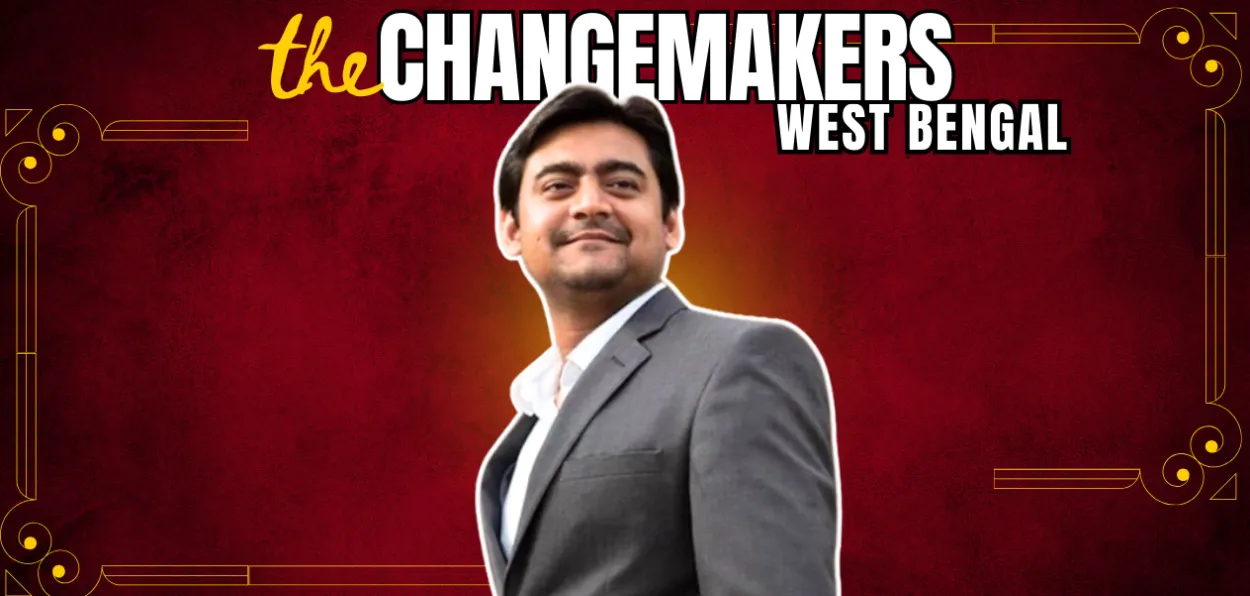
Dr. Matiar Rahman, Scientists, Cambridge University, The UK
Dr. Matiar Rahman, a Bengali researcher at Cambridge University, is hailed as the “father of the artificial leaf”. He received this title for his pioneering innovation of a device that converts sunlight into liquid fuel while reducing carbon emissions.
Explaining his work, Rahman told the media: “Carbon dioxide is vital for photosynthesis in plants, but in excess it becomes dangerous—it’s one of the chief drivers of global warming. Humanity now faces both a climate crisis and an energy crisis. Fossil fuels are depleting fast. Our research aims to address both challenges at once.”
Many believe this breakthrough could play a decisive role in safeguarding Earth’s fragile environment. Yet, behind this extraordinary success lies a story of hardship, persistence, and unwavering determination.
Dr. Rahman was born into a lower-middle-class family where survival often outweighed comfort. His father worked either as a low-paid employee or as a daily labourer, while his mother managed the household. As a child, he often walked barefoot to school, studied from borrowed books, and read by the dim glow of a kerosene lamp in a house without electricity. There were days when the family survived on a single meal.
In his village, pursuing science was seen as impractical. Neighbours would often remark: “Study science and you’ll end up jobless.” Affording higher education was a formidable hurdle, and to continue his studies, Matiar took up tutoring and part-time jobs. Despite financial strain and social discouragement, he refused to give up.
Excelling at a government university in India, he won a scholarship that paved the way for studies abroad. Eventually, he secured admission into Cambridge University for research. But life overseas was far from easy. He struggled with a new language, culture, and climate, and at times also faced racial prejudice. Yet he endured with quiet resilience.
Through all these adversities, he continued his research and achieved a breakthrough: the development of the “artificial leaf,” a device that captures sunlight to generate renewable fuel. His life affirms a timeless truth: poverty cannot stop a dreamer who dares to dream. His story is not just one of scientific achievement but also an inspiration to countless young dreamers across the globe.
Human civilization now stands at a crossroads. Carbon dioxide levels are soaring, global warming is intensifying, summers are lengthening, glaciers are retreating, biodiversity is collapsing, and ecosystems are at risk. The greatest challenge of our era is to avert environmental catastrophe. Scientists worldwide are racing against time to find solutions, and among them is Bengali researcher Dr. Matiar Rahman, whose work offers fresh hope.
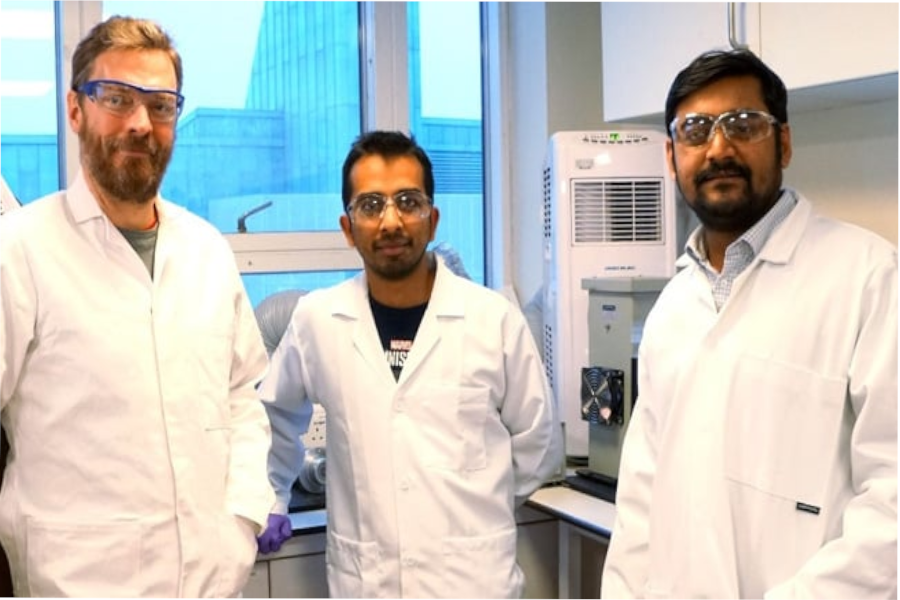
Alongside fellow scientist Subhajit Bhattacharya at Cambridge, Dr. Rahman has successfully created an Artificial Leaf that produces liquid fuel and oxygen using only sunlight, water, and carbon dioxide. Their research was published in Nature Energy, a leading sub-journal of Nature.
A native of Kadamba village in Kalna, Bardhaman district, and an alumnus of Jadavpur University, Dr. Rahman now works under Professor Erwin Reisner, a Cambridge professor and Fellow of St. John’s College.
After schooling at Ambika Kalna Maharaja High School, he earned a Chemistry degree from Jadavpur University, completed his Master’s at IIT Madras, pursued his PhD at the University of Bern in Switzerland, and later joined Cambridge as a Marie Curie Fellow. Today, he is a Senior Scientist with the same university.
Discussing his breakthrough, Dr. Rahman explains: “Converting CO₂ into fuel usually requires huge amounts of energy, often from fossil fuels. But our method uses sunlight alone.” With atmospheric CO₂ now averaging around 424 ppm, he warns: “Unless we reduce this excess, global warming cannot be controlled. Our solution is to convert atmospheric CO₂ into fuel, offering an alternative to fossil fuels while ensuring net-zero emissions.”
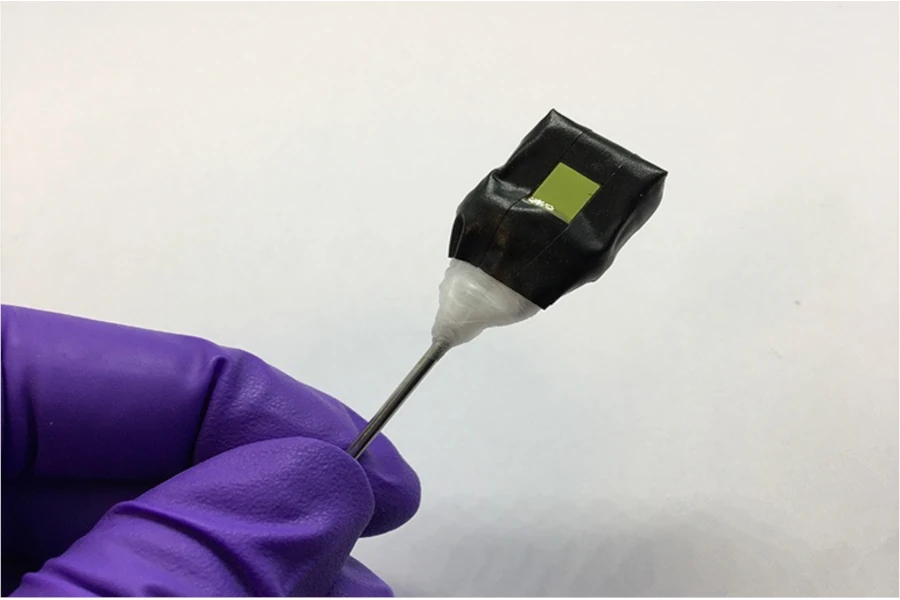
The device mimics photosynthesis in nature. Just as leaves use sunlight, water, and CO₂ to produce sugar and oxygen, the artificial leaf uses sunlight and CO₂-dissolved water to produce liquid fuels—such as ethanol and propanol—alongside oxygen.
It consists of two core components: one side has a solar cell and a bimetallic catalyst that captures solar energy and breaks down CO₂ into fuel molecules, while the other side uses nanomaterials to split water into oxygen. Both processes run simultaneously, keeping the system electron-neutral. Simply immerse the device in CO₂-mixed water and expose it to sunlight, and it starts working.
Unlike earlier global attempts that required large amounts of external energy, often fossil-based, Dr. Rahman’s system relies directly on solar power. For the first time, scientists have produced multi-carbon liquid fuels through artificial photosynthesis, earning them publication in Nature. Dr. Rahman is the paper’s first author, with Professor Reisner as principal investigator.
From a modest village school in Bengal to a pioneering laboratory in Cambridge, Matiar Rahman’s journey shows how dedication can change destinies. Reflecting on his path, he says: “At every stage—school, college, university, research—you must prepare yourself well. Step by step, nothing is impossible.”
source: http://www.awazthevoice.in / Awaz, The Voice / Home> Changemaker / by Debkishore Chakraborty, Kolkata / September 09th, 2025
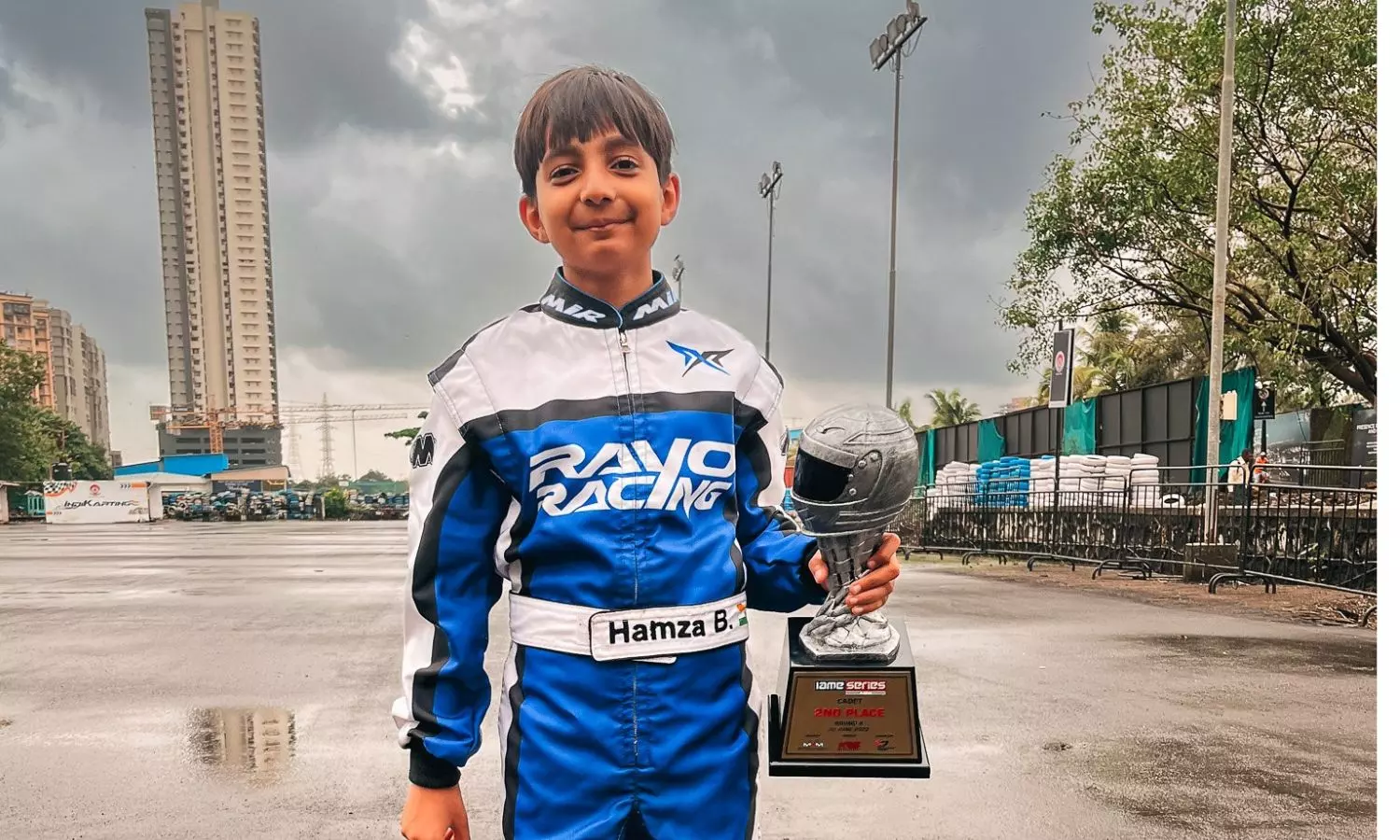
11-year-old Hamza Balasinorwala impressed all with his racing skills as he fought his way from the back to clinch the second position on the podium of the IAME Asia Series.
Hamza Balasinorwala
11-year-old Indian kart racer Hamza Balasinorwala impressed all with his racing skills as he fought his way from the back to clinch the second position on the podium in the 4th Round of the IAME Asia Series, Asia’s most prestigious X30 Championship, in Sepang on Monday night.
The Grade 6 student of Podar International School, Mumbai improved with every practice session but was hit by bad luck in the crucial qualifying round to take the twelfth position on the Cadet class grid.
As if that was not enough, Hamza suffered another setback in Heat 1, pulling out of the race – eventually won by Esteban Freihuber from the Philippines — in the first lap itself.
Undeterred, the Rayo Racing prodigy made a strong comeback in Heat 2, overtaking several experienced racers from around Asia to finish an impressive fourth. Singapore’s Aaron Mehta won this race, ahead of Thai racer Kamolphu Anuchatkul and Freihuber.
Hamza’s resilience continued in the pre-finals, where he expertly manoeuvred through the field from a 10th-place starting position, to finish an admirable fifth place. Mehta notched up his second consecutive win while Anuchatkul and Freihuber once again took the other two places on the podium.
As the finishing order of the pre-final decides the start order for the final, the Indian began from fifth on the grid. Getting off to a good start, Hamza soon found his way past Singapore’s Maximilian Schilling only to be passed by another Singaporean — Michael Lederer.
Hamza exhibited exceptional skill, maintaining a consistent and impressive pace throughout and went along with Lederer up the field. The duo got past Freihuber, Mehta and Anuchatkul.
Lederer eventually took the win 2 seconds ahead of Hamza. The Indian racer’s fantastic effort saw him seal the second position, ahead of Freihuber of Philippines.
“I am really happy to get my first international podium. I want to thank my family and team for their support,” the elated Hamza, who has already notched up multiple podiums in the IndiKarting Pro Races, said.
Rayomand Banajee, founder of Rayo Racing, said: “While this is just his third international race, this has been over 1 and a half years in the making. Hamza has a lot of potential and we are confident he will rise to bigger things soon. Being just 11, he has a promising future ahead.”
source: http://www.thebridge.in / The Bridge / Home> Motorsports / by The Bridge Desk / June 27th, 2023
Indian racing’s 10-year-old prodigy Atiqa Mir on Sunday created history by becoming the first woman in UAE karting to win a race in the Minimax category.
Indian racing’s 10-year-old prodigy Atiqa Mir on Sunday created history by becoming the first woman in UAE karting to win a race in the Minimax category.
In a competitive field of 14 drivers including seasoned European race winners, Atiqa was the lone female but that was hardly a factor as she completed a commanding victory from pole position in the prestigious DAMC Championship opener at the Dubai Kartdrome.
In the finals, Atiqa kept it clean and within track limits to cross the chequered flag before anyone else.
The win makes her the first ever female to take a pole and a final win in the MiniMax category, marking a perfect start to her Middle Eastern Karting leg.
Recognising her rare talent, Formula 1 had signed her for its F1 Academy DYD program earlier this year, another first for an Indian driver.
“Im so happy with this win. Dubai Kartdrome is where I started karting so this track will always remain close to my heart. I got limited running in preparation for this race, but nonetheless I was still able to be on pace. Big thanks to my sponsors AKCEL Academy for all their support,” said Atiqa.
Fresh off a successful European season, Atiqa was in Dubai for a quick stop and will head to Slovakia next for Champions of the Future Academy Round 4 where she drives for the F1 DYD program.
Atiqa hails from a racing family with her father, Asif Nazir Mir, being a former Formula Asia vice-champion. She idolises reigning Formula 1 world champion Max Verstappen and her ultimate goal is to reach the pinnacle of motorsport.
(Except for the headline, this story has not been edited by NDTV staff and is published from a syndicated feed.)
source: http://www.sports.ndtv.com / NDTV & NDTV Sports / Home> Sports Home> Other Sports> News / by Press Trust of India / September 14th, 2025