Tag Archives: Manzar Imam

Obituary: Maulana Muhammad Salim Qasmi, an ocean of knowledge

Deoband, UTTAR PRADESH :

With scarcity of good ulama, the passing away of Maulana Muhammad Salim Qasmi, rector of Al-Jamia Al-Islamia Darul Uloom Waqf, Deoband, has sent a sense of gloom across India.

People have written obituaries describing his death as the loss of the last chain in the golden series of Khanwada-e-Qasmiyat, a metaphor used to describe the great legacy whose history got prominence with establishment of Darul Uloom in Deoband in 1867 against the backdrop of persistent British onslaught on Indians on the one hand and its ugly design to kill ulama in large numbers on the other hand, to mitigate the impact of resistance against the Colonial power.

Maulana Salim Qasmi was a witness to the British cruelty on Indians and the Indian ulama during the eventful years if Independence. He had lived those times as a young student of India’s most prominent madrasa that had been a great centre of anti-British movements like the Silk Letter Movement.

Being the great-grandson of Maulana Muhammad Qasim Nanautwi, Salim Qasmi knew well the role he had to play to live up to the reputation and expectations both of his family and its followers and admirers spread over countries and continents. He rightly did so. His demise thus has rightly been described as the end of that golden chain. However, as there are others from the same family trying to carry forward both the academic and social and historical legacy, will they be able to do justice with that, only time will tell.

Muhammad Salim was born on 8 January, 1926 at Deoband and received primary education from many teachers. He completed his studies in 1948 from Darul Uloom Deoband where his teachers included great luminaries like Maulana Hussain Ahmad Madani, Maulana Aizaz Ali, Allama Ibrahim Balyawi, Maulana Syed Fakhrul Hasan Moradabadi.

He is said to be the last surviving disciple of Maulana Ashraf Ali Thanwi from whom he studied Mizan, an important book of Arabic grammar. Soon after passing out, he was appointed a teacher there. However, later, due to a serious conflict and crisis then in Darul Uloom, he along with some other colleagues, decided to stay away from it and established Darul Uloom Waqf which he nurtured till his last breath. Besides looking after its administrative affairs as a rector, he also taught Bukhari Sharif, the well-known book of hadith. Earlier, he had taught Muslim Sharif, another important book of hadith.

Some of the key positions he held at the time of his death are as follows:

Chief Rector, Al-Jamia Al-Islamia Darul Uloom Waqf, Deoband,

Vice-President, All India Muslim Personal Law Board,

Member, Aligarh Muslim University Court,

Member of Advisory Board and Managing Committee, Darul Uloom Nadwatul Ulama,

Member of Advisory Board, Mazahir Uloom Waqf, Saharanpur,

Permanent Member of the Fiqh Council, Al-Azhar,Cairo,

President, All India Muslim Majlis-e-Mushawarat (before two fractions of it finally united),

Patron, Kul Hind Rabta-e-Masajid,

Patron, Islamic Fiqh Academy, India.

About his written contribution to the domain of knowledge, the website of Darul Uloom Waqf Deoband mentions that besides being:

… one of the top speakers of ulama, his articles and writings are also much admired. Some of the books are worthy to be mentioned here like (1) Mabaadi al-Tarbiyat al-Islami (Arabic), (2) Jaiza Tarjama Quran Karim, (3) Taajdar-e-Arz-e-Haram ka Paigham, (4) Mardaan-e-Ghaazi, (5) Ek Azeem Tarikhi Khidmat, (6) Safar Nama-e-Burma.

(7) The book Khutbat-e-Khatibul Islam (a collection of his speeches) has been published in 5 volumes. Moreover, there are many articles and scripts awaiting publication.

Formally, Maulana received bai’at (a reformative and self-actualization method historically in vogue for quite long as an Islamic tradition in certain schools of thought) at the hand of Maulana Shah Abdul Qadir Raipuri. However, he received much of the training from his glorious father, Qari Muhammad Tayyib (d. 17 July, 1983)

A remarkable trait of his personality was to maintain the dignity of a true aalim (religious scholar) by not partaking in sectarian lines as is the wont of some Ulama. He was therefore respected among all sections of Muslims and his views were very well received. Maulana Salim did not create the binary division of education between religious and modern. He believed that ‘the source of all streams of knowledge is one’.

In recognition of his services to the domain of knowledge and ideas Maulana Salim was honoured with many awards, some of which are as follows:

Nishan-e-Imtiyaz (Mark of Distinction) from the Government of Egypt for being a distinguished aalim of the Indian Sub-Continent,

Imam Muhammad Qasim Nanotwi Award,

Shah Waliullah Award.

Prominent leaders and ulama from different countries have expressed grief over the demise of Maulana Salim Qasmi. In her telephonic message, External Affairs Minister Sushma Swaraj said that Maulana Salim’s love for education was amazing. Outside the country he worked as an exemplary ambassador of education. Congress President Rahul Gandhi said Maulana Salim Qasmi illuminated the world through education and he would touch people through simplicity. Samajwadi Party chief, Mulayam Singh Yadav said that Maulana never asked anything for himself. He was a crown prince of education whose absence would be felt long.

Former Justice of Pakistan’s Shariah Court, Mufti Taqi Usmani described Maulana Salim Qasmi as an ocean of knowledge. His death is a huge loss to the Islamic world. The simplicity with which he lived is rare, he said adding, “His service in the field of education is a golden chapter”.

Member of Parliament and AIUDF President Maulana Badruddin Ajmal Qasmi termed the demise of Maulana Salim Qasmi as ‘end of an era’ whose enumerable services are worth to be written in golden words. Senior leaders Ahmad Patel, Ghulam Nabi Azad, Syed Shahnawaz Hussain and others also sent their condolence messages.

Maulana Syed Rabey Hasani Nadwi, President of All India Muslim Personal Law Board, who had closely worked with Maulana Salim Qasmi and had also been his classmate at Darul Uloom Deoaband, wrote an article in which he stated that Maulana Salim Sahab had acquired many of the qualities of his father Qari Tayyib Sahab and his great grandfather Maulana Qasim Nanautwi. He worked in a similar way from whom different sections of ummah benefitted. His death therefore has caused concerns about the void in the ummah and in religious circles.

Maulana Arshad Madani described Maulana Salim Qasmi’s death as a loss which does not seem to be filled in near future. “Whenever there is a crisis he would be remembered’ he said. The responsibility to protect the institution that he established falls on all of us.

Prof Humayun Murad said that Maulana knew well how to avoid confrontation and find peaceful and constructive ways. Darul Uloom Waqf Deoband is its living example.

Maulana Muhammad Sayeedi, nazim, Mazahir Uloom Waqf said, “In the passing away of Maulana Salim Qasmi, Mazahir Uloom has been deprived of one of its true guide and patron”. He was its member since 1988. Mufti Muzaffar Husain would trust him a lot and his suggestions were highly helpful.

As against the commonly held opinion of ulama who do not tire of speaking about the division of knowledge between religious and modern or worldly, Maulana Salim Qasmi, in June 2013, had in a public programme, very categorically said that all the available forms of knowledge are from Allah. There is nothing as religious and worldly knowledge.

Maulana Qasmi said that the division of knowledge (between religious and worldly) is a political creation because all streams of knowledge flow from God. He then asked heads of madrasas to invite people of other faiths to their madrasas and exchange views and, share their problems with them also.

As I write this obituary, his soft-spoken words remind me of the sincerity with which he would draw the attention of the people to real issues and to the approaches that need to be adopted to find their solution.

Maulana Salim Qasmi was among the important personalities who had set up the Darul Uloom Waqf. His colleagues Maulana Muhammad Nayeem Deobandi died a little over a decade ago on 23 August, 2007, Shaikhul Hadith Maulana Syed Anzar Shah Kashmiri died 10 years ago on 26 April, 2008, Mufti Khursheed Alam died on 7 February, 2012, while Maulana Salim’s younger brother Maulana Muhammad Aslam Qasmi, an outstanding orator, died about five months ago on 13 November, 2017. Finally, this great son of the great Khanwada-e-Qasmiyat passed away on 14 April, 2018. He is survived by four sons and two daughters.

May the Almighty grant him an exalted place in Jannah!

The author is a PhD Fellow at the Academy of International Studies, Jamia Millia Islamia and is also doing an online program “Contending Modernities” of the University of Notre Dame, USA.

source: http://www.twocircles.net / TwoCircles.net / Home> Articles> Indian Muslim> Lead Story / by Manzar Imam for TwoCircles.net / April 28th, 2018
Two books on Seemanchal’s writers released in Delhi

Seemanchal, BIHAR :

New Delhi:

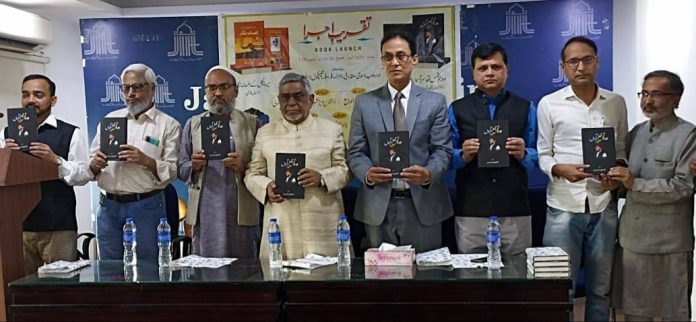
A sense of ‘Think global, act local’ prevailed at the launch of two significant books “Who jo Shams tha Sar-e-Aasmaan” and “Seemanchal ke Afsana Nigar.” The launch was jointly organized by Forum for Intellectual Discourse and Idara Adab-e-Islami, Delhi on Sunday, 7 November, 2021 at the headquarters of Jamaat-e-Islami Hind.

The book “Who Jo Shams tha Sar e Assmaan” was compiled by Dr Noman Qaisar and Mohd Islam Khan and has 41 Urdu articles and six poems on the life and services of journalist Dr Abdul Qadir Shams who died during Covid-19 on 25 August, 2020. It also has four write-ups in English.

Another book “Seemanchal ke Afsana Nigar” is an effort to document the life and works of dozens of fiction writers of Seemanchal.

Presiding over the programme renowned Islamic scholar and former President of Maulana Azad University, Jodhpur, Prof Akhtarul Wasey said that the work done by Abdul Qadir Shams was ‘unusual’. “Shams used to sleep in Delhi but dreamed of Seemanchal.” The void left with his demise would always be felt in my life, said Wasey, who is also the Professor Emeritus of Islamic Studies at Jamia Millia Islamia. Seemanchal ke Afsana Nigar will be an indispensable work in the history of short-story writing. Prof Wasey also congratulated the Forum for Intellectual Discourse stating that the need for such an organization like the Forum could never be felt more strongly than the present times. He wished the Forum success.

Special guest, editor general at NCERT, Dr Perwaiz Shaharyar expressed happiness over organizing a meeting for a journalist in which a large number of people from media were present whose responsibility had grown manifold as the nation was confronted with difficult situations. He called the book a ‘valuable addition to literature’. Prof Abu Bakar Abbad had his reservations for confining any segment of Urdu literature to a specific region as Urdu was a global language. The protagonists, however, had their own arguments for identifying geographical regions, as was also the case with Seemanchal, a region long ignored by most literary aficionado.

Abdul Mannan, editor of monthly Yojana reasoned that the creative facets of Seemanchal remained shrouded because their writers usually shied away from the limelight. In that context, he considered Ehsan Quasmi’s work exceptional.

Chief guest, senior journalist Siraj Naqvi, who had worked with Abdul Qadir Shams for over a decade said that Shams new the art of maintaining relationships. Despite all the difficulties, the smile on his face would dispel worries. Author, critic and famous litterateur Haqqani Al-Qasmi paid a glowing literary tribute to his childhood friend Abdul Qadir Shams which moved the audience. He said Woh jo Shams tha… is not merely a collection of articles but teardrops flowing directly from the hearts.

Dr Waris Mazhari, Assistant Professor, Jamia Hamdard; Dr Khalid Mubashshir, Assistant Professor, Jamia Millia Islamia; Dr Ahmad Ali Jauher, Assistant Professor, Indira Gandhi National Open University; Dr Jasim Uddin Qasmi of Delhi University, Jamshed Adil Alig and Dr Zain Shamsi also shared their views. Uzma Shaheen, daughter of late Abdul Qadir Shams paid a rich tribute to her father.

Manzar Imam of Forum for Intellectual Discourse moderated the three-hour long programme which had begun with Qur’anic recitation of Abdur Rahman, followed by welcome remarks of Dr Mohammad Ajmal, Assistant Professor, Centre for Arabic and African Studies, Jawaharlal Nehru University. It ended with a vote of thanks by journalist Abid Anwar.

source: http://www.muslimmirror.com / Muslim Mirror / Home> Books / by Manzar Imam / November 10th, 2021

Meet Mohammad Furqan, Madrasa Graduate Selected for University of Notre Dame, Indiana

Darbangah District, BIHAR / Indiana, U.S.A:

From a humble beginning as a student of a Madrasa to being selected for Masters in Peace Studies at University of Notre Dame, one of world’s leading universities, Furqan’s journey is an answer to those critics of madrasas who refuse to accept their relevance and contribution to the society and academia.

Meet Mohammad Furqan, Madrasa Graduate Selected for University of Notre Dame  | ummid.com

While hundreds of Madarasas are being shut down allegedly for being non-productive, a good number of graduates of independent Madrasas are making great academic strides. One such Madrasa graduate, Mohammad Furqan has qualified for the Masters of Global Affairs in Peace Studies at the University of Notre Dame, Indiana, USA.

Furqan’s selection has been widely welcomed by graduates of different Indian madrasas and especially by the graduates of Madrasa Discourses Program run by the Keogh School of Global Affairs, University of Notre Dame.

Buoyed by the good wishes, Furqan said:

“It all started with the Madrasa Discourses, and it would have not been possible without the great leadership of Prof. Ebrahim Moosa and Dr. Waris Mazhari. Coming from an ordinary family, I could have never imagined to study in the USA with scholarship.”

Belonging to Darbhanga district of Bihar, Furqan graduated with a Fazilat degree from Madrasa Alia Arabia, Masjid Fatehpuri, Delhi in 2016, after which he did BA (Hons) in English Literature from Jamia Millia Islamia (JMI). In 2023, he completed Masters of Arts in Islamic and Arabic Studies from JMI.

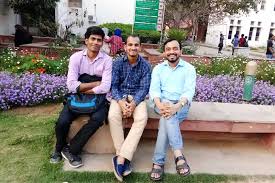
[M Furqan with his friends at Jamia Millia Islamia New Delhi in a file photo.]

While continuing his formal studies, Furqan also pursued the three-year research program for Madrasa graduates namely “Advancing Scientific and Theological Literacy in Madrasa Discourses”, offered by the University of Notre Dame. It is where he made the most of his time and had the opportunity to interact with a number of renowned academicians and scholars from different countries.

Recalling those years Furqan says:

“It was indeed a life changing journey for me to connect with you all for more than five years”.

Extending his special thanks to his Madrasa Discourses fellows Mohammad Ali, Manzar Imam, Mohammad Ehtesham, Mohammad Fozail, Muhammad Zeeshan, Mohammad Aadil Affan, Ghulam Rasool, Md Khaleeque Rehmani, Abul Aala Subhani, Syed Abdur Rasheed, Tajammul Husain, Saif ul Hadi and others, Furqan expressed his intention to remain connected with what he called “our shared commitment for our society and madrasa community.”

From a humble beginning as a student of a Madrasa to being selected for Masters in Peace Studies in one of world’s leading universities, Furqan’s journey is an answer to those critics of madrasas who refuse to accept their relevance and contribution to the society and academia.

Indian madrasas need some reform but more than that they need to sustain and serve the society to carry forward the huge academic and intellectual legacy which has been the hallmark and pride of India’s story of diversity and open discourse.

(A graduate of Madrasa Discourses Program, the writer, Manzar Imam, is Director of MJ Achievers Academy LLP)

source: http://www.ummid.com / Ummid.com / Home> Education & Career / by Manzar Imam / April 01st, 2024

Book on Indo-Kuwait Relations by late Dr Abdul Qadir Shams launched in Delhi

NEW DELHI / INDIA:

Hindustan aur Kuwait (Tarīkhī, Ilmì aur Thaqafatī Rishte’ by Dr Abdul Qadir Shams launched in Delhi.

New Delhi:

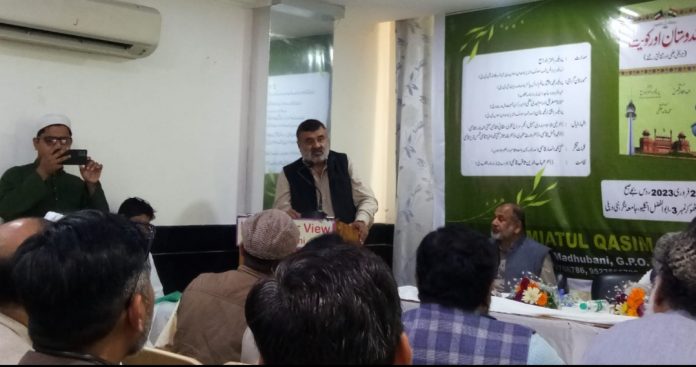
Hindustan aur Kuwait (Tarīkhī, Ilmì aur Thaqafatī Rishte) i.e. India and Kuwait: Historical, Academic and Cultural Relations in Urdu, a book crafted out of the doctoral thesis of late Dr Abdul Qadir Shams Qasmi (1972-2020) originally titled ‘Ulūm-e-Islamī ki Tahqīq-o-Isha’at mein Wazārat-e-Auqaf Kuwait ka Kirdar by Mohammad Khalid Azmi (residing in Kuwait) was launched at Hotel River View, Jamia Nagar, New Delhi on Saturday, 25 February, 2023. The launch programme witnessed a good number of participants from media, academia and other spheres.


The participatns appreciated Khalid Azmi for his timely efforts to turn the thesis into a book with helpful additions to focus on the bilateral role of India and Kuwait in the academic and cultural domains.

The event was presided over by Prof Akhtarul Wasey, Islamic scholar and former president of Maulana Azad University, Jodhpur. Academics and media persons including Dr Raziul Islam Nadwi, Professor Iqtidar Mohammad Khan, Maulana Asghar Ali Imam Mehdi Salafi, Dr Waris Mazhari, Dr Khalid Mubashshir, Dr Mohammad Ajmal, Suhail Anjum, Siraj Naqvi shared their views.


Dr Shahabuddin Saqib Qasmi, senior sub-editor, Urdu daily Inquilab, conducted the event, organised by Qari Zafar Iqbal Madni of Jamiatul Qasim Darul Uloom -il Islamia, Supaul, Bihar.

Mufti Mohammad Ansar Qasmi of Jamiatul Qasim presented vote of thanks.

It should be noted that author and senior journalist, Dr Abdul Qadir Shams Qasmi, had died of cardiac arrest on 25 August, 2020, during Covid-19.

source: http://www.muslimmirror.com / Muslim Mirror / Home> Books / by Manzar Imam / February 27th, 2023

Third book of Haqqani Al-Qasmi’s single-theme series Andaz-e-Bayan launched

NEW DELHI :

New Delhi:

Andaz-e-Bayan is the outcome of my passion, a passion which I did not allow to die even during unemployment and the pandemic. These views were expressed by renowned Urdu critic and writer Haqqani Al-Qasmi.

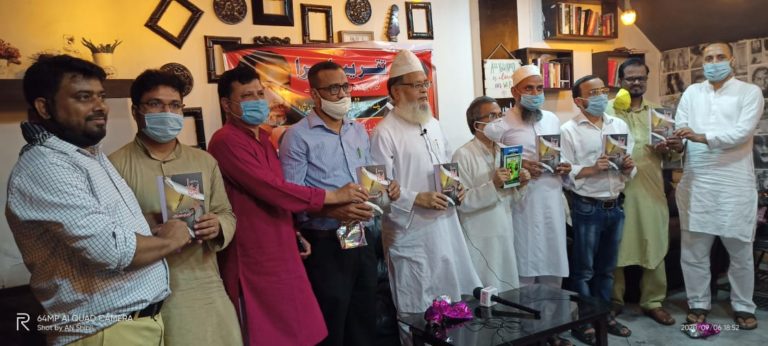
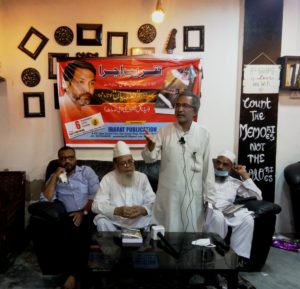
He was speaking at the launch of the third book of his famous single-theme Andaze-e-Bayan series at a cafe in Shaheen Bagh, New Delhi on Sunday, 6 September, 2020.

The present journal, which in fact, is part of a series of books, “discusses about those poets, litterateurs, authors and novelists, who, despite being in the medical profession, are serving Urdu in areas of research and criticism”, said Haqqani.


Speaking on this occasion Maulana Ajaz Urfi Qasmi, president of All India Tanzeem Ulama-e-Haq, who chaired the session, lauded the author for his powerful, creative style of writing which had won him global acclaim.

Haqqani Al-Qasmi is an accomplished and distinguished litterateur and critic serving Urdu with great sincerity and humbleness. There is an unusual amount of literary taste in his works which can be felt by the reader. He further said that Haqqani is not unaware of the social world. “From above the literary firmament, Haqqani surveys the mundane world”, Mualana Urfi said adding that one can see that in his literary journal series Andaz-e-Bayan as well.


Abid Anwar, a senior journalist with UNI remarked that to say anything about Haqqani would amount to explaining the obvious.

Urdu critic and Post-Doctoral Research Fellow, Dr Noman Qaisar presented an overview of the author’s literary journey mentioning about some of his well-received and critically acclaimed books like Philisteen Ke Chaar Mumtaz Shu’ara, Tawaaf-e-Dasht-e-Junoon, La Takhaf, Takalluf Bar Taraf, etc which are full of literary aesthetics, creative imagination and academic insights.

It should be noted that the first issue of this book series (Andaz-e-Bayan-1, May-July 2016) was dedicated to literary contributions of women, especially of women from marginalized sections of society, with reference to biographical writings and their analysis.

The second one was dedicated to the creative facets of the police while the latest is an effort to unmasking the unrevealed literary contributions of doctors and medical professionals not just in Urdu literature but in English and Hindi literature as well.


Persons from media and different Urdu literary circles present on this occasion included Shahidul Islam, A N Shibli, Dr Khan Mohammad Asif, Ashraf Bastawi, Zubair Khan Saeedi, Majid Khan, Manzar Imam, Mohammad Alamullah, Nayab Hasan, Maulana Firoz Akhtar Qasmi, Shams Tabrez Qasmi, Ahsan Mehtab, Anwarul Haq, Abdul Bari Qasmi.


The launch programme was coordinated by T M Ziaul Haque. Salam Khan, head of Ibarat Publication which has published the book, presented the vote of thanks.

source: http://www.millattimes.com / Millat Times / Home> Education> National / by Md Irshad Ayub / Manzar Imam / September 11th, 2020

Dr Mukhtar Ahmad Ansari: A Committed Nationalist, Founder and 2nd Chancellor of Jamia Millia Islamia

Yusufpur- Mohammadabad (Ghazipur) , UTTAR PRADESH / NEW DELHI :

As Jamia celebrates 100 years of its foundation, we extend our gratitude to Dr Mukhtar Ansari for his contribution

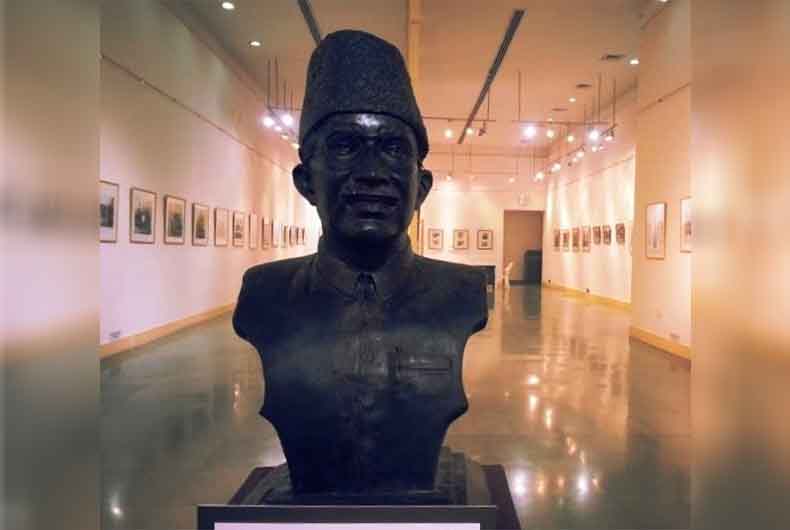
Dr M A Ansari’s bust during a photo-exhibition at M.F. Husain Art Gallery, JMI on 24 Dec. 2014. (Photo Courtesy: Aniket Dikshit)

The three most important persons who, undoubtedly, not only played the most significant role in the foundation of Jamia Millia Islamia, but also shifted it from the makeshift arrangement of Aligarh to Delhi’s Karol Bagh on 7 July, 1925, are Hakim Ajmal Khan, Abdul Majeed Khwaja and Dr Mukhtar Ahmad Ansari.

In view of upheavals faced in Aligarh, Jamia was shifted but problems existed. The problems that made many think that Jamia will not survive long. However, the trio’s efforts were no way trivial. They set the future course of Jamia as ‘an institution with a difference.’

Mukhtar Ahmad Ansari’s consistent efforts bore fruits. Not only did Jamia get its first house in Karol Bagh in 1931, it was also shifted to a much bigger plot of land of its own in 1936 in its present location in South Delhi’s Okhla, then a ‘non-descript village’ where now it has a panoramic sprawling campus.

However, the journey was not as simple as it might look to a casual viewer. Within those ten years, much sweat and blood went in to nurse the tender sapling whose seed was sown in Aligarh on 29 October, 1920. Dr Ansari’s contribution through all these years is one of the most unforgettable and astonishingly stout chapters in the history of Jamia Millia Islamia.

Born on 25 December, 1880 in Yusufpur-Mohammadabad, Ghazipur in eastern Uttar Pradesh, son of Haji Abdur Rahman and Ilahan Bibi, Mukhtar Ahmad Ansari, received primary and secondary education at Ghazipur and Allahabad, then studied medicine and graduated from Madras Medical College. He went to England from where he achieved M.D. and M.S. degrees. He earned the Master of Surgery degree from the University of Edinburgh in 1910. Being a top-class student and a pioneering surgeon he worked in some well-known hospitals of England where “he had a successful medical career”.

Dr Ansari had everything – money, fame, fortune, and life that could be lived luxuriously. This brief background is provided to underscore the significance of his passion, devotion and commitment not just for Jamia but for the country’s struggle for freedom as those were the years of heightened activism for independence during which Dr Ansari – through his active involvement in and unwavering support for freedom, emerged as a committed nationalist leader.

From England, Dr Ansari returned to India in 1910 and started medical practice at Delhi. His contact with leaders like Motilal Nehru, Hakim Ajmal Khan and Pandit Jawaharlal Nehru rekindled in him the desire to take part in the country’s political developments.

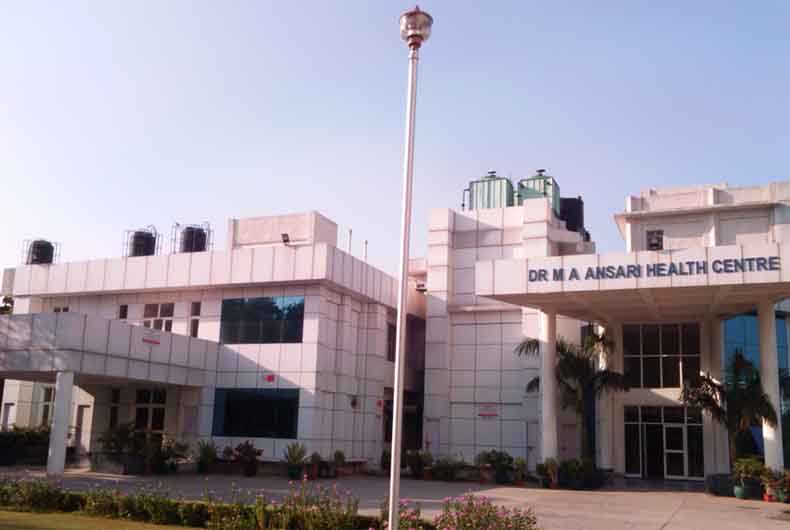
Dr M A Ansari Health Centre, Jamia Millia Islamia. (Photo: Manzar Imam)

During the Balkan Wars of 1912-13, he led a Medical Mission to Turkey to provide medical aid to the Turkish army. “The mission”, according to Dr. Burak Akçapar, Ambassador of the Republic of Turkey to India, “not only established two field hospitals, but also did other humanitarian and political work.”

This was among his first political works which won the hearts and minds of the Turkish public and leaders which created a deep bond between Turkey and Jamia. Many Turkish leaders and prominent literary figures visited Jamia. The series of ‘Extension Lectures’ that began was his brainchild. It was on his invitation that famous Turkish scholars Dr Husein Raouf Bey (1933) and Ms Halide Edib (1936) and Dr Behadjet Wahbi of Cairo (1934) then delivered their lectures at Jamia.

His role in the Khilafat Movement was pivotal and his presence both in the Congress and Muslim League was equally felt. His Delhi house ‘Darus-Salam’ was a meeting point for leading Congressmen. For many years he was General Secretary of Congress and remained a member of the Congress Working Committee all through his life.

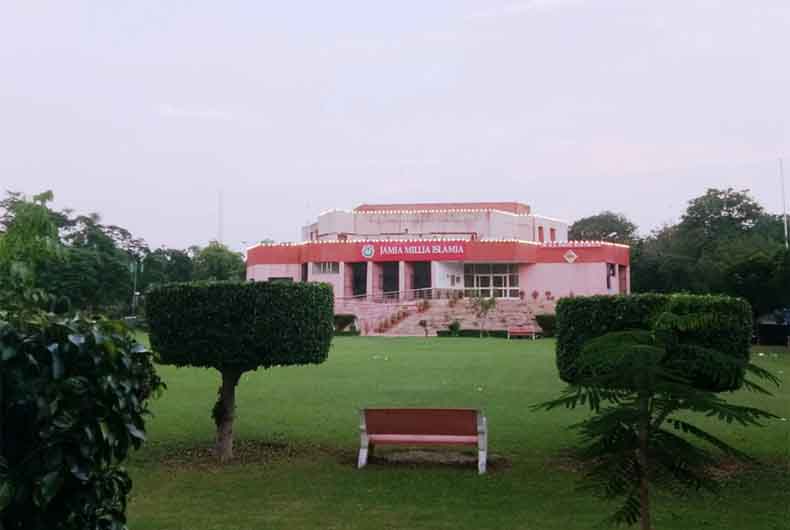
Dr M A Ansari Auditorium, Jamia Millia Islamia. (Photo: Manzar Imam)

Dr Ansari was the leader of the Khilafat delegation of 1920 which went to meet the Viceroy. He was also a member of the second delegation of Khilafat which went to England and other countries of Europe under the leadership of Maulana Mohammad Ali Jauhar. He was also president of the Delhi Khilafat Committee. During his presidential address at the Nagpur session of Muslim League in 1920 he demanded Swaraj.

When his name was proposed for the Secretary of the Foundation Committee of Jamia during its foundation, he requested not to appoint him for the post as it would require regular visits to Aligarh. Nevertheless, his interest in the activities of Jamia persisted.

Dr Ansari was among the front leaders of the Congress and was made its president in 1927. According to Prof Zafar Ahmad Nizami his name for the president of Congress was proposed at the instance of Mahatma Gandhi in 1924 who believed that “only he could make the efforts of Hindu-Muslim unity successful.”

Although Dr Ansari could not live long to see Jamia blossom into a beautiful university or see India breathing in freedom from the strangulating slavish life under the colonial rule, he had played his gigantic role both as a freedom seeker and as a founder of Jamia. He was a prominent member of the sixteen-member Foundation Committee formed on 29 October, 1920 to establish Jamia which would become a historic institution and the first one to be set up in response to call for boycott of the British Indian government-run, aided and supported academic institutions.

According to The British Medical Journal:

“As leader of the Congress movement, though at first opposed to the teaching of Gandhi on civil disobedience, he actively associated himself later with the various non-cooperative movements, and served at least one term of imprisonment.”

When it comes to Jamia as also to some other movements that were the currency of the 1920’s and 1930’s, it is very difficult to dissociate the trio of Hakim Ajmal Khan, Maulana Mohammad Ali Jauhar and Dr Mukhtar Ahmad Ansari, the “great Muslim trio of Indian politics”, as they were quite befittingly called so. However, each person has certain unique and individual personality traits and characteristics which separate him from others.

According to Dr Hamida Riaz (1988, p.119), Dr Ansari had a great passion for education. Initially, he highly appreciated Western education and culture and would keep himself completely away from what did not interest him. However, on the call of Mohammad Ali Jauhar, he participated in the medical delegation that went to Turkey and did a tremendous service. In a way, the beginning of international politics in India was made by Dr Ansari’s delegation.

Together with Hakim Ajmal Khan, Motilal Nehru and Maulana Azad, Dr Ansari formed a non-sectarian “Indian National Union.” He had opposed the Rowlatt Bill and participated in Home Rule and Non-Cooperation movements. In 1929, Dr Ansari formed the All India Muslim Nationalist Party. Besides Jamia, he was also associated with the foundation of Kashi Vidyapith, Benaras.

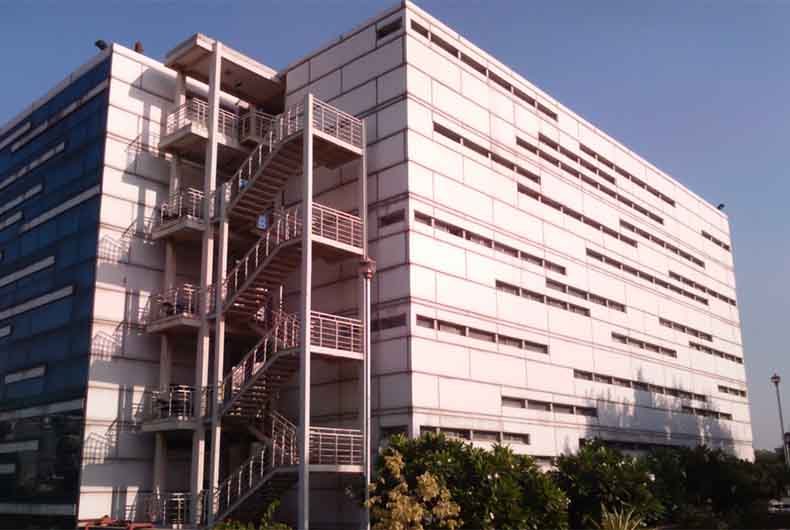
Faculty of Dentistry, Jamia Millia Islamia. (Photo: Manzar Imam)

Riaz (p.121) writes that all through his life he [Dr Ansari] “stayed away from sectarian groups” and continued his efforts to forge “Hindu-Muslim unity”. His wife Shamsun Nisa Begum too, was committed to the cause of women uplift.

Dr Ansari actively participated in the Jamia’s establishment, nurtured it, and, following the demise of Hakim Ajmal Khan in December 1927, served as its second Chancellor from 1928 to 1936. The financial needs that Hakim Sahab used to carry had fallen on his shoulder which he discharged diligently.

The “Ajmal Khan Fund”, set up exclusively for the purpose, was a result of his efforts. At a critical juncture when Jamia faced great financial crisis a Board of Trustees was created. Dr Ansari was appointed its chairman. It was at Gandhiji’s indication that industrialist Jamnalal Bajaj (1889-1942) was made its treasurer. Other bodies were also formed in which he was there.

As Chancellor of Jamia, Dr Ansari could not be an employee and Life Member of the ‘Anjuman Talim-e-Milli’. However, he extended all his support to all the bodies and continued to serve Jamia all his life. Remembering the services of Hakim Ajmal Khan and Dr Mukhtar Ahmad Ansari during a lecture in Jamia on 26 August 2014, former VC and renowned historian Prof Mushirul Hasan (d. 10 December 2018), terming the duo as the “real founders” of Jamia, had said, “Ansari raised money for Jamia and Hakim Ajmal Khan provided nobility and support.”

As mentioned earlier, Dr Ansari did not live long after Jamia was shifted to its present place in the national capital. He passed away on 10 May, 1936 and buried in the Jamia graveyard.

A radio speech which Dr Zakir Hussain had prepared for the 1936 Foundation Day of Jamia, which Dr Ansari could not hear as he passed away before it, sheds enough light both on the impact Dr Ansari had on Dr Zakir Husain and on his character and sphere of activity. It read:

[Dr Ansari] set out for a journey from which no one looks back…Dr Sahab’s personality was a fountain of blessings…a mainstay for anyone in times of need. His heart was a refuge where many would seek solace for their heartfelt grief.

As in life, in death too, he did not part ways from Jamia, writes Ghulam Haider, as he became the first among the founders of Jamia, to find his resting abode in Jamia Nagar where he was laid to rest three months before the primary madrasa of Jamia moved in.

Dr Mukhtar Ahmad Ansari, who died near Delhi on May 10th, at the age of 56, had been a member of the British Medical Association since 1909, and had gained distinction in India as a medical practitioner as well as in politics. In view of his services and to keep his memory as a prominent physician, Jamia has named its health centre and a big auditorium after him.

It was his sincerity for the national cause and his passionate commitment for Jamia that whenever Gandhiji would come to Jamia, he would definitely pay a visit to his grave. As Jamia celebrates 100 years of its foundation, we extend our gratitude to its architect for nurturing it with his consistent remedial care, unflinching commitment and great sacrifices!

[Sources: Celebrating India : Reflections on Eminent Indian Muslims 1857-2007, Meher Fatima Hussain (2009, Manak Publications, New Delhi), “Dr. Mukhtar Ahmed Ansari”, The British Medical Journal (Vol. 1, No. 3933 (May 23, 1936) p.1082, Mohammad Ali Jauhar, authored and published by Hamida Riaz (1988, Nagpur), Nuqoosh-e-Jamia (Jamia ki Kahani Jamia Walon ki Zabani or the Story of Jamia from Jamiites) by Ghulam Haider (2012, Maktaba Jamia Limited in collaboration with National Council for Promotion of Urdu Langue, New Delhi), www.jmi.ac.in.

Manzar Imam is a Ph.D. Candidate at Maulana Mohammad Ali Jauhar Academy of International Studies, Jamia Millia Islamia. He can be reached at manzarimam@rediffmail.com. The above article is ummid.com special series titled ‘Founders of Jamia Millia Islamia’. Read the first part here. To read the second article of the series click here. To read the 3rd article of the series, click here.]

source: http://www.ummid.com / Ummid.com / Home> India / by Manzar Imam, ummid.com / October 28th, 2020