Tag Archives: Muslim Women of India

How Taj Mahal and Aligarh’s Jama Masjid – Built 250 Years Apart – Share a Calligrapher

Agra / Aligarh, UTTAR PRADESH :

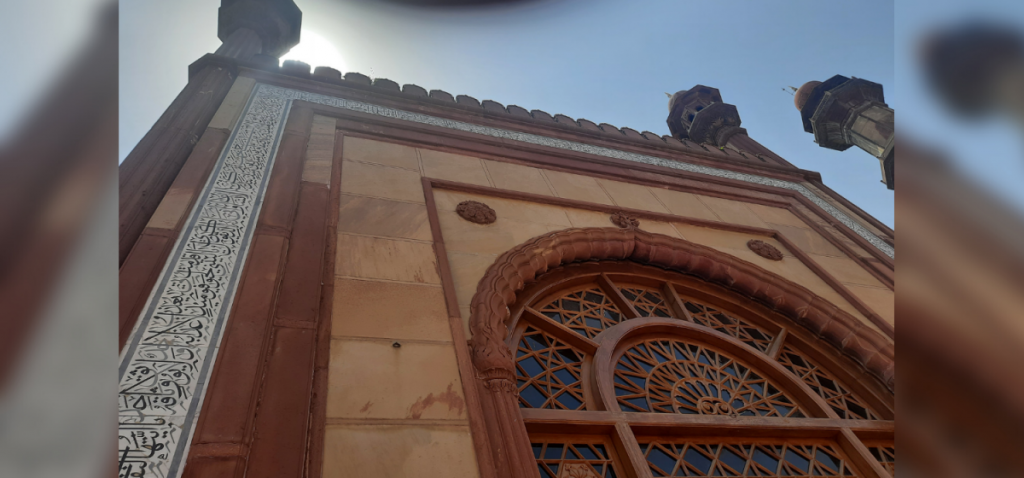
The imposing walls of both the Taj Mahal and Aligarh Muslim University’s Jama Masjid have Quranic verses crafted onto white marbles in black paint.
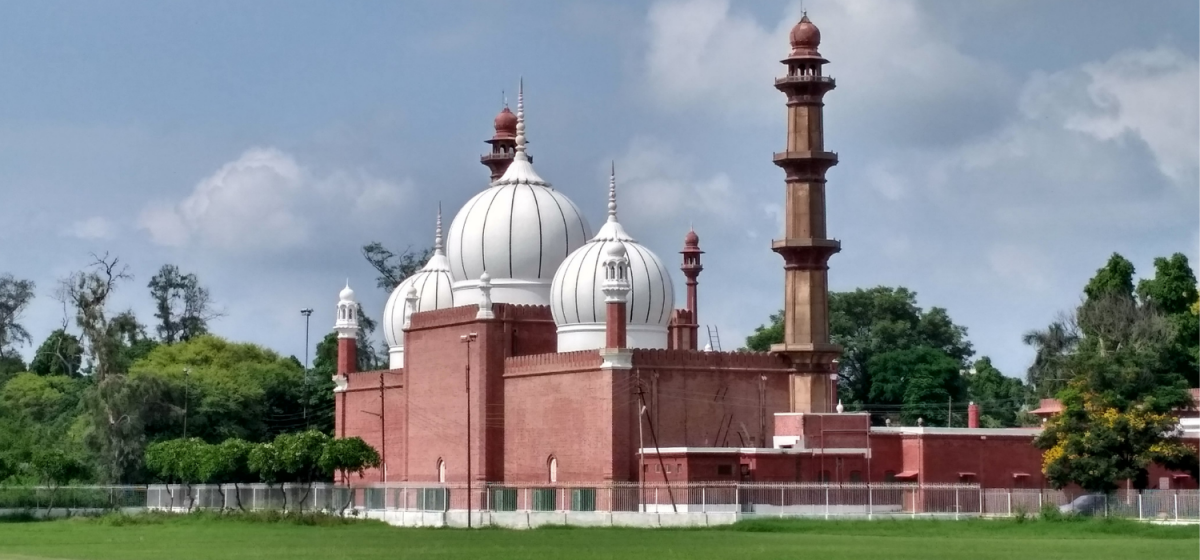
Jama Masjid on Aligarh Muslim University campus. Photo: Author provided.

Constructed nearly 250 years apart, the Taj Mahal in Agra and Jama Masjid at the Aligarh Muslim University (AMU) have an interesting connection.

The construction of the Taj Mahal began in 1632 and was completed in 1653, while the construction of Jama Masjid at AMU began in 1879 and was completed in 1915.

While the Taj Mahal, which is the tomb of Mughal emperor Shahjahan and his wife Mumtaz Mahal, attracts millions of visitors every year, AMU’s Jama Masjid is the main mosque of the university. AMU’s Jama Masjid is, perhaps, the last enduring symbol of the Mughals, constructed when the Mughals lost their kingdom during British rule.

A surprising connection

As one enters the Taj Mahal, beautiful calligraphy adorns all four corners. Several verses from the Holy Quran crafted in black calligraphy on white marble can be seen. This is a unique form of calligraphy, and expert artisans from Persia were involved in creating it. Similar calligraphy can be seem inscribed at the tomb of Mughal King Akbar at Sikandra, Agra, and also at the AMU Jama Masjid.
A closer look at the white marble with Quranic verses in black colour adorning the walls of Jama Masjid in Aligarh Muslim University. Photo: Special arrangement.

In fact, it is believed that the artisan responsible for the calligraphy at the Taj Mahal also brought his expertise to AMU’s Jama Masjid.

Since there is a difference of nearly 250 years between the construction of both architectural wonders, it is interesting to study how this was possible.

During Shah Jahan’s regime, several buildings were constructed, including the Taj Mahal and Delhi’s historic Jama Masjid. The calligraphist used was the same.

Professor Nadeem Ali Rezavi of the Centre of Advanced Studies, Department of History, Aligarh Muslim University, says that the master calligraphist in most of the buildings constructed during Shah Jahan’s regime is the same person.

“His name was Abdul Haq, and later due to his craftsmanship, his rank was elevated. He was given the title of Amanat Khan. In fact, he even signed the bands on this calligraphy with dates,” says Rezavi.

Still, there is a gap of over two centuries between these two buildings, Taj Mahal and AMU’s Jama Masjid.

The connection between the two monuments becomes clear with the involvement of Akbarabadi, one of Shah Jahan’s queens. Her original name was Aiza-un-Nisa. She, in 1650, commissioned the construction of a mosque situated in Daryaganj, Delhi, during the same period. In that mosque, Quranic calligraphy was done by the same artisan in black paint on white marble. This was around the same time as when the Taj Mahal was built.

After nearly two centuries, the Daryaganj mosque was demolished by the Britishers following the 1857 revolt. This was when Britishers gained control over the Red Fort, and the last Mughal emperor Bahadur Shah Zafar was sent in exile to Rangoon. They destroyed many buildings which were supposed to have harboured the rebels. At the site of the destroyed Akbarabadi Mosque, a park was developed and came to be known as Edward Park in 1911, which is now called Subhash Park.

During the same period, Sir Syed Ahmed Khan, the founder of the Mohammadan Anglo Oriental College (which later became AMU) felt the oppression against Muslims after the revolt. He nurtured the idea of setting up an educational institution to try and uplift the community.

A visionary man, Sir Syed had the taste for collecting things, particularly artefacts which had archaeological and historical importance. He was aware of the demolition of the Akbarabadi Mosque in Delhi.

As per the AMU Gazette, the scraps generated at the demolished Akbarabadi mosque were sold to a dealer and later purchased by Sahabzada Suleman Jah Bahadur. These remains were thus sold after over 200 years. These were presented to Sir Syed Ahmed Khan, who planned to use them in the Jama Masjid of the educational institution.
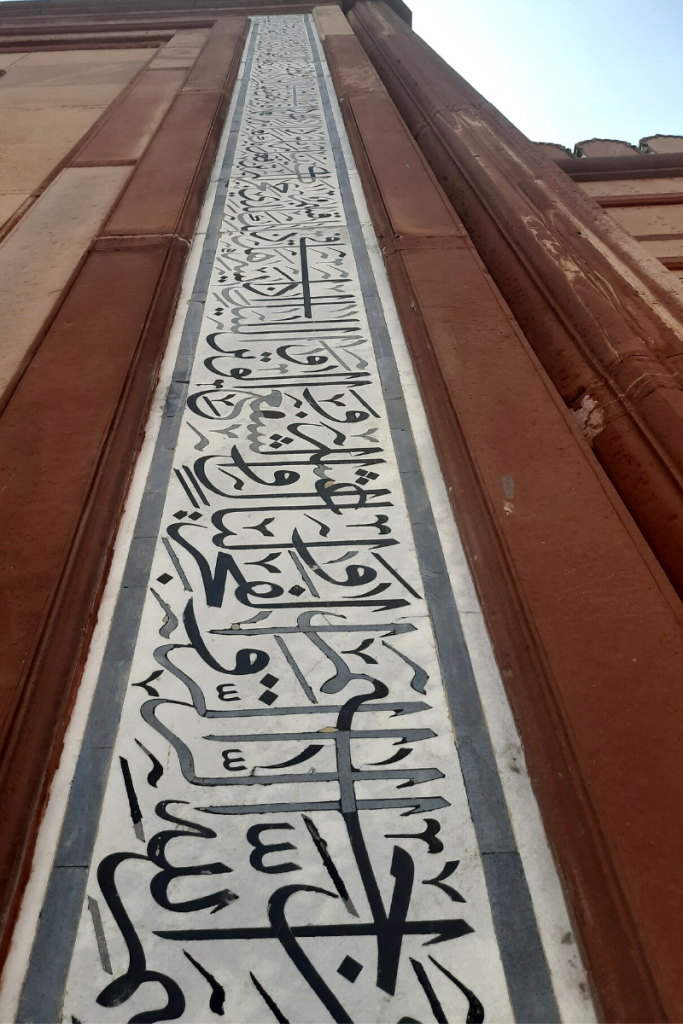
A closer look at the white marble with Quranic verses in black colour adorning the walls of Jama Masjid in Aligarh Muslim University. Photo: Special arrangement.

The white marbles with black calligraphy now present in the Jama Masjid of AMU depict Surah Fajr from the Holy Quran. Thus centuries apart, the two buildings carry the work of the same artisan.

“Even if you compare, it is the same thing and the only difference is in the scale. The artisans are the same who have shown their skills in the construction of the Taj Mahal,” says Prof. Rezavi.

Thus AMU’s Jama Masjid is, perhaps, the last enduring symbol of the Mughals, constructed when the Mughals lost their kingdom during the British rule. On the other hand, the domes of AMU’s Jama Masjid employed techniques of the Mughal era: they are “true domes” as they were built using lime mortar and vousseurs (wedge cornered stones/bricks).

“It is a brick structure, guava-shaped, carrying white marble with black stripes. This is the last true dome. After this, the particular technology faded out, and the buildings constructed after them have concrete domes,” said Rezavi.

Later, in 2016, AMU authorities began the conservation of the Jama Masjid. Now revived at the cost of Rs 90 lakh, the Jama Masjid has a Hauz in the courtyard, three domes, seven arches and two lofty minarets cornered by a Cricket Pavilion at its rear end. Sir Syed, the founder of the institution, was also buried in the same compound.

Faisal Fareed is a senior Lucknow-based journalist. 

This article went live on June fifth, two thousand twenty one, at zero minutes past seven in the morning.

source: http://www.thewire.in / The Wire / Home> History / by Faisal Fareed / June 05th, 2021

AMU Professor Presents AI-Based Medical Education Research at International Conference

Aligarh, UTTAR PRADESH :

Prof Saira Mehnaz with other participants during the AI-Based Medical Education Research at International Conference

Aligarh:

Prof Saira Mehnaz, Department of Community Medicine, Jawaharlal Nehru Medical College (JNMC), Aligarh Muslim University (AMU), presented an innovative research paper at the International Conference on Advancements in Data, Information, and Systems (ICADIS) 2025, hosted by Noida International University.

Dr. Mehnaz’s paper, titled “AI-Augmented Assessment of a Medical Foundation Course: A Mixed-Method Study,” attracted widespread attention for its pioneering application of AI in medical education. The study evaluated a week-long foundation course for 150 first-year MBBS students at JNMC, aimed at strengthening communication, teamwork, ethics, and academic preparedness among new medical learners.

Using a mixed-method approach, the research combined quantitative student feedback with qualitative reflections, analysed through Rolfe’s reflective model and NVivo software. The integration of AI tools enabled adaptive feedback, more precise evaluation of learning outcomes, and data-driven improvements in curriculum design.

The presentation stimulated engaging discussions among international delegates about the growing role of AI in competency-based and reflective medical education.

source: http://www.radiancenews.com / Radiance News / Home> Latest News> Report / by Radiance News Bureau / October 27th, 2025

AR Rahman launches all-women band Rooh-e-Noor. His daughter to lead six-member team

Chennai, TAMIL NADU :

The band is set to make its World Premiere debut at the Tanweer Festival on 21 November in Sharjah, United Arab Emirates.

Rahman earlier dropped the teaser of the band on his Instagram account, which shows the band members dressed in purple, with headscarves covering their hair | By special arrangement

New Delhi: 

Academy and National Award-winning composer A R Rahman announced the launch of Rooh-e-Noor, a six-member all-women band, formed under the leadership of his daughter, Khatija Rahman. The band has been launched under Rahman’s KM Musiq audio label, with Kannika Urs heading the project. 

Rooh-e-Noor is set to make its World Premiere debut at the Tanweer Festival on 21 November in Sharjah, United Arab Emirates.

Apart from Khatija, the ensemble comprises musicians Pooja Tiwari, Sana Aziz, Shaoni Mojumdar, Amina Rafiq, and Shifa Ruby. Tiwari and Mojumdar are the vocal trainers, Rafiq and  Ruby will lead music supervision, and production will be carried out by Sana Aziz, Sarthak Kalyani and Nakul Abhyankar. Rooh-e-Noor means “Soul of Light”, and it has been created to focus on the idea that women’s voices are transformative and can heal, inspire, and uplift.

“Rooh-e-Noor isn’t just a band, it’s a light that connects hearts. Each of these women carries the confidence of modern artistry. Their collective voice is pure, powerful, rooted, and futuristic,” said AR Rahman.

Rahman earlier dropped the teaser of the band on his Instagram account, which shows the band members dressed in purple, with headscarves covering their hair. Khatija is the only member who has also opted to wear a hijab in the video.

A rare sight in the music industry

All-girl bands in India are still few in the music industry. Music producer Mikey McCleary created the band W.I.S.H in 2021, which released their first single Lazeez last year. The last time a girl band took over the Indian music scene was in 2002 when Viva was created. 

But soon after its launch, band member Seema Ramchandani left, and the remaining members continued without her for another year.

Rahman’s band—a new step in the world of Indian girl bands, for its distinctive aesthetic—seeks to bring reimagined classics, film compositions, and spiritual renditions.

The teaser shows the girls performing the whirling dervish, a Sufi form of devotional dance. Earlier, Rahman spoke of his own spiritual journey as well as embracing Sufism and its influence on his life and music.

(Edited by Saptak Datta)

source: http://www.theprint.in / The Print / Home> Features> Around Town / by Shubhangi Misra / February 19th, 2025

For the first time, AMU student union poll sees three women win

Aligarh, UTTAR PRADESH :

For the first time in the history of Aligarh Muslim University Student politics, three women have won the student union elections. Ghazala Ahmad, Sadaf Rasool and Labiba Sherwani all contested the polls for the first time and all three won posts of cabinet members in the AMUSU.

The results of AMUSU elections sent a positive message about gender equality in an university that had gotten bad press for restricting library access for undergraduate women students.

Ms. Ahmad is final year student of Bachelors of Social Work, Ms. Rasool is in the final year of B.U.M.S. and Ms. Sherwani is in her first year of Bachelors of Social Work.

In 2015, one female student had won the union elections. But this is the first time in the history of AMU that three women have won the polls in their maiden attempt.

Kehkashan Khanam, a student of Ph. D. in Theology had won the post of cabinet in the last AMU student union elections. Ms. Khanam had contested this time for the post of vice-president in the AMUSU.

While talking to The Hindu on phone from Aligarh, Ghazala Ahmad said she held the victory of three girls in their first attempt to be a “sign that students of AMU want to see more girls presence and participation in overall student politics”.

When asked how she convinced a male-dominated electorate to vote for her, Ms. Ahmad said, “I told everybody on the campus that time has come to change outsiders’ perception of AMU. I told them, lets show the outside world that AMU campus is friendly and open to girls.”

The twenty-one-year old Ms. Ahmad said her inspiration was her working mother Nahid Fatima, Principal of a Government Primary School in Aligarh.

The job of a cabinet member is to ensure that the problems faced by the students at the departmental and faculty level, should be conveyed and taken up with the president, vice-president and secretary of the AMUSU. “It is a male-dominated campus but the results show that students on the campus want to more participation from girls. After all girls are also there on campus. Who will represent them. It was a tough competition so I had to work really very hard,” said Ms. Ahmad.

source: http://www.thehindu.com / The Hindu / Home> News> India> Other States / by The Hindu / November 01st, 2016

AMU PhD Scholar Adiba Receives Prestigious American Physical Society (APS) Distinguished Student Award

Aligarh, UTTAR PRADESH :

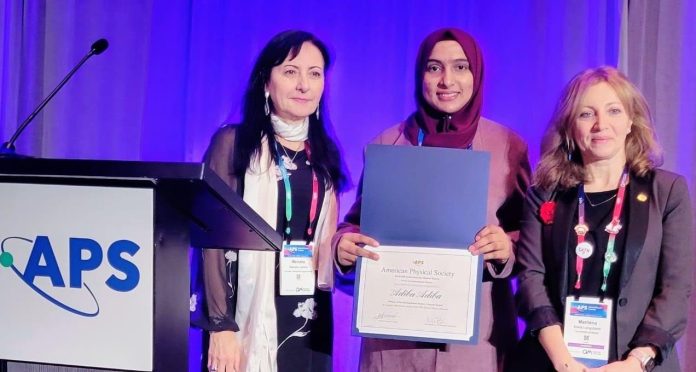
Adiba receiving the Prestigious APS Distinguished Student Award

Aligarh:

Adiba, a PhD student in Physics at Aligarh Muslim University (AMU), has been honoured with the Distinguished Student Award by the American Physical Society (APS) at the APS March Meeting 2025 in Anaheim, California.

Instituted in 2015, the award recognises exceptional early-career researchers from outside the U.S. and supports their participation in APS’s flagship meetings.

Adiba, working under the supervision of Prof Tufail Ahmad, is conducting cutting-edge research on Resistive Random Access Memory (ReRAM) devices for neuromorphic computing – an emerging frontier in physics and artificial intelligence. Her work earned her the prestigious award for outstanding contributions to the field.

Beyond research, she leads as President of the International Centre for Muslim Women in Sciences (ICMWS), championing science education among young women.

Expressing her gratitude to AMU for its role in her success, Adiba said, “Receiving this recognition from APS makes me feel incredibly proud and motivates me to strive even harder.”

source: http://www.radiancenews.com / Radiance News / Home> Latest News> Research> Science & Technology / by Radiance News Bureau / April 08th, 2025

Muslim Students Emerge Victorious in JNU Polls, Visually Impaired Scholar Among Winners

MADHYA PRADESH /JAMMU & KASHMIR / BIHAR // DELHI :

New Delhi:

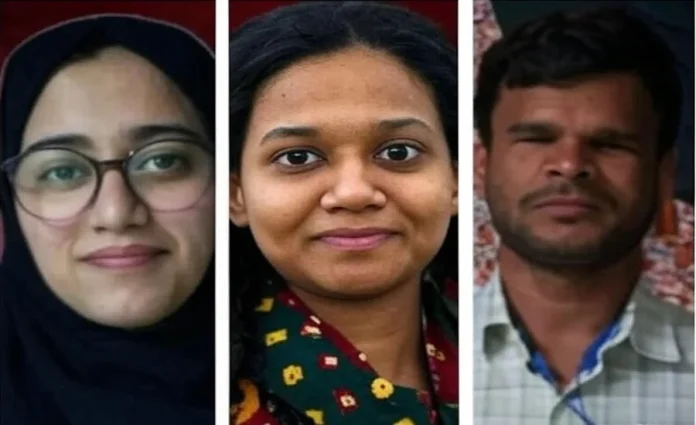
Muslim students have made a strong mark in this year’s Jawaharlal Nehru University (JNU) student union elections, with Danish Ali, Hafsa Bukhari, and Mohammad Aslam among the winners. The elections saw the Left alliance secure all four top posts, defeating the ABVP. Aditi Mishra was elected President, K Gopika Babu as Vice President, Sunil Yadav as General Secretary, and Danish Ali as Joint Secretary.

Danish Ali, a research scholar at the Centre for Historical Studies, defeated ABVP’s Anuj to win the Joint Secretary seat. Coming from Narsinghpur, Madhya Pradesh, Danish belongs to a family of educators. She was active in student mobilisations during the 2019 CAA protests and said her victory belongs to all students who value justice and democratic rights.

Hafsa Bukhari from Poonch, known for her hijab-wearing identity, also won a councilor seat. Her election is seen as a step forward for women’s representation and Muslim inclusion on campus. Alongside her, Mohammad Aslam, a visually impaired PhD scholar from Bihar, earned a councilor position. Despite his challenges, Aslam has consistently spoken up for equality, disability rights, and social justice.

Faculty members at JNU described their wins as a reflection of courage, resilience, and commitment to equality. Students across the university have welcomed the outcome, seeing it as a mandate for inclusivity and democratic engagement.

source: http://www.radiancenews.com / Radiance News / Home> Latest News> Report / by Radiance News Bureau / November 08th, 2025

Fruit vendor’s daughter wins gold medal at CUK

Aland Town (Kalaburagi District), KARNATAKA :

Saniya Samreen receiving a Gold Medal from Justice Dinesh Maheshwari, Chairperson of the Law Commission of India and former Judge of the Supreme Court, at the 9th Convocation of the Central University of Karnataka (CUK) held on Saturday. | Photo Credit: ARUN KULKARNI

Defying all odds, Saniya Samreen, daughter of a fruit vendor from Aland town in Kalaburagi district, bagged the Gold Medal in Master of Commerce (MCom) at the 9th convocation ceremony of the Central University of Karnataka (CUK) held on Saturday.

She received the medal from Justice Dinesh Maheshwari, Chairperson of the Law Commission of India and former Judge of the Supreme Court, in the presence of Vice-Chancellor Battu Satyanarayana, Registrar R.R. Biradar and Controller of Examinations Kota Sai Krishna, on Saturday.

Ms. Samreen, who completed her schooling and college education in Aland before joining CUK for her postgraduate studies, said that her achievement was a result of perseverance and family support. 

“All of my achievements are the result of hard work, dedication, and the unwavering support and guidance from my family and mentors,” she with gratitude during her interaction with media representatives on the sidelines of the convocation.

Her father, Mr. Shamu Bagwan, earns his livelihood as a fruit vendor, while her mother, Mrs. Raziya Begum, is a homemaker. “My parents’ constant belief in me has been the driving force behind my success,” Saniya added.

Saniya, who has also qualified both the Karnataka State Eligibility Test (KSET) and the National Eligibility Test (NET) for assistant professor, said she wishes to build her career in academia. 

“I aspire to contribute to the field of commerce through teaching and by shaping future professionals,” she said.

source: http://www.thehindu.com / The Hindu / Home> News> India> Karnataka / by The Hindu Bureau / November 08th, 2025

10 extraordinary persons who enrich life in Delhi

DELHI :

Changemakers of Delhi

New Delhi :

Delhi is the city of enterprising people, many of whom are migrants from smaller towns and cities.  Many achieved successes in careers, businesses and professions — but some of them transcended the boundaries of success. They are trailblazers who give it back and inspire others. Here, we feature ten personalities of Delhi whose work makes them extraordinary and the Changemakers:

Sirajuddin Qureshi

Sirajuddin Qureshi a well-known industrialist who laid the foundation of India’s meat industry and food processing. Besides, he is one of the founders of the India Islamic Cultural Centre in Delhi. He is a trailblazer in modernising and scaling up the meat and food processing industry under the aegis of his Hind Group. He set up the first modern slaughterhouse and expanded his food business to 50 countries.

However, his lasting contribution to society is his relentless campaign for promoting education among the Qureshi clan, who were small-time meat sellers and traders. He persuaded his community members to pledge to promote the education of girls and women, opt for simpler weddings and encourage youth to join professions. His social campaign was so successful that today, only 20 per cent of the Qureshi men are meat sellers, and women have higher educational standards.

Azra Naqvi

Azra Naqvi wears many hats, but her core remains attached to Urdu, the language, she claims, she breathes, thinks in, and is in her DNA. Despite having lived a fulfilling life with her husband in many countries, dabbled in different professions and roles, her heart always pined for her favourite language. So, when she got a chance to work as a consulting editor with Rekhta Foundation, she made the most of the opportunity.

Besides fulfilling her passion for Urdu at Rekhta, Azra Naqvi found an innovative use of the WhatsApp application on her mobile. First, she connected 200 Urdu women writers to establish a first-of-its-kind literary organisation, Bainalakwami Nissai Adabi Tanzeem (BANAT). The BANAT has created a sisterhood of Urdu writers.  So far, BANAT has published two anthologies based on WhatsApp communication, while a third one is in process. Using the WhatsApp group, Azra Naqvi collected theme-based writings of 40 women writers. 

Siraj Khan

‘Yes, We Can’ stands as a reminder that unity and opportunity can transform lives. This non-profit organisation is dedicated to empowering communities, nurturing youth potential, and creating safe spaces for growth. At the heart of this movement is Shiraz Khan, a changemaker from Old Delhi, whose journey of self-discovery and resilience has shaped the ethos of “Yes, We Can”. The seeds of Yes We Can were planted in 2015. For Shiraz Khan and his co-founder, Nandish, the pandemic wasn’t just a crisis; it was also a wake-up call. They realised that people needed support not only in material terms but also in inspiration, guidance, and community.

From grassroots awareness drives to collaborations with youth-led groups, Yes We Can has quickly grown into a space where possibility meets action. Shiraz often says, reflecting the organisation’s focus on building resilience rather than dependency.

Sahar Hashmi

Mental health in India remains a taboo; words like depression, anxiety, or personality disorder are either laughed off or bring shame. Breaking this deafening silence is Sahar Hashmi, the 29-year-old woman from Delhi. She not only overcame her mental illness but also became a beacon of hope for others suffering in silence.

In April 2025, Sahar launched a campaign, “Breaking Stigma: One Mile at a Time”. She took a 2,779 km bike ride from Delhi to Kashmir. This journey was not just about crossing the geographical boundaries, but an emotional journey against the stigma and silence of society on mental health.

Asghar Ali

Delhi-based artist Asghar Ali is spreading the message of Ganga-Jamuni tehzeeb (Inclusive Indian culture) in society through his art. Asgar Ali, a Muslim by faith, has more than 50 paintings based on Lord Krishna and his life story to his credit.

Asghar Ali said that since his childhood, he was fascinated and influenced by Shri Krishna, colours of his peacock feathers and the flute. Asgar Ali’s major work is on the childhood form of Shri Krishna (Bal Krishna), his youth, his objectives in the Mahabharata war, as well as his leela (stories).

Asgar Ali had also organised an exhibition of his Krishna-themed paintings at the recently concluded International Geeta Mahotsav at Kurukshetra, Haryana, where people appreciated his work.

Amna Mirza

Amna Mirza is a trailblazing teacher who prefers holding her lectures outside her classroom amidst the pieces of history strewn around in Delhi. She not only makes teaching interesting, but also helps heritage and modernity coalesce. In the rat race of the modern world, Dr Amna Mirza stands tall as a teacher bringing about profound changes in people’s mindsets.

A political science professor at the University of Delhi. Dr Mirza’s journey defies the rigidity often associated with academia. She wears many hats with ease: educator, social worker, cultural custodian, and above all, a proud Delhiite who believes in nurturing the soul of a nation through its people and plurality.

Mohd. Meraj Rayeen

Md. Meraj Rayeen’s inclusive campaign to improve the conditions of indigenous Pasmanda Muslims, who comprise approximately 80 per cent of the Muslim population, is shaping social change.

Rayeen says, “Politics alone cannot be the solution to every problem.” Based on this thought, he founded the ‘Pasmanda Vikas Foundation’ over a year ago. The organisation has undertaken substantial work to change the lives of people and instil new hope and confidence within the community.

This foundation is not into rhetoric in favour of Pasmanda Muslims’ rights on political platforms; It addresses issues such as education, health, economic empowerment, and social justice.

Meraj Rayeeen believes that the development of Pasmandas is possible only with the awakening and cooperation of the community members. but the entire Muslim society, especially the Ashraf class.

Uvais Ali Khan

Uvais Ali Khan is a successful Chartered Accountant and a changemaker whose journey stands as a beacon of determination and service to society.

He quit his job and started his own business in a small apartment in Laxmi Nagar, East Delhi. Borrowing from friends and banks, he began building not just a company, but a platform for change. Uvais believes in a simple but powerful idea: “Providing basic skills to an individual can open avenues for them to get a job. That single opportunity can change the life of a family for generations.

Adeeba Ali

Adeeba Ali’s life is a testimony to the power of the human spirit and willpower. The 17-year-old is not only a rising star in the world of para-shooting but also an inspiration to many others struggling with self-pity and helplessness.

Five years ago, Adeeba fell from the balcony of her house in Nizamuddin. Four years later, she stunned everyone with her stellar performance at the 26th National Shooting Championship held at the Madhya Pradesh State Shooting Academy, Bhopal, in December 2023.

Adeeba’s success is not just a story of winning two medals; it is a story of perseverance that transformed disability into a new identity, not a hindrance.

Syed Sahil Agha

Storytelling is associated with Sufis and Khanqahs; it’s a medium of the message of peace and love, which instils patriotism, unity, and religious harmony, and nurtures the Ganga-Jamuni (inclusive) civilisation. Keeping the tradition in mind, Syed Saahil Agha revived this art and gave it a modern context. Today, he is one of the most well-known names in the world of storytelling.

Syed Saahil Agha conducts storytelling programs in India and abroad. He says, “I realised that people prefer listening over reading, so I thought stories should be narrated so that the public can become familiar with the past and also learn lessons from it.”

He says his aim is not just to narrate stories but also to promote Indian civilisation.

source: http://www.awazthevoice.in / Awaz, The Voice / Home> The Changemakers / by Aasha Khosa / November 09th, 2025

Shabana Faizal is the youngest among Indian philanthropists

Mangaluru, KARNATAKA / Kozhikode, KERALA / Dubai, U.A.E :

Shabana Faizal with her husband Faizal Kottikollon

New Delhi :

Mangalore-based Shabana Faizal has emerged as the youngest woman among India’s top 10 philanthropists, according to the EdelGive Hurun India Philanthropy List 2025.

She has donated ₹40 crore (approximately $1.5 billion) through the Faisal & Shabana Foundation to education, health, and social development.

Shabana Faisal’s journey from being raised in a small town in Mangalore to co-leading a global enterprise is about he hard work and ambition.

Her entrepreneurial journey began in 1995 as a retailer of unique, speciality and luxury products. After leading the company for eight successful years, she decided to team up with her husband, entrepreneur Faizal Kottikollon, and support him in running the world-class foundry, Emirates Techno Casting (ETC).

Shabana took charge of all human resources and administrative processes at ETC, where she created a significant impact in shaping the company’s business success.

In her role as Vice Chairperson of KEF Holdings, she is actively involved in guiding the business’s growth strategy across global markets. Deeply committed to social improvement, Shabana and her husband founded the Faizal & Shabana Foundation in 2007, with the vision of ‘Giving to Create Impact’.

At 53, Shabana’s work has placed her among some of the most influential women in India’s philanthropy world, including Rohini Nilekani, Kiran Mazumdar-Shaw and Bina Shah.

EdelGive Foundation, in collaboration with Hurun Research Institute, recently released the 12th edition of the EdelGive Hurun India Philanthropy List 2025.

The list honors India’s most generous individuals and families. Over the past three years, 191 philanthropists have donated a total of ₹10,380 crore, representing an 85% increase in contributions.

The education sector continues to lead as the top donor, receiving ₹4,166 crore from 107 donors.

Shabana is the mother of four children – Sophia, Sara, Zakaria, and Zarina – but continues to play an active role in business and philanthropy. Her work makes her one of India’s most influential female philanthropists, exemplifying how professional leadership and a commitment to giving can combine to create widespread social impact.

The EdelGive Hurun India Philanthropy List 2025 states that the top 25 donors contributed ₹50,000 crore in just five years, or an average of ₹46 crore per day. Mumbai leads in philanthropy, contributing 28% of total donations, followed by New Delhi and Bengaluru.

source: http://www.awazthevoice.in / Awaz, The Voice / Home / posted by Aasha Khosa / November 10th, 2025

Historian Abbas Panakkal’s latest book redefines Jihad

KERALA :

In the Western view, Jihad is depicted within a framework of communal hostility and destruction, but in the documents of Malabar it is a word of interfaith harmony and peaceful coexistence, Abbas said.

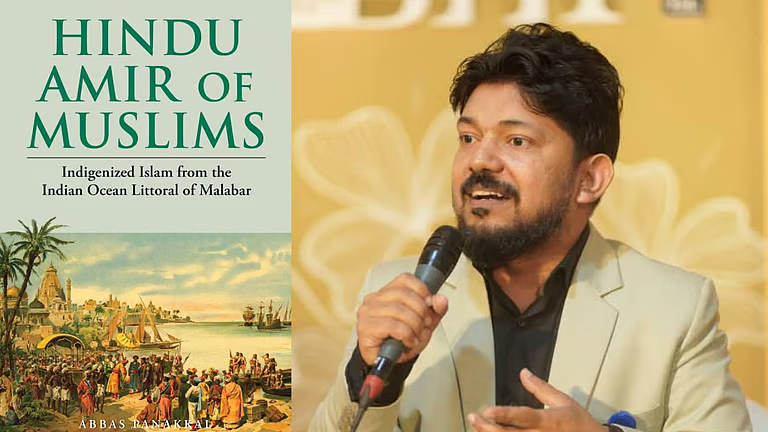
Author of the book ‘Hindu Amir of Muslims: Indigenised Islam from the Indian Ocean Littoral of Malabar’ Abbas Panakkal.Photo | Special Arrangement

Kozhikode :

Contradicting popular narratives put forth by extremist Islamic organisations and the West that portray Jihad as a violent aggression on non-Muslims to establish the supremacy of Islam, is a one originating in Kerala that describes the unified efforts of Muslims and non-Muslims to protect a Hindu king.

Historian Abbas Panakkal’s intriguingly titled book Hindu Amir of Muslims: Indigenised Islam from the Indian Ocean Littoral of Malabar counters the argument that a non-Muslim cannot be the Amir of Muslims, quoting the works of Islamic scholars such as Sheikh Zainuddin Makhdoom and Qazi Muhammad. Some Muslim organisations assert that a true believer should at least strive mentally to establish an Islamic rule, otherwise his/her Islam will remain incomplete.

Abbas argues that Islamic scholars around the sixteenth century had called for Jihad against the Portuguese when the intruders locked horns with the Zamorins. In the Western view, Jihad is depicted within a framework of communal hostility and destruction, but in the documents of Malabar it is a word of interfaith harmony and peaceful coexistence, Abbas said.

“Qazi Muhammad’s poem Fat’hul Mubin narrates an incident during the attack on Chaliyam fort, built by the Portuguese. Zamorin was the ruler and the Muslims had taken a vow to sacrifice their life in the fight for the king. On hearing this, the Hindus felt sad and said that Muslims should not let Muslims die as they are the minority. Finally, they decided to fight together,” Abbas said.

The Qazi conducted prayers for the king and requested all Muslims to pray for the non-Muslim sovereign. He criticised Muslim kings, who signed treaties with the Portuguese and supported their cruelties, the book says.

“Here, jihad was declared to support the local ruler, irrespective of his religion. It was not to crown a Muslim ruler or to turn a Darul Harb into a Darul Islam. Within the Kingdom of Zamorin the Jihad became a tool of accord and interreligious cohabitation,” the book says.

Abbas quotes an incident narrated in Fat’hul Mubin to show the camaraderie between Hindus and Muslims during the siege of the Chaliyam fort.

Zamorin’s mother wrote a letter to the Muslim leaders seeking their intervention and important warriors of the times including Kunjali Marakkar, Umar Anthabi and Abdul Azeez gathered at a mosque in Kozhikode along with the officials of Zamorin to discuss the war strategies.

Tufat al-Mujahidin by Sheikh Zainuddin Makhdoom II, written in the sixteenth century, narrates the privileges enjoyed by Muslims under the rule of Zamorin. Proper burial was given to the bodies of Muslim offenders as per the Islamic custom while the bodies of non-Muslim criminals were left to be consumed by wild animals, says the book.

“Non-Muslim rulers actively supported the construction of mosques and the organization of religious observances, and the state provided funding for the salaries of qazis (judges) and other religious officials, such as mu’addins (callers to prayer). In this pluralistic context, where Muslims enjoyed considerable freedom and leniency,” the book said.

source: http://www.newindianexpress.com / The New Indian Express / Home> Kerala / by MP Prashanth /August 06th, 2025